Long-range shooting on a budget: rifle and ongoing costs

Plan on spending around €4,000–€8,000 to get started in long-range shooting—not just the price of the rifle. So compare the rifle, scope, mount, any stock adjustments you need, and the costs of acquisition and storage as a complete package.
At 600 rounds per year, the example calculations come to ongoing costs of €1,670 for .308 Winchester and €1,934 for 6.5 Creedmoor. Based on the information available, it’s not possible to determine a clear price winner among Tikka, Bergara, Howa, and Mossberg.
Quick comparison
| Model | Price and features | What to consider for your budget |
|---|---|---|
| Tikka T3x CTR | About €2,160–€2,850 with an entry-level scope and rings | Confirm the rail; check the cost of stock adjustments and spare magazines |
| Bergara B-14 HMR | No verified package price; adjustable stock and AICS magazine | Factor in the scope and mount; consider the weight |
| Howa 1500 | No verified package price; comparison based on a Hogue stock and internal magazine | Check for a missing mounting base and possible stock or magazine modifications |
| Mossberg Patriot LR | Exact model name and complete price in Germany not confirmed | Confirm the configuration first, then compare costs |
Before you buy, get a written quote with every item listed separately. This should also include range fees, maintenance, and administrative costs. Count the initial ammunition only once in your first-year budget; check acquisition and storage requirements with the relevant firearms authority.
As of November 13, 2026. All prices are estimates.
1. Tikka T3x CTR
Price of the complete setup
Budget €1,700–€2,100 for the rifle. With an entry-level scope and Picatinny rings, the setup costs €2,160–€2,850. If you choose a higher-end scope with the same rings, the total is €2,560–€3,750. [2][3] For your budget, consider the complete package: rifle, scope, mount, and any adjustments you may need later.
Optic and Mount Compatibility
The CTR is often offered with a Picatinny rail. Before buying, ask for confirmation that it comes installed as standard. If not, expect to pay an additional €60–150. Make sure the rings match the optic’s tube diameter and mounting height. [2][3]
Ergonomics and Modification Costs
The synthetic stock does the job. However, the cheek rest and stock length may not adjust to suit your needs. So budget separately for any modifications.
The CTR uses its own 10-round steel magazines. If you want spare magazines, include their cost in your budget too. The CTR weighs more than a T3x Lite. This may mean you need a sturdier rest or bipod. These purchases will also add to the total cost. [2][3]
Annual Running Costs
The cost of ammunition and range time depends on how much you shoot. There’s no fixed rate. Multiply your annual round count by the actual cartridge price, then add the cost of range visits and fees. Budget around €20 per year for cleaning supplies. [2][4]
Next, we’ll look at the Bergara B-14 HMR—and whether you can get more features for a similar budget.
sbb-itb-1cfd233
2. Bergara B-14 HMR
Price of the Complete System
Based on the information available, it’s not possible to calculate a reliable total price for the B-14 HMR. You’ll need a quote that lists the rifle, optic, rings, and rail separately. What matters isn’t the list price, but what you actually get for that price.
Additional Costs and Annual Running Costs
Ask for written confirmation of which rail is included and whether the rings fit it. The stock configuration, magazine type, and items included should also be clearly specified. A rail that isn’t listed isn’t automatically included in the package. Missing mounting parts, stock adjustments, and an extra magazine cost more. Also check the weight and balance with the optic mounted.
Use the same round count and the same costs for ammunition, range fees, and maintenance for the HMR as for the CTR. Count the initial ammunition only once in the first year. With these consistent assumptions, you can then compare it directly with the Howa 1500.
3. Howa 1500
Price of the complete system
The standard Howa 1500 with a Hogue stock and internal magazine with hinged floorplate serves as the basis for comparison. There is no verified price for the complete setup. Information on barrel length, barrel contour, and mounting hardware is also missing.
Ask for these details in the quote. Include optics and accessories just as you would for the CTR and HMR. The additions you actually need determine the total price. [3]
Optics and mount compatibility
For the standard Howa, you will usually need a separate rail or bases. As a guide, an additional Picatinny rail costs around €60–120. Before buying, check that the rail and rings fit your action configuration and chosen optic. [3]
Ergonomics and conversion costs
The internal magazine is not equivalent to the CTR's detachable magazine or the HMR's AICS-compatible system. A magazine conversion costs around €100–150. A different stock or chassis costs an additional €400–800.
So first check whether the Hogue stock works for you. A conversion is only worthwhile if it solves a specific problem. If the setup already suits you, you can avoid this expense. [3]
Annual operating costs
Use the same annual ammunition requirement and cartridge price for the Howa as for the other rifles. If the starter package already includes ammunition, deduct its value from the annual calculation. This way, the starter ammunition is only counted once. [2]
The next comparison looks at whether the Mossberg Patriot LR's lower entry price also reduces the total cost.
Budget vs Premium Long Range Rifle Challenge
4. Mossberg Patriot LR
There is not enough data to compare the total cost of the Mossberg Patriot LR: the model designation cannot be confirmed using the available sources. [1][2]
Price of the complete system
A complete price in Germany has not been verified. This means there is no basis for a reliable price comparison. [2]
Optics and Mount Compatibility
Until the exact configuration is confirmed, the costs for optics and the mount cannot be calculated reliably. [3]
Ergonomics and Modification Costs
There is no verified information on the stock or adjustment ranges. Therefore, no modification costs can be estimated. [2]
Annual Operating Costs
The caliber and usage data have also not been confirmed. Therefore, the costs for ammunition, range fees, and maintenance cannot be reliably estimated. [2][4]
Annual Costs: Ammunition, Range Fees, and Maintenance
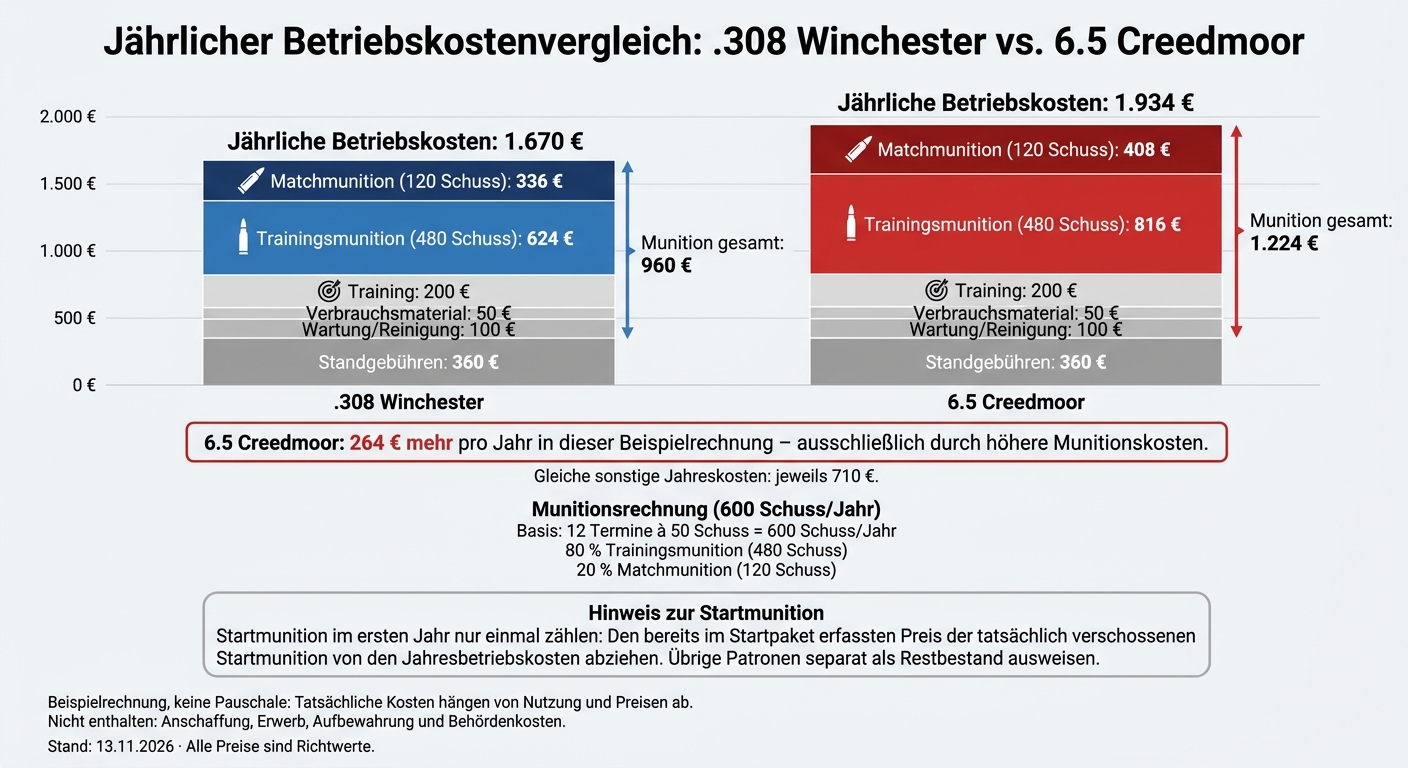
Long-Range: Annual costs for .308 and 6.5 Creedmoor
For a direct comparison of the four models, the same annual usage applies: 12 sessions of 50 shots each, with 80% training ammunition and 20% match ammunition. That’s 600 shots per year. This calculation is for planning purposes. You should check separately whether the figures apply to each rifle.[1][2]
| Cost item | .308 Winchester | 6.5 Creedmoor |
|---|---|---|
| Training ammunition: 480 shots | €1.30/shot → €624 | €1.70/shot → €816 |
| Match ammunition: 120 shots | €2.80/shot → €336 | €3.40/shot → €408 |
| Total ammunition | €960 | €1,224 |
| Range fees: 12 × €30 | €360 | €360 |
| Maintenance/cleaning | €100 | €100 |
| Consumables | €50 | €50 |
| Training | €200 | €200 |
| Annual operating costs | €1,670 | €1,934 |
.308 Winchester is widely available. For long-range shooting, 6.5 Creedmoor is often more appealing. 6.5 PRC serves as a separate reference and usually comes with higher ammunition costs.[2][3]
In the first year, make sure you don’t count the ammunition in the starter package twice.
First-year costs: count starting ammunition only once
Only count the starting ammunition you actually fire toward your annual consumption. Deduct its price, already included in the starter package, from your annual operating costs. List any remaining cartridges separately as stock—they are not part of your annual consumption.
Acquisition, storage, and administrative costs
In addition to ongoing expenses, there are mandatory costs for acquisition and storage.
List acquisition, possession, ammunition acquisition, storage, and lawful transfer separately from the equipment price. The German Weapons Act and the requirements of your responsible firearms authority apply. You can also check registration and administrative fees there.
For a new purchase, a certified gun safe under DIN/EN 1143-1 with resistance grade 0 or 1 is generally required. This usually costs €550 to €1,500.[2] List transport costs and other administrative fees separately.
Pros and cons: fit, weight, and upgrade costs
In addition to ammunition and operating costs, consider whether the rifle fits your budget with the scope, mount, and any necessary adjustments. What matters is not the model name, but the specific configuration: caliber, barrel length, stock, magazine system, and right- or left-handed version must be confirmed. So compare fit, weight, included accessories, and actual additional costs—not just rifle prices.
| Rifle | Advantage | Limitation | Additional costs |
|---|---|---|---|
| Tikka T3x CTR (check configuration) | Established T3x platform with a wide range of accessories. | Standard stocks offer less adjustment for cheek height and length of pull. | Scope mount not included; stock adjustment only if there are fit issues. |
| Bergara B-14 HMR (check configuration) | Adjustable cheekpiece, stock length adjustable with spacers, mini chassis, and 5-round AICS magazine included as standard.[5][6] | Depending on configuration, around 4.3–4.4 kg; less comfortable to carry over longer distances.[5][6] | Scope and mount depend on what's included; spare magazine and bipod are optional. |
| Howa 1500 (check configuration) | If the standard equipment fits, ergonomic modifications aren't needed. | Fit, magazine setup, and mounting base vary by listing. | Mounting base and rings may be missing; stock or magazine modifications only if specifically needed. |
| Mossberg Patriot LR (verify LR configuration) | A price advantage can only be assessed based on a confirmed offer. | The exact configuration and equipment have not yet been verified. | Costs for missing mounting components and necessary adjustments can only be determined after checking the equipment. |
Fit before modifications: Only pay for adjustments that solve a specific problem.
When considering weight, look at the rifle ready for use, including scope, mount, and accessories. More weight can be useful when shooting from a steady rest, if the equipment already fits and no further modifications are needed. It remains a disadvantage on longer walks, though. Neither a mini chassis nor the model name guarantees a certain level of accuracy.
For occasional outings, extra adjustment options need to justify their added cost. For frequent training, however, they can help avoid modification costs later. For each offer, add up the rifle, scope, mount, and only the necessary adjustments; keep optional extras separate. This calculation helps weigh the overall package against the price advantage alone in the conclusion.
Conclusion: Decide based on verified total costs
The rifle, scope, mount, and ongoing costs all belong in the same calculation. A low rifle price doesn't make for a low-cost overall package. With Tikka offers, the rail, magazine, scope, and rings are only a price advantage if they fit together. Otherwise, there will be additional costs.[10][11]
Tikka, Bergara, Howa, and Mossberg can only be compared once the included items and additional costs are clearly documented.
| Decision | Criteria |
|---|---|
| Best overall package | Without comparable included items, a confirmed mount, and documented prices, no reliable winner can be determined. |
| Lowest operating costs | Caliber, ammunition price, and usage are what matter—not the model name. |
| Greatest cost risk | Unclear equipment, unresolved compatibility questions, and the condition of used firearms. This risk cannot be reliably attributed to any one model. |
For ongoing expenses, use this formula:
Operating costs = number of shots × price per cartridge + range fees + maintenance.
Before buying, get the total price in writing, check that the scope and mount are compatible, and have the ammunition price per shot confirmed. For used items, also check the condition, round count, and service history. Check with your firearms authority about acquisition, storage, and transfer.[7]
Make sure you don't count the initial ammunition twice. On Gunfinder, you'll find complete new and used packages.[8][9] Check each offer's listings, seller terms, and lawful transfer individually.
FAQs
How can I spot a really good deal on a complete setup?
Compare the total cost, not just the rifle price. Factor in optics, mounting hardware and ammunition, as well as maintenance and repairs. On Gunfinder, you can compare market prices for new and used firearms.
Your firearm and optics should be compatible and suited to how you plan to use them. For used firearms, set aside 15 to 30 percent of the purchase price for maintenance or replacement parts. Be cautious of unusually low prices: they may hide defects.
Which purchases can I put off at first?
You can prioritize your initial gear. But legal requirements come first: a gun safe and liability insurance are mandatory and can't be put off [1][2].
Buying used clothing and accessories can be worthwhile: items in good condition cost 30 to 50% less than new ones [3]. But don't compromise on quality when it comes to firearms and optics. Proven used models are a better choice [3].
When is a used long-range rifle worth it?
A used long-range rifle can help you stay within budget without compromising on quality. High-quality models often cost 30% to 50% less than new firearms when used. On Gunfinder, you can compare suitable listings.
Before buying, have the barrel, bolt and trigger thoroughly inspected by a gunsmith. Also set aside around 15% to 30% of the purchase price for potential maintenance or replacement parts.