Long-Range Rangefinder: Questions and Answers
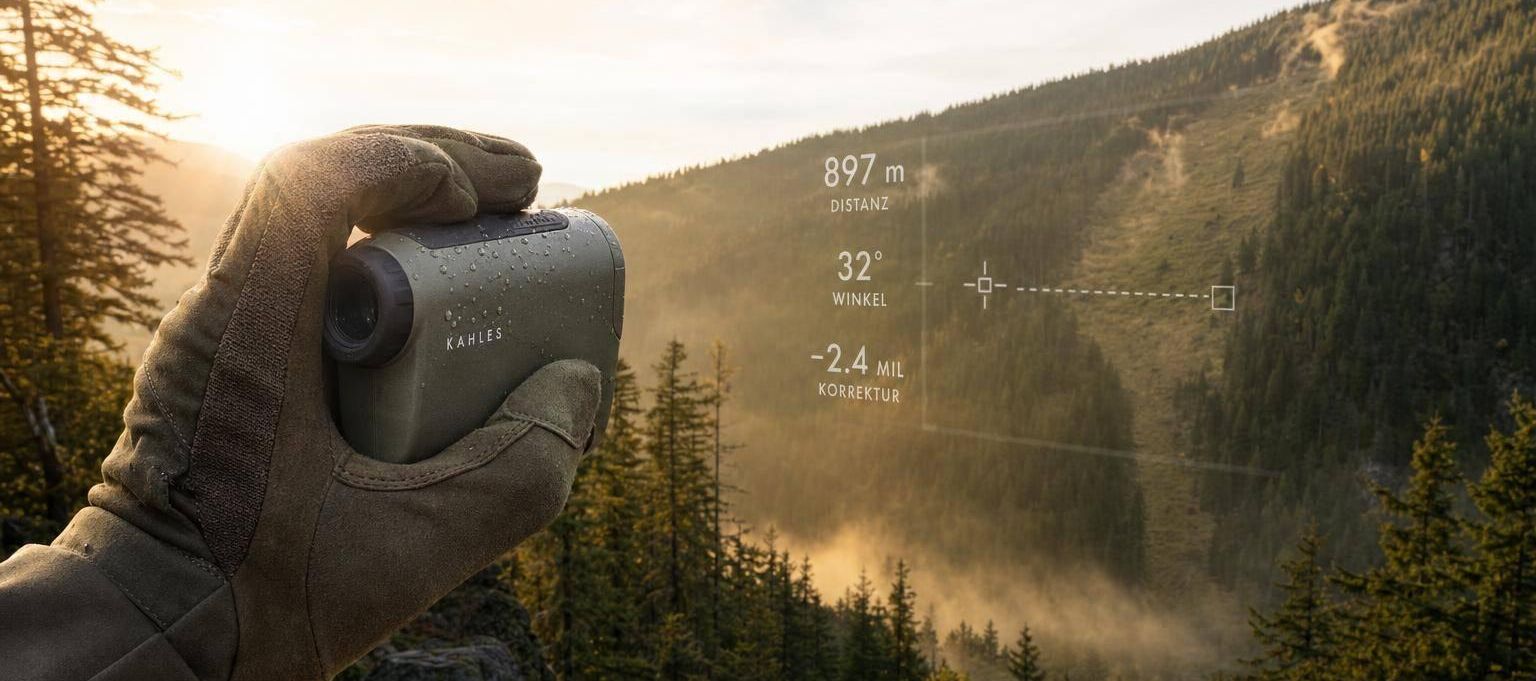
In short: A Long-Range Rangefinder doesn’t measure what’s on the box, but what still returns cleanly under hunting conditions. In many cases, only 30 to 50% of the stated maximum range applies to game. Added to that are errors caused by grass, branches, angles, rain, fog, and incorrect ballistic data.
I would sum up the core like this: Measuring distance is only the first step. What matters is whether I measure the right target, whether the value fits uphill or downhill, whether weather and lenses interfere with the measurement, and whether the ballistic output was tested at the shooting range. And even then, the device does not replace a clean shot call, no bullet trap, and no shooting decision.
Here’s what I take away from the article:
-
Maximum range is not a practical value
The usable distance on game is usually clearly shorter than the manufacturer’s specification. -
Misreadings often happen before the target
Grass, twigs, and terrain quickly produce a false value. -
The aiming point counts
I aim at the body or shoulder, not at narrow parts like legs or antlers. -
Measuring twice helps
Similar values indicate a clean measurement. Large deviations are a warning sign. -
Angles change the shooting distance
At a 400 m slant distance and 30° inclination, the ballistically usable distance is only about 346 m. -
Weather costs range
Rain, fog, snow, haze, and wet lenses make measurements less accurate or shorter. -
Ballistic data depend on the inputs
Errors in V0, BC, zeroing distance, or mounting height shift the output. -
Every ballistic output belongs on the shooting range
Especially after changing ammunition, shocks, temperature changes, or different altitude. -
Legality depends on the design
Handheld devices are usually uncritical. Weapon mounting, aiming point projection, or combinations with night or thermal imaging can be legally sensitive. -
Maintenance keeps the device ready for use
Blow or brush lenses first, then wipe. Remove batteries during long storage.
If I boil it down to one sentence, it’s this: The rangefinder provides data – the responsibility stays with me.
Range: What Manufacturer Specifications Really Mean
Why the Maximum Range Is Not the Hunting Range
The maximum range is a lab value for highly reflective targets. This value can only be transferred to game to a limited extent. Dark fur, irregular body shapes, and the small target area absorb much of the laser signal. In the end, often too little return signal comes back.
Therefore, in practice: Reflective targets can be measured at the greatest distance, natural targets significantly shorter, and game the shortest. Often only 30 to 50% of the stated maximum value applies to game. The value on the box sounds good. But in the field, it only helps to a limited extent.
What matters is the distance at which you can confidently identify and measure game in the terrain. That’s exactly what counts in hunting.
What reduces the usable distance in the field
It’s not just the target itself that matters. The environment can also noticeably shorten the measurement. Vegetation in the foreground, poor visibility due to haze or rain, and an unstable shooting position cost range.
The rule of thumb is simple: the worse the target, visibility, and support, the shorter the usable distance. Especially at long ranges, you therefore need a stable rest – already when measuring.
sbb-itb-1cfd233
Measure game and targets reliably in the field
Avoid misreadings caused by grass, branches, and terrain
If the range is sufficient, it mainly comes down to the right aiming point in the hunting area. A laser often measures the first object that reflects the beam cleanly. And that’s not always the game. Grass, twigs, or uneven terrain can lie between you and the animal. That’s exactly what causes measurement errors.
Therefore, aim at the largest clear area of the animal’s body, preferably the torso or shoulder. Barrels, antlers, and other narrow parts are more likely to cause misreadings.
It’s best to measure twice in a row. If both values are almost the same, that indicates a stable target. If the values fluctuate strongly, the game was very likely not measured cleanly. Then vegetation, game, and background interfere simultaneously. In such a case: change the aiming point, slightly adjust your position, or discard the measurement.
Repeated measurements only help to check the distance for plausibility. Target identification and backstop remain your responsibility.
Besides the aiming point, the angle also plays a role, especially for measurements uphill or downhill.
When angle compensation really helps
On flat terrain, slope distance and horizontal distance are almost identical. It’s different for uphill or downhill shots. For bullet drop, the horizontal distance counts, not the slope distance. In other words: the slope distance can be ballistically misleading, the horizontal distance not.
At a 400 m slope distance and 30° inclination, the ballistically relevant distance is only about 346 m.[5]
Before you trust an angle-corrected value, check two things:
- Is the angle mode even active on the device?
- Do the stored ballistic data match your firearm and your ammunition?
Angle compensation only corrects the distance. It does not replace a safe shot clearance.
Longest range ballistic rangefinder 8000 yards! Mileseey IONJet8
Weather and Ballistics Edition: Where the Device Helps and Where Limits Remain
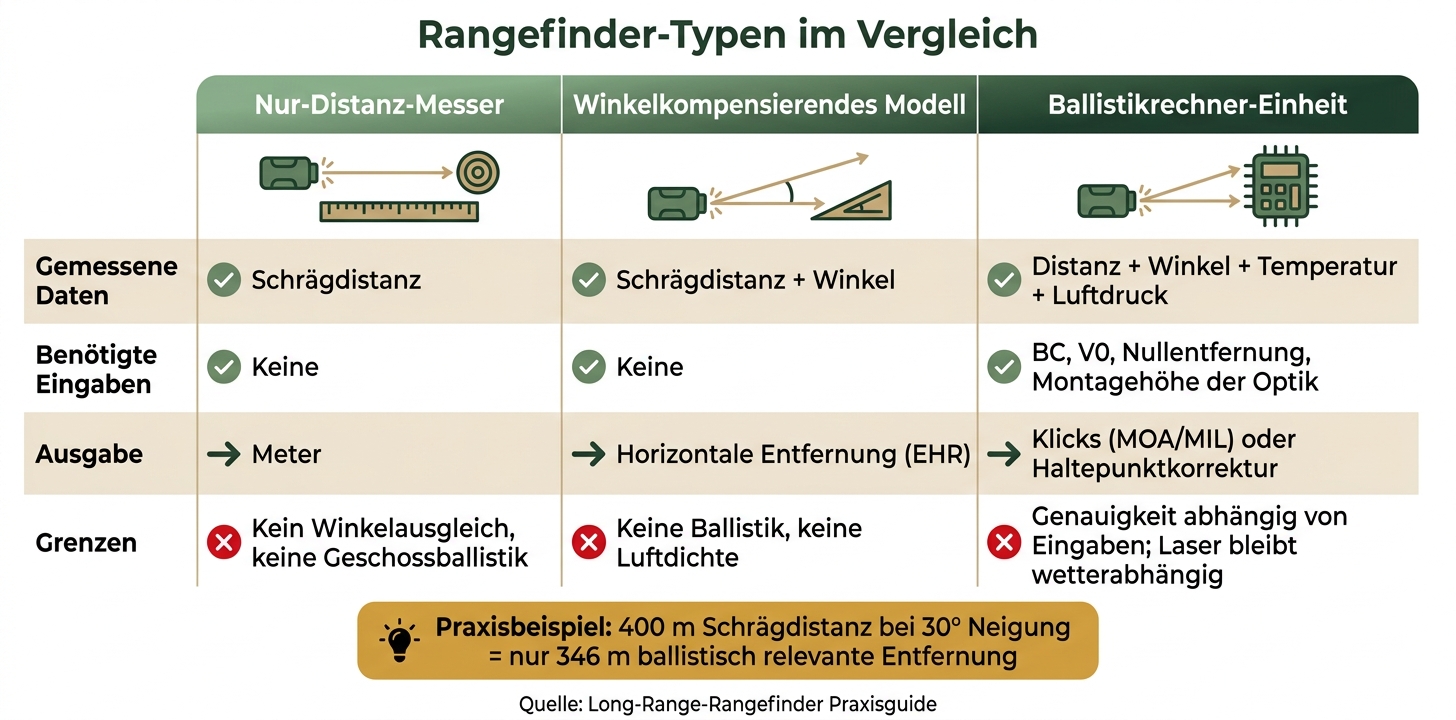
Rangefinder types compared: Function, Inputs & Limits
Even if the distance is measured accurately, the next hurdles often just begin: weather and ballistics.
How Rain, Fog, Snow and Cold Affect the Measurement
Rain, fog, snow and haze scatter the laser beam. This reduces the range and makes measurement errors more likely. Damp cold also affects optics and mechanics [4].
If your device has a rain mode, turn it on during precipitation. It can suppress reflections from drops or snowflakes, but does not replace a clear line of sight [2]. Another often overlooked point: wet or fogged lenses often worsen the measurement even more. Keep the lenses dry and clean. After a weather change, it’s worth double-checking the first measurement.
Once the measurement is set, the next step is the evaluation for the shooting solution.
What Ballistic Rangefinders Really Calculate
Simple rangefinders only show the distance. Devices with built-in ballistic calculators go further and provide correction values, for example MOA, MIL or clicks.
For this to be accurate, the device needs precise inputs. These include:
- Zero distance
- Muzzle velocity
- Bullet weight
- BC
- Mount height of the optic
Higher-end models also factor in temperature, air pressure and altitude [1][2]. You should measure the muzzle velocity with a chronograph for your exact firearm and ammunition. Manufacturer specs can differ [2]. Sounds like a small detail, but it’s not. Even one incorrect value can shift the entire output.
| Device Type | Measured Data | Required Inputs | Output | Key Limitations |
|---|---|---|---|---|
| Distance-Only Rangefinder | Slant distance | None | Meters | No angle compensation, no bullet ballistics |
| Angle-Compensating Model | Slant distance + angle | None | Horizontal distance (EHR) | Does not consider ballistics or air density |
| Ballistic Calculator Unit | Distance + angle + temperature + air pressure | BC, V0, zero distance, scope mounting height | Clicks (MOA/MIL) or holdover correction | Accuracy depends on inputs; laser remains weather-dependent |
Why every ballistic output must be tested at the shooting range
Ballistic data is only as good as the values you enter. That’s exactly why every output must be tested at the shooting range. Even small deviations in muzzle velocity, zero distance, or ammunition batch can distort the correction value [1][3].
That’s why a control shot is mandatory when you change ammunition, the device has been bumped during transport, or you’re operating at a different altitude or significantly different temperature [3]. On paper, ballistic values often look clean. In practice, only then does it show if everything fits together.
Legal use in Germany and everyday maintenance
After range and ballistics, what a device can do isn’t the only thing that counts in the field. Equally important is whether it’s even allowed to be used like that in Germany – and whether it works reliably in everyday use.
Which legal points depend on the device configuration
A handheld laser rangefinder is usually uncritical. It’s different as soon as the device configuration changes. Then the legal assessment can quickly shift.
- Weapon mounting: If the device is mounted on the weapon or integrated into the scope, a separate firearms law review is required.
- Point of aim projection: Devices with point of aim projection are prohibited for hunting.
- Combination with night or thermal imaging technology: Such combinations are strictly regulated; hunting use depends on state law.
After the legal classification comes the part that often decides reliability in the field: maintenance.
Cleaning, storage, and troubleshooting
For the lenses, a simple order applies. First remove loose dust and dirt with a soft brush or blower, then wipe. Otherwise, every small dirt particle acts like sandpaper and can scratch the coating.
Before storage, the housing should be dry. After a temperature change, let the device acclimate before using it. Otherwise, condensation can form inside. If the device will be stored for a longer time, it’s better to remove the batteries. Leaking batteries can damage the contacts permanently.
With irregular measurements, it’s worth first checking the objective lens. Grass, branches, or some dirt are often enough to scatter the laser beam. If the range seems short or the display is weak, first check the battery.
Conclusion: Strengths and Limits of a Long-Range Rangefinder
After range, weather, ballistics, and law, the simple question remains: What does the device bring in the field? A long-range rangefinder helps you with distance control. But it only works precisely under ideal conditions. So it is no substitute for hunting judgment.
This also applies to the ballistic function. The displayed ballistic values are and remain approximate values. You have to check them at the shooting range. The display is a starting point, nothing more.
Law and maintenance also continue to depend on the device configuration and everyday handling. A long measuring distance does not automatically justify a shot.
Distance data help with the decision. But they never replace target identification, backstop, and hunting judgment. The rangefinder measures the distance. You make the decision.