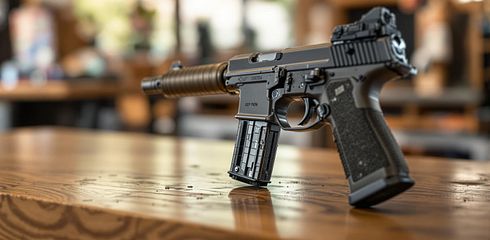
Gun license in Germany: requirements, costs and difference to the firearms ownership license

In Germany, there are two types of firearms licenses: the Small firearms license, which applies to blank-firing, irritant, and signal weapons, and the Large firearms license, which is required for live firearms. Both are subject to strict legal regulations. Here are the key points at a glance:
- Small firearms license: Allows carrying certain weapons (e.g. blank-firing weapons). No proof of need required. Validity: unlimited.
- Large firearms license: Requires proof of a legitimate need (e.g. occupational risk). Validity: 3 years.
- Requirements: Minimum age 18, personal suitability, reliability, possibly liability insurance.
- Application: Through the responsible firearms authority, with documents such as certificate of conduct, proof of expertise, and medical certificate.
- Penalties for violations: Fines, revocation of the firearms license, or imprisonment.
Quick comparison of firearms license types
| Feature | Small firearms license | Large firearms license |
|---|---|---|
| Type of weapon | Blank-firing, irritant, and signal weapons | Live firearms |
| Proof of need | Not required | Mandatory |
| Validity | Unlimited | 3 years |
| Insurance requirement | None | Liability insurance required |
Read on for detailed answers to the most common questions about the German firearms license.
1. What is a firearms license and who needs it?
What is a firearms license?
A firearms license is an official permit that allows carrying firearms in public under strict conditions [1]. There are two main types of firearms licenses:
| Type | Description |
|---|---|
| Small firearms license | Applies to blank-firing, irritant, and signal weapons with PTB approval |
| Large firearms license | Required for live firearms, associated with extensive examinations |
Who needs a firearms license?
A firearms license is necessary as soon as a weapon is to be carried in public [1][2]. There is a clear distinction between:
- Weapon possession: The weapon may be stored at home.
- Weapon carrying: The weapon is carried in public.
However, there are exceptions: Transporting unloaded firearms to the shooting range or hunting area does not require a firearms license, as long as the firearms are not ready to fire and are securely stored [2].
Additional regulations apply to foreign nationals. They must have lived in Germany for at least five years before they can apply for a firearms license [1]. Violations of the firearms license requirement can be punished with fines or imprisonment.
After clarifying the basics of the firearms license, let's now take a look at the application process.
Small Firearms License - Requirements and Prohibitions
2. How to apply for a firearms license?
In Germany, the process for applying for a firearms license is strictly regulated and involves several steps. The application is submitted to the responsible firearms authority, usually the police headquarters or public order office. Applicants must meet various requirements, including proof of completed proficiency training, liability insurance, and submission of all required documents [1][2].
Required Documents
| Document | Description |
|---|---|
| ID card/Passport | Proof of identity and residence |
| Certificate of Conduct | Must be current and contain no relevant entries |
| Proof of Proficiency | Proof of completion of a proficiency course |
| Proof of Insurance | Proof of liability insurance |
| Proof of Need | Required for the large firearms license |
| Medical Certificate | Confirmation of physical and mental fitness |
The processing time for the application can take several weeks to months depending on the authority and individual situation. Costs include administrative fees, participation in the expert course, and liability insurance, which can vary depending on the federal state [2][5]. A firearms license is valid for three years, and suitability is rechecked upon renewal [1].
After submitting the application, applicants must meet further strict requirements to obtain approval.
sbb-itb-1cfd233
3. Requirements for the Firearms License
In Germany, strict rules apply for issuing a firearms license. These serve to protect public safety and ensure that weapons may only be carried by responsible persons.
Basic requirements include a minimum age of 18 years as well as personal suitability [2].
Reliability and Personal Suitability
Personal suitability includes both mental stability and physical abilities as well as abstaining from addictive substances. The following criteria are checked:
| Criterion | Requirements |
|---|---|
| Criminal Record | No relevant entries in the certificate of conduct |
| Addiction Behavior | No dependence on alcohol or drugs |
| Mental Health | Proof of mental stability |
| Physical Suitability | Ability to handle weapons safely |
Proof of Need
A central criterion for the firearms license is proof of a legitimate need. This exists if the applicant either requires the firearms license professionally, for example in security services, or due to a proven personal threat.
Insurance Coverage
Additionally, liability insurance is required. This must cover a minimum sum insured of one million euros [2].
Even if all requirements are met, this does not automatically mean the application will be approved. The responsible authority decides on a case-by-case basis.
The next section explains how the requirements differ depending on the type of firearms license.
4. Small vs. Large Gun License: The Differences
The Small Gun License allows carrying blank, irritant, and signal weapons, provided they bear a PTB test mark from the Physikalisch-Technische Bundesanstalt [2].
| Feature | Details |
|---|---|
| Validity Period | Unlimited |
| Minimum Age | 18 years |
| Proof of Need | Not required |
| Insurance | No special insurance necessary |
The Large Gun License has significantly stricter requirements, as it is issued for live firearms that carry a higher risk potential [2].
| Feature | Details |
|---|---|
| Validity Period | Three years, with two possible extensions of three years each |
| Insurance Requirement | Liability insurance with at least 1 million euros coverage |
| Proof of Need | Mandatory |
A legitimate need is essential for the Large Gun License. This could be justified, for example, by professional activity in the security sector or a proven personal threat situation [2][3].
In addition to the general requirements already described in the previous section, authorities check the following for the Large Gun License:
- A detailed reliability check
- A comprehensive assessment of personal suitability
- Proof of professional qualifications
- Regular follow-up inspections during the validity period
After explaining the differences between the two types of gun licenses, we now turn to the legal obligations and possible consequences associated with carrying weapons.
5. Legal Obligations and Penalties
Anyone who holds a gun license must comply with strict legal requirements. These rules reflect the high safety standards of the German Weapons Act.
Documents to Carry
Gun license holders are required to always carry three essential documents with them:
| Document | Purpose |
|---|---|
| Gun License | Proof of authorization |
| Valid ID card | For identity verification |
| Proof of Insurance | Required for the Large Gun License (liability insurance) |
Additionally, weapons must be securely stored. This means: they belong in locked gun safes, while ammunition must be stored separately and also locked. This prevents unauthorized access.
Penalties for Violations
Anyone who violates the Weapons Act must expect severe consequences:
| Violation | Consequences |
|---|---|
| Carrying without the required documents | Fine, temporary revocation of the firearms license |
| Improper storage | Fine, revocation of the firearms license |
| Carrying without a valid firearms license | Possible imprisonment, permanent revocation |
A firearms license can be revoked if:
- Personal suitability is no longer given.
- Weapons law regulations are violated.
- There is a conviction for a serious crime.
The responsible authorities regularly check whether the requirements for the firearms license are still met [2][3].
Complying with these requirements is essential to keep the firearms license and avoid legal problems.
Conclusion: Important Aspects of the Firearms License in Germany
Here is an overview of the key points about the firearms license in Germany after considering the legal requirements.
Requirements for a Firearms License
To obtain a firearms license, the following conditions must be met:
- Minimum age: 18 years
- Proof of personal suitability: No psychological or physical limitations
- Reliability: No criminal record or doubts about law-abiding behavior
- Private liability insurance [2][4]
Differences Between Types of Firearms Licenses
The two main categories of firearms licenses differ in important points:
| Feature | Small Firearms License | Large Firearms License |
|---|---|---|
| Validity | Unlimited | 3 years |
| Proof of need | Not required | Required |
Thorough Examination by Authorities
The authorities scrutinize every application carefully. Especially personal reliability plays a central role. If there are doubts about suitability, a psychological assessment may be requested [5][6].
Responsibility When Owning a Firearms License
Owning a firearms license comes with great responsibility. This includes:
- Secure Storage: Firearms must be stored in a way that prevents unauthorized access.
- Document Duty: All relevant documents must always be up-to-date and readily accessible.
Violations of these duties can have serious consequences, up to the revocation of the firearms license [2][5].
Regular inspections by authorities ensure that all legal requirements are met. Those who act responsibly and follow the rules can keep their permit.