Silent rain gear for stand hunting and stalking
If rainwear rustles audibly, it’s often already at a disadvantage for hunting. That’s why I pay attention not only to waterproofing but first to noise, friction, and fit.
For me, it comes down to one clear point: sitting and stalking don’t need the same rainwear. When sitting, it’s mainly about quiet, warmth, and wind protection. When stalking, quiet movement, low bulk, and good moisture transport are usually more important.
In short:
- I avoid hard, smooth outer fabrics if I want to stay quiet.
- I check not only the fabric but also membrane, cut, zippers, and snaps.
- I watch for friction on thighs, armpits, backpack straps, and rifle sling.
- I always test clothing in motion: walking, crouching, turning, shooting position, hood adjustment.
- I expect a trade-off: more rain protection often means more noise.
For me, the fabrics can roughly be categorized as follows:
| Material | Noise Level | Waterproofing | What I tend to use it for |
|---|---|---|---|
| Loden | very low | medium | Sitting, light rain |
| Brushed Softshell | low | medium to high | Stalking, changeable weather |
| Fleece | very low | low | only as a layer underneath |
| Soft membrane outer surface | medium | high | heavy rain, more wind |
My quick summary: When I sit for a long time, I tend to choose soft, warm, and quiet pieces. When I stalk a lot, I prefer light, breathable, and quiet clothing. And no matter what the label says: only practical testing shows me if the gear works in the field.
Why Rainwear Gets Noisy in the Field
In the field, even small movements stand out: slow steps, a quick turn, crouching, or the shooting position. What matters is where the noise is coming from. Rain only partially covers rustling. Especially during rain breaks or the quiet phase while sitting, it often remains clearly audible.
Outer Material, Membrane, and Closures as Main Noise Sources
Hard, smooth nylon or polyester often rustles noticeably when moving. Additionally: stiff membranes can amplify noise, even if the outer material feels softer at first touch. [3]
Details like zippers and snaps also make themselves heard. That might sound like small stuff, but in the field, it’s often exactly the point. Sleeve and hem adjustments help fix loose fabric and stop flapping.
How Cut and Fabric Friction Create Noise
As soon as fabric rubs against fabric, friction occurs. This mainly happens on the thighs, sleeves, and sides. A tight cut increases tension and friction. A loose cut tends to cause fabric to slap. When stalking slowly or making small movements while sitting, you hear this immediately.
There are also other contact points: straps, backpack, and stock often cause extra friction noises. [2]
Which fabrics reduce rustling becomes clear mainly from the surface, lining, and workmanship.
sbb-itb-1cfd233
Fabrics and workmanship that reduce rustling
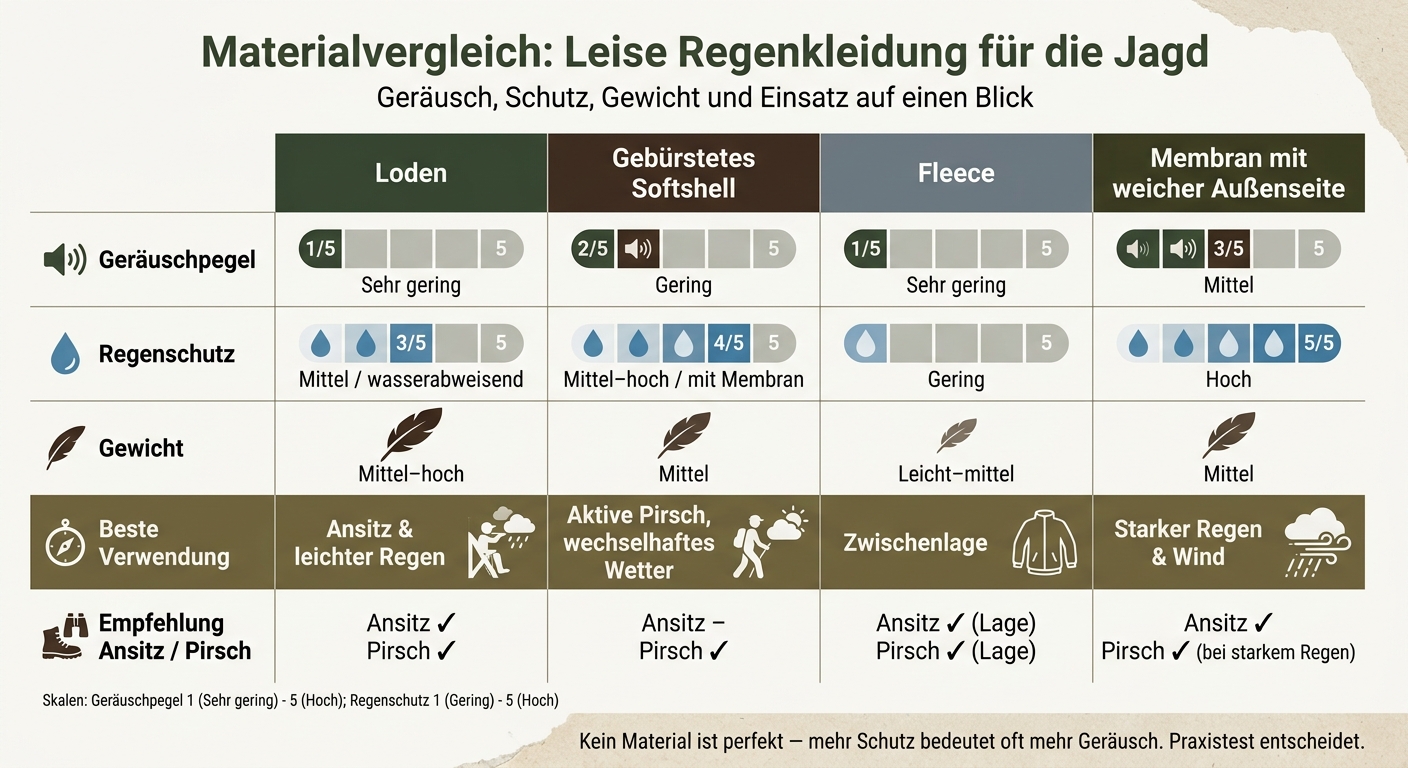
Quiet hunting rainwear: material comparison for stand hunting & stalking
Quiet and fully waterproof rarely work at the same time. Usually, it’s about the right mix for use, temperature, and rain. Soft, matte surfaces and as few hard edges as possible help against rustling. Which solution fits best depends heavily on whether you sit mostly still or are on the move a lot.
Loden, softshell, fleece, and soft membranes
Loden is one of the quietest options in the field. The dense, slightly felted surface absorbs friction noises and is water-repellent [3]. It’s a strong choice for light rain during stand hunting or stalking.
Brushed softshell has a roughened, quiet surface. Combined with a membrane, it keeps moisture out better [1][4]. This works well when breathability and freedom of movement are priorities.
Fleece is not suitable as an outer layer in rain. But as a mid-layer or in handwarmer pockets, it’s quiet and keeps you warm [1][5].
Membrane jackets with a soft outer side protect best against rain and wind when the outer shell is matte and soft. Smooth outer sides rustle noticeably more [4].
Workmanship details that make the difference
Even quiet material is of little use if the fit isn’t right. Too loose areas rub faster and make noise. Adjustable sleeve and hem closures help avoid exactly that. Quiet zipper closures also play a role [1].
On top of that: Jacket and pants have to match. If one piece rubs, the advantage of the quiet surface is quickly gone. It’s a bit like with good hiking boots: It’s not just the material that counts, but also how everything works together.
| Material | Noise level | Rain protection | Weight | Best use |
|---|---|---|---|---|
| Loden | Very low | Medium (water-repellent) | Medium–high | Still hunting & stalking in light rain [3] |
| Brushed Softshell | Low | Medium–high (with membrane) | Medium | Active stalking in changeable weather [1][4] |
| Fleece | Very low | Low | Light–medium | Mid layer [1][5] |
| Membrane with soft outer side | Medium | High | Medium | Heavy rain and wind [4] |
For the purchase, what counts now is mainly which of these fabrics brings quietness when still hunting and enough mobility when stalking.
Choosing rainwear for still hunting and stalking
After the material comes the purpose. Because still hunting and stalking place very different demands on rainwear.
Still hunting: Warmth, wind protection and quietness during small movements
When still hunting, you often sit for many hours almost without moving. Weight and pack size hardly matter here. More important are warmth, wind protection and as little noise as possible during small movements. Exactly in the moments when you turn your head, reposition your hand or briefly reach for your rifle.
And that’s exactly where hard, smooth surfaces often show their weakness. Even small movements make some outer fabrics rustle audibly. Loden or lined rain jackets with a soft, matte outer side usually fit better for still hunting [1][3]. They reduce friction noise when turning your head and reaching. They also keep you warm even when you stay long on the stand.
Stalking: Low volume, breathability and quiet steps
With stalking, it’s different. You’re moving, your body produces heat, and too much insulation makes you damp quickly. That’s why here breathability, low pack volume and quiet steps count above all.
Stiff or bulky rain gear is twice as annoying: it restricts movement and creates more rubbing noises between the thighs and under the arms [2]. This often only becomes noticeable when walking, not on the hanger in the store.
Usually, a thin, quiet outer layer over a soft base layer works better for stalking. Brushed softshell or a membrane with a soft, matte surface work well for this [1][4]. They stay quieter when rubbing legs and raising arms.
Check before buying – and where you can compare options
You can’t tell from product photos if a jacket rustles. That’s why you should always test the entire layering system and not just the jacket alone.
Do the test as close to real use as possible:
- Walk a few steps slowly.
- Kneel down.
- Turn your upper body.
- Take your rifle into position.
- Rub sleeves against the torso and pant legs against each other.
- Open pockets and zippers.
- Pay attention if the hood rustles right next to your ear when turning your head.
The hood noise is often underestimated. If it rustles right next to your ear, it can clearly disturb hearing game. If you usually carry a backpack or a rifle sling, repeat the test with those as well.
Once your requirements are clear, preselection in the market helps. On Gunfinder you can filter new and used hunting clothing by material and workmanship and preselect specifically. But this doesn’t replace the practical test.
The quick check shows the differences at a glance:
| Situation | Main requirement | Suitable construction | Compromise | Test |
|---|---|---|---|---|
| Sitting hunt | Warmth & wind protection | Loden or lined rain jackets with soft outer surface | Higher weight, slower drying | Noises when turning the head and reaching |
| Stalking | Breathability & low volume | Light softshell or thin, soft membrane | Less insulation – movement replaces it | Thigh rubbing and arm raising in walking test |
Conclusion: The quietest rain gear is always a compromise
No rain gear can do everything at once. More weather protection often means more noise. And if a piece is especially quiet, it often lacks something in protection or warmth. So in the end, it’s not about the one best feature, but about the best compromise for your use.
Where does the noise come from? Mostly from a mix of stiff outer fabrics, hard laminates, smooth surfaces, firm fasteners, and a fit where fabric rubs on fabric. That sounds technical at first, but is immediately noticeable in the field. Even small movements can then make more noise than you actually want.
In the end, the purpose dictates the direction. For sitting hunts, warmth, wind protection, and quietness with the smallest movements count above all. For stalking, it’s a bit different: breathability and quiet walking are often more important.
Only practical testing shows whether a jacket or pants are really good – and that with your complete layering system and the movements that actually occur in your hunting area. So only compare clothing that you have tested exactly like this: fully dressed, in real movement, and not just briefly in the store. In the end, choose the rain gear that is the quietest for your purpose and still gives you enough protection, warmth, and mobility.
FAQs
Which rain gear is the quietest for sitting hunts?
For sitting hunts, quiet clothing is important. Otherwise, even a slight rustle is enough to alert the game.
Loden is especially suitable here because the material is naturally quiet and repels weather well. This makes a big difference during long, quiet sitting periods.
The outer material is also important: it should not rustle when moving. For sitting hunts, the combination of silence and the layering principle counts above all.
How can I recognize rustling rain gear before buying?
The best way is to check directly: touch the fabric and move it. If the material makes clearly audible noises when rubbed or moved, be cautious.
Especially synthetic fabrics and special overcover camouflage suits made of gauze-like materials often rustle more. If possible, try the clothing in motion in the store. Loden is considered a significantly quieter alternative.
How much rain protection do I lose with quiet materials?
As a rule, you do not have to compromise on rain protection with quiet materials. High-quality fabrics like Loden or special functional membranes combine low noise development with good protection against moisture.
It often looks different with very cheap or simple overcover materials: they usually rustle more. And when the weather really changes, a well-planned layering system can sensibly complement rain protection.