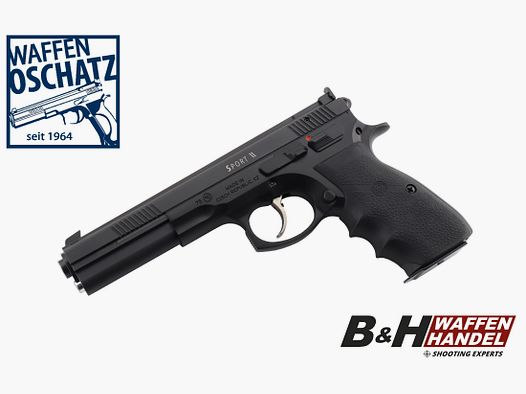
Liquidation of my collection: Heckler & Koch Mod. P7 M13 Cal. 9mm
Details
- Original language
- German
- Brand
- Heckler & Koch
- Category
- Purchase eligibility
- Required - What am I allowed to buy?
- Caliber
- 9mmLuger
- Condition
- Used
- Location
- 🇩🇪 85232 Bergkirchen, Germany
- Availability
- In stock
- Expires
- 16.09.2026
Description
The Heckler & Koch P7 M13 in caliber 9mm Luger is one of the most technologically innovative and today one of the most exclusive collector pistols in the world. Its development history ranges from the criteria of German police authorities to secret US military trials.
The 1972 Munich Olympics attack drastically revealed the inadequate armament of the German police (at that time often still in the weak caliber 7.65 mm Browning). The Interior Ministers' Conference demanded a new, safe service pistol in the powerful caliber 9mm Luger with immediate readiness to fire without manual disengagement of the safety. The designer Helmut Weldle developed the PSP (Polizei-Selbstlade-Pistole), which was presented in 1976. It was officially numbered as P7 (Pistole 7) by the procurement office and produced in series from 1979. It was used, among others, by the GSG 9 and the Bavarian state police.
In the early 1980s, the US military was looking for a successor to the outdated Colt M1911 in the XM9 program. A magazine capacity of at least 10, ideally more rounds, was required. The birth of the M13: The original P7 (also called P7 M8) only had a single-row 8-round magazine. For the US tender, Heckler & Koch then developed the P7 A13 variant with a double-row magazine for 13 cartridges. Although the weapon lost the US test to the Beretta 92 due to extremely high production costs, HK released the modifications from 1983/1984 as the P7 M13 for the commercial market and special units.
The European magazine catch at the bottom of the grip frame was replaced by a lever operable from both sides directly behind the trigger guard. Heat protection: Since the gas-delayed system above the trigger became very hot due to the high rate of fire of the larger magazine, HK integrated a heat shield made of plastic in the trigger guard. The grip frame had to be widened and slightly lengthened, giving the weapon a noticeably bulkier appearance.
The weapon has no traditional manual safety. Only when the hand squeezes the distinctive cocking lever at the front of the grip frame is the firing pin cocked. If the lever is released, the weapon is immediately and absolutely drop-safe and decocked.
Part of the powder gases is directed through a small bore in front of the cartridge chamber into a cylinder under the barrel. A piston located there delays the rearward movement of the slide until the projectile has left the barrel.
Since the polygon barrel is fixed in the housing and does not tilt like in the Browning system, the P7 M13 has legendary inherent accuracy.
Due to the extremely elaborate, completely steel-milled construction, the manufacturing costs were no longer economically competitive in the era of modern polymer pistols (like the Glock 17). Today, the P7 M13 is considered a "cult classic."
The exact year of manufacture is 1988 (Code II). No warning label: Pistols from this production period do not yet have the large, visually disturbing warning labels (“Warning: Read Manual”) on the slide compared to later models (from around the 1990s).
The engraving “Heckler & Koch GmbH Oberndorf/N. Made in W.-Germany” confirms that the P7 M13 was manufactured directly in the main factory in Oberndorf am Neckar for the European market and is not a re-import from the USA.
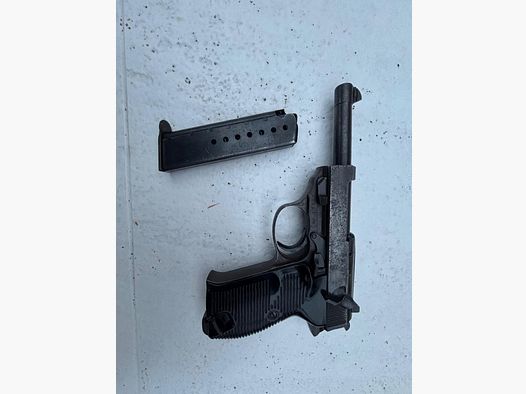
It is sold in the original packaging with a second magazine (see pictures).
It comes from an inherited collection that I am gradually dissolving after careful consideration. It is not easy to part with these pieces, but they should go into the hands of people who appreciate their quality and history.
The pistol can of course be viewed and inspected on site by appointment. I place great value on transparency so that you can personally verify the condition of the weapon.
The price is negotiable. However, please remain realistic.
Since I am liquidating the entire collection, more interesting and high-quality firearms will be offered in the coming weeks. So it's worth taking a look at my other listings.
I look forward to your inquiry and am happy to answer any questions.
Note: The sale is exclusively to persons with a valid acquisition permit and in compliance with all applicable firearms laws. The description was made to the best of my knowledge and belief. Errors, typos, and prior sale reserved.
(Show description in original language)Die Heckler & Koch P7 M13 im Kaliber 9mm Luger ist eine der technologisch innovativsten und heute exklusivsten Sammlerpistolen der Welt. Ihre Entwicklungsgeschichte reicht von den Kriterien deutscher Polizeibehörden bis hin zu geheimen US-Militärerprobungen.
Das Olympia-Attentat 1972 in München zeigte drastisch die unzureichende Bewaffnung der deutschen Polizei (damals oft noch im schwachen Kaliber 7,65 mm Browning). Die Innenministerkonferenz forderte eine neue, sichere Dienstpistole im leistungsstarken Kaliber 9mm Luger mit sofortiger Feuerbereitschaft ohne manuelles Entsichern. Der Konstrukteur Helmut Weldle entwickelte die PSP (Polizei-Selbstlade-Pistole), die 1976 vorgestellt wurde. Sie wurde vom Beschaffungsamt offiziell als P7 (Pistole 7) nummeriert und ab 1979 in Serie produziert. Sie kam unter anderem bei der GSG 9 und der bayerischen Landespolizei zum Einsatz.
Anfang der 1980er Jahre suchte das US-Militär im XM9-Programm einen Nachfolger für die veraltete Colt M1911. Gefordert war eine Magazinkapazität von mindestens 10, idealerweise mehr Schuss. Die Geburtsstunde der M13: Die ursprüngliche P7 (auch P7 M8 genannt) besaß nur ein einreihiges 8-Schuss-Magazin. Für die US-Ausschreibung entwickelte Heckler & Koch daraufhin die Variante P7 A13 mit einem zweireihigen Magazin für 13 Patronen. Obwohl die Waffe den US-Test aufgrund extrem hoher Produktionskosten gegen die Beretta 92 verlor, brachte HK die Modifikationen ab 1983/1984 als P7 M13 für den kommerziellen Markt und Spezialeinheiten heraus.
Der europäische Magazinhalter unten am Griffstückboden wich einem beidseitig bedienbaren Hebel direkt hinter dem Abzugsbügel. Wärmeschutz: Da das gasgebremste System über dem Abzug durch die hohe Schussfrequenz des größeren Magazins sehr heiß wurde, integrierte HK ein Hitzeschild aus Kunststoff im Abzugsbügel. Das Griffstück musste verbreitert und leicht verlängert werden, was der Waffe ein deutlich wuchtigeres Aussehen verlieh.
Die Waffe besitzt keine traditionelle manuelle Sicherung. Erst wenn die Hand den prägnanten Spanngriff an der Vorderseite des Griffstücks zusammendrückt, wird der Schlagbolzen gespannt. Wird der Griff losgelassen, ist die Waffe sofort wieder absolut fallsicher entspannt.
Ein Teil der Pulvergase wird durch eine kleine Bohrung vor dem Patronenlager in einen Zylinder unter dem Lauf geleitet. Ein dort sitzender Kolben verzögert den Rücklauf des Schlittens so lange, bis das Geschoss den Lauf verlassen hat.
Da der Polygonlauf fest im Gehäuse sitzt und nicht wie beim Browning-System abkippt, besitzt die P7 M13 eine legendäre Eigenpräzision.
Aufgrund der extrem aufwendigen, komplett aus Stahl gefrästen Bauweise waren die Herstellungskosten im Zeitalter moderner Polymer-Pistolen (wie der Glock 17) wirtschaftlich nicht mehr konkurrenzfähig. Heute gilt die P7 M13 als "Kult-Klassiker"
Das exakte Baujahr ist 1988 (Code II) Kein Warnhinweis: Pistolen aus dieser Fertigungsperiode besitzen im Vergleich zu späteren Modellen (ab ca. 1990er) noch nicht die großen, optisch störenden Warnhinweise („Warning: Read Manual“) auf dem Schlitten.
Die Gravur „Heckler & Koch GmbH Oberndorf/N. Made in W.-Germany“ bestätigt, dass die P7 M13 direkt im Stammwerk in Oberndorf am Neckar für den europäischen Markt gefertigt wurde und kein Re-Import aus den USA ist.
Sie wird in der Originalverpackung mit einem zweiten Magazin verkauft (siehe Bilder)
Sie stammt aus einer geerbten Sammlung, die ich nach reiflicher Überlegung nach und nach auflöse. Es fällt nicht leicht, sich von diesen Stücken zu trennen, jedoch sollen sie in die Hände Personen gelangen, die ihre Qualität und Geschichte zu schätzen wissen.
Die Pistole kann nach vorheriger Terminvereinbarung selbstverständlich vor Ort besichtigt und begutachtet werden. Ich lege großen Wert auf Transparenz, sodass Sie sich persönlich vom Zustand der Waffe überzeugen können.
Der Preis ist Verhandlungsbasis. Allerdings bitte ich darum realistisch zu bleiben.
Da ich die gesamte Sammlung auflöse, werden in den kommenden Wochen weitere interessante und hochwertige Waffen angeboten. Ein Blick auf meine weiteren Anzeigen lohnt sich daher.
Ich freue mich auf Ihre Anfrage und beantworte offene Fragen gerne.
Hinweis: Der Verkauf erfolgt ausschließlich an Personen mit gültiger Erwerbsberechtigung und unter Einhaltung aller geltenden waffenrechtlichen Bestimmungen. Die Beschreibung erfolgte nach bestem Wissen und Gewissen. Irrtümer, Druckfehler und Zwischenverkauf vorbehalten.