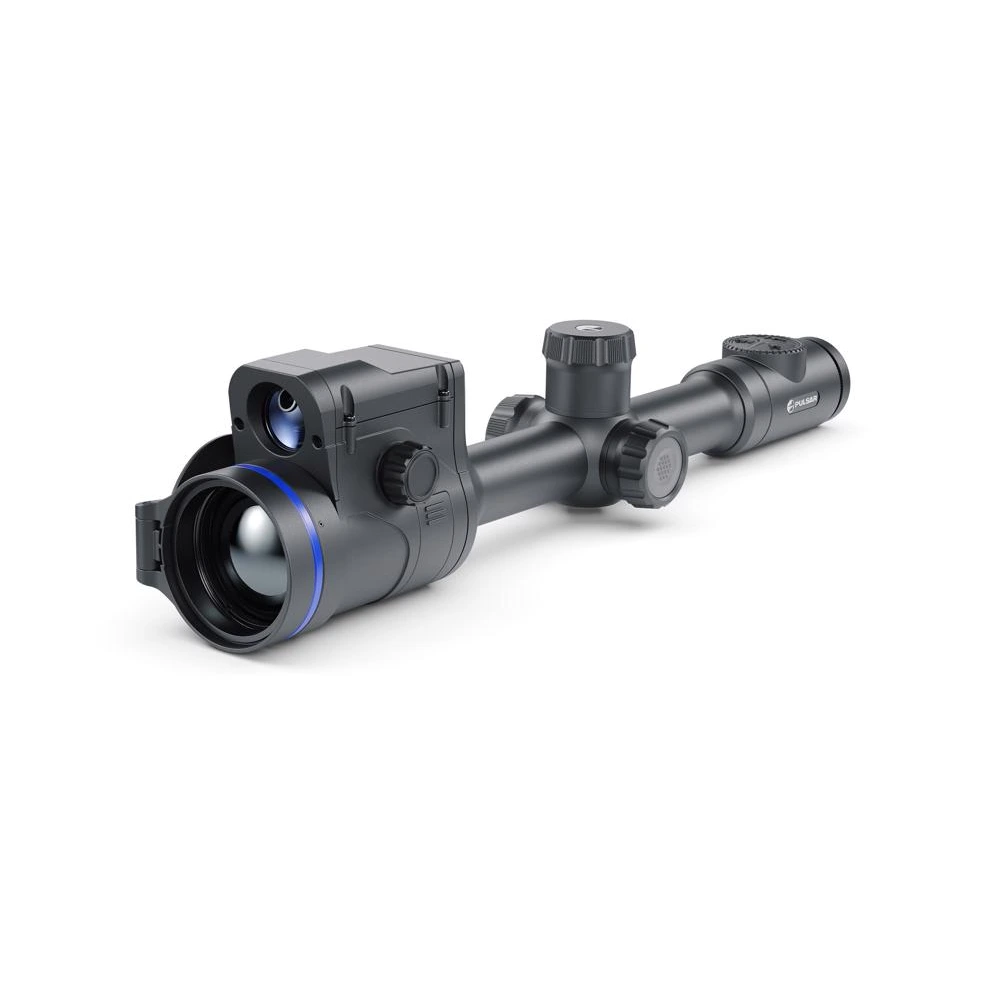
Pulsar Thermion 3 LRF 60



Pulsar THERMION 3 LRF 60: XR60 and XT60 Compared
The Pulsar THERMION 3 LRF 60 series includes two thermal imaging scopes with different strengths: The THERMION 3 LRF XR60 combines higher base magnification with a longer stated battery life. The THERMION 3 LRF XT60 offers a higher-resolution sensor and a significantly wider field of view. Shared features include a 60 mm lens, an integrated laser rangefinder, and a ballistic calculator. The technical specifications below are based on manufacturer information. They are no substitute for a field test; range and operating times in particular depend on the conditions of use.
Legal notice for Germany
Thermal imaging rifle scopes with their own reticle are not legally equivalent to thermal imaging observation devices or clip-on devices. In Germany, devices of this type are generally subject to the firearms law ban on night vision aiming devices. This applies not only to hunting use, but generally also to acquisition and possession unless an applicable exemption applies. Hunting law permits for certain clip-on devices cannot be extended to these scopes. You must clarify the legal situation before acquiring, importing or using one.
XR60 and XT60: Sensor, Magnification and Field of View
THERMION 3 LRF XR60: Higher base magnification
The XR60 features a thermal imaging sensor with 640 × 480 pixels. The magnification range is 4x to 40x, and the horizontal field of view is 12.8 meters at 100 meters. The higher base magnification makes distant objects appear larger right from the default setting. The trade-off is a narrower field of view. Pulsar positions the model accordingly under the name Long-Range Precision. However, higher magnification does not automatically mean more discernible detail. Digital zoom in particular enlarges existing image information without producing additional sensor detail.
THERMION 3 LRF XT60: Higher sensor resolution and a wider field of view
The XT60 uses a sensor with a resolution of 1280 × 1024 pixels. That gives it around 4.27 times as many sensor pixels as the XR60. Its magnification range is 2x to 24x. At 25.7 meters at 100 meters, its horizontal field of view is about twice as wide as the XR60’s. The lower base magnification makes it easier to scan larger areas of terrain and spot heat sources. The manufacturer’s term Versatile Awareness describes this focus. Which details are actually visible depends not only on sensor resolution, but also on the optics, image processing, distance, and thermal contrast.
Detection range of up to 3,100 meters
Pulsar lists a detection range of up to 3,100 meters for both models. A revised zoom algorithm is designed to improve image quality when magnifying. Detection does not mean reliable identification. The figure describes detecting a heat source under defined conditions. It is neither a reliable identification distance nor an indication of a responsible shooting distance. Weather, humidity, vegetation, and temperature differences between the object and its surroundings significantly affect the usable range.
60 mm lens and revised image display
Both thermal imaging scopes feature a 60 mm lens with an F1.0 aperture ratio. Compared with the F1.1 optics mentioned in the original comparison, more thermal radiation can reach the sensor under otherwise comparable conditions. In the XT60, sensor resolution increases from 1024 × 768 to 1280 × 1024 pixels compared with the predecessor model mentioned. The horizontal field of view expands from 11.7 to 14.6 degrees, while the magnification range changes from 2.5–20× to 2–24×. The following functions are available to adjust the thermal image display:
- Three sensitivity boost levels
- Nine color palettes
- Two picture-in-picture display options
- An additional smoothing filter to reduce visible image noise
Which setting provides the most informative image depends on the terrain, weather, and temperature contrast.
Laser rangefinder up to 1,200 meters
According to the manufacturer, the integrated laser rangefinder has a maximum measuring distance of 1,200 meters. Compared with the 800 meters stated for the previous generation, this is a 50 percent increase. The stated measurement accuracy is ±1 meter. Features include:
- Single measurements
- A continuous scan mode
- Determining the horizontal distance, referred to as True Horizontal Distance or THD
- Displaying angle information
The maximum measuring range cannot be achieved under all conditions. Factors such as target size, reflective properties, and weather affect distance measurement.
Integrated Ballistics Calculator
An integrated ballistics calculator processes the distance together with the selected ballistic profile and displays the resulting correction values or a calculated holdover point. You can create custom profiles using Stream Vision Ballistics and transfer them via Bluetooth. The accuracy of the calculation depends on correct input data. A calculated display does not replace checking the actual point of impact or assessing the situation at hand.
Housing, focusing and operation
The THERMION 3 LRF 60 models retain the classic riflescope shape. The stated dimensions are 391 × 76 × 96 millimeters. Compared with the predecessor mentioned, the housing is 51 millimeters shorter and 8 millimeters narrower. Both versions weigh 1.3 kilograms including batteries. The central focusing wheel can be operated from either side. A lever on the zoom ring lets you adjust the magnification directly without opening the menu. This controls electronic magnification, not optical zoom as found on a classic daytime riflescope. The redesigned user interface uses horizontal menus with settings grouped by topic. A proximity sensor can automatically turn off the display when it’s not in use.
Video Recording, Storage, and App Connectivity
Internal storage increases from 64 to 128 GB compared with the previous generation mentioned. Both models have a built-in photo and video recorder.
- Shadow Recording: According to the manufacturer, it also saves the 30 seconds before you manually start recording.
- Recoil Recording: Records 30 seconds before and after a detected shot.
- AI Shot Detection: Is designed to make it easier to find relevant shot moments in video footage.
With Stream Vision 2, you can access recordings, stream live images, change device settings, and install firmware updates over Wi-Fi. This app is different from Stream Vision Ballistics, which is designed for ballistic profiles.
Battery life, protection rating, and recoil resistance
One power supply upgrade is the user-replaceable internal battery, according to the manufacturer. This means a worn internal power source can be replaced. Maximum operating time varies between the models:
- THERMION 3 LRF XR60: up to 14 hours
- THERMION 3 LRF XT60: up to 8.5 hours
Actual battery life depends on factors such as temperature, battery condition, display settings, and use of additional features. Both devices have an IP67 protection rating. This means they are dust-tight and protected against temporary immersion under specified test conditions. The stated operating temperature range is −25 to +50 °C, and eye relief is 65 millimeters. The manufacturer's 6,000 joule recoil resistance rating should not be understood as the device's measured impact energy. Such ratings refer to the permissible muzzle energy of the firearm and ammunition combination used; the manufacturer's specific instructions remain decisive.
Technical specifications at a glance
Pulsar THERMION 3 LRF XR60
- Sensor: 640 × 480 pixels
- Magnification: 4–40×
- Horizontal field of view at 100 meters: 12.8 meters
- Objective lens: 60 mm F1.0
- Detection range: up to 3,100 meters
- Laser rangefinder: up to 1,200 meters
- Storage: 128 GB
- Operating time: up to 14 hours
- Weight including batteries: 1.3 kilograms
- Protection rating: IP67
Pulsar THERMION 3 LRF XT60
- Sensor: 1280 × 1024 pixels
- Magnification: 2–24×
- Horizontal field of view at 100 meters: 25.7 meters
- Objective lens: 60 mm F1.0
- Detection range: up to 3,100 meters
- Laser rangefinder: up to 1,200 meters
- Storage: 128 GB
- Battery life: up to 8.5 hours
- Weight including batteries: 1.3 kilograms
- Protection rating: IP67
Conclusion: Higher base magnification or wider field of view?
The THERMION 3 LRF XR60 offers higher base magnification and a longer stated battery life. The THERMION 3 LRF XT60 combines a higher-resolution sensor with a horizontal field of view that is about twice as wide. The XR60’s higher magnification alone does not establish that it is generally better at detecting details. A reliable comparison would require recordings made under identical conditions. Both models offer a comprehensive set of features, including rangefinding, ballistic functions and video recording. For buyers in Germany, however, the first consideration is whether the device is legal under firearms law.
Legal notice for the German market:
The possession, mounting and use of thermal imaging scopes are subject to German firearms and hunting laws. Integrated thermal imaging scopes such as the Pulsar Thermion 3 are prohibited under German law. Before purchasing or using such products, readers should check the applicable legal requirements and, if necessary, consult the relevant authorities.