Types of game carts and sleds
I choose the game carrier based on the weight of the game, terrain, and distance – not just the material. Wheels are suitable for firm paths, while sleds are better for snow or soft ground. Before buying, I check load capacity, attachment points, and the entire route to the vehicle.
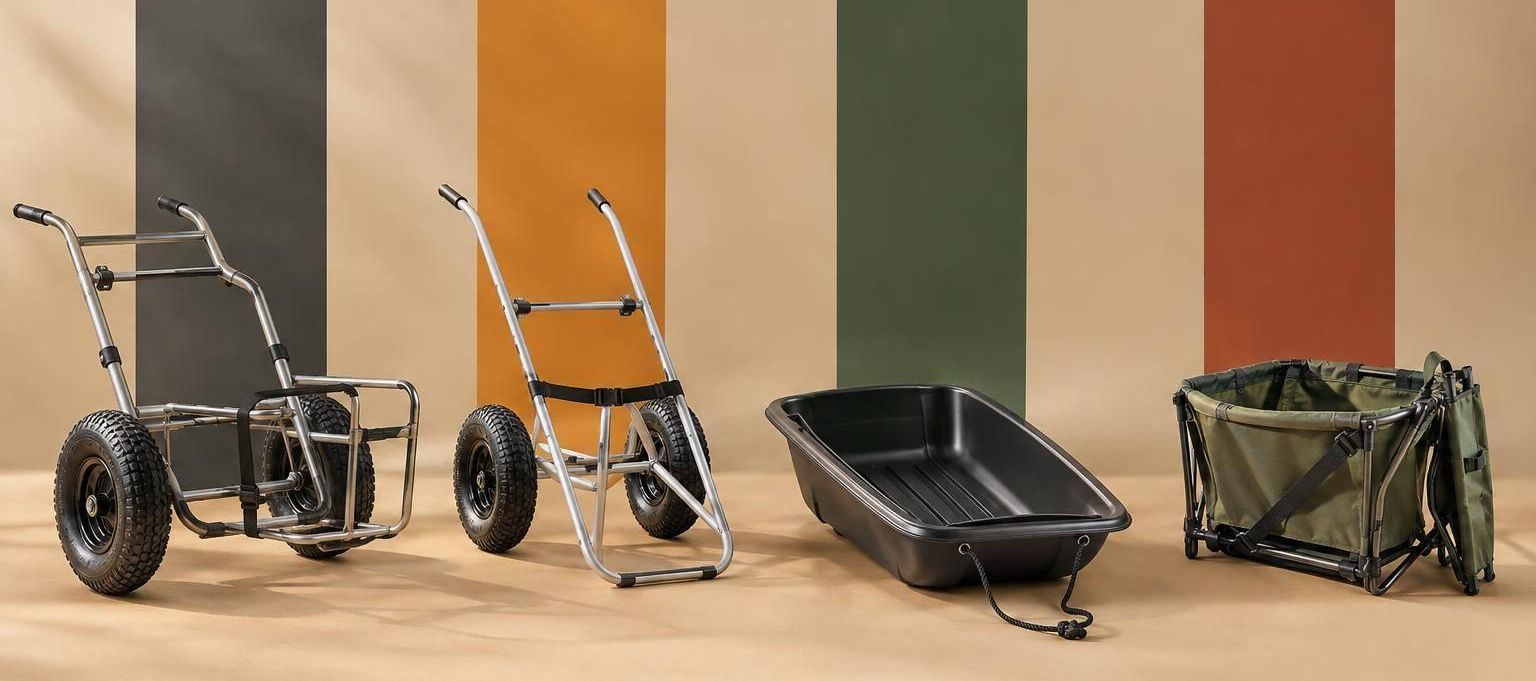
The four designs mainly differ in weight, space requirements, and handling:
- Steel frame game cart: durable but heavier; for well-passable paths.
- Aluminium frame game cart: lighter weight; many models weigh about 10–15 kg according to the article. Frame, wheels, and manufacturer load capacity remain crucial for selection.
- Rigid game tray or sled: for snow, mud, and soft ground; requires more storage space.
- Foldable game tray or carrying stretcher: compact pack size; carrying and pulling must be checked separately.
Quick comparison
| Design | Suitable Use | What I watch for |
|---|---|---|
| Steel cart | Firm to moderately uneven paths | Weight, load capacity, rust |
| Aluminium cart | Paths where low weight matters | Wheels, axle, connections |
| Rigid tray or sled | Snow and soft ground | Pull release, sliding surface, storage space |
| Foldable carrier | Short to medium distances, little storage space | Load capacity, seams, handles, pull release |
<u>A game tray is not automatically suitable for pulling.</u> I only use it for that with explicit manufacturer approval. I secure the game against slipping and protect exposed meat surfaces from dirt. If I can’t move or stop the load safely, I plan for help. After use: clean, check for damage, and store completely dry.
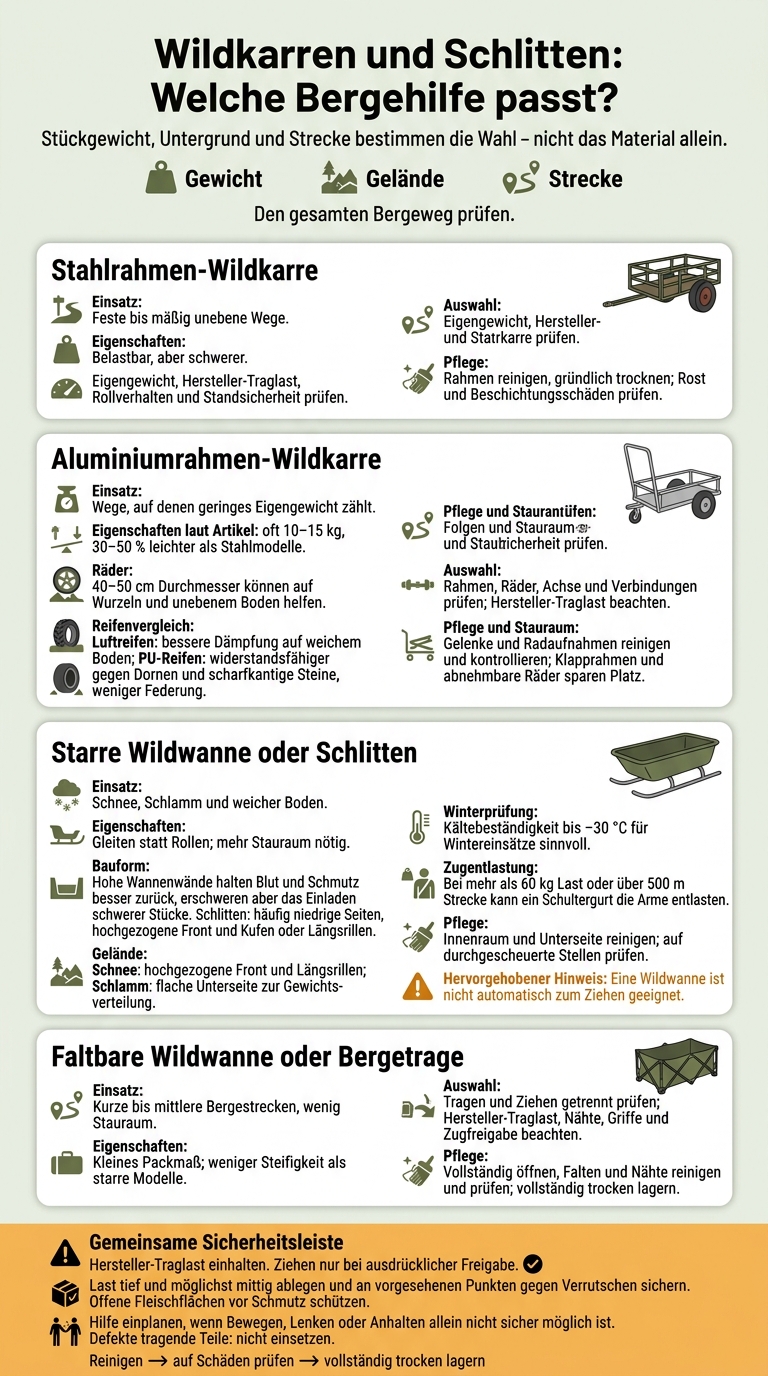
Game carts and sleds: Which carrier fits?
1. Game Cart with Steel Frame
Design and Use
Game carts with steel frames are very durable and sturdy. However, they have more weight. They are especially suitable for stand and calling hunts as well as for roe and red deer.
Terrain
These carts are suitable for firm to moderately uneven terrain.
Hygiene
Remove mud and dirt after each use. This prevents contamination from transferring to game and equipment [3][4]. Dry the frame thoroughly afterwards.
The next section covers how aluminium reduces weight.
sbb-itb-1cfd233
2. Game cart with aluminium frame
Design and materials
Aluminium offers less weight with sufficient load capacity. Such game carts often weigh 10–15 kg and are thus 30–50 % lighter than steel models. This makes transport easier on long and steep routes.
How stiff the cart is depends on the frame, the joints, and the axle setup. Check these parts carefully. For the permissible load, the load capacity according to the manufacturer counts.
Terrain and load capacity
On roots and uneven ground, wheels with a 40–50 cm diameter help. Air tires cushion better on soft ground. PU tires withstand thorns and sharp-edged stones better but absorb less shock.
If the axle sits below the load’s centre of gravity, it relieves your arms. If it’s too far back, you have to carry more weight at the handles. When transporting wild boar, a wide track and a low load position reduce tipping. Position the centre of gravity over or slightly in front of the axle and secure the game with tie-down straps.
Hygiene and storage
After transport, clean especially the load surface, joints, and wheel mounts. No organic residues should remain there. Also check if the axle bolts are tight.
Folding frames and removable wheels save space in storage. However, you also have to clean and check their additional joints.
Game Cart vs. Deer Sled! Getting deer out of woods - which is best? Part 1 of 2 part series!
3. Rigid game tray or deer sled
Where wheels can no longer move on soft ground, rigid trays and sleds can help. They glide over the surface instead of rolling on it.
Design and materials
Rigid plastic trays with high side walls retain blood and dirt better. However, heavy game is harder to load. Deer sleds often have lower, slightly flared sides, a raised front, and shaped runners or integrated longitudinal grooves. Use only models with reinforced towing eyes or attachment points expressly designed for pulling.
Check the manufacturer’s description: Is the model suitable for pulling over the ground, and what cold resistance is specified? For winter use, cold resistance up to −30 °C is advisable. A simple tray does not replace a dragging tray.
Besides the design, it also matters whether you want to pull the game over snow, mud, or firm ground.
Terrain and load capacity
On snow, deer sleds with raised fronts and integrated longitudinal grooves glide better. In mud, a flat bottom distributes the weight over a larger area. On forest paths, narrow sleds with a low centre of gravity are more stable than tall trays. The loading area must offer enough space so the barrels don’t get caught.
Integrated slots for tie-down straps help you secure the game against slipping. For more than 60 kg load or a distance over 500 m, a shoulder strap can distribute the pulling force on the upper body and relieve the arms.
Hygiene and Storage
Protect the game meat during transport from dirt and other contaminants [3]. A clean blanket or hide protects against dirt. Smooth HDPE is easy to clean. However, rigid models require more storage space and cannot be folded.
If packing size and storage space are more important, foldable game carriers are the next option.
4. Foldable Game Tray or Game Carrier
If a small packing size is more important to you than maximum stiffness, foldable game carriers are easier to carry and store more compactly than rigid models. Depending on the design, they are suitable for short to medium game retrieval distances.
Strictly follow the manufacturer's load rating. You may only use the game carrier for pulling if the model is explicitly designed for it. Choose the version according to your space requirements, load, and planned distance.
After use, remove dirt, blood, and plant residues – especially at folding points, existing joints, straps, and contact surfaces. Then store the game carrier dry.
Adapt Game Carrier to Terrain, Load, and Distance
This overview complements the individual types and helps you select the game carrier based on distance, load, and ground. Check the entire retrieval route, not just the find spot. Mud, broken ground, molehills, and dense underbrush determine which design is suitable.[1][2][4]
The table lists the test criteria for each design. Always evaluate them based on your actual route.
| Design | Terrain | Load and Handling | Retrieval Distance |
|---|---|---|---|
| Steel Frame Game Cart | On uneven ground and in mud: rolling behaviour, manoeuvrability, and stability | Load capacity, stability, and pulling effort | Move and stop safely |
| Aluminium Frame Game Cart | Same as steel frame; additionally check wheel clearance | Same as steel frame; evaluate own weight separately | Move and stop safely |
| Rigid Game Tray or Sled | In mud and vegetation: sliding and pulling behaviour | Lateral guidance and stability | Controlled stopping |
| Foldable Game Tray or Game Carrier | Evaluate carrying and pulling separately | Load capacity, handles, and space for helpers | Effort when carrying or pulling |
The decisive factor is the weight of the game, not the species. Angaben in kg only indicate the upper limit. They say nothing about suitability for terrain.[1][2][4] Check the clearance under the frame and axle for carts. For every design, pay attention to steerability, stability, pulling effort, and your secure footing.
Plan for help as soon as you cannot safely manage load, steering, or stopping alone.[1][2] Manual help is often needed for heavy recoveries.[4] After use, cleaning and dry storage are required.
Cleaning, Storage and Maintenance
Besides design and area of use, how easy the recovery aid is to clean and store also matters. The design affects not only pulling behaviour and load capacity but also the effort needed for cleaning and drying.
| Design | Care and Checkpoints |
|---|---|
| Steel frame game cart | Clean the open frame. Watch for rust and damage to the coating. |
| Aluminium frame game cart | Clean the open frame; for folding models, especially check joints and wheel mounts. |
| Rigid game tray or sled | Clean the interior and underside and check for worn spots. |
| Foldable game tray or carrying stretcher | Fully open for cleaning and drying. Check and clean folds and seams particularly carefully. |
Quick check before loading: Is the total load within the manufacturer’s approval? Check wheels, axles or sliding surfaces as well as handles, seams, pulling points and carrying surfaces for cracks, abrasion and deformations. Also watch for bent or loose connections. Do not use the recovery aid with defective load-bearing parts.
Place the game low and as centrally as possible. Secure it at the designated points against slipping and falling out. Open meat surfaces must not be dragged over dirty surfaces.[3]
Remove dirt, hair and residues first. Then clean the recovery aid according to the manufacturer’s instructions and disinfect if necessary. Only store it when completely dry. Textile parts must not be folded damp. Follow the manufacturer’s instructions for maintenance and repairs as well.
Conclusion: Choose According to Load and Terrain
Which game carrier fits depends on three questions: How heavy is the game, how long is the distance, and how difficult is the terrain? Game weight, distance, and terrain determine the choice. The material alone is not enough: Load capacity and manufacturer approval must also match the intended use.
| Load | Terrain and Distance | Suitable Design and Material | Check Approval |
|---|---|---|---|
| Heavy game | Well passable forest paths, longer distance | Durable game cart with steel frame | Permissible load and approval |
| Light game | Well passable paths, medium to longer distance | Game cart with aluminium frame, if low weight is important | Permissible load and approval |
| Game within permissible load capacity | Snow, mud or dense underbrush, short to medium distance | Rigid game tray or sled made of plastic | Pulling only with explicit approval |
| Light game | Difficult terrain, short distance to vehicle | Foldable tray or carrier made of textile or plastic | Check load capacity and pulling approval separately |
For further selection, packing size, cleaning, and secure attachment points matter. Before purchase, check load capacity, empty weight, dimensions, cold resistance, cleanability, packing size, and attachment points.
At Gunfinder you will find game carriers depending on the listing. Check load capacity, approval, and availability there. Missing information should be clarified before purchase.[1][2][3]
FAQs
How do I safely carry game on steep slopes?
On steep slopes, the weight can shift forward when braking and overload certain areas. Therefore, keep the load low and as centred as possible. Also, make sure to distribute the weight evenly.
Use a stable carrying system or pack carrier, for example with a good hip belt and suitable frame. This reduces slipping of the load, makes it easier to control, and helps you maintain balance. Regularly check the fit and straps, especially after movements on uneven terrain. [1][2]
Which game carrier is suitable for changing terrain?
If you regularly transport heavy loads over changing or soft terrain, a game carrier with multiple, closely spaced axles is a good choice. The axles distribute the load over a larger area and thus reduce ground pressure. On particularly wet or very soft ground, dual wheels provide additional contact area.
Also pay attention to a low centre of gravity centred between the axles. This protects the frame and keeps the recovery aid stable in the field and when braking.
What should I look for in used game carts?
The condition of the mechanical components limits the load capacity. Check the frame for deformations, cracks, and weak points at the welds. These damages can become critical, especially under load in the field. Inspect axles and wheels for bearing play and wear. Models with multiple axles have more moving parts and are therefore more prone to defects.
If brakes are present, check that they work perfectly. This is especially important on slopes. The design must suit your paths and the load.