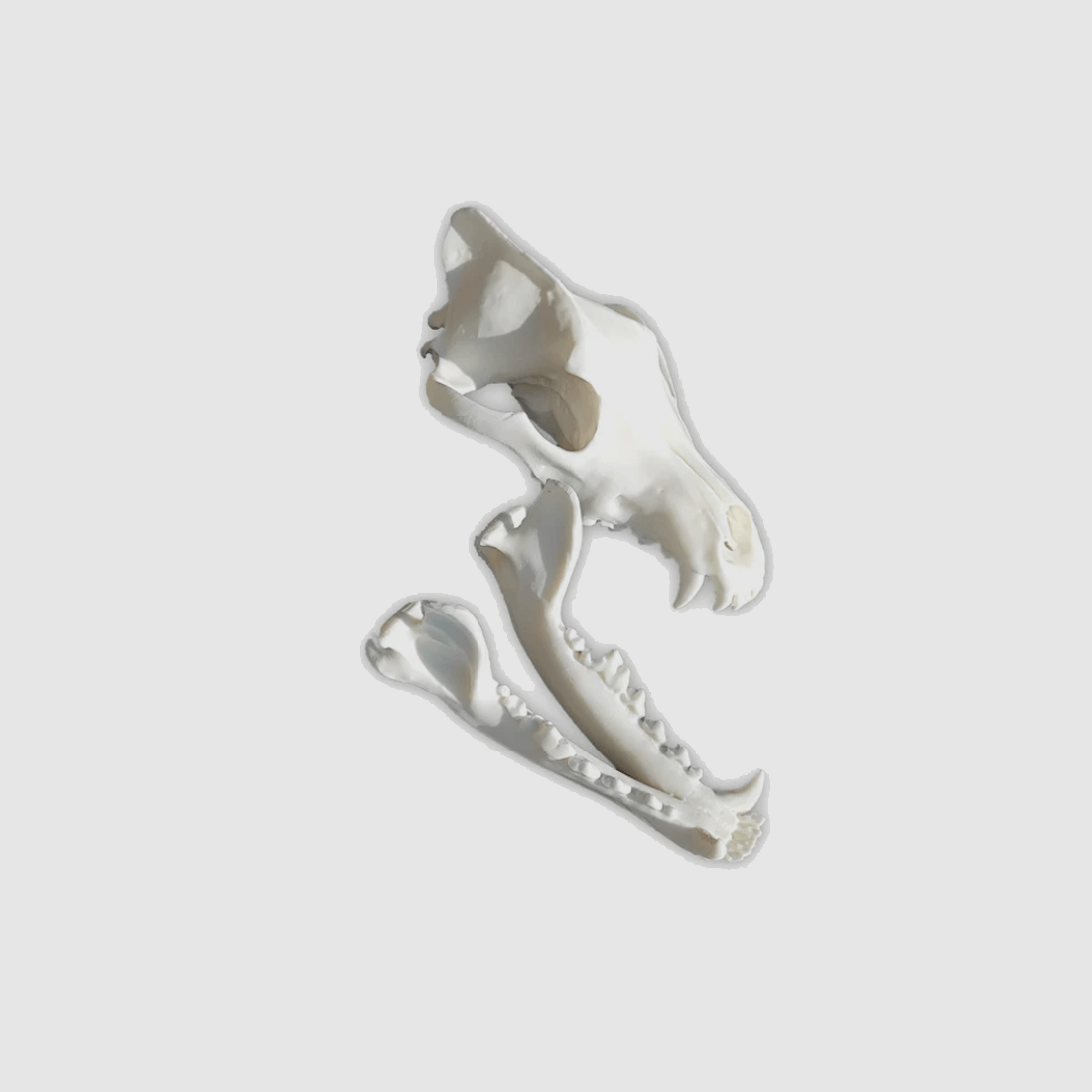
Wolf skull replica (life-size)
115.50 €
No permit required (18+)
53175 Bonn, Germany
13
ID: 9792646
Shop safely with Gunfinder
Our AI-powered seller identity verification makes Gunfinder the safest marketplace online.
Learn more
Details
- Original language
- German
- Category
- Condition
- New
- Location
- 🇩🇪 53175 Bonn, Germany
- Availability
- In stock
Freshness
This listing is based on a mirrored offer, where the listing data was synced to us from a shop, dealer, or external marketplace. Please note that temporary price discrepancies may occur due to possible delays in data transmission.
- Source
- DJV-Shop
- Last updated
- about 19 hours ago
Description
Note:
The item is located abroad. Please note that delivery conditions, shipping times, and/or the purchase process may differ.
An impressive model of the wolf: This realistically crafted wolf skull replica made from PLA plastic showcases all the distinctive features such as the typical skull shape, pronounced teeth, and proportions – two-part and life-sized made from high-quality PLA plastic. Perfectly suited for use in environmental education, nature education programs, or hunting license courses.
Product details:
Life size: approx. 26 x 15 cm
Two-part: upper and lower jaw
Material: PLA plastic
Delivered in a high-quality presentation box
Ideal for environmental education, school, hunting, exhibition, props
Information about the wolf skull
The skull of wolves is elongated and relatively flat and wide, with the eyes positioned slightly obliquely. The brain volume is significantly larger than that of similarly sized domestic dogs. The zygomatic arch (lower bony arch of the eye socket) is distinctly pronounced, where the Musculus masseter, the main chewing muscle, attaches. This muscle raises the lower jaw, enabling jaw closure, which allows for powerful chewing movements.
The wolf's dentition has 42 teeth in the permanent dentition. The tooth change occurs between the 5th and 7th month of life. Wolves have a typical carnivore dentition with large canine teeth (Incisivi). Due to the arrangement and shape of the back teeth, they form what is known as a shearing blade, allowing wolves to bite off pieces of meat and even crush bones.
In total, wolves have 42 teeth, their dentition consists, as in all dogs, of three incisors (Incisivi), one canine (Caninus), four premolars (Praemolares), and two molars (Molares) per upper jaw half, and three incisors (Incisivi), one canine (Caninus), four premolars (Praemolares), and three molars (Molares) per lower jaw half.
Dental formula upper jaw/lower jaw: Incisivi: 3/3, Caninus: 1/1, Praemolares: 4/4, Molares: 2/3
In the upper jaw, the premolar P4 is developed as a carnassial tooth and has a length of approx. 2 cm.
In the lower jaw, the molar M1 is the opposing carnassial tooth. The molar M2 in the upper jaw has a chewing surface of more than 100 square millimeters, which is not reached by any other dog species. (Show description in original language)
Das perfekte Anschauungsobjekt: eindrucksvoll und naturgetreu Ein beeindruckendes Modell vom Wolf: Dieses realistisch nachgebildete Wolfschädel-Replikat aus PLA-Kunststoff zeigt alle markanten Merkmale wie die typische Schädelform, ausgeprägte Zähne und Proportionen – zweiteilig und lebensgroß gefertigt aus hochwertigem PLA-Kunststoff. Perfekt geeignet für den Einsatz in der Umweltbildung, bei naturpädagogischen Programmen oder Jagdscheinkursen.Produktdetails:Lebensgröße: ca. 26 x 15 cmZweiteilig: Ober- und UnterkieferMaterial: PLA-KunststoffLieferung im hochwertigen PräsentationskartonIdeal für Umweltbildung, Schule, Jagd, Ausstellung, RequisiteInformationen zum Wolfsschädel Der Schädel von Wölfen ist langgestreckt und relativ flach und breit, die Augen sind leicht schräg gestellt. Das Hirnvolumen ist deutlich größer als das gleichgroßer Haushunde. Der Jochbogen (unterer Knochenbogen der Augenhöhle) ist deutlich ausgeprägt, hier setzt Musculus masseter, der wichtigste Kaumuskel, an. Dieser Muskel zieht den Unterkiefer hoch und macht damit den Kieferschluss möglich, wodurch kräftigen Kaubewegungen möglich sind.Das Wolfsgebiss weist im Dauergebiss 42 Zähne auf. Der Zahnwechsel erfolgt zwischen dem 5. und 7. Lebensmonat. Wölfe haben typisches Raubtiergebiss mit den großen Eckzähnen (Incisivi). Durch die Anordnung und Form der hinteren Zähne zueinander bildet sie die sogenannte Brechschere, so können Wölfe Fleischstücke abbeißen und sogar Knochen zerkleinern.Insgesamt haben Wölfe 42 Zähne, ihr Gebiss besteht wie bei allen Hunden pro Oberkieferhälfte aus drei Schneidezähnen (Incisivi), einem Eckzahn (Caninus), vier Vorbackenzähnen (Praemolares) und zwei Backenzähnen (Molares) pro Unterkieferhälfte aus drei Schneidezähnen (Incisivi), einem Eckzahn (Caninus), vier Vorbackenzähnen (Praemolares) und drei Backenzähnen (Molares) Zahnformel Oberkiefer/Unterkiefer: Incisivi: 3/3, Caninus: 1/1, Praemolares: 4/4, Molares: 2/3 Im Oberkiefer ist der Vorbackenzahn Prämolar P4 als Reißzahn ausgebildet und hat eine Länge ca. 2 cm.
Im Unterkiefer ist der Backenzahn M1 der gegenspielende Reißzahn. Der Backenzahn Molar M2 im Oberkiefer hat eine Kaufläche von mehr als 100 Quadratmillimetern, die von keiner anderen Hundeart erreicht wird.
Im Unterkiefer ist der Backenzahn M1 der gegenspielende Reißzahn. Der Backenzahn Molar M2 im Oberkiefer hat eine Kaufläche von mehr als 100 Quadratmillimetern, die von keiner anderen Hundeart erreicht wird.