
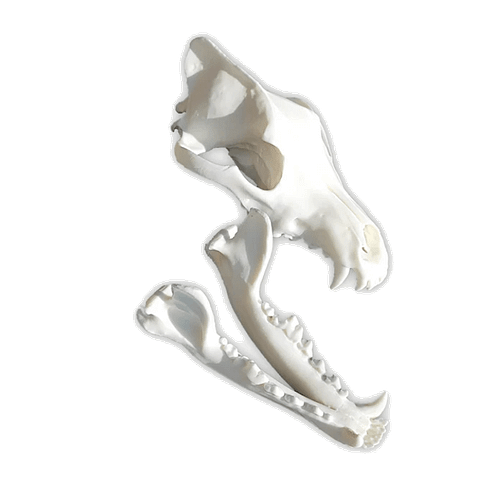
The perfect specimen: impressive and lifelike
An impressive model of the wolf: This realistically crafted wolf skull replica made from PLA plastic showcases all the distinctive features such as the typical skull shape, pronounced teeth, and proportions – two-part and life-sized made from high-quality PLA plastic. Perfectly suited for use in environmental education, nature education programs, or hunting license courses.
Product details:
Life size: approx. 26 x 15 cm
Two-part: upper and lower jaw
Material: PLA plastic
Delivered in a high-quality presentation box
Ideal for environmental education, school, hunting, exhibition, props
Information about the wolf skull
The skull of wolves is elongated and relatively flat and wide, with the eyes positioned slightly obliquely. The brain volume is significantly larger than that of similarly sized domestic dogs. The zygomatic arch (lower bony arch of the eye socket) is distinctly pronounced, where the Musculus masseter, the main chewing muscle, attaches. This muscle raises the lower jaw, enabling jaw closure, which allows for powerful chewing movements.
The wolf's dentition has 42 teeth in the permanent dentition. The tooth change occurs between the 5th and 7th month of life. Wolves have a typical carnivore dentition with large canine teeth (Incisivi). Due to the arrangement and shape of the back teeth, they form what is known as a shearing blade, allowing wolves to bite off pieces of meat and even crush bones.
In total, wolves have 42 teeth, their dentition consists, as in all dogs, of three incisors (Incisivi), one canine (Caninus), four premolars (Praemolares), and two molars (Molares) per upper jaw half, and three incisors (Incisivi), one canine (Caninus), four premolars (Praemolares), and three molars (Molares) per lower jaw half.
Dental formula upper jaw/lower jaw: Incisivi: 3/3, Caninus: 1/1, Praemolares: 4/4, Molares: 2/3
In the upper jaw, the premolar P4 is developed as a carnassial tooth and has a length of approx. 2 cm.
In the lower jaw, the molar M1 is the opposing carnassial tooth. The molar M2 in the upper jaw has a chewing surface of more than 100 square millimeters, which is not reached by any other dog species.
| ID | 9792646 |
| URL | https://www.gunfinder.com/items/9792646 |
| Category | Accessories / Hunting Literature |
| Condition | Neu |
| Location | 53175 Bonn, Germany |
| Availability | In stock |
| Shipping costs paid by | Buyer |