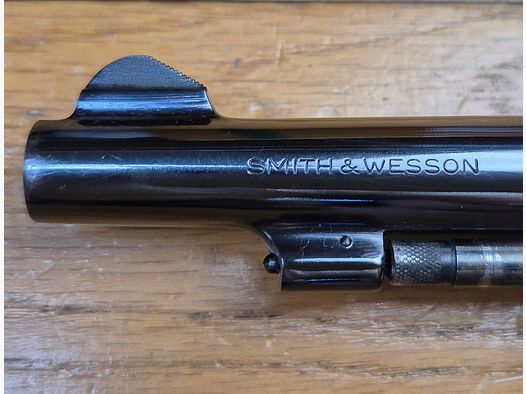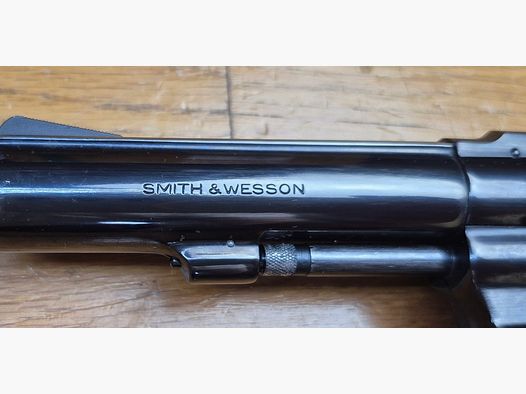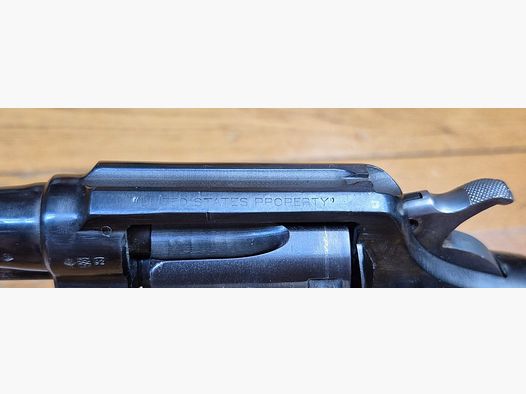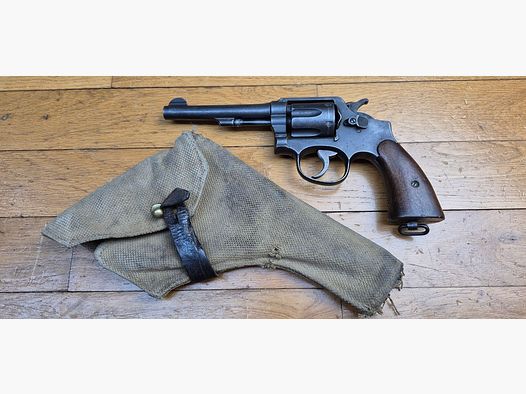
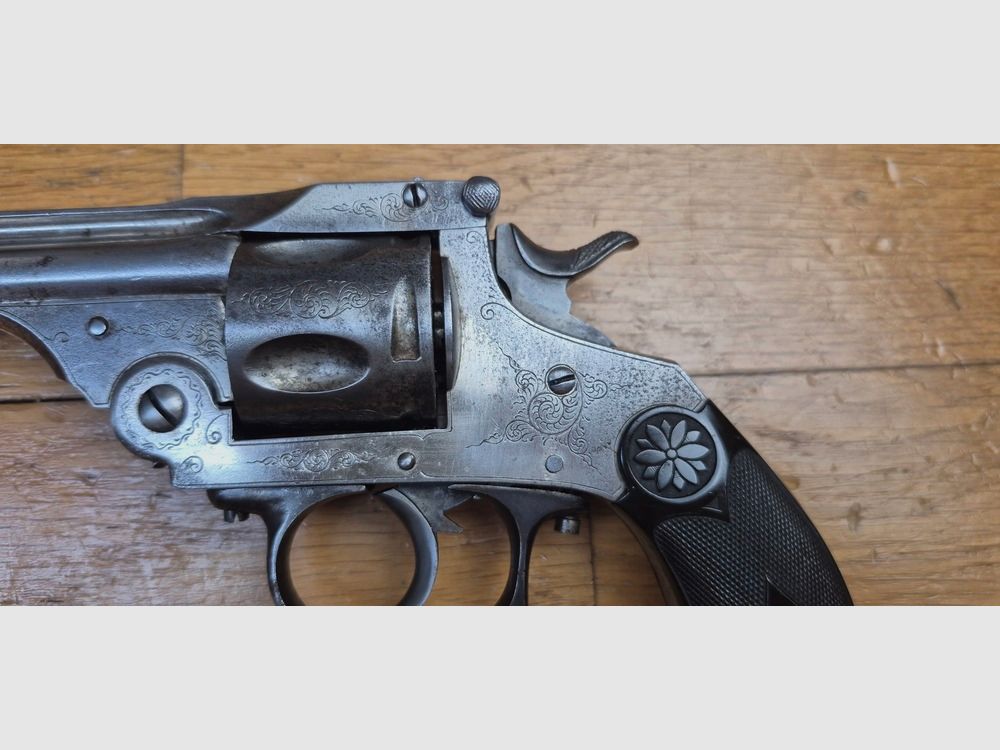
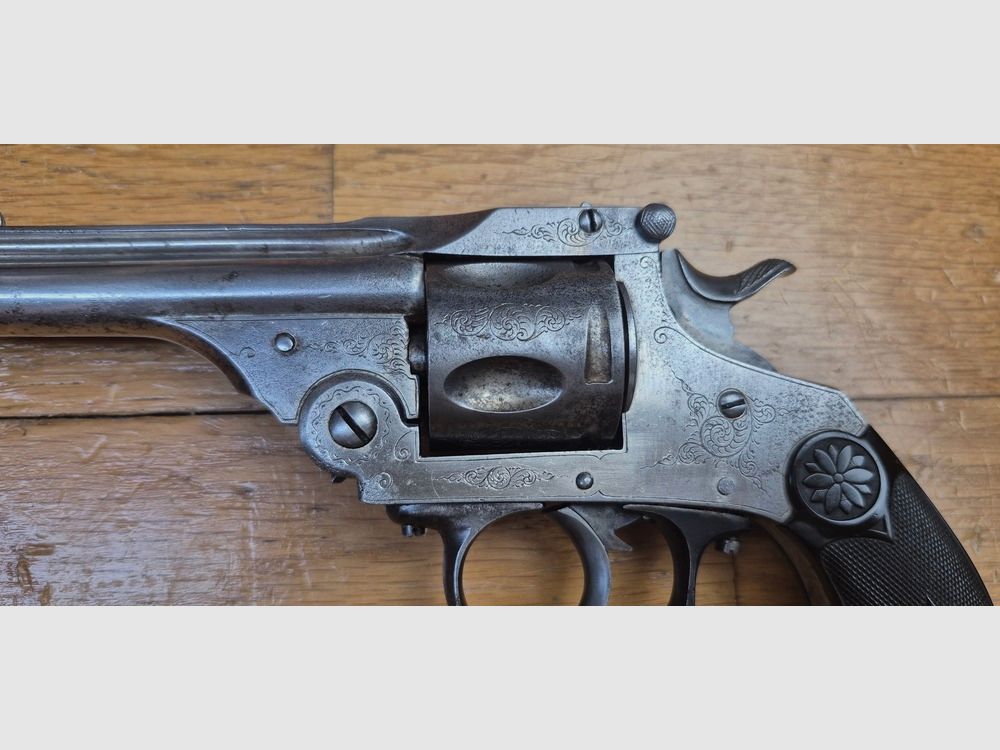
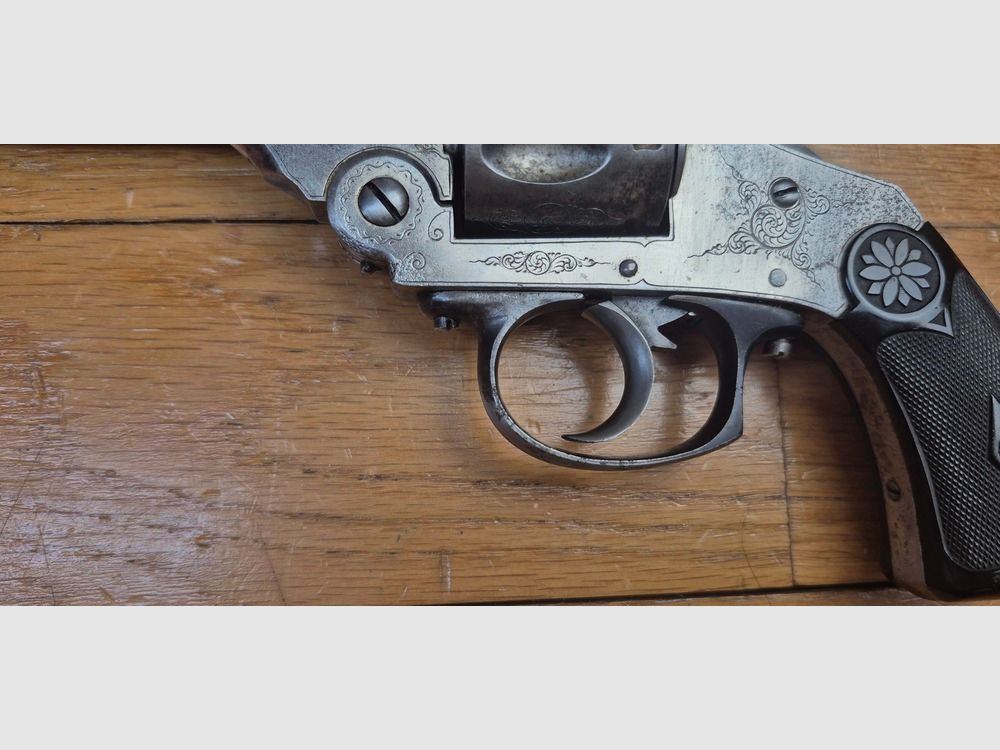

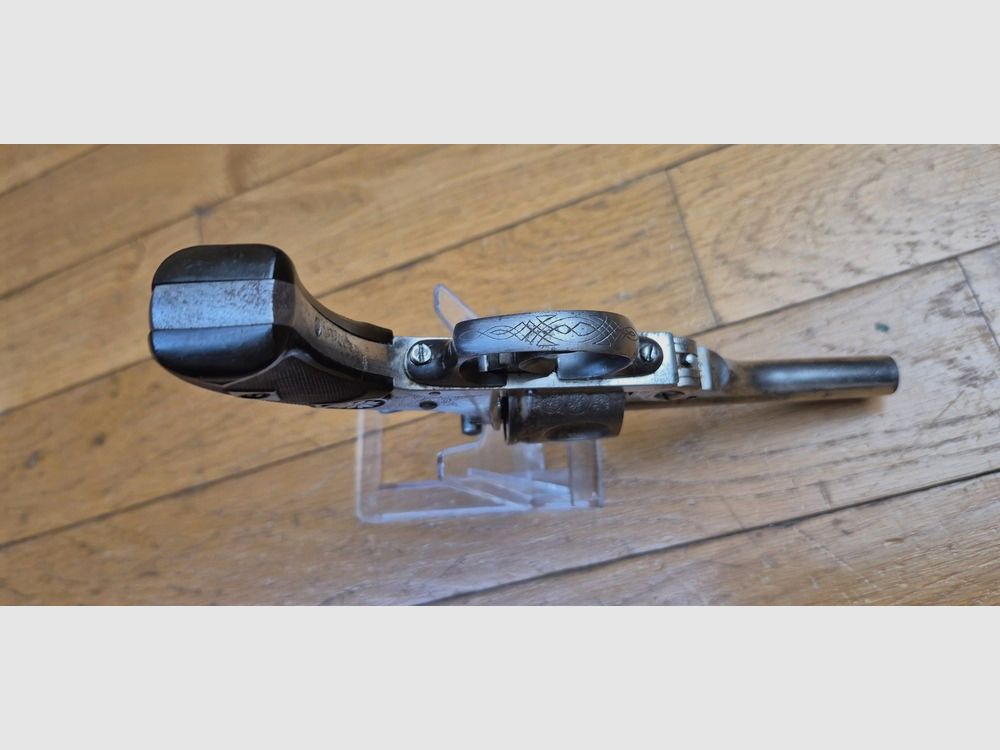
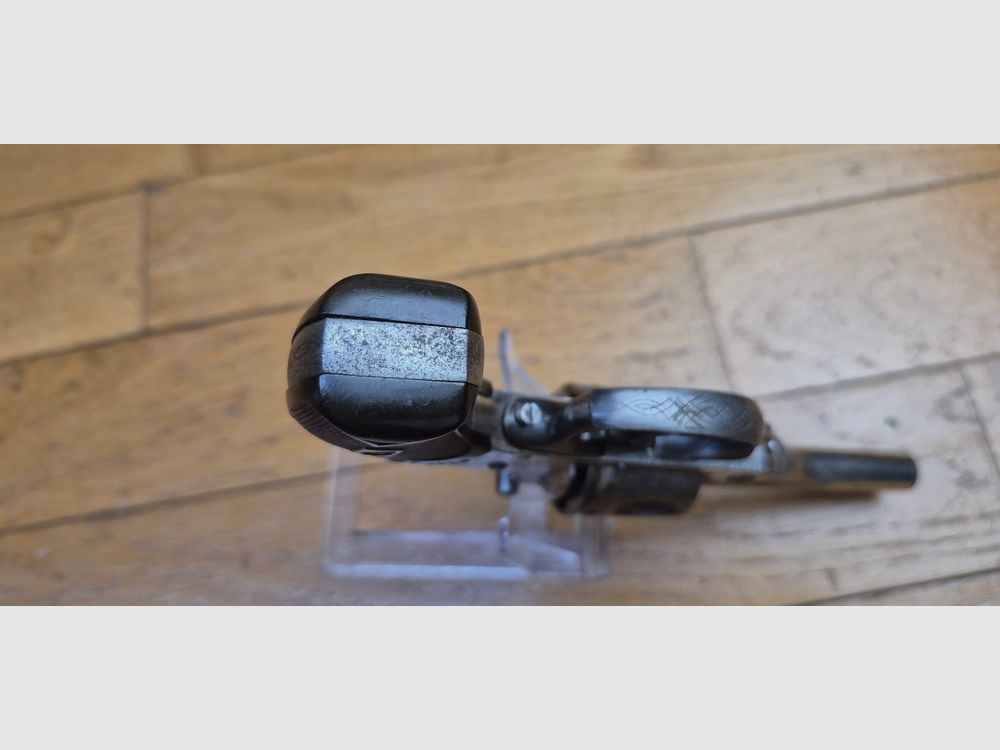
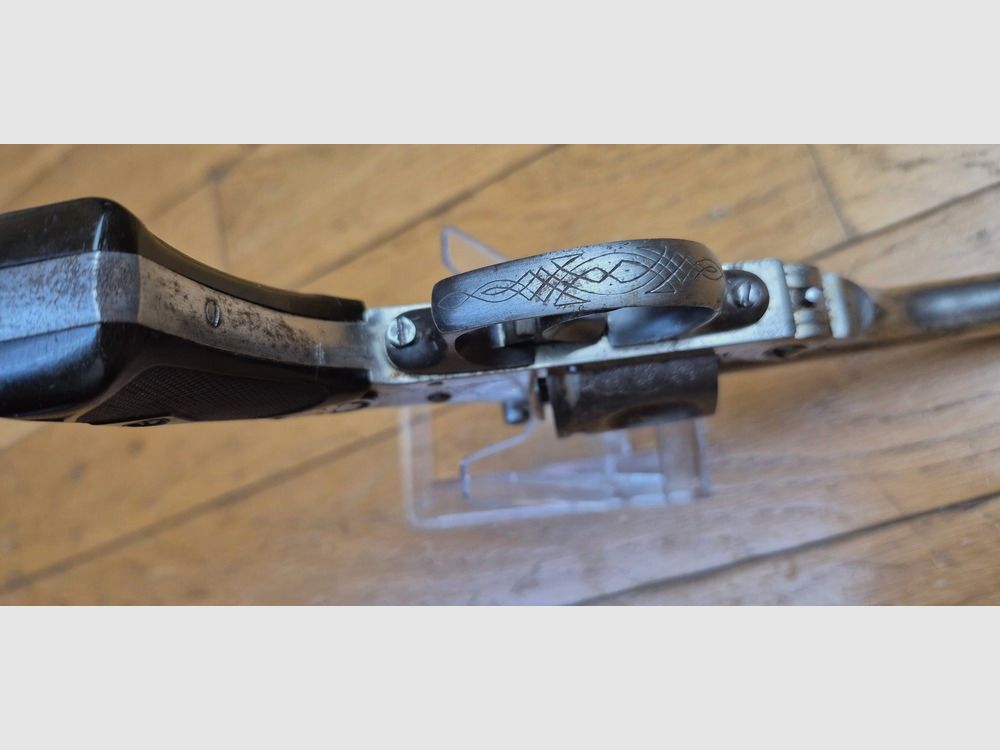
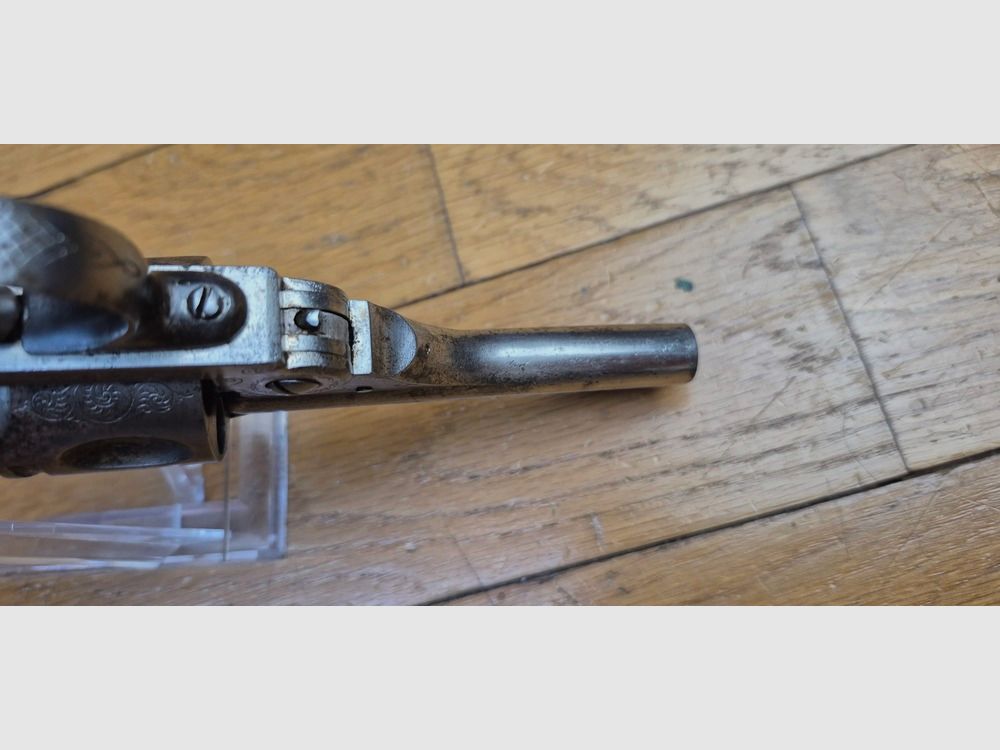
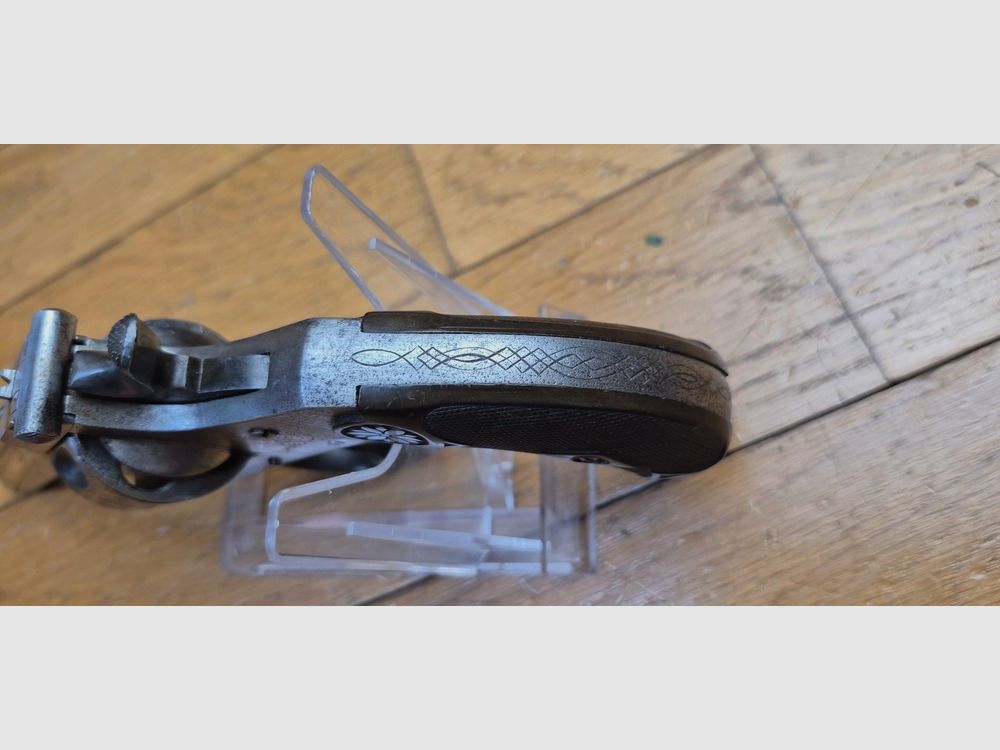
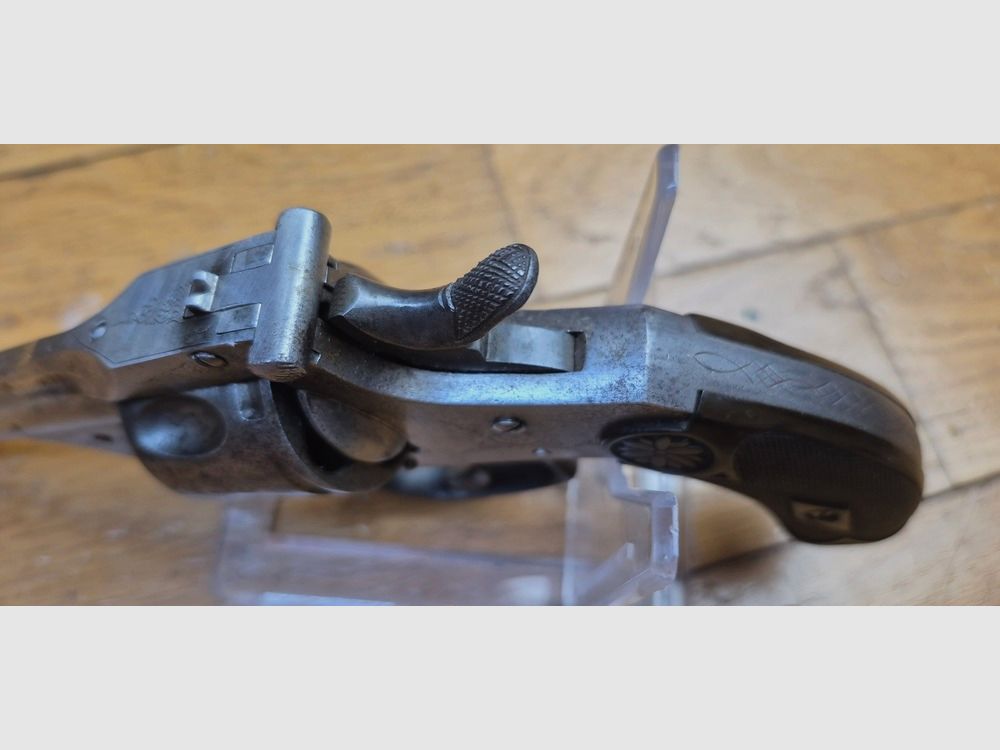

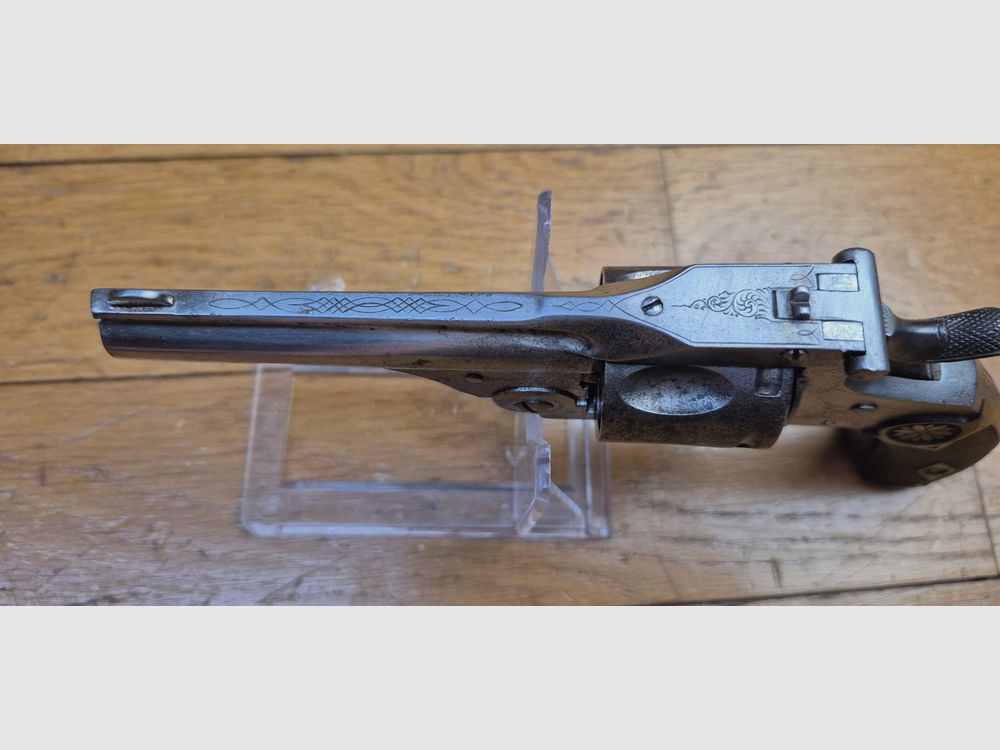
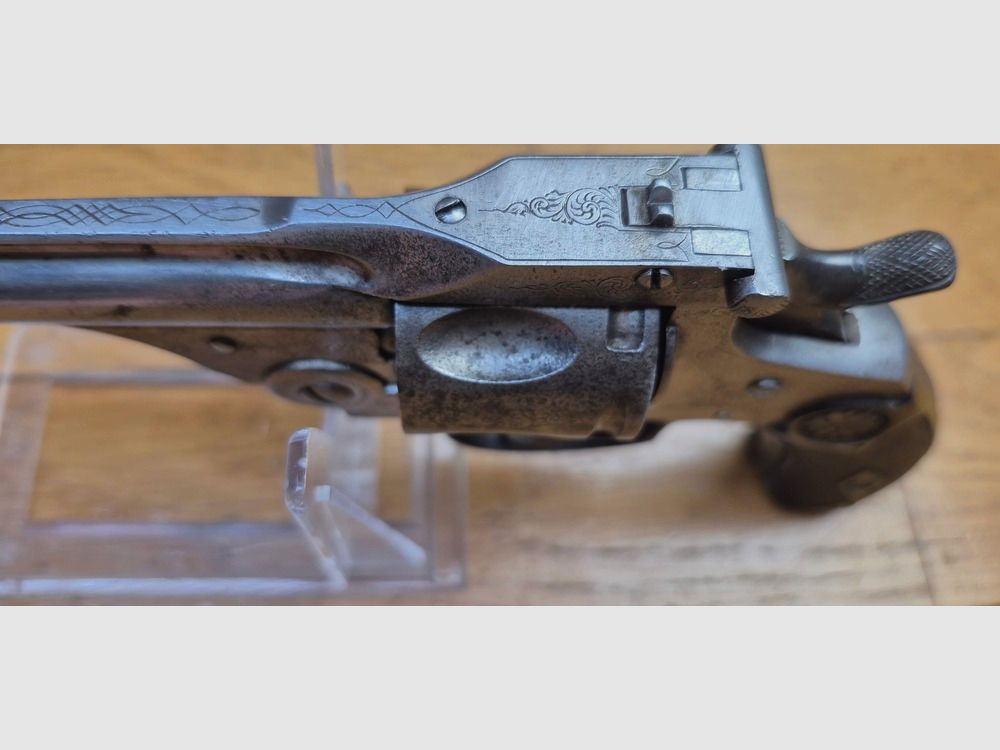
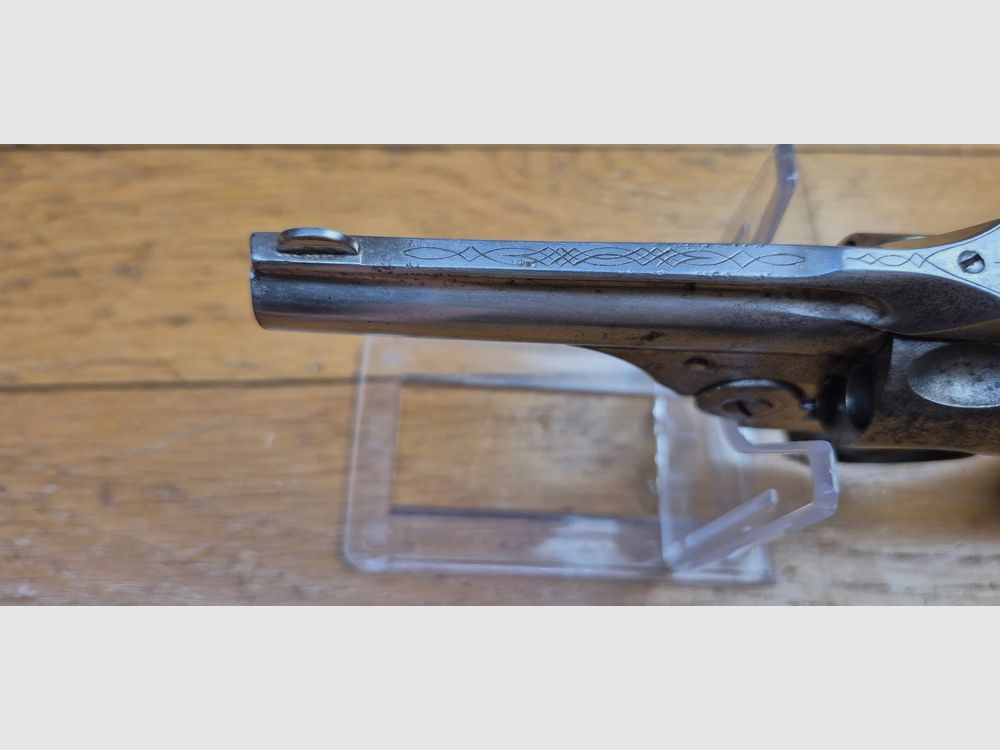
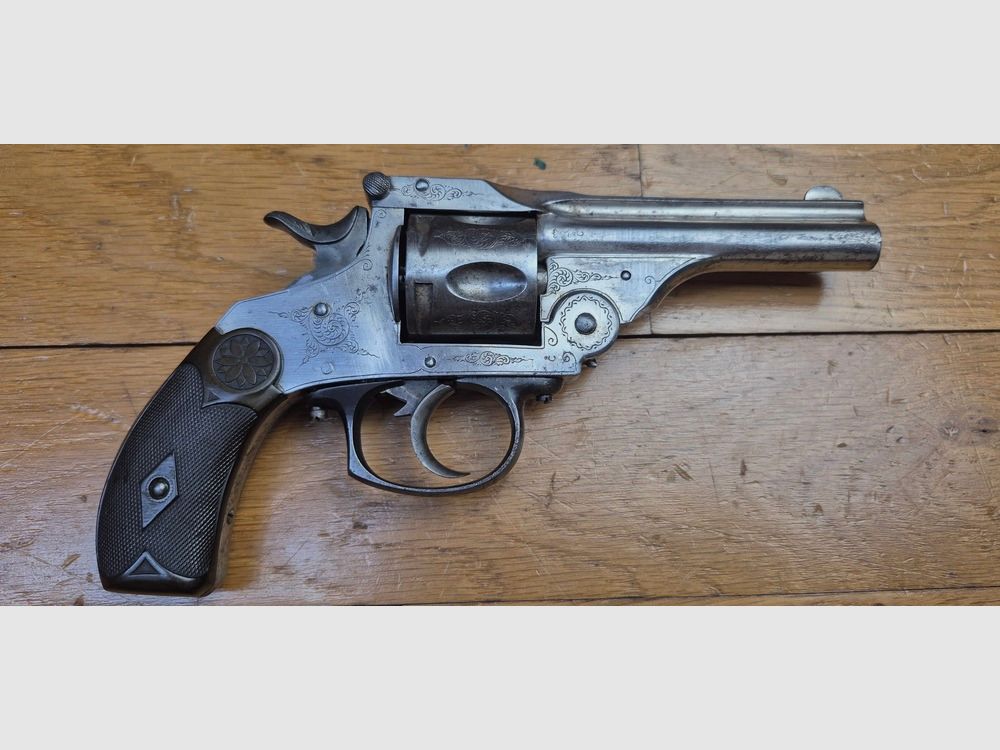
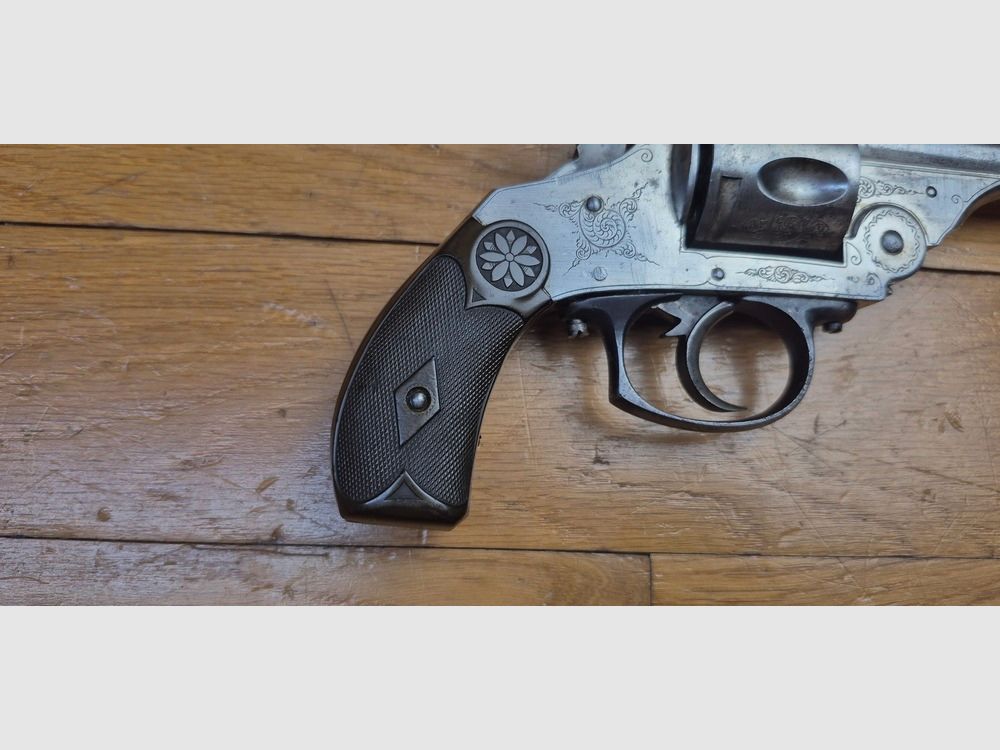
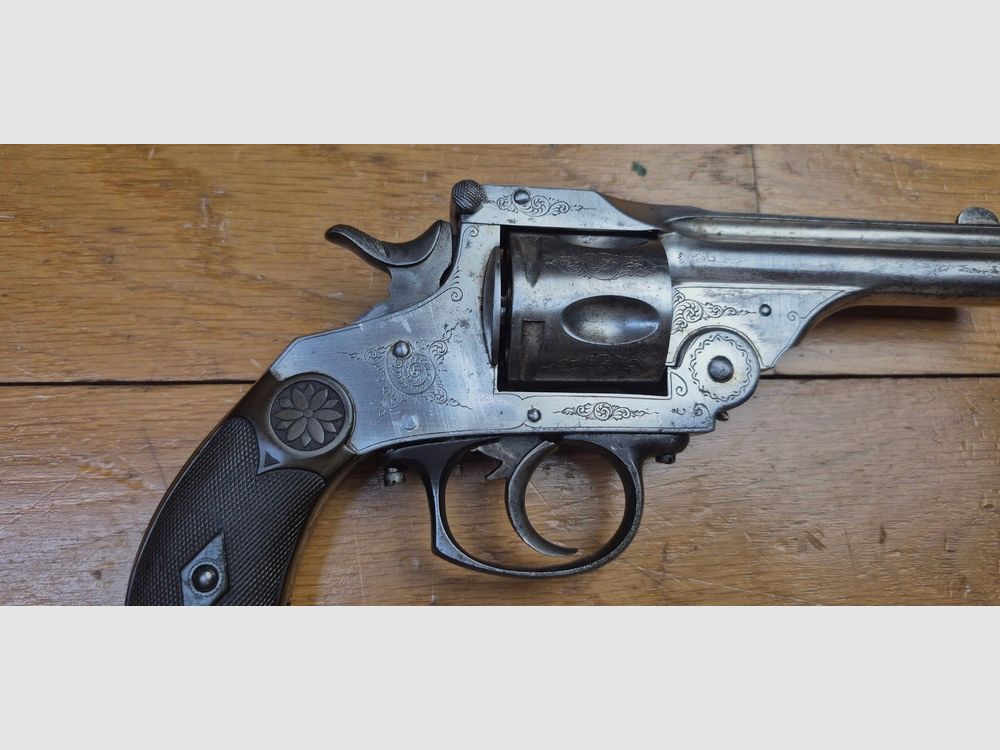
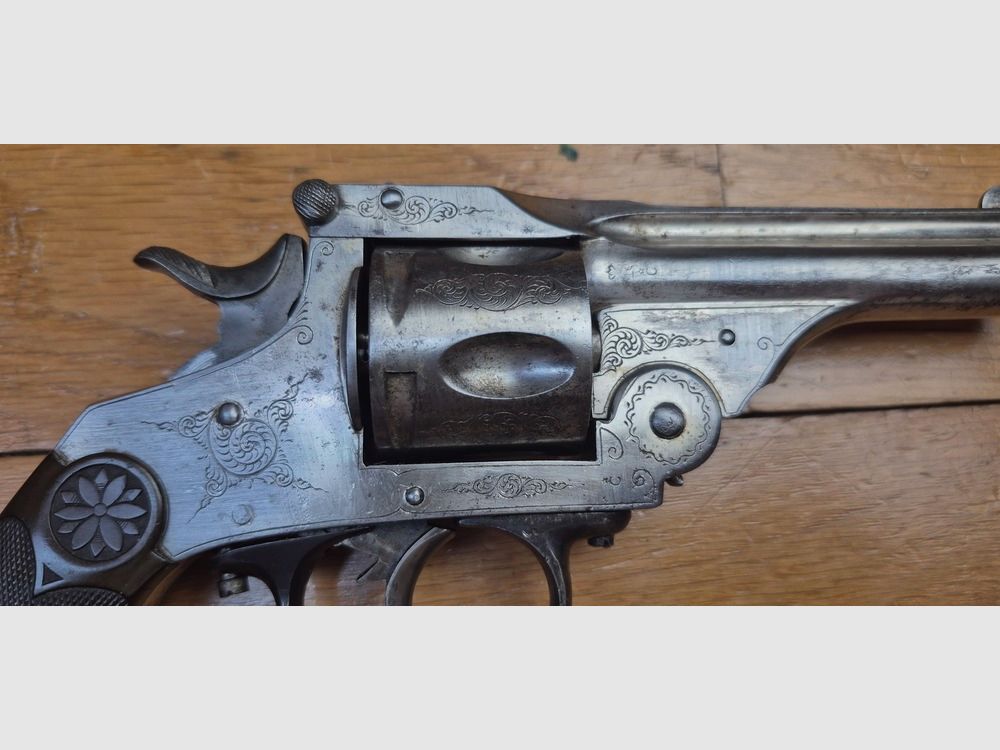

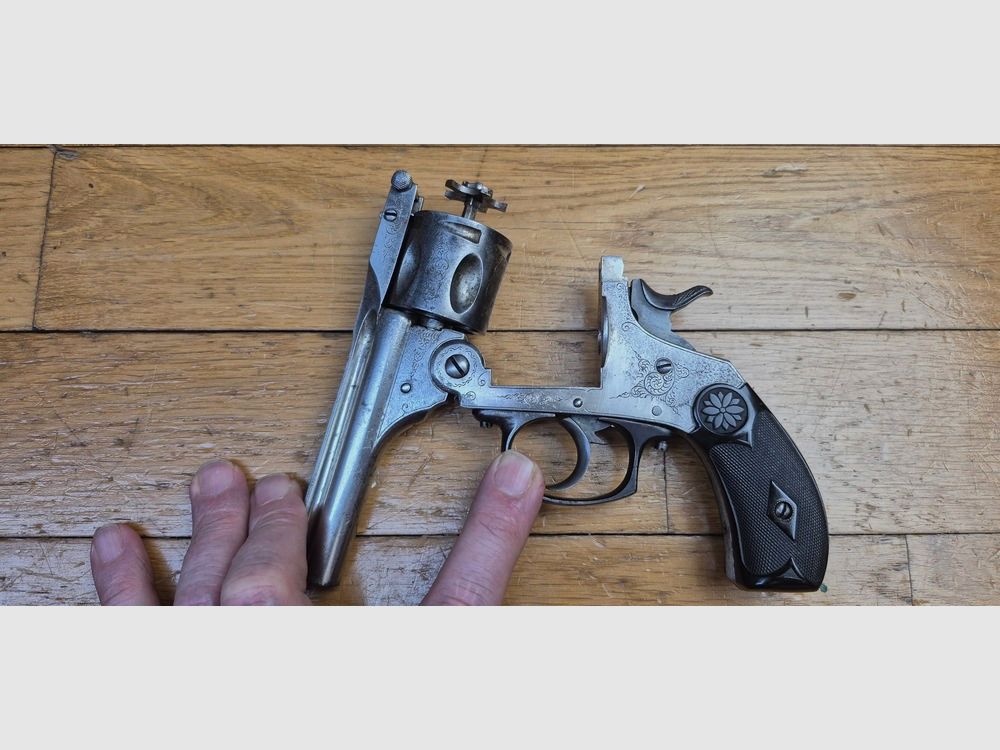


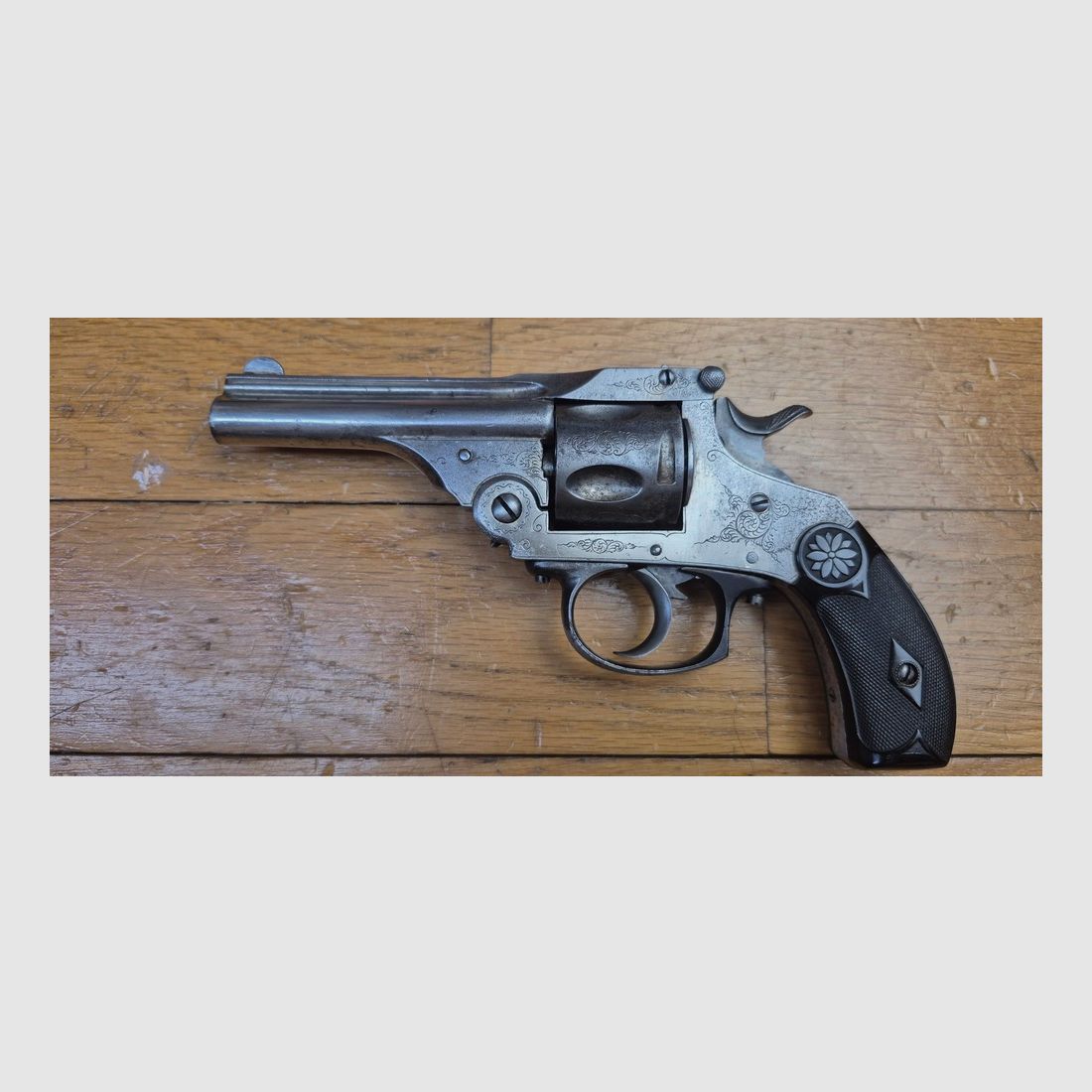
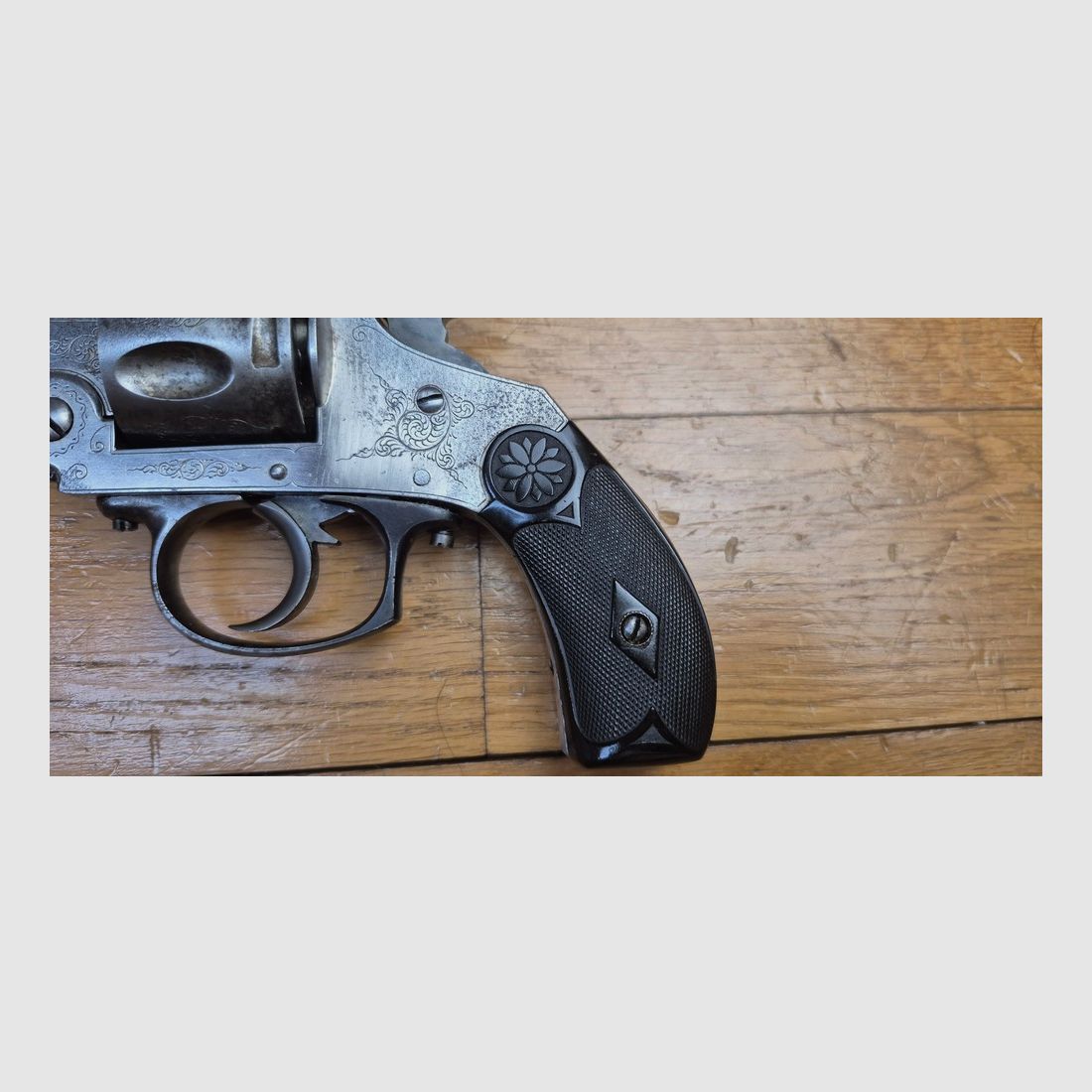
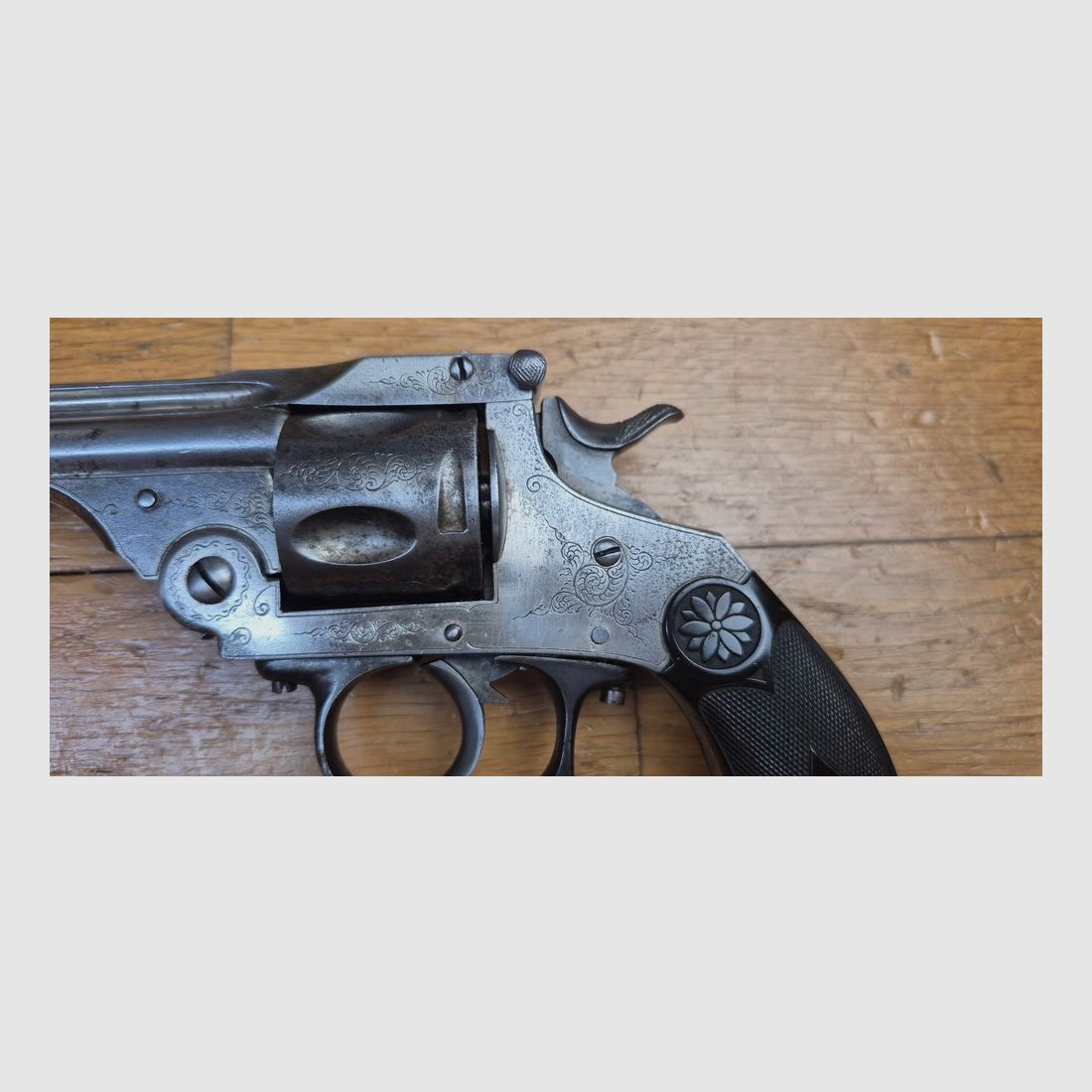
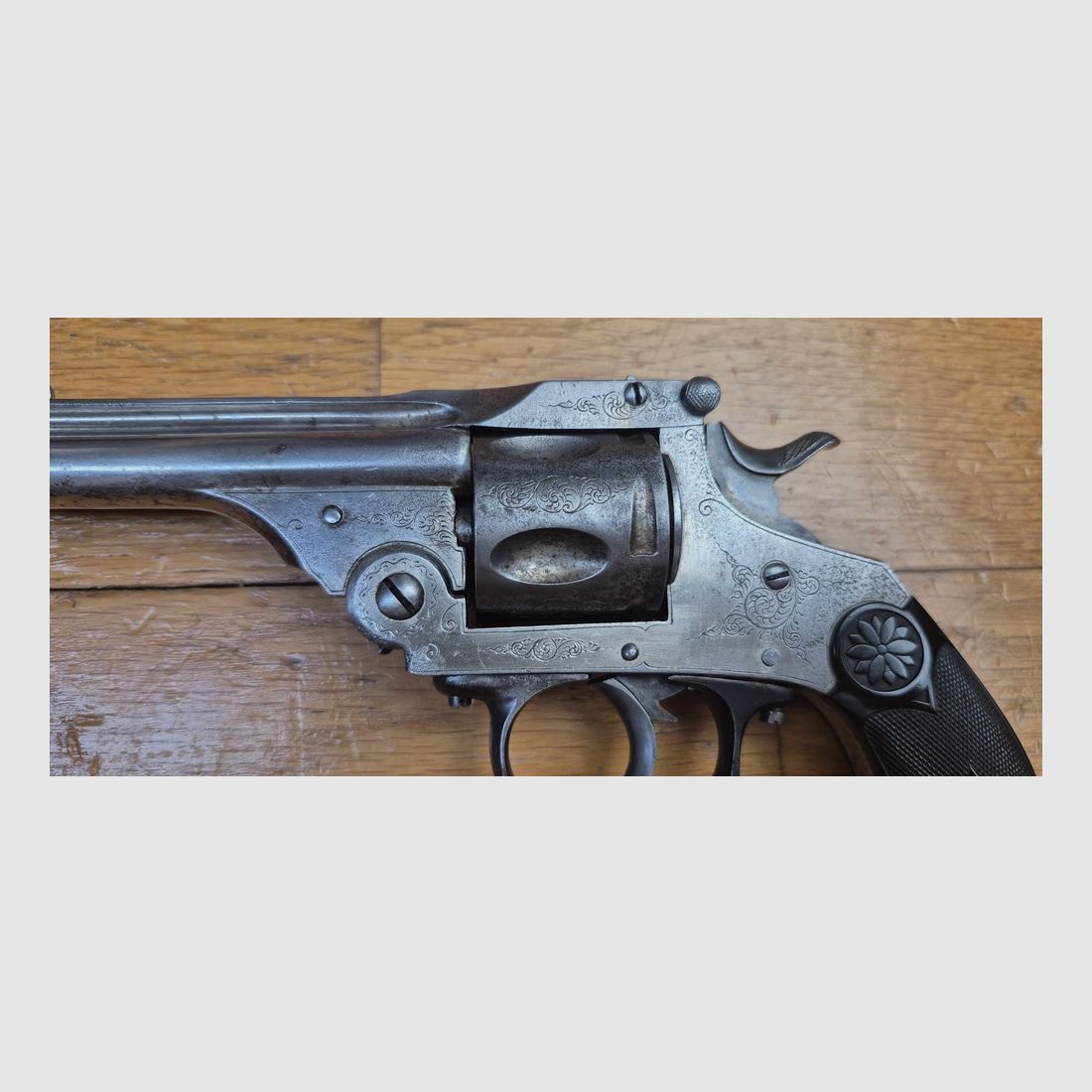


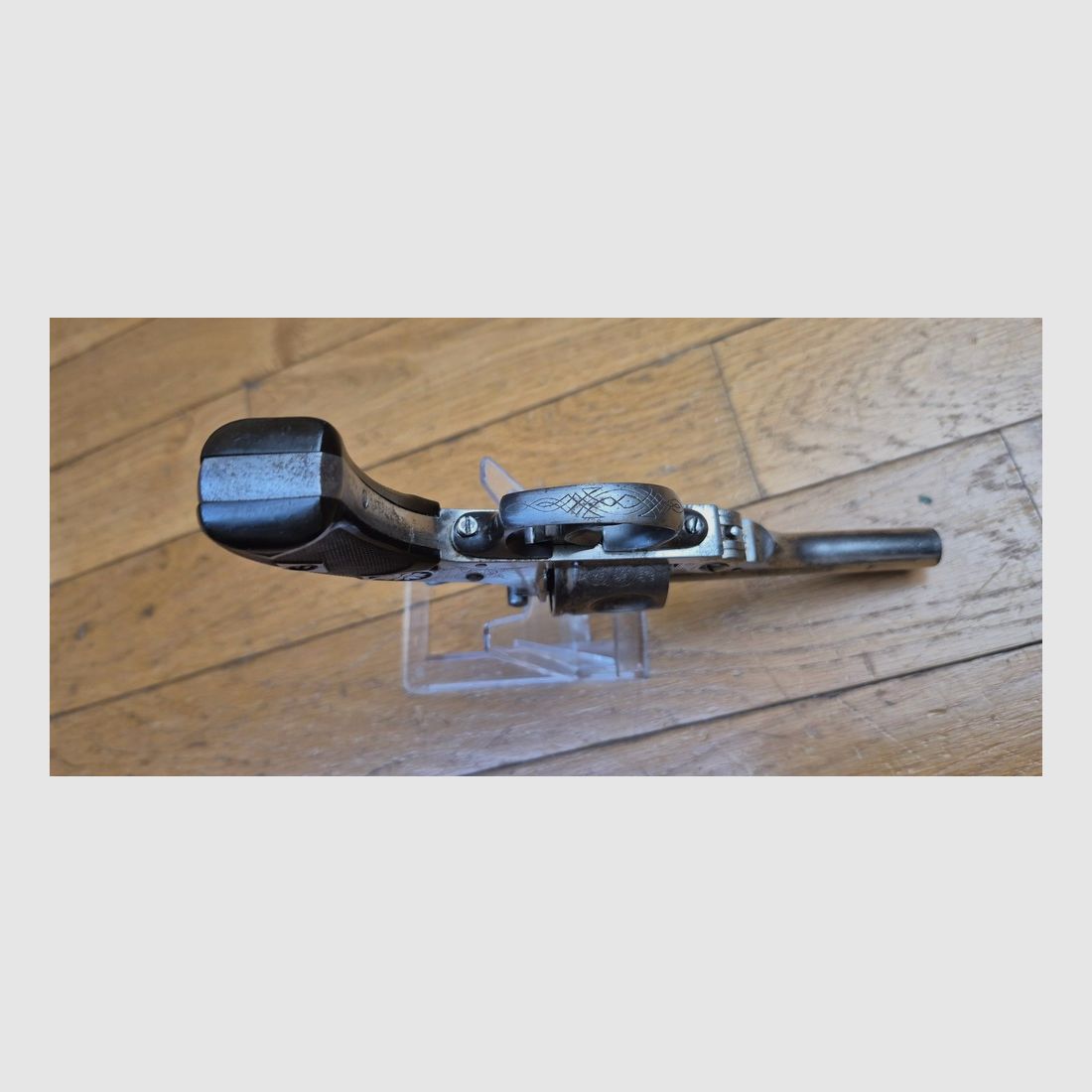


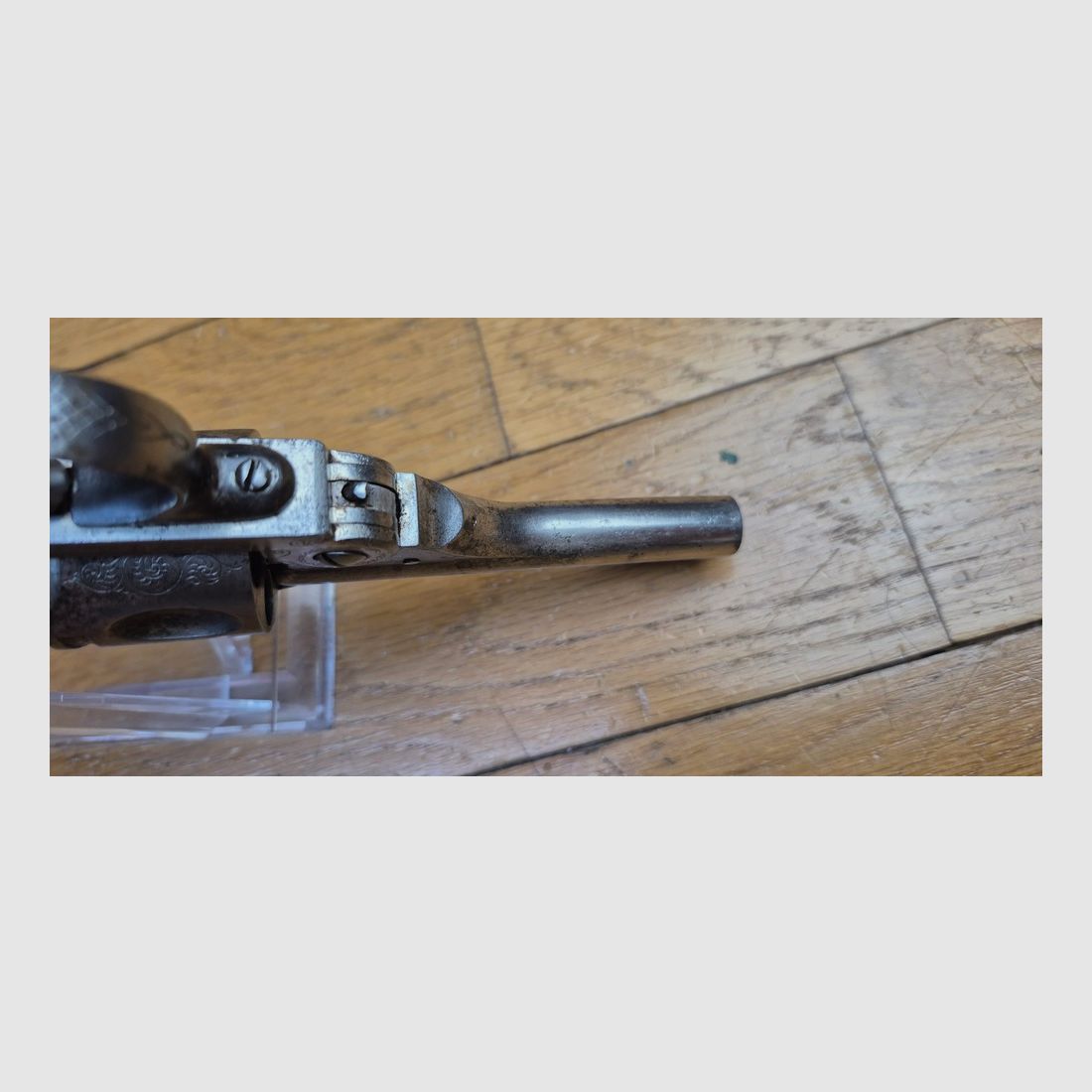
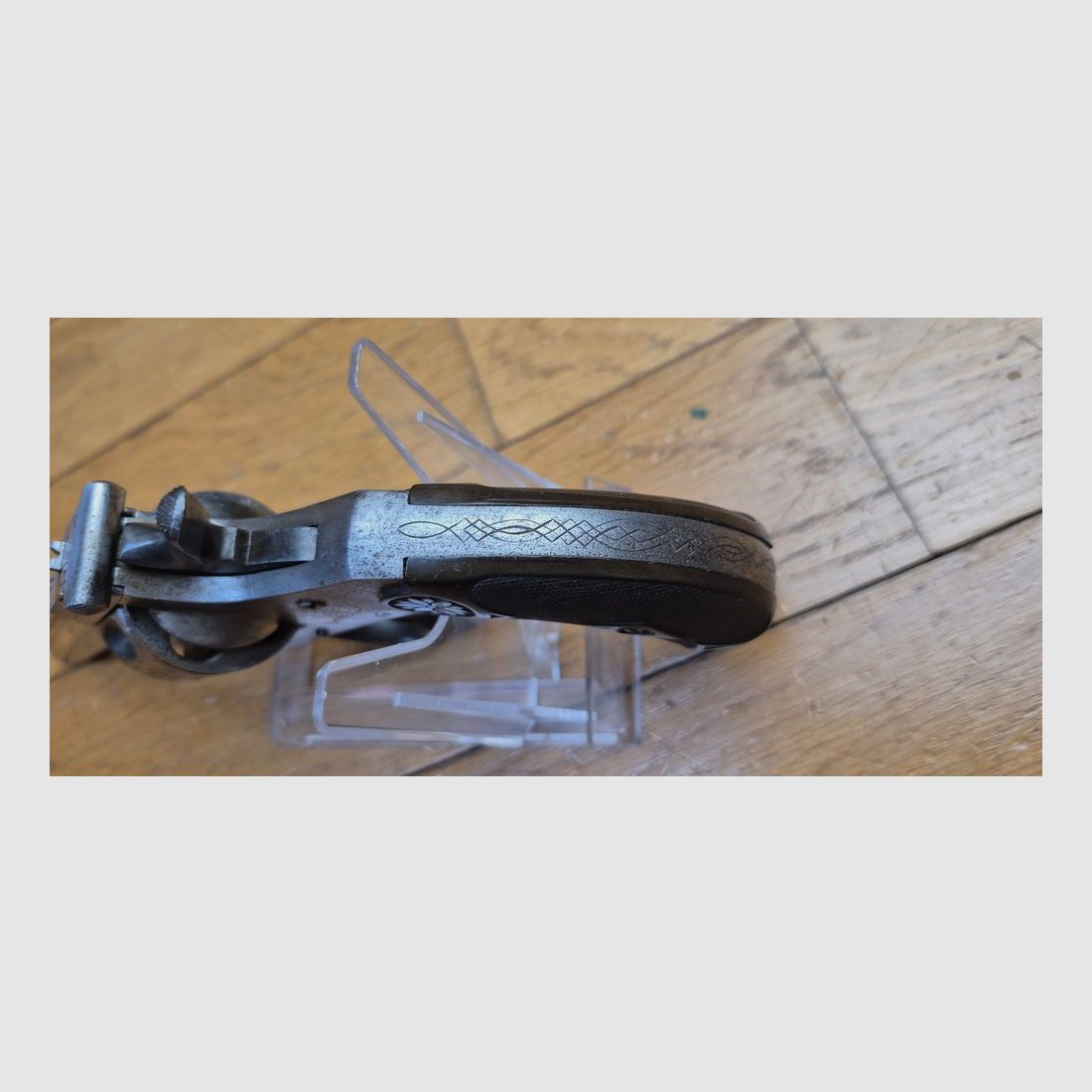
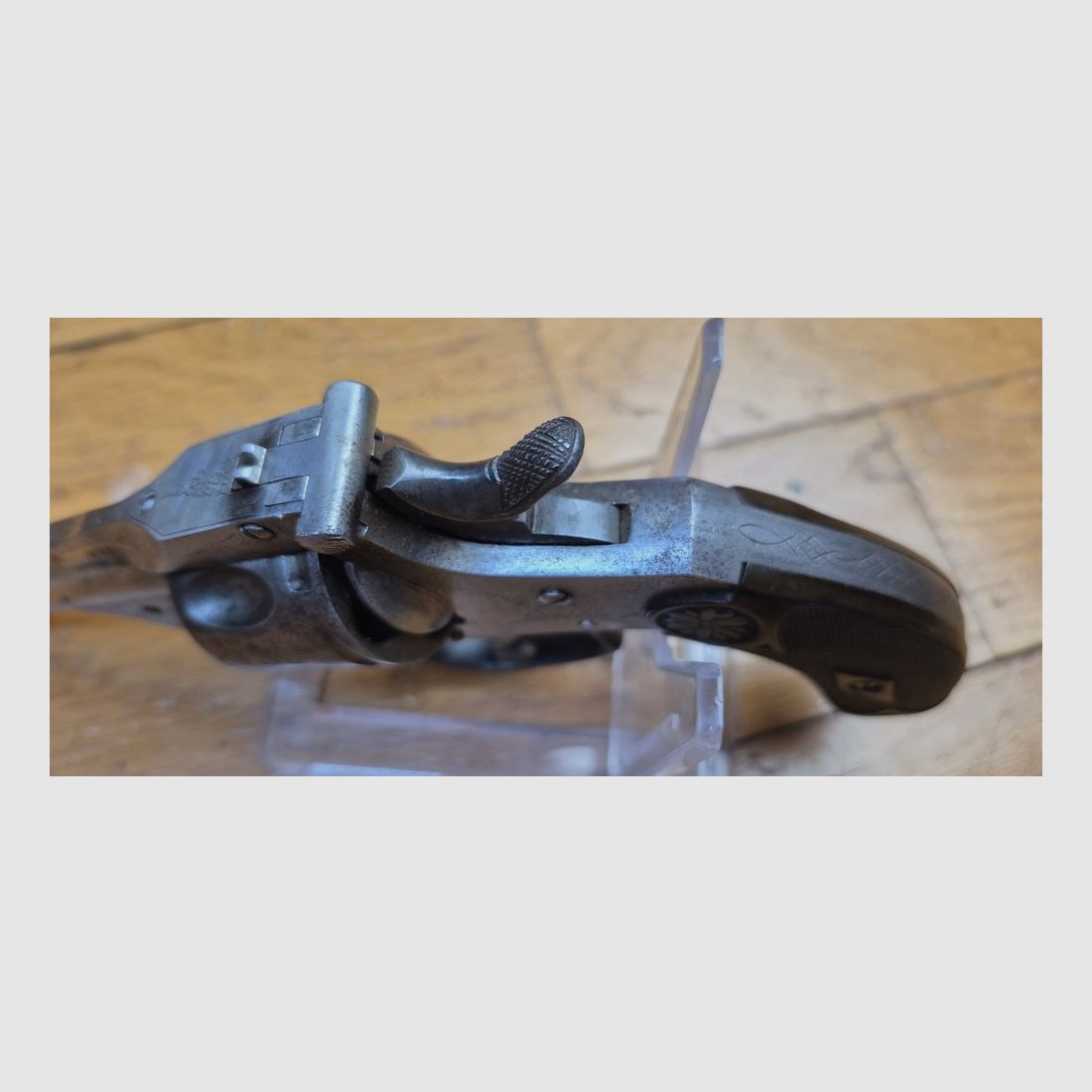
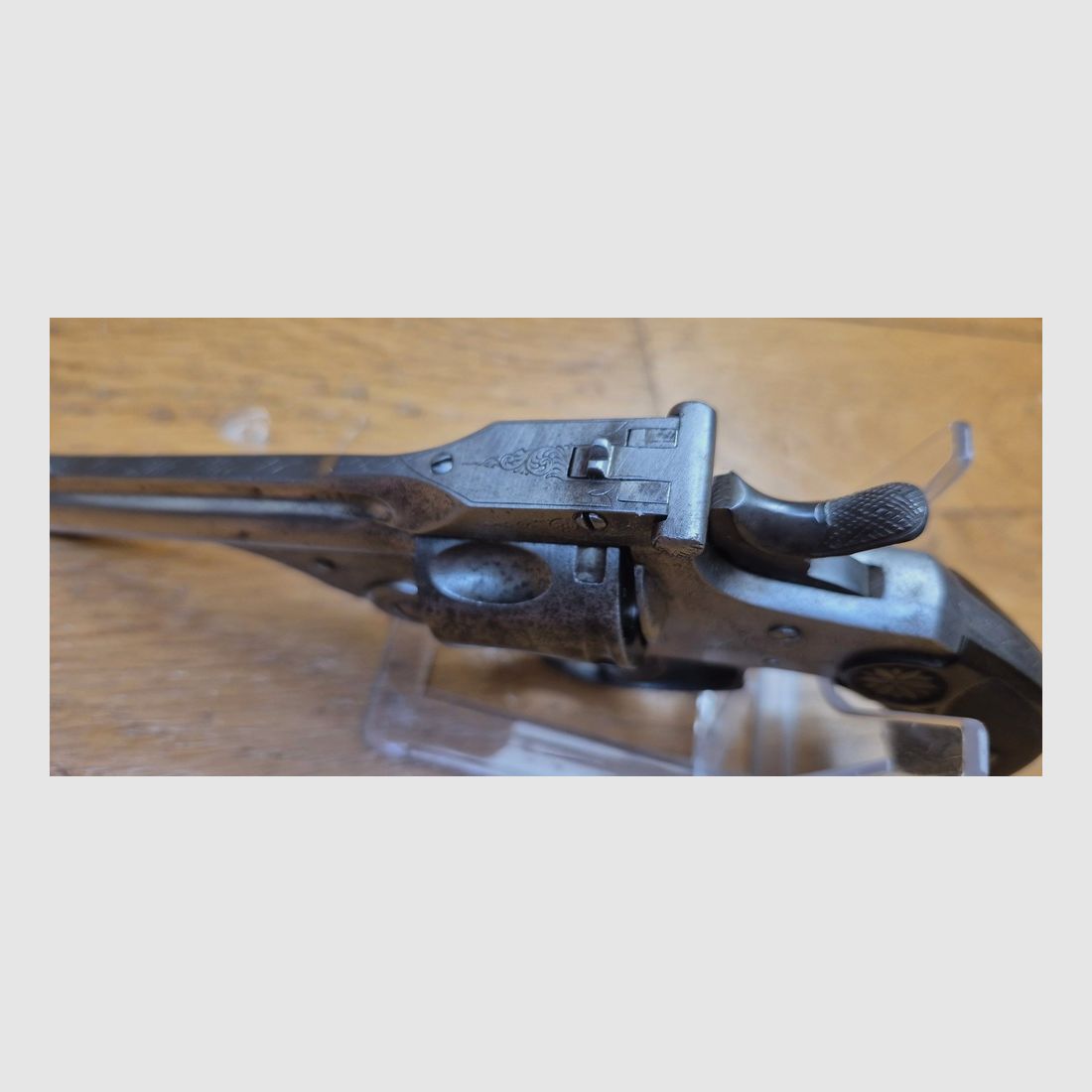
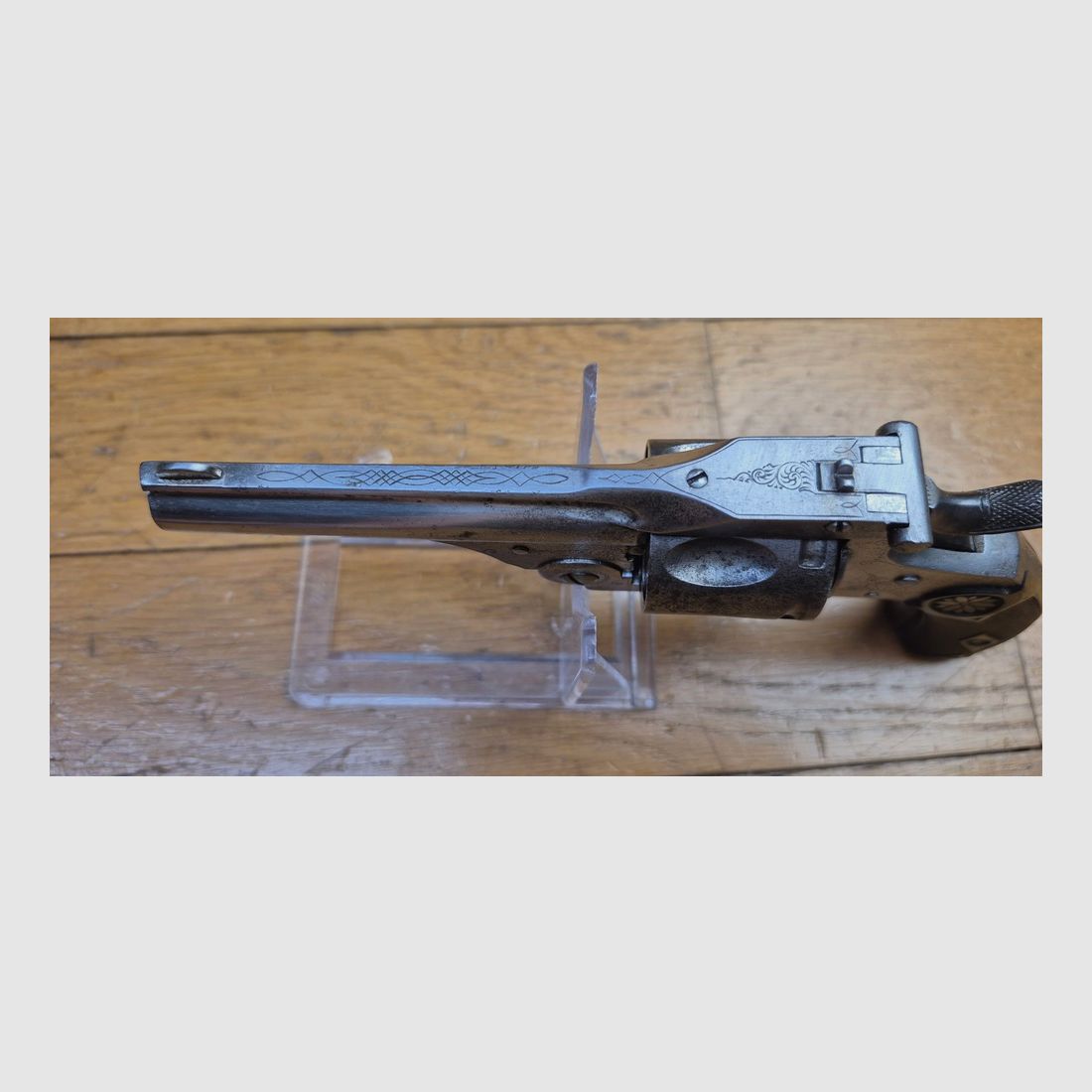
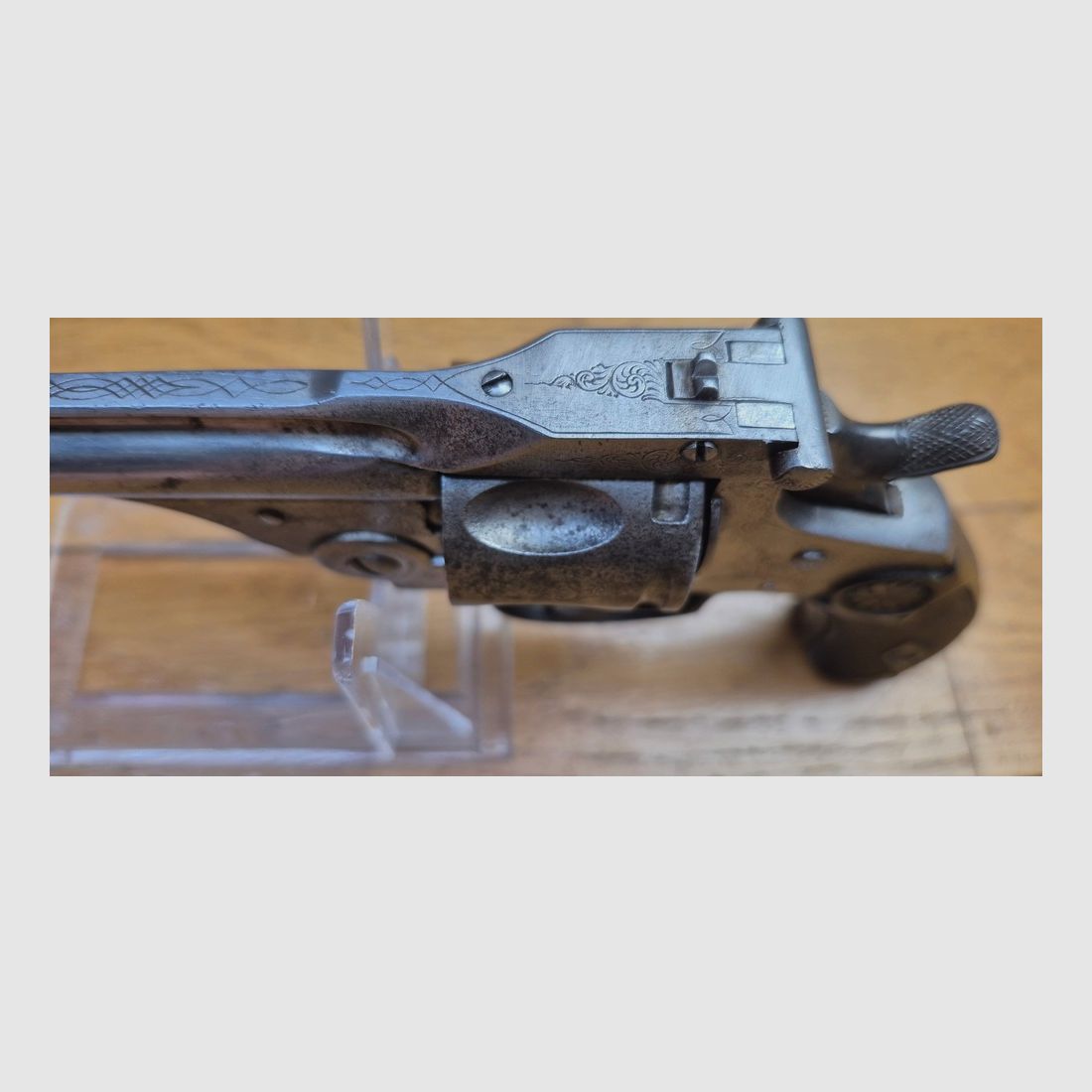


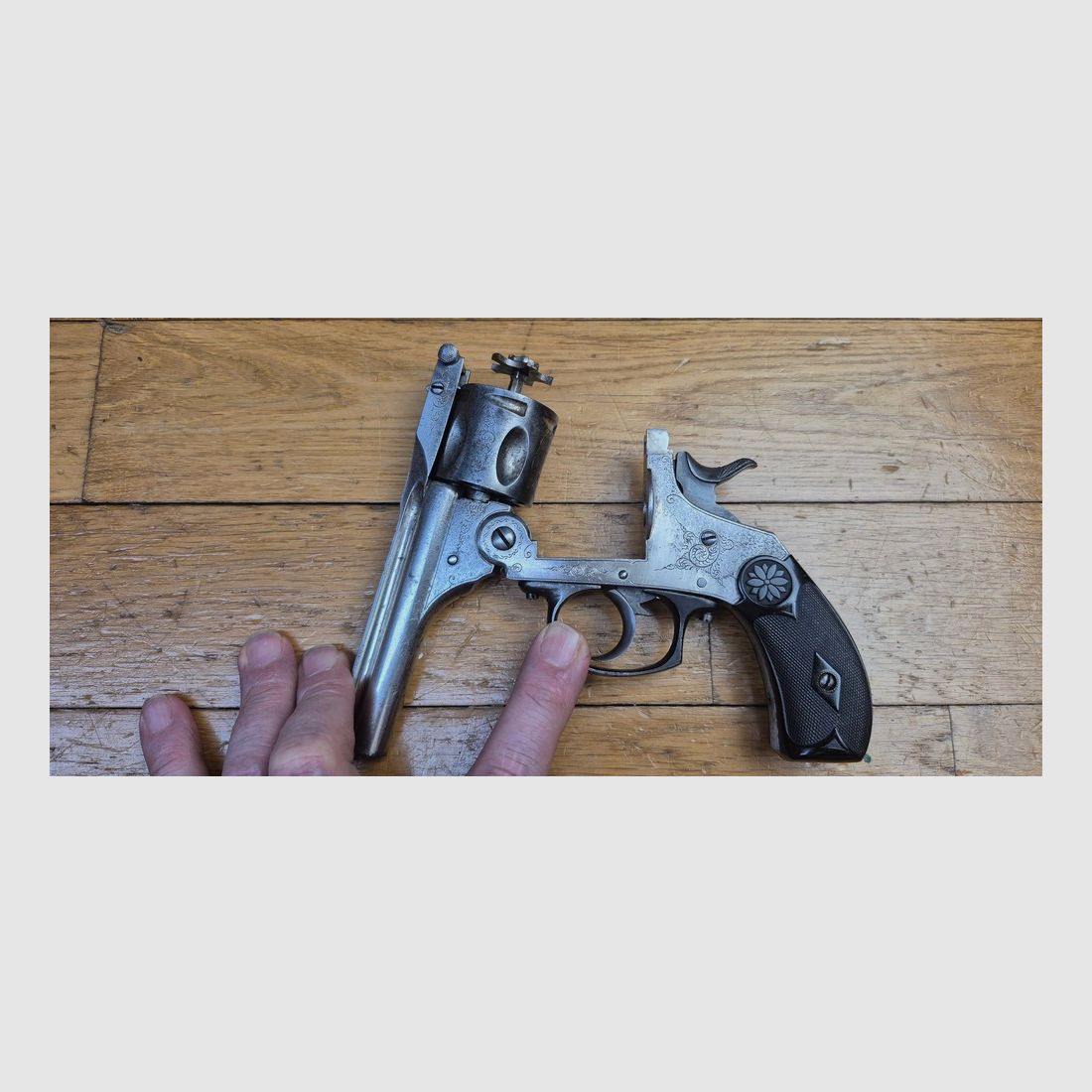
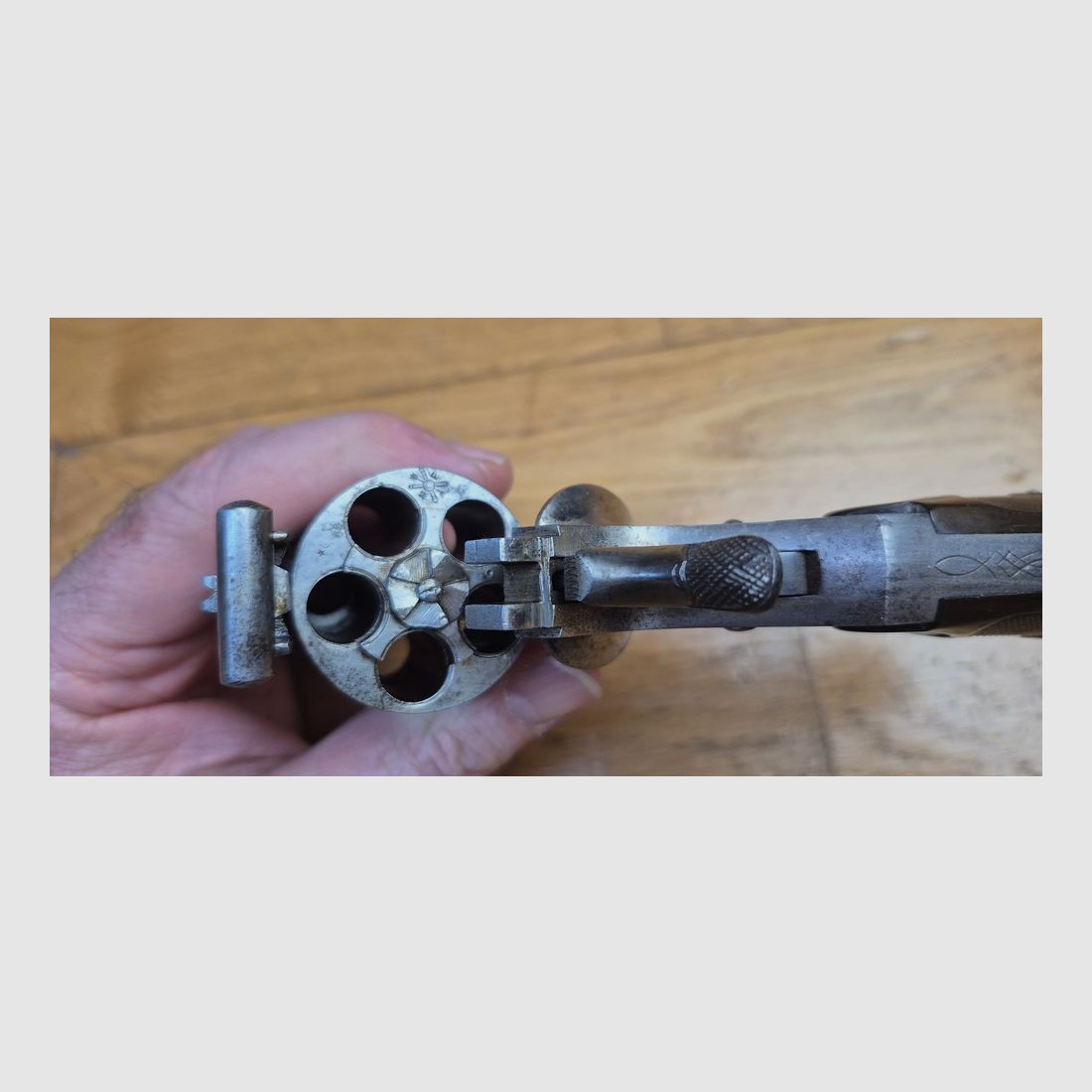
Very nice revolver style Smith&Wesson Top Break – Beautiful imitation by a good Belgian manufacturer of the Smith & Wesson .38 Double Action 2nd or 3rd Model – Five shots – Cal. 380 Black Powder – Gun distributed in the Manufrance catalog of 1890 – Surface oxidation on beautiful engravings – Beautiful grips and nice presentation – Excellent single and double action mechanism – Very good mechanics – Very good barrel – BE+/TBE
≈ $374
Price at the dealer: 340 €. Converted at the ECB rate as of November 20, 2026.
Purchase permit required
75002 Paris, France
12
ID: 10338450
Purchase from outside the EU: The firearm goes through an importer in your country, the dealer handles the export.
How buying from Europe works
Shop safely with Gunfinder
Our AI-powered seller identity verification makes Gunfinder the safest marketplace online.
Learn more
Details
- Original language
- French
- Brand
- Smith & Wesson
- Category
- Purchase eligibility
- Required
- Condition
- New
- Location
- 🇫🇷 75002 Paris, France
- Availability
- In stock
Freshness
This listing is based on a mirrored offer, where the listing data was synced to us from a shop, dealer, or external marketplace. Please note that temporary price discrepancies may occur due to possible delays in data transmission.
- Source
- Flingus Maximus
- Last checked with the dealer
- 1 day ago
Description
Note:
The item is located abroad. Please note that delivery conditions, shipping times, and/or the purchase process may differ.
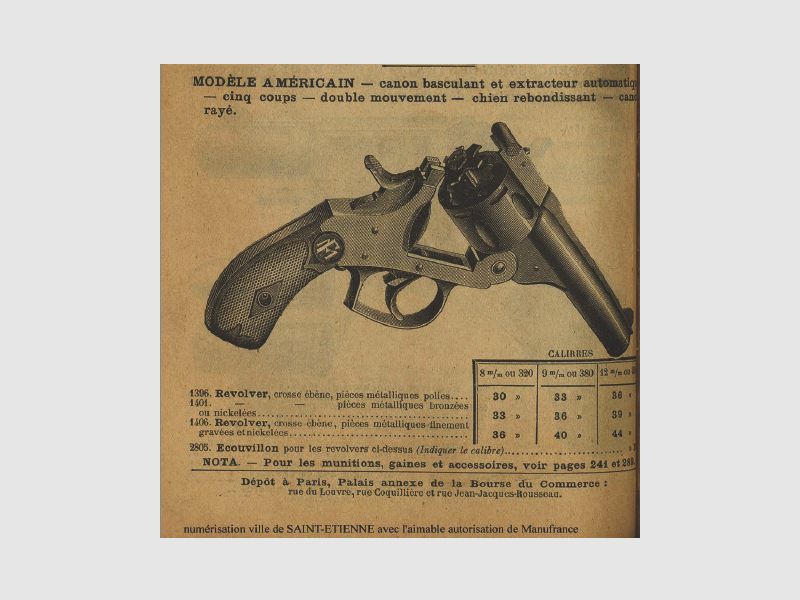
That’s how this handsome top-break revolver appeared in the Manuf’s catalog around 1890. I found it again thanks to the BNF (Gallica view f212 / 212) — around page 240.
Maître Flingus loves rummaging through old tomes to track down every one of his beloved firearms…
The little beauty was sold in 8mm or 320 caliber, 9 mm or .380 caliber, and even 12mm, or 450. In 450, you were in pocket artillery territory! And all of it in black powder.
I found it in the 1890 catalog, but there’s nothing to say it wasn’t made a little earlier. A noble old-timer. A handsome old-timer.
It’s described there exactly as: “American Model — tipping barrel and automatic extractor — five shots — double action — rebounding hammer — rifled barrel”.
The catalog price is amusing: around 1890, depending on caliber and finish, it cost about 30 to 44 francs; the finely engraved 9 mm/.380 version was listed at around 40 francs. That’s no small amount.
Bear in mind that a revolver costing 30 to 40 francs represented about half a month’s wages for a modest worker in the provinces, or around 8 to 10 days’ wages for a Parisian worker… This modern pocket firearm was out of reach for many.
So even in the Belle Époque, you already had to explain to Madame, as I’ve sometimes done myself, that “no, it wasn’t a leisure expense, but an excellent investment in family assets…”
This is indeed a Liège-made firearm, distributed by Saint-Étienne. Even back then, it was hard to compete with the Liège gun trade and its battalions of impoverished subcontractors, who produced perfectly acceptable quality at prices that undercut all of Europe. The Chinese of their day. But Belgian Chinese.
The firearm does indeed bear typical Belgian proof marks: a crowned “R” and a “starred C”, visible on the barrel and frame. The crowned R corresponds to Belgian proof marks for rifled barrels, which is the case with our firearm. The “starred C” is a controller’s countermark from the Liège Proof House.
There’s also a mark from the Manufacture Française d’Armes de Saint-Étienne on the rear face of the cylinder, an interesting detail linking the firearm to its quality French distribution.
The distributor didn’t distribute just anything without checking it, and cared about its reputation for quality…
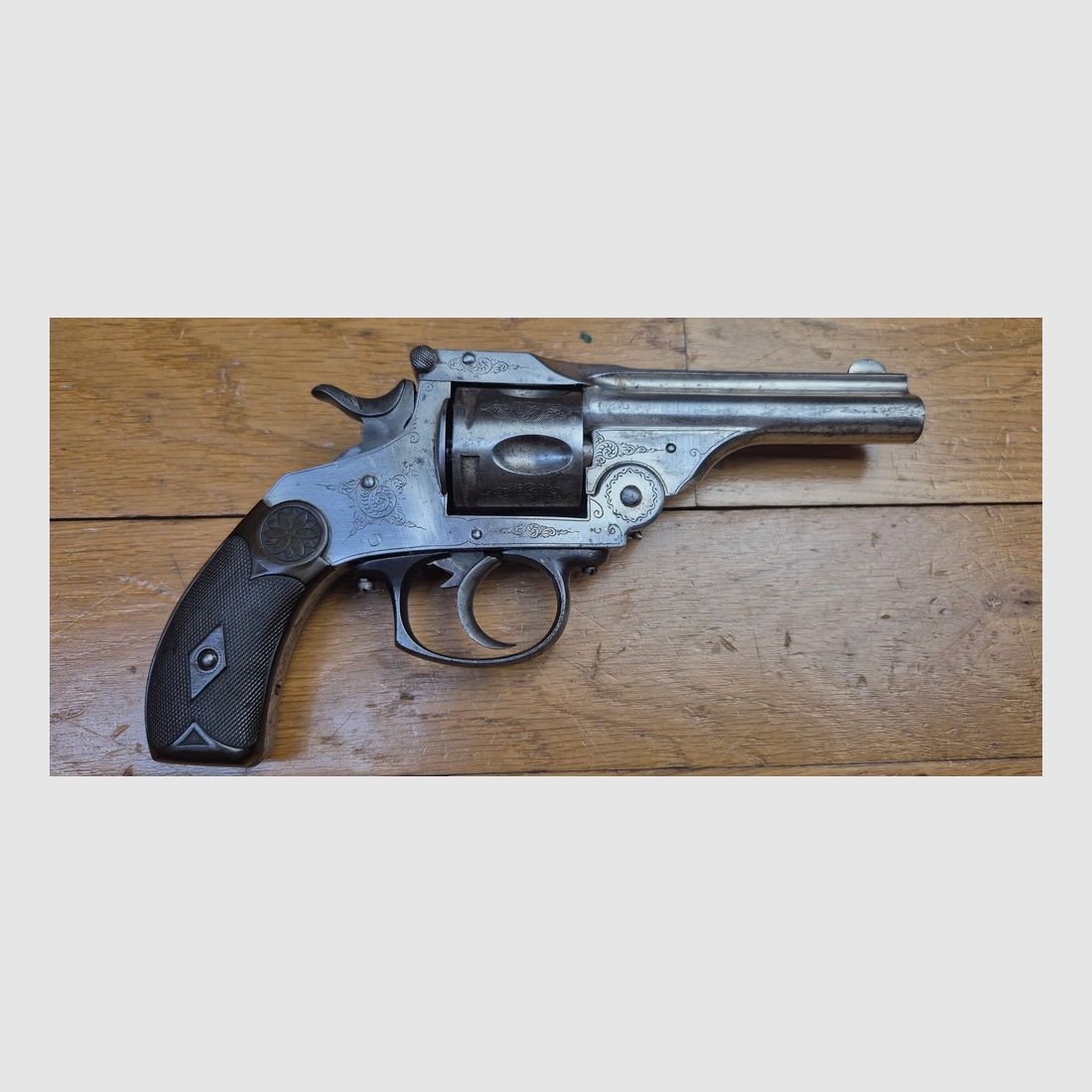
Technically, it belongs to the large family of European imitations of the Smith & Wesson .38 Double Action “Top-Break”. More specifically, it’s in the style of the 2nd or 3rd models with an external hammer: the barrel tips forward together with the upper part of the frame, with automatic simultaneous extraction, five shots, double-action mechanism, and exposed hammer.
It’s not a strict American copy. Rather, it’s a fairly typical Belgian interpretation for the civilian market of the late 19th century. There are also quite a few Spanish, English, and even German copies of these Smiths.
All these illegitimate “S&W” Top-Break offspring are defined by this open-frame opening system, with the barrel and cylinder assembly tipping forward and “automatic” extraction of the cases.
This one is a 9 mm or .380 black-powder revolver. The chamber measurements leave little room for doubt.
Obviously, don’t confuse this old black-powder .380 revolver with our modern .380 ACP. And it’s strictly for black powder. Any attempt to do anything else with this revolver will be immediately and mercilessly punished by the irreparable destruction of this beautiful firearm and likely injuries to boot.
So please don’t play around. You’ve been warned, dear listener or reader. Greetings and fraternity…
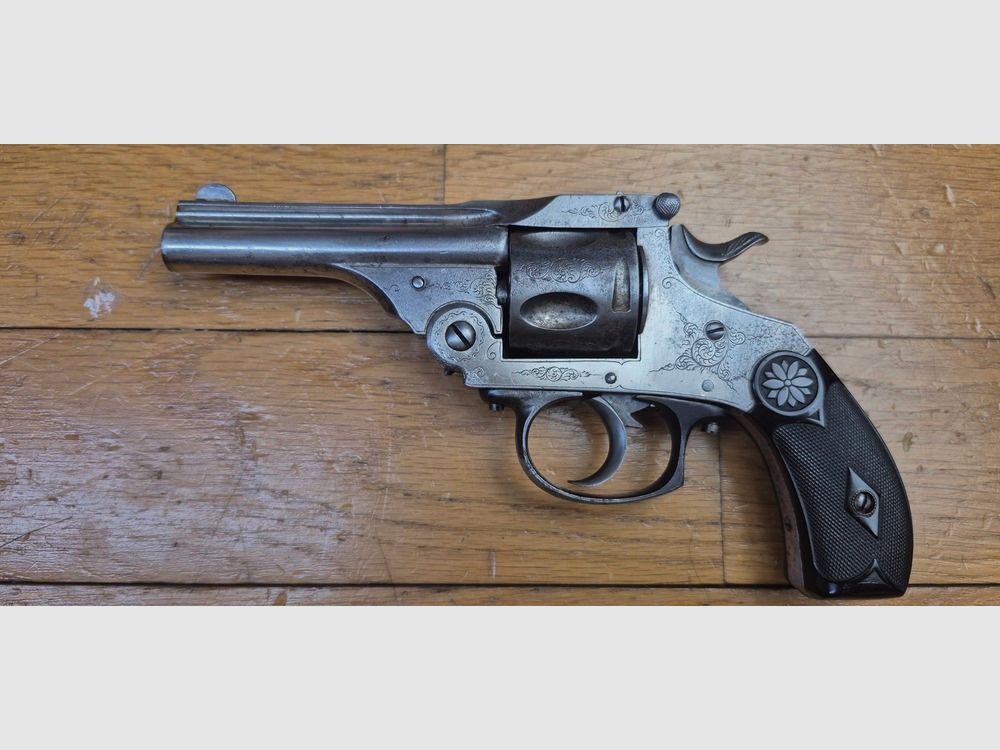
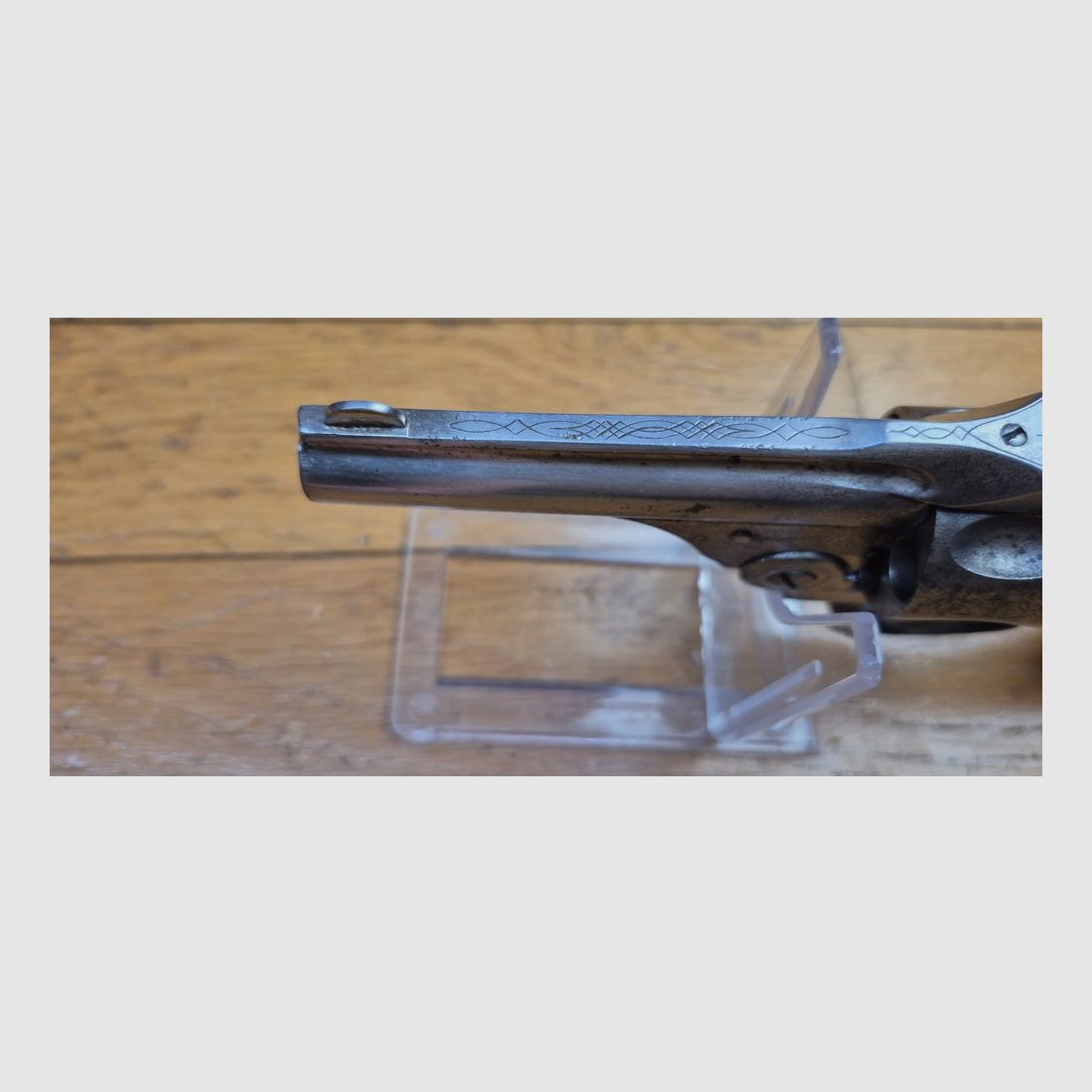
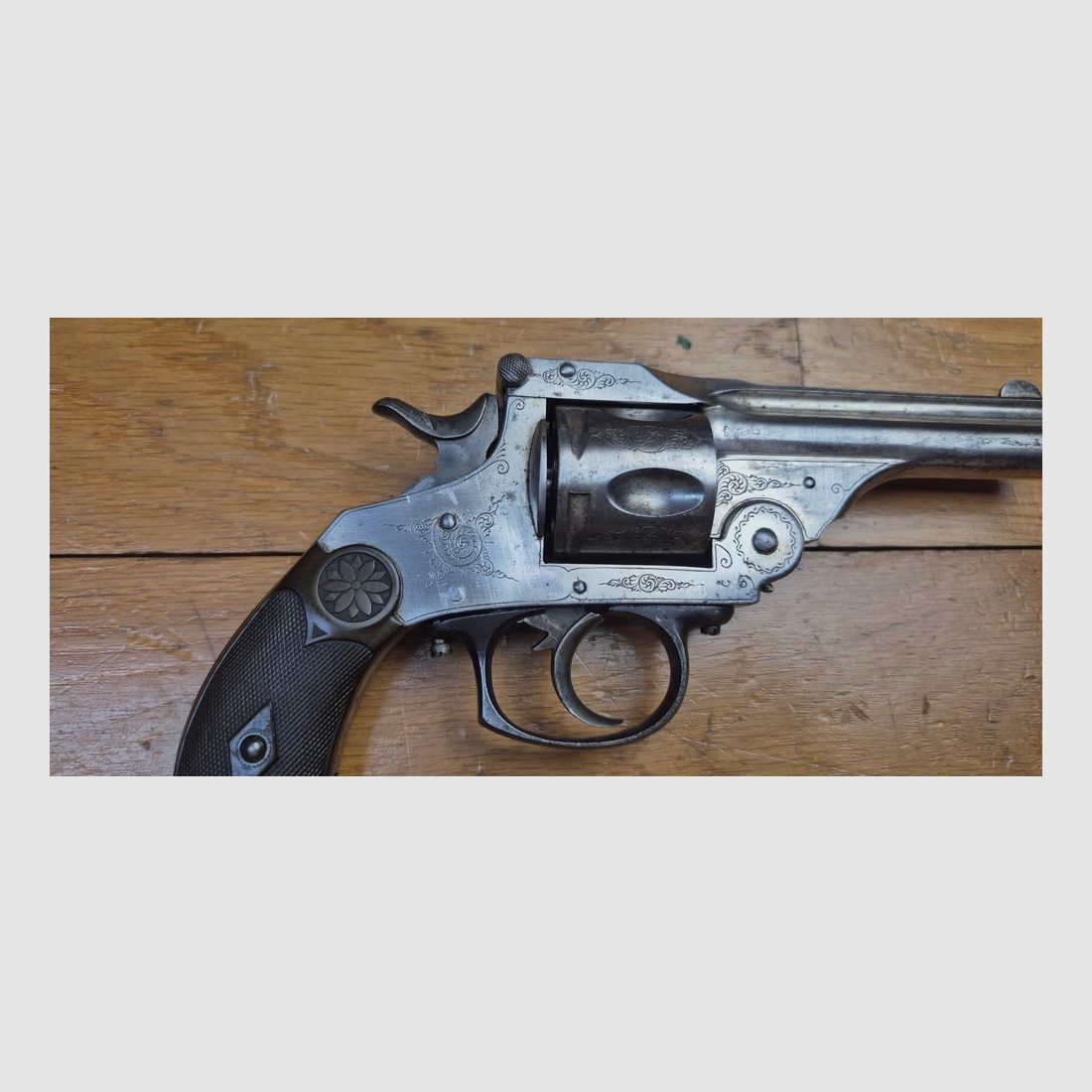
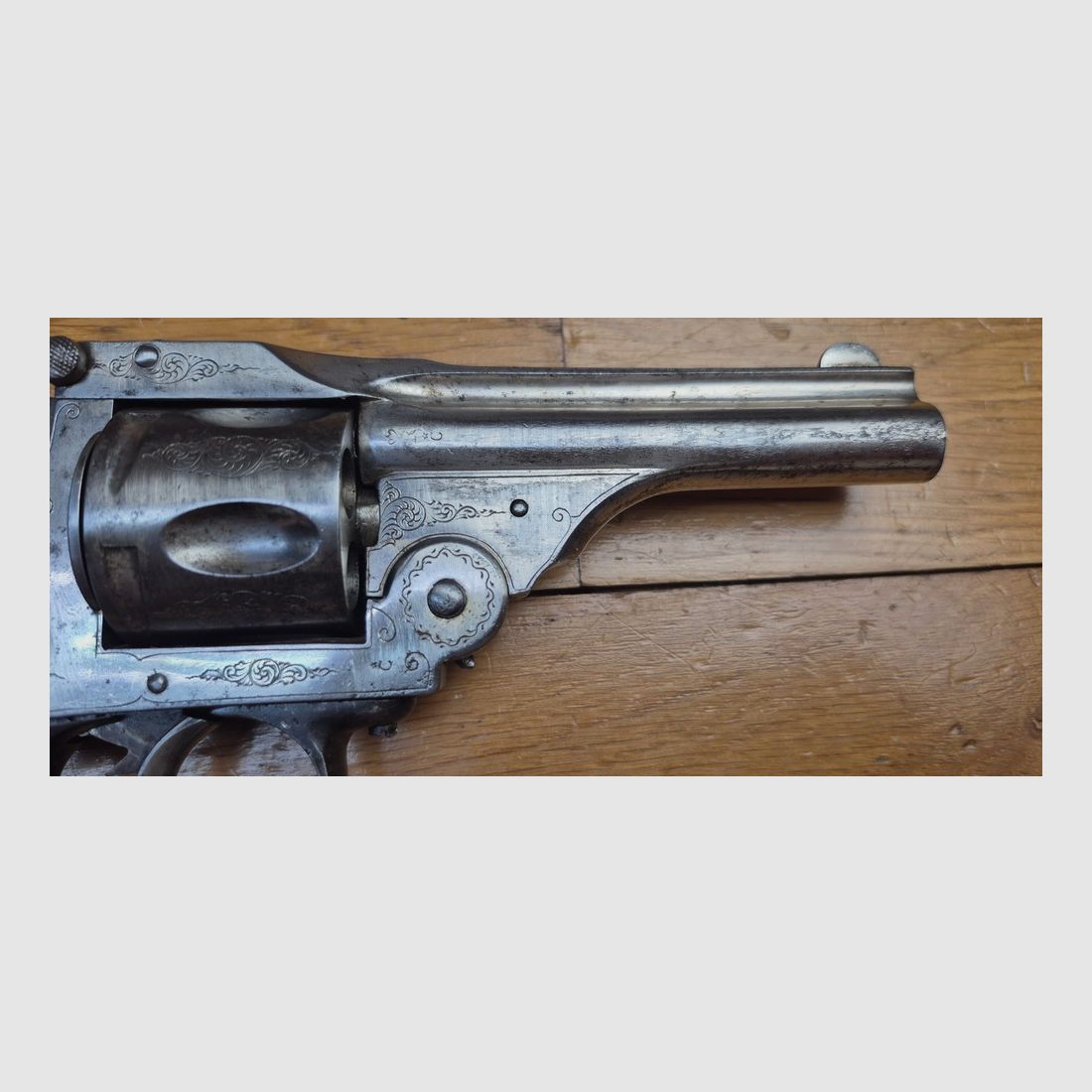
Aesthetically, this revolver really has a lot of character for a copy. The frame is nicely decorated with external scrollwork engravings.
The cylinder is decorated too. The top rib of the barrel also has a small geometric design.
The whole thing has that “notary’s desk-drawer revolver” look. But notary’s…
and had good taste.
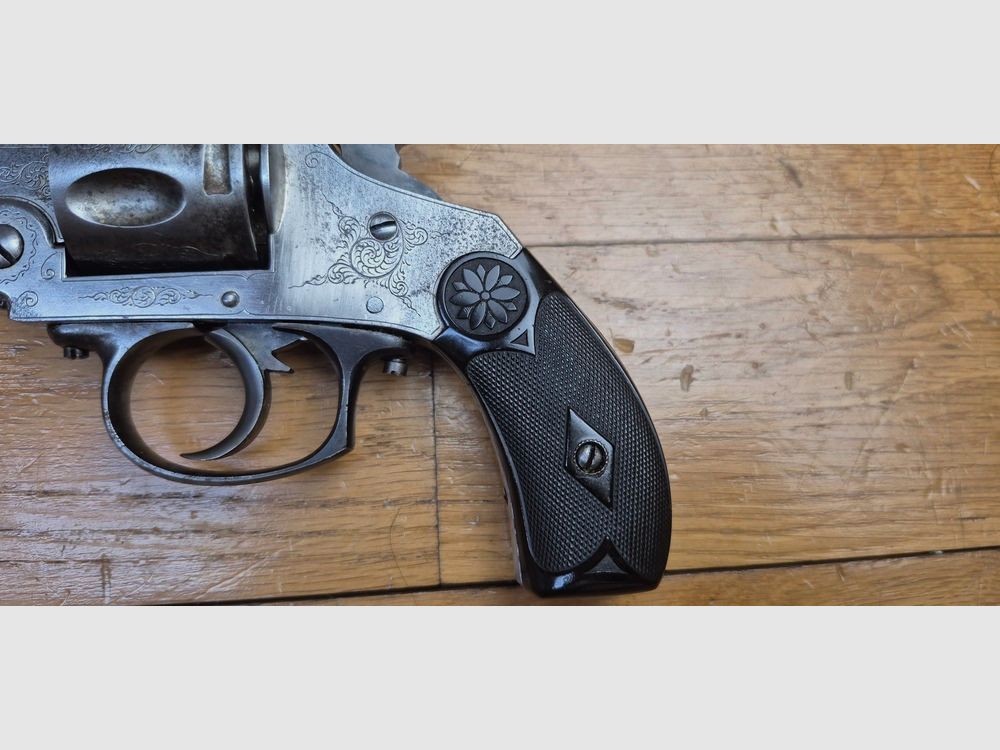
The gutta-percha grips are black on one side and brown on the other! One of them has faded perfectly evenly, but without the slightest sign of handling or chemical treatment? An unfortunate replacement? I very much doubt it.
Grips are very rarely perfectly interchangeable on these guns, where everything was hand-fitted back when labor was cheap. And these are more than perfectly fitted...
I think it has always been like this, and it actually gives it a very distinctive look!
These grips are 100% original. They are also very attractive, slim, intact, well checkered, with a central floral motif that fits the period perfectly.
Overall, it is in good, very presentable condition, with light surface oxidation and normal signs of age that do not detract from it.
On the contrary, they give it an honest patina, without the overly polished or “redone yesterday afternoon with sandpaper” look, sadly seen on so many guns from this period that have survived the passage of time. The engravings remain legible, the contours are crisp, and the gun retains a genuine, untouched period character.
Mechanically, it is more than satisfactory: opens perfectly, locks up cleanly, the extractor works and is even lively, and the trigger is very pleasant in both single and double action.
It functions crisply and smoothly, without that sad feeling of tired old mechanics. This one works, and works well.
The chambers are in good shape. The barrel is an especially pleasant surprise: very attractive, almost mirror-bright, with *beautiful, crisp rifling.
For guns of this type, which have often languished in the backs of drawers or wells, in cellars during the occupation, been fired with old black powder cartridges without cleaning afterward, or subjected to decades-long “restorations” with a grinder, this is a real strong point.
In the interest of professional honesty, we should mention that the rear trigger guard screw is not original. It may not be obvious in the photos to an untrained eye. A slightly shortened matching screw would be perfect. There, it’s been said.
It does nothing to diminish the gun’s charm. It is fairly uncommon, especially in this condition. Its original price explains why. It is attractive, very sound, and consistent, but it is not exactly “fresh from a display case in 1890 with the receipt folded in the waistcoat pocket.”
All in all, a very interesting Belgian Smith & Wesson Top-Break-type revolver, sold by the Manufacture Française d’Armes de Saint-Étienne, in 9 mm / .380 black powder caliber, well documented in the 1890 Manufrance catalog, nicely engraved, more than presentable, mechanically excellent, with attractive gutta-percha grips, good chambers, and a very good barrel.
A Category D e) firearm under the CSI: valid national ID card or passport required.
**********************************************************************************************************************************************
Let’s say it again! Flingus Maximus gun shop in Paris and throughout France is also here to buy your firearms and militaria collections, appraise your firearms, and answer your questions about firearms laws or firearms in estates and inheritances. Contact your favorite gunsmith using our contact form or at [email protected]
Reminder: All collectible, hunting, and shooting firearms are used and sold as-is, without warranty.
All antique firearms sold as Category C or D, “Collection” or “Cowboy shooting,” are collectible firearms that have not been proof-tested for shooting or tested at a range. They have been visually inspected for their general and mechanical condition, but none have been fired, so they are sold as untested. Buyers wishing to use a firearm for shooting must first contact the National Proof House of Saint Étienne.
, the only entity authorized to issue proof certificates before use for shooting. (Show description in original language)
“Modèle américain”…
C’est ainsi que ce beau revolver top break figurait au catalogue de la Manuf vers 1890. Je l’ai retrouvé. Grâce à la BNF (vue Gallica f212 / 212) – Vers la page 240.
Maître Flingus aime fouiller les vieux grimoires pour retrouver la moindre de ses armes chéries…
Le bébé était vendu en calibre 8mm ou 320, en calibre 9 mm ou .380 et même en 12mm soit du 450. En 450, on était dans l’artillerie de poche ! Et tout ça en poudre noire.
Si je le trouve au catalogue de 1890 rien ne nous dit qu’il ne soit pas même un peu antérieur. Un noble vieillard. Un beau vieillard.
Il y est décrit exactement comme : “Modèle américain — canon basculant et extracteur automatique — cinq coups — double mouvement — chien rebondissant — canon rayé” .
Le tarif catalogue fait sourire : Vers 1890, selon calibre et finition, on était autour de 30 à 44 francs ; la version 9 mm/.380 finement gravée était affichée autour des 40 francs. Ce n’est pas anodin.
Retenez qu’un revolver entre 30 et 40 francs représentait environ un demi mois de salaire d’un ouvrier modeste en province,ou environ 8 à 10 jours de salaire d’un ouvrier parisien… Inaccessible pour beaucoup, cette arme de poche moderne.
Comme quoi, même à la Belle Époque, il fallait déjà expliquer à Madame, comme je l’ai parfois fait moi-même, que “non, ce n’était pas une dépense de loisir, mais bien un excellent investissement patrimonial… ».
Il s’agit bien d’une fabrication liégeoise, distribuée par Saint-Étienne. Difficile déjà à l’époque d’être compétitif face à l’armurerie liégeoise et ses bataillons de sous-traitant miséreux qui produisaient une qualité tout à fait acceptable pour des tarifs défiants toute concurrence européenne. Des chinois de l’époque. Mais des chinois belges.
L’arme porte en effet de typiques poinçons belges « R » couronné et « C étoilé », visibles en canon et en carcasse. Le R couronné correspond aux poinçons belges liés au canon rayé ce qui est le cas de notre arme. Le « C étoilé » est une contremarque de contrôleur du banc d’épreuve de Liège.
On note également, sur la face arrière du barillet, le poinçon de la Manufacture Française d’Armes de Saint-Étienne, élément intéressant qui rattache l’arme à sa diffusion française de qualité.
Le distributeur ne distribuait pas tout et n’importe quoi sans contrôle et tenait à sa réputation de qualité…
Techniquement, on est dans la grande famille des imitations européennes du Smith & Wesson .38 Double Action « Top-Break ». Plus précisément dans l’esprit des 2e ou 3e modèles à chien externe: canon basculant vers l’avant avec la partie supérieure de la carcasse, extraction automatique collective, cinq coups, platine double action, chien apparent.
Ce n’est pas une copie américaine stricte. C’est plutôt une interprétation belge assez typique du commerce civil de la fin du XIXe siècle. Il en existe aussi pas mal de copies espagnoles, anglaises, et même allemandes de ces Smith.
Tous ces enfants illégitimes « S&W » Top-Break se définissent justement par ce système d’ouverture en carcasse ouverte avec basculement de l’ensemble canon-barillet et extraction « automatique » des étuis.
Ici le calibre est du 9 mm ou .380 revolver poudre noire. La mesure des chambres ne laisse pas trop de doute.
Il ne faut évidemment pas confondre ce vieux .380 revolver à poudre noire avec notre moderne .380 ACP. Et c’est strictement de la poudre noire. Toute tentative de faire autre chose avec ce revolver sera immédiatement et impitoyablement punie par destruction irrémédiable de cette belle arme et probable blessures à la clé.
Donc interdit de jouer SVP. A bon entendeur ou lecteur, Salut et Fraternité…
Esthétiquement, ce revolver a vraiment de la gueule pour une copie. La carcasse est joliment décorée de gravures externes à rinceaux.
Le barillet est lui aussi orné. La bande supérieure du canon porte également son petit décor géométrique.
L’ensemble présente cette allure “revolver de tiroir de notaire ». Mais de notaire qui avait du goût.
Les plaquettes en gutta-percha sont noire d’un coté et brune de l’autre ! Décoloration parfaitement uniforme d’une d’entre elles mais sans la moindre trace de manipulation ou de produit chimique ? Remplacement malheureux ? Je n’y crois guère.
Les plaquettes sont très rarement parfaitement interchangeables sur ces armes où tout était manuellement ajusté à une époque d’heure de travail peu chère. Et là elles sont mieux que parfaitement ajustées…
Je pense qu’il a toujours été comme ça et cela lui donne d’ailleurs un très beau style !
Car ces plaquettes sont 100% d’origine. Elles sont d’ailleurs très belles, fines, intactes, bien quadrillées, avec un motif floral central qui colle parfaitement à l’esprit de l’époque.
L’état général est bon, très présentable, avec une légère oxydation de surface et des traces d’âge normales, qui ne le discréditent pas.
Au contraire, cela lui donne une patine honnête, sans l’aspect trop poli ou trop “refait hier après-midi au papier de verre” que l’on voit hélas sur nombre d’armes de cette époque ayant survécu au temps qui passe. Les gravures restent lisibles, les volumes sont francs, et l’arme conserve une vraie identité d’époque non retouchée.
Mécaniquement, c’est plus que très satisfaisant : ouverture impeccable, verrouillage propre, extracteur fonctionnel et même dynamique, détente très agréable en simple comme en double action.
Le fonctionnement est net et bien vivant, sans cette sensation triste des vieilles mécaniques fatiguées. Là, ça fonctionne, et ça fonctionne bien.
Les chambres sont belles. Le canon est même une très bonne surprise : très beau, quasi miroir avec de *belles rayures bien nettes.
Pour les armes de ce type, qui ont souvent connu les fonds de tiroirs ou de puits, les caves d’occupation, les cartouches PN anciennes sans nettoyage après tir, les « restaurations » pluri-décennales à la meuleuse, c’est un vrai point fort.
Par abnégation professionnelle, signalons tout de même que la vis arrière du pontet n’est pas d’origine. Ça ne se voit pas fatalement sur les photos pour un regard non initié. La même légèrement raccourcie fera merveille. Voilà, c’est dit.
Ça ne change rien au charme de l’arme. Elle est assez peu courante surtout dans cet état. Son prix d’origine l’explique. Elle est belle, très saine, cohérente, mais pas non plus “sortie de vitrine en 1890 avec facture pliée dans la poche du gilet”.
In fine un très intéressant revolver belge type Smith & Wesson Top-Break, vendu par la Manufacture Française d’Armes de Saint-Étienne, en calibre 9 mm / .380 poudre noire, bien attesté au catalogue Manufrance de 1890, joliment gravé, plus que très présentable, mécaniquement excellent, avec de belles plaquettes en gutta-percha, de bonnes chambres et un très bon canon.
Arme de catégorie D e) au CSI : CNI ou passeport en cours de validité obligatoire.
**********************************************************************************************************************************************
Répétons le ! L’armurerie Flingus Maximus à Paris et partout en France est là aussi pour vos rachats de collections armes et militaria, vos estimations d’armes, vos questions de législation ou sur les armes dans les successions et héritage. Contactez votre armurier préféré via notre formulaire de contact ou à [email protected]
Rappel : Toutes les armes de collection, de chasse, et de tir sont d’occasion et sont vendues dans l’état, sans garantie.
Toutes les armes historiques de fabrication ancienne vendues en tant que C ou D, « Collection » ou « Cow-boy shooting », sont des armes de collection non éprouvées pour le tir et non testées en stand. Elles ont été inspectées visuellement relativement à leur état général et mécanique mais aucune n’a été utilisée au tir et elles sont donc vendues comme non testées. L’acquéreur désirant utiliser une arme pour le tir devra impérativement se rapprocher préalablement du banc National d’Épreuve de Saint Étienne, seule entité habilitée à délivrer des certifications d’épreuves préalable à un usage de tir.