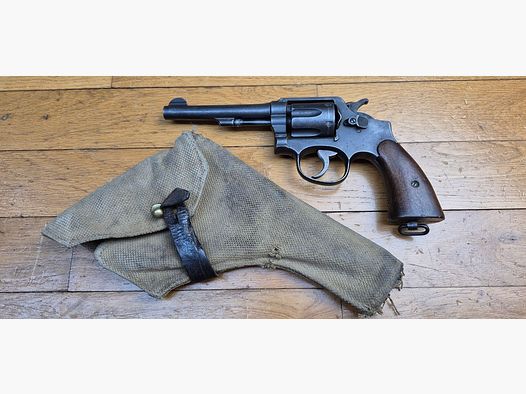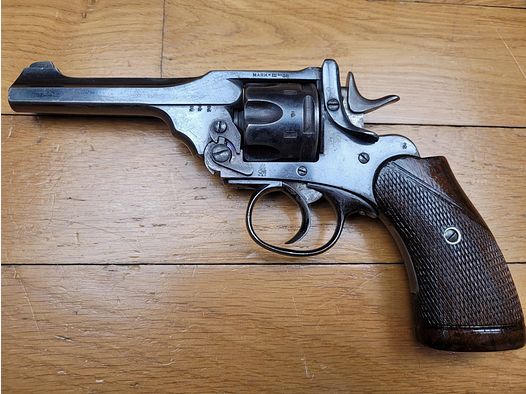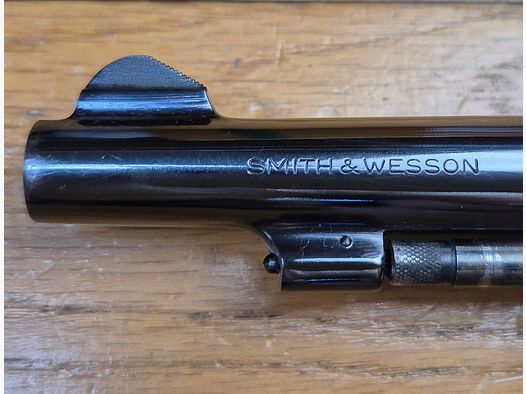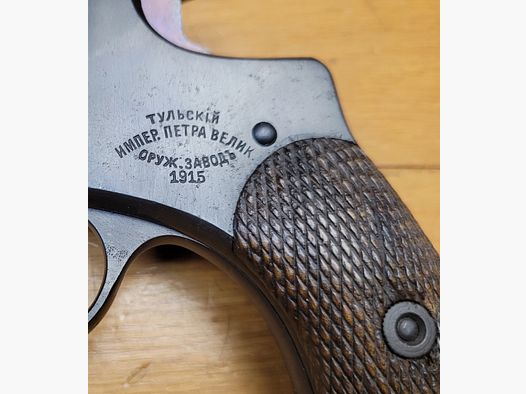

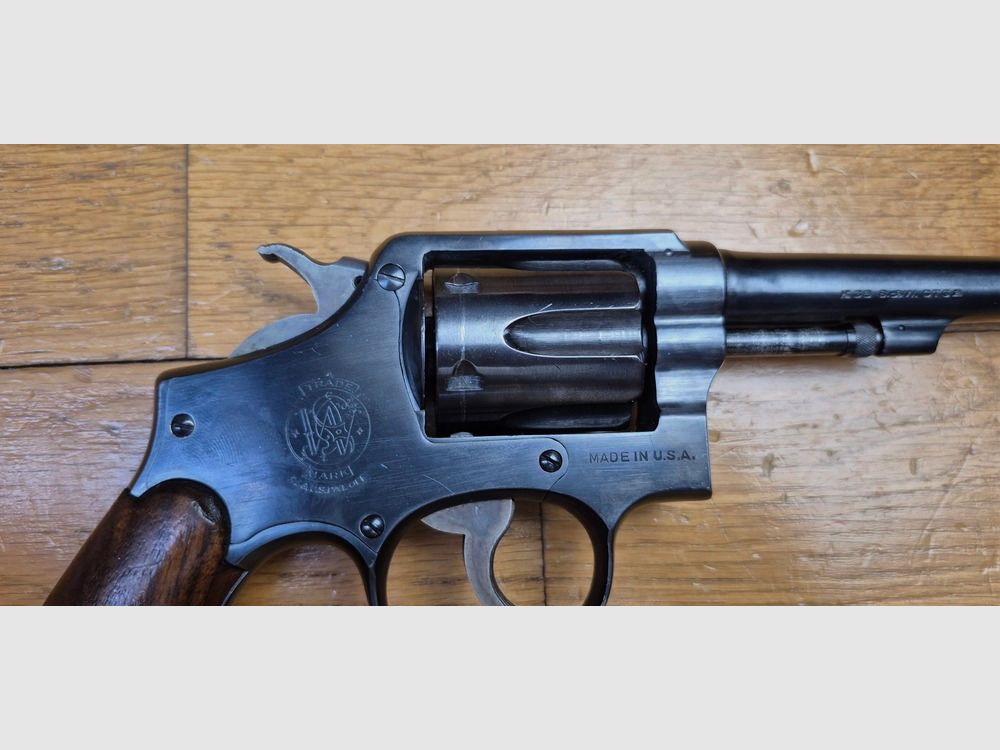

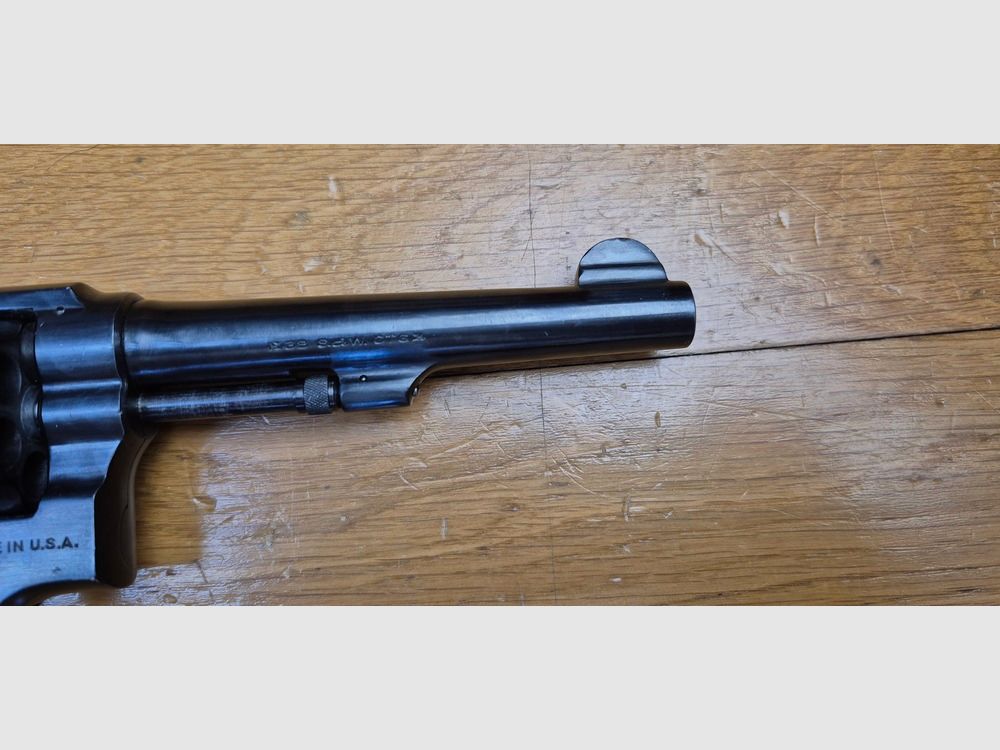
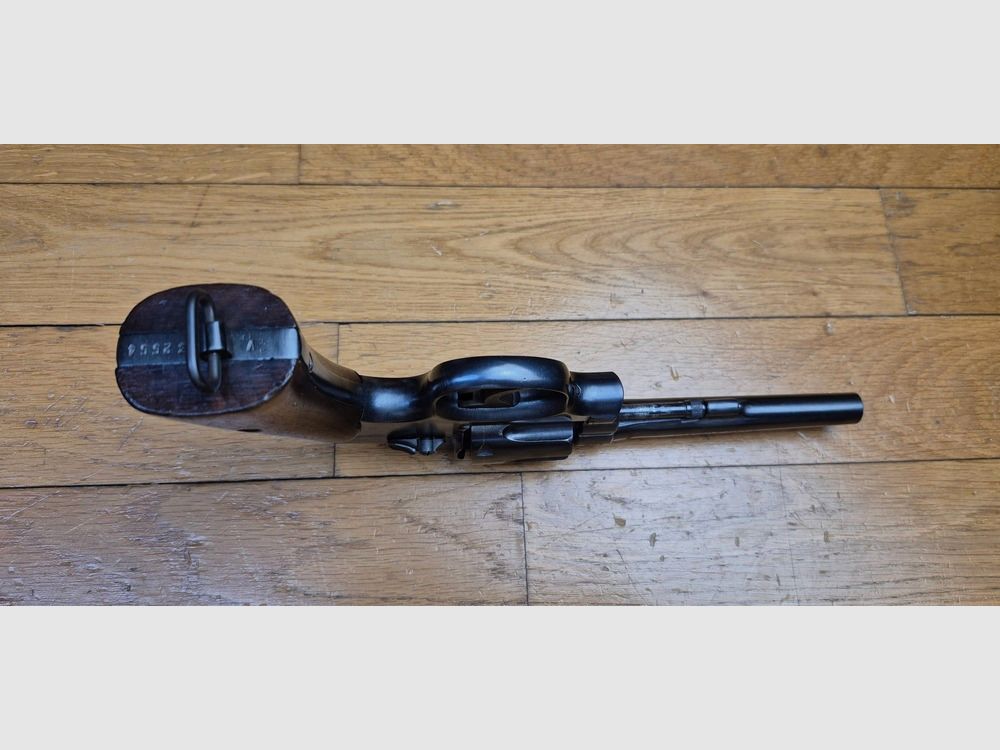
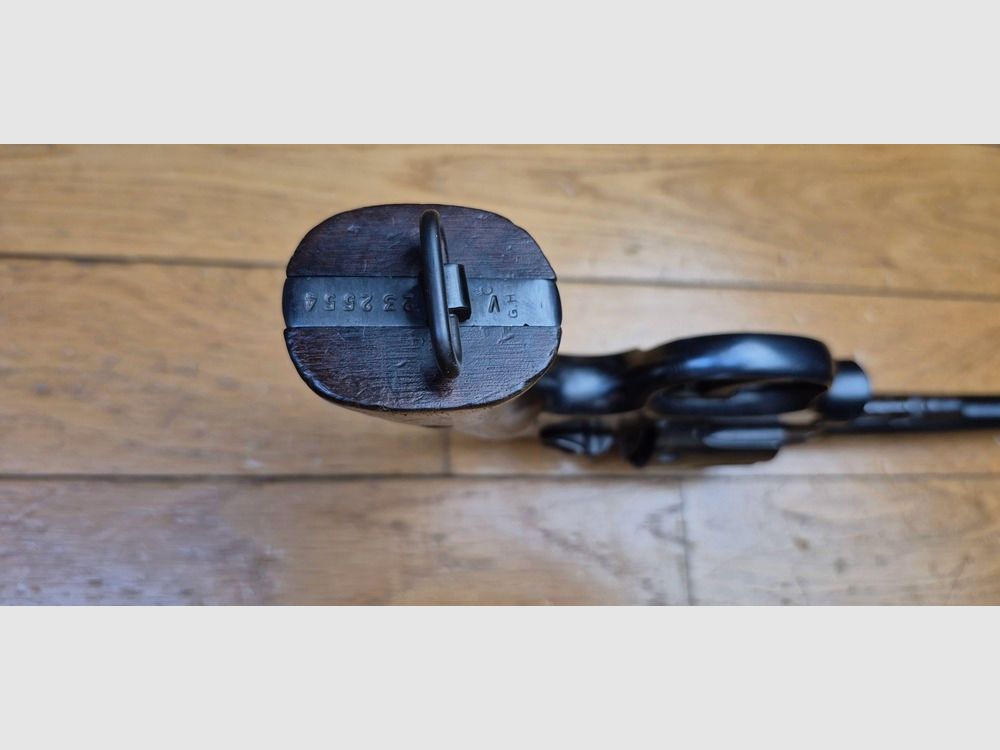





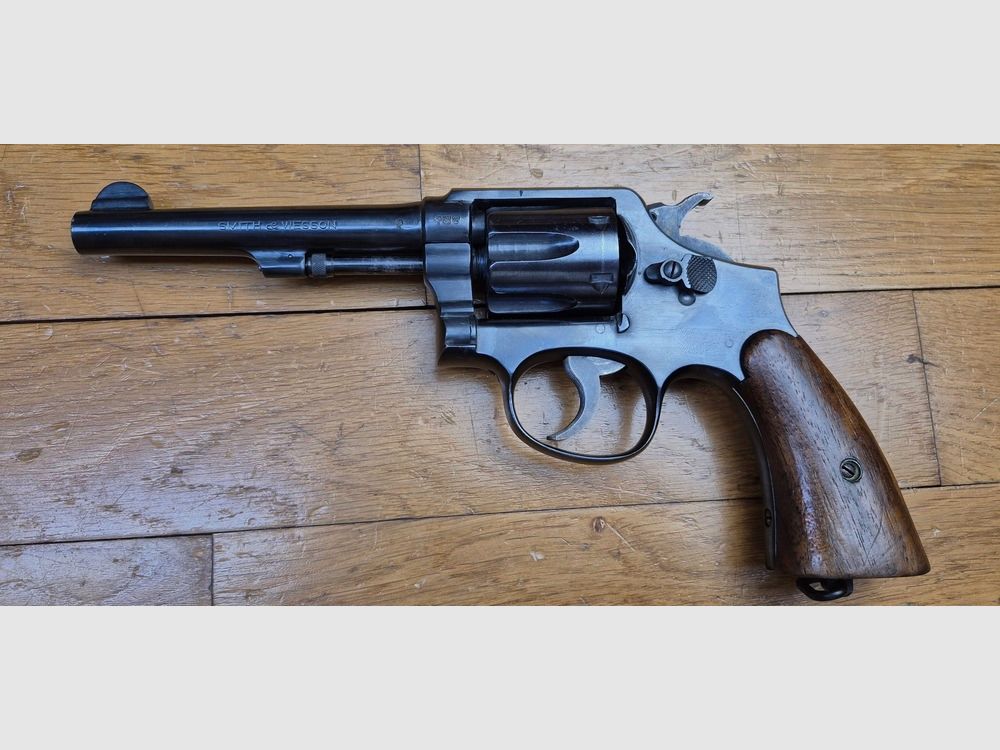



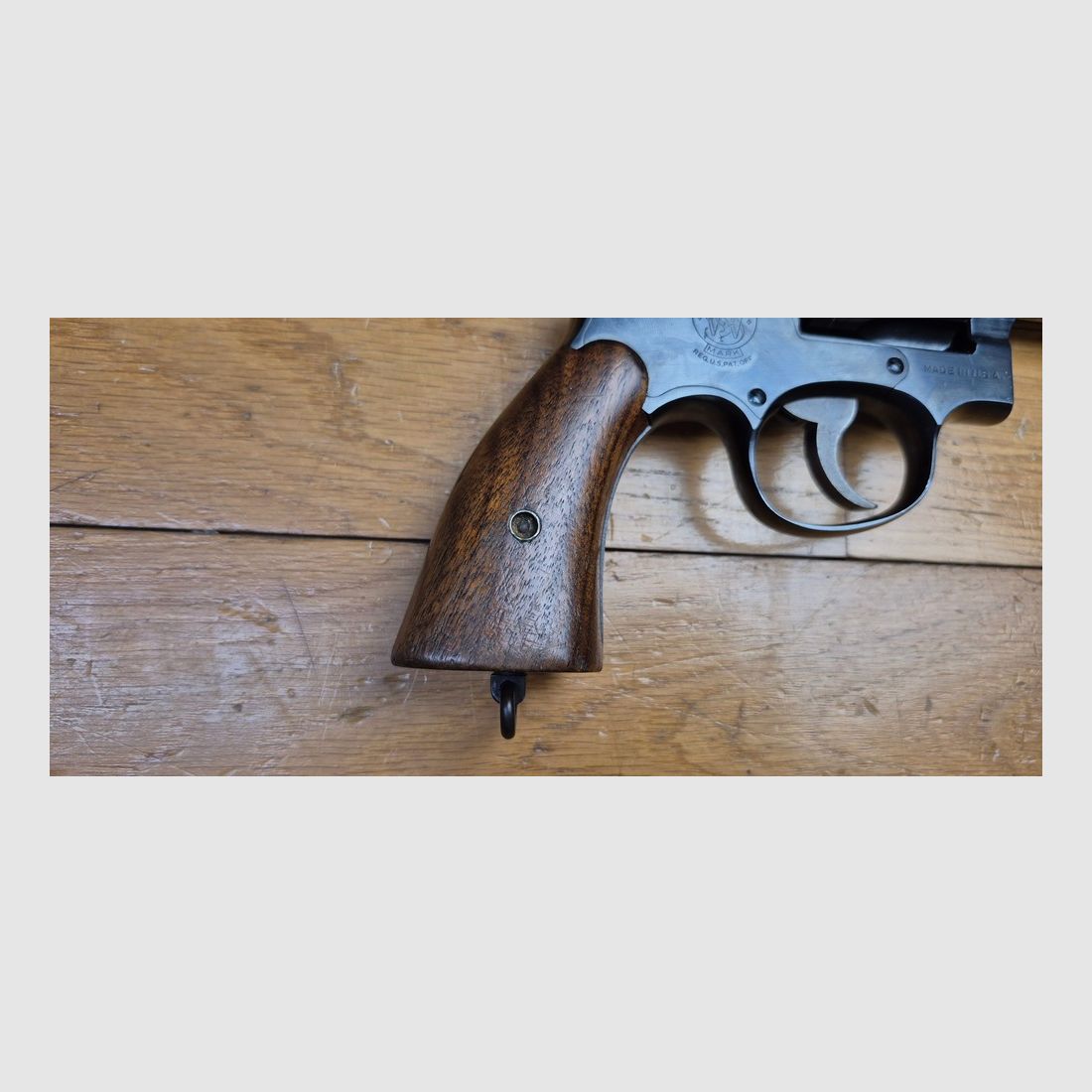
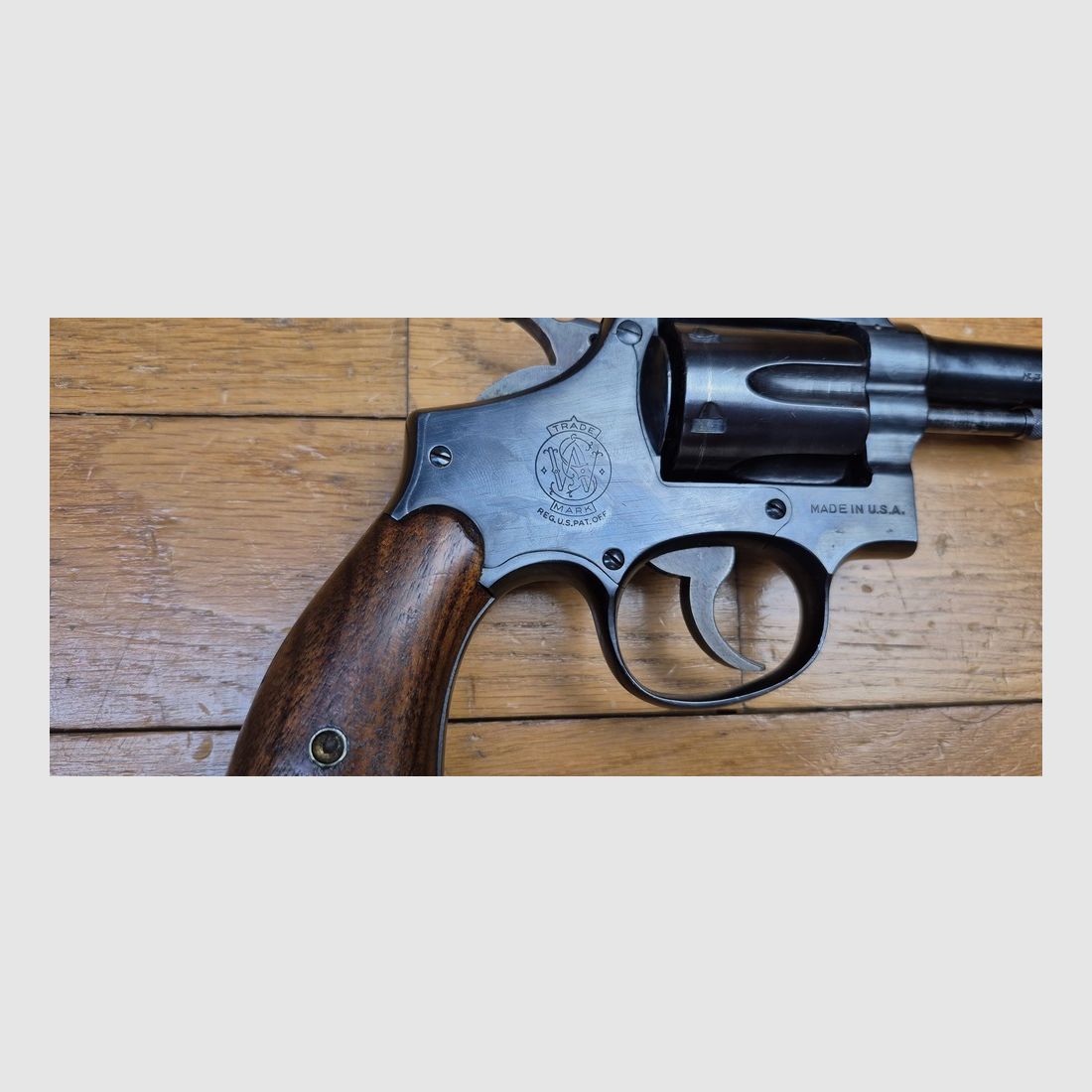
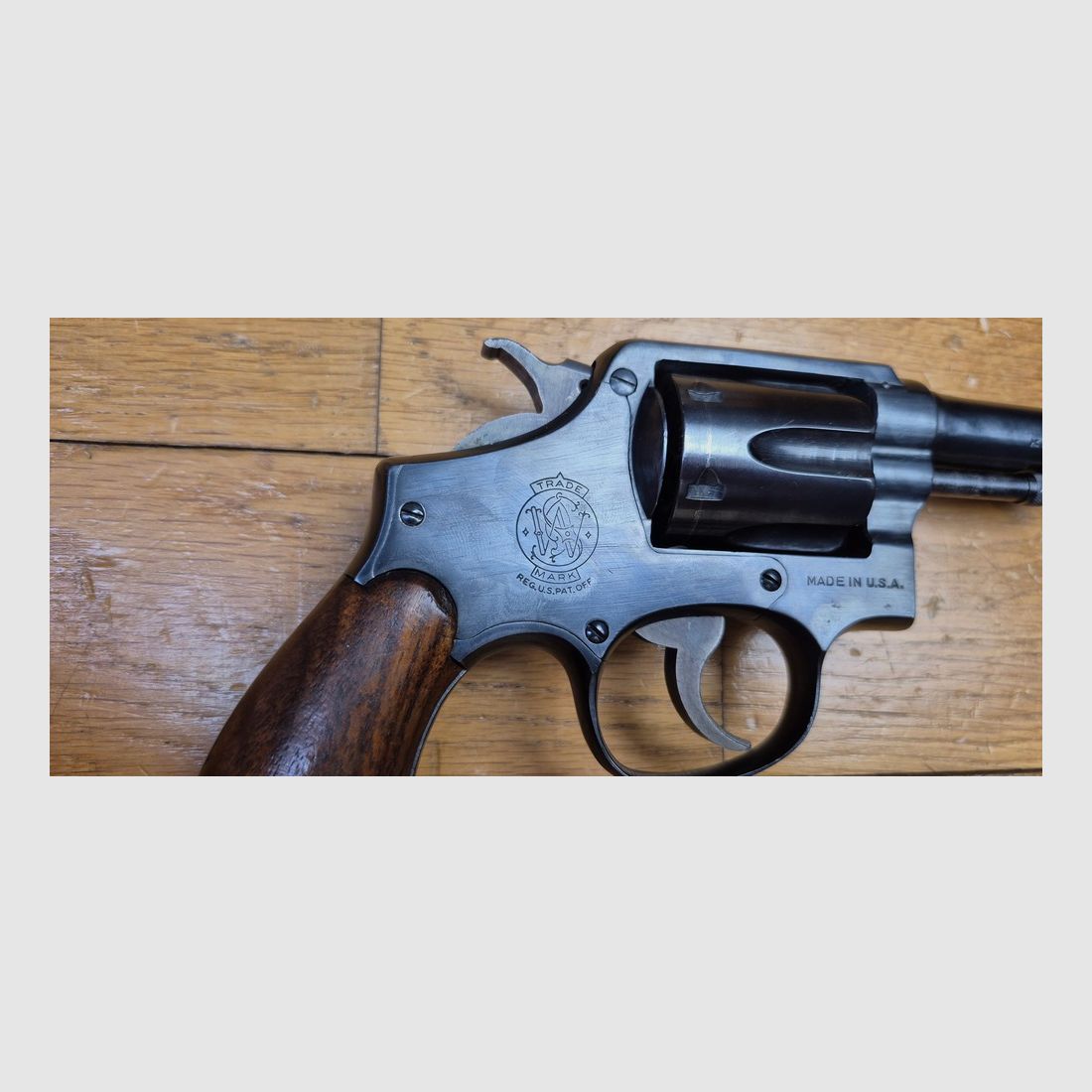

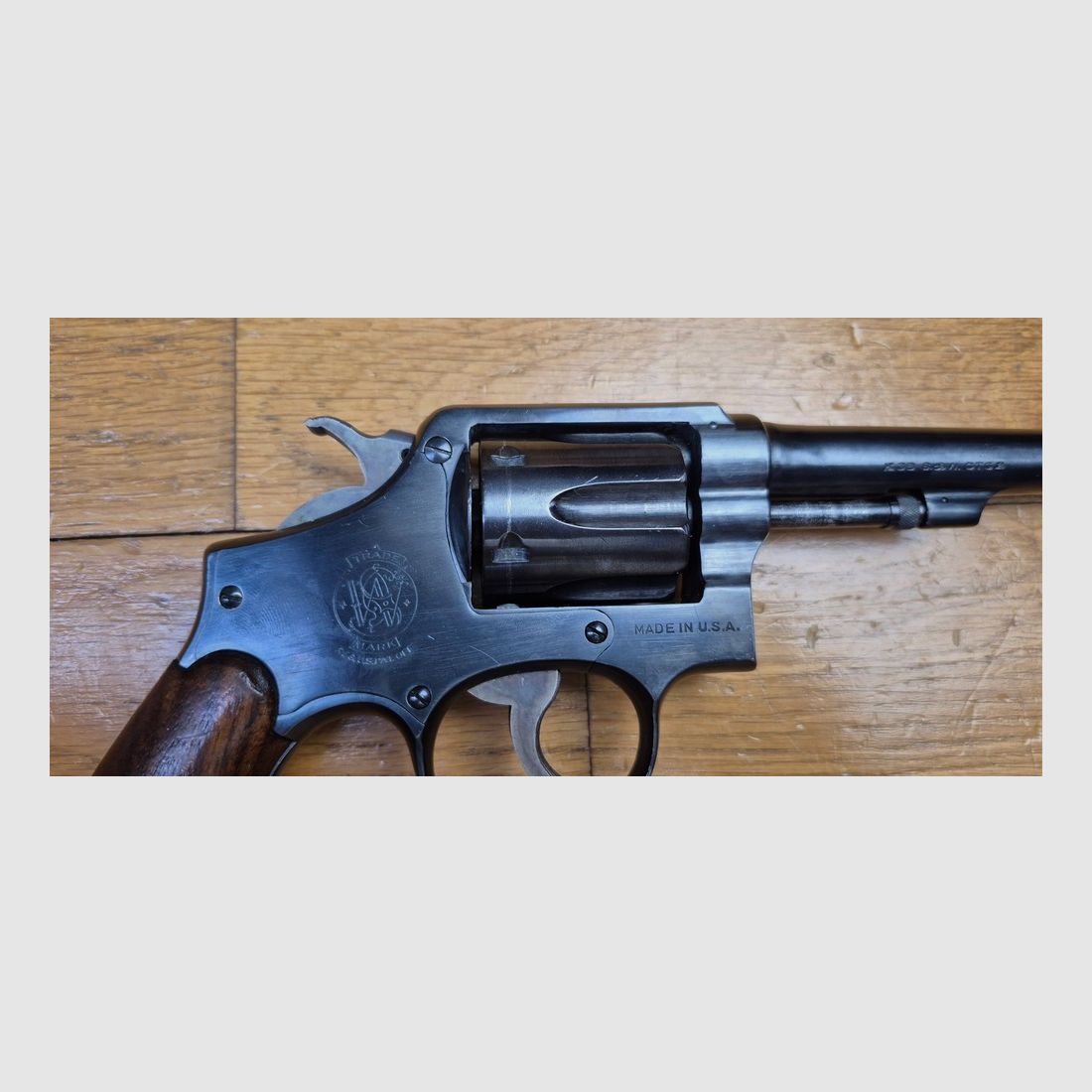
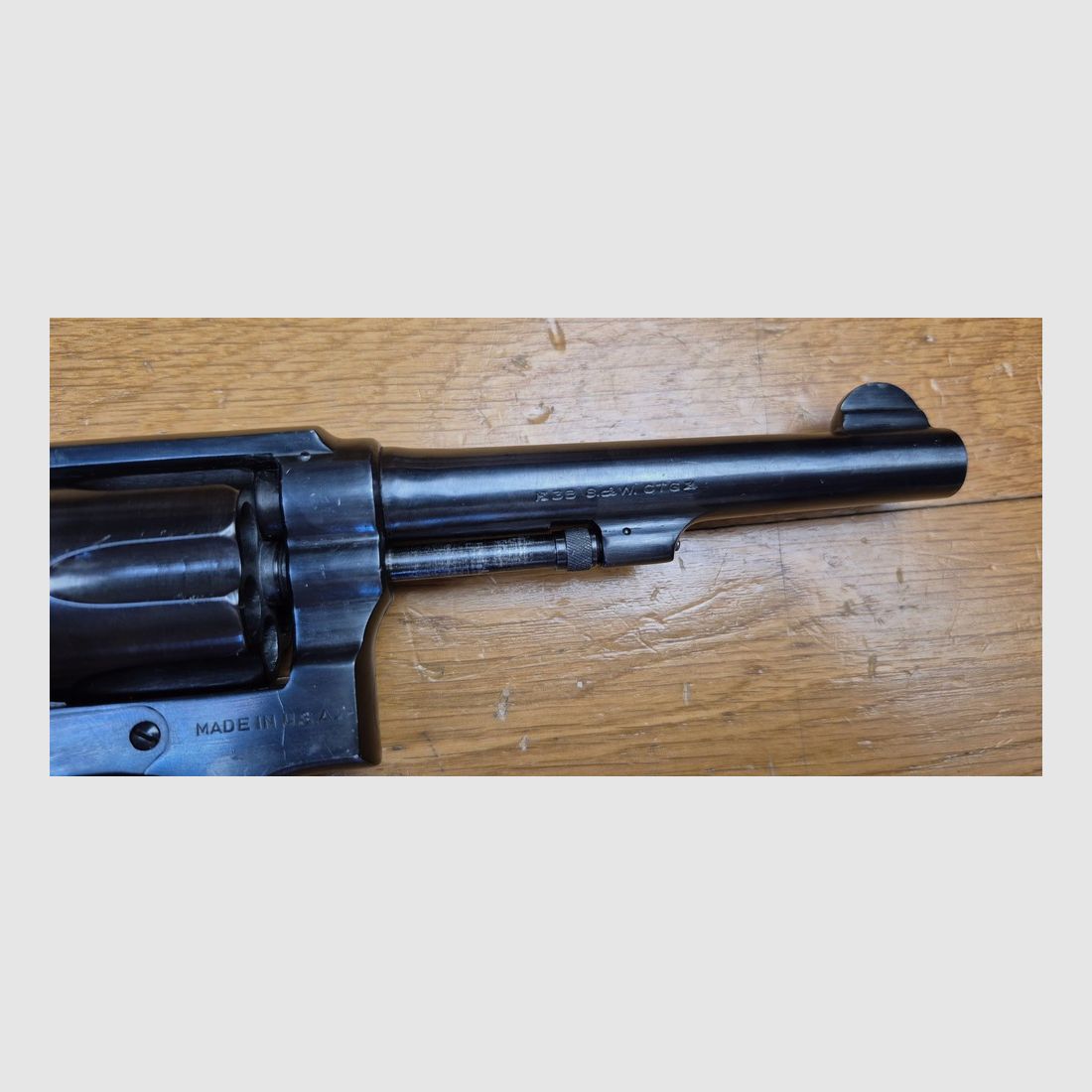

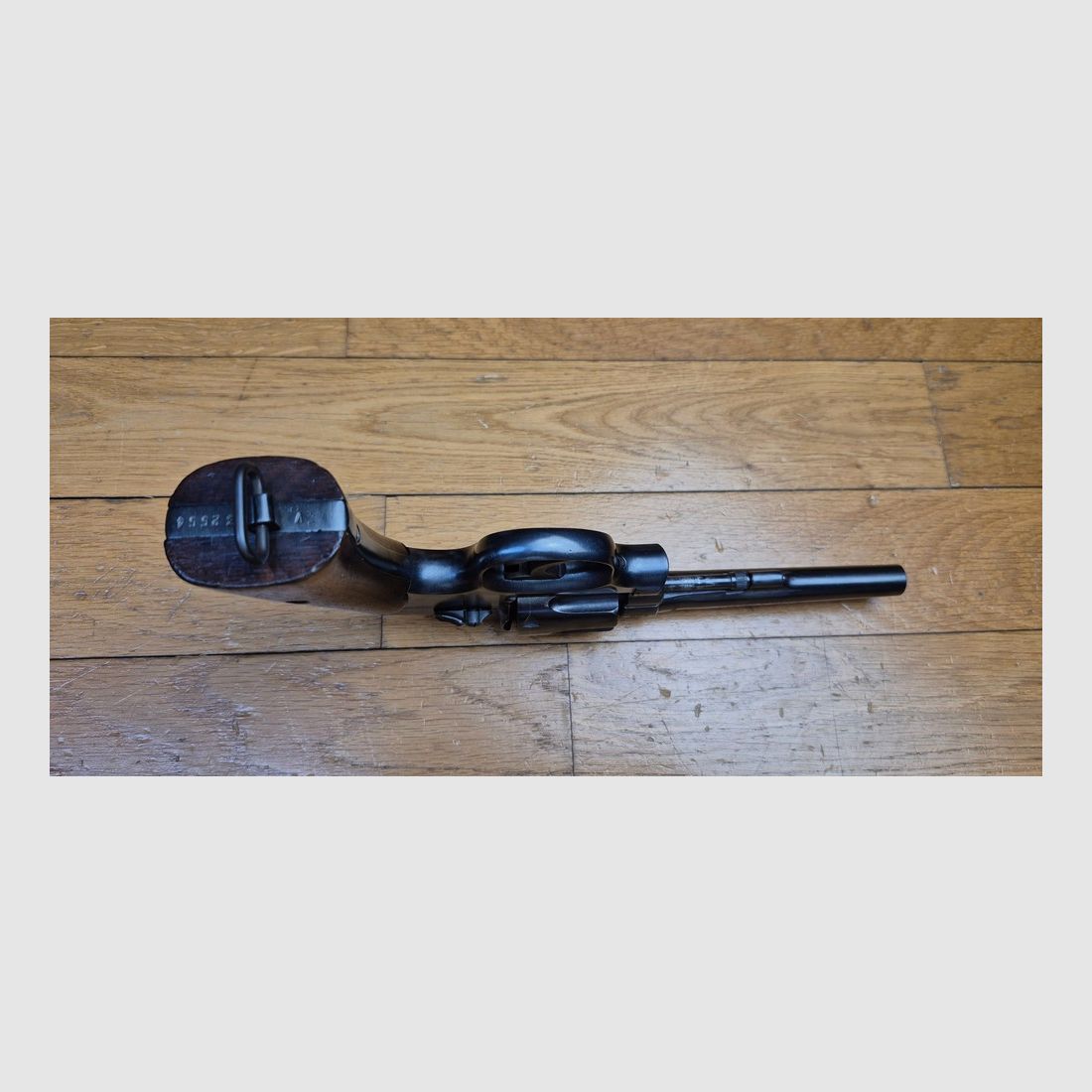






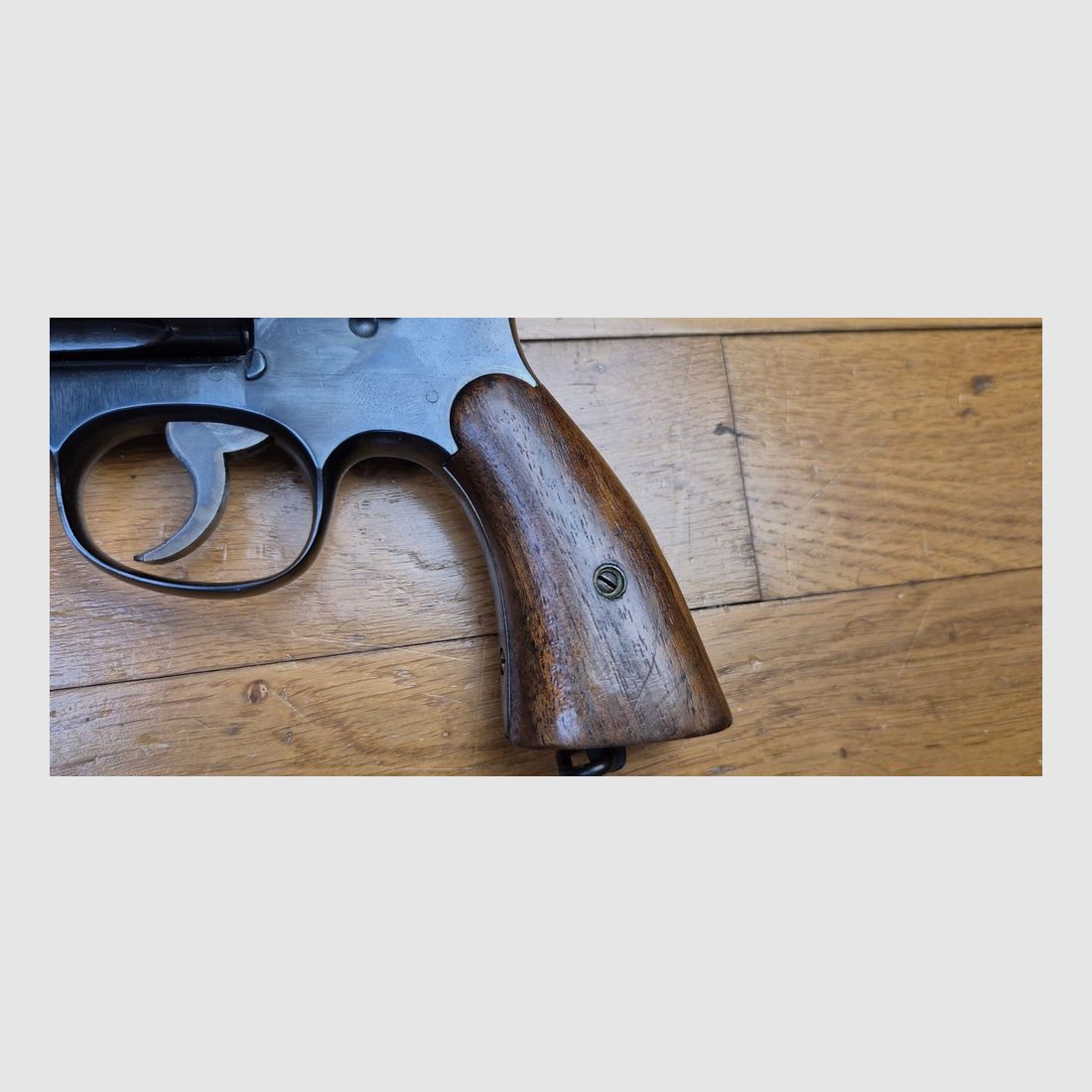

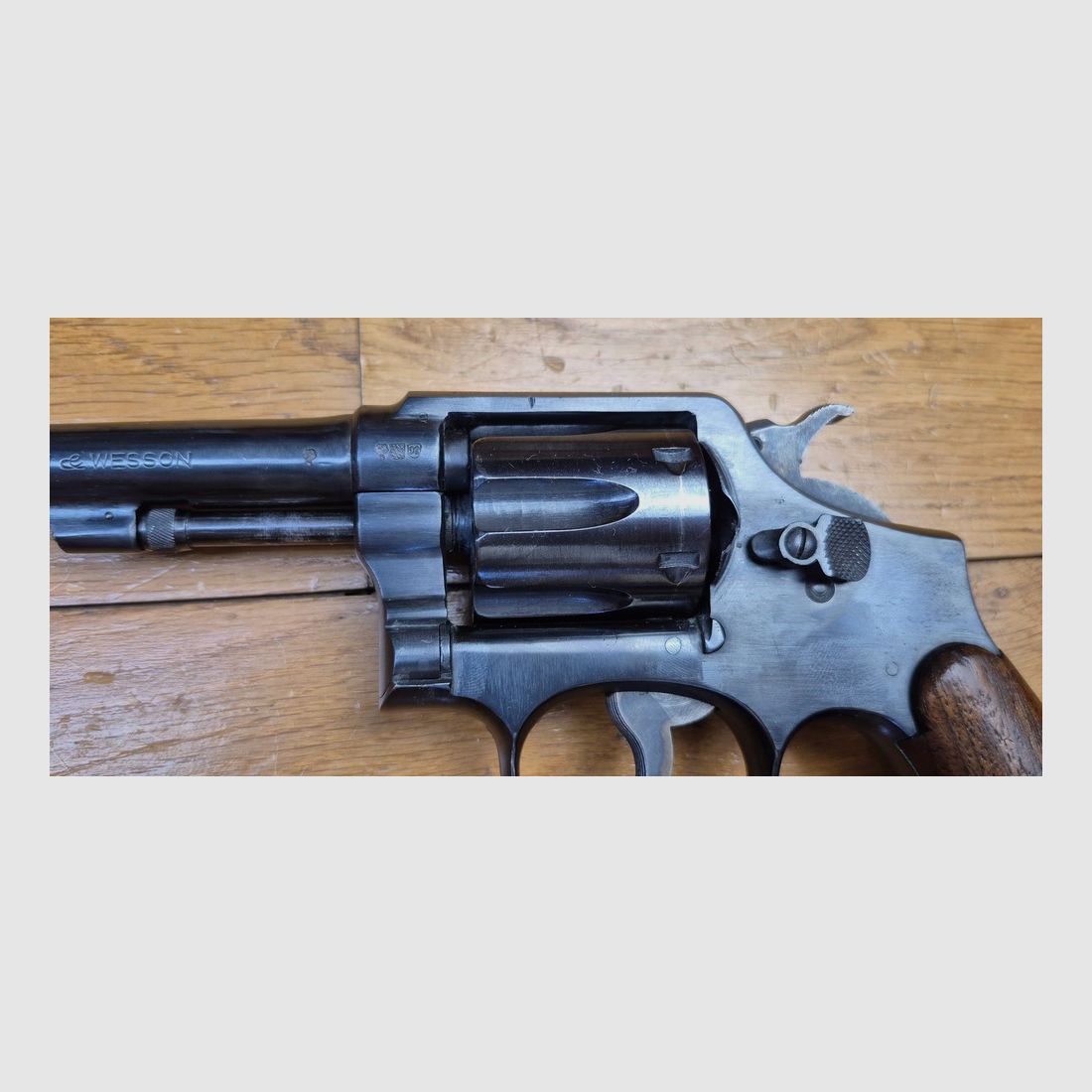
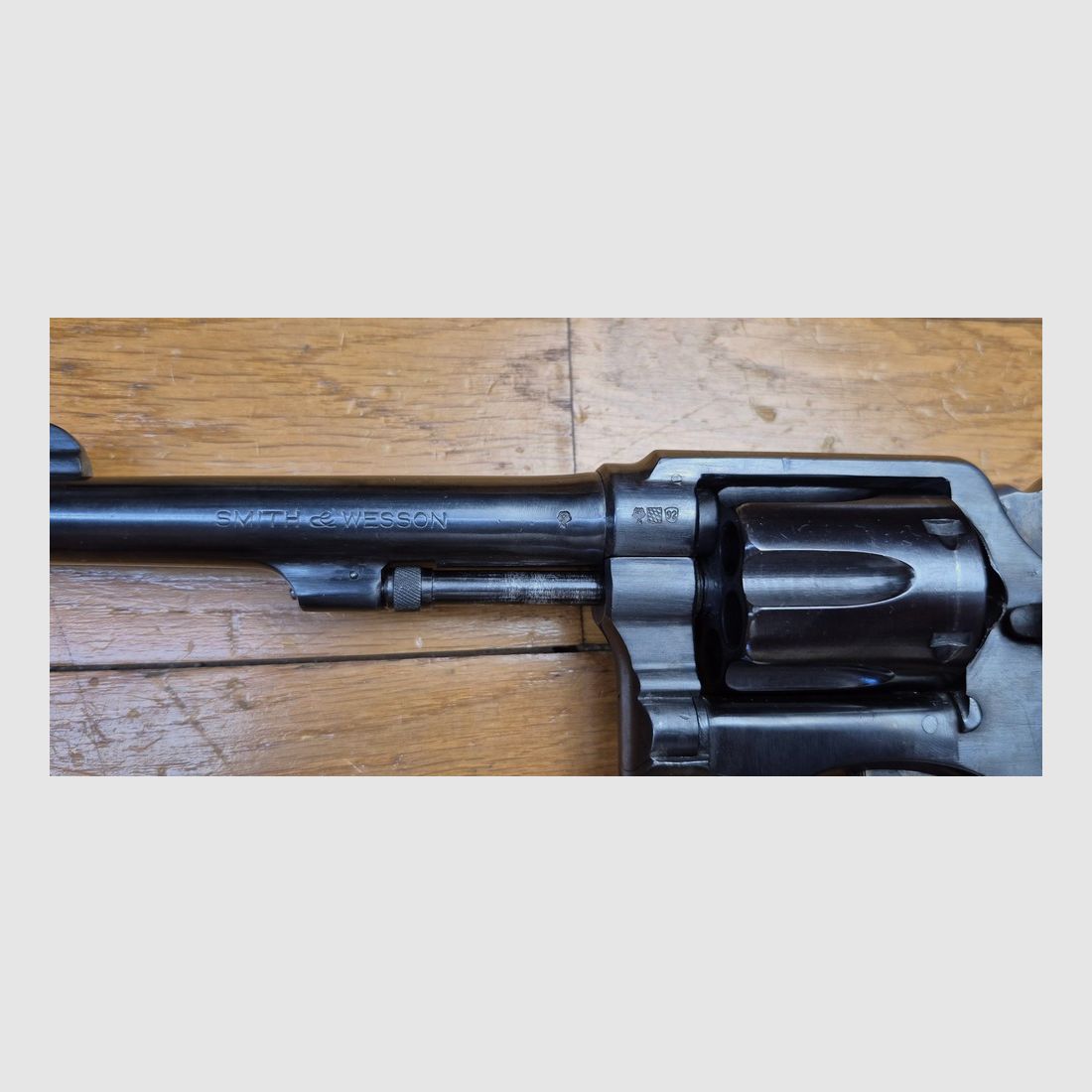
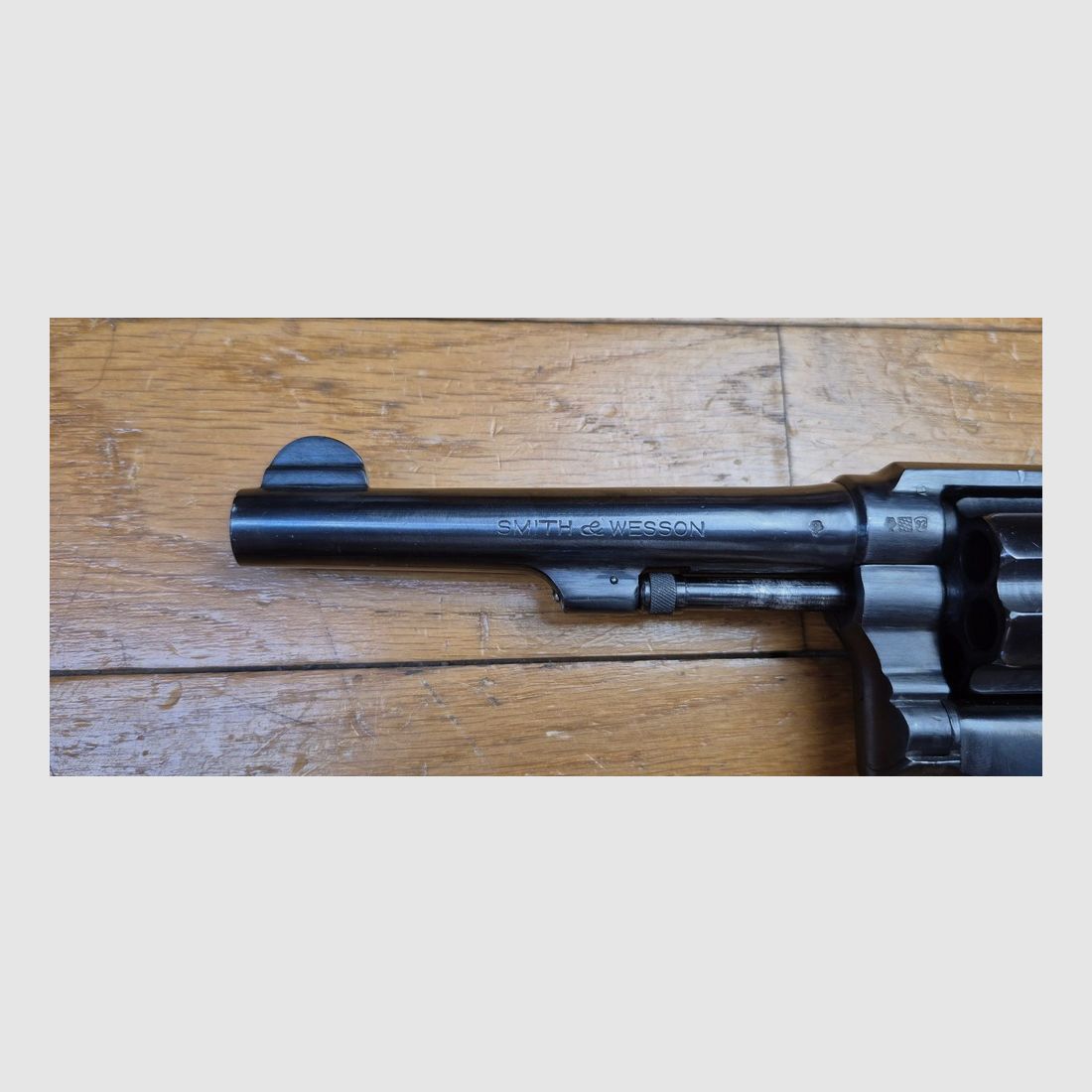
Very nice Smith & Wesson « Victory » revolver – The Hand ejector 1899 and the future model 10 from World War II – Cal. 38 SW / 38-200 – Excellent mechanics – Very good aesthetic condition – Mark « GHD » – Weapon from February 1943 – TBE
≈ $550
Price at the dealer: 500 €. Converted at the ECB rate as of November 20, 2026.
Purchase permit required
75002 Paris, France
7
ID: 10338409
This item is currently unavailable.
Purchase from outside the EU: The firearm goes through an importer in your country, the dealer handles the export.
How buying from Europe works
Shop safely with Gunfinder
Our AI-powered seller identity verification makes Gunfinder the safest marketplace online.
Learn more
Details
- Original language
- French
- Brand
- Smith & Wesson
- Category
- Purchase eligibility
- Required
- Caliber
- .38S&W
- Condition
- New
- Location
- 🇫🇷 75002 Paris, France
- Availability
- Out of stock
Freshness
This listing is based on a mirrored offer, where the listing data was synced to us from a shop, dealer, or external marketplace. Please note that temporary price discrepancies may occur due to possible delays in data transmission.
- Source
- Flingus Maximus
- Last checked with the dealer
- 1 day ago
Description
Note:
The item is located abroad. Please note that delivery conditions, shipping times, and/or the purchase process may differ.
Because what also characterizes this firearm is the dance of its names.
In just over half a century, the same core mechanism — a K-frame with a swing-out cylinder in caliber 38 — went through no less than five successive official identities.
Simply named “.38 Hand Ejector Military & Police” or “Model of 1899” at its birth, it became the “Military and Police Model of 1902” with the arrival of the new .38 Special caliber, then became the “Model of 1905” with a firing modification and enlarged sights. This model itself underwent four minor mechanical changes until the 1940s.
In 1942, it was given the nickname “Victory Model.” Born from a simple prefix “V” added to serial numbers when the millionth unit was produced — a name that was never official — this designation became common usage to refer to the military versions of World War II.
In 1957, Smith & Wesson abandoned the imaginative names in favour of a numbered nomenclature, finally and definitively renaming the model the plain “Model 10.” At least five names used for a single mechanical soul.
Let’s talk here more specifically about the “Victory,” that is the Hand Ejector during World War II. Our S&W Victory today is a fine example. This will also help place its history.
In fact, during World War II, the firearm lived two parallel lives. A British life and an American life.
First, it must be recalled that before World War II, this model, ceremoniously and clearly named “Military and Police,” which clearly shows Smith’s initial ambitions in military supplies, had totally failed the so-called military career.
Barely 3,000 firearms were ordered by the Army and Navy combined during the Philippine War, an order that was not even fully received.
World War I didn’t help.
In 1914-1918, among the Anglo-Saxons, it wasn’t so much the .38s that made noise but rather the .45s. And after the war, while the excellent British .455 was gradually being pushed out in favour of the .38/200 (in 1932), it was much less obvious with Uncle Sam.
America, meanwhile, had mainly seen the legendary Colt 1911 emerge.
Around 1930/1940, one could legitimately wonder if there was still a military future for the .38 revolver.
It was actually the war and Great Britain that revived the firearm. And it was especially the price that revived the military revolver in the USA. And the two ultimately converged at Smith.
The British fired first, as usual.
Smith & Wesson’s military production of war revolvers started as early as March 11, 1940, with the launch of the “British Service Revolver” (BSR), a “Military and Police” chambered in .38 S&W/.38-200 for the British government. Initially in 38SW, then in 38/200 from September 1940. The two cartridges are interchangeable.
This first order then intensified strongly after the Dunkirk disaster in June 1940, when the British, having lost most of their equipment on the French beaches, found themselves in urgent need of re-equipment.
They turned massively to American manufacturers who, for some like Smith, had nothing else to do as they were still hit hard by the Great Depression.
In the USA, which sensed the war coming but were not yet involved, the price of the Colt 1911 A1 actually prevented equipping everyone. It was a resource allocation di
expensive at a time when the focus was mainly on equipping infantry and sailors with semi-automatic shoulder weapons and submachine guns.
So they were looking for a simpler and cheaper weapon for men less exposed to direct combat — pilots, submariners, various guards…
Thus, the Navy placed the first American order for these military revolvers in mid-1940.
It was quite well suited for them too. The revolver has its own usefulness aboard a plane or submarine: fewer moving parts, less sensitive to moisture, capable of firing even partially submerged. No bolt to cock, no safety to disengage — valuable when only one hand remains functional or the other is busy.
The old “Military and Police” was therefore put back into armed service in the USA. And the Smith & Wesson from the British order came just in time, so to speak, as its large-scale production was already underway due to the British. They also chose the Military & Police as their combat revolver.
In the end, about 850,000 to 950,000 Smith & Wesson Military and Police revolvers were produced, of which about 568,000 in .38 SW/.38-200 went to the British. The production estimate range is due to the difficulty of precisely accounting for all distribution channels (direct military contracts, DSC, Maritime Commission, ordered but undelivered weapons, weapons included or not in various lend-lease waves, etc.).
At first, Smith continued its civilian numbering on these military weapons. It was only upon reaching one million (including pre-war civilian and police guns) that Smith decided to change the numbering by adding the famous “V” for “Victory,” which eventually designated all weapons, whether British or American, from this military production.
The V numbers start at V1 on April 24, 1942, and end at V811119 on August 27, 1945. Weapons were delivered to the British until March 1945.
I strongly emphasize the quality of these weapons. We were still at a time when Smith didn’t do anything mediocre. Sure, the finishes suffered due to the war, but the mechanics and fit remained uncompromising. I’m always surprised by the mechanical smoothness and trigger quality of these military weapons.
In particular, Ordnance quality control on US weapons was fierce, with up to a third of production rejected on some days early in production! This also explains the quality of these weapons.
Two Ordnance inspectors oversaw this. Waldemar Broberg (stamp “WB”) was succeeded by the formidable Guy H. Drewry (stamp “GHD”) around weapon number 142,000. Drewry validated not only production for the US Army but also Smith & Wesson production destined for British lend-lease.
So in 1940, the “Military and Police” finally began its long-awaited military career. It would be present on all fronts and far from its bases.
US Navy pilots like Boyington carried the weapon in a chest holster, somewhat like tank crews but with a different holster. Marine pilots also carried extra cartridges on a sling suspended from the weapon.
This handgun carry configuration in naval aviation remained in use until the Beretta M9 appeared in 1985. There are many photos of pilots in Vietnam around 1970 carrying their weapon just like in the Pacific in 1943. In case of forced landing in enemy territory, the weapon could be drawn quickly and fired in one motion, enough to greet the welcoming committee from the cockpit or hanging from the parachute.
On the British side, soldiers clearly preferred the Victory over their old Webley and Enfield break-barrel revolvers: more ergonomic operation, crisper and smoother trigger, firmer lockup. Smith manufacturing, of course.
The weapon also had a
more clandestine career.
A significant portion of the Victory in 38SW /.38-200 will not end up in a British military holster. These firearms are actually "redistributed" by the OSS — the Office of Strategic Services, the direct predecessor of the CIA.
The OSS parachuted them in large numbers to resistance networks throughout occupied Europe. Many landed in France, parachuted in the dead of night in 1943 and 1944, into the hands of our resistance fighters.
It is precisely for this reason that the Victory in .38 S&W remains much more common in our regions today than its cousin in .38 Special: our continent simply received many more, but through much less official channels.
Our firearm today is typical of this production. By its style and history, the Victory is one of the must-haves of World War II firearms.
This example is in a condition more than very good compared to many of its peers on the market. According to its serial number, this firearm left the factory in February 1943 and is therefore celebrating its 83rd summer. The firearm was re-proofed in Bavaria in 1992.
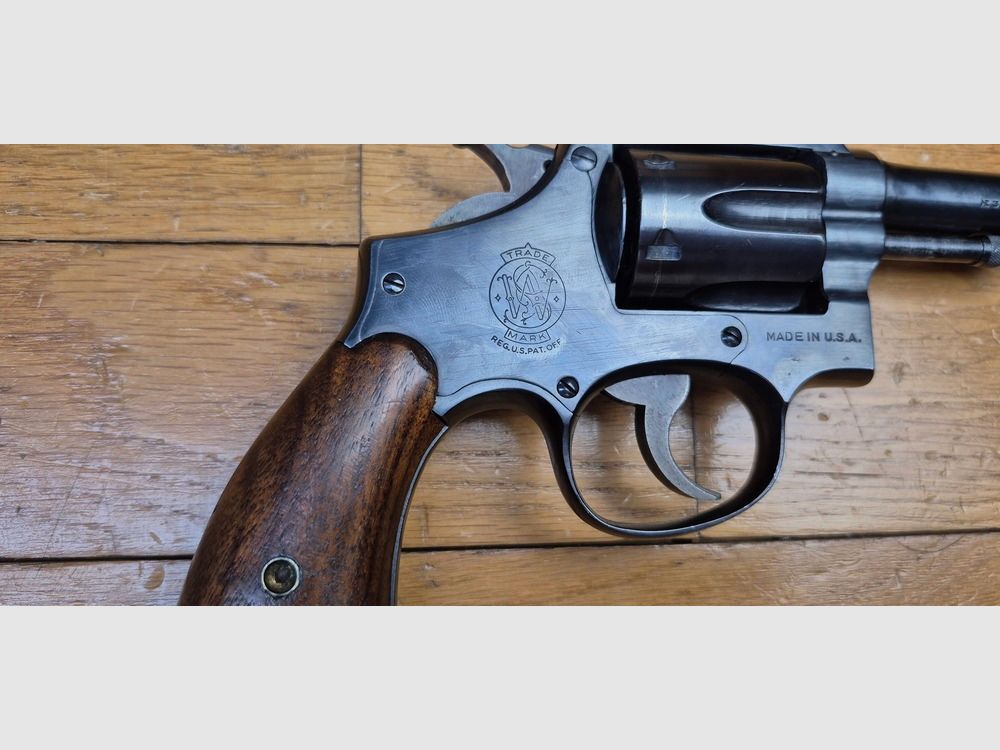
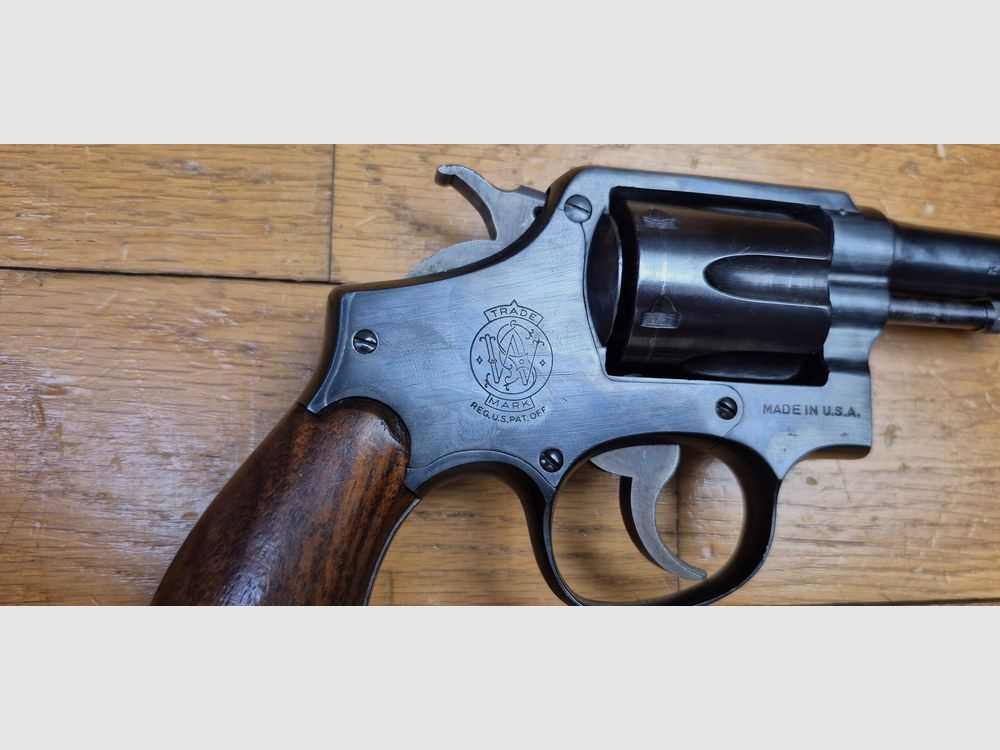
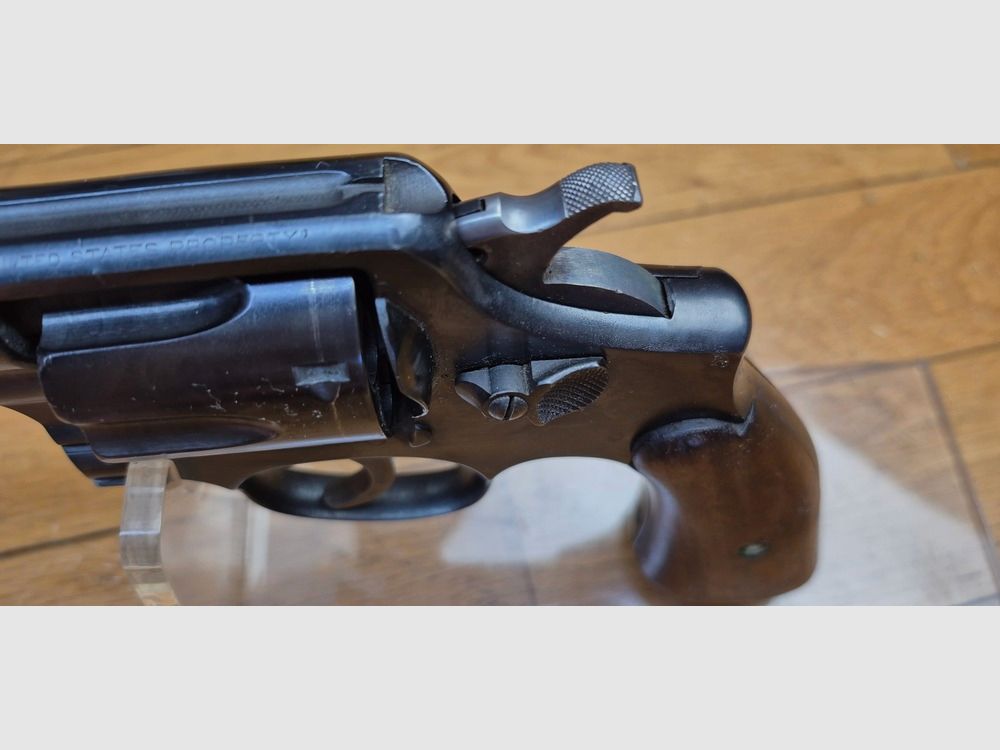
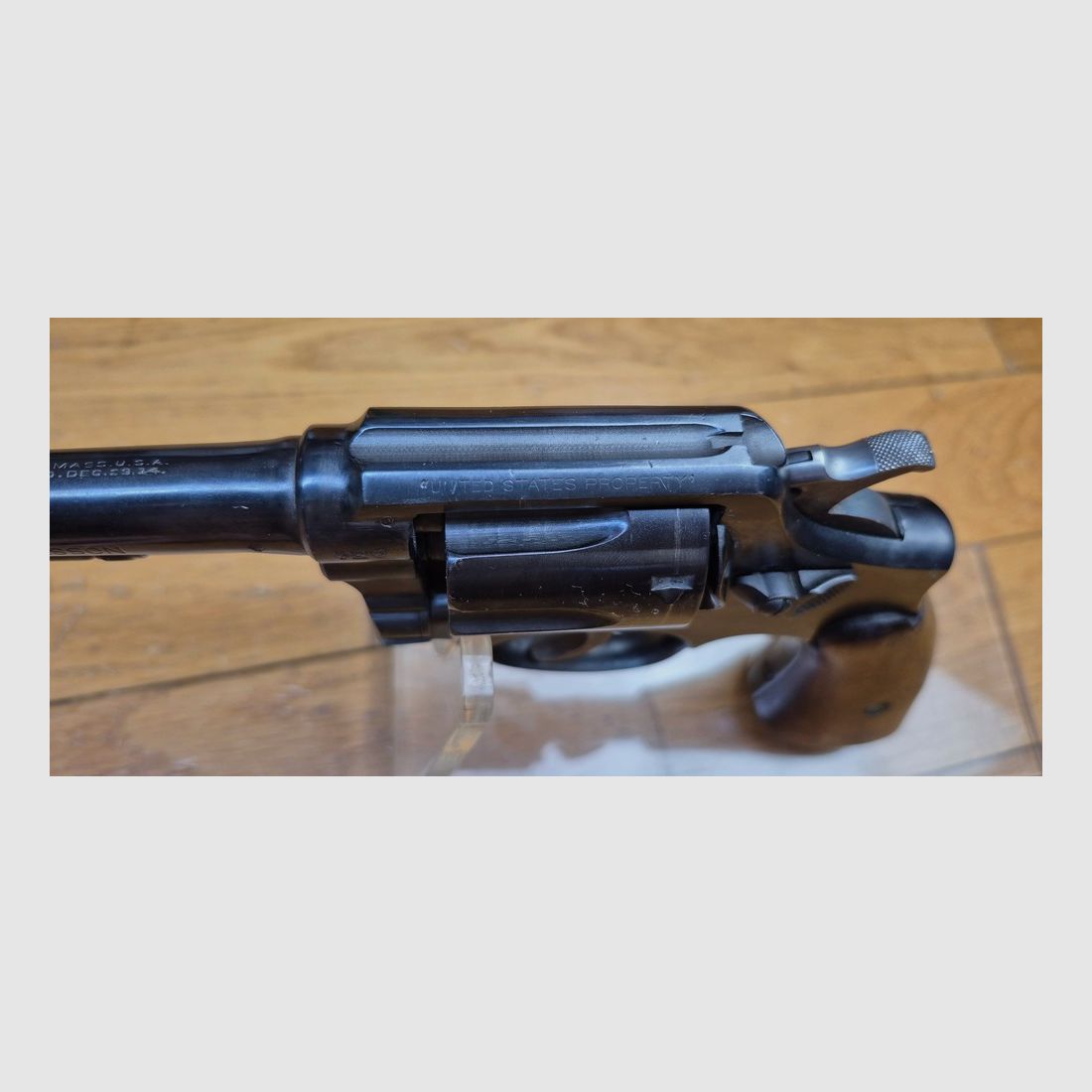
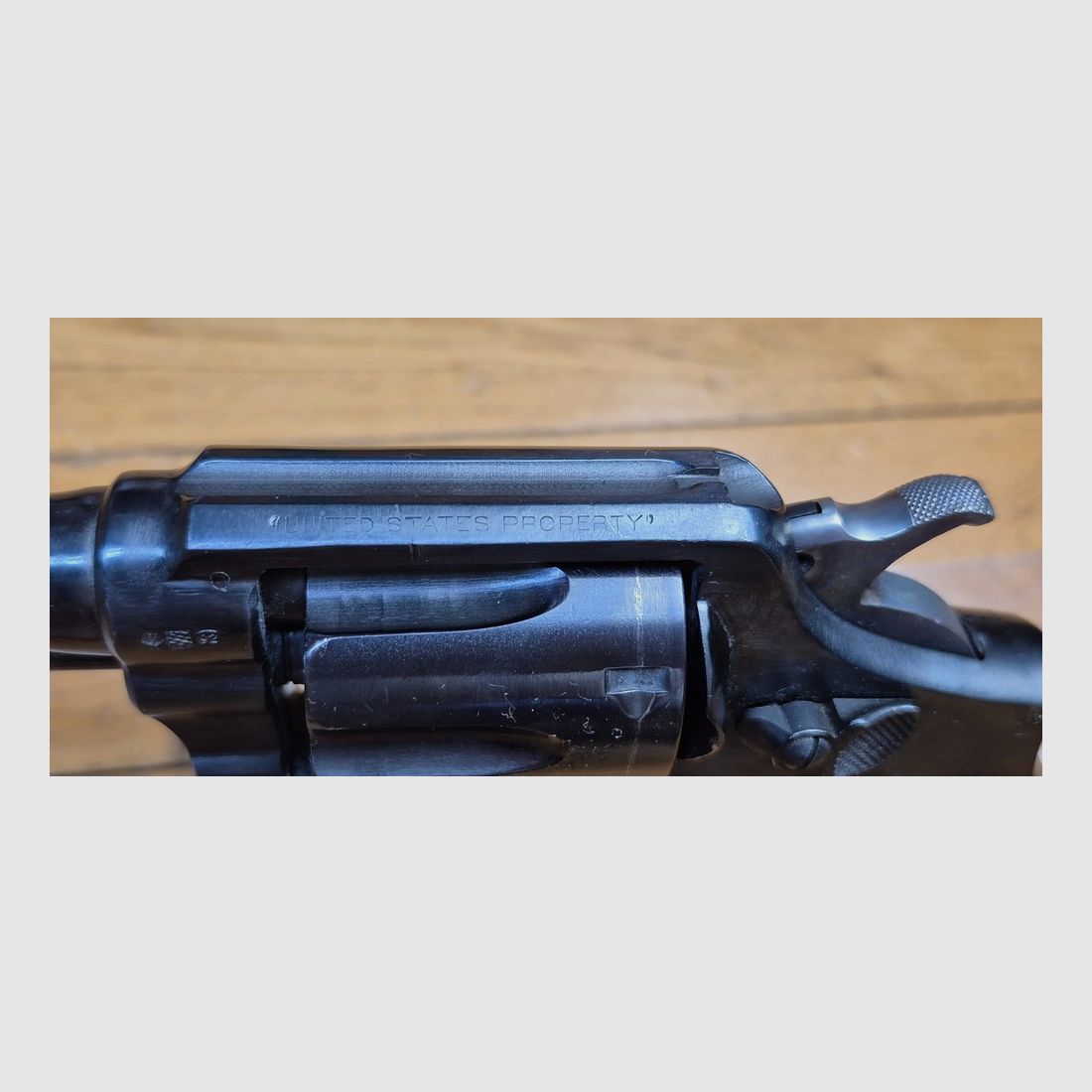
Its external surface is preserved at 95%. No trace of oxidation is visible, and even less orange peel on the bluing. Very nice. No holster wear marks are visible either, neither at the muzzle nor on the edges.
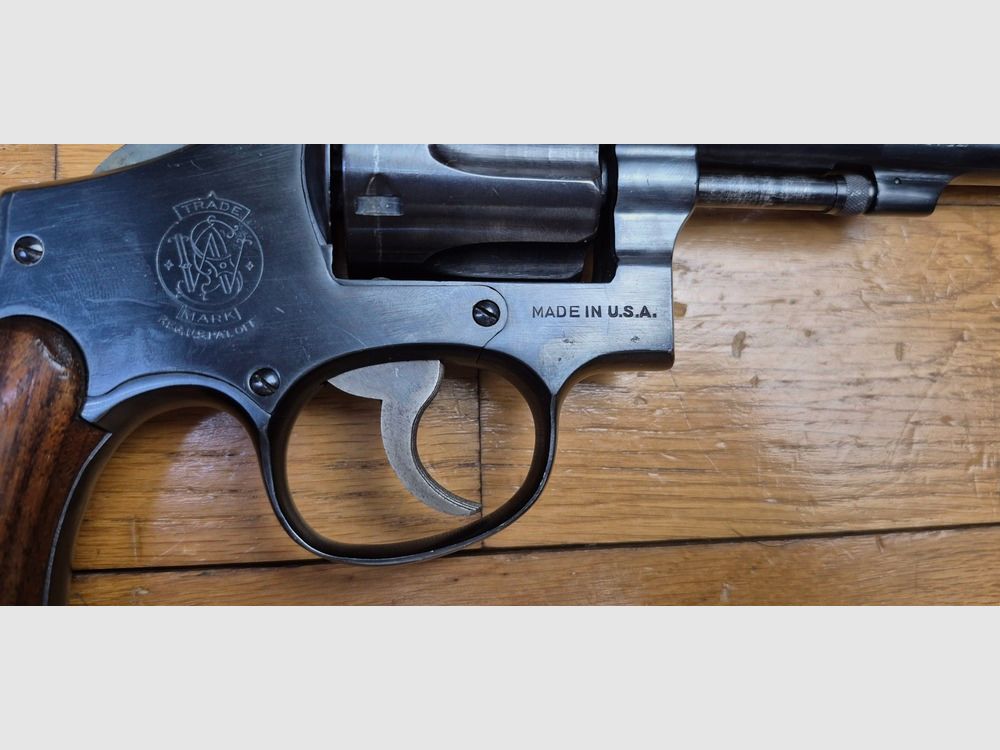
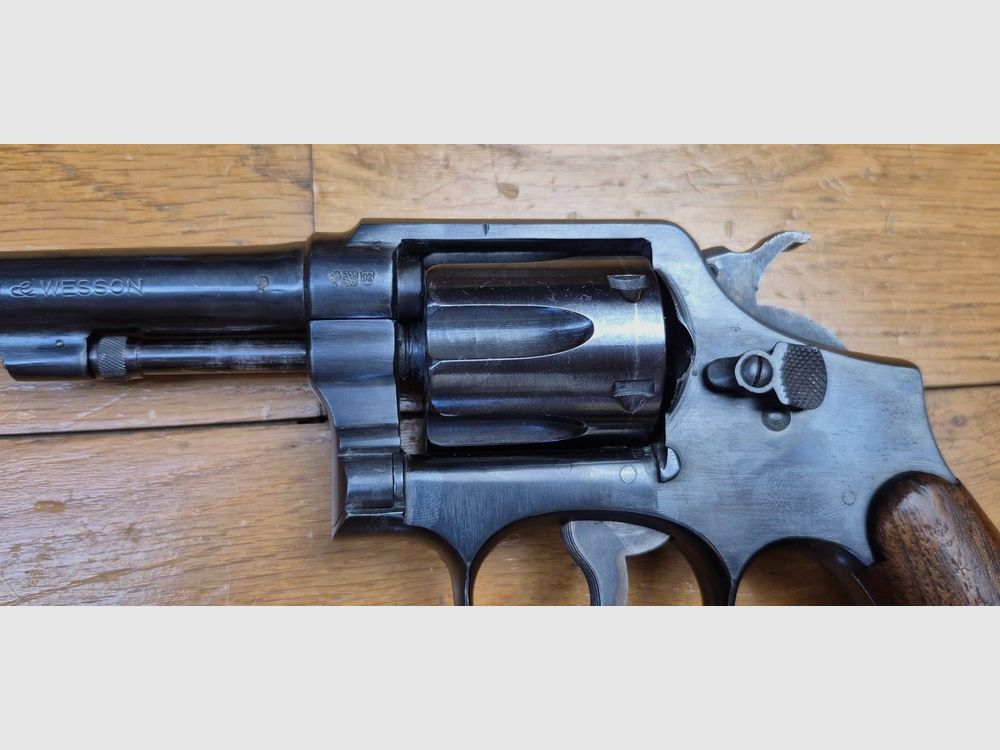
Scratches and other handling marks are also extremely limited, almost absent. What you see is, as usual, VERY exaggerated by my TOO close-up shots.
The overall photos do much more justice to the firearm. But this way, you see everything.
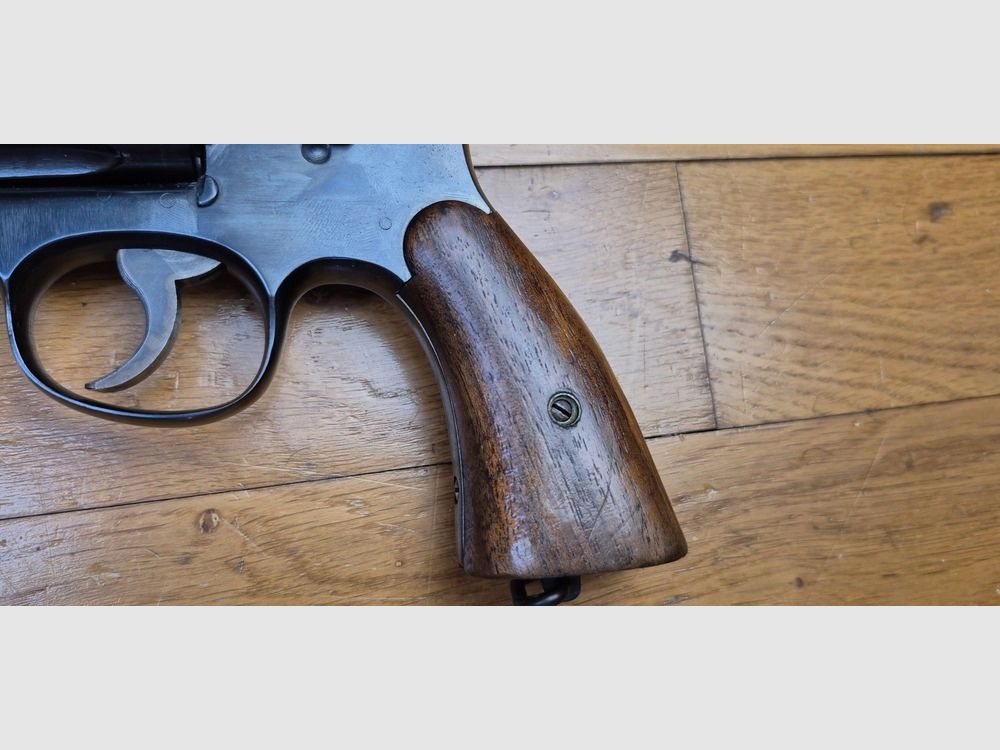
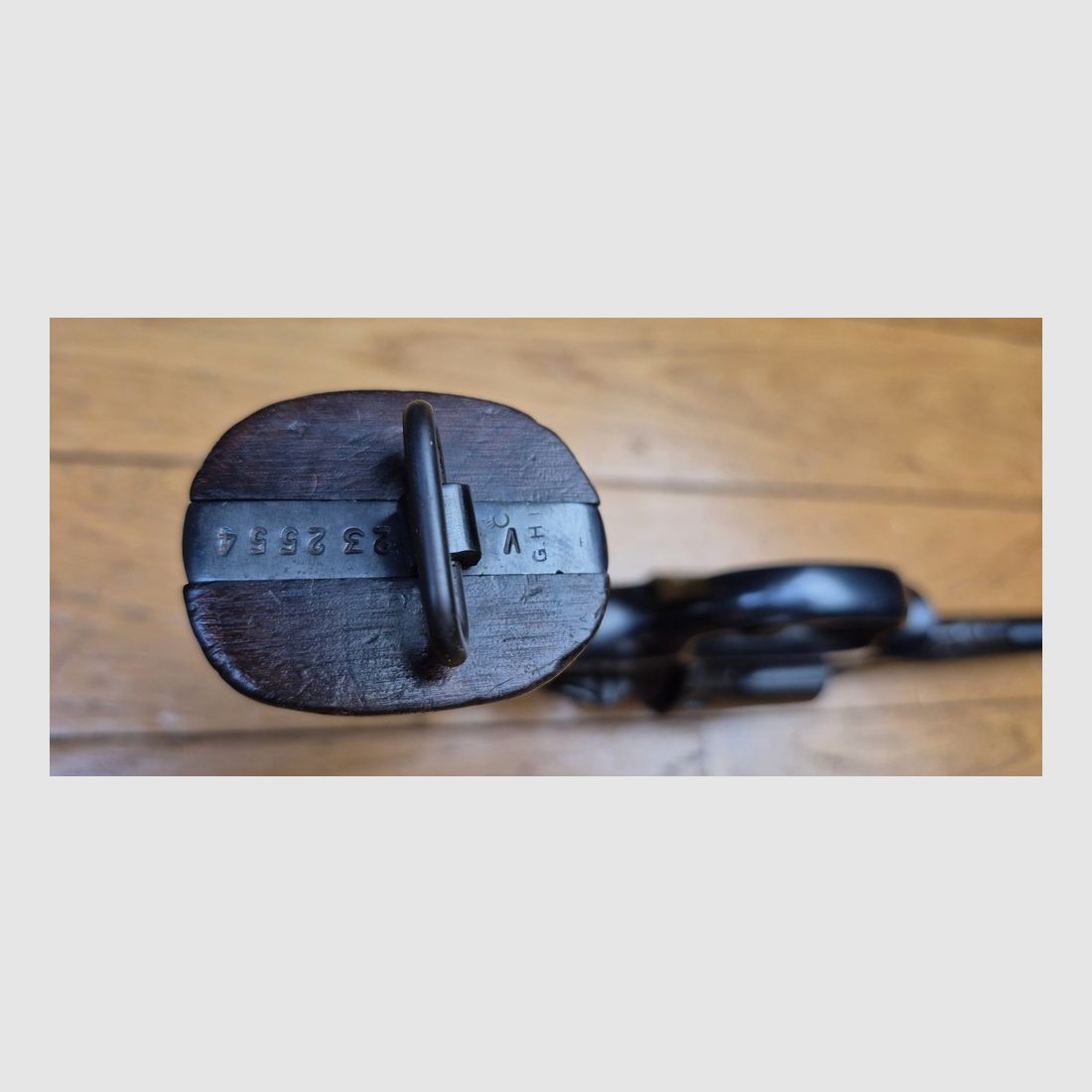
The grip panels, in beautiful American walnut, also show no notable handling marks — no major dents or chips. The wood has obviously seen little use. Excellent condition aesthetically for this firearm.
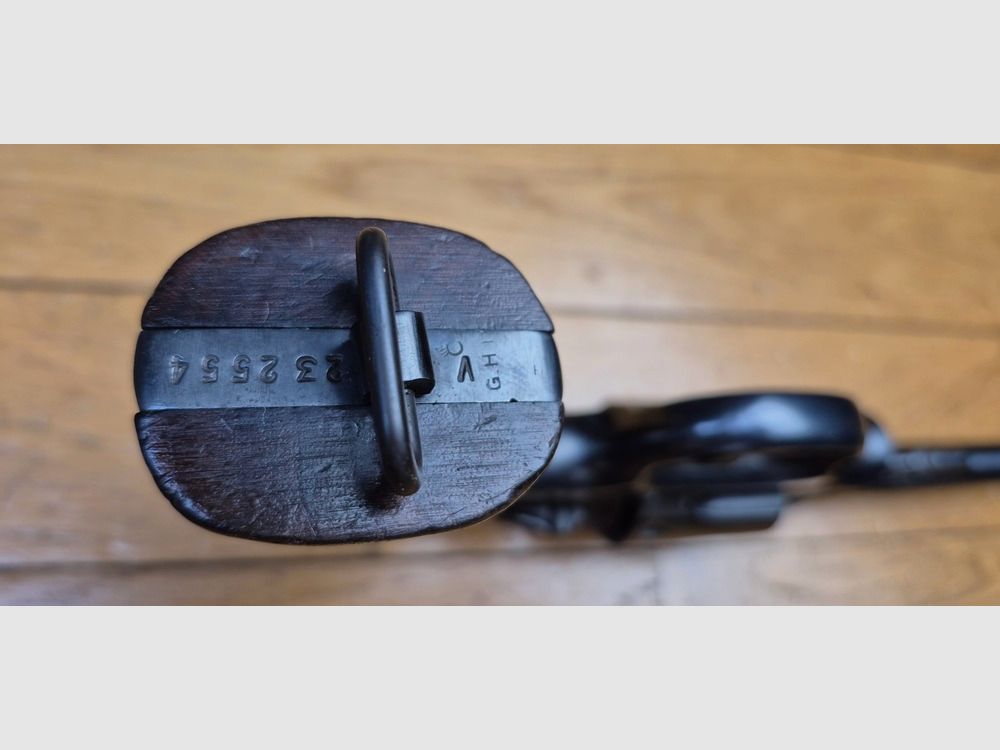
Lanyard ring and screws are also in perfect condition.
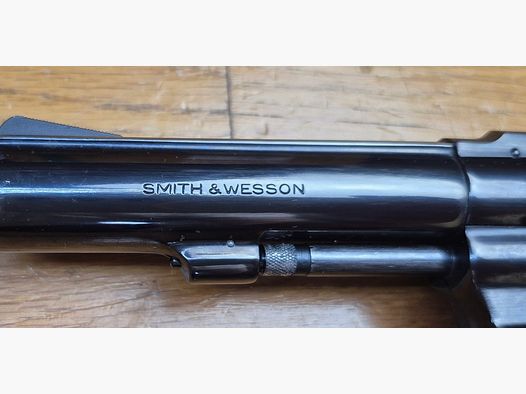
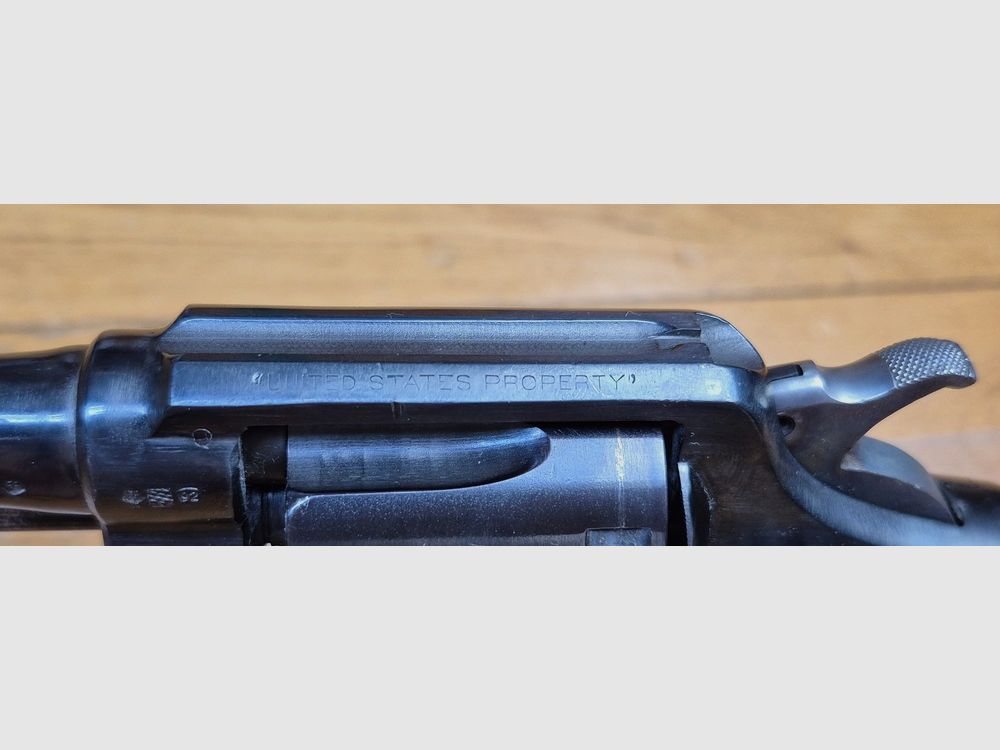
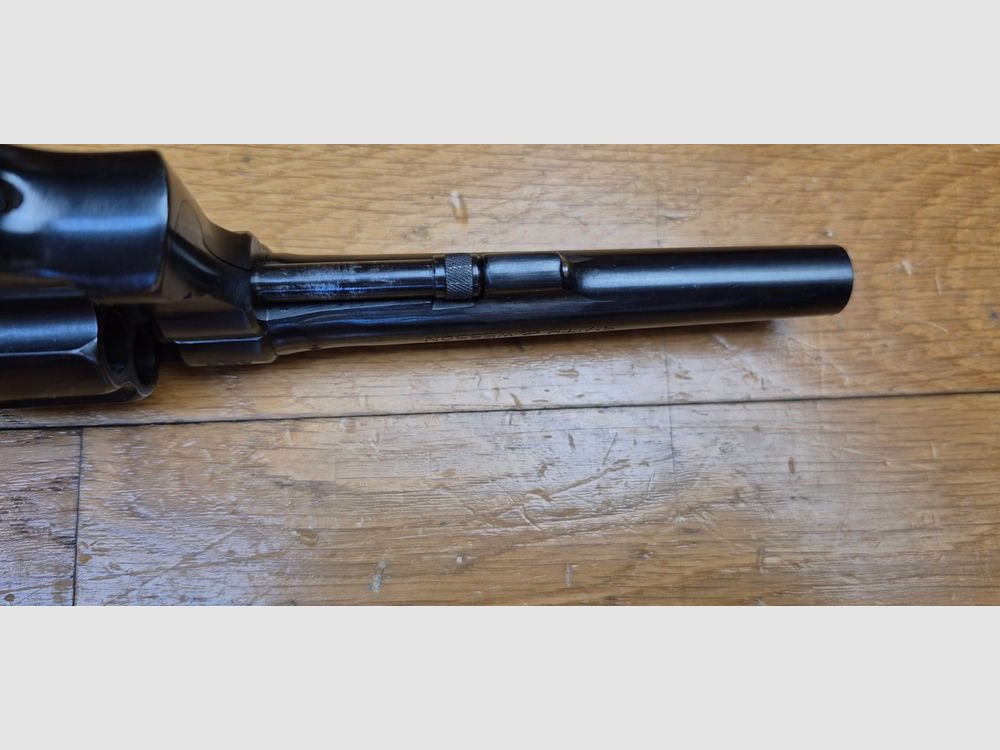
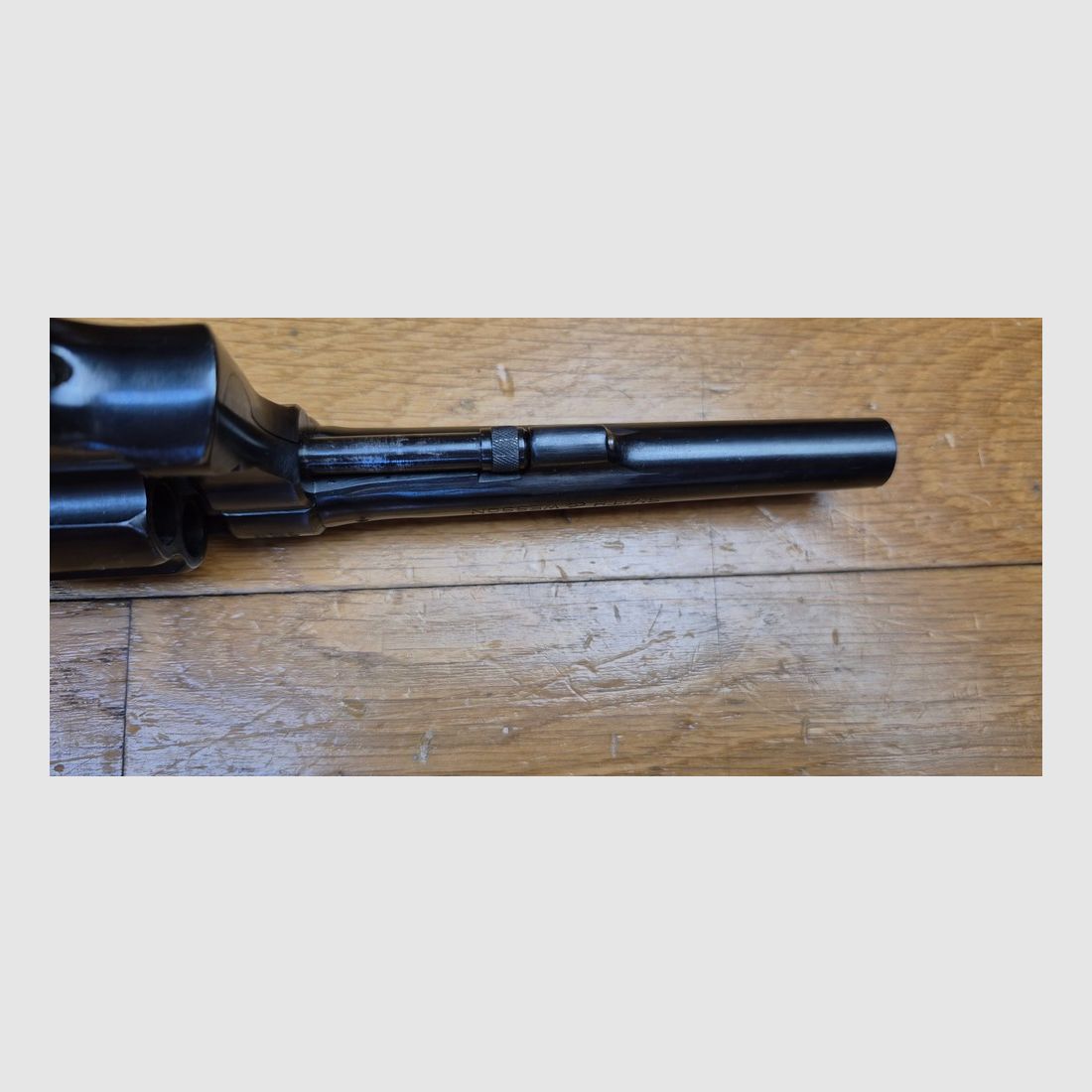
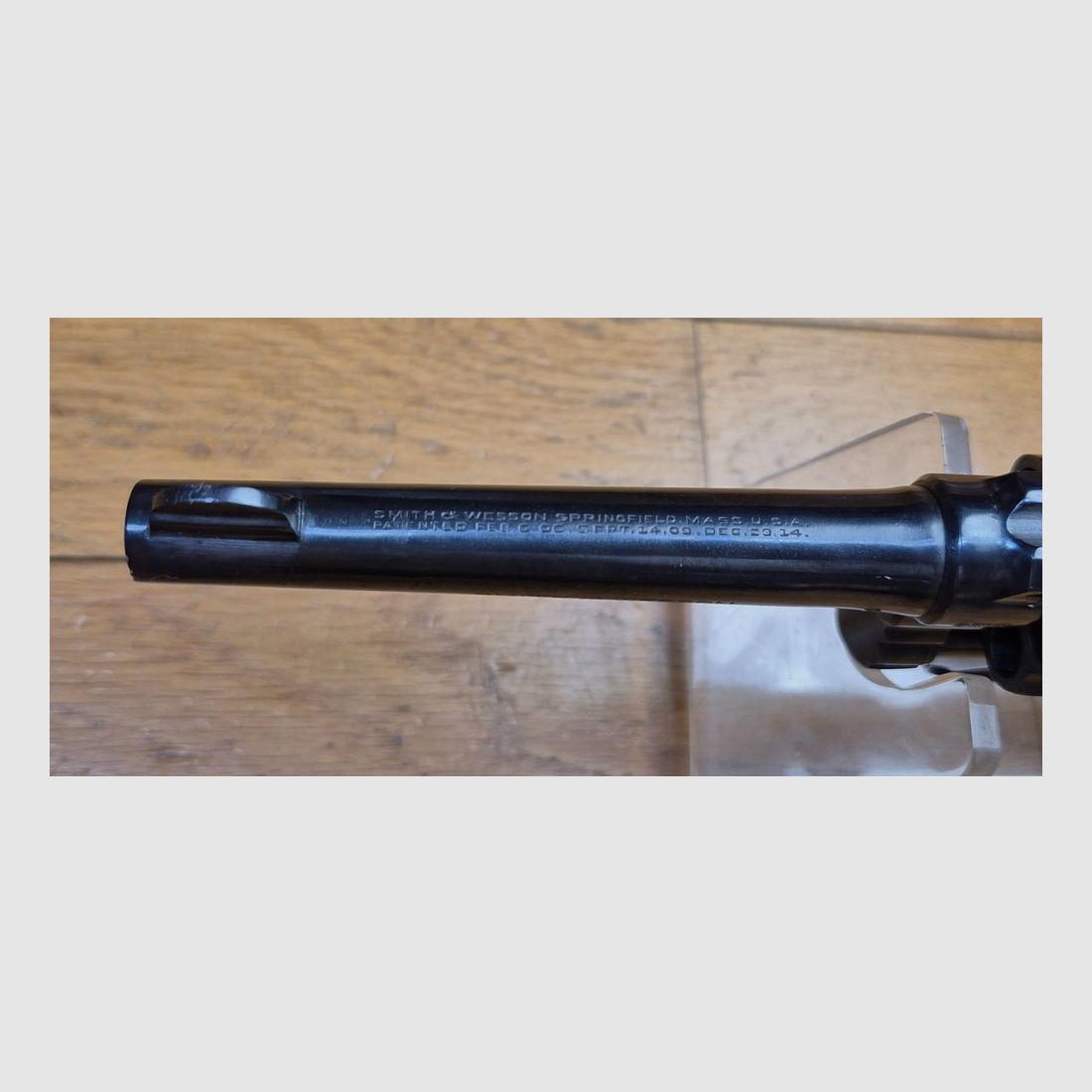
All the markings on the firearm — manufacturer, model, proof marks — remain clear and perfectly legible, without any wear or oxidation obscuring the reading.
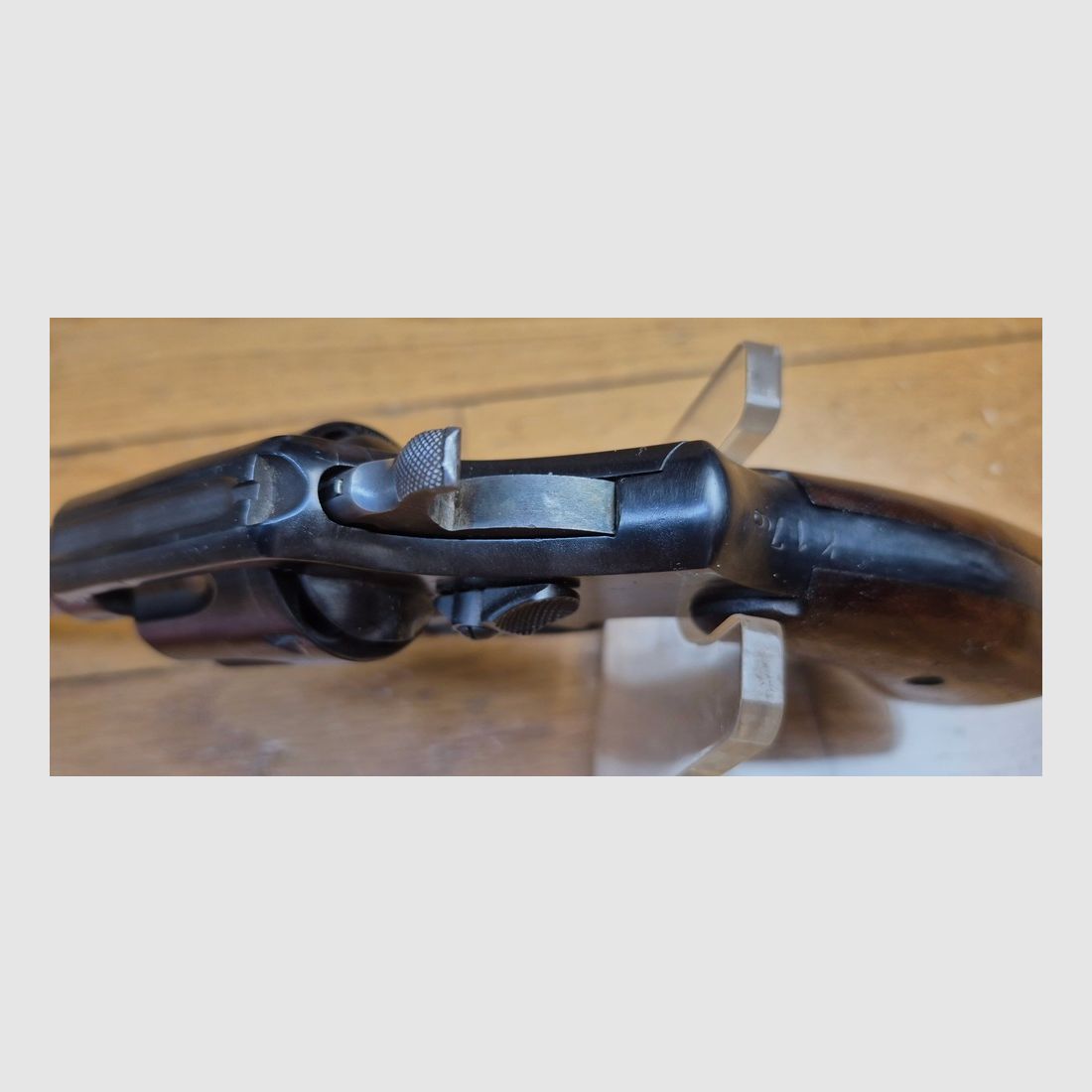
Under the stock, you can clearly see the small GHD stamp for Guy H. Drewry, the American Army Ordnance officer responsible at that time in the war for inspecting and accepting Smith & Wesson’s military production before shipment. Its presence therefore attests that this firearm passed American military quality control.
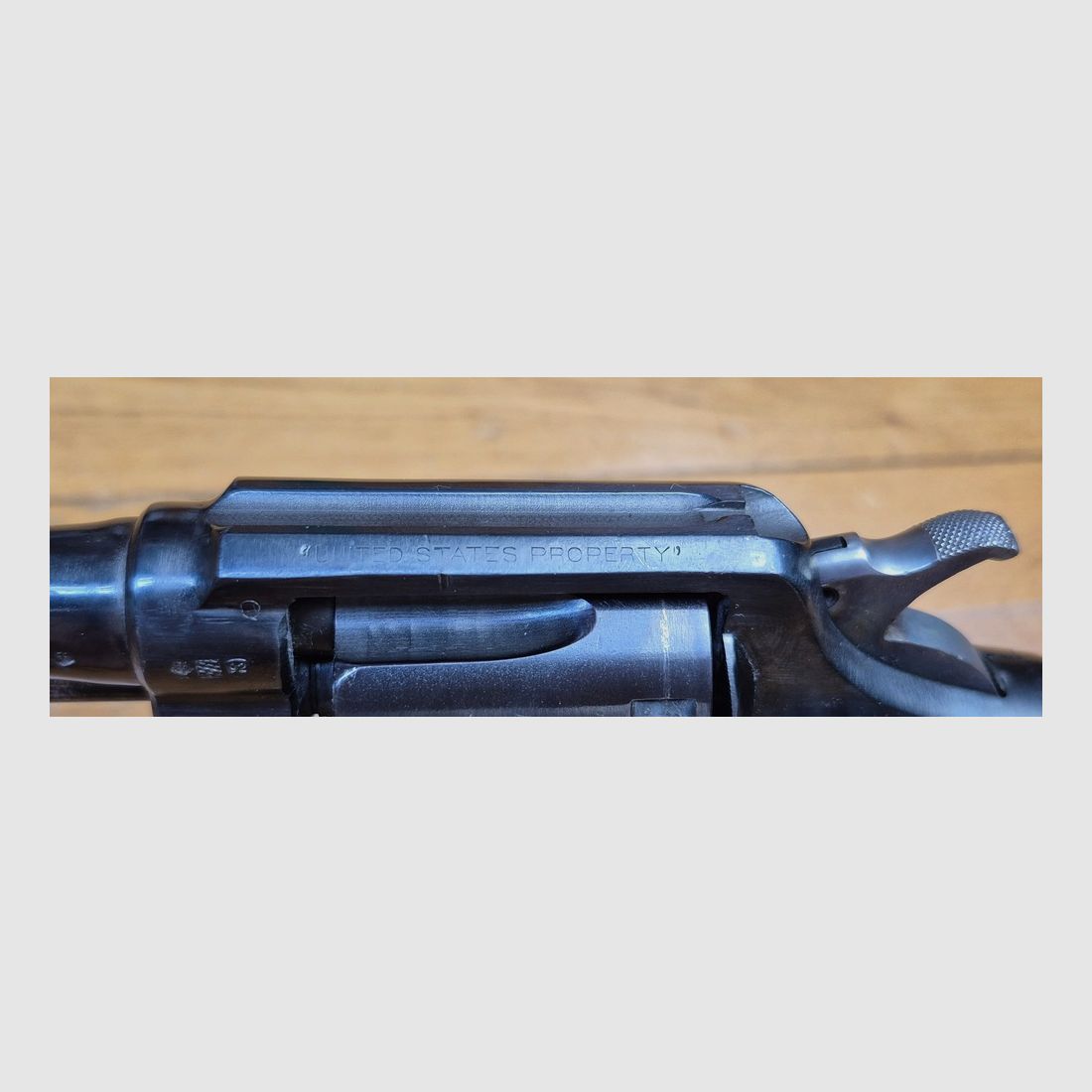
This is undoubtedly an American service firearm as it is clearly marked "United States Property" on the frame — no British proof marks. This makes this example, in my opinion, interesting. It is very likely a parachute weapon from the OSS to resistance networks in occupied Europe.
Note that the original case hardening on the hammer and trigger remains 98% visible, also a sign of a piece that has seen little firing and handling. The said trigger is also serial numbered on the front.
These are details, of course, but details that say a lot: even in full wartime production, at an industrial pace, Smith & Wesson of the great era continued to produce more than quality firearms. Honour to those workers and craftsmen we miss so much today…
Mechanically, the firearm is flawless: the cylinder indexing works without any issue. The trigger remains smooth even in double action. The firing is crisp and clean. An excellent shooting firearm as well.
The firearm seems barely broken in — the internal springs are still firm, another sign of very limited use over the decades.
The barrel is like new, literally mirror polished along its entire length with very nice rifling.
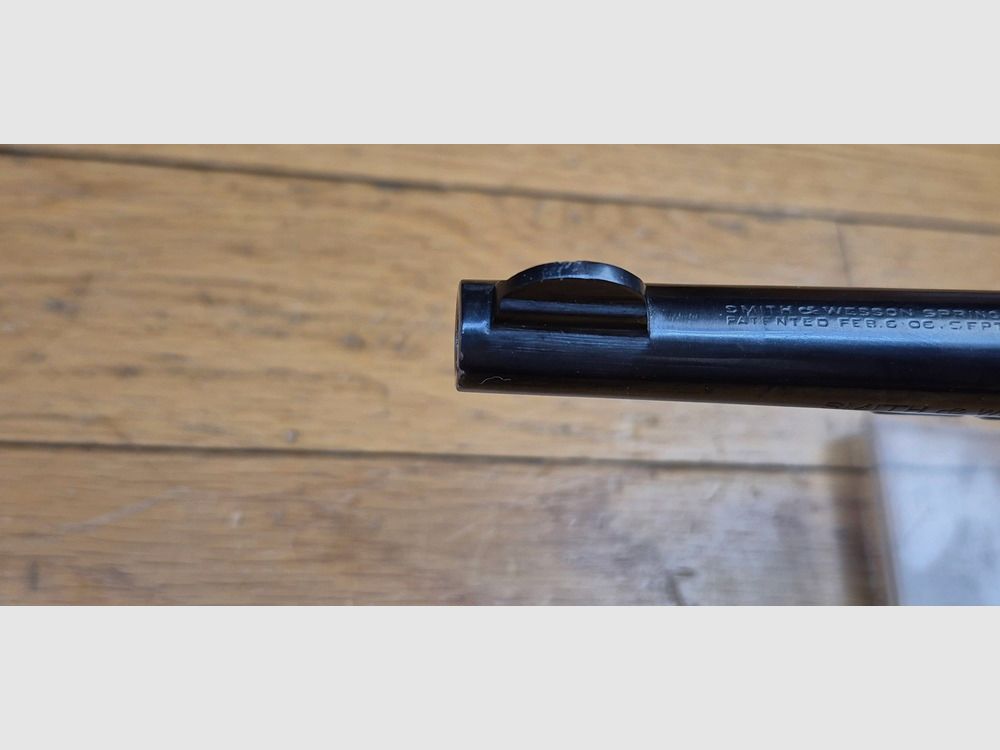
The front sight, crescent-shaped, also remains perfectly original and well preserved — unlike many examples encountered where the front sights have been "reshaped" by successive owners.
Ultimately, voi
Here is a very nice example of a Smith & Wesson Victory in like new condition, capable of satisfying both the demanding shooter and the collector looking for a piece of history.
CATEGORY B FIREARM UNDER THE CSI: FIREARM SUBJECT TO AUTHORIZATION – PHOTOCOPIES OF VALID ID AND LICENSE REQUIRED – SIA ACCOUNT OPENED OF COURSE – Shipment with signature in two separate packages at least 48 hours apart mandatory.
***************************************************************************************************************************************
Let’s repeat it! The Flingus Maximus gun shop in Paris and throughout France is also here for your private party firearm formalities, buying collections of firearms and militaria, your firearm appraisals, your firearm questions in successions and inheritance. Contact your favourite gunsmith via our contact form or at [email protected] (Show description in original language)
Maître Flingus vous a raconté ici ou ici l‘histoire pas si simple du Hand Ejector de 1899 devenu, en 1957, après nombre de détours, le prosaïque « Modèle 10 ».
Car ce qui caractérise aussi cette arme, c’est la valse de ses dénominations.
En un peu plus d’un demi-siècle, la même mécanique de fond — un K-frame à barillet basculant en calibre 38 — traversera pas moins de cinq identités officielles successives.
Baptisée simplement « .38 Hand Ejector Military & Police » ou « Model of 1899 » à sa naissance, elle deviendra le « Military and Police Model of 1902 » avec l’arrivée du nouveau calibre .38 Special, puis deviendra le « Model of 1905 » avec une modification de percussion et des organes de visée agrandis. Ce modèle connaîtra lui-même encore quatre modifications mineures de la mécanique jusqu’aux années 1940.
En 1942, c’est le sobriquet « Victory Model » qui lui sera affublé. Née d’un simple préfixe « V » ajouté aux numéros de série lors du passage du millionième exemplaire produit — un nom qui n’a d’ailleurs jamais été officiel — cette dénomination s’imposera dans l’usage courant pour désigner les versions militaires de la seconde guerre mondiale.
En 1957, l’abandon des noms imagés par Smith & Wesson au profit d’une nomenclature chiffrée fera encore rebaptiser le modèle, enfin et définitivement, en un sobre « Modèle 10 ». Cinq noms usités au moins pour une une seule âme mécanique.
Parlons ici plus particulièrement du « Victory », c’est à dire du Hand Ejector durant la seconde guerre mondiale. Notre S&W Victory de ce jour en est un bel exemple. Cela permettra d’ailleurs aussi d’en situer l’histoire.
En fait, durant la seconde guerre mondiale, l’arme a vécu deux vies parallèles. Une vie britannique et une vie américaine.
Il faut d’abord rappeler que, avant la seconde guerre mondiale, ce modèle, cérémonieusement et clairement dénommé « Military and Police », ce qui témoigne bien des ambitions initiales de Smith en matière de fournitures militaires, avait totalement raté la dite carrière militaire.
A peine 3.000 armes commandés par l’Army et la Navy réunies durant la Guerre des Phlippines, commande qui n’avait d’ailleurs pas été totalement réceptionnée.
La première guerre mondiale n’avait rien arrangé.
En 1914-1918, chez les anglo-saxons, ce ne furent pas tant les .38 qui donnèrent de la voix mais plutôt des .45. Et après la guerre, si l’excellent .455 britannique tendait à se faire timidement pousser vers la sortie au profit du .38/200 (en 1932), c’était nettement moins évident chez l’oncle Sam.
L’Amérique, elle, avait surtout vu sortir du bois le mythique Colt 1911.
Vers 1930/1940, on pouvait donc légitimement se demander s’il existait encore un avenir militaire pour le revolver en .38.
C’est en fait la guerre et la Grande Bretagne qui vont relancer l’arme. Et c’est surtout le prix qui va relancer le revolver militaire aux USA. Et les deux vont finalement converger chez Smith.
Les anglais tirent les premiers à leur habitude.
La production militaire de revolvers de guerre chez Smith & Wesson démarre dès le 11 mars 1940, avec le lancement du « British Service Revolver » (BSR), un « Military and Police » chambré en .38 S&W/.38-200 pour le compte du gouvernement britannique. En fait en 38SW au départ, puis en 38/200 à partir de septembre 1940. Les deux cartouches sont d’ailleurs interchangeables.
Cette première commande s’intensifie ensuite fortement après le désastre de Dunkerque, en juin 1940, lorsque les britanniques, ayant perdu l’essentiel de leur matériel sur les plages françaises, se retrouvent en urgence absolue de rééquipement.
Ils se tournent massivement vers les fabricants américains qui pour certains comme Smith n’ont que ça à faire vu qu’ils sont encore frappés de plein fouet par la Grande Dépression.
Aux USA, qui sentent la guerre arriver mais n’y sont pas encore impliqués, c’est le prix du Colt 1911 A1 qui interdit en fait d’en équiper tout le monde. C’est une allocation de ressource dispendieuse à une époque où on cherche surtout à équiper l’infanterie et marins en armes semi-automatique d’épaule et en PM.
On cherche donc une arme plus simple et moins chère pour les hommes moins exposés au combat direct — pilotes, sous-mariniers, gardes divers…
C’est donc la Navy qui passe la première commande américaine de ces revolvers militaires à la mi 1940.
C’est assez bien adapté pour elle en plus. Le revolver a son utilité propre à bord d’un avion ou d’un sous-marin : moins de pièces mobiles, moins sensible à l’humidité, capable de tirer même partiellement immergé. Pas de culasse à armer, pas de sûreté à lever — précieux quand une seule main reste valide ou que l’autre fait autre chose.
Le vieux « Military and Police » reprend donc du service armé aux USA. Et le Smith & Wesson de la commande britannique tombe à pic pour elle si je puis dire car sa production à assez vaste échelle est déjà lancée du fait des anglais. Elle choisit donc aussi le Military & Police comme revolver de combat.
In fine, environ 850.000 à 950.000 environ de Smith&Wesson Military and Police seront produit dont environ 568.000 en 38 SW/38-200 iront chez les britanniques. L’écart d’estimation de production s’explique par la difficulté à comptabiliser précisément tous les canaux de distribution (contrats militaires directs, DSC, Commission maritime, armes commandées non livrées, armes reprises ou non dans les différentes vagues du prêt-bail, etc.).
Au début, Smith poursuit sa numérotation civile sur ces armes militaires. Ce n’est que arrivé au million (armes civiles et policières d’avant-guerre comprises) que Smith se décide de modifier sa numérotation en y ajoutant le fameux V » pour « Victory » qui va finir par designer toutes les armes, qu’elles soient britanniques ou américaines, de cette production militaire.
Les numéros en V commence au V1 le 24 avril 1942 et se terminent au V811 119 le 27 août 1945. Des armes seront livrées au britanniques jusque mars 1945.
J’insiste lourdement sur la qualité de ces armes. Nous sommes encore à une époque où Smith ne sait pas faire du moyen. Certes les finitions pâtissent de la guerre mais la mécanique et les ajustements restent eux intraitables. Je suis d’ailleurs toujours surpris pas la souplesse mécanique et la qualité de détente de ces armes militaires.
En particulier, le contrôle qualité de l’Ordnance sur les armes US sera féroce avec jusqu’à un tiers de la production rejetée certains jours en début de production ! Ce qui explique aussi la qualité de ces armes.
Deux inspecteurs de l’Ordnance y veilleront. Waldemar Broberg (poinçon « WB ») laissera sa place au redoutable Guy H. Drewry (poiçon GHD) aux alentours de l’arme n°142.000. Drewry validera non seulement la production destinée à l’armée des États-Unis mais aussi aussi la production des Smith & Wesson destinée au prêt-bail des anglais.
En 1940 donc, le « military and police » tient donc enfin la carrière militaire tant attendue. Il sera dès lors présent sur tous les fronts. Et très loin de ses bases.
Les pilotes de la Marine américaine comme Boyington portent l’arme en étui de poitrine, un peu comme les tankistes mais l’étui est différent. Les pilotes des Marines portaient en plus des cartouches supplémentaires sur une bandoulière suspendue l’arme.
Cette configuration de port de l’arme de poing dans l’aéronavale restera en vigueur jusqu’à l’apparition du Beretta M9 en 1985. On voit beaucoup de photos de pilotes au Vietnam vers 1970 portant leur arme comme dans le Pacifique en 1943. En cas d’atterrissage forcé en territoire ennemi, l’arme se dégaine vite et tire en un seul geste, de quoi accueillir dignement le comité de réception depuis son cockpit ou suspendu à son parachute.
Côté britannique, les soldats préfèrent nettement le Victory à leurs vieux Webley et Enfield à canon basculant : fonctionnement plus ergonomique, détente plus nette et plus souple, verrouillage plus rigide. Fabrication Smith oblige.
L’arme aura aussi une carrière plus clandestine.
Une partie significative des Victory en 38SW /.38-200 ne finira pas dans un étui militaire britannique. Ces armes sont en réalité « redistribuées » par l’OSS — l’Office of Strategic Services, l’ancêtre direct de la CIA.
L’OSS les parachutera en nombre aux réseaux de résistance de toute l’Europe occupée. Beaucoup atterrissent en France, parachutés en pleine nuit en 1943 et 1944, entre les mains de nos résistants.
C’est très exactement pour cette raison que le Victory en .38 S&W reste aujourd’hui bien plus courant sous nos latitudes que son cousin en .38 Special : notre continent en a tout simplement reçu beaucoup plus, mais par des voies bien moins officielles.
Notre arme de ce jour est typique de cette production. Par son style et son histoire, le Victory est un des incontournables des armes de la seconde guerre mondiale.
Cet exemplaire se présente dans un état plus que très bon par rapport à nombre de ses collègues sur le marché. D’après son numéro de série, cette arme est sortie d’atelier en février 1943 et elle fête donc ses 83 étés. L’arme a été ré éprouvée en Bavière en 1992.
Sa surface externe est conservée à 95%. Aucune trace d’oxydation n’est perceptible et encore moins de peau d’orange sur le bronzage. Très beau. Aucune marque de port en étui n’est visible non plus, ni en bout de canon ni sur les arêtes.
Les griffures et autres marques de manipulation sont, elles aussi, extrêmement limitées, presque absentes. Ce que vous voyez est comme d’habitude TRÈS exagéré par mes TROP gros plans.
Les photos d’ensemble rendent beaucoup plus justice à l’arme. Mais, comme cela, vous voyez tout.
Les plaquettes de crosse, en beau noyer américain, ne présentent, elles non plus, aucune marque de manipulation notable — Aucun coup important aucun manque. Des bois qui ont manifestement peu servis. TBE en esthétique donc pour cette arme.
Anneau de dragonne et vis en parfait été également.
L’ensemble des marquages de l’arme — fabricant, modèle, poinçons — reste d’ailleurs net et parfaitement lisible, sans aucune usure ou oxydation venant brouiller la lecture.
Sous la crosse, on retrouve bien le petit poinçon GHD pour Guy H. Drewry, l’officier de l’Ordnance de l’armée américaine chargé, à cette période de la guerre, d’inspecter et d’accepter la production militaire de Smith & Wesson avant expédition. Sa présence atteste donc que cette arme est bien passée par le contrôle qualité militaire américain.
C’est une arme de service américaine sans aucun doute puisque bien nettement marquée « United States Property » en carcasse — Aucun poinçon britannique. Ce qui rend cet exemplaire à mon sens intéressant. Il s’agit plus que très probablement d’une arme de parachutage de l’OSS aux réseaux de résistance en Europe occupée.
A noter que le jaspage d’origine de l’arme reste bien visible à 98% sur le chien et la détente, signe aussi une pièce qui a peu tiré et a été peu manipulée. Ladite détente est aussi sériée en avant.
Ce sont des détails certes, mais des détails qui en disent long : même en pleine production de guerre, à un rythme industriel effréné, Smith & Wesson de la grande époque a continué à faire une production plus que qualitative. Honneur à ces ouvriers et artisans qui nous nous manquent tant aujourd’hui…
Mécaniquement, l’arme est irréprochable : l’indexation du barillet se fait sans la moindre histoire. La détente reste souple même en double action. La percussion est nette et franche. Une excellente arme de tir aussi.
L’arme paraît à peine rodée — les ressorts internes sont encore fermes, un signe supplémentaire d’un usage resté très limité au fil des décennies.
Le canon est comme neuf, littéralement miroir sur toute sa longueur avec de très belles rayures.
Le guidon, en demi-lune, est lui aussi resté parfaitement d’origine et bien préservé — contrairement pas mal d’exemplaires que l’on croise, où les guidons ont été « retaillés » par des propriétaires successifs.
En définitive, voilà un très bel exemplaire de Smith & Wesson Victory en TBE, capable de satisfaire aussi bien le tireur exigeant que le collectionneur en quête d’une pièce qui a fait l’histoire.
ARME DE CATÉGORIE B AU CSI : ARME SOUMISE À AUTORISATION – PHOTOCOPIES DE LA PIÈCE D’IDENTITÉ ET DE LA LICENCE EN COURS DE VALIDITÉ OBLIGATOIRES – COMPTE SIA OUVERT BIEN ÉVIDEMENT – Expédition contre signature en deux colis séparés d’au moins 48 heures obligatoire.
***************************************************************************************************************************************
Répétons le ! L’armurerie Flingus Maximus à Paris et partout en France est là aussi pour vos formalités armes entre particuliers, le rachat de collections armes et militaria, vos estimations d’armes, vos questions armes dans les successions et héritage. Contactez votre armurier préféré via notre formulaire de contact ou à [email protected]