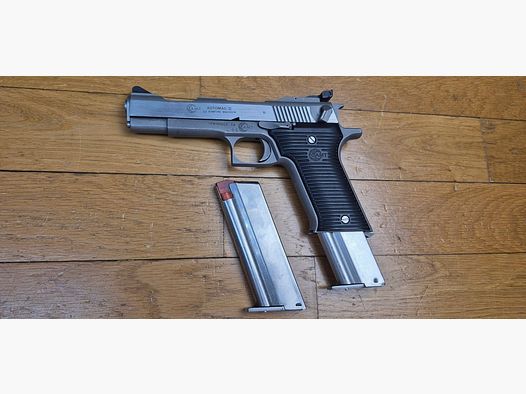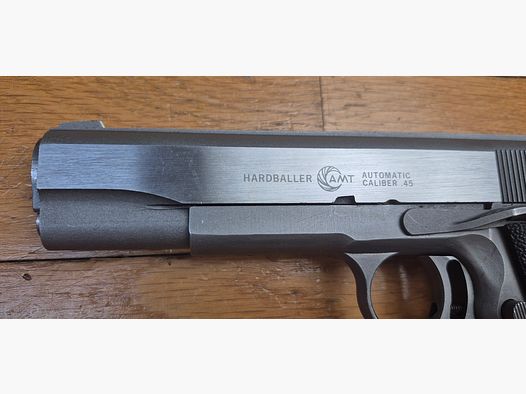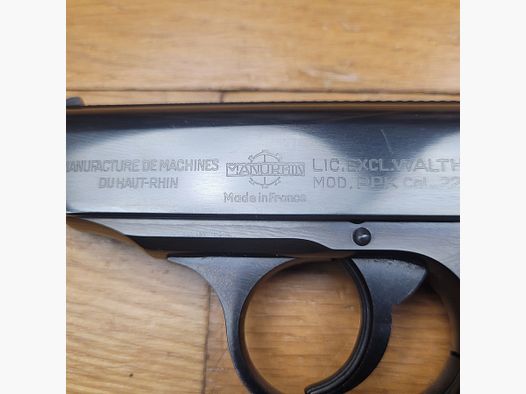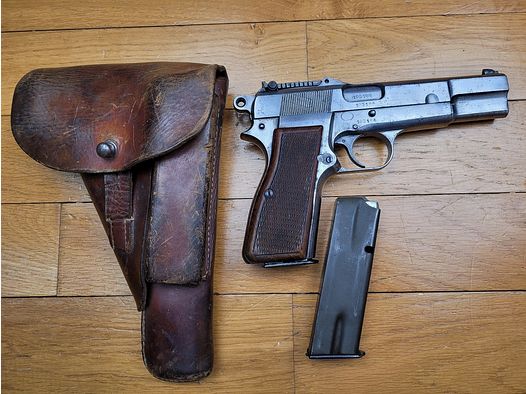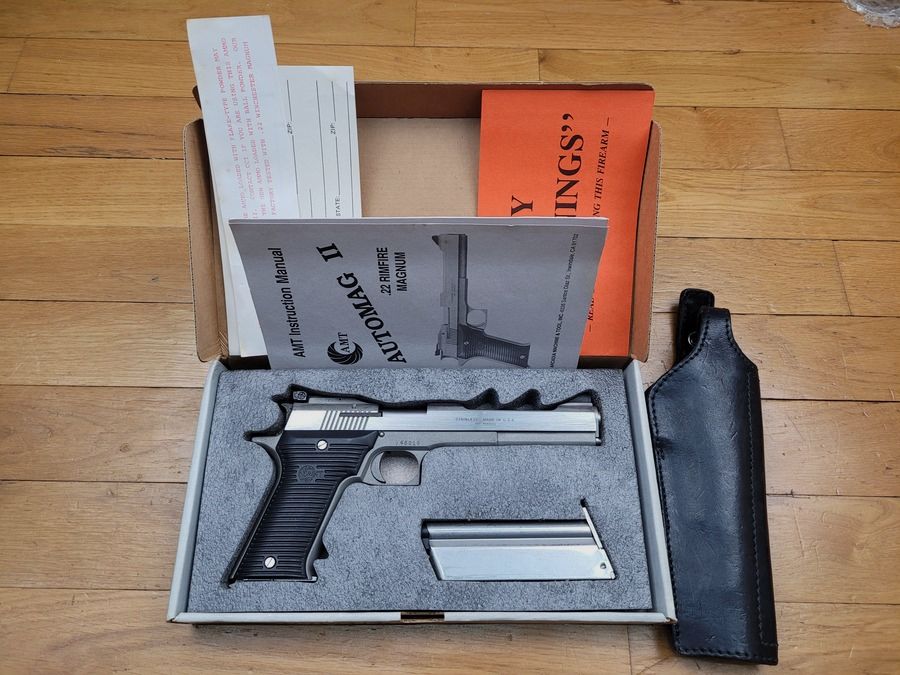
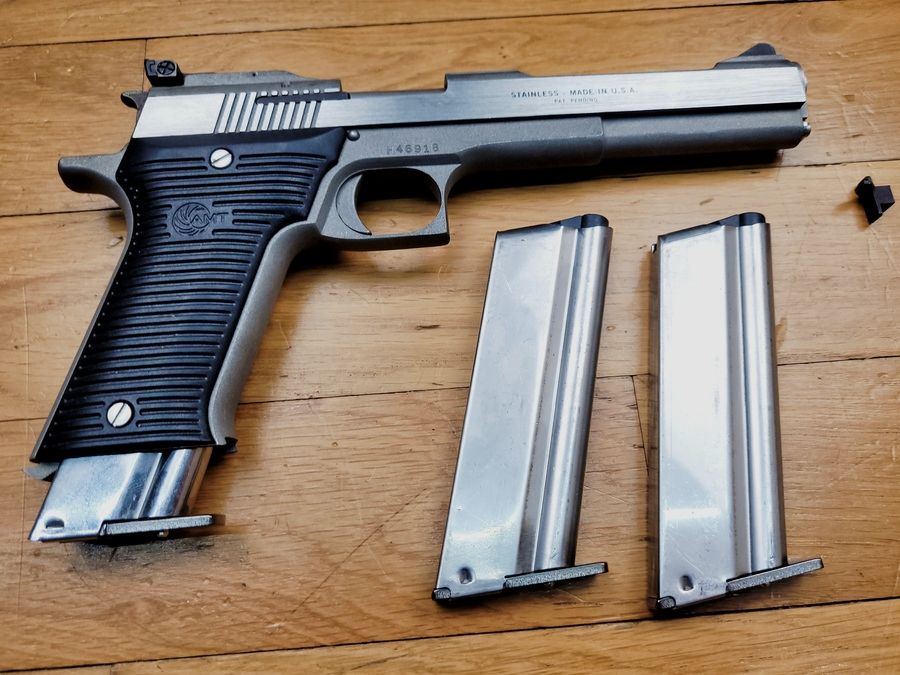

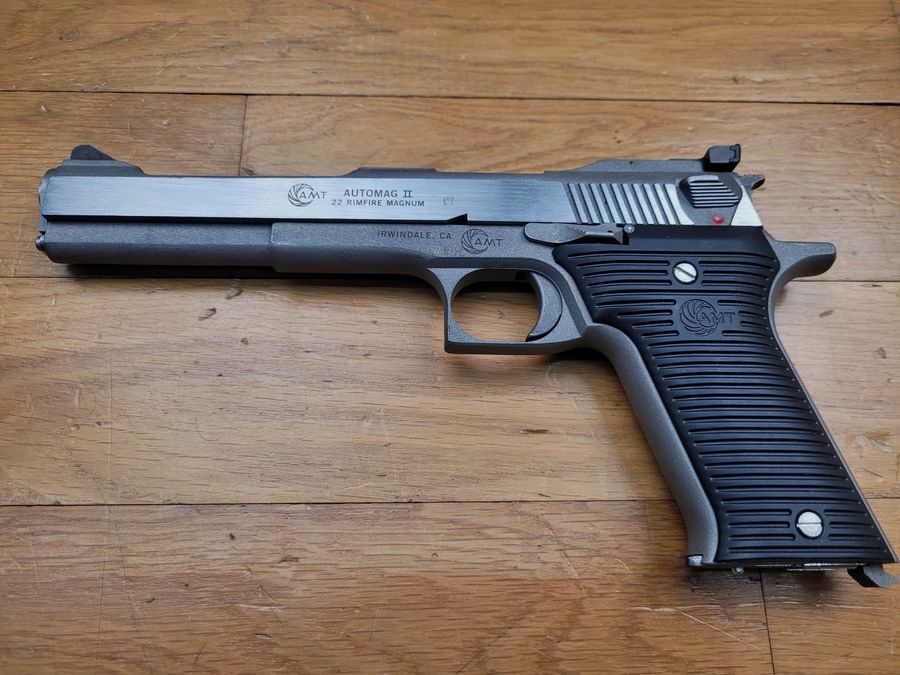
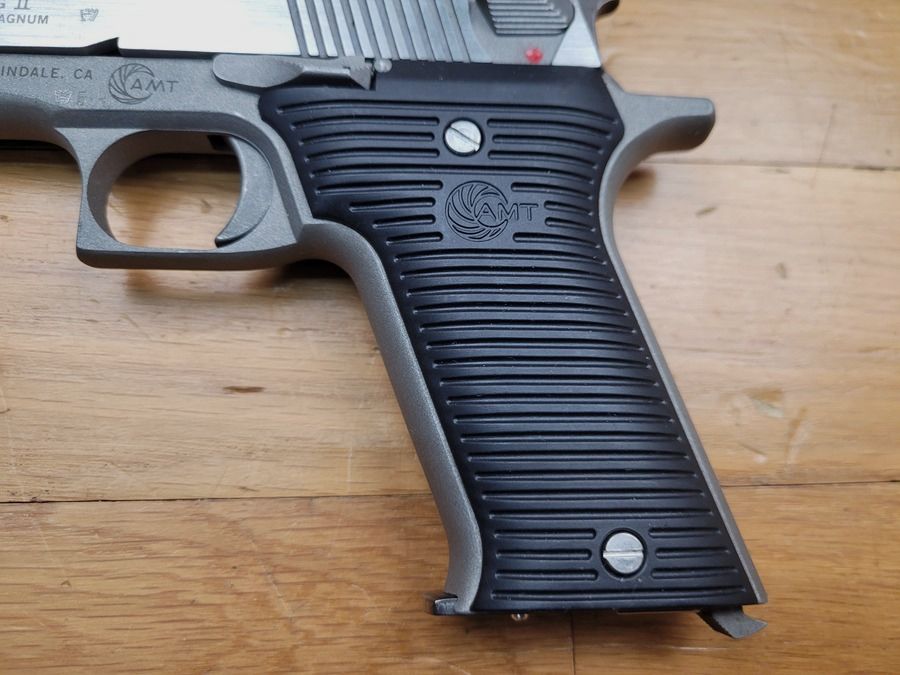
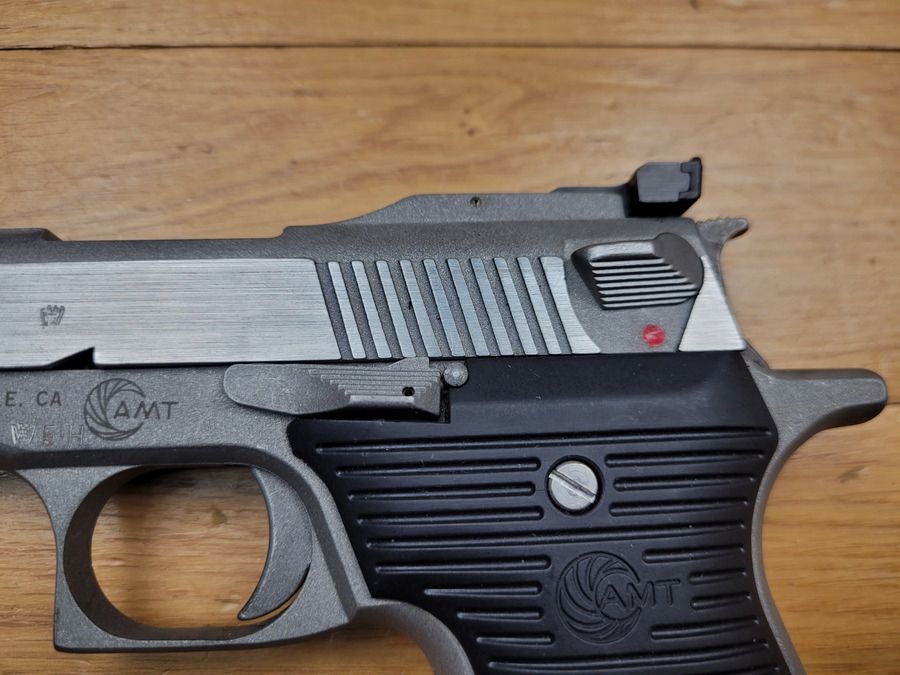

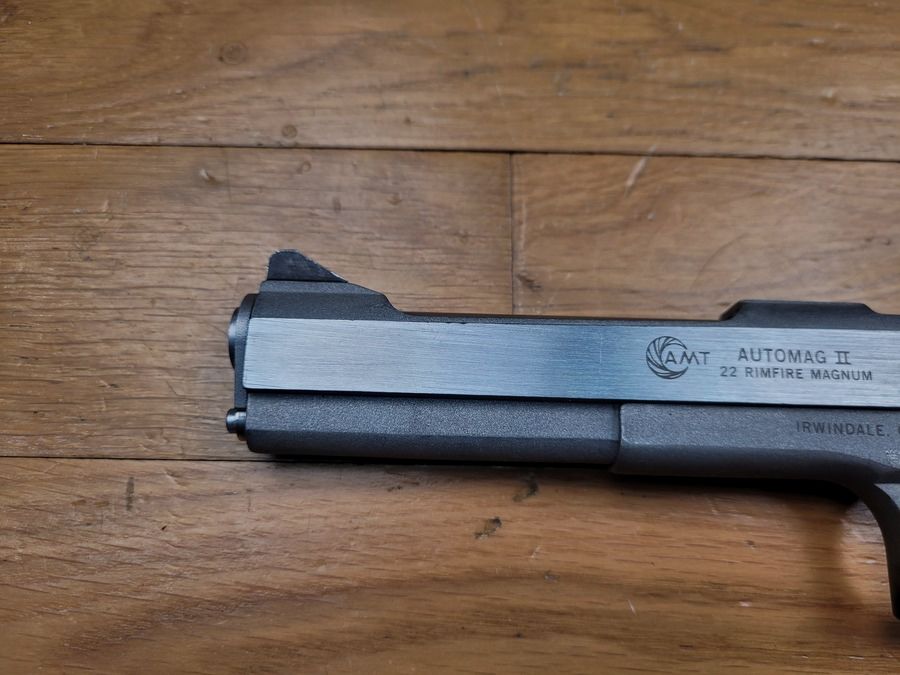
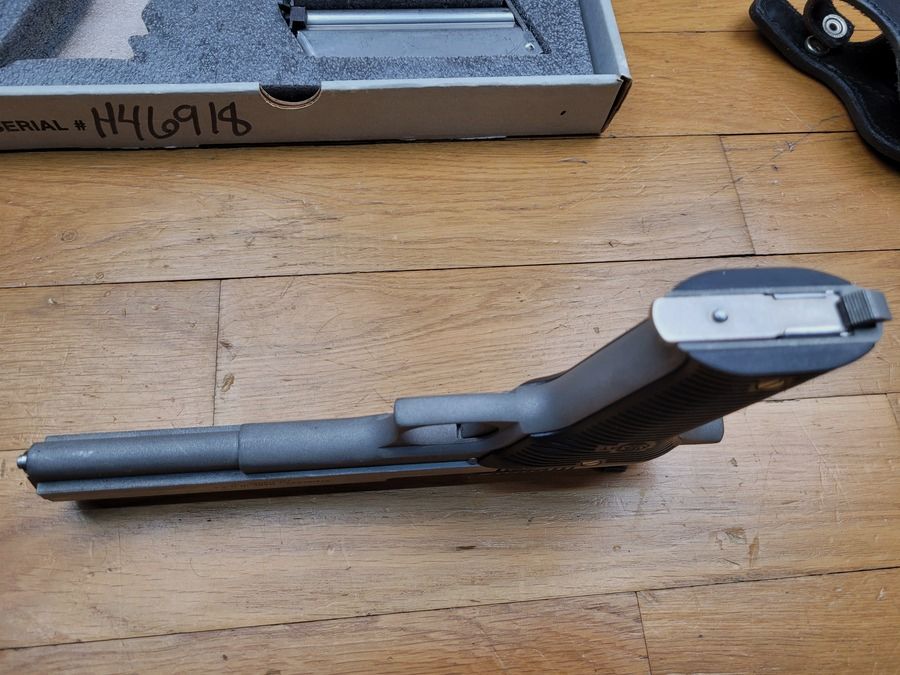


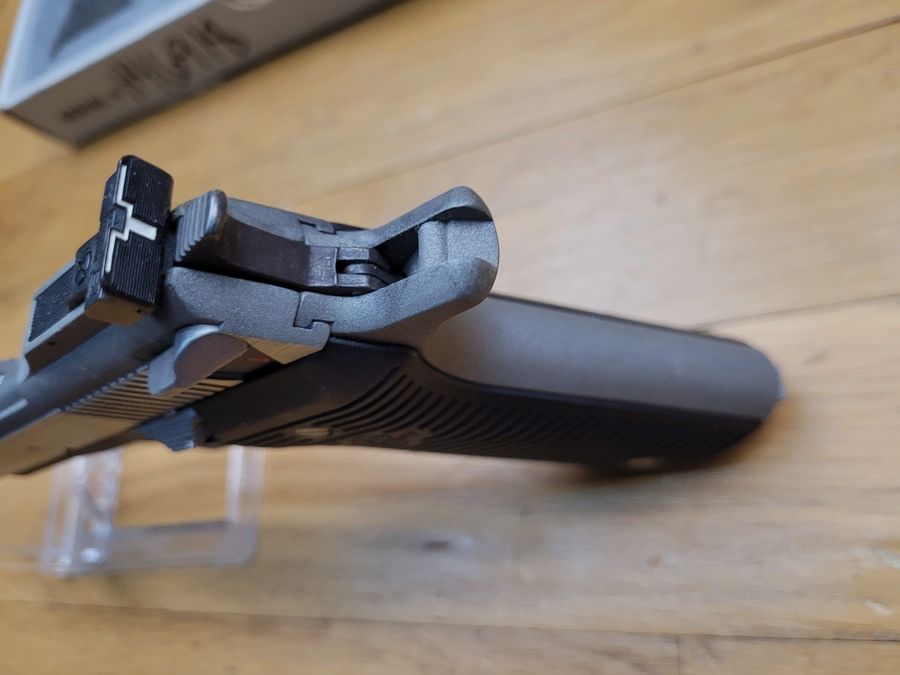

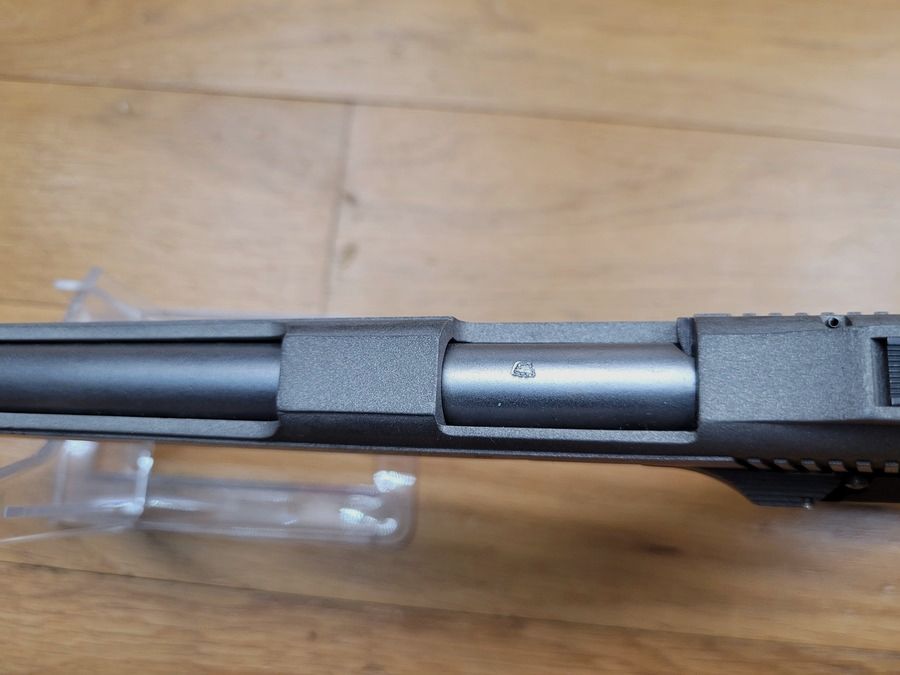
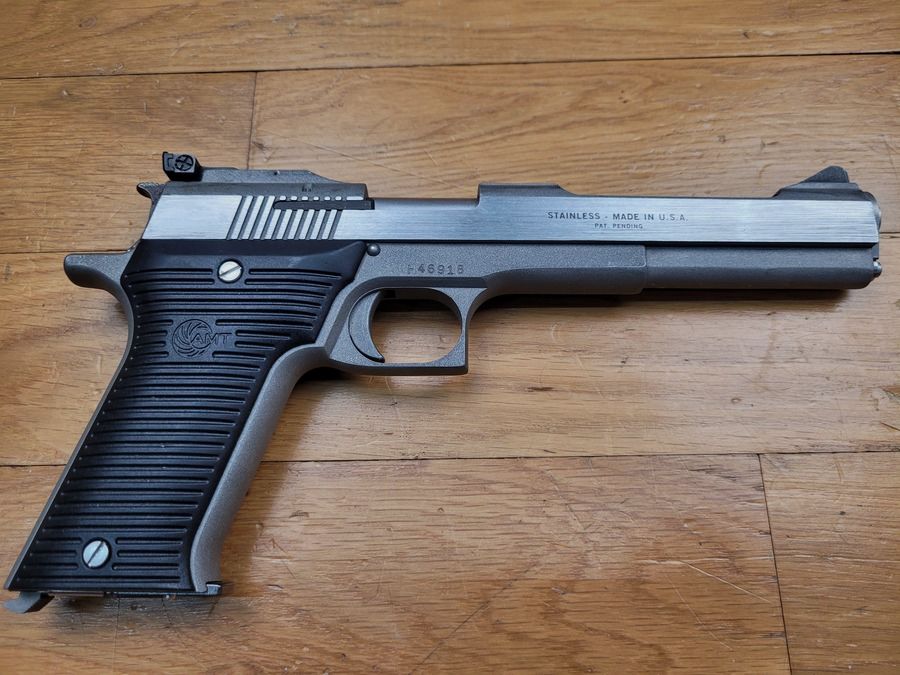
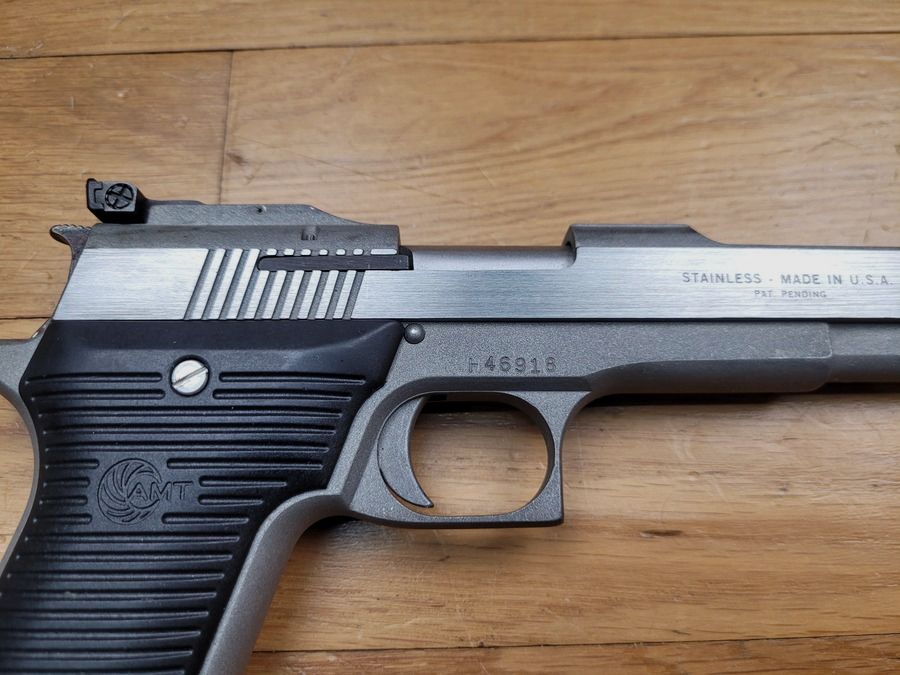

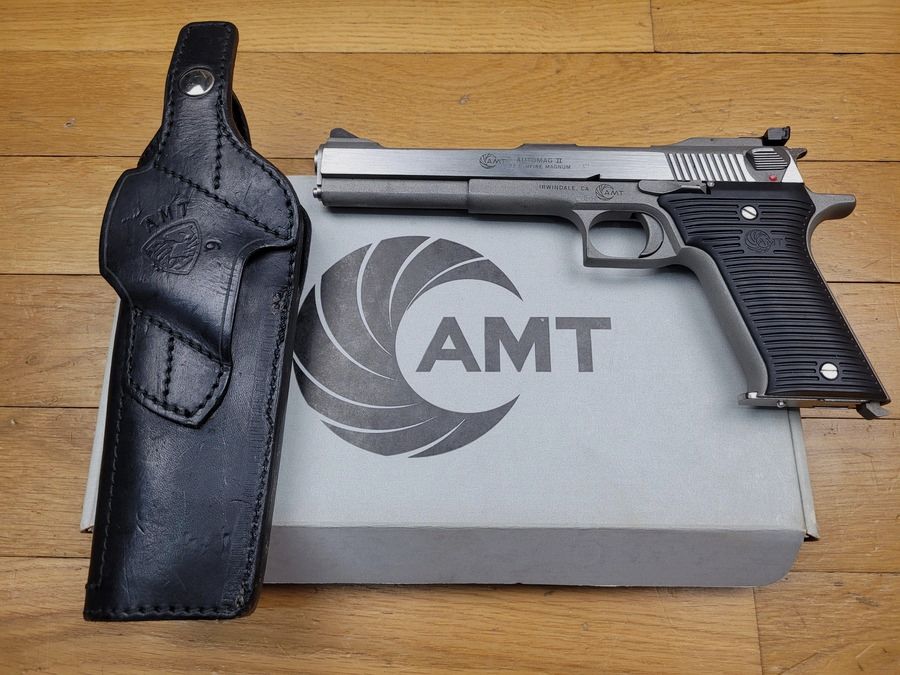
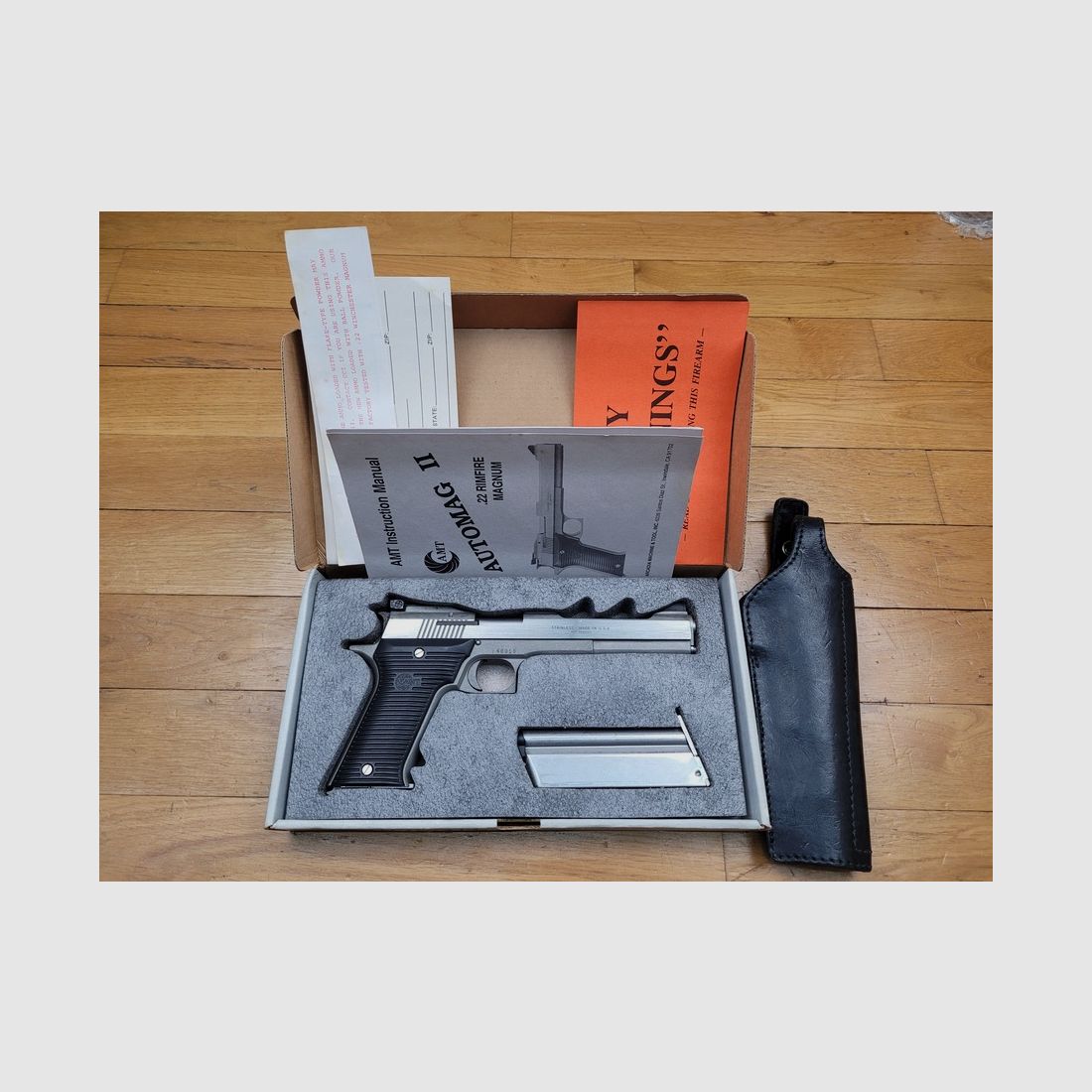


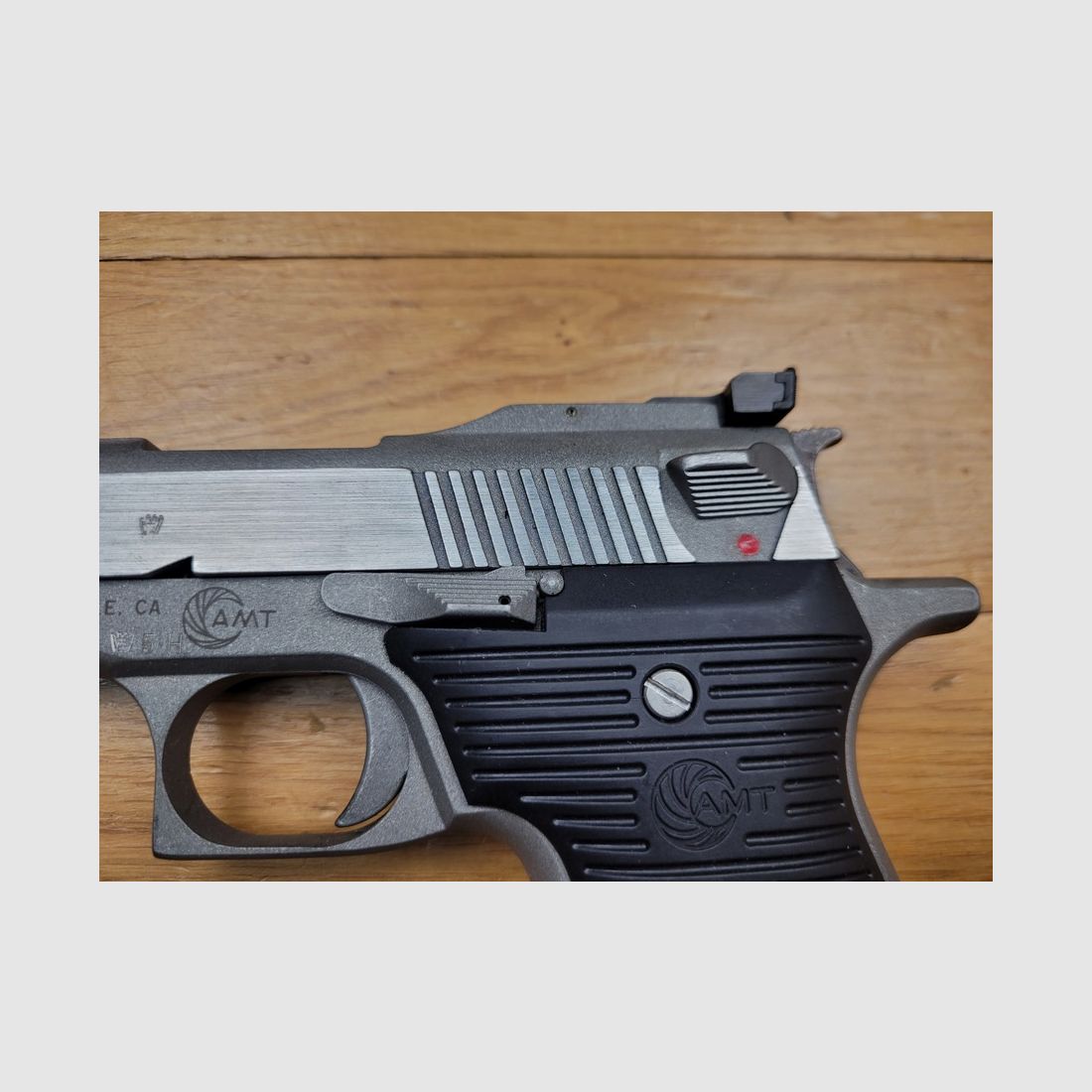
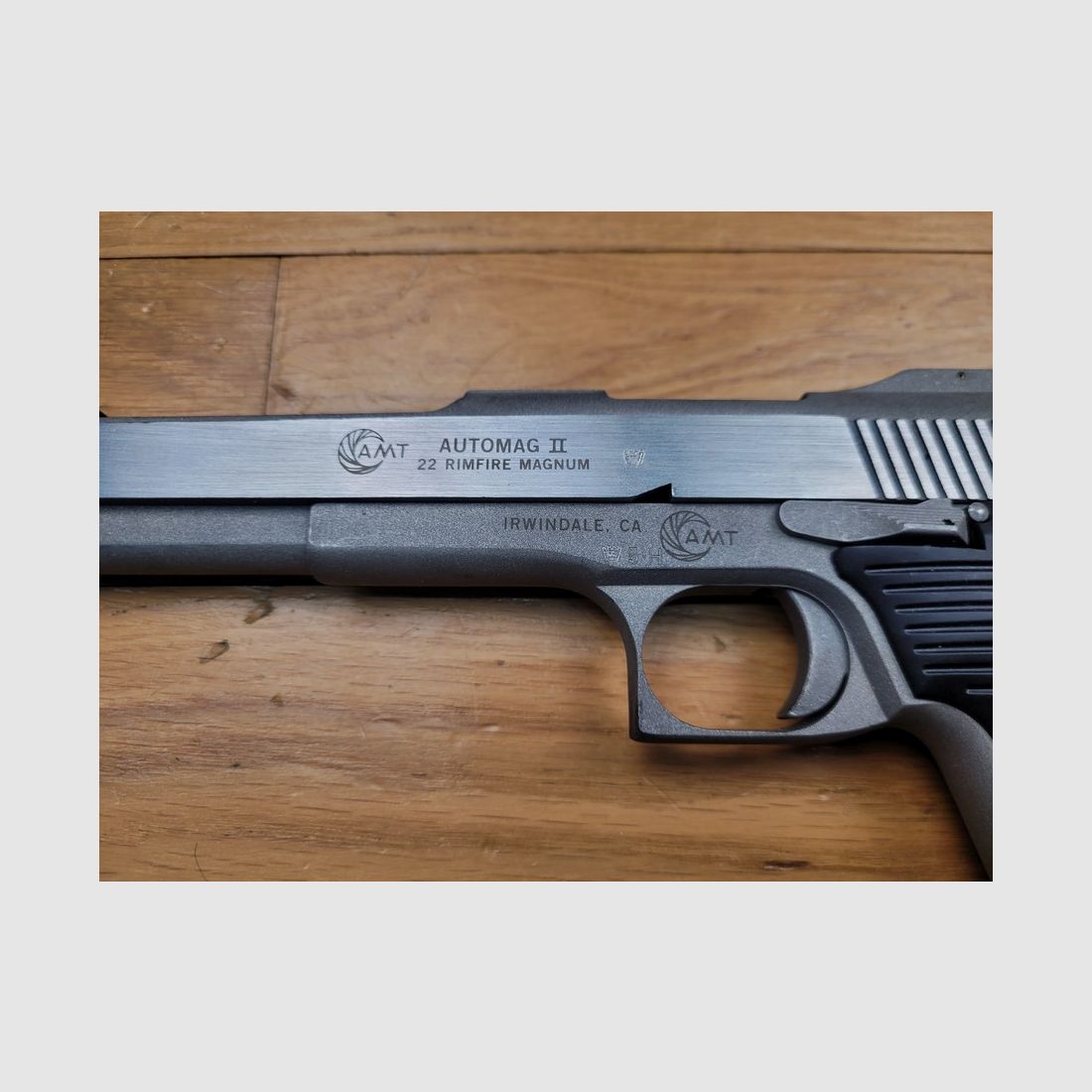

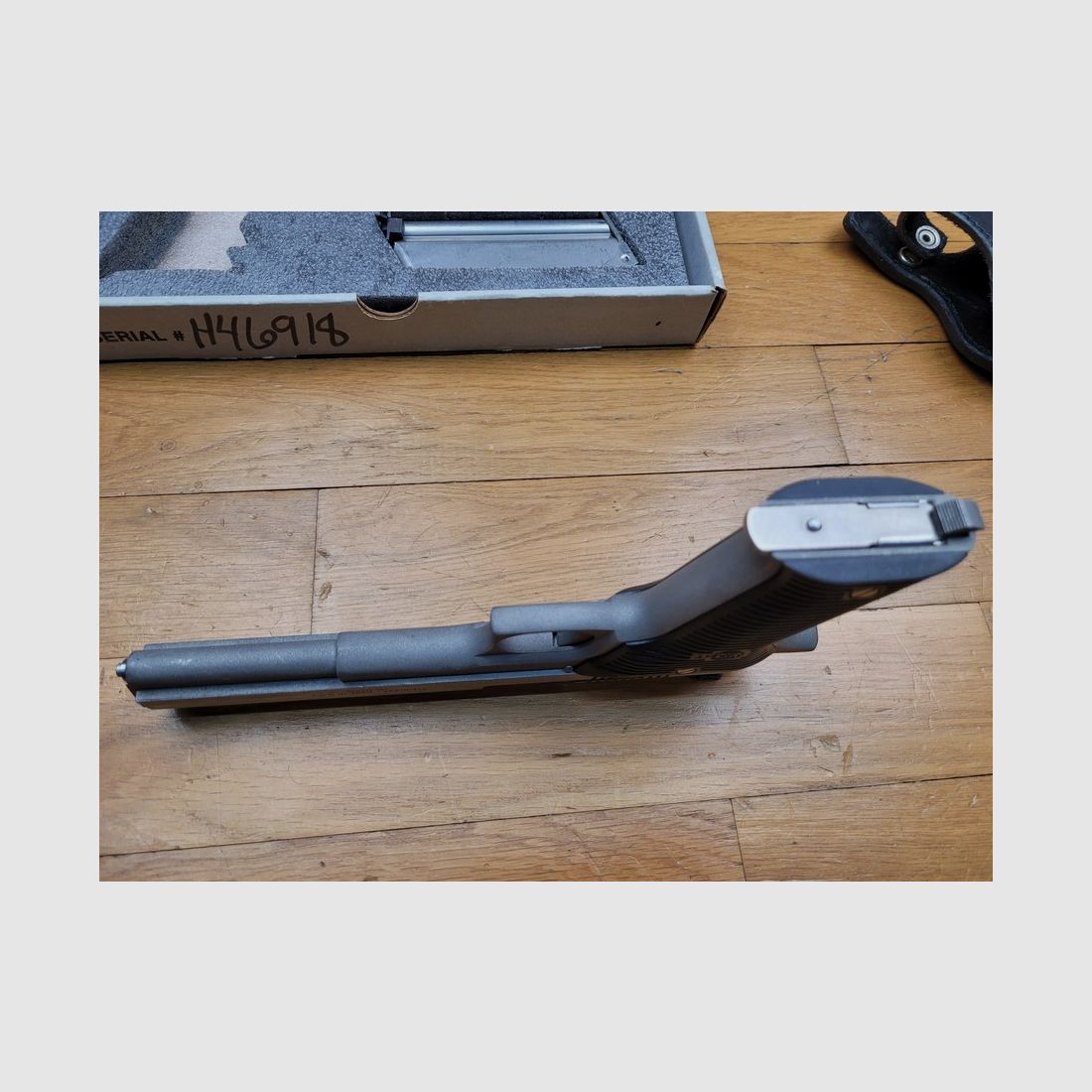
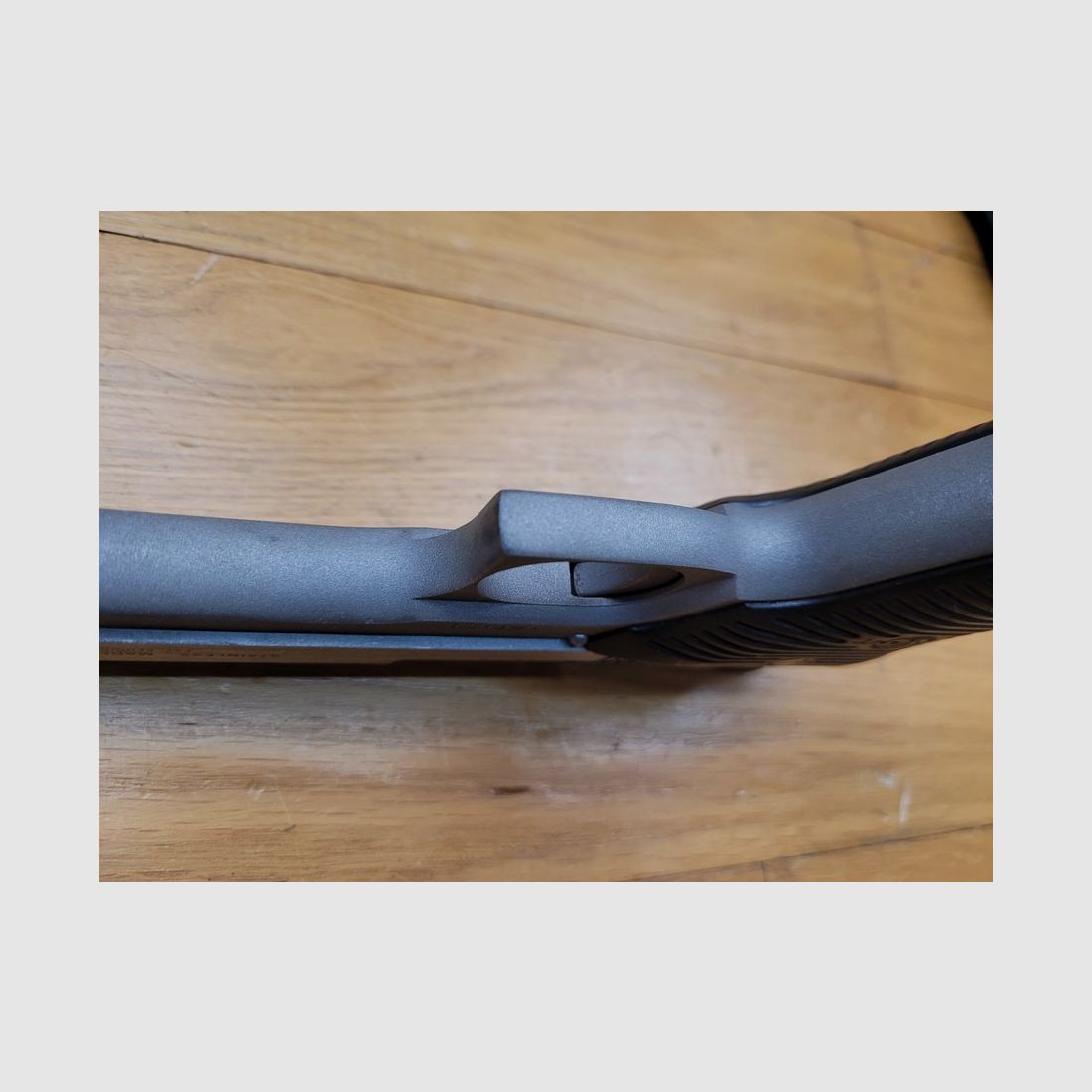
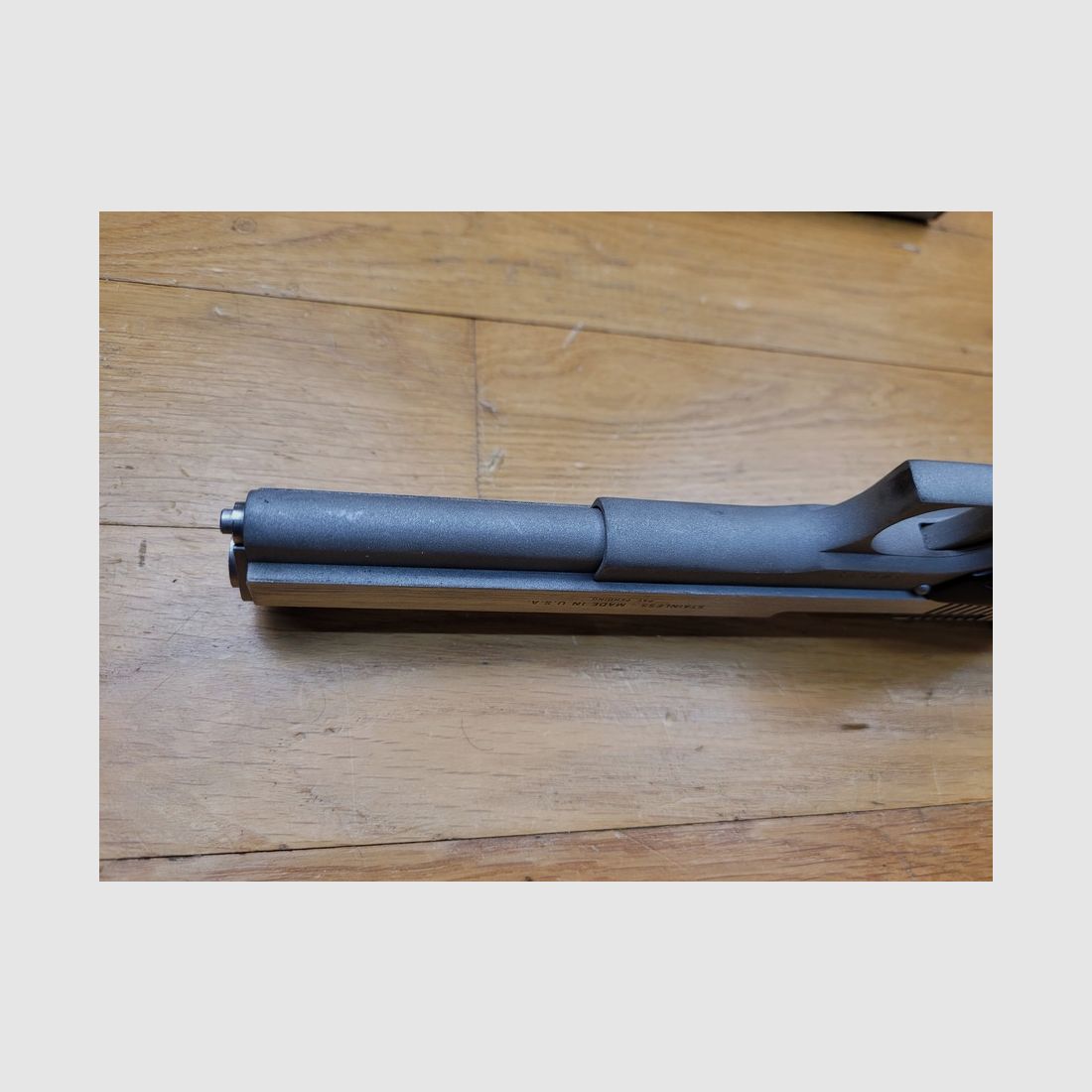

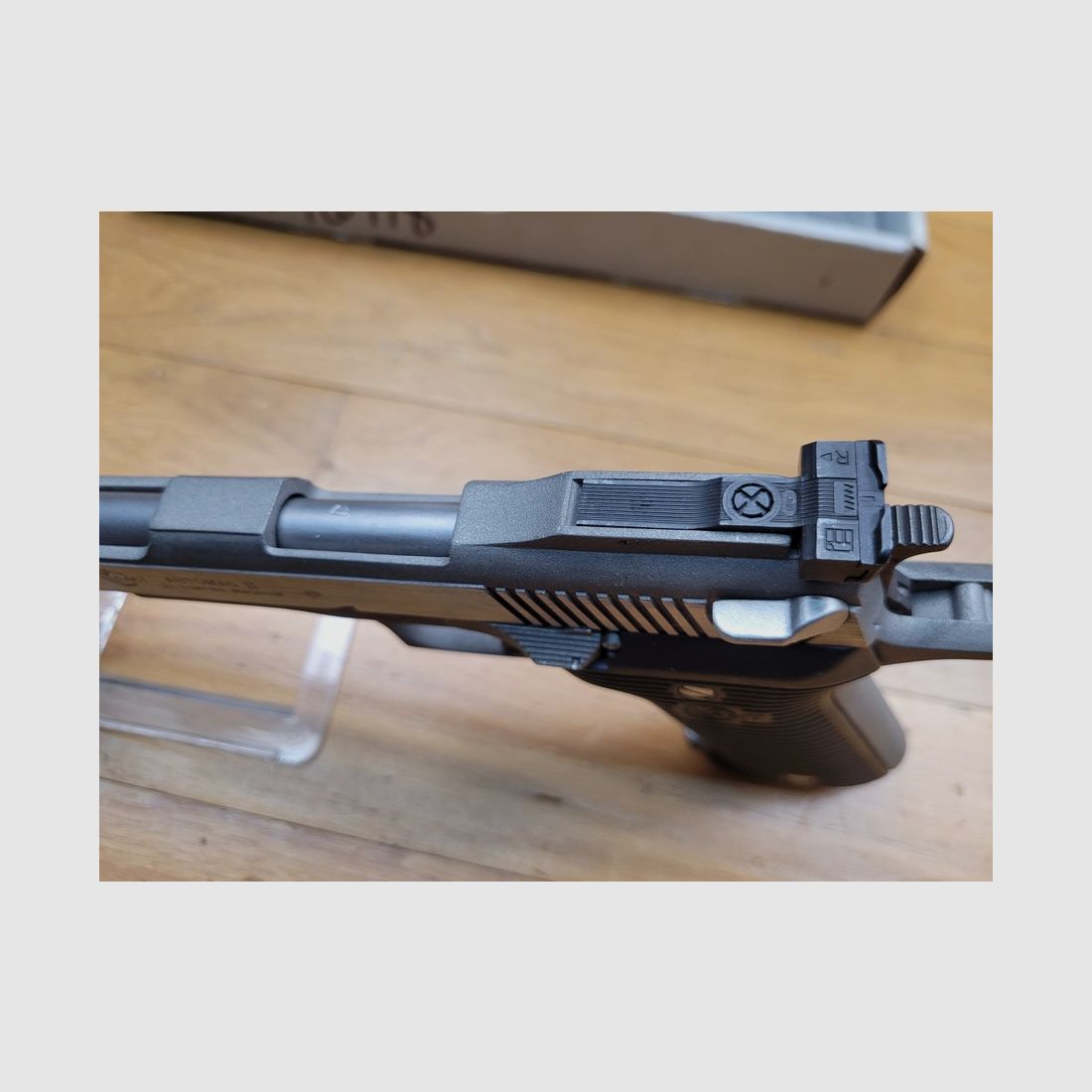
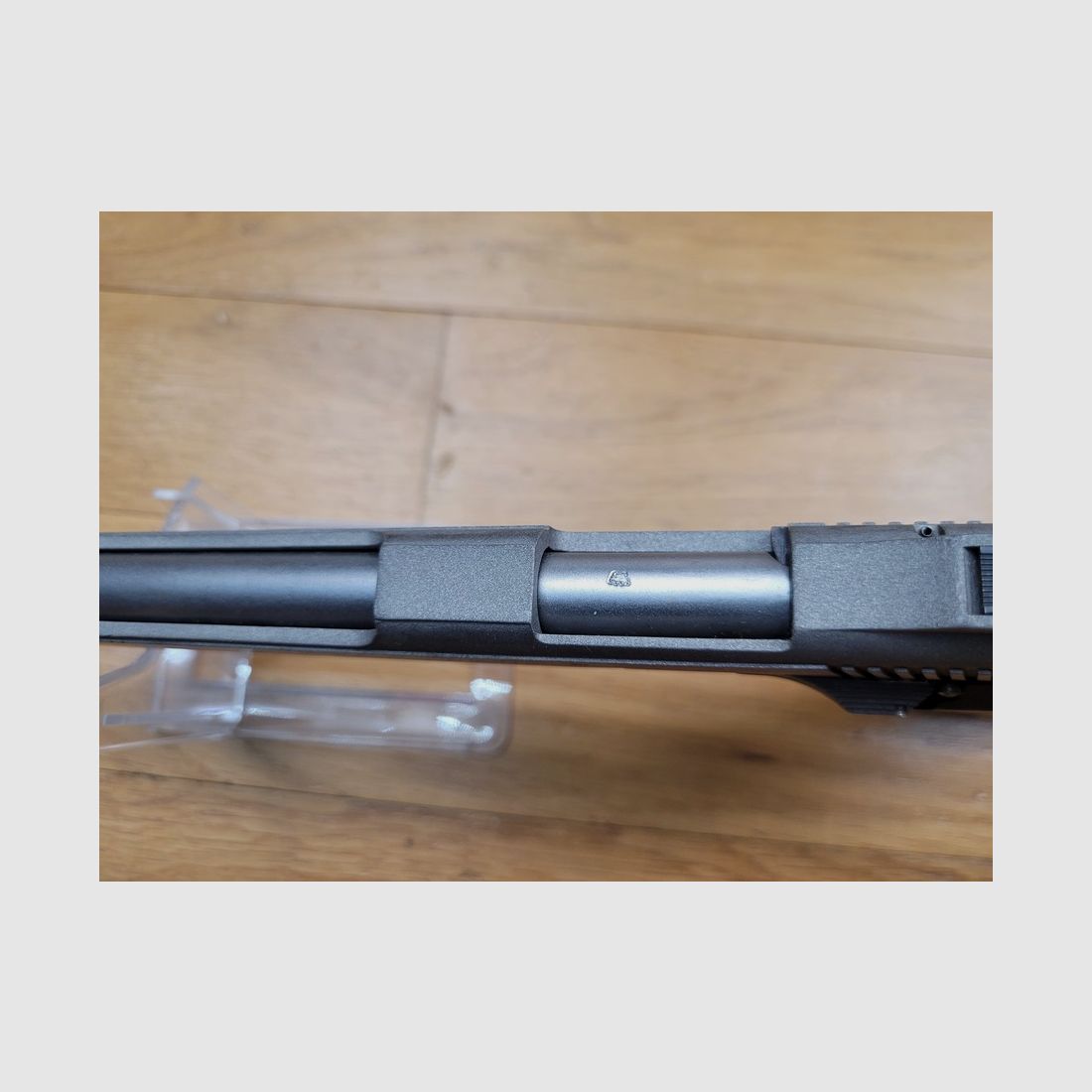


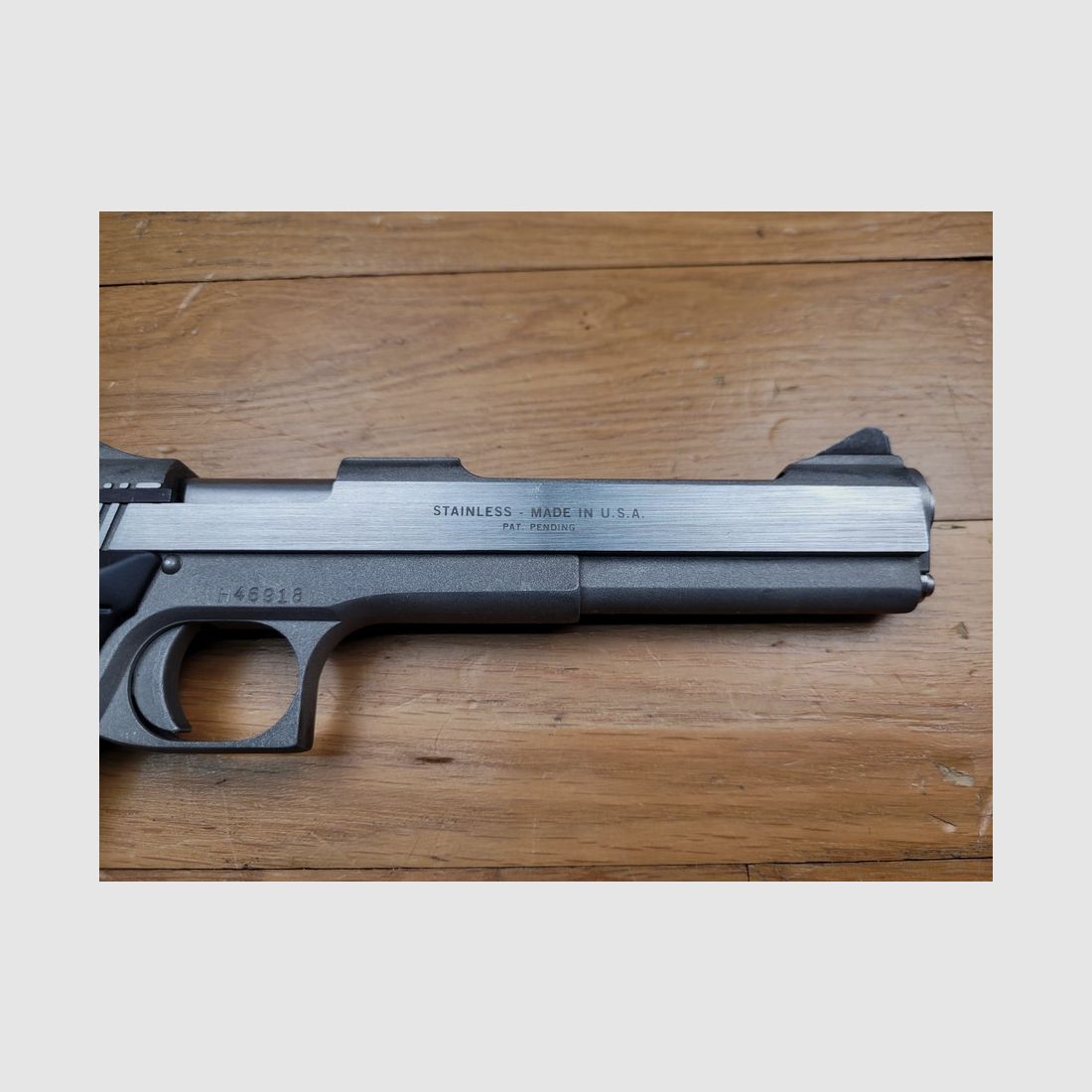

Very beautiful and rare Automag II – Caliber 22 Magnum – Made by AMT – Stainless steel from A to Z – Rare six inches – Excellent mechanical condition – Original box – 3 magazines – Custom holster by Pony – Like new!
≈ $934
Price at the dealer: 850 €. Converted at the ECB rate as of November 20, 2026.
Purchase permit required
75002 Paris, France
6
ID: 10338758
This item is currently unavailable.
Purchase from outside the EU: The firearm goes through an importer in your country, the dealer handles the export.
How buying from Europe works
Shop safely with Gunfinder
Our AI-powered seller identity verification makes Gunfinder the safest marketplace online.
Learn more
Details
- Original language
- French
- Category
- Purchase eligibility
- Required
- Caliber
- .22WinMag
- Condition
- New
- Location
- 🇫🇷 75002 Paris, France
- Availability
- Out of stock
Freshness
This listing is based on a mirrored offer, where the listing data was synced to us from a shop, dealer, or external marketplace. Please note that temporary price discrepancies may occur due to possible delays in data transmission.
- Source
- Flingus Maximus
- Last checked with the dealer
- 1 day ago
Description
Note:
The item is located abroad. Please note that delivery conditions, shipping times, and/or the purchase process may differ.
From these iconic fairies gathered around its cradle, a massive being was destined to emerge, Made in USA to its very core, and absolutely overflowing with power: our AMT Automag II in .22 Winchester Magnum!
In the 1980s, AMT (or Arcadia Machine and Tools) was known for its systematic use of stainless steel, which it crafted with extremely precise, tight tolerances.
“Normally,” you might reply, dear Flingus, “it’s nothing more than a modest subsidiary of the famous ‘High Standard.’”
Though less well known in our parts, this company, based in the same Connecticut city as Winchester, has an identity summed up in its name. To those in the know, “High Standard” means a very high level of quality at a fair price.
But there’s a little more to it than that.
From its founding in 1926, its specialty was making .22-caliber firearms for recreation, precision shooting, and military training alike. During World War II, it developed training pistols with the same layout and grip angle as the “big” 1911s.
But, much more discreetly, a special version of these pistols was ordered by the OSS, forerunner of today’s CIA.
Fitted with suppressors, these HDMs were used from World War II through the Vietnam War for all kinds of dirty tricks wherever the interests of the Stars and Stripes demanded it. Among others, they were carried by pilots of the “firm’s” U-2 spy planes.
As a result, some of them ended up a long way from home. It comes with the territory.
The Central Museum of the Armed Forces in Moscow—which Master Flingus highly recommends visiting, as it’s fascinating for anyone interested in history and exceptional artifacts—displays the contents of the mission kit belonging to a famous American spy, shot down in his U-2 over the territory of the Soviet Motherland on May 1, 1960.
Among the items on board was one of these High Standard pistols with an integrated suppressor…
Some in the US intelligence community criticized him for ejecting instead of swallowing his cyanide capsule or using his HDM to end his life.
The Soviets were able to use him as a bargaining chip to secure the release of Wiliam Fischer, perhaps the greatest spy in history. But anyway, while the pilot returned to the USA, his .22 High Standard HDM retired in Moscow.
In 1982, AMT managed to get its hands on the manufacturing patents for the AUTO MAG (two words, all caps), the world’s first semi-automatic pistol chambered for the .44 Magnum cartridge.
It wasn’t the classic rimmed revolver cartridge, of course, but an entirely new cartridge made from .30-06 cases cut to the right length. The firearm featured several innovations, including a six-lug rotating bolt, while keeping its final weight respectable given its cannon-like cartridge and 7-round magazine.
When it came out in 1971, the firearm made an impression.
It even won over Inspector Harry Callahan in “The Dead Pool.”
But its price, the narrow market, and the difficulty of sourcing ammunition meant that, despite widespread acclaim, very few people took the plunge and bought one. It remains a myth that’s very hard to find—a kind of Nessie, the Loch Ness Monster of the .44 Magnum…
But the story linking Magnum calibers, AMT, and the creator of the Auto Mag couldn’t end with the simple purchase of the patent for a supposed hit.
if.
Under the umbrella of High Standard, AMT, its Irwindale, California subsidiary, and Harry Sandford, creator of the Auto Mag, soon went on to create no fewer than four other “Automags” (as one word this time).
The first, in 1987 (the Automag II), was chambered in .22 WMR; the second, in .30 Carbine, followed in 1988 (Automag III); the third, in .45 Win Mag, came in 1991 (Automag IV); and finally, in 1993, the last one arrived in .50 Action Express (Automag V), the largest handgun caliber approved in the US.
With a new design and industrial manufacturing processes in the best sense of the word, the concept really reached an excellent level of refinement, especially in the most affordable caliber, .22 Win Mag.
The success of the guns in .22 Win Mag, built from 1987 to 1999, made it possible to develop the Automag III through V.
What is .22 Win Mag?
If .22 Win Mag is now known as an excellent caliber for defense and shooting—compact, with little recoil and highly effective—that’s no coincidence.
Originally developed to become the ultimate caliber for varmint hunting, especially for shooting prairie dogs at distances of several dozen meters (these little critters are very skittish but cause a lot of damage), .22 Mag has the velocity of .30-30 (600 m/s) and the energy of 9mm Parabellum (430 J). At comparable dimensions, only the P90’s 5.7×28 does better…
In other words, it’s a very interesting combination for a handgun, where cartridge case dimensions are crucial and recoil is still very limited.
A distinctly French peculiarity: here, this caliber is mainly used in rifles, so it’s classified as Category C… For high-volume shooting, this can be a real advantage over 9mm, since you can buy it without limit by presenting your license.
And above all, its terminal energy is enough to knock over metal gongs that .38 doesn’t always manage to topple! Highly penetrating, this steroid-fueled .22 has an extremely flat trajectory.
Our Automag II today stands out immediately, at first glance, for the “trademark” shared by all its siblings and its 1971 cousin: its steel!
Gold may be a precious metal throughout history, but in the world of firearms, steel is just as precious. Here, every component of the gun is made from 174-type stainless steel. From the barrel to the trigger mechanism, including every last pin and screw, everything is made from top-quality stainless steel. The same steel throughout. No need to throw it in a river to make it rust. Impossible.
This makes the components much more durable and life much easier for the user.
But let’s not kid ourselves: this quality comes at a price. Reproducing a gun to the same manufacturing standard and in the same material would probably cost close to 2,000 euros today. Even if it were made in a country far more exotic than the USA, its homeland… And price is what held back sales of these guns in the past.
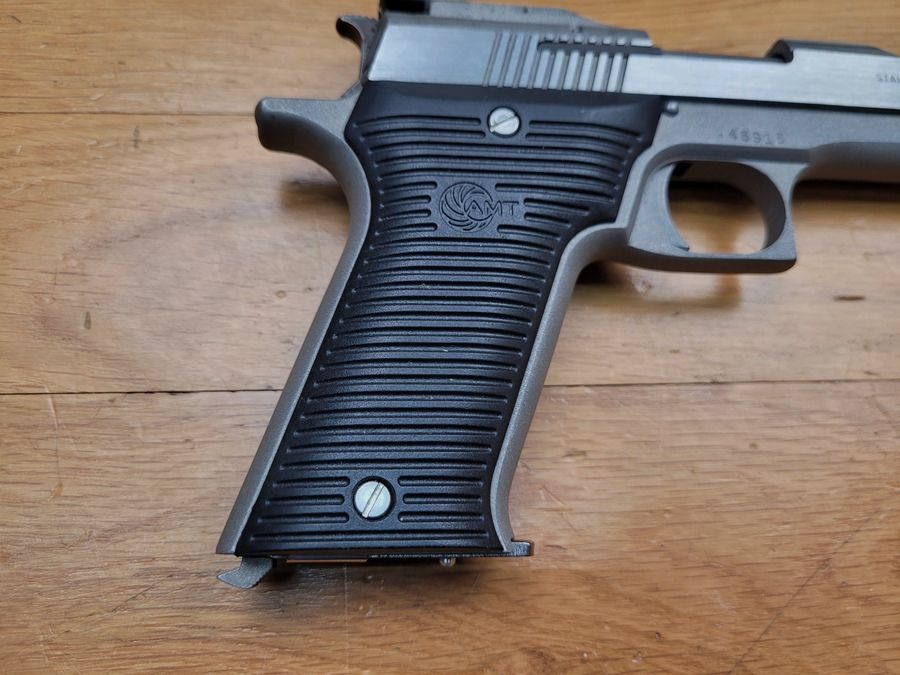
The first time you pick up this formidable gun, its dimensions come as a surprise: the magazine has to accommodate the length of Magnum cartridges and hold 9 rounds. So the grip is very flat and elongated.
It offers an excellent grip, but it’s much more substantial than a .22 LR like the Buckmark, making it better suited to medium-to-large hands. A shooting gun, then, that’s more masculine, though not exclusively so.
The original black polymer grip panels do their job particularly well. Excellent quality. Like new.
They pair perfectly with the rest of the gun’s bare stainless and brushed finishes.
The magazine release is at the base of the magazine well. It’s reliable and solid, just like the gun’s entire design philosophy. With another full magazine in your support hand, the drill is no longer or more complicated than with…
a button located behind the trigger guard.
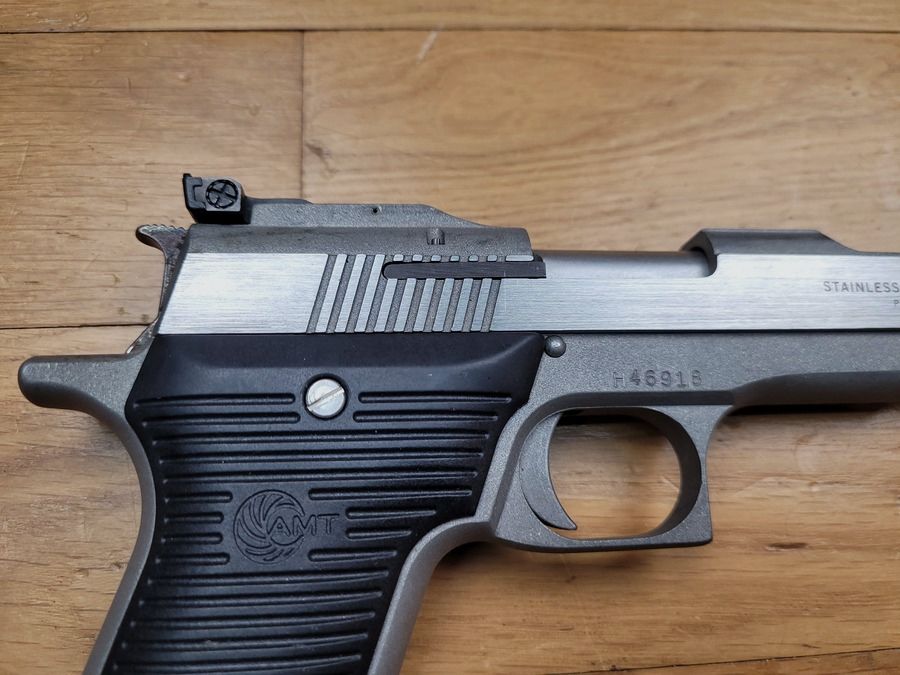
The trigger is identical to that of a 1911 and feels great, with a smooth, straight pull. Short travel and a crisp break. A fine target pistol.
The hammer spur is easy to grip, and the springs are still very firm because the pistol has seen very little use. You’ll be surprised by how naturally and steadily it points.
The trigger guard is squared off, typical of the very “eighties” grip style where the support-hand index finger went in front. But I still like the look. Then again, Maître Flingus is very “eighties” (and not just when it comes to music)… It’s really a matter of taste.
The pistol also features one of the most unusual systems for delaying the opening of the bolt: instead of being smooth, or even fluted like on an SVT 40 to aid ejection, the chamber is made rougher with a multitude of small recesses.
This means there’s no need for a tilting barrel, locking lug, roller or gas system. Just an unlocked bolt whose operation relies on the case being held against the chamber for longer to delay opening. This pistol was clearly designed and optimized with care.
A tank-like ejector and the rimfire cartridge, whose thin, malleable walls are perfectly suited to this system, complete the setup for reliable, simplified operation. For the manufacturer, it means a little more machining; for the user, fewer parts and fewer problems. Someone just had to think of it. No need to worry about ejection issues!
A safety with an interposed block, as on a good old Mac 50. Just as effective as any other system, but rarely used across the Atlantic.
Disassembly is fairly similar to a 1911 or a CZ.
The unusual part is that once the bolt is pulled back and locked on its stop, you don’t engage the safety. Instead, simply push the stop lever through the ejection port. After that, it comes apart easily: the barrel comes out with the bolt, revealing very long guide rails that ensure accuracy.
The ejector is also accessible at the same time. Its claw must be positioned on the left side, where the aforementioned stop is located. Be careful: the part isn’t attached, so take care not to lose it!
The action is very smooth and tightly fitted, with a lovely metallic sound. Powerful springs—impeccable screws. The action, like the rest of the pistol, is like new!
The barrel is pristine, with beautiful rifling. With steel of this quality, it’s practically indestructible. This is the 6-inch model. Another rarity! And much better for shooting, too!
The high-quality rear sight is adjustable in every direction. Both its notch and upper edge have white outlines. The sight picture is absolutely superb.
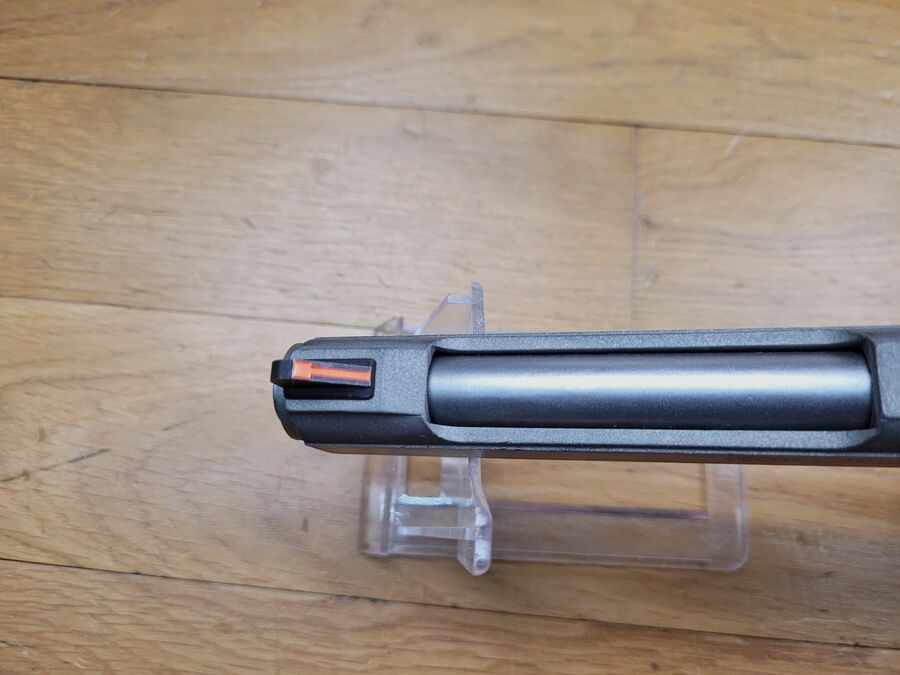
The front sight has a distinctive shape: an orange “T” whose crossbar helps you find the center of the rear sight. It works a little like the ball front sight on competition guns used with a diopter sight.
It’s a really interesting design, and once you’ve fired a few cartridges to get used to it, it feels great and lets you acquire the target quickly and very precisely.
If the T shape really bothers you, just add a small strip of electrical tape and you’re all set, without modifying this magnificent US front sight. It would be a real shame, given how rare this combination is in Europe.
The metal parts are cleverly finished with a mix of smooth and brushed surfaces for a great look! No scratches. Like new.
A very nice pistol, too, and one that has seen very little use. Maybe a few dozen shots…
The pistol still needs breaking in, which will take a few hundred rounds!
Maître Flingus is really spoiling you. Because this little
This wonder comes with not just its original magazine, but three (!)—all in absolutely like-new condition. With a capacity of nine rounds, there’s plenty to enjoy!
The icing on the cake: in addition to its three magazines, this pistol comes in its original box with all its documents. It also comes with a Pony brand holster, made of very thick leather and lined with suede to prevent scuff marks on the firearm!
Excellent quality, made specifically for this Automag II and in perfect condition, it’s a real bonus, considering the usual price of having this kind of item made. A top-notch set!
With an exceptionally powerful caliber, excellent mechanics and outstanding durability, this firearm has a rugged look, and is both accurate and rare.
The Automag II is a creature from another world. From the land of shooting. A firearm for demanding shooters and connoisseurs. Simply put: luxury! It’s a pleasure to shoot thanks to its accuracy, power, reliability and the feeling that you have a “real” magnum in your hand, despite its very reasonable size and recoil.
A high-quality target-shooting and collectible firearm that, especially as part of this set and with its 6-inch barrel, is sure to please you and increase in value over time.
FIREARM IN CATEGORY B UNDER THE CSI: PERMIT REQUIRED, COPY OF A VALID ID AND LICENSE REQUIRED – SIA ACCOUNT MUST OF COURSE BE OPEN – SHIPPING WITH SIGNATURE REQUIRED IN TWO SEPARATE PARCELS AT LEAST 48 HOURS APART.
***********************************************************************************************************************
Let’s say it again! Flingus Maximus gun shop in Paris and throughout France is also here to help with private firearm transfers, buying firearm and militaria collections, firearm valuations, and questions about firearms in estates and inheritances. Contact your favorite gun dealer using our contact form or at [email protected] (Show description in original language)
Imaginez, un enfant caché, né des amours d’un Colt 1911 et d’un Beretta M9, élevé, non par la Louve capitoline, mais par Terminator lui-même pour liquider sans pitié et jusqu’au dernier les insectes osant déranger l’Auguste Gouverneur de Californie durant sa sieste en son palais hollywoodien…
De ces fées iconiques penchées sur son berceau devait naître un être massif, Made in USA jusqu’en son tréfonds, et tout de puissance absolument non contenue: notre AMT Automag II en calibre .22 Winchestester Magnum !
La compagnie AMT (ou Arcadia Machine and Tools) est, dans les années 1980, réputée pour son emploi systématique de l’acier inox, qu’elle façonne avec des ajustages extrêmement soignés et serrés.
Normalement, me répondriez vous, cher Flingus, il ne s’agit ni plus ni moins que d’une modeste filiale de la fameuse « High Standard ».
Certes moins connue en nos contrées, cette firme, basée dans la même ville du Connecticut que Winchester, possède toute son identité résumée dans sa dénomination sociale. En effet « High Standard » pour les connaisseurs, c’est un très haut niveau de qualité payé au juste prix.
Mais c’est un peu plus que cela.
Sa spécialité, dès sa fondation en 1926, fût de créer des armes en calibre 22, aussi bien pour le loisir, le tir de précision que pour l’entraînement militaire. Pendant la seconde guerre mondiale, elle développa des pistolets d’entrainement ayant les mêmes agencements et pente de crosse que les « gros » 1911.
Mais, beaucoup plus discrètement, une version spéciale de ces pistolets fut commandée par l’OSS, ancêtre de notre contemporaine CIA.
Équipés de silencieux, ces HDM furent utilisées de la seconde guerre mondiale à la guerre du Viet Nam pour toutes sortes de coups tordus partout où les intérêts de la bannière étoilée l’exigeaient. Ils équipaient, entre autres, les pilotes des avions espions U2 de la « firme ».
Du coup, certains se sont perdus assez loin. C’est la loi du genre.
Le Musée Central des Forces Armées de Moscou, dont Maître Flingus vous recommande vivement la visite tant le lieu est passionnant pour toute personne intéressée par l’Histoire et les pièces d’exception, expose dans ses vitrines, le contenu du paquetage de mission d’un célèbre espion américain, abattu avec son U2 le 1er mai 1960 au dessus du territoire de la Mère-Patrie soviétique.
Il avait notamment à son bord un de ces pistolets High Standard à silencieux intégré…
Au sein du monde de l’espionnage US, certains lui reprochèrent de s’être éjecté au lieu d’ingérer sa capsule de cyanure ou d’utiliser son HDM pour mettre fin à ses jours.
Les Soviétiques disposèrent en effet en sa personne d’un moyen d’échange pour obtenir la libération de Wiliam Fischer, peut-être le plus grand espion de l’Histoire. Mais, bref, si le pilote retourna aux USA, son High Standard HDM en 22, lui, pris sa retraite à Moscou.
En 1982, AMT réussissait à mettre la main sur les brevets de fabrication de l’AUTO MAG (en deux mots et en majuscules). premier pistolet automatique au monde à chambrer une cartouche de .44magnum.
Il ne s’agissait certes pas de la classique munition à bourrelet pour revolver, mais une toute nouvelle munition réalisée sur base d’étuis de 30.06 recoupés à la bonne longueur. L’arme contenait pas mal de nouveauté comme une culasse rotative à six tenons pour un poids final honorable compte tenu de sa munition-obus et de son chargeur de 7 coups.
A sa sortie, en 1971, l’arme impressionna.
Elle séduisit même l’inspecteur Harry Callahan dans « La dernière cible ».
Mais son prix, l’étroitesse de son marché et la complexité de son approvisionnement en cartouches firent, qu’en dépit d’un large succès d’estime, bien peu franchirent le pas de l’acquérir. Elle reste d’ailleurs un mythe très difficile à trouver. Une sorte de Nessie le Monstre du loch Ness du 44 mag…
Mais l’histoire nouée entre les calibres Magnum, AMT et le créateur de l’Auto Mag ne pouvait en rester à un simple rachat de brevet d’un succès putatif.
Sous l’égide de High Standard, AMT sa filiale de Irwindale en Californie et également le créateur de l’Auto Mag, Harry Sandford ne créèrent bientôt pas moins de quatre autres « Automag » ! (en un seul mot cette fois).
Le premier, en 1987, (ou l’Automag II) sera en 22WMR, le second en .30 carbine en 1988 (Automag III), le troisième en .45WM en 1991 (Automag IV) et enfin en 1993, le dernier en .50 Action Express (Automag V), plus gros calibre de poing homologué sur le sol US.
Avec une nouvelle architecture et des procédés de fabrication industriels au sens noble du terme, on arrivait vraiment à un très bon aboutissement du concept. notamment dans le calibre le plus abordable, le 22Win Mag.
C’est le succès rencontré par les armes dans ce calibre 22 Win Mag, construites de 1987 à 1999, qui permit de développer les Automag III à V.
C’est quoi ce 22 Win Mag ?
Si le 22 Win Mag est aujourd’hui connu comme étant un excellent calibre de défense et de tir, compact, avec peu de recul et très efficace, ce n’est pas pour rien.
Développé à l’origine pour devenir le calibre absolu de la chasse aux nuisibles, en particulier le tir des chiens de prairies à plusieurs dizaines de mètres (ces petites bestioles sont très craintives mais font beaucoup de dégâts), le 22 Mag possède la vélocité de la 30.30 (600m/s) et l’énergie de la 9 para (430j). Dans des dimensions comparables, seul le 5,7×28 du P90 fait mieux…
Autrement dit un cocktail très intéressant pour une arme de poing, où les dimensions des étuis sont une donnée cruciale et avec quand même un recul très limité.
Spécificité bien franco-française, ce calibre est chez nous essentiellement tiré dans des carabines et il est donc classé en catégorie C,… Pour tirer beaucoup, cela peut présenter un avantage certain par rapport au 9mm car il est achetable sans limite sur présentation de sa licence.
Et surtout, son énergie terminale est suffisante pour faire basculer des gongs métalliques que le .38 n’arrive pas toujours à faire tomber! Très perforant, ce 22 sur stéroïdes possède une balistique extrêmement rasante.
Notre Automag II de se jour se distingue d’abord et immédiatement à l’œil par la « marque de fabrique » de tous ses frères et de son cousin de 1971 : ses aciers !
Si l’or est un métal précieux dans l’histoire, dans le monde des armes, l’acier l’est tout autant. Ici, chaque composant, tous les composants, de l’arme sont réalisés en acier inoxydable type 174. Du canon, au mécanisme de détente en passant par la moindre goupille ou vis tout est dans un acier inoxydable de 1er choix. Et le même partout. Inutile de le jeter à la rivière pour le faire rouiller. Impossible.
La longévité des composants et la facilité de vie de l’utilisateur en seront donc largement facilités.
Mais, ne nous leurrons pas: cette qualité à un prix. Refaire une arme dans une qualité de fabrication équivalente et dans le même matériaux coûterait certainement pas loin des 2000 euros de nos jours. Et même fabriquée dans un pays bien plus exotique que les USA, sa Patrie d’origine… Et c’est bien le prix qui freina la diffusion de ces armes par le passé.
La prise en main de ce terrible engin surprend la première fois du fait des dimensions du chargeur qui doit s’adapter à la longueur des cartouches Magnum et à une capacité de 9 coups. La crosse est donc très plate et allongée.
Excellente prise en main mais c’est bien plus costaud que sur un 22LR genre Buckmark et donc pour des mains moyennes à grandes. Une arme de tir donc plutôt masculine sans exclusivité.
Les plaquettes d’origine en polymère noir font particulièrement bien leur travail. Très belle qualité. État neuf.
Elles s’associent à la perfection avec les finitions inox brut et brossé par endroit du reste de l’arme.
Le déverrouillage du chargeur se fait à la base de son puits. C’est fiable et solide comme toute la philosophie de l’arme. Avec un autre chargeur plein en main faible, le drill n’est ni plus long ni plus compliqué qu’avec un bouton situé derrière le pontet.
La détente reprend trait pour trait celle d’un 1911 est très agréable et bien rectiligne dans son déplacement. Course courte et départ bien franc. Une belle arme de tir.
La crête du chien est facile à saisir, les ressorts sont bien fermes car elle a très peu tirée. Vous serez surpris de voir à quel point l’arme pointe bien et naturellement.
Le pontet est carré, typique de la mode de préhension très « eighties » où l’index de la main faible passait devant. Mais cela me plait encore esthétiquement. Mais Maître Flingus est très « eighties » (et pas seulement pour la musique)… Affaire de goût en fait.
L’arme présente aussi un des systèmes de retardement d’ouverture de culasse parmi les plus originaux: la chambre au lieu d’être lisse, voire cannelée comme sur un SVT 40, pour faciliter l’éjection, est rendue ici au contraire plus rugueuse au moyen d’une multitude de petites alvéoles.
Ainsi, point besoin de canon basculant, de tenon de verrouillage, de galet ou autre emprunt de gaz. Juste une culasse non calée mais dont le fonctionnement utilise l’adhésion forcée de l’étui à la chambre pendant un laps de temps plus important pour retarder l’ouverture. Cette arme a vraiment été pensée et optimisée.
Un éjecteur bâti comme un tank et la cartouche annulaire dont les parois fines et malléables se prêtent parfaitement à cet exercice, complètent le dispositif pour assurer un fonctionnement parfait et simplifié. Pour le producteur in fine un peu plus d’usinage mais pour l’utilisateur moins de pièces et moins de problème. Il suffisait d’y penser. Aucun souci d’éjection à anticiper!
Sécurité par bloc interposé, comme sur un bon vieux Mac 50. Dispositif aussi efficace qu’un autre mais très rarement employé Outre Atlantique.
Le démontage s’effectue de manière assez similaire à un 1911 ou un CZ.
Sa particularité est qu’une fois la culasse en arrière,bloqué sur son arrêtoir, ce n’est pas la sécurité qu’il faut enclencher, mais simplement pousser le levier arrêtoir depuis la fenêtre d’éjection. Après, cela vient tout seul, le canon vient avec la culasse, ce qui laisse apparaître de très longs rails de guidage, garantissant sa précision.
L’éjecteur est aussi par la même occasion accessible. Sa griffe doit être placée du côté gauche, où se trouve l’arrêtoir sus nommé. Attention, la pièce n’est pas attachée et il faut rester attentif à ne pas la perdre!
La mécanique est très fluide, hyper ajustée et offre un beau bruit très métallique. Ressorts puissants – Vis impeccables. Mécanique comme le reste: neuve !
Le canon est nickel avec de très belles rayures. Inusable dans cette qualité d’acier. C’est un modèle 6 pouces. Encore une rareté ! Et pour le tir c’est bien mieux !
La hausse, de grande qualité, est dérivable dans tous les sens. Elle présente une bordure en blanc à la fois de son encoche ainsi que de son arrête supérieure. Prise de visée absolument super.
Le guidon est lui d’une forme particulière prenant l’apparence d’un « T » de couleur orange dont la barre supérieure viendrait vous aider à mieux situer le milieu de hausse. Il fonctionne un peu à la manière d’un guidon à boule des armes de compétition utilisées avec un dioptre.
Le concept est vraiment intéressant, et une fois quelques cartouches tirées pour s’y habituer, c’est très agréable et cela permet une acquisition rapide et très précise de la cible.
Si la forme en T vous gênait vraiment une simple petite bande de scotch chatterton, et le tour sera joué, sans modifier l’arme de ce magnifique guidon US. Ce serait fort dommage au vu de sa rareté de cet ensemble sur le sol européen.
Les parties « métal » sont habilement mélangées entre le « lisse » et le « brossé pour un effet esthétique au top !Aucune rayure État neuf.
Très belle arme en plus qui a très peu servie. Peut être quelques petites dizaines de coups…
L’arme doit encore être rodée ce qui en réclamera quelques centaines!
Maître Flingus vous gâte vraiment. Car cette petite merveille est accompagnée non pas de son seul chargeur d’origine mais de trois (!), tous dans un état absolument neuf. D’une contenance de neuf coups, il y a de quoi vraiment en profiter !
Cerise sur le gâteau, outre ses trois chargeurs, ce pistolet vous arrive en plus dans sa boîte d’origine avec tous ses documents. Et il est accompagné en prime d’un étui de marque Pony, réalisé en cuir très épais doublé daim, afin d’éviter les marques de frottement sur l’arme !
D’excellente qualité, réalisé spécialement pour cet Automag II et en parfait état, c’est une vraie valeur ajoutée, compte tenu du prix demandé usuellement pour la réalisation de ce genre de pièces. Un top ensemble !
De calibre ultra performant, mécaniquement excellent, d’une solidité à toute épreuve, avec un look viril, l’arme est précise et rare.
L’Automag II est une créature venue d’ailleurs. Du pays du tir. Une arme de tireur exigeant et de connaisseur. Pour le dire simplement: de luxe ! Il est très agréable au tir par sa précision, sa « pêche », sa fiabilité et l’impression qu’il donne d’avoir un « vrai » magnum dans la main malgré une taille et un recul très raisonnable.
Une arme de tir de grande qualité et de collection qui ne peut, surtout dans cet ensemble et en 6 pouces, que vous plaire et se valoriser dans le temps.
ARME DE CATÉGORIE B AU CSI : SOUMISE À AUTORISATION, PHOTOCOPIE DE LA PIÈCE D’IDENTITÉ EN COURS DE VALIDITÉ ET DE LA LICENCE OBLIGATOIRE – COMPTE SIA OUVERT BIEN ÉVIDEMENT – Expédition contre signature en deux colis séparés d’au moins 48 heures obligatoire.
***********************************************************************************************************************
Répétons le ! L’armurerie Flingus Maximus à Paris et partout en France est là aussi pour vos formalités armes entre particuliers, le rachat de collections armes et militaria, vos estimations d’armes, vos questions armes dans les successions et héritage. Contactez votre armurier préféré via notre formulaire de contact ou à [email protected]