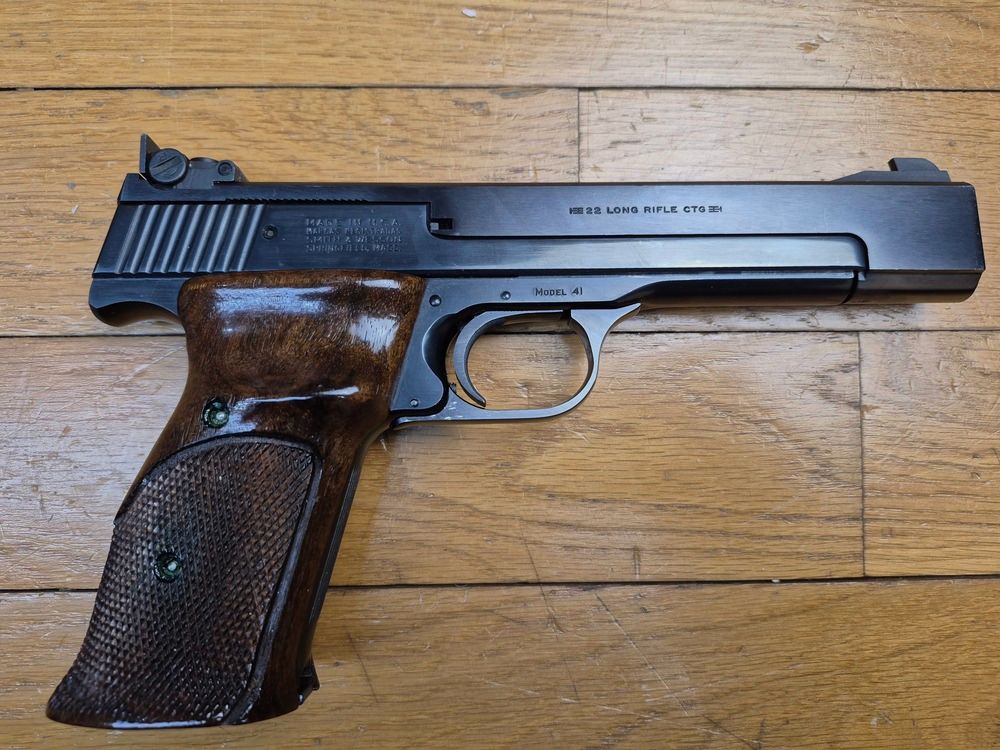
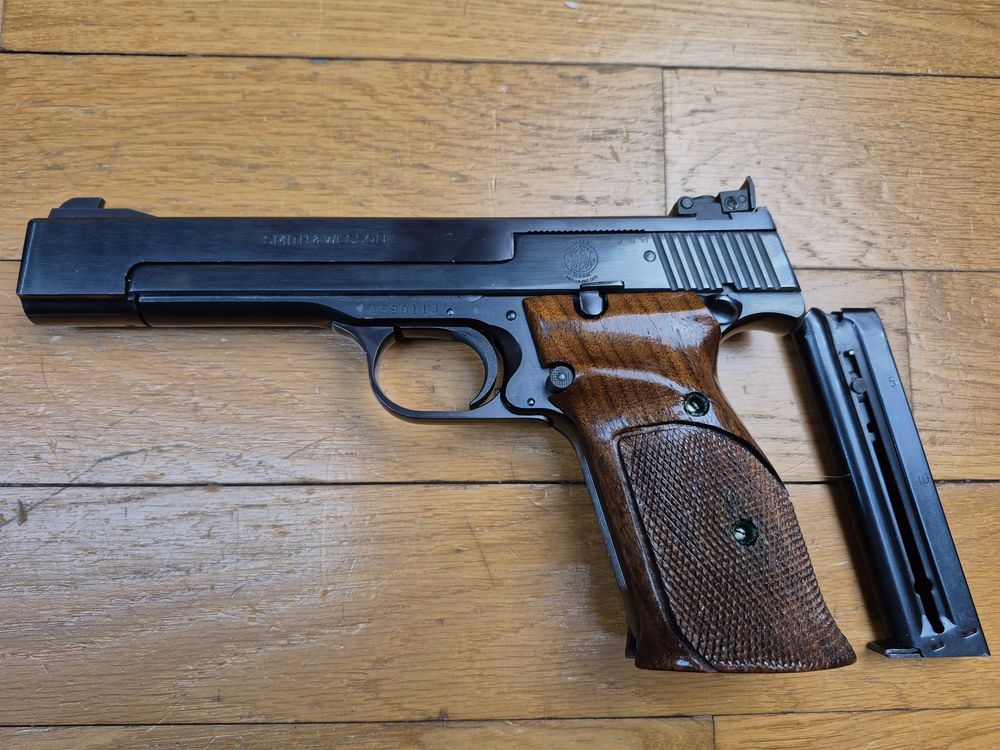
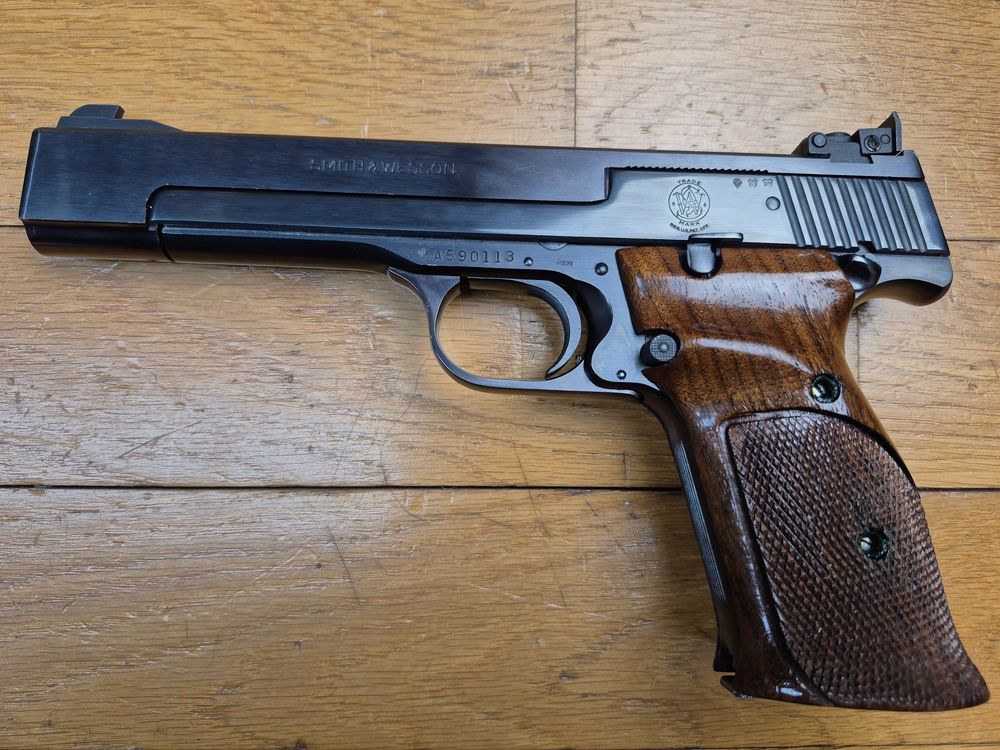


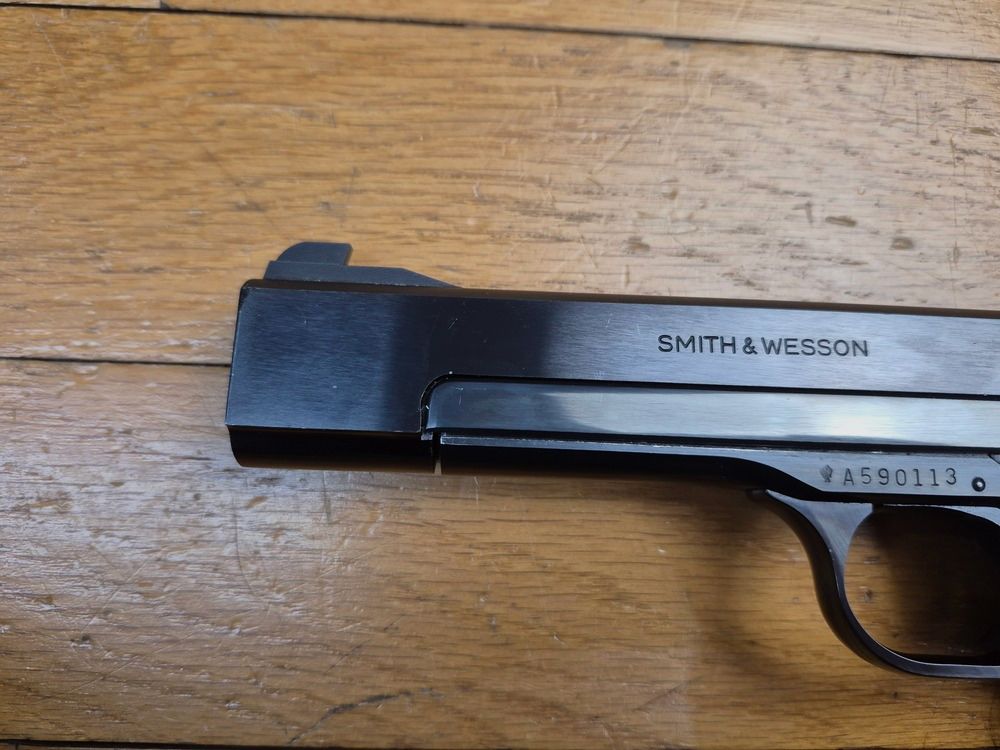
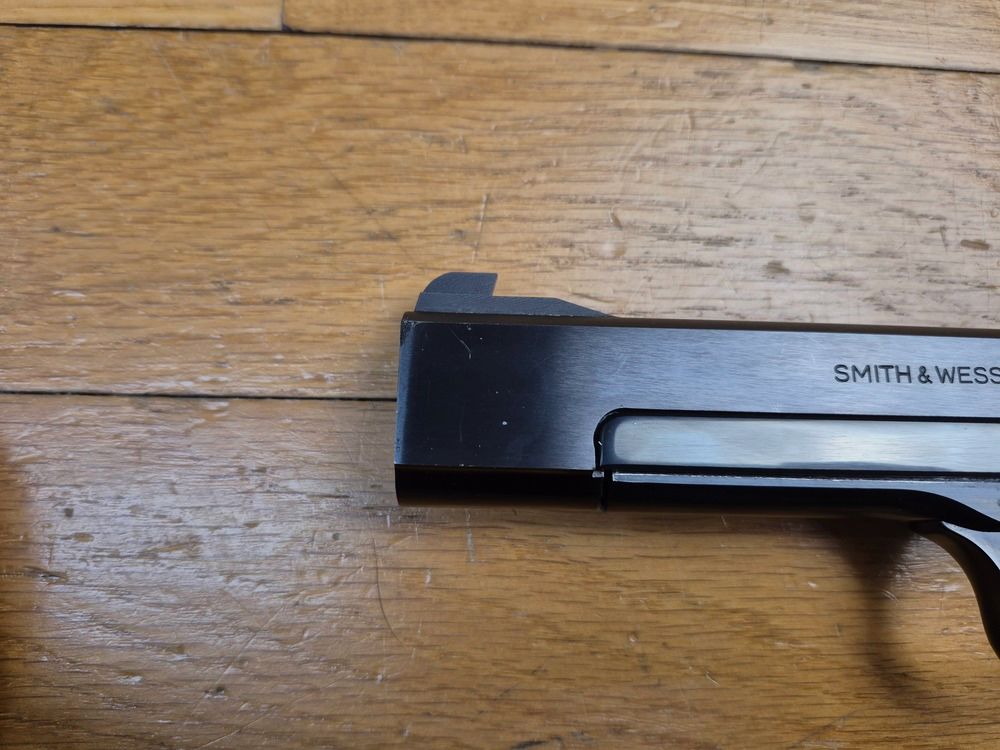
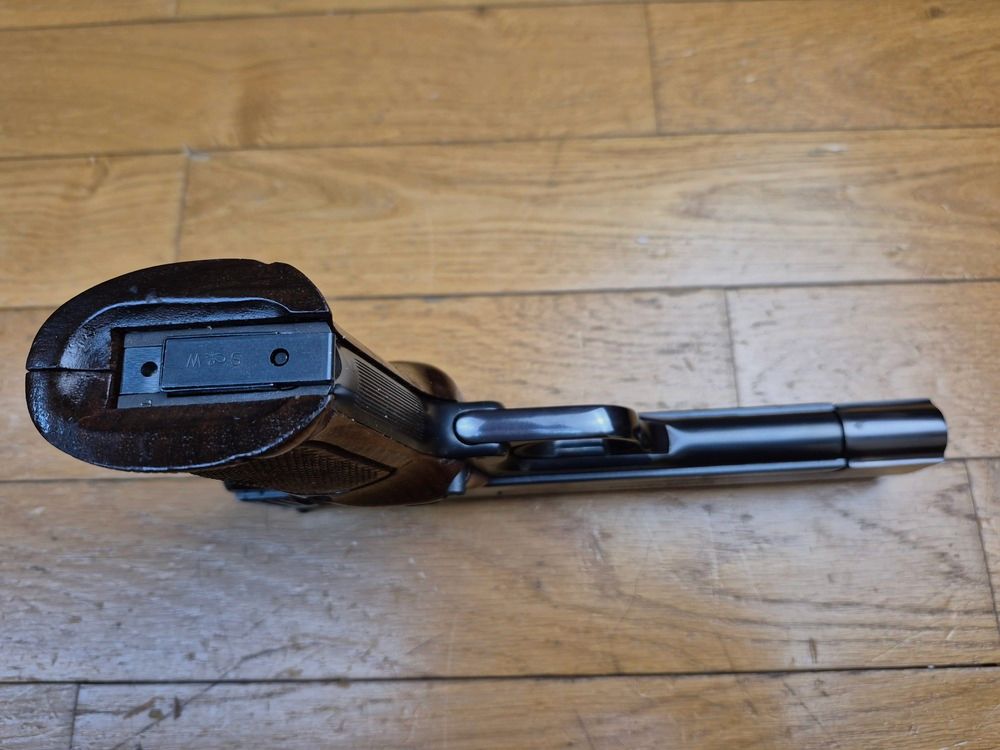

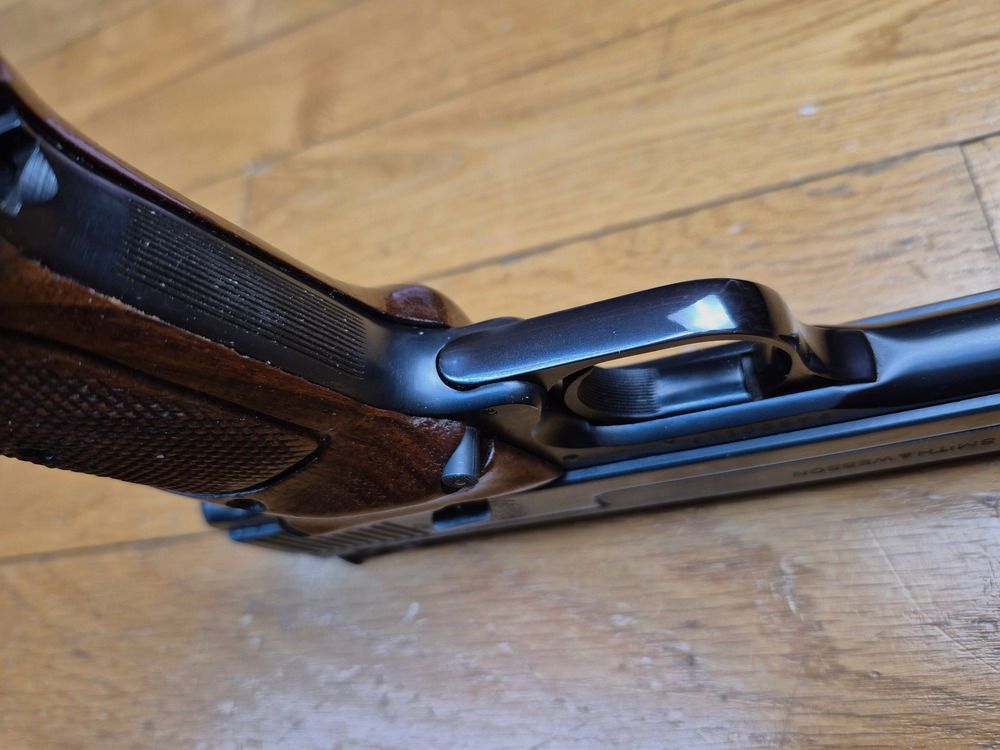













Superb Smith & Wesson Mod.41 pistol – cal. .22LR – All in real steel – 100% bluing – Gun from 1980 – Mechanism and barrel outstanding – One of the lowest handguns ever made – Superb condition – TBE++
≈ $1,484
Price at the dealer: 1,350 €. Converted at the ECB rate as of November 20, 2026.
Purchase permit required
75002 Paris, France
17
ID: 10338715
This item is currently unavailable.
Purchase from outside the EU: The firearm goes through an importer in your country, the dealer handles the export.
How buying from Europe works
Shop safely with Gunfinder
Our AI-powered seller identity verification makes Gunfinder the safest marketplace online.
Learn more
Details
- Original language
- French
- Brand
- Smith & Wesson
- Category
- Purchase eligibility
- Required
- Caliber
- .22lr
- Condition
- New
- Location
- 🇫🇷 75002 Paris, France
- Availability
- Out of stock
Freshness
This listing is based on a mirrored offer, where the listing data was synced to us from a shop, dealer, or external marketplace. Please note that temporary price discrepancies may occur due to possible delays in data transmission.
- Source
- Flingus Maximus
- Last checked with the dealer
- 1 day ago
Description
Note:
The item is located abroad. Please note that delivery conditions, shipping times, and/or the purchase process may differ.
Set down on a table among all those .22 automatics with their Luger-like looks, it stands out, makes an impression, and hits the mark.
When it comes to designing excellent handguns and mass-produced precision monsters, you can trust Smith & Wesson. From their earliest .22 models, then .32 rimfires, the quality and accuracy of Smith revolvers were far above what anyone else was making.
Precision shooters really began to be won over in the 1870s with the No. 3 American models and the famous .44 Russian.
The great Parisian gunsmith Gastinne Renette, based at 39 Allée d’Antin (now Franklin D. Roosevelt, but it’s not quite the same thing!), had such success with his Smiths specially prepared for target shooting that he got a telling-off from the Springfield firm itself!
A long tradition had begun, producing wonderful target versions of the brand’s best models, as well as firearms specially designed for small-caliber shooting, such as the Straigth Line.
So, while Smith had been part of the very exclusive world of precision shooting for a long time, by the end of World War II it had been more than twenty years since Smith had introduced anything new in this field. And nothing semi-automatic.
The time had come to roll up their sleeves. Fans of Smith precision pistols had to wait 21 years between the last iconic Straigth Line, released in 1936, and the first Model 41, which went on sale in… 1957!
Yet as early as 1947, a pair of prototypes called the X-41 and X-42 had been handed over to the in-house gunsmith team. They were all champions, with a knack for engineering and a good understanding of Smith’s manufacturing processes.
Better still, Carl Helström himself, President of Smith & Wesson, would come and get the shooters’ feedback firsthand on what could be improved. He was known for taking copious notes during these conversations and immediately discussing with production managers how to incorporate them into Smith’s production lines.
Helström actually worked through iterations after testing (for example, test a bolt on its own, then incorporate it into the project) rather than testing an overall concept and then making corrections. Master Flingus, contrary to the culture of national engineers, humbly thinks that this is probably how the greatest firearms, from the Colt 1911 to the Luger, were made—even if it seems a little laborious to “very intelligent” people.
Designing a beautiful theoretical firearm and then correcting its main practical flaws doesn’t produce the same result as these iterations. Theoreticians can’t explain it. But that’s how it is. In this case, every detail, every comment was examined and analyzed to create a truly exceptional firearm. One worthy of the name it would bear.
And it took… 10 years. First prototypes in 1947, as mentioned, and the first production models in 1957. I love Smith. Well, Smith from that era.
And the success was immediate. Just under 700 sold in 1957, and nearly 10,000 by 1958, its first full year on sale. And they hadn’t even been able to fill all the orders!
Amusingly, they didn’t start with a No. 1, but with serial number 1401. Typical Smith. And they’ve done much worse. Master Flingus told you to always be wary of serial numbers. And not just with Smith. I caught Manufrance pulling the same tricks with the Idéal. For sure.
Two barrel lengths were offered: 8 and 5 inches, one intended more for precision shooting.
n pure and the second more suited to military-style training, a precursor to the Model 46, which would also be used by the Air Force. Worth noting: early production featured an iconic 8″ barrel, with blueing that would make a 1990s supermodel jealous, a Patridge front sight machined into the barrel, and a muzzle brake… What a look! Replaced by the more sensible 7-inch version without a muzzle brake in 1978. The 5.5-inch version was introduced in 1963.
So it wasn’t just Hi-Standard and all its improbable variants that got a piece of the competitive shooting pie…
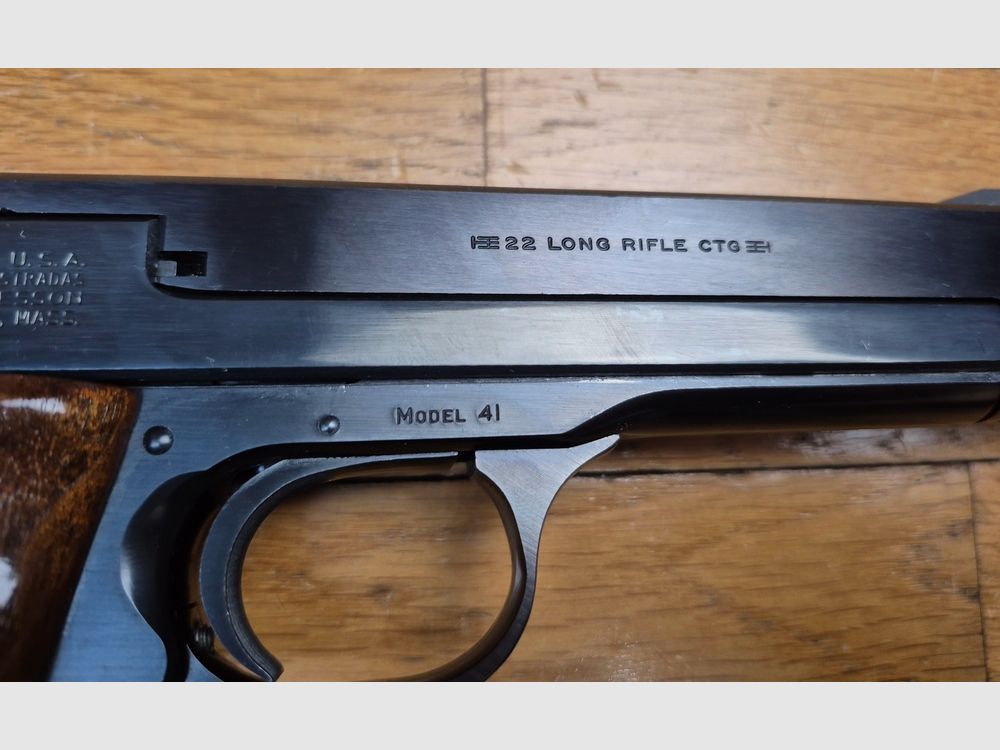
In terms of ergonomics, aside from its exceptional 105° grip angle and controls identical to those of the Colt 1911, it stands out from other .22 heavyweights because its barrel is easy to remove and machined as a single piece with the “upper.”
This makes it possible to customize the gun as you like, with a longer or thicker barrel of your choice, which could be ordered from the factory. A risky choice, but one that paid off, given the gun’s excellent fit and finish. Cleaning is also easier, much like a Walther PP (which was also made by Smith for a while!) or a Makarov, if you’re more of a Warsaw Pact type.
Another advantage of the Model 41: the rear sight isn’t mounted on the slide and is independent of it. It therefore stays perfectly fixed when firing, avoiding any misalignment or distraction from seeing it move constantly.
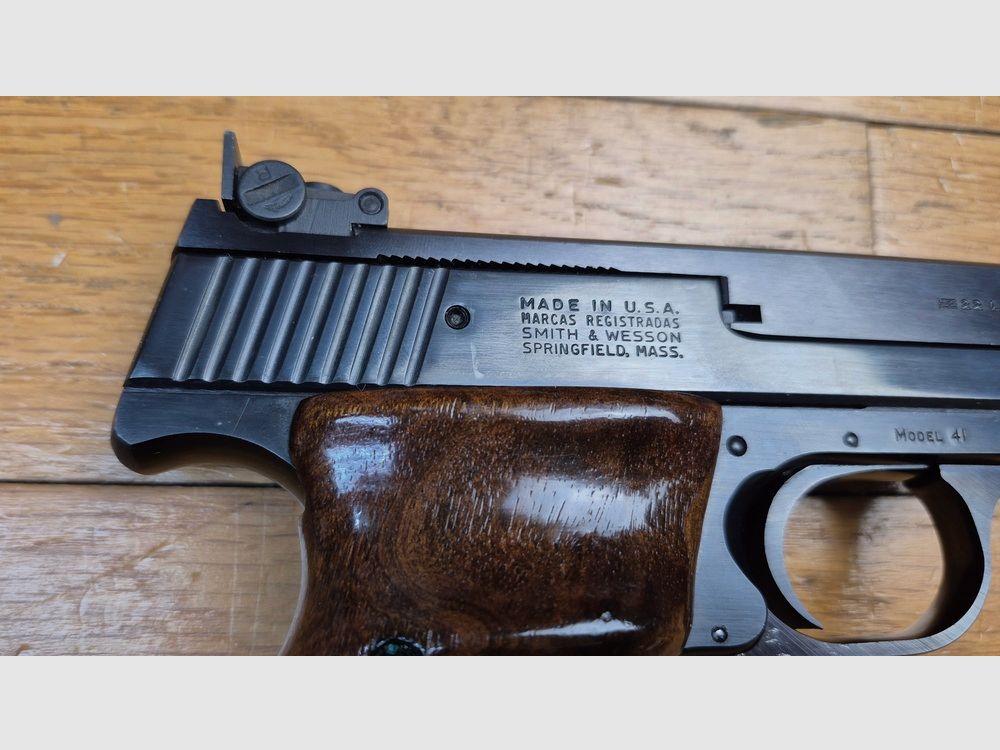
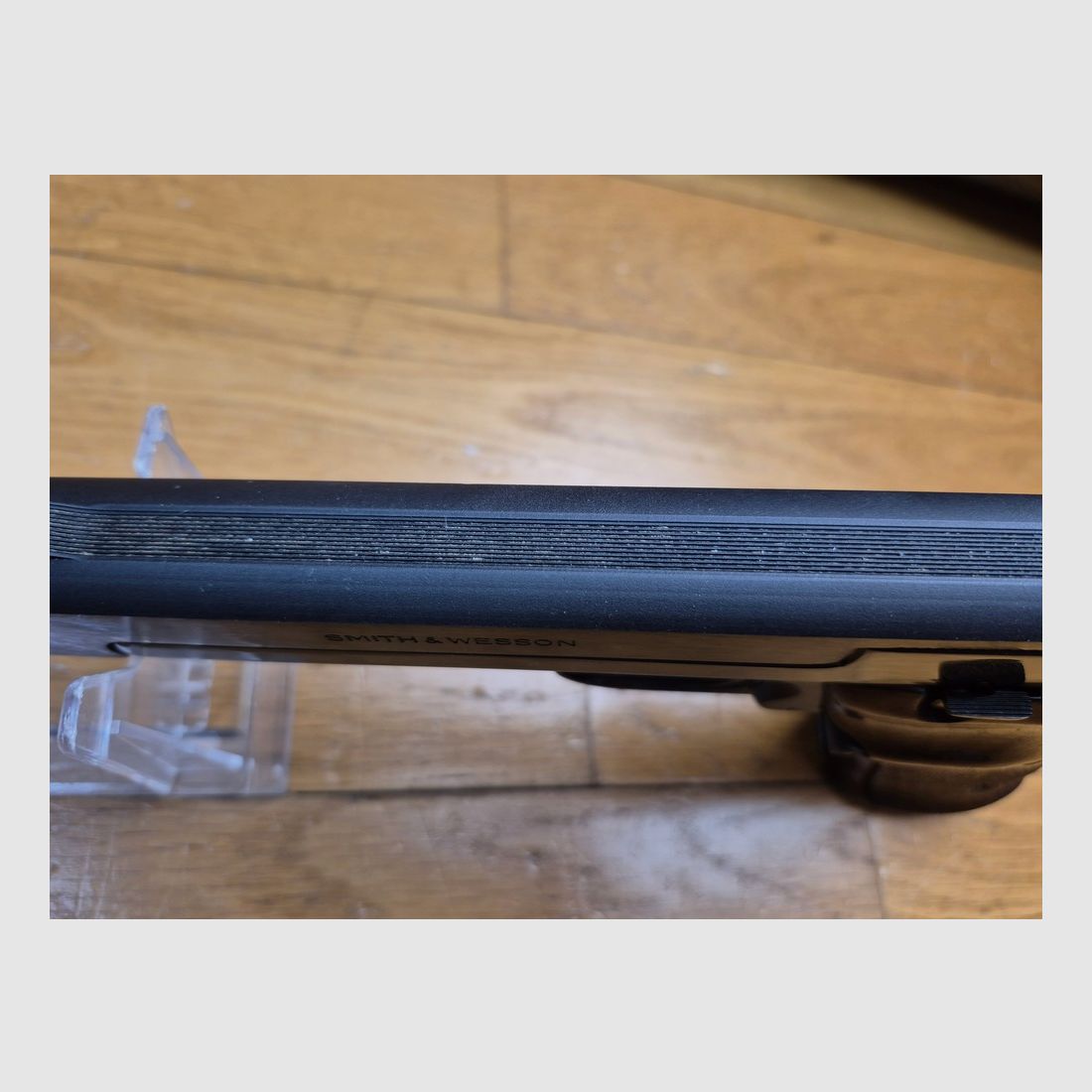
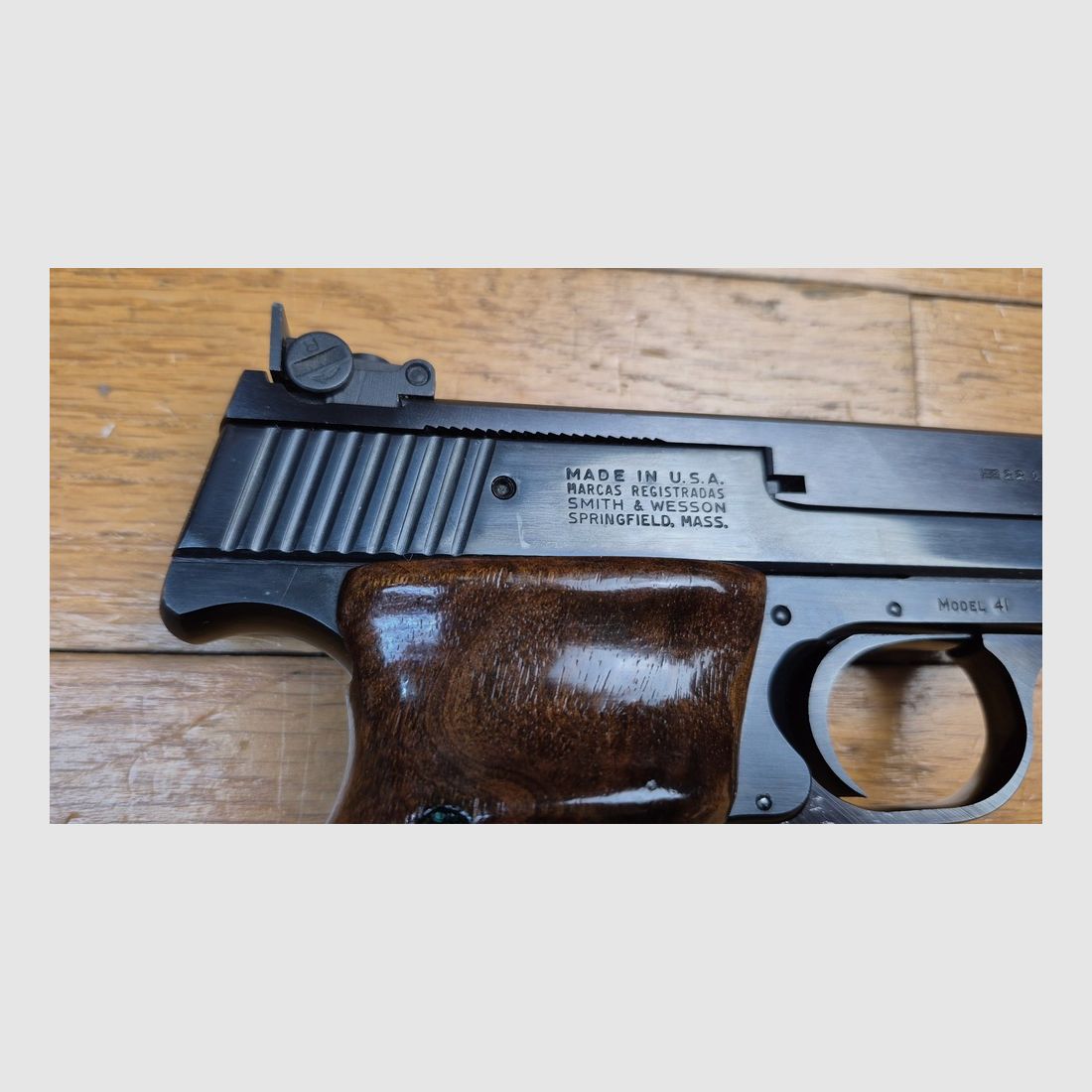
The slide is almost entirely enclosed in steel, yet remains very easy to operate thanks to serrations that are cleverly adapted to the overall design of the Smith 41.
In short, our Smith 41 had all the makings of the star it became, sought after at shooting ranges around the world. Add Smith’s almost unbelievable build quality from its golden years, and you have a top-notch pistol from the masters of the roll mark!
As an aside, you know that Maître Flingus is a fan of Smith revolvers from the “first two generations,” roughly “1900–1947” and “1947–1992.” And he knows exactly why. So do his clients who’ve had the chance to take the “Smith Experience” with him.
Well, it turns out that production of the all-steel, well-fitted Smith 41 ended in late 1992, precisely. That was the same year production of the “Pinned and Recessed” revolvers that had made the brand famous disappeared from the radar.
Coincidence?
I don’t think so. The time for fitters with thirty years’ experience was already over. The focus had shifted to maximum profitability (short-sightedly, given the deadly competition from the East and elsewhere that this later created for the once-great manufacturers) and cheaper laser cutting that could be moved elsewhere. But every time I pull the hammer on a modern 686, my heart is as dry as its mechanism…
Holding this Smith 41 and hearing its slide return with crystal clarity gives me a curious feeling—the same one I sometimes get when taking a piece out of a safe—that I suddenly have a firearm in my hands. A real one.
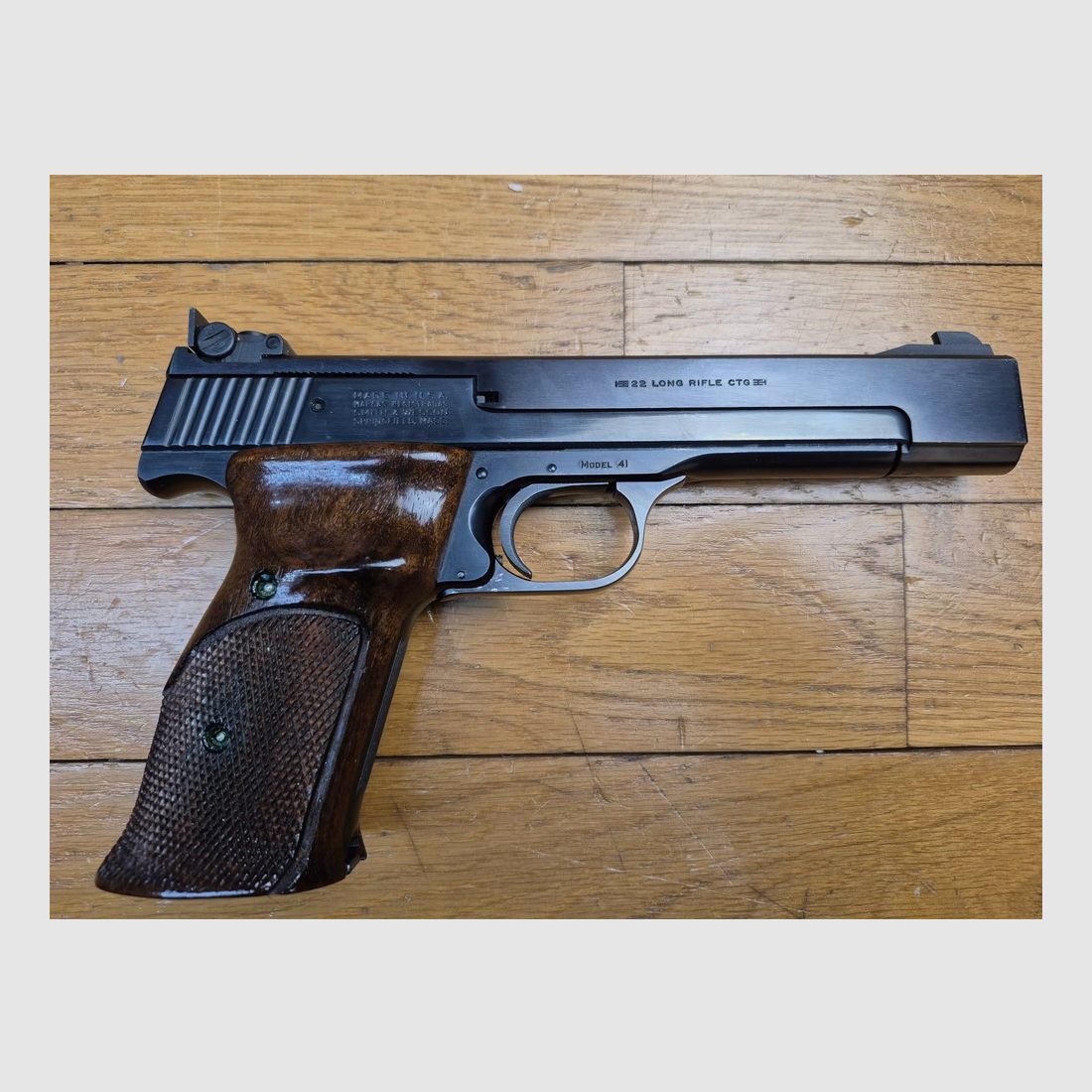
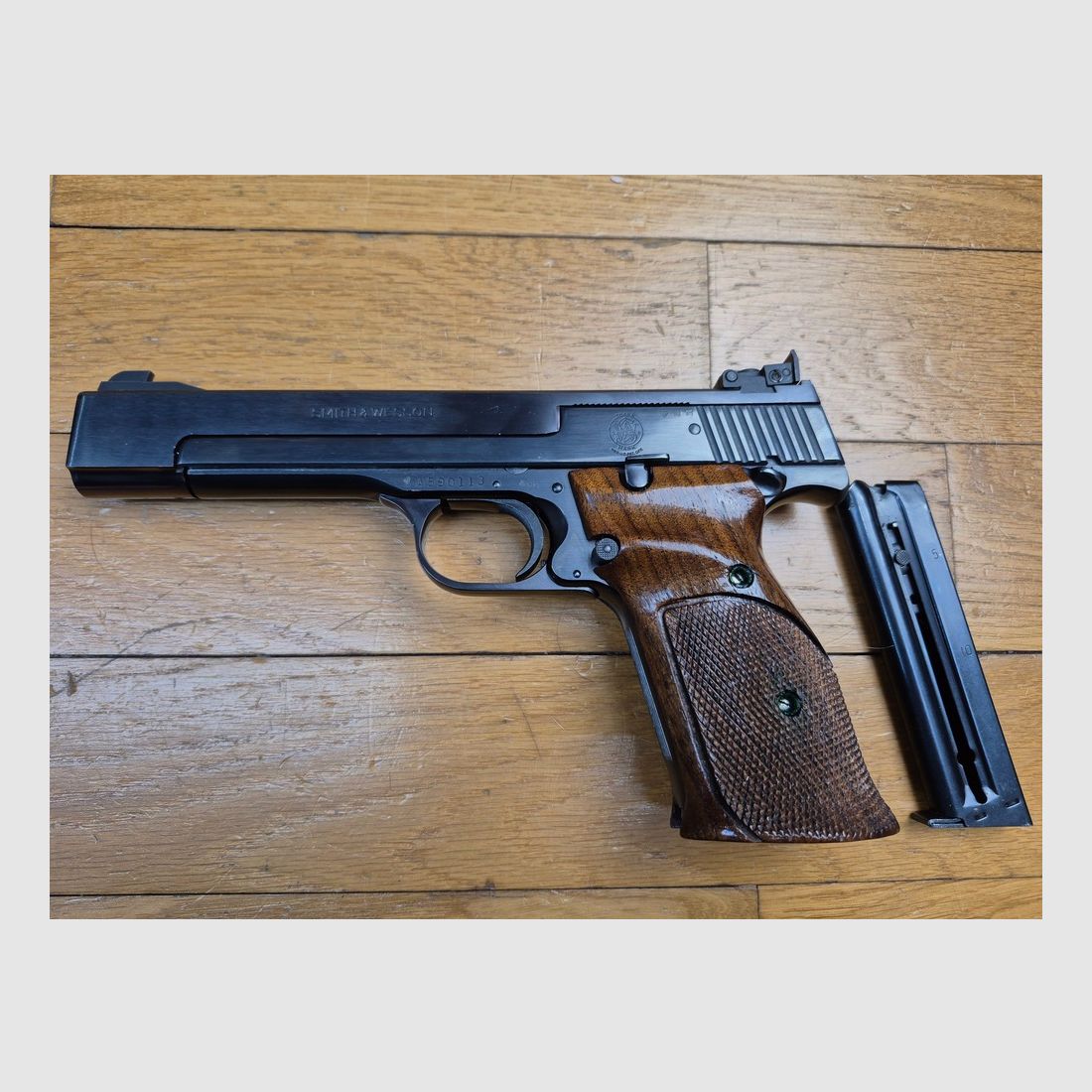
This very fine example was made in 1980. It comes to us in remarkably fresh condition.
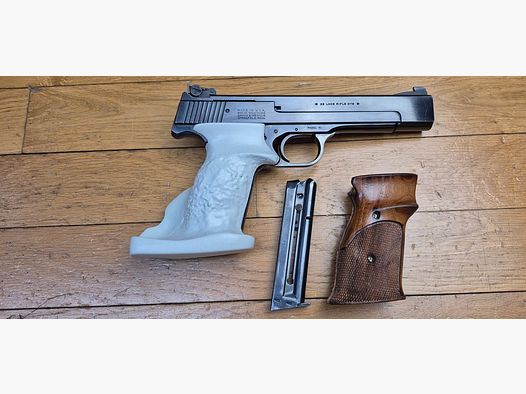
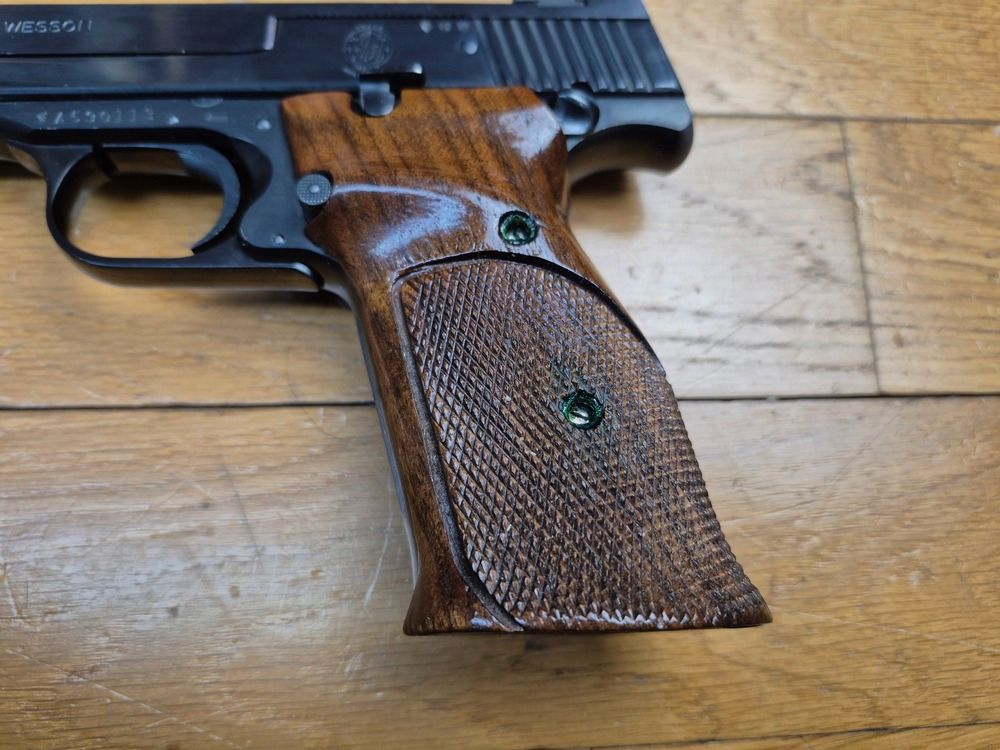
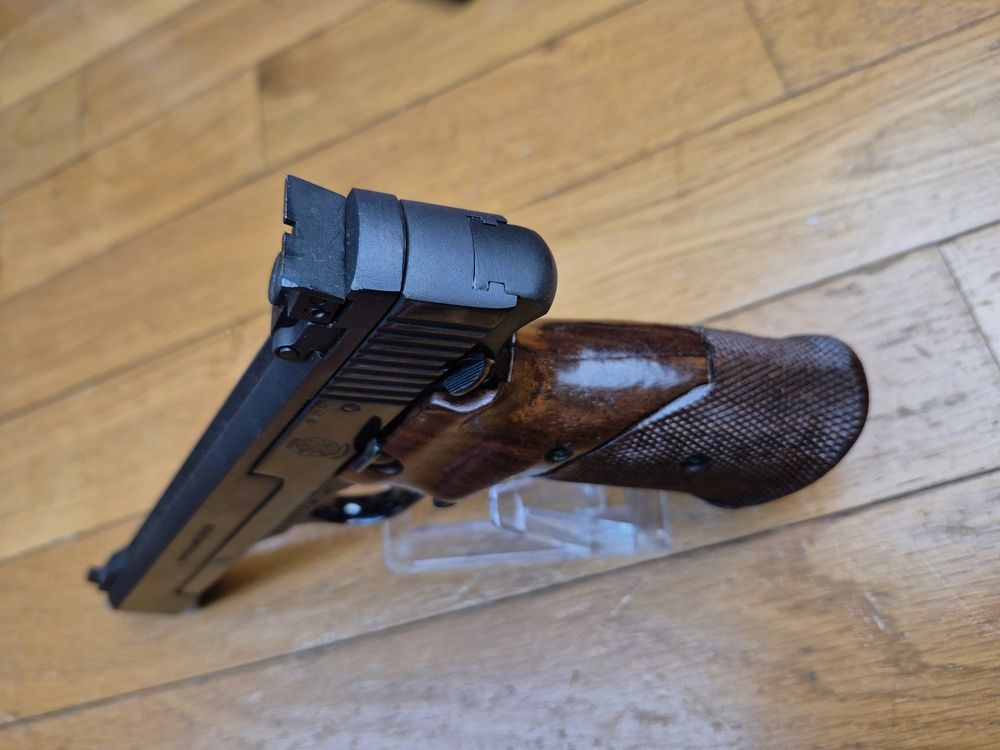
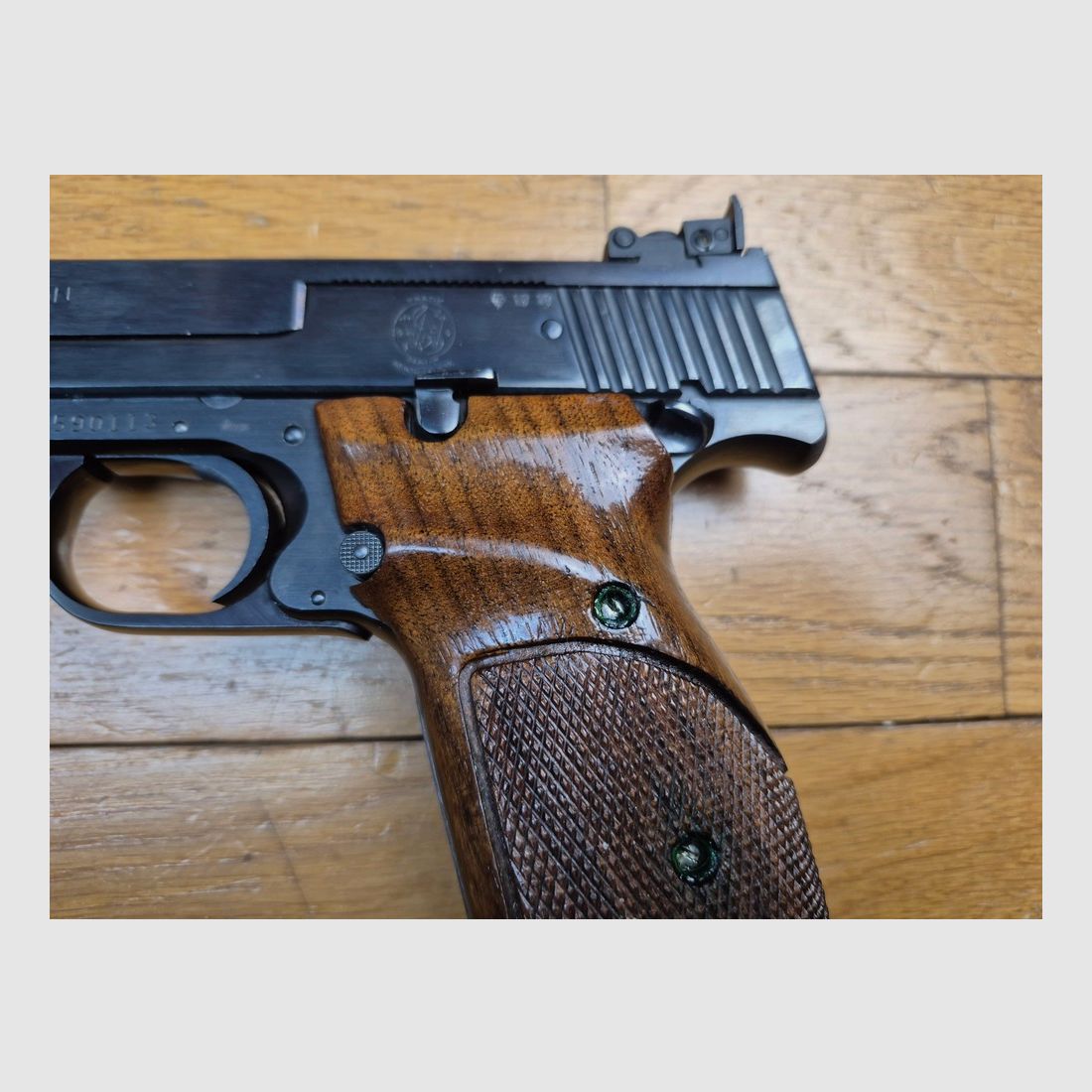
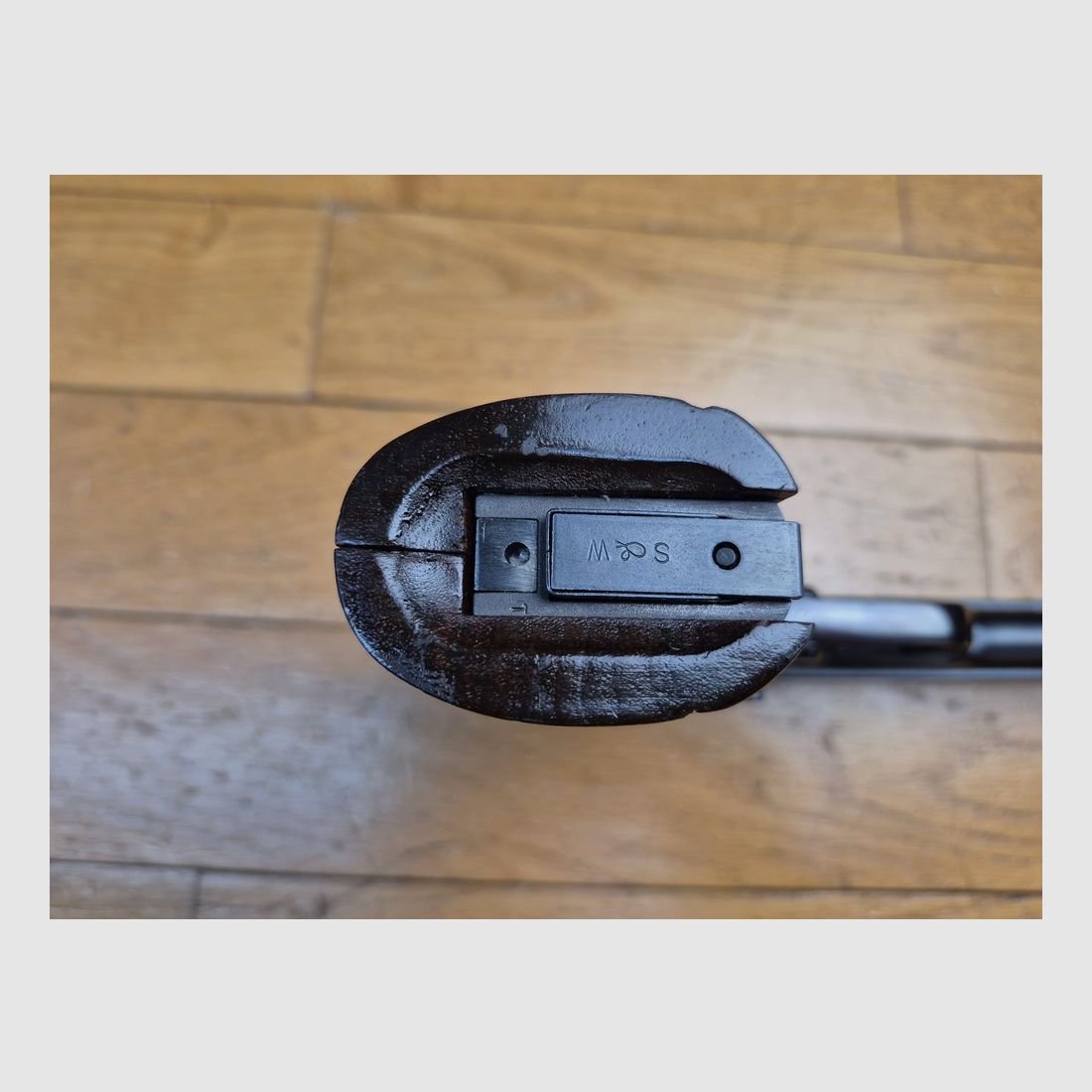
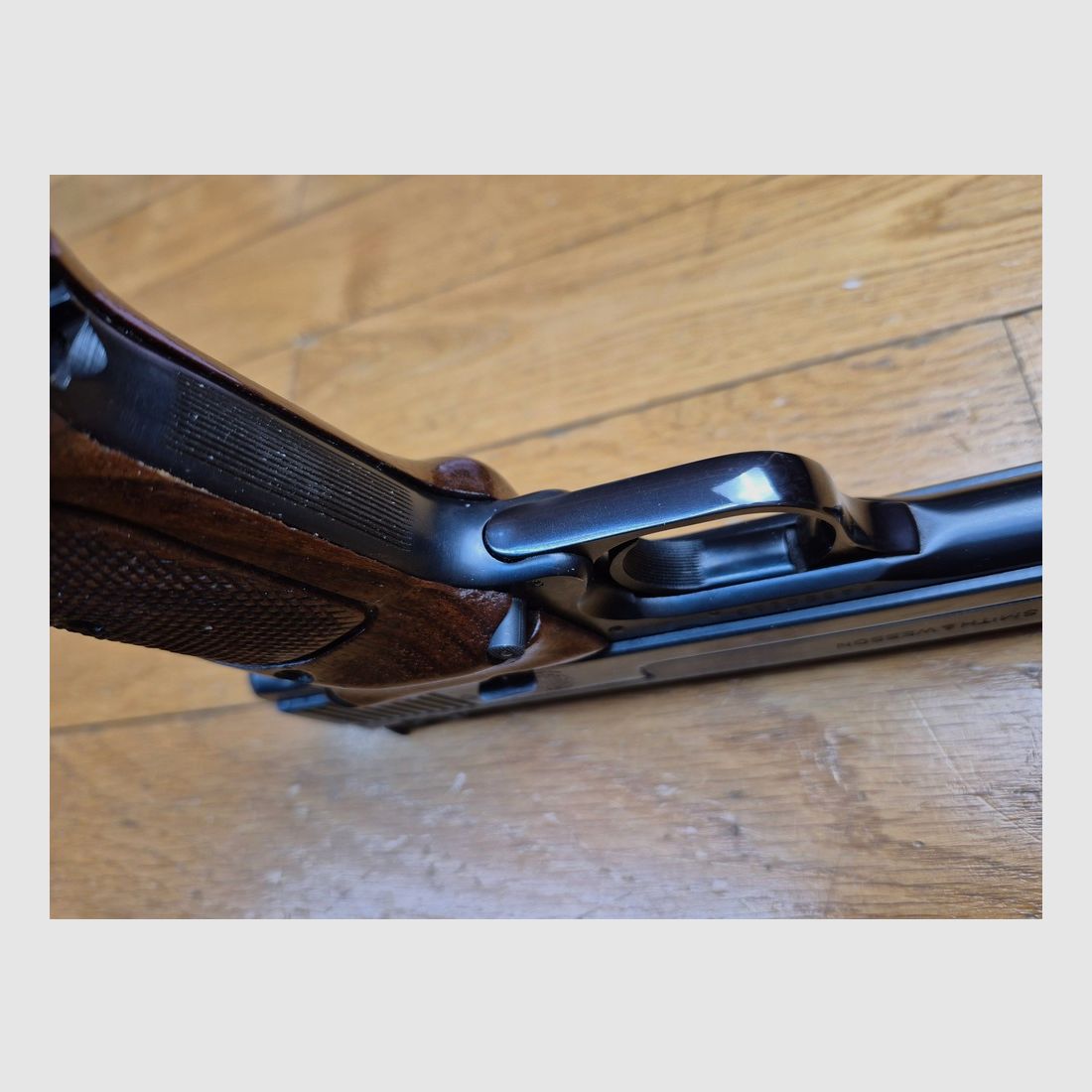
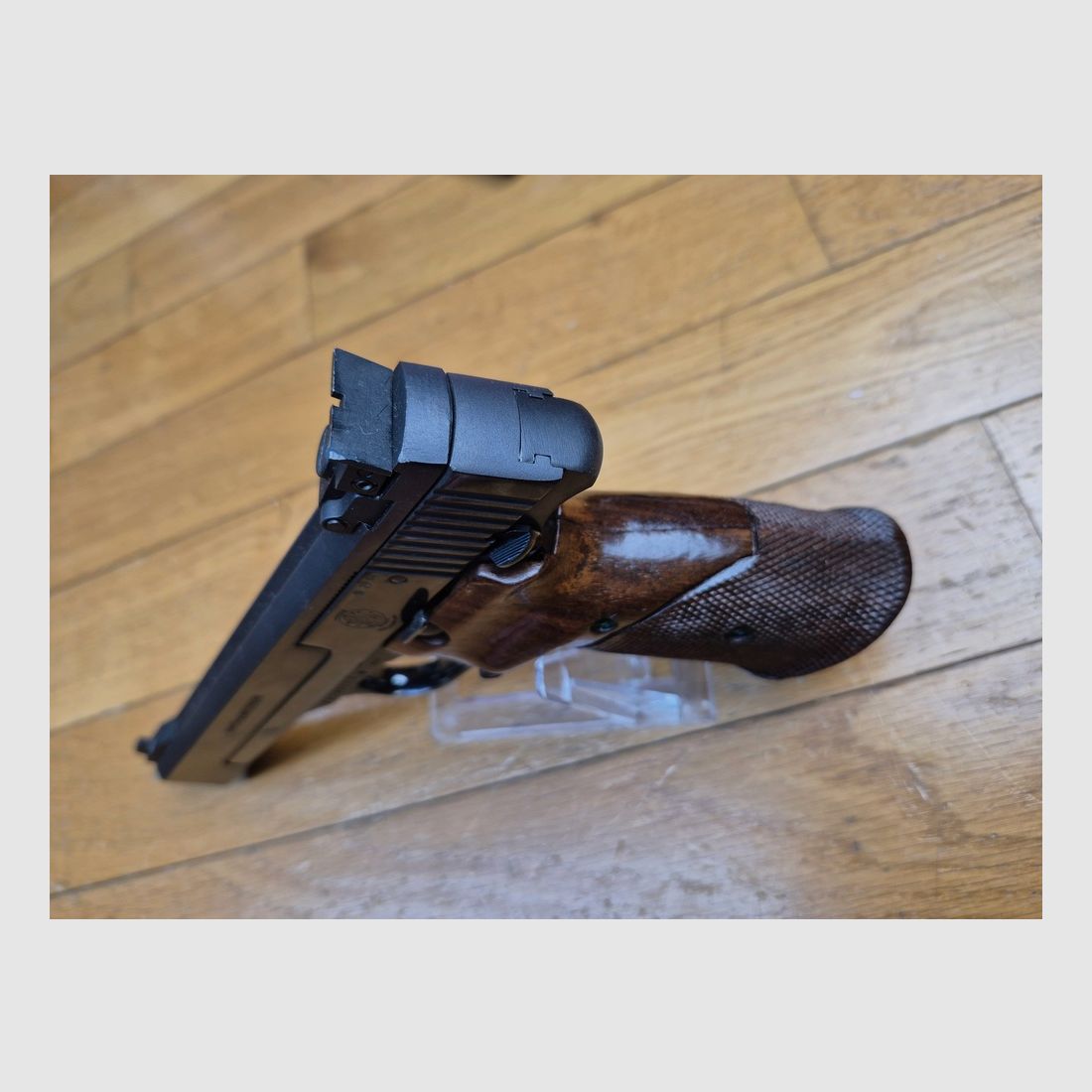
The grip is excellent, with a slight thumb rest that works for both right- and left-handed shooters. The grips are made of beautiful varnished walnut. Their checkering is just as it was on day one. Many replacement models are readily available, also letting you change its look (because being a precision firearm doesn’t mean you can’t have style in every situation).
The front of the stock is grooved to prevent canting errors. You can’t beat that finish…
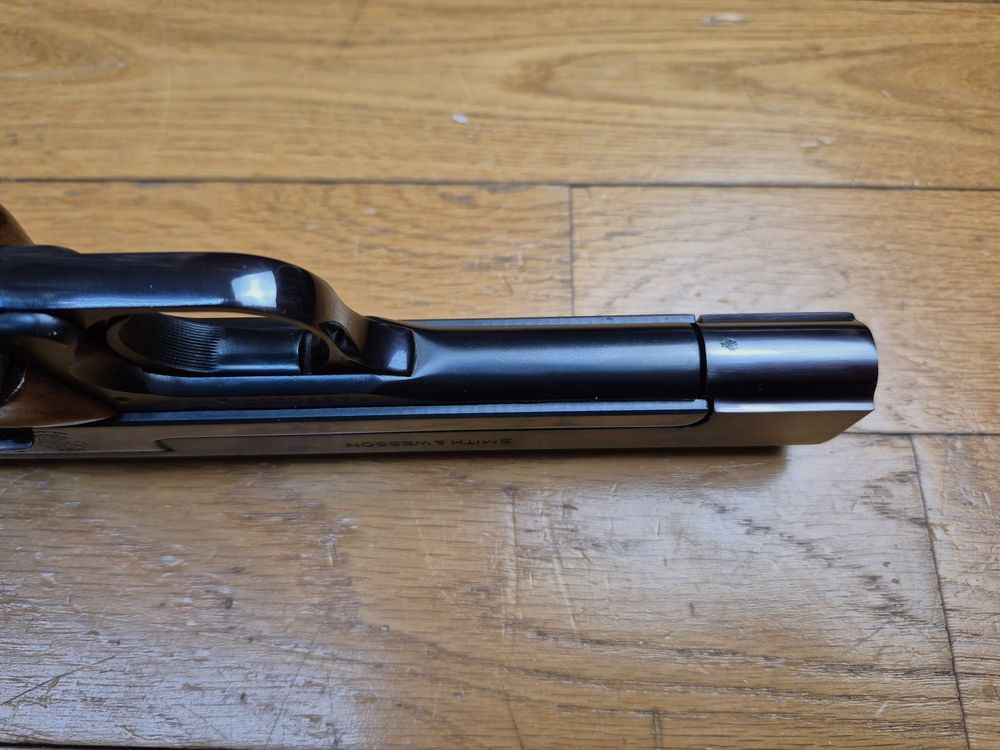
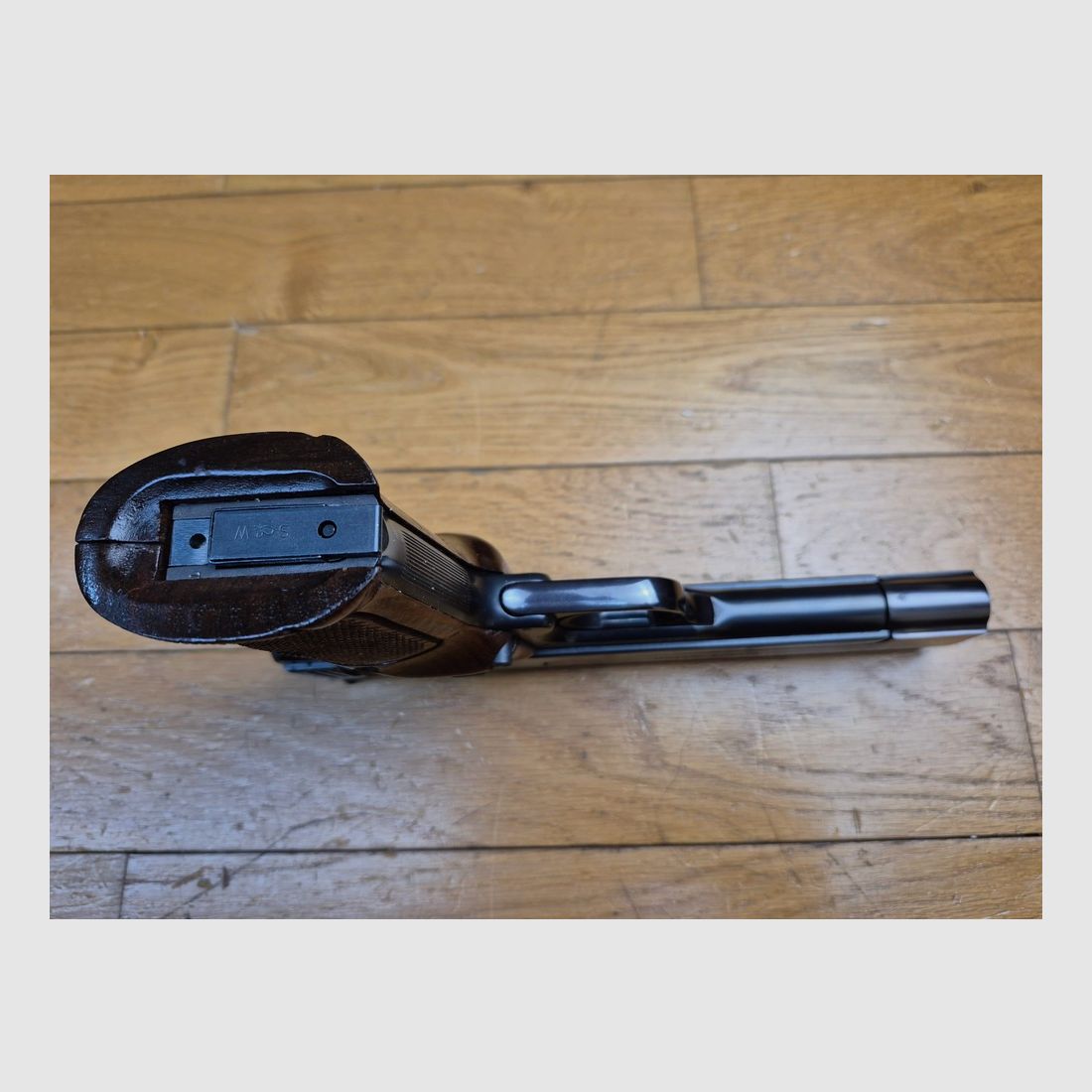
The Smith 41 is one of the lowest-profile semi-automatic pistols on the market.
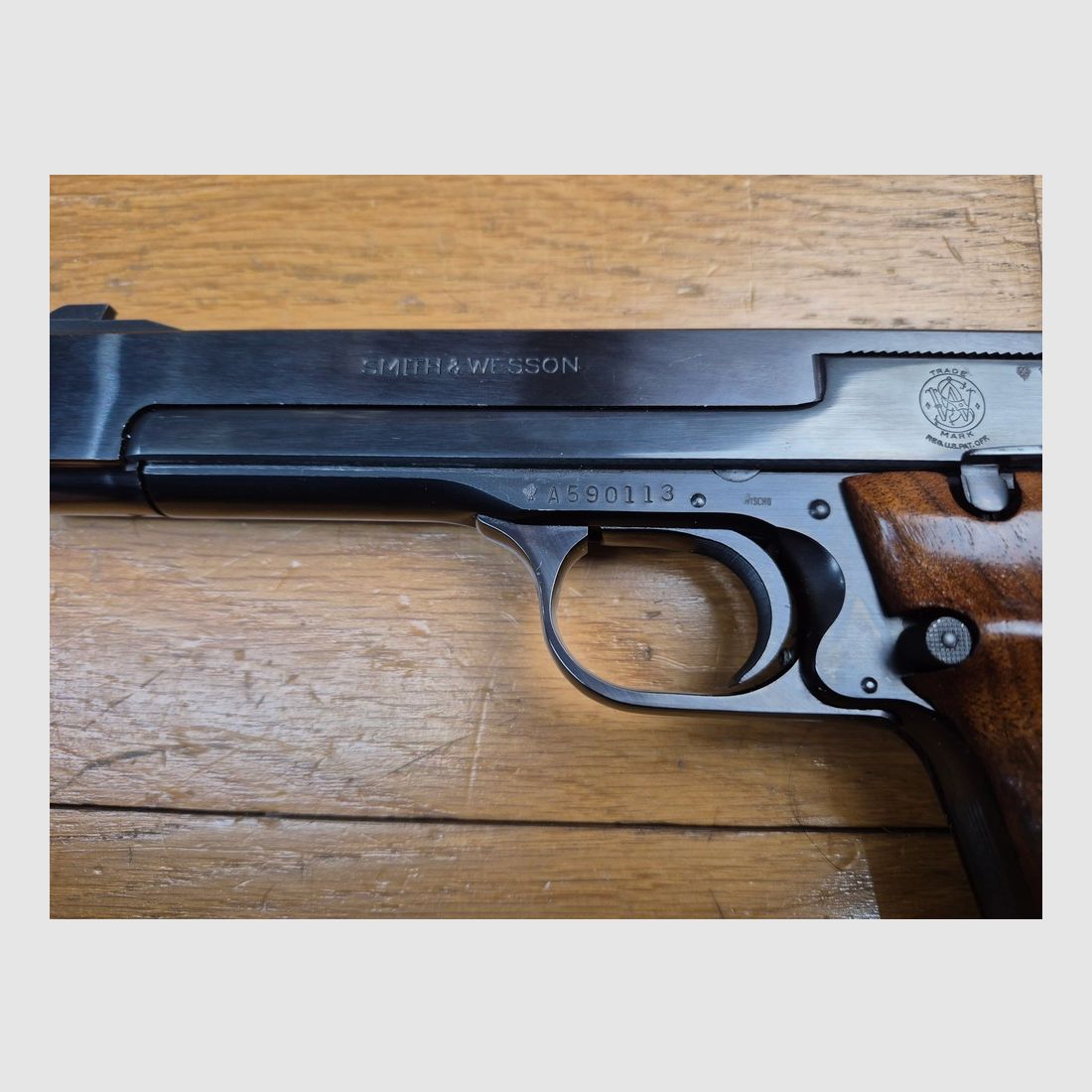
The single-action trigger provides an exceptionally smooth pull with a very linear break. The trigger position has been carefully designed for maximum comfort and control. Fans of the 1911A1 will notice the fine cutout in the frame behind the trigger, making it easier to reach for small to medium-sized hands. Quality is always in the details.
A manual safety is located on the left side of the firearm, just like on the 1911, allowing you to carry it “cocked and locked” and, above all, ensuring compliance with the old international competition rules. Smith thinks of everything.
The slide is easy to rack, with no squeaking or sticking. You can really feel the exceptional care taken with the fit and finish. It’s simply beautiful.
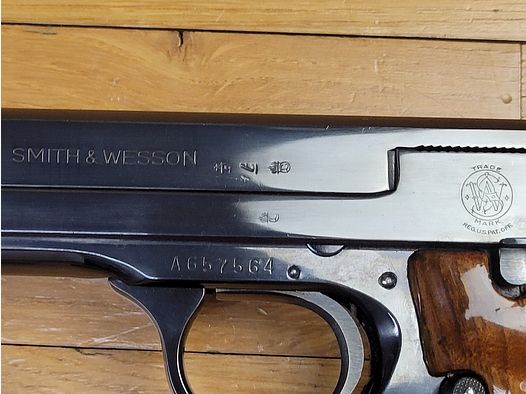
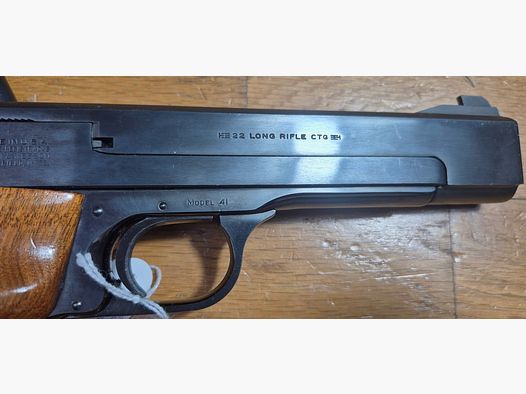
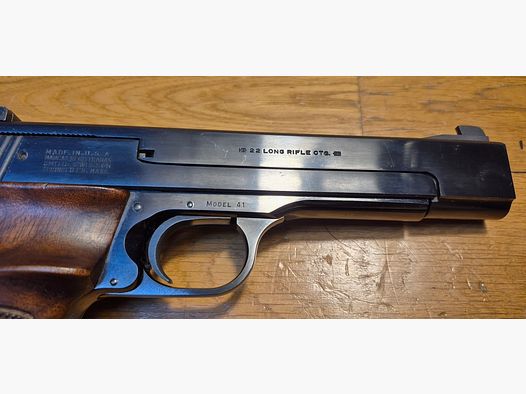
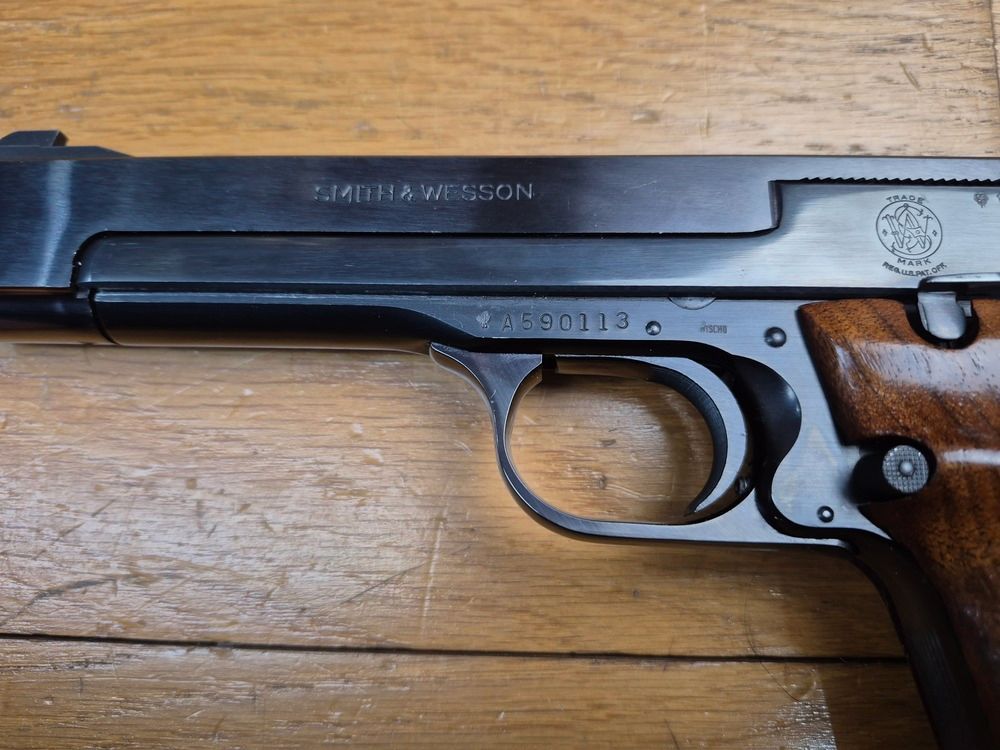
The exterior is just as beautiful, with 99.9% of the finish somewhere between glossy and matte. Not a visible scratch, even in my close-ups, except for a few very faint marks on the trigger guard that I could have removed with a tiny touch of cold bluing. In short, like new at 45 years old. Magnificent!
All the markings are in excellent condition, and it proudly bears the words “Made in USA.” The only addition since it left the factory is the elegant Bavarian proof marks, and our friends in leather breeches have clearly taken great care of it. Many thanks to them!
The barrel is immaculate and bright, with hundreds of thousands of rounds left in it. Original Smith magazine.
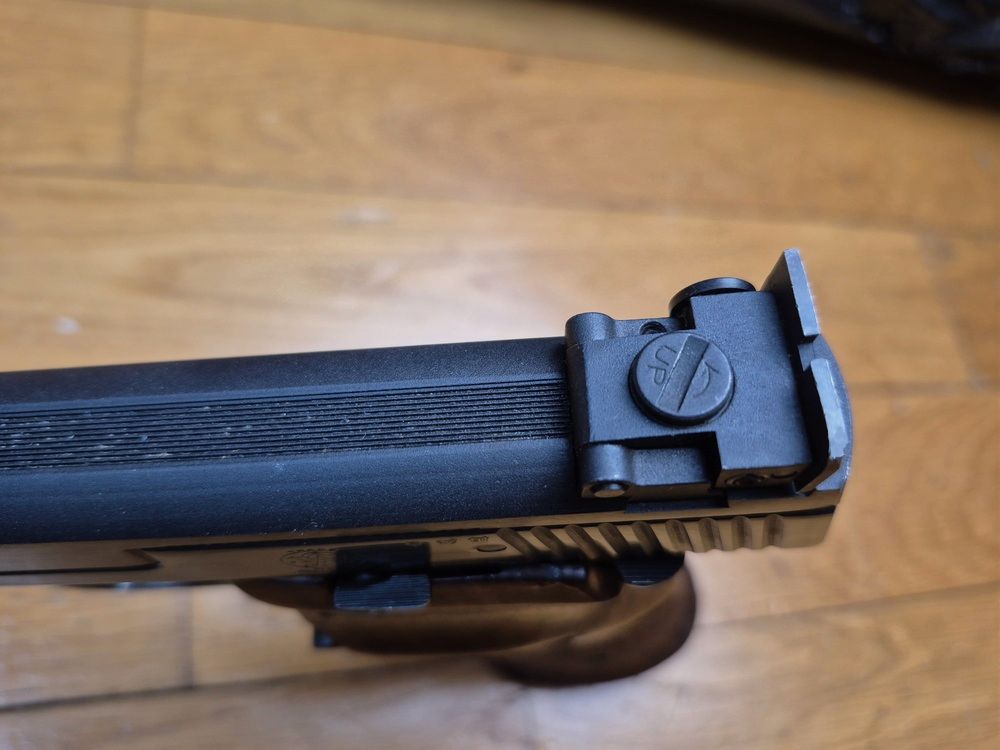
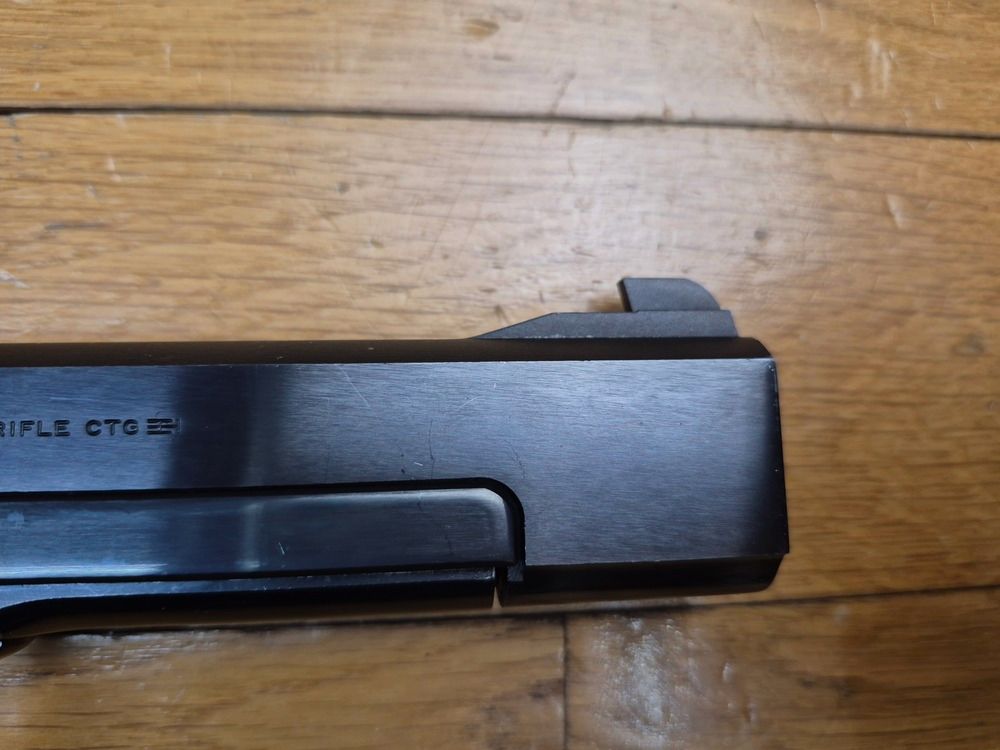
We’re spoiled for sights, with a 100% steel, fully adjustable rear sight. It has a very slight ding that doesn’t affect aiming at all. It’s 100% steel, after all—a perfect example of the quality of these firearms compared with modern junk. It adjusts with a large, sturdy flathead screw, which you can also turn with a cartridge case head or a coin if you’ve forgotten your toolkit!
The sight picture is very clear and very “square.” Simple, I’d say. This rear sight naturally “isolates” and frames the front sight. You can shoot for a long time without straining your eyes too much—one of the 41’s strong points. Top-notch.
The front sight is a Patridge sight (an easy way to remember how to spell it: with an “r” before the “t,” you’re talking about a partridge, not a firearm). It’s machined from solid steel—a real fortress.
The top of the slide is sandblasted and grooved so no glare distracts you from your target. An excellent, superior-quality firearm that will last a very long time. You can pass it down to your children or grandchildren, just like the Smith “Rollers” from that era. I’d love to see what the neighbor at the range thinks of his brand-new 2025 Buckmark in 45 years—that’s how old our baby is today…
A target firearm designed down to the last detail and an exceptional range gun thanks to its build quality, this Smith 41 is a top-tier pistol and a collector’s item that bears witness to Smith’s golden age—and will become increasingly rare. A must-have. Class and beauty, too.
CATEGORY B FIREARM AT THE CSI: SUBJECT TO AUTHORIZATION. A COPY OF A VALID ID AND A VALID SHOOTING LICENSE ARE REQUIRED – SIA ACCOUNT MUST BE OPEN, OF COURSE – SHIPPING WITH SIGNATURE REQUIRED IN TWO SEPARATE PARCELS AT LEAST 48 HOURS APART.
***********************************************************************************************************************
Let’s say it again! Flingus Maximus gun shop in Paris and throughout France is also here to help with private firearm transfers, buying firearm and militaria collections, firearm valuations, and questions about firearms in estates and inheritances. Contact your favorite gunsmith using our contact form or at [email protected] (Show description in original language)
Classique parmi les classiques, le Smith et Wesson Modèle 41 a vu le jour en 1957. Et, depuis lors, sa réputation n’a fait que grandir… Il en est devenu un standard.
Posé sur une table au milieu de tous ces automatiques en .22 aux faux airs de Luger, il se distingue, il frappe et il fait mouche.
Pour ce qui est de la conception d’armes de poing d’excellence et de monstres de précision fabriqués en série, on peut faire confiance à Smith et Wesson. Dès leurs premiers modèles en .22, puis en .32 annulaire, les qualités de fabrication et de précision des revolvers Smith surent être largement au dessus de ce qui se faisait ailleurs.
Le cœur des tireurs de précision commença à être vraiment conquis à partir des années 1870 avec les modèles N°3 American et les célèbres Russian en 44.
Le grand arquebusier parisien, Gastinne Renette, installé au 39 Allée d’Antin (maintenant Franklin D. Roosevelt, mais c’est plus la même chose !) eut un tel succès avec ses Smith spécialement préparés pour le tir, qu’il se prit des remontrances de la firme de Springfield elle même !
Une longue tradition avait débuté, produisant de merveilleuses versions target des meilleurs modèles de la marque ainsi que des armes spécialement pensées pour le tir en petit calibre comme avec le Straigth line.
Si Smith avait donc un pied dans le cercle très fermé du tir de précision depuis fort longtemps, à la sortie de la 2° Guerre Mondiale, cela faisait plus de vingt ans qu’aucune nouveauté Smith n’était sortie dans ce domaine. Et rien d’automatique.
L’heure était donc venue de se retrousser les manches. Les tireurs fans des pistolet Smith de précision avaient donc du attendre 21ans entre la sortie du dernier exemplaire de l’iconique Straigth Line en 1936 à celle du premier modèle 41 sera commercialisé en … 1957 !
Pourtant, dès 1947, une paire de prototypes dénommés X-41 et et X-42 avaient été confiée à l’équipe des flingueurs maison. Que des champions ayant en outre de bonnes dispositions d’ingénierie et connaissant bien les modalités de fabrications de Smith.
Mieux, Carl Helström lui-même, le Président de Smith&Wesson venait recueillir en direct l’opinion des tireurs sur les points d’améliorations. Il était connu pour prendre de copieuses notes lors des entretiens et cherchait immédiatement avec les responsables de production comment les insérer dans les lignes de production de Smith.
Helström fonctionnait en fait par itérations après tests (on teste, par exemple, une culasse à part puis on l’insère dans le projet) plutôt que par test d’un concept global suivi de corrections. Maître Flingus, à rebours, de la culture des ingénieurs nationaux, pense modestement que c’est sans doute comme cela, même si cela semble un peu besogneux aux gens « très intelligents », qu’ont été produites les plus grandes armes du Colt 1911 au Luger.
Créer une belle arme théorique puis en corriger les principaux défaut pratiques ne permet pas d’arriver au même résultat que ces itérations. Inexplicable à des théoriciens. Mais c’est comme cela. En l’espèce, chaque point, chaque remarque fut observée et analysée, afin de proposer une arme vraiment exceptionnelle. Digne du nom quelle porterait.
Et là cela a duré…10 ans. Premiers prototypes en 1947 comme indiqué et premiers exemplaires de série en 1957. J’aime Smith. Enfin cette époque-là.
Et le succès fut immédiat. Un peu moins de 700 exemplaires vendus en 1957 et déjà près de 10.000 dès 1958 pour sa première année complète de ventes. Et toutes les commandes n’avaient pas pu être satisfaites !
Chose amusante, ils ne commencèrent pas par sortir un N°1 mais l’exemplaire 1401. Typique de chez Smith. Et ils ont fait bien pire. Quand Maître Flingus vous disait qu’il faut toujours se méfier des numéros de série. Et pas que chez Smith. J’ai chopé Manufrance a nous faire les mêmes carabistouilles sur les Idéal. Certain.
Deux versions de longueurs de canon différentes étaient proposées : 8 et 5 pouces, un destiné plutôt au tir de précision pur et le second plutôt destiné à un entraînement de type militaire, un précurseur du modèle 46 qui sera d’ailleurs employé dans l’Air Force. A signaler en début de production un iconique 8″ barrel, avec un bronzage bleu à rendre jalouse une mannequin de 1990 , un guidon Patridge dans la masse et un frein de bouche… Un look de folie ! Remplacé par le 7 pouces plus raisonnable sans frein de bouche en 1978. Le 5.5 pouce a été introduit lui en 1963.
Il n’y avait donc pas que Hi-Standard et toutes ses imporbables variantes qui aurait droit à sa part du gâteau du tir de compet’ …
En termes d’ergonomie et en dehors de sa pente de crosse de 105° de prise en main exceptionnelle et de ses contrôles, identiques au Colt 1911, il se distingue des autres ténors du .22 par le fait que son canon est facilement démontable et soit usiné d’une seule pièce avec le « upper ».
Ainsi, il devient possible de customiser l’arme à sa guise, avec un canon plus long ou plus épais selon son choix, et qu’il était possible de commander d’usine. Choix risqué mais payant au vu de la qualité d’ajustage de la bête. Le nettoyage en est également simplifié, assez proche somme toute d’un Walther PP (qui sera aussi fabriqué par Smith pendant un temps!) ou d’un Makarov si vous êtes plutôt Pacte de Varsovie dans l’âme.
Avantage aussi pour le modèle 41, la hausse n’est pas située sur la culasse et en est indépendante. Elle reste ainsi parfaitement fixe lors du tir, évitant tout dérèglement ou perturbation en la voyant se déplacer constamment.
La culasse est ainsi quasi-entièrement enveloppée d’acier mais reste très facile à manipuler grâce à des stries de préhension très intelligemment adapté à l’architecture générale du Smith 41.
Bref, notre Smith 41 avait dès le départ tous les atouts pour devenir ce qu’il est devenu: une star recherchée des Stands de Tir du monde entier. Avec, en plus, la qualité de fabrication Smith, un peu folle, des grandes années. Un top de pistolet venu de chez les as du rouleau !
A titre accessoire, vous savez que Maître Flingus est un aficionados des révolvers Smith des « deux premières générations » en gros « 1900-1947 » et « 1947 – 1992 ». Et lui sait parfaitement pourquoi. Comme ceux de ses clients, qui ont eu la chance de faire avec lui la « Smith Expérience », le savent aussi.
Et bien figurez vous que la production du pistolet Smith 41 tout en acier et bien ajusté a très exactement cessé fin 1992. Cette même année où a disparu des radars la fabrication « Pinned and Recessed » qui avait fait la gloire de ses revolvers.
Un hasard ?
Je ne le pense pas. L’heure n’était déjà plus aux ajusteurs de trente ans d’expérience mais à la rentabilité maximale (à courte vue, du fait de la concurrence mortifère d’orient et d’ailleurs que cela a suscité ensuite pour les ex-grandes maisons) et à la découpe laser meilleur marché et transportable ailleurs. Mais à chaque fois que je tire le chien d’un moderne 686, mon cœur est aussi sec que leur mécanique…
En ayant ce Smith 41 dans les mains, en entendant le son de sa culasse revenir avec une netteté de cristal, il me vient ce curieux sentiment, que j’ai parfois en attrapant une pièce dans un coffre, d’avoir soudainement une arme entre les mains. Une vraie.
Ce très bel exemplaire a été produit en 1980. Il nous parvient dans un état de fraîcheur remarquable.
La prise en main est excellente, avec un léger rebord pour le pouce, fonctionnant pour droitier comme pour gaucher. Les plaquettes sont en beau noyer verni. Leur quadrillage est comme au premier jour. De nombreux modèles de remplacement sont facilement trouvables permettant également de changer son look (car ce n’est pas parce que l’on est une arme de précision que l’on ne peut pas avoir du style en toutes circonstances).
Le devant de la crosse est strié, évitant les erreurs de devers. Finition quand tu nous tiens…
Le Smith 41 a pour lui d’être un des pistolets automatiques les plus bas sur la main qu’il existe sur le marché.
La platine à simple action permet un départ des plus doux et avec un lâché très linéaire. La position de la détente est savamment étudiée pour un maximum de confort et de contrôle. Les amoureux de 1911A1, remarqueront la fine découpe de la carcasse derrière la détente qui facilitent son accès pour les mains de tailles petites à moyennes. La qualité est toujours dans le détail.
Une sûreté manuelle est placée sur le côté gauche de l’arme, façon 1911 aussi, offrant la possibilité de la porter en « cock and lock » mais surtout pour se conformer aux anciens règlements de compétitions internationales. Smith pense à tout.
L’armement de la culasse est très accessible, rien ne grince, rien ne coince. On sent vraiment attention extrême dans le soin de l’ajustage. C’est juste beau.
L’aspect extérieur est des plus beaux aussi, avec 99.9% d’un bronzage jouant entre le « glossy » et le mat. Pas une rayure visible hors mes très gros plans sauf de petites marques légérissimes en pontet que j’aurai pu faire disparaitre d’un micro coup de bronzage à froid. Bref neuf pour ses 45 ans. Magnifique !
Tous les marquages sont en excellent état, il porte fièrement sa mention « Made in USA ». Seul ajout depuis sa sortie d’usine, les élégants marquages d’épreuves bavarois et nos amis en culottes de peau en ont visiblement pris grand soin. Qu’ils en soient remerciés !
Le canon est impeccable, bien brillant avec des centaines de milliers de cartouches devant lui. Chargeur Smith d’origine.
Côté visée, nous sommes gâtés avec une hausse 100% acier et 100% réglable. Elle porte un très un léger coup ne nuisant nullement à la visée. Parce qu’elle est 100% acier justement – démonstration faite par l’exemple de la qualité de ces armes sur les cochonneries modernes. Elle est réglable au moyen d’une large et solide vis plate, accessible aussi avec le culot d’une douille ou une pièce de monnaie si vous avez oublié votre trousse à outils !
La prise de visée est très nette, très « carrée ». Simple je dirais. Cette hausse « isole » et encadre le guidon très naturellement. Vous pourrez tirer longtemps sans excessivement fatiguer votre visuel – Un des points forts du 41. Top.
Le guidon est de type Patridge sight (un moyen facile de ne pas se tromper en l’écrivant est de se dire qu’avec un « r » avant le « t » on parle de peRdix et non plus d’armes à feu) . Il est usiné dans la masse – Un coffre-fort.
Le dessus de la culasse est sablé et strié, afin qu’aucun reflet ne vienne vous détacher de votre cible. Une excellente arme de qualité très supérieure. Et qui durera encore très longtemps. Vous pourrez la céder à vos enfants ou petits enfants. Comme les « Rouleaux » Smith de cette époque d’ailleurs. Je voudrai bien voir la tête du Buckmark de 2025 tout neuf du voisin de stand dans 45 ans, c’est à dire l’âge de notre bébé de ce jour…
Arme de tir pensée jusqu’au bout dans sa conception et une arme de stand d’exception par sa qualité de fabrication, ce Smith 41 est un top de pistolet doublé d’un collector témoignant de l’âge d’or de Smith qui se fera de plus en plus rare. Un must have. La classe et la beauté en plus.
ARME DE CATÉGORIE B AU CSI : SOUMISE À AUTORISATION, PHOTOCOPIE DE LA PIÈCE D’IDENTITÉ EN COURS DE VALIDITÉ ET DE LA LICENCE OBLIGATOIRE – COMPTE SIA OUVERT BIEN ÉVIDEMENT – Expédition contre signature en deux colis séparés d’au moins 48 heures obligatoire.
***********************************************************************************************************************
Répétons le ! L’armurerie Flingus Maximus à Paris et partout en France est là aussi pour vos formalités armes entre particuliers, le rachat de collections armes et militaria, vos estimations d’armes, vos questions armes dans les successions et héritage. Contactez votre armurier préféré via notre formulaire de contact ou à [email protected]