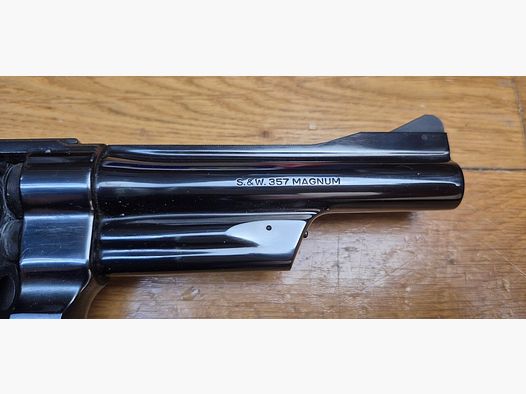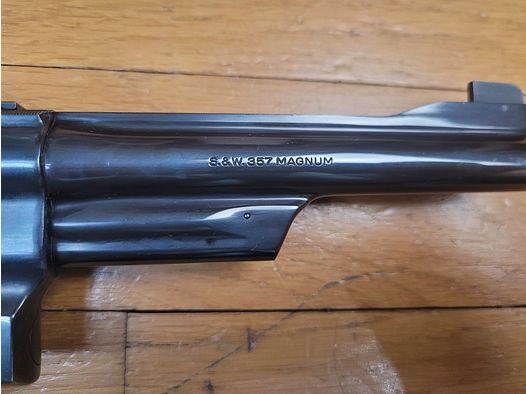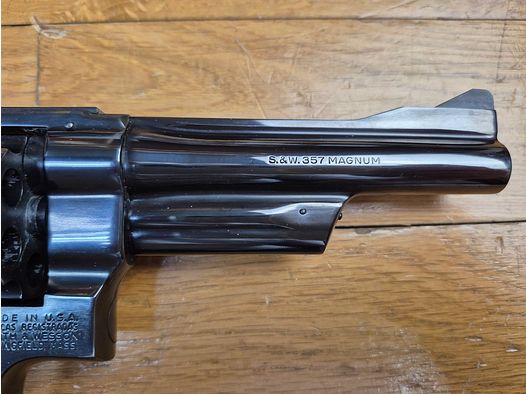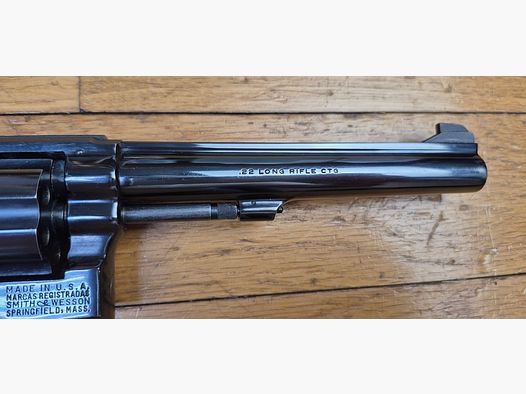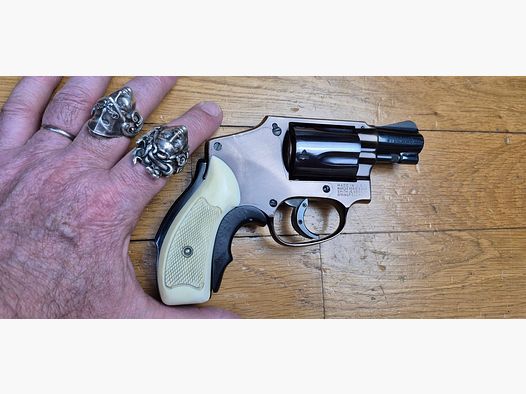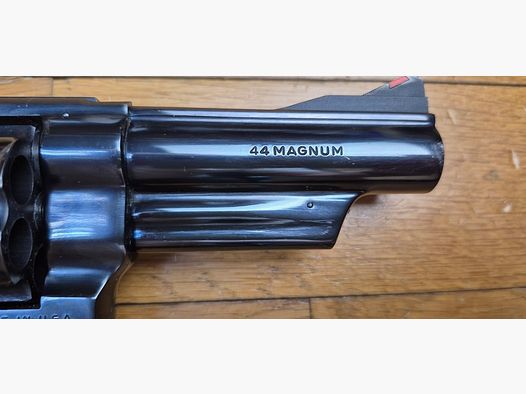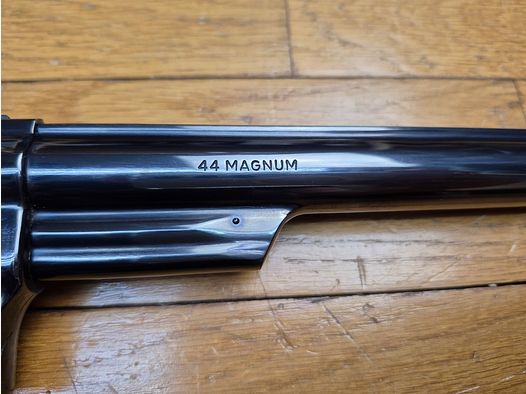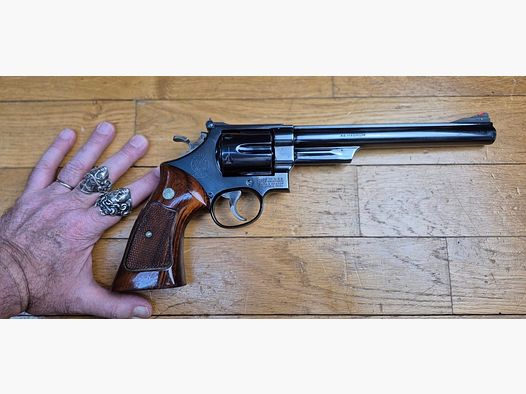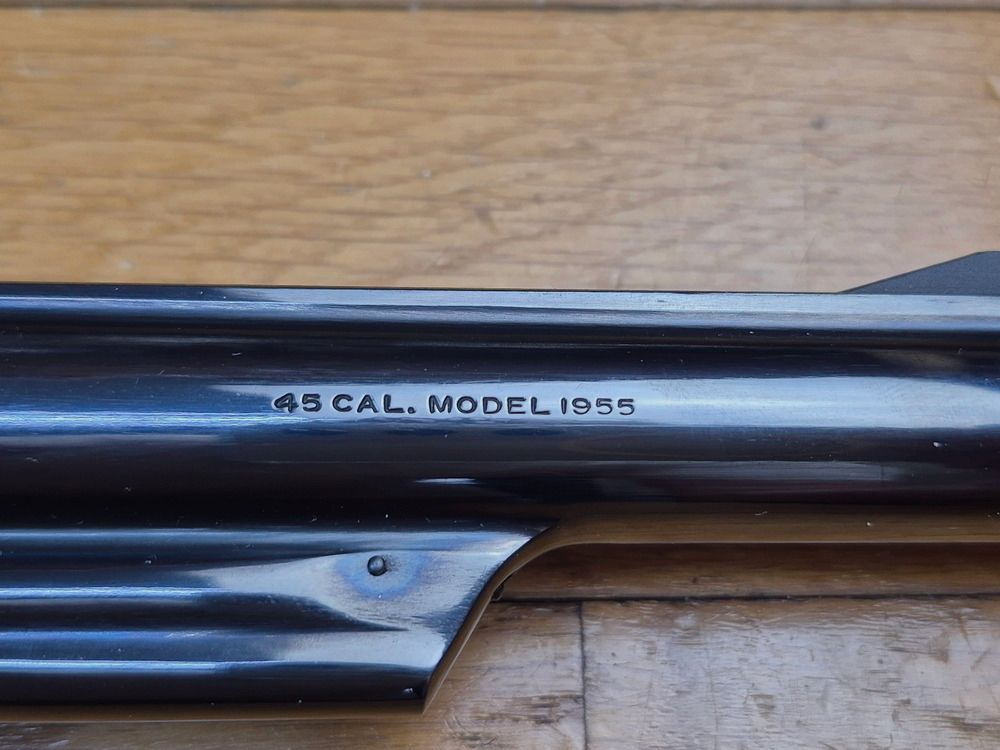

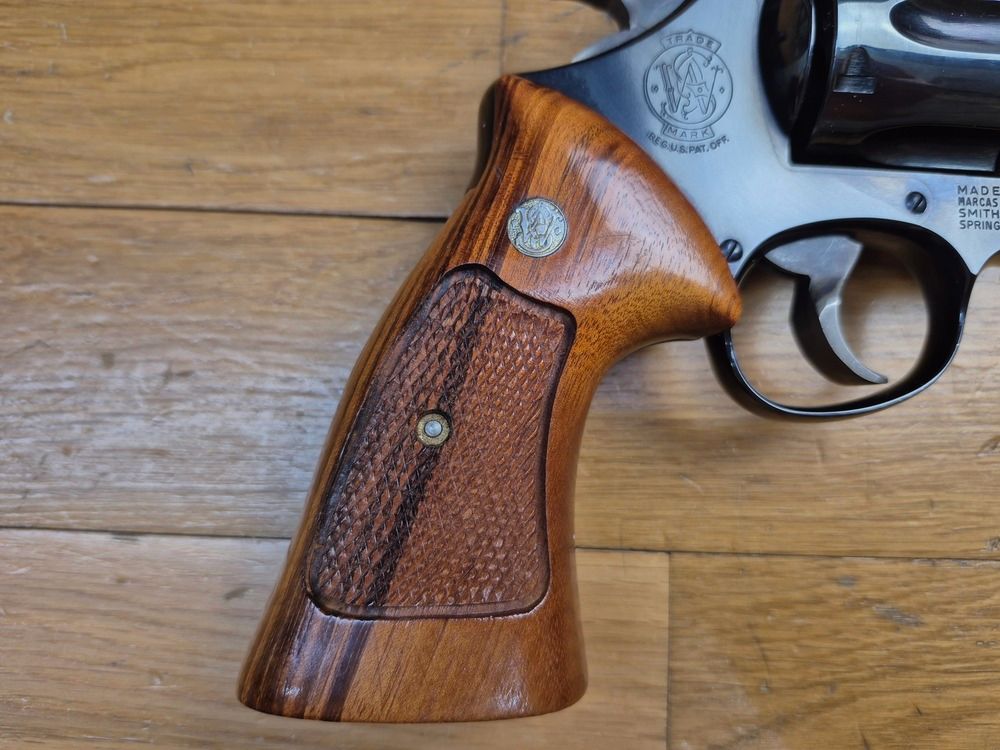
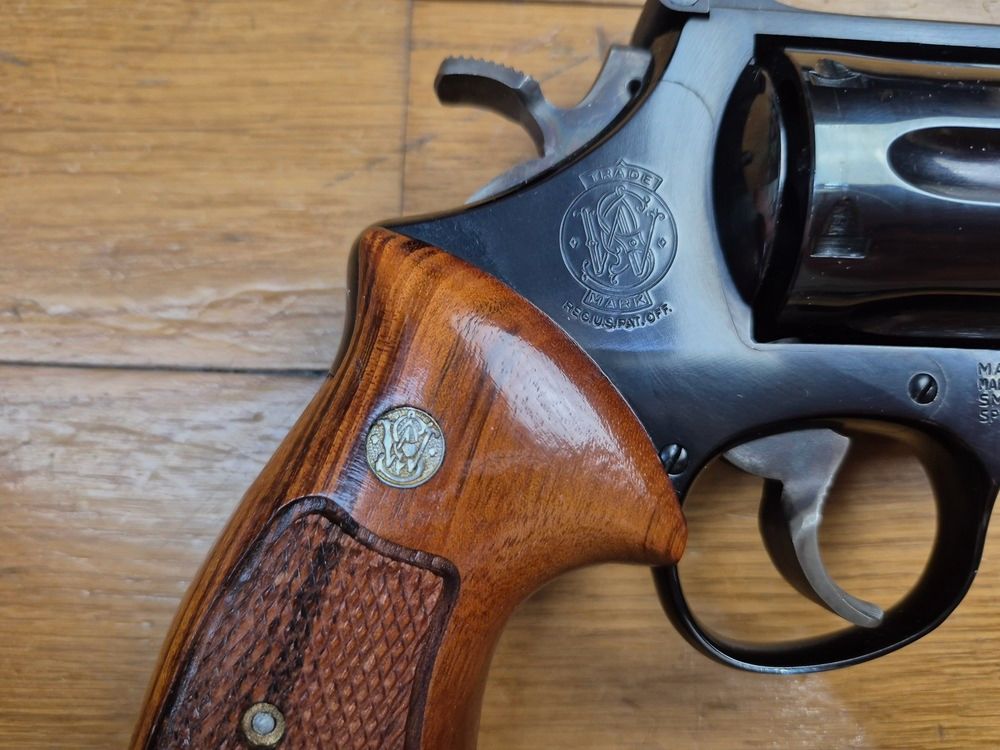
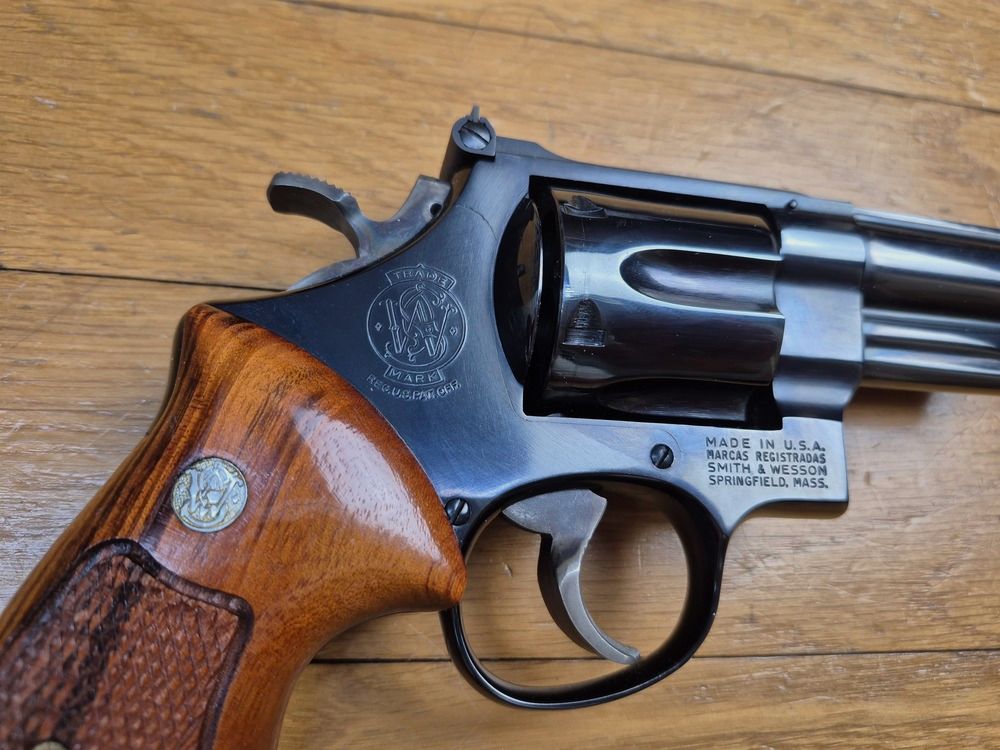


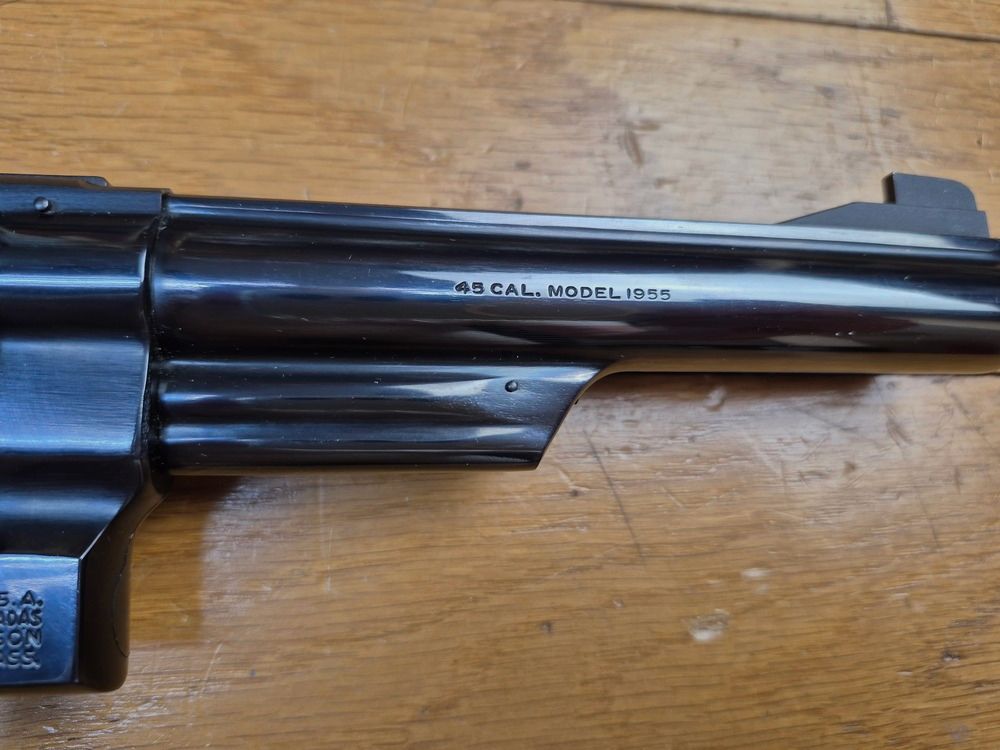









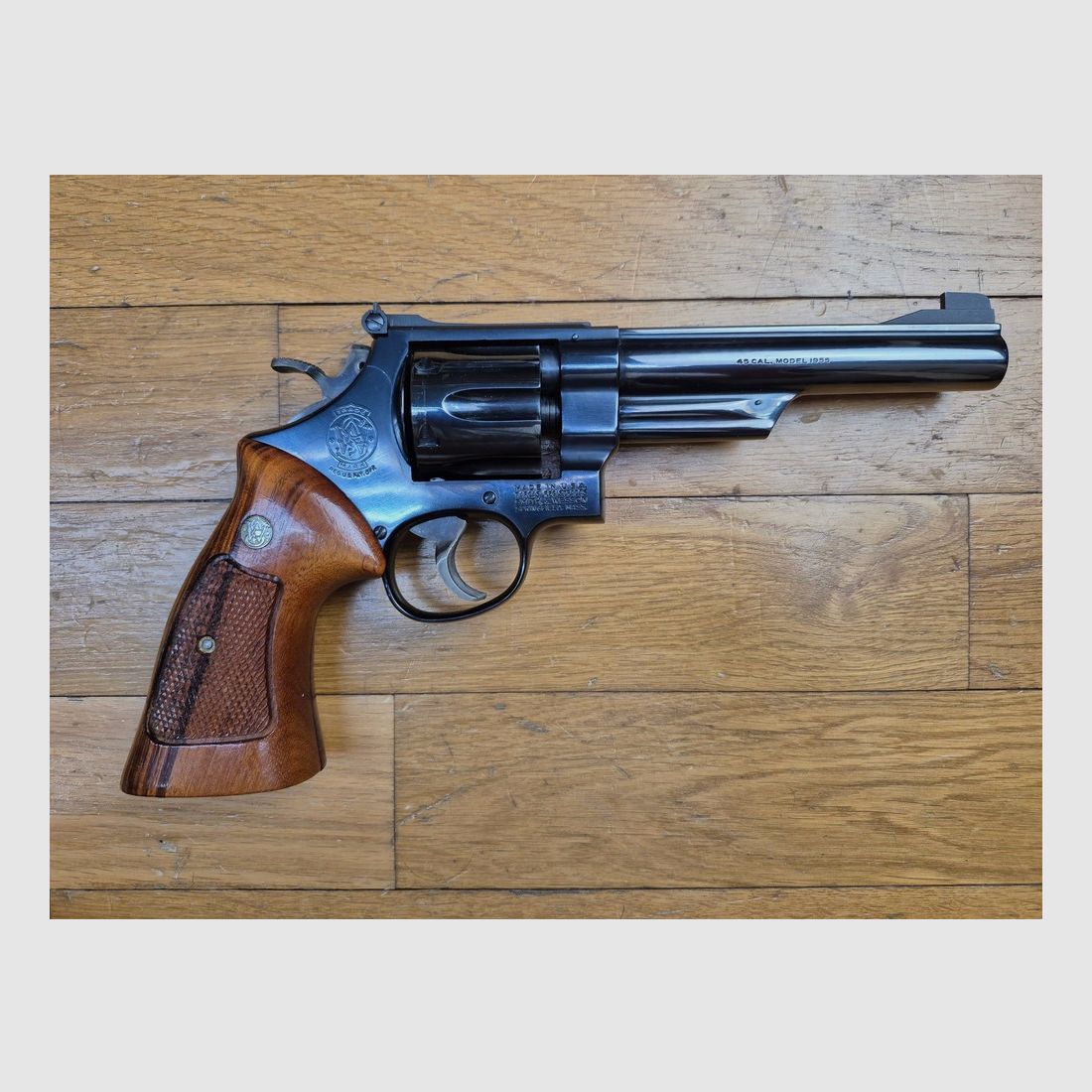

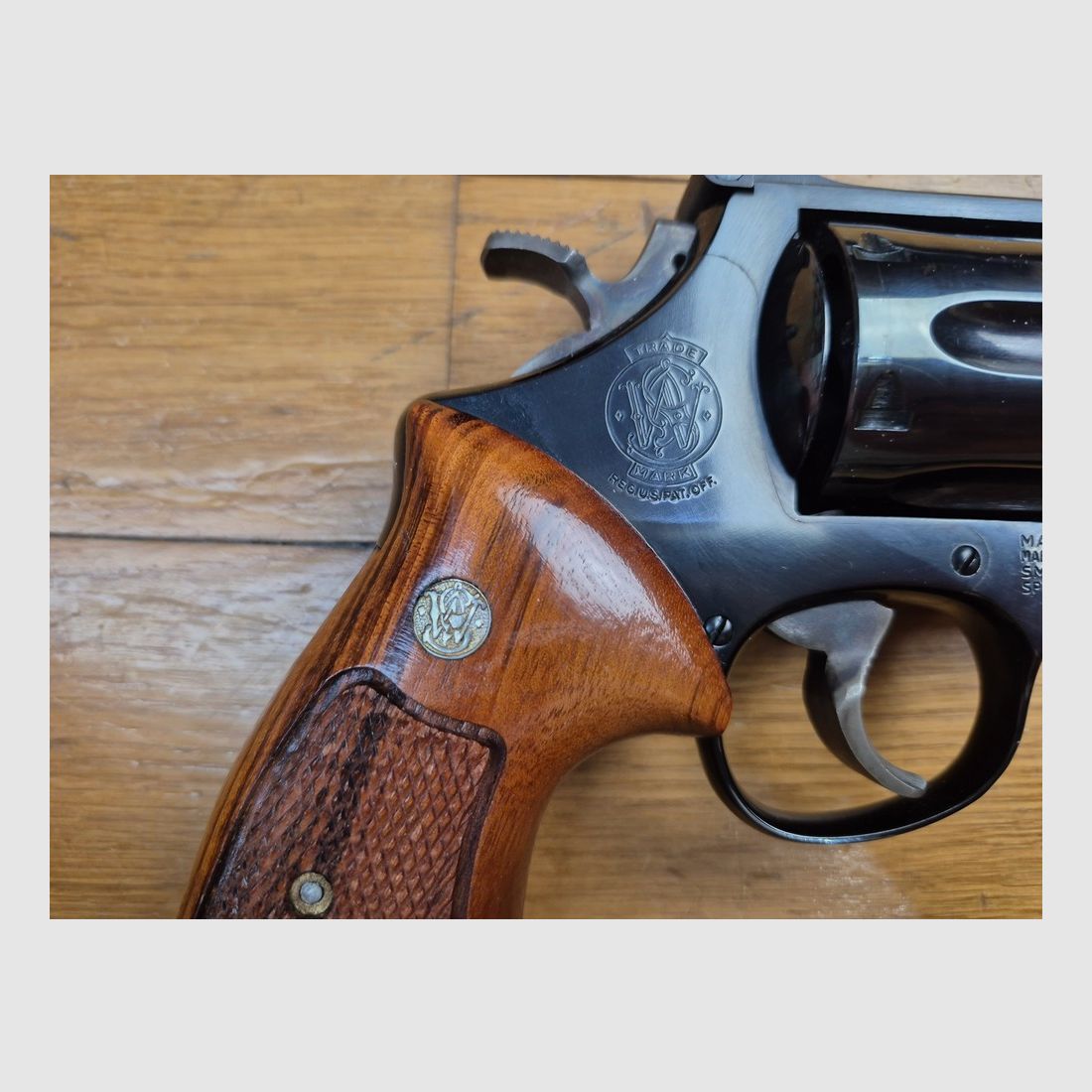

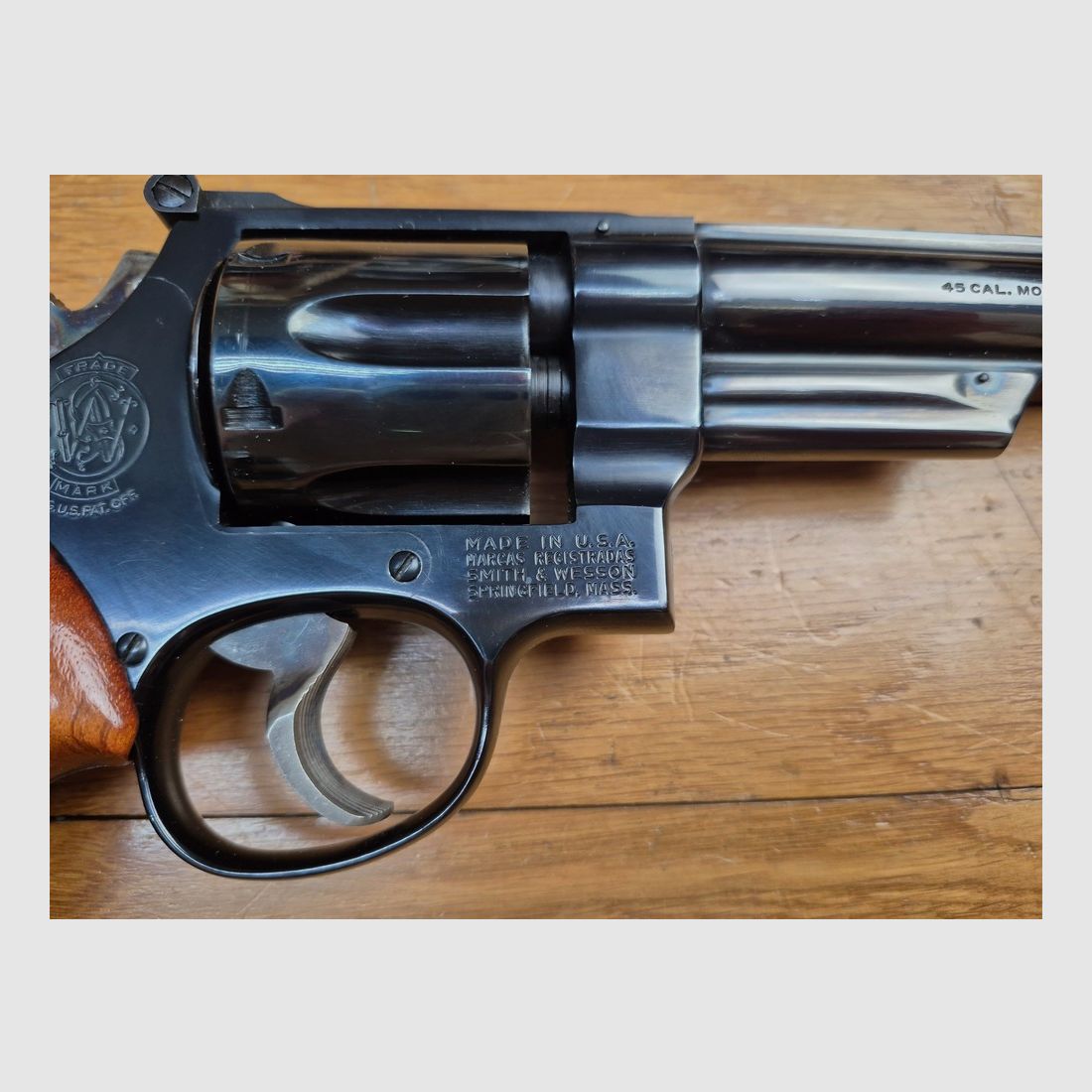

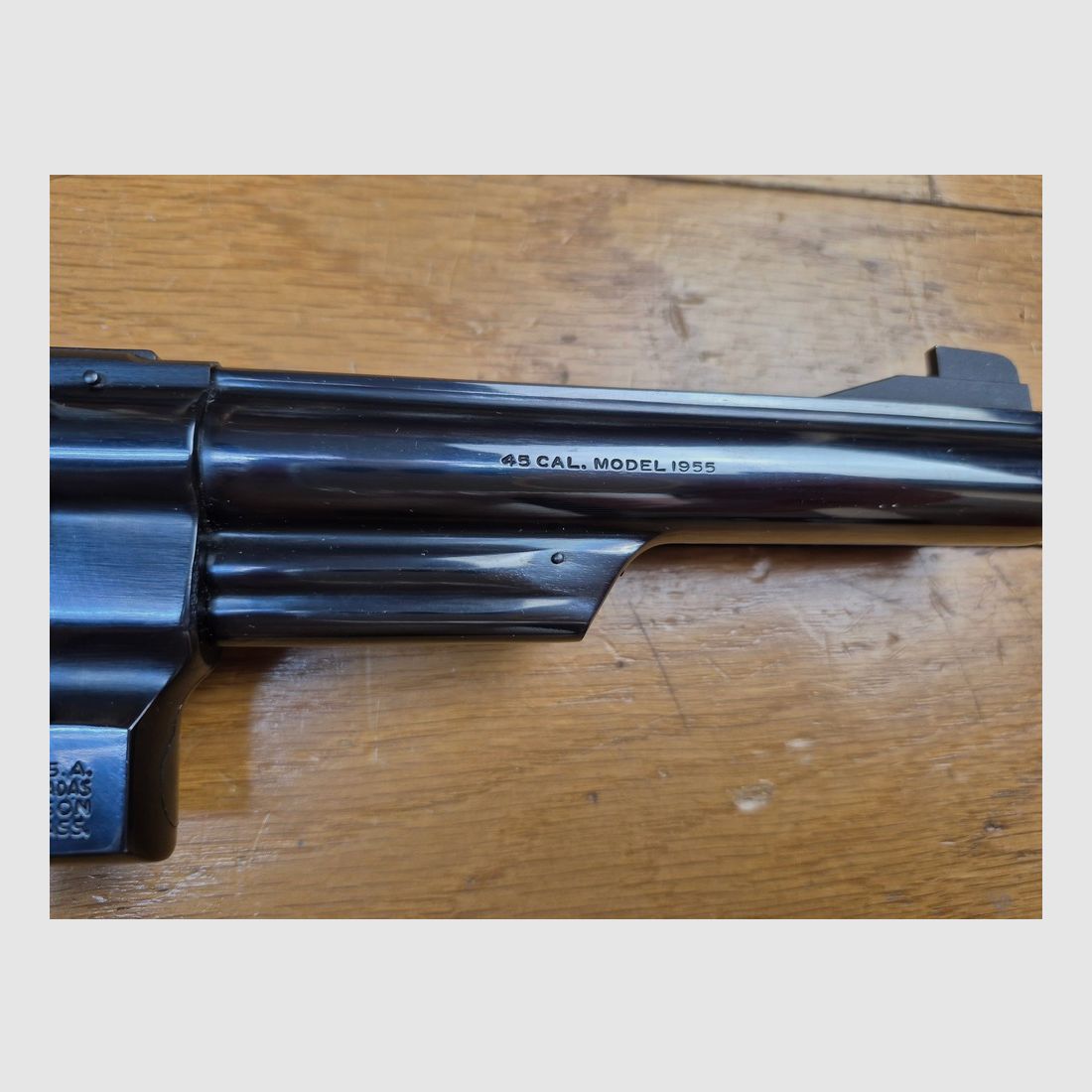







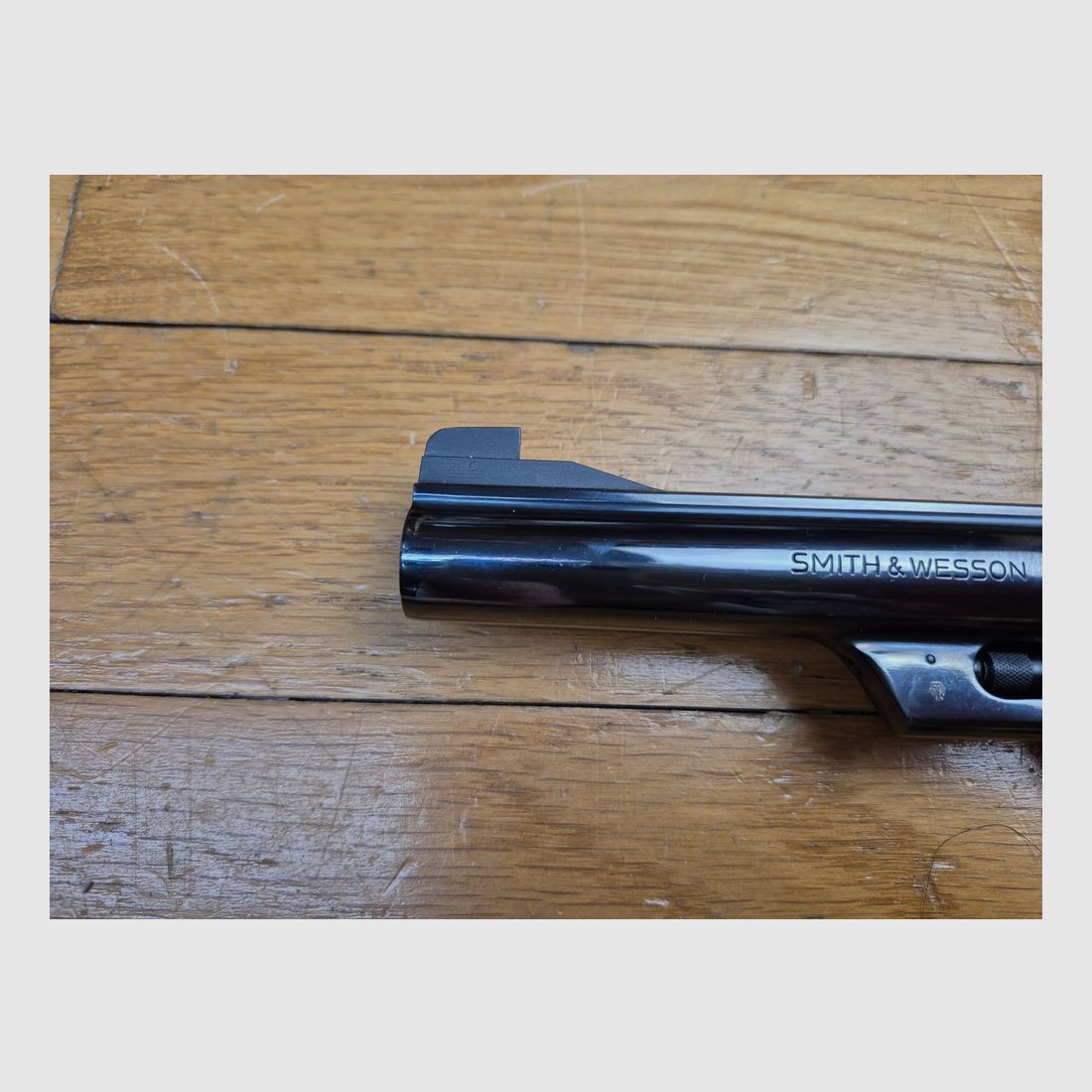
Exceptional Smith & Wesson Mod 25-2 revolver – LE Smith in cal. 45ACP! – Gun from the early 1980s – Quality and mechanics that are no longer found today – Also a CIA revolver! – 6-inch barrel – Superb glossy black finish – Exceptional gun for exceptional shooters – TBE++
≈ $2,418
Price at the dealer: 2,200 €. Converted at the ECB rate as of November 20, 2026.
Purchase permit required
75002 Paris, France
7
ID: 10338676
This item is currently unavailable.
Purchase from outside the EU: The firearm goes through an importer in your country, the dealer handles the export.
How buying from Europe works
Shop safely with Gunfinder
Our AI-powered seller identity verification makes Gunfinder the safest marketplace online.
Learn more
Details
- Original language
- French
- Brand
- Smith & Wesson
- Category
- Purchase eligibility
- Required
- Caliber
- .45Auto
- Condition
- New
- Location
- 🇫🇷 75002 Paris, France
- Availability
- Out of stock
Freshness
This listing is based on a mirrored offer, where the listing data was synced to us from a shop, dealer, or external marketplace. Please note that temporary price discrepancies may occur due to possible delays in data transmission.
- Source
- Flingus Maximus
- Last checked with the dealer
- 20 minutes ago
Description
Note:
The item is located abroad. Please note that delivery conditions, shipping times, and/or the purchase process may differ.
A 25-2. A “wheelgun” on an N-frame from Smith’s golden age, but in .45 ACP, with a dream of a heavy-barrel Target finish. A real oddball.
But how do you talk about it?
You could say it’s a splendid, legendary .45 ACP revolver (already an oxymoron—I love it!), the fifth member of the N-frame family and by far the rarest in our part of the world; the handsomest brother of the iconic 27 and 29; the only true descendant of the Smith & Wesson Model 1917, itself chambered in .45 ACP and used in the 1914–18 war, amid the mud of the trenches…
This 25-2 has everything to charm sentimental Master Flingus! So much so that he doesn’t even know where to begin…
So, who exactly are these N-frame brothers?
I’ll draw a discreet veil over the N-frames behind the 625 and the other 610, 624, 627 and 629 models… which are simply modern reissues of their august predecessors. And especially over the dreadful failure—one of Smith’s few—of the 57 and 58 models in .41 Magnum, despite their beauty, also built on the N-frame. But in that case, the cartridge was mostly to blame. The guns are splendid.
The true N-frame Brothers of the Coast are five rogues who played a major part in Smith’s legend.
The Smith & Wesson Hand Ejector Model of 1905, adapted to the N-frame in 1908—the original, in .44 S&W Special; the Smith & Wesson Model 1917, already in .45 ACP, a veteran of both world wars; the 27 (and its twin, the 28) in .357, the official companion of the ideal police officer, even on screen; the 25-2 in .45 ACP, our handsome baby of the day, the so-called UFO; and finally, the last in the series, the 29 in .44 Mag—the one wielded by “Clint.” The Dirty Harry legend.
What a lineup!
First appearing with the Hand Ejector / New Century 1908 (an N-frame adaptation of the 1905 model), also known as the Triple Lock, guns built on the N-frame were—and remain—among the strongest revolvers in the world.
Designed from the outset for the powerful .45 Long Colt and the then-new .44 Special, they were already the most powerful guns of their time. This Hand Ejector, the Triple Lock, is our first Brother of the Coast.
This complex locking system, with a third locking point on the cylinder via a plunger, was the result of a rivalry more than a century old between Colt of Hartford and Smith of Springfield.
Like the space race, where each side had to outdo its rival, the goal was to develop the most accurate gun, with the smoothest action and the strongest lockup.
Smith’s Triple Locks had a third locking point on the cylinder yoke, turning them into veritable bank vaults.
Colt poked fun at them, boasting that its cylinders “turned the right way.”
Smith replied with guns that, a hundred years later, haven’t budged—and won’t, like the best-made Smith 27s and 29s that Master Flingus finds for you. Or like today’s exceptional Model 25-2.
Sadly for Smith, customers, both military and civilian, weren’t keen on the Triple Lock’s excessive complexity and cost.
But the N-frame wasn’t done for.
At the request of the British Army, this largest of the Smith & Wesson revolvers evolved, adopting the two-point lockup of the smaller models. The result was the Hand Ejector 2nd Model, chambered in .455 Webley.
This variant, adapted to the American .45 ACP, became the “Smith & Wesson Model 1917”—the first Smith & Wesson revolver to be adopted en masse by the U.S. Army in 1917, alongside the celebrated 1911 pistol, which was also seeing its first action that year.
On April 6, 1917, the United States of America entered the First World War. Five months later
Later, the first Smith&Wesson 1917s in 45ACP arrived in Army units—the largest order the US government had ever placed with the Massachusetts firm.
The order was intended to free up as many of the recently introduced Colt 1911s as possible for front-line Sammies, while giving everyone a common caliber: 45 ACP.
But, you might ask me, Master Flingus, how do you make a rimless 45 ACP cartridge, designed for a semi-automatic pistol, work in a revolver designed for a rimmed cartridge? Won’t it just slide right through the whole thing?
Questions that are just as relevant, incidentally, to today’s 25-2!
Joseph Wesson (Dan’s son) came up with the solution. It was twofold.
First, he machined a ledge inside the cylinder chambers to stop the cartridges from sliding all the way through. Then he came up with a brilliant invention: the “half-moon” clip, which made it possible to load and extract the cartridges together, or “moon clips.”
This made the gun much easier to handle in combat.
You no longer had to rummage through your trench coat pockets or your belt for those six little things that could go bang, risking dropping them in the mud while loading, before drawing down at point-blank range on a few rowdy Germans wandering around your sector…
Two movements were all it took to fully load your cylinder. And with a little practice, you were as fast as with an “automatic”! There’s a reason moon clips are still used in IPSC with the 625!
And you still had all the advantages of the good old revolver, especially in the early days of semi-automatic pistol technology:
No time wasted loading a magazine with a stubborn spring, no improperly seated magazine, no jams, no accidental discharges from a 1911 in your belt (like the rather comical incident—if it hadn’t involved a foot injury—that happened to future General Patton in 1915 in a bar in Sierra Bianca, Mexico; or, even more hilariously, the one involving Pierrot le Fou. But that was more down to carrying a 1911 “Balkan-style” near his crotch, which ended with a 45ACP round in his balls and cost him his life in 1946…).
A true “man’s” frame, then, the N-frame would later show its full strength and recoil-absorbing potential in 357 and 44Mag. Perfectly suited to Magnum cartridges, it’s also the only one reputed to be indestructible.
After starting its career (from 1908 to before 1935) chambered in 45 Long Colt and 44 Special, it would reappear in 357 Magnum from 1935, thanks to Elmer Keith and Prohibition. Finally, it was adapted to 44 Magnum in 1955, again by Elmer Keith—a caliber that would make it, and Clint Eastwood along with it, internationally famous.
I told you about the 357 Mag and what would become the Model 27 here—and about the 44 Magnum and what would become the Model 29 here.
That’s already quite a track record for these “big” revolvers. But what about 45 ACP?
Despite its worldwide success in these various calibers, Smith&Wesson couldn’t give up on the legendary 45 ACP revolver and let its story end with the Model 1917, which had been a great success with the military, who had taken very well to the precious moon clips.
So, in March 1950, Smith reintroduced a 45 ACP revolver, but with a light, fluted barrel, an unfluted cylinder, and only in a 6-inch version. They were marked “CAl 45 Model 1950” and were barely produced until 1957, when production ended.
It’s a modernized Smith 17 that wasn’t specifically designed for accuracy in 45 ACP, since it doesn’t have a heavy barrel. Incidentally, it’s now an extreme rarity, selling for USD 10,000 and up in the US. Let’s consider it the prototype of the n
Our 25-2 of the day.
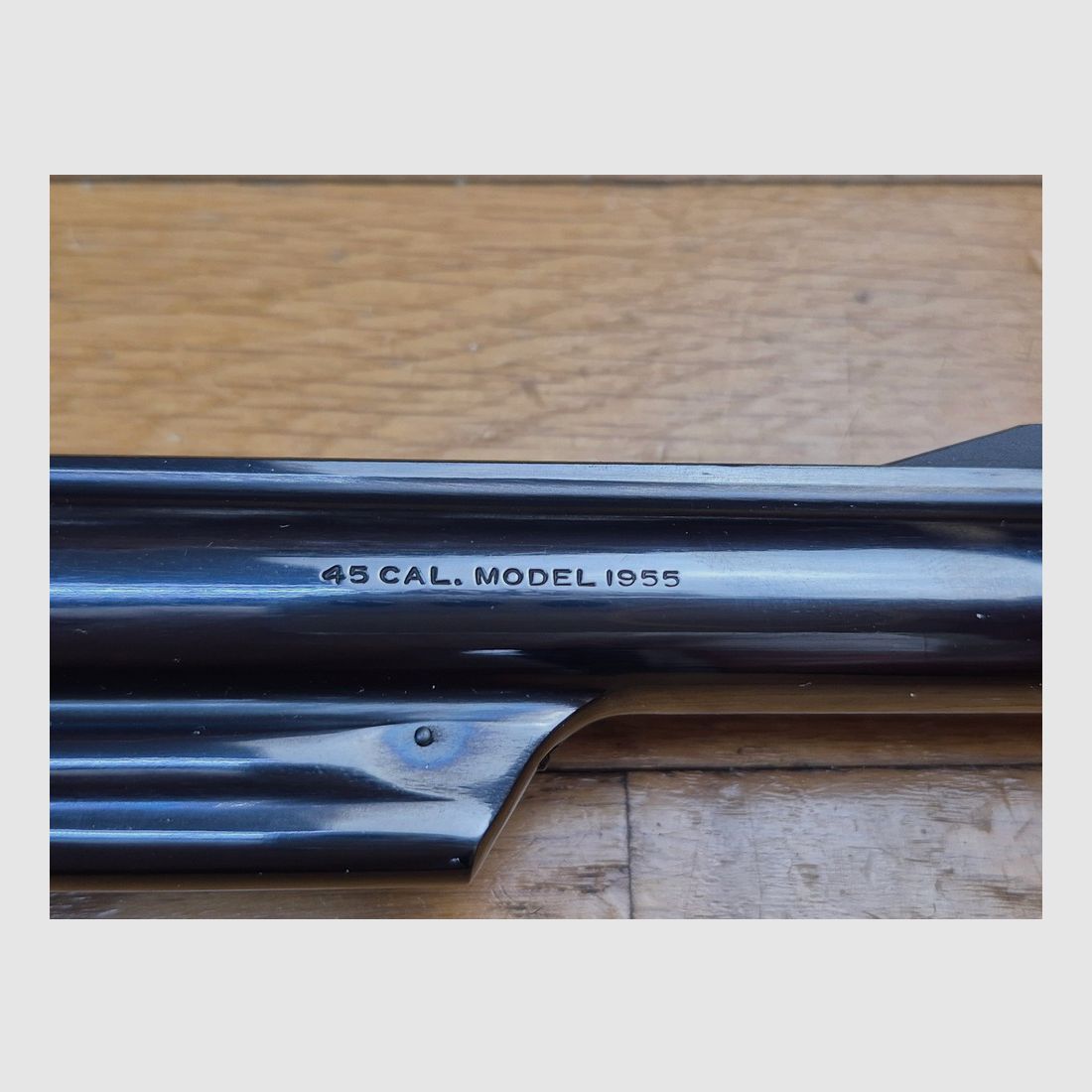
It was in 1955 that Smith & Wesson introduced its Model 25, ours, an iconic revolver designed for precision shooting and built for performance.
Before the 1957 catalog redesign, its full catalog name was “1955 Model .45 Target Heavy Barrel” (or “.45 Heavy Barrel Target Model”), to make clear exactly what we’re talking about and avoid confusion with the Model 1950.
Although inspired by the Smith Model 1917 from World War I, it represented a major design evolution: the Model 25 incorporated all the features that made it well suited to precision shooting, while drawing the very best in accuracy and power from the .45 ACP. We’ll take a look.
A favorite among .45 ACP fans for its features and extraordinary looks, it has become a highly sought-after classic among American sport shooters and collectors. In the years when Smith was making its best guns, a Model 25 in perfect condition became a competition beast that’s very hard to find.
This rare Model 25 belongs to the 25-2 series, produced from 1961 to 1991.
It is chambered in .45 ACP—though from 1977 onward it was also made in .45 Colt, the original caliber for the N-frame.
Based on its serial number—which is always very difficult to date with Smith—our example is almost certainly from early 1980, perhaps late 1979. But definitely not earlier, because it has a 6-inch barrel. Before 1979, the 25-2 was only available with a 6.5-inch barrel, which was discontinued that year to make way for the 6-inch version. So this is one of the first 6-inch 25-2s.
N-frame, of course. Indestructible, including—and especially—in .45 ACP.
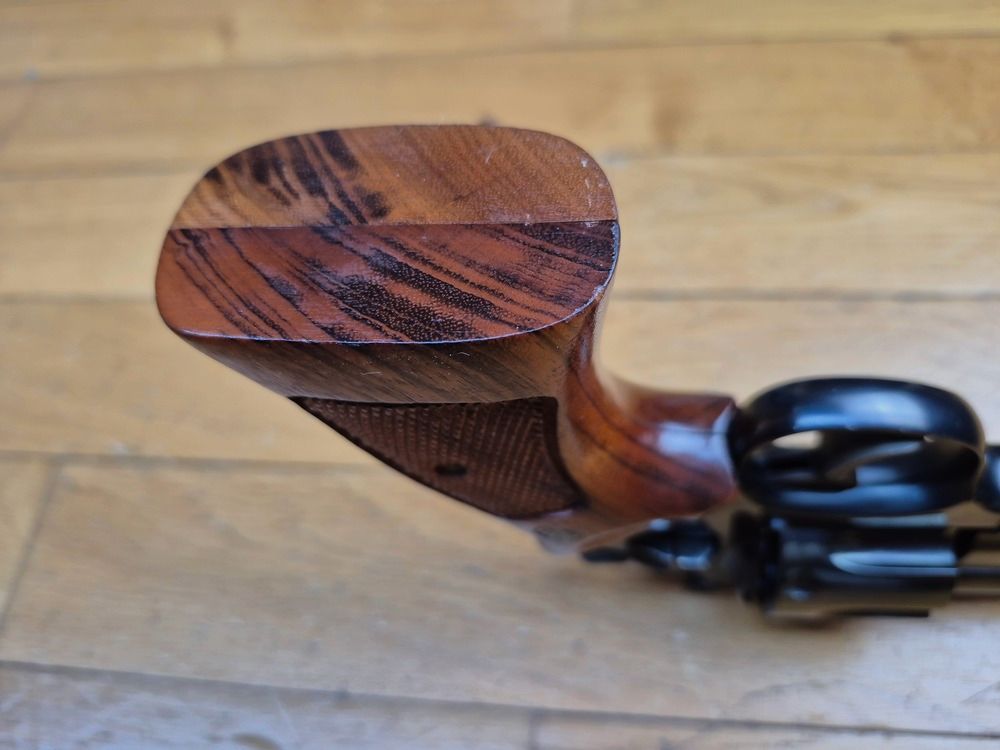
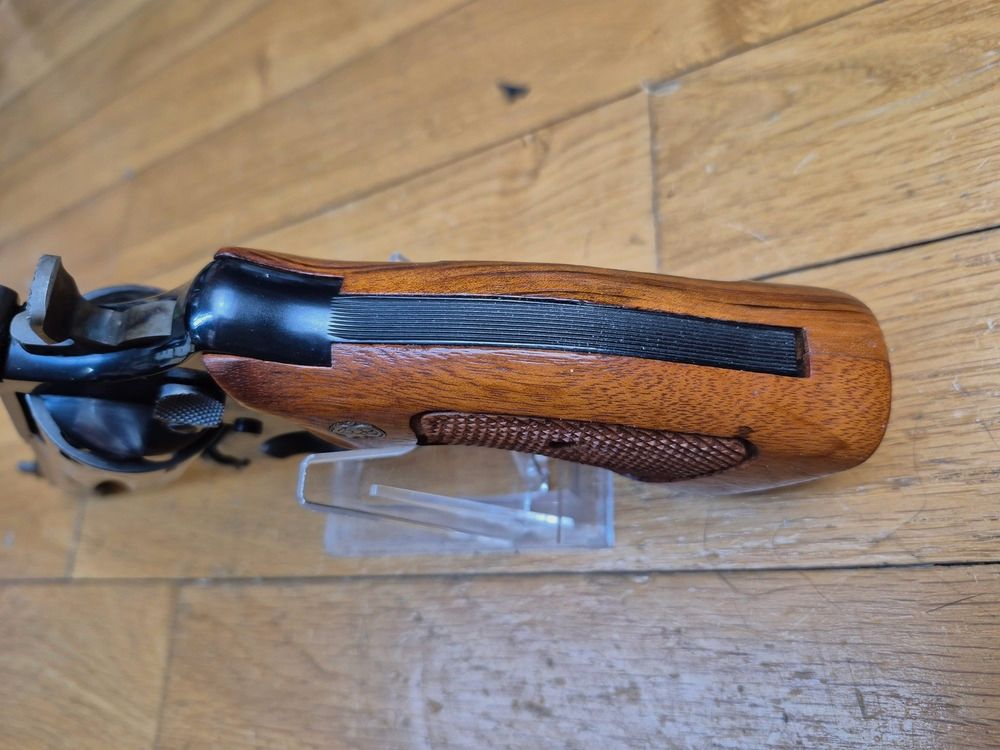
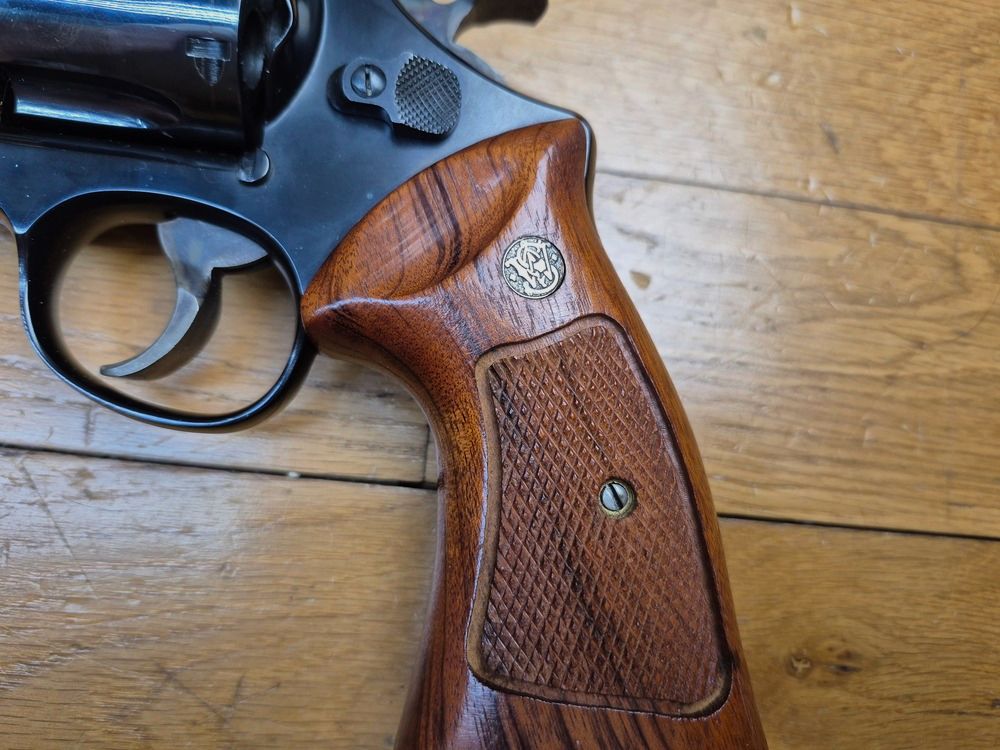
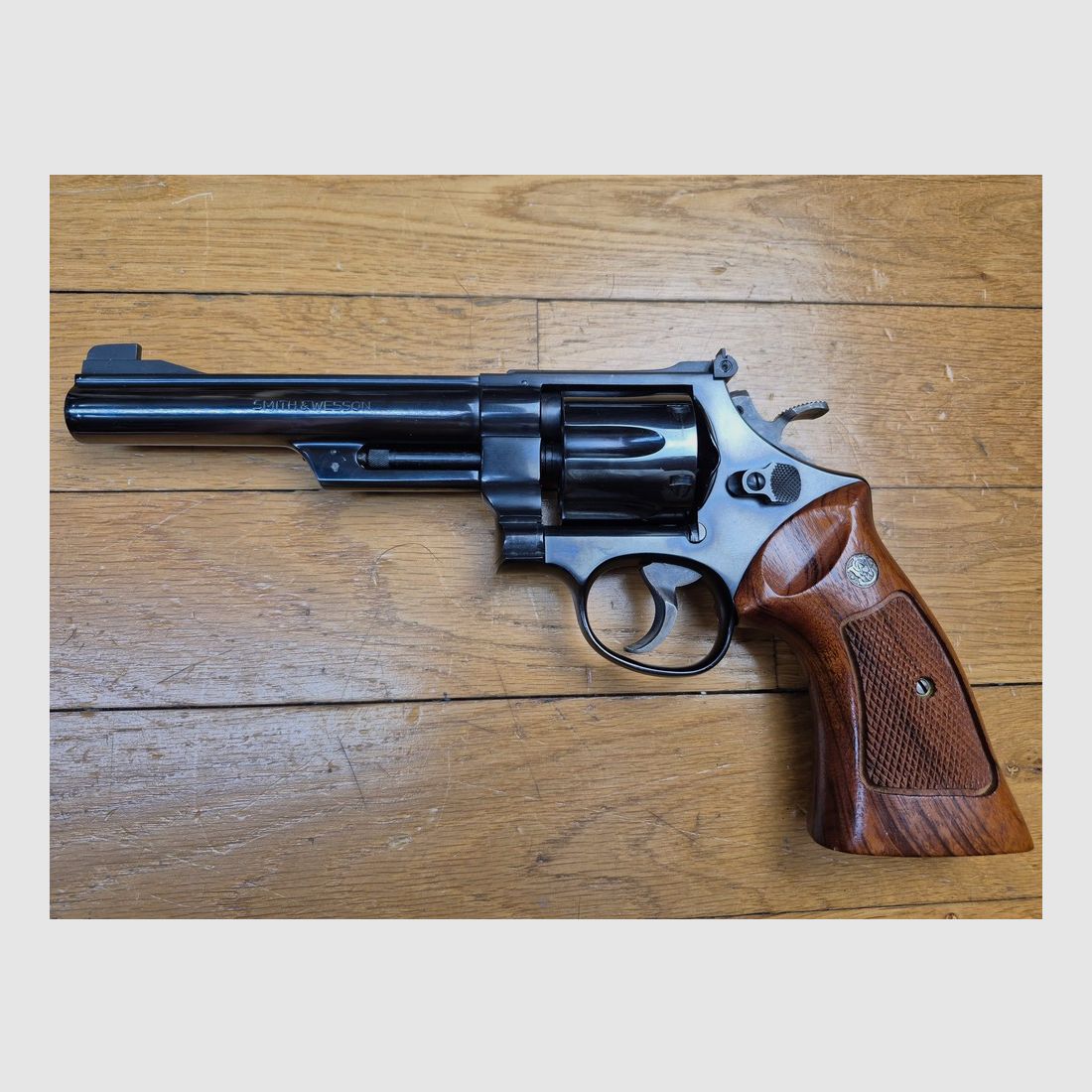
This frame has a “square butt” grip, finely checkered along the backstrap. Over there, this “square butt” grip is also known as the “Army” style, because it was popularized by its direct military ancestor, the 1917—its granddad in .45 ACP. A fine tribute from Smith.
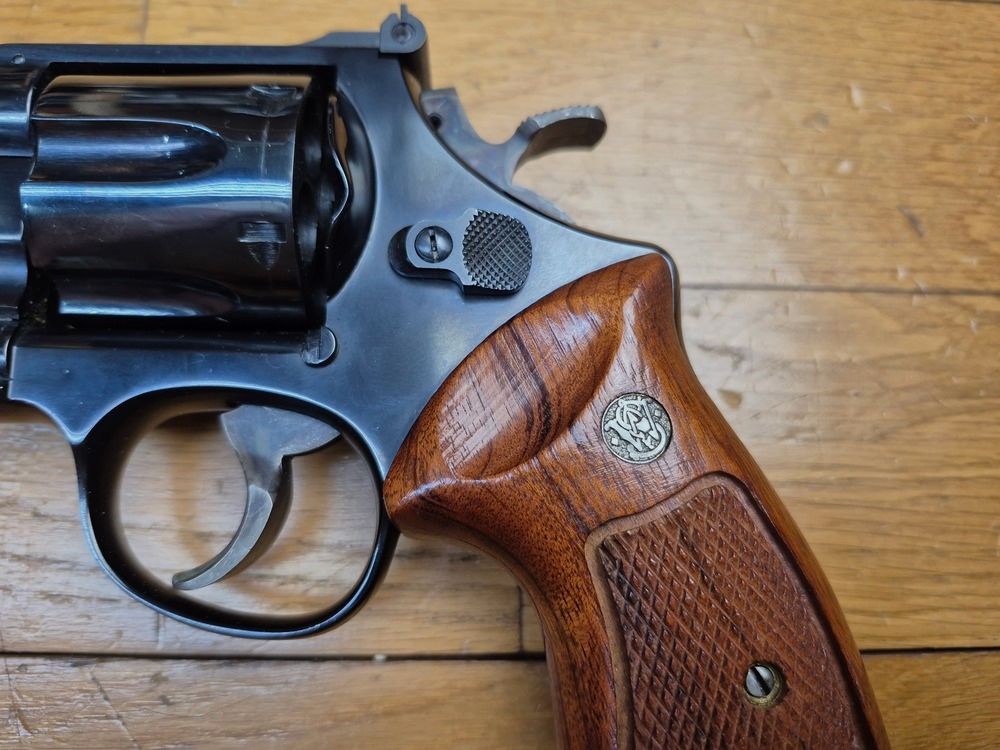
The grip is fitted with original factory Magna-style panels in beautiful varnished American red walnut, with checkering. Excellent grip, even with wet hands.
They’re fairly thick, which suits the gun’s lines and generous size perfectly. They’ll be an even better fit for medium or large hands.
They’re far better quality than the rubber grips that come with today’s “627” models. Proof: they haven’t changed in forty years. Like new!
Of course, you can fit any grips made for the N-frame. Whether you choose slim panels or wraparound grips, the gun will remain perfectly controllable.
Our splendid 25-2 was built for competition from the start, as that’s what it was sold for. This one is also in exceptional condition, very close to absolutely mint. A truly exceptional piece.
It’s still one of the remarkable guns made in those years, before 1982. Why?
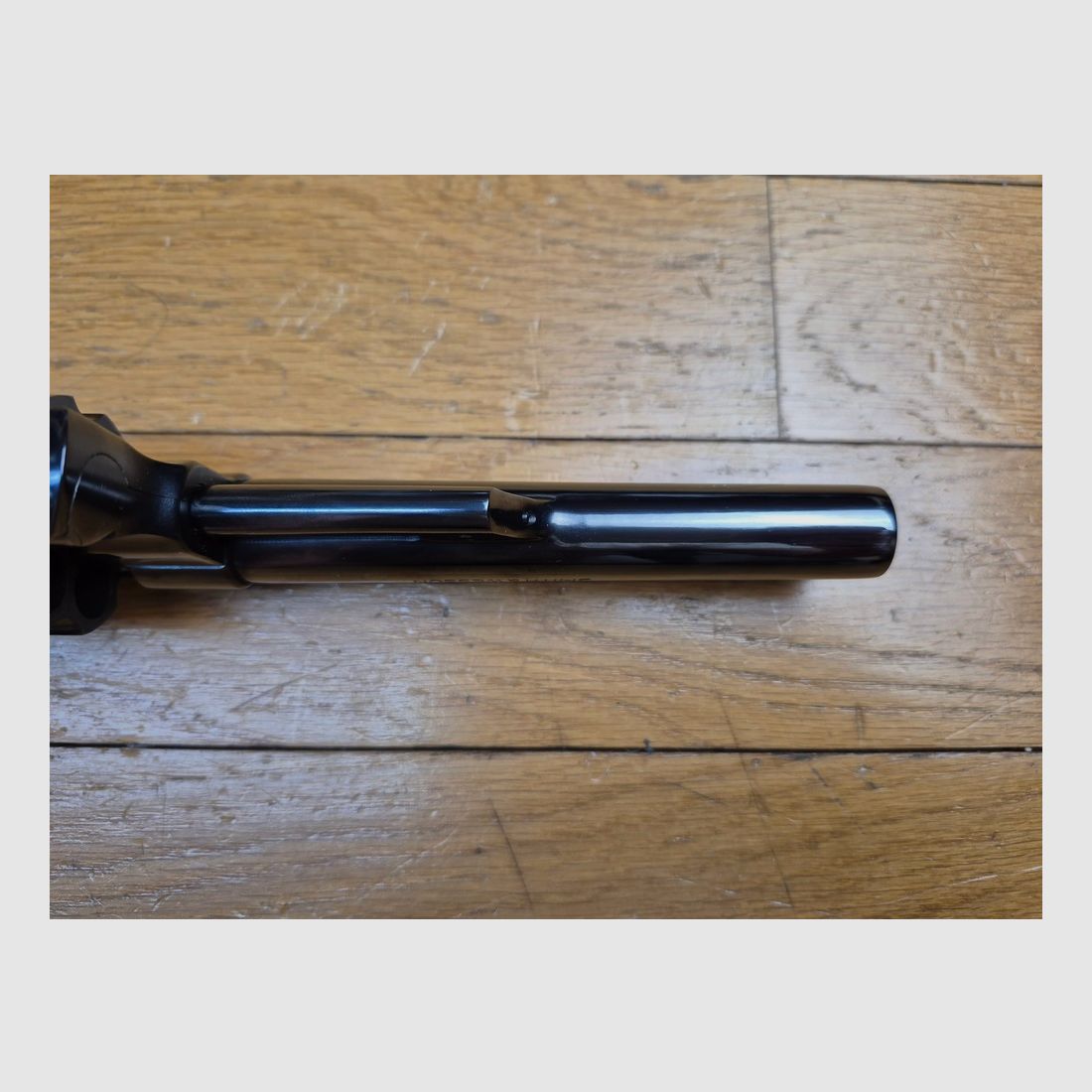
First, its barrel is still “pinned.”
“Pinned” means there’s a pin visible from the outside, set into the barrel near the top, where it meets the frame. It locks the barrel in place in the frame. This famous pin required more complex machining of the barrel and extra steps during assembly.
The pin and the assembly method that went with it made the barrel more rigid and also helped the gun last longer. Even intensive use couldn’t create the excessive cylinder gap found on lower-quality guns.
After 1982, Smith did away with all that to cut costs, and because “nobody wanted a real revolver that would last long enough to pass down to their son or grandson.” They could make them “cheaper”…
In my opinion, the downward slide had begun, even if it would be steeper still at Colt and elsewhere. One thing’s for sure: they made them cheaper without doing so...
ute, better finished, will have to wait for the next millennium…
Mechanically, this 25-2 is a dream. My patriotism may suffer for it, but its action is even smoother and crisper than that of a Manurhin from Mulhouse, despite the latter’s remarkable Maillard mechanism.
Yet the Smith lacks this Gallic invention, and our example is barely broken in!
The secret behind such an action? An “ayatollah-level” fit, combined with painstaking polishing of the contact surfaces between every part.
Here we see the work of Smith’s specialist fitters and polishers from the golden age, all with more than 15 years at the company. David Murray, Smith’s head of production, wouldn’t use anyone else for certain operations. They did it all “by eye” (and fast—but, alas for them, not as fast as a laser cutter, which still leaves rough edges everywhere!).
With guns like this, I give a few select customers what I call the “Smith experience”: comparing several generations of Smiths mechanically, blind, and at several points (hammer, cylinder, cocking). Once you’ve got a feel for the differences, you can recognize a “Golden Age” example like this 25-2 immediately, without even looking at it. Just by handling it. Marvelous!
Mechanically, this gun is a masterpiece. As you cock it, you can feel the beast’s innards move each of its parts mechanically, without deviating by a tenth, before it spits its venom.
The cylinder release is more than smooth, with no jerking. Try the wrist-flick test once and you’ll see for yourself.
Its rotation is a dream, too. That makes for fast, flawless reloading, ideal for speed shooting (a reminder: it takes Jerry Miculek just 3 seconds to empty two cylinders from his Smith&Wesson!).
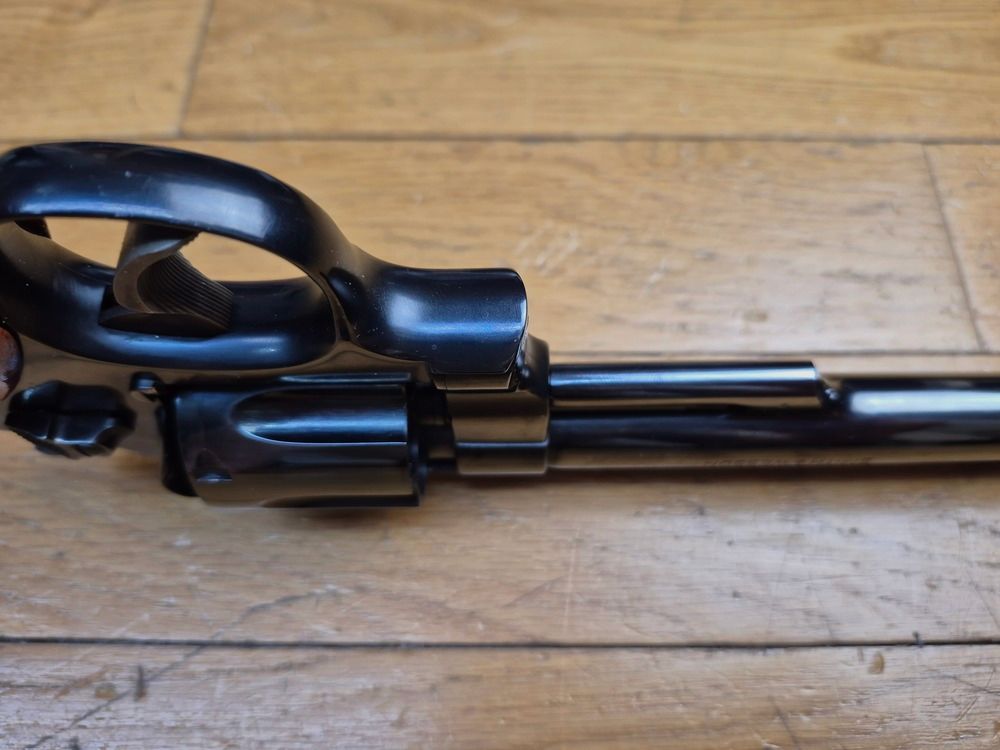
The quality of these cylinders and how they’re fitted is also the first mechanical clue to the quality of manufacture in those years. The shroud underneath makes it impossible to bend or warp the cylinder axis.
A military-inspired obsession with sound reasoning, inherited from the Triple Lock and never abandoned by Smith, the shroud here is more streamlined than that of the more modest Smith 19. Before 1982, Smith didn’t skimp on machining costs…
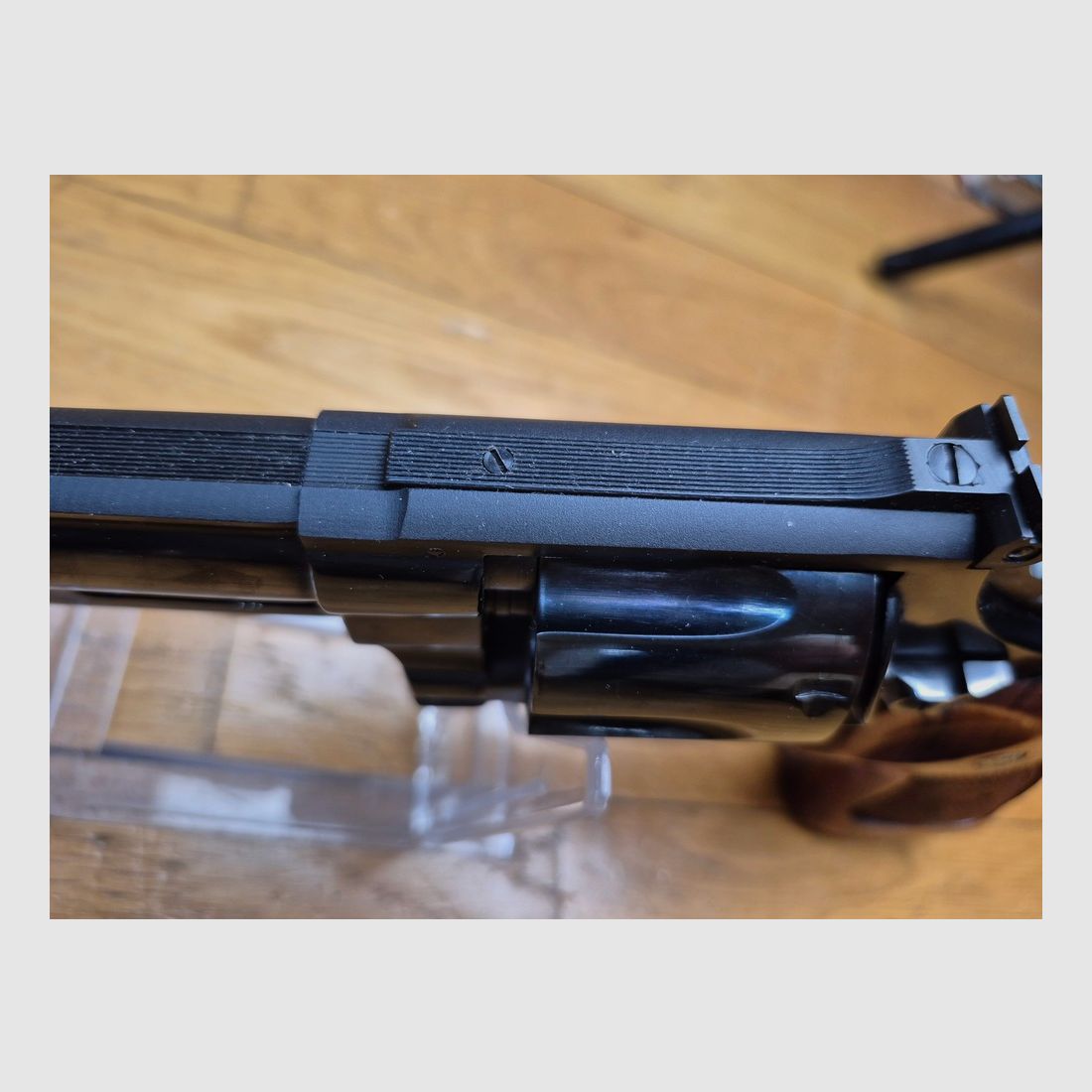
The cylinder has absolutely stunning chambers. You could gaze right into them!
Inside, they have the machined rim that keeps rimless .45 ACP cartridges from slipping all the way through. Quite a machining feat, too. Half-moon clips serve the same purpose, so the cartridges are ultimately “held” along their entire length.
This makes recessed chambers unnecessary on the .45-caliber Model 25-2, whereas—despite the complex machining involved, and in keeping with Smith’s standards—recessed chambers were still standard on Golden Age Smiths in other calibers, such as .357 or .44.
For loading and rapid fire, .45 ACP half-moon clips are easy to find on well-known websites (some clever folks now make them with 3D printing and sell them in packs of 50 or 100 for next to nothing). You can also find metal ones, which last longer and are better for the environment, from plenty of fellow dealers. It’s the gun that’s hard to find!
No infernal hex-key lock on the cylinder like on recent examples, but it already has the “transfer bar” that works with the rebounding hammer to make an accidental discharge impossible.
The alignment and lockup are remarkable. The double-action trigger is a real joy, unlike anything you’ll find on a modern gun.
Incidentally, there’s almost no trace of the cylinder stop rubbing against the cylinder’s outer surface. Just a very faint mark. So this cylinder hasn’t turned much—another sign that the gun has seen little handling and even less shooting.
Another sign of how little it’s been used…
Here, the frame shows virtually no signs of firing (I say virtually to be on the safe side!). Overall condition and mechanical condition are simply splendid.
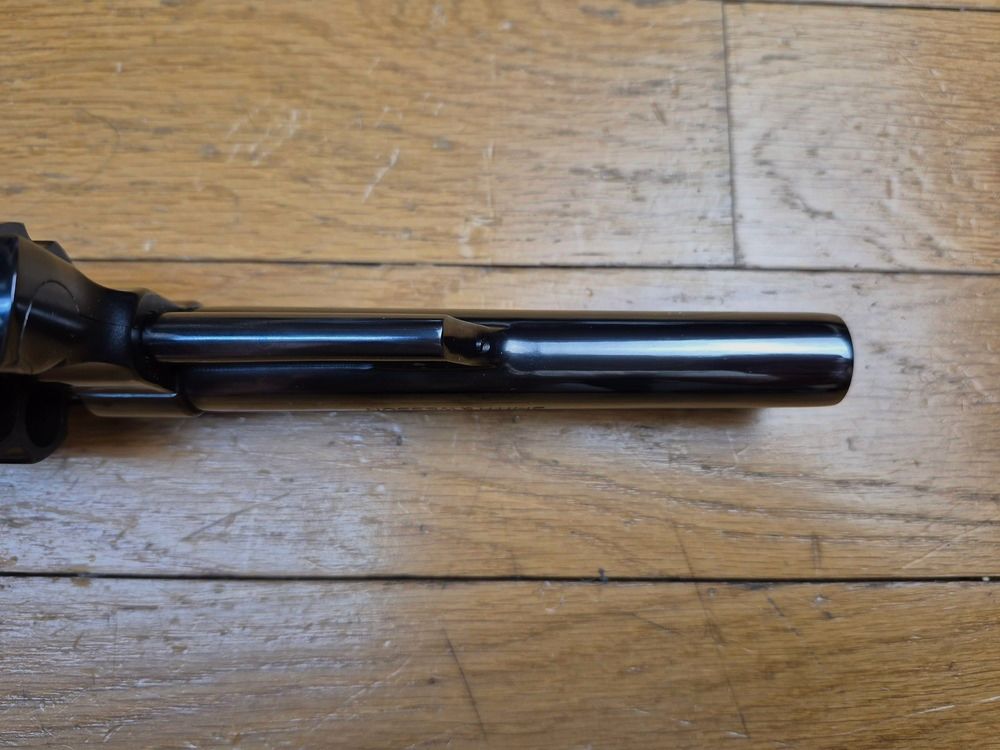
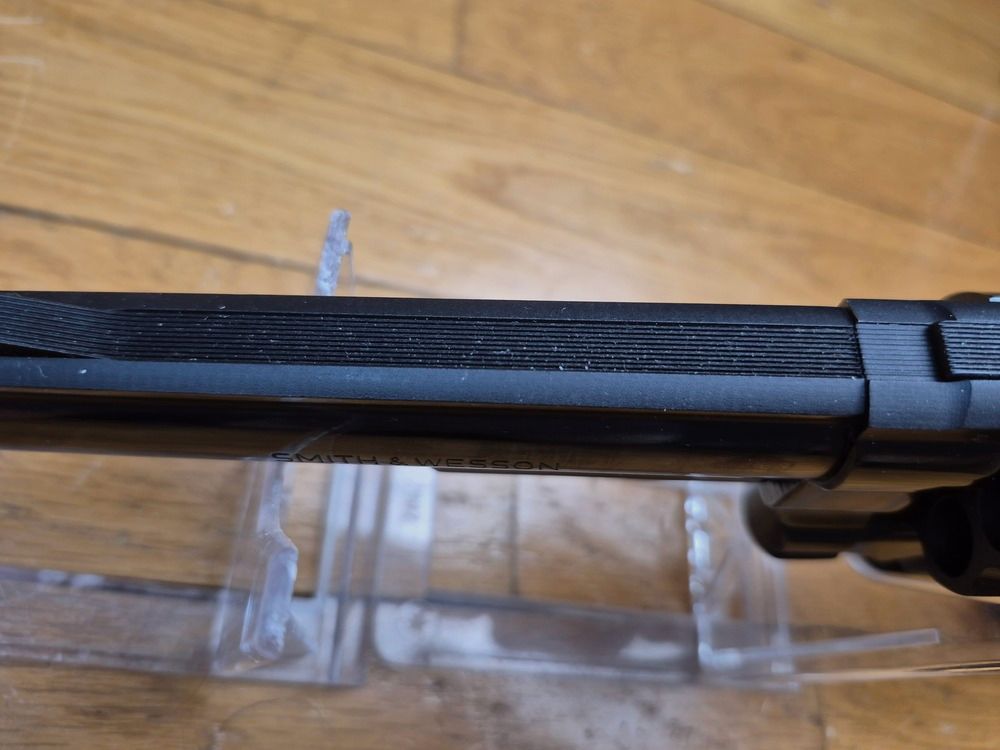
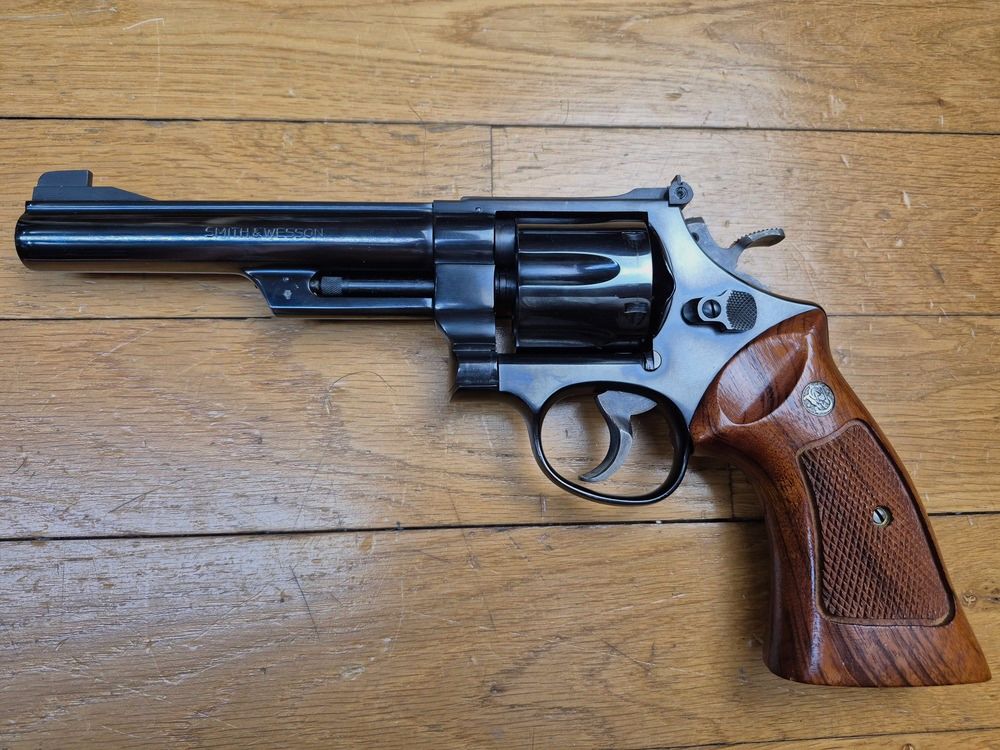
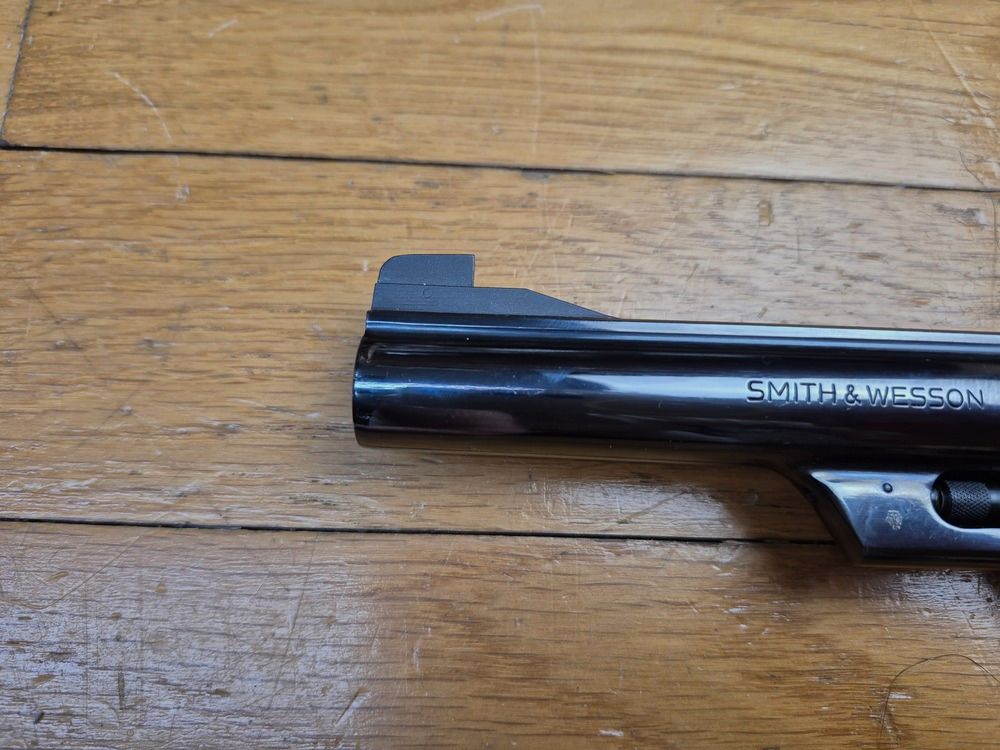
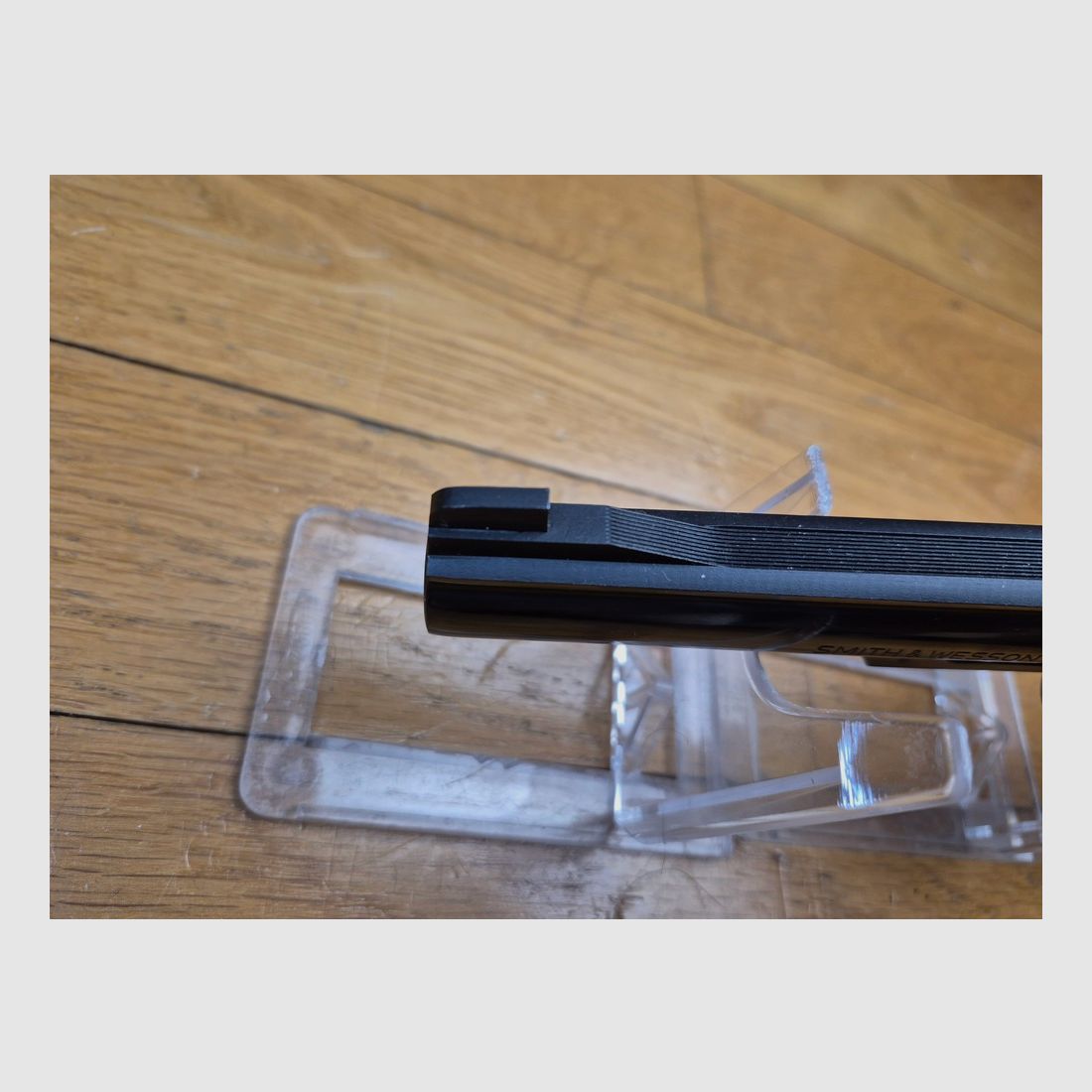
The heavy barrel, not fluted like those on the 27s from the golden age, is a splendid six-inch barrel with new, sharp rifling that shines like a mirror. The top of the gun is fully grooved (not sandblasted like later models) across its entire surface to prevent any summer sunlight from reflecting and disturbing your eagle eye.
This barrel is fitted with a Patridge-style competition front sight, better suited than the “Baughman,” which is better suited to combat. At this time, it was still machined from the solid barrel stock and measures over 3 mm thick on this model. As far as strength goes, it’s Everest!
The rear sight is an LPA type, adjustable in every direction, with perfect screws.
The deep black bluing, with its subtle sheen, has no marks, scratches, or fading. It enhances markings so finely engraved they look laser-etched, yet were done by hand.
As well as being splendid, it is thick and “hard.” It will last and last… That also explains the gun’s condition today, despite having been handled and fired a little over the past 50 years. And yet, it’s like new!
Although this was one of the most expensive guns in the Smith catalog, we can conclude, as in Les Tontons Flingueurs, that you forget the price, but the quality lasts. For a long time.
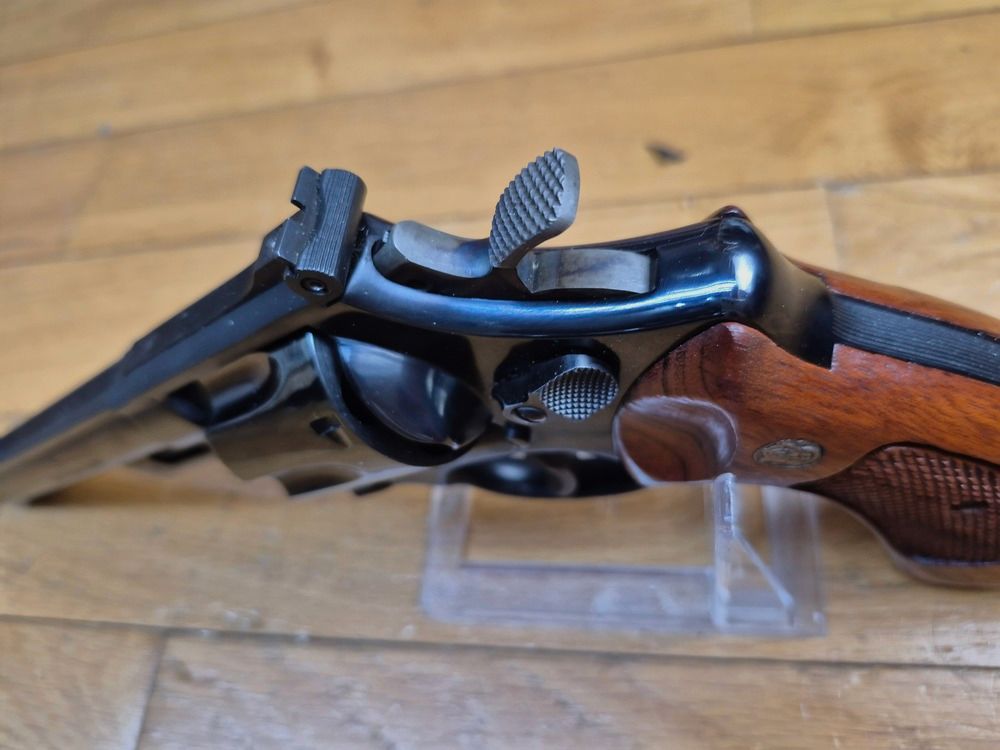
On these 25-2s made specifically for competition, you’ll notice that the hammer spur (with special checkering) and the trigger (also finely grooved) are noticeably wider than on the standard models, which were already remarkably well finished for the time. What’s more, both are fully case-hardened. Luxury that completes the gun’s overall look.
On other Smith models, these widened and prepared parts were an expensive option. Here, they came standard on this competition gun. And today, that’s a very welcome bonus. Neither the hammer nor the trigger will slip away from you.
You can tell its former owner loved it and took great care of it. The gun is in near-new condition. It deserves to be loved again. This gun is much rarer than the 29s in this very carefully made configuration.
A little-known fact about the 25-2: Supica reports that 10 or 12 of these guns in .45 ACP were ordered with a “round butt” frame and a 4-inch barrel by… the CIA! No one knows what the “Company” in Langley might have used them for…
Ultimately, the rarest of the N-frame brothers, with dreamlike mechanics and craftsmanship that are impossible to match today, in an ideal competition configuration, and in a legendary caliber.
Also ideal for a shooter who already owns a fine .45 ACP pistol and is looking for an exceptional revolver to add to their collection. On top of that, this beauty is in remarkable condition and very hard to find on the market. An exceptional gun in every sense of the word.
CATEGORY B FIREARM AT THE CSI: SUBJECT TO AUTHORIZATION. A COPY OF A VALID ID AND A VALID FIREARMS LICENSE ARE REQUIRED – AN OPEN SIA ACCOUNT IS ALSO REQUIRED, OF COURSE – SHIPPING WITH SIGNATURE REQUIRED IN TWO SEPARATE PARCELS AT LEAST 48 HOURS APART.
***********************************************************************************************************************
Let’s say it again! Flingus Maximus gun shop in Paris and throughout France is also here to help with private firearm transfers, buying firearm and militaria collections, firearm valuations, and questions about firearms in estates and inheritances. Contact your favorite gun dealer via our contact form or at [email protected] (Show description in original language)
Content de sa trouvaille Maitre Flingus.
Un 25-2. UN « rouleau » en carcasse N de la grande époque de Smith, mais en 45acp, et dans une finition Target canon lourd de rêve. Un ovni, quoi.
Mais comment en parler ?
Dire que c’est un splendide et mythique revolver en 45ACP (déjà un oxymore, j’adore!), qu’il est le cinquième larron de la carcasse N, et de loin le plus rare sous nos climats, le plus beau frère des iconiques 27 et 29, l’unique vrai descendant du Smith & Wesson modèle 1917, celui, en 45 acp déjà, de la guerre de 1914-18 et de la boue des tranchées….
Vraiment tout pour plaire au sentimental Maître Flingus, ce 25-2 ! Du coup, il ne sait même pas par où commencer…
Alors, quels sont-ils ces frères de la carcasse N au juste ?
Je jette d’office un voile pudique sur les carcasses N soutenant les modèles 625 et autres 610, 624, 627, 629 … qui sont juste des re fabrications modernes de leurs augustes prédécesseurs. Et surtout sur l’épouvantable échec, un des rares de Smith, que furent les modèles, pourtant très beaux, 57 et 58 en 41 Magnum, et toujours en carcasse N. Mais,là, c’est surtout la faute de la cartouche quand même. Les armes sont splendides.
Les vrais Frères de la Côte de la carcasse N, c’est plutôt cinq larrons qui ont lourdement contribué à la légende de Smith.
Le Smith & Wesson Hand Ejector Model of 1905 adapté à la carcasse N en 1908, l’originel, en 44SW special, le Smith & Wesson Model 1917, lui déjà en 45 ACP, le combattant des deux guerres mondiales, le 27 (et son jumeaux le 28) en 357, compagnon officiel du policier idéal y compris de cinéma, le 25-2 en 45 acp, notre beau bébé de ce jour, dit l’OVNI, et puis, enfin, le rejeton final de la série, le 29 en 44 Mag, Celui de « Clint ». Le mythe Inspecteur Harry.
Quelle série !
Apparues une première fois avec le modèle Hand Ejector / New Century 1908 (adaptation en N du modèle 1905), celui-ci aussi appelé le Triple Lock, les armes bâties sur cette carcasse N étaient, et restent, parmi les revolvers les plus solides du monde.
Destinées dès l’origine aux puissantes 45 long Colt et au tout nouveau (à l’époque) 44 special, ils étaient déjà les plus puissants de leur temps. Ce Hand Ejector, Triple lock, c’est notre premier frère de la Côte
Cette complexité de verrouillage, avec un troisième point de verrouillage en barillet via un plongeur, est le fruit d’une rivalité plus que centenaire entre les firmes Colt de Hartford et Smith de Springfield.
A la manière de la course à l’espace, où chaque bloc devait faire toujours plus fort que son rival, il fallait développer l’arme la plus précise, avec la platine la plus douce et le verrouillage le plus solide.
Les TripleLock de Smith avaient pour eux un troisième point de verrouillage situé sur la potence du barillet les transformant en véritables coffres forts.
Colt ironisait en vantant la qualité de ses barillets qui, eux, «tournaient dans le bon sens ».
Smith répliquait par des armes qui, cent ans après, n’ont pas bougé. Et qui ne bougeront pas comme les Smith 27 ou 29 des meilleures fabrications que cherche pour vous Maître Flingus. Ou comme notre exceptionnel modèle 25-2 de ce jour aussi.
Hélas pour Smith, la trop grande complexité du triple lock et son coût ne furent pas du goût de la clientèle tant militaire que civile.
Mais la carcasse N n’était pas perdue pour autant.
A la demande de l’armée britannique, ce plus gros des Smith & Wesson évoluera à son tour, empruntant aux modèles de la taille du dessous son verrouillage en deux points seulement. Naîtra ainsi le Hand Ejector 2nd Model, chambré en 455 webley.
C’est cette variante, une fois adaptée au 45 acp américain, qui deviendra, le « Smith & Wesson Model 1917 « , le premier révolver Smith & Wesson adopté massivement par l’armée US en 1917 en complément du célébrissime Pistolet 1911 qui faisait ses premières armes en 1917 aussi
Le 6 avril 1917, les Etats-Unis d’Amérique entraient en effet dans le premier conflit mondial. Cinq mois plus tard, arrivent dans les unités de l’Army les premiers Smith&Wesson 1917 en 45ACP, la plus grosse commande jamais effectuée par le gouvernement américain à la firme du Massachussett.
Cette commande avait pour but de libérer le maximum des récents Colts 1911 pour les Sammies de première ligne tout en permettant une unité de calibre en 45 ACP pour tous.
Mais, me demanderez-vous, Maître Flingus, comment faire fonctionner une munition de 45acp à gorge, conçue pour un P.A, dans un revolver, lui conçu pour une munition à bourrelet ? Ça va t’y pas glisser tout à travers votre affaire ?
Questions tout aussi pertinentes au demeurant pour notre 25-2 de ce jour!
C’est Joseph Wesson (le fils de Dan) qui trouva la solution. Elle était double.
D’abord, en usinant un rebord à l’intérieur des chambres du barillet pour éviter aux munitions d’y glisser de bout en bout, et, ensuite, en mettant au point une trouvaille géniale : le clip « demi-lune » qui permettait une introduction/extraction collective et facilitée des munitions ou « moon clips ».
La manipulation de l’arme au combat en était grandement facilitée.
Vous n’aviez plus à fouiller dans les poches de votre « trenchcoat » ou votre ceinturon à la recherche de ces six petits éléments capables de faire boum, au risque de les faire tomber dans la boue au chargement, avant de défourailler à bout portant sur quelques germains agités en goguette dans votre secteur…
Deux mouvements suffisaient à charger complétement votre barillet. Et avec un peu d’entraînement, vous étiez aussi rapide qu’avec un « automatique »! Ce n’est pas pour rien que l’on utilise toujours les « moon clips » au TSV avec les 625 !
Et toujours avec les avantages du bon vieux revolver surtout au début de la technologie pistolet semi-automatique:
pas de perte de temps à grailler un chargeur au ressort récalcitrant, de chargeur mal enclenché, d’enrayement, de départ de coup intempestifs de 1911 à la ceinture (comme l’incident, assez comique, si ce n’était une blessure au pied, qui arriva au futur Général Patton en 1915 dans un bar à Sierra Bianca au Mexique, ou, encore plus drolatique, celui de Pierrot le Fou. Mais là, c’était plutôt du à un port « balkanique » d’un 1911 près l’entre-jambe avec, pour conclusion, un coup de 45ACP dans les balloches et qui lui coûta la vie en 1946…).
Carcasse de « mec » par excellence donc, la carcasse N révèlera ensuite, en 357 ou en 44Mag, tout son potentiel de solidité et d’absorption du recul. Se prêtant parfaitement aux cartouches Magnum, elle est d’ailleurs la seule réputée inusable.
Après son début de carrière (de 1908 à avant 1935) chambrée en 45 long Colt et en 44 special on l’a retrouvera donc à partir de 1935 grâce à Elmer Keith et à la prohibition, en 357 magnum. Elle sera in fine adaptée au calibre 44 magnum en 1955, toujours par Elmer Keith, calibre qui fera sa renommée internationale et celle de Clint Eastwood au passage.
Pour la 357 Mag et ce qui sera le modèle 27, je vous ai raconté cela ici – et pour la 44 magnum et ce qui sera le modèle 29 ici.
Voilà déjà un très beau palmarès pour ces « gros » revolvers. Et le 45 acp alors dans tout ça?
En dépit de ses succès mondiaux dans ces différents calibres, Smith& Wesson ne pouvait renoncer au mythique 45 ACP en revolver et laisser son histoire se terminer avec son modèle de 1917 qui avait rencontré un franc succès dans son utilisation auprès des militaires qui s’étaient très bien faits aux précieux « moon clips ».
En mars 1950 Smith réintroduit donc un révolver en 45 acp mais à canon léger et fluté, barillet sans cannelure et seulement en 6 pouces. Ils sont marqués « CAl 45 Model 1950 » et ne seront quasiment pas produits jusque 1957, date de leur fin de production.
C’est un Smith 17 modernisé qui n’a pas été spécifiquement pensé pour la précision en 45 ACP car il n’est pas à canon lourd. C’est, au passage, aujourd’hui une insigne rareté qui se vend 10.000 USD et plus aux USA. Considérons le comme le prototype de notre 25-2 de ce jour.
C’est donc en 1955 que Smith & Wesson introduit son modèle 25, le notre, un revolver emblématique conçu pour le tir de précision et construit pour la performance.
Son nom complet catalogue avant la refonte de catalogue de 1957 est d’ailleurs « 1955 Model .45 Target Heavy Barrel » ou « Modèle de Cible .45 Canon Lourd ») pour bien situer le sujet et ne plus entrainer de confusion comme avec le modèle 1950.
S’il s’inspire du Smith Model 1917 de la Première Guerre mondiale, il représentait une évolution importante de conception de la chose car le design du modèle 25 intégrait toutes les caractéristiques qui le rendait bien adapté au tir de précision tout tirant la quintessence de précision et de puissance de la .45 ACP. On va le voir.
Dédié aux fans de la 45 acp, par ses spécificités, par son esthétique hors norme, il est devenu une référence très recherchée pour les tireurs sportifs et les collectionneurs américains. Dans les années de bonnes productions de Smith et en parfait état, il est devenu une bête de compétition très difficile à trouver.
Ce rare exemplaire de Model 25 appartient à la série 2, dont la production courre de 1961 à 1991.
Il est bien en 45 acp – car il a été aussi produit à partir de 1977 en .45 Colt qui est aussi le calibre d’origine de la carcasse N.
Par son numéro de série (toujours très difficile à suivre chez Smith) notre exemplaire est plus que très probablement de début 1980, peut-être de fin 1979. Mais pas d’avant pour sûr car c’est un 6 pouces. Or, avant 1979, il n’existait qu’un 6 pouces et demi en 25-2, supprimé justement cette année là pour faire place au 6 pouces. Un des premiers 25-2 en 6 pouces donc.
Carcasse N bien sûr. Increvable. Y compris et particulièrement en 45 acp.
Cette carcasse est de type « square butt », finement striée en dos de poignée. Cette crosse « square butt » est dite aussi « Army » là-bas. Car elle fut popularisée par son ancêtre guerrier direct le 1917 son grand papa en 45 acp. Un bel hommage de Smith.
Cette crosse est ici revêtue de plaquettes « maison » d’origine en beau noyer rouge américain verni et quadrillé de type Magna. Excellente prise en mains, même mains mouillées.
Celles-ci sont d’un module assez épais qui vont parfaitement avec la ligne et la taille généreuse de l’arme. Elles conviendront encore mieux à des mains moyennes ou grandes.
Elles sont d’une qualité bien supérieures à celles en caoutchouc qui sont livrées avec leurs « 627 » de nos jours. Preuve en est: elles n’ont pas bougé en quarante ans. Neuves !
Vous pouvez bien sûr adapter toutes les poignées qui vont sur cette carcasse N. Que ce soit avec des plaquettes fines ou enveloppantes, la maîtrise de l’arme restera impeccable.
Notre splendide 25-2 est taillé pour la compétition de naissance car il était vendu pour cela. Celui-ci est en plus dans un état exceptionnel très proche du neuf absolu. Une pièce d’exception.
Il fait encore partie des fabrications remarquables de ces années là, d’avant 1982. En quoi ?
D’abord son canon est encore « pinned ».
“Pinned”, c’est une goupille visible de l’extérieur, logée dans le canon au niveau supérieur en limite de carcasse. Cela vient “enclouer” le vissage du canon dans la carcasse. Cette fameuse goupille obligeait à un usinage plus complexe du canon et à des manipulations supplémentaires à l’assemblage.
Facteur de rigidité accrue du canon, cette modeste goupille et l’assemblage qui lui était associé était aussi un facteur de durabilité de l’arme dont un usage intensif ne parvenait pas à créer le moindre entrefer “d’usage excessif” propres aux armes de moindre qualité.
Après 1982, Smith mettra fin à tout cela pour des raisons de coûts et parce que « plus personne ne voulait d’un vrai revolver qui dure pour le fils ou le petits-fils ». On pouvait faire « moins cher »…
A mon sens, la pente fatale était amorcée même si, elle sera plus raide encore chez Colt et d’autres. Un truc est sûr, moins cher ils ont faits sans doute, mieux fini, ce sera en revanche pour un prochain millénaire…
Ensuite, mécaniquement, ce 25-2, c’est un rêve. Mon patriotisme dut il en souffrir, c’est encore plus souple et net en mécanique qu’un Manurhin de Mulhouse, pourtant lui aidé par le remarquable chariot Maillard.
Or, le Smith est dépourvu de cette invention gauloise et notre exemplaire est pourtant à peine rodé !
Le secret d’une telle mécanique? Un ajustage « ayatolesque » doublé d’un polissage des contacts entre chaque pièce aux petit oignons.
On retrouve ici le travail des ouvriers ajusteurs/polisseurs spécialisés de Smith de la grande époque, tous de plus de 15 ans d’expérience dans la boite, car David Murray le chef de la production de Smith n’en prenait pas d’autres pour certaines opérations. Ils faisaient tout cela « à l’oeil » (et fissa – mais ils allaient, hélas pour eux, moins vite qu’une découpe laser qui pourtant accroche de partout !).
C’est avec ce genre d’armes que je fais, avec quelques clients privilégiés, ce que j’appelle la « Smith expérience » consistant à comparer mécaniquement à l’aveugle et à plusieurs niveaux (chien, barillet, armement) plusieurs générations de Smith. Une fois les différences appréhendées, un exemplaire de la « Grande Époque » comme ce 25-2 se reconnaît immédiatement sans même le regarder. Rien qu’en le manipulant. Des merveilles !
Mécaniquement cette arme est une splendeur. A l’armer, on sent le ventre de la bête bouger mécaniquement le moindre de ses organes sans dévier d’un dixième avant de cracher son venin.
Le déverrouillage du barillet est plus que fluide, sans à-coups. Faites une fois le test du coup du quart de poignet et vous comprendrez de vous même.
Sa rotation est un rêve en plus. Il permet donc un rechargement rapide et sans défaut, idéal pour le tir de vitesse (rappel: il ne faut que 3 secondes à Jerry Miculek pour vider deux barillets de son Smith&Wesson!).
La qualité de ces barillets et de leur montage est d’ailleurs le premier indice mécanique de la qualité de fabrication de ces années là. Le carénage sur le dessous rend l’axe de barillet impossible à tordre ou à fausser.
Obsession d’origine bien militaire et pleine de bon sens, héritée du Triple Lock, qui n’a jamais quitté Smith, la forme de ce carénage est ici plus profilée que celui d’un plus modeste Smith 19. On ne lésinait pas sur le coût de l’usinage avant 1982 chez Smith…
Le barillet possède des chambres absolument splendides. A se voir dedans !
Elles portent bien en interne l’usinage interne de rebord qui évite aux munitions de 45acp sans bourrelet d’y glisser de bout en bout. Une performance d’usinage au passage. Les clips demi lune sont là aussi pour cela et les cartouches sont donc in fine « tenues » dans leur intégralité de longueur.
Cela rend inutile l’usinage de drageoirs (« recessed ») sur le modèle 25-2 en 45 alors que, usinage complexe mais qualité Smith oblige, ces drageoirs étaient encore la norme sur les Smith de la grande époque dans les autres calibres type 357 ou 44.
Pour le chargement et le tir rapide, les demi-clips de chargement pour le 45 acp se trouvent facilement sur des site bien connus (des malins les font maintenant en impression 3 D à des prix ridicules vendus par 50 ou 100). On en trouve en métal, plus durables pour les écolos, chez pas mal de confrères. C’est l’arme qui est difficile à trouver !
Pas de verrou infernal à clef hexagonale sur le dit barillet comme sur les exemplaires récents mais, en revanche, déjà la «transfert bar» qui complète le chien rebondissant, rendant impossible tout départ involontaire.
L’alignement et le jeu à l’abattu sont remarquables. La double action est un vrai bonheur, introuvable sur une arme contemporaine.
Au passage, il n’y a quasiment pas de trace de frottement de l’arrêtoir de barillet sur le pourtour de ce dernier. Très légère. Ce barillet a donc peu tourné, indice encore que l’arme a été peu manipulée et à encore moins tiré.
Autre preuve de son peu de service, le rempart ne porte quasiment pas de trace de combustion (je dis quasiment pour être prudent!). État et condition mécanique au global juste splendide.
Le canon lourd, et non fluté comme sur les 27 de la grande époque, est un six pouces splendide avec des rayures neuves, coupantes et brillantes comme un miroir. Son dessus de l’arme est intégralement rainuré (et pas sablé comme après) sur toute sa surface afin d’empêcher tout reflet du soleil d’été de venir troubler votre œil d’aigle.
Ce canon est complété d’un guidon de compétition type Patridge, mieux adapté que le « Baughman” plus adapté lui au combat et qui est encore, à cette époque, taillée dans la masse du barreau et mesure plus de 3 mm d’épaisseur sur ce modèle. En matière de solidité, c’est l’Everest!
La hausse est de type LPA réglable dans tous les sens avec des vis parfaites.
Le bronzage d’un noir profond aux reflets n’a pas une trace, une rayure ou un éclaircissement. Il sublime des marquages d’une finesse tels que gravés au laser et pourtant manuels.
En plus d’être splendide il est épais et « dur ». Il durera durera…C’est ce qui explique aussi aujourd’hui l’état de l’arme qui a au moins été manipulés et a un peu tiré durant ses 50 dernières années. Et pourtant. Neuve !
Même si l’arme était une des plus chère au catalogue de Smith, on peut en conclure comme dans les Tontons Flingueurs que le prix s’oublie mais que la qualité reste. Longtemps.
Sur ces 25-2 dédiés directement à la compétition, vous noterez que la crête de chien (spécifiquement quadrillée) et la queue de détente (finement rainurée aussi) sont sensiblement élargies par rapport aux modèle standards déjà remarquables en finition de l’époque. En plus, elles sont toutes deux jaspées à la boite avec un jaspage à 100%. Le luxe pour un look total de l’arme.
Pour les autres modèles de Smith, ces pièces élargies et préparées était une option coûteuse qui ici était présente en sortie de boite pour cette arme de compet’. Et c’est aujourd’hui un plus fort appréciable. Ni le chien ni le dix ne vous échapperont.
On le voit. Son ancien propriétaire l’a beaucoup aimé et en a pris grand soin. L’arme est dans un état de quasi neuf. Il faut l’aimer encore. Cette arme est bien plus rare que les 29 dans cette fabrication très soignée.
Petite anecdote sur le 25-2 : Supica rapporte que 10 ou 12 de ces armes en 45 acp aurait été commandées en carcasse « round butt » et en 4 pouces par… la CIA ! Sans que personne ne sache ce à quoi la « Firme » de Langley a bien pu les utiliser…
In fine, le plus rare des frères de la carcasse N, dans une mécanique et une fabrication de rêve intouchable aujourd’hui, dans une configuration idéale pour la compétition, et dans un calibre mythique.
Idéal aussi pour un tireur, déjà possesseur d’un beau pistolet en 45acp recherchant un revolver d’exception pour compléter son coffre. La bête est en plus dans un état remarquable et très difficile à trouver sur le marché. Arme d’exception dans tout les sens du terme.
ARME DE CATÉGORIE B AU CSI : SOUMISE À AUTORISATION, PHOTOCOPIE DE LA PIÈCE D’IDENTITÉ EN COURS DE VALIDITÉ ET DE LA LICENCE OBLIGATOIRE – COMPTE SIA OUVERT BIEN ÉVIDEMENT – Expédition contre signature en deux colis séparés d’au moins 48 heures obligatoire.
***********************************************************************************************************************
Répétons le ! L’armurerie Flingus Maximus à Paris et partout en France est là aussi pour vos formalités armes entre particuliers, le rachat de collections armes et militaria, vos estimations d’armes, vos questions armes dans les successions et héritage. Contactez votre armurier préféré via notre formulaire de contact ou à [email protected]