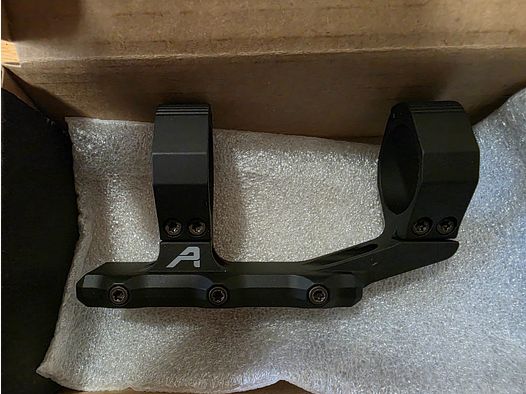
Spuhr Scope Mount, 30 mm / 38 mm / 0 MOA
≈ $505
Price at the dealer: 449.92 €. Converted at the ECB rate as of October 21, 2026.
No permit required (18+)
72479 Straßberg, Germany
18
ID: 9897179
Purchase from outside the EU: The firearm goes through an importer in your country, the dealer handles the export.
How buying from Europe works
Shop safely with Gunfinder
Our AI-powered seller identity verification makes Gunfinder the safest marketplace online.
Learn more
Details
- Original language
- German
- Category
- Condition
- New
- Location
- 🇩🇪 72479 Straßberg, Germany
- Availability
- In stock
Freshness
This listing is based on a mirrored offer, where the listing data was synced to us from a shop, dealer, or external marketplace. Please note that temporary price discrepancies may occur due to possible delays in data transmission.
- Source
- Black Raptor
- Last updated
- about 14 hours ago
Description
Note:
The item is located abroad. Please note that delivery conditions, shipping times, and/or the purchase process may differ.
On a modern chassis or a rifle with a straight, high stock line, a very low mount can force the shooter to press their head behind the optic. This not only costs comfort: The head position becomes less reproducible, and with hearing protection or in changing shooting positions, the sight picture becomes harder to achieve.
The SP-3002 therefore does not focus on minimal height but on a defined 38 mm axis line. At the same time, it remains neutral at 0 MIL. It is designed for setups where ergonomics, installation space, and alignment to an extended front rail are more important than additional ballistic tilt.
The four crucial questions before buying: Position: Does the eye naturally sit 38 mm behind the optic? Installation space: Is there enough clearance for the objective, ring zones, and distance to the bolt and adjustment rings? Distance: Can the eye relief be achieved on the existing rail without a cantilever? System angle: Does a neutral mount fit the existing rail tilt and the desired adjustment range?
What 38 mm axis height practically changes
Spuhr measures the height from the top edge of the Picatinny rail to the optical center axis. For the SP-3002, this is 38 mm or 1.5 inches. Compared to the 30 mm high SP-3001, the eye is thus 8 mm higher.
This difference is especially noticeable on chassis, straight stock axes, and platforms with higher cheek rests. The head can remain more upright, the cheek weld feels less compressed, and a front-mounted optic can more easily be arranged at the same axis height. On a classic stock rifle without an adjustable cheek piece, the same 38 mm can be too high and break the stable cheek contact.
Therefore, height is not a quality ranking. It is an ergonomic interface between rail, optic, and stock. Anyone mounting high just because of a large objective should also check if the cheek piece can compensate for the additional height difference.
Calculating objective clearance accurately
Over a flat rail that extends under the objective housing, the 38 mm axis height results in a theoretical zero clearance limit of 76 mm outer diameter. This is not a recommendation for a 76 mm housing, but only the geometric upper limit without cap and safety clearance.
The reliable calculation is: 38 mm minus half the actual outer diameter. For a realistically measured housing of 64 mm, this leaves 6 mm over an equally high rail. Objective caps, sunshades, rail steps, and a desired safety clearance are deducted from this.
A designation like 5-25x56 does not provide the correct measurement for this. 56 mm describes the free objective lens, not the outer housing diameter. Additionally, the longitudinal position must be correct: A wide cone can be free at the front and rest further back on the mounting bridge or rail. Spuhr does not clearly specify bridge clearance for this model; therefore, it is not derived from the product photo.
0 MIL means neutral
The SP-3002 adds no forward tilt between rail and scope. 0 MIL or 0 MOA does not shift or enlarge the elevation adjustment range. The mount keeps the op
tical axis parallel to its base.
The entire system can still be tilted if the weapon rail is already designed with forward tilt. For ballistic classification, the rail still counts. Those who need an additional 6 MIL choose the SP-3602; those who want to keep a neutral rail neutral stick with the SP-3002.
The neutral version is especially useful if the desired zero point is reached without additional mounting tilt, the scope’s adjustment range should not be stressed, or a forward-facing attachment system is organized parallel to the rail.
Designed for extended rails and attachment systems
The exact model datasheet describes the SP-3002 as a Picatinny mount for use with night vision equipment and names extended Picatinny rails in connection with attachment systems as a special application case. This does not imply universal compatibility with every attachment device.
Crucial are axis height, attachment of the front device, free distance in front of the objective, and the alignment required by the device manufacturer. The 38 mm line provides a suitable starting geometry for this. However, adapters, front devices, and their mounting are not included.
For a purely optical hunting or range setup, the same height advantage remains usable if the objective and stock line require it. Those who do not need an extended rail or raised cheek rest get no functional bonus from the 38 mm alone.
Solid block body without forward offset
The mount body is 126 mm long. The datasheet shows 32 mm wide ring areas and 62 mm free distance between the rings. The 30 mm main tube must be cylindrical at both clamping points; turret block, transition cone, and erector housing must not protrude into the ring zones.
Spuhr explicitly excludes scopes with extended erector housings like US Optics TPAL/EREK. Likewise, according to the manufacturer, the SP-3002 does not fit the SAKO S20 or two-piece rails. The one-piece body requires a common, rigid Picatinny or STANAG-4694 base.
The SP-3002 has no structural cantilever. On a bolt-action rifle with a long rail, this is usually uncritical. On a semi-auto platform, the necessary eye relief may require moving the scope further forward. Then the SP-3022C with 70 mm forward offset is more practical instead of clamping the SP-3002 body only partially or in an unsuitable position.
Secure clamping and reproducible mounting
The current ISMS instructions require a clean, lightly oiled rail. The body is fully placed, pressed forward against the groove flank, and initially hand-tightened with the middle M5-Tx20 clamping screws. Then the same sequence follows with 5 Nm.
For the M4-Tx20 ring screws, Spuhr specifies 2.0 Nm or the lower value of the scope manufacturer. The screws are factory waxed; additional lubricants or locking agents change the preload and must not be combined carelessly with the same torque values.
All ISMS models over 30 mm height have prepared holes for captive clamping screws according to the current instructions. This is a service feature for a permanently installed system but does not make mounting tool-free. Those who regularly remove the optic unit should choose the QDP-3002 with quick-release levers.
Aligning the scope and attaching accessories
The supplied 10-degree wedge aligns a scope with a suitable flat underside to the integrated bubble level. It neither replaces a vertical weapon position nor the control of the reticle. According to the manufacturer, models made since autumn 2023 lack the previous alignment grooves on the rear ring caps; therefore, the wedge remains the clear tool.
Seven Spuhr interface sets allow mounting compatible accessories. The instructions point out that interface screws of incorrect length can protrude into the ring space and da
s can damage the center tube. The back of the wedge therefore serves as a screw length gauge.
Our Assessment
The strongest reason to buy the SP-3002 is the combination of a neutral 38 mm line, solid body, and suitability for extended rails. It fits very well into a permanently set-up system where eye, scope, and a possible front device are brought together on a high, straight geometry.
The most common misconception would be to automatically read 38 mm as AR height or 0 MOA as a long-range advantage. Without cantilever, the eye relief can be missing on a semi-automatic. And 0 MOA does not provide additional elevation travel. For an inclined long-range configuration or a more forward ring block, there are more suitable Spuhr models.
Instructor Tip: Prioritize cheek weld height over objective clearance
Go into your natural cheek weld with closed eyes and only open them once your head and shoulder are steady. If the eye is below the optical axis, a high mount won’t solve the problem; if it consistently rests at 38 mm with a straight stock line, the height is ergonomically justified. Only then is the objective distance evaluated as a second level.
User Tip: Calculate outer diameter instead of objective class
Measure the housing and mounted cover at the widest point. Divide the value by two and subtract it from 38 mm. This creates a comprehensible rail distance; a “56” designation does not replace this calculation.
User Tip: Plan front device by axes instead of eye measurement
Note the 38 mm axis height of the main optic and the axis height of the intended front device over the same rail reference plane. A height offset cannot be corrected by lateral shifting and is not negated by the brand name of the components.
User Tip: Decide eye relief before ring position
Align the optic at highest magnification in the actual cheek weld. If the correct eye relief forces the ring zones outside the 126 mm body or mounting beyond the rail end, a cantilever model is the structurally correct solution.
User Tip: Document clamping sequence
Push the body forward, start with the middle clamping screws, and record the 5 Nm sequence. Markings on screws and mount will later show movement without routine retightening by feel.
User Tip: Use wedge also as screw gauge
Check every accessory screw on the gauge on the back of the wedge before it goes into a Spuhr interface. Damage from a too-long screw occurs inside the center tube and is initially easy to overlook from outside.
Black-Raptor Short Summary:
Buy if: a 30 mm scope should sit neutrally at 38 mm, a one-piece long rail is present, and cheek weld, objective, and a possible front device actually use this height.
Don’t buy if: a low classic stock line, additional inclination, quick tension, or forward offset are needed, or the ring zones of the scope don’t fit the solid body.
Scope of Delivery
1 × Spuhr SP-3002 scope mount
1 × 10-degree leveling wedge with screw length gauge
1 × Manufacturer’s manual
Scope, firearm, front device, interface accessories, and torque tool are not included.
Suitable Alternatives
Select by height, inclination, and operation:
SP-3001: neutral and 8 mm lower for classic stock lines
SP-3602: same 38 mm height with 6 MIL additional inclination
QDP-3002: same tube, height, and inclination class with QD levers
SP-3022C: neutral, 38 mm high, and with 70 mm forward offset
Technical Data
Manufacturer: Spuhr
Model: SP-3002
Design: one-piece fixed block mount without QD
Weapon interface: MIL-STD-1913 / STANAG 4694
Center tube: 30 mm
Axis height: 38 mm / 1.5 inch
Inclination: 0 MIL / 0 MOA, neutral
Forward offset: no structural cantilever
Length: 126 mm
Ring width: each
32 mm according to the technical drawing
Distance between the rings: 62 mm according to the technical drawing
Weight: approx. 0.26 kg; Spuhr states 261 g in the model datasheet and 264 g on the model page
Material: 7075-T651 aluminum according to the model datasheet
Surface: black hard anodized
Spuhr interfaces: seven
Integrated bubble level: yes
Torque for rail clamping: 5 Nm
Torque for ring screws: 2.0 Nm or lower release by the optic manufacturer
EAN: 7340150700072
FAQ
Does the SP-3002 create additional cant? No. 0 MIL / 0 MOA is neutral. The mount adds no angle and does not shift the elevation adjustment range. However, an already canted weapon rail remains part of the overall system.
Is 38 mm a typical height for a quick cheek weld? On straight chassis and stock lines, the 1.5-inch axis can support a more upright, quickly repeatable cheek weld. On a low classic stock, it may be too high. The actual eye height is decisive, not the platform designation.
What objective diameter fits over a continuous rail? Theoretically, at 38 mm axis height, 76 mm outer diameter is possible with zero clearance. Practically, cap, safety clearance, rail geometry, and the longitudinal position of the objective cone are deducted.
Is the SP-3002 suitable for night vision attachments? Spuhr states extended Picatinny rails with night vision equipment as the intended use case. This confirms the system concept but not the compatibility of a specific device. Its axis height, adapter, and clearance must fit the 38 mm line.
Does it fit the SAKO S20 or two-piece rails? No. Both applications are explicitly excluded by Spuhr. The one-piece body requires a common Picatinny or STANAG-4694 base.
When is the SP-3022C more sensible? When barrel dimension, 38 mm height, and neutral axis match, but the eye relief requires a more forward ring block. The SP-3022C offers 70 mm forward offset for this. (Show description in original language)
.br-product-v3{--br-ink:#17201c;--br-muted:#54615b;--br-line:#d9e0dc;--br-soft:#f5f7f5;--br-deep:#10271d;--br-gold:#f2d58e;color:var(--br-ink);font-family:Arial,Helvetica,sans-serif;line-height:1.62;max-width:1180px;margin:0 auto}.br-product-v3 *{box-sizing:border-box}.br-hero-v3{background:var(--br-deep);color:#fff;padding:26px;border-radius:14px;margin:0 0 18px}.br-hero-v3 strong{color:var(--br-gold)}.br-section-title{font-size:1.08rem;font-weight:800;margin:24px 0 10px}.br-box,.br-card{border:1px solid var(--br-line);background:#fff;border-radius:12px;padding:16px}.br-grid{display:grid;grid-template-columns:repeat(2,minmax(0,1fr));gap:12px}.br-fit-good{border-left:5px solid #2f7d4a}.br-fit-no{border-left:5px solid #9a3b31}.br-limit{background:#fff7f3;border-left:5px solid #b75a45}.br-specs{display:grid;grid-template-columns:minmax(170px,.7fr) minmax(0,1.3fr);gap:8px 14px}.br-specs div{padding:7px 0;border-bottom:1px solid var(--br-line)}.br-delivery{background:var(--br-soft)}.br-product-v3 details{border:1px solid var(--br-line);border-radius:10px;padding:10px 12px;margin:8px 0;background:#fff}.br-product-v3 summary{font-weight:700;cursor:pointer}.br-final{background:var(--br-deep);color:#fff;padding:18px;border-radius:12px;margin-top:18px}@media(max-width:700px){.br-grid,.br-specs{grid-template-columns:1fr}.br-product-v3{max-width:100%;overflow:hidden}.br-hero-v3,.br-box,.br-card,.br-final{overflow-wrap:anywhere}}
Spuhr SP-3002 30-mm-Blockmontage mit 38 mm Achshöhe und 0 MOA – für hohe Chassis-/Schaftlinien, lange Rails und neutralen Systemwinkel.
Passt gut 30-mm-Zielfernrohr, einteilige Picatinny/STANAG-Rail, 38-mm-Visierlinie, kein QD und keine zusätzliche Neigung nötig.
Passt eher nicht Niedriger klassischer Jagdschaft, kurzer Receiver mit fehlendem Augenabstand, Bedarf an Cantilever oder zusätzlicher Vorneigung.
Praxiswirkung der 38-mm-Linie
Aufrechterer Kopfstand Gegenüber einer 30-mm-Montage liegt die Optik 8 mm höher. Auf Chassis und gerader Schaftlinie kann das den Anschlag deutlich entspannen.
Mehr Objektivfreiheit Über einer gleich hohen Rail liegt die theoretische Nullabstandsgrenze bei 76 mm Außendurchmesser. Schutzkappe und Reserve müssen trotzdem abgezogen werden.
Neutraler Winkel 0 MIL / 0 MOA addieren keinen Winkel. Eine vorhandene Schienenneigung bleibt Teil des Systems.
Kein Cantilever Der 126-mm-Körper setzt ausreichende Rail-Länge voraus. Augenabstand darf nicht durch Teilklemmung oder Überbrücken beweglicher Bauteile erkauft werden.
Kompatibilität & Fehlkaufvermeidung
Neben dem 30-mm-Mittelrohr müssen die festen Ringzonen, der Turmblock und die Längsposition der Optik passen. Spuhr schließt zweiteilige Rails, die SAKO S20 und bestimmte verlängerte Erektorgehäuse aus. Wer ein Vorsatzgerät plant, muss dessen Achshöhe, Abstand und Freigaben unabhängig von der Hauptoptik prüfen.
Grenzen & Nachteile
38 mm sind kein universeller Vorteil. Auf niedriger Schaftlinie kann der Wangenkontakt verloren gehen. 0 MOA bringen keinen zusätzlichen Long-Range-Verstellweg. Ohne konstruktiven Vorversatz kann die Montage auf kurzen Receivern zu weit hinten liegen. Wer die Optik regelmäßig abnimmt, ist mit einer QD-Variante oft besser bedient.
Technische Daten mit Praxisdeutung
Modell
SP-3002 – feste ISMS-Blockmontage.
Aufnahme
MIL-STD-1913 / STANAG 4694 – einteilige Basis erforderlich.
Mittelrohr
30 mm – zusätzlich Ringzonen und Turmblock prüfen.
Achshöhe
38 mm / 1,5″ – passend für höhere Schaft-/Chassis-Geometrien.
Neigung
0 MIL / 0 MOA – neutral.
Vorversatz
Keiner – Rail-Länge und Augenabstand vorab prüfen.
Länge
126 mm.
Ringgeometrie
32 mm Ringbreite, 62 mm freier Zwischenraum laut Maßzeichnung.
Gewicht
ca. 261–264 g je nach Herstellerangabe.
Material
7075-T651-Aluminium laut Modelldatenblatt.
Drehmomente
Rail-Klemmung 5 Nm; Ringschrauben 2,0 Nm bzw. niedrigere Optikvorgabe.
Lieferumfang
Spuhr SP-3002, 10°-Nivellierkeil mit Schraubenlängenlehre und Herstelleranleitung. Nicht enthalten: Zielfernrohr, Waffe, Vorsatzgerät, Interface-Zubehör und Drehmomentwerkzeug.
Sichere Anwendung
Montage vollständig auf einer starren Rail einsetzen und nach vorn gegen die Nutflanke drücken. Augenabstand bei realer Schießposition festlegen, bevor die Ringdeckel endgültig angezogen werden. Schrauben nach Hersteller-/Optikvorgabe anziehen und freie Bedienung von Verschluss, Kappe und Verstellringen kontrollieren.
FAQ
Ist 38 mm automatisch besser für Chassis? Nein. Die Höhe muss zur realen Augenposition und Schaftbacke passen; Chassis ist nur ein typischer Anwendungsfall. Was bedeutet 0 MOA? Die Montage addiert keine Neigung. Eine geneigte Waffenrail bleibt dennoch wirksam. Kann sie ein Vorsatzgerät aufnehmen? Die 38-mm-Linie kann dafür sinnvoll sein, aber das konkrete Gerät muss hinsichtlich Achshöhe, Abstand und Freigabe separat passen. Wann brauche ich eine Cantilever-Version? Wenn der korrekte Augenabstand mit dem geraden 126-mm-Körper auf der vorhandenen Rail nicht erreichbar ist.
Black-Raptor-Einordnung: gute neutrale 30-mm-Montage für moderne hohe Setups. Wer nur „mehr Höhe“ sucht, ohne Schaftlinie und Augenabstand zu prüfen, riskiert einen unnötig schlechten Anschlag.
Spuhr SP-3002 30-mm-Blockmontage mit 38 mm Achshöhe und 0 MOA – für hohe Chassis-/Schaftlinien, lange Rails und neutralen Systemwinkel.
Passt gut 30-mm-Zielfernrohr, einteilige Picatinny/STANAG-Rail, 38-mm-Visierlinie, kein QD und keine zusätzliche Neigung nötig.
Passt eher nicht Niedriger klassischer Jagdschaft, kurzer Receiver mit fehlendem Augenabstand, Bedarf an Cantilever oder zusätzlicher Vorneigung.
Praxiswirkung der 38-mm-Linie
Aufrechterer Kopfstand Gegenüber einer 30-mm-Montage liegt die Optik 8 mm höher. Auf Chassis und gerader Schaftlinie kann das den Anschlag deutlich entspannen.
Mehr Objektivfreiheit Über einer gleich hohen Rail liegt die theoretische Nullabstandsgrenze bei 76 mm Außendurchmesser. Schutzkappe und Reserve müssen trotzdem abgezogen werden.
Neutraler Winkel 0 MIL / 0 MOA addieren keinen Winkel. Eine vorhandene Schienenneigung bleibt Teil des Systems.
Kein Cantilever Der 126-mm-Körper setzt ausreichende Rail-Länge voraus. Augenabstand darf nicht durch Teilklemmung oder Überbrücken beweglicher Bauteile erkauft werden.
Kompatibilität & Fehlkaufvermeidung
Neben dem 30-mm-Mittelrohr müssen die festen Ringzonen, der Turmblock und die Längsposition der Optik passen. Spuhr schließt zweiteilige Rails, die SAKO S20 und bestimmte verlängerte Erektorgehäuse aus. Wer ein Vorsatzgerät plant, muss dessen Achshöhe, Abstand und Freigaben unabhängig von der Hauptoptik prüfen.
Grenzen & Nachteile
38 mm sind kein universeller Vorteil. Auf niedriger Schaftlinie kann der Wangenkontakt verloren gehen. 0 MOA bringen keinen zusätzlichen Long-Range-Verstellweg. Ohne konstruktiven Vorversatz kann die Montage auf kurzen Receivern zu weit hinten liegen. Wer die Optik regelmäßig abnimmt, ist mit einer QD-Variante oft besser bedient.
Technische Daten mit Praxisdeutung
Modell
SP-3002 – feste ISMS-Blockmontage.
Aufnahme
MIL-STD-1913 / STANAG 4694 – einteilige Basis erforderlich.
Mittelrohr
30 mm – zusätzlich Ringzonen und Turmblock prüfen.
Achshöhe
38 mm / 1,5″ – passend für höhere Schaft-/Chassis-Geometrien.
Neigung
0 MIL / 0 MOA – neutral.
Vorversatz
Keiner – Rail-Länge und Augenabstand vorab prüfen.
Länge
126 mm.
Ringgeometrie
32 mm Ringbreite, 62 mm freier Zwischenraum laut Maßzeichnung.
Gewicht
ca. 261–264 g je nach Herstellerangabe.
Material
7075-T651-Aluminium laut Modelldatenblatt.
Drehmomente
Rail-Klemmung 5 Nm; Ringschrauben 2,0 Nm bzw. niedrigere Optikvorgabe.
Lieferumfang
Spuhr SP-3002, 10°-Nivellierkeil mit Schraubenlängenlehre und Herstelleranleitung. Nicht enthalten: Zielfernrohr, Waffe, Vorsatzgerät, Interface-Zubehör und Drehmomentwerkzeug.
Sichere Anwendung
Montage vollständig auf einer starren Rail einsetzen und nach vorn gegen die Nutflanke drücken. Augenabstand bei realer Schießposition festlegen, bevor die Ringdeckel endgültig angezogen werden. Schrauben nach Hersteller-/Optikvorgabe anziehen und freie Bedienung von Verschluss, Kappe und Verstellringen kontrollieren.
FAQ
Ist 38 mm automatisch besser für Chassis? Nein. Die Höhe muss zur realen Augenposition und Schaftbacke passen; Chassis ist nur ein typischer Anwendungsfall. Was bedeutet 0 MOA? Die Montage addiert keine Neigung. Eine geneigte Waffenrail bleibt dennoch wirksam. Kann sie ein Vorsatzgerät aufnehmen? Die 38-mm-Linie kann dafür sinnvoll sein, aber das konkrete Gerät muss hinsichtlich Achshöhe, Abstand und Freigabe separat passen. Wann brauche ich eine Cantilever-Version? Wenn der korrekte Augenabstand mit dem geraden 126-mm-Körper auf der vorhandenen Rail nicht erreichbar ist.
Black-Raptor-Einordnung: gute neutrale 30-mm-Montage für moderne hohe Setups. Wer nur „mehr Höhe“ sucht, ohne Schaftlinie und Augenabstand zu prüfen, riskiert einen unnötig schlechten Anschlag.