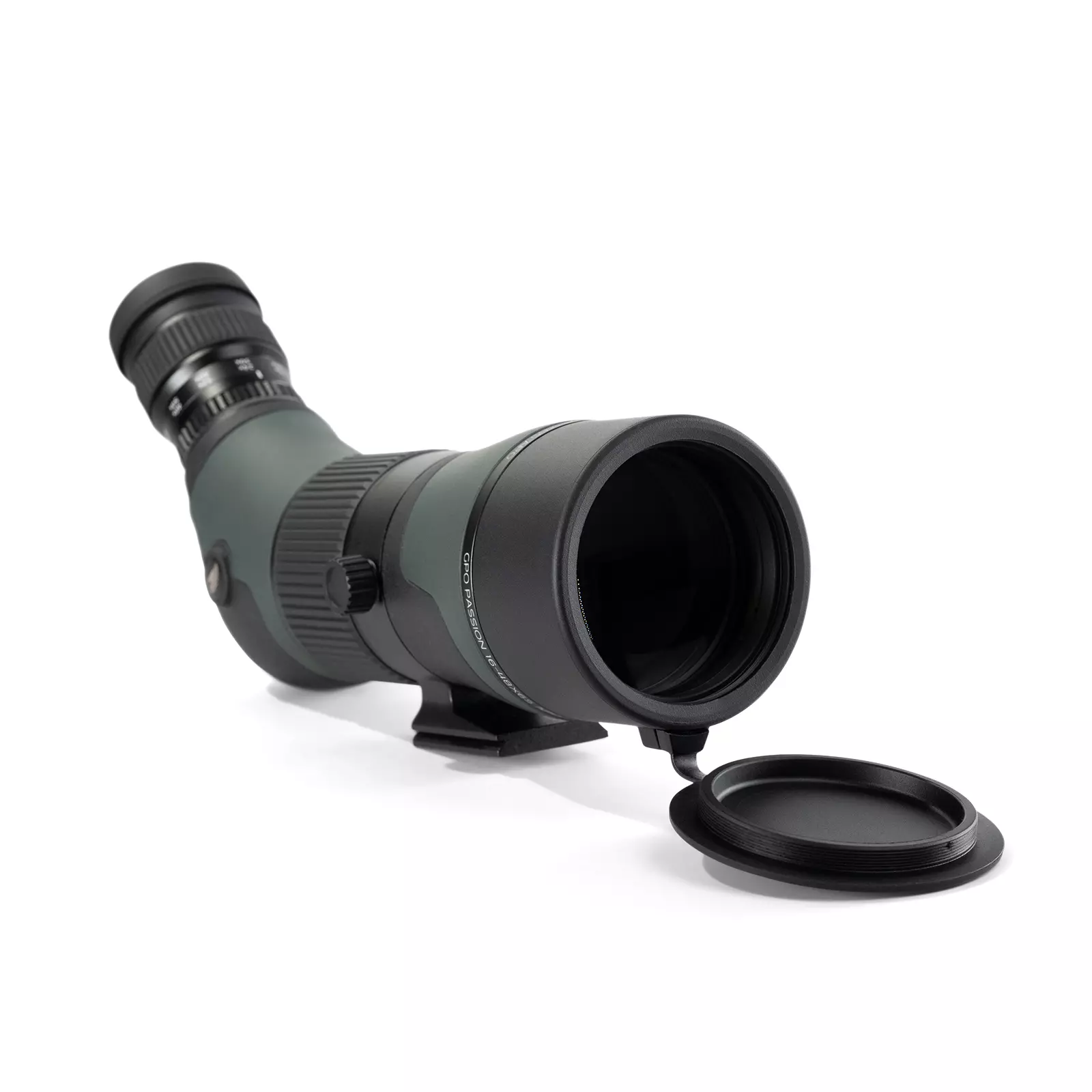
Powerful APO Spotting Scope for Precise Observations at Long Distances
The GPO PASSION™ 16-48x65 APO Spotting Scope has been designed for demanding nature observers, hunters, and outdoor enthusiasts who value the highest optical performance, precise details, and a robust construction. With its high-quality APO lens system, powerful zoom range, and compact design, this spotting scope offers an excellent combination of image quality, mobility, and ease of use.
The flexible zoom range of 16x to 48x magnification allows for both wide-area observation and detailed viewing at long distances. Combined with the 65 mm objective, the spotting scope provides a bright, high-contrast image with high resolution – ideal for observations in the field, at the shooting range, or during nature watching.
APO lens system for maximum image quality
The integrated apochromatic lens system (APO) significantly reduces color fringing and ensures particularly natural color reproduction as well as high image sharpness. Even fine details remain clearly visible – even at high magnifications or in difficult lighting conditions.
Large Zoom Range for Flexible Observations
With a variable magnification of 16x to 48x, the spotting scope can be optimally adapted to different observation situations. While the low magnification offers a wide field of view, the high magnification allows for precise detail observation at great distances.
The field of view of up to 46 meters at 1,000 meters makes it easier to locate objects, while at maximum magnification, even the smallest details can be reliably recognized.
Comfortable central focusing
The central focusing system allows for quick and precise focusing. This makes it easy to track and observe objects even at varying distances or with moving subjects.
Robust construction for outdoor use
The housing of the GPO PASSION™ spotting scope is specifically designed for use in the field. The robust construction reliably protects the optics from external influences. Additionally, the spotting scope is waterproof according to IPX5 and filled with nitrogen, which prevents the lenses from fogging up.
With its compact format and a weight of around 1.3 kg, the spotting scope remains pleasantly portable despite its strong performance and is ideal for mobile use in the area or during outdoor tours.
FAQ
What areas of application is the spotting scope suitable for?
The spotting scope is excellent for hunting, nature and wildlife observation, shooting range analysis, as well as outdoor activities.
What advantages does an APO lens system offer?
APO lenses significantly reduce color fringing and provide particularly high image sharpness as well as natural color reproduction.
Is the spotting scope weatherproof?
Yes, the housing is waterproof according to IPX5 and additionally filled with nitrogen to prevent lens fogging.
How close can the spotting scope focus?
The close focus limit is about 4 meters.
Technical Data
Magnification |
16x – 48x |
Objective Diameter |
65 mm |
Focusing |
Central Focusing |
Exit Pupil |
4.1 – 1.4 mm |
Real Field of View |
2.65 – 1.4° |
Apparent Field of View |
42 – 66 m |
Field of View at 1,000 m |
46 – 24.5 m |
Minimum Focus Distance |
4 m |
Water Resistance |
IPX5 |
Nitrogen Filling |
Yes |
Dimensions |
315 × 92 × 156 mm |
Weight |
1,301 g |
Features & Areas of Application
The GPO PASSION™ 16-48x65 APO spotting scope has been designed for demanding observations where high image quality and reliable technology are crucial. The large zoom range allows for both wide views and detailed observations at great distances.
Thanks to its compact design, the spotting scope is ideal for mobile use in the field or on longer outdoor tours. The robust and weatherproof construction ensures that the optics function reliably even in challenging weather conditions.
- Hunting and field observation
- Nature and wildlife observation
- Shooting range and hit assessment
- Outdoor and nature photography
- Professional observation applications
Technical Data
| Model | GPO PASSION™ 16-48x65 APO |
| Magnification | 16x – 48x |
| Objective Diameter | 65 mm |
| Exit Pupil | 4.1 – 1.4 mm |
| Real Field of View | 2.65 – 1.4° |
| Apparent Field of View | 42 – 66 m |
| Field of View at 1000 m | 46 – 24.5 m |
| Minimum Focus Distance | 4 m |
| Water Resistance | IPX5 |
| Nitrogen Filling | Yes |
| Dimensions | 315 × 92 × 156 mm |
| Weight | 1,301 g |
(Show description in original language)
GPO Passion 16-48x65 Apo: Spektiv mit Zoom und farbsaumarmem Bild Das GPO Passion 16-48x65 Apo ist ein Zoom-Spektiv für Jäger und Naturbeobachter, die Wild und Landschaft auf große Entfernung ansprechen wollen. Es vergrößert 16- bis 48-fach, hat ein Objektiv mit 65 mm Durchmesser und zeigt bei kleinster Vergrößerung einen Ausschnitt von 46 m Breite auf 1.000 m. Auf dem Ansitz oder im Revier suchst du mit niedriger Vergrößerung den Überblick und holst dir Einzelheiten dann per Zoom heran. Das Apo-Linsensystem soll dabei Farbsäume an Kontrastkanten mindern. Der Mehrwert liegt in der Kombination aus Zoombereich, Apo-Optik und Gehäuseschutz. Mit 1.301 g ist es aber kein Leichtgewicht. Für wen eignet sich das Passion – und für wen nicht? Geeignet für Jäger und Naturbeobachter, die vom Ansitz, vom Auto oder von einem festen Beobachtungspunkt aus weit entfernte Objekte betrachten und dafür einen großen Zoombereich wollen. Auch für Outdoor-Touren ist es nutzbar, wenn du das Gewicht von 1.301 g einplanst. Weniger geeignet, wenn du jedes Gramm sparen musst oder ein Gerät für die Jackentasche suchst: Mit 315 mm Länge und 1.301 g ist das Spektiv ein Gerät, das du bewusst mitnimmst. Zoom16-48x Wie flexibel ist der Zoombereich im Revier? Das Spektiv vergrößert stufenlos zwischen 16x und 48x, so weit das Zoomobjektiv es erlaubt. Mit 16x behältst du Wiese, Waldrand oder Gewässer im Blick, mit 48x holst du Details auf große Distanz heran. So brauchst du für Übersicht und Detailansprache kein zweites Gerät. Sehfeld46-24,5 m Wie schnell finde ich Wild im Bild? Das reale Sehfeld misst auf 1.000 m Entfernung 46 m bei 16x und 24,5 m bei 48x. Ein breiter Ausschnitt hilft dir, ein Stück Wild überhaupt zu entdecken, bevor du hineinzoomst. Bei hoher Vergrößerung führen schon kleine Bewegungen zu großen Bildsprüngen, deshalb lohnt der Weg über die niedrige Stufe. ObjektivØ 65 mm Wie viel Licht kommt am Auge an? Das Objektiv hat 65 mm Durchmesser, die Austrittspupille liegt zwischen 4,1 mm bei 16x und 1,4 mm bei 48x. Je höher du zoomst, desto schmaler wird das Lichtbündel am Okular. In der Dämmerung beginnst du deshalb besser mit der kleineren Vergrößerung. OptikApo Was bringt die Apo-Optik bei Kontrasten? Die apochromatische Linsenanordnung soll Farbsäume reduzieren, die an hellen Kanten etwa vor Himmel oder Wasser stören. Das Bild wirkt dadurch ruhiger und farbtreuer. Besonders bei hohen Vergrößerungen zahlt sich das aus. Fokusab 4 m Scharfstellen auch bei wechselnder Distanz Die zentrale Fokussierung stellt das Bild über ein einziges Bedienelement scharf. Die Naheinstellgrenze beträgt 4 m, du kannst also auch Objekte im Nahbereich betrachten. Beim Wechsel zwischen nahem und fernem Motiv musst du nur nachfokussieren. GehäuseIPX5 Wie gut ist das Spektiv gegen Nässe geschützt? Das Gehäuse ist nach IPX5 wasserdicht und mit Stickstoff gefüllt. Das soll das Beschlagen der Linsen im Inneren verhindern. So bleibt die Sicht auch bei wechselndem Wetter im Ansitz erhalten. Einsatzbereiche Ansitz und Revierbeobachtung auf Distanz Wild- und Naturbeobachtung am Waldrand oder Gewässer Vogelbeobachtung auf freier Fläche Outdoor-Touren mit festem Beobachtungspunkt Technische Daten Optik Vergrößerung 16-48x Objektivdurchmesser 65 mm Fokussierung zentrale Fokussierung Austrittspupille 4,1-1,4 mm Reales Sehfeld 2,65-1,4° Scheinbares Sehfeld 42-66° Sehfeld auf 1.000 m 46-24,5 m Naheinstellgrenze 4 m Gehäuse & Allgemein Wasserdichtigkeit IPX5 Stickstofffüllung ja Länge × Breite × Höhe 315 × 92 × 156 mm Gewicht (Gerät) 1.301 g (laut Hersteller) Einsatzzweck Jagd, Sport, Outdoor Häufige Fragen zum GPO Passion 16-48x65 Apo Für welche Situationen ist das Spektiv gedacht? Der Hersteller nennt Jagd, Sport und Outdoor als Einsatzzweck. In der Praxis passt es zu Ansitz, Revierbeobachtung und Naturbeobachtung auf größere Distanz. Ist das Bild bei 48x noch hell genug? Bei 48x sinkt die Austrittspupille auf 1,4 mm, das Bild ist dann lichtschwächer als bei 16x mit 4,1 mm. In der Dämmerung nutzt du daher besser eine niedrigere Stufe. Was ist der Unterschied zwischen realem und scheinbarem Sehfeld? Das reale Sehfeld (2,65-1,4°) beschreibt, welchen Ausschnitt der Landschaft du siehst. Das scheinbare Sehfeld (42-66°) gibt an, wie weit das Bild im Okular wirkt. Wie finde ich bei hoher Vergrößerung ein bewegliches Ziel wieder? Stelle zuerst 16x ein und suche dort im breiten Ausschnitt von 46 m auf 1.000 m. Zoome erst danach auf die gewünschte Stufe. Hält das Spektiv Regen aus? Ja, IPX5 bedeutet Schutz gegen Strahlwasser, also auch gegen Regen. Untertauchen deckt diese Schutzklasse nicht ab. Kann das Spektiv innen beschlagen? Die Stickstofffüllung soll ein Beschlagen der Linsen im Inneren verhindern. Äußere Feuchtigkeit auf den Glasflächen wischst du wie bei jeder Optik ab. Was bringt das Apo-Linsensystem? Es mindert Farbsäume an Kontrastkanten und sorgt für eine natürlichere Farbwiedergabe. Das fällt besonders bei hoher Vergrößerung auf.