Boker Tiger-Damascus
≈ $527
Price at the dealer: £399. Converted at the ECB rate as of November 16, 2026.
No permit required (18+)
BN1 1HP Brighton, United Kingdom
0
ID: 12020055
This item is currently unavailable.
Purchase from outside the EU: The firearm goes through an importer in your country, the dealer handles the export.
How buying from Europe works
Shop safely with Gunfinder
Our AI-powered seller identity verification makes Gunfinder the safest marketplace online.
Learn more
Details
- Brand
- Böker
- Category
- Condition
- New
- Location
- 🇬🇧 BN1 1HP Brighton, United Kingdom
- Availability
- Out of stock
Freshness
This listing is based on a mirrored offer, where the listing data was synced to us from a shop, dealer, or external marketplace. Please note that temporary price discrepancies may occur due to possible delays in data transmission.
- Source
- Airgun Express
- Last checked with the dealer
- about 6 hours ago
Description
Note:
The item is located abroad. Please note that delivery conditions, shipping times, and/or the purchase process may differ.
The tank parts we use come from a Tiger I of the Schwere Panzerabteilung 502, which was destroyed in combat in Latvia in the summer of 1944 in a heavily wooded area near the town of Bauska. Based on the wreckage found at the original excavation site, it was determined that this Tiger was an early to mid-production model. Examination of battle damage to the remains, military records and local historical accounts revealed that this Tiger tank collided with both a Russian T-34 medium tank and an SU-76 anti-tank gun, and was also damaged by a stationary 45-mm anti-tank gun. It is still unclear which of the impacts caused the most damage and sealed the fate of the Tiger. However, as several 76-mm fragments were lodged in the heavy armour, it is assumed that a nearby T-34 landed the decisive hits before it was destroyed 300 metres away, too.
Otto Carius and Albert Kerscher, two of the most successful tank commanders of the Second World War, were attempting to stop the advance of Soviet forces on Riga at the time, with the Schwere Panzerabteilung 502. The division was able to so devastatingly defeat the enemy blockade forces near Tukums that it was able to retreat to the Latvian Courland together with more than 500,000 other soldiers of the Heeresgruppe Nord. There the forces were encircled in the further course of the Soviet advance. The Kurland Cauldron served as a bridgehead and could be supplied by the Kriegsmarine via sea. It withstood six major attacks by Soviet forces until the unconditional surrender on 8 May, 1945.
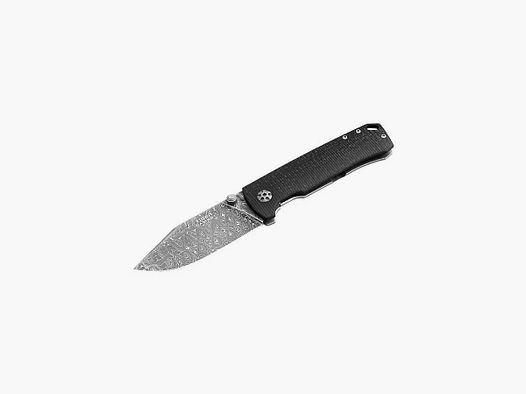
The straight-edged Boker Tiger-Damascus is equipped with a unique damascus blade made from the steel of the battle tank destroyed at Bauska. The non-stainless mosaic damascus is forged for us by hand by Chad Nichols in the Intrepid pattern and is reminiscent of the tank tracks left in the ground by the Tiger’s heavy tracks. Unlike conventional damascus, the production of mosaic damascus does not create layers, but complex damascus bars are forged by hand into a mosaic in an elaborate and very complicated process. The ball-bearing blade is opened by a thumb stud and locked by a sturdy steel framelock with a stonewash finish, while a Hinderer lock-stop acts as an over-extension protection for the lock. The overall shape of the knife pays homage to the famous lines of the tank, while the decorative pivot screw is modelled on the main drive sprocket. The slightly contoured handle scales made of burlap micarta are provided with precisely milled grooves, which are reminiscent of the characteristic surface structure of the Zimmerit coating of German armoured vehicles. With lanyard hole and milled clip (tip-up/r) with steel ball. Handmade in the Boker Knife Manufactory in Solingen. Supplied with a classy suspended display, a certificate of authenticity and an individual serial number.
Specifications:
Type: Pocket Knife
Brand: Boker
Engraving: No
Overall Length: 20 cm
Blade Length: 8.50 cm
Blade Thickness: 4 mm
Weight: 139g
Blade Material: Damascus
Handle Material: Micarta
Opener: Thumb Stud
Opening: Manual
Lock Type: Framelock
Made in: Solingen
Item Number: 111103DAM