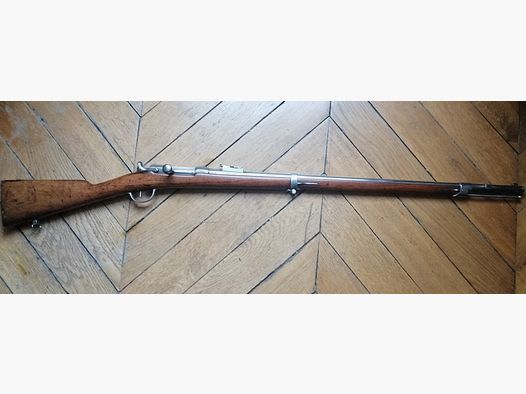
Very nice Chassepot rifle model 1866 2nd type – Manufacture 1869 – Saint Étienne – monomatricule yc. cleaning rod – TBE +
Price on Request
Purchase permit required
75002 Paris, France
7
ID: 10339181
This item is currently unavailable.
Purchase from outside the EU: The firearm goes through an importer in your country, the dealer handles the export.
How buying from Europe works
Shop safely with Gunfinder
Our AI-powered seller identity verification makes Gunfinder the safest marketplace online.
Learn more
Details
- Original language
- French
- Category
- Purchase eligibility
- Required
- Condition
- New
- Location
- 🇫🇷 75002 Paris, France
- Availability
- Out of stock
Freshness
This listing is based on a mirrored offer, where the listing data was synced to us from a shop, dealer, or external marketplace. Please note that temporary price discrepancies may occur due to possible delays in data transmission.
- Source
- Flingus Maximus
- Last checked with the dealer
- 1 day ago
Description
Note:
The item is located abroad. Please note that delivery conditions, shipping times, and/or the purchase process may differ.
600 Garibaldians down…
After announcing that six hundred Garibaldians had been killed by the rifles of the French Corps he commanded at the Battle of Mentana, the expedition’s leader, General de Failly, ended his telegram with these now-famous words: “Our Chassepot rifles worked wonders!”
It’s true that our Chassepots worked wonders at Mentana on November 3, 1867—the new rifle’s first military engagement. This pitched battle pitted the allied Papal troops against the French expeditionary corps sent by Napoleon III, on the (often poor) advice of the very Catholic Empress Eugénie, to help the Pope, who had come under attack from Garibaldians (often anarchist-leaning themselves)…
General de Failly was, of course, criticized for his unfortunate remark, which was seen as showing contempt for human life. Questions in the Chamber, scathing articles in the European press. Criticism is easy, but the art is difficult.
General du Barrail, whose memoirs are well worth reading (vol. III, p. 108), offered a more objective assessment of a phrase taken out of context:
“Misguided public opinion saw a lack of compassion in this phrase, for which he was so heavily criticized, even though it was entirely natural for a commander reporting on the performance of a new weapon.”
I would add, along with du Barail, that Emperor Napoleon III himself was deeply passionate about military technology and inventions, personally oversaw the quality of the armaments, personally conducted many trials, personally intervened to have the new rifle adopted, and appreciated the after-action report for what it was…
The rifle had only just been adopted in 1866, and it was reasonable to wonder how it would perform under real operational conditions. A commander wanting to impress his superior by sharing very good news in an area of interest to that superior is hardly anything new, either. Even if that would surely never happen at all nowadays 🙂
It’s true that this first French Army breech-loading rifle, which used a paper cartridge, allowed firing from a prone position and offered a rate of fire previously unheard of for a bolt-action rifle, was innovative. Yet everything depended on a rubber seal that made the breech gas-tight… The Chassepot proved its worth once again during the 1870 war, showing itself to be significantly superior to the German Dreyse it was designed to counter.
Antoine-Alphonse Chassepot, son and nephew of arms inspectors and a worker at the Saint Étienne arms factory, certainly deserved the Legion of Honor and the 30,000-franc prize awarded for his invention.
A very fine example of a Chassepot Model 1866 rifle, made in late 1869 in Saint Étienne.
This one is in truly beautiful condition.
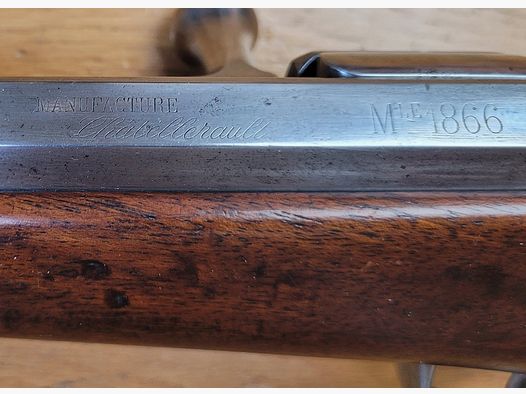
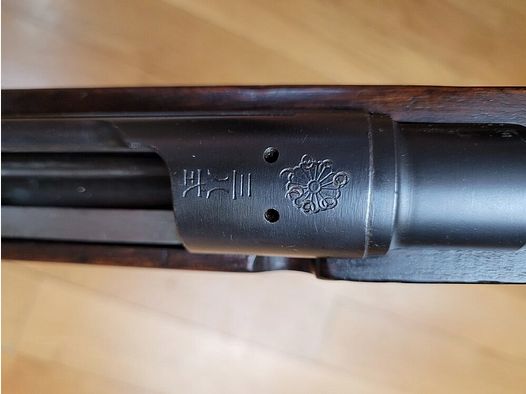
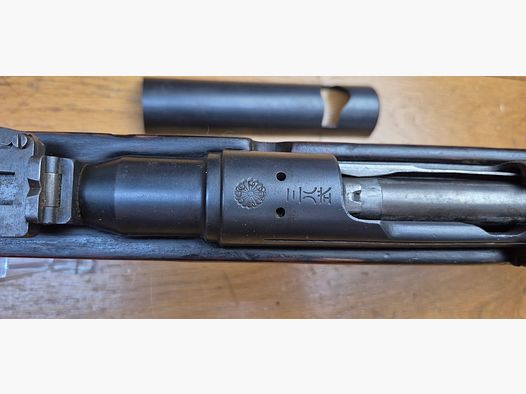
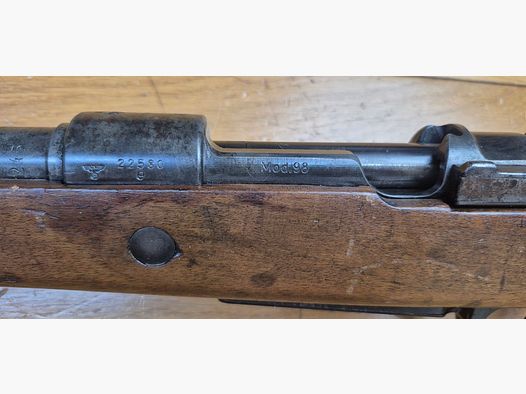
Metal is in perfect condition, with no oxidation or pitting. All proof marks and markings are clearly visible and legible. The arsenal and model engravings are crisp and unworn. Saint Étienne manufacture, clearly marked “S 1869.” The metalwork is in very fine condition.
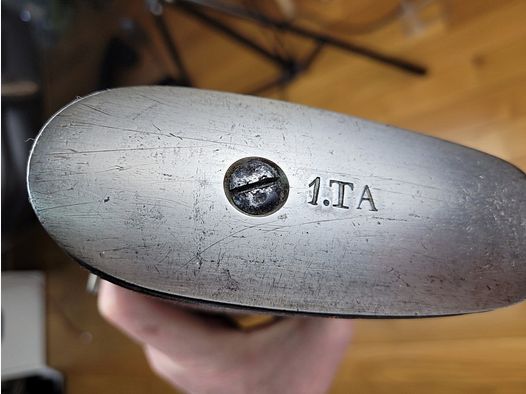
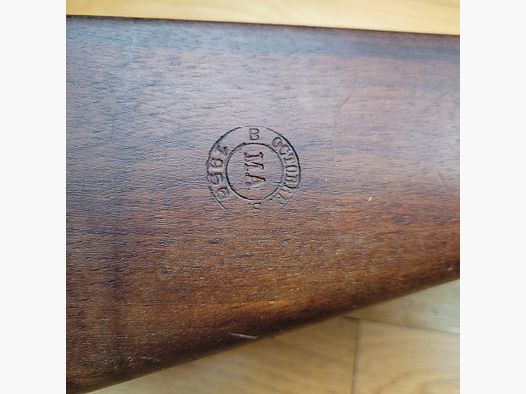
The wood is also in excellent condition, despite one small, shallow dent on the left side and a few usual handling marks. Otherwise, it is truly beautiful: no cracks, repairs, or wormholes. The cartouche is still legible, with its boxwood insert intact, dated January 1870. The rifle must have been prepared using parts made in late 1869 and assembled or accepted early in 1870. The stock proof marks are crisp. Proof marks are consistent throughout. The buttplate is immaculate.
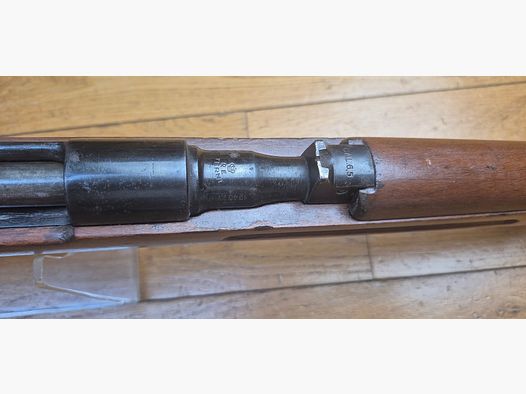
This is a second-type rifle (rounded breech tang, checkered bolt handle). Production of the first type ended in spring 1869, so this is one of the first second-type rifles.
Mechanically flawless—percussion
Crisp trigger – good spring – perfect lockup, with a barrel that needs cleaning but is absolutely mirror-bright, with sharp, deep rifling. I’ve never seen a barrel this beautiful on a Chassepot!
The rear sight is the 1st type, from before 1874.
A very beautiful, well-matched firearm in excellent condition, increasingly hard to find for an Imperial.
The icing on the cake: it’s completely matching-numbered, including the cleaning rod. This has become VERY RARE.
Ammunition and shooting kits are readily available on the market—for example, from H&C.
In short, a classic firearm in excellent condition, emblematic of the conflict period (July 1870 – late January 1871), matching-numbered and perfectly well-matched. A choice addition to a collection of French service firearms.
Category D firearm under the CSI: valid ID card or passport required
*********************************************************************************************************************************************************************************************************************
Let’s say it again! Flingus Maximus gun shop in Paris and throughout France is also here to help with private firearm transfers, buying firearm and militaria collections, firearm appraisals, and questions about firearms in estates and inheritances. Contact your favorite gun dealer using our contact form or at [email protected]
Reminder: All collectible, hunting, and shooting firearms are used and sold as-is, without warranty.
All antique firearms sold as Category C or D, “Collection” or “Cowboy shooting” are collectible firearms that have not been proof-tested for shooting or tested at a range. They have been visually inspected for their general condition and mechanics, but none have been used for shooting, so they are sold as untested. Anyone wishing to use a firearm for shooting must first contact the National Proof House of Saint Étienne, the only body authorized to issue proof certificates before use for shooting. (Show description in original language)
Fusil réglementaire français Chassepot modèle 1866 en excellent état et monomatricule. Calibre 11mm Chassepot.
600 Garibaldiens au tapis…
Après avoir annoncé que six cents garibaldiens avaient trouvé la mort face aux fusils du Corps français qu’il commandait à la bataille de Mentana, le chef de l’expédition, le Général de Failly, terminait son télégramme par ces mots restés fameux : » Nos fusils Chassepot ont fait merveille ! »
Il est vrai que nos Chassepots avaient fait merveille à Mentana le 3 novembre 1867 – 1er engagement militaire du dit nouveau fusil. Cette bataille rangée opposait les troupes pontificales alliées au corps expéditionnaire français envoyé par Napoléon III sur les (souvent mauvais) conseils de la très catholique Impératrice Eugénie pour venir en aide au Pape pris à parti par des Garibaldiens (eux, souvent) anarchisants…
On reprocha évidemment au Général de Failly son mot malheureux comme teinté de mépris pour l’humanité. Interpellations à la Chambre, articles acides dans la presse européenne. La critique est aisée mais l’art est difficile.
Le général du Barrail, dont les mémoires méritent lecture (t. III. p. 108), fit un jugement plus objectif d’une phrase sortie de son contexte:
« L’opinion égarée vit un manque de cœur dans cette phrase qu’on lui reprocha tant et qui pourtant était toute naturelle dans la bouche d’un chef rendant compte des effets d’une arme nouvelle. »
J’ajouterai avec du Barail que l’Empereur Napoléon III lui-même était absolument passionné de techniques et inventions militaires, veillait personnellement à la qualité de l’armement, procédait personnellement à nombre d’essais, était tout aussi personnellement intervenu pour l’adoption du nouveau fusil et apprécia à sa juste valeur le RETEX….
Le fusil venait d’être adopté en 1866 et on pouvait légitiment s’interroger sur ce qu’il donnerait en conditions opérationnelles réelles. Qu’un chef ait voulu se faire mousser en annonçant à son supérieur une très bonne nouvelle, dans un domaine d’intérêt pour le dit supérieur, n’est pas non plus d’une grande nouveauté. Même si cela n’arriverait sûrement plus du tout de nos jours 🙂
Il est vrai que ce premier fusil à chargement par la culasse de l’armée française, fonctionnant avec une cartouche papier, permettant le tir couché et une cadence de tir inconnue jusque là pour un fusil à verrou, était novateur. Pourtant tout tenait à un joint de caoutchouc faisant étanchéité dans la culasse… Le Chassepot prouva encore une fois sa valeur durant la guerre de 1870 en se révélant sensiblement supérieur au Dreyse allemand auquel il était censé répondre.
Il valait donc bien à Antoine-Alphonse Chassepot, fils et neveu de contrôleur d’armes, et ouvrier à la Manufacture d’armes de Saint Étienne de son état, la légion d’Honneur et le prix de 30.000 francs que lui valurent son invention.
Très bel exemplaire de fusil Chassepot modèle 1866 fabriqué fin1869 à Saint Étienne.
Celui-ci est dans un état véritablement très beau.
Métal sans aucune oxydation ou piqûre en parfait état – tous les poinçons ou marquages sont bien visibles et lisibles – les gravures d’arsenal et de modèle sont bien nettes et pas usées. Fabrication de St Étienne bien Marquée « S 1869 ». Très bel état des fers.
Les bois sont en excellent état aussi nonobstant une seul et unique petit coup peu profond sur le coté gauche et quelques traces usuelles de manipulation – sinon vraiment très beaux ( ni fracture, ni enture ni vers) – Macaron encore lisible avec son insert de buis bien présent de janvier 1870 – l’arme a du être préparée sur des fers de fin 69 et assemblée ou réceptionnée en début d’année 1870 – les poinçons du bois bien nets. Poinçons bien homogènes partout. Plaque de couche impeccable.
C’est un deuxième type (queue de culasse arrondie – tige d’armement de culasse quadrillée). La fabrication du 1er type a cessé au printemps 1869. C’est donc un des premiers deuxième type.
Fonctionnement mécanique irréprochable – percussion franche – bon ressort – verrouillage parfait avec un canon à nettoyer mais absolument miroir aux rayures bien nettes et bien profondes – je n’ai jamais vu un canon aussi beau sur un Chassepot !
La hausse est bien du 1er type avant 1874.
Très belle arme très homogène dans un état excellent qui devient très difficile à trouver pour un Impérial.
Cerise sur le gâteau, il est intégralement monomatricule y compris baguette. C’est devenu TRÈS RARE.
Des munitions et kit de tir sont disponibles facilement sur le marché – chez H&C par exemple.
Bref une arme classique dans un état excellent – emblématique de la période du conflit (juillet 1870 – fin janvier 1871) mono matricule et parfaitement homogène – Addition de choix pour une collection d’armes réglementaires françaises.
Arme de catégorie D au CSI : pièce d’identité, CNI ou passeport, en cours de validité obligatoire
*********************************************************************************************************************************************************************************************************************
Répétons le ! L’armurerie Flingus Maximus à Paris et partout en France est là aussi pour vos formalités armes entre particuliers, le rachat de collections armes et militaria, vos estimations d’armes, vos questions armes dans les successions et héritage. Contactez votre armurier préféré via notre formulaire de contact ou à [email protected]
Rappel : Toutes les armes de collection, de chasse, et de tir sont d’occasion et sont vendues dans l’état, sans garantie.
Toutes les armes historiques de fabrication ancienne vendues en tant que C ou D, “Collection” ou “Cow-boy shooting”, sont des armes de collection non éprouvées pour le tir et non testées en stand. Elles ont été inspectées visuellement relativement à leur état général et mécanique mais aucune n’a été utilisée au tir et elle sont donc vendues comme non testées. L’acquéreur désirant utiliser une arme pour le tir devra impérativement se rapprocher préalablement du banc National d’Épreuve de Saint Étienne, seule entité habilitée à délivrer des certifications d’épreuves préalable à un usage de tir.