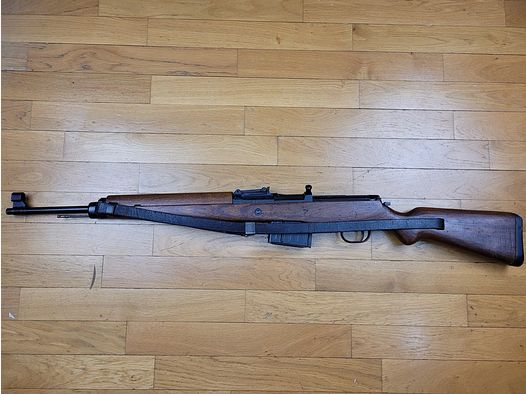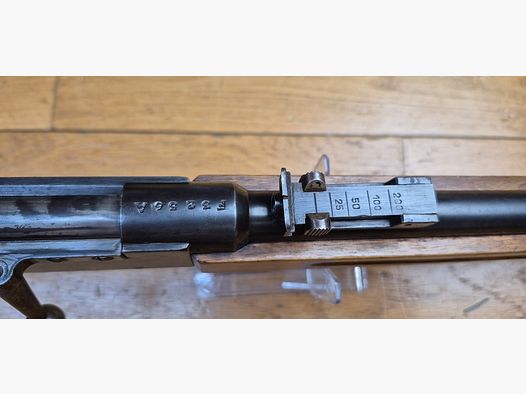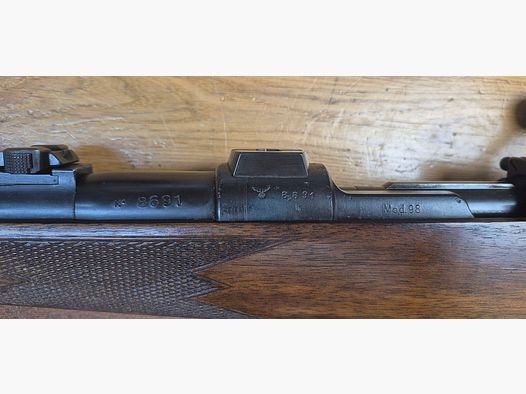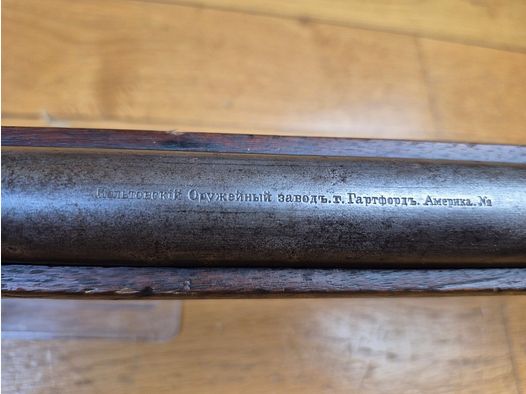
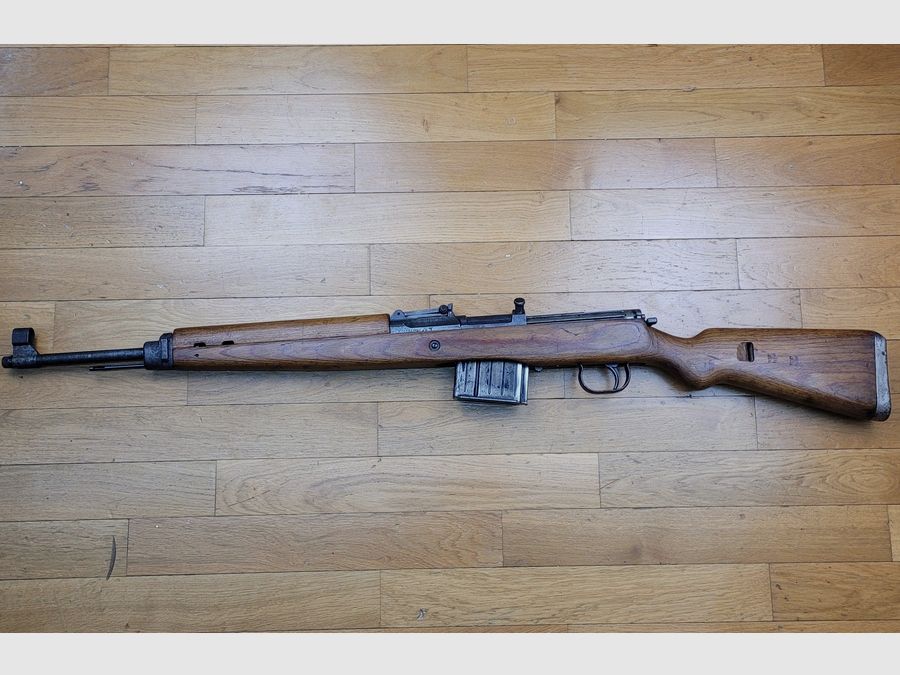









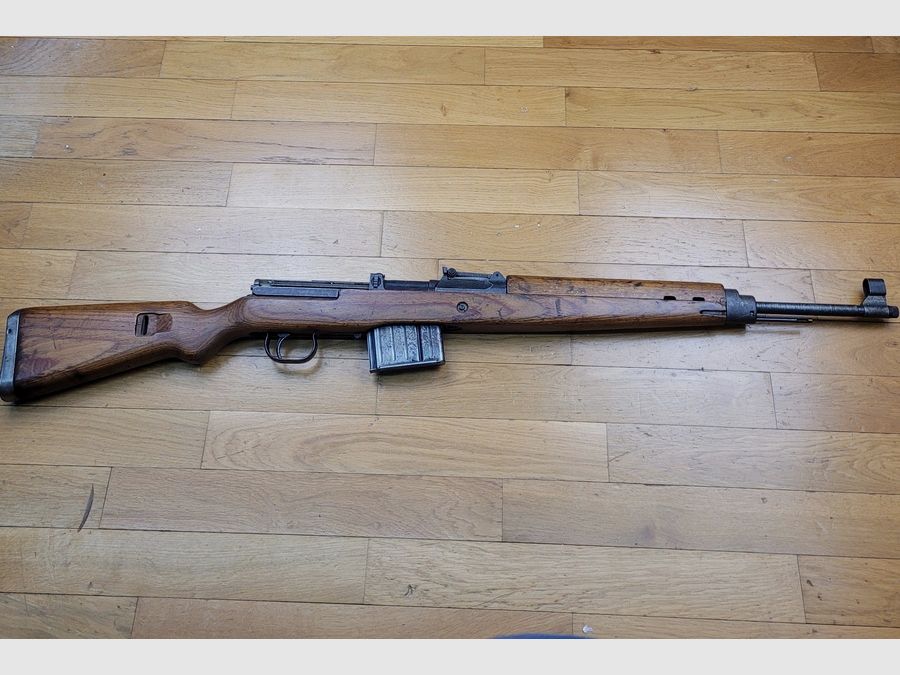



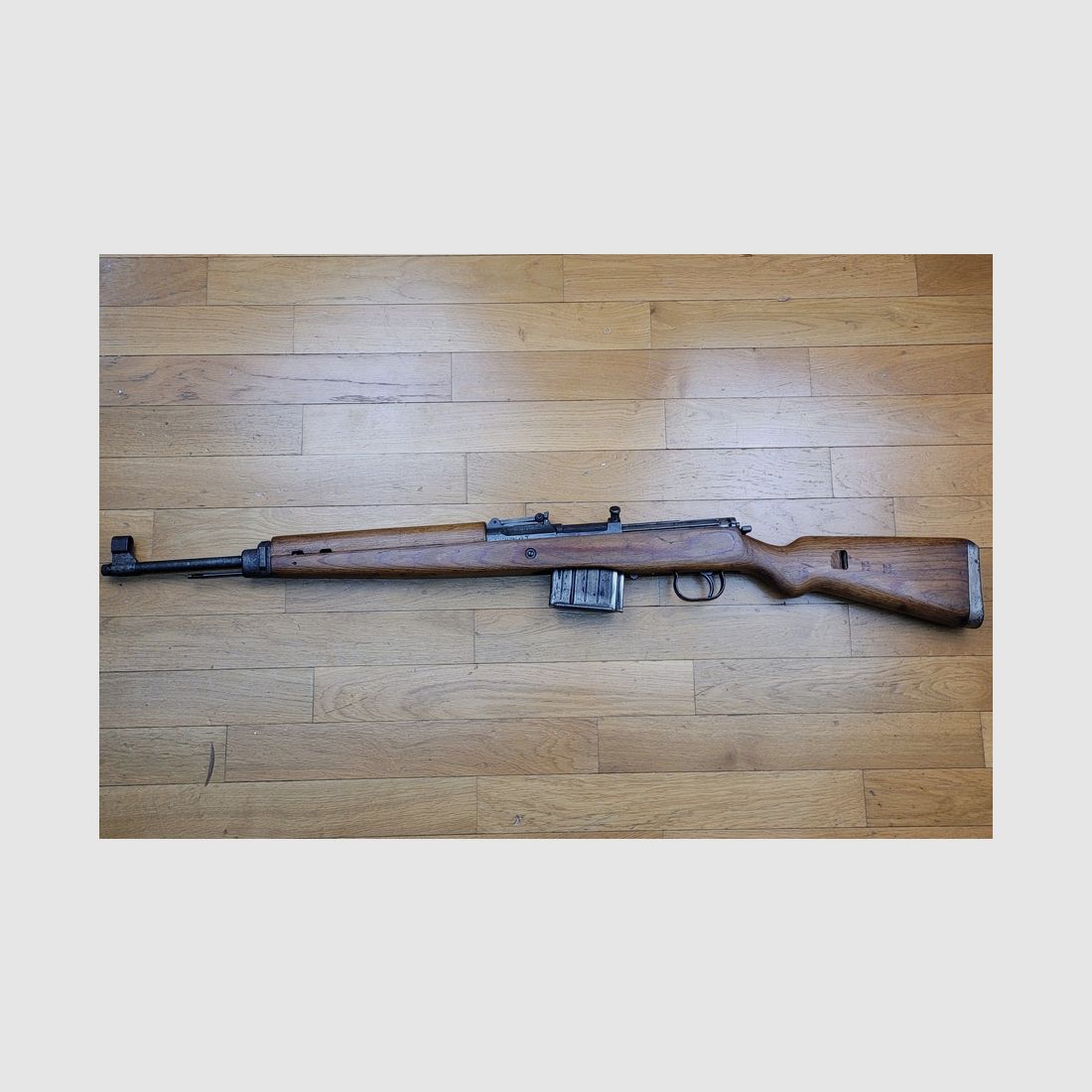







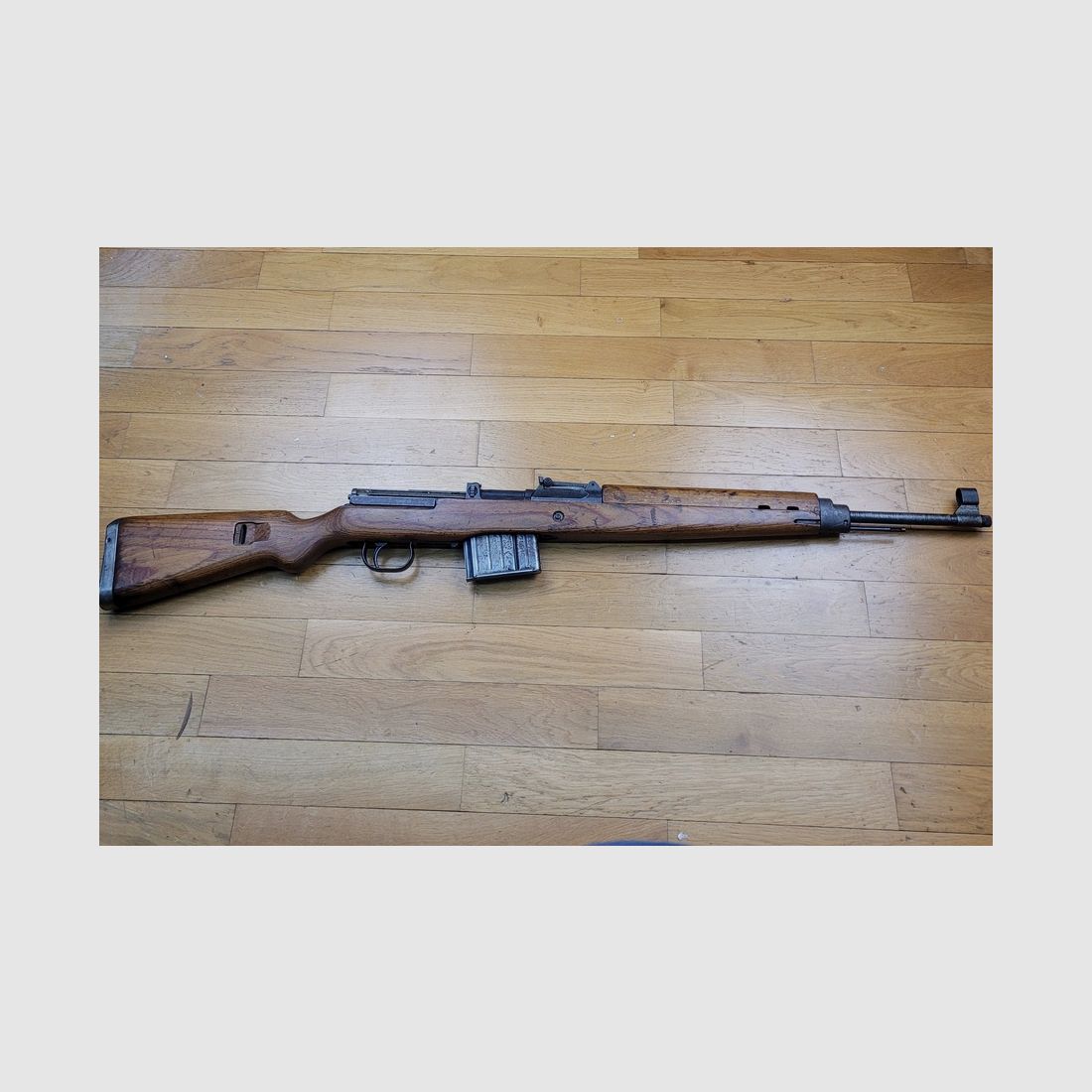



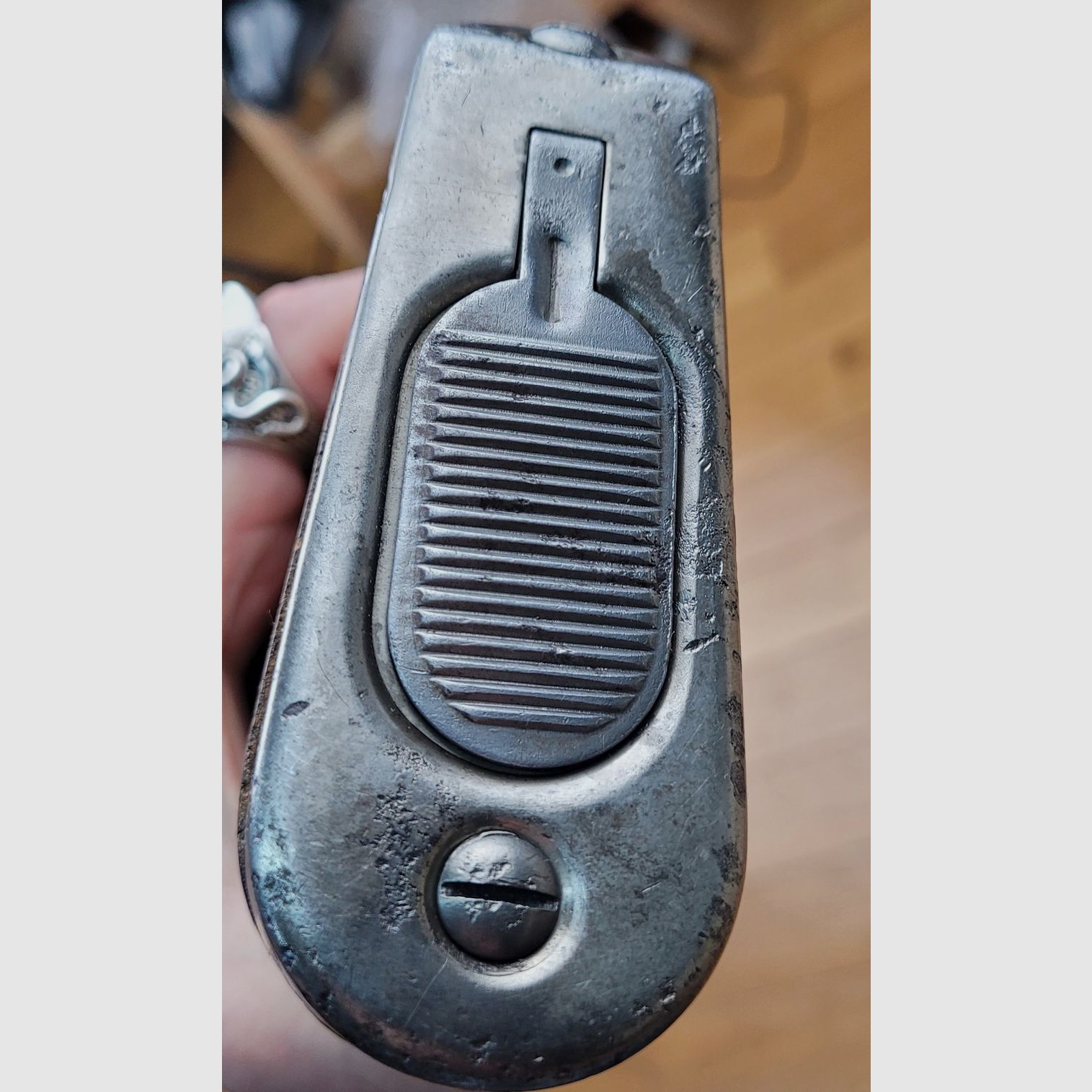
Very beautiful and very rare German semi-automatic rifle Walther G43 – Rare production by « bcd » from May/July 1944 for the SS – Monotoken weapon – beautiful stamps « eagle star » and Saint-Etienne – beautiful wood – « mythical » weapon of WWII – TBE ++
Price on Request
Purchase permit required
75002 Paris, France
9
ID: 10338915
This item is currently unavailable.
Purchase from outside the EU: The firearm goes through an importer in your country, the dealer handles the export.
How buying from Europe works
Shop safely with Gunfinder
Our AI-powered seller identity verification makes Gunfinder the safest marketplace online.
Learn more
Details
- Original language
- French
- Brand
- Walther
- Category
- Purchase eligibility
- Required
- Condition
- New
- Location
- 🇫🇷 75002 Paris, France
- Availability
- Out of stock
Freshness
This listing is based on a mirrored offer, where the listing data was synced to us from a shop, dealer, or external marketplace. Please note that temporary price discrepancies may occur due to possible delays in data transmission.
- Source
- Flingus Maximus
- Last checked with the dealer
- 1 day ago
Description
Note:
The item is located abroad. Please note that delivery conditions, shipping times, and/or the purchase process may differ.
And above all, it’s a rare one.
Let’s hope the saying “never two without three” holds true.
But first, a bit of history.
You can’t really say the German army shone for its innovation skills, especially conceptual ones, in individual weapons between 1914 and 1918. Most of the effort was done by private companies like Mauser or Luger (who was Austrian) before 1914.
Where is the German Chauchat? Where is the light machine gun like the Lewis (the 08/15 weighs 17kg!)?
Worse.
Where are the FSA 17, the Meunier, and other German Fedorov 1916s?
Answer: nowhere. Not even as trials pushed to the front lines.
Their only real innovation in individual weapons was limited to the PM 18 at the end of the war. That’s important but it’s far from being a rifle or a support weapon with the cartridge power that implies.
But no automatic or semi-automatic assault rifle or “light machine gun” in their ranks. No repeating weapon simple enough to use and with a strong enough caliber to support the basic infantry group and that can be carried by a single man. The German infantryman’s assault weapon in 14-18 was the grenade.
And it didn’t get better between 1918 and 1941. Between factory destructions (from 1920 only Simson&Co in Suhl could legally produce), the Versailles Treaty clauses, and doctrinal reluctance towards novelty, no serious semi-auto weapon was developed in Germany.
Only Walther, who had to innovate in Switzerland, stood out around 1930 with a prototype rifle called “A115”, a gas-operated semi-auto with a fixed magazine (and no detachable magazine), a device that, in the few archive images, strongly reminds us of our object today or rather its older brother from 1941 that we will talk about again.
This modest Walther experience was not lost.
And it was on the basis of this experience that Walther earned its central role in Germany’s recovery in semi-automatic rifles.
Germany thus entered World War II well equipped with SMGs and machine guns but without a worthy semi-auto or automatic infantry support weapon. It had neither Garand, nor SVT40, nor FM29, nor Bren…
Some will answer “MG34”, the famous “light and versatile” machine gun. I’ll answer “12 kilos with the bipod and no ammo!” Have fun with precision, single shots, or alone, holding that at arm’s length against a group of men at 300 meters who, normally, are armed too… And there will always be fewer of those than semi-auto rifles. In fact, it’s not quite the same tactical use, especially in urban combat.
And in 1941, when it launched into Russia, the disappointment was heavy for the German army still massively equipped with its good old K98, which is nothing but a shortened G98. The Russians, on the other hand, were widely equipped not only with PPSH submachine guns (and its formidable 71-round magazine in the very good 7.62TT) but also with the excellent SVT40, a true semi-automatic rifle with a heavy cartridge that impressed them from the start. Even its automatic AVT40 version (a lesser success). But that’s another story I told you here.
The Walther Germans, working on a prototype since entering Russia, decided to copy what seemed good to them in the Russian SVT40 while keeping what they considered promising innovations from their own prototype (innovations inspired by the Swedish Bang system with rotating bolt and gas recovery at the muzzle end).
But these technical choices were made on a semi-auto system on which they had no prior experience or con...
ception, neither in production nor in the field. Especially regarding the gas-operated model. That didn’t end well for them.
Sure, it’s the Walther semi-automatic rifle Gewehr41 or G41 (which completely failed to meet the specifications since they were so complex) that won during tests against a Mauser prototype. But, to put it mildly, it’s not a technological triumph.
By the way, this famous specification imposed at least three bizarre constraints on manufacturers that caused far more problems than solutions:
1) not to drill the barrel even to recover the gas (so as not to harm accuracy… of a weapon operationally intended to shoot at 200 to 500 meters at most!),
2) to have all moving parts inside the weapon,
and, to top it all off,
3) to be able to operate manually in case of semi-automatic system failure.
In short, everything to complicate a project with ideas that Russians and Americans had long abandoned.
Shall we sum up this G41?
Complex, unreliable in the field, fragile, and with accuracy problems when heated, especially for the M version. Needs a rewrite. But the German army was so “behind” in semi-autos in 1941 that they launched production anyway!
Two versions of the G41, the M (by Mauser) and the W (by Walther), were produced in total at less than 145,000 units. The weapon, especially in its W version, is usable and nice at the range, very interesting mechanically, but far from reliable and robust enough for use on the harsh Eastern Front. The M version is worse and never saw lasting operational use. But, W or M, they are rare and highly sought after nowadays. Master Flingus has been chasing a good M version, which is almost “prototype-like” in fact, for years. And the more reliable G41 W are not much more common. Even very rare. All that was lost in the East. A legend that Master Flingus finally managed to seize here exceptionally.
Some data to illustrate the scale of the G41 problem: M version has 8 moving parts just to operate the bolt back and forth and 18 springs in total, still in the M version (not all the same). A kind of world record. And the “simplified” W version, certainly more reliable and a bit lighter, remains complex and quite difficult to maintain at the front.
To top it all off, manufacturing was a nightmare, especially at Mauser, already overwhelmed by 98K production. It was nevertheless produced in the W version until March 44 alongside our G43. The M version was abandoned as early as December 1942.
For the G41 M, production stopped at only 6,673 units (and less than 130,000 for the W), of which… 1,673 were directly returned to the Materiel and then to the manufacturer. G41 M and W are in any case very rare weapons today that delight wealthy collectors, especially in the USA. Note that at the range it still shoots very straight and is fascinating to handle.
But it couldn’t end there, and a reaction was needed to equip the best soldiers (because these expensive semi-autos weren’t entrusted to just anyone) with a semi-automatic weapon capable of withstanding the harsh Eastern campaign.
They simply started by recovering masses of SVT 40 taken from the Russians during the terrible summers of ’41 and ’42 and made it a standard weapon in the German army under the name “G.259(r)”. That was still the easiest. The 7.62×54 R ammo was abundant due to the captures as well.
Then, above all, they finally decided to simply copy the operating system of the SVT 40 and adapt it to the excellent 8x57IS. This is the birth of our splendid Gewehr 43 or K 43 of today.
The chosen gas-operated system is short-stroke piston with gas tapped from a barrel port just like on the SVT 40 and...
this Russian system will become a standard on all modern firearms. The SKS 45 and the AK47 will not adopt other solutions. To hell with the honour of the German engineers.
At the price of swallowing this bitter pill, the G43 is a good rifle but, according to many, remains inferior in combat conditions to the SVT40, which is simpler and lighter (3.8 kg versus 4.4 for the G43). In this category, the Garand is also a very good rifle on the level of the SVT but heavier (4.3kg) and a bit less well balanced in my opinion. The G43 is probably a bit better balanced than the Garand, which is surprisingly robust. And its operational history is a bit different. Collector/shooter friends, make your choice!
That said, the G43 is a quality weapon, accurate, reliable, effective, and will get the job done and can stand up to its Eastern adversaries. It even became a legend through its lines, inseparable from the silhouette of the elite Landser hardened on the Eastern Front. It was renamed “K43” for “Karabiner” in 1944 if I recall correctly.
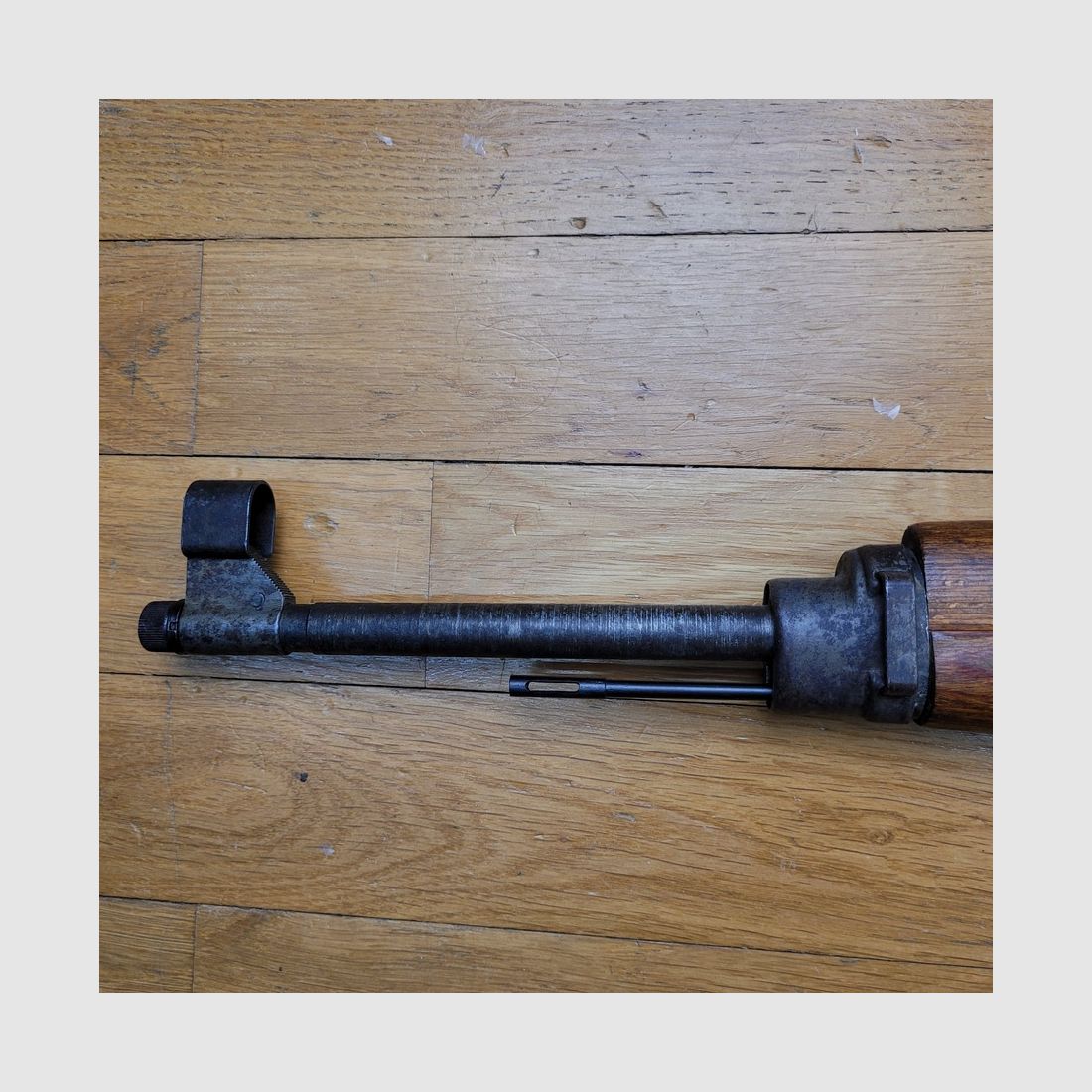
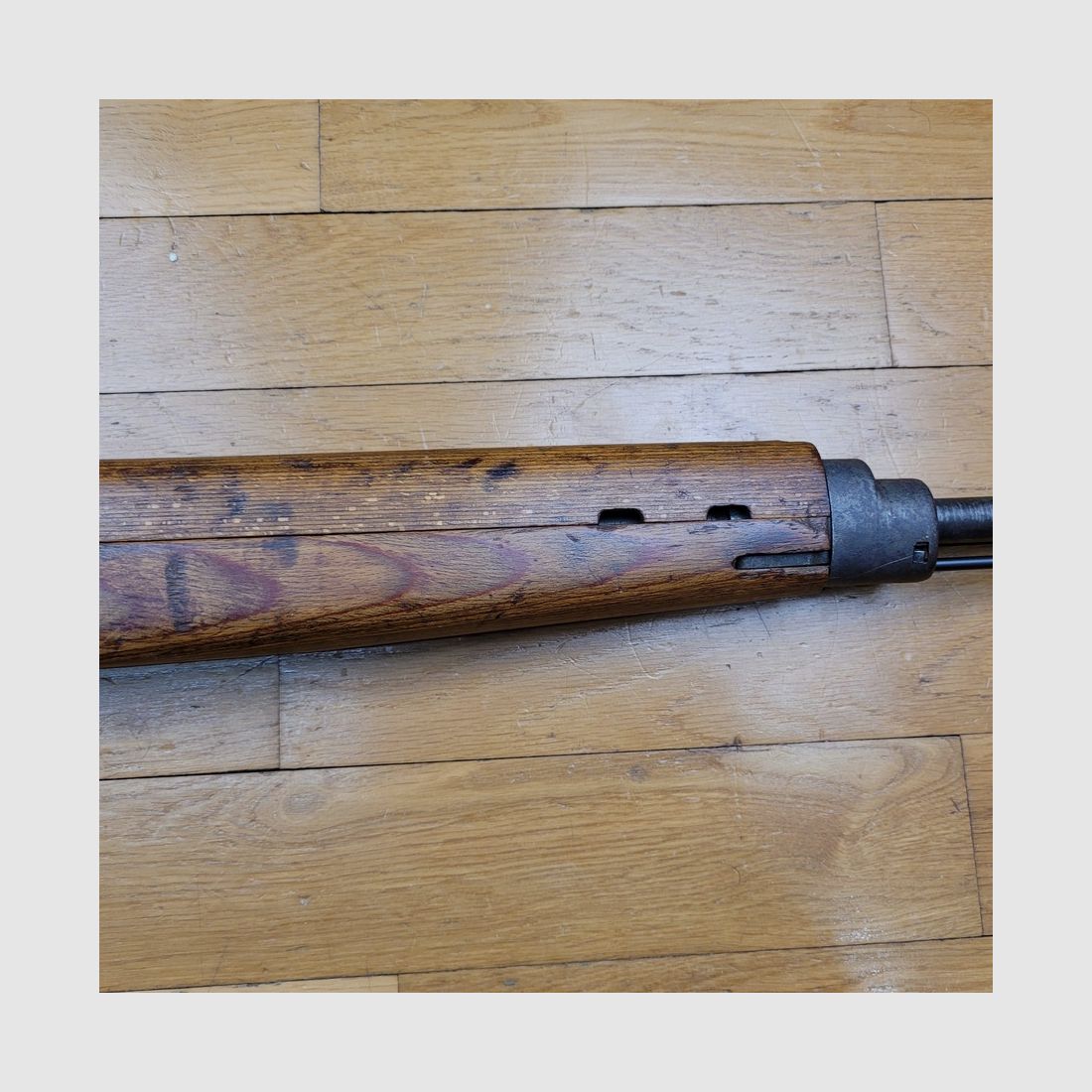
The operational reliability of the G43 in field conditions (especially cleaning) is day and night compared to its older brother from 1941 with gas recovery at the muzzle. As a result, the barrel sleeve that characterised the G41 disappeared, making the weapon not only more reliable but also much more stylish.
Finally, and this is no small thing (one wonders how, in 1941, they could have thought otherwise!), the magazine finally became detachable, which simplifies quite a few things as well.
I won’t lecture you on the qualities and ease of finding and reloading the 8x57IS cartridge but that also counts.
In the end, in 1943, the German army finally had with our G43 the reliable and effective semi-automatic rifle of its dreams. Seven years after the Russians and Americans and 25 years after others had started implementing the idea. But it was here. A real revolution compared to the good old K98.
The weapon was produced in 415,000 units (compared to 15 million or more K98s of all variants) mainly used on the Eastern Front.
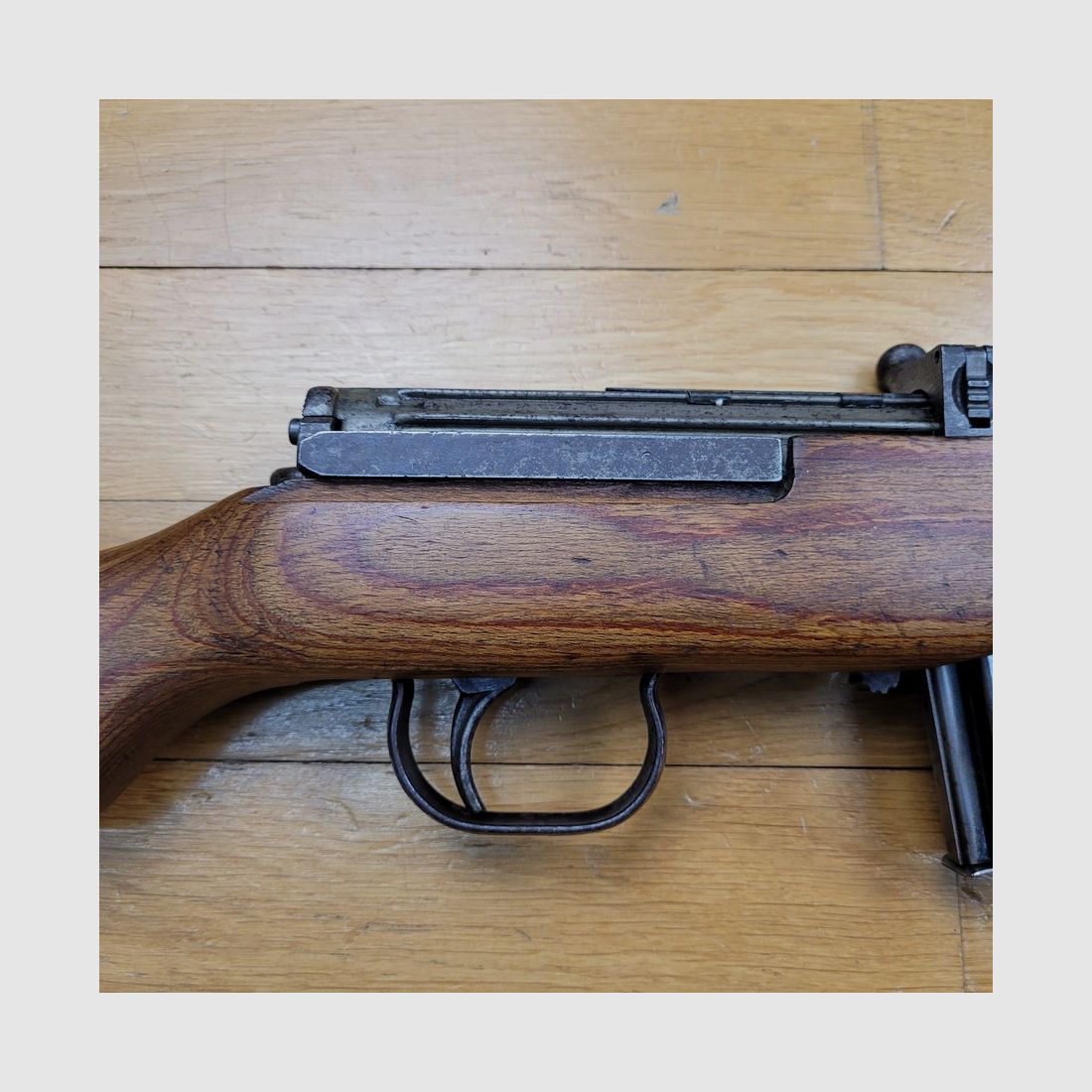
Note that the G43 is equipped as standard with a rail on the right side to mount a ZF4 type scope (or its reproduction). This weapon was indeed widely used for precision shooting at less than 400/500 meters. Between 53,000 and 57,000 weapons, depending on sources, left the factory equipped with this scope.
An excellent combat weapon, widely used and often by elite troops, this weapon has become somewhat iconic with video games and quite difficult to find. Very sought after in any case.
***********************************************************************************************************************
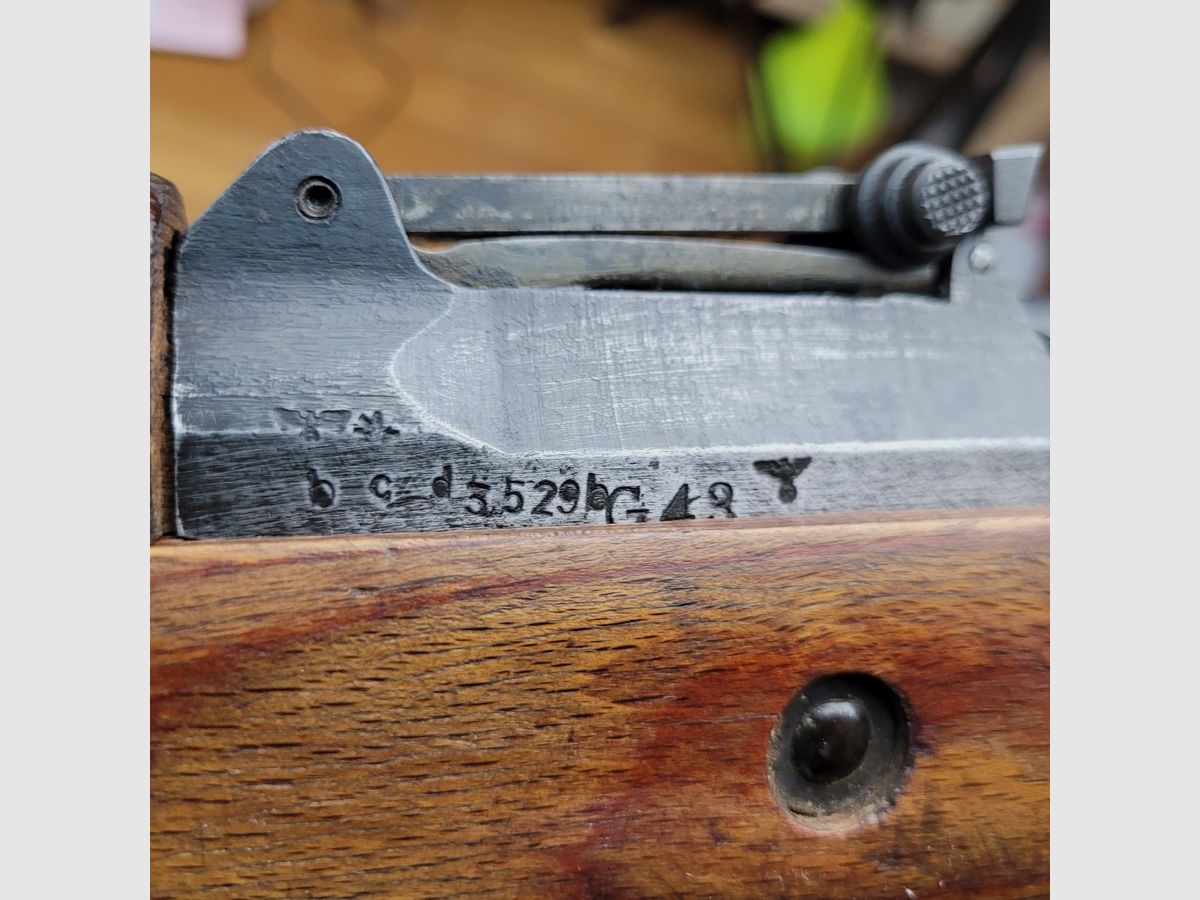
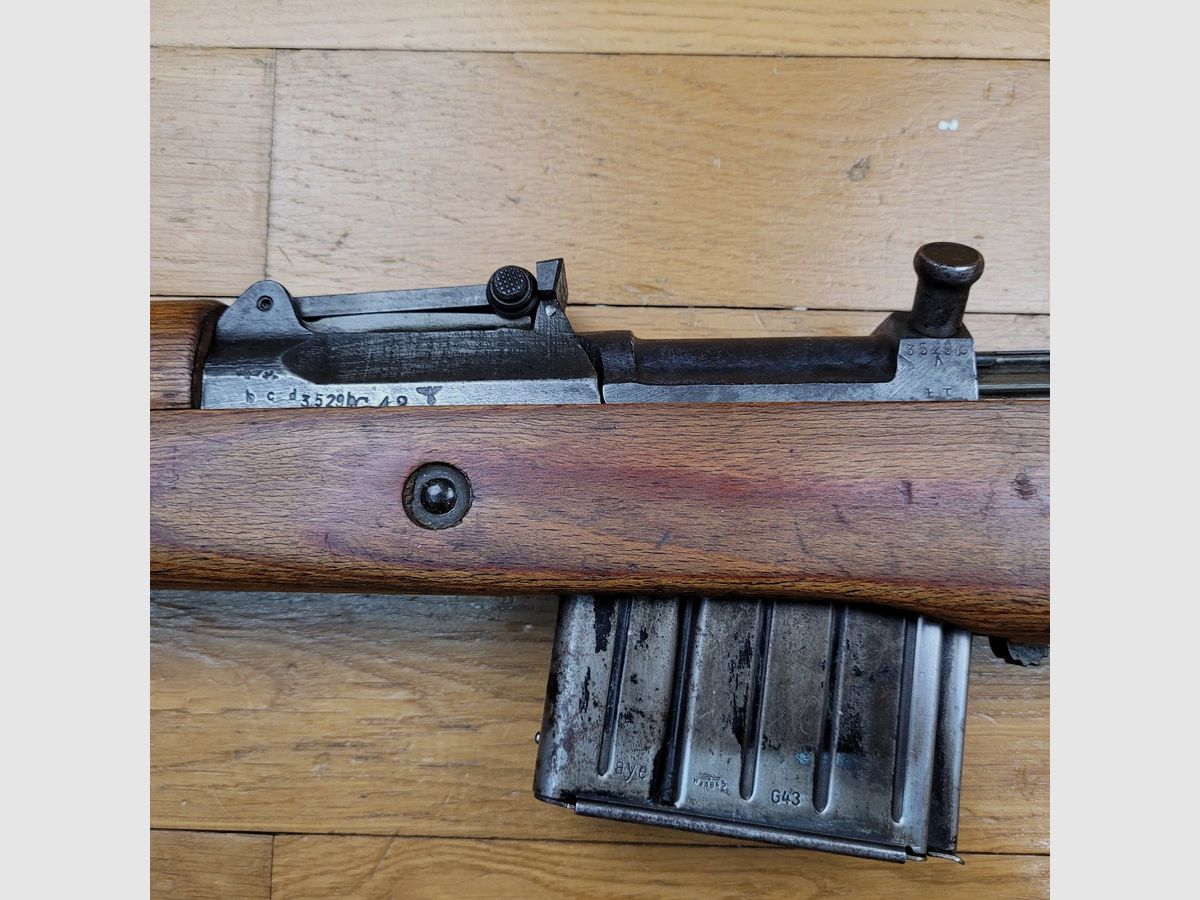
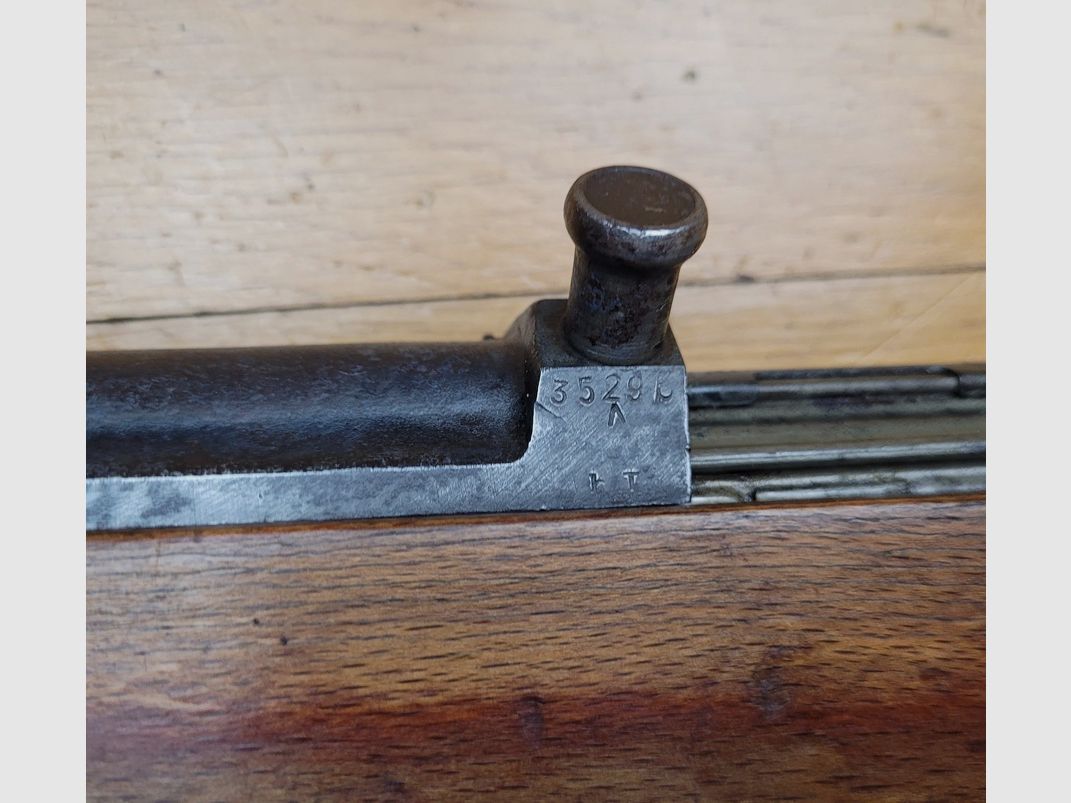
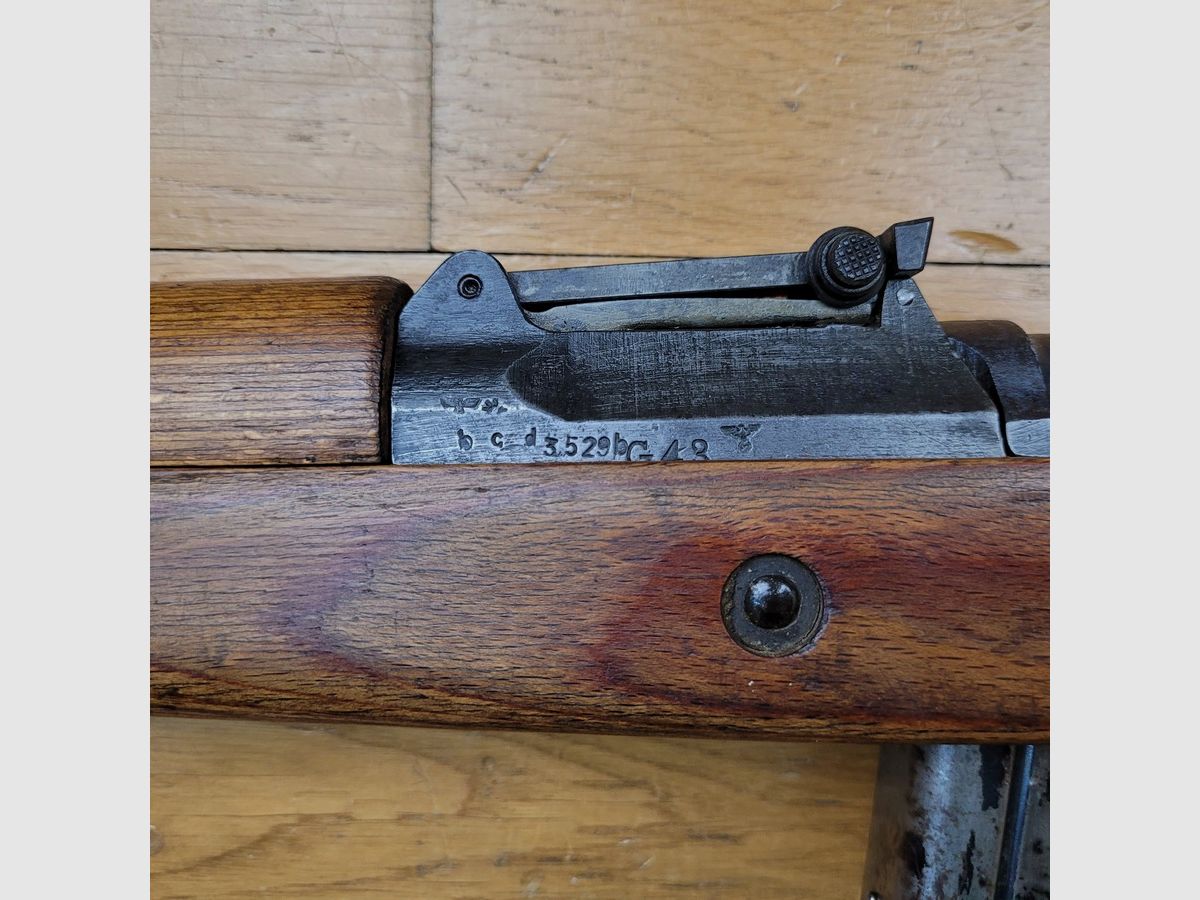
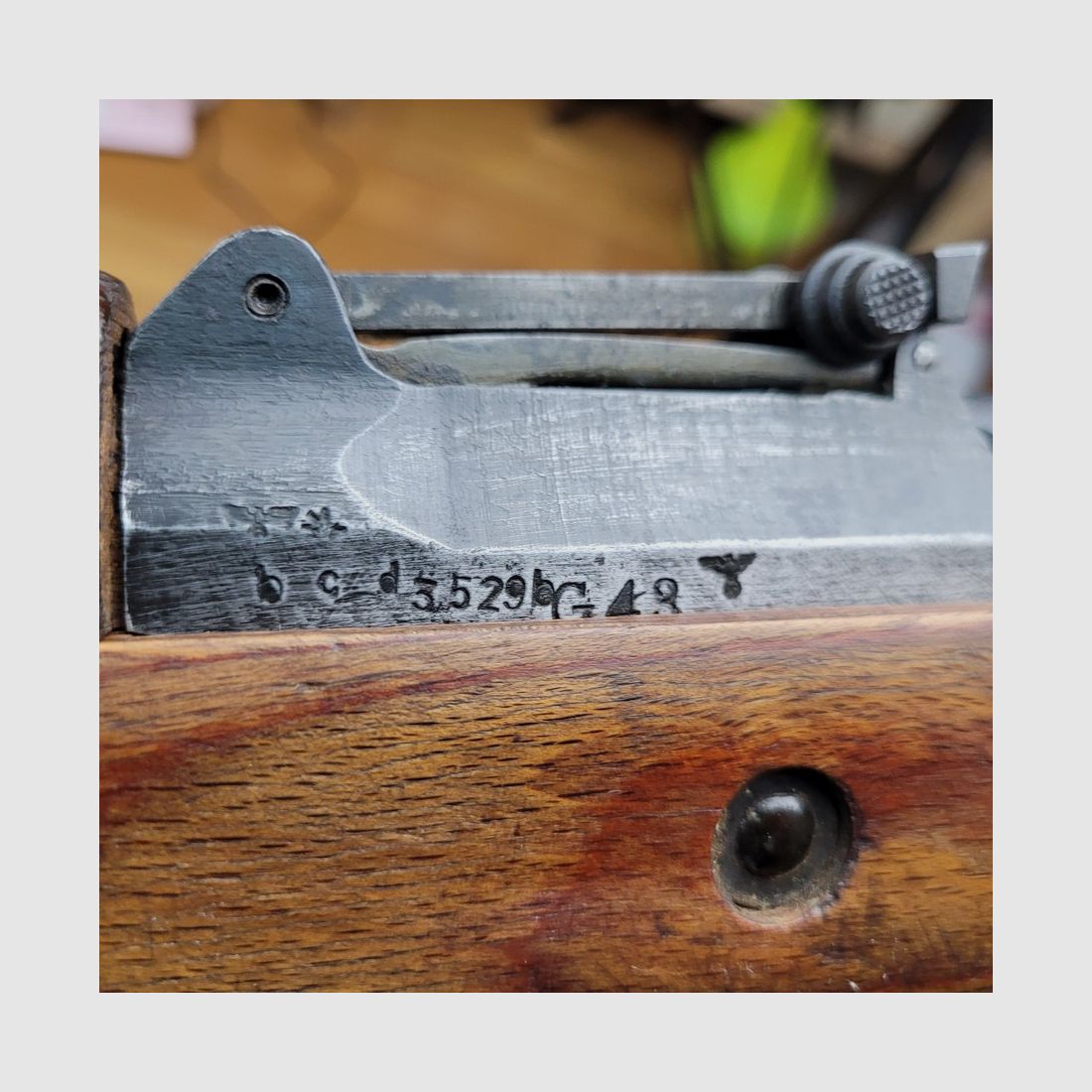
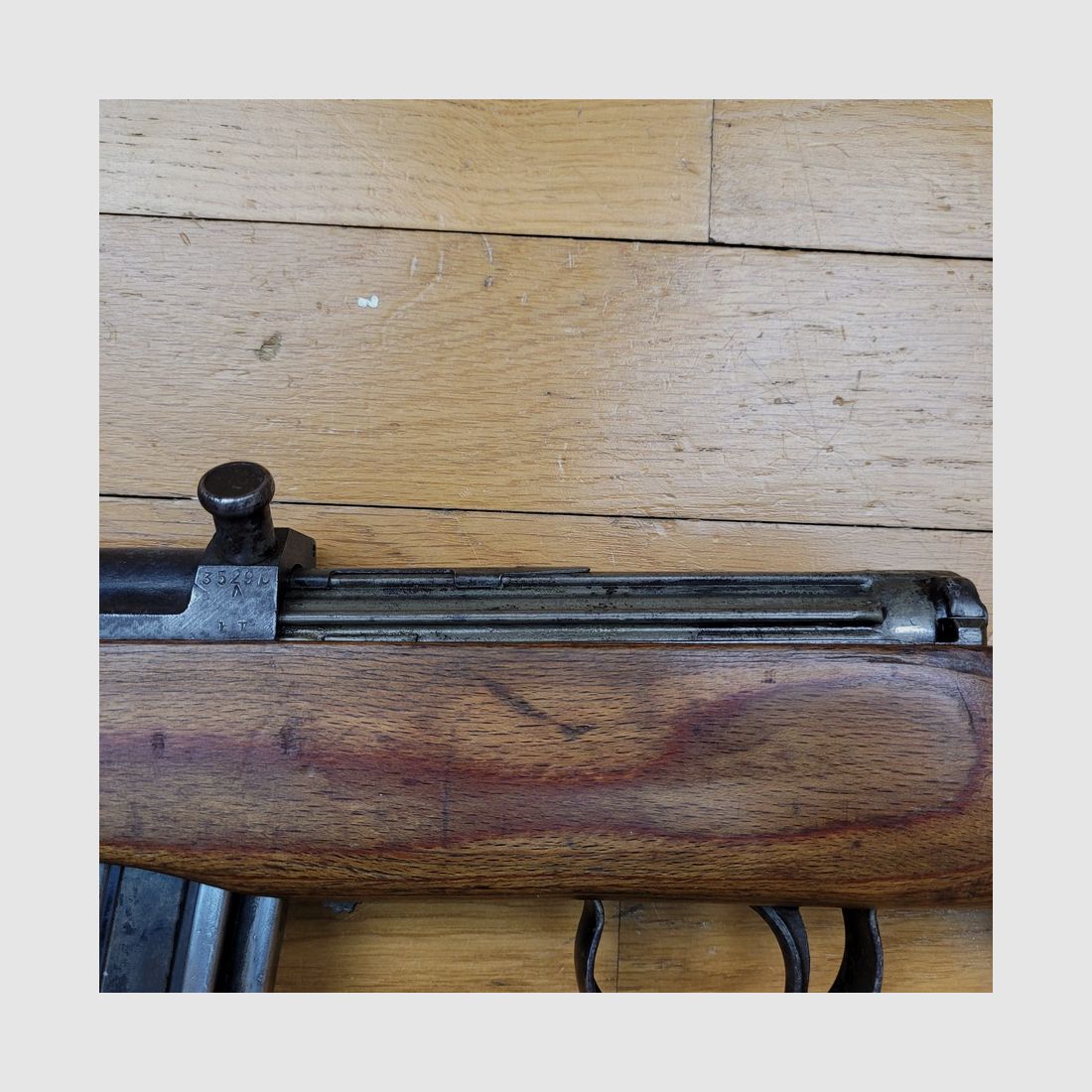
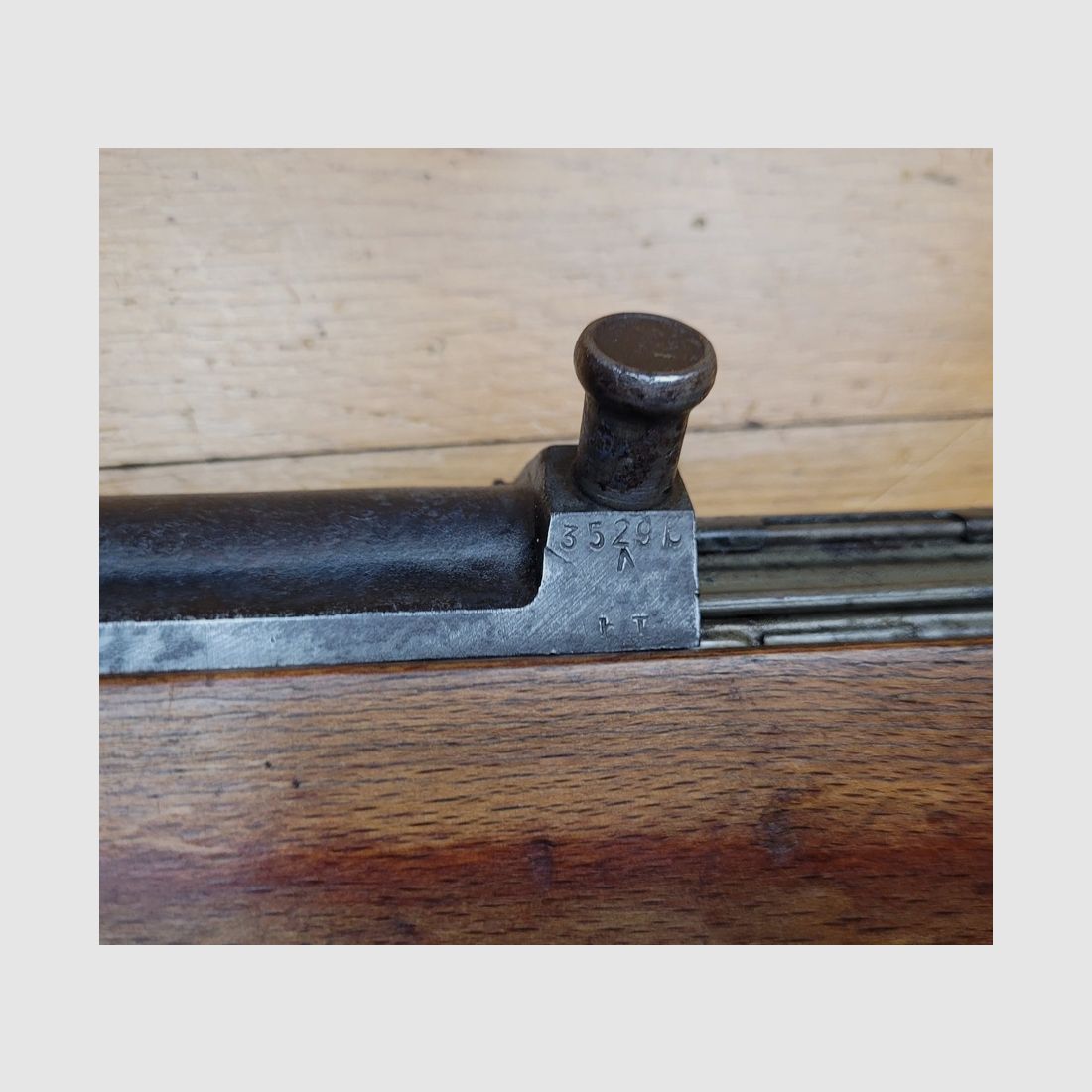
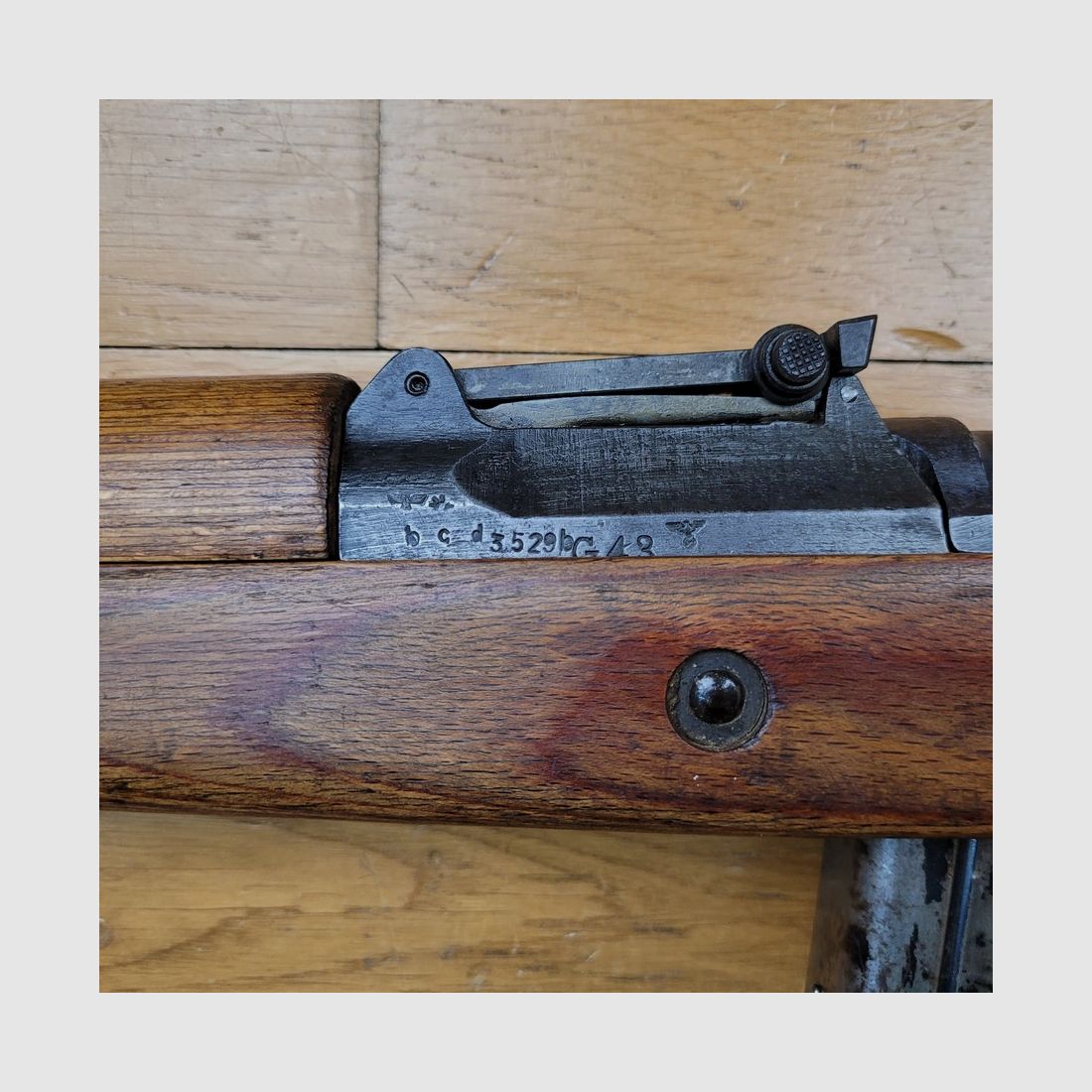
Our weapon today is a rare example manufactured by “bcd” (meaning “Gustloff Werke”) in the summer of 1944 – clearly marked “bcd 3529 b – G43”. And, after research, this one is quite sinister. And nevertheless rare. It is the rarest of the G43 manufacturers.
The G43s were indeed produced by three distinct production centres: Walther, the designer, which made 223,800, Berlin-Lübecker-Maschinenfabrik or BLM which produced 156,000, and finally Gustloff Werke which produced… 35,200. Only.
That shows the rarity of this variant. Because this production lasted very little time.
And there is a terrible historical explanation for this.
Gustloff was the only German production consortium working directly for the Nazi party because it was… the property of the said party.
Mid-1943, Gustloff opened an assembly plant to assemble weapons within the Buchenwald camp. 3,000 prisoners, mainly Russian, French and Polish, were forced to serve there under continuous eleven-hour shifts under surveillance. This workshop began assembling G43s in mid-February 1944. All its production went
to equip the armed SS, a combat unit.
The English wrongly suspected that this factory might be working on building V1s that directly threatened them. It was for this sole reason that they bombed this factory (the Allies did almost nothing during the war to help the prisoners of the camps as such).
The factory was therefore destroyed by a Royal Air Force bombing on August 24, 1944. The bombing caused 364 deaths (including 80 SS), 238 injured, and 65 missing. Among the prisoners who were victims of the bombing were Princess Mafalda of Hesse, daughter of the King of Italy, as well as the German socialist deputy Rudolf Breitscheid and his wife. But at least, the production of G43 could never resume and the remaining parts were shipped to the Walther Factory in Zella-Mehlis to be used there.
That is why this production was short-lived and why this variant is rare.
Our firearm, with the serial number 3529b, very likely came out of this workshop between June and July 1944, shortly before this bombing.
It should also be known that these firearms were only assembled at Buchenwald from parts subcontracted, notably from … Saint-Étienne in France (barrel and receiver, no other parts to my knowledge).
Gustloff receivers are known to bear either a waffenamt unique to it with a star next to a roller eagle (star indicating subcontracting and waffenamt specific to the Gustloff II arsenal – not to be confused with the “Sunburst” which indicates reuse after the war by the DDR) like ours, or the Waffenamt 134 of Saint-Étienne in occupied France.
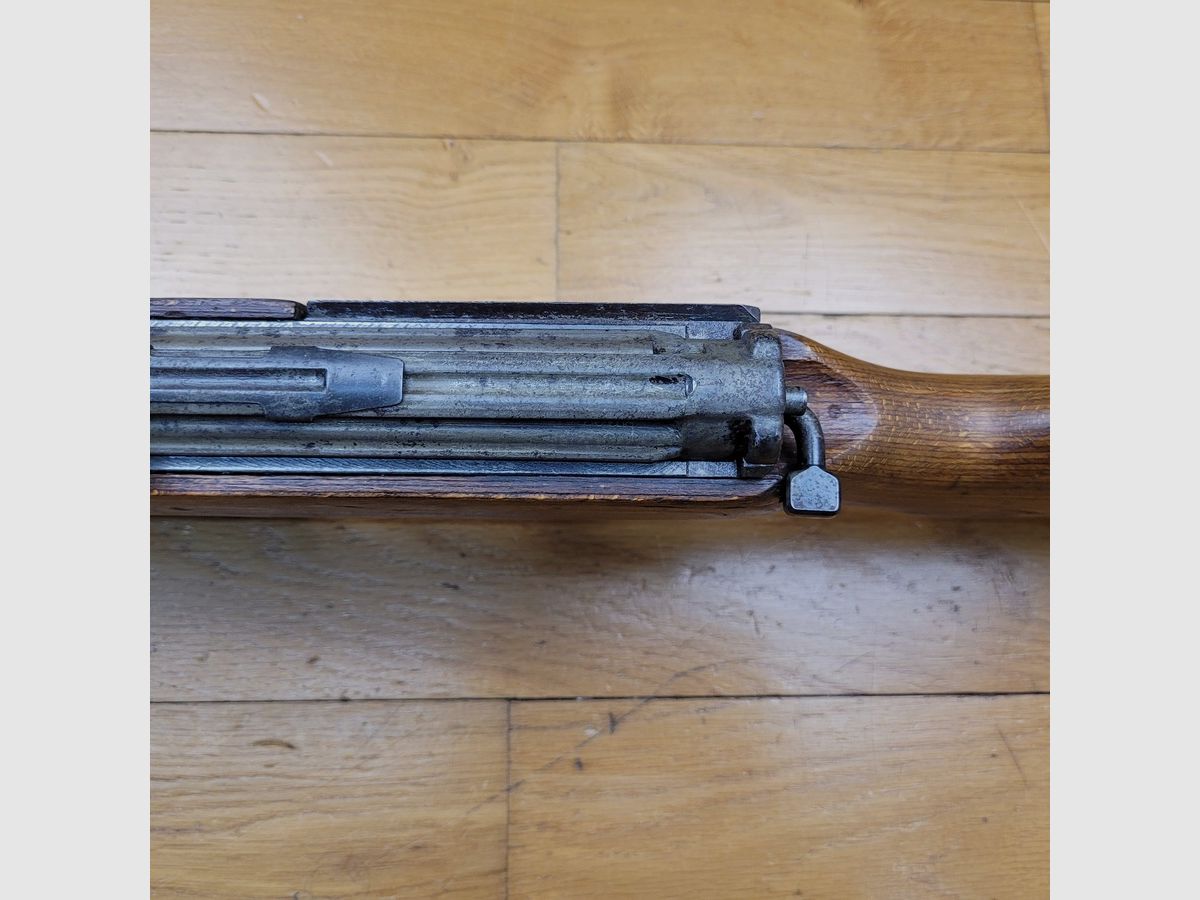
Ours bears this special starred Gustloff waffenamt on the receiver and also the Waffenamt 134 plus an eagle of Saint-Étienne on its barrel. I removed the handguard to check. It is 100% one of the firearms produced by Gustloff to equip the SS during this short period.
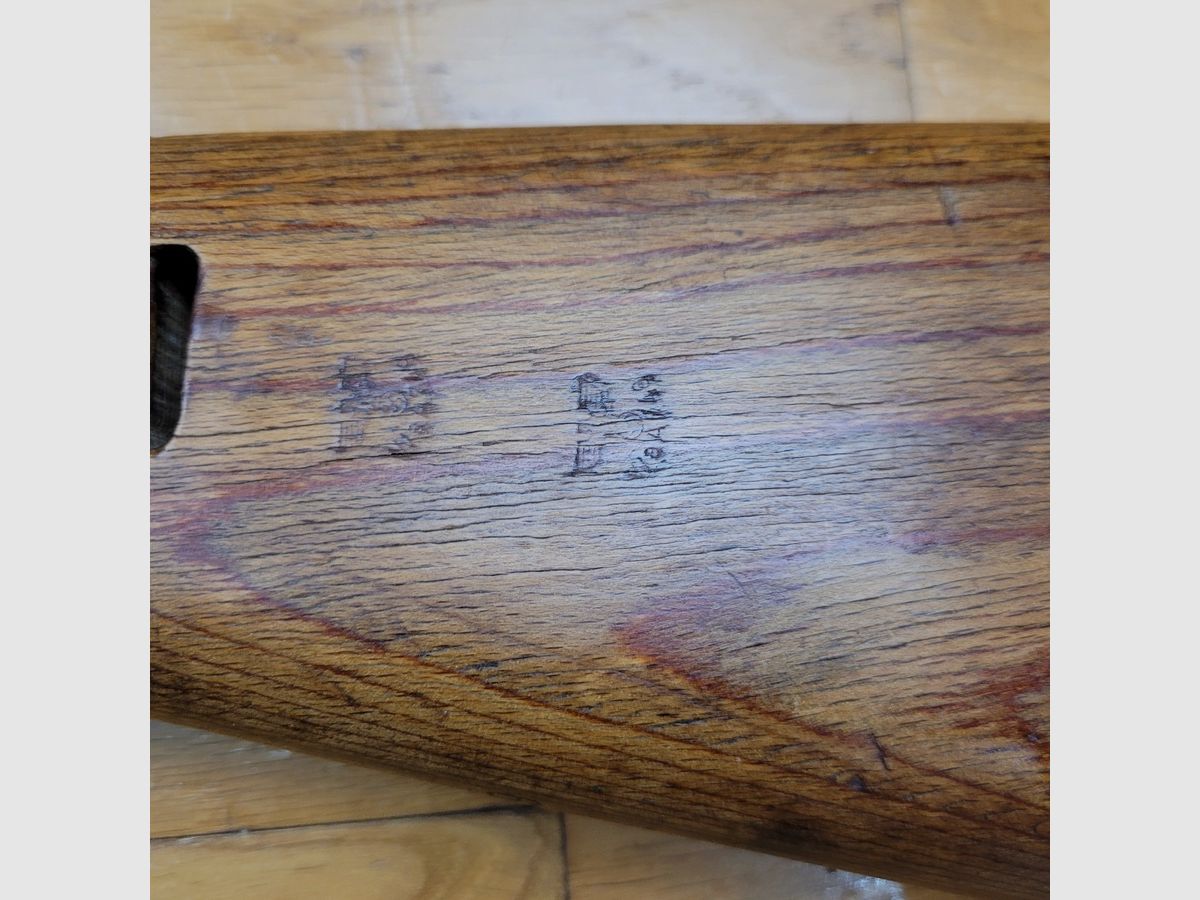
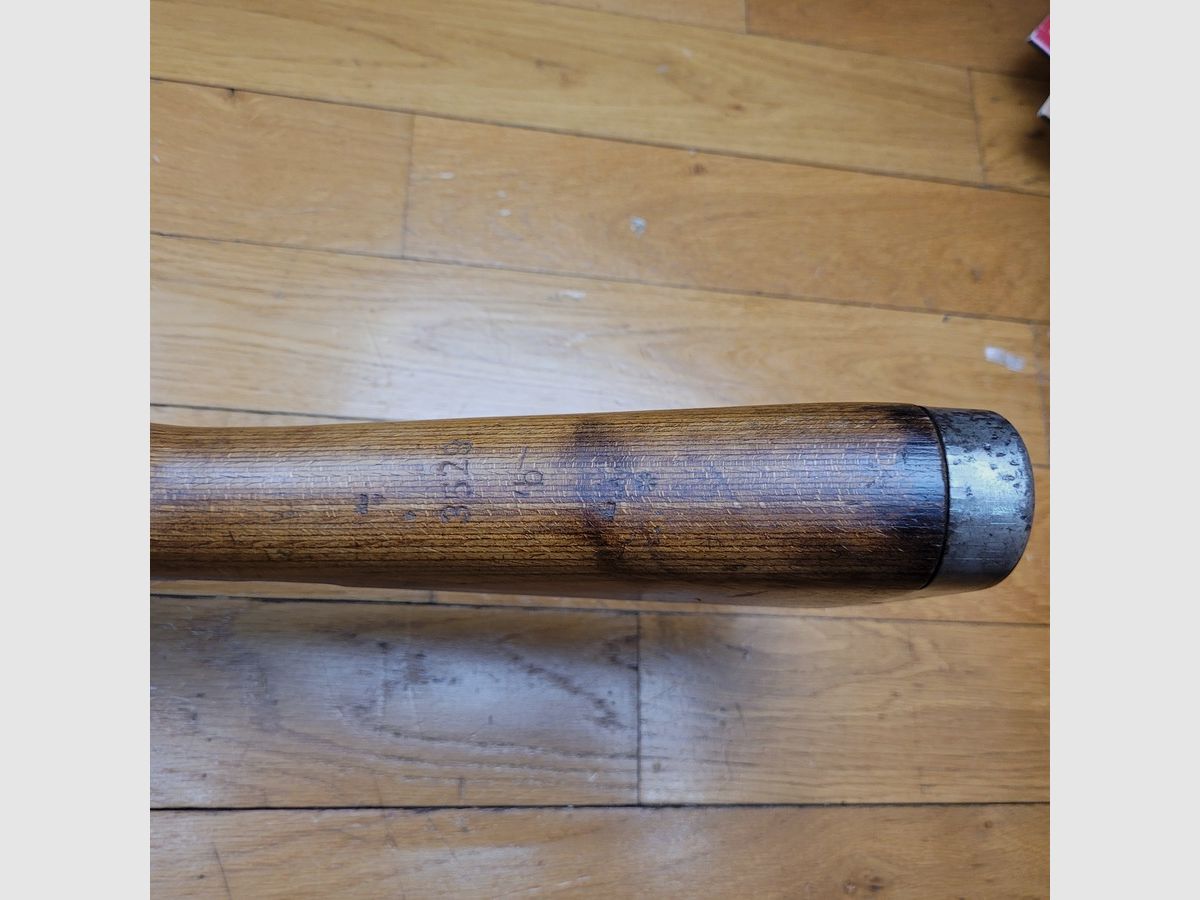
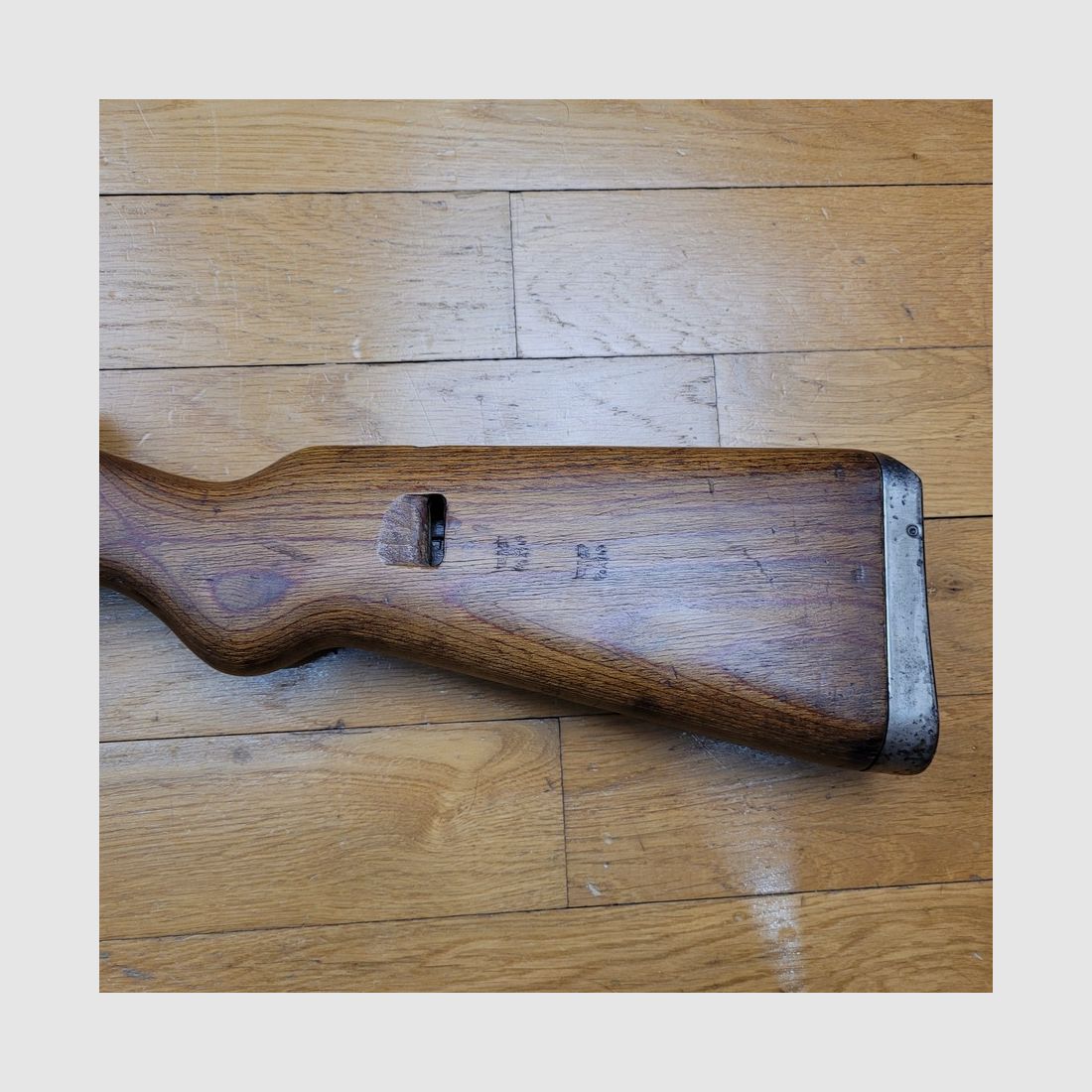
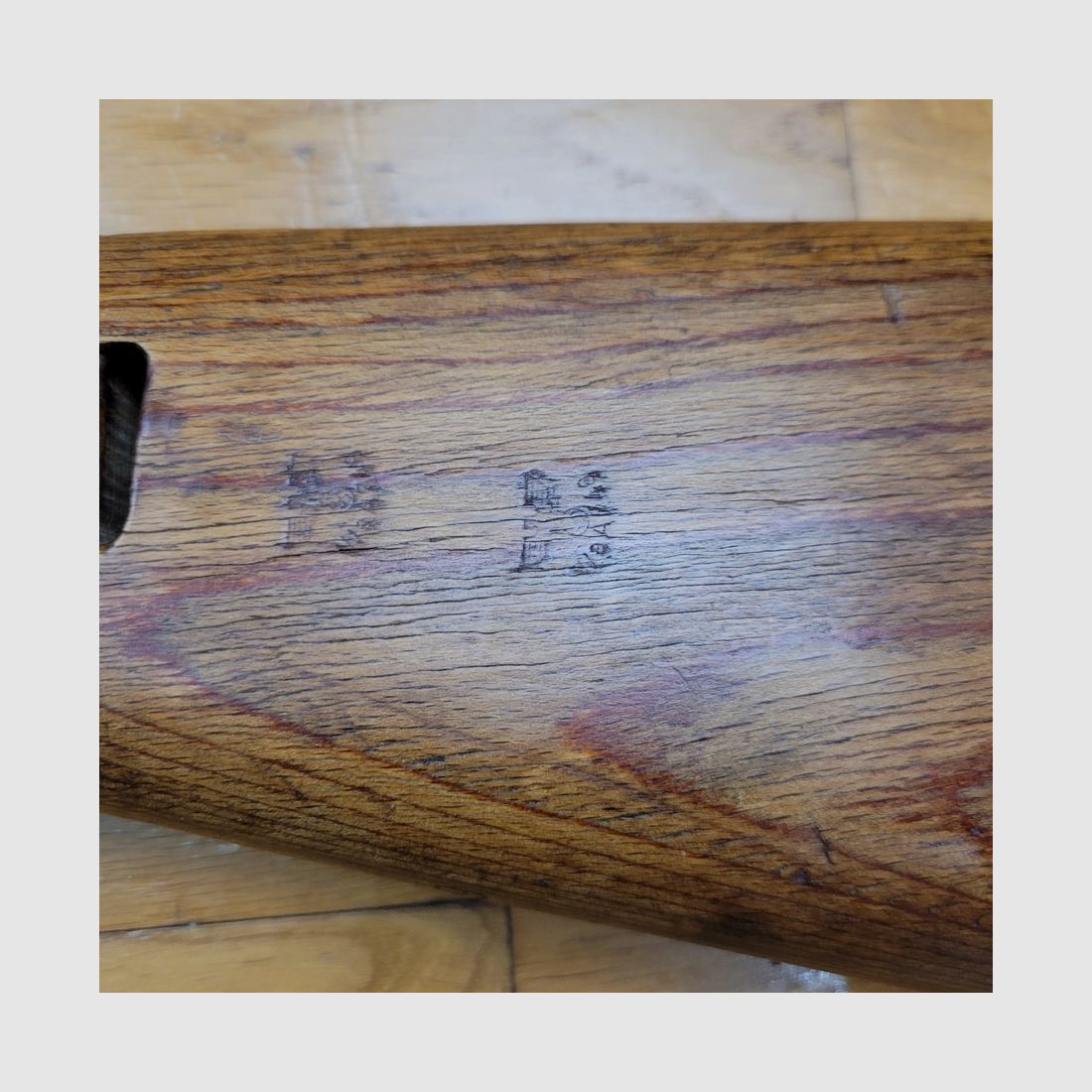
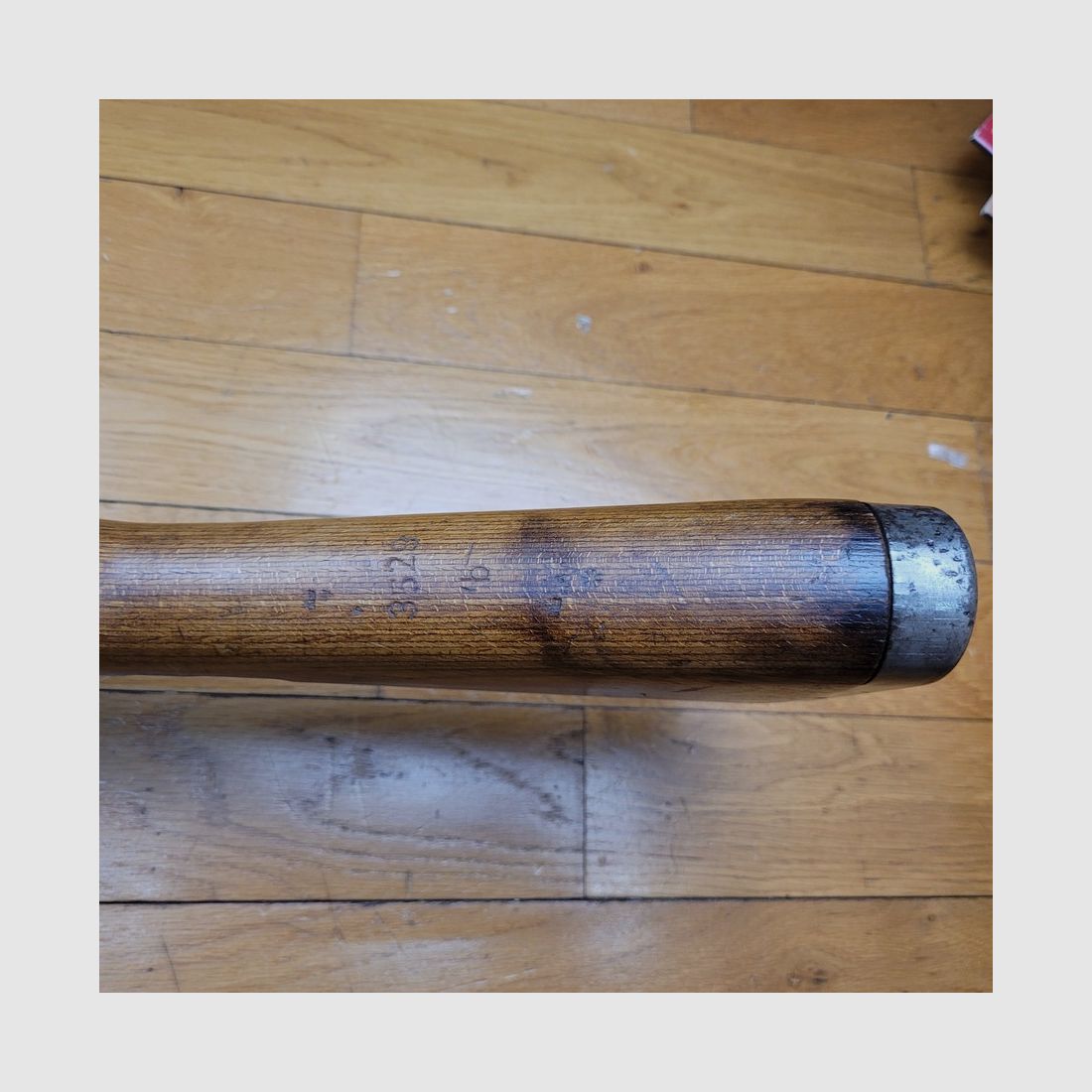
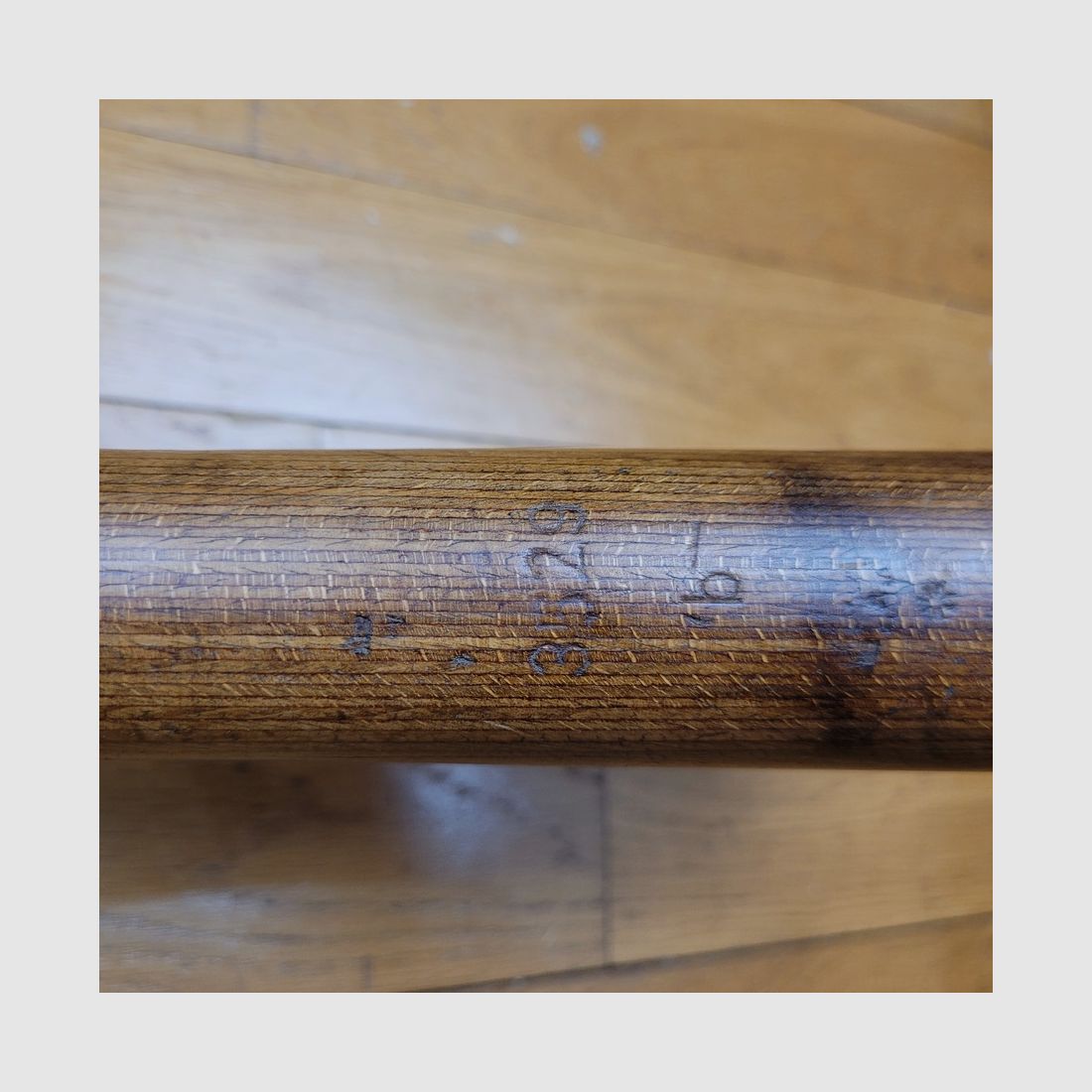
Regarding the stamps, I also note the waffenamt “749” specific to Gustloff in project management on the wood in two places.
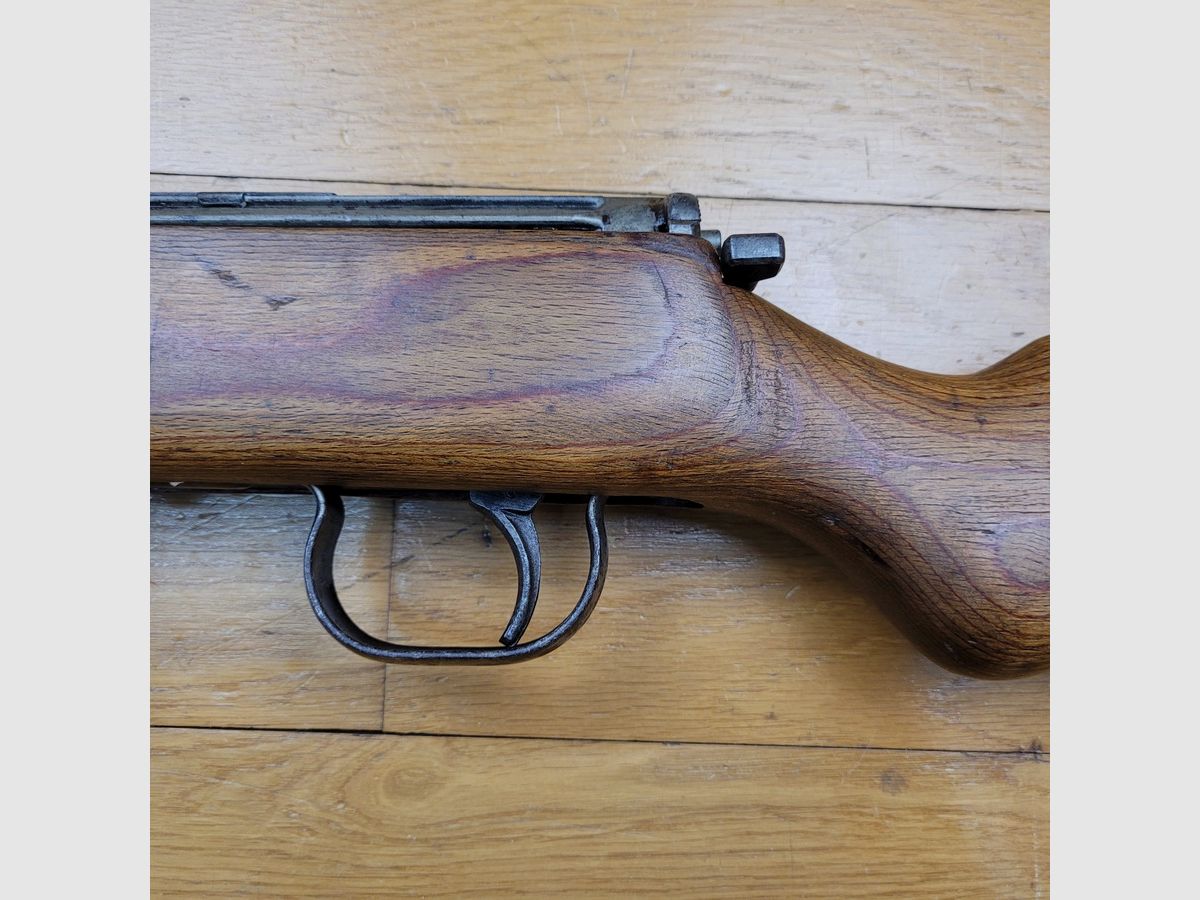
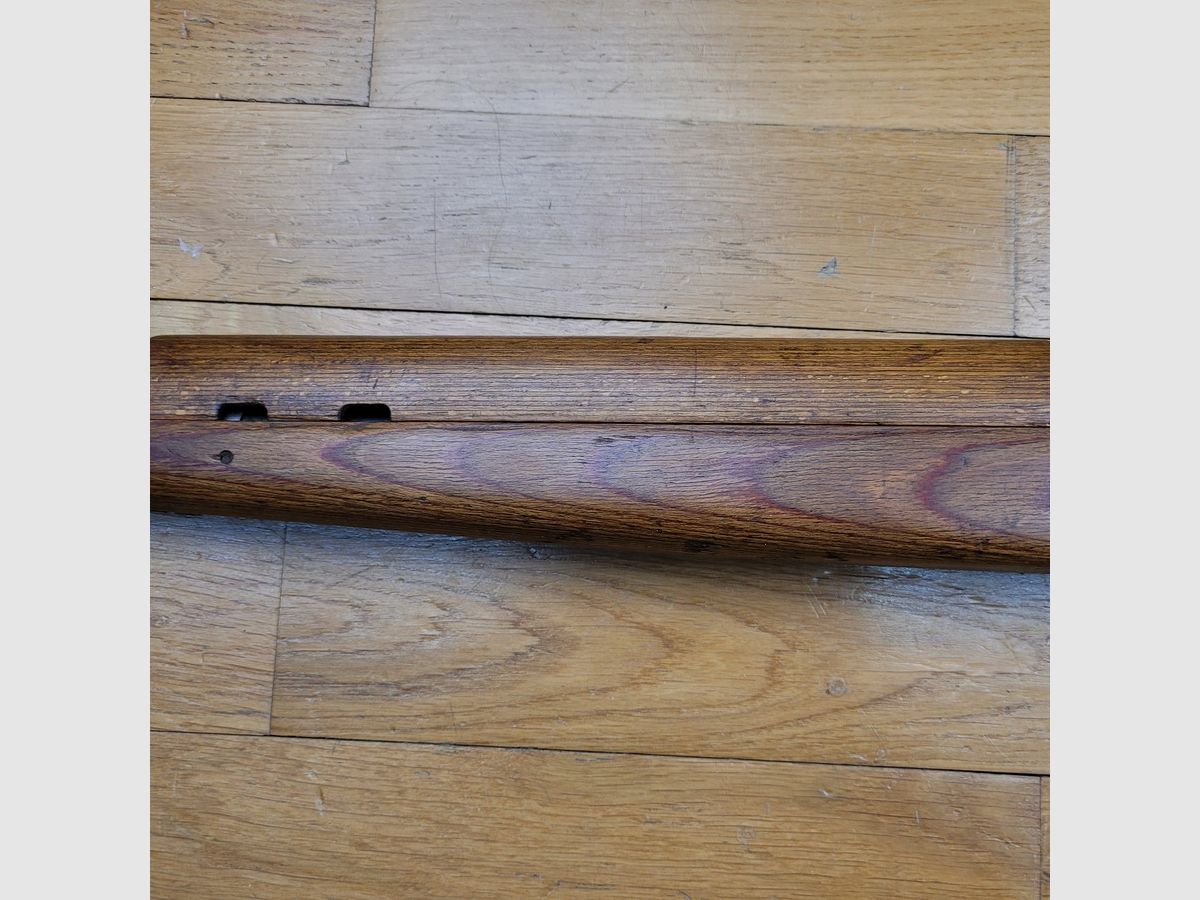
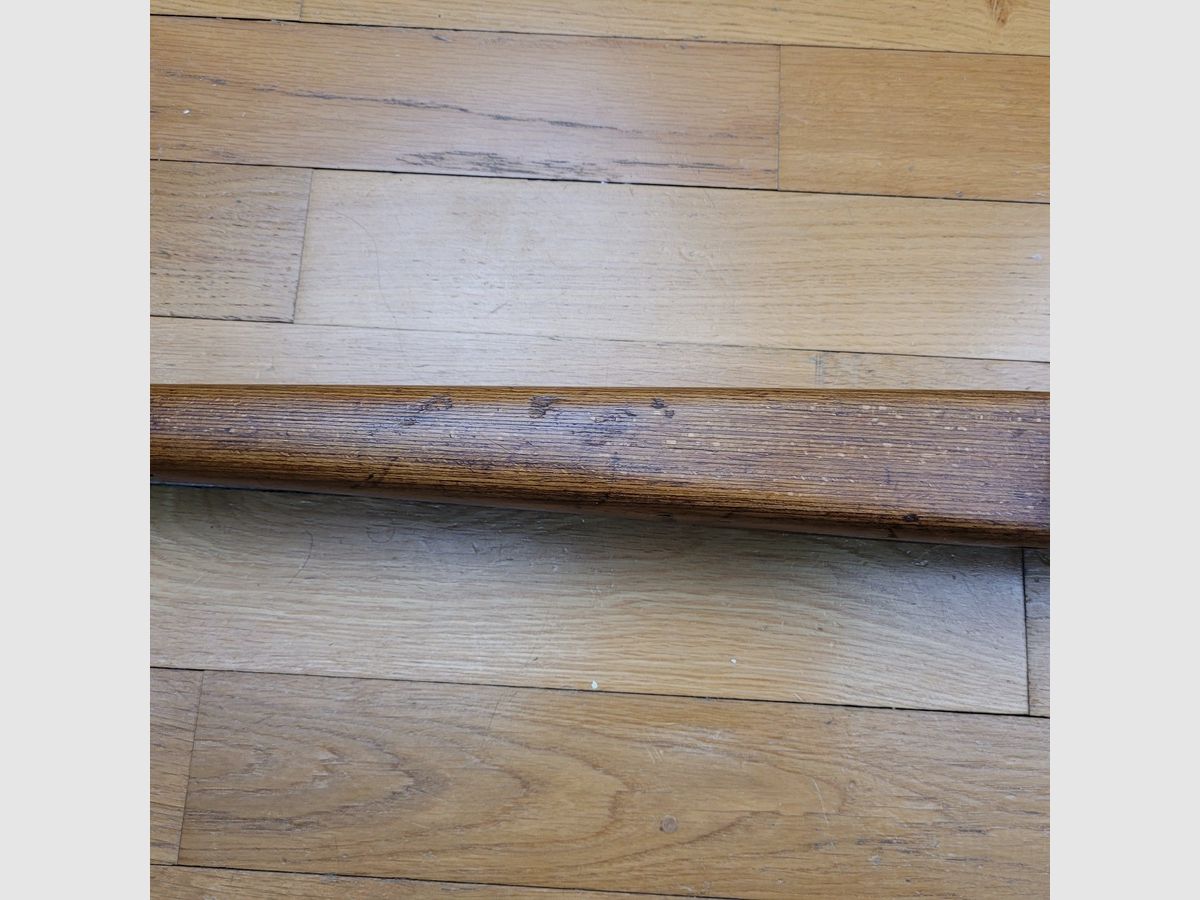
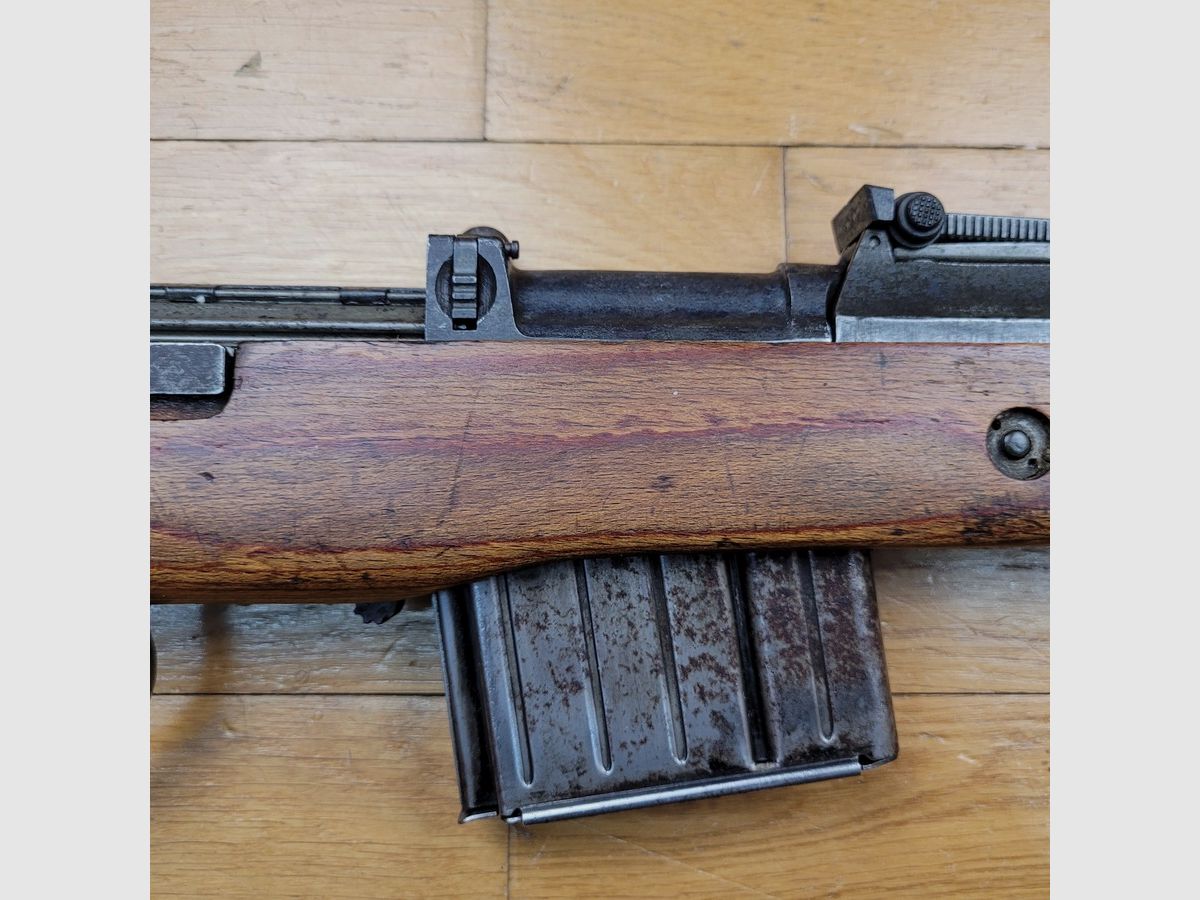
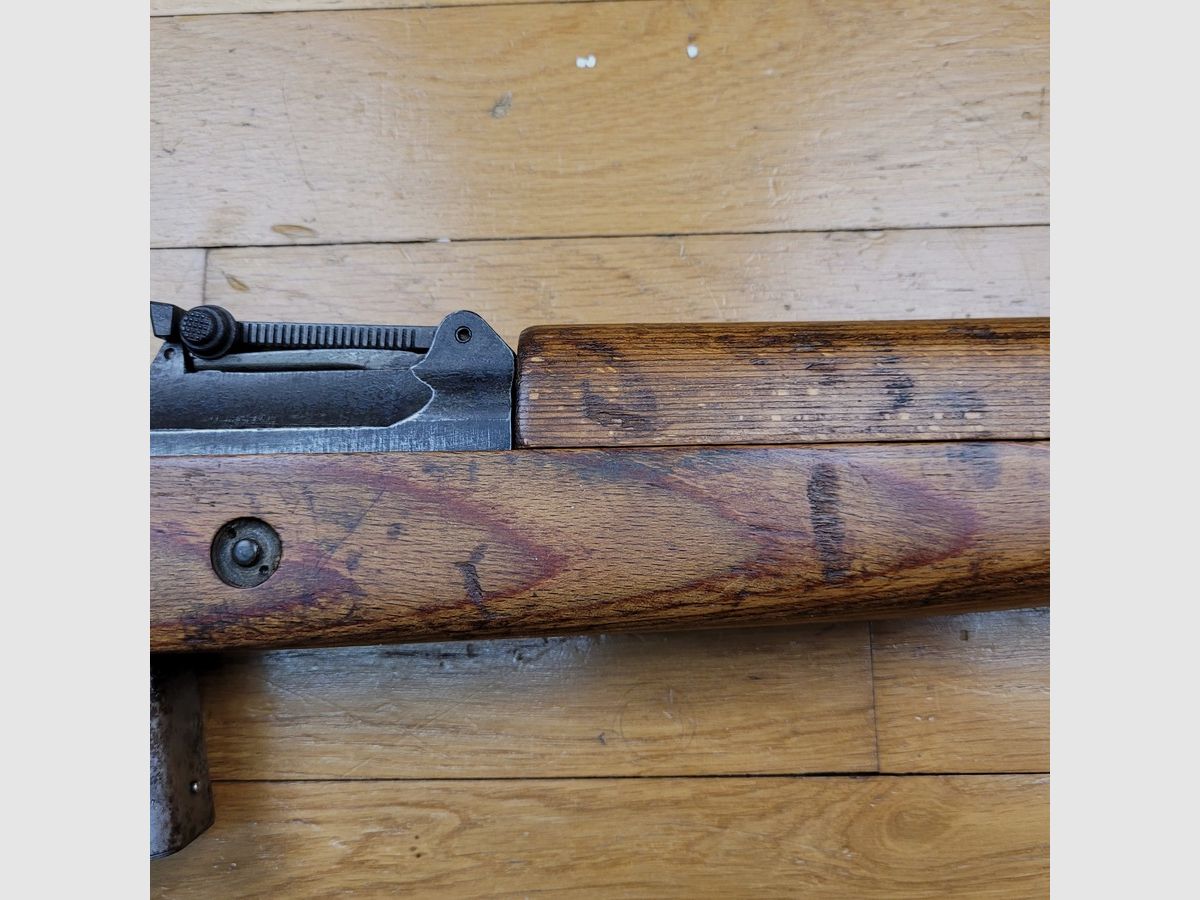
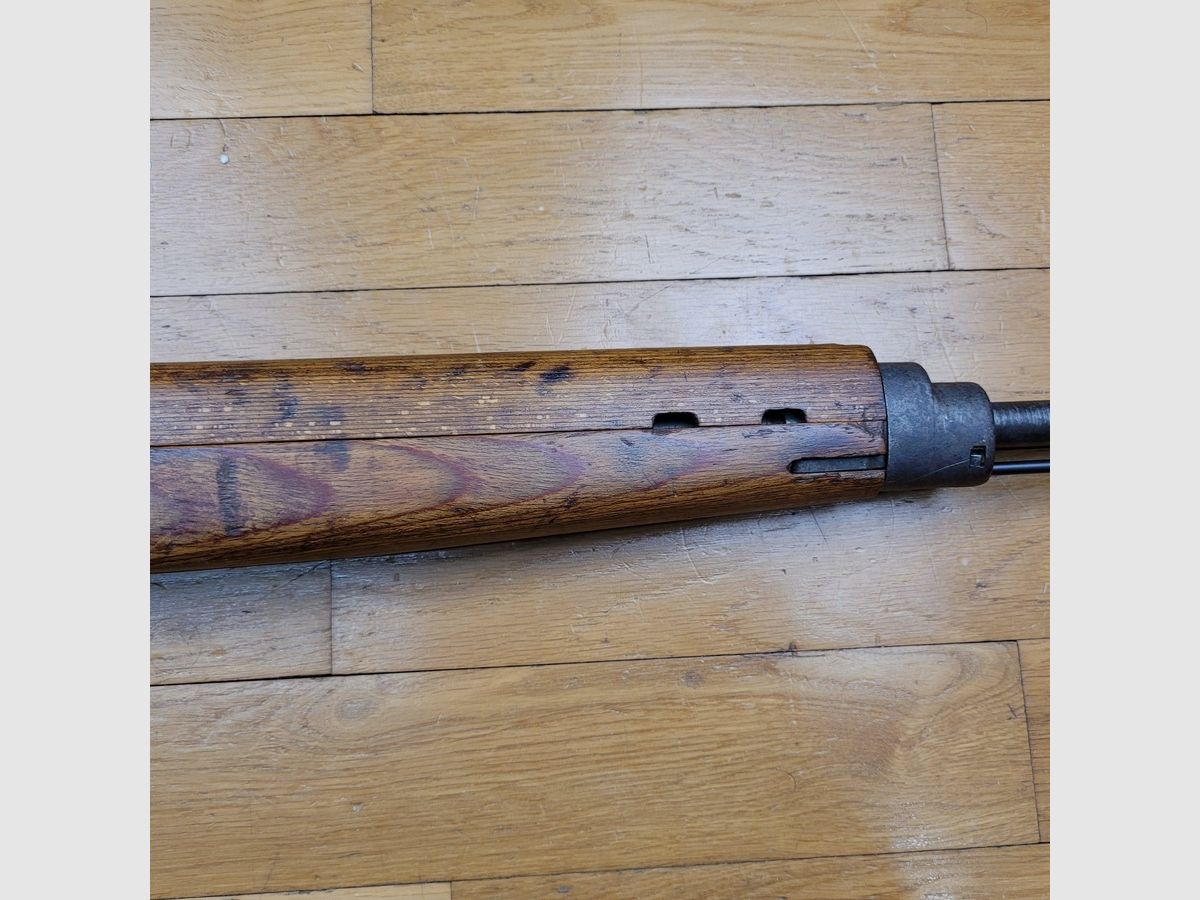
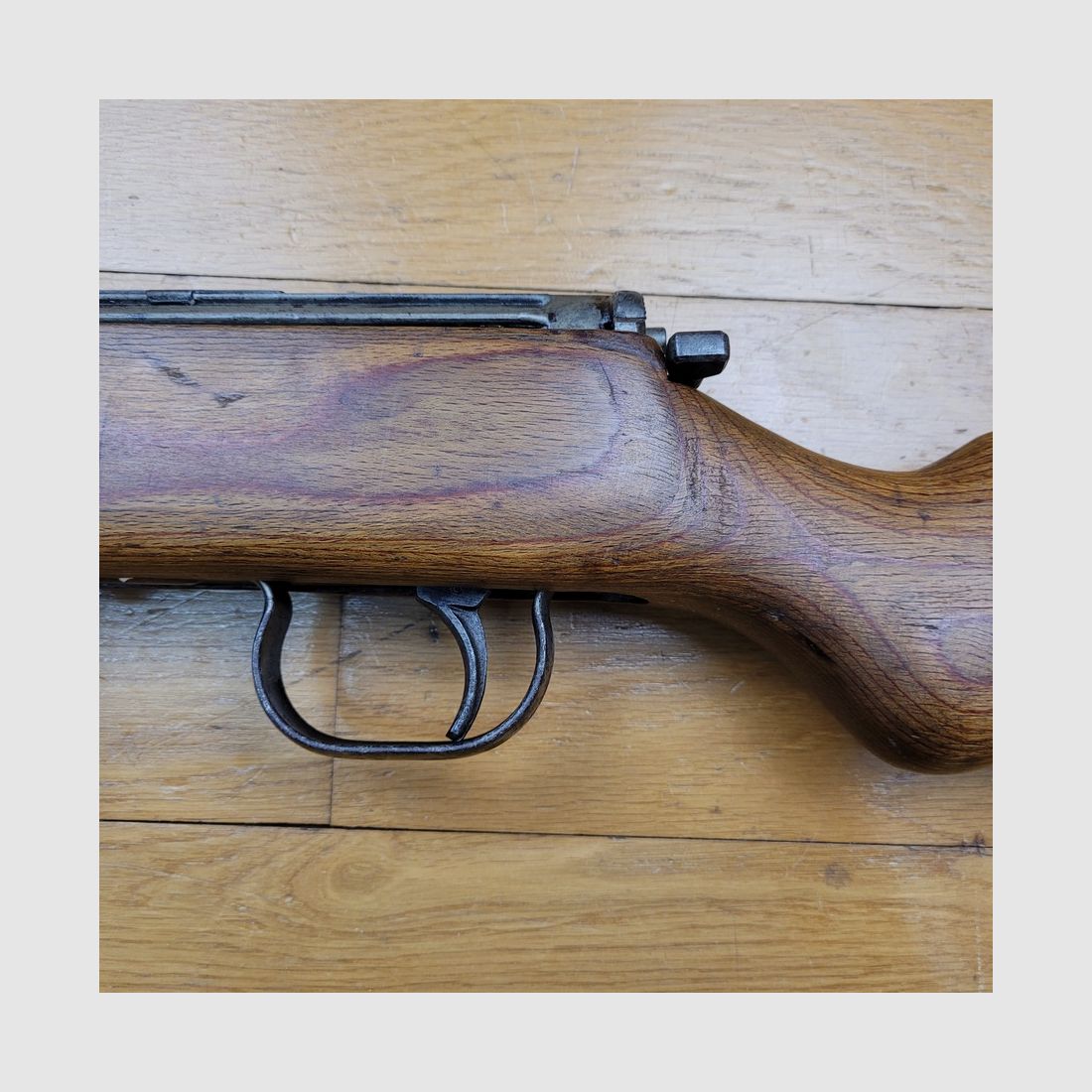
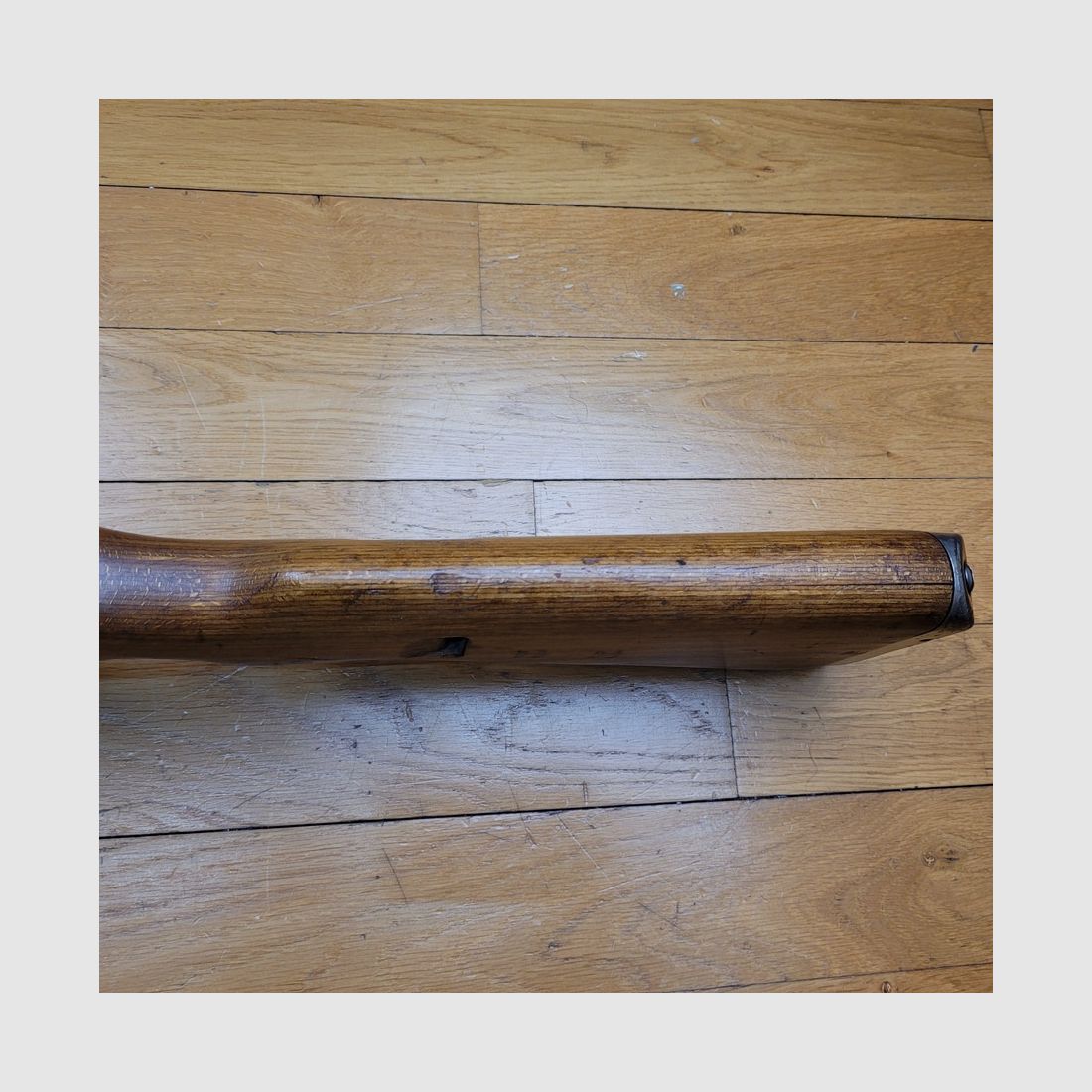
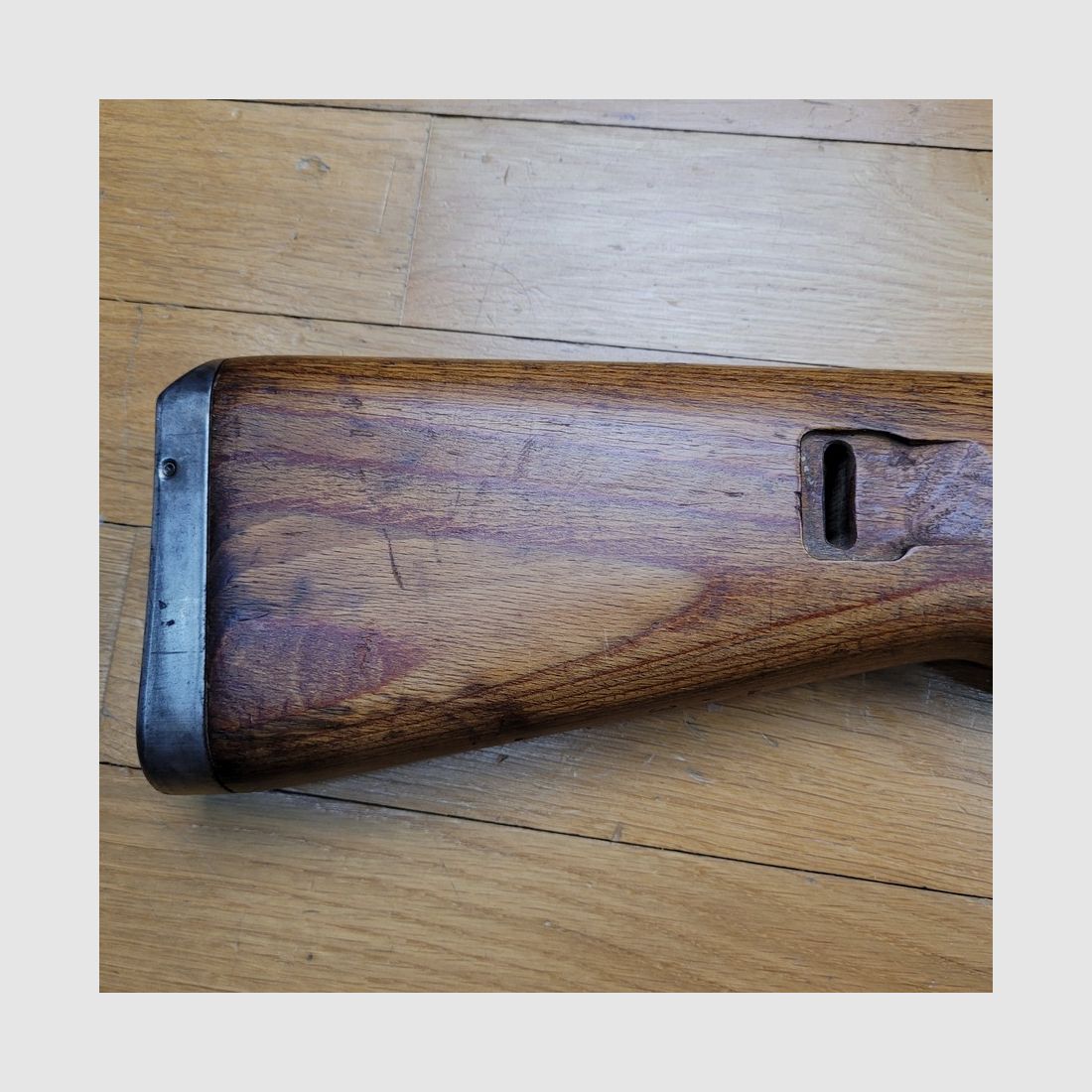
These stocks are laminated as they should be and in excellent condition with very few handling marks, mainly on the right side of the fore-end. But they are really in very nice presentational condition with very few dents. Absolutely not sanded or abusively “cleaned” as often seen. Very beautiful.
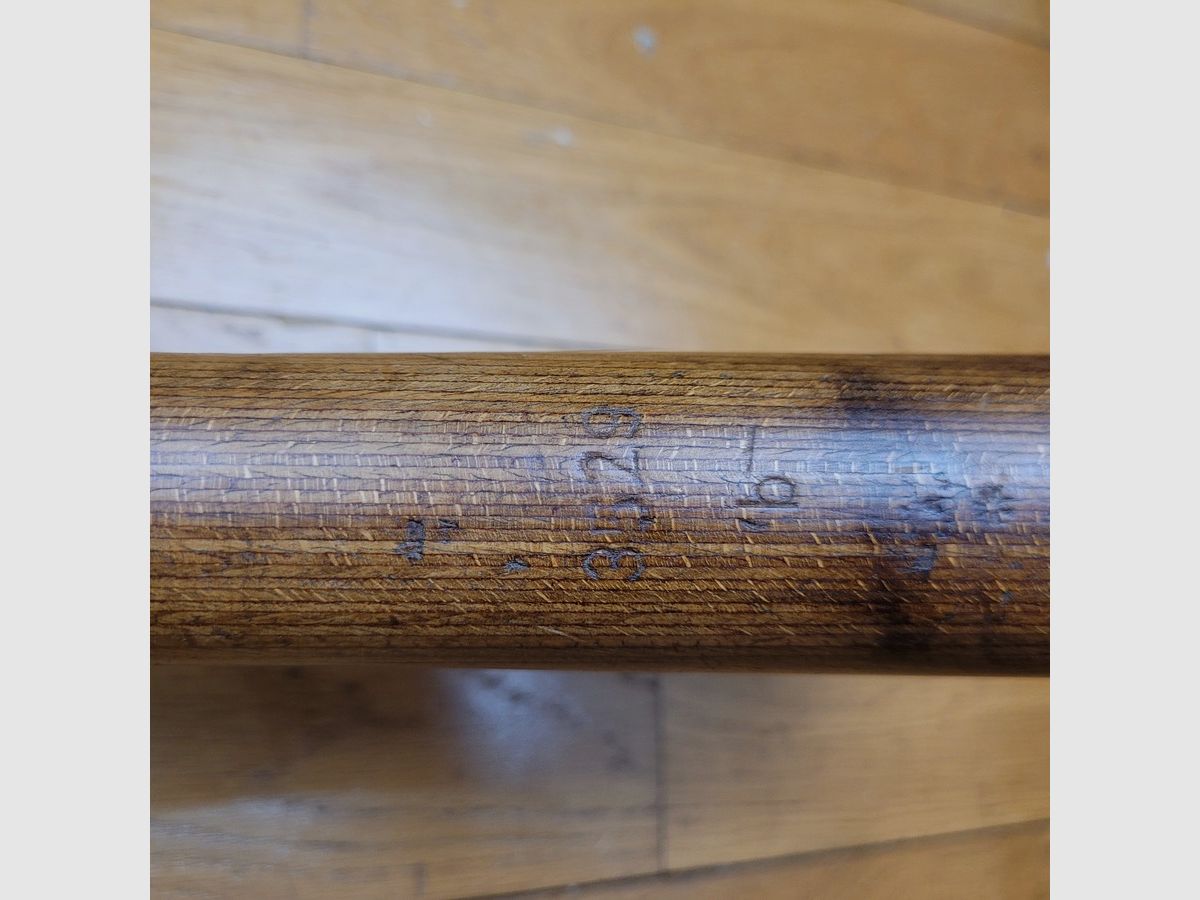
The stock also bears the number “3529 b” on the buttstock below the grip with another waffenamt stamped in the wood a little lower, that of Gustloff once again.
The firearm is therefore entirely matching serial numbers, receiver, bolt, stock with all its stamps and serial numbers perfectly legible moreover (well, I used a magnifying glass for those on the wood with my 60-year-old eyes but it’s clear!). Beyond its origin, its history, and its intrinsic rarity, this makes it in my opinion a rather exceptional firearm.
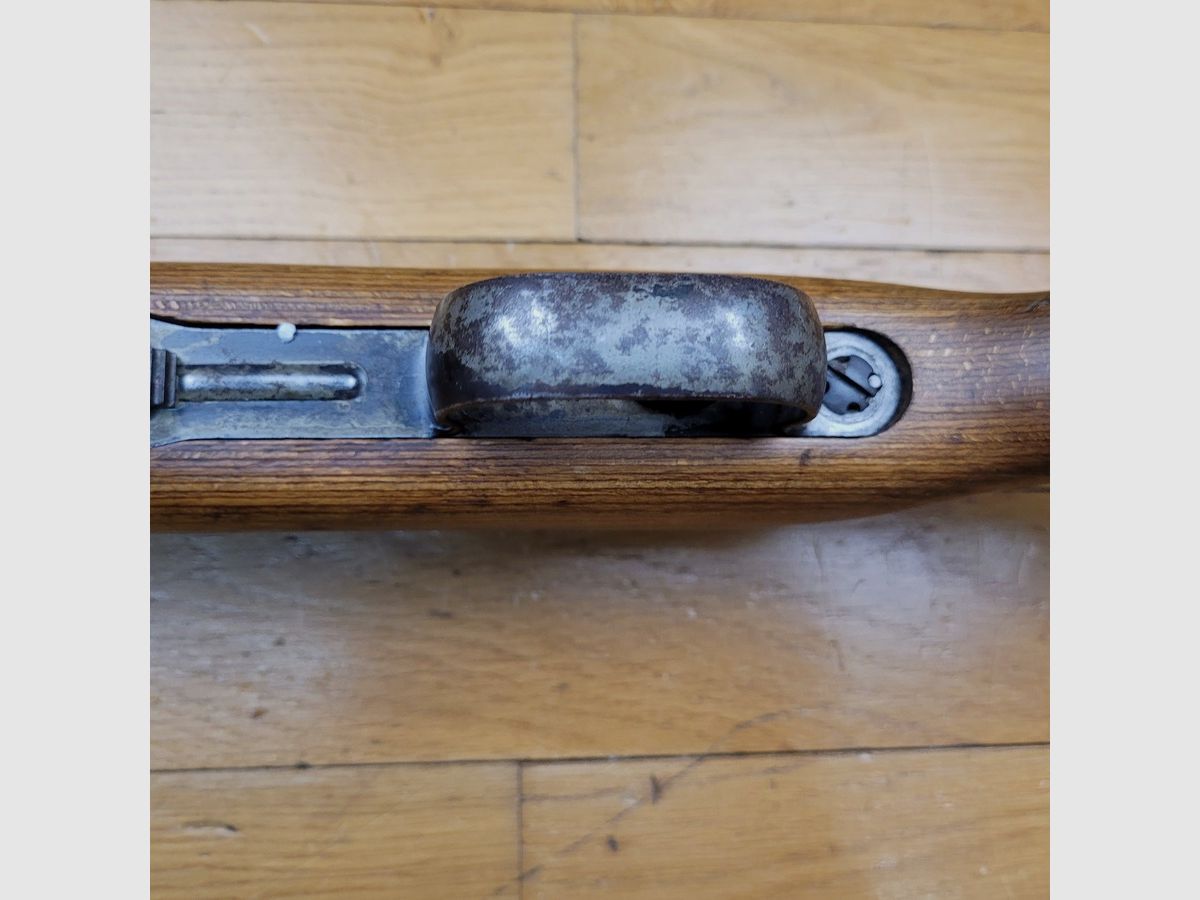
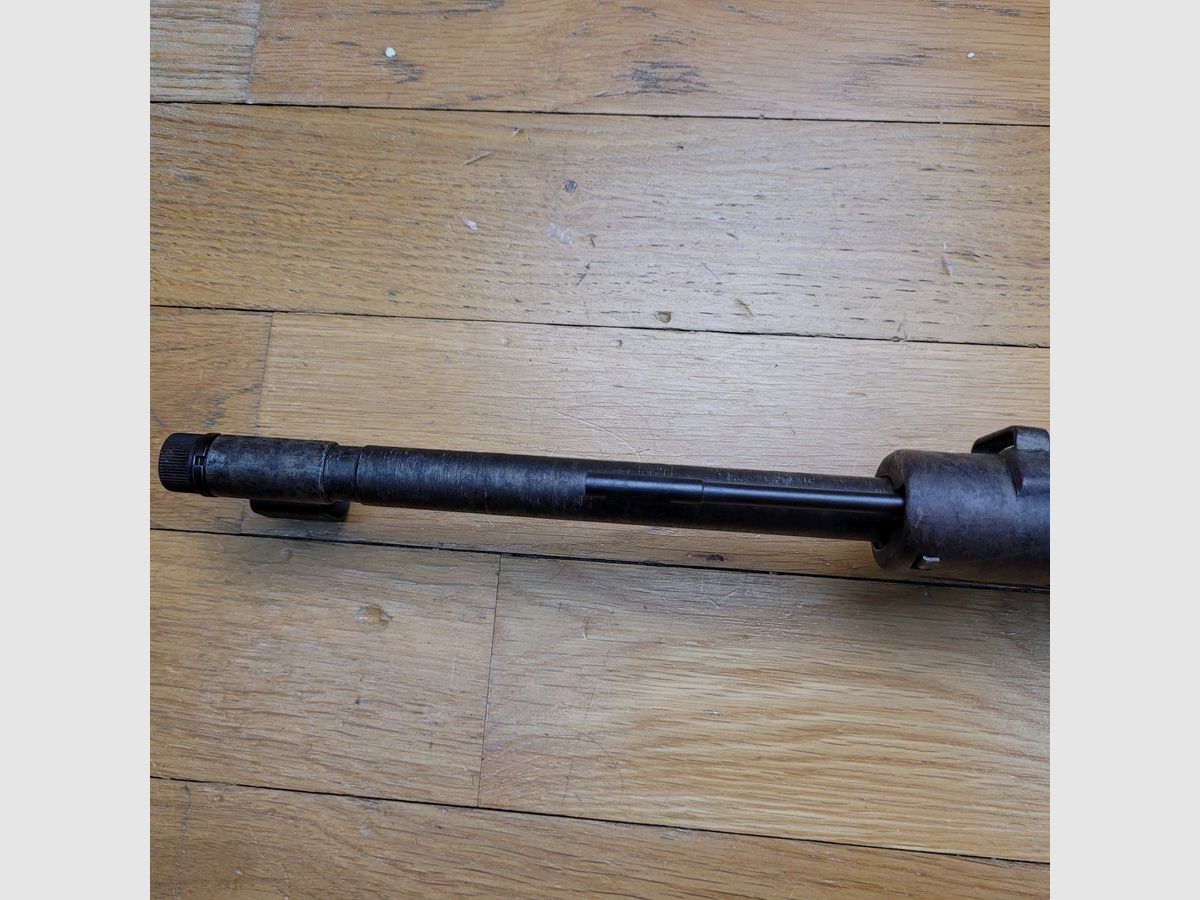
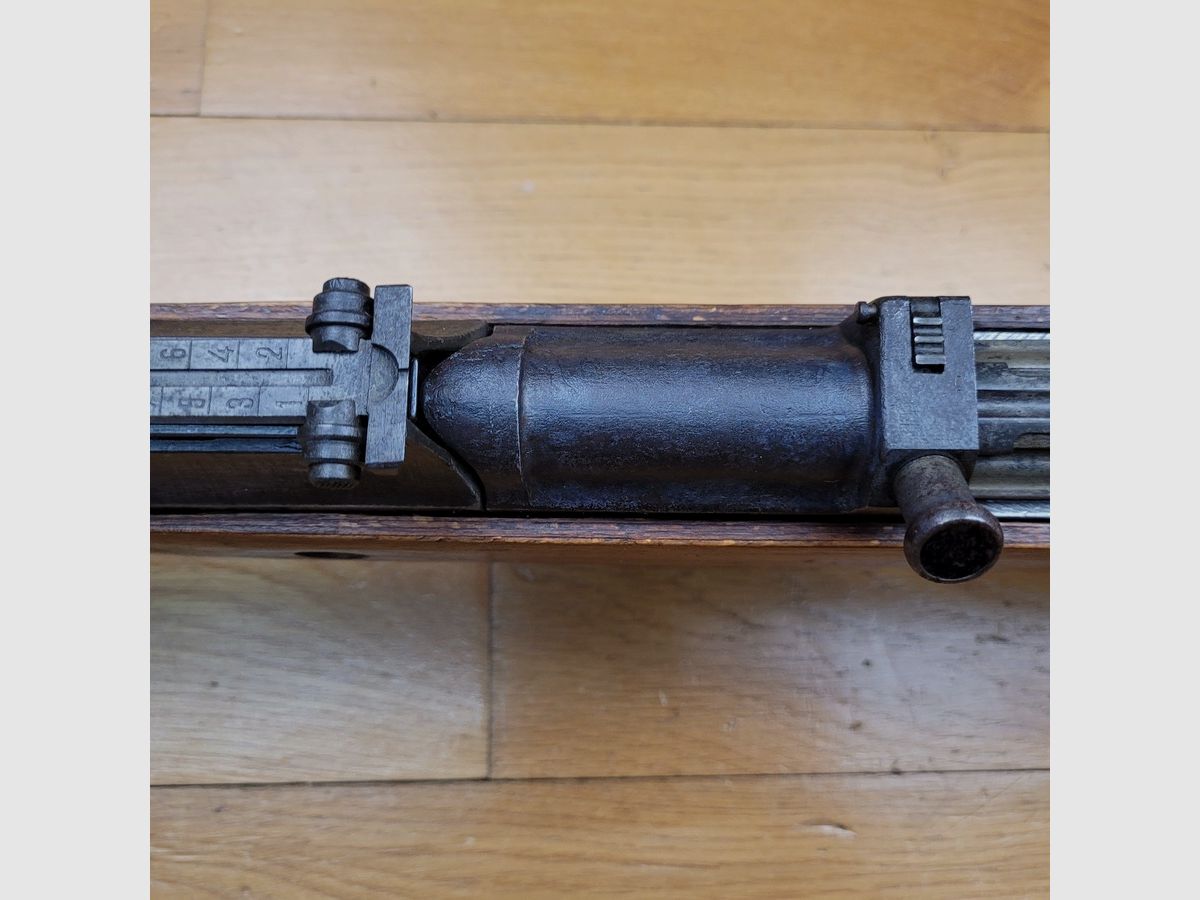
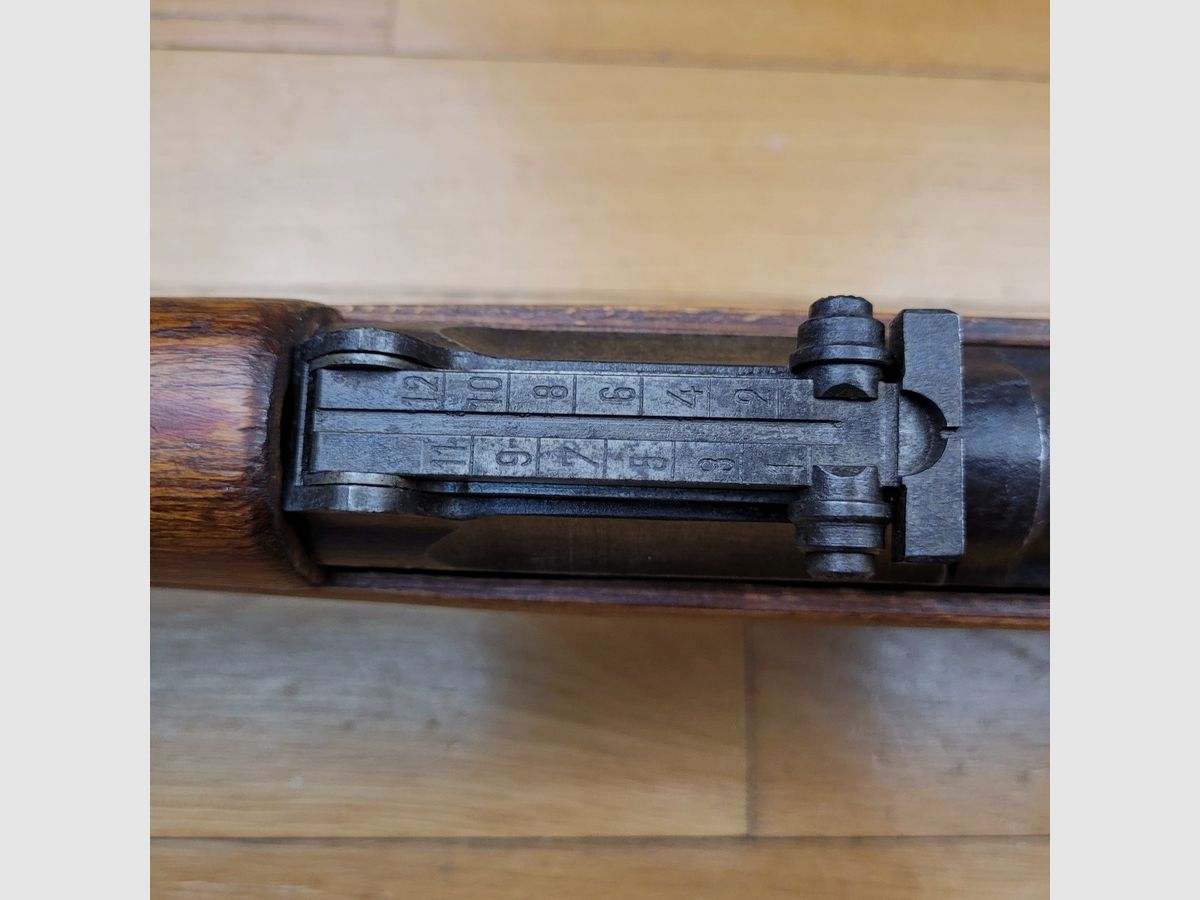
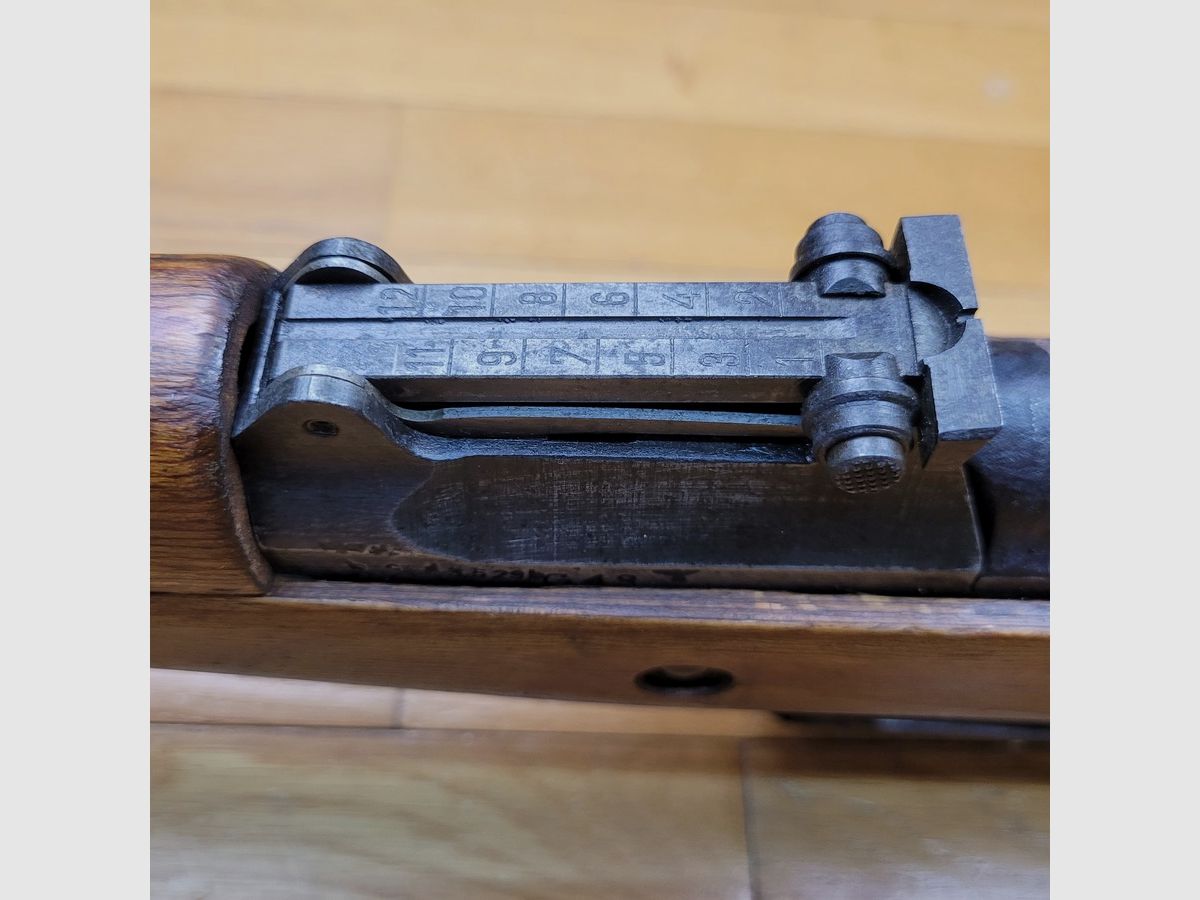
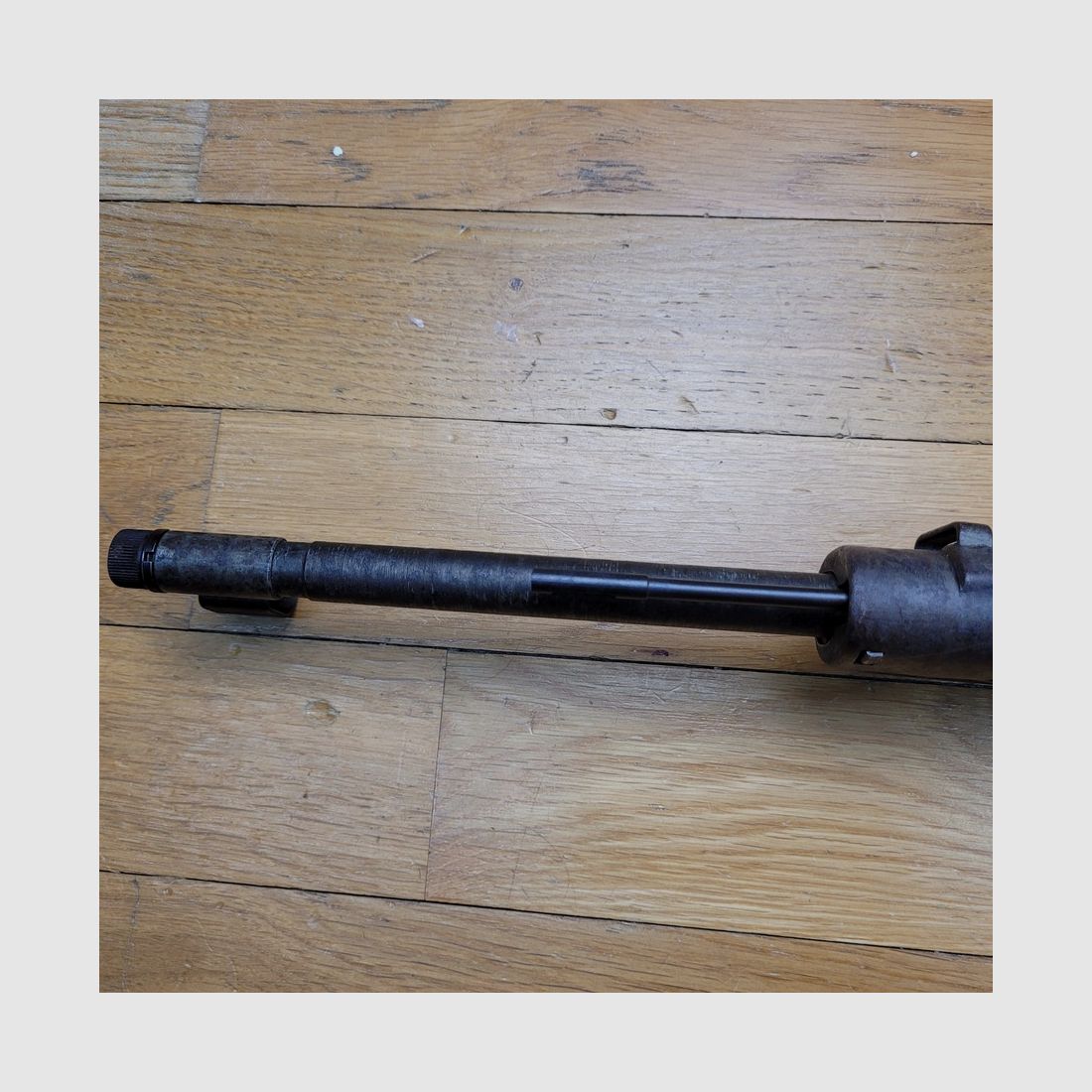
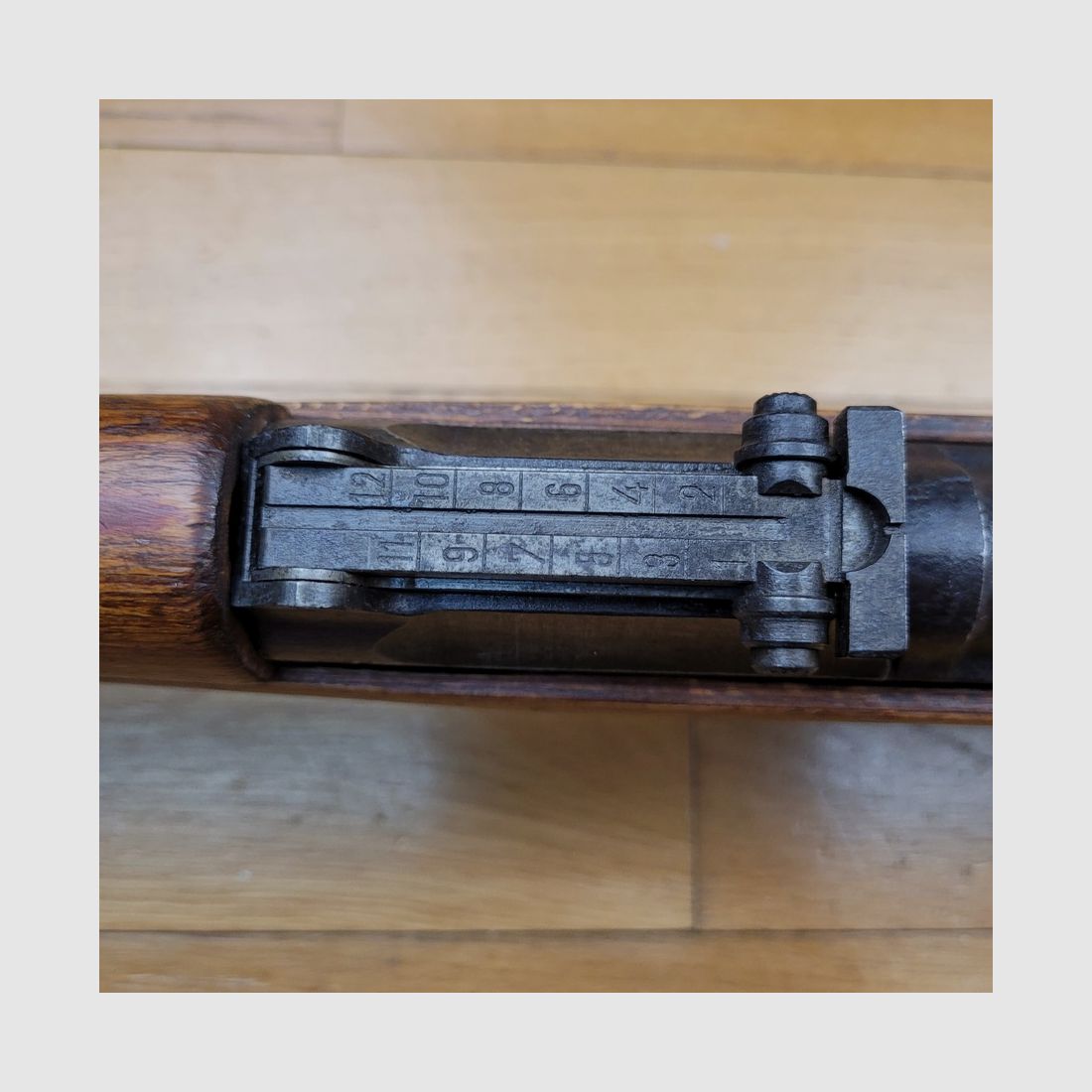
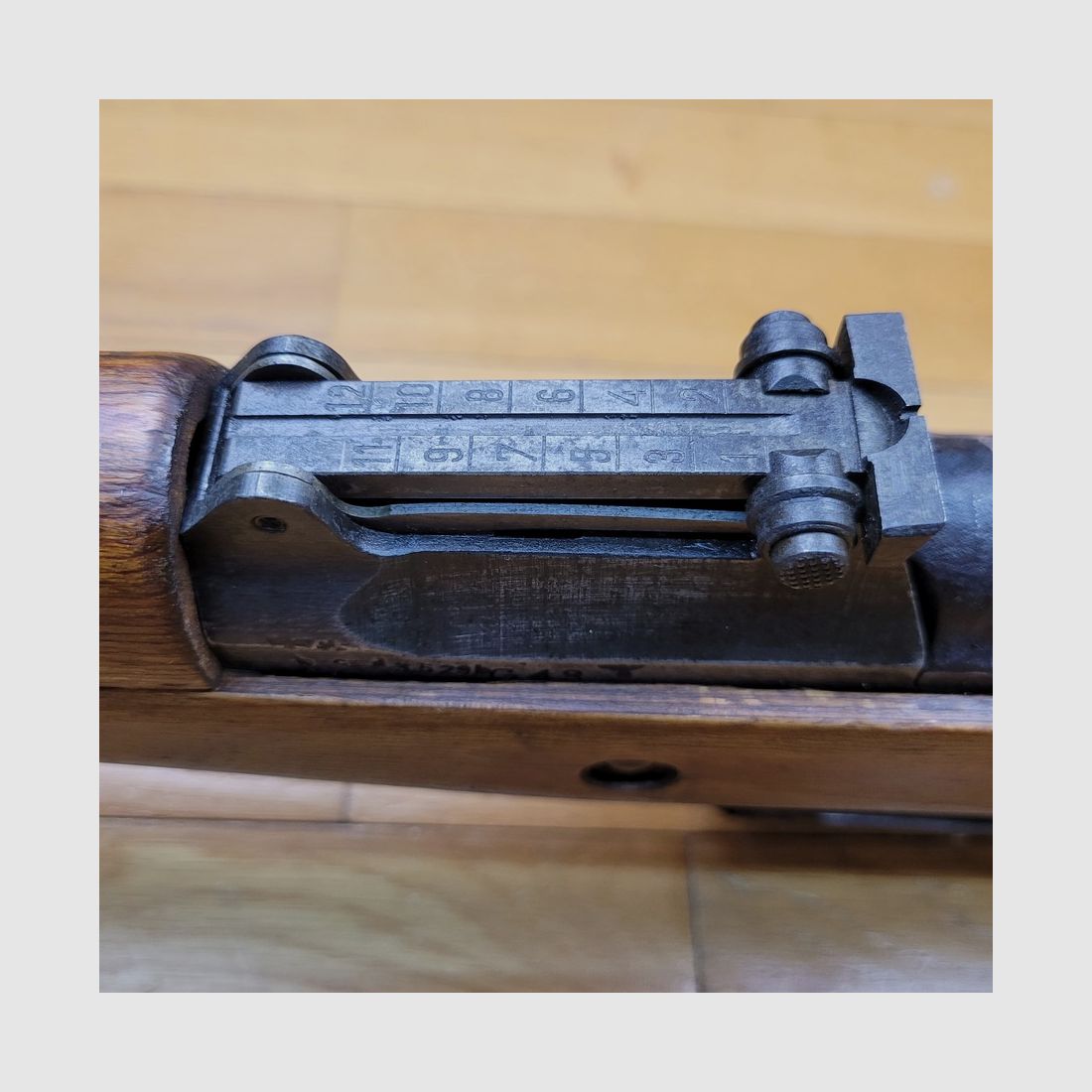
The metal parts of our firearm are in perfect condition – no oxidation except a little at the end of the barrel (very slight) and almost no rust. The rear sight is original and functional.
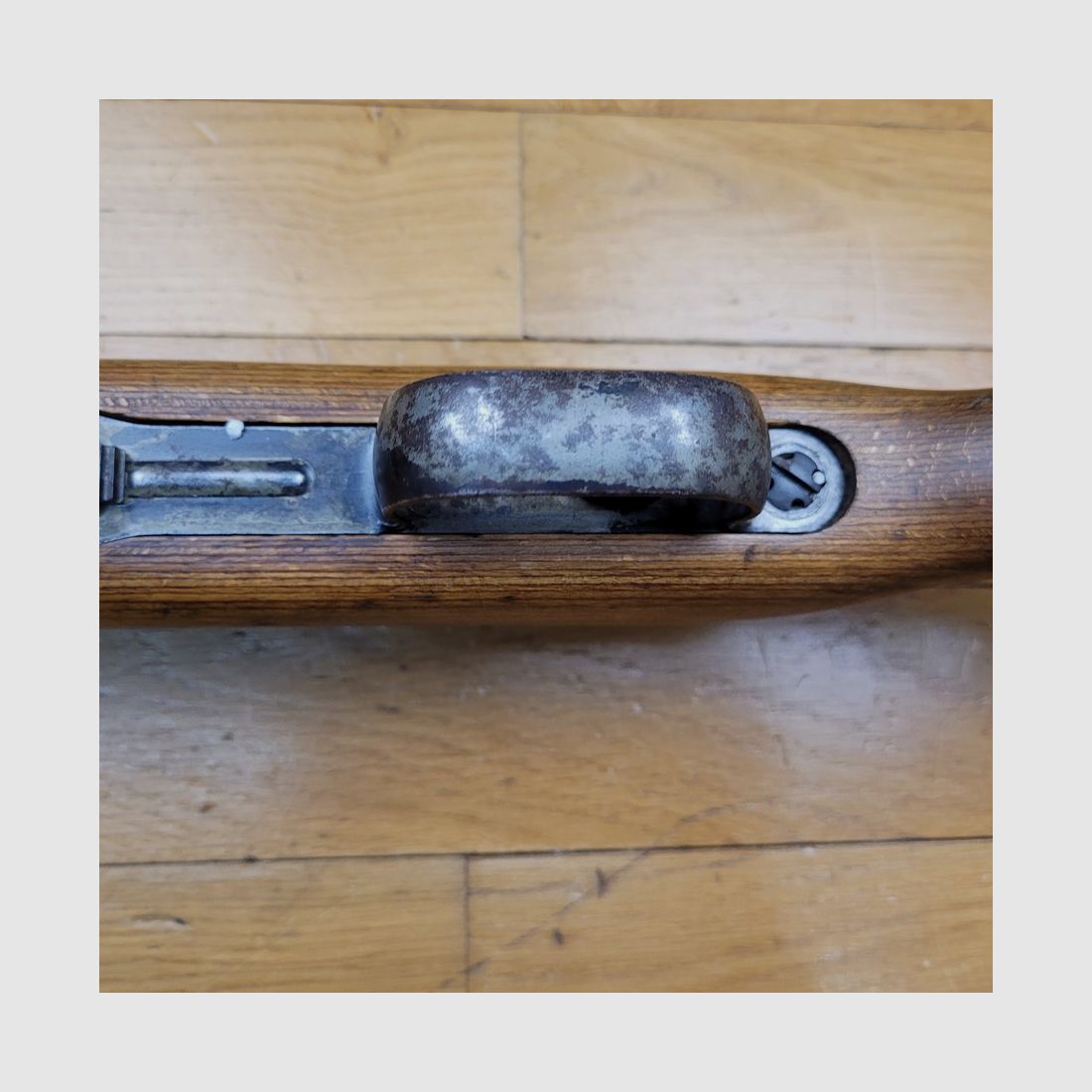
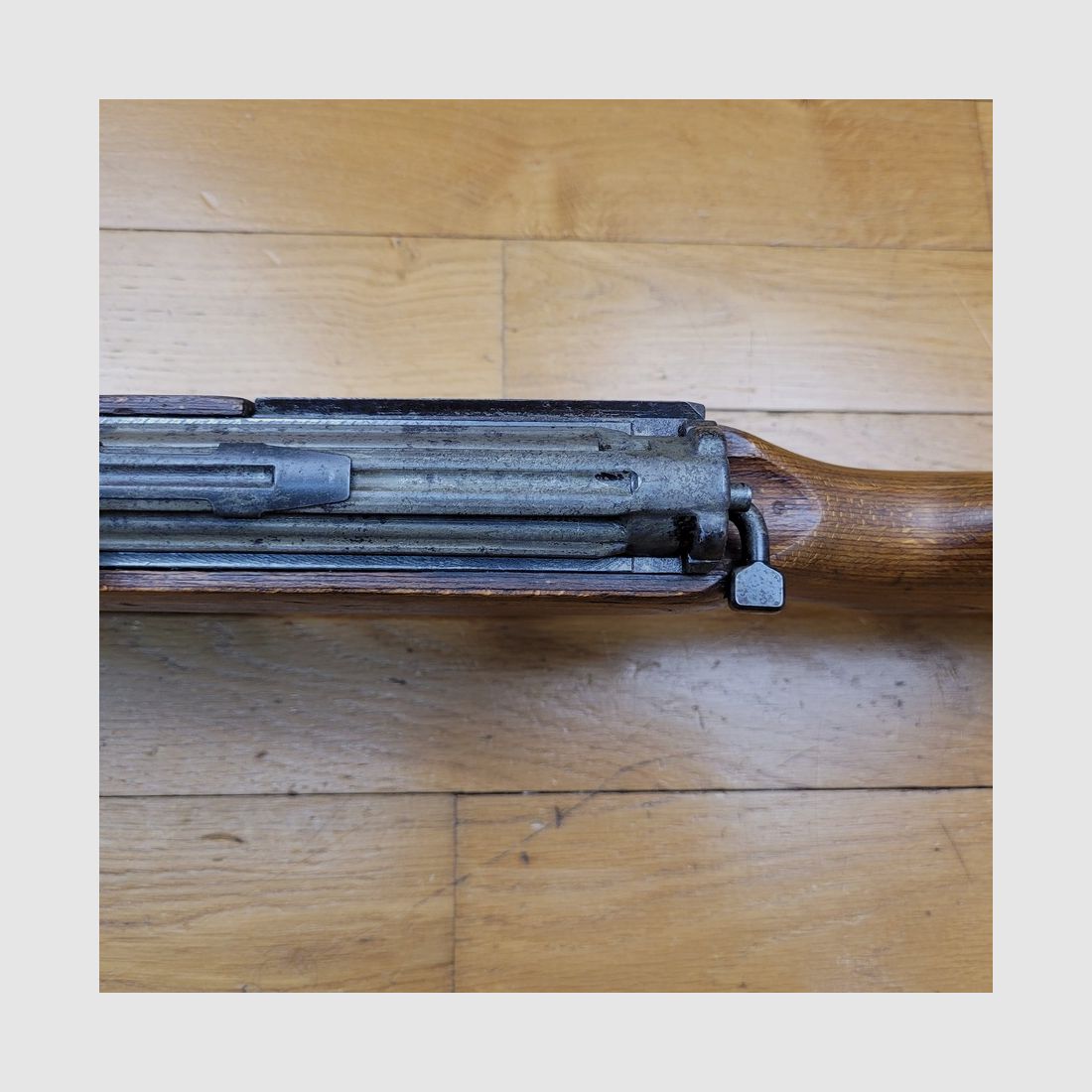
The mechanical operation of our firearm is impeccable including the safety flag and the small bolt button that holds it in the open position.
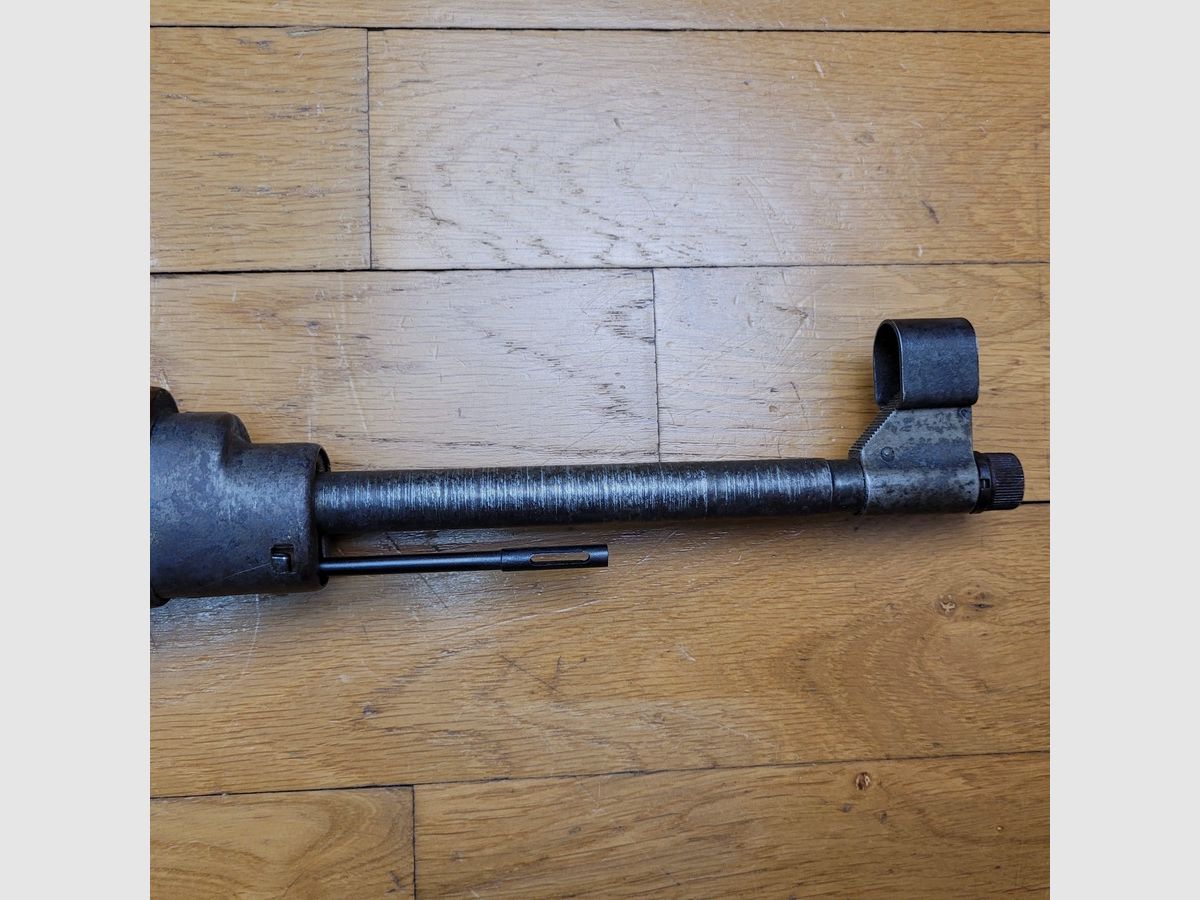
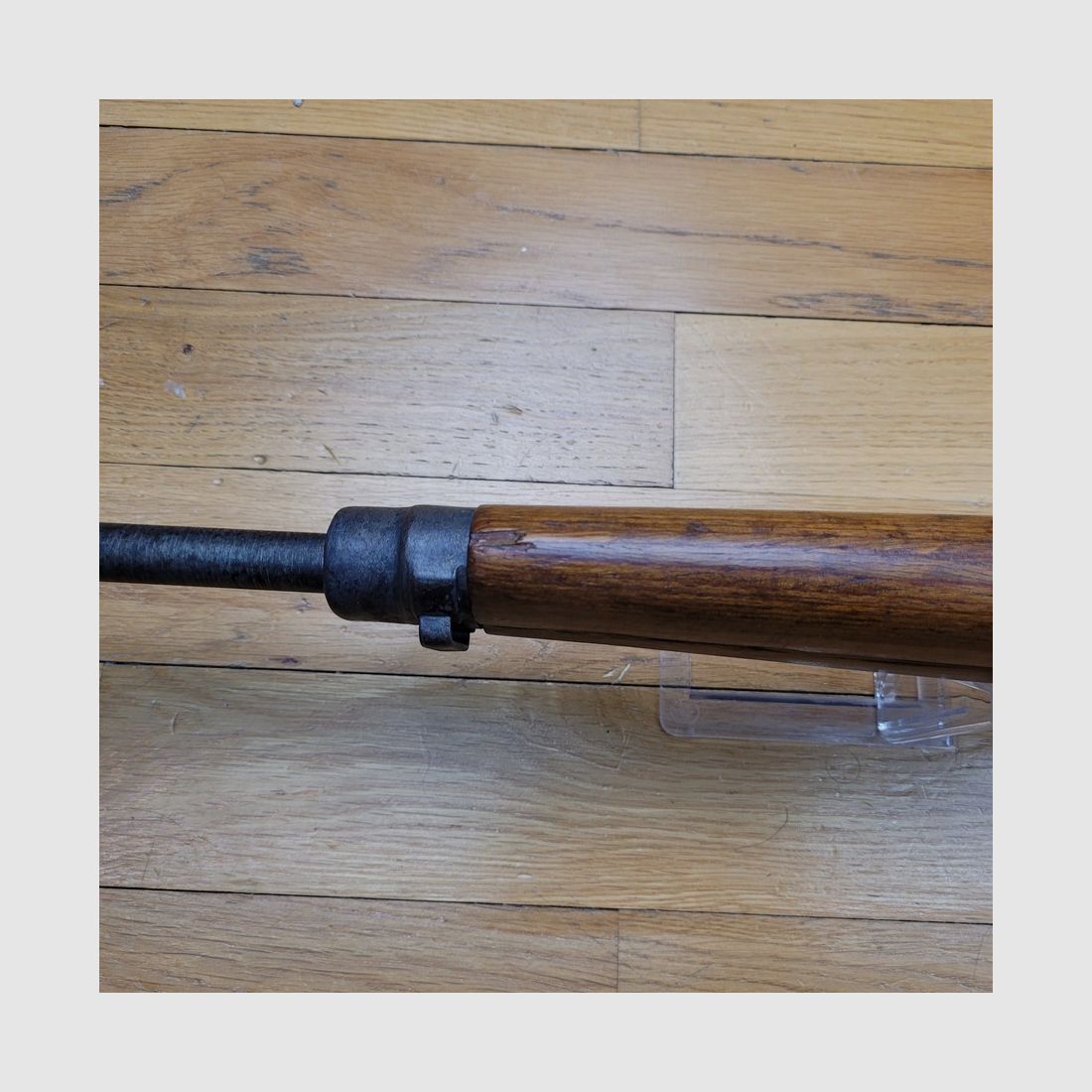
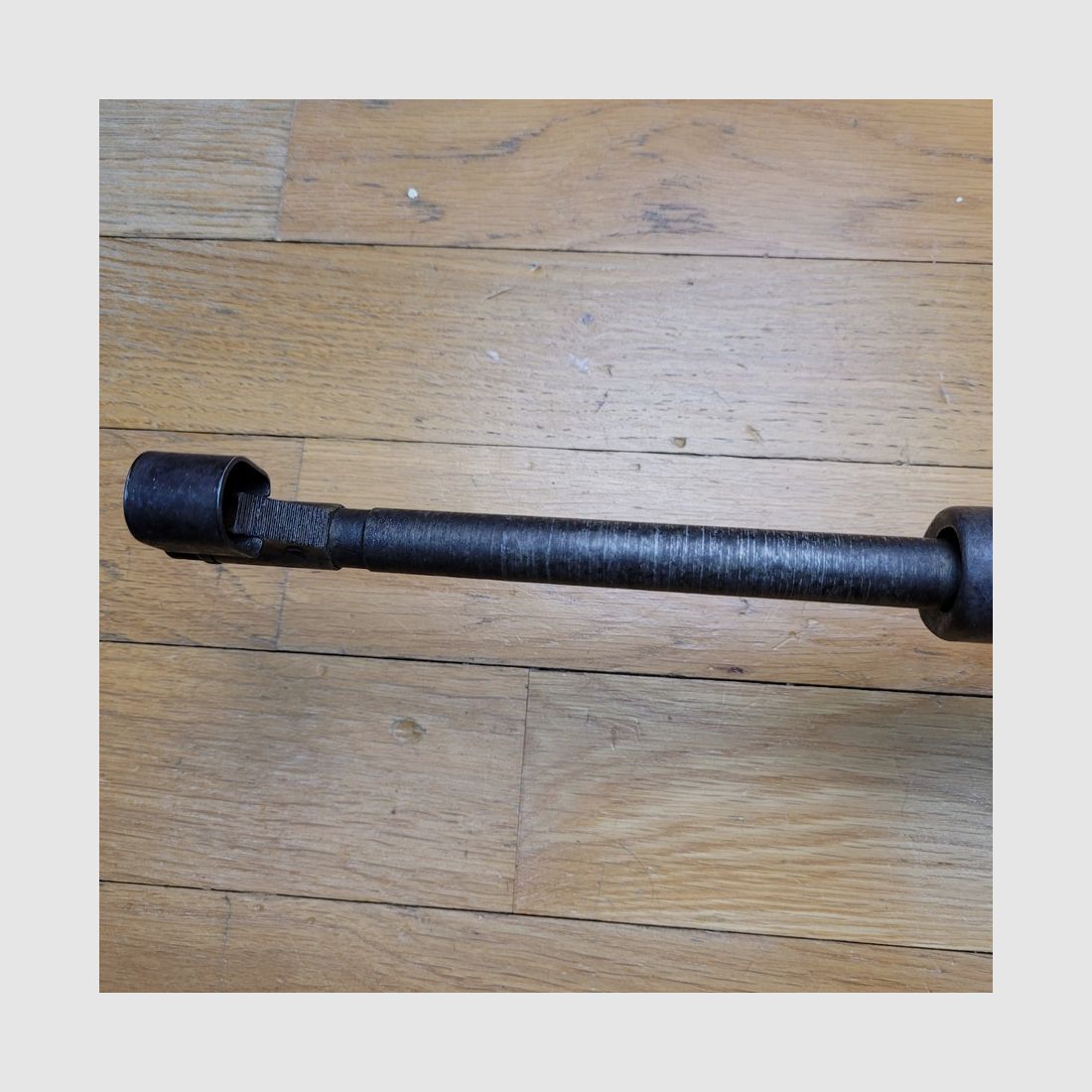
All parts are period correct (screws, bolt parts, rear sight) except perhaps the cleaning rod which is too bronzed and new for my taste. It is a replacement (they were no longer numbered on the G43 anyway). If this detail really bothers you, Maître Flingus will be happy to provide you with a period mute K98 cleaning rod as a replacement. They are the same… It is the only part common with the K98 (along with the sling). The buttplate, slightly oxidized only on the edges (but no problem), with the cleaning compartment is also the correct Gustloff model with grooves.
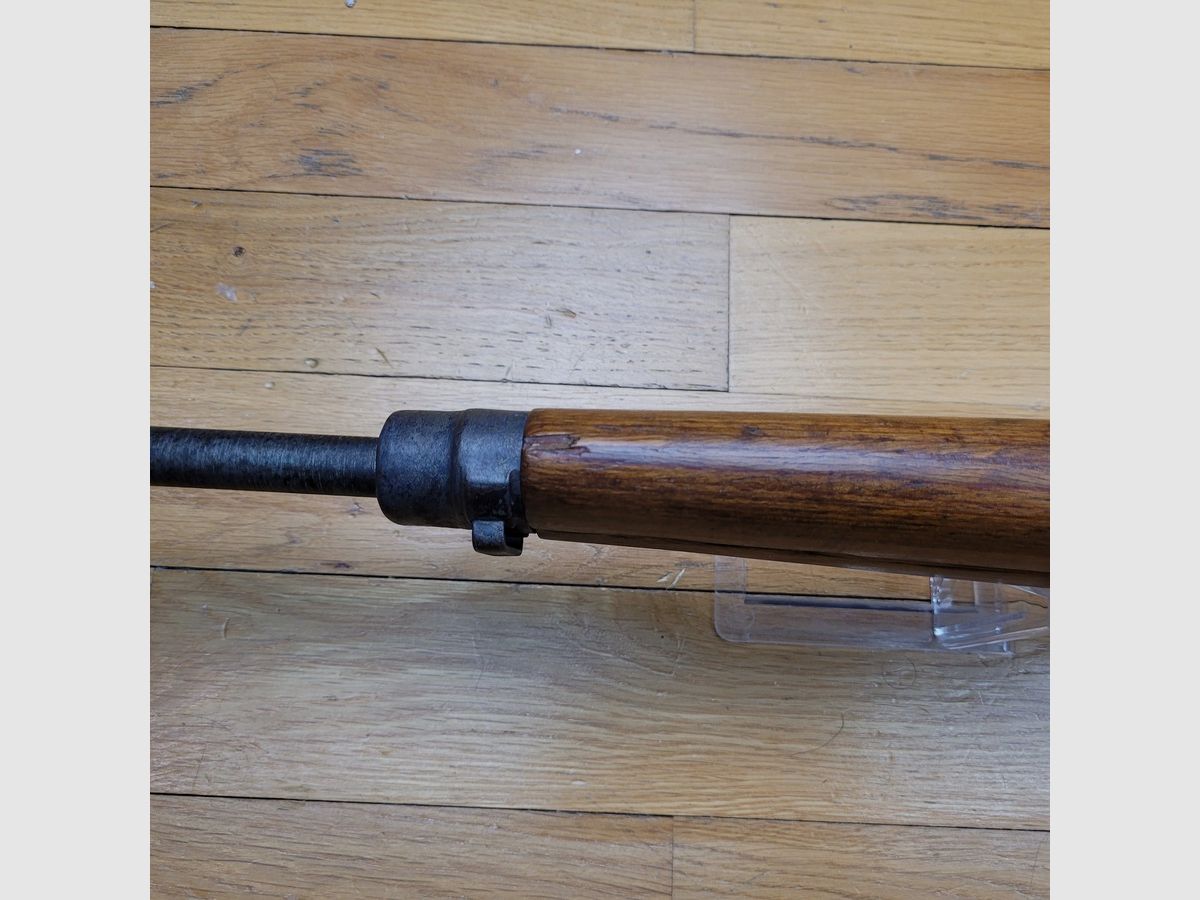
The barrel is in very good condition, dull because it is dirty, but in very good condition.
The rifling is still very sharp and free of oxidation. It still has a lot of potential. I recommend the American product "bore elimitor" from Bore Tech.inc. (with a pig on it!) which, if you strictly follow the instructions and wear gloves (a warned man is worth two!), is the best on the market to my knowledge. It should completely change its appearance and become even more beautiful.
You should know that the barrel of the G43 is only 55 cm long to fire the very powerful 8×57 (which also had to operate an MG42 at the time!), that its extraction system is quite violent (sometimes capable of flattening the top of the case). The weapon is very robust. This often resulted in quite heavy wear on the parts, especially the barrels. However, this is not at all the case with our weapon. All its parts are in like new condition. Our barrel still has at least 80% or more of its potential, if not more. Really good.
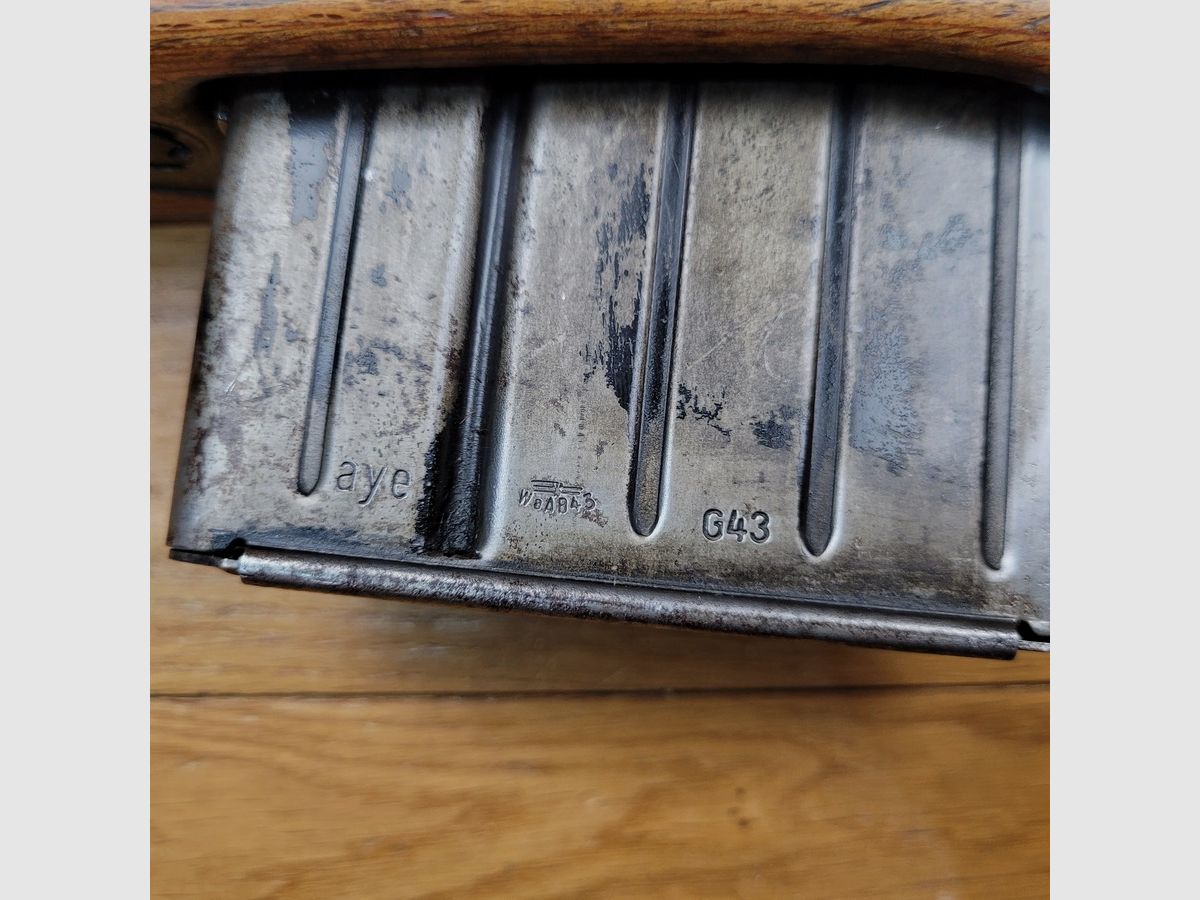
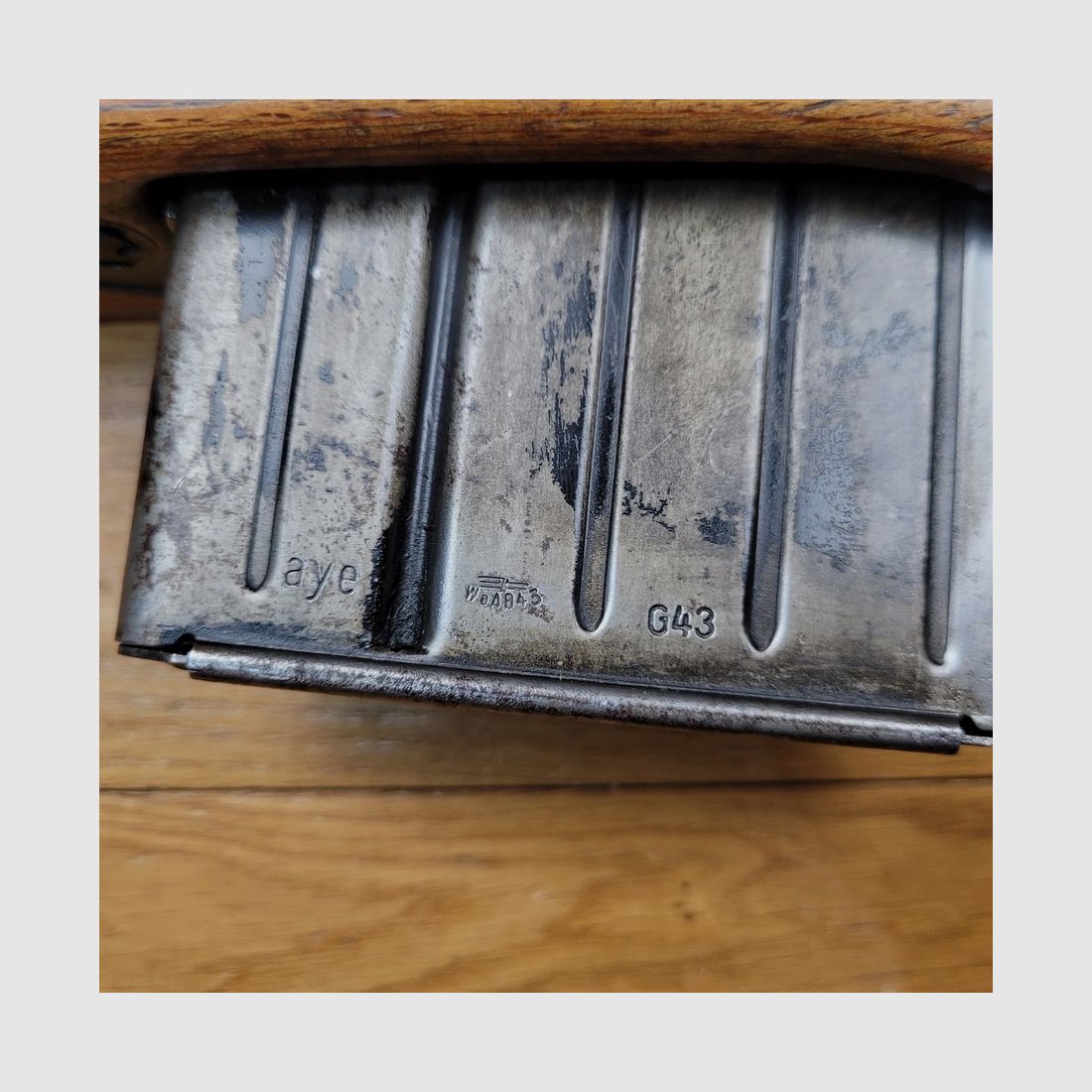
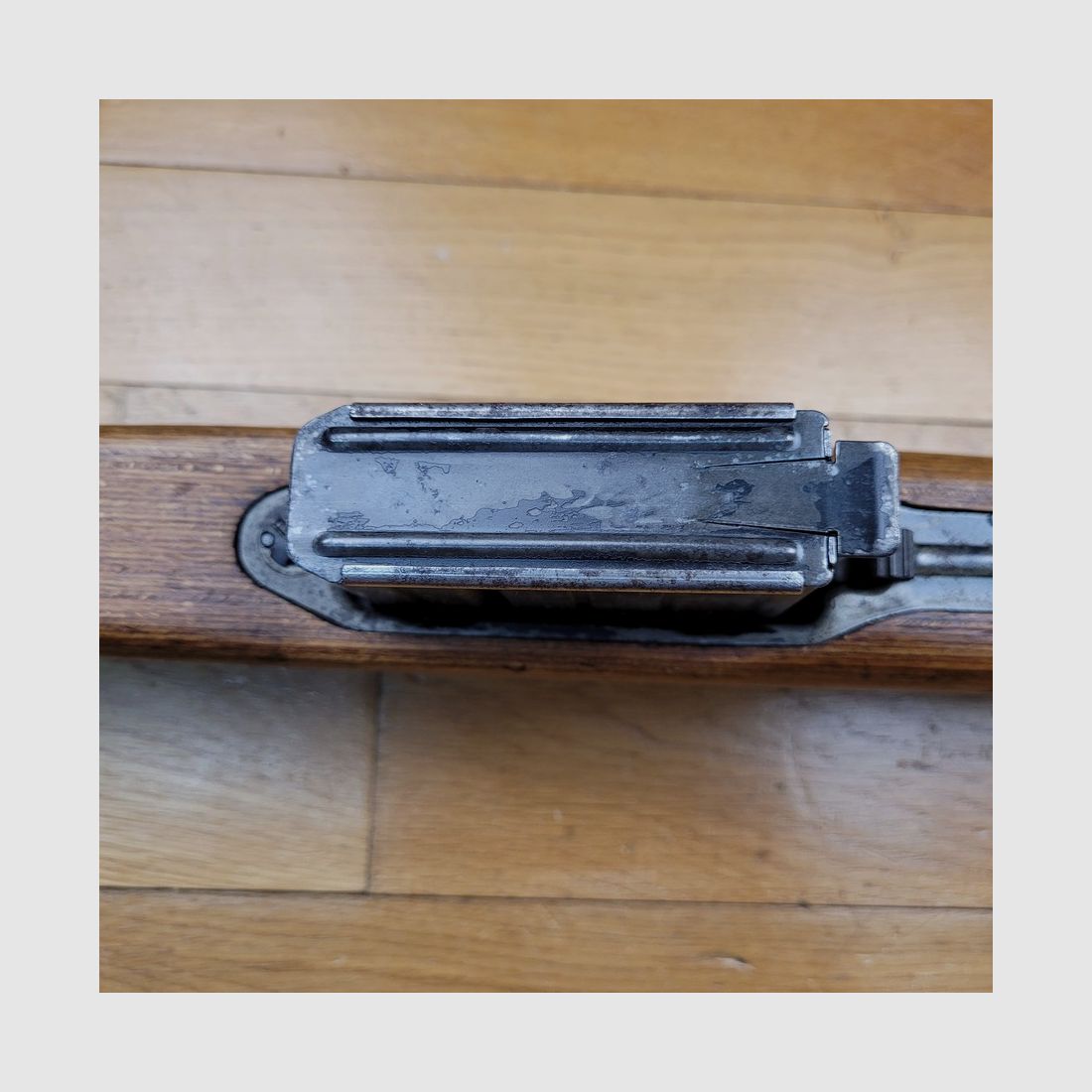
Our weapon comes with a very good period magazine clearly marked "AYE G43" with its proper waffenamt "WaAB43" – This is not a reproduction. This magazine is in excellent condition.
Objectively, a weapon in excellent condition, close to almost museum quality. A top collector’s piece.
The weapon is of course semi-automatic, 10 rounds, and in the original caliber 8x57IS. It is definitely category B. It would be scandalous to reduce its capacity and modify a weapon of this rarity and near museum condition to pass it into category C.
No need to ask me to do that. The answer will definitely be: "No!"
G43s have become rare and this one might even be a bit more than that. They all go abroad or to castration (conversion to C)/ neutralisation in our beautiful country. It would cost me to export this quality weapon as I will do more often now with this type of equipment. I would like it to stay in France because it is now part of our history too, having also been used by the five or six SS divisions present in Normandy and Alsace from summer 1944 to early 1945.
It should also not be damaged by too intensive shooting with overpowered market ammunition (reloading recommended) because they are rarely seen in this condition and the piece will become increasingly rare over the years.
This very beautiful G43, of rare manufacture, single serial number and in like new++ condition will make a choice addition hardly improvable for a serious collector of European, German or World War II regulated weapons.
If you’re going to buy a G43, you might as well get an exceptional one. The finest pieces never lose value. On the contrary. And take care of it. Its 80-year journey has been long and hazardous to come to us in this condition. You are responsible for what is now as much a piece that tells History and memory as a weapon.
CATEGORY B WEAPON AT THE CSI: SUBJECT TO AUTHORIZATION, PHOTOCOPY OF ID AND ORIGINALS OF AUTHORIZATION PARTS 1 AND 2. Or part 1 of an authorization released by a weapon transfer and still valid. Shipment against signature in two separate packages at least 48 hours apart mandatory.
***********************************************************************************************************************************
Let’s repeat it! The Flingus Maximus armory in Paris and throughout France is also here for your private party weapon formalities, buying collections of weapons and militaria, your weapon appraisals, your weapon questions in successions and inheritance. Contact your favourite gunsmith via our contact form or at [email protected] (Show description in original language)
Encore un ! Et c’est pas facile à trouver. Très bon état comme l’autre mais celui-là est monomatricule en plus.
Et c’est surtout un rarissime en plus.
Espérons que l’adage jamais deux sans trois se vérifiera.
Mais un peu d’histoire d’abord.
On ne peut décemment pas dire que l’armée allemande ait brillé par ses capacités d’innovation, notamment conceptuelle, sur les armes individuelles entre 1914 et 1918. Le gros de l’effort avait été fait par des privés comme Mauser ou Luger (qui était autrichien) et avant 1914.
Où est le Chauchat allemand ? Où est la mitrailleuse légère type Lewis (la 08/15 fait 17kg!) ?
Pire.
Où sont les FSA 17, les Meunier et autres Fedorov 1916 allemands?
Réponse: nulle part. Même pas à titre d’essais poussés jusqu’aux premières lignes.
Leur seule vraie innovation en matière d’armes individuelles s’est limitée au PM 18 en fin de guerre. C’est important mais c’est loin d’être un fusil ou une arme d’appui avec la puissance de cartouche que cela suppose.
Mais nul fusil d’assaut automatique ou semi-automatique ou « fusil mitrailleur » dans ses rangs. Nulle arme à répétition suffisamment simple d’emploi et de calibre assez costaud pour soutenir le groupe d’infanterie élémentaire et qui puisse être portée par un homme seul. L’arme d’assaut du fantassin allemand en 14-18, c’est la grenade.
Et cela ne s’est pas arrangé entre 1918 et 1941. Entre les destructions d’usines (à partir de 1920 seul Simson&Co à Suhl peut produire légalement), les clauses du traité de Versailles et les réticences doctrinales face à la nouveauté, on ne développera pas d’arme semi-auto sérieuse en Allemagne.
Seul Walther, qui est d’ailleurs obligé d’aller innover en Suisse, se distinguera vers 1930 par un prototype de fusil dit « A115 », semi-automatique à récupération de gaz à la bouche (et sans chargeur amovible), un engin qui, sur les rares images d’archives, nous rappelle quand même furieusement notre objet de ce jour ou plutôt son frère ainé de 1941 dont nous allons reparler.
Cette modeste expérience de Walther ne sera toutefois pas perdue.
Et c’est sur la base de cette expérience que Walther gagnera en Allemagne son droit de figure centrale dans le redressement allemand en matière de fusils semi-automatiques.
L’Allemagne abordera donc la seconde guerre mondiale plutôt bien équipée en PM et en mitrailleuse mais sans arme semi-auto ou auto d’appui d’infanterie digne de ce nom. Elle n’a ni Garand, ni SVT40, ni FM29, Ni Bren…
On me répondra « MG34 », la fameuse mitrailleuse « légère et polyvalente ». Je répondrai « 12 kilos avec le bipied et sans les munitions! ». Amusez vous bien en précision, au coup par coup, ou tout seul, avec ça à bout de bras sur un groupe d’hommes à 300 mètres qui, normalement, est armé lui aussi… Et on en aura toujours moins que de fusils semi auto. En fait ce n’est pas tout à fait le même emploi tactique notamment en combat urbain.
Et, en 1941, quand elle se lance en Russie, la déconvenue est lourde pour l’armée allemande toujours massivement équipée de son bon vieux K98 qui n’est rien d’autre qu’un G98 raccourci. Les russes, eux, sont largement équipés non seulement de pistolets-mitrailleurs PPSH (et de son redoutable chargeur à 71 cartouches dans le très bon 7,62TT) mais aussi de l’excellent SVT40, un vrai fusil semi-automatique avec une cartouche lourde qui dès le début fait leur admiration. Voire de sa version automatique AVT40 (un moindre succès). Mais c’est déjà une autre histoire que je vous ai racontée ici.
Les allemands de Walther, qui travaillent sur un prototype depuis l’entrée en Russie, décident de copier ce qui leur parait bien dans le SVT40 russe tout en conservant ce qu’ils considèrent comme des innovations prometteuses de leur propre prototype (innovations d’ailleurs inspirées du système Bang suédois à culasse rotative et récupération de gaz en extrémité de bouche).
Mais ces choix techniques sont faits sur un système semi-auto sur lequel ils n’ont pas de recul ni en conception, ni en production, ni sur le terrain. Notamment sur le modèle d’emprunt de gaz. Mal leur en prend.
Certes c’est bien le fusil semi-automatique Walther Gewehr41 ou G41 (qui n’a carrément pas respecté le cahier des charges tant celui-ci est complexe) qui l’emporte lors des essais sur un prototype Mauser. Mais, euphémisme, ce n’est pas un triomphe technologique.
Au passage, ce fameux cahier des charges imposait aux constructeurs au moins trois contraintes baroques à l’origine de bien plus de problèmes que de solutions :
1) ne pas percer le canon même pour récupérer les gaz (pour ne pas nuire à la précision … d’une arme portant destinée opérationnellement à tirer à 2 ou 500 mètres tout au plus !),
2) avoir toutes les pièces mobiles à l’intérieur de l’arme,
et, pour couronner le tout,
3) être capable de fonctionner en manuel en cas de défaillance du système semi-automatique.
Bref, tout pour compliquer un projet avec des idées que russes et américains avaient abandonnées depuis longtemps.
On résume ce G41 ?
Complexe, peu fiable sur le terrain, fragile et avec des problèmes de précision à l’échauffement en prime pour la version M. Copie à revoir. Mais on est tellement « à la rue » en matière de semi-auto dans l’armée allemande en 1941 qu’on lance quand même la production !
Deux versions du G41, la M (chez Mauser) et la W (Chez Walther), seront produites en tout à moins de 145.000 exemplaires. L’arme, surtout dans sa version W est utilisable et sympa au stand, très intéressante au plan mécanique, mais loin d’être assez fiable et solide pour une utilisation sur le dur Front de l’Est. La version M est pire et n’a pas connu d’utilisation opérationnelle durable. Mais, W ou M, c’est rarissime et ultra recherché de nos jours. Maître Flingus court après une bonne version M, qui est en quasi « prototypale »en fait, depuis quelques années. Et les G41 W, plus fiables, ne sont pas beaucoup plus courants. Même très rares. Tout ça a été perdu à l’Est. Une arlésienne que Maître Flingus a finit par exceptionnellement saisir ici.
Quelques données pour illustrer par l’exemple l’ampleur du problème G41 « M : 8 pièces mobiles rien que pour faire fonctionner la culasse aller-retour et 18 ressorts en tout, toujours dans la version M (pas tous les mêmes). Une sorte de record du monde. Et la version « simplifiée » W, certes plus fiable et un peu plus légère reste toujours complexe et assez difficile d’entretien au front.
Pour couronner le tout, la fabrication est cauchemardesque notamment chez Mauser déjà débordé par la production de 98K. Elle sera néanmoins produite en version W jusque mars 44 en complément de notre G43. La version M est abandonnée, elle, dès décembre 1942.
Pour le G41 M, la production sera stoppée à 6,673 exemplaires seulement (et moins de 130.000 pour le W) dont …. 1,673 seront directement retournés au Matériel puis au fabricant. G41 M et W sont en toutes hypothèses aujourd’hui des armes très rares qui font le bonheur des collectionneurs argentés surtout aux USA. Notez bien au stand ça tire quand même très droit et c’est passionnant en main.
Mais on ne pouvait en rester là et il fallait réagir pour équiper les meilleurs soldats (car on ne confiait pas ces semi auto chers à produire à n’importe qui) avec une arme semi automatique capable de résister à la dure campagne à l’Est.
On commença tout simplement par récupérer les masses de SVT 40 pris aux russes durant les terribles étés 41 et 42 et par en faire une arme réglementaire dans l’armée allemande sous le vocable« G.259(r) ». C’était encore le plus simple. La munition de 7,62×54 R était abondante du fait des prises aussi.
Puis, surtout, on se résout enfin à copier tout bonnement le système de fonctionnement du SVT 40 et à l’adapter à l’excellente 8x57IS. C’est l’acte de naissance de notre splendide Gewehr 43 ou K 43 de ce jour.
Le système d’emprunt de gaz retenu est à piston court et récupération des gaz par un orifice du canon comme sur le SVT 40 et ce système russe deviendra un standard sur toutes les armes modernes. Le SKS 45 et l’AK47 n’adopteront pas d’autres solutions. Au diable, l’honneur des ingénieurs allemands.
Au prix de cette couleuvre à avaler, le G43 est un bon fusil mais qui, selon beaucoup, reste inférieur, en conditions de combat, au SVT40 qui est plus simple et moins lourd (3,8 kg contre 4,4 au G43). Dans cette catégorie, le Garand est aussi un très bon fusil du niveau du SVT mais plus lourd (4,3kg) et un peu moins bien équilibré à mon sens. Le G43 est sans doute un peu mieux équilibré que le Garand, lui d’une étonnante robustesse. Et son histoire opérationnelle est un peu différente. Amis collectionneurs /tireurs faites votre choix !
Reste que le G43 est une arme de qualité, précise, fiable, efficace, et qui fera le boulot et pourra répondre dignement à ses adversaires de l’Est. Il deviendra même par ses lignes une légende, inséparable de la silhouette du Landser d’élite blanchi sous le harnais du front est. Elle sera renommée « K43 » pour « Karabiner » en 1944 de mémoire.
La fiabilité opérationnelle du G43 en condition de terrain (notamment de nettoyage) est de l’ordre du jour et de la nuit en comparaison avec son frère aîné 1941 à récupération de gaz en bout de canon. Du coup, le manchon de canon qui caractérisait le G41 a disparu aussi rendant l’arme non seulement plus fiable mais aussi nettement plus design.
Enfin, et ce n’est pas rien, (on se demande même comment, en 1941, on avait pu réfléchir autrement !), le chargeur devient enfin amovible ce qui simplifie quand même pas mal de choses aussi.
Je ne vous fais pas la leçon sur les qualités et la facilité à trouver et recharger la munition 8x57IS mais ça compte aussi.
In fine, en 1943, l’armée allemande tenait enfin avec notre G43 le fusil semi-automatique fiable et efficace de ses rêves. Sept ans après les russes et les américains et 25 ans après que les autres aient commencé à mettre l’idée en œuvre. Mais il était là. Une vraie révolution par rapport au bon vieux K98.
L’arme fut produite à 415.000 exemplaires (à comparer à 15 millions ou plus de K98 de toutes variantes) utilisés pour l’essentiel sur le Front de l’Est.
Précisons que le G43 est équipée en série d’un rail sur le coté droit pour pouvoir fixer une lunette de type ZF4 (ou sa reproduction). Cette arme fût en effet largement utilisée pour le tir de précision à moins de 4/500 mètres. 53.000 à 57.000 armes, selon les sources, sortiront d’usine équipées de cette lunette.
Excellente arme de combat, largement utilisée et souvent par les troupes d’élites, cette arme est devenue un peu iconique avec les jeux vidéos et assez difficile à trouver. Très recherchée en tous cas.
***********************************************************************************************************************
Notre arme de ce jour est un rare exemplaire fabriqué par « bcd » (comprendre « Gustloff Werke ») à l’été 1944 – bien marqué « bcd 3529 b – G43 « . Et, après recherches, celui-là est assez sinistre. Et néanmoins rare. C’est le plus rare des fabricants de G43.
Les G43 ont en effet été fabriqués par trois centres de production distincts: Walther, le concepteur, qui en a fabriqué 223.800, Berlin-Lübecker-Maschinenfabrik ou BLM qui en a produit 156.000 et enfin Gustloff Werke qui en a produit… 35.200. Seulement.
C’est dire la rareté de cette variante. Car cette production a duré très peu de temps.
Et il y a à cela une terrible explication historique.
Gustloff était le seul consortium de production allemand à travailler directement pour le parti nazi car il était … la propriété même du dit parti.
Mi-1943, Gustloff ouvrit une usine de montage pour monter des armes au sein du camps de Buchenwald. 3.000 prisonniers essentiellement russes, français et polonais furent contraints d’y servir sous surveillance par roulements ininterrompus de onze heures. Cet atelier commença à monter des G43 à la mi-février 1944. Toute sa production partait pour équiper la SS armée, unité combattante.
Les anglais soupçonnèrent (à tord) que cette usine puissent travailler à la construction de V1 qui les menaçaient directement. C’est pour ce motif seul qu’ils bombardèrent cette usine (les alliés ne firent quasiment rien de la guerre pour aider les prisonniers des camps en tant que tels).
L’usine fut donc détruite par un bombardement de la Royal Air Force le 24 août 1944. Le bombardement fit 364 morts (dont 80 SS), 238 blessés et 65 disparus. Parmi les prisonniers victimes du bombardement se trouvaient la princesse Mafalda de Hesse, fille du roi d’Italie ainsi que le député socialiste allemand Rudolf Breitscheid et son épouse. Mais au moins, la production de G43 ne put jamais reprendre et les pièces restantes furent expédiées à l’Usine Walther de Zella-Mehlis pour y être utilisées.
Voilà pourquoi cette production fut de courte durée et que cette variante est rare.
Notre arme, avec le numéro de série 3529b est plus que très probablement sortie de cet atelier entre juin et juillet 1944, très peu de temps avant ce bombardement.
Il faut savoir aussi que ces armes n’étaient qu’assemblées à Buchenwald à partir de pièces venues de sous traitance et notamment de … Saint-Étienne en France (canon et boitier pas d’autres pièces à ma connaissance).
Les boitiers de Gustloff sont connus pour porter soit un waffenamt qui lui est propre avec une étoile à coté d’un aigle à roulette (étoile indiquant une sous-traitance et waffenamt propre à l’arsenal Gustloff II – et à ne pas confondre avec le « Sunburst » qui indique une réutilisation après guerre par la DDR ) comme le notre ou bien le Waffenamt 134 de Saint-Étienne en France occupée.
Le notre porte bien ce waffenamt spécial étoilé de Gustloff sur le boitier et aussi le Waffenamt 134 plus un aigle de Saint-Étienne sur son canon. Je l’ai démonté le garde main pour m’en assurer. C’est bien à 100% une des armes produite par Gustloff pour équiper la SS dans cette courte période.
Au titre des poinçons, je signale aussi le waffenamt « 749 » propre à Gustloff en maitrise d’œuvre sur le bois en deux endroits.
Ces bois sont en lamellé-collé comme il se doit et en excellent état avec assez peu de marques de manipulation essentiellement du coté droit du fût. Mais ils sont vraiment dans un très bel état de présentation avec très peu de coups. Absolument pas poncés ou abusivement « nettoyés » comme souvent. Très beaux.
Le bois porte aussi le numéro « 3529 b » sur la crosse en dessous de poignée avec encore un waffentamt imprimé dans le bois un peu plus bas, celui de Gusntloff encore une fois.
L’arme est donc intégralement monomatricule, boitier, culasse, bois avec tous ses poinçons et numéros de série parfaitement lisibles qui plus est (bon, je me suis aidé d’une loupe pour ceux des bois avec mes yeux de 60 ans mais c’est clair !). Outre sa provenance, son histoire et sa rareté intrinsèque, cela en fait à mon sens une arme assez exceptionnelle.
Les fers de notre arme sont en parfait état – aucune oxydation sauf un peu en bout de canon (c’est très léger) et aucune peu d’orange. La hausse est du modèle et fonctionnelle.
Le fonctionnement mécanique de notre arme est impeccable y compris le drapeau de sureté et le petit bouton de culasse qui sert à la maintenir en position ouverte.
Toutes les pièces sont bien d’époque (vis, pièces de culasse, hausse) sauf peut être la baguette trop bronzée et neuve à mon goût. C’est un remplacement (elles n’étaient de toutes façons plus numérotées sur les G43). Si ce détaille vous choque vraiment, Maître Flingus se fera un plaisir de vous fournir une baguette de K98 muette d’époque en remplacement. Ce sont les mêmes… C’est la seule pièce commune avec le K98 (avec la bretelle). La plaque de couche, un poil oxydée en tranches seulement (mais sans gravité), avec le logement de nettoyage est aussi bien du modèle Gunstloff à stries.
Le canon est en très bon état, terne car il est sale, mais en très bon état. Les rayures sont encore bien nettes et sans oxydation. Il a encore beaucoup de potentiel. Je vous conseille à cet égard le produit américain « bore elimitor » de chez Bore Tech.inc. (avec un cochon dessus!) qui, si on suit religieusement le mode d’emploi et que l’on met des gants (un homme averti en vaut deux!), est le meilleur sur le marché à ma connaissance. Il devrait totalement changer d’aspect et devenir encore plus beau.
Il faut savoir que le canon du G43 fait 55 cm seulement pour tirer les très puissantes 8×57 (qui devaient aussi faire fonctionner une MG42 à l’époque!), que son système d’extraction est assez violent (parfois capable d’aplatir le sommet de l’étui). L’arme est très virile. Il en est résulté souvent une assez forte usure des pièces et notamment des canons. Or ce n’est pas du tout le cas sur notre arme. Toutes ses pièces sont en TBE. Notre canon a encore au moins 80% ou plus de son potentiel, si ce n’est plus. Vraiment bon.
Notre arme nous vient avec un très bon chargeur d’époque bien marqué « AYE G43 » avec son bon waffenamt « WaAB43 » – Ce n’est pas une reproduction. Ce chargeur est en excellent état.
Objectivement, une arme en excellent état, proche du quasi muséal. Un sommet de collection.
L’arme est bien sûr en semi-automatique 10 coups et en calibre d’origine 8x57IS. Elle est en définitivement catégorie B. Il serait scandaleux de la réduire en capacité et de modifier une arme de cette rareté et de cet état quasi muséal pour la passer en C.
Inutile de me demander de faire ça. La réponse sera définitivement: « Non ! ».
Les G43 sont devenus rares et celui-ci est peut-être même un peu plus que cela. Ils partent tous à l’étranger ou à la castration (passage en C)/ neutralisation dans notre beau pays. Il me couterait d’exporter cette arme de qualité comme je vais le faire plus souvent désormais sur ce type de matériel. Je souhaiterais qu’elle reste en France car elle fait désormais partie de notre histoire à nous aussi, ayant été aussi utilisée par les cinq ou six divisions SS présentes en Normandie et en Alsace de l’été 1944 au début de 1945.
Il conviendrait aussi de ne pas l’abîmer par un tir trop intensif en munitions survitaminées du marché (rechargement conseillé) car on les voit rarement dans cet état et la pièce deviendra de plus en plus rare avec les années.
Ce très beau G43, d’une rare fabrication, monomatricule et en TBE++ fera une addition de choix difficilement améliorable pour un collectionneur sérieux d’armes réglementaires européennes, allemandes ou de la seconde guerre mondiale.
Quitte à vous acheter un G43, autant en prendre un exceptionnel. Les plus belles pièces ne perdent jamais de valeur. Au contraire. Et soignez le. Son parcours de 80 ans a été long et hasardeux pour venir jusqu’à nous dans cet état. Vous êtes responsable de ce qui est désormais autant une pièce qui raconte l’Histoire et le souvenir qu’une arme.
ARME DE CATÉGORIE B AU CSI : SOUMISE À AUTORISATION, PHOTOCOPIE DE LA PIÈCE D’IDENTITÉ ET ORIGINAUX DES VOLETS 1 ET 2 DE L’AUTORISATION. Ou du volet 1 d’une autorisation libérée par une cession d’arme et encore valide. Expédition contre signature en deux colis séparés d’au moins 48 heures obligatoire.
***********************************************************************************************************************************
Répétons le ! L’armurerie Flingus Maximus à Paris et partout en France est là aussi pour vos formalités armes entre particuliers, le rachat de collections armes et militaria, vos estimations d’armes, vos questions armes dans les successions et héritage. Contactez votre armurier préféré via notre formulaire de contact ou à [email protected]