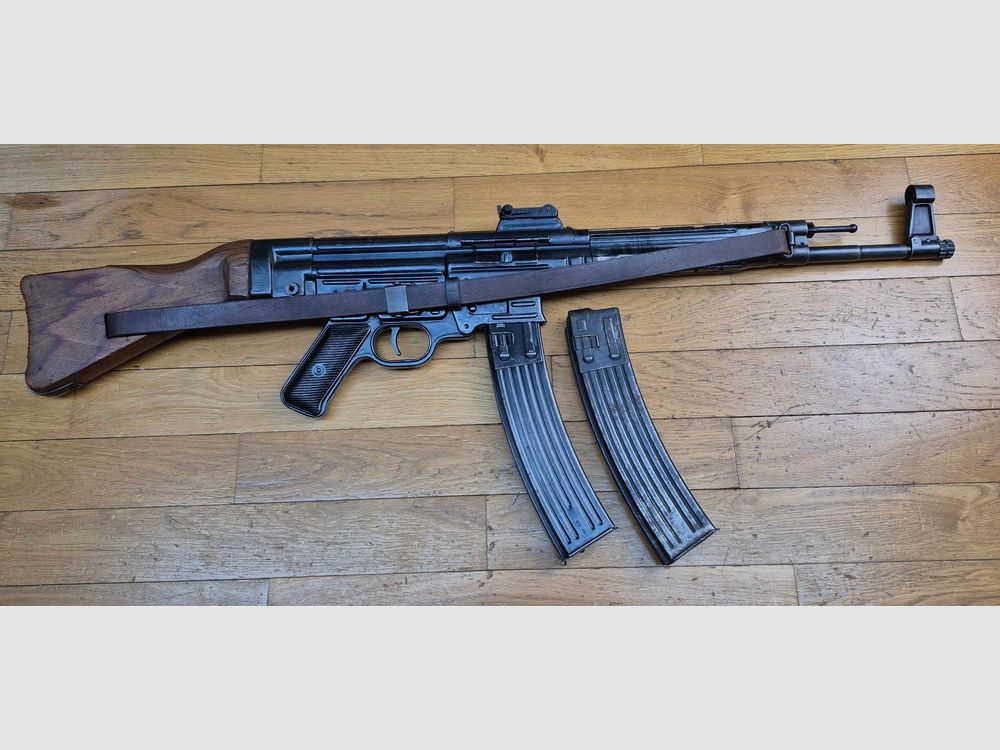



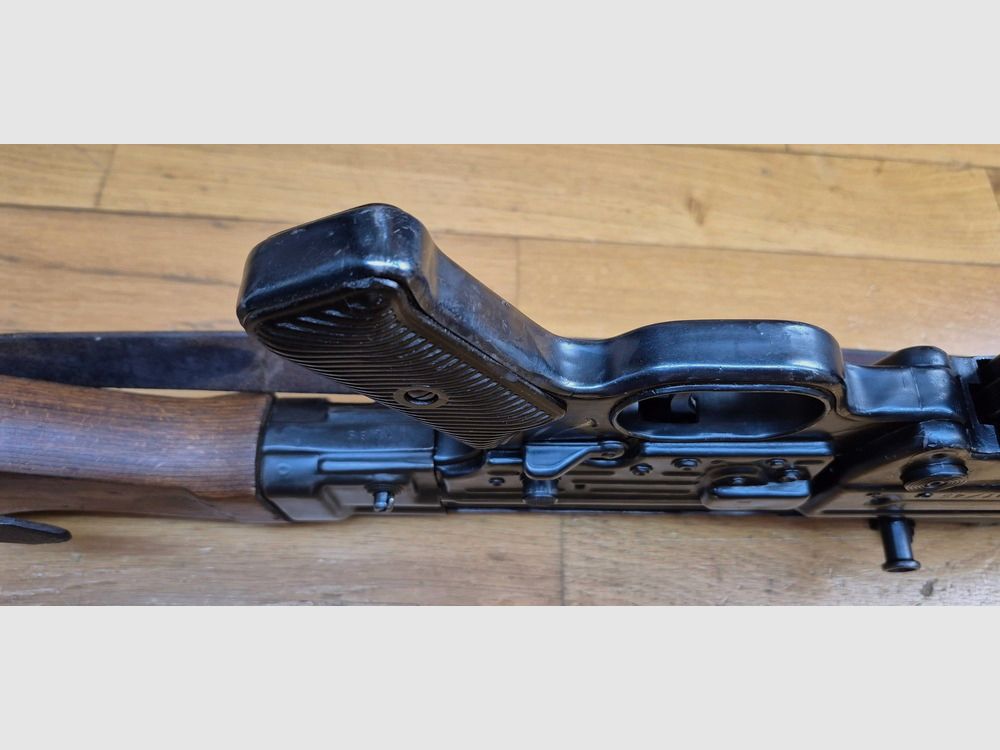

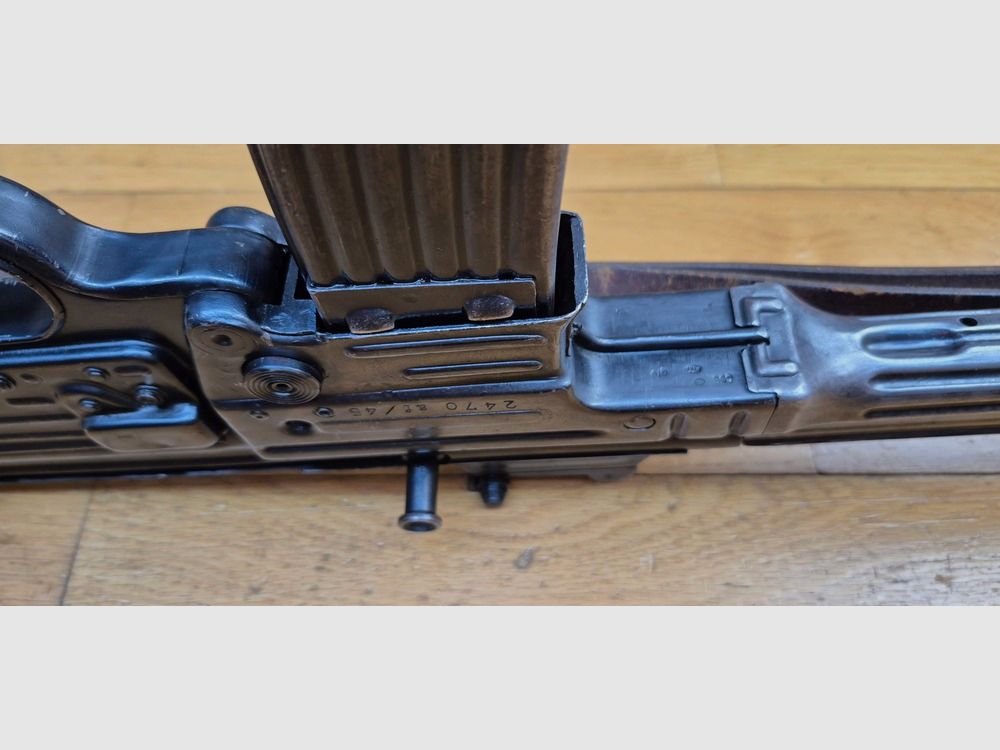
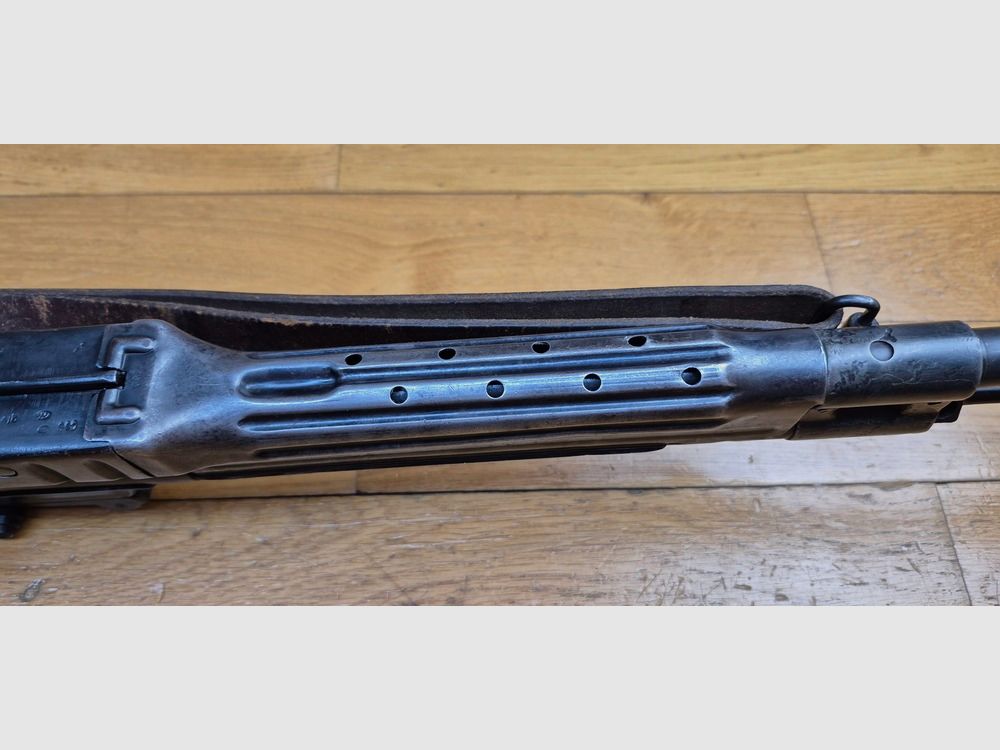

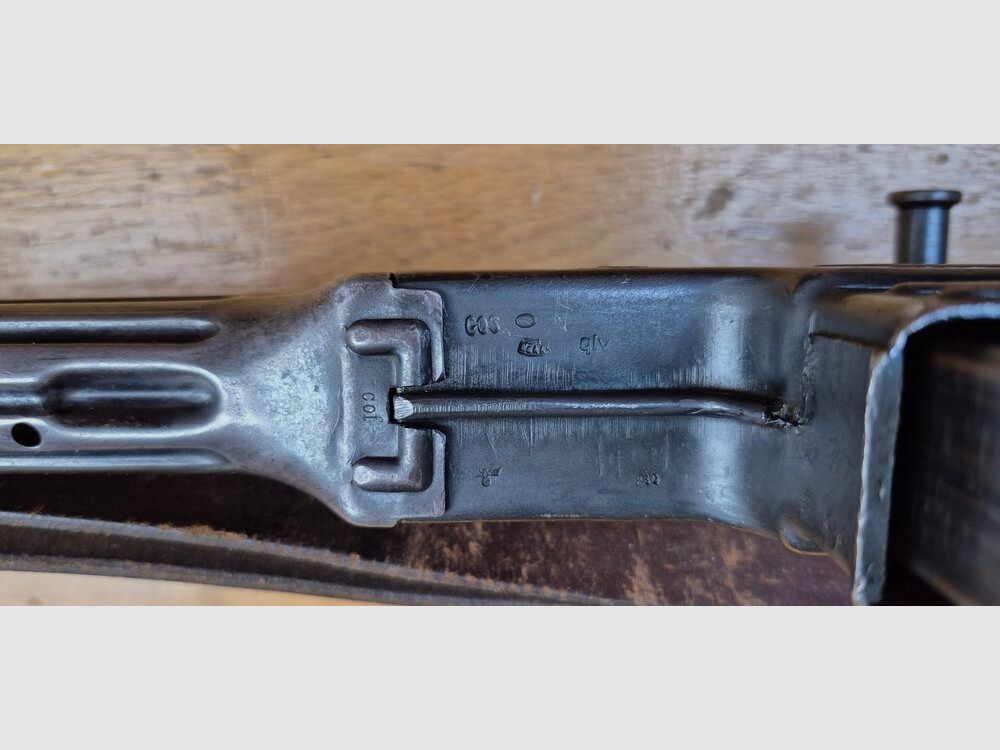
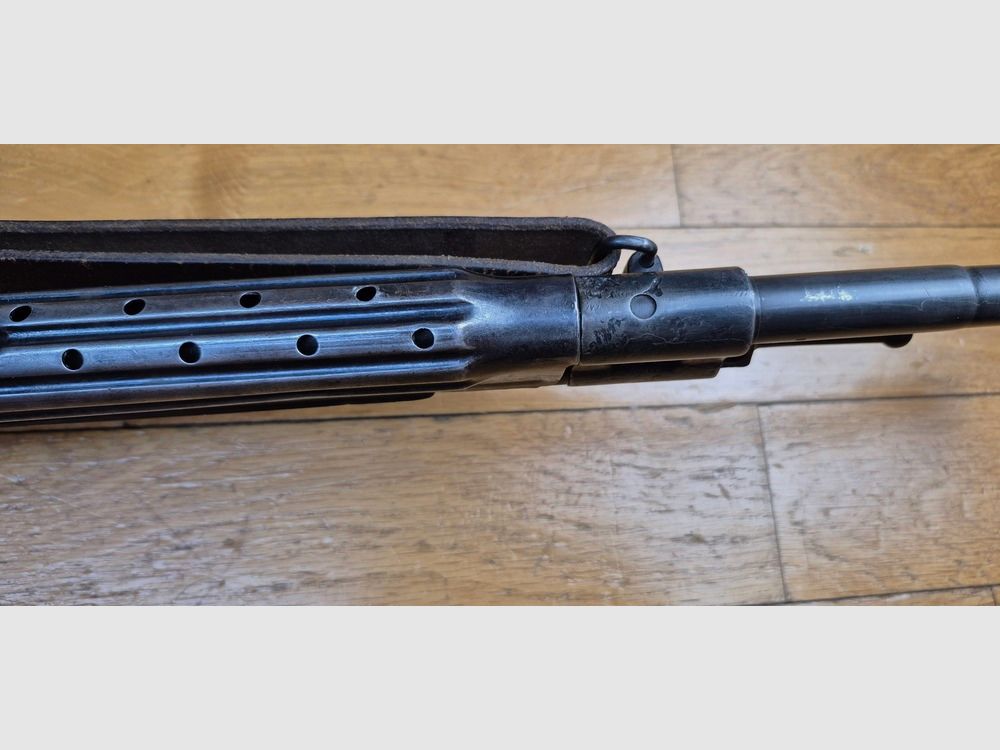
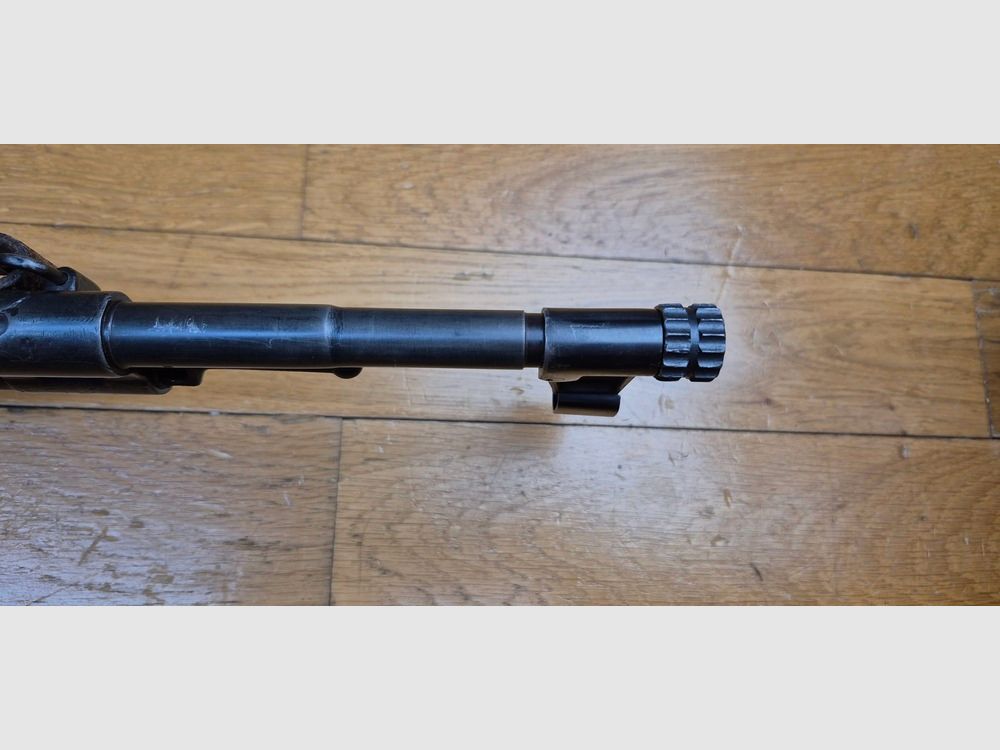

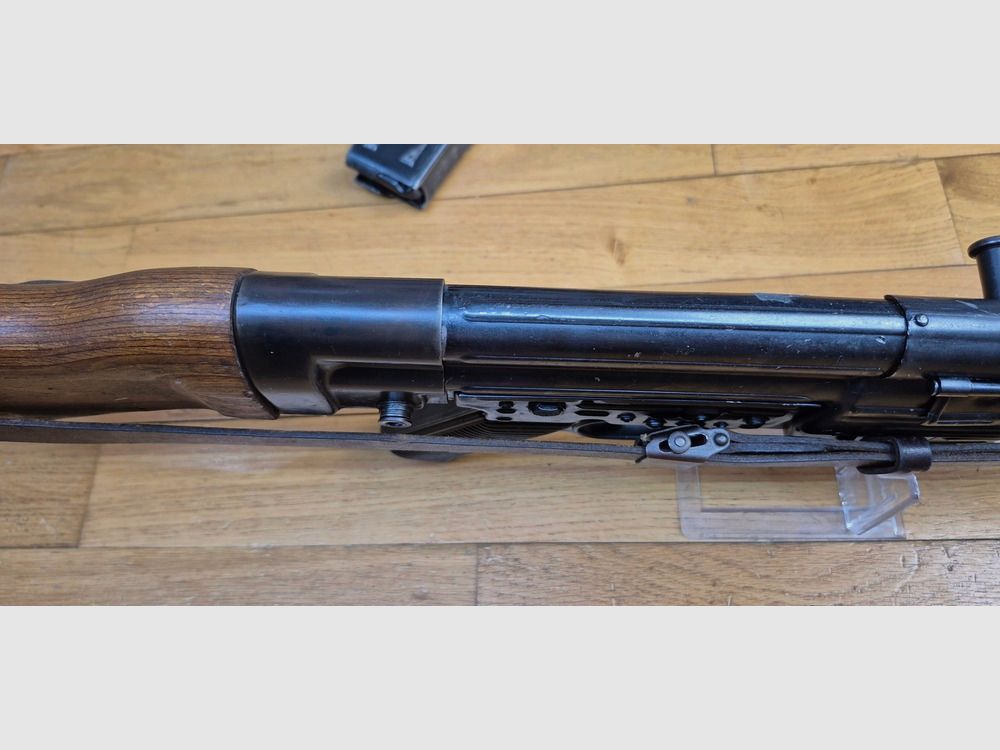

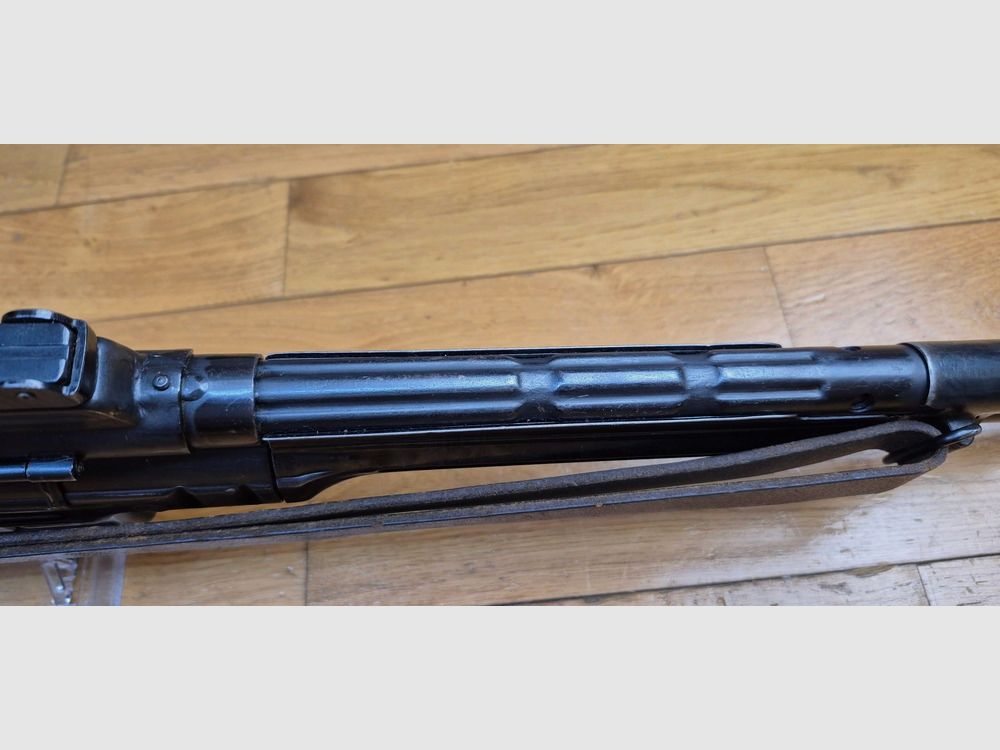
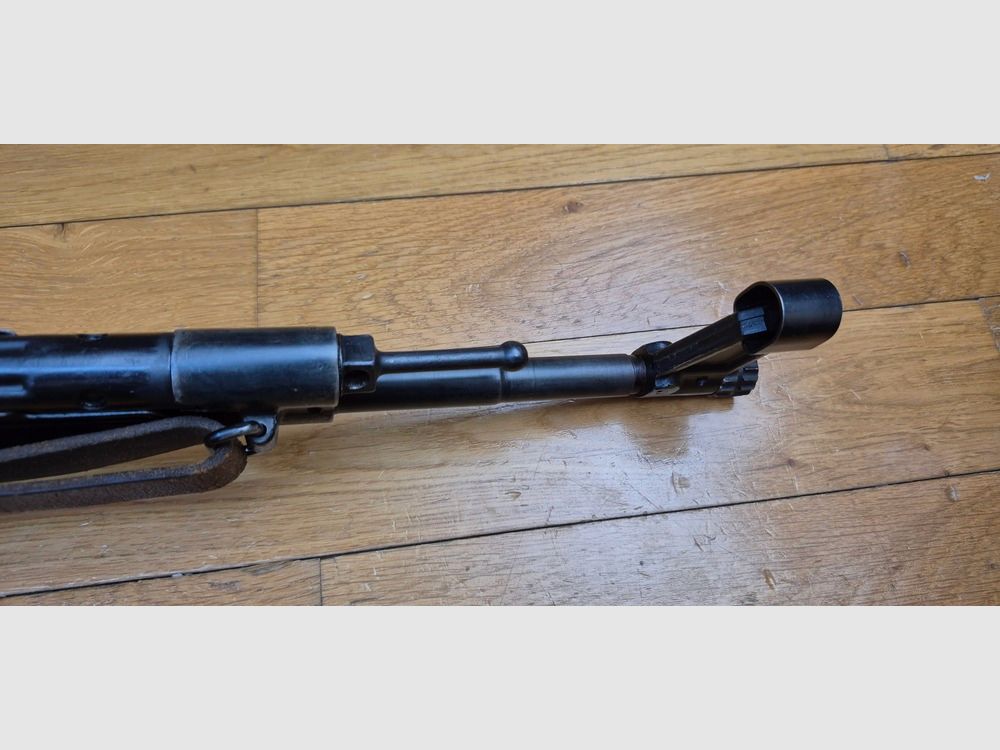
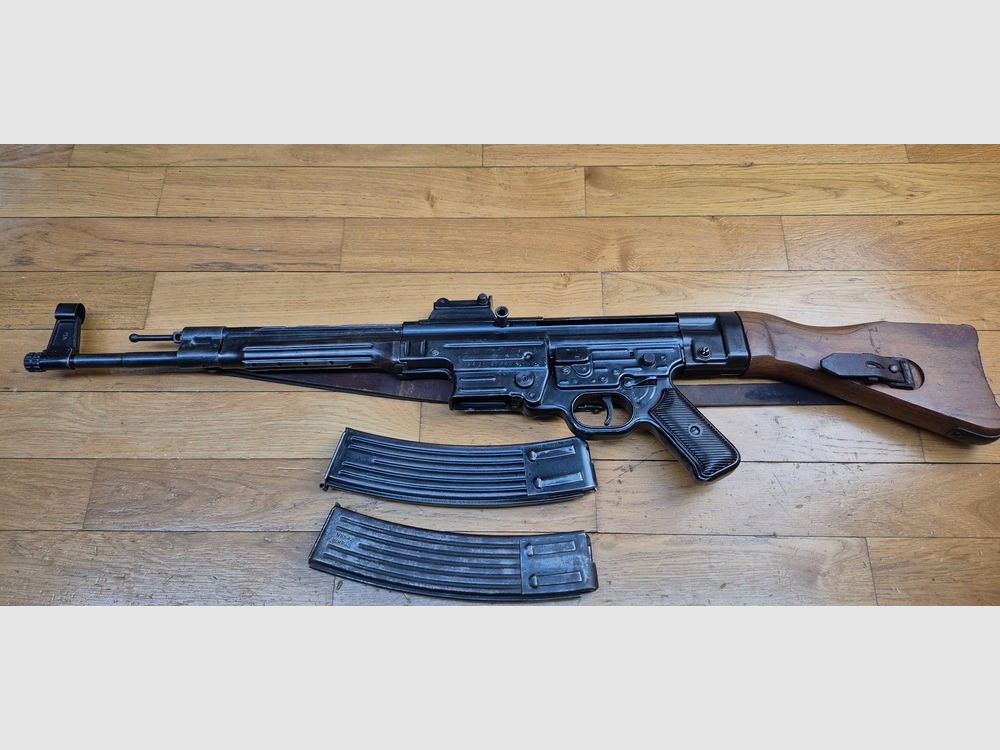



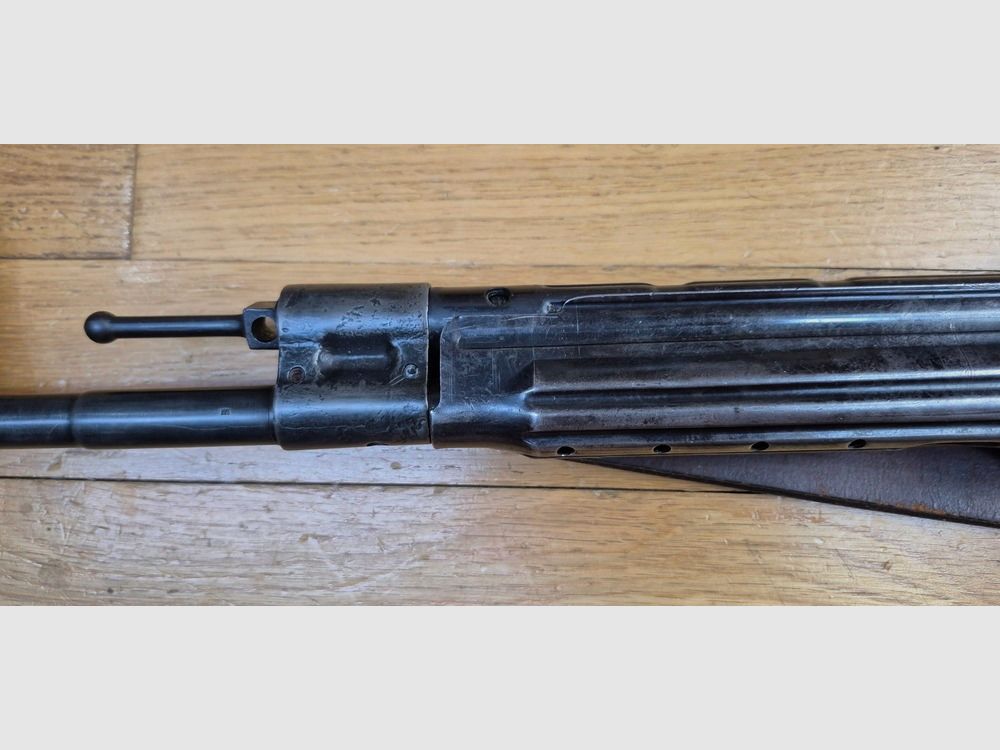
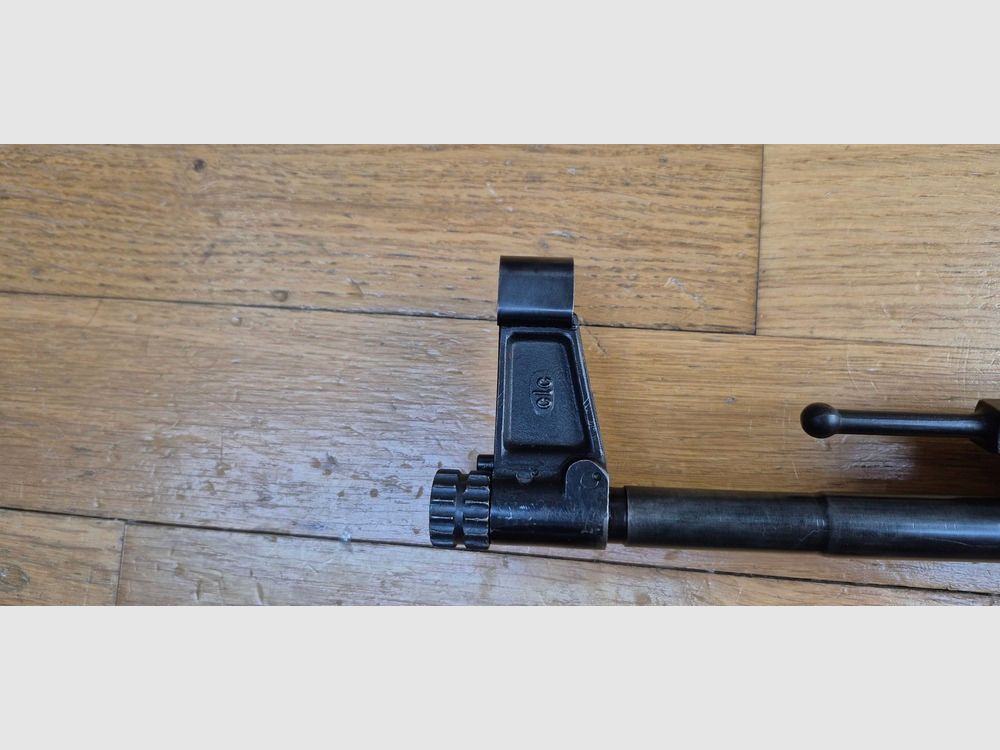

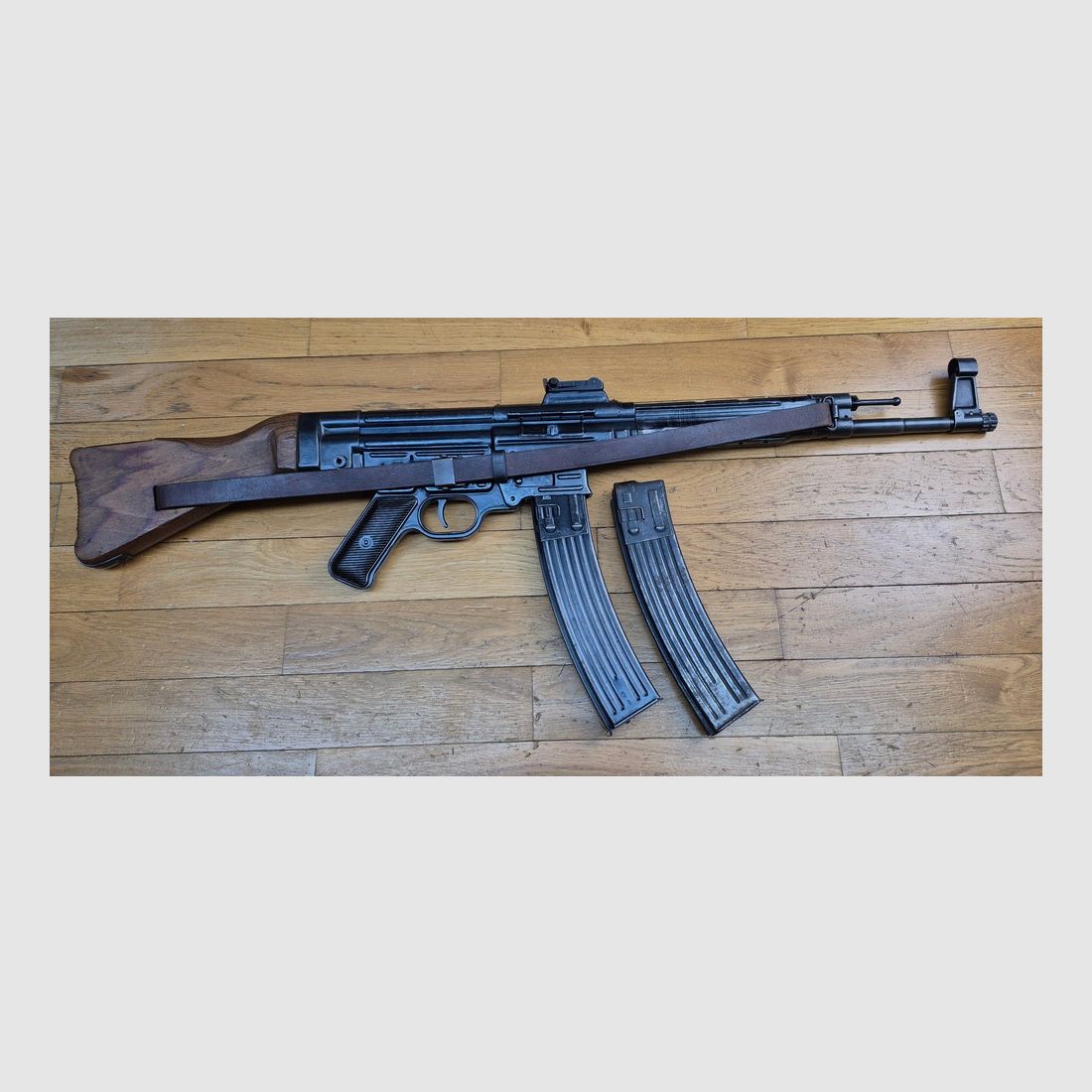
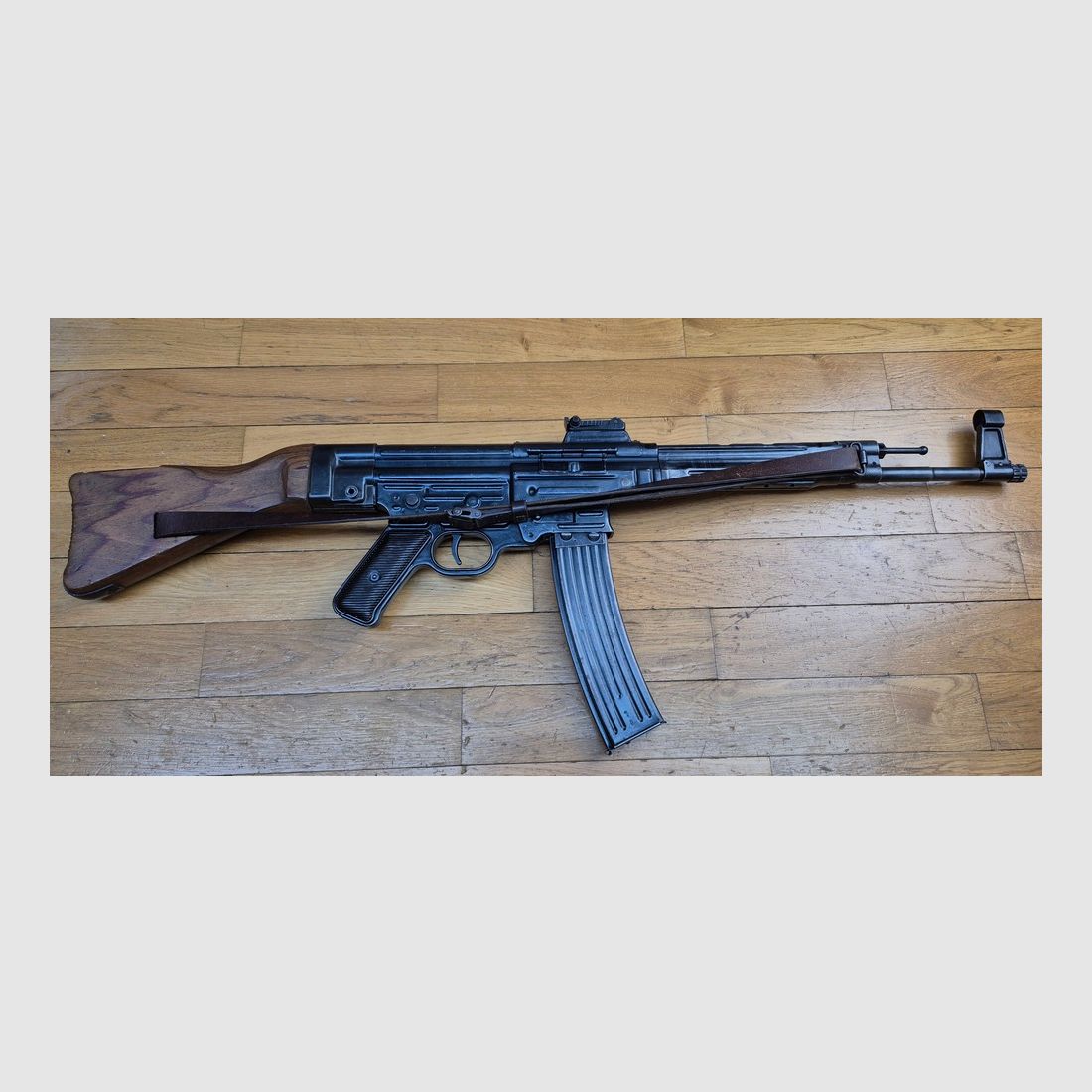

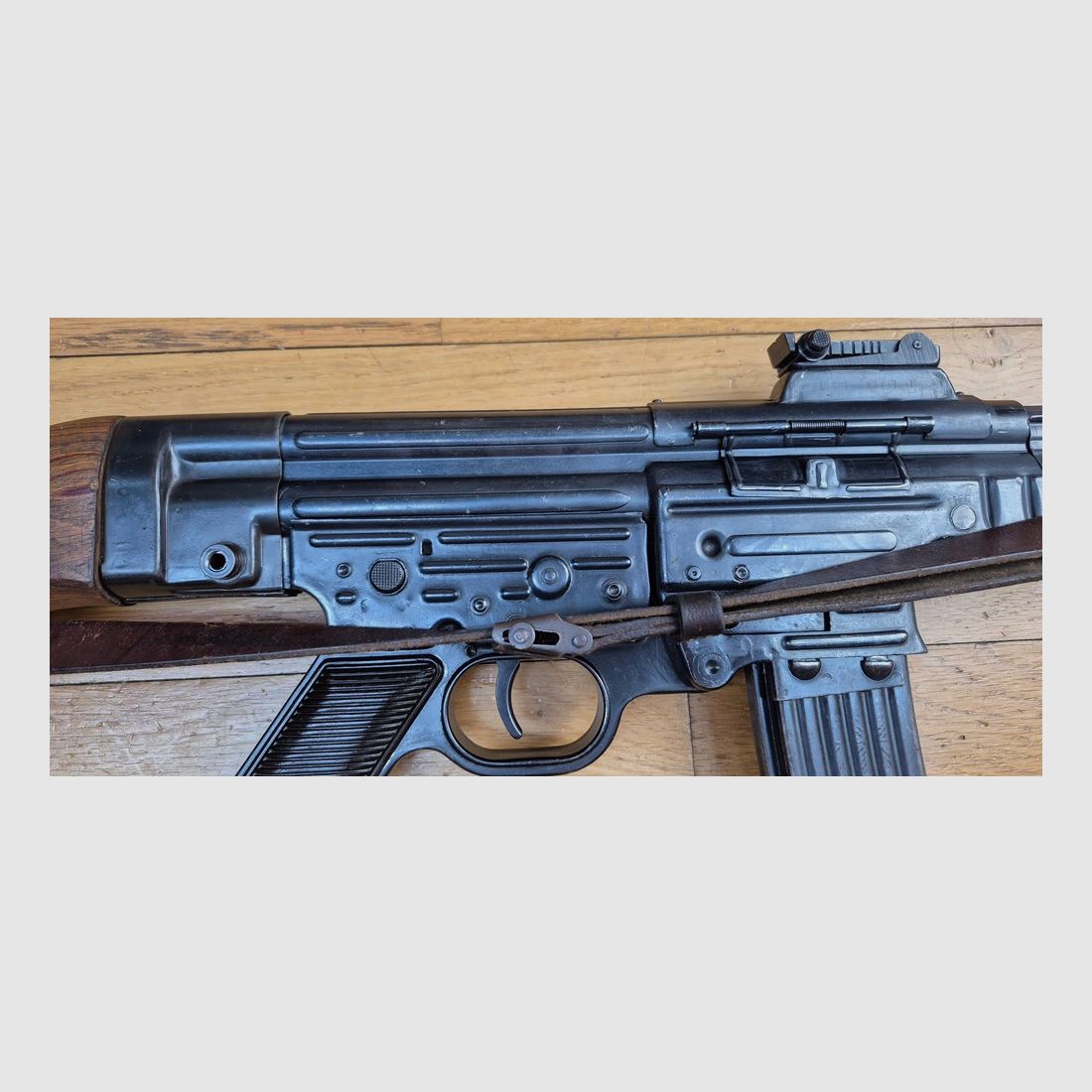
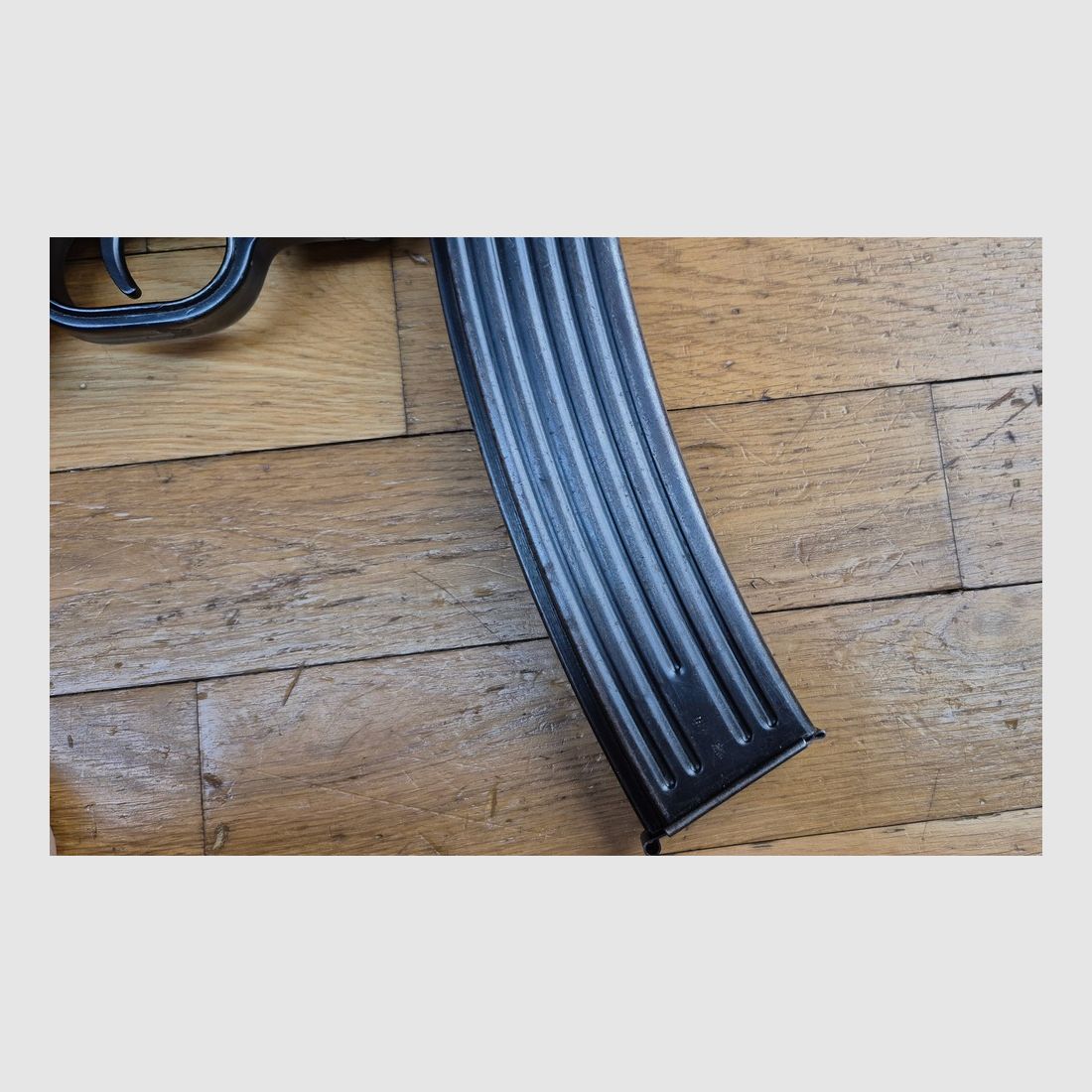
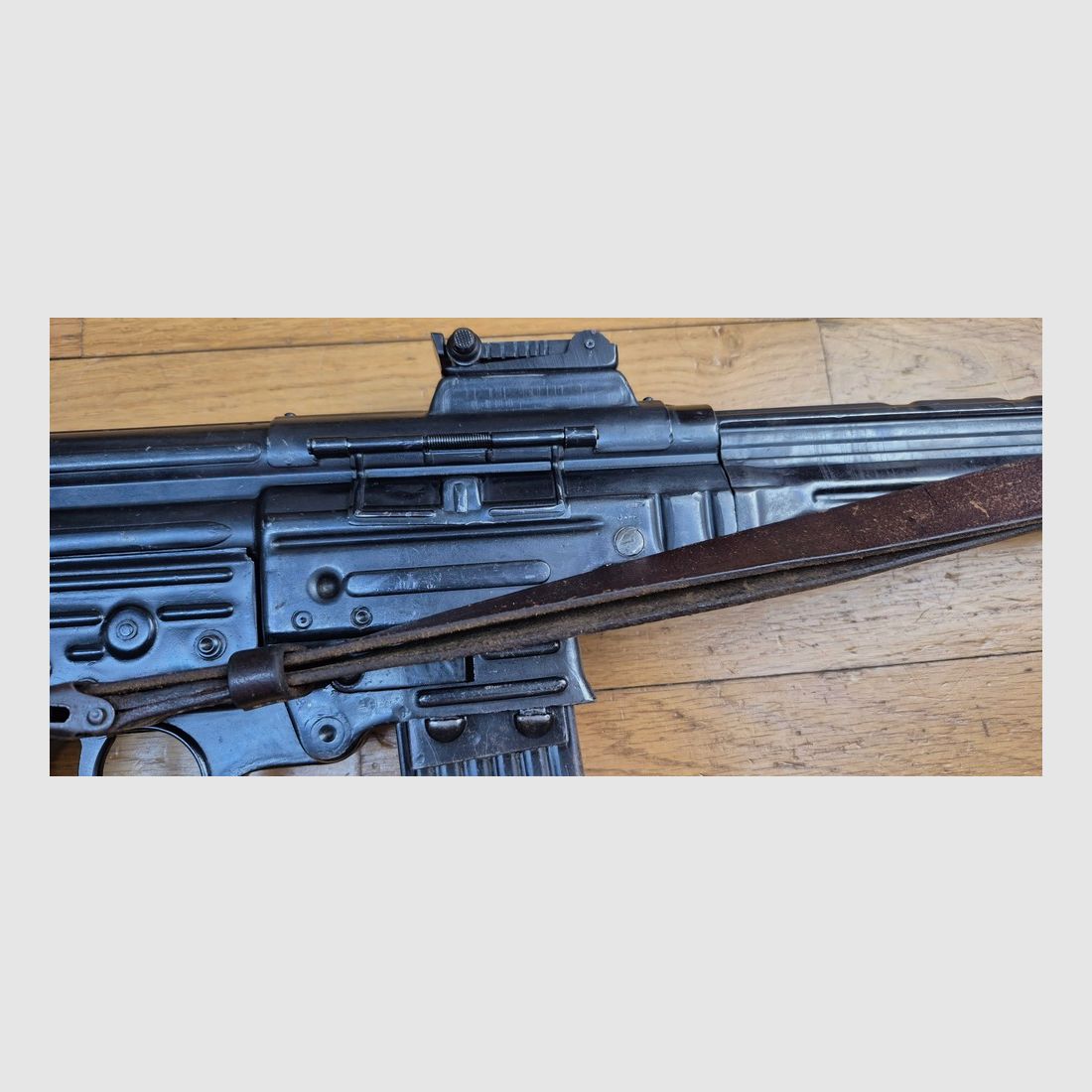
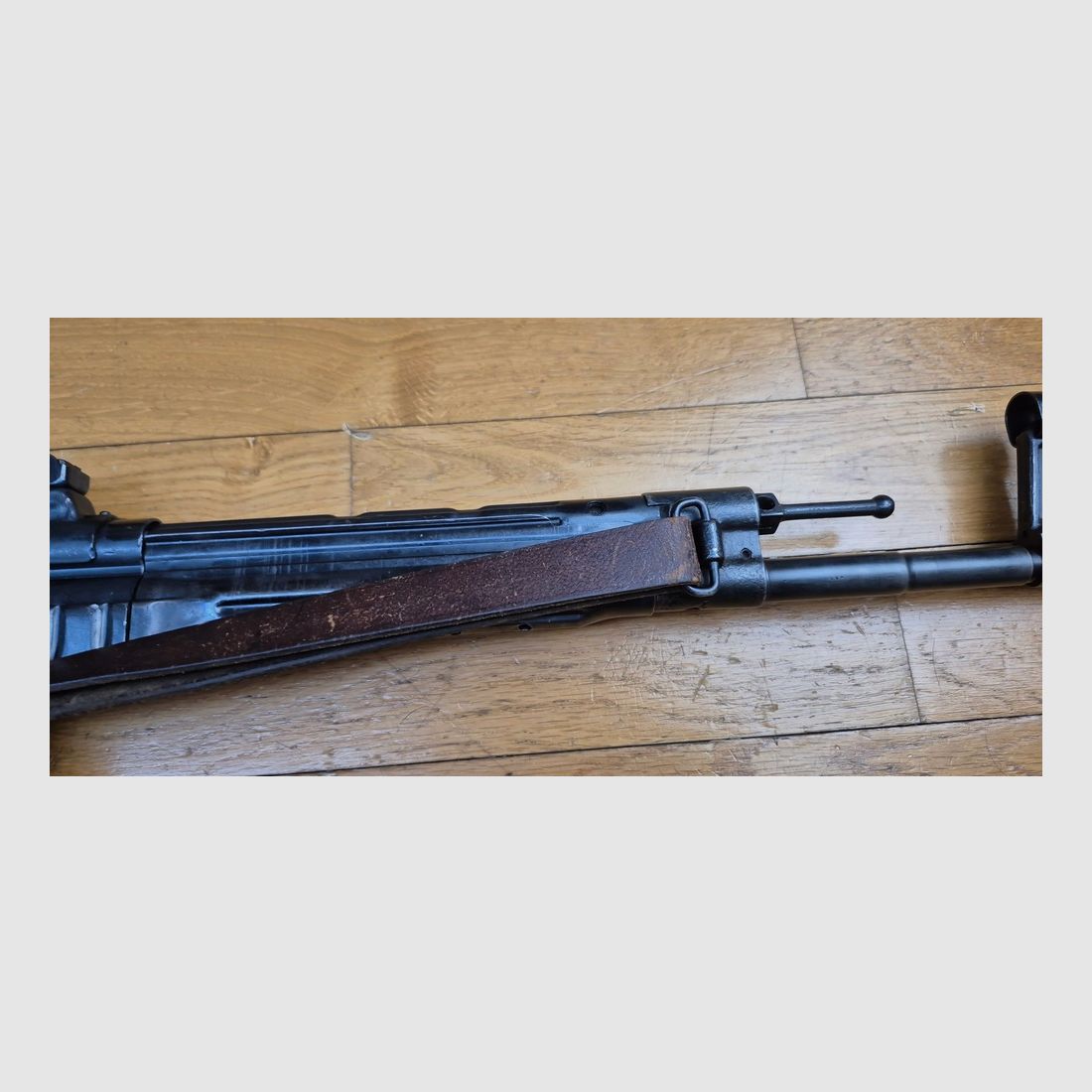
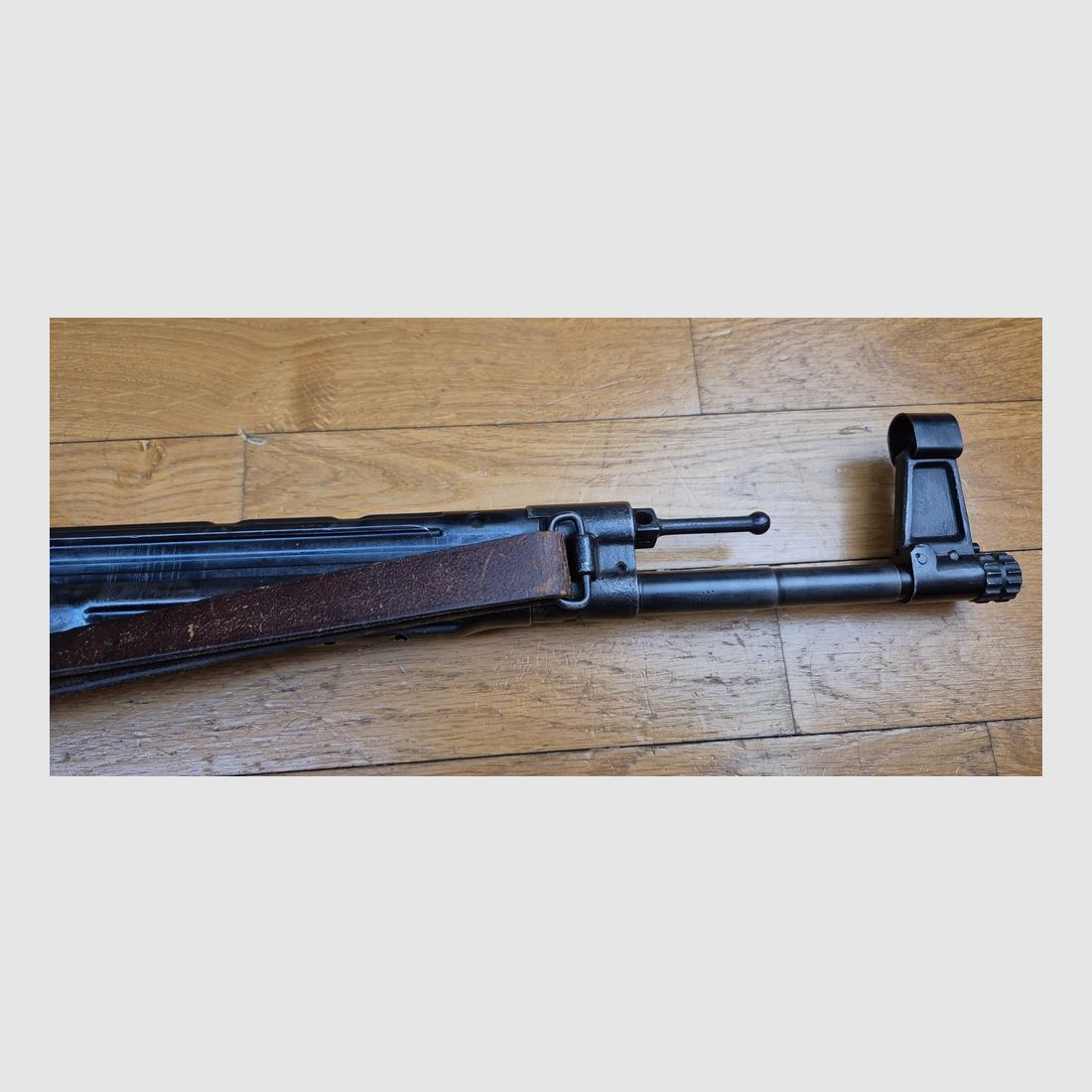
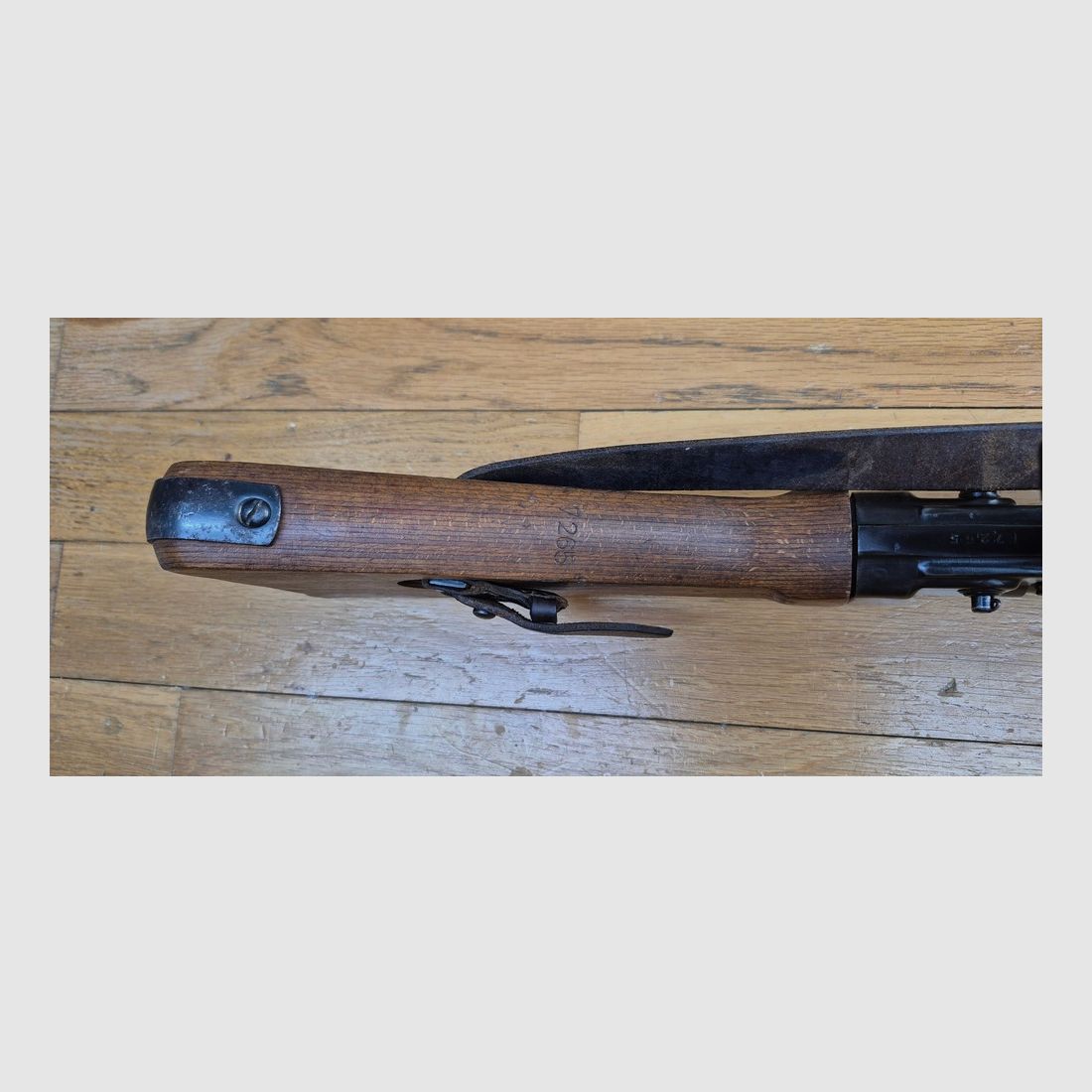



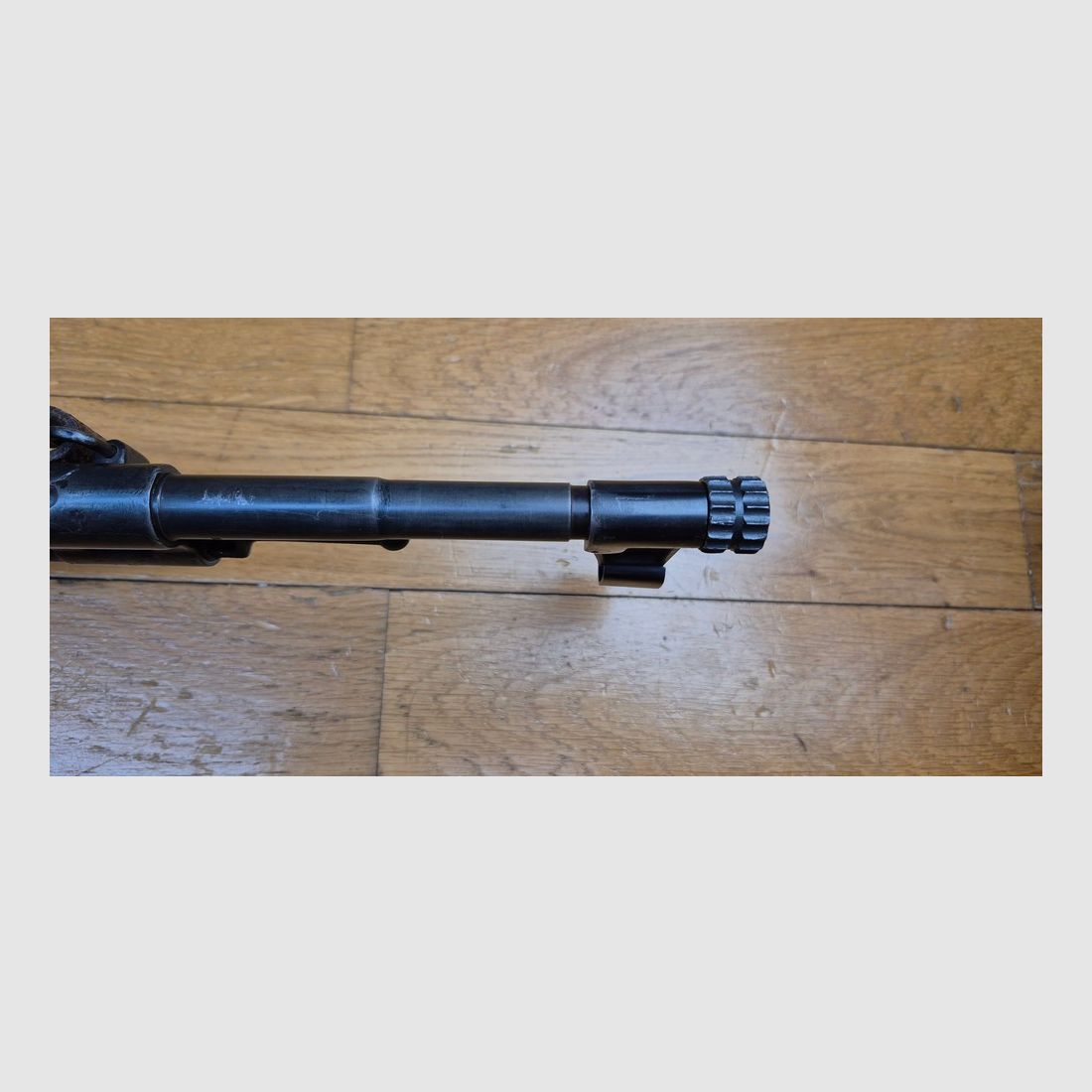


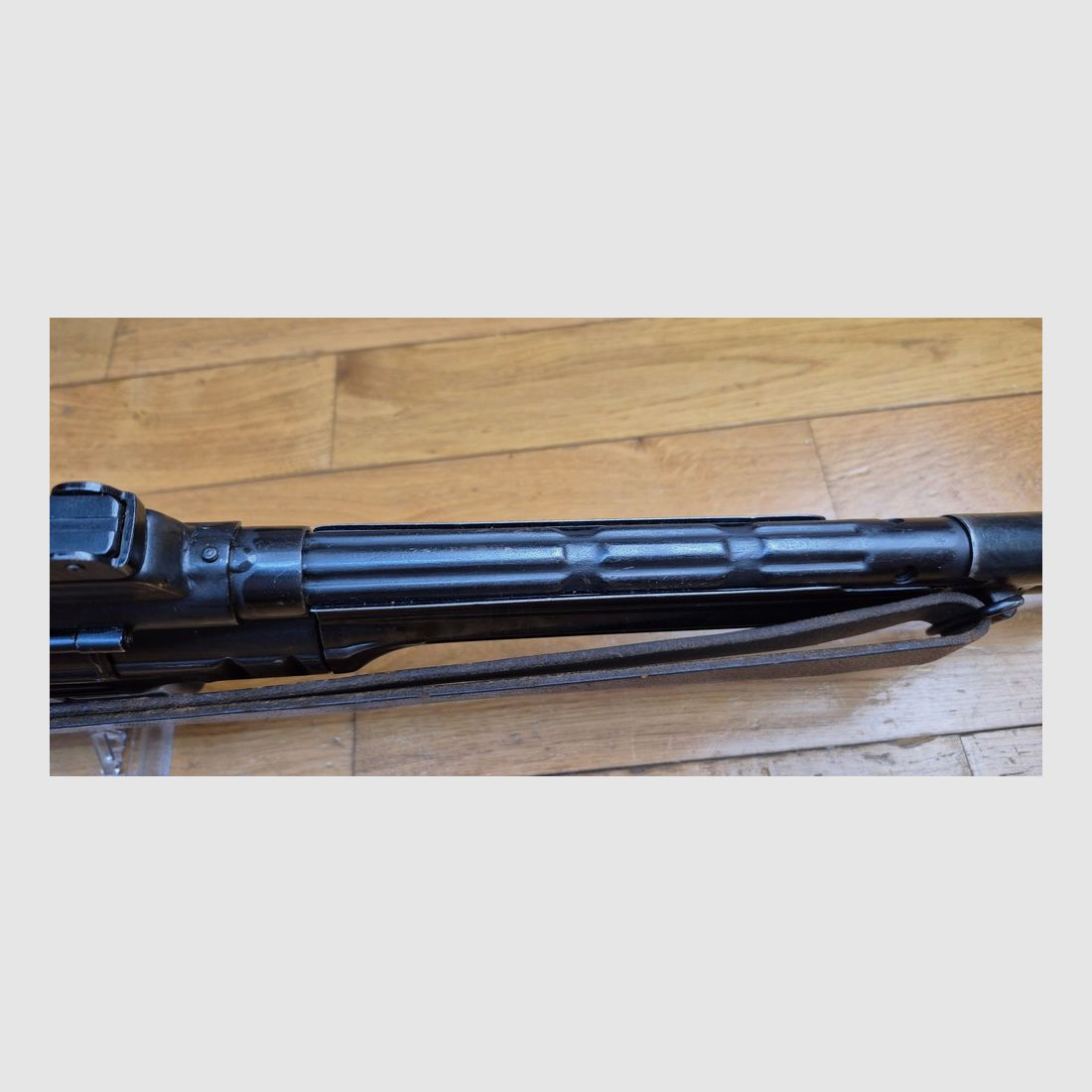
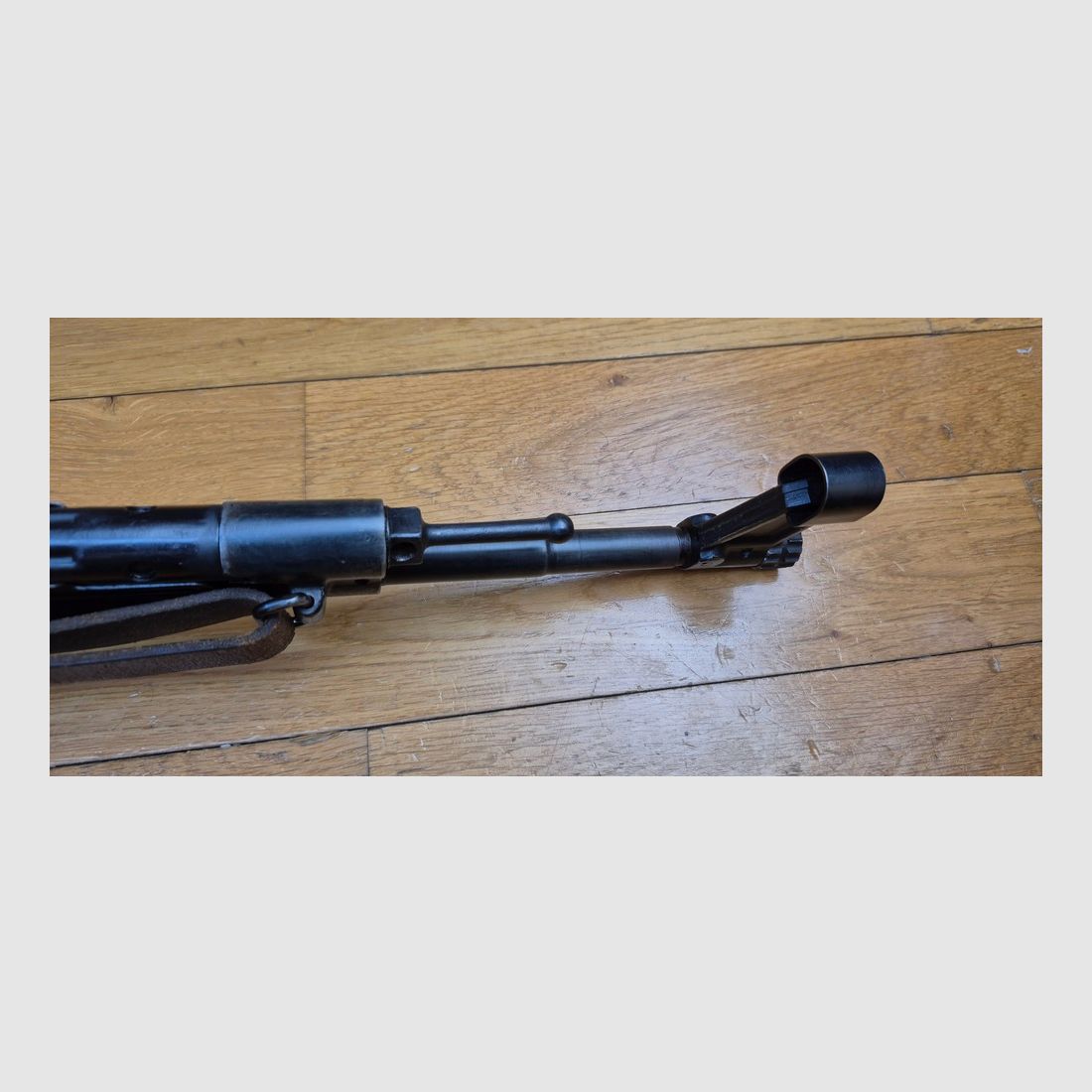
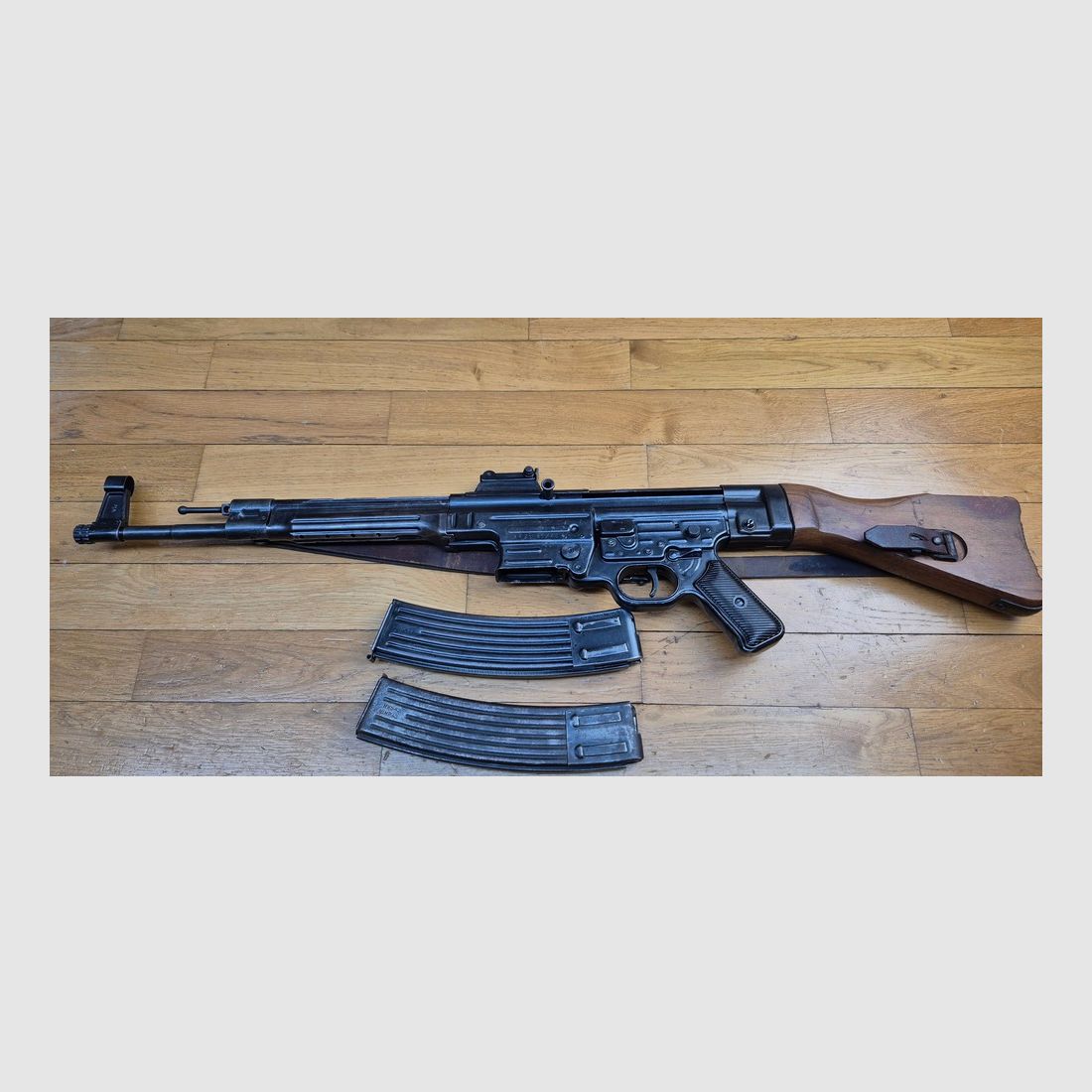

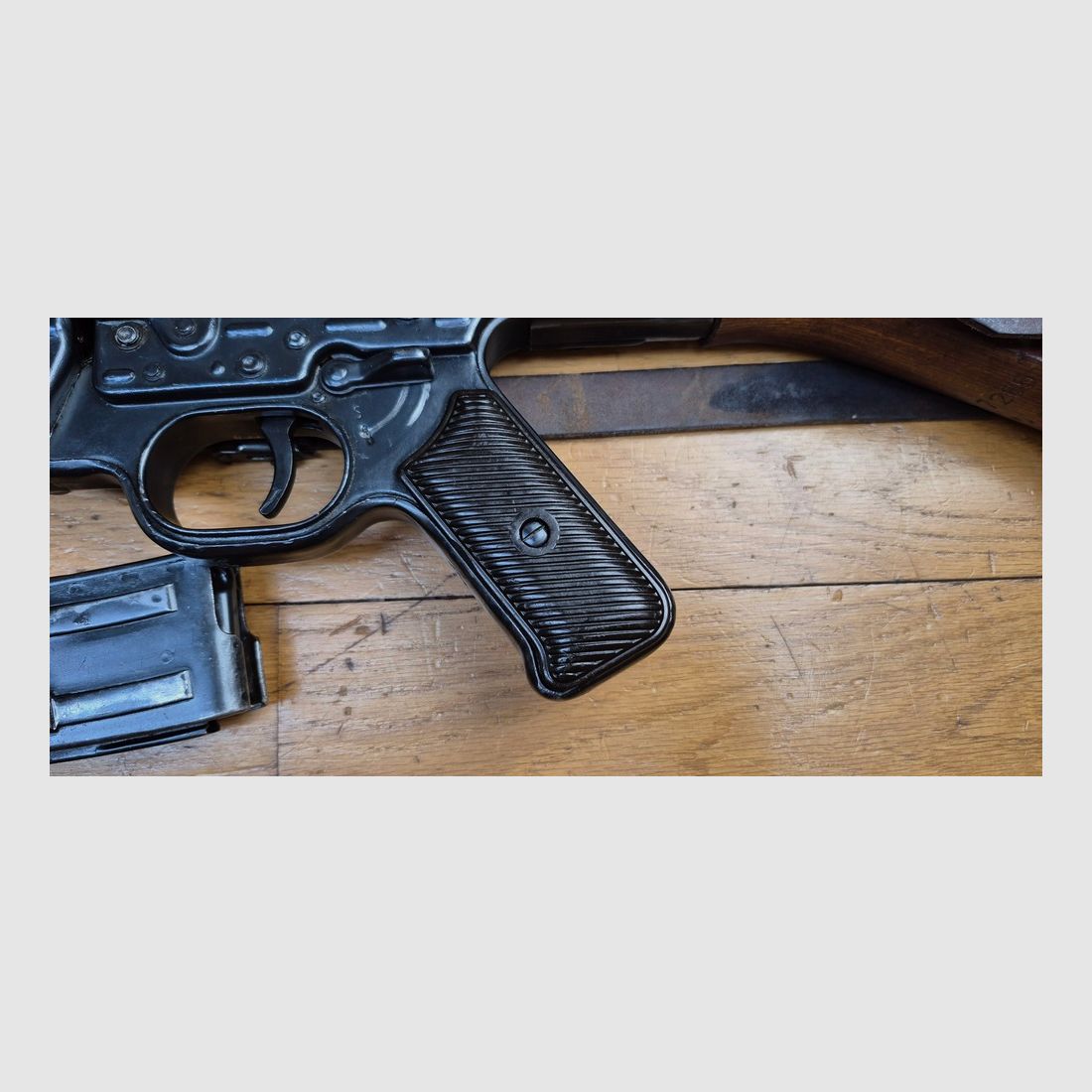
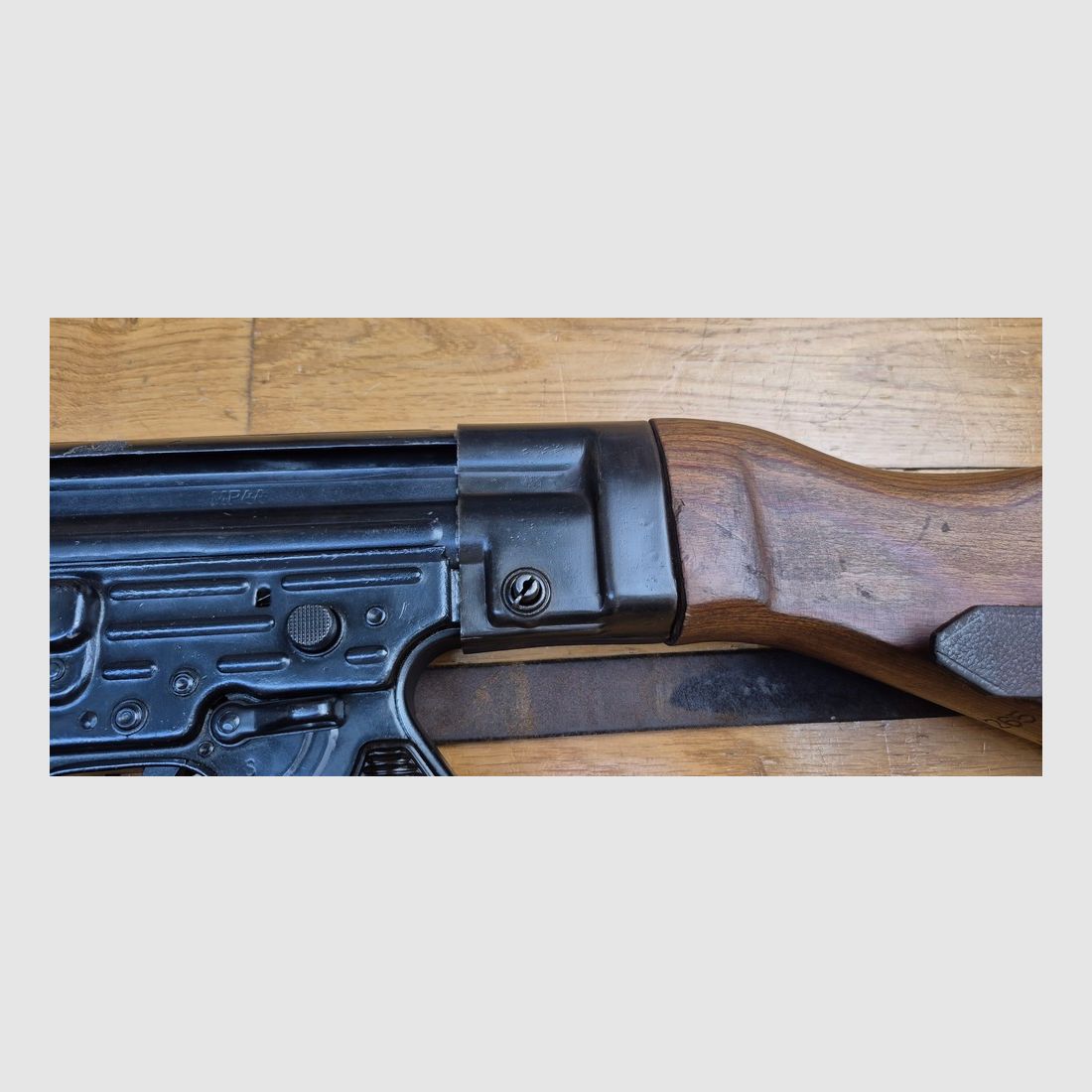
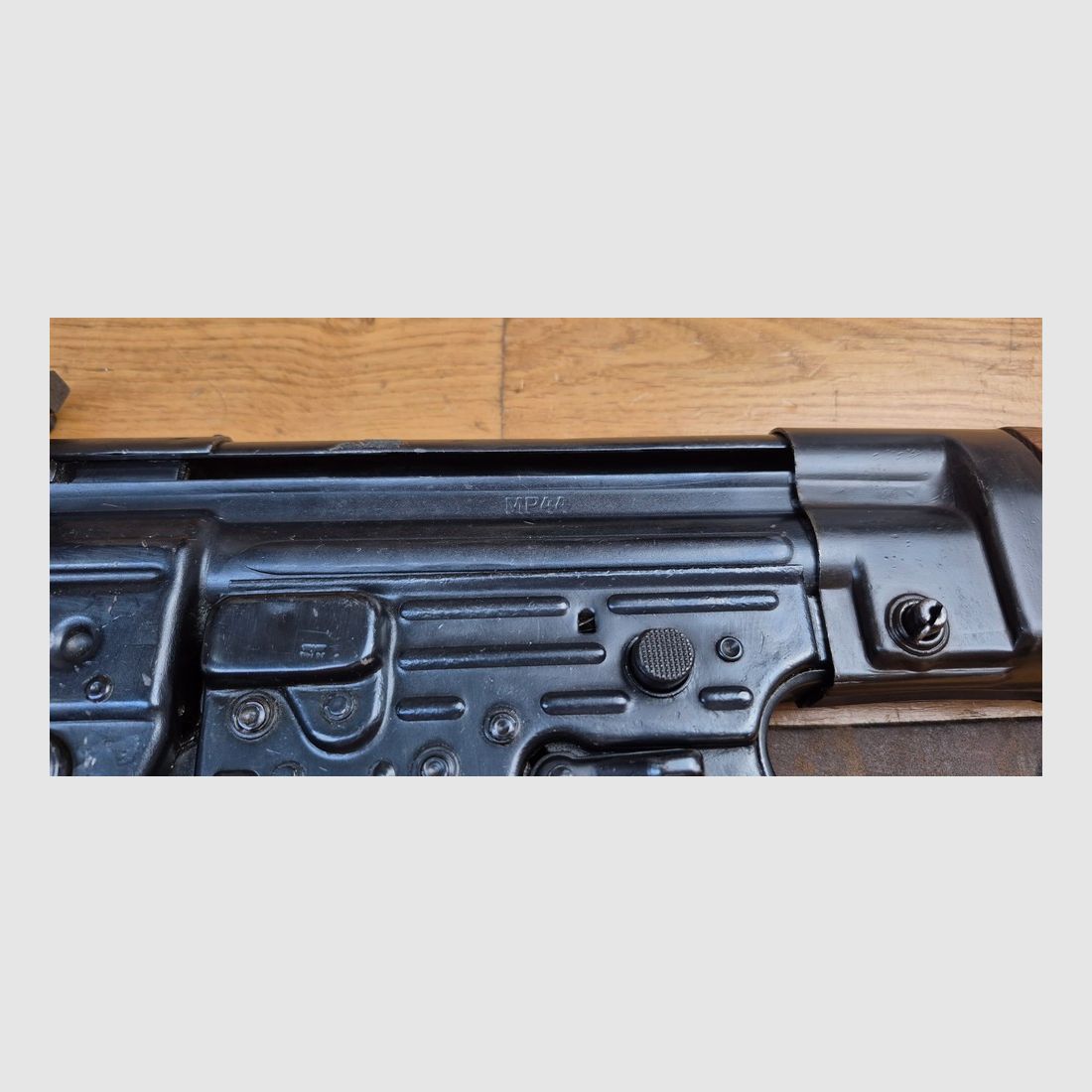


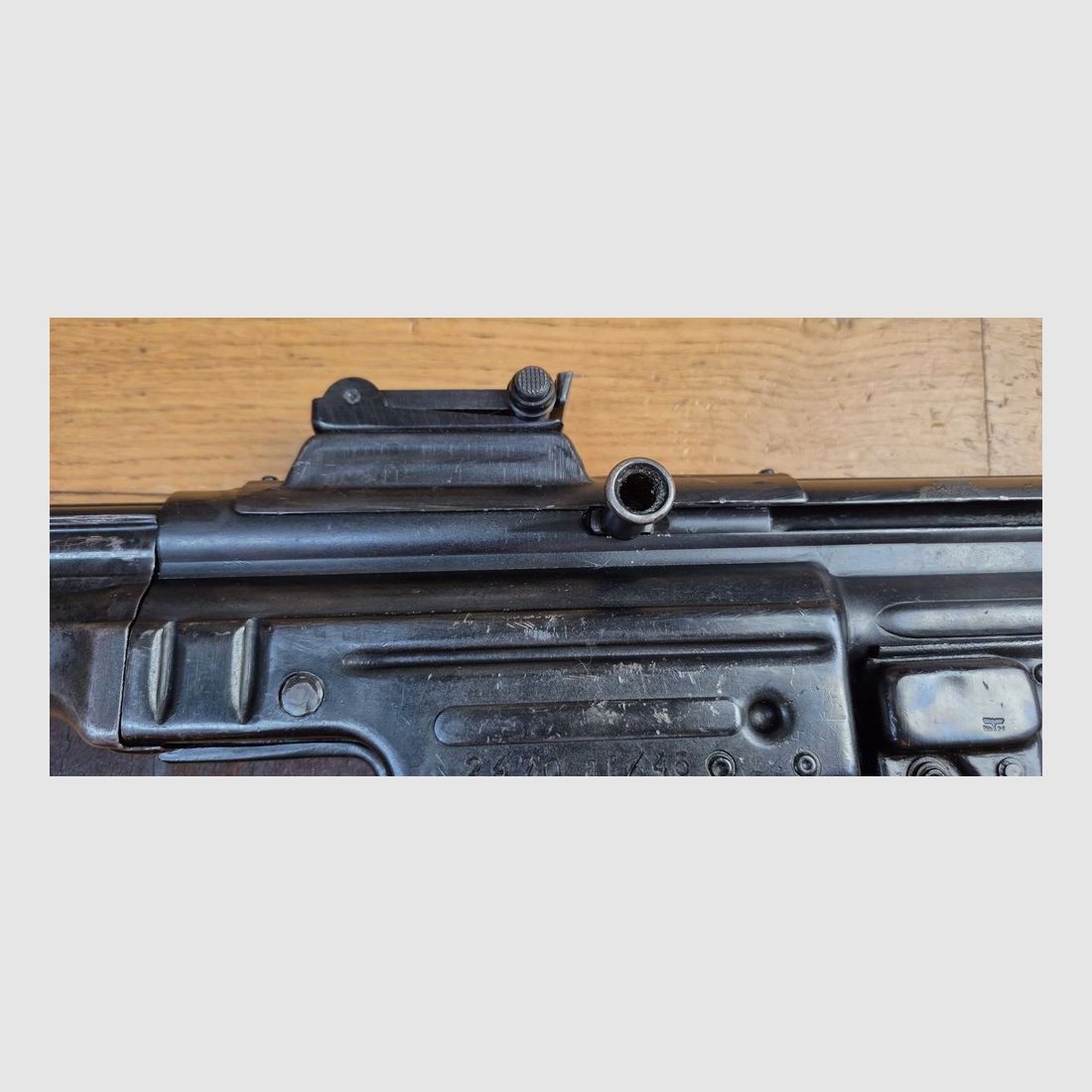

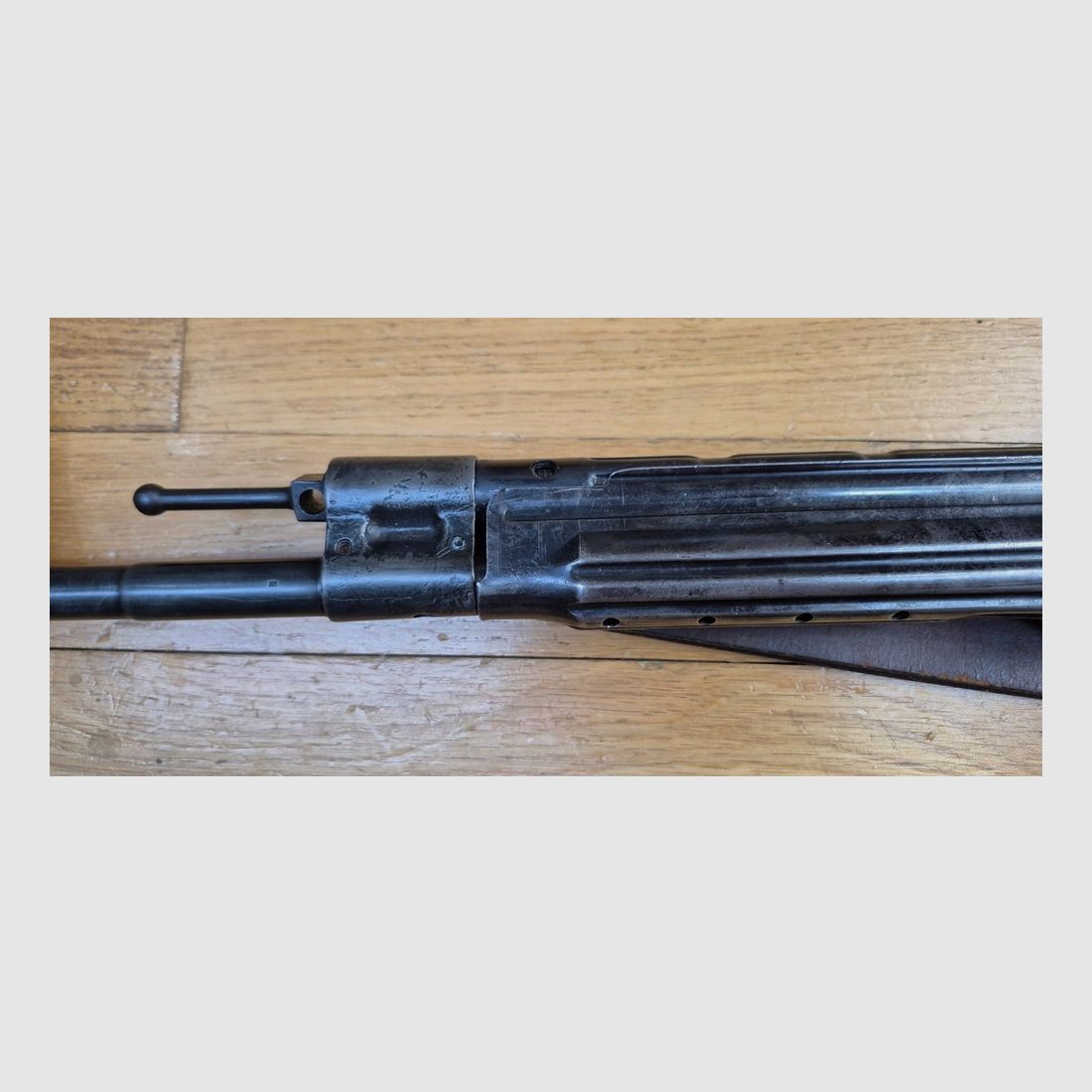
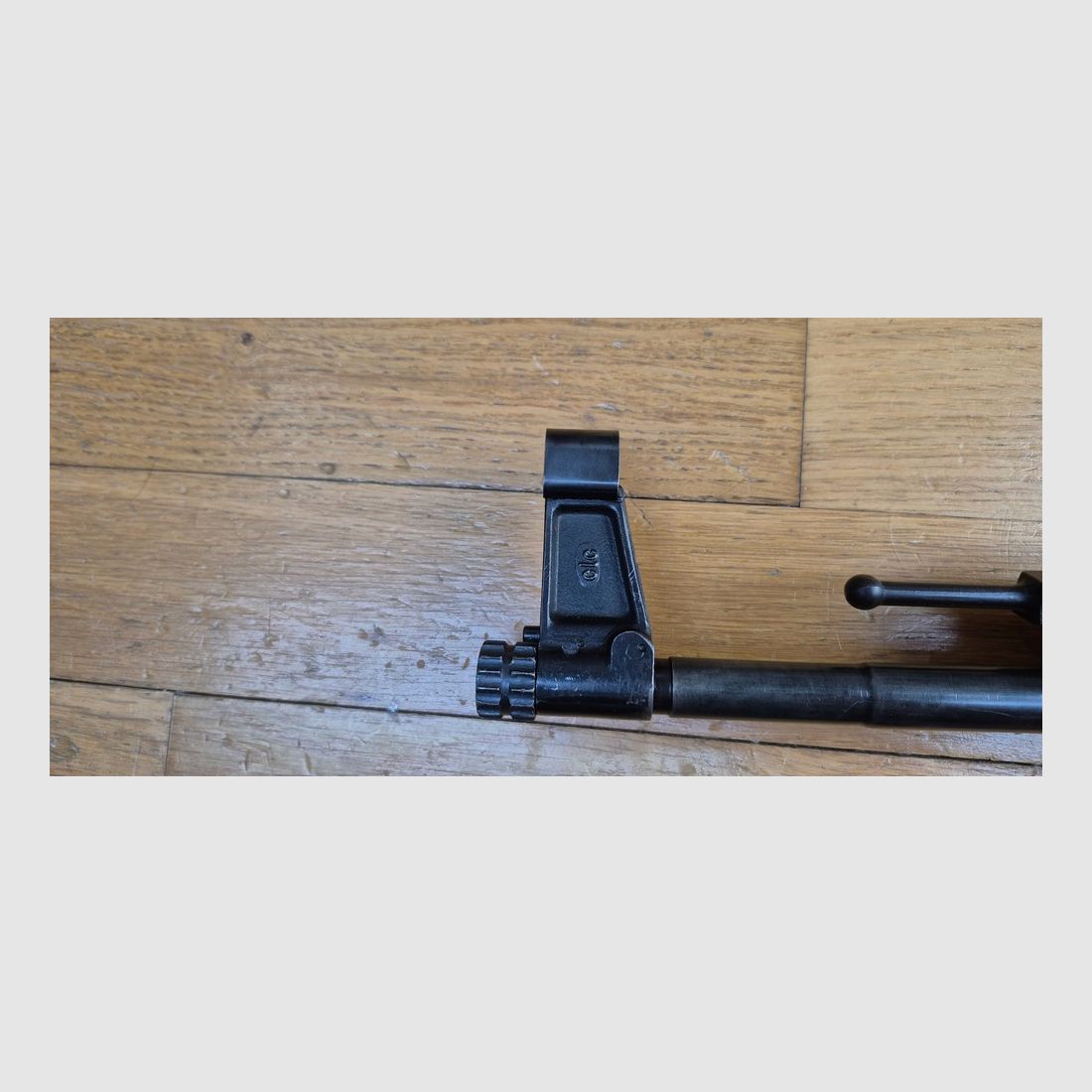
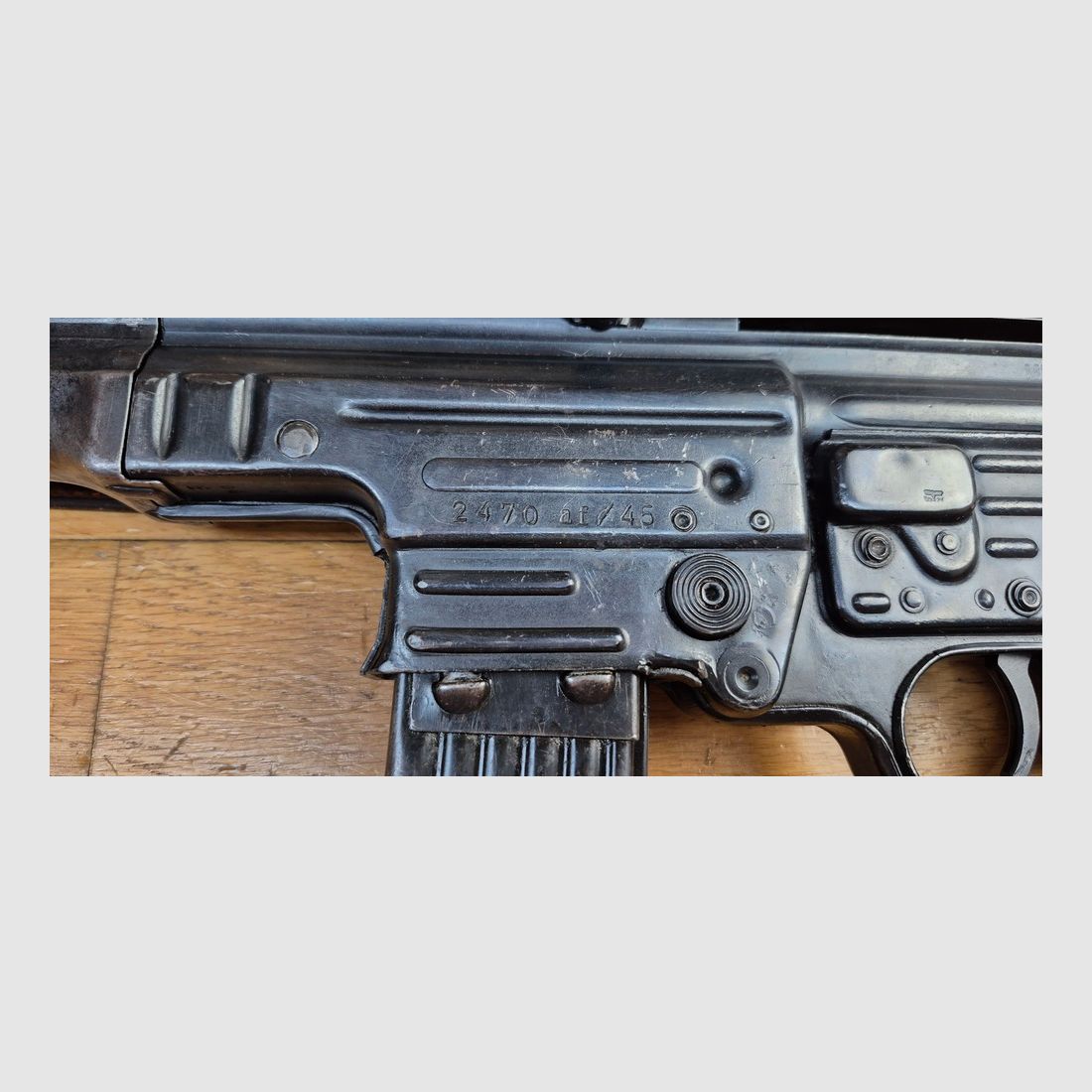
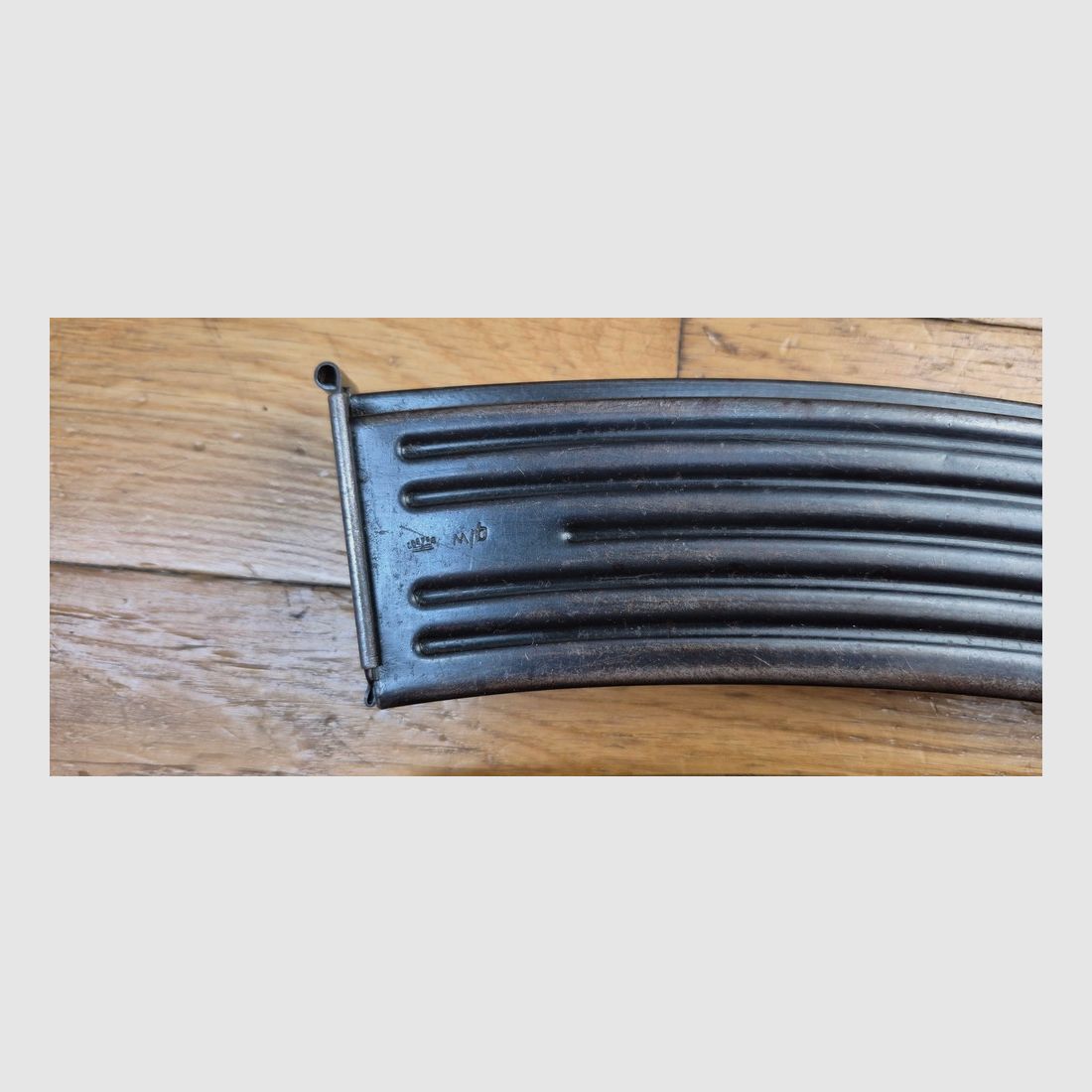


Beautiful Sturmgewehr 44 – MP43 / MP44 / Stg44 – Erma weapon from 1945 – 1st assault rifle in history – Not monomatriculated but 100% from WWII – Not refurbished DDR / Yugoslavia – 2 original 30-round magazines – Rare and mythical weapon in excellent condition – TBE+ – Category A2 – Export EXCLUSIVELY
Price on Request
Purchase permit required
75002 Paris, France
44
ID: 10338659
Purchase from outside the EU: The firearm goes through an importer in your country, the dealer handles the export.
How buying from Europe works
Shop safely with Gunfinder
Our AI-powered seller identity verification makes Gunfinder the safest marketplace online.
Learn more
Details
- Original language
- French
- Brand
- Erma
- Category
- Purchase eligibility
- Required
- Condition
- New
- Location
- 🇫🇷 75002 Paris, France
- Availability
- In stock
Freshness
This listing is based on a mirrored offer, where the listing data was synced to us from a shop, dealer, or external marketplace. Please note that temporary price discrepancies may occur due to possible delays in data transmission.
- Source
- Flingus Maximus
- Last checked with the dealer
- 1 day ago
Description
Note:
The item is located abroad. Please note that delivery conditions, shipping times, and/or the purchase process may differ.
And to think it took until 1944 to get there.
And even to give it a name. A conceptual name. The founding concept of a vast family: the assault rifle.
The concept was so good that our famous assault rifle has even managed to bring a little stability to modern individual firearms right up to the present day. Because our “assault rifle,” which took its first steps in 1943, is still going strong in 2025.
It’s hard to see what could dethrone it today, even in the age of drones, which have themselves already been reduced to expendable munitions used to attack groups of two or three people…
Eighty years of success for a military concept for an individual firearm is no small feat.
The assault rifle is the spiritual offspring and ultimate battlefield adaptation of the semi-automatic rifle (FSA). I’d say that’s unfortunate for the FSA.
Because the creation of the FSA by military high commands was, in fact, a very long and painful process that delayed the birth of the assault rifle itself by just as long.
Master Flingus will tell you another time about the endless missteps of all the military high commands, from 1912 (when the innovative French developed the Meunier FSA) to 1942 (when the STG44 prototypes began to appear), in the field of semi-automatic rifles.
The missteps with the FSA were already so great that there was no chance, not even by a miracle, of producing any kind of usable assault rifle.
An assault rifle is first and foremost a compact firearm (under a meter), portable by one person with enough ammunition for a standard engagement, capable of firing in both semi-automatic and automatic modes, and still controllable in full-auto.
It also needs to be effective enough in full-auto to hold its own out to around 40 meters against high-capacity submachine guns with very high rates of fire (they fire at 800–900 rounds per minute). But it must also have an effective range of at least a few hundred meters (around 400–500 meters) so it can hold its own against rifles in most combat situations.
And since it’s also close to a rifle, it can even play a supporting role as a precision weapon.
There you have it.
It’s the weapon long dreamed of by all the combatants of the Second World War who found themselves one day in rural combat, where small units supported by vehicles tried to encircle others, only to find themselves the next day in urban or suburban combat. With the same weapon.
But to do all that, and make coffee on top of it, it needs an intermediate cartridge—far more powerful than a submachine gun cartridge, but much less powerful than the nearly 3 cubic meters of gas (!) generated by a standard rifle cartridge such as 8×51, 7.92, .30-06, or .303.
Those damned cubic meters of gas from the standard 19th-century infantry cartridges made developing the Garand or SVT-40 a nightmare. Neither was perfect (they were either too heavy or too fragile, but they worked), and they even directly led to failures like the G41/G43…
The cartridge problem had been around since the FSA 17 and its 8×51.
Because it was precisely the refusal to even consider an intermediate cartridge (not any technical difficulties with the firearm) and the fanatical insistence on using “standard” cartridges dating from the late 19th century that made developing the semi-automatic rifle so laborious for the military high commands from 1917 to 1942.
And, as a consequence, developing the assault rifle too, since it can only function with an intermediate cartridge!
To show just how far this doctrinal fanaticism went, steeped in an outdated concept of logistics dating from before the First World War, I’ll remind you that they had to hide from MacArthur that the future (and wonderful) USM1 wouldn’t use .30-06 (which he constantly
required during the development of the Garand).
So its future ammunition was referred to exclusively as “0.30” or “.30-M1” (combining the caliber with the weapon’s model) in the design reports intended for him. Otherwise, he would almost certainly have killed our US-M1 in the cradle, just as he had killed several competing Garand projects for exactly the same reason: the cartridge.
I’d also point out that in 1942, when operational trials of the Stg44 prototypes began, the Germans still couldn’t manage to produce a decent semi-automatic rifle (the G41 is above all an excellent weapon for a technical museum, which it should never have left).
Even their “solution,” the G43, remained a generally fragile and complex combat weapon in the field, and impressed no one at the time, much to the chagrin of German equipment enthusiasts. All this, just so they wouldn’t have to give up the good old 7,92 x57 from …1889 in 1943!
Ultimately, after all these convolutions and failures, the Germans were the ones who finally saw reason and turned everything on its head with the Sturmgewehr 44: the first true assault rifle in history. It was the cumulative impact of their failures with semi-automatic rifles and the realities on the battlefield that forced them, belatedly, to take the plunge. Not a desire to innovate.
I’m not going to retell the history of the STG and its 7.92×33 or 7.92 Kurz (short) cartridge here, or how Hitler himself coined the term “assault rifle”—and, incidentally, was also kept in the dark about the weapon’s development—or even the StG44’s operational use. There’s plenty to say about its manufacture and handling, too. Another time.
I’ll just remind you of two facts about this weapon, and take the opportunity to put to rest, in detail, a classic shooting-range myth about the STG 44.
First, the weapon is rare.
And it was already rare at the time! This revolutionary weapon was, in fact, produced in fairly small numbers.
Just 425,977 were made, of which perhaps only 300,000 saw combat between 1943 and 1944. That’s not many. Very few. About as many as the G43 (402,000, though far more of those saw combat).
The other 130,000 were captured mainly by the Russians before they were even sent to the front. After their Third Reich markings were removed, they were used in East Germany (DDR) and allied countries (Yugoslavia and the Czech Republic) until the 1970s.
Many were also resold to even more distant allied countries.
The first ones turned up in Algeria between 1954 and 1962, then, after being resold by Yugoslavia and the DDR, they made their way around the Horn of Africa in the 1980s and were even still in the hands of Syrian rebels in… 2012!
I very much doubt many will make their way back to us from these exotic journeys. And even if some are “saved,” what condition will they be in when they return?
Still destroyed or deactivated here today, surviving examples with 100% original parts are extremely rare.
Second, the other fact.
Ultimately, the history of the STG 44 seems to have vindicated those who didn’t want weapons of this type, on the grounds that they didn’t fire the standard infantry cartridge!
At least to some extent, and at least in Germany. Let me explain.
One of the reasons many STG44s never saw combat was, in fact… a shortage of 7.92 x 33 cartridges!
It’s a much larger-scale version of the story of the Meunier 1912 here, tested in the field in 1916, and its 7mm cartridge, whose logistics in particular led to the weapon being abandoned.
They needed to find 86,000 additional workers to produce the 1.5 million weapons ordered and the 200 million intermediate 7.92 x 33 cartridges consumed each month when the weapon was introduced. They never found them. Even with the use of concentration camp labor. And that’s not good.
In addition.
The 400 million rounds per month planned from late 1943 for February 1944 (yes, 1944!) were simply the result of a severe case of wishful thinking. By February 1945, planning had returned to a somewhat more realistic figure of… just 110 million rounds per month.
To put things in perspective, during the period from the field trials of advanced prototypes in 1943 through May 1945, only … 822 million rounds of 7.92 x 33 were produced! A far cry from the planned production figures.
By the end of March 1945, the troops had barely 274 million rounds, with only 69 million more in immediately available stock.
Contrary to what has sometimes been claimed, the Sturmgewher 44 therefore had no chance of changing anything on the battlefield. The logistical realities of war are unforgiving.
Now for the legend.
Mikhail Kalashnikov supposedly “copied” the STG 44 to create his AK-47.
This is supposedly true “because” the two weapons “look very similar” in their overall lines (though…) and have curved magazines; because Hugo Schmeisser (the STG44’s principal designer) and his family lived in Ijevsk for a few months after the war, where the famous AK was created; because 10,000 pages of technical documentation from the Suhl factory on the subject were seized by the Soviets and taken to Ijevsk; and because, in addition to weapons captured during the conflict, 50 weapons, including STG-45 prototypes, were also sent to Ijevsk in 1945 for disassembly and study.
Alas, alas. None of that changes anything. So let’s take the weapon apart together and see for ourselves.
I’ll skip over the curved magazine, which is simply a necessity for any weapon fed by a magazine holding cartridges whose cases aren’t parallel-sided. Try laying such rounds side by side on the ground and you’ll immediately and inevitably get a nice curve that shows you exactly what shape your magazine needs to be.
It’s worth noting that Russian submachine guns were already using curved magazines in combat as early as 1941, long before the Germans did so with the STG44. So much for overall appearances…
But, much more tellingly, when you take the weapons apart, you find that they have just… about nothing in common other than their intermediate cartridge (the famous Russian 7.62×39 used in the SKS 45 and then the AK47, which was considerably more powerful than the 7.92 x 33, had already been developed in Russia in early 1943).
First, the STG44 uses a complex tilting-block bolt, while the AK47 has a rotating bolt. The great Mikhail himself always said that his main inspiration on this point was the US Garand, itself descended from the rotating bolt of the French FSA 17. So nothing to do with the STG44. That’s already a major difference, but it’s far from the only one.
Both weapons do use a long-stroke gas piston system. But that was a Russian invention, already found on the SVT-40 (which the Germans would in fact be forced to copy for the G43!). But above all, these gas systems work very differently.
The StG 44 uses a fixed piston rod that isn’t attached to the bolt. This piston, independent of the bolt, strikes a transfer rod that pushes the bolt assembly backward. Ultimately, the StG44 mechanism is more similar to that of certain semi-automatic rifles, such as the Russian Simonov’s SKS 45, than to the AK47! This design is much less robust because it requires more parts and is more susceptible to fouling.
The AK47, on the other hand, uses a piston rod directly attached to the bolt carrier, as a single unit. The AK47’s gas piston therefore moves in unison and in a straight line to drive the entire moving assembly backward. It uses fewer moving parts that operate independently of one another. As a result, it is less susceptible to fouling and more robust.
M
but, even more importantly in my view, it mainly provides a better gas seal, allowing more energy to be harnessed to operate the firearm. Beyond the added reliability, look no further for the reason the AK 47 fires around a hundred more rounds per minute than the STG 44, despite also using a slightly more powerful cartridge.
That’s already a much better result from the shepherd from the Altai than from the gunsmith, son of a gunsmith, Hugo Schmeisser. And we could leave it at that.
But in my view, there’s something even more important. Kalashnikov was a genius of pure mechanics. He had the fundamental idea of using the receiver itself to eliminate parts.
In the STG 44, the receiver is divided into distinct subassemblies, each with its own housing: the bolt is guided by separate rails, the recoil spring sits in a separate tube, and the upper and lower parts of the receiver are two distinct pieces assembled together. Everything has its place, and each subassembly has its own clearly defined job. Neat as a Swiss village.
That’s very German. And above all, it means lots of small add-on parts that complicate production and maintenance.
It’s often difficult to compare the number of parts in two firearms, depending on how their components are divided up (main parts vs. subcomponents), but the result is that an StG 44 has 120/125 parts in total.
In the AK47, the design philosophy is radically different. The stamped-steel receiver (or even the milled receiver, depending on the version) is structurally integrated into the firearm. It directly supports several internal components. It guides the piston and bolt carrier, houses the recoil spring, and anchors the trigger mechanism. This makes it possible to combine several functions in a single rigid structure.
That’s also the source of the Kalashnikov’s legendary durability.
The result? An AK47 has around 75 parts, not 120 or 125…
It’s a whole different world. And that means a whole different world in production and operation, too. There’s no comparison.
The AK 47 is therefore in no way a copy of the StG 44. But the StG44 had the distinction of being the first successful, operational firearm based on a new concept with a great future: the assault rifle. In the hands of the last fighters in a vast, desperate battle, it became a legend and a major milestone in the history of firearms. And that’s already a huge achievement.
Maitre Flingus was lucky enough to get hold of an STG44—probably one of the last ones still available from private owners in our beautiful country, as very few remain. Even fewer are in working order and not eaten away by rust.
It’s A2, so you can’t buy it, and it will therefore be exported. I’d rather see it leave our beautiful country for more favorable shores than condemn it to the terrible fate of so many of its brothers, even if I make less money.
It’s a fine, 100% German specimen from the period. It may not be all matching, but it’s 100% original and unmodified. All the proof marks are there, none erased. It never passed through the DDR or Yugoslavia.
As for the parts, it’s worth knowing that the STG 44 was the product of a highly fragmented war industry, linking hundreds of suppliers across occupied Europe, many of them with their own markings and codes.
Its technical success stands in contrast to the brutal conditions under which it was produced (including forced labor at Mathausen).
But that explains why you find several Waffenamt marks on its parts: they were often stamped “approved for service” by military inspectors at the original manufacturing plant before being shipped to another entity for final assembly of the firearm, which then marked the receiver.
Four entities assembled the STG 44: C.G.
Haenel in Suhl, Mauser-Werke in Oberndorf, Steyr-Daimler-Puch in Austria, and Erma-Werke in Erfurt.
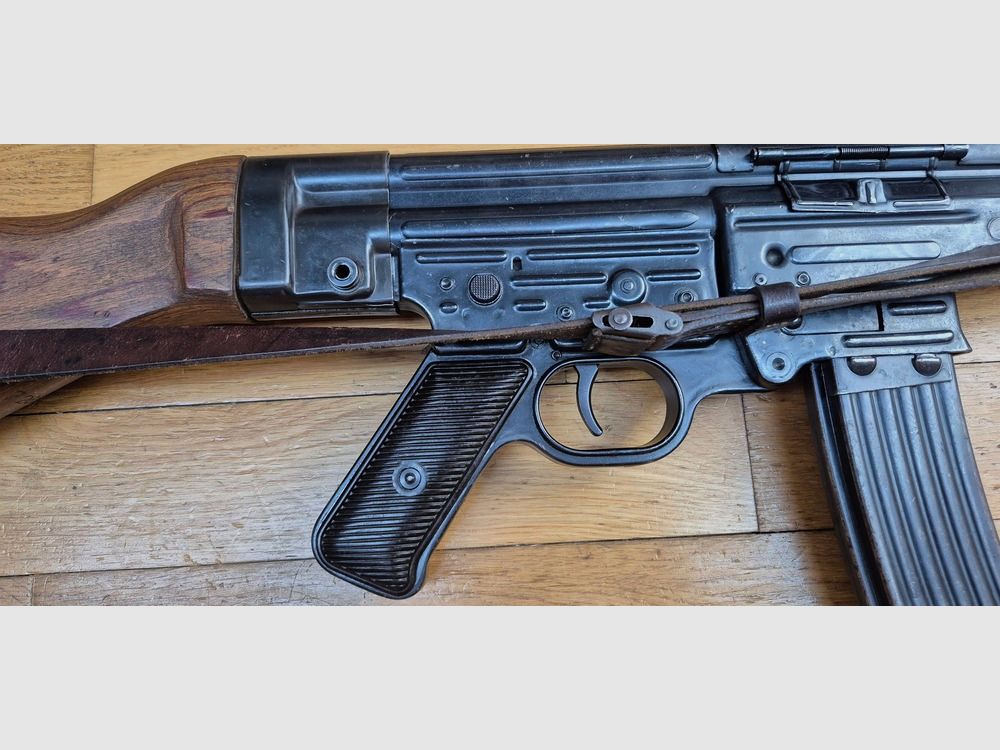
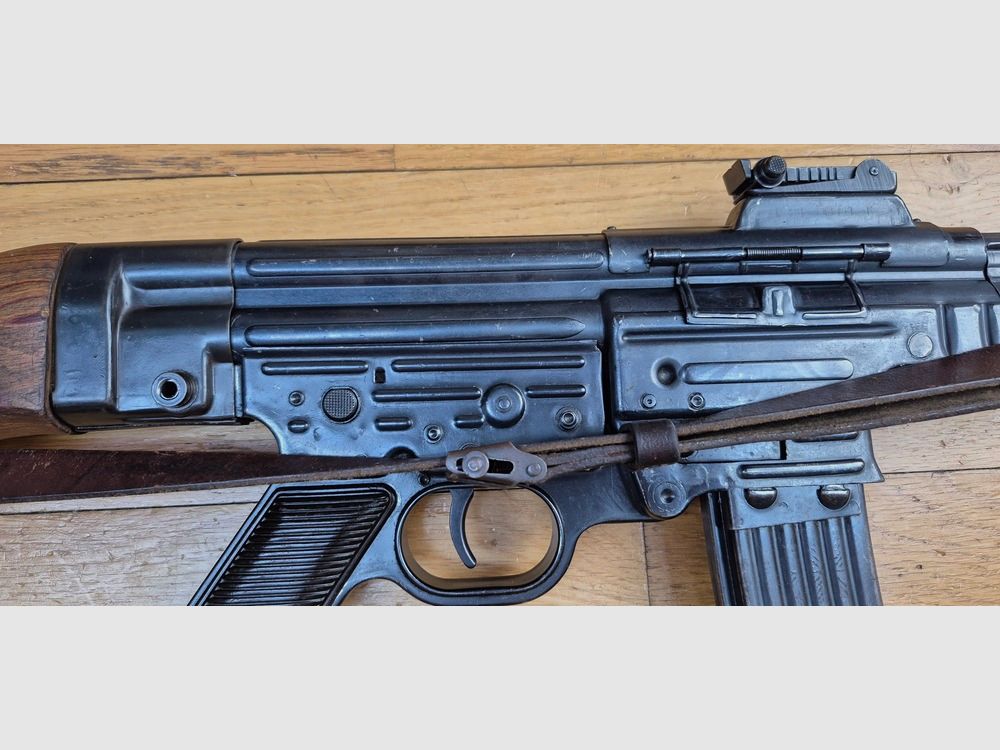
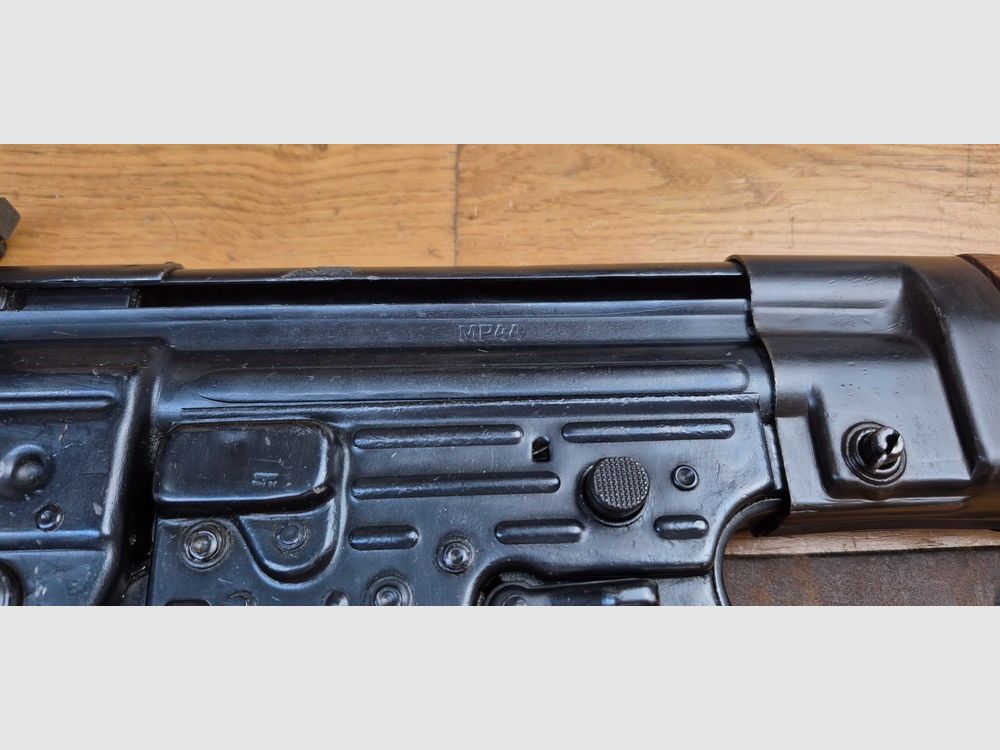
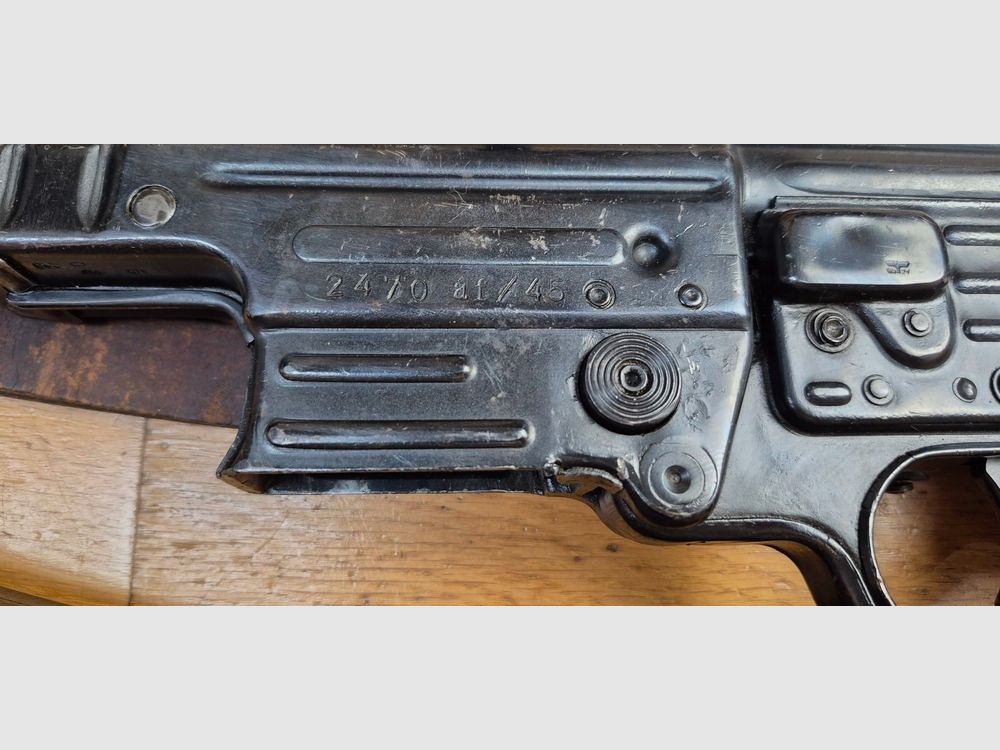
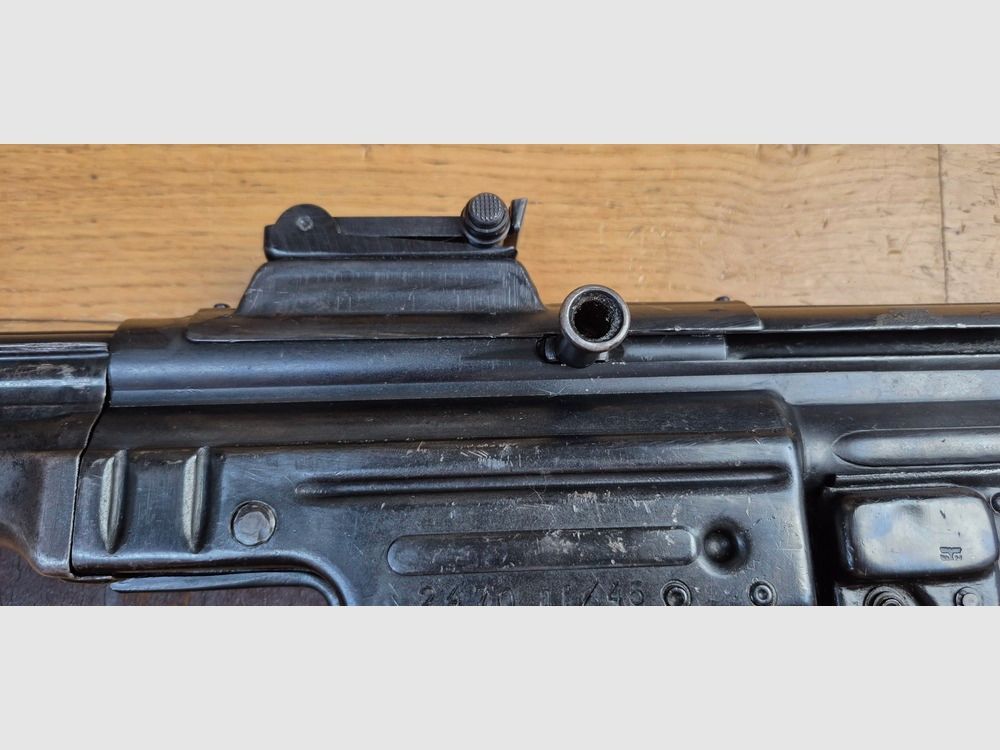
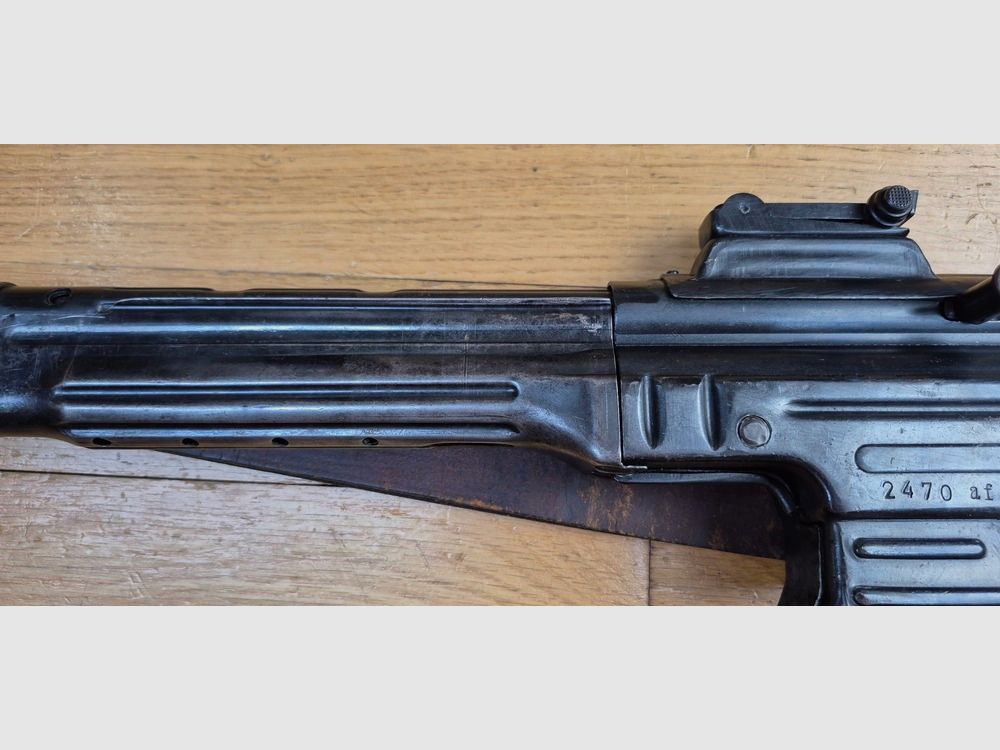
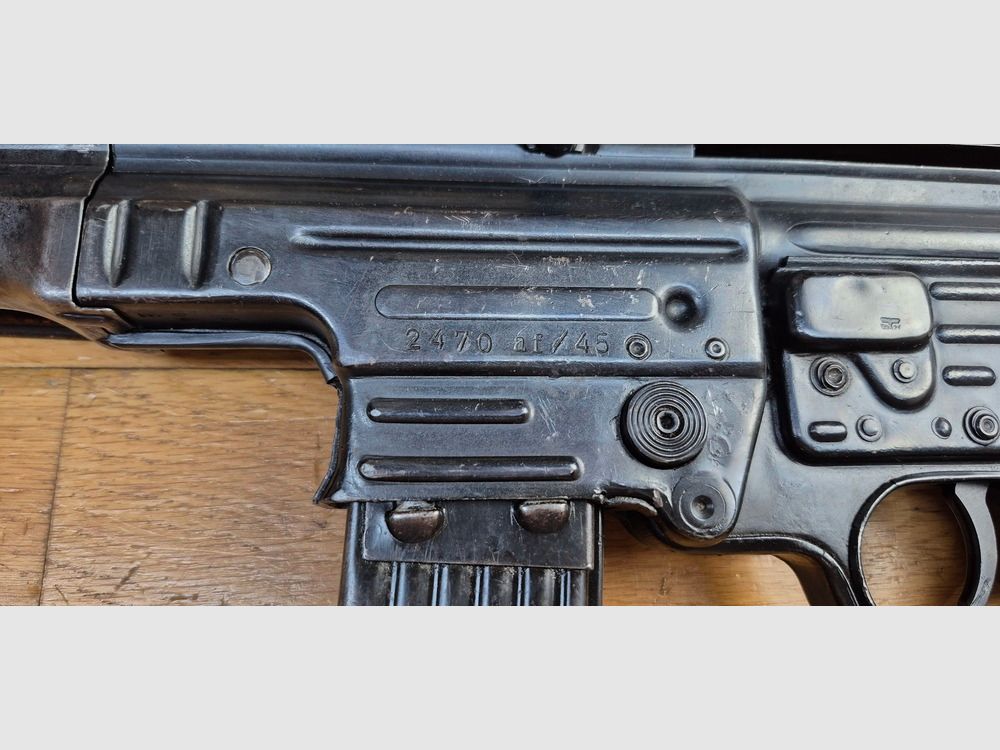
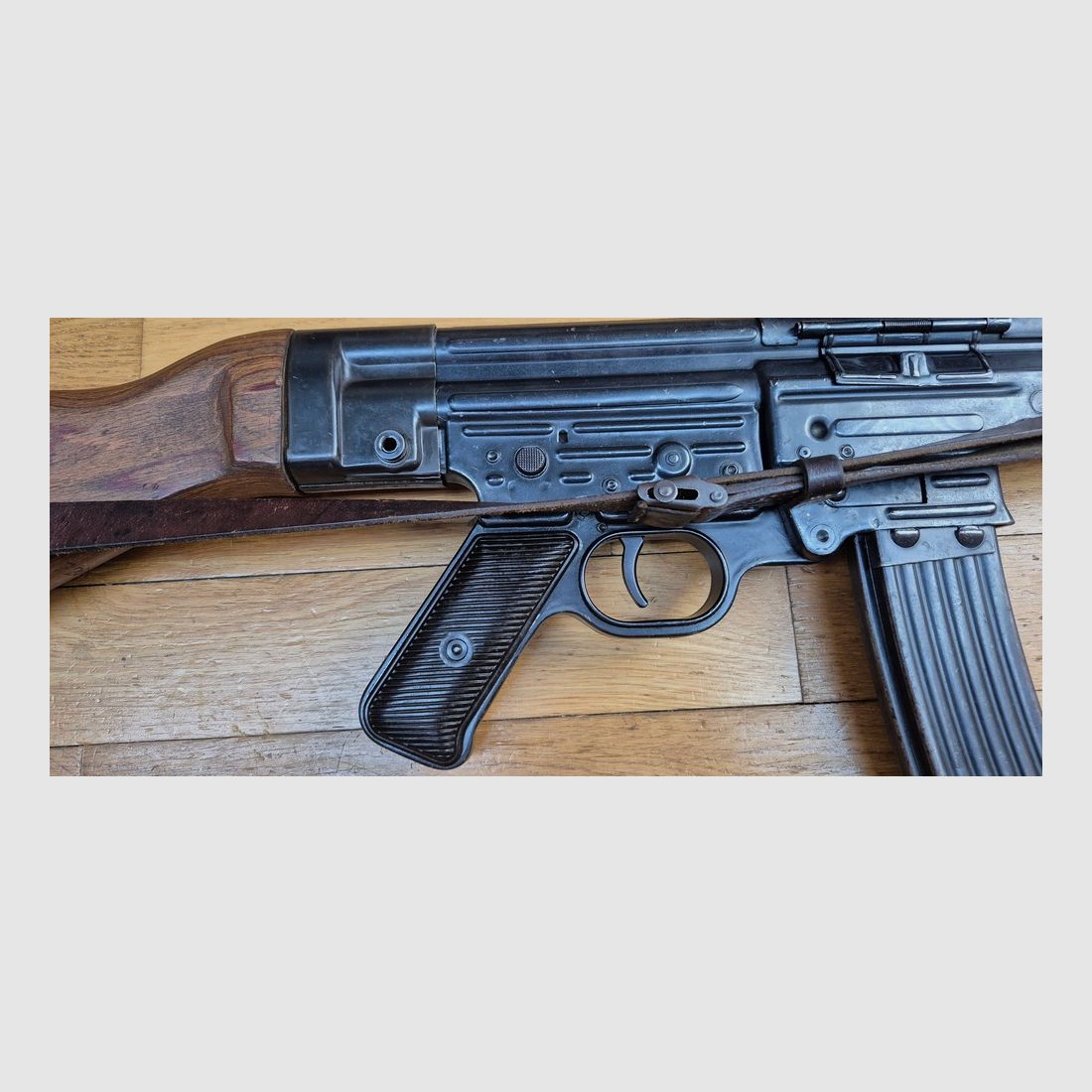
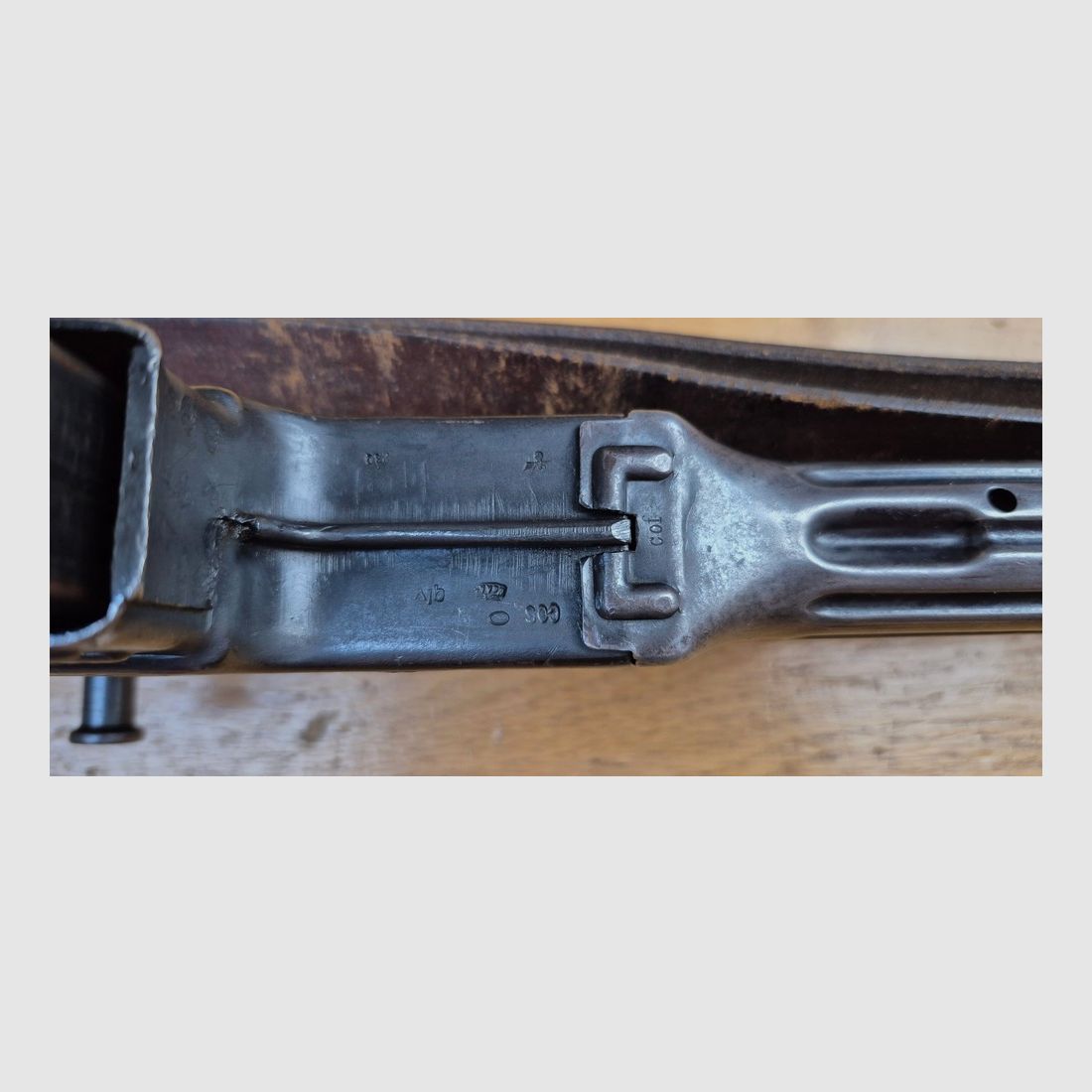
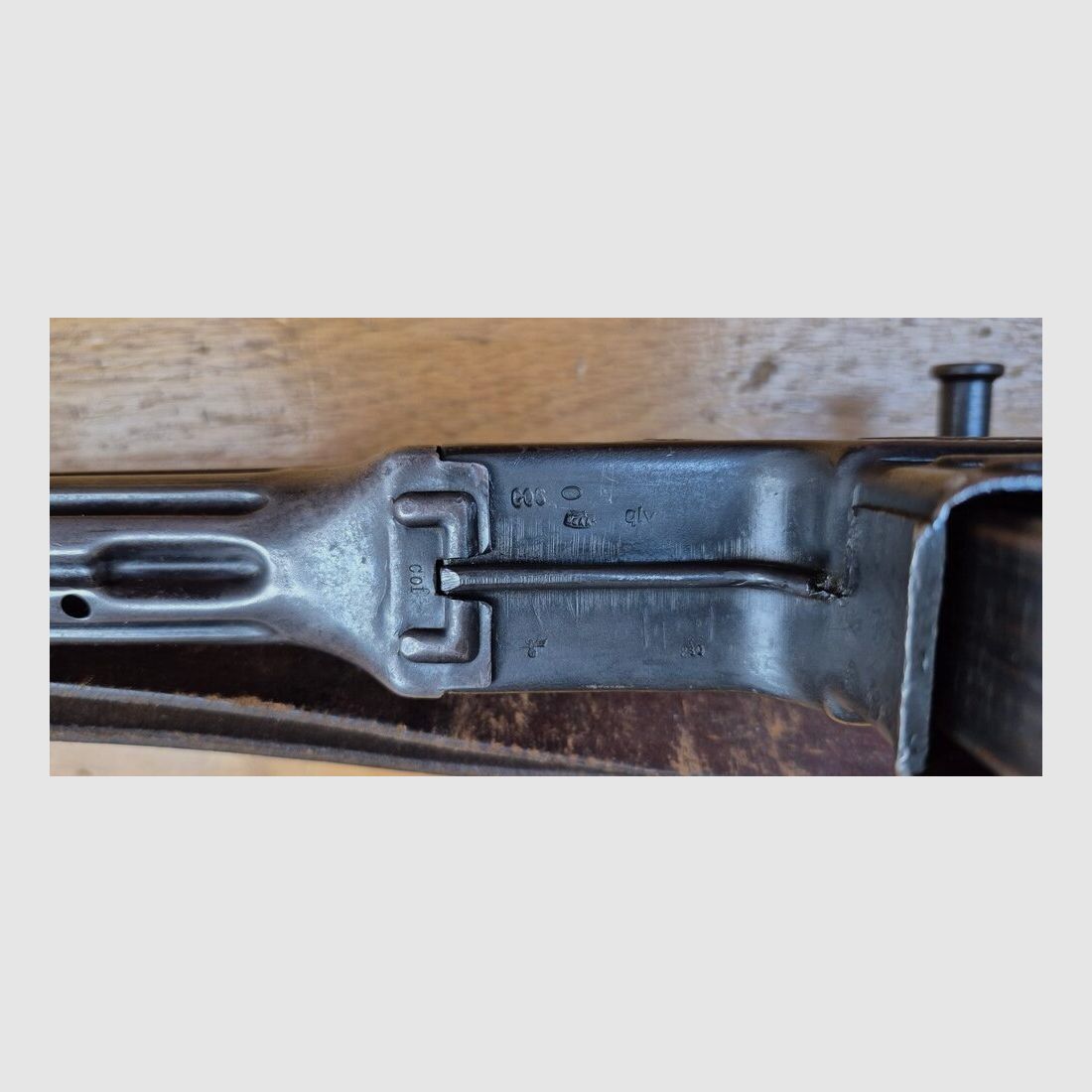
Ours is marked with the codes “MP44” and “af/45”. It is therefore an Erma firearm (code “qlv” underneath the upper receiver), probably dating from around February 1945. The receiver was made by Merz-Werke (code “cos”, also on the upper receiver), and the whole firearm bears the correct Erma Waffenamt WaA280, marking its final inspection.
The barrel is also marked with Waffenamt WaA280, again indicating that the firearm was assembled at Erma, while the barrels were supplied by Rheinmetall-Borsig in Düsseldorf. It is also marked “MP44” on the receiver (the lower part that hinges down).
Note that Erma used the MP44 designation right to the end, and toward the end used it alongside STG44.
In this “MP44” configuration, I found Erma firearms ranging from serial number 108af/45 to code 3863af/45, and firearms marked “Stg44” with serial numbers ranging from 1095af/45 to 7764/af45 …
The conclusion? It was a mess.
The trigger group bears the Württembergische Metallwarenfabrik Waffenamt 21 mark on the outside of the receiver. This company specialized in manufacturing these critical parts for automatic firearms. Note that even within its subassemblies (the trigger group, for example), many parts came from other manufacturers! You’ll find aqr, ce, v, qv, fxo, pa, cnd, and others…
The only part I had to replace on this firearm was the hammer, whose top was broken. It bore a nice “qve” mark from Karl Walther, Zella-Mehlis. I replaced it with a beautiful, modern hammer from Sport Systeme Dittrich—the best. I’ll include the broken hammer with the firearm, which is then 100% World War II. The sling swivel was also replaced, but not by me. It has old oxidation marks, but it’s also period-correct.
In short, a 100% World War II firearm, all the same. These are uncommon because many were reassembled after the war.
The firearm is in very good overall condition, despite being covered in scratches and other handling marks, which are of course greatly exaggerated by my VERY close-up photos. But now you know everything.
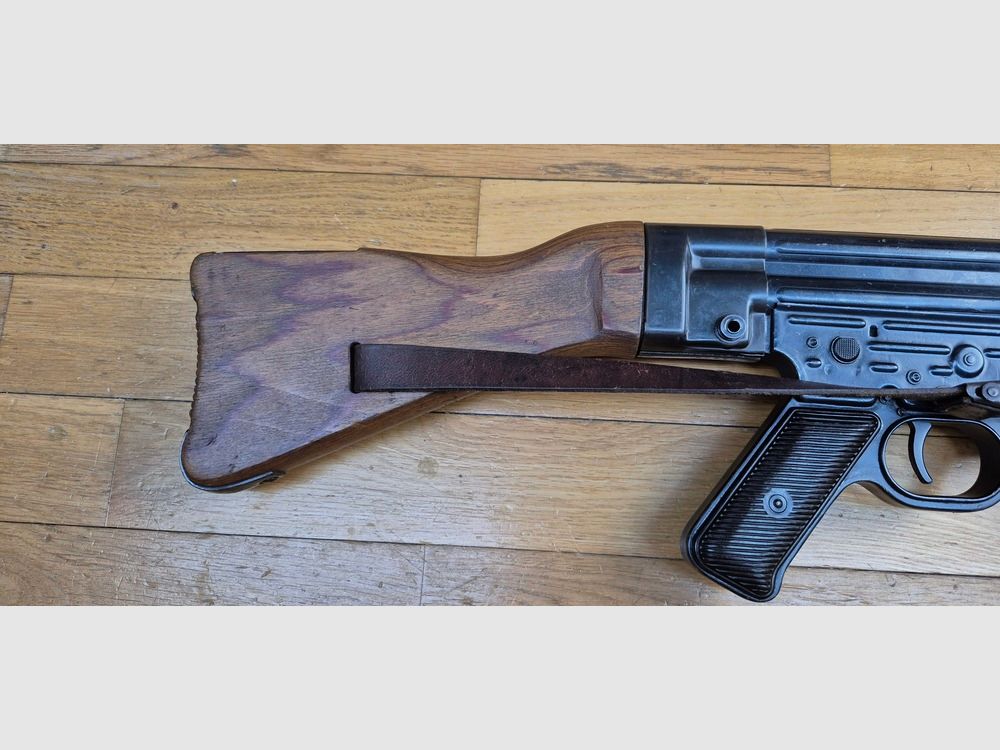
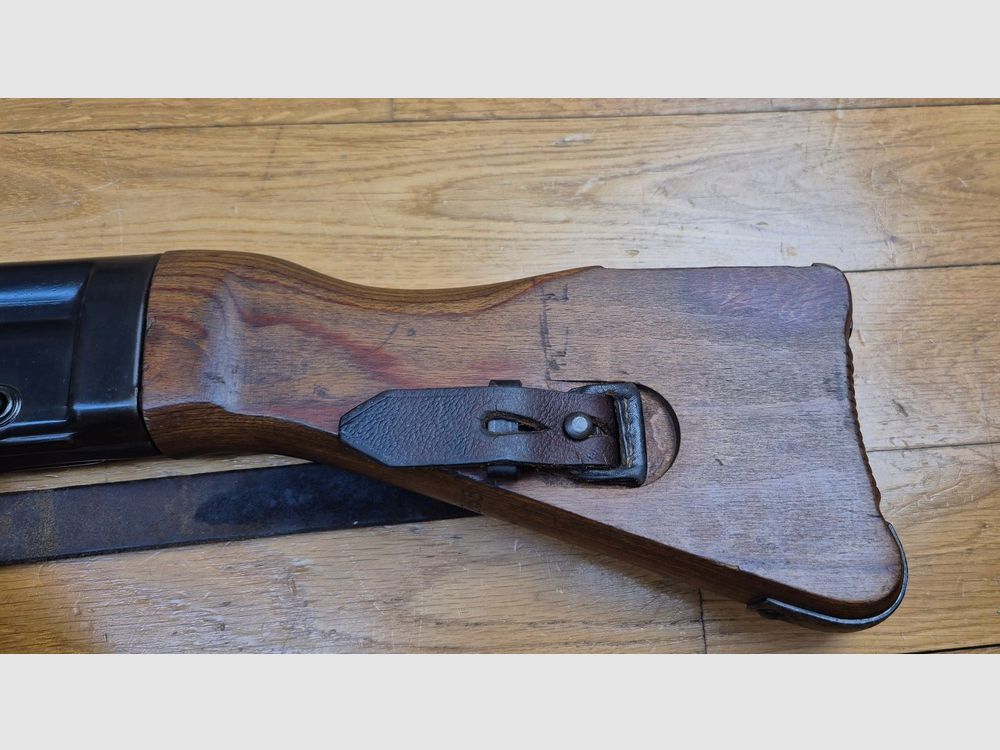
The stock, whose maker I couldn’t identify, is a genuine period laminated stock, not a modern replacement, as is very often the case. It has a different number from the receiver (but the same number on the stock attachment), and the Type 98 sling is correct.
The firearm works flawlessly mechanically. Cocking and firing are crisp, with original springs that have seen little use. The same goes for the ejection port cover.
Its barrel is beautiful, with excellent rifling. Almost new! That’s rare too.
If the lucky foreign buyer wants to shoot this firearm, they should remember that it was rated for a maximum of 100,000 rounds. 7.92 Kurz wears things out… But this one still has its full potential—beautiful and uncommon too.
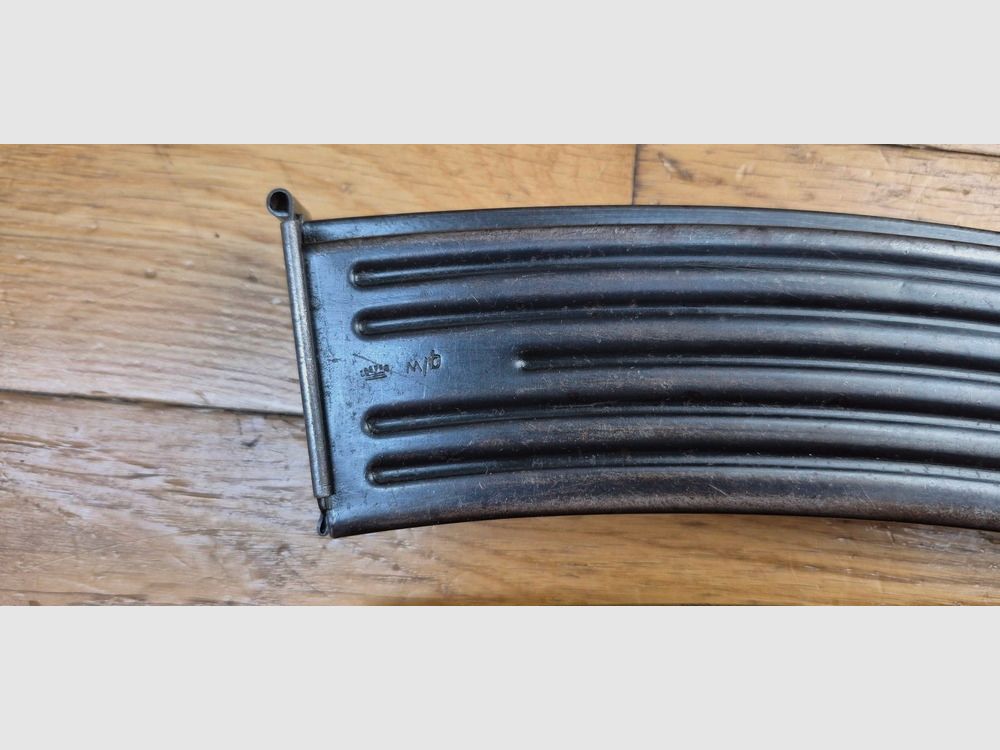
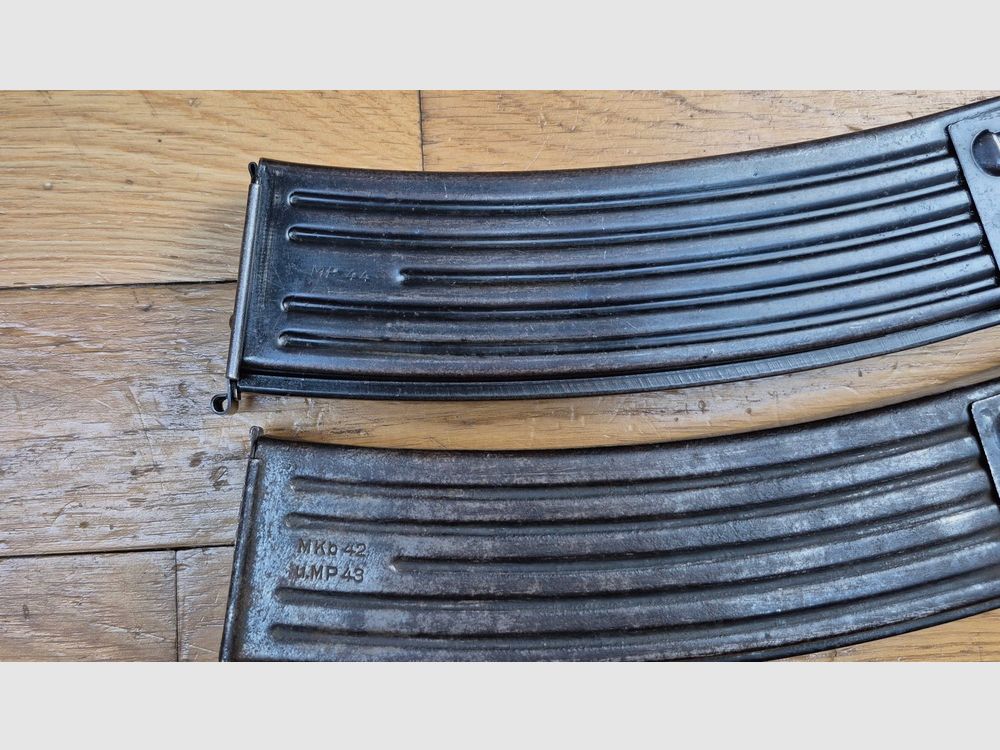
The firearm will come with two period magazines of different models and manufacture. The first is in perfect condition, with 95% of its original period bluing and marked “qlw” for Adolf Grohmann & Sohn, as well as MP44 + Waffenamt 892.
The second has been stripped of its bluing and shows signs of old oxidation, but it works perfectly. It’s a beautiful “fxo” (Haenel) marked Waffenamt 37. Most importantly, it’s an early model. It’s still marked “MKb 42 u. MP43”, after the first MKb 42 prototype tested in the field. It’s a collector’s item in its own right.
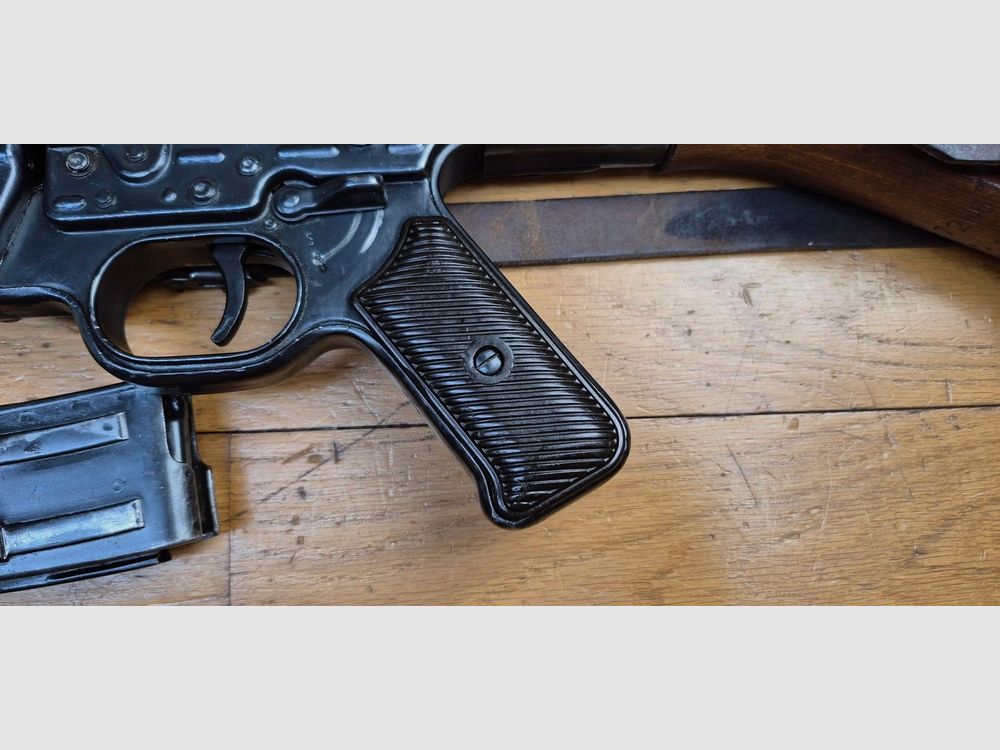
Note that the magazine release button is also the late, non-checkered type.
Erma assembled around 104,000 MP44/StG44 firearms before the city was taken by the Americans on April 10, 1945. Eventually located in the Soviet occupation zone, the factory was dismantled by the Soviets themselves in 1948.
Overall, a legendary firearm in very good condition, with original World War II parts and a fine collector’s piece for a knowledgeable enthusiast whose legislation p
ermet la détention de ce type d’arme. Le premier fusil d’assaut de l’histoire. Une rareté Flingus qui se fera de plus en plus rare encore hélas.
PRIX : Nous consulter (et seulement si vous êtes en situation légale de l’acquérir…)
Catégorie A2 – Export EXCLUSIVEMENT – Nous consulter pour vos formalités export.
English Below
Master Flingus was lucky enough to acquire an STG44 – most likely one of the very last that can still be found among private owners in our beautiful country, as very few remain. And even fewer are still functional and not eaten up by rust.
Being a Category A2 firearm, you cannot legally purchase it in France (but some special administration), and so it will be exported.
I would rather see it leave our beautiful country for more friendly skies than subject it to the horrible fate suffered by many of its brothers — even if that means I earn less money.
It’s a beautiful, 100% original German specimen from the period. While not all matching numbers, every part is authentic and untouched. All military proof marks are present and intact. It never passed through the DDR nor Yugoslavia.
It’s important to know that the STG44 was the result of a highly fragmented wartime industrial system, involving hundreds of subcontractors throughout occupied Europe, many with their own markings and codes.
Its technical success stands in stark contrast to the brutal conditions of its manufacture — including forced labor, notably at Mauthausen.
This fragmentation explains why multiple Waffenamt stamps can be found on the same weapon, as parts were often individually inspected and approved at the production site before being shipped to a different final assembly plant, which would then mark the receiver.
Four entities assembled the STG44: C.G. Haenel (Suhl), Mauser-Werke (Oberndorf), Steyr-Daimler-Puch (Austria), and Erma-Werke (Erfurt).
Ours is marked “MP44” and “af/45”, identifying it as an Erma weapon (with code “qlv” under the upper receiver), likely from around February 1945. The receiver is from Merz-Werke (code “cos”, also on upper receiver), all with the correct Waffenamt WaA280, Erma’s final inspection stamp.
The barrel also bears the WaA280 stamp, further proof of Erma assembly, even though the barrels were supplied by Rheinmetall-Borsig in Düsseldorf. The lower receiver (the hinged part) is also properly marked “MP44”.
Note: The “MP44” designation continued to be used at Erma until the very end, sometimes simultaneously with “StG44”.
In this specific « MP44 » configuration, I’ve seen Erma weapons ranging from serial 108af/45 to 3863af/45, and others marked « StG44 » ranging from 1095af/45 to 7764af/45…
Conclusion? It was a pure mess in German factories at the time.
The trigger group bears on the outer housing the Waffenamt 21 of Württembergische Metallwarenfabrik, the company specialized in manufacturing such sensitive components for automatic weapons. Even within that subassembly, parts could come from various manufacturers! You’ll find markings like aqr, ce, v, qv, fxo, pa, cnd, and more…
The only part I had to replace on this weapon is the hammer, as the original had a broken top. It was marked “qve” from Karl Walther, Zella-Mehlis. I replaced it with a beautiful modern hammer from Sport Systeme Dittrich, the best in the field.
The original broken hammer will be sold with the weapon, if you want it, making it a complete WWII-era piece. The barrel band was replaced too — not by me — and shows signs of old oxidation, but is also a period-original.
In short: it’s a 100% WWII firearm. That’s rare, as most surviving STG44s were reassembled with mixed parts post-war.
The weapon is overall in excellent condition, even if covered in scratches and handling marks — as always, heavily emphasized by my EXTREME close-ups. But that way, you know everything.
The stock, whose maker I couldn’t identify, is an original wartime laminated one — not a modern replacement, which is very often the case. It has a di
Different serial number than the receiver (but matching the stock attachment), and the sling is a correct Model 98.
Mechanically, the firearm is flawless. Cocking and firing are crisp. The original springs show very little wear. The same goes for the ejection port.
The barrel is excellent, with clean, sharp rifling. Nearly new! Also rare.
Should the lucky foreign buyer want to shoot it, remember: these were rated for about 100,000 rounds. The 7.92 Kurz round is harsh on the firearm. But this one still has its full potential—an outstanding and rare example.
The firearm will be delivered with two period-correct magazines of different types and origins:
One is in excellent condition, with 95% original finish, marked “qlw” (Adolf Grohmann & Sohn), MP44 + Waffenamt 892.
The second has lost its finish and shows signs of old oxidation, but is fully functional. It’s a beautiful “fxo” (Haenel), Waffenamt 37. More importantly, it’s an early and rare model, still marked “MKb 42 u. MP43”, the name of the first prototype rifle tested in the field—a collectible in its own right.
Note: the magazine release button is the late-war smooth (non-checkered) type.
Erma assembled around 104,000 MP44/StG44s before the city of Erfurt was taken by the Americans on April 10, 1945. Falling later into the Soviet zone, the factory was ultimately dismantled by the Soviets in 1948.
In summary: a legendary firearm in very good condition, with original WWII parts, and a top-tier collectible for an informed enthusiast whose legislation allows ownership. The first true assault rifle in history. A Flingus rarity that, sadly, will only become rarer.
PRICE: Contact us (only if you are legally eligible to acquire it in your country…)
Category A2 – EXPORT ONLY – Contact us for assistance with your customs procedures. (Show description in original language)
Le StG 44…
Et dire qu’il avait fallu attendre 1944 pour en arriver là.
Et même avoir un nom pour le désigner. Un nom conceptuel. Concept-père d’une vaste famille : le fusil d’assaut.
Le concept fut tellement bon que notre fameux fusil d’assaut a même réussi à stabiliser un peu les choses dans l’armement moderne individuel jusqu’à nos jours. Car il tient encore la rampe en 2025 notre « fusil d’assaut » qui fit ses premiers pas en 1943.
On ne voit même pas trop ce qui pourrait aujourd’hui le détrôner, même à l’heure des drones, déjà eux-mêmes ravalés au rang de munitions consommables attaquant des groupes de deux ou trois individus…
80 ans de succès pour un concept militaire d’arme à feu individuelle, ce n’est déjà pas si courant.
Le fusil d’assaut est le fils spirituel et l’adaptation de terrain ultime du fusil semi-automatique (FSA). Je dirai, hélas pour lui d’ailleurs.
Car la création du FSA par les états-majors fut en fait un très long chemin de croix qui retarda d’autant la naissance du fusil d’assaut lui-même.
Maître Flingus vous fera une autre fois l’histoire des errements infinis de tous les états-majors, de 1912 (mise au point du FSA Meunier par les français toujours novateurs) jusque 1942 (début de l’entrée sur scène des prototypes du STG44) en matière de fusils semi-automatiques.
Errements déjà tels pour le FSA que l’on ne risquait pas, même par miracle, de donner naissance à un quelconque fusil d’assaut utilisable.
Un fusil d’assaut, c’est d’abord une arme compacte (moins d’un mètre), portable par un seul homme avec son stock de munitions suffisant pour un combat standard, fonctionnant en mode semi-automatique et automatique, et qui reste contrôlable en mode rafale.
Il doit aussi être encore suffisamment efficace dans ce mode rafale pour pouvoir lutter jusqu’à une 40aine de mètres contre des PM de grosse capacité très rapides en cadence (eux sont à 8/900 coups minute). Mais il doit également avoir une portée utile de quelques centaines de mètres au moins (env. 400/500 mètres) pour pouvoir lutter contre des fusils dans la plupart des situations de combat.
Il a même le droit, étant également proche d’un fusil, de jouer accessoirement un rôle de composition dans l’arme de précision.
Voilà.
C’est l’arme longtemps rêvée par tous les combattants de la seconde guerre mondiale pris un jour dans des combats de campagne où de petites unités, appuyées par des véhicules, cherchent à en encercler d’autres pour se retrouver, le lendemain, pris dans des combats urbains ou péri-urbains. Avec la même arme.
Mais, pour faire tout cela, et le café en plus, il lui faut une cartouche intermédiaire bien plus puissante que celle d’un PM mais beaucoup beaucoup moins puissante que les quasi 3 mètres cubes de gaz ( !) générés par une cartouche de fusil standard type, 8×51, 7,92 , 30-06 ou 303.
Damnés mètres cubes de gaz des cartouches standard d’infanterie du XIX° siècle qui ont rendu cauchemardesques la mise au point du Garand ou du SVT-40, loin d’être parfaits (soit trop lourds soit trop fragiles mais qui fonctionnent) et qui ont même directement mené aux échecs type G41 /G43…
On tournait en fait autour du problème de la cartouche depuis le FSA 17 avec sa 8×51.
Car c’est bien pour ne pas avoir voulu entendre parler de cartouche intermédiaire (et nullement du fait de difficultés techniques liées à l’arme) et exiger fanatiquement l’emploi des cartouches « standards » datant de la fin du XIX° siècle, que les états-majors, de 1917 à 1942, ont rendu si laborieux la mise au point du fusil semi-automatique.
Et, par voie de conséquence, celle du fusil d’assaut aussi, puisque, lui, ne peut strictement fonctionner, QU’avec une cartouche intermédiaire!
Pour montrer jusqu’où allait ce fanatisme doctrinal, emprunt d’une conception surannée de la logistique datant d’avant la guerre de 14, je rappellerai que l’on avait du cacher à Mac Arthur que la future (et merveilleuse) USM1 n’emploierai pas la .30-06 (qu’il avait constamment exigé dans le développement du Garand).
On baptisait donc sa future munition élusivement du nom de « 0.30 » ou bien de « .30-M1 » (en accolant au calibre le modèle de l’arme) dans les rapports de conception qui lui étaient destinés. Sinon il l’aurait très sûrement tuée dans l’œuf direct notre US-M1 comme il avait tué plusieurs projets concurrents du Garand exactement pour cette même raison de cartouche.
Je rappelle également qu’en 1942, quand débutent les essais opérationnels des prototypes du Stg44, les allemands n’étaient toujours pas foutus d’avoir un simple FSA correct (le G41 est surtout une excellente arme pour un musée technique qu’elle n’aurait jamais du quitter).
Même leur « solution » G43 reste une arme de combat globalement fragile et complexe en campagne et qui n’a impressionné personne à l’époque n’en déplaise aux thuriféraires du matériel allemand. Tout ça, pour ne pas renoncer, en 1943, à la bonne vieille 7,92 x57 de …1889!
Finalement, après ces circonvolutions et noirs échecs, ce sont les allemands qui finiront par se rendre à la raison et renverseront la table avec le Sturmgewehr 44 : le premier fusil d’assaut véritable de l’Histoire. C’est bien le dur effet cumulé de leurs échecs en FSA et des évidences de terrain qui les contraignit, tardivement, à franchir le cap. Pas la volonté d’innover.
Je ne veux pas ici refaire l’histoire du STG et de sa cartouche de 7.92×33 ou 7.92 Kurz (court), ni de la création du mot « fusil d’assaut » par Hitler lui-même à qui, au passage, on avait également caché le développement de l’arme, ni même de l’emploi opérationnel du StG44. Il y aurait beaucoup à dire aussi sur sa fabrication et sa manipulation. Une autre fois.
Je rappellerai juste deux faits sur cette arme et j’en profiterait au passage pour tuer « dans le détail » une légende classique de radio-stand au sujet du STG 44.
D’abord, premier fait, l’arme est rare.
Et elle l’était déjà à l’époque! Cette arme révolutionnaire fut, en fait, assez peu produite.
425,977 exemplaires seulement dont seulement peut-être 300.000 sont allés au combat entre 1943 et 1944. C’est peu. Très peu. A peu près autant que de G43 (402.000 mais eux sont allés plus massivement au combat).
Les 130.000 autres ont été capturés essentiellement par les russes avant même leur envoi en ligne. Ils ont servi (après effacement des marquages III° Reich) en Allemagne de l’Est (DDR) et dans les pays frères (Yougoslavie et République Tchèque) jusque dans les années 70.
Beaucoup ont été aussi revendus à des pays frères plus lointains encore.
On a vu les premiers en Algérie entre 1954 et 1962, puis, après leur revente par la Yougoslavie et la DDR, ils se sont promenés dans la Corne de l’Afrique dans les années 80 et même encore chez les rebelles syriens encore en… 2012!
Je doute fort que beaucoup reviennent chez nous de ces exotiques périples. Et, quand bien même certains seraient « sauvés », dans quel état nous reviendraient-ils ?
Encore détruits ou castrés de nos jours chez nous, les exemplaires survivants avec 100% de pièces d’époque se font très rares.
Ensuite, second fait.
L’histoire du STG 44 semble, in fine, avoir quand même donné raison à ceux qui ne voulaient pas d’armes de ce type. Au motif qu’elles ne tiraient pas la cartouche d’infanterie standard !
Au moins d’une certaine façon et au moins pour l’Allemagne. Je m’explique.
Une des raisons pour lesquelles nombre de STG44 ne virent pas le combat fut bel et bien …. le manque de cartouche de 7.92 x 33!
C’est, en bien plus gros, l’histoire du Meunier 1912 chez nous, testé en ligne en 1916, et de sa cartouche de 7mm dont la logistique, surtout, fit renoncer à l’arme.
Il fallait trouver 86.000 travailleurs supplémentaires pour produire les 1.5 millions d’armes commandées et leurs 200 millions de cartouches intermédiaires de 7.92 x 33 consommées mensuellement au lancement de l’arme. On ne les trouva jamais. Même en recourant à la main d’œuvre concentrationnaire. Et c’est pas bien en plus.
Les 400 millions de cartouches mensuelles planifiées dès fin 43 pour février 1944 (oui, 44 !) ressortaient juste d’une crise aiguë de prise de ses désirs pour des réalités. En février 45, on était revenu à une planification un peu plus réaliste de…110 millions seulement de cartouches mensuelles.
Pour fixer les choses, sur la période courant des essais des prototypes avancés sur le terrain de 1943 à mai 1945, seulement … 822 millions de cartouches de 7.92 x 33 furent produites! Très très loin des productions planifiées.
Fin mars 1945, la troupe disposait d’à peine 274 millions de cartouches avec seulement 69 millions d’autres en stock de disponibilité immédiate.
Contrairement à ce qu’on a parfois dit, le Sturmgewher 44 n’avait donc aucune chance de changer quoi que ce soit sur le terrain. Les réalités logistiques de la guerre sont impitoyables.
La légende maintenant.
Mikhail Kalashnikov aurait « copié » le STG 44 pour créer son AK-47.
Ce serait donc vrai « puisque » les deux armes se « ressemblent beaucoup » dans leurs lignes (quoique…) avec leur chargeur courbe, que Hugo Schmeisser (le principal concepteur du STG44) et sa famille ont vécu quelques mois à Ijevsk après la guerre, là où été créée la célèbre AK, que 10.000 pages de documentation technique de l’usine de Suhl sur le sujet ont été embarqués par les soviétiques lors de sa capture et transportées à Ijevsk toujours, et, qu’outre les armes capturées durant le conflit, 50 armes y compris des prototypes de STG-45 ont été aussi expédiées à Ijevsk en 1945 pour démontage et étude.
Hélas, Hélas. Rien n’y fera. Démontons donc l’arme ensemble pour s’en convaincre.
Je passe sur le chargeur courbe qui n’est rien d’autre qu’une nécessité propre à toute arme alimentée par chargeur de cartouches dont les étuis ne sont pas de bords parallèles. Essayez de poser côte à côte sur le sol de telles munitions et vous obtiendrez illico et inévitablement une très belle forme courbe qui vous dessine illico ce que doit être votre chargeur.
Notez au passage que les PM russes utilisaient d’ailleurs des chargeurs courbes au combat, dès 41, bien avant que les allemands ne le fassent avec le STG44. Comme quoi, les apparences générales…
Mais, de façon bien plus édifiante, quand on démonte les armes, on constate qu’elles n’ont juste… à peu près rien à voir d’autres que leur cartouche intermédiaire (la fameuse 7.62×39 russe du SKS 45 puis de l’AK47, sensiblement supérieure à la 7.92 x 33, était déjà née en Russie début 43).
D’abord, le STG44 utilise une complexe culasse à coin basculant contre une culasse rotative dans la AK47. Le beau Mikhaïl a d’ailleurs toujours dit que sa principale source d’inspiration sur ce point là avait été le Garand US, fils lui-même de la culasse rotative du FSA 17 français. Rien à voir avec le STG44 donc. C’est déjà une grosse différence mais c’est loin d’être tout.
Les deux armes utilisent certes un système d’emprunt de gaz avec piston à débattement long. Mais justement c’est une invention russe que l’on trouve déjà sur le SVT-40 (que les allemands seront d’ailleurs contraints de copier pour le G43!). Mais, surtout, surtout, ces systèmes d’emprunt de gaz fonctionnent très différemment.
Le StG 44 utilise un piston à tige fixe et non solidaire de la culasse. Ce piston, indépendant de la culasse, frappe une tige de transmission qui pousse le bloc culasse vers l’arrière. Le mécanisme du StG44 est in fine plus proche de certains fusils semi-auto comme …le SKS 45 du russe Simonov que le l’AK47! Ce concept est beaucoup moins robuste car il réclame plus de pièces et il est plus sensible à l’encrassement.
L’AK47, elle, utilise un piston à tige solidaire directement monté sur le porte-culasse. Comme un bloc. Le piston à gaz de la AK 47 effectue donc un mouvement solidaire et linéaire pour reculer l’ensemble mobile. Il utilise moins de pièces en mouvement indépendantes les unes des autres. Il est de fait moins sensible à l’encrassement et plus robuste.
Mais, encore bien plus important encore à mes yeux, il assure surtout une meilleure étanchéité des gaz qui permet de récupérer plus d’énergie pour faire fonctionner l’arme. Outre le surcroit de fiabilité, il ne faut pas chercher ailleurs la centaine de coups minute de plus de la AK 47 comparée au STG 44 et avec une munition un peu plus puissante en outre.
C’est déjà beaucoup mieux du côté du berger de l’Altaï que de l’armurier, fils d’armurier, Hugo Schmeisser. Et on pourrait s’arrêter là.
Mais il y a encore plus important encore à mon sens. Kalashnikov est un génie de la mécanique pure. Il a eut l’idée fondamentale d’utiliser la carcasse elle-même pour supprimer des pièces.
Dans le STG 44, le boîtier est segmenté en sous-ensembles distincts, chacun ayant son propre logement: la culasse est guidée dans des rails séparés, le ressort récupérateur est logé dans un tube séparé, la partie supérieure et inférieure du boîtier forment deux pièces bien distinctes assemblées ensemble. Chaque chose est bien à sa place, chaque sous ensemble a son boulot à lui, bien clairement identifié. Net comme un village suisse.
C’est très allemand. Et c’est surtout beaucoup de petites pièces rapportées qui compliquent la production et l’entretien.
Il est souvent délicat de comparer le nombre de pièces entre deux armes selon la façon dont on segmente les composants (pièces principales vs sous-composants), mais le résultat c’est qu’un StG 44 c’est 120/125 pièces au total.
Dans le AK47, la philosophie de conception est radicalement différente. Le boîtier de culasse en tôle emboutie (ou même usiné selon les versions) est structuralement intégré à l’arme. Il sert, lui même et directement, de support à plusieurs composants internes. Il assure le guidage du piston et du bloc culasse, le logement du ressort récupérateur, l’ancrage du système de détente. Cela permet de fusionner plusieurs fonctions dans une seule structure rigide.
C’est aussi la source de la légendaire robustesse de la Kalachnikov.
Résultat ? Une AK47 c’est plutôt 75 pièces et pas 120 ou 125…
C’est pas le même monde. Du coup, pas le même monde non plus en production et en fonctionnement. Il n’y a pas photo.
L’AK 47 n’est donc en rien une copie du StG 44 mais le StG44 a eu lui l’honneur d’être la première arme opérationnelle (et réusie) d’un concept nouveau appelé à un grand avenir: le fiusil d’assaut. Au main des derniers combattants d’un combat gigantesque et désespéré, il est devenu une légende autant qu’une étape majeure de l’histoire de l’armement. Et c’est déjà énorme.
Maitre Flingus a eu la chance de récupérer un STG44 – sans doute dans les derniers récupérables chez des particuliers dans notre beau pays car il n’en reste plus guère. Et encore moins en état de fonctionnement et pas bouffés de rouille.
C’est du A2 donc vous ne pouvez pas l’acheter et il partira à donc l’export. Je préfère le voir quitter notre beau pays pour des cieux plus cléments pour lui que de lui réserver le sort affreux de nombre de ces frères et même si je gagne moins d’argent.
C’est un beau spécimen 100% germanique d’époque. S’il n’est pas mono-matricule, il est 100% d’époque non modifié. Tous les poinçons sont là, non effacés. Il n’est pas passé ni par la DDR ni par la Yougoslavie.
Pour ce qui est des pièces il faut savoir que le STG 44 était le produit d’une industrie de guerre hautement fragmentée, reliant des centaines de fournisseurs à travers l’Europe occupée ayant pour beaucoup leurs propres marquages et codes.
Son succès technique contraste avec les conditions brutales de sa production (travail forcé à Mathausen notamment ).
Mais c’est ce qui explique qu’on trouve plusieurs waffen amt sur ces pièces car celles-ci étaient souvent estampillées « bonnes pour le service » par des contrôleurs militaires dans leur usine de fabrication d’origine avant expédition vers une autre entité d’assemblage final de l’arme qui, elle, signait le boitier.
Quatre entités ont assemblé le STG 44: C.G. Haenel à Suhl, Mauser-Werke à Oberndorf, Steyr-Daimler-Puch, en Autriche, et Erma-Werke à Erfurt.
Le notre est en code « MP44 » et « af/45 ». C’est donc une arme de chez Erma (code « qlv » en dessous de boitier haut), probablement de vers février 45. La carcasse vient de chez Merz-Werke (code « cos » en boitier haut toujours), le tout avec le bon Wafen amt WaA280 de Erma qui marque l’inspection finale de l’arme.
Le canon est bien marqué aussi au Wafen amt WaA280 ce qui témoigne à nouveau d’un assemblage de l’arme chez Erma alors que les canons étaient fourni par Rheinmetall-Borsig à Düsseldorf. Il est bien aussi marqué « MP44 » en boitier (partie dite inférieure celle qui bascule vers le bas).
A noter que la mention MP44 a été utilisée jusqu’au bout chez Erma et à la fin concomitamment avec STG44.
Dans cette configuration « MP44 » j’ai trouvé des armes Erma allant du numéro de série 108af/45 au code 3863af/45 et des armes marquées « Stg44 » dans des numéros de série allant de 1095af/45 jusque 7764/af45 …
Conclusion? C’était le foutoir.
Le bloc détente porte en extérieur sur la carcasse le Waffenamt 21 de Württembergische Metallwarenfabrik, entité spécialisée dans la fabrication de ces pièces sensibles sur une arme automatique. A noter que même dans ses sous-groupe (bloc détente par exemple) de nombreuses pièces venaient encore d’autres fabricants ! On y trouve aqr, ce, v, qv, fxo, pa, cnd et d’autres…
La seule pièce que j’ai du changer sur cette arme est le marteau dont le sommet était brisé, lui avec un joli « qve » de chez Karl Walther, Zella-Mehlis. Je l’ai changé pour un beau et moderne marteau de chez Sport Systeme Dittrich, les meilleurs. Je vendrai le marteau brisé avec l’arme qui est alors 100% seconde guerre mondiale. La grenadière a été changée aussi mais pas par moi. Elle porte d’anciennes traces d’oxydation mais est d’époque aussi.
Bref arme 100%, 2° GM quand même. C’est peu courant car ces armes ont subit de nombreux remontages après guerre.
L’arme est globalement en TBE même si pleine de rayures et autres marques de manipulation qui sont bien évidemment très accentuées par mes TRÈS gros plans. Mais comme cela vous savez tout.
La crosse dont je n’ai pu déterminé le fabricant est une bonne lamellée-collée d’époque et non un remplacement moderne ce qui est très fréquemment le cas – Elle est d’un numéro différent du boitier (mais même numéro en attache de crosse) et la bretelle type 98 est au modèle.
L’arme fonctionne mécaniquement impeccablement. Armement et percussion sont bien nette avec des ressorts d’origine ayant peu servis. Idem à la portière d’éjection.
Son canon est très beau avec de très belles rayures. Quasi neuf ! C’est rare aussi.
Si l’heureux acquéreur étranger de cet arme veut jouer avec il ne devra pas oublier que ce dernier était donné pour 100.000 coups maximum. La 7.92 Kurz, ça use, ça use… Mais, là, il a tout son potentiel – Superbe et peu courant aussi.
L’arme sera livrée avec deux chargeurs d’époque de deux modèles et fabrications différentes. Le premier est en parfait état avec 95 % de son bronzage d’origine et d’époque au marquage « qlw » de Adolf Grohmann & Sohn et MP44 + Wafen Amt 892.
Le second est débronzé avec des traces d’ancienne oxydation mais il est parfaitement fonctionnel. C’est un beau « fxo » (Haenel) au Wafen Amt 37. Surtout, c’est un modèle précoce. Il est encore marqué « MKb 42 u. MP43 » du nom du premier prototype MKb 42 testé sur le terrain. C’est, en soi, un objet de collection.
A noter que le bouton de libération de chargeur est bien aussi du type tardif non quadrillé.
Erma a assemblé environ 104.000 MP44/StG44, avant que la ville ne soit prise par les Américains le 10 avril 1945 – Située in fine en territoire d’occupation soviétique, l’usine a été démantelée par ces mêmes soviétiques en 1948.
Au global, une arme mythique, en très bon état, avec des pièces d’origine 2° GM et une belle pièce de collection pour un amateur éclairé dont la législation permet la détention de ce type d’arme. Le premier fusil d’assaut de l’histoire. Une rareté Flingus qui se fera de plus en plus rare encore hélas.
PRIX : Nous consulter (et seulement si vous êtes en situation légale de l’acquérir…)
Catégorie A2 – Export EXCLUSIVEMENT – Nous consulter pour vos formalités export.
English Below
Master Flingus was lucky enough to acquire an STG44 – most likely one of the very last that can still be found among private owners in our beautiful country, as very few remain. And even fewer are still functional and not eaten up by rust.
Being a Category A2 firearm, you cannot legally purchase it in France (but some special administration), and so it will be exported.
I would rather see it leave our beautiful country for more friendly skies than subject it to the horrible fate suffered by many of its brothers — even if that means I earn less money.
It’s a beautiful, 100% original German specimen from the period. While not all matching numbers, every part is authentic and untouched. All military proof marks are present and intact. It never passed through the DDR nor Yugoslavia.
It’s important to know that the STG44 was the result of a highly fragmented wartime industrial system, involving hundreds of subcontractors throughout occupied Europe, many with their own markings and codes.
Its technical success stands in stark contrast to the brutal conditions of its manufacture — including forced labor, notably at Mauthausen.
This fragmentation explains why multiple Waffenamt stamps can be found on the same weapon, as parts were often individually inspected and approved at the production site before being shipped to a different final assembly plant, which would then mark the receiver.
Four entities assembled the STG44: C.G. Haenel (Suhl), Mauser-Werke (Oberndorf), Steyr-Daimler-Puch (Austria), and Erma-Werke (Erfurt).
Ours is marked “MP44” and “af/45”, identifying it as an Erma weapon (with code “qlv” under the upper receiver), likely from around February 1945. The receiver is from Merz-Werke (code “cos”, also on upper receiver), all with the correct Waffenamt WaA280, Erma’s final inspection stamp.
The barrel also bears the WaA280 stamp, further proof of Erma assembly, even though the barrels were supplied by Rheinmetall-Borsig in Düsseldorf. The lower receiver (the hinged part) is also properly marked “MP44”.
Note: The “MP44” designation continued to be used at Erma until the very end, sometimes simultaneously with “StG44”.
In this specific « MP44 » configuration, I’ve seen Erma weapons ranging from serial 108af/45 to 3863af/45, and others marked « StG44 » ranging from 1095af/45 to 7764af/45…
Conclusion? It was a pure mess in German factories at the time.
The trigger group bears on the outer housing the Waffenamt 21 of Württembergische Metallwarenfabrik, the company specialized in manufacturing such sensitive components for automatic weapons. Even within that subassembly, parts could come from various manufacturers! You’ll find markings like aqr, ce, v, qv, fxo, pa, cnd, and more…
The only part I had to replace on this weapon is the hammer, as the original had a broken top. It was marked “qve” from Karl Walther, Zella-Mehlis. I replaced it with a beautiful modern hammer from Sport Systeme Dittrich, the best in the field.
The original broken hammer will be sold with the weapon, if you want it, making it a complete WWII-era piece. The barrel band was replaced too — not by me — and shows signs of old oxidation, but is also a period-original.
In short: it’s a 100% WWII firearm. That’s rare, as most surviving STG44s were reassembled with mixed parts post-war.
The weapon is overall in excellent condition, even if covered in scratches and handling marks — as always, heavily emphasized by my EXTREME close-ups. But that way, you know everything.
The stock, whose maker I couldn’t identify, is an original wartime laminated one — not a modern replacement, which is very often the case. It has a different serial number than the receiver (but matches on the stock attachment), and the sling is a correct model 98.
Mechanically, the weapon is flawless. Cocking and firing are crisp. The original springs show very little wear. Same goes for the ejection port.
The barrel is excellent, with clean, sharp rifling. Nearly new! Also rare.
Should the lucky foreign buyer want to shoot with it, remember: these were rated for about 100,000 rounds. The 7.92 Kurz round is harsh on the weapon. But this one still has its full potential – an outstanding and rare example.
The firearm will be delivered with two period-correct magazines of different types and origins:
One is in excellent condition, with 95% original finish, marked “qlw” (Adolf Grohmann & Sohn), MP44 + Waffenamt 892.
The second has lost its finish and shows signs of old oxidation, but is fully functional. It’s a beautiful “fxo” (Haenel), Waffenamt 37. More importantly, it’s an early and rare model, still marked “MKb 42 u. MP43”, the name of the first prototype rifle tested in the field — a collectible in its own.
Note: the magazine release button is the late-war smooth (non-checkered) type.
Erma assembled around 104,000 MP44/StG44s, before the city of Erfurt was taken by the Americans on April 10, 1945. Falling later into the Soviet zone, the factory was ultimately dismantled by the Soviets in 1948.
In summary: a legendary weapon, in very good condition, with original WWII parts, and a top-tier collectible for an informed enthusiast whose legislation allows ownership. The first true assault rifle in history. A Flingus rarity that, sadly, will only become rarer.
PRICE: Contact us (only if you are legally eligible to acquire it in your country…)
Category A2 – EXPORT ONLY – Contact us for assistance with your customs procedures.