



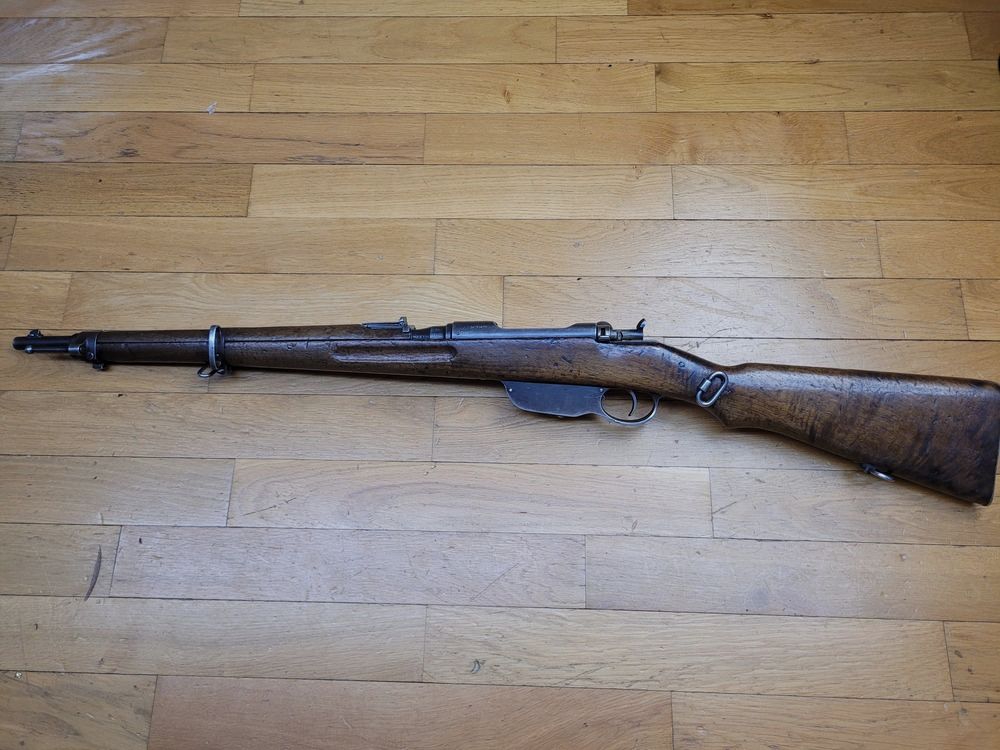




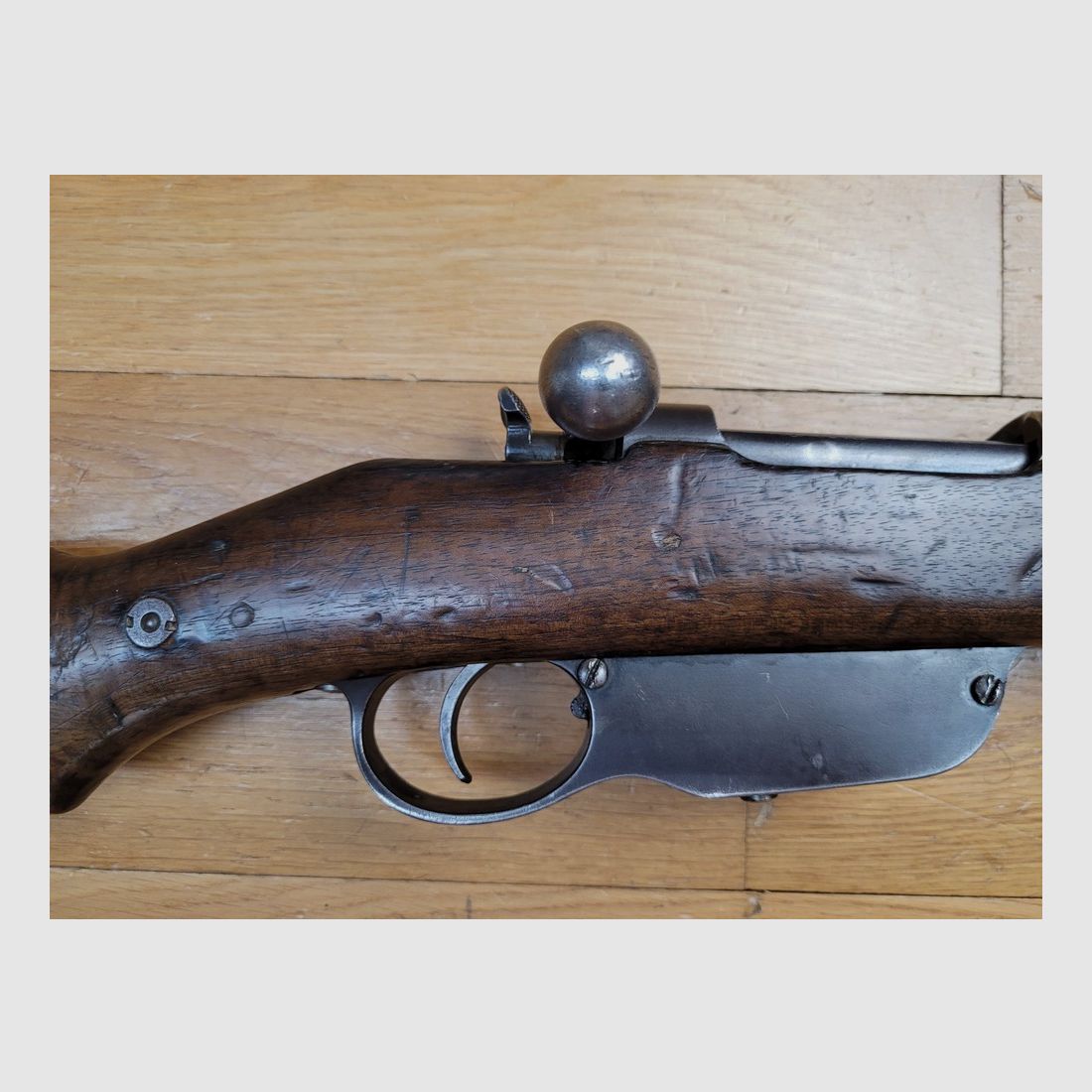
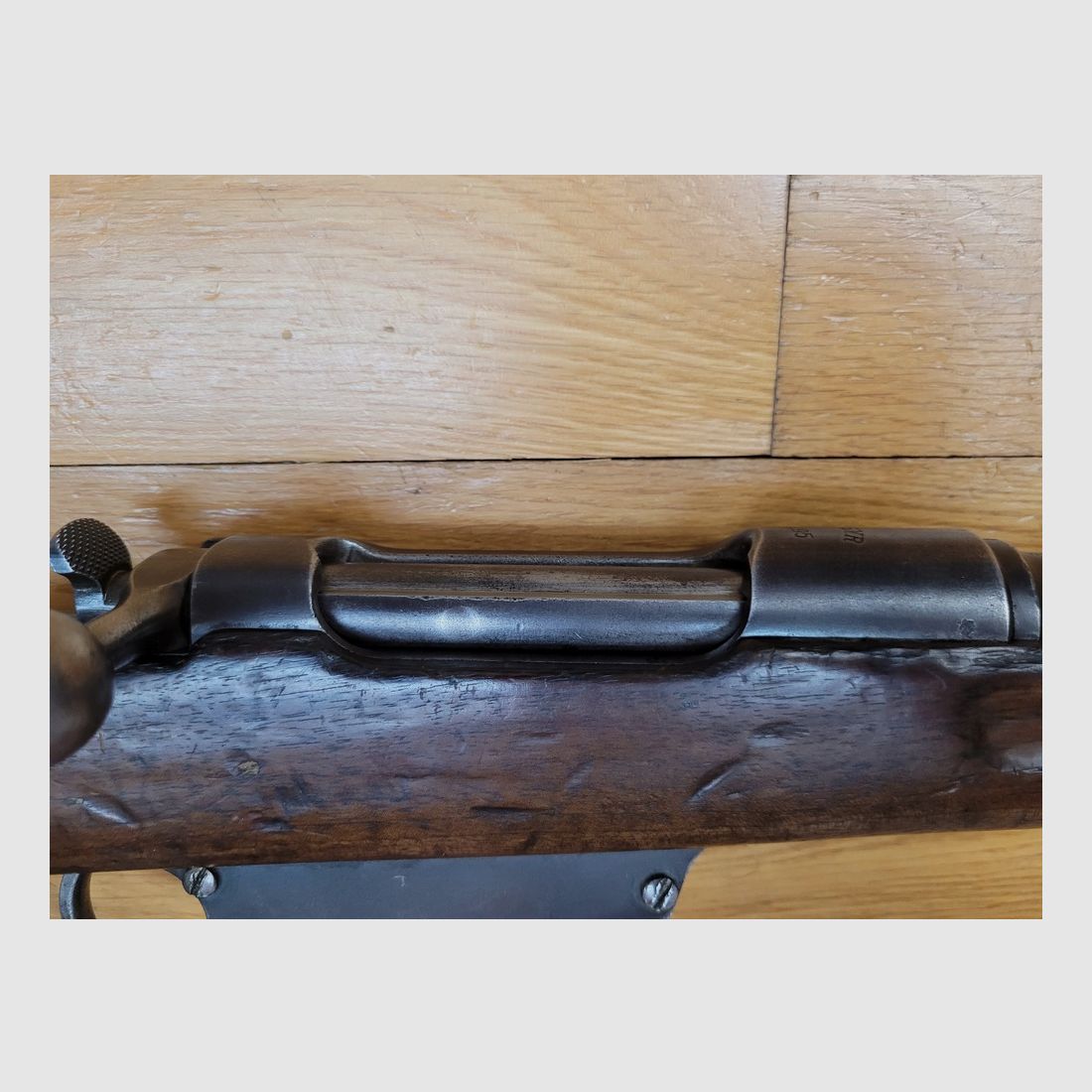
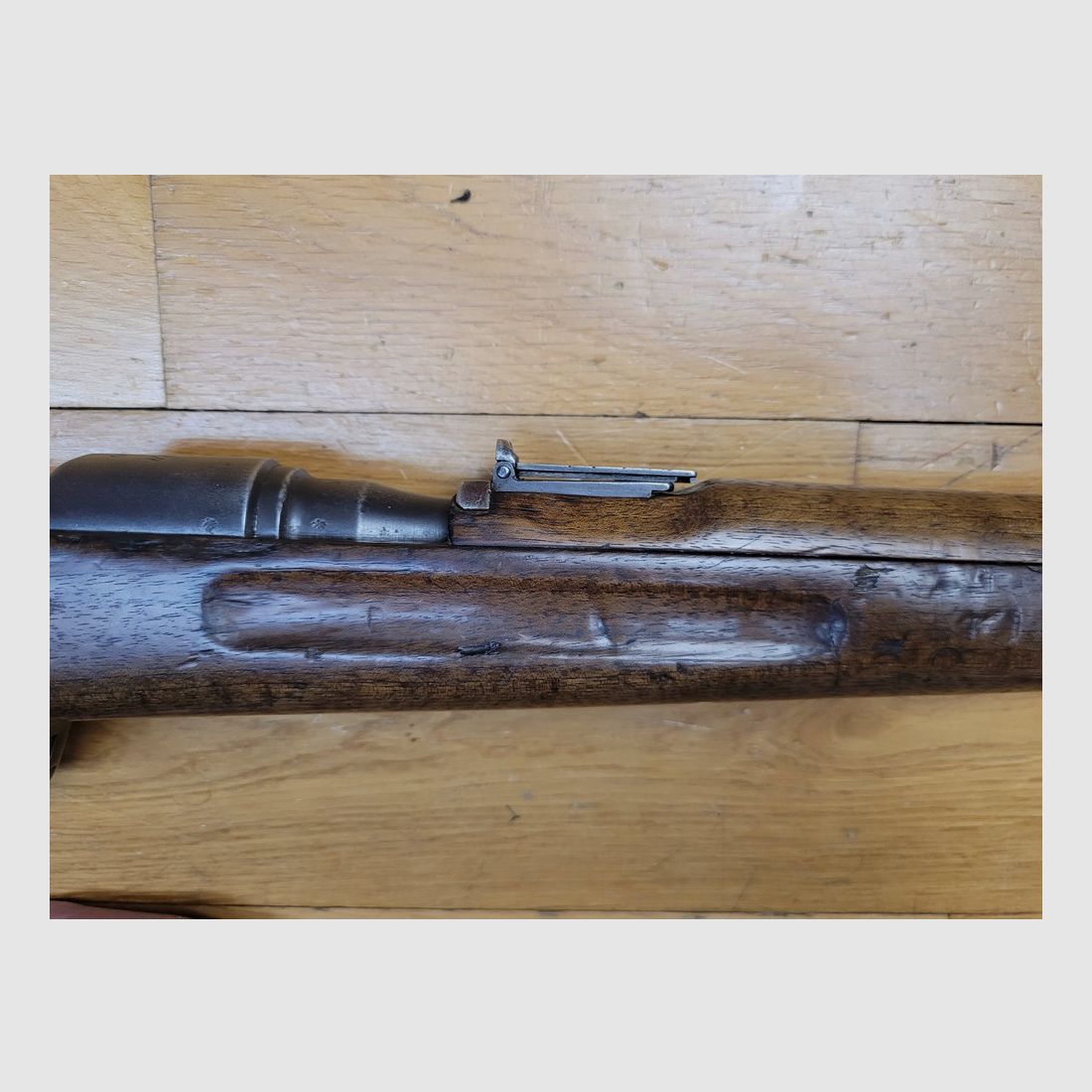
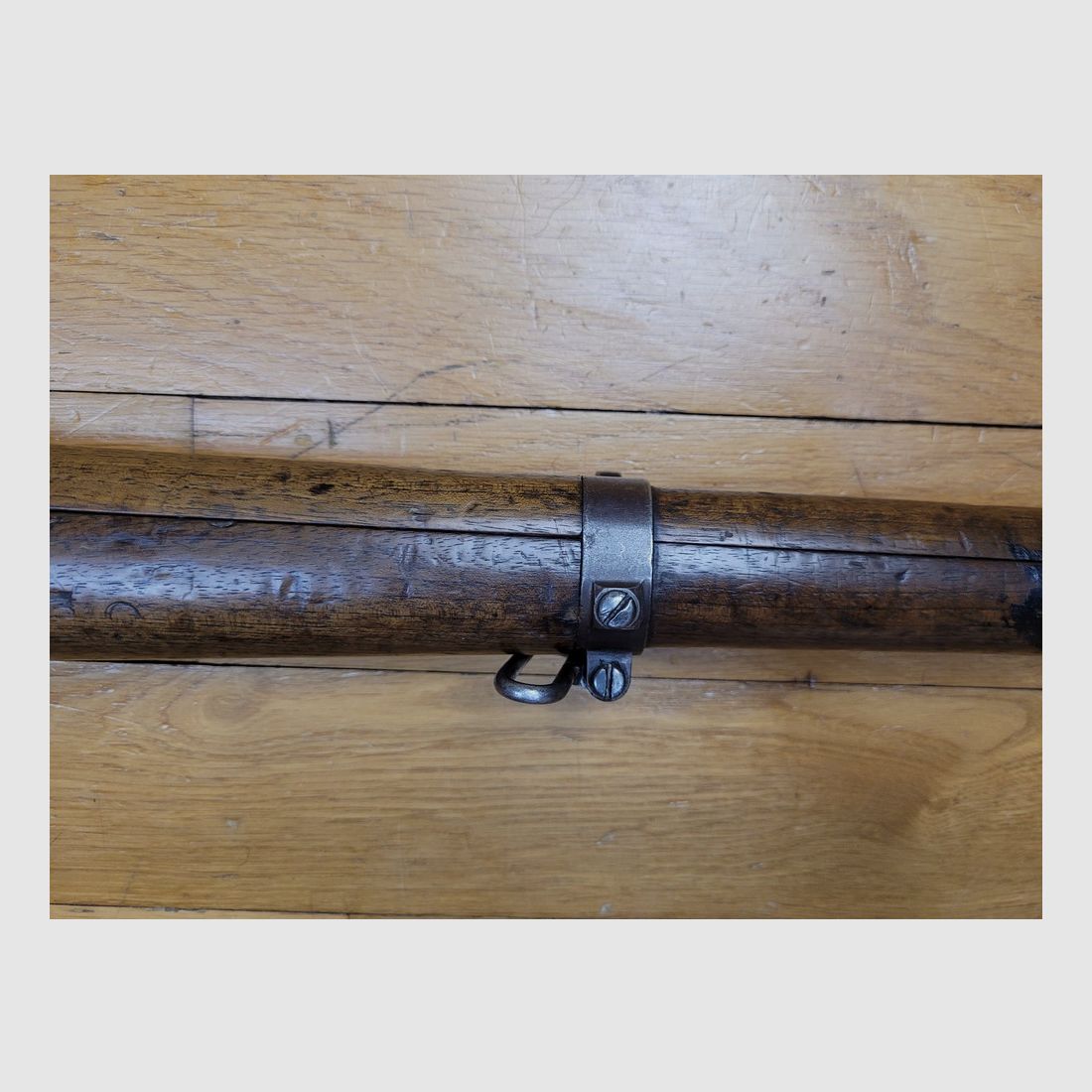




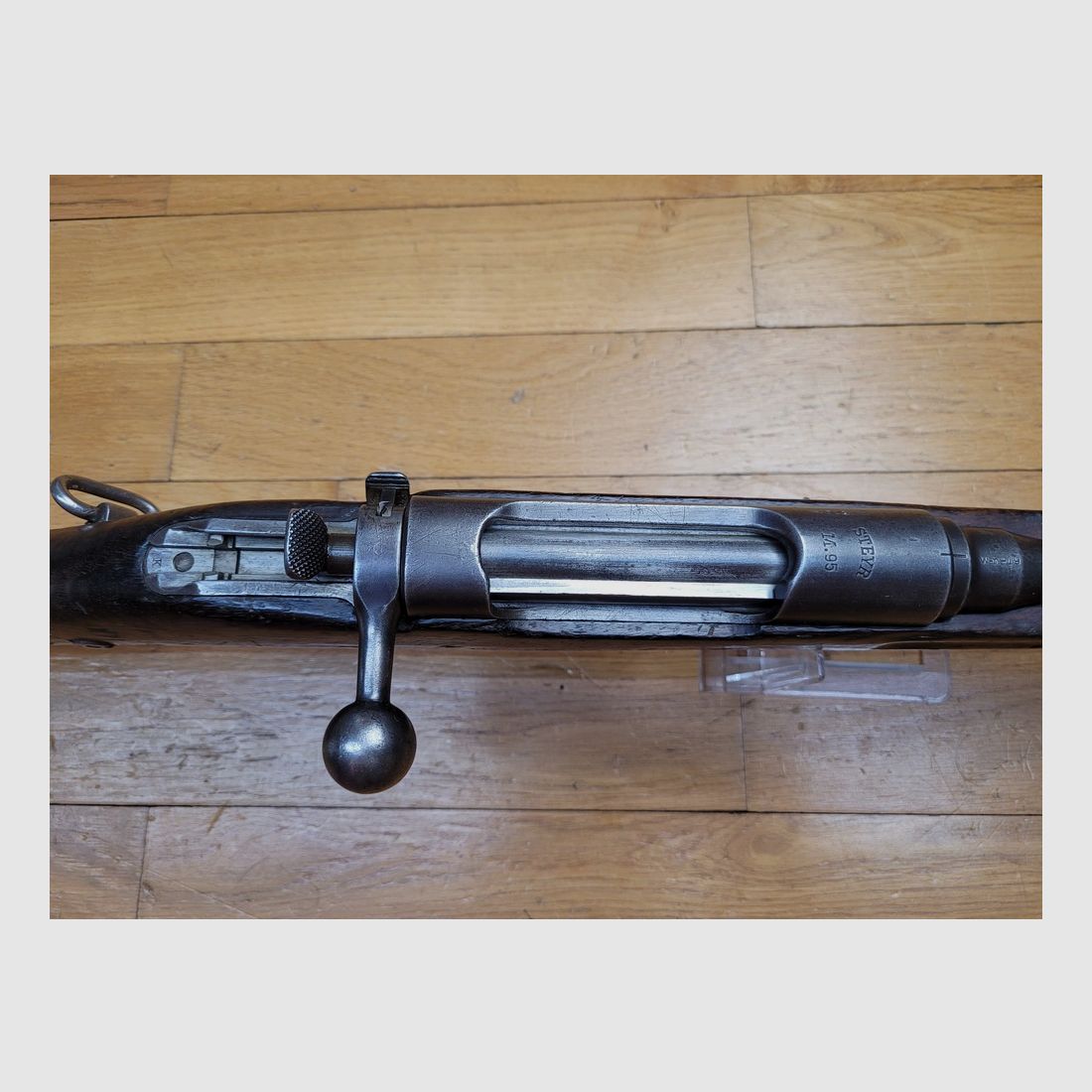

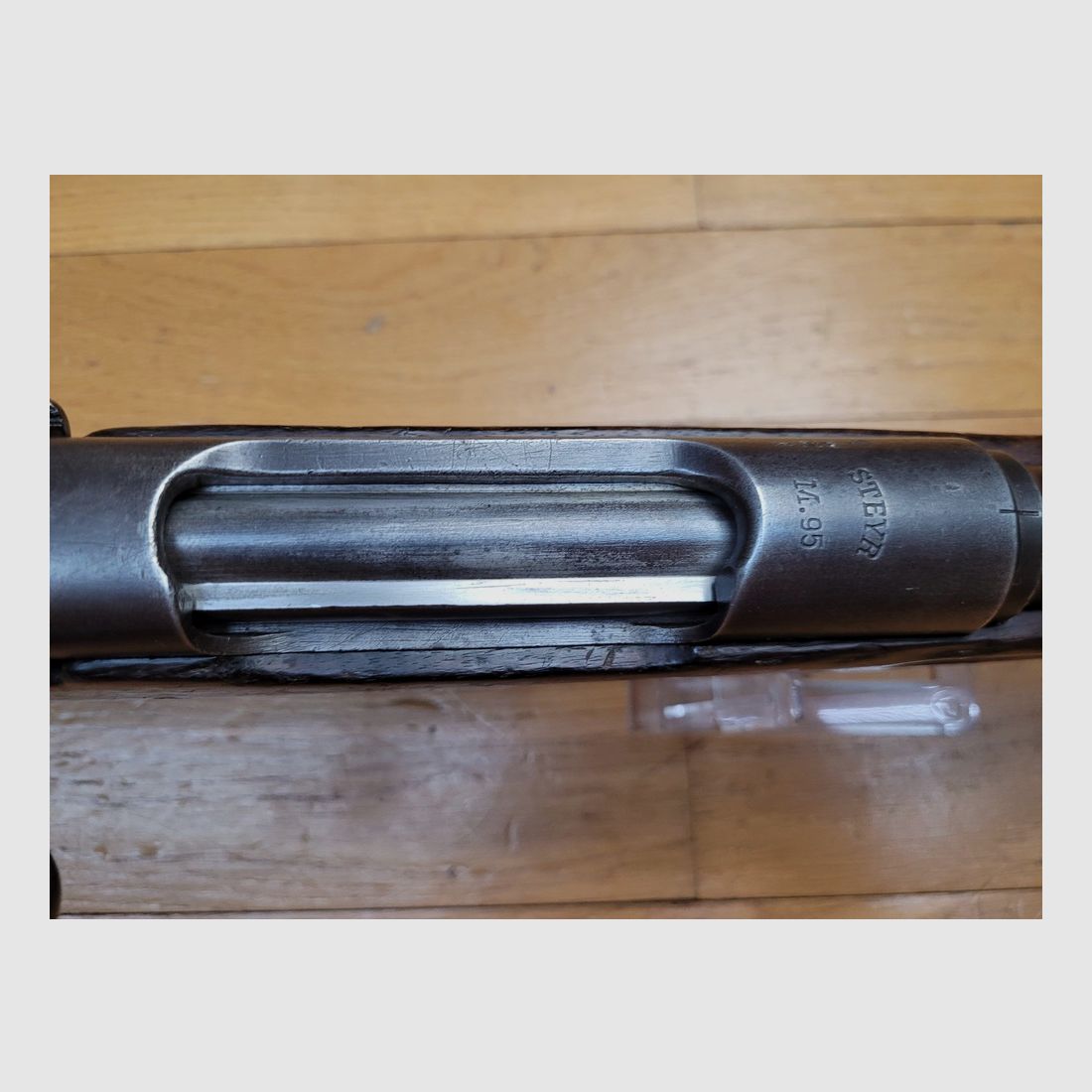


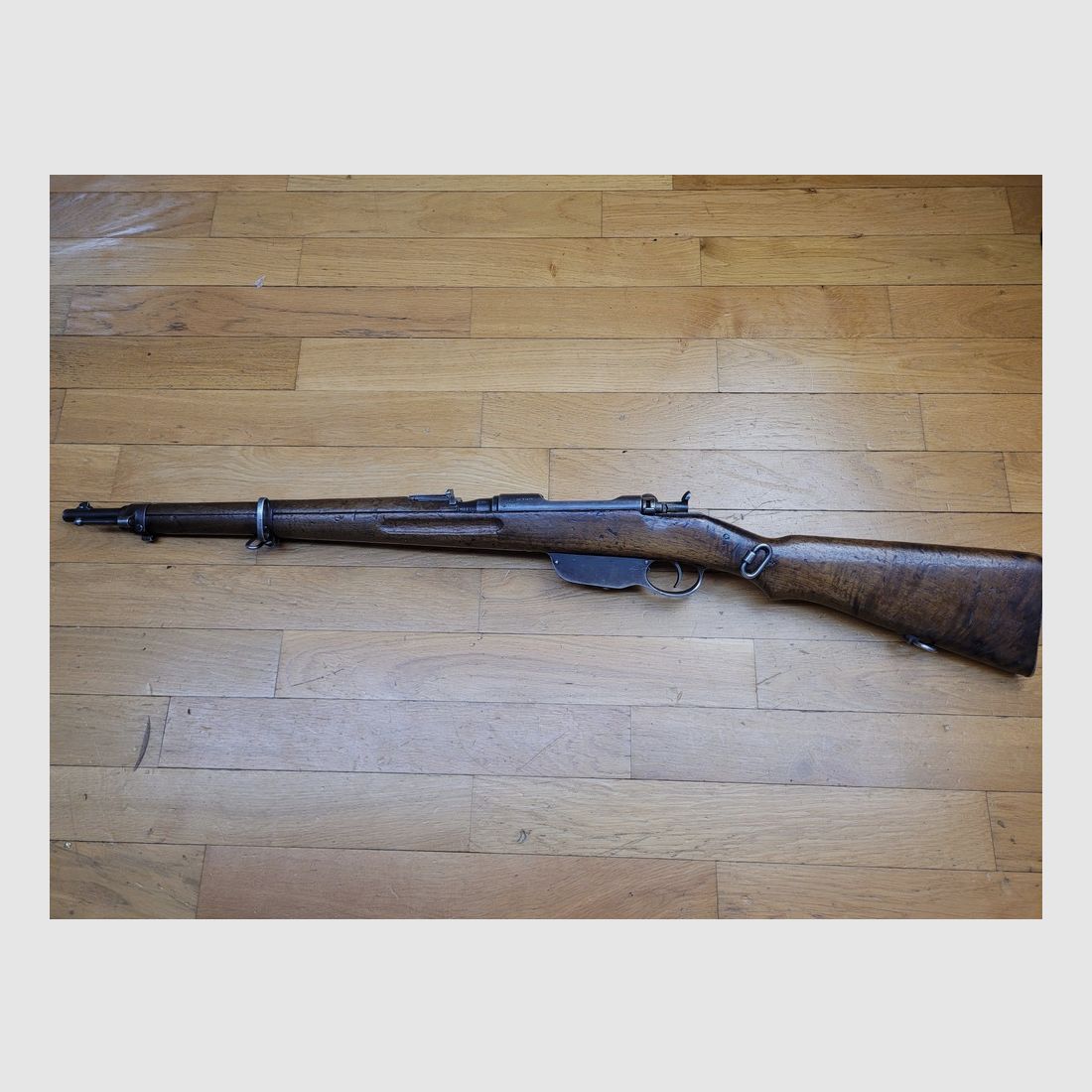





Venerable and RARE Austrian cavalry carbine M95 (not 95/30 exactly!) – Original caliber from 14-18 in 8×50 Mannlicher (and not in 8x56R post 1930) – Mannlicher clip available – Steyr arsenal and 100% original – Category D – Very uncommon and in overall excellent condition
Price on Request
Purchase permit required
75002 Paris, France
17
ID: 10338781
This item is currently unavailable.
Purchase from outside the EU: The firearm goes through an importer in your country, the dealer handles the export.
How buying from Europe works
Shop safely with Gunfinder
Our AI-powered seller identity verification makes Gunfinder the safest marketplace online.
Learn more
Details
- Original language
- French
- Category
- Purchase eligibility
- Required
- Condition
- New
- Location
- 🇫🇷 75002 Paris, France
- Availability
- Out of stock
Freshness
This listing is based on a mirrored offer, where the listing data was synced to us from a shop, dealer, or external marketplace. Please note that temporary price discrepancies may occur due to possible delays in data transmission.
- Source
- Flingus Maximus
- Last checked with the dealer
- 1 day ago
Description
Note:
The item is located abroad. Please note that delivery conditions, shipping times, and/or the purchase process may differ.
Especially since, as far as possible, I only take these. The “good 14s,” as I call them to myself when I find them…
Still passionate about objects from a wild era, tinged with nostalgia for another France, which died somewhere between Calais and the Vosges, between the very hot summer of 1914 (in every sense of the word) and the delirious, exhausted victory of November 1918, which brought to a close a series of battles that were just as summery and nevertheless remain among the fiercest in human history.
The Mannlicher rifle family, witnesses to this titanic conflict, is one of the most complex and fascinating of the 1880s.
After its first iteration in 1884 in 11mm, replacing the old Werndl tabatière, the Austro-Hungarian Empire equipped itself, starting in 1888, with the most advanced weapons system of its time: the Mannlicher system.
These firearms were adopted by the Empire, then constantly improved and quickly exported to China (1888/90 system), Romania (93 then 96 system), Greece (Mannlicher Shoenauer 1903/14 system), and as far as the Kingdom of Ethiopia and the Kingdom of Afghanistan (1890 system)…
You’ll find them in conflicts all over the world from 1888 onward, and they were still seeing action in the 1948 Arab-Israeli conflict! They also witnessed the blood-red skies of battle evenings in the Philippines, Chile, and South Africa. What a wandering soldier this Mannlicher was!
Copied all over the place, the Mannlicher system was standardized for the Dual Monarchy as the 1895 system. It would be carried by the soldiers of Emperor Franz Joseph in August 1914 in their final struggle, the one that would destroy that other Empire which really did last 1,000 years…
Its single-stack magazine, developed at the same time as James Paris Lee’s (1831–1904), and used in the Lee-Enfield, was the first in the world that could be loaded with a “charger clip.” While the guy opposite had only put one cartridge in his rifle, whether single-shot or repeating, you already had five ready to fire!
Many would copy it, Germany and Italy above all, and it made the final round in every adoption commission.
This advantage, combined with a remarkable straight-pull bolt that cocked in two stages and was built like a tank, was simply revolutionary. Over time, the system evolved mainly toward smaller calibers and a locking mechanism that no longer used a tilting block, but instead used two rotating lugs positioned at the front of the bolt head for optimum rigidity.
It’s often forgotten, but the Balkan conflicts, as well as the First World War—which, from one point of view, grew out of them—proved extremely deadly and called for specialized equipment.
Because of its cosmopolitan makeup, the Dual Monarchy, historically and like any self-respecting empire, had to deal with numerous clashes with partisans, whether in the Carpathian Mountains or the Slavic plains. A rifle with a fast action, a very flat trajectory, and a compact size proved to be a highly effective strategy.
The Mannlicher system was therefore copied, exported, and lasted, beyond all reason, right up to the Third Reich in Austria.
So, logically, we should find many Mannlicher-system firearms that fought with the Dual Monarchy against Russia, Italy, Serbia, or France, and with or against many Balkan and Eastern European countries, in their original caliber.
But that’s not the case.
In 1930, most Austrian and Hungarian firearms in 8x50R were all rechambered for 8×56, considered more modern because of its new pointed projectile and extra powder. The more powerful equivalent of the conversion of our Lebel and Berthier rifles to the 32N bullet in 1932, which already leaves very few of them here…
survivors in their configuration from the summer of 1914 to the winter of 1918.
The opportunity was taken to modify the sling attachments, rear sight and, of course, front sight to suit the new standard 8x56R cartridge. These Mannlichers are the most common and are known as “95/30”. There are plenty of them around.
Then came the final blow for the few survivors of the Great War and the 1930 conversion: modern anti-gun legislation.
The so-called “war calibers” legislation (what successful centerfire caliber in history hasn’t been a “war caliber”?) forced the irreversible alteration of an astronomical number of service rifles. Italy, where many Mannlicher 1895 rifles were still found, adopted legislation that was at least as stupid.
The result?
Loads of century-old or older firearms—testaments to human history, marvels of gunsmithing engineering, lovingly preserved by their custodians in their original configuration and often in excellent condition—were put through the barbaric rebarreling mill. Including quite a few of the very last Mannlichers of Imperial Austria-Hungary in 8x50R.
Just thinking about it makes the hairs on Master Flingus’s thick, unkempt bear coat stand on end…
The few survivors that are still in 8x50R and in largely original condition are firearms that were lost amid the turmoil of the war and the immediate postwar period of 1914, then kept—most often by private owners—through the many upheavals in the turbulent history of these fascinating and beautiful regions.
So, like a hallucinating sentry, I search for them. Like everything that isn’t “32N” around here. Everywhere. I love a difficult quest. But I don’t find many.
And I’ve just found one. Maybe the fifth I’ve seen in 20 years. This one, I tracked down at a German crook’s place.
This example is an 1895-pattern cavalry or “special troops” carbine of the Austro-Hungarian Army, in its August 1914 configuration. The rifle is just as hard to find—and paradoxically, perhaps even harder to find—than the carbine. I don’t know why.
Our veteran fought his last battle to make a run for it and escape the grim fate of almost all his brothers. It remains in its original Austrian service caliber, 8×50 Mannlicher, with the correct parts.
I’ll answer THE question in advance: 8X50 Mannlicher is NOT 8×50 Lebel, and the cartridges are in no way compatible. I have a few new 8X50 Austrian cases (you can find them at Bertram and in Germany too) and a few bullets available for the buyer, as I personally reloaded this rare caliber in the past. If you’re interested in reloading this original caliber from the days of steel storms, you’ll also need the dies, which occasionally turn up and are made by CH4D.
Reloading 8X50 Mannlicher (and its younger Austrian sibling, 8 mm Gasser for handguns) is a bit like joining an exclusive club of reloading specialists, whom “the others” speak of with respect at the range. A Legion of Honor for a skill that smells of powder and a love of the authentic.
And today’s firearm seems even rarer to me. We’ll see why. After doing some research, it taught me something about Austrian production in the immediate postwar period after 1914.
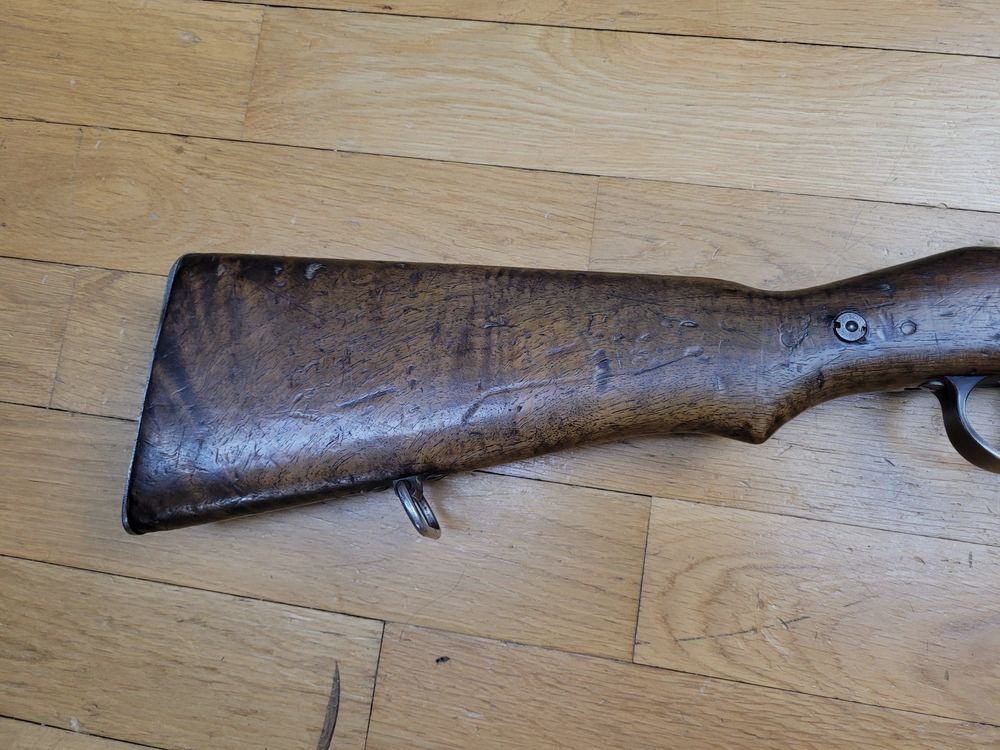
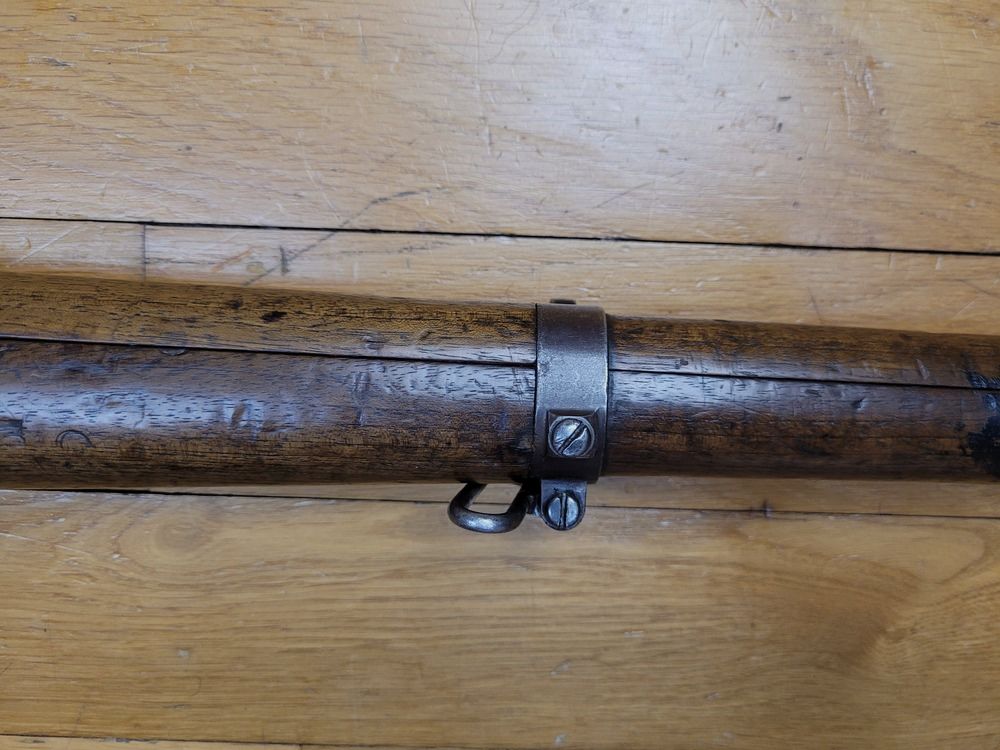
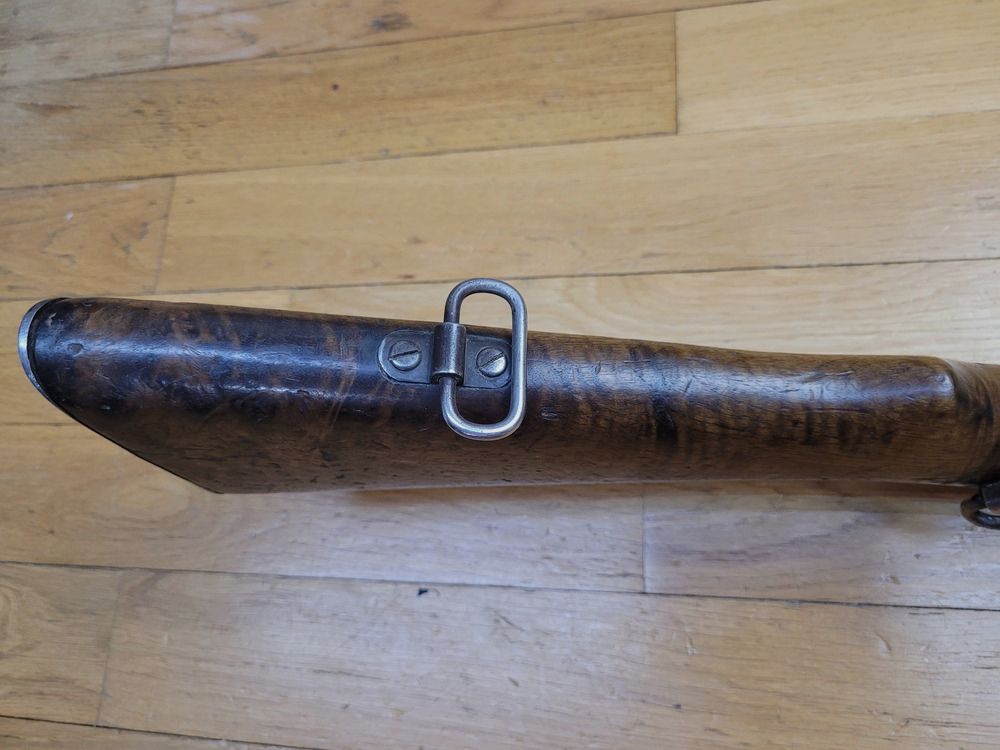
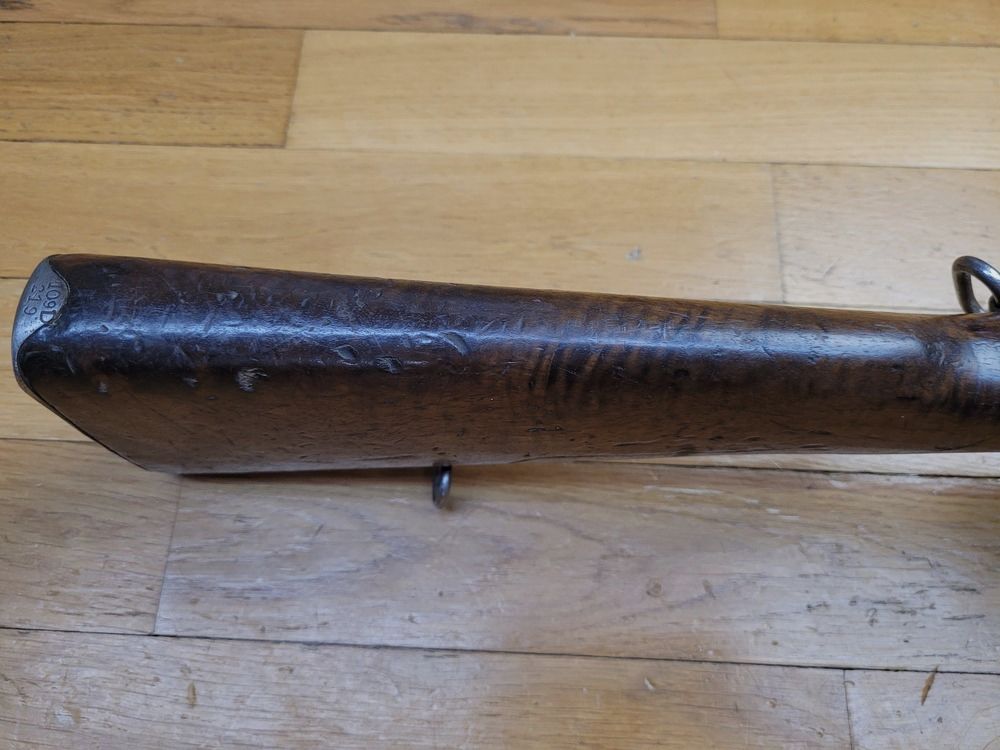
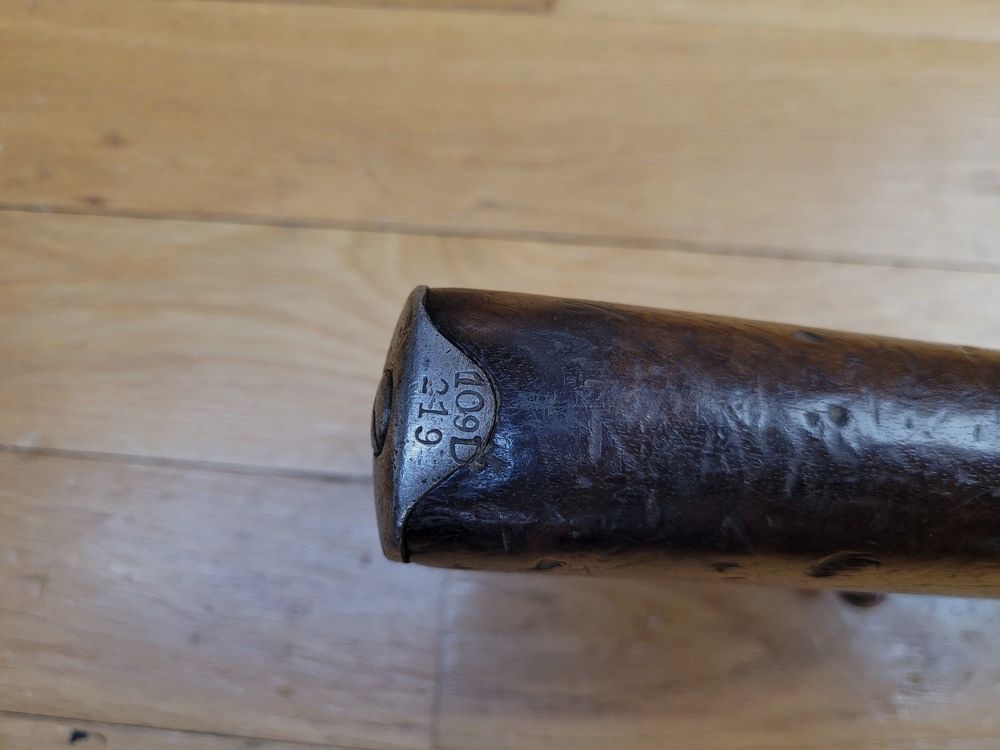
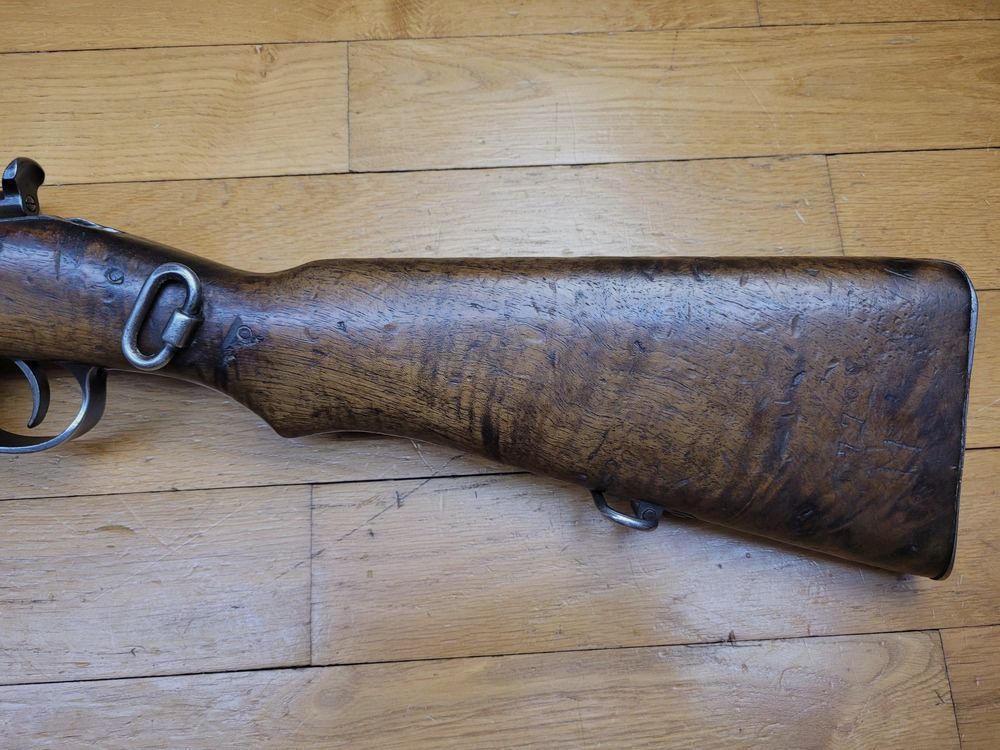
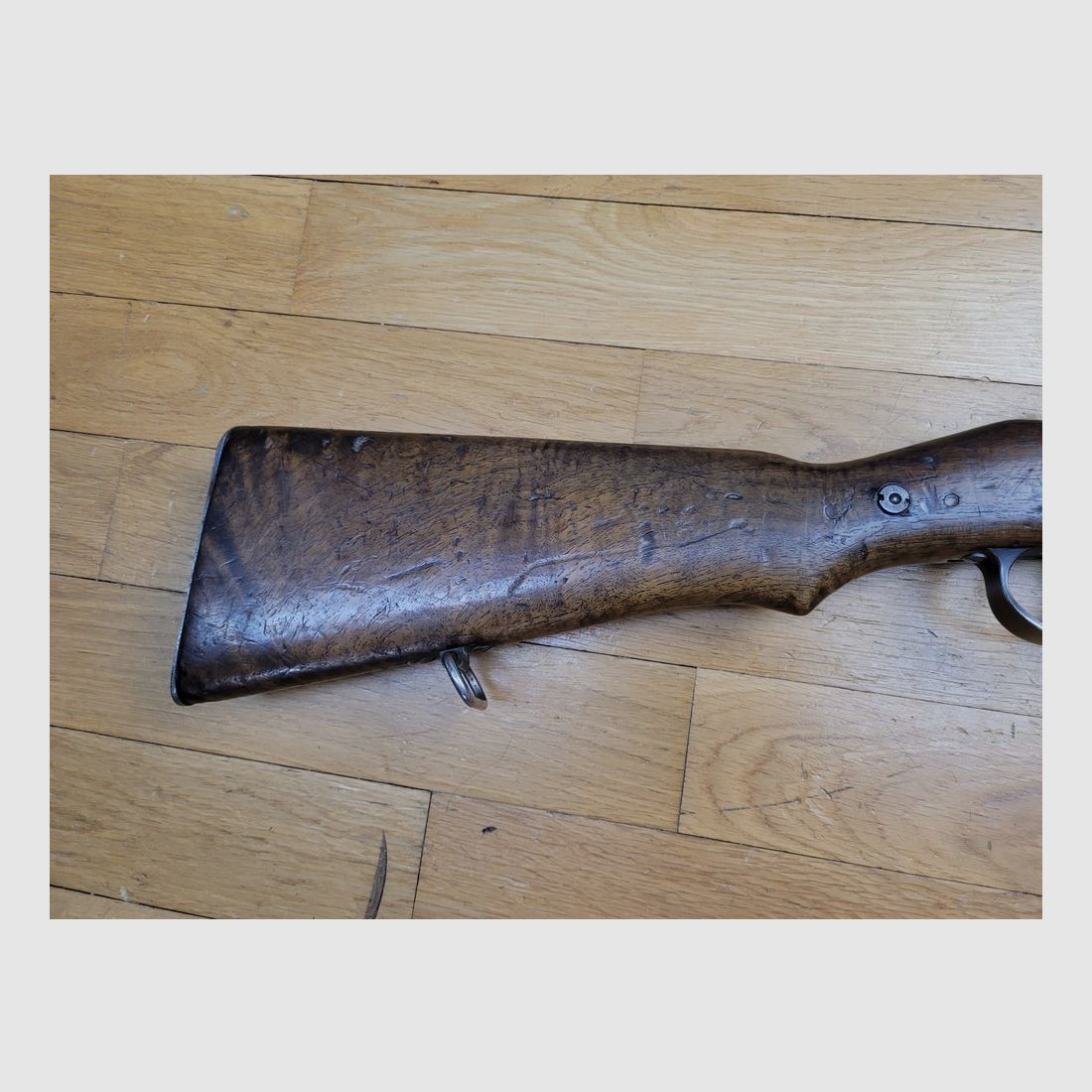
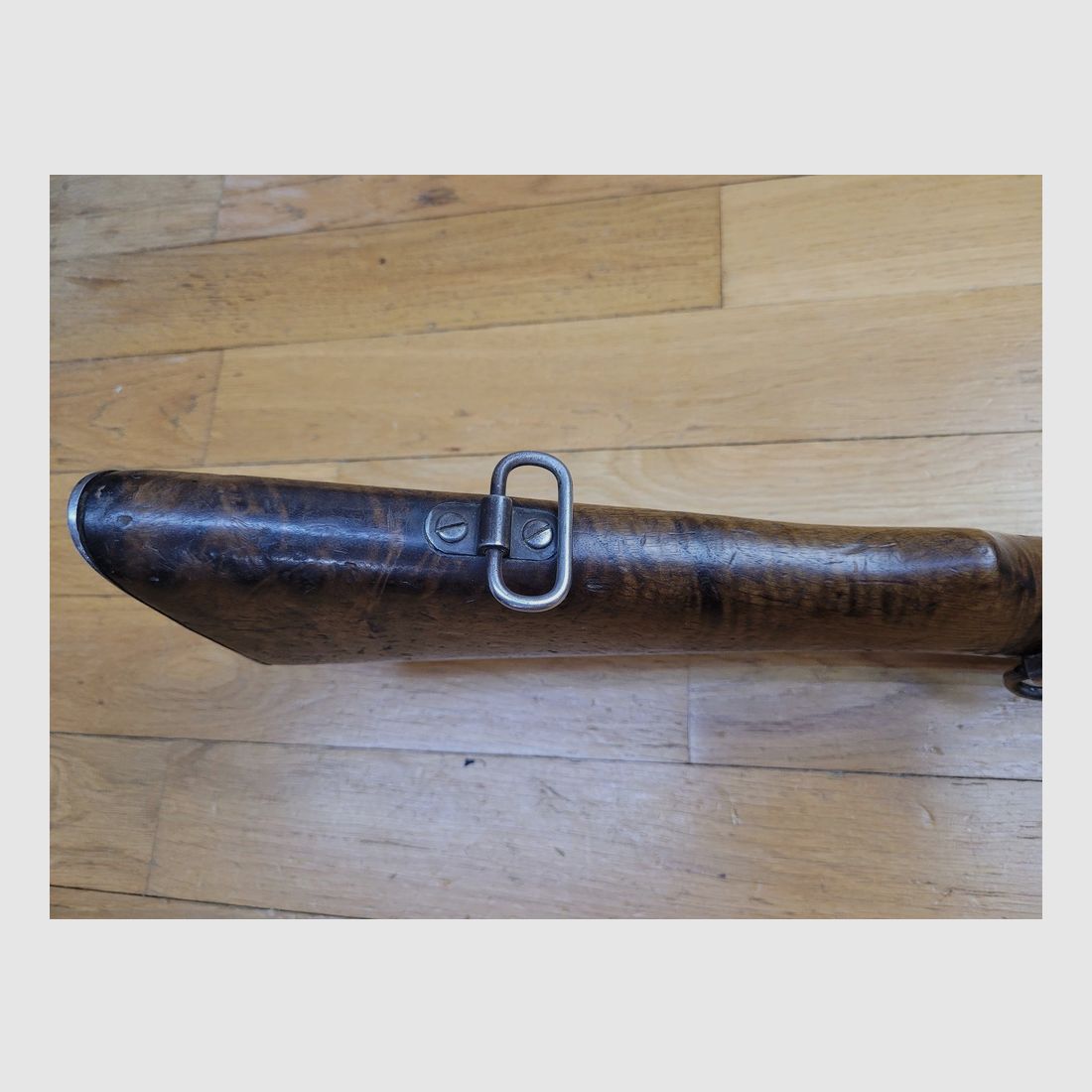
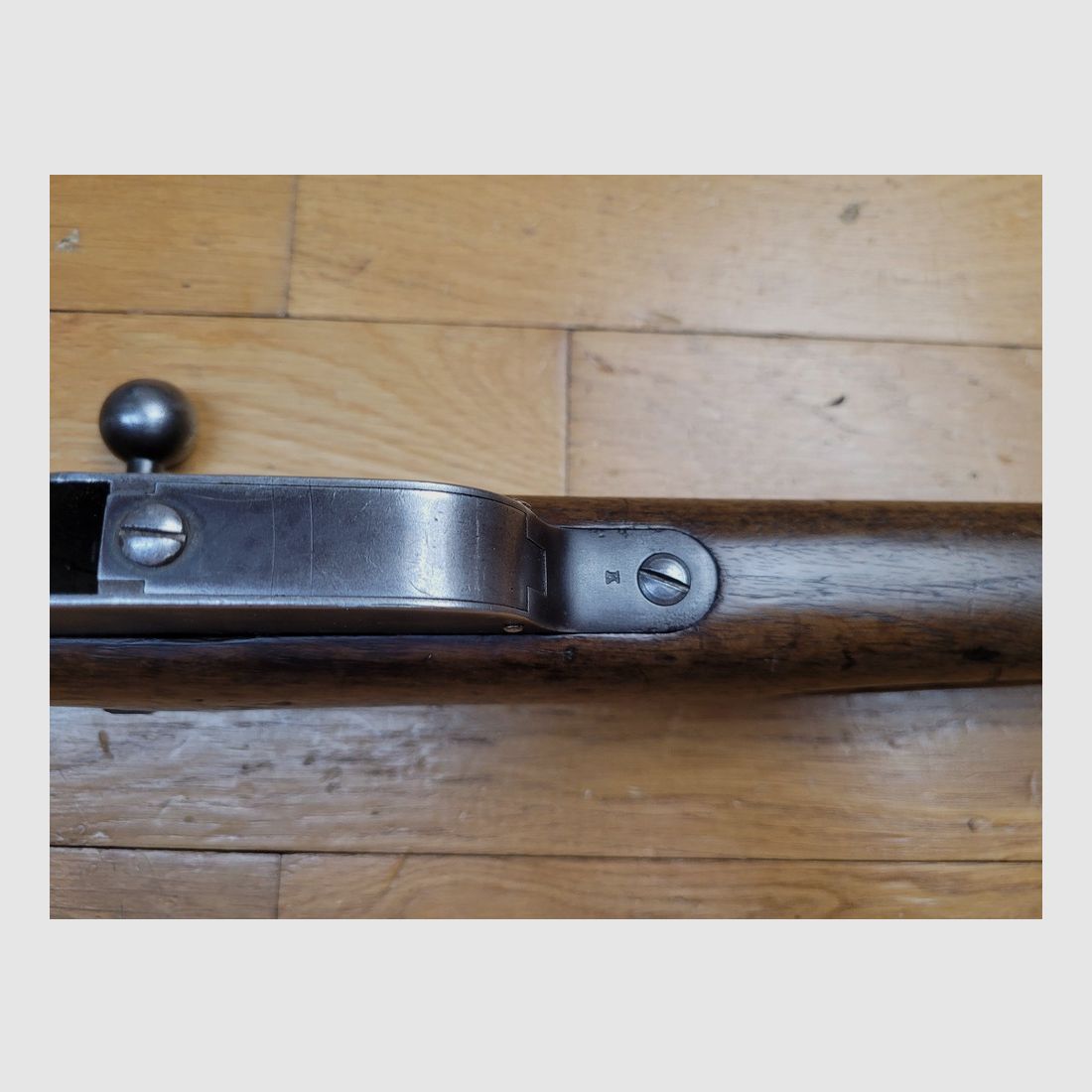
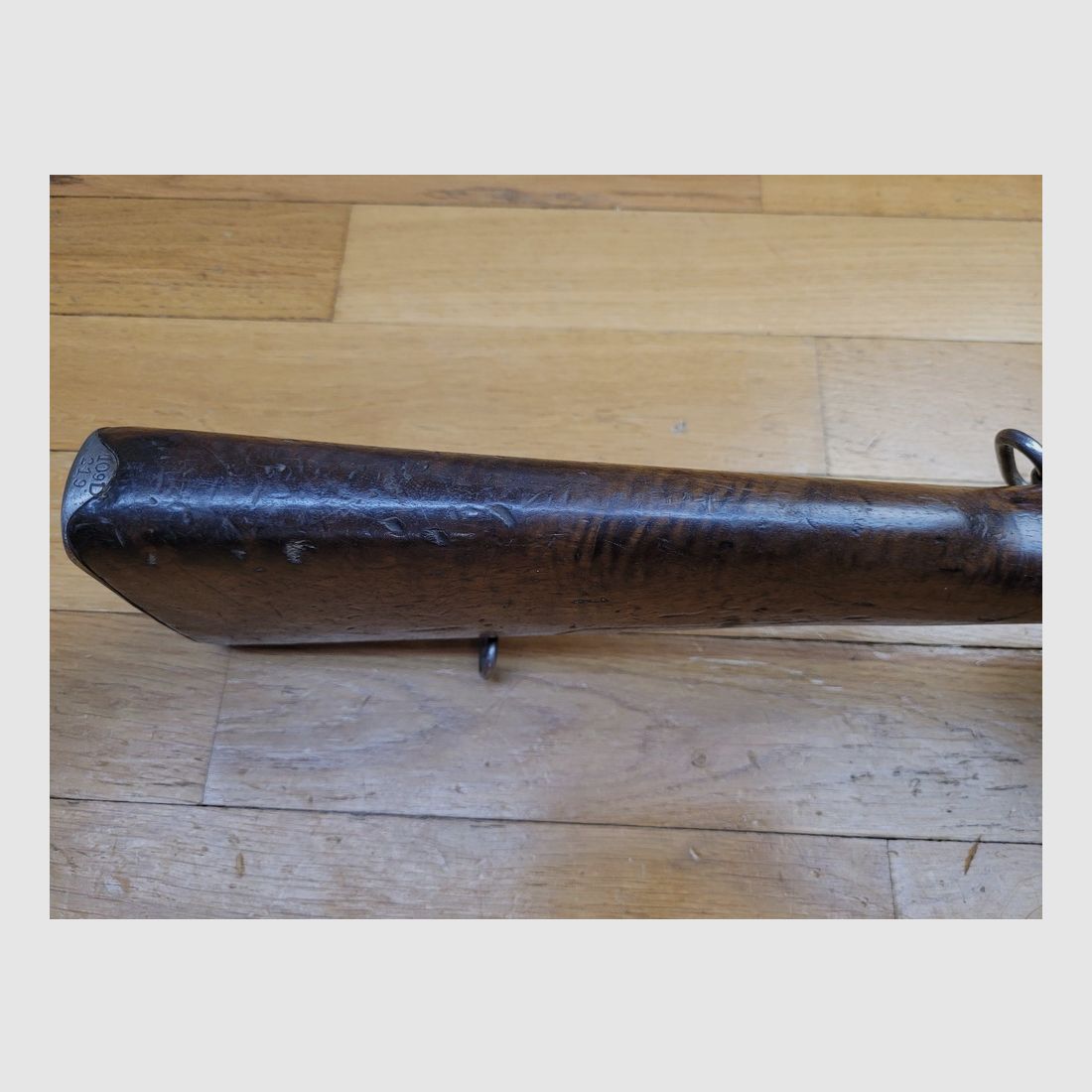
The wood on this little 95 cavalry carbine has seen some handling, but it’s still in good condition. No major repairs or missing pieces. The unit number is still legible on the buttplate tang (109. D.219 – which would link it to a Landwehr Dragoon unit).
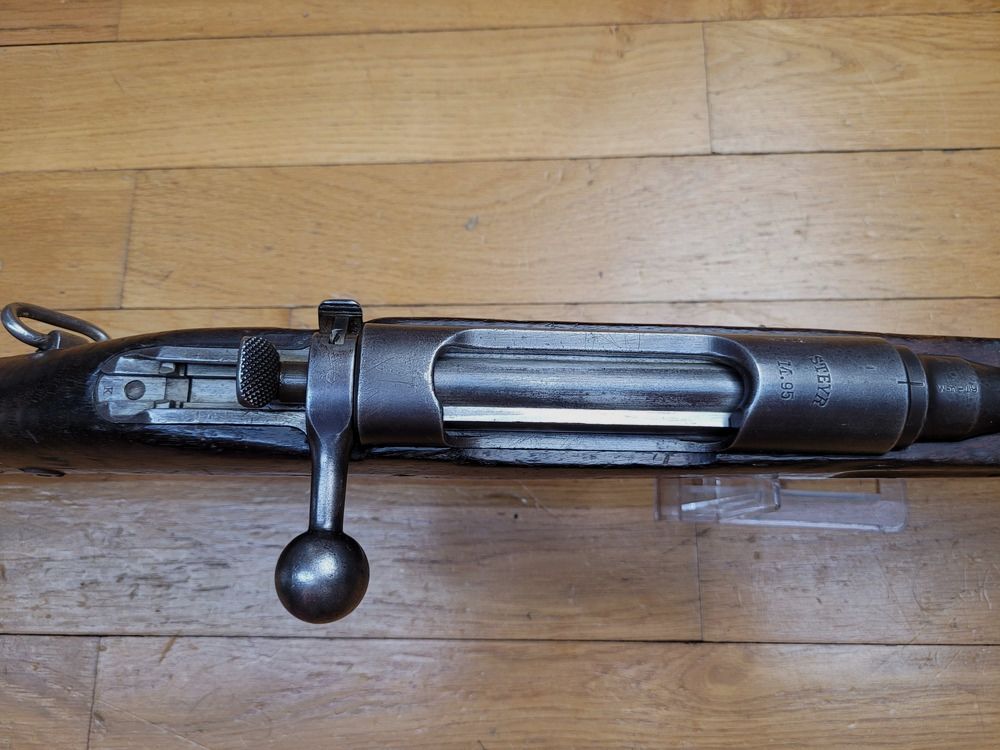
The bolt is 100% original and hasn’t been renumbered with an electric pencil to match the serial number on the barrel and receiver, as is very often seen on firearms rechambered for 8×56, which required a bolt test for this more powerful post-1930 cartridge. Just a few stray German proof marks on the chamber (the Württemberg stag antler for 1
972 and a caliber marking of “8×50”). Everything else, including all its parts and markings, is original M95 and predates the 1930 modifications.
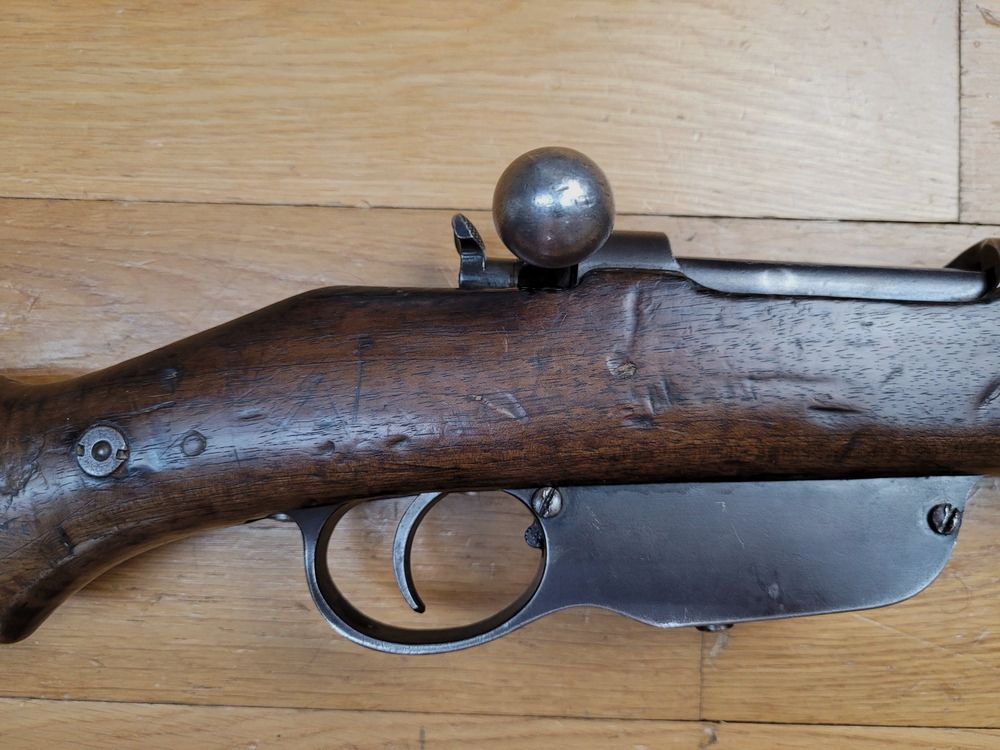
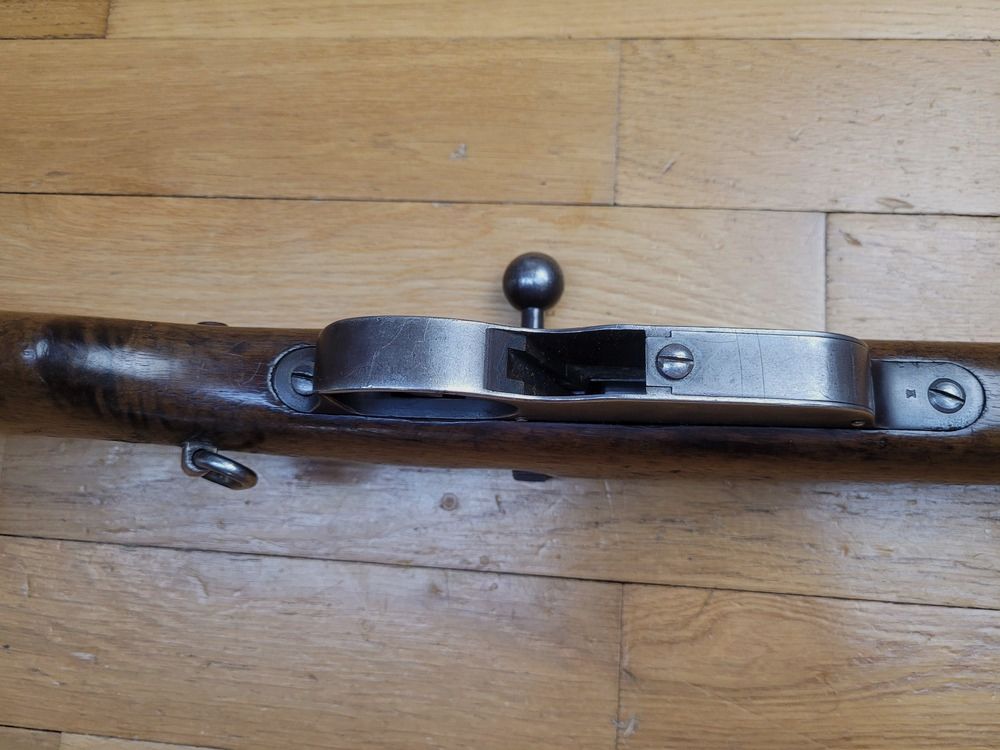
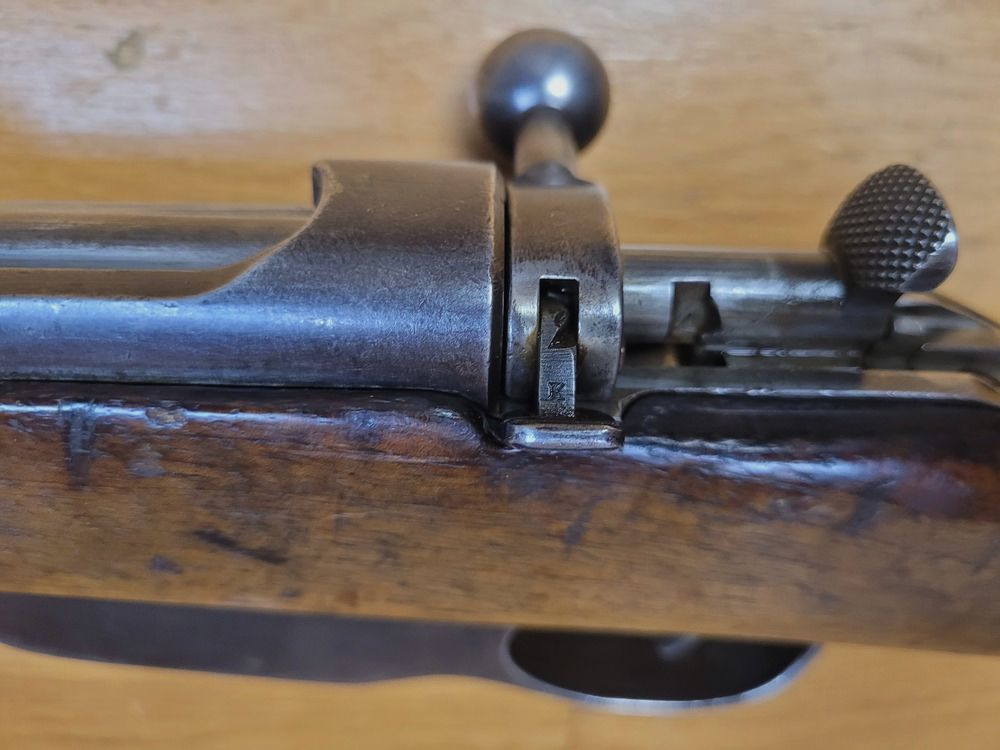
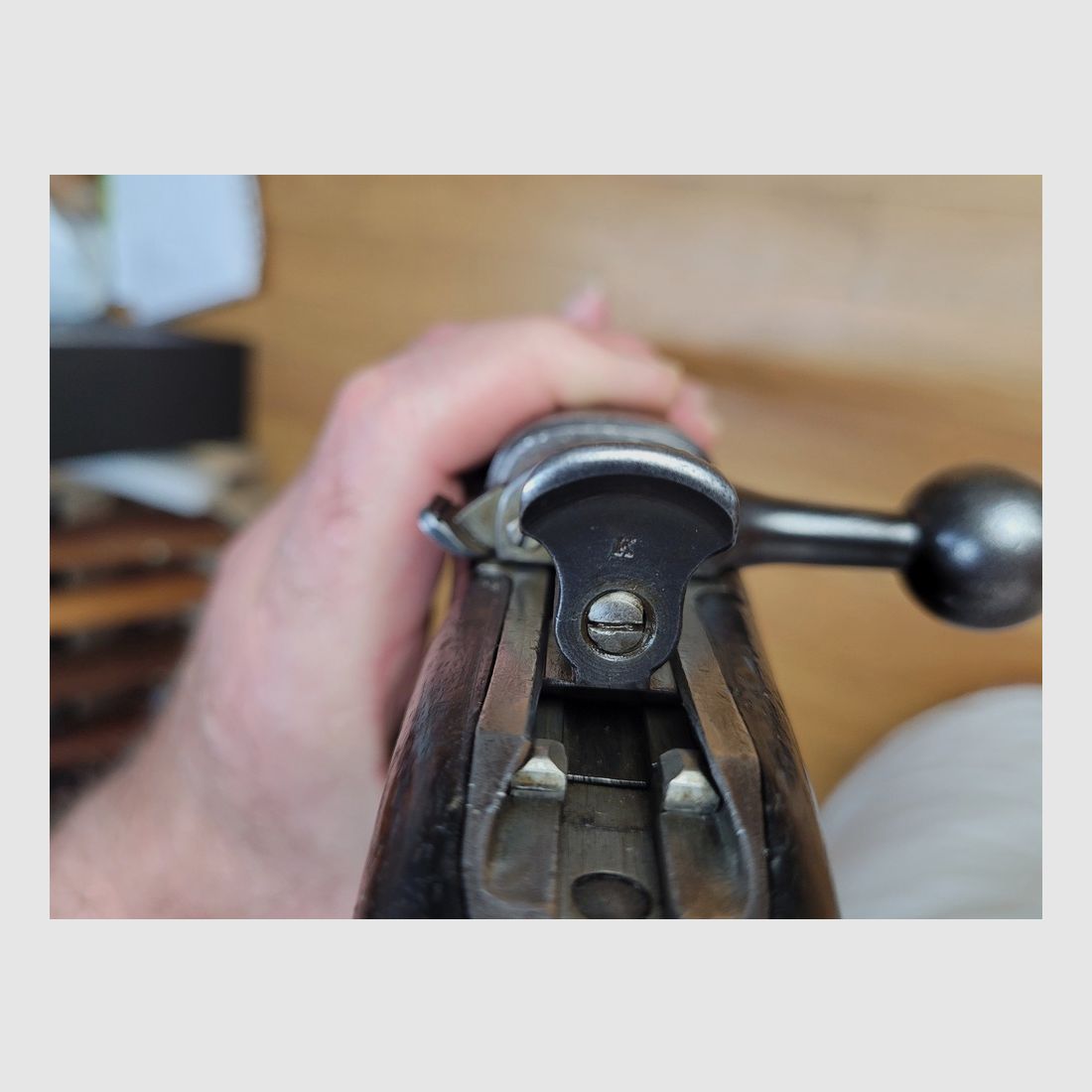
The bolt is operated with a firm pull, like all Mannlicher straight-pull rifles. The large ball-ended lever on the right side makes this easier. Excellent firing mechanism. Safety works. All springs are nice and strong.
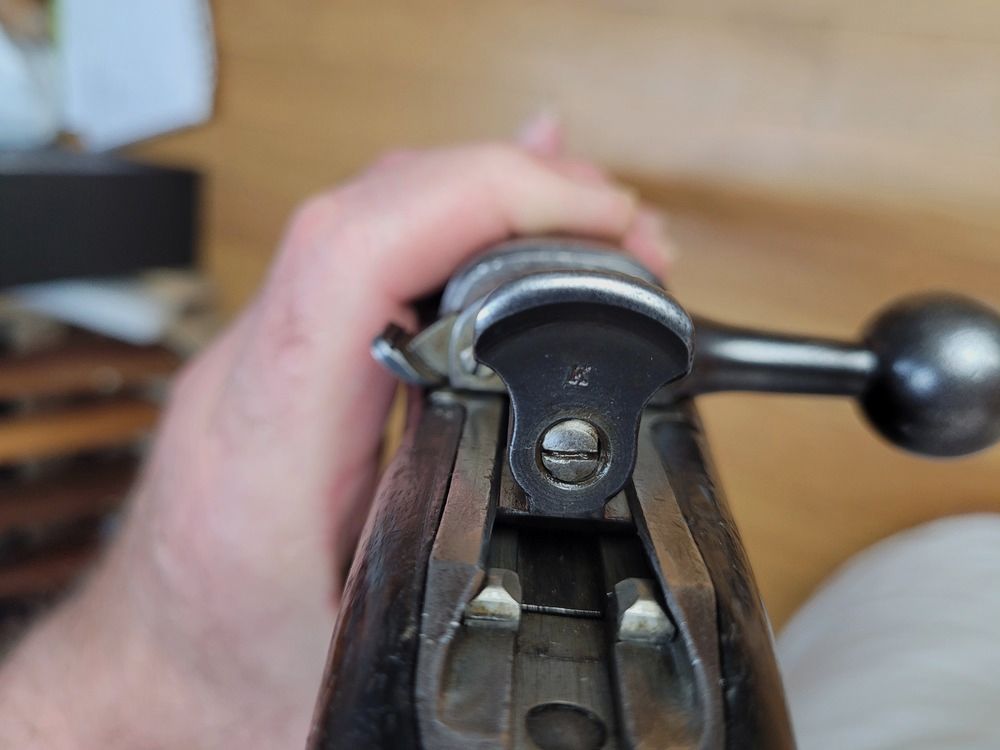
The magazine is complete and works with original clips (the same ones as for 8×56, since the cartridge case head is the same and they’re easy to find—I should still have a few and will include one with the firearm). Perfect condition.
All the bluing is original, including the arsenal bluing, and is still present on 85% of the surface, despite a few areas of fading. No rust spots or pitting. In short, the metal is in excellent condition.
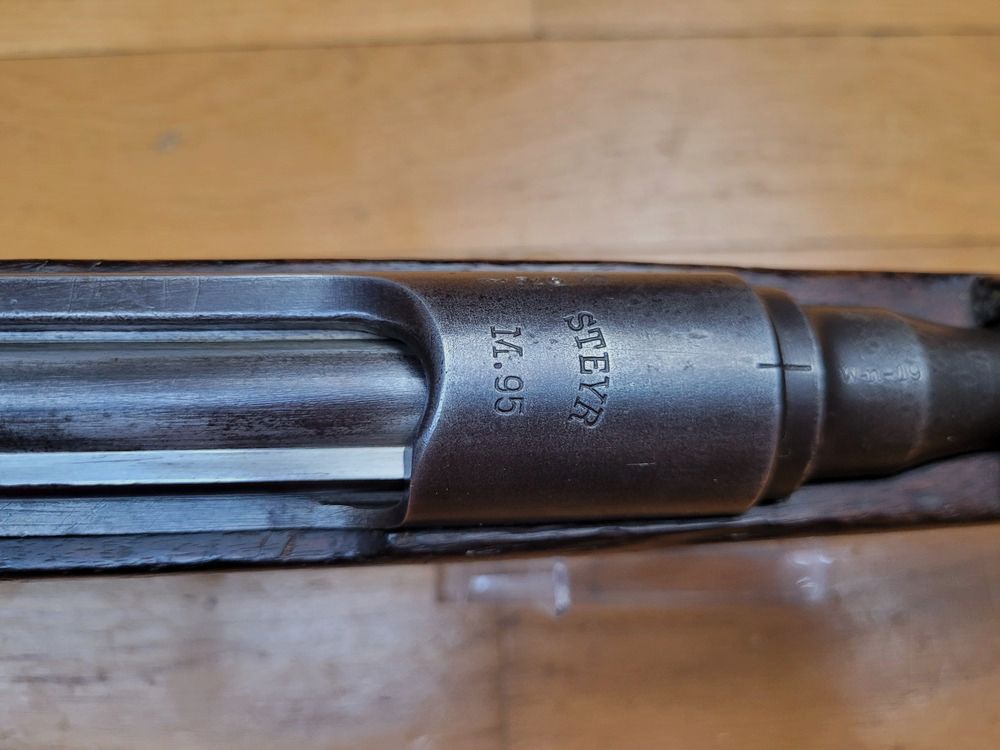
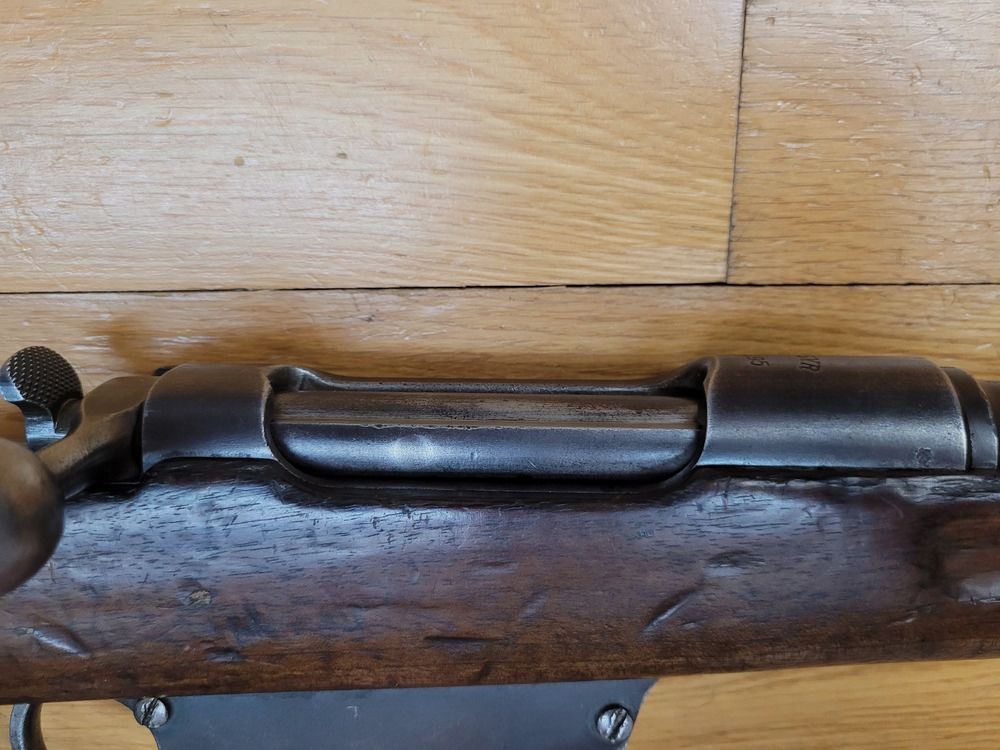
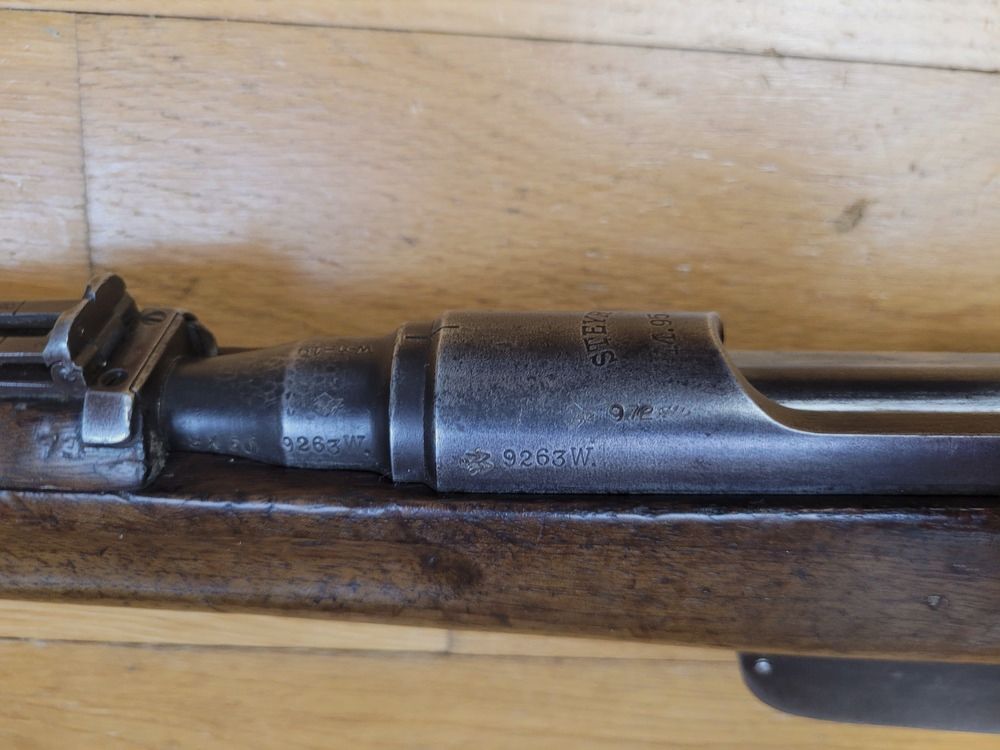
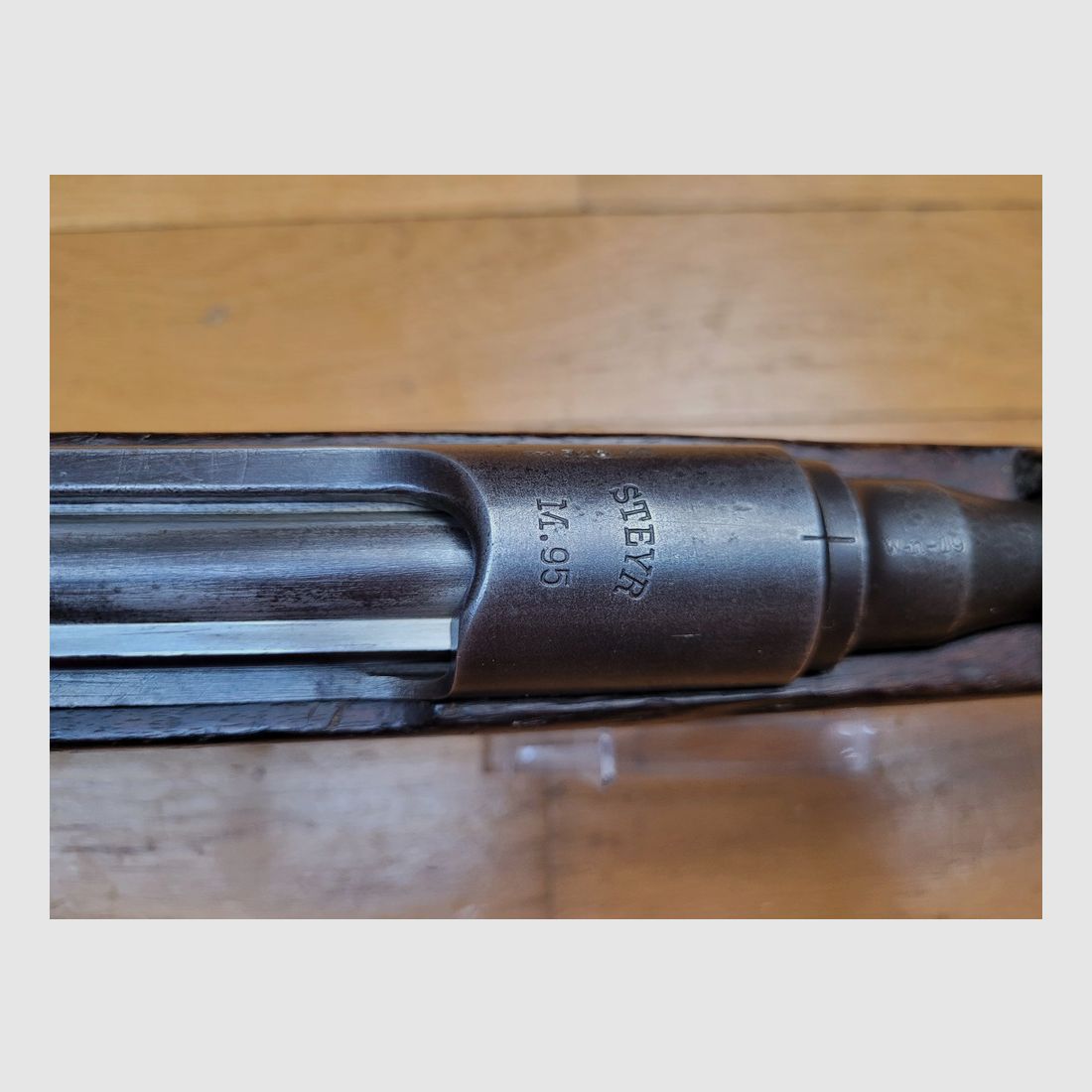
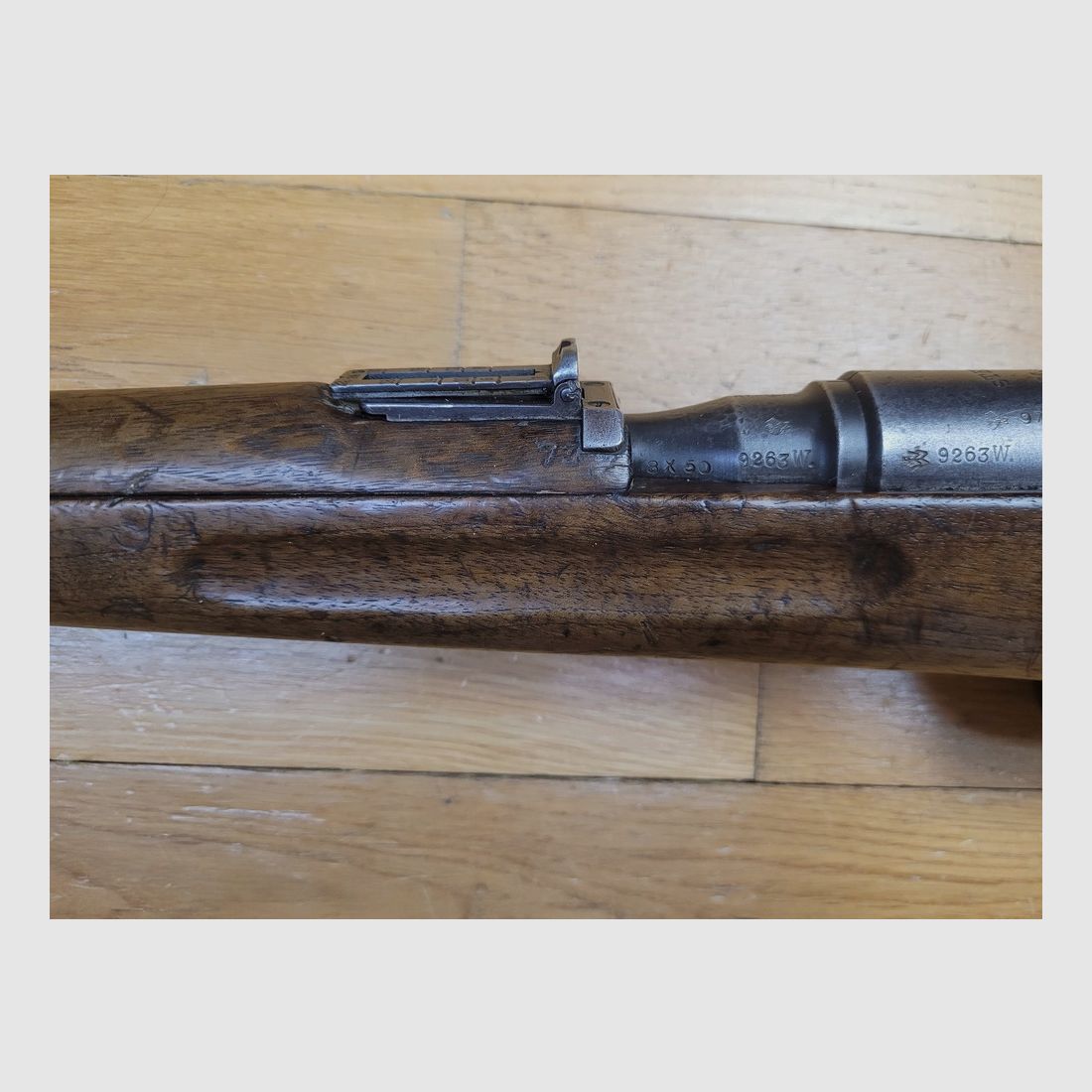
All markings and proof marks are clearly legible. Naturally, there is no “S” marking in the chamber, as this is specific to firearms rechambered in 8×56 from 1930 onward (equivalent to the “N” marking on our Lebel and Berthier rifles rechambered after 1932), which is not the case with this firearm. The firearm is marked “Steyr” on the receiver ring, indicating that it is Austrian, not Hungarian (in the latter case, it would be marked with the “Budapest” arsenal).
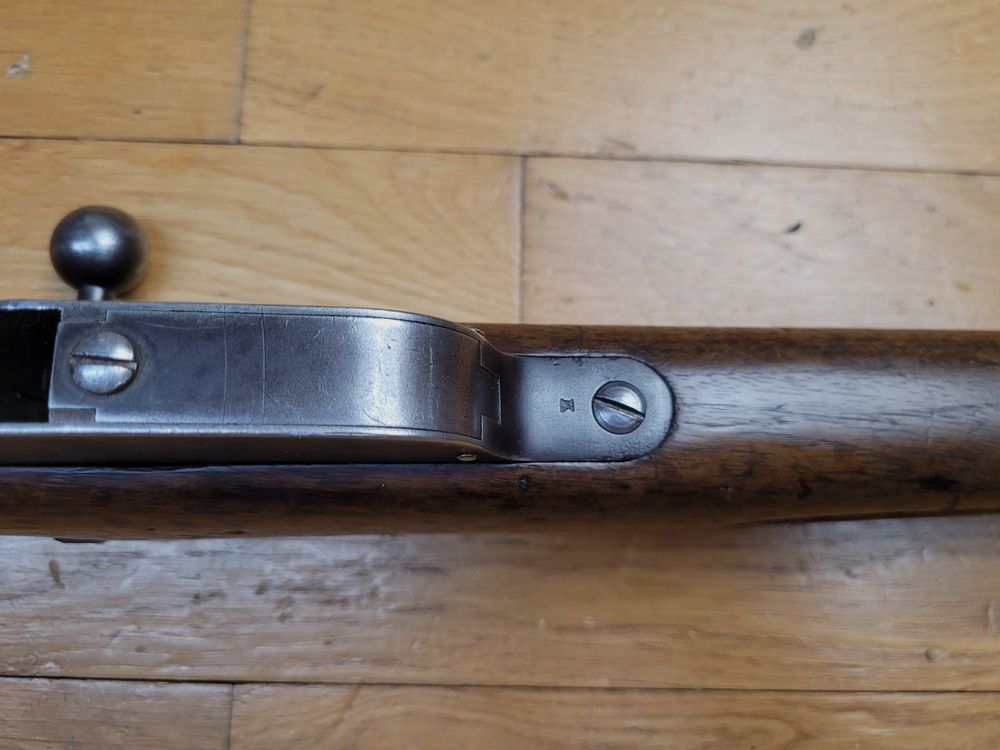
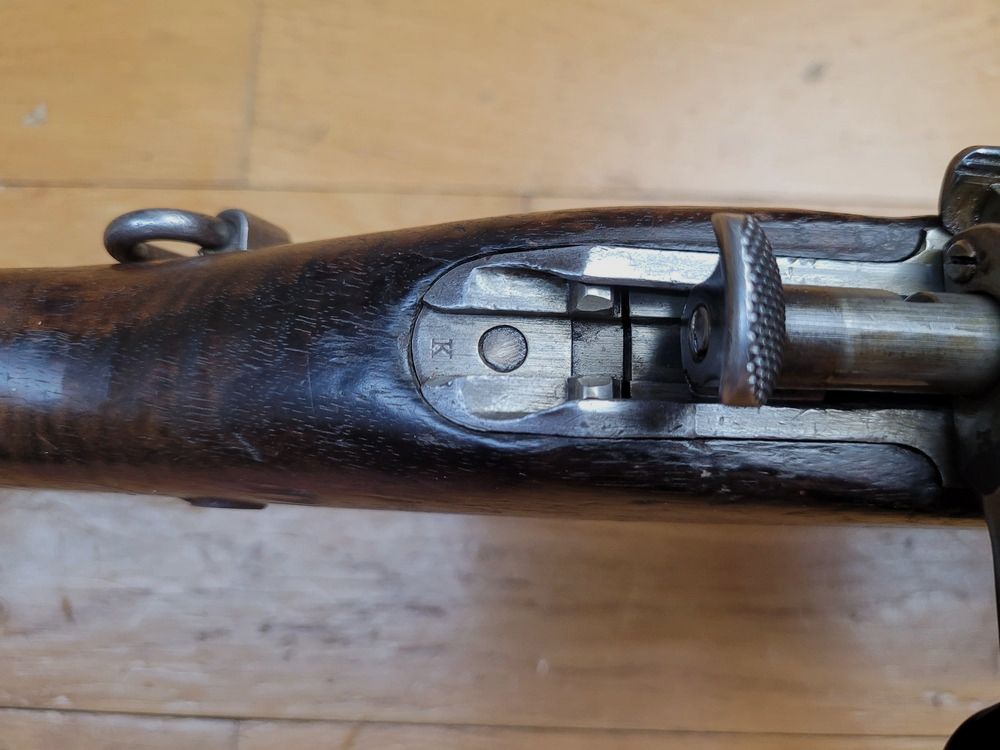
The same serial number appears on the barrel and chamber. Bolts were not numbered on these M95 rifles. Only the stock is not numbered to match, but all over the metal parts (including the bolt) you’ll find the “K” used for Steyr’s manufacturer code until 1919 (it would be an “R” on a firearm from the Budapest arsenal). All its parts are therefore from a Steyr M95 made before 1930. The firearm is remarkably consistent.
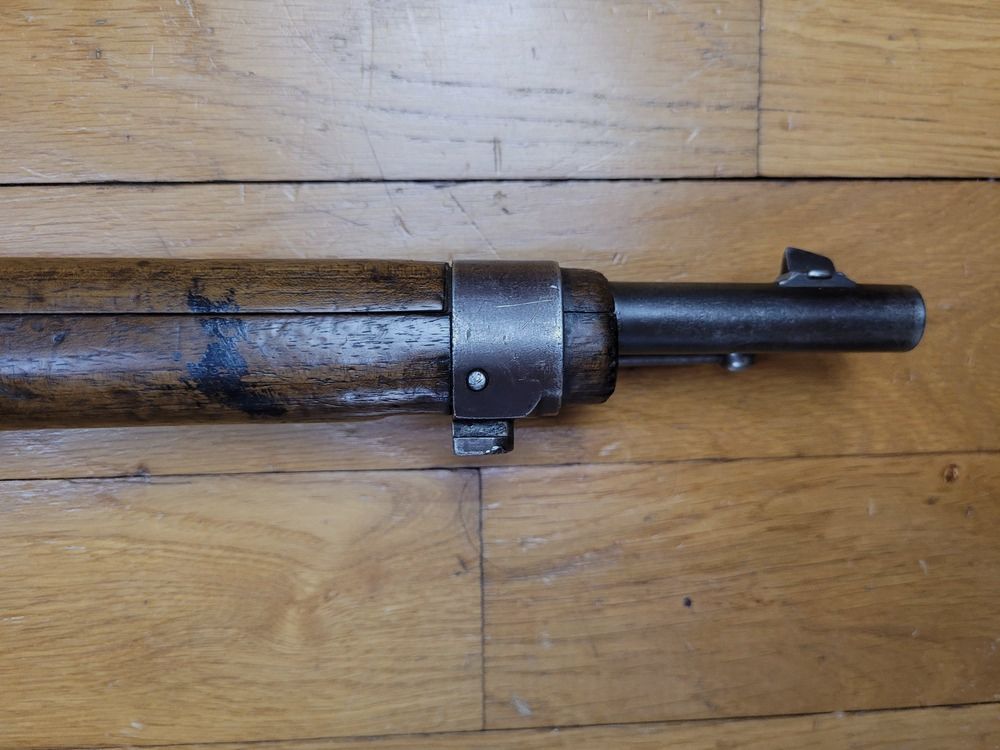
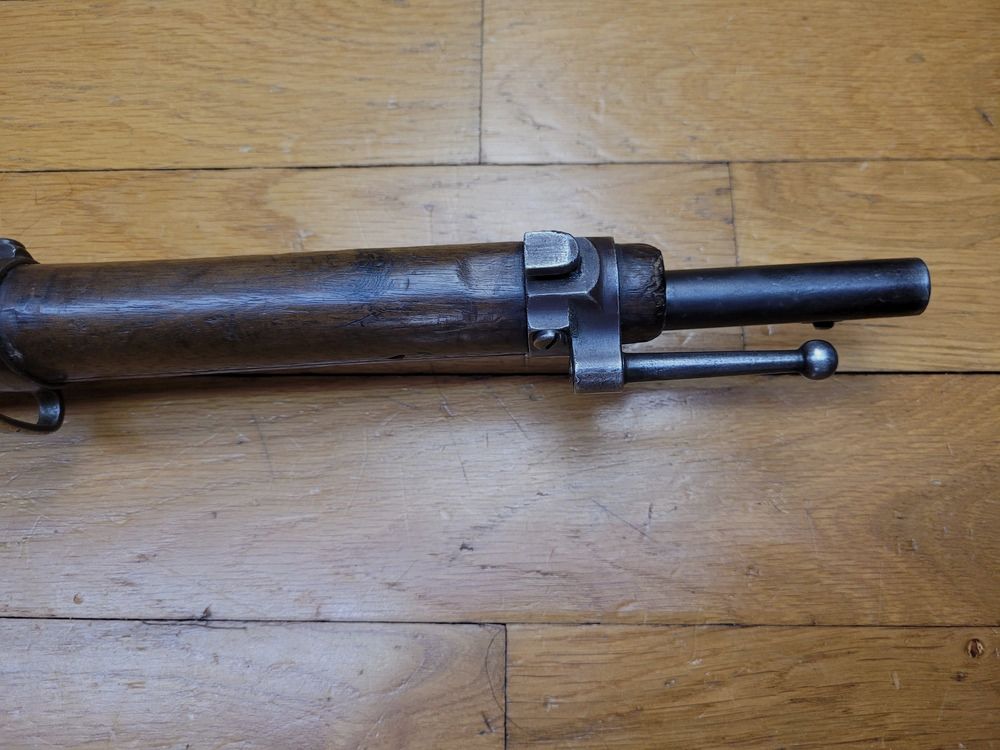
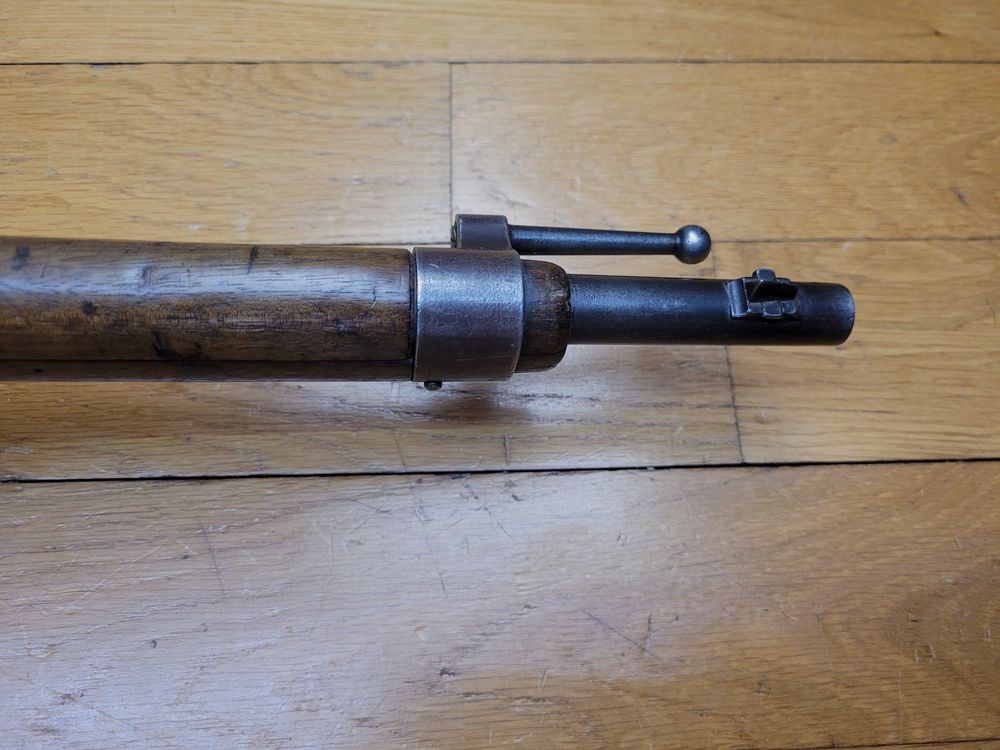
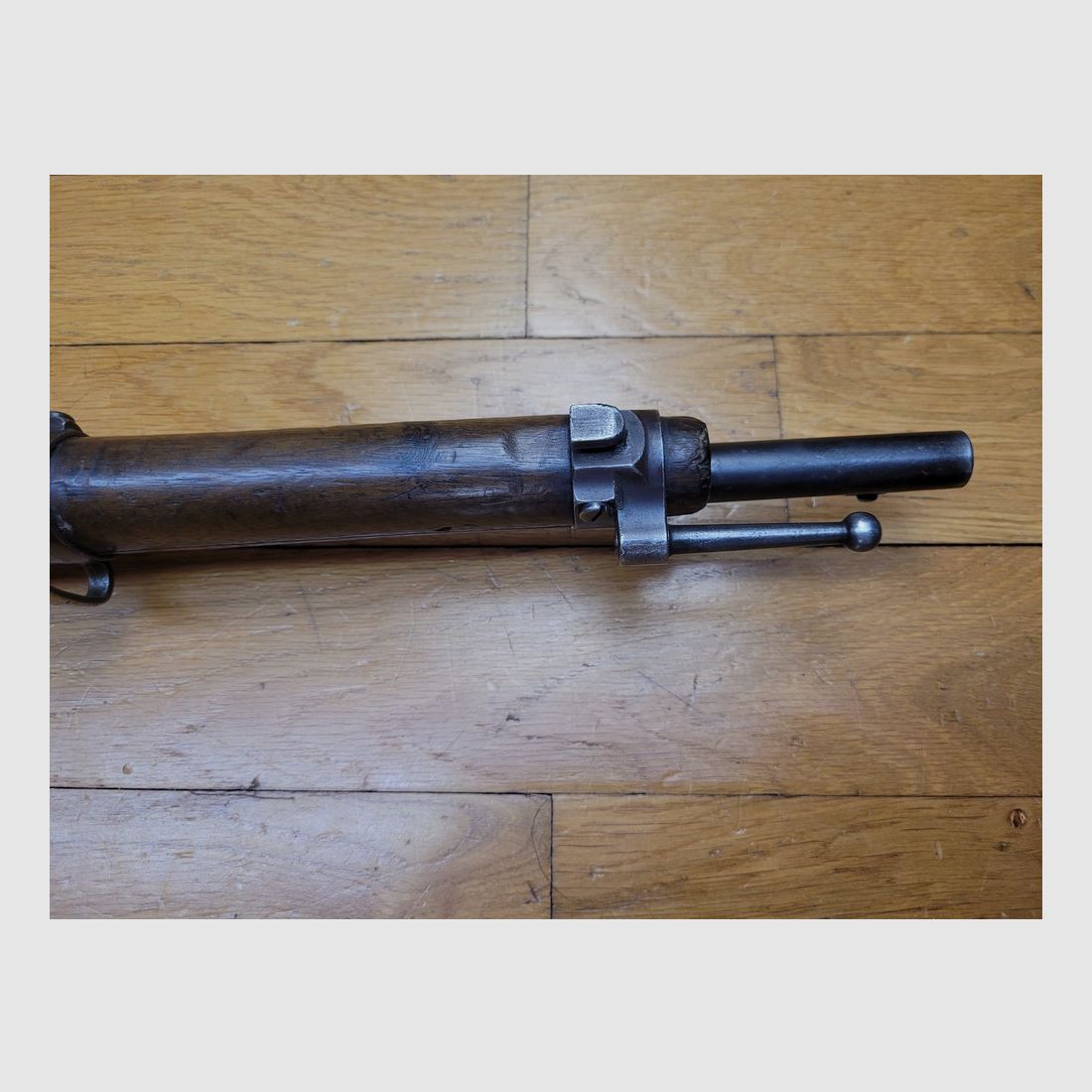
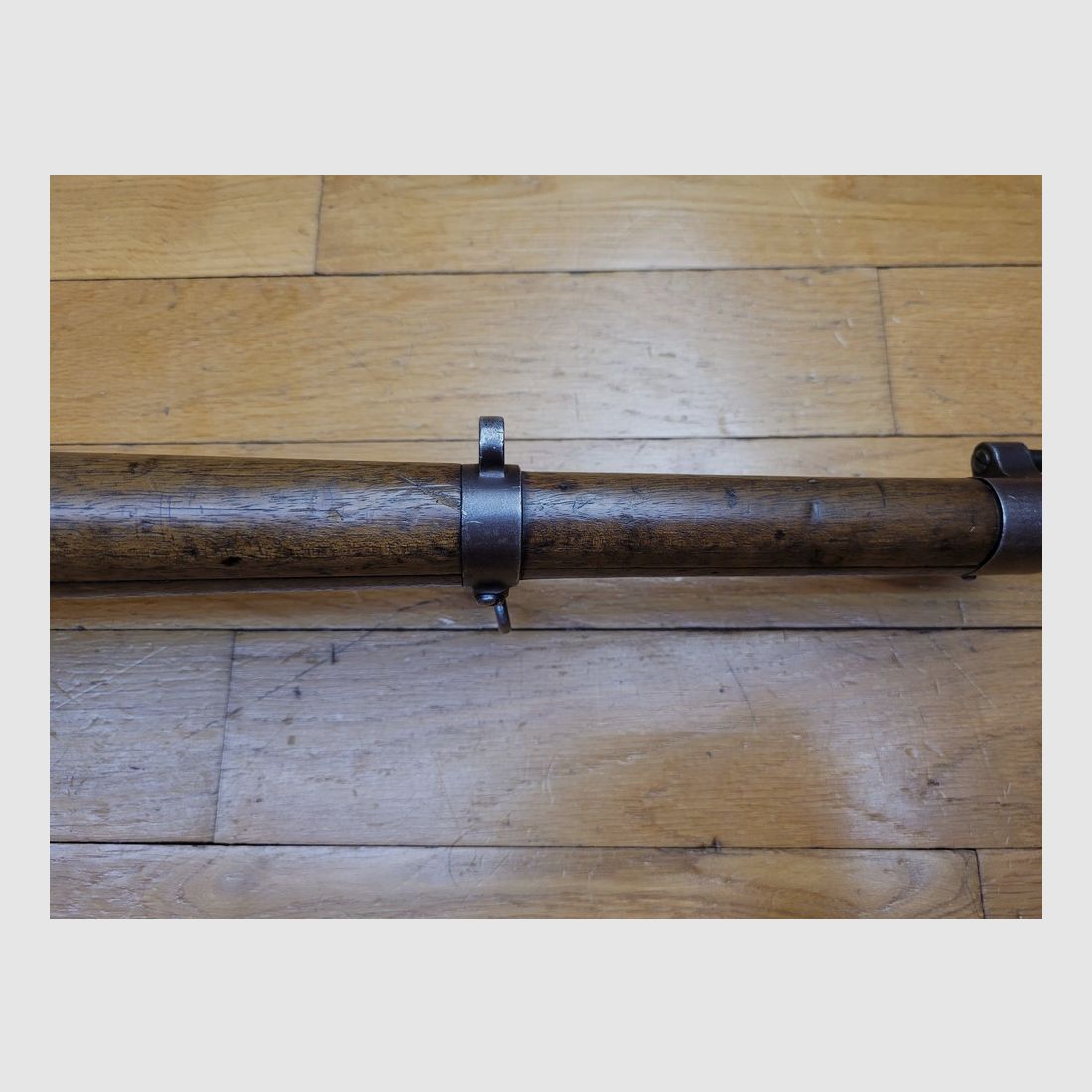
Our carbine has all its original cavalry fittings, including the sling ring on the left side of the stock. It has also retained its bayonet lug.
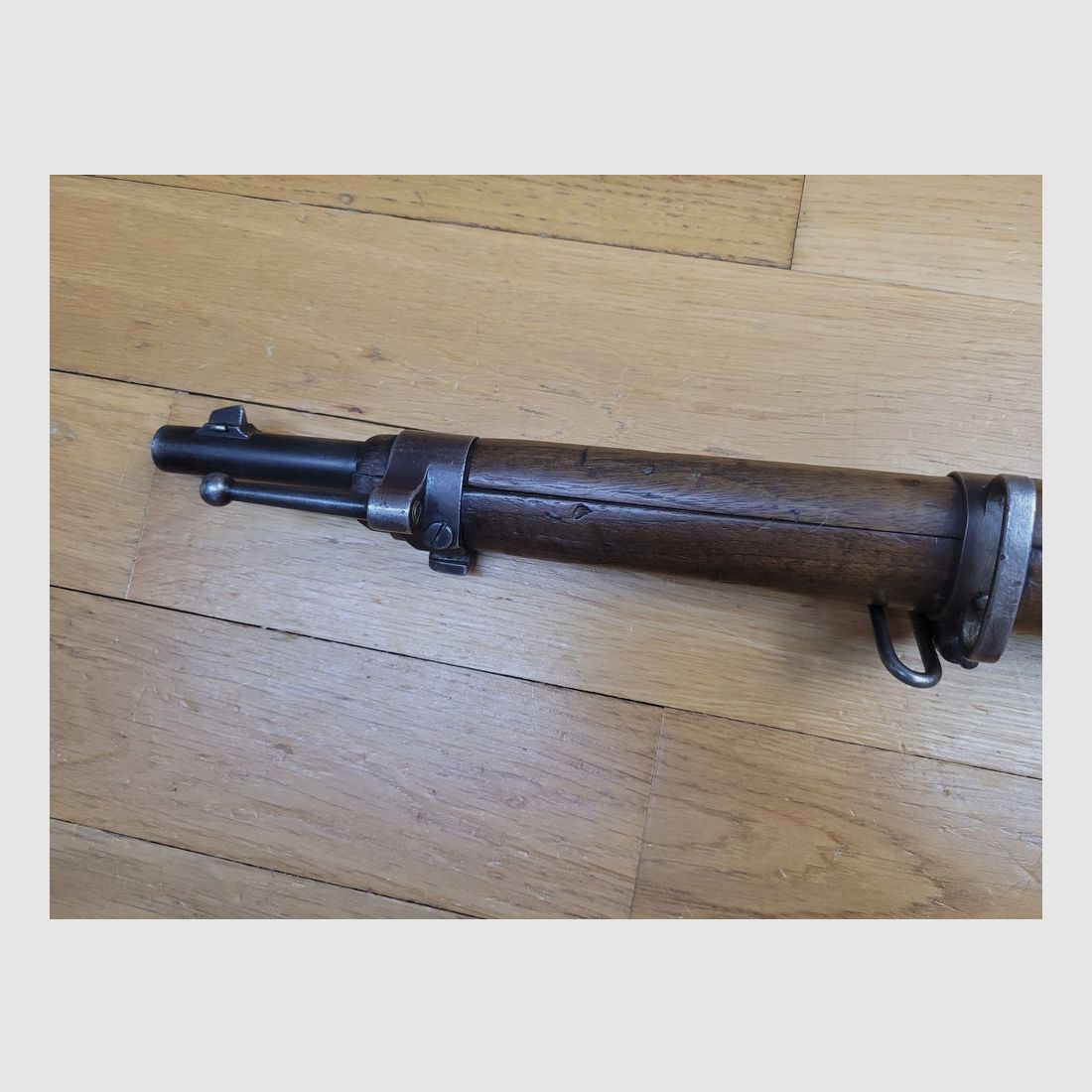
Note that the bayonet fitted to this firearm is the M95 bayonet known as the “technical troops” model, distinguished from the standard M95 infantry bayonet by its front sight, mounted directly on the bayonet socket.
This is because of a peculiarity of this firearm: when the bayonet is fixed, the carbine’s front sight disappears from the sight line! The front sight permanently mounted on the bayonet socket takes over, allowing you to aim with the bayonet fixed. I tried it once, and to my great surprise, it works very well!
The inside of the barrel is dull but not corroded, with very sharp rifling and its potential almost intact. It just needs a good cleaning.
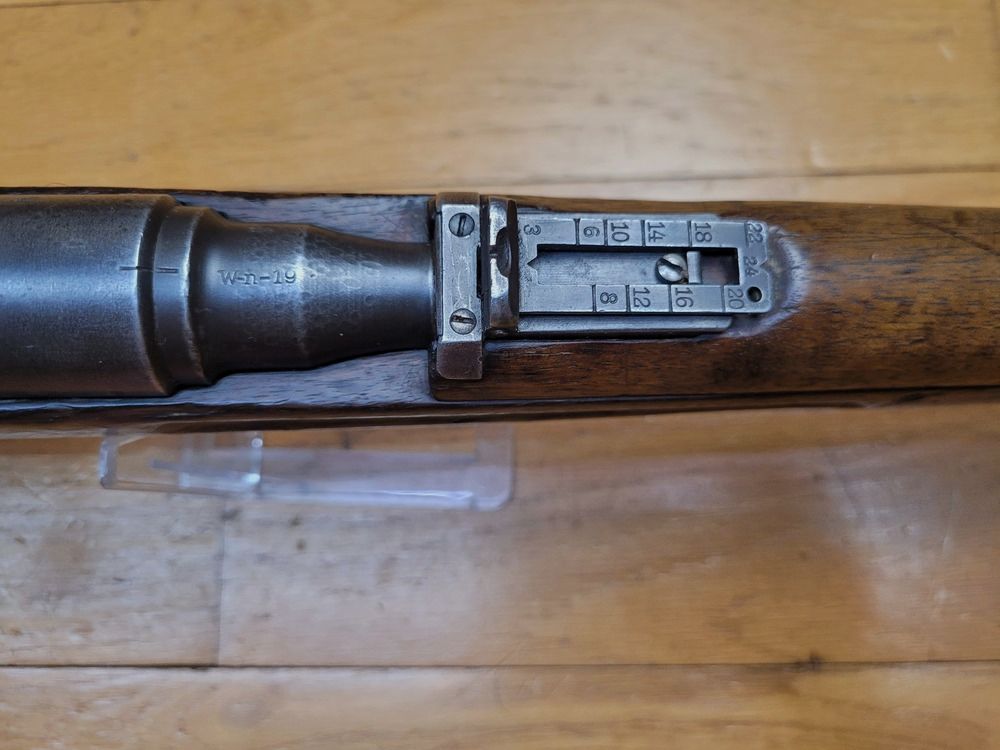
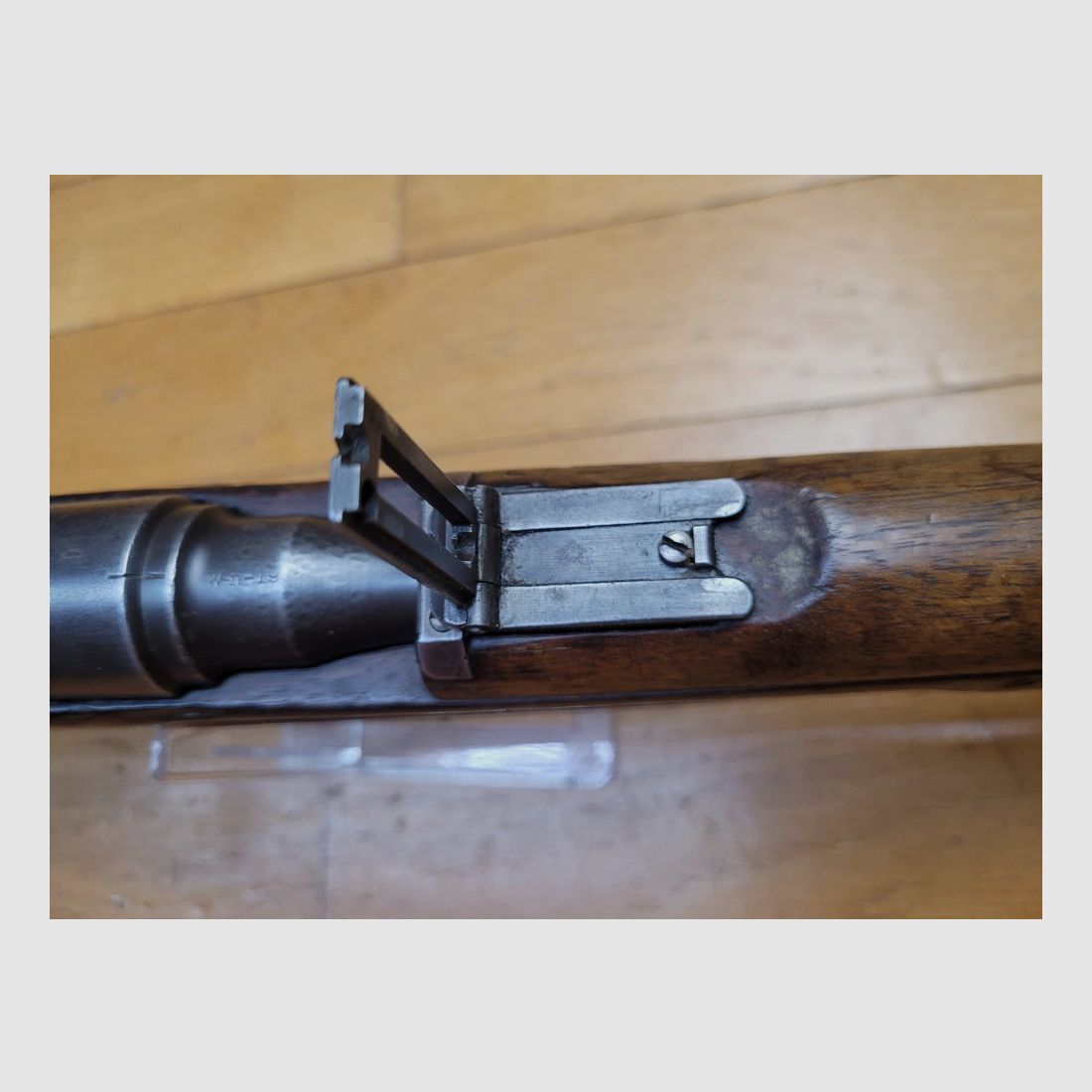
A special feature: the firearm is from 1919! Its date is stamped in the regulation position on the chamber: “W-n-19”. And there’s no small eagle after W-n (the Austro-Hungarian Empire disappeared on November 3, 1918!). None of these chambers were made after November 1918, but enough parts remained in stock to assemble a few thousand more after 1918.
Our firearm is one of them. It’s rare, and this may explain why it has so rarely survived in its original 1914–1918 configuration, without being rechambered from 1930 onward.
Our carbine is therefore a survivor from a deeply troubled era, when the Romanians took it upon themselves to invade and loot imperial Budapest, no longer defended by the Austro-Hungarian Army—a source of great resentment among the Hungarian people—and the central bank’s gold was only just saved by some American Marines who had lost their way there but were determined to put an end to the chaos; when Tyrolean free corps fought the Italian army to remain Austrian; and when the Austrian 1895 rifles of the last organized units fired at will against the Poles, Ukrainian nationalists and Viennese communists of a rapidly disintegrating empire, and then against Béla Kun’s forces in Budapest once the Romanians had left on the orders of their French and British allies…
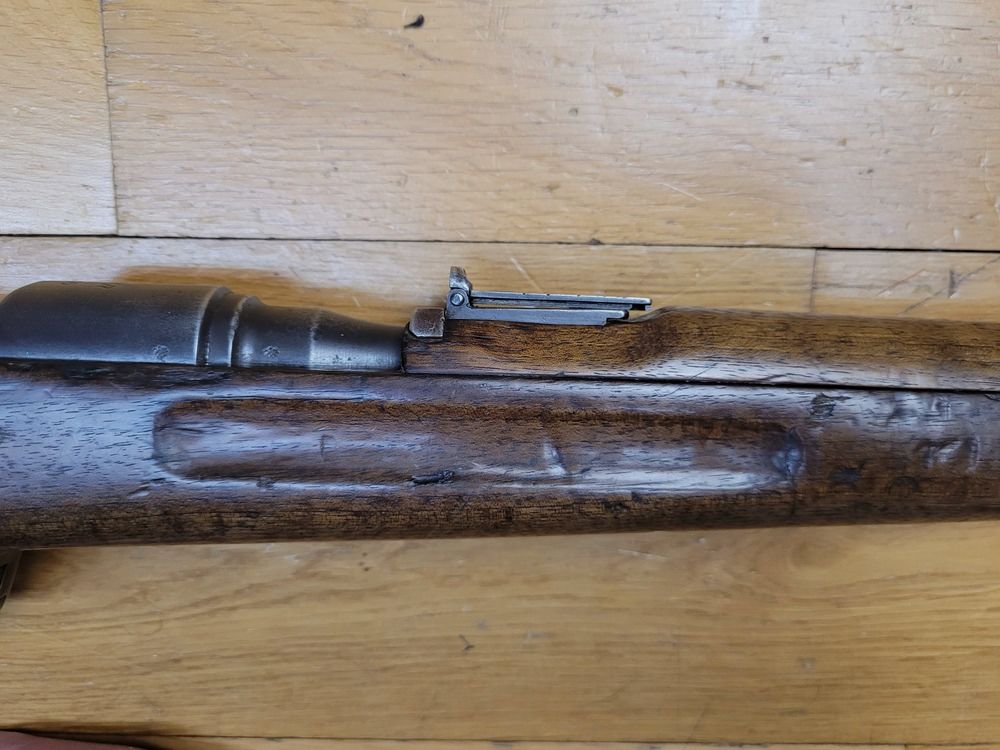
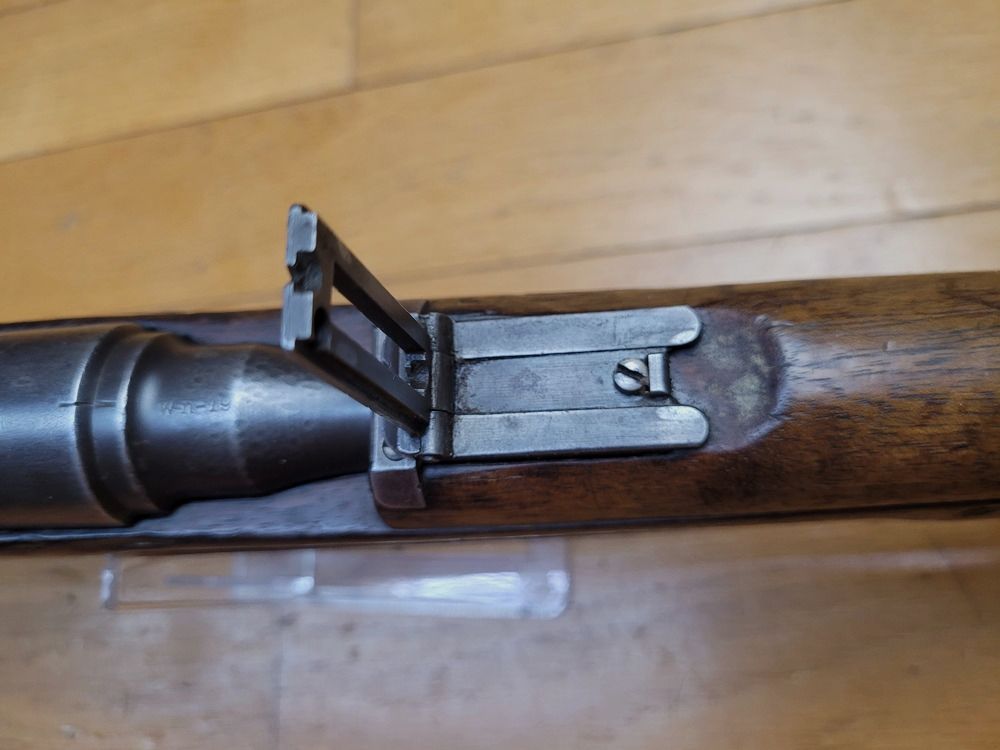
Original rear sight, fully blued
of origin, well graduated from 300 to 2200 Schritten (either an “Austrian old-regime pace” or 75 cm in our units). It is followed by a handguard that extends to the bayonet lug, making it almost possible to grip in a “C-clamp” position, a stance much appreciated in practical shooting with AR-15 family firearms! The front sight is the original one (lower than on the modified 8×56 firearms).
All in all, a very fine piece in one of the less common 1914–18 configurations, “not converted in 1930”. A piece that evokes the fierce, pivotal battles of history, from Caporetto and Galicia to the siege of Przemyśl against the Russian Imperial forces, and the truly crazy years of 1919–1923 in this region of the world, devastated by the destruction of the Austro-Hungarian and Russian Empires…
A must for any 1914–18 collector and a piece of European history. Also perfect—and perhaps above all—for reenactments, as a splendid Moravian Hussar or a proud Bohemian Dragoon. And it’s category D.
Firearm in category D: valid ID card or passport required
***********************************************************************************************************************
Let’s say it again! Flingus Maximus gun shop in Paris and throughout France is also here to help with private firearm transfers, buying firearm and militaria collections, firearm valuations, and questions about firearms in estates and inheritances. Contact your favorite dealer using our contact form or at [email protected]
Reminder: All collectible, hunting and shooting firearms are used and sold as-is, without warranty.
All antique firearms sold as category C or D, “Collection” or “Cowboy shooting”, are collectible firearms that have not been proof-tested for shooting or tested at a range. They have been visually inspected for their general condition, but none have been used for shooting, so they are sold as untested. Anyone wishing to use a firearm for shooting must first contact the National Proof House of Saint-Étienne, the only body authorized to issue proof certificates before a firearm is used for shooting.
. (Show description in original language)
En voilà un qui a bien roulé sa bosse. Et qui a peu près survécu pour une fois. Ils ne sont pas faciles du tout à « loger » ceux-là.
D’autant que, autant que faire se peut, je ne prends que ceux-là. Les « bons 14 » comme je dis en moi-même quand je les trouve…
Toujours la passion des objets d’une période folle teintée d’une nostalgie d’une autre France, morte quelque part entre Calais et les Vosges entre le très chaud (dans tous les sens du terme) été 1914 et la victoire hallucinée et épuisée de novembre 1918 qui clôturait une série de batailles tout aussi estivales et néanmoins restées parmi les plus furieuses de l’Histoire des Hommes.
La famille des fusils Mannlicher, témoins de ce conflit dantesque, est une des plus complexes et fascinantes des années 1880.
Après sa première itération en 1884 en 11mm, remplaçant le vieux Werndl à tabatière, l’empire austro-hongrois se dote, à partir de 1888, du plus performant système d’armes de son temps, le système Mannlicher.
Ces armes sont adoptées par l’Empire puis constamment améliorées et rapidement exportées en Chine (système 1888/90), Roumanie (système 93 puis 96), en Grèce (Système Mannlicher Shoenauer 1903/14) et jusqu’au Royaume d’Éthiopie et à celui d’Afghanistan (Système 1890)…
On en trouvera dans toutes les luttes du monde depuis 1888 et il sera encore au coup de feu dans le conflit israélo-arabe de 1948 ! Il aura vu aussi les cieux sanglants des soirs de bataille aux Philipinnes, au Chili ou en Afrique du Sud. Quel reitre voyageur ce Mannlicher !
Copié un peu partout, le système Mannlicher se fige pour la Double Monarchie dans le système 1895. Ce sera celui des soldats de l’Empire de François Joseph en août 1914 dans leur ultime combat, celui qui détruira cet autre Empire qui, lui, a vraiment duré 1000 ans…
Son magasin simple pile, développé en même temps que celui de James Paris Lee (1831-1904) et qui équipera lui le Lee-Enfield, est le premier au monde à pouvoir se charger par un « clip chargeur ». Alors que le gars d’en face n’avait mis qu’une seule cartouche dans son fusil, qu’il soit mono-coup ou à répétition, vous, vous en aviez déjà cinq prêtes à partir !
Nombreux le copieront, Allemagne et Italie en tête, et il fut en finale dans toutes les commissions d’adoption.
Cet avantage, associé à une remarquable culasse linéaire à réarmement en deux temps, en béton armé, était tout simplement révolutionnaire. Ce système évoluera avec le temps essentiellement vers le petit calibre et un verrouillage non plus à bloc oscillant mais par doubles tenons rotatifs, placés en avant sur la tête de culasse pour une rigidité optimum.
On l’oublie souvent mais les conflits balkaniques, ainsi que la première guerre mondiale qui en est, d’un certain point de vue, le produit, se sont révélés fort meurtriers et exigeant un matériel particulier.
Du fait de sa composition cosmopolite, la double monarchie devait, historiquement et comme tout bon Empire qui se respecte, faire face à de nombreux affrontements avec des partisans, que ce soit à travers les montagnes des Carpates ou dans les plaines slaves. Un fusil au mécanisme rapide, à la balistique très tendue et d’un encombrement réduit se révéla une stratégie des plus pertinentes.
Le système Mannlicher fut donc copié, exporté et dura, au-delà du raisonnable, jusqu’au III° Reich en ce qui concerne l’Autriche.
On devrait donc trouver logiquement de nombreuses armes du système Mannlicher ayant combattues avec la Double Monarchie contre la Russie, l’Italie, la Serbie ou la France et avec ou contre nombre de pays balkaniques et est-européens en calibre d’origine.
Il n’en est rien.
En 1930, la plupart des armes autrichiennes et hongroises en calibre 8x50R furent toutes re chambrées en 8×56 jugé plus moderne du fait de son nouveau projectile à profil pointe et de son supplément de poudre. L’équivalent, en plus violent, de la transformation de nos Lebel et Berthier à la Balle 32N en 1932 qui laisse déjà chez nous fort peu de survivants dans leur configuration de l’été 1914 à l’hiver 1918.
On en a profité pour modifier les attaches, la hausse et bien sûr le guidon adaptés à la nouvelle munition réglementaire en 8x56R. Ces Mannlicher là sont les plus fréquents et sont dit « 95/30 ». On en trouve beaucoup.
Puis vint l’achèvement des quelques survivants de la Grande Guerre et de l’opération de 1930 par les législations hoplophobes modernes.
La législation dite sur les « calibres de guerre » (quel calibre à percussion centrale ayant eu un peu de succès dans l’Histoire ne l’est pas ?) força à commettre l’irréparable sur une quantité astronomique de fusils réglementaires. L’Italie, où se trouvait encore nombre de Mannlicher 1895 prit une législation au moins aussi stupide.
Résultat?
Des tombereaux d’armes centenaires ou plus, témoignages de l’Histoire des hommes, merveilles d’ingénierie armurière, préservées avec amour par leurs dépositaires dans leur configuration d’origine et souvent en état excellent passèrent à la moulinette du recalibrage barbare. Dont pas mal des tous derniers Mannlicher de l’Autriche-Hongrie Impériale en 8x50R.
Rien que d’y penser, les poils de l’épaisse toison d’ours mal léché de Maître flingus se hérissent…
Les rares survivants bien homogènes et toujours en 8x50R sont des armes perdues dans les troubles de la guerre et de l’immédiat après guerre de 14 et gardées, chez des particuliers le plus souvent, à travers les nombreuses vicissitudes de l’Histoire très tourmentée de ces régions passionnantes et magnifiques.
Alors, comme un veilleur halluciné, je les cherche. Comme tout ce qui n’est pas « 32N » chez nous. Un peu partout. J’aime les quêtes difficiles. Mais j’en trouve peu.
Et je viens dans trouver un. Peut-être le 5° que je vois en 20 ans. Celui-là, je l’ai logé chez un margoulin germanique.
Cet exemplaire est un mousqueton de cavalerie ou « troupes spéciales » modèle 1895 de l’armée austro-hongroise dans sa configuration de août 1914. Le fusil est tout aussi, et, paradoxalement, peut-être même encore plus difficile à trouver que la carabine. Je ne sais pas pourquoi.
Notre vétéran a mené son dernier combat pour prendre la tangente et échapper au sort funeste de la quasi intégralité de ses frangins. Resté en calibre d’origine réglementaire autrichien 8×50 Mannlicher donc avec mes pièces idoines.
Je réponds d’avance à LA question : le 8X50 Mannlicher n’est PAS le 8×50 Lebel et les cartouches ne sont en rien compatibles. J’ai quelques étuis neufs en 8X50 autrichien (on en trouve chez Bertram et en Allemagne aussi) et quelques balles dispos pour l’acquéreur car j’ai personnellement rechargé ce calibre rare autrefois. Si vous êtes intéressés par recharger ce calibre d’origine du temps des orages d’acier, il vous faut aussi les outils qu’on voit parfois et qui sont fabriqués par CH4D.
Recharger le 8X50 Mannlicher (d’ailleurs comme son petit frère autrichien 8 mm Gasser pour l’arme de poing), c’est un peu entrer dans un club fermé de spécialistes (du rechargement) dont les « autres » parlent avec respect au stand. Une légion d’honneur d’un savoir-faire qui sent bon la poudre et l’amour de l’authentique.
Et notre arme de ce jour me parait encore plus rare. On va voir pourquoi. Car elle m’a appris, après recherches, quelque chose sur les productions de l’immédiat après guerre de 14 autrichien.
Les bois de ce petit mousqueton 95 de cavalerie ont été manipulés mais ils restent en BE. . Aucune enture ou manque majeur. Le numéro d’unité reste lisible en bec de plaque de couche (109. D.219 – ce qui la rattacherai à une unité de Dragons de landwehr)
La culasse est 100% d’origine et n’a pas été renumérotée au stylo électrique au même matricule que l’ensemble canon boîtier comme on le voit très souvent pour les armes re-chambrées 8×56, ce qui supposaient un test de culasse pour cette munition plus puissante post 1930. Juste quelques poinçons d’épreuve parasites allemands en chambre (Bois de cerf du Wurtemberg pour 1972 et une mention de calibre « 8×50 ») . Tout le reste dans toutes ses pièces et marquages est bien d’origine M95 et d’avant modifictions 1930.
La culasse se manipule virilement comme tous les Mannlicher »straight pull ». Ce mouvement est facilité par le massif levier à boule qui se trouve sur son côté droit. Percussion impeccable. Sécurité fonctionnelle. Tous ressorts bien fermes.
Le magasin est complet et fonctionne avec des clips originaux (les mêmes, pour le coup, que ceux en 8×56 car le culot de cartouche est le même et trouvables facilement – je dois en avoir encore quelques uns et j’en donne un à l’acquéreur avec l’arme) – Parfait état.
Tout le bronzage est d’origine et celui d’arsenal, bien présent à 85% nonobstant quelques éclaircissement. Aucun point de rouille ou de peau d’orange. Bref, très beaux fers.
Tous les marquages et poinçons sont bien lisibles. Bien évidemment, vous ne trouverez pas de marquage «S» en chambre car il est propre aux armes re-chambrées en 8×56 à partir de 1930 (équivalent de la mention « N » sur nos Lebel et Berthier re chambrés post 1932) ce qui n’est pas le cas de notre arme. L’arme est bien marquée « Steyr » en tonnerre ce qui nous indique qu’elle est autrichienne et pas hongroise (arsenal ‘Budapest’ dans ce dernier cas).
Le même numéro apparait en canon et chambre. Les culasses n’étaient pas numérotées sur ces fabrications M95 . Seul le bois n’est pas au numéro mais partout, sur les pièces métalliques (y compris de culasse), apparait bien le « K » propre au code fabricant de Steyr jusque 1919 (ce serait un « R » sur une arme sortie de l’arsenal de Budapest). Toutes ses pièces sont donc bien des pièces de Steyr M95 avant 1930. L’arme est remarquablement homogène.
Notre carabine a bien toutes ses garnitures d’origine propre aux armes de cavalerie y compris son anneau de grenadière en poignée coté gauche. Elle a aussi conservé son tenon de baïonnette.
A noter que la baïonnette qui chausse cette arme est la baïonnette M95 dite pour « troupes techniques » qui se distingue de la M95 « classique » d’infanterie par son guidon de visée directement fixé sur la douille de la baïonnette.
Car, particularité de cette arme, quand on y fixe la baïonnette, le guidon de carabine disparait de la ligne de visée ! C’est le guidon fixé à demeure sur la douille de baïonnette qui prend le relai pour pouvoir viser « baïonnette au canon ». J’ai essayé autrefois. Et, à ma grande surprise, ça marche très bien !
L’intérieur du canon est terne mais non oxydé avec de très belles rayures et son potentiel quasi intact. Il suppose juste un bon nettoyage.
Particularité : l’arme est de 1919 ! – Elle porte sa date à l’emplacement règlementaire en chambre « W-n-19 ». Et pas de petit aigle après W-n (l’Empire austro-hongrois a disparu le 3 novembre 1918 !). Aucune de ces chambres ne fut fabriquées après novembre 1918 mais il restait en stock suffisamment de pièces pour en assembler encore quelques milliers post 1918.
Notre arme est une de celles-là. C’est rare et c’est peut-être une piste qui explique sa rare survie en configuration d’origine 1914-1918 non re-chambrée à partir de 1930.
Notre mousqueton est donc un survivant d’une époque plus que troublée où les roumains se permettaient d’envahir et piller l’Impériale Budapest qui n’était plus défendue par l’Armée austro-hongroise, à la grande rancune du peuple hongrois, et dont l’or de la banque centrale ne fut sauvé que de justesse par des Marines américains perdus là mais très décidés à mettre fin au désordre, où des corps francs tyroliens faisant le coup de feu contre l’armée italienne pour rester autrichiens, et où les 1895 autrichiens des dernières unités constituées faisaient feu à volonté contre les polonais, les nationalistes ukrainiens et les communistes viennois d’un Empire en décomposition accélérée puis contre ceux de Bélà Kun à Budapest une fois les Roumains partis sur ordre des allés franco-britanniques…
Hausse d’origine intégralement bronzée d’origine, bien graduée de 300 à 2200 Schritten (soi un »pas » -autrichien et d’ancien régime!- soit 75cm de chez nous). Elle est suivie par un garde-main qui courre jusqu’au tenon de baïonnette ce qui permettrait presque de le saisir en position « C clamp », attitude très appréciée en TSV sur les armes de la famille AR15 ! Le guidon est bien celui d’origine (plus bas que sur les armes modifiées 8×56).
In fine une très belle pièce dans une configuration 14-18 « non transformée 1930 » des moins courantes sur ces armes. Une pièce évocatrice des combats féroces et essentiels dans l’Histoire, de Caporetto ou de Galicie, du siège de Przemyl contre les impériaux russes et des années vraiment folles 1919-1923 dans cette région du monde dévastée par la destruction des Empires austro-hongrois et russe…
Un must pour un collectionneur de 1914-1918 et un morceau d’histoire européenne. Parfaite aussi, et peut-être surtout, pour aller rouler sa bosse en reconstitution en superbe Hussard de Moravie ou en fier Dragon de Bohême. Et c’est du D.
Arme de catégorie D au CSI: CNI ou passeport en cours de validité obligatoire
***********************************************************************************************************************
Répétons le ! L’armurerie Flingus Maximus à Paris et partout en France est là aussi pour vos formalités armes entre particuliers, le rachat de collections armes et militaria, vos estimations d’armes, vos questions armes dans les successions et héritage. Contactez votre armurier préféré via notre formulaire de contact ou à [email protected]
Rappel : Toutes les armes de collection, de chasse, et de tir sont d’occasion et sont vendues dans l’état, sans garantie.
Toutes les armes historiques de fabrication ancienne vendues en tant que C ou D, “Collection” ou “Cow-boy shooting”, sont des armes de collection non éprouvées pour le tir et non testées en stand. Elles ont été inspectées visuellement relativement à leur état général mais aucune n’a été utilisée au tir et elles sont donc vendues comme non testées. L’acquéreur désirant utiliser une arme pour le tir devra impérativement se rapprocher préalablement du banc National d’Épreuve de Saint Étienne, seule entité habilitée à délivrer des certifications d’épreuves préalable à un usage de tir.
.