




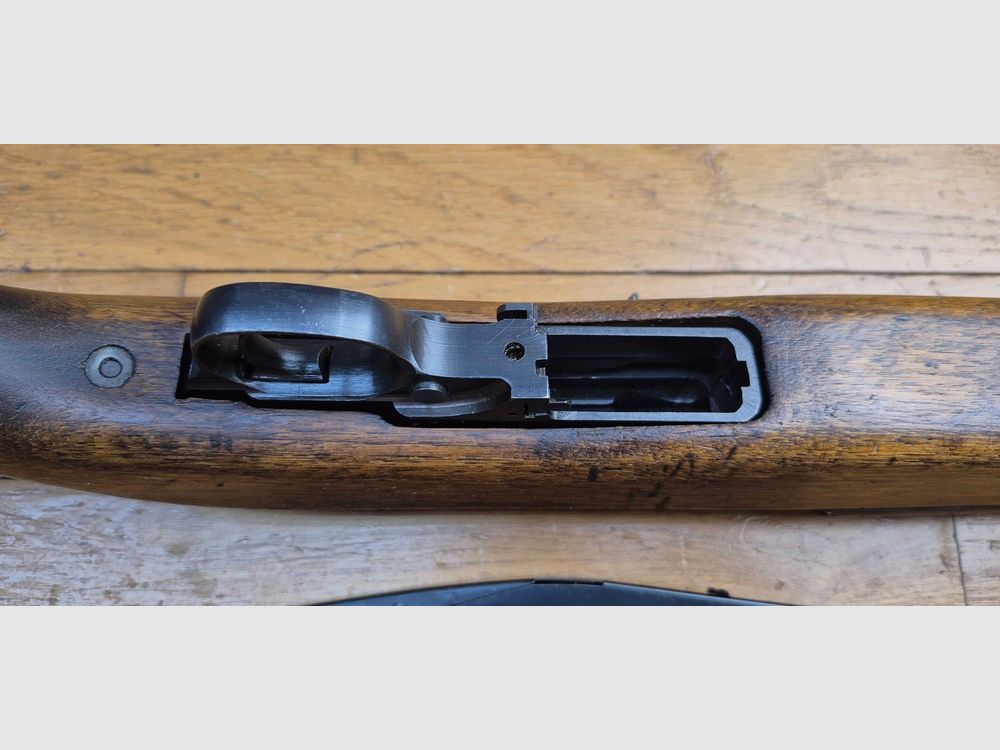
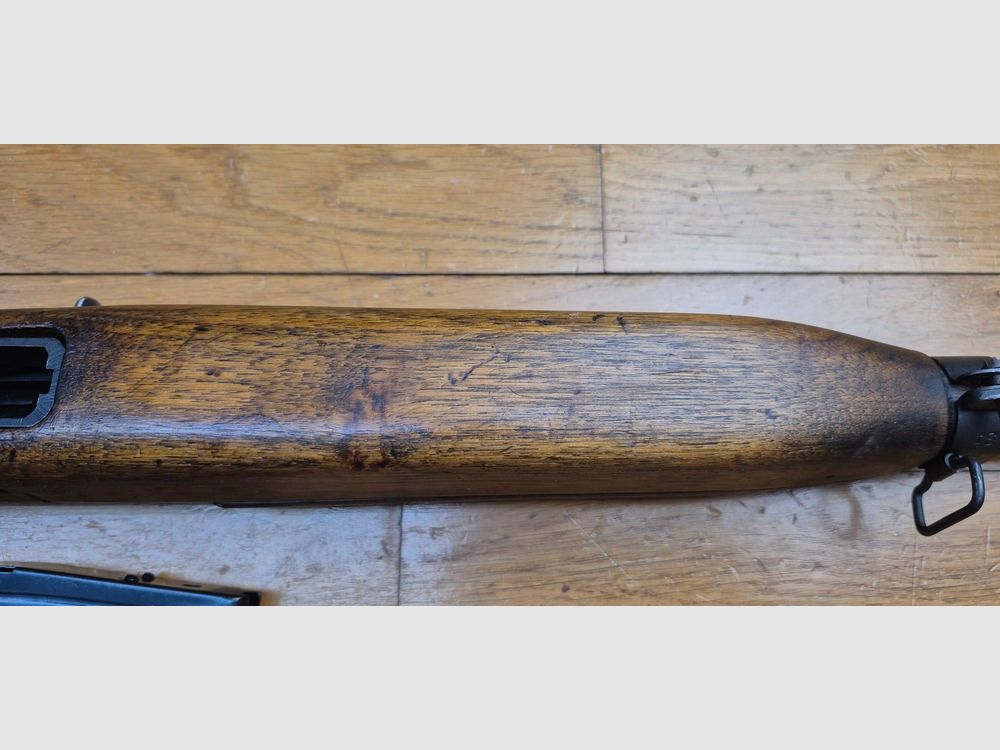
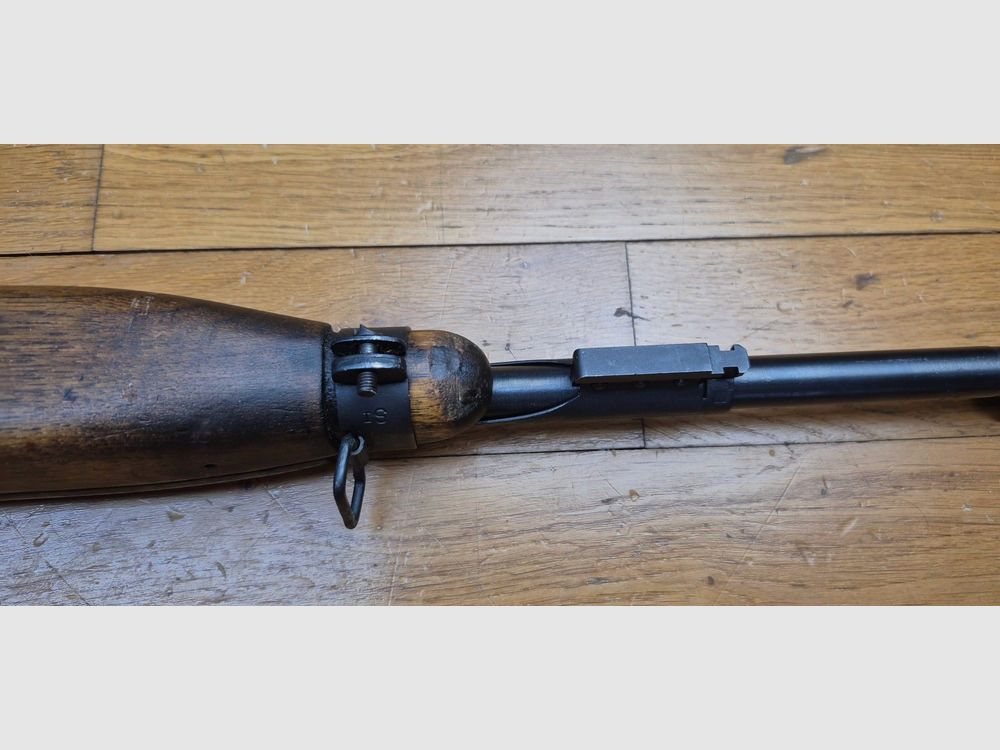
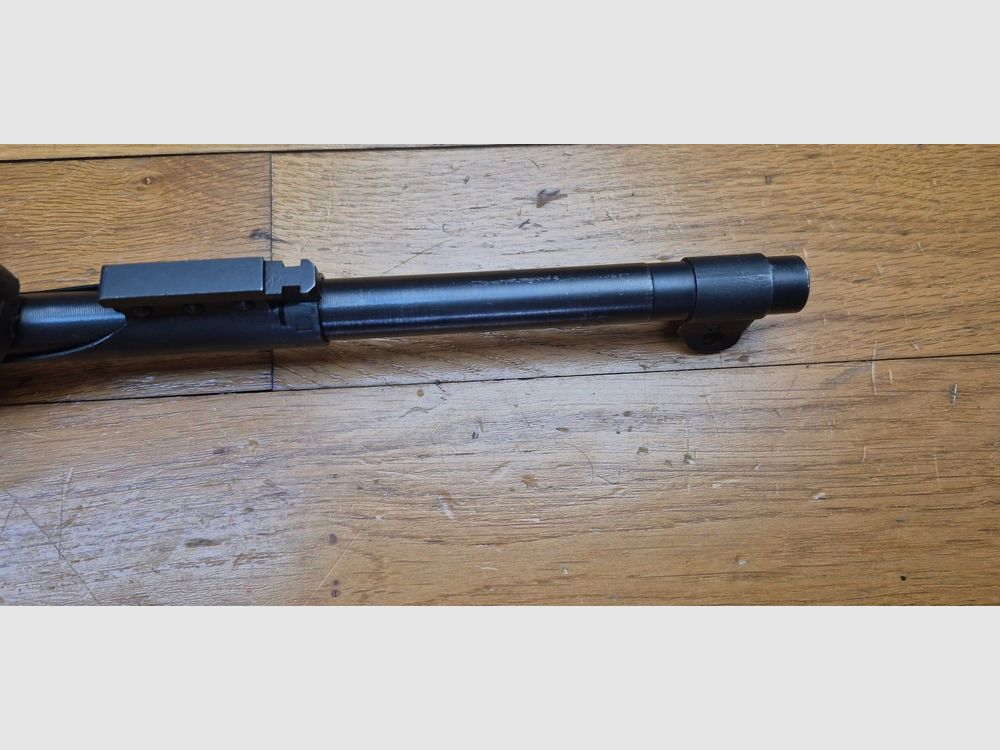





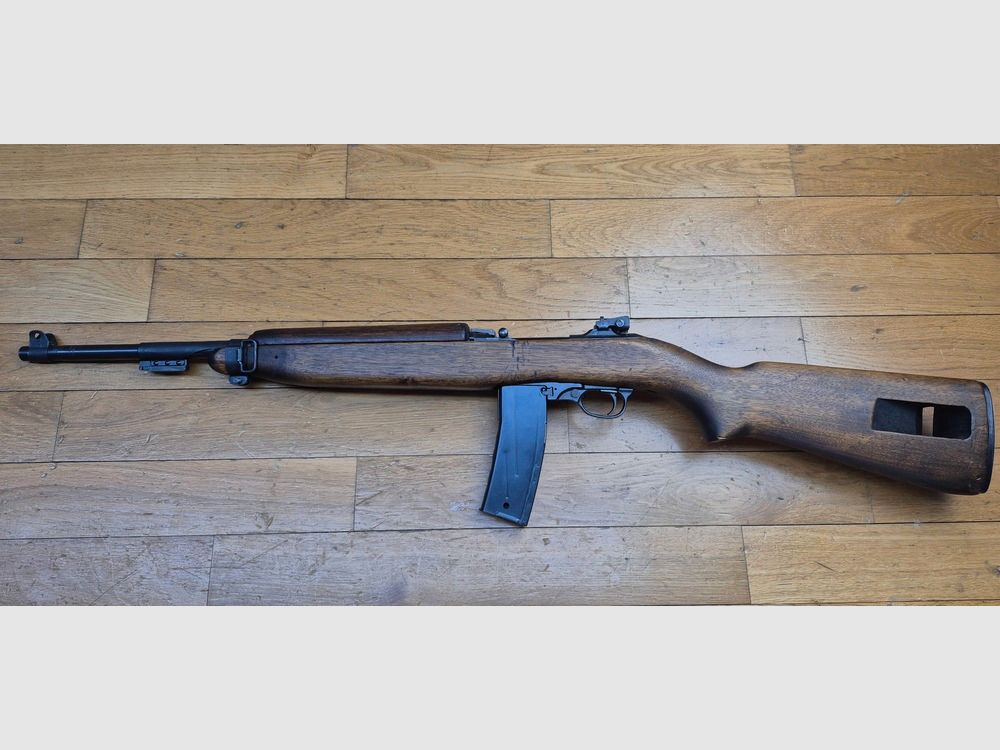

























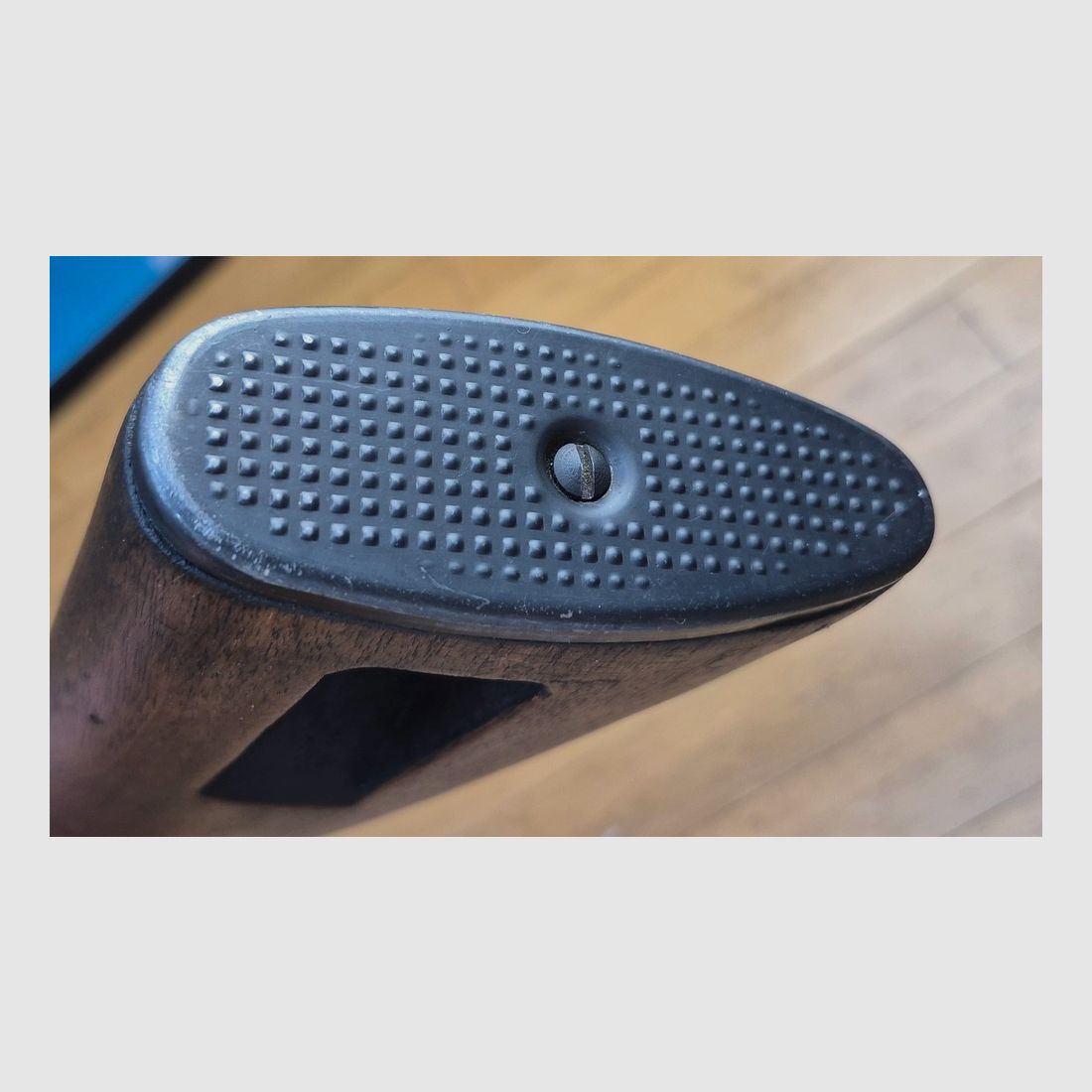
Very rare USM2 rifle – The automatic version (select-fire) of the USM1 – Manufactured by INLAND in 1945 – Original caliber .30 M1 (7.62×33) – Type T4/M2 weapon not derived from a converted USM1 – Excellent condition – TBE++ – Military equipment category A2 – EXPORT ONLY
Price on Request
Purchase permit required
75002 Paris, France
8
ID: 10338397
Purchase from outside the EU: The firearm goes through an importer in your country, the dealer handles the export.
How buying from Europe works
Shop safely with Gunfinder
Our AI-powered seller identity verification makes Gunfinder the safest marketplace online.
Learn more
Details
- Original language
- French
- Category
- Purchase eligibility
- Required
- Caliber
- 7,62x33
- Condition
- New
- Location
- 🇫🇷 75002 Paris, France
- Availability
- In stock
Freshness
This listing is based on a mirrored offer, where the listing data was synced to us from a shop, dealer, or external marketplace. Please note that temporary price discrepancies may occur due to possible delays in data transmission.
- Source
- Flingus Maximus
- Last checked with the dealer
- 1 day ago
Description
Note:
The item is located abroad. Please note that delivery conditions, shipping times, and/or the purchase process may differ.
Here’s the automatic little sister of the most widely produced American small arm of World War II, the USM1 carbine. Its nickname is “USM2.”
In the late 1930s, the US Army was looking for a “light rifle”—something between the .45 pistol and the heavy Garand rifle.
The idea was to properly arm everyone who wasn’t a frontline infantryman but might find themselves in direct contact with the enemy—officers, radio operators, mortar crews, artillerymen, armored vehicle crews, and drivers.
The Colt 1911 had too short a range and was too difficult to use in infantry combat because of its very short sight radius; the Garand, on the other hand, was too long and too heavy for men whose main job was something else.
The basic idea was defensive combat at distances of 20 to 300 meters.
Winchester won the 1941 trials with its prototype. At the heart of the weapon was an ingenious short-stroke piston—the famous “short-stroke gas piston.” This weapon would become the USM1.
This short-stroke piston is the weapon’s mechanical DNA. It would go on to influence countless postwar designs.
Firearms history credits this excellent system to David Marshall Williams, known as “Carbine Williams.” He is said to have refined the principle in… prison. The man had indeed been convicted in connection with an illegal distillery where he had killed a sheriff. General René Studler, head of Ordnance, intervened to get “Carbine Williams” a job at Winchester after his release from prison. Quite a piston himself. Of a different kind. But surely deserved.
MGM would turn this colorful life into a film typical of the way American legends are written. Released in 1952, it starred James Stewart in the title role, under the same title: “Carbine Williams.”
Nevertheless, while David Marshall Williams did invent the short-stroke piston, he was supported by the entire Winchester team at its peak in the rapid development of the USM1.
The USM1 was indeed designed incredibly quickly: Winchester’s prototype was reportedly cobbled together in less than two weeks. Thirteen days, they say. Take that with a grain of salt, but the general idea is right. It really was a lightning-fast design, completed in less than a month for sure.
The weapon, excellent from the trials onward, also went into production very quickly, without the prolonged unit testing that was standard practice. The Americans, confident in their industrial processes, really did consider the USM1 expendable.
Adopted in October 1941 as the M1 Carbine, it fires the .30 Carbine (7.62×33) cartridge: a 110-grain bullet at around 600 m/s, delivering about 1,300 joules at the muzzle. Much more than a pistol—and considerably less than a true battle rifle.
A deliberate compromise, with a gas volume perfectly suited to semi-automatic operation for once (just think of the more than laborious development of the Garand, the SVT36, 38, then 40, or the even worse results of the G41/G43).
For the USM1, the lightning-fast design was followed by a genuine industrial explosion. More than six million were produced during the war, in roughly three years. It was by far the most widely manufactured American weapon of the conflict.
Ten prime contractors took part, including some rather amusing ones: Inland (a General Motors division specializing in automotive fittings, from horns to hubcaps), Underwood (typewriters), IBM (punch-card machines and time clocks), National Postal Meter (postage meters), Saginaw (car and truck steering parts)… and even Rock-Ola, a jukebox manufacturer!
In fact, Winchester was the only producer with prior experience making firearms. All of industrial America had mobilized for this lovely little carbine. I wrote a detailed history of the M1 here for a
e M1 “pure as the driven snow” and here, the rare USM1 A1 paratrooper model.
The USM2, our firearm of the day, is a little USM1 that seems to have taken vitamins, to the point of also gaining a fully automatic firing mode. In other words, full-auto.
It appeared at the eleventh hour, so to speak, in the context of the Second World War.
Standardized late, in November 1944, it received a rotary selector on the left side of the receiver, a set of specific parts (sear, disconnector, “M2” hammer), and a nice curved 30-round magazine, the famous “banana mag.” The model was originally and officially designated T4/M2.
Its rate of fire was around 750 to 850 rounds per minute. Enough to empty a 30-round magazine in about two seconds. Needless to say, it’s best used in delicate bursts, like playing a grand piano, or you’ll send everything flying—and often miss the target. But in short bursts, it’s a joy!
Factory production of the USM2 was far more modest than that of the M1. Only around 217,000 firearms were produced in total: about 199,500 by Inland, plus 17,500 M2 firearms produced by Winchester.
Factory production was confined to a very short window, from May to August 1945, with some examples still assembled later, after production had stopped, through October 1945. Barely six months, then.
This explains both its low production volume (the roughly 217,000 examples I mentioned) and, above all, the rarity of the M2, especially the “pure as the driven snow” examples. I’ll explain what I mean by “pure as the driven snow” later.
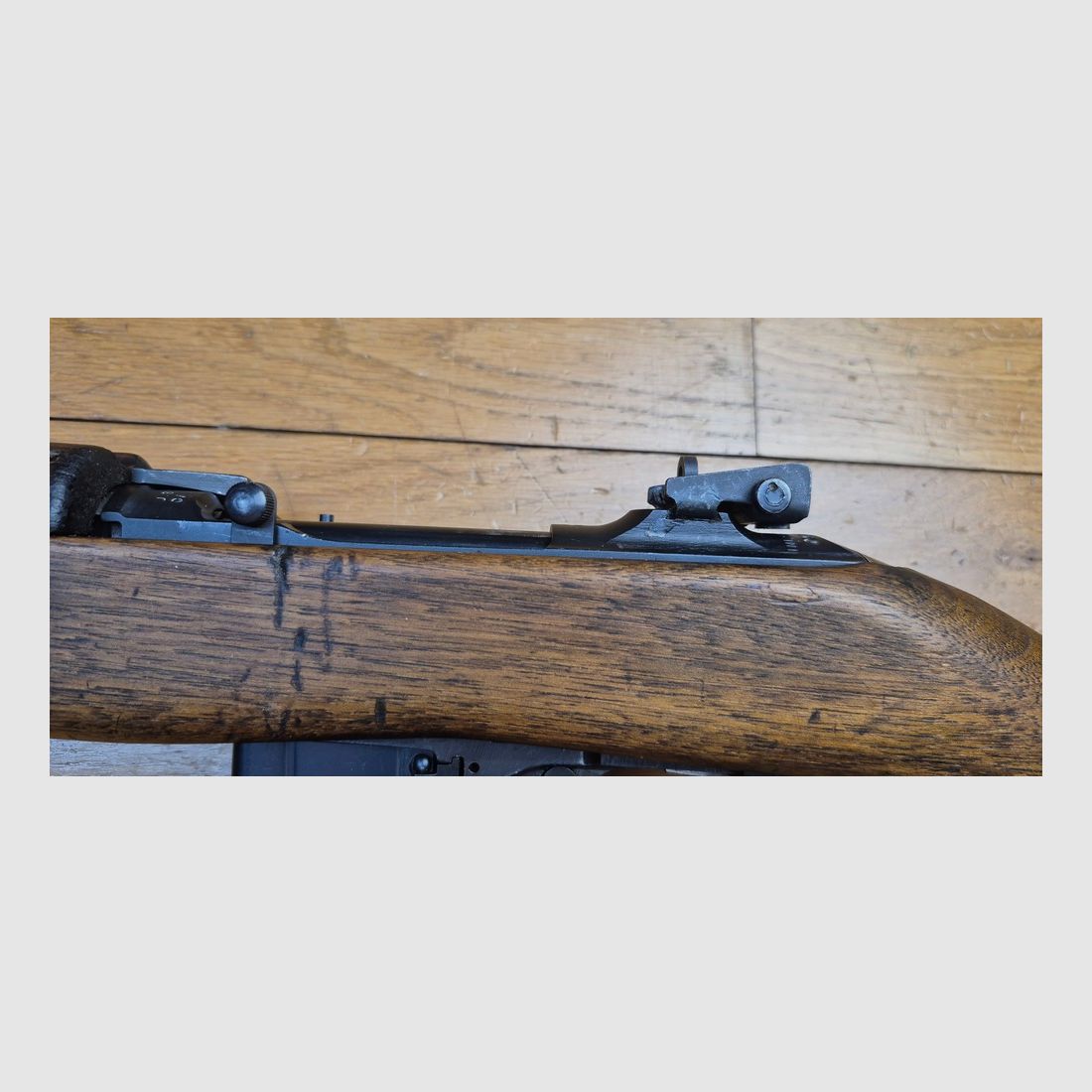
Note that, unlike the USM1, all USM2s were made late and came with the bayonet lug already fitted. It had appeared on USM1s late in the war in the Pacific Theater (but not in Europe) and would be fitted to all firearms rebuilt after the war. They also all have the second-type adjustable rear sight. That’s better for shooting, too.
So why “pure as the driven snow”?
Because, alongside this limited late factory production of USM2s built as such, kits were available to convert an M1 into an M2 directly at unit level. These kits were still being used into the early 1950s.
Many USM2s (already fairly uncommon) on the market are actually M1s converted to M2s. But it’s clear that an original M2 is much rarer than an M1, or even an M1 converted to an M2, which is already not that common.
A quick word about the M3, cousin to these M1s and M2s.
The USM3 is actually a USM2 specially adapted to take an infrared scope (the “sniperscope”), one of the very first night-fighting firearms. They were used at Okinawa in 1945, too. But that’s just an aside. A very rare one, admittedly (only 15,000 examples), but still just an aside.
It’s also worth knowing that many M2s went through the major rebuild operation (mass disassembly—cleaning/repair—mass reassembly) that affected almost all USM1s between 1945 and 1947.
This operation resulted in a huge mix of parts from all manufacturers and subcontractors. That alone makes USM1s that are 100% Second World War—meaning original, with all parts from the same manufacturer—relatively rare.
But above all, it’s also why you sometimes find USM1s with… USM2 stocks!
The operation made “pure as the driven snow” USM2s even rarer than their already low production numbers would suggest.
So, what are the differences between USM1s, USM2s converted from USM1s, and original “pure as the driven snow” USM2s?
The first way to identify an original USM2 at a glance, even before opening the firearm, is the stock.
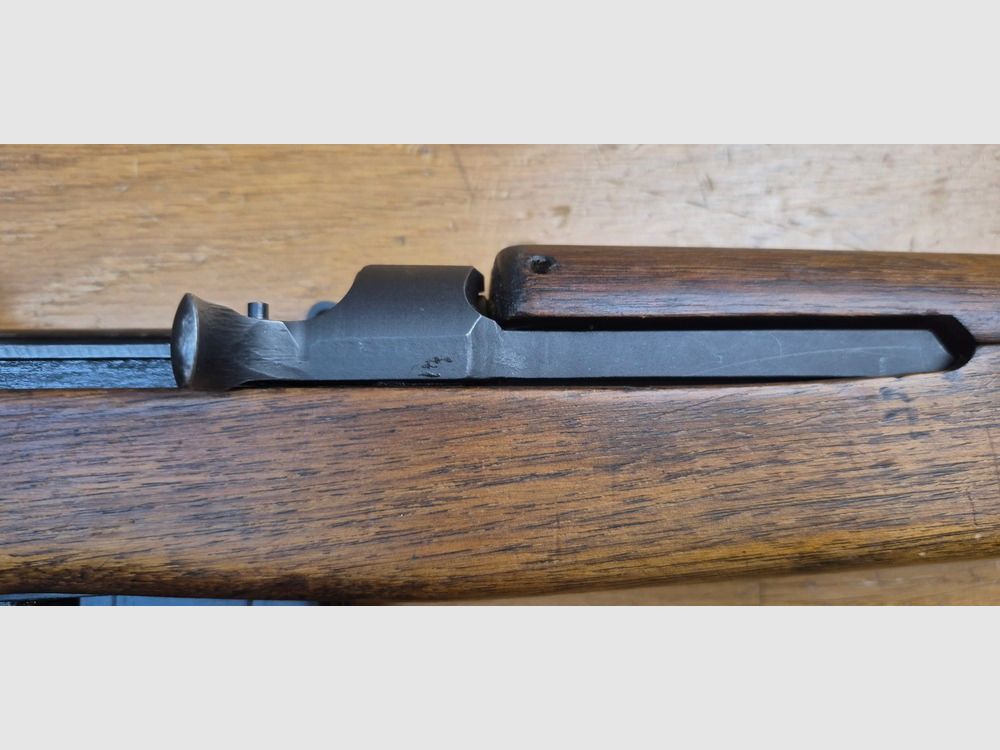
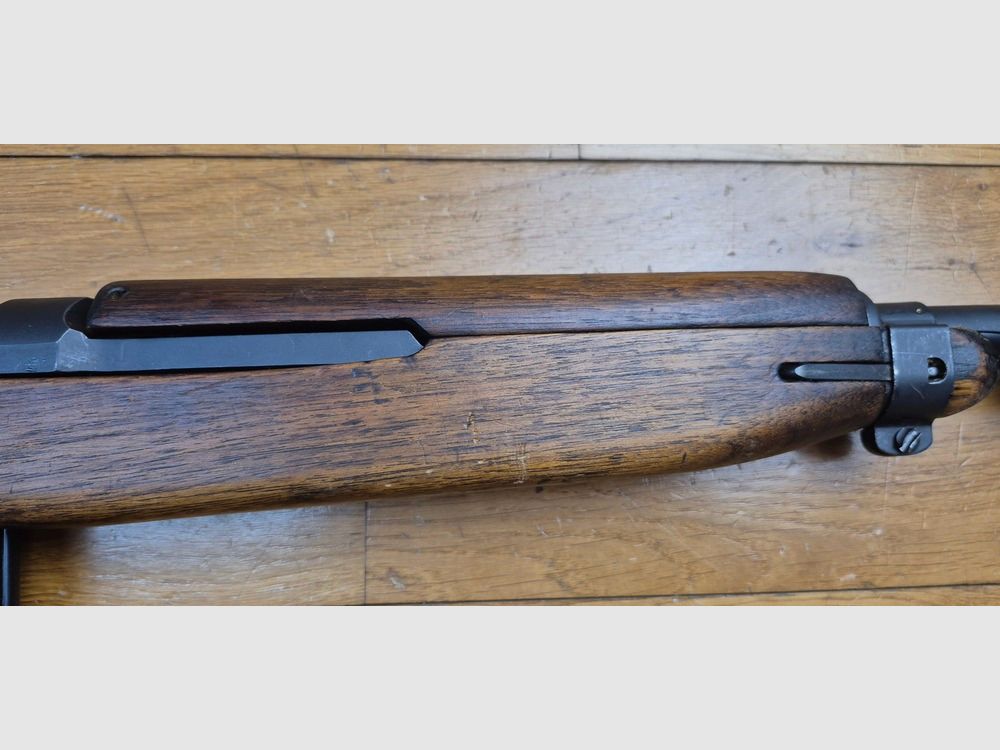
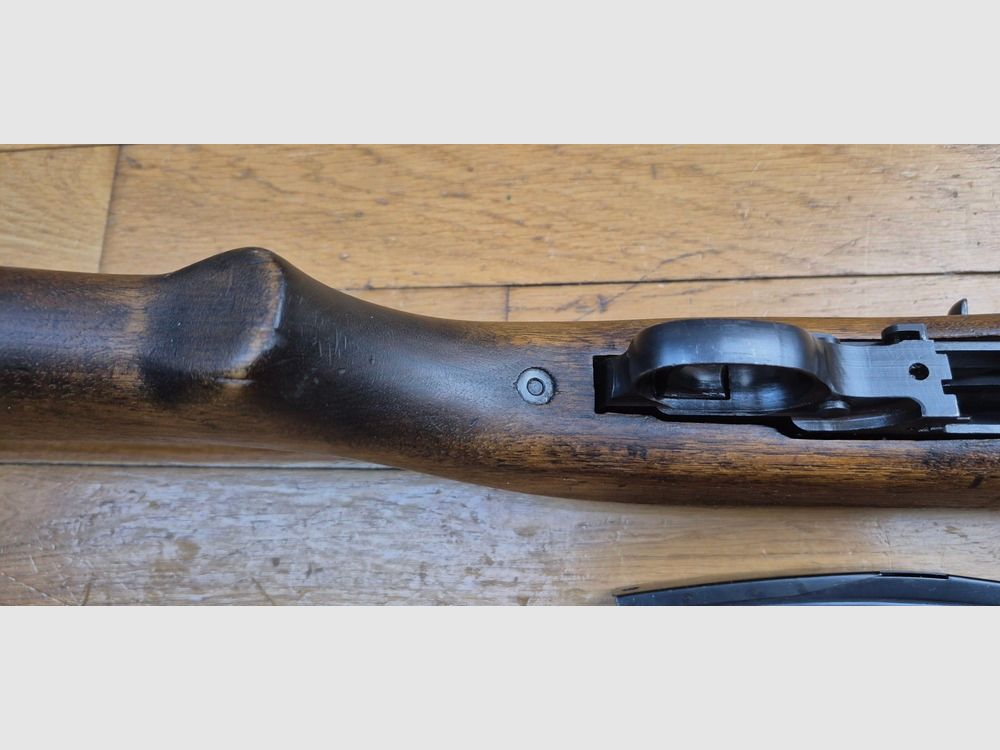
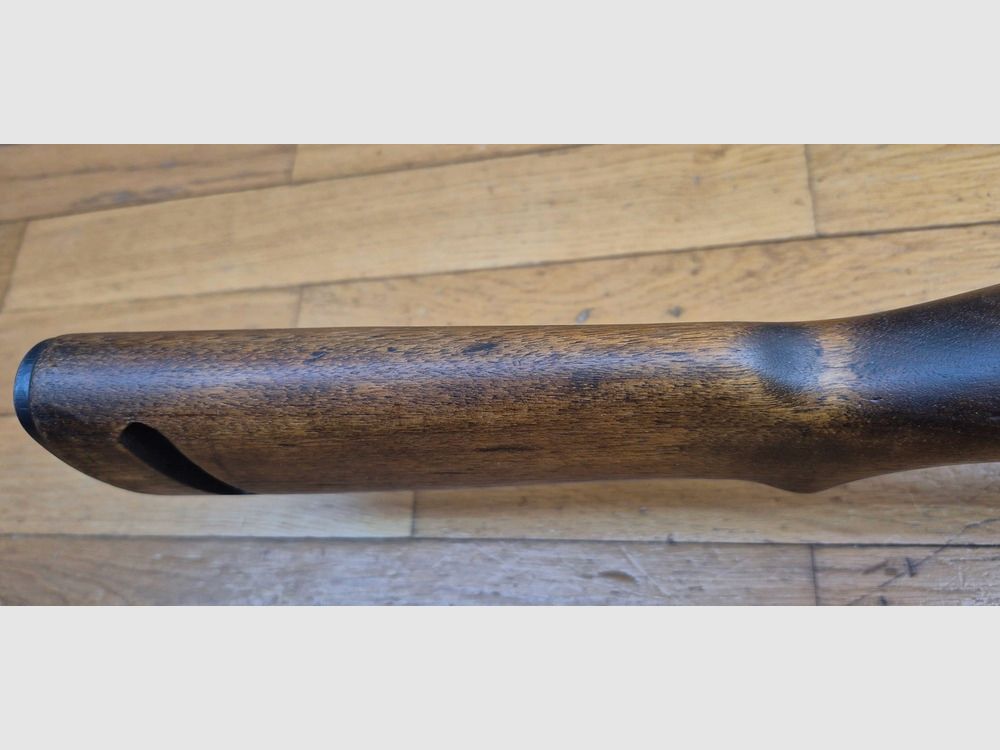
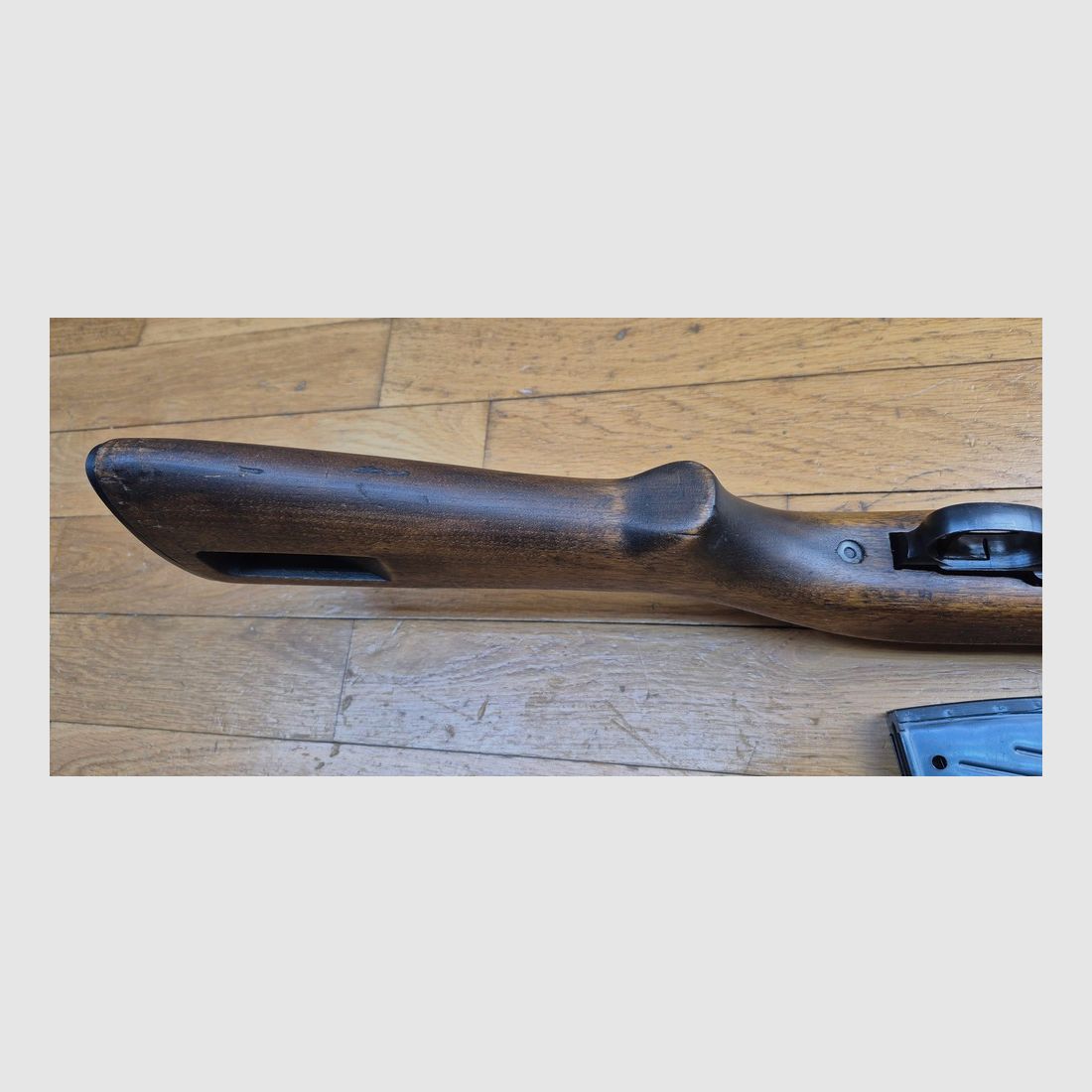
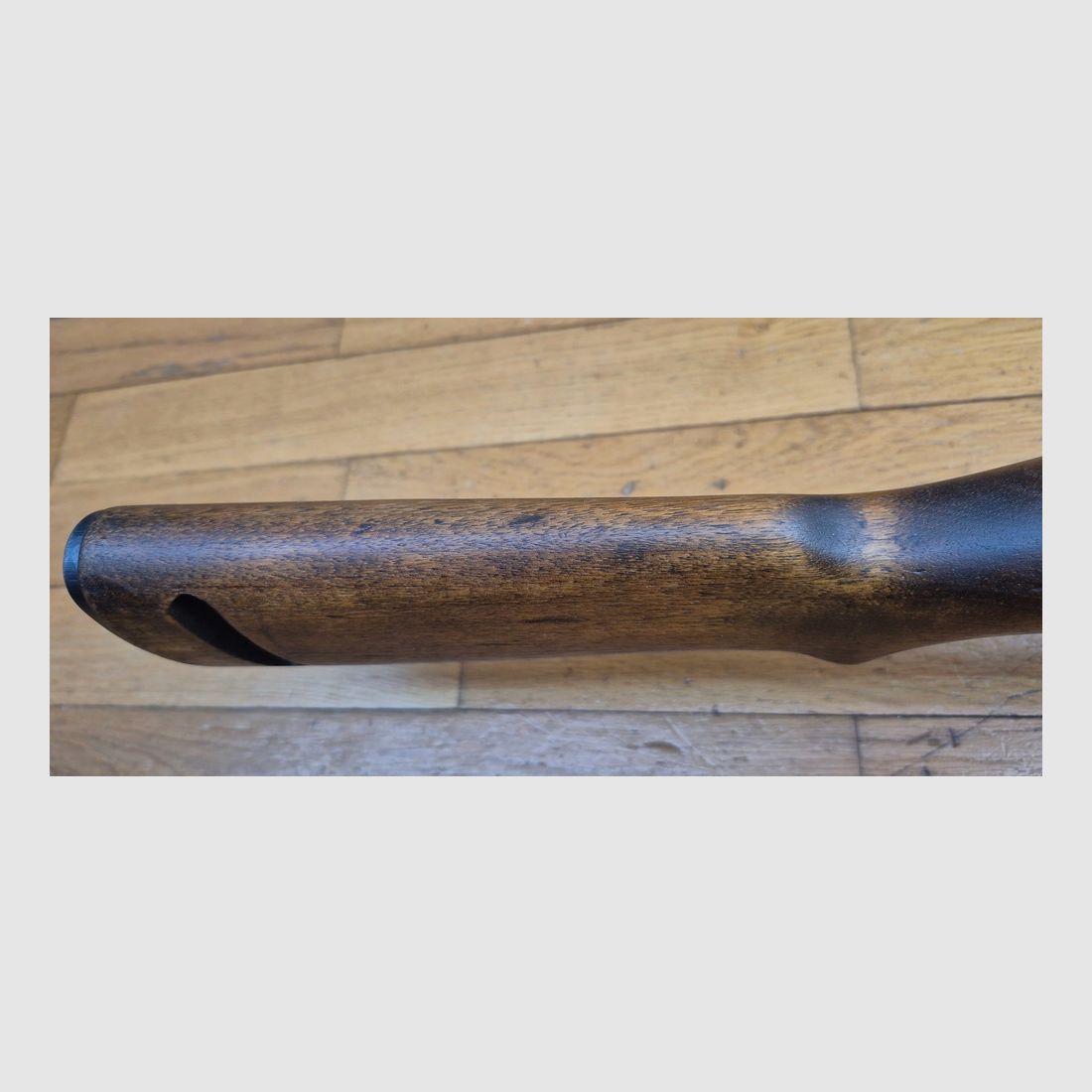
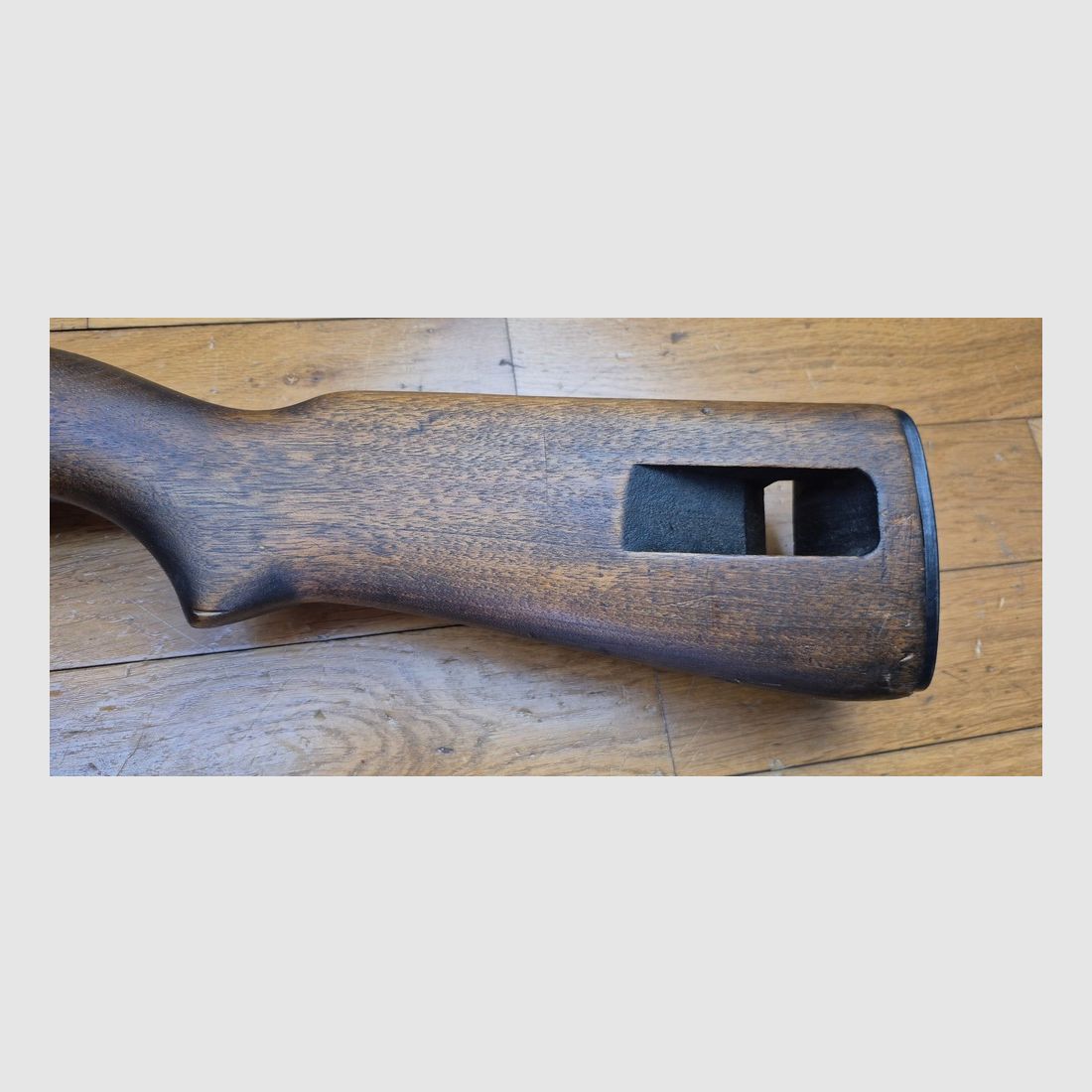
The M2 has what’s known as a “potbelly” stock—literally, a “potbellied” stock: wider and slightly deeper wood beneath the moving part of the bolt and its piston. The stocks also have a
long clearance cut on the right side.
Why? Because the automatic firing mechanism (selector, disconnector, modified lever) needs a little more room than the M1’s slim stock provides. Also, a wider, slightly heavier stock offers more stability during automatic fire.
The M2 stock is therefore fuller underneath and cut away on the right. M2 parts could also be fitted to modified M1 stocks, and postwar mixes are common—but the original “potbelly” stock remains THE hallmark of the original automatic version.
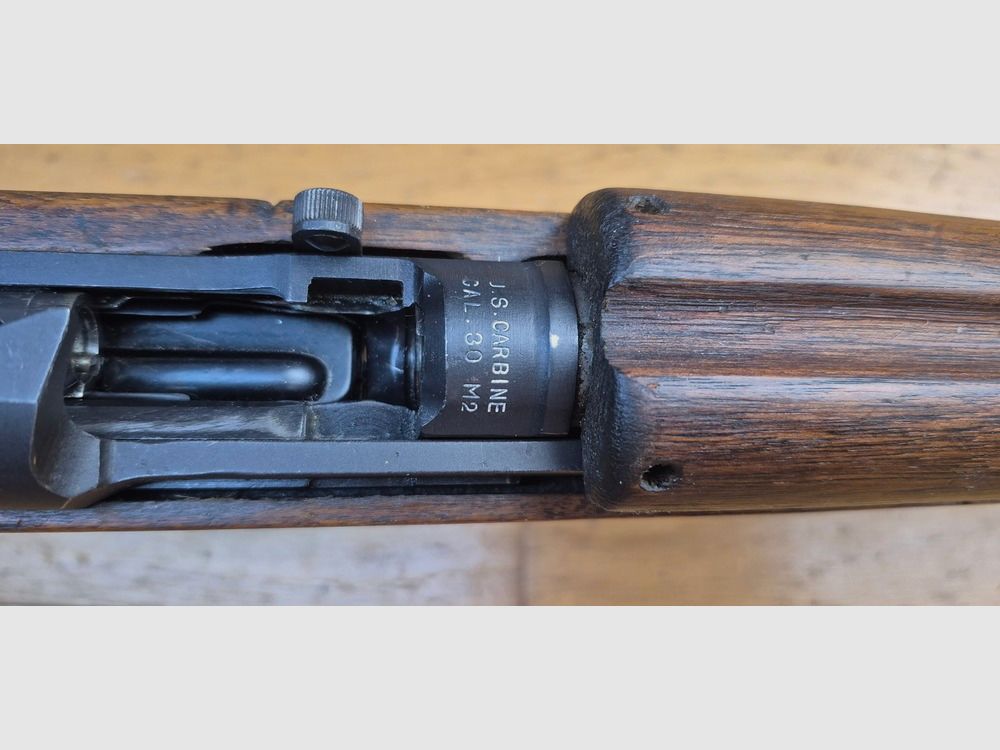
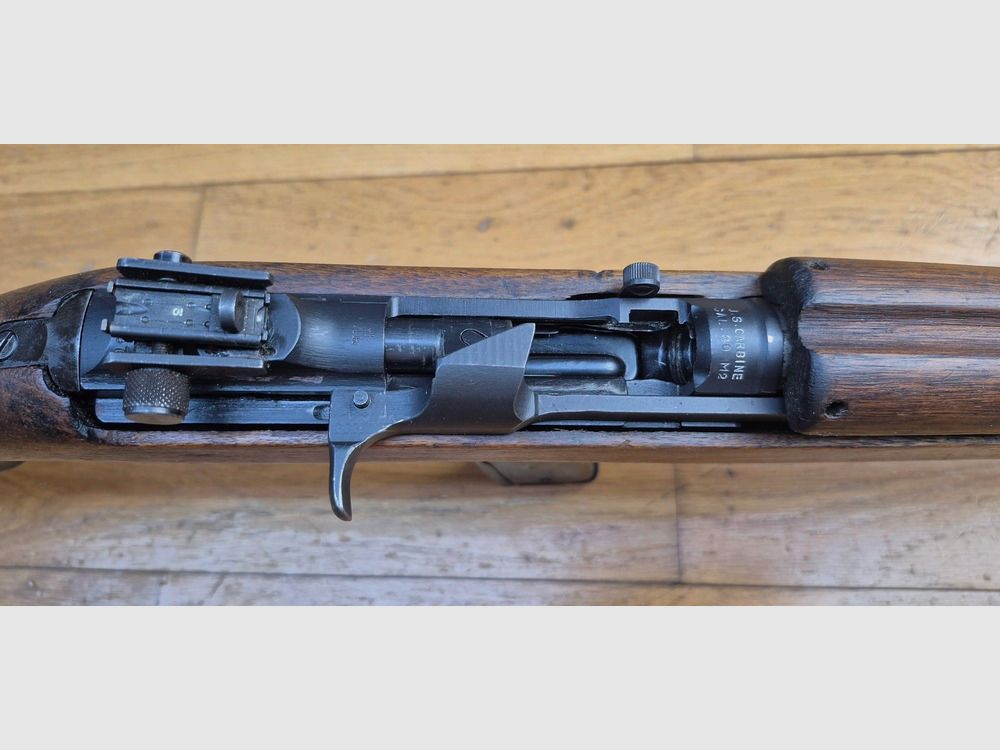
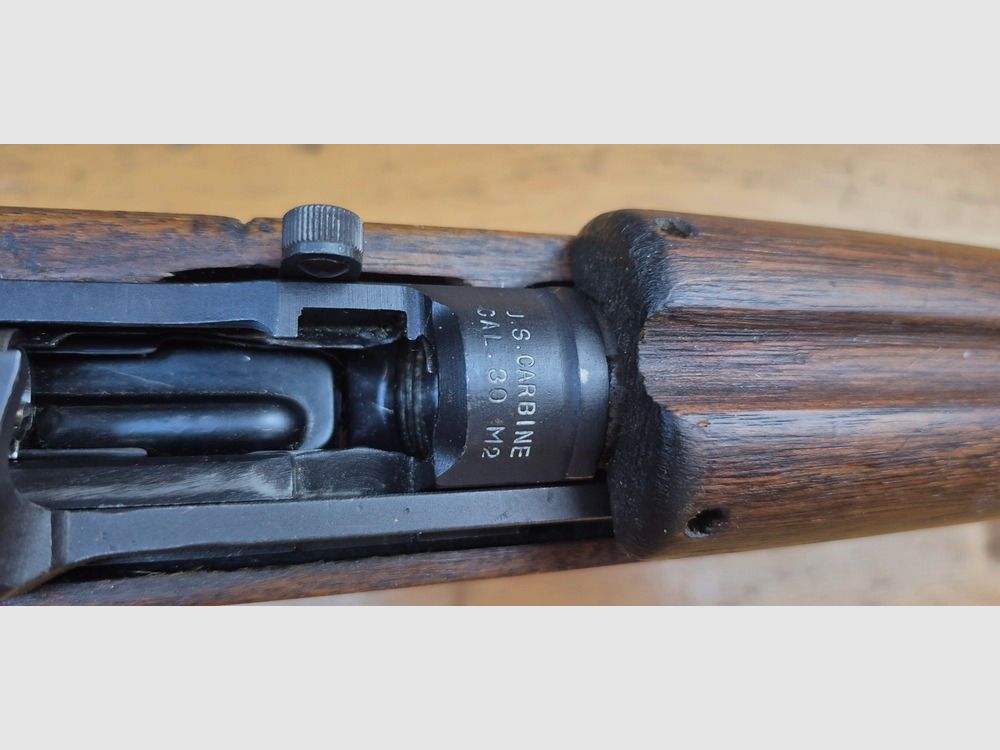
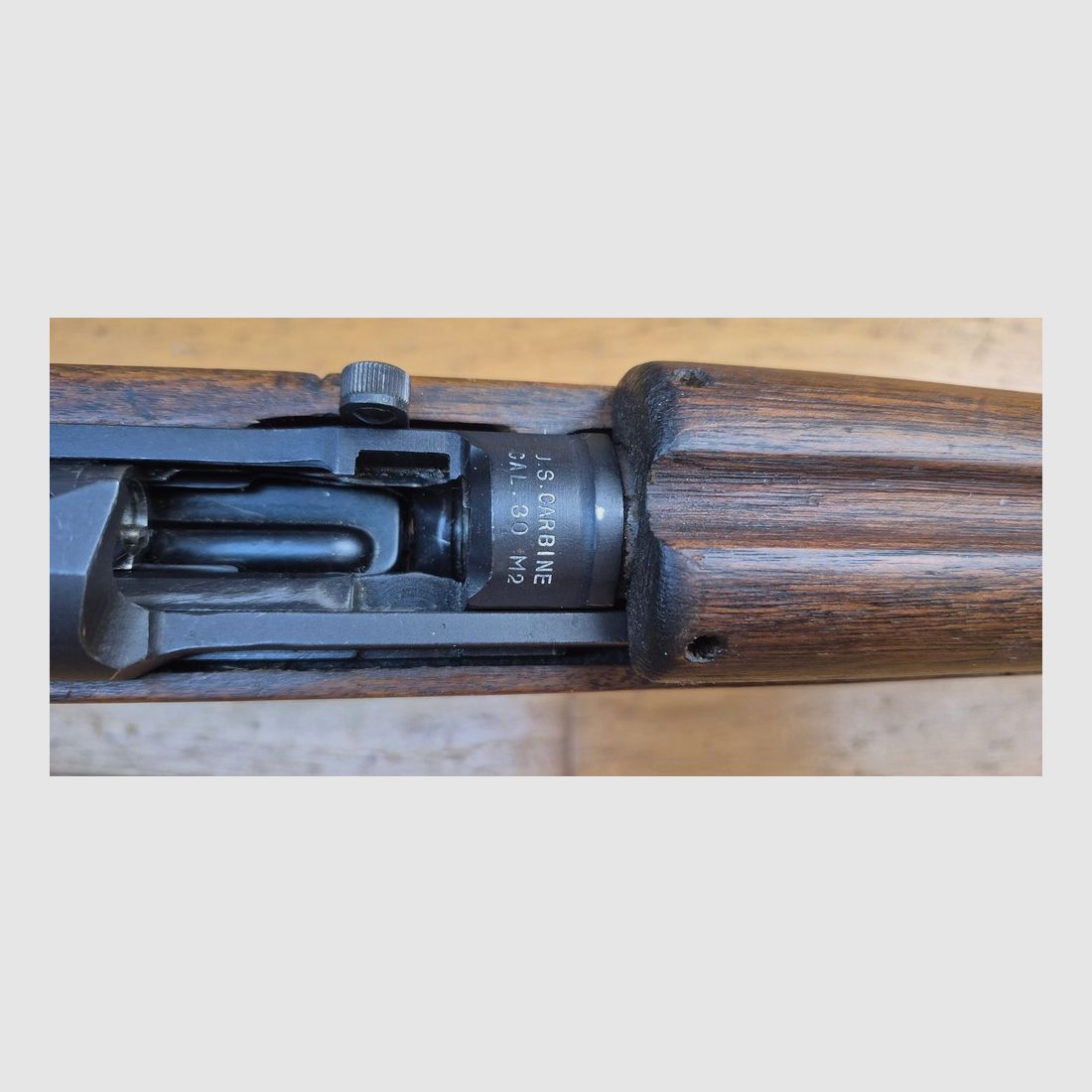
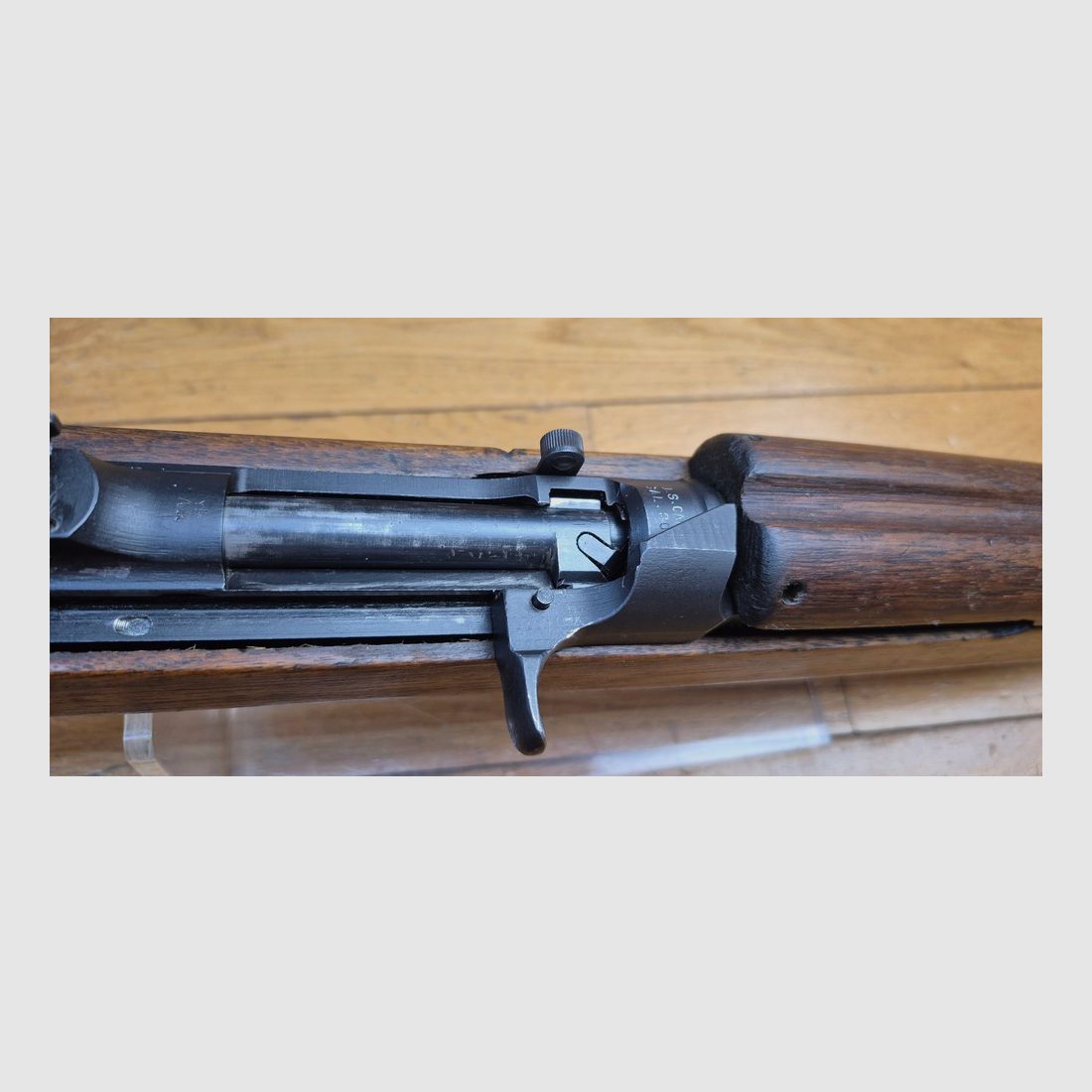
The receiver marking should also read “US Carbine Cal.30 USM2”. Not “USM1”.
On converted examples, the markings were most often left unchanged, so they remain marked “M1” on the receiver despite the conversion. Sometimes the “1” was overstruck with a “2”, manually stamped over the original “USM1” marking.
But there are a few subtleties here: Inland also produced standard receivers very early in production, marked only with an M and no model designation.
Depending on whether these receivers were later assembled as M1s or M2s, they received a “1” or “2”, hand-stamped and not always very well aligned. These guns, whether ultimately USM1 or USM2 (“1” or “2”), are called “Handstamped” by American collectors.
Winchester has another subtlety. Winchester receiver markings went directly from M1 to M2. So the first M2s were still assembled using receivers marked “M1”. They were given a “2” overstruck on the “1”. Collectors call these transitional guns M2 “Overstamp” (overstamped, like postage stamps).
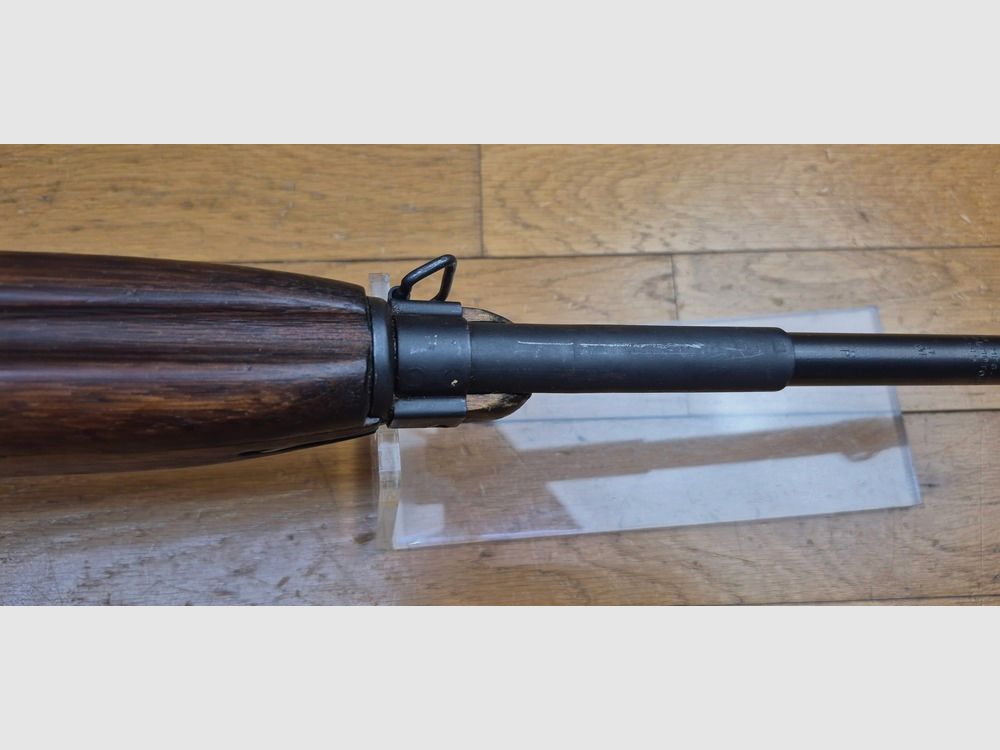
Of course, any original M2 must have a 1945 barrel, and only a 1945 barrel. These barrels may date from March–May 1945, a little before M2 production actually began, since barrels were generally machined and marked well ahead of final assembly on the receiver. But they must be from 1945. Otherwise, at best, it’s a USM2 converted from a USM1.
So, to identify a “pure” USM2 with certainty, it’s also useful to know the relevant serial number ranges.
What are they?
Well, paraphrasing a certain Nicolas married to a certain Carla who sings, Maître Flingus declares, imitating said Nicolas: “Well, um, I’ll tell you, Mrs. Duchmole!”
For Inland, “pure” USM2s fall in the serial number range 6 664 884–7 234 883, corresponding to production in May and June 1945.
For Winchester, the range is 7 234 884–7 369 660, corresponding to June–August 1945 (a separate block, immediately following Inland’s).
Original USM2s fall within these serial number ranges.
There, you now know pretty much everything I know about USM2s and how to identify them.
As for combat, the USM2 arrived a little too late to make much of an impact in 1944–45. And only in the Pacific.
However, the weapon came into its own in Korea. Its burst fire was valued over the M1 for close-quarters night combat against mass assaults by North Korean and Chinese forces. This is also where the old controversy began over the .30 Carbine’s lack of stopping power in extreme cold against Chinese soldiers bundled up a little too warmly—a never-ending, largely mythologized debate that has stuck to the cartridge ever since.
The fine little USM2 would appear again in Vietnam, early in the conflict, where its light format suited the smaller South Vietnamese soldiers quite well compared with the tough guys from Kansas. That didn’t stop them from often showing great bravery and a deep understanding of combat in a country they knew.
France also made extensive use of the
age of the USM2. USM2 carbines often equipped our troops in Indochina and later in Algeria, whether they were converted M1s or genuine M2s. Many French veterans had this handy, fun little rifle in their hands. And sometimes they brought it home. That’s the case with today’s firearm, which had been sleeping in Burgundy.
In the end, these East Asian and North African adventures only contributed a little more to the rarity of USM2s converted from USM1s, and even more so to the rarity of original USM2s like ours.
Today, because of its full-auto selector, the USM2 falls into Category A2 in France — automatic military equipment, reserved for export. So my fellow countrymen will just have to admire it and dream.
And all I want is to save one more from destruction by exporting it. I’m doing what I can, as old man Ducros would have said in a famous ad from the ’80s. But perhaps, long after Maître Flingus is gone, one of these firearms will still bring joy to a collector or a museum somewhere…
Today’s firearm is indeed one of these rare original USM2s. A survivor. Not an USM1 converted into an M2.
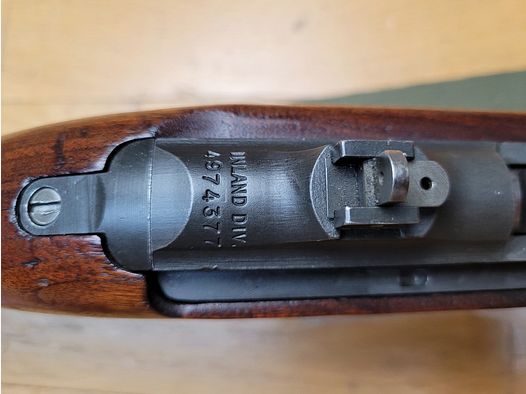
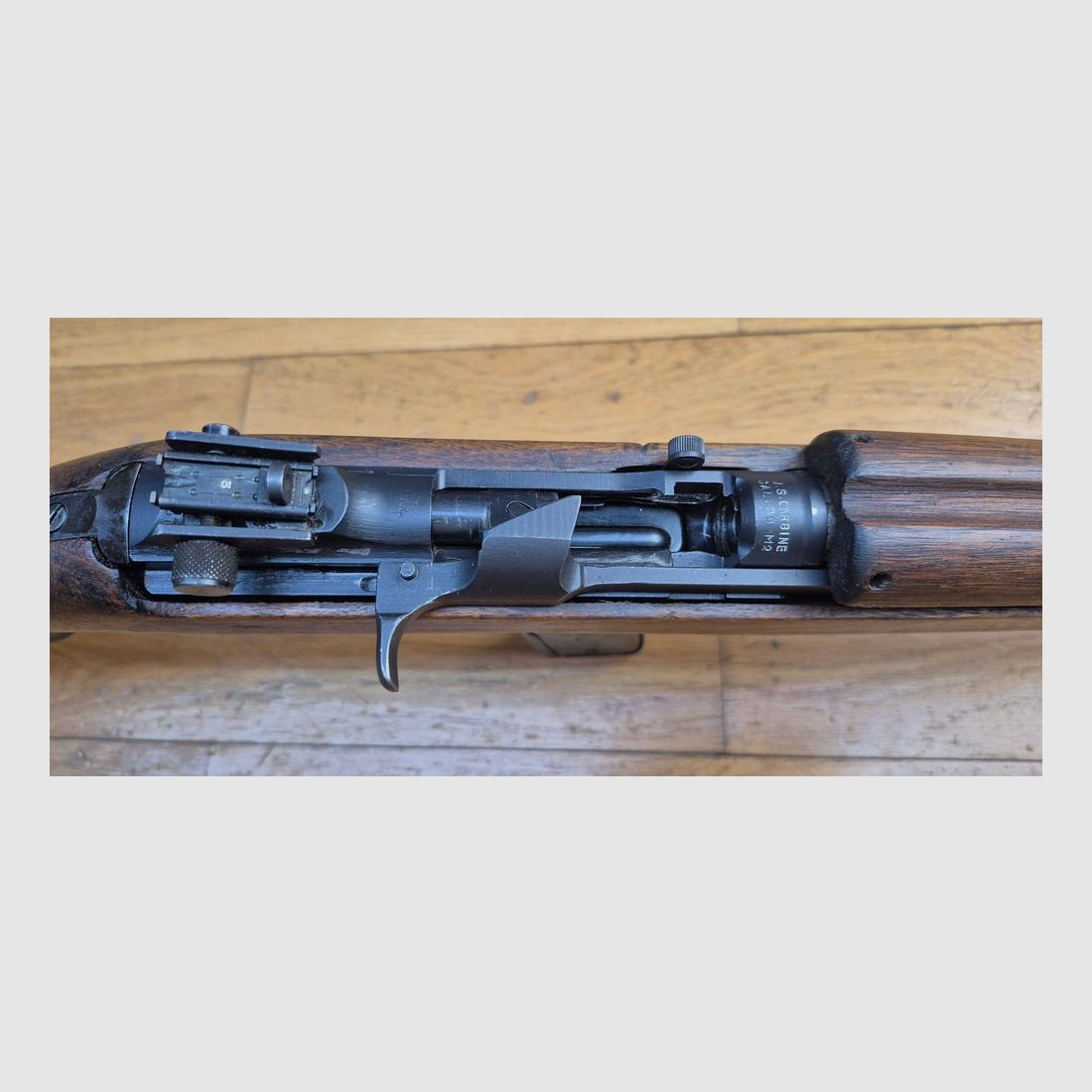
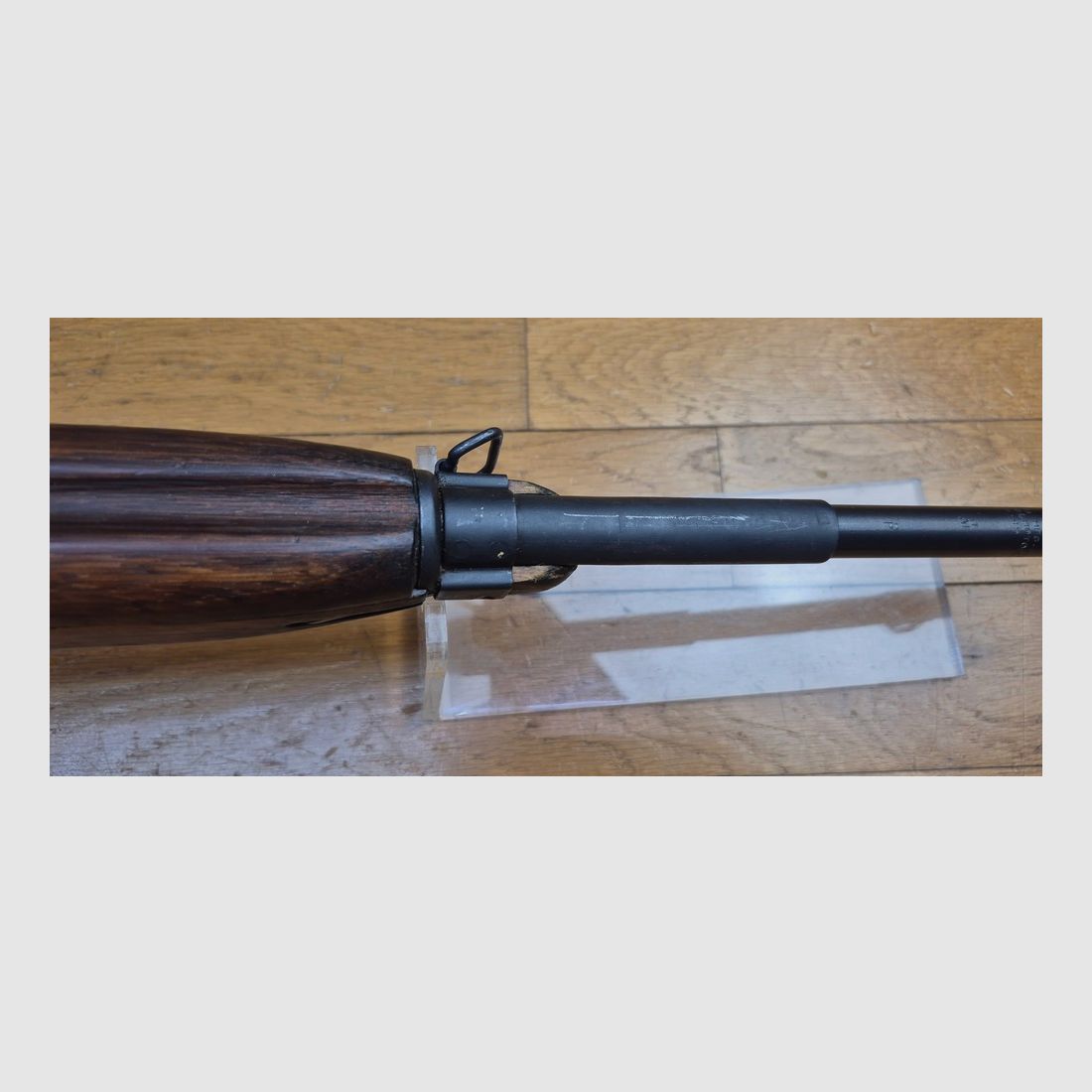
It’s an Inland, as shown on the rear of its receiver. Its barrel is Inland-made too. One of only two factories that produced them.
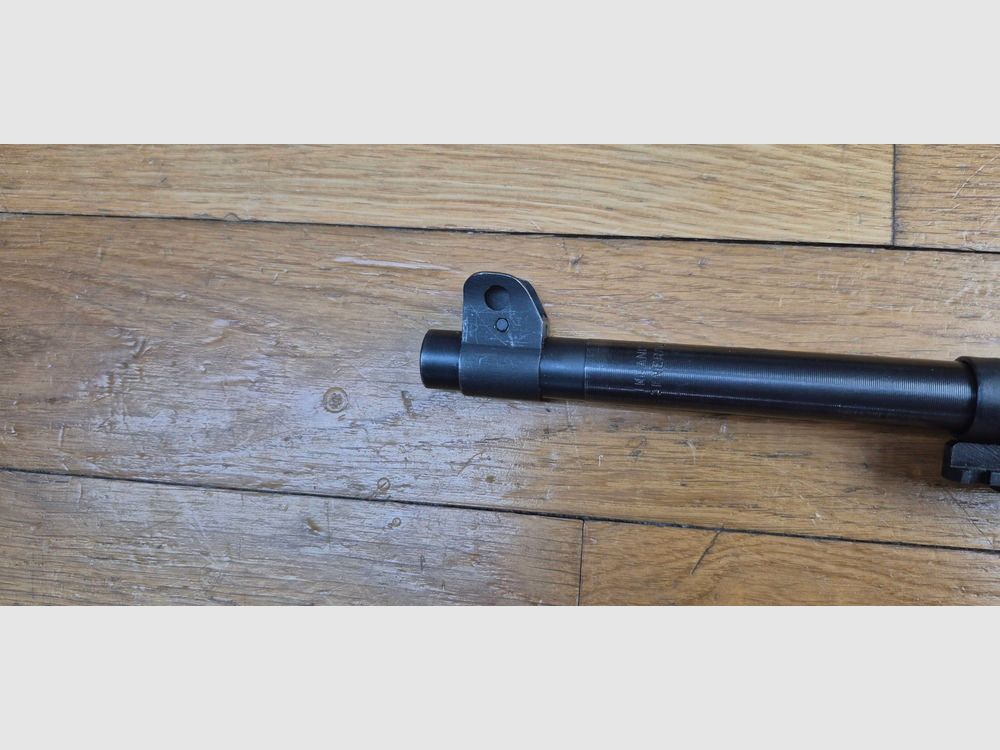
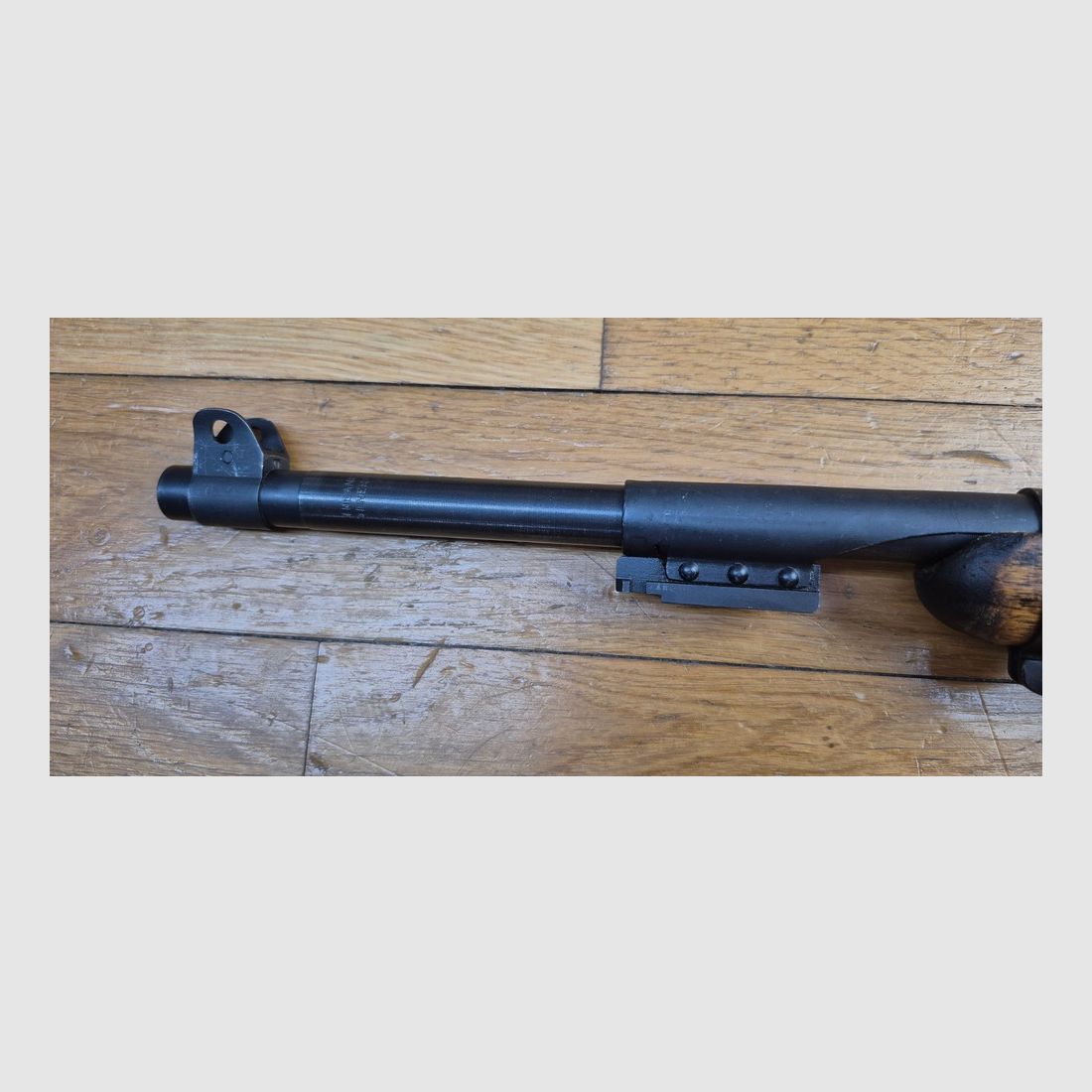
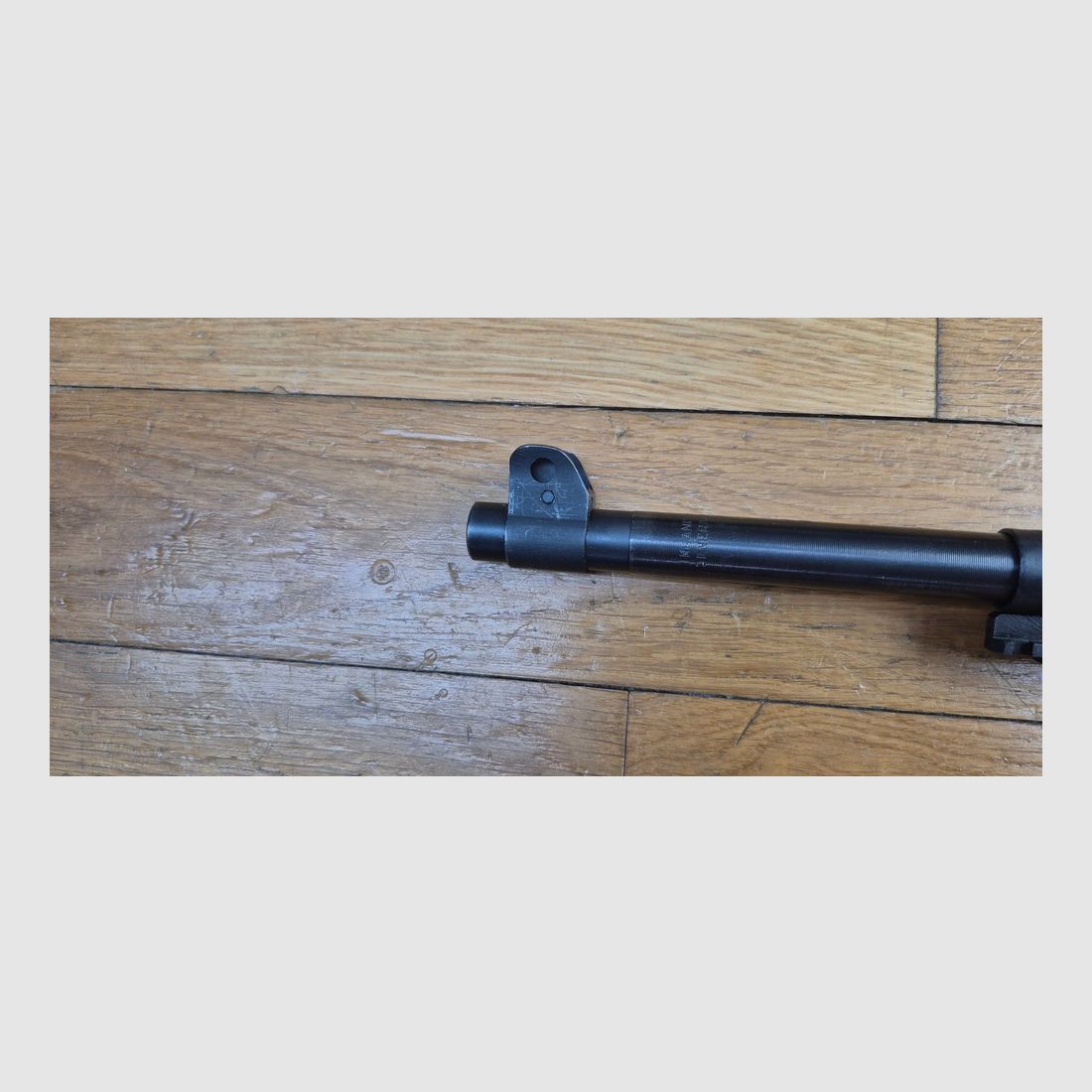
Its serial number is in the 7,200,XXX range, which places it squarely within Inland’s short production window in spring 1945, around May or June 1945. Its barrel is also dated (April) 1945, which is perfectly consistent for an original USM2, given that barrels were machined and dated before the firearm was assembled.
All USM2 barrels are from 1945, as explained below. This is one way to distinguish them from standard USM1s converted to M2s.
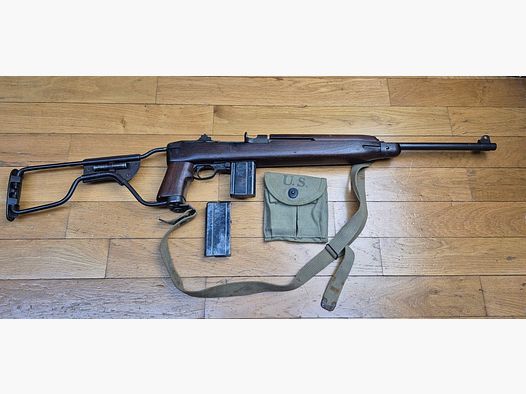
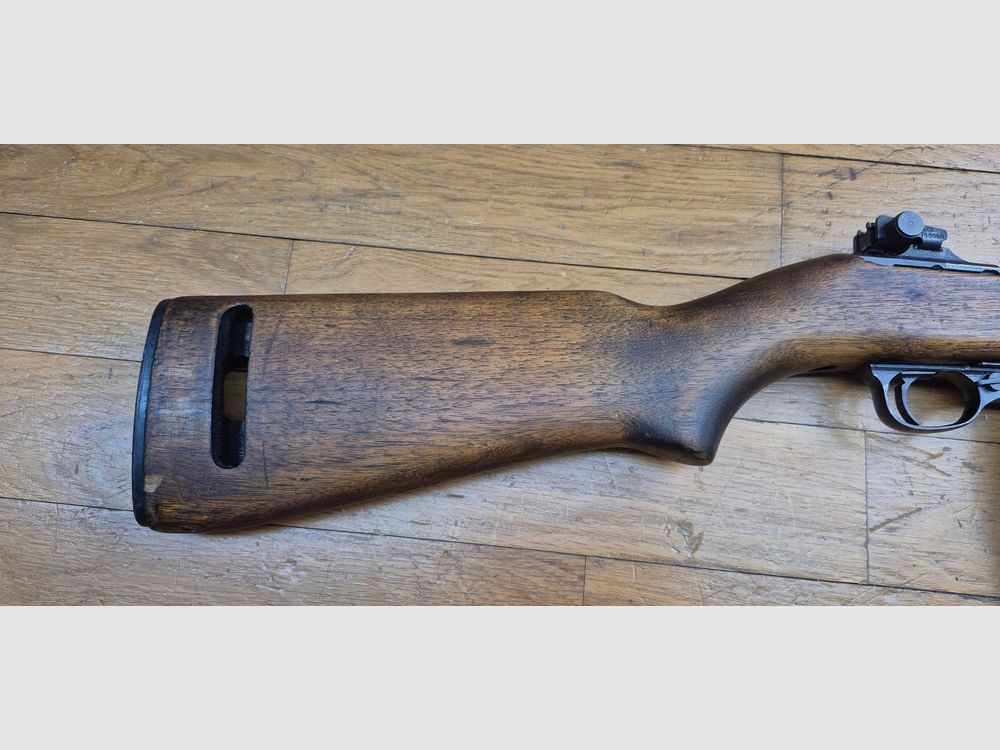
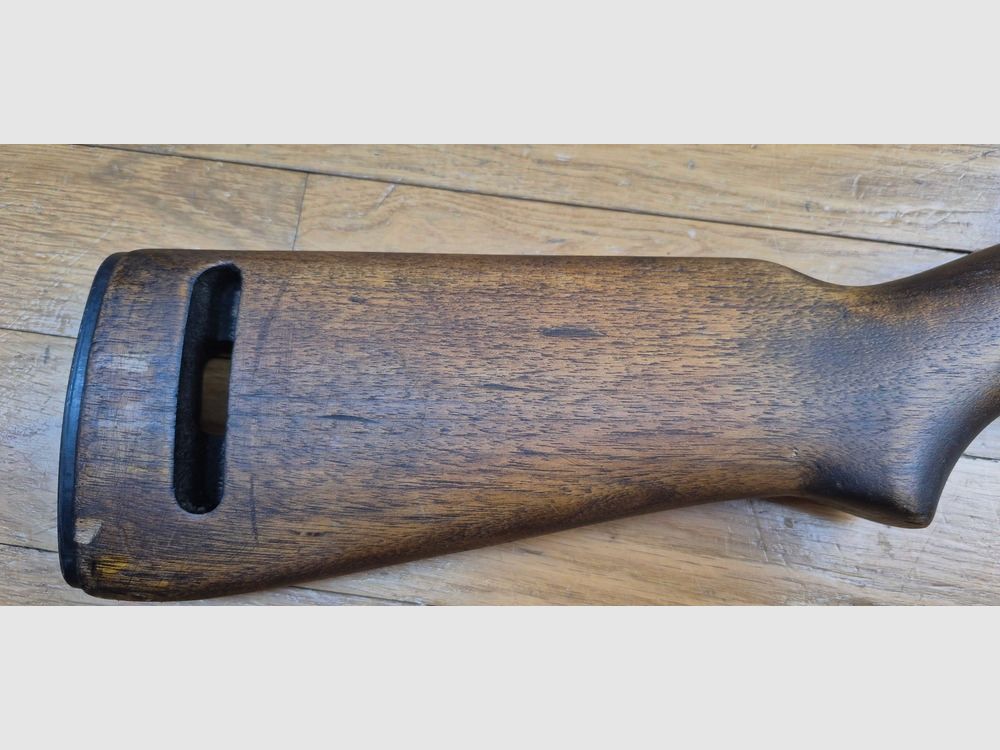
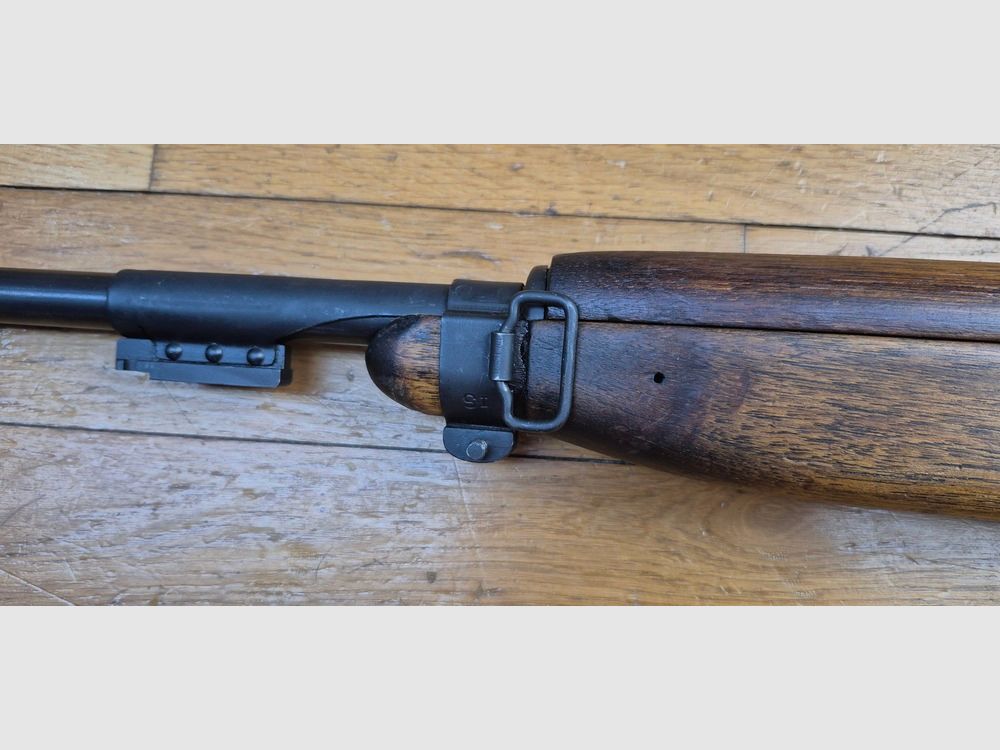
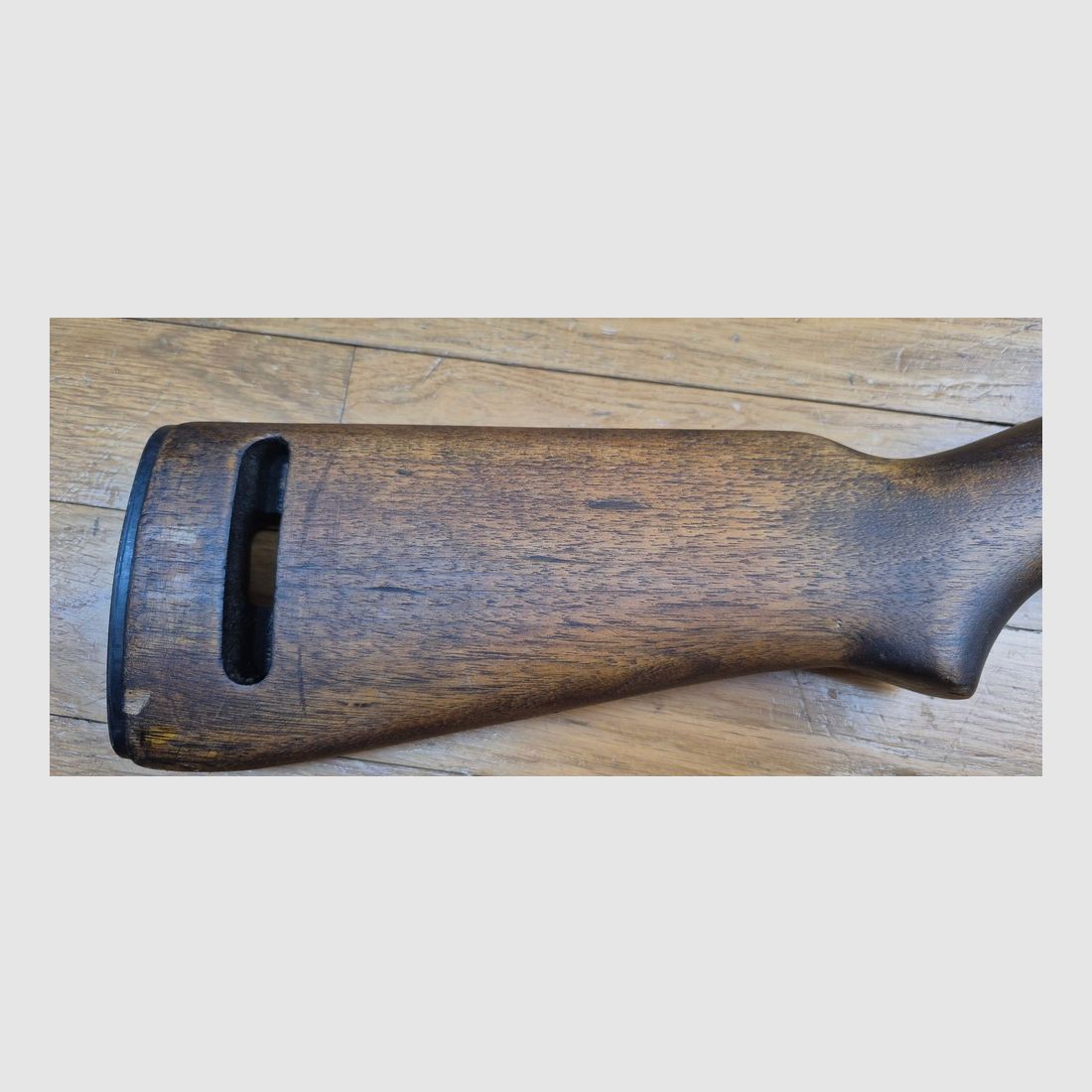
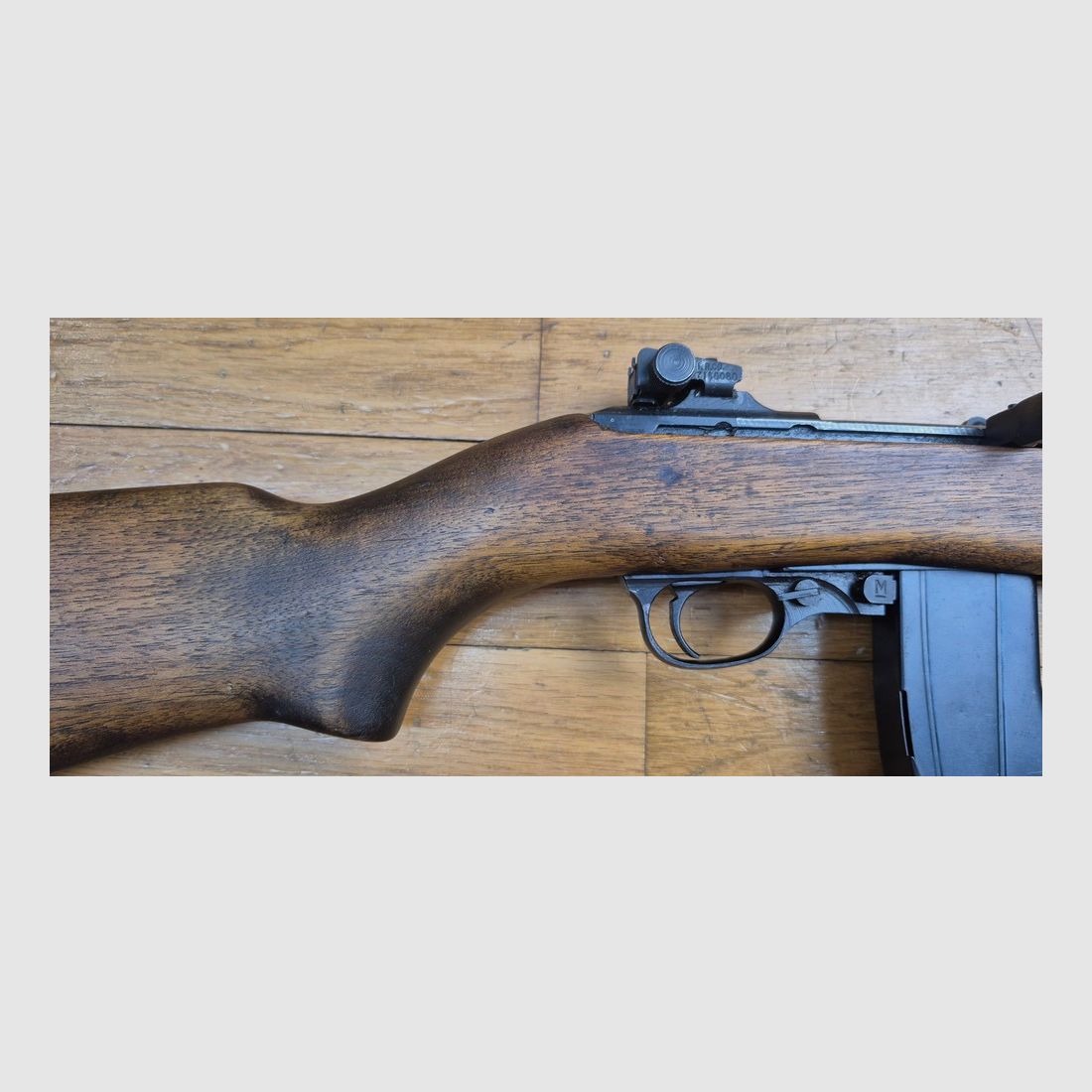
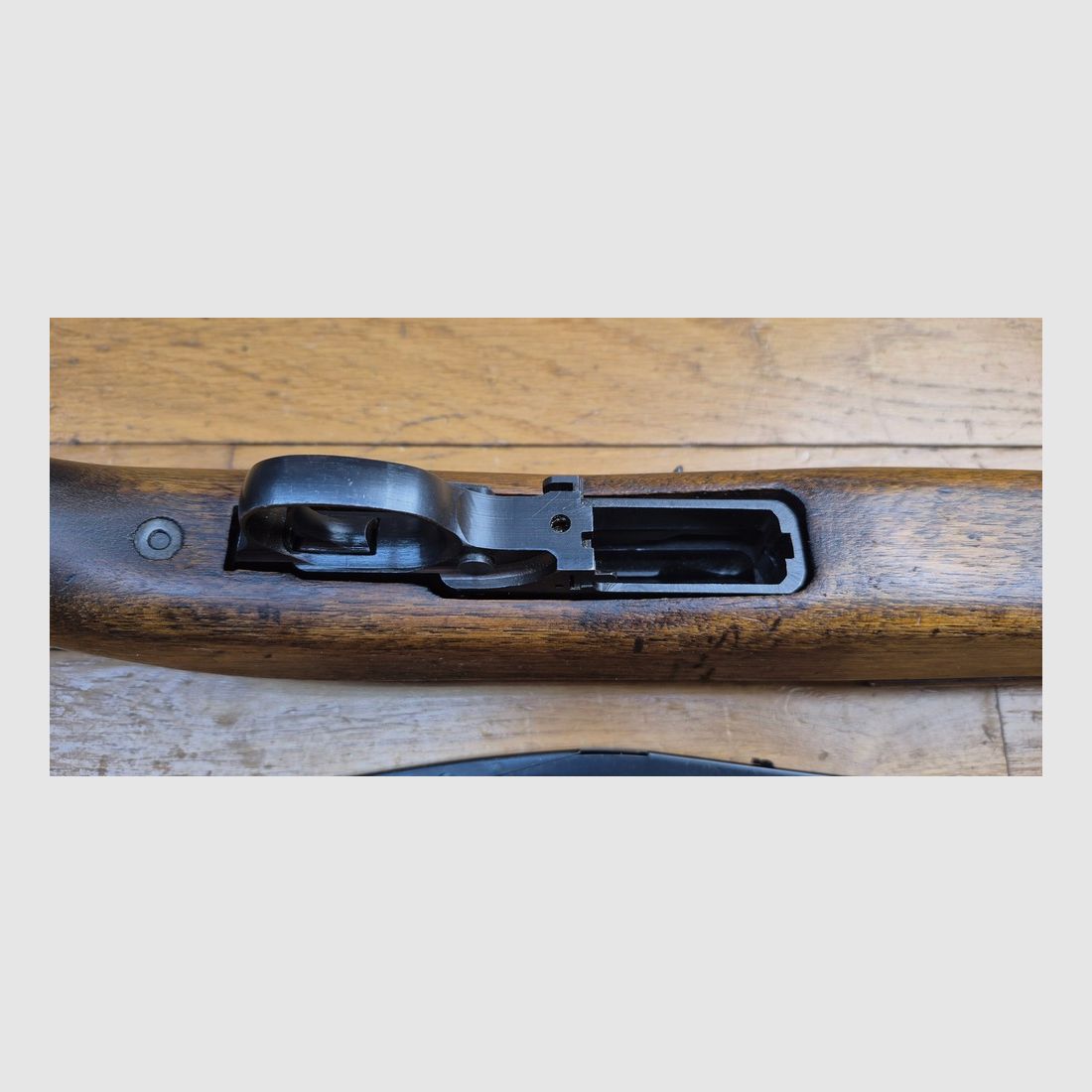
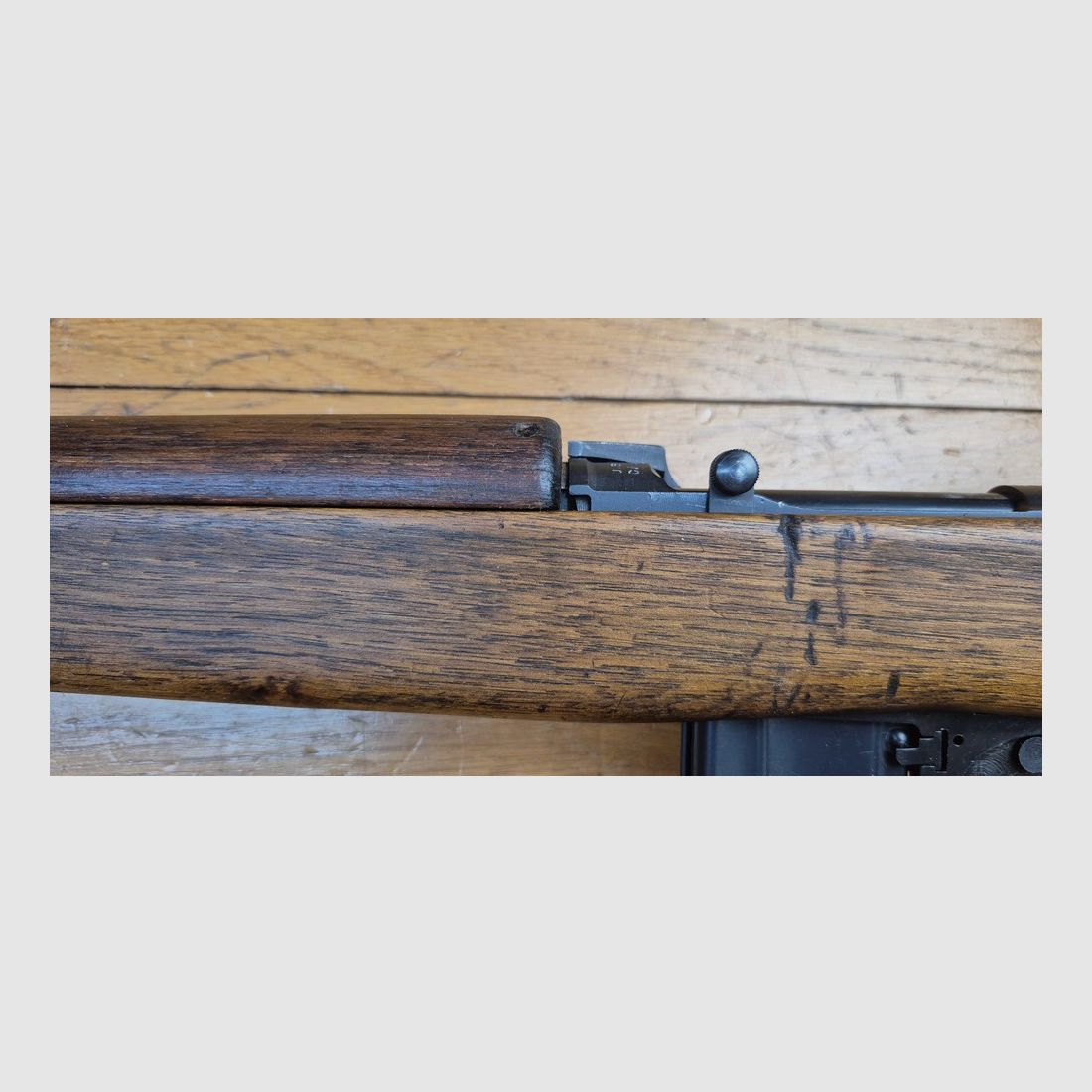
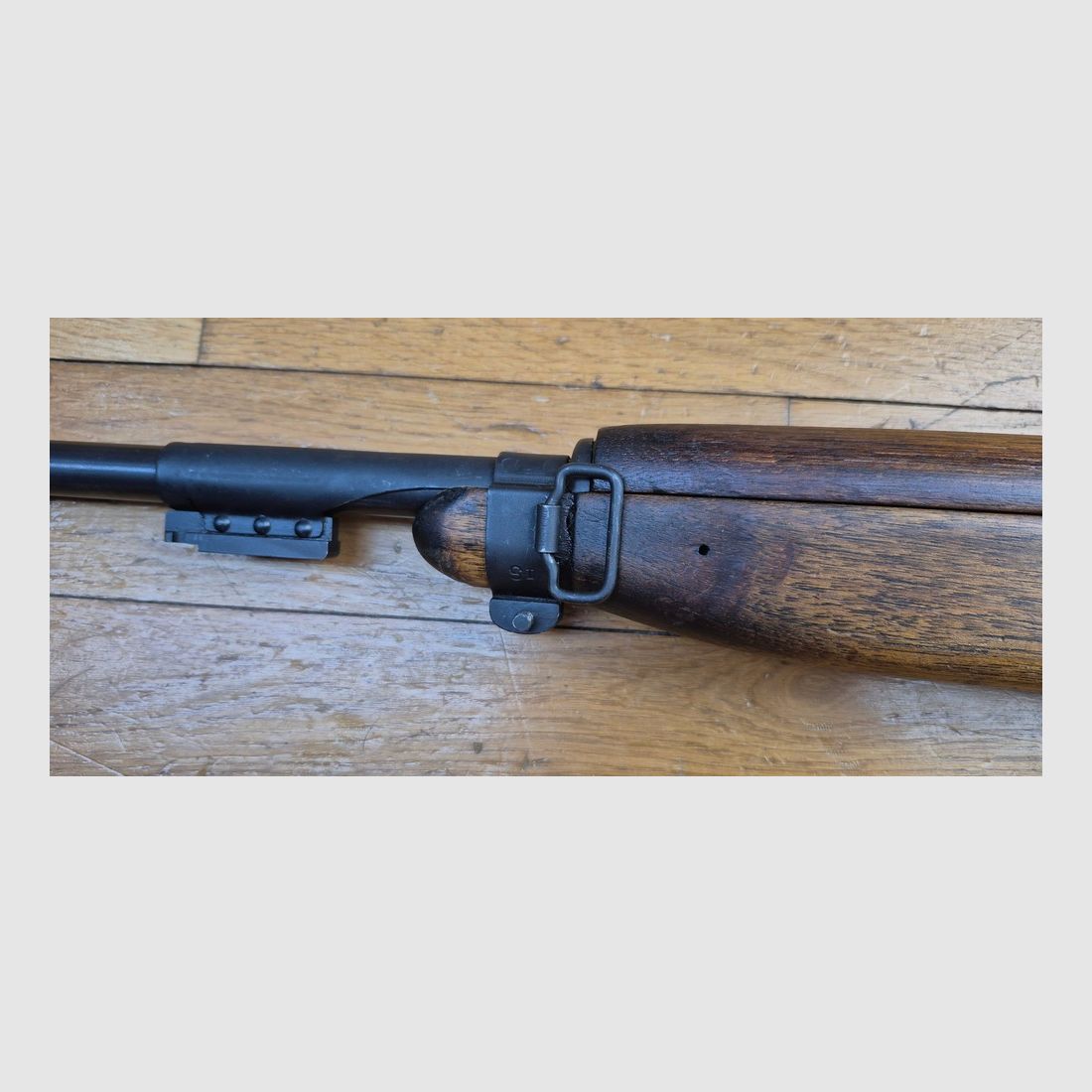
The firearm is, of course, fitted with its correct original potbelly stock, with its swollen underside and wide cutout, another feature that identifies authentic firearms. This is a very fine original USM2 carbine.
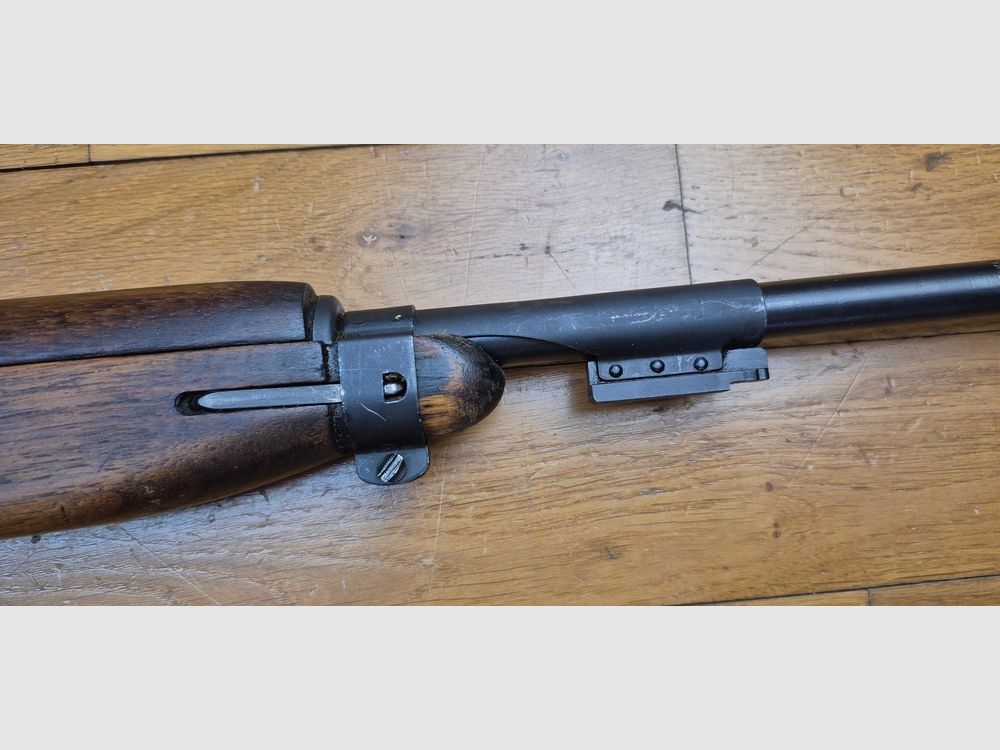
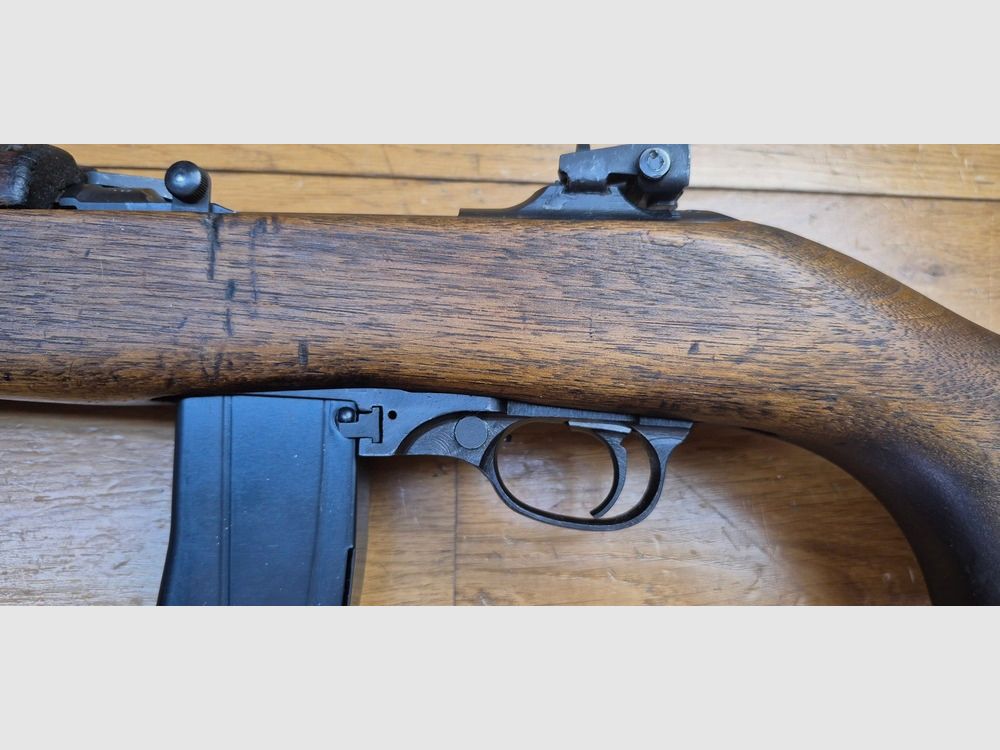
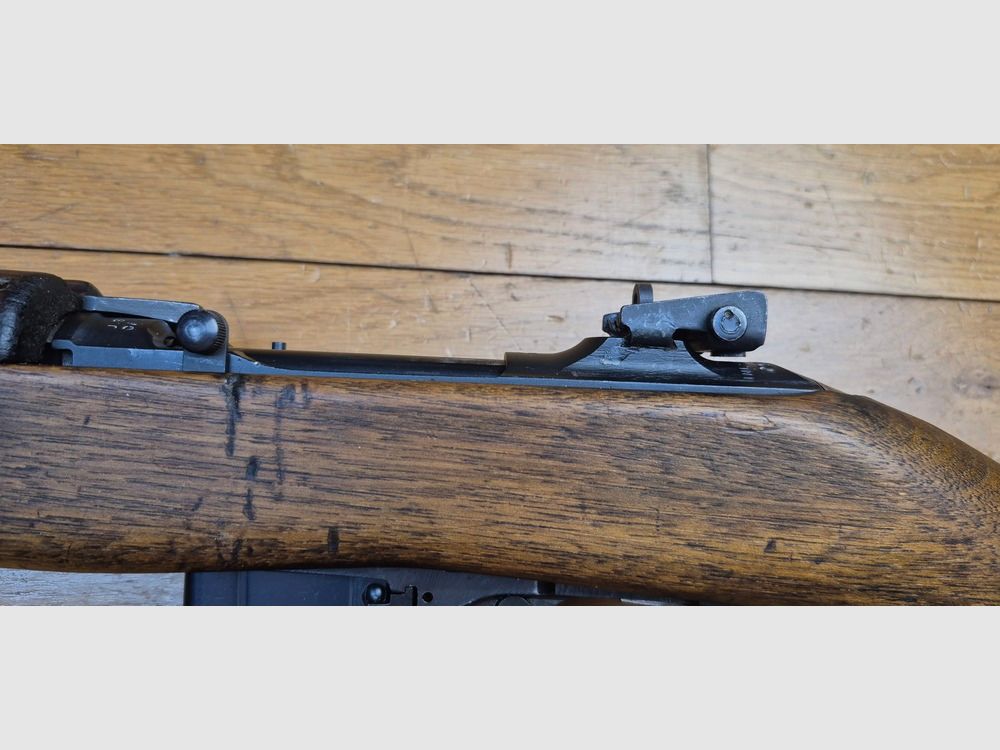
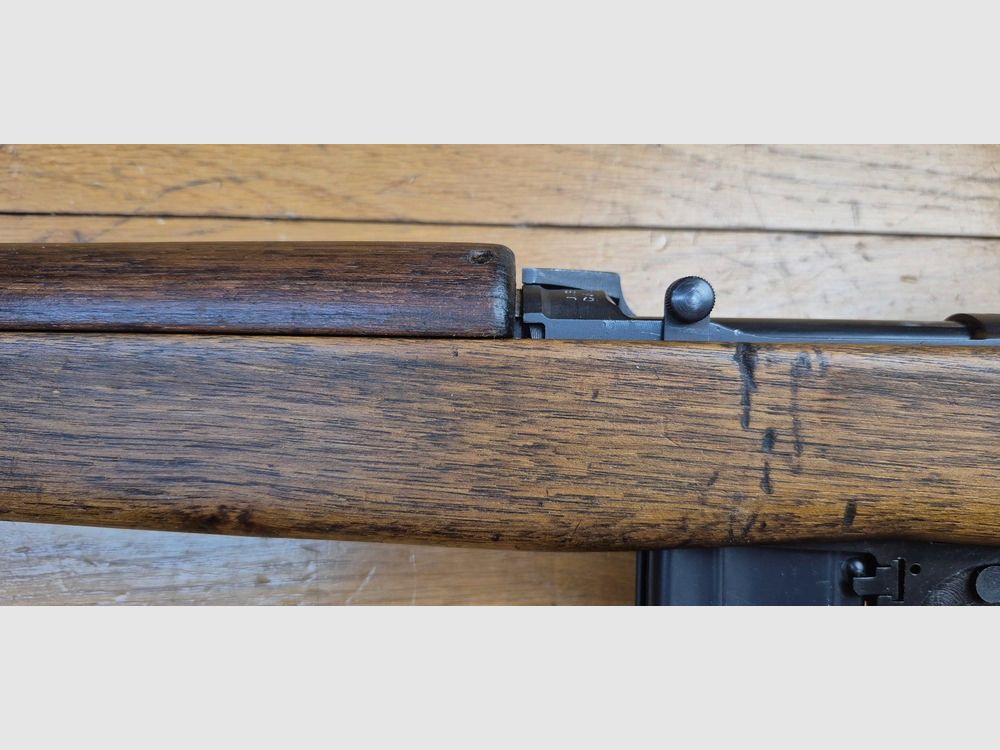
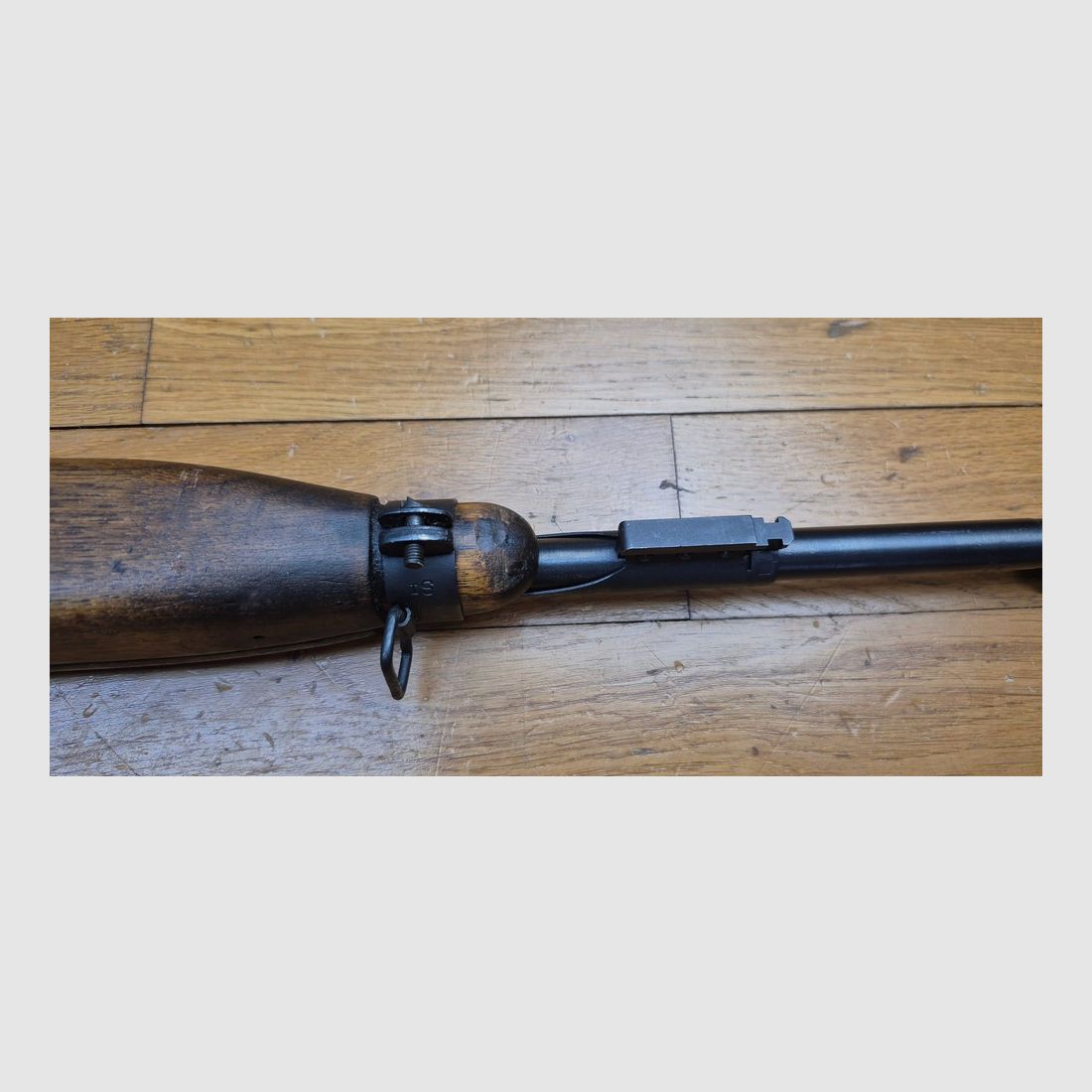
The wood is in very nice condition. No major repairs or damage. Just a few scattered handling marks, as usual, GREATLY EXAGGERATED by my TOO-CLOSE close-ups. Look at the firearm as a whole to get a better idea. But this way, you can see everything.
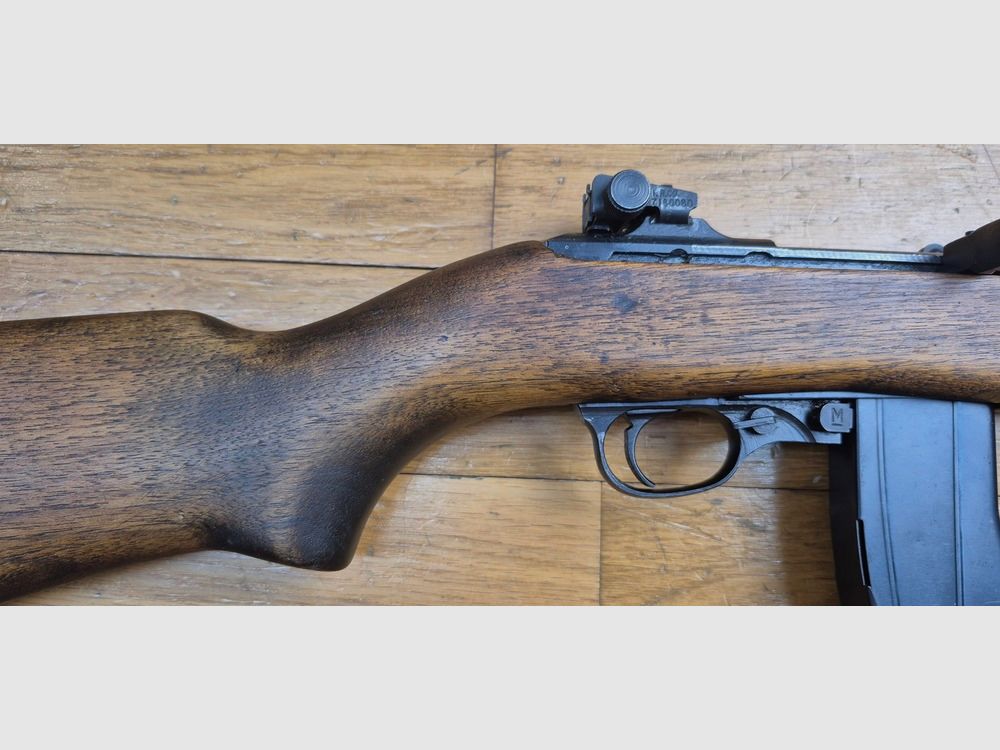
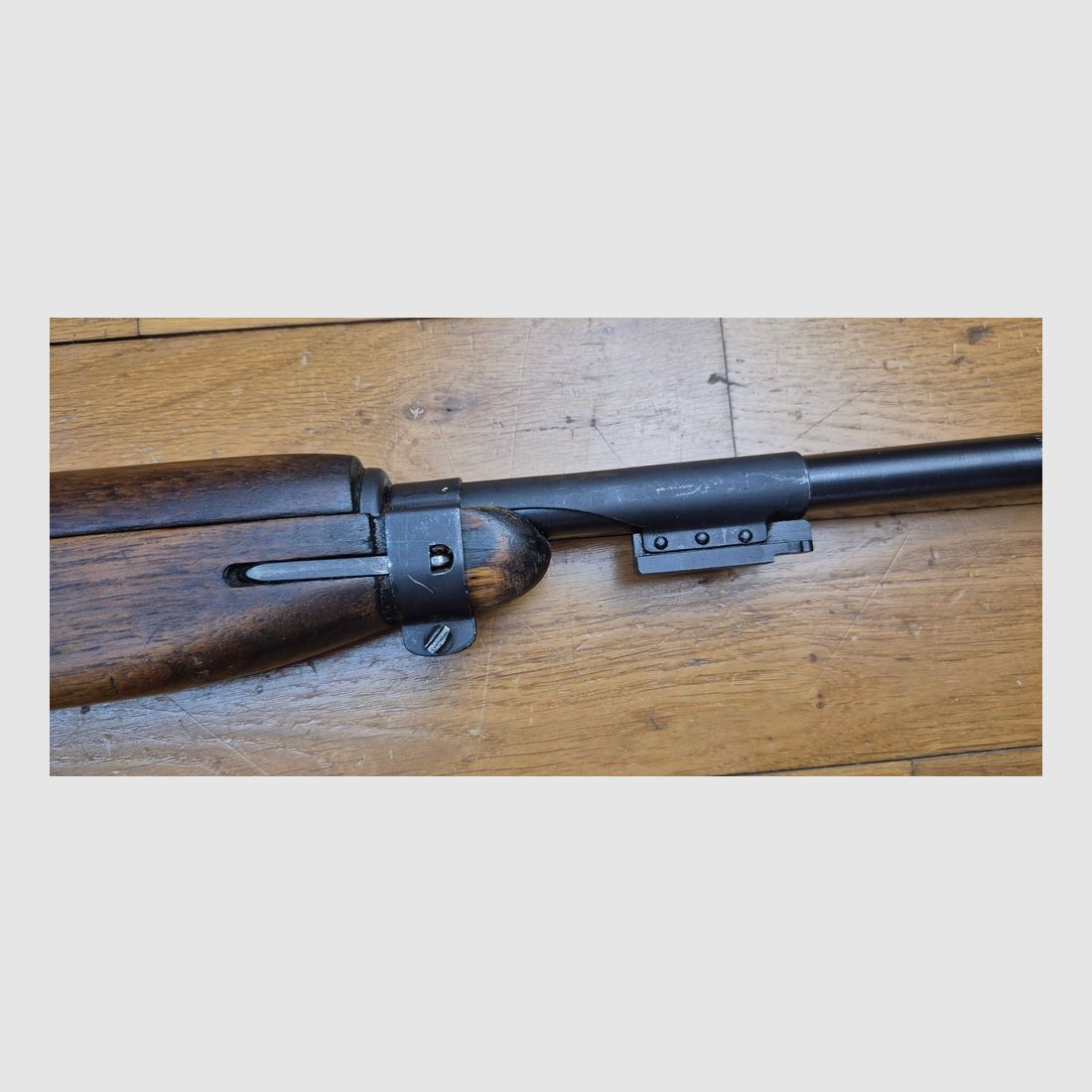
The firearm is fitted with its original second-type rear sight and bayonet lug, which was only fitted to USM1s across the board after the war, before they were sent back to Korea.
The metal parts are also in very good condition, with 98% of the original bluing and no oxidation or orange peel. Overall, the firearm is in very good-plus cosmetic condition.
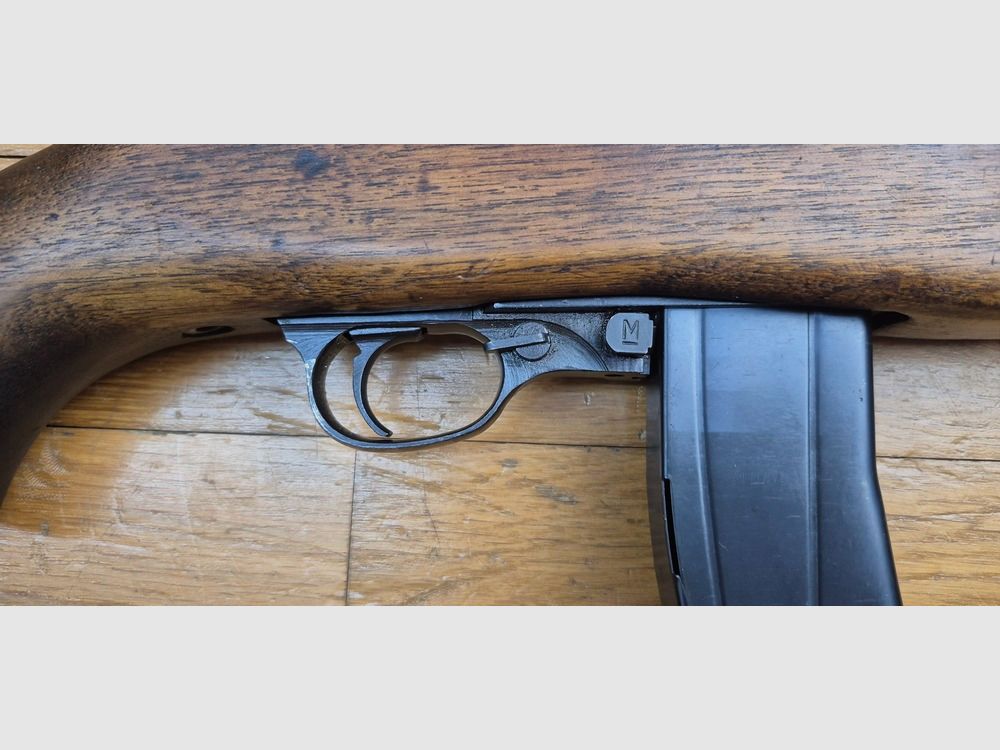
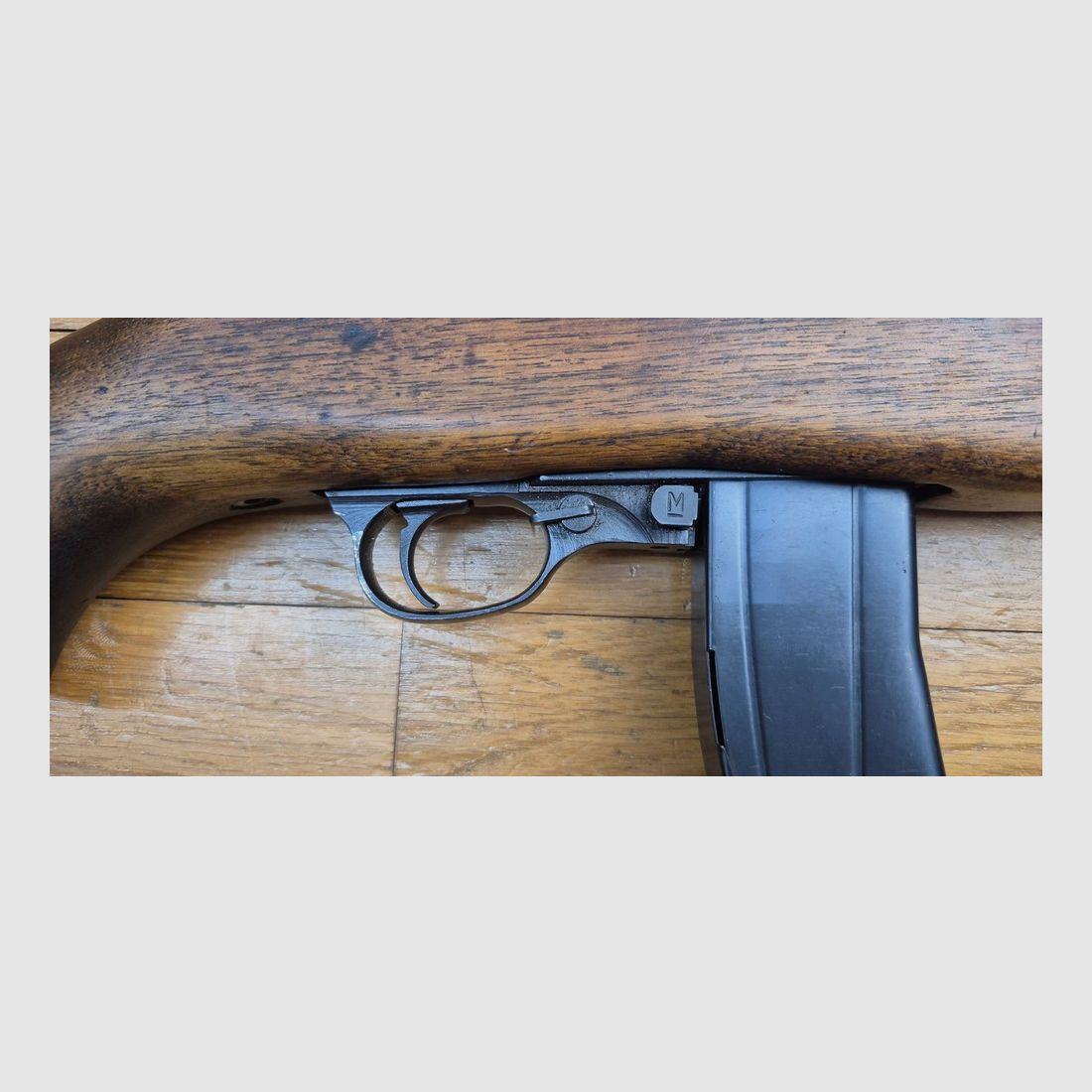
The action is impeccable, with good, firm springs and a crisp, positive strike. The trigger is very good, as is often the case with USM1s/M2s.
The barrel is splendid. Mirror-bright and almost like new, with very fine rifling. It’s clear that the firearm has seen very little use or even handling. An excellent specimen.
The firearm is fitted with a modern-made 30-round magazine that is correct for the model. Original .30 M1 caliber.
All in all, an excellent example of the rare automatic version of the USM1, in more than very good condition. A very fine, uncommon piece for a firearm with the profile of an original USM2, not converted from an USM1. A choice piece for a discerning collector or a museum. Reserved for export once again.
PRICE: Contact us (and only if you are legally allowed to acquire it…)
Category A2 – EXPORT ONLY – Contact us about the paperwork.
English translation
Today’s example is indeed one of these rare original USM2s. A survivor. Not an USM1 converted into an M2.
It’s an Inland, as shown on the rear of its receiver. Its barrel is Inland-made too — one of only two factories that ever produced these USM2s.
Its serial number falls in the 7,200,XXX range, which places it squarely within Inland’s short spring 1945 production window, around May-June 1945. Its barrel is also dated (April) 1945, which is perfectly consistent for an original USM2,
since barrels were machined and dated ahead of final assembly.
USM2 barrels are all dated ’45, as explained above. That’s one of the ways to distinguish them from ordinary USM1s converted to M2.
The firearm is of course fitted with its correct original « potbelly » forestock — the swollen, wide-notched wood — another criterion marking out authentic pieces. This is indeed a very fine original USM2 carbine.
The wood is beautiful. No major dents or gouges. Just a few scattered handling marks, as always GREATLY EXAGGERATED by my WAY-TOO-CLOSE close-ups. Look at the firearm as a whole to get a true sense of it. But this way, you see everything.
The firearm is fitted with its correct original second-type rear sight and the bayonet lug, which would only become standard on regular USM1s after the war, for Korea.
The metal is likewise in excellent condition, with 98% original bluing and no oxidation or orange-peel texture. An overall excellent-to-outstanding specimen aesthetically.
Mechanically flawless, with strong, firm springs and a crisp, clean firing pin strike. A very good trigger, as is often the case on USM1/M2s.
The barrel is superb. Mirror-bright and virtually new, with beautiful rifling. It’s clear this firearm was very little used, or even carried. An excellent specimen.
The firearm comes with a modern-manufacture 30-round magazine, correct to the model. Original .30 M1 caliber.
In short, an excellent example of the rare automatic version of the USM1, in more than very fine condition. A choice piece, quite uncommon, for a genuine original USM2 profile rather than a converted USM1. A prime piece for a discerning collector or a museum. Once again reserved for export.
PRICE: Contact us (and only if you are legally eligible to acquire it…)
Category A2 – EXPORT ONLY – Contact us for your customs formalities. (Show description in original language)
English translation below for item’s description
Voici la petite sœur automatique de la plus produite des armes légères américaines de la Seconde Guerre mondiale, la carabine USM1. Son petit nom à elle, c’est « USM2 ».
À la fin des années 1930, l’US Army cherche un « light rifle » — un objet intermédiaire entre le pistolet .45 et le lourd fusil Garand.
L’idée est d’armer correctement tous ceux qui ne sont pas des fantassins de première ligne mais qui peuvent se retrouver au contact direct de l’ennemi — officiers, radios, servants de mortier, artilleurs, équipages de blindés, conducteurs.
Le Colt 1911 est trop court en portée et trop difficile à utiliser en combat d’infanterie du fait d’une ligne de mire très réduite ; le Garand est lui trop long et trop lourd pour des hommes qui « travaillent » à titre principal.
L’idée, en gros, c’est du combat de défense entre 20 et 300 mètres.
Winchester rafle la mise lors des essais de 1941 avec son prototype. Le cœur de l’arme est un ingénieux petit piston à course courte — le fameux « short-stroke gas piston ». Cette arme deviendra l’USM1.
Ce piston à course courte est l’ADN mécanique de l’arme. Et il essaimera ensuite sur quantité de conceptions d’après-guerre.
L’histoire des armes attribue cet excellent système à David Marshall Williams, dit « Carbine Williams ». Il en aurait peaufiné le principe en… prison. L’animal avait en effet été condamné pour une affaire de distillerie clandestine dans laquelle il avait tué un shérif. C’est le Général René Studler, patron de l’Ordnance, qui était intervenu pour que « Carbine Williams » rejoigne Winchester à sa sortie de taule. Un gros piston aussi. D’un autre genre. Mais sûrement mérité.
La MGM tirera de cette vie romanesque un film typique de l’écriture de la légende américaine, film de 1952, avec James Stewart dans le rôle-titre sous ce même titre de « Carbine Williams ».
Néanmoins, si David Marshall Williams est bien l’inventeur de ce piston court, il fut épaulé dans la mise au point ultra rapide de l’USM1 par toute l’équipe de la Winchester de la grande époque.
Ultra rapide la conception de l’USM1 en effet; car le prototype Winchester aurait été bricolé en moins de deux semaines. On parle de treize jours. À prendre avec des pincettes, mais l’esprit y est. Ce fut réellement une conception éclair en moins d’un mois à coup sûr.
L’arme, excellente dès les essais, passa également très rapidement en production sans tests prolongés en unités comme il est de rigueur. Pour les américains, sûrs de leurs process industriels, l’USM1, c’était bel et bien du consommable.
Adoptée en octobre 1941 sous le nom de M1 Carbine, elle tire la cartouche .30 Carbine (7,62×33) : une balle de 110 grains à environ 600 m/s, pour de l’ordre de 1 300 joules en sortie de bouche. Beaucoup plus qu’un pistolet — et nettement moins qu’un vrai fusil de guerre.
Un compromis assumé avec un volume de gaz parfaitement compatible avec du semi-auto pour une fois (que l’on songe aux mises au point plus que laborieuses du Garand , du SVT36, 38 puis 40 ou encore pire en résultat du G41/G43).
Pour l’USM1, la conception éclair fut suivi d’une véritable explosion industrielle. Plus de six millions d’exemplaires produits pendant la guerre, en 3 ans en gros. C’est l’arme américaine de loin la plus fabriquée du conflit.
Dix maîtres d’œuvre, s’en chargeront dont certains assez cocasses : Inland (division de General Motors spécialisée dans les garnitures automobiles des klaxons aux enjoliveurs), Underwood (machines à écrire), IBM (machines à carte perforée et des pointeuses), National Postal Meter (machines à affranchir le courrier), Saginaw (pièces de direction de voitures et camion)… et même Rock-Ola, un fabricant de juke-box !
Winchester est en fait le seul producteur qui avait une expérience préalable dans les armes. Toute l’Amérique industrielle s’était donc mobilisée pour cette jolie petite carabine. Je vous avais fais une histoire détaillée de la M1 ici pour une M1 « pur sucre » et ici pour rare USM1 A1 de parachutiste.
L’USM2, notre arme du jour, est une petite USM1 qui aurait mangée des vitamines au point de se doter aussi d’un mode de tir à automatique. C’est à dire en rafale.
Elle apparait à la fumée des cierges, si j’ose dire, concernant le second conflit mondial.
Standardisée sur le tard, en novembre 1944, elle reçoit un sélecteur rotatif sur le côté gauche du boîtier, un jeu de pièces spécifiques (gâchette, disconnecteur, marteau « M2 ») et un beau chargeur courbe de 30 coups, le fameux « banana mag ».Le modèle était désigné à l’origine et officiellement T4/M2T
Cadence de tir de l’ordre de 750 à 850 coups/minute. De quoi vider un chargeur de 30 cartouches en environ deux secondes. Autant dire il vaut mieux l’utiliser par fines touches façon piano à queue sous peine de tout envoyer en l’air et souvent à coté de la cible. Mais par rafales courtes, c’est du bonheur!
La production d’usine de l’USM2 fut infiniment plus modeste que celle du M1. L’arme fut produite à environ 217 000 exemplaires au total seulement : environ 199 500 chez Inland auquel s’ajoutent 17 500 armes M2 produites par Winchester.
Sa production d’usine tient tout entière dans une toute petite fenêtre qui va de mai à août 1945 avec certains exemplaires encore assemblés tardivement après arrêt de la production jusqu’en octobre 1945. A peine six mois donc.
Ceci explique à la fois le volume réduit de sa production (les environs 217 000 exemplaires dont je parlais) et, surtout, la rareté du M2, surtout « pur sucre ». Je m’expliquerais après sur le « pur sucre »
A noter que, à la différence des USM1, les USM2, toutes de fabrication tardives, sont dotées du tenon de baïonnette déjà présent en fin de guerre sur le Front du Pacifique pour les USM1 (mais pas en Europe) et qui sera généralisé sur toutes les armes remontées de l’après guerre. Elles sont aussi toutes dotées de la hausse dérivable de second type. C’est d’ailleurs mieux pour le tir.
Pourquoi « pur sucre » donc ?
Car, à cette production tardive et limitée en usine d’exemplaires USM2 de naissance, s’ajoutaient des kits permettant de convertir une M1 en M2 directement au niveau des unités. Ces kit seront d’ailleurs utilisés jusqu’au début des années 1950.
Beaucoup des USM2 (déjà assez peu courantes) présentes sur le marché sont en fait des M1 transformées M2. Mais il est clair que la M2 d’origine est bien plus rare que la M1 ou même que la M1 transformée M2 déjà pas si fréquente.
Un mot au mot au passage sur la cousine M3 de ces M1/M2.
La USM3 est en fait une US M2 mais spécialement adaptée pour être coiffée d’une lunette infrarouge (le « sniperscope »), l’une des toutes premières armes de combat nocturne. Elles furent d’ailleurs utilisées à Okinawa en 1945. Mais c’est de l’anecdote. De l’anecdote très rare certes (15.000 exemplaires seulement) mais de l’anecdote.
Il faut aussi savoir que nombre de M2 ont subi la grande opération de recyclage (démontage de masse – nettoyage/réparation – remontage de masse) qui a touché quasiment toutes les USM1 entre 1945 et 1947.
Cette opération a abouti à un vaste mélange de toutes les pièces de tous les fabricants et sous-traitants. Cela, déjà, fait des USM1 100% seconde guerre mondiale, c’est à dire d’origine avec toutes pièces du même fabricant, de relatives raretés.
Mais c’est aussi et surtout ce qui fait que l’on trouve parfois des USM1 avec des bois de…USM2!
L’opération a encore contribué à rendre les USM2 « pur sucre » encore plus rares que leur déjà faible production.
Alors, quelles différences entre USM1, USM2 issues de USM1 transformées et USM2 « pur sucre » d’origine ?
Le premier moyen d’identifier une USM2 d’origine d’un simple coup d’œil, avant même d’ouvrir l’arme, déjà, c’est le fût.
La M2 reçoit un fût dite « potbelly » — littéralement fût « bedonnant » : un bois plus large et légèrement plus profond sous la partie mobile de la culasse et de son piston. Les bois comportent aussi une longue échancrure de dégagement sur le flanc droit.
Pourquoi ? Parce que le mécanisme de tir automatique (sélecteur, disconnecteur, levier modifié) réclame un peu plus de place que les bois sveltes du M1 n’offrent pas. Et aussi parce qu’un bois large et légèrement plus lourd offre plus de stabilité dans un tir automatique.
Le bois du M2 est donc plus « plein » dessous et creusé à droite. Les pièces M2 pouvaient aussi se monter sur des crosses M1 retouchées, et les mélanges d’après-guerre sont fréquents — mais la crosse « potbelly » d’origine reste LE marqueur de la version automatique d’origine.
Par ailleurs le marquage de boitier doit être « US Carbine Cal.30 USM2 ». Et pas « USM1 ».
Les exemplaires transformés ont vu leurs marquages le plus souvent inchangés et restent marqué « M1 » en boitire en dépit de la transformation. Parfois le « 1 » a été surchargé d’un « 2 » apposé manuellement sur le marquage « USM1 » d’origine.
Mais il y a ici quelques subtilités : Inland a également produit, en tout début de séries, des boîtiers standard, dont le marquage ne comportait que le M sans indication de modèle.
Suivant que ces boitiers furent ensuite montés en M1 ou en M2, ils reçurent le chiffre « 1 » ou « 2 », frappé à la main et plus ou moins bien alignés d’ailleurs. Ces armes, qu’ils s’agissent in fine de USM1 ou USM2 (« 1 » ou « 2 »), sont dénommées « Handstamped » soit « frappé à la main » par les collectionneurs américains.
Chez Winchester, on a affaire à une autre subtilité. Le marquage des boîtiers Winchester passa directement de M1 à M2. Donc les premières M2 sont encore montées à partie de boîtiers marqués « M1 ». Et elles reçurent ici un chiffre « 2 », cette fois-ci en surcharge sur le chiffre « 1 ». Les collectionneurs désignent ces armes de transition sous l’appellation de M2 « Overstamp » (« surchargées » comme les timbres).
Bien sûr, toute M2 d’origine doit avoir un canon de 1945 et seulement de 1945. Ces canons peuvent toutefois être de mars – mai 1945, donc d’un peu avant le début de production effectif des M2 car les canons étaient généralement usinés et marqués sensiblement en amont du montage final sur le boitier. Mais ils doivent être de 1945. Sinon c’est, au mieux, une USM2 issue d’une transformation de USM1.
Il est donc aussi utile pour bien identifier une USM2 « pur sucre » avec certitude de connaitre aussi les numéros de séries concernés.
Quels sont-ils ?
Et bien, paraphrasant un certains Nicolas marié à une certaine Carla qui chante, Maître Flingus vous déclare en imitant le dit-Nicolas: « Et bien, hum, je vais vous le dire Mme Duchmole! ».
Chez Inland on est, pour les USM2 « pur sucre », dans la tranche de série 6 664 884 – 7 234 883, correspondant à une fabrication de mai et juin 1945.
Et chez Winchester on est entre 7 234 884 – 7 369 660, correspondant à la période juin-août 1945 (bloc distinct, qui prend la suite immédiatement après celui d’Inland).
Les USM2 d’origine sont dans ces tranches de numéros de série.
Voilà vous savez à peu près tout ce que je sais sur les USM2 et leur identification.
Côté baroud, la USM2 arrive un peu tard pour vraiment peser en 1944-45. Et dans le Pacifique uniquement.
En revanche, l’arme triomphe en Corée. Sa rafale est appréciée par rapport au M1 pour le close-combat nocturne face aux assauts massifs des nord-coréens et chinois. C’est là d’ailleurs qu’enfle la vieille controverse sur le manque de puissance d’arrêt du .30 Carbine par grand froid, contre des Chinois un peu trop emmitouflés — un débat sans fin, largement mythifié, mais qui colle à la peau de la cartouche depuis lors.
On reverra encore la belle petite USM2 au Viêt Nam, au début du conflit, où son format léger convenait assez bien aux soldats sud-vietnamiens de petite taille comparés rudes gaillards du Kansas. Ce qui ne les a pas empêché de faire souvent preuve d’une grande bravoure et d’une grande science du combat dans un pays que, eux, connaissaient.
La France fit aussi un large usage de l’USM2. Les carabines USM2 ont souvent équipé nos troupes en Indochine puis en Algérie qu’elles soient des M1 transformées ou de pures M2. Beaucoup de vétérans français ont eu ce petit fusil si pratique et si ludique entre les mains. Et parfois ils l’ont ramené. C’est le cas de notre arme de ce jour qui dormait en Bourgogne.
Au final, ces aventures est-asiatiques et nord-africaines n’ont fait que contribuer un peu plus à la rareté des USM2 provenant d’USM1 mais encore bien plus à celle des USM2 d’origine comme la notre.
Aujourd’hui, par son sélecteur aussi full-auto, l’USM2 relève en France de la catégorie A2 — matériel de guerre automatique, réservé à l’export. Mes compatriotes auront donc juste le droit de se rincer l’œil et d’en rêver.
Et moi, tout ce que je veux, c’est en sauver une de plus du massacre en l’exportant. Je fais ce que je peux comme aurait dit le père Ducros dans une célèbre pub des années 80. Mais peut-être que quand Maître Flingus ne sera plus là depuis longtemps, une des ces armes fera encore le bonheur d’un collectionneur ou d’un musée quelque part…
Notre arme de ce jour est bien une des ces rares USM2 d’origine. Une survivante. Pas une USM1 devenues USM2.
C’est une Inland, comme nous l’indique l’arrière de son boitier. Comme son canon de Inland aussi. Une des deux seules boites à les avoir produites.
Son numéro de série est dans les 7200 XXX ce qui la situe bien dans la courte fenêtre de production des Inland du printemps 1945 vers mai juin 1945. Son canon aussi est daté de (avril) 1945 ce qui est parfaitement cohérent pour une USM2 d’origine sachant que les canons étaient usinés et datés en amont du montage de l’arme.
Les canons des USM2 sont tous de 45 comme expliqués ci-dessous. C’est un des moyens de les distinguer des USM1 classiques transformés en M2.
L’arme est bien sûr dotée de son bon fût d’origine à ventre renflé et large échancrure dit « potbelly », autre critère caractérisant les armes authentiques. C’est bien une très belle carabine USM2 d’origine.
L’arme est très belle en bois. Aucune enture ou coup majeurs. Juste quelques traces de manipulation éparses comme d’habitude TRÈS EXAGÉRÉES par mes TROP GROS plans. Regardez l’arme dans son ensemble pour vous faire une idée. Mais comme ça vous voyez tout.
L’arme est bien dotée de sa hausse du second type d’origine et du tenon de baïonnette qui ne sera généralisé sur les USM1 qu’après la guerre pour repartir en Corée.
Les fers ont aussi en TBE avec un bronzage d’origine à 98% et aucune oxydation ou peau d’orange. Arme globalement esthétiquement en TBE++
La mécanique est impeccable avec de bons ressorts bien ferme et une percussion nette et franche. Très bonne détente comme souvent sur les USM1/M2.
Le canon est splendide. Miroir et quasi neuf avec de très belle rayures. Il est clair ue l’arme a fort peu été utilisée ou même trimbalée. Un excellent spécimen.
L’arme est doté d’un chargeur 30 coups de fabrication moderne qui est au modèle. Calibre .30 M1 d’origine.
In fine un excellent exemplaire de la rare version automatique de l’USM1 dans un état plus que très beau. Une très belle pièce fort peu courante pour une arme au profil USM2 d’origine et non issue d’une USM1. Pièce de choix pour un collectionneur de goût ou un musée. Réservée à l’export encore une fois.
PRIX : Nous consulter (et seulement si vous êtes en situation légale de l’acquérir…)
Catégorie A2 – Export EXCLUSIVEMENT – Nous consulter pour vos formalités.
English translation
Today’s example is indeed one of these rare original USM2s. A survivor. Not an USM1 converted into an M2.
It’s an Inland, as shown on the rear of its receiver. Its barrel is Inland-made too — one of only two factories that ever produced these USM2.
Its serial number falls in the 7,200,XXX range, which places it squarely within Inland’s short spring 1945 production window, around May-June 1945. Its barrel is also dated (April) 1945, which is perfectly consistent for an original USM2, since barrels were machined and dated ahead of final assembly.
USM2 barrels are all dated ’45, as explained above. That’s one of the ways to distinguish them from ordinary USM1s converted to M2.
The firearm is of course fitted with its correct original « potbelly » forestock — the swollen, wide-notched wood — another criterion marking out authentic pieces. This is indeed a very fine original USM2 carbine.
The wood is beautiful. No major dents or gouges. Just a few scattered handling marks, as always GREATLY EXAGGERATED by my WAY-TOO-CLOSE close-ups. Look at the firearm as a whole to get a true sense of it. But this way, you see everything.
The firearm is fitted with its correct original second-type rear sight and the bayonet lug, which would only become standard on regular USM1s after the war, for Korea.
The metal is likewise in excellent condition, with 98% original bluing and no oxidation or orange-peel texture. An overall excellent-to-outstanding specimen aesthetically.
Mechanically flawless, with strong, firm springs and a crisp, clean firing pin strike. A very good trigger, as is often the case on USM1/M2s.
The barrel is superb. Mirror-bright and virtually new, with beautiful rifling. It’s clear this firearm was very little used, or even carried. An excellent specimen.
The firearm comes with a modern-manufacture 30-round magazine, correct to the model. Original .30 M1 caliber.
In short, an excellent example of the rare automatic version of the USM1, in more than very fine condition. A choice piece, quite uncommon, for a genuine original USM2 profile rather than a converted USM1. A prime piece for a discerning collector or a museum. Once again reserved for export.
PRICE: Contact us (and only if you are legally eligible to acquire it…)
Category A2 – EXPORT ONLY – Contact us for your customs formalities.