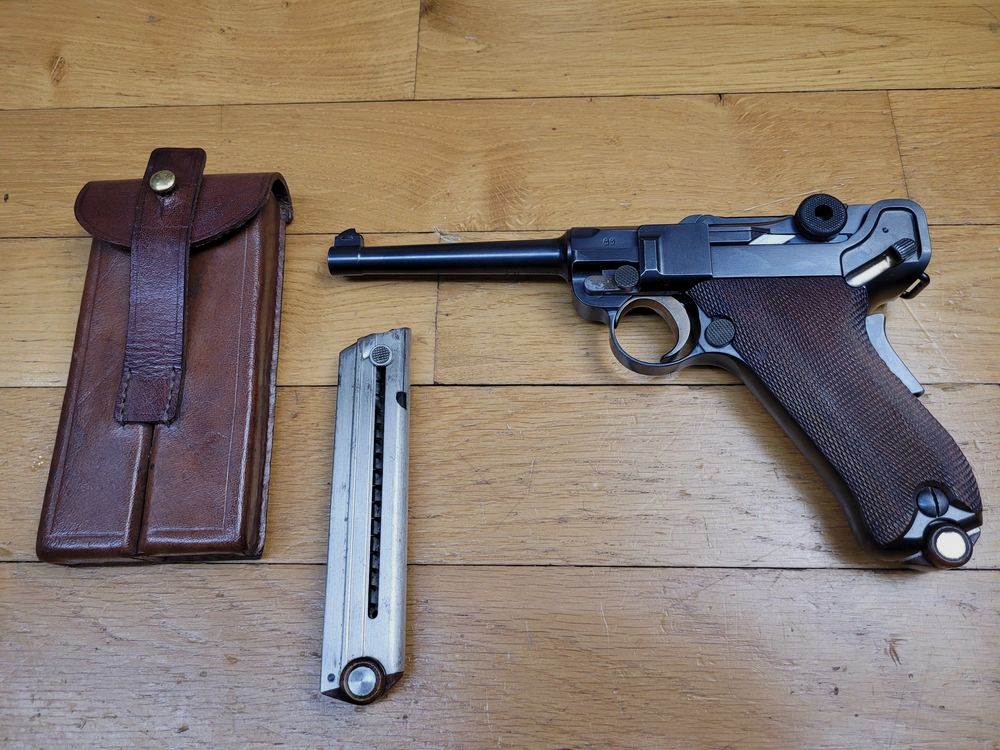
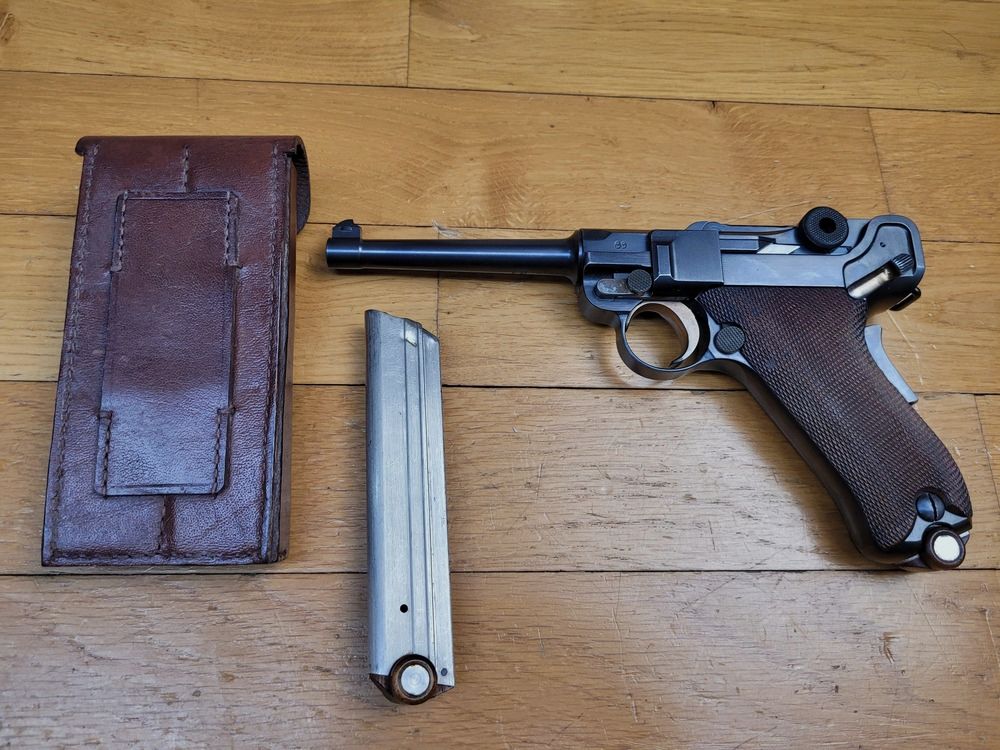


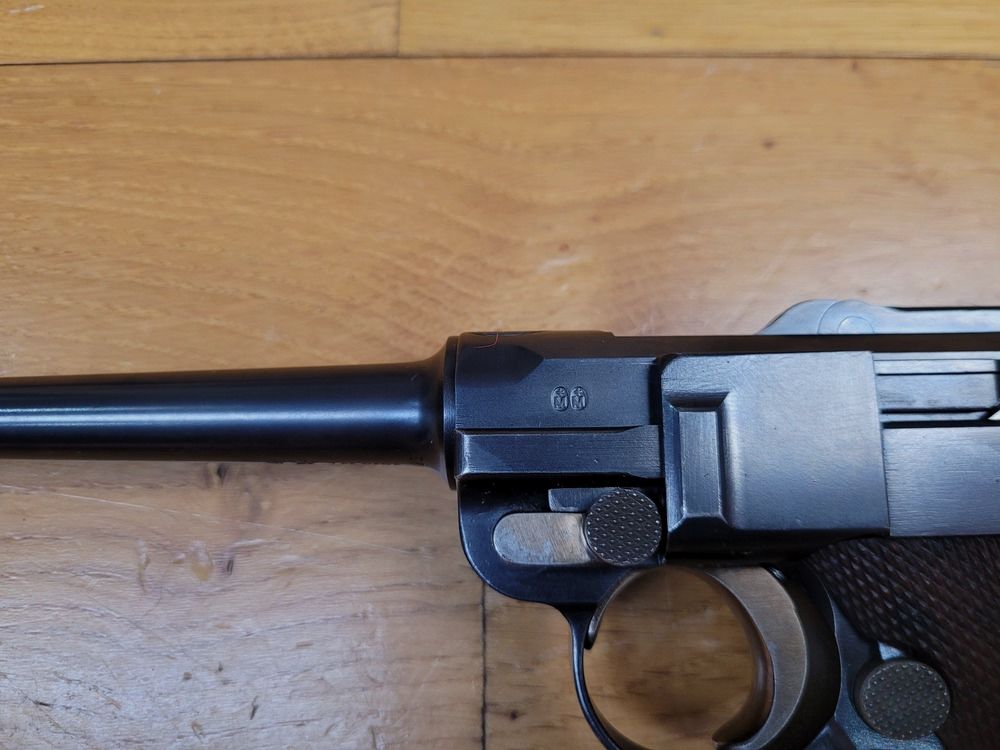
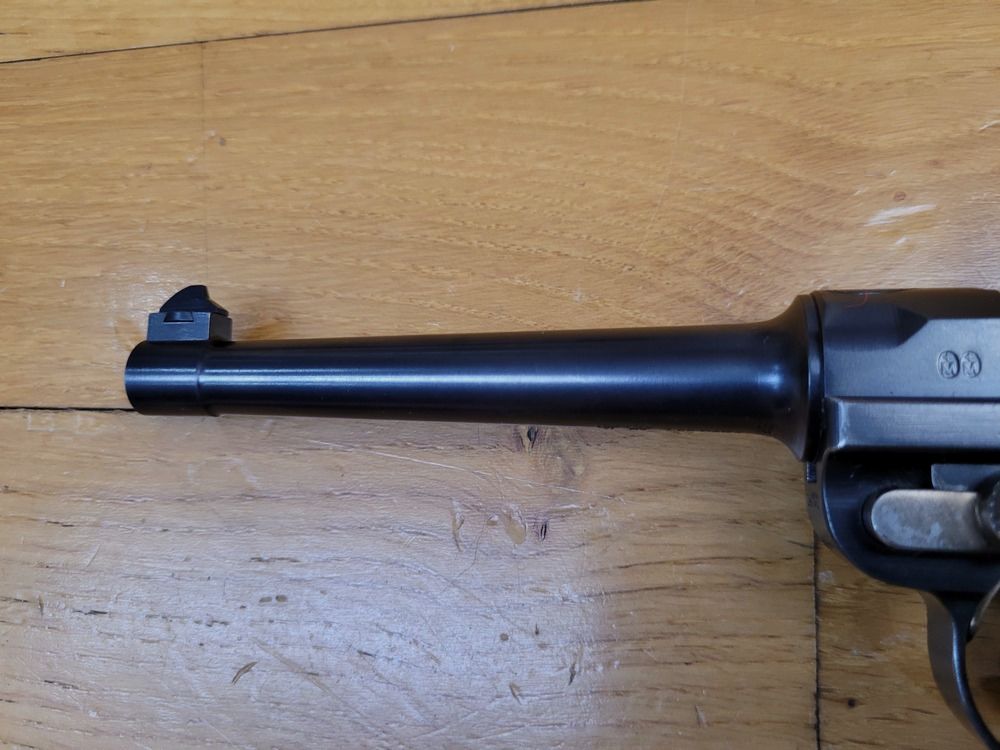


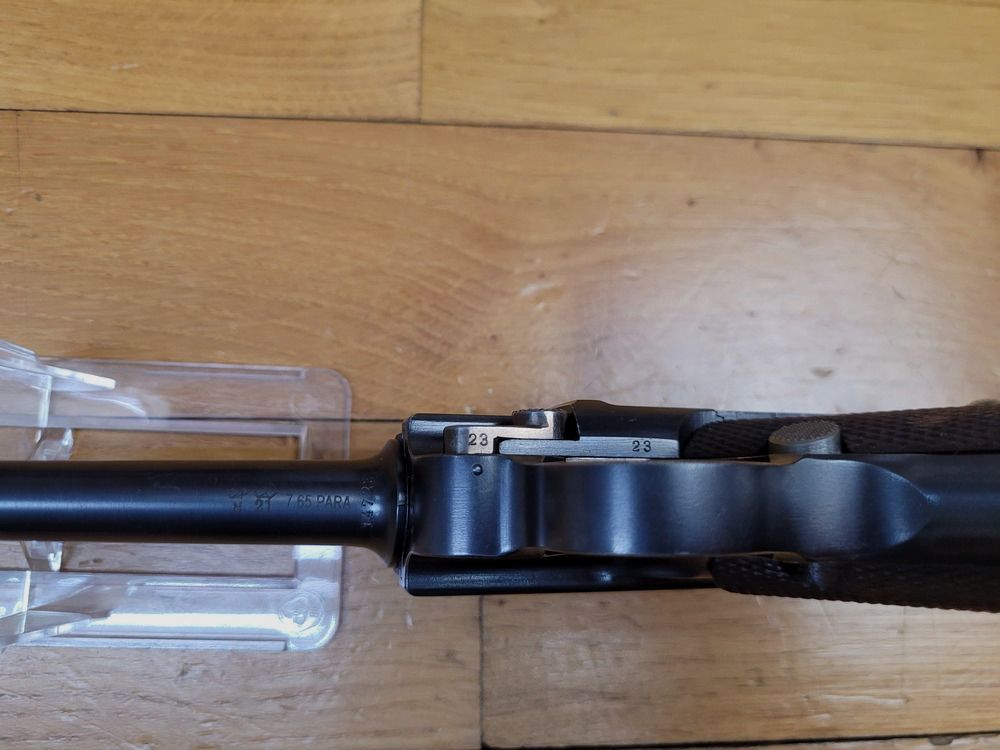
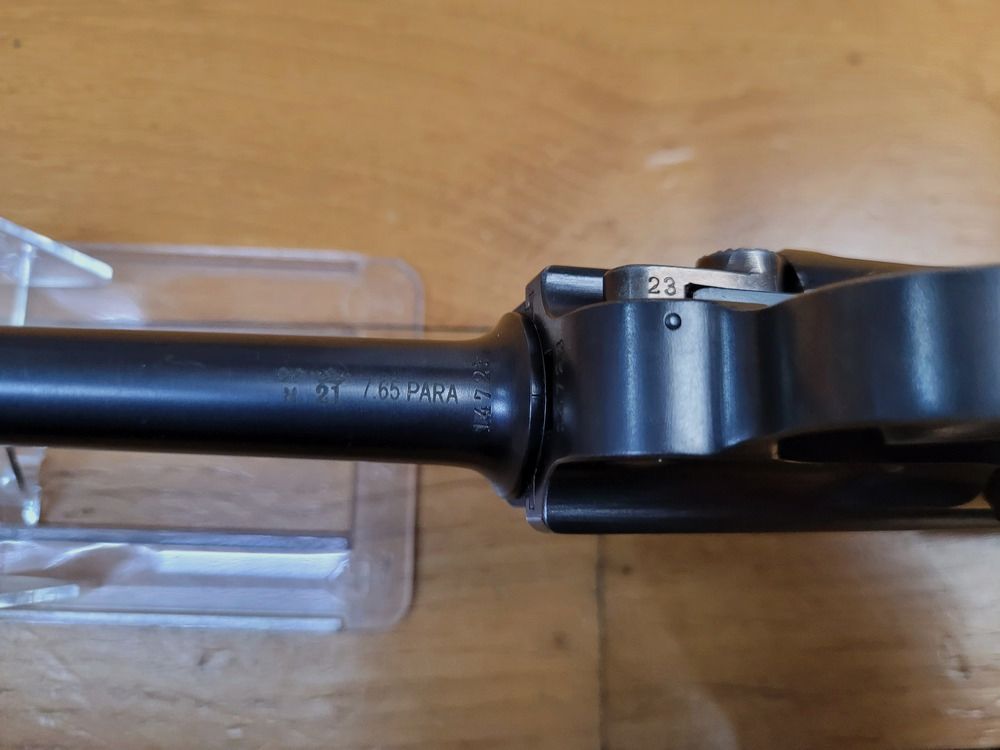
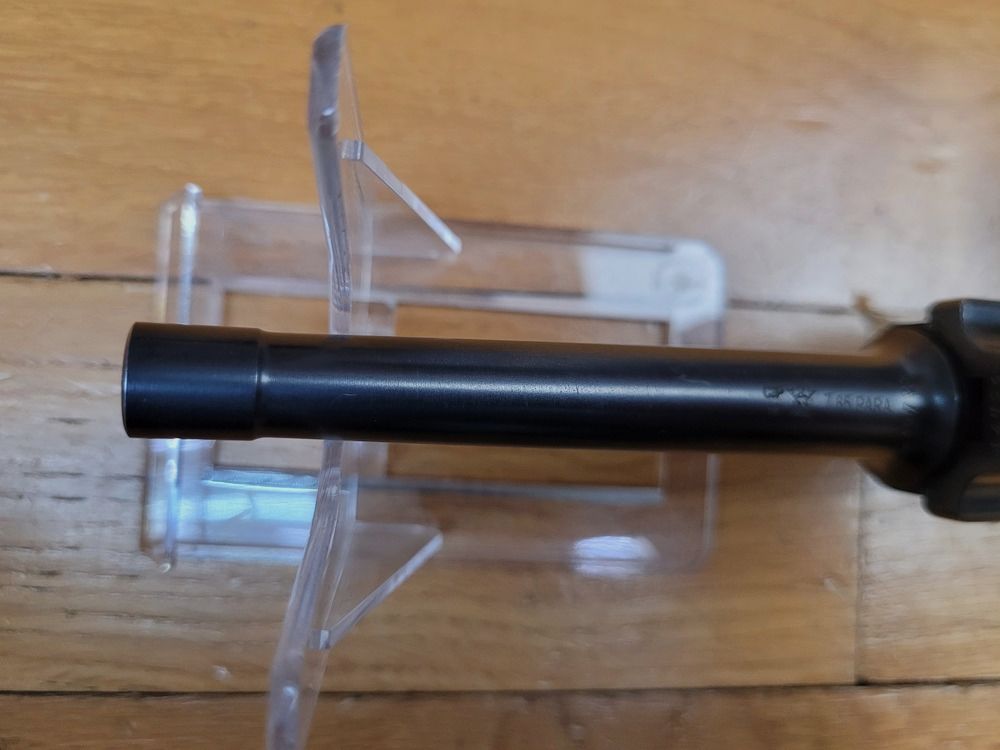


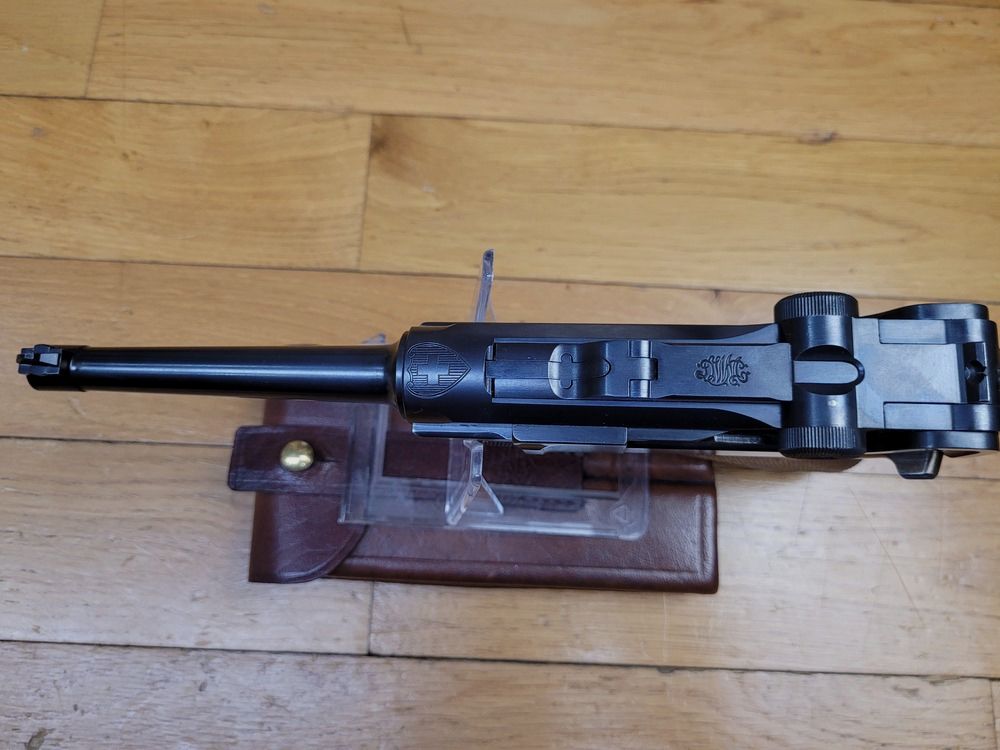
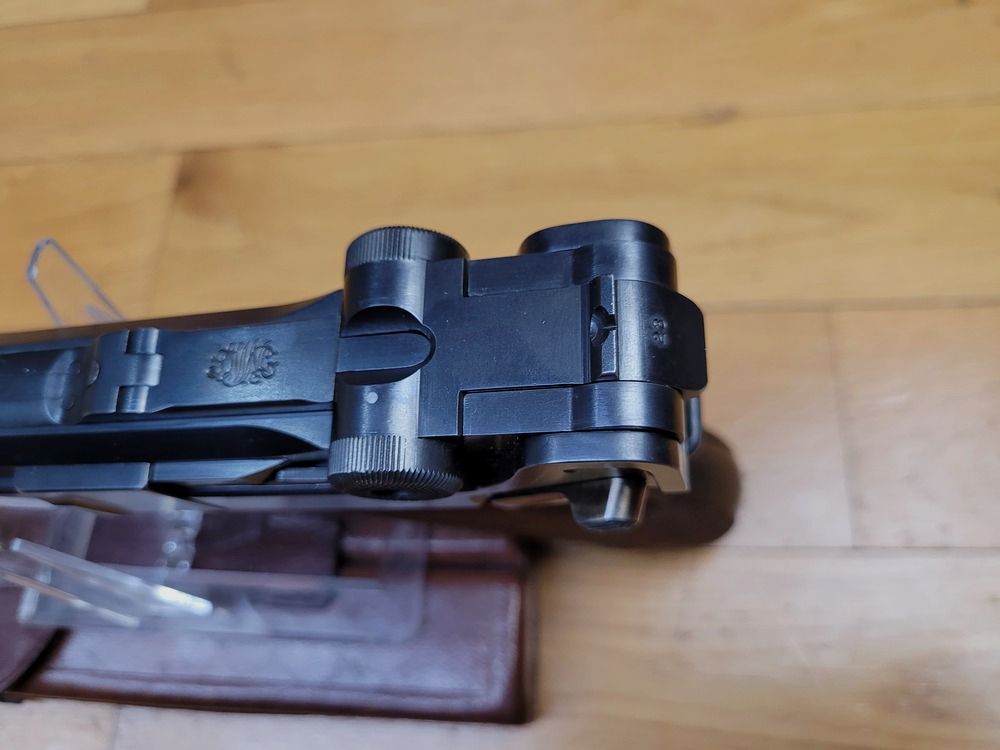

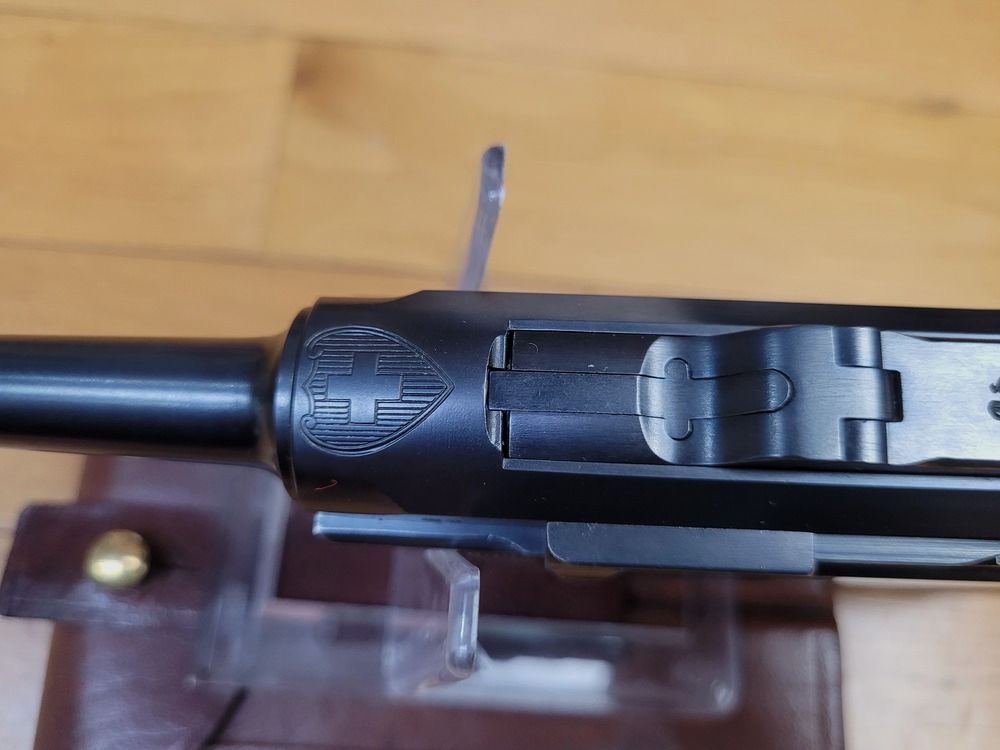


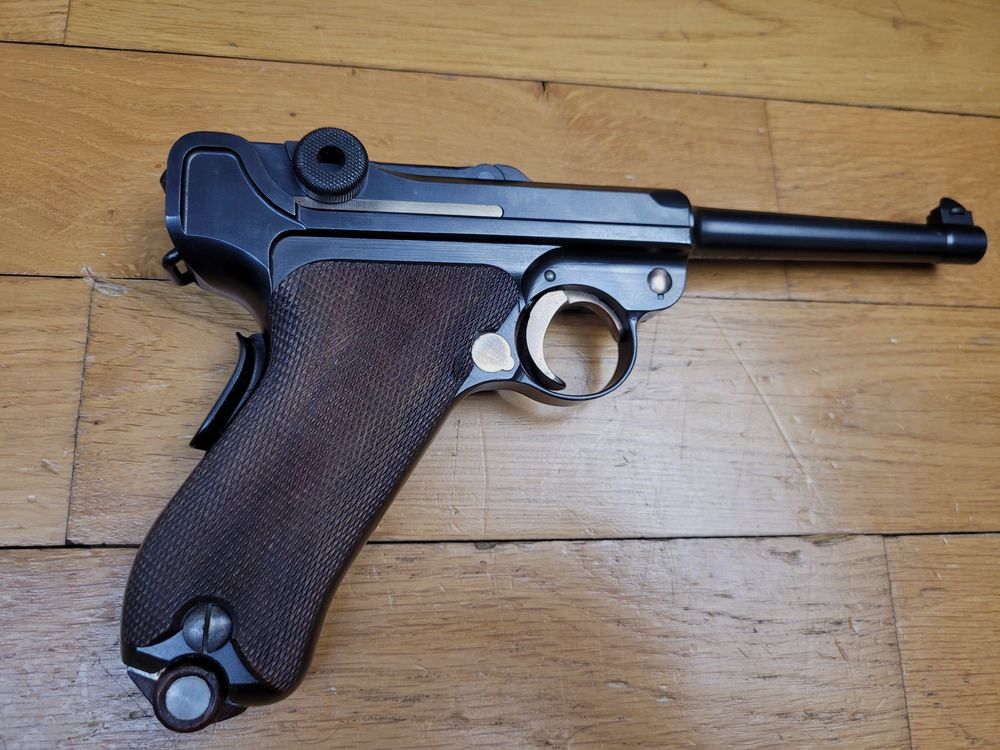


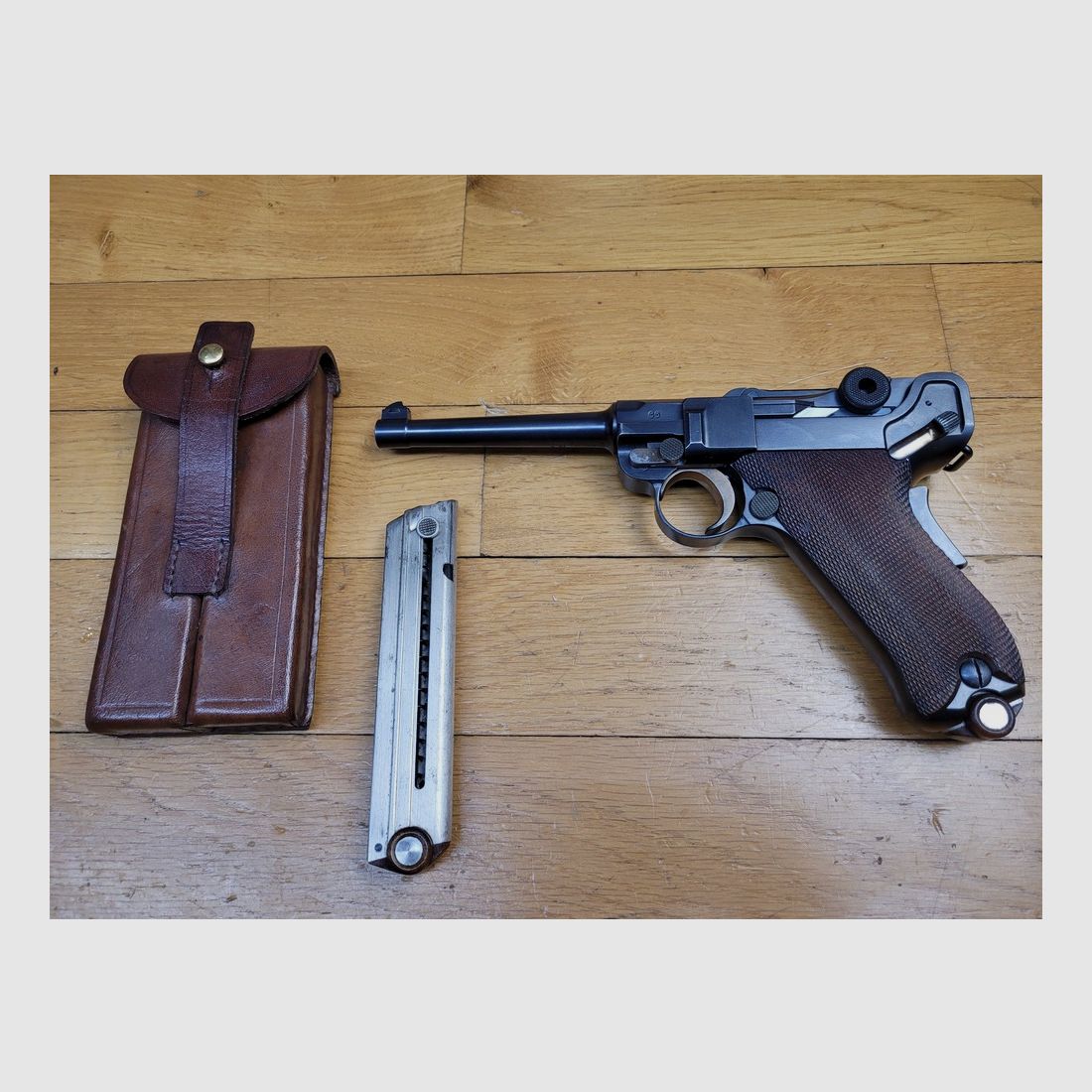


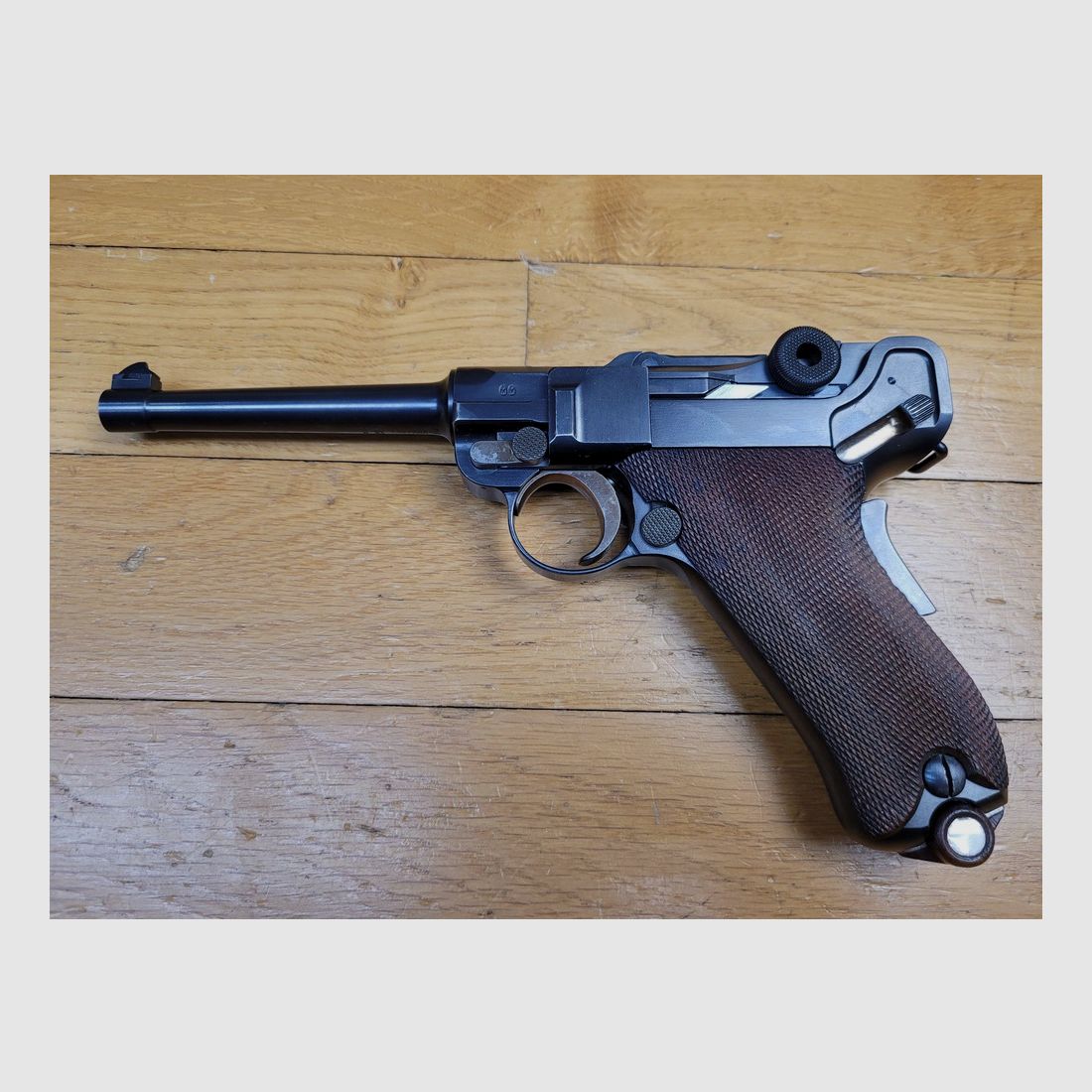

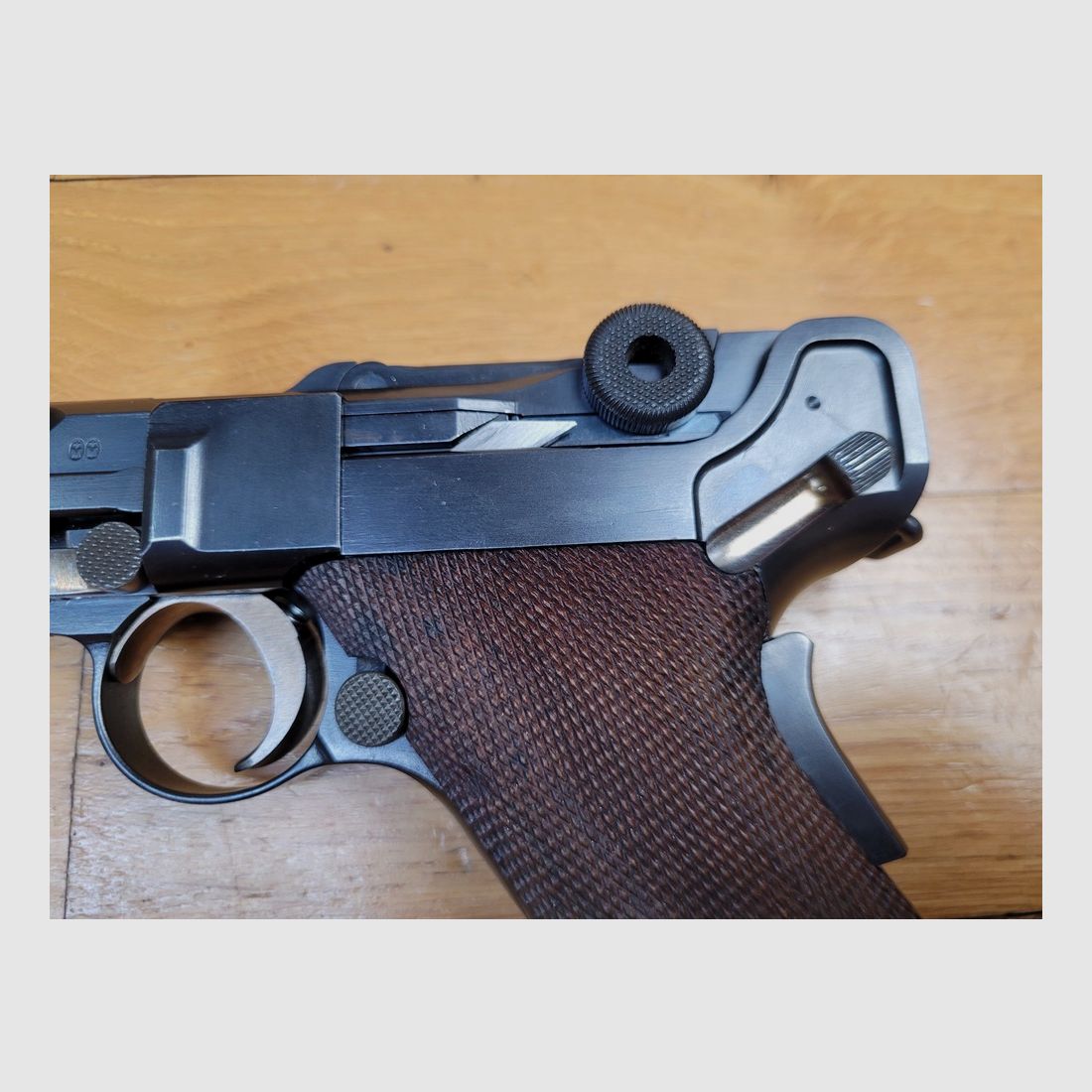
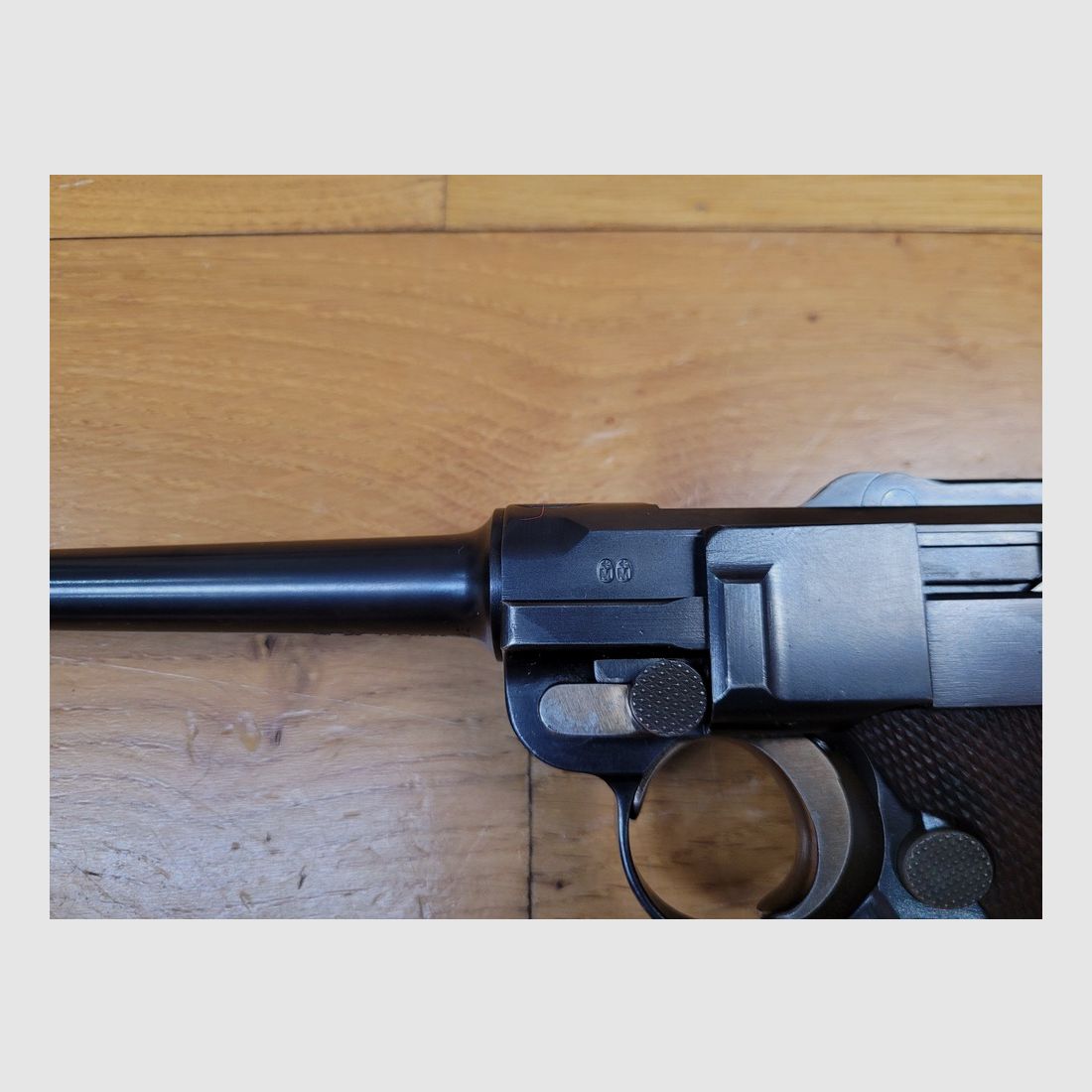


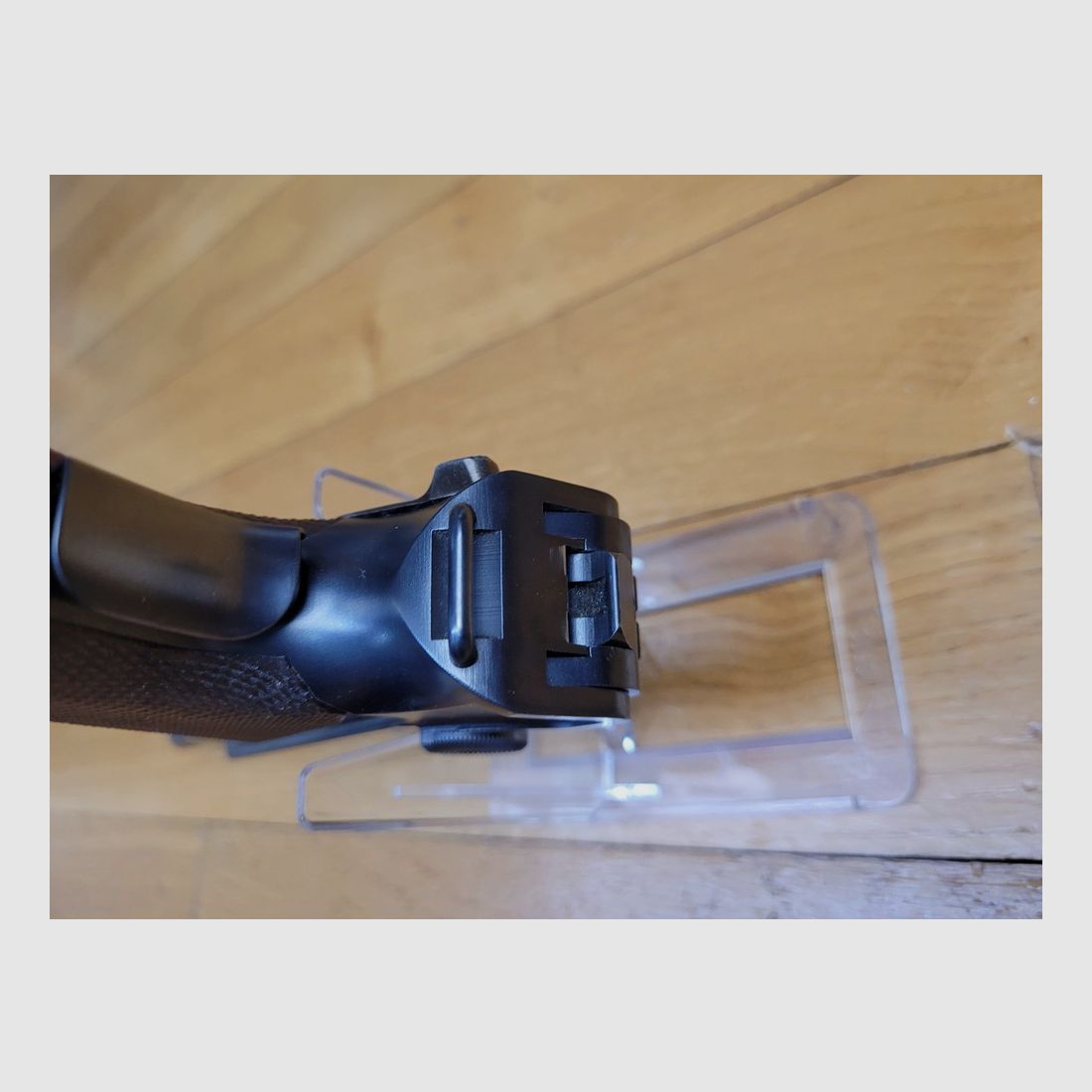


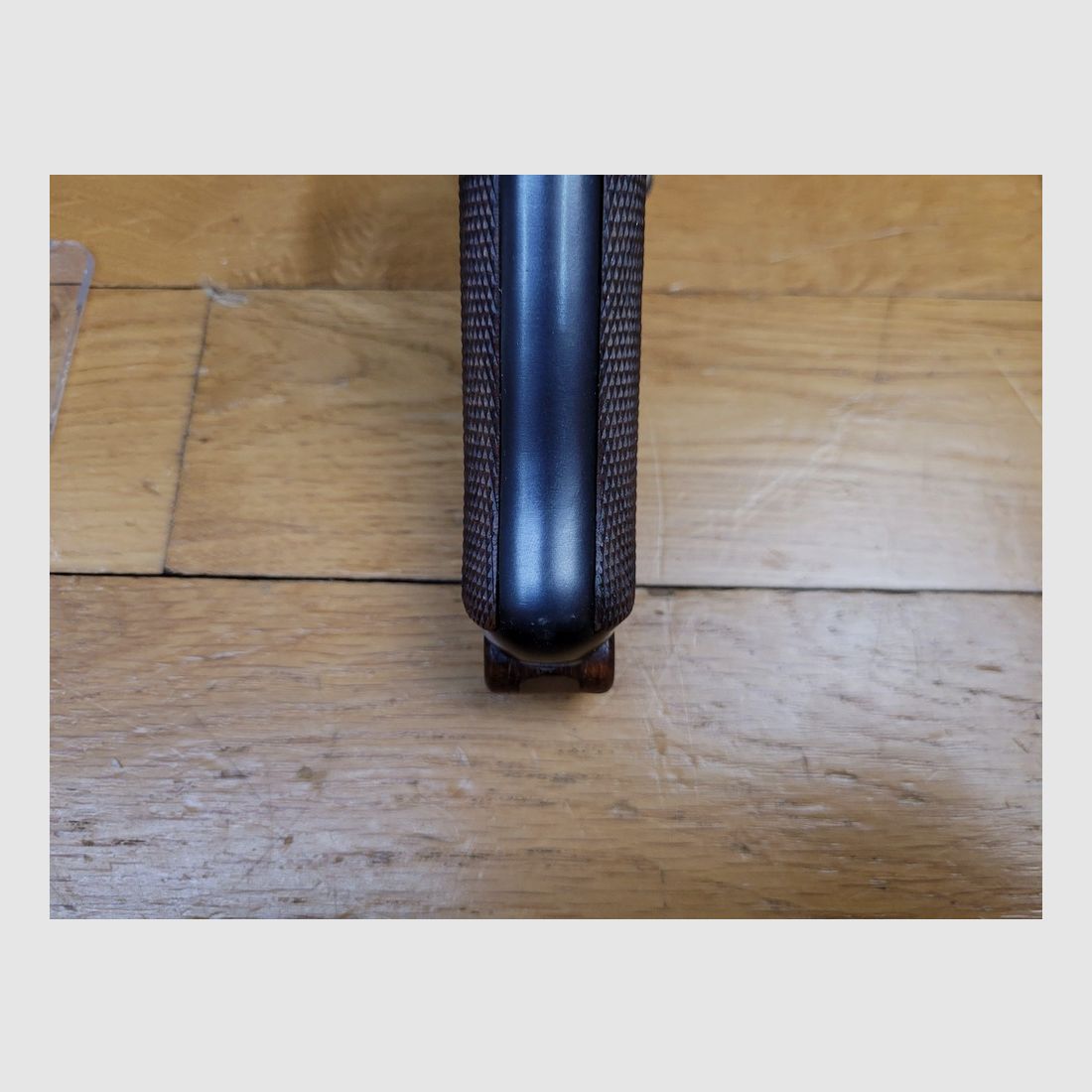


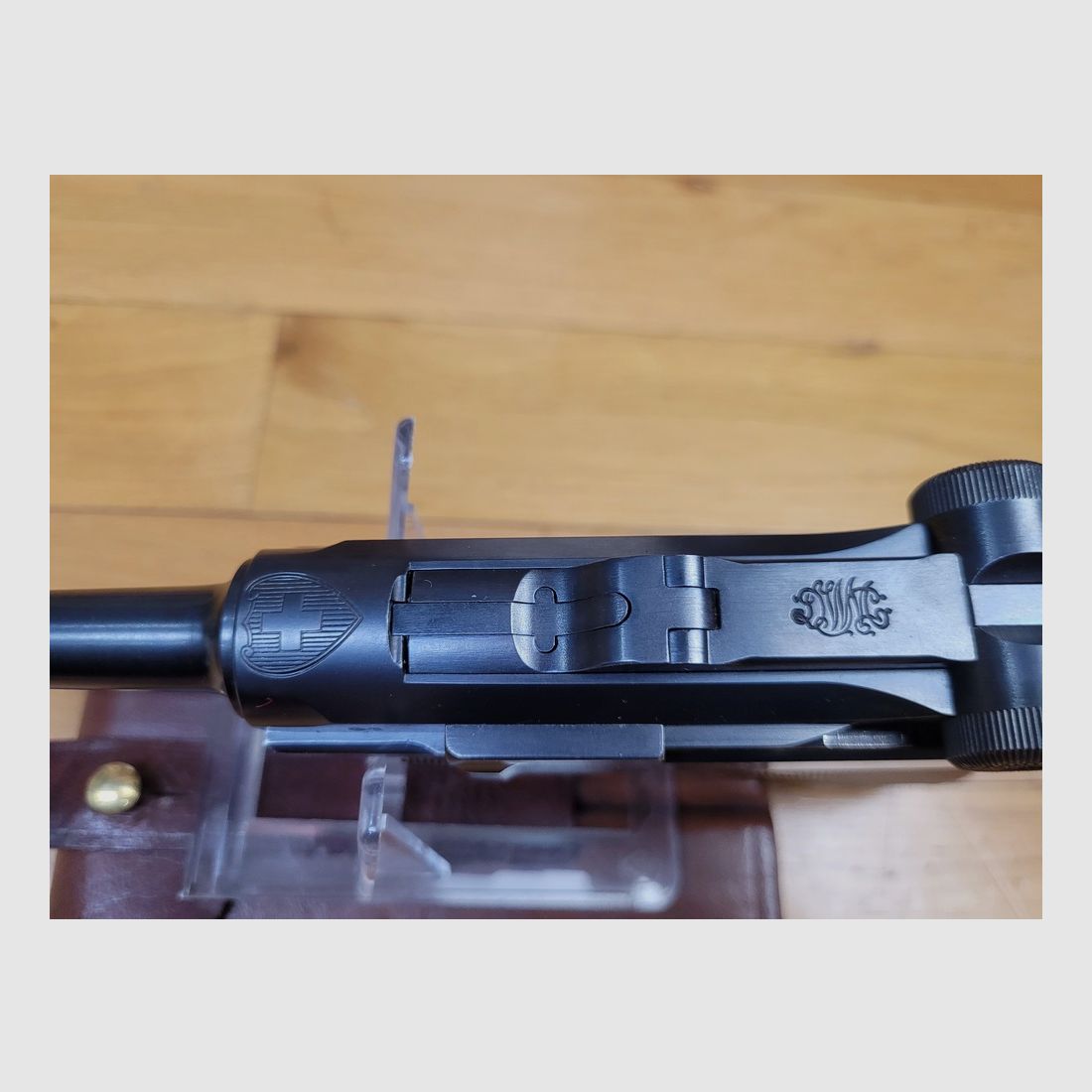


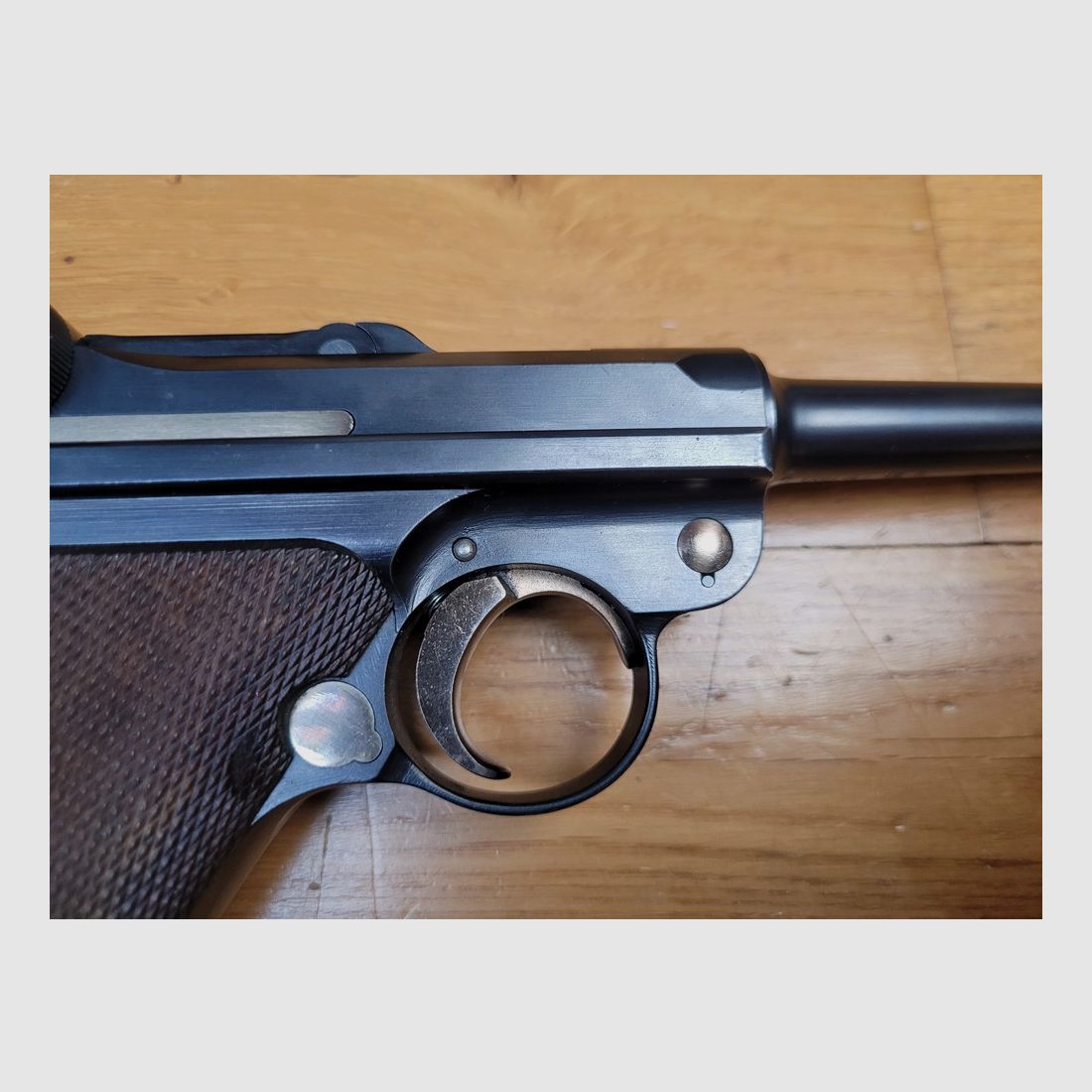

Splendid Swiss Luger P00/06 or model 1906 – One of the 15,215 manufactured in Germany by DWM in Berlin – Weapon from 1914 – Cal. 7.65 Parabellum original – Single serial number – Dream mechanics and barrel – Original bluing at 100% – Regulation pouch with second magazine for the model – Museum condition – TBE++
Price on Request
Purchase permit required
75002 Paris, France
10
ID: 10338769
This item is currently unavailable.
Purchase from outside the EU: The firearm goes through an importer in your country, the dealer handles the export.
How buying from Europe works
Shop safely with Gunfinder
Our AI-powered seller identity verification makes Gunfinder the safest marketplace online.
Learn more
Details
- Original language
- French
- Category
- Purchase eligibility
- Required
- Condition
- New
- Location
- 🇫🇷 75002 Paris, France
- Availability
- Out of stock
Freshness
This listing is based on a mirrored offer, where the listing data was synced to us from a shop, dealer, or external marketplace. Please note that temporary price discrepancies may occur due to possible delays in data transmission.
- Source
- Flingus Maximus
- Last checked with the dealer
- 1 day ago
Description
Note:
The item is located abroad. Please note that delivery conditions, shipping times, and/or the purchase process may differ.
That’s exactly why Georg Luger (March 6, 1849 – December 22, 1923), born in Tyrol and a polyglot, raised in Padua, Italy, by a father who was a professor of medicine and preferred the sunshine, could not have designed the invention that made his name almost eternal in Austria, his native country.
Nor could he have had his first order succeed where his Luger would be born and built, in the country where he made his life and died: Germany.
Switzerland was the first to adopt his military semi-automatic pistol, on May 4, 1900. Germany would do so only very cautiously for its Navy in 1904, and on a much larger scale for its army starting in 1908.
It all began with Hugo Bochardt’s C93 pistol (June 6, 1844 – May 8, 1924), one of the first semi-automatic pistols in history and, in any case, one of the first from which an army might hope to get a usable weapon.
The gun was fairly reliable, an unusual feature for a semi-automatic pistol of the time. It had a detachable magazine, still a novelty back then (the C96, Mannlicher, and others used stripper clips). And above all, it was chambered for an innovative, powerful cartridge (which would give rise to the 7.65 Para and 7.63 Mauser), well suited to the task.
But it was also a “fishing rod”—30 cm long and weighing 1.1 kg—far too cumbersome to be accepted in a military competition…
The gun was made by DWM in Berlin (formerly Loewe, after the G88 story), where a salesman named Georg Luger worked alongside Borchardt, increasingly moving into engineering.
It’s worth noting that there were some big names at DWM back then, because our two fellows crossed paths there with a promising young man named Karl Maybach.
DWM, already a powerful industrial consortium, with a majority stake in Mauser and a major shareholding in FN Herstal, among others, politely asked Bochardt to improve his design.
I won’t revisit Hugo Bochardt’s bad-tempered ways. He was a prolific inventor across many fields (but I’ll come back one day to his skirt-chasing stories, which are quite amusing and give a good sense of the man and his many moves).
But handsome Hugo stubbornly refused to modify his pretty good C93 pistol, which he considered absolutely perfect.
A terrible mistake, because the project was then handed to Georg Luger, who was less reluctant and, of course, seized the chance to make a name for himself. In 1894, Georg had already presented the Bochardt C93 at a competition in the USA. He knew the gun inside out—its flaws and its potential.
Luger would thus be able to keep what he liked about the C93, especially the famous toggle mechanism (not the “frog mechanism,” as some of my lovely customers call it) and its slightly shortened bottle-neck cartridge, which would become the 7.65 Parabellum.
On the other hand, he adopted an innovative main compression spring system in the grip (initially a leaf spring) and removed the coil spring housed in the circular bulge at the rear of the frame.
That spring gave the Bochardt C93 the look of a fire-breathing harpoon rifle, as if it had come straight out of a 1950s science-fiction movie.
The Luger, in its almost final form, was born.
Still called the “Borchardt-Luger pistol,” the gun was entered in the 1898 competition to select a new semi-automatic pistol for the Swiss Army.
Its competitors were the Mauser C 96, the Bergmann, a Mannlicher, and a Mannlicher-Roth. Five competitors in all.
Luger arrived with three prototypes of his “Borchardt-Luger,” numbered No. 5, No. 6, and No. 7. Handsome Georg left No. 5 as a memento for the Selection Commission. It’s in a museum in Bern. He returned to Germany with Nos. 6 and 7.
No. 6 is now the rightful pride and joy of a great Swiss collector. No. 7 is lost. If you find it, call me. I’ll build it a cozy nest, sing it lullabies, and take good care of it.
and so on.
Given what the other competing firearms are like, and with no irony intended, it’s the Borchardt-Luger pistol—our Luger—that wins the trials hands down.
There’s no chance of competing with the invention of our two associates, so superior is it in every test. In the meantime, the fickle Hugo missed his chance to more firmly link his name in the public’s mind with this legendary invention…
After a few minor modifications and a trial order for 20 additional firearms for a new series of tests in 1899, the DWM Borchardt-Luger pistol was officially adopted under the official name “Parabellum Model 1900,” in 7.65 Parabellum caliber, or more simply “P00” for 1900. On May 4, 1900, to be precise.
Calling Lugers “Lugers” (for the Germans, they’re P04, P06, P08, P14…) is a whim of an American businessman (Stoeger, the importer of these firearms in the USA after World War I), who had the good sense …to register the name Luger in the US (Luger died in 1923). But the name stuck.
The Swiss had chosen the excellent (and very high-velocity) 7.65 Parabellum caliber proposed by Luger—a caliber that, in my opinion, shoots better than the Germans’ 9mm Para.
The very first Swiss Lugers were ordered from DWM in Germany.
This “Deutsche Waffen- und Munitions Aktiengesellschaft,” based in Berlin (formerly Loewe), was and remained one of Germany’s largest arms manufacturers until it was acquired by the Quandt dynasty (the BMW empire, extending far beyond cars and engines) in 1929. It was responsible, among other things, for the infamous MG08 machine gun of 1914–18, which killed quite a few of us.
These DWM-made Lugers for Switzerland are, like many pre-1914 German firearms, among the finest and most beautiful you can find. Bluing, fit, barrel—everything is top-notch.
The Swiss ordered 5,000 of these P00 Lugers from Germany, numbered from 1A to 5000A, and spread their purchases over six years, requesting minor improvements with each batch to bring the firearm ever closer to perfection. There was also a very small order of 200 trial and demonstration models in series E.
You can immediately recognize these first 5,000 examples by the Swiss cross in a sunburst on top of the chamber.
In 1906, this first order of 5,000 firearms was fully delivered, and Switzerland decided to order just 10,000 more—the firearm incorporated the modifications and improvements made over the previous six years.
This was known as the P06 model, or rather P00/06, to avoid confusing it with one of the variants of the German Navy Luger.
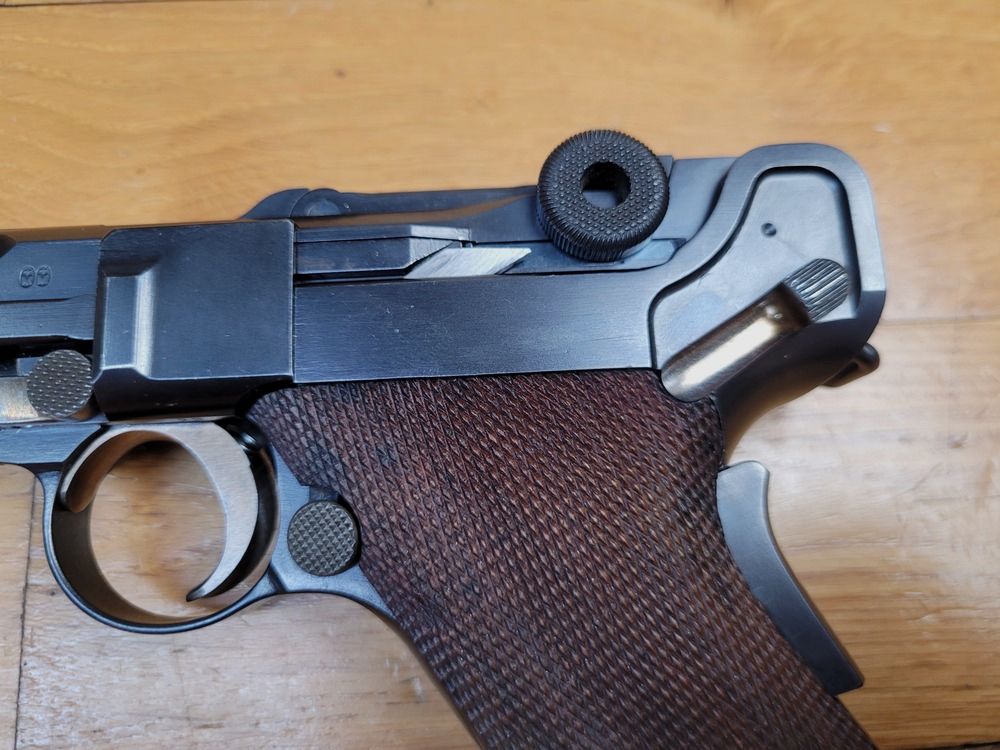
These firearms are distinguished by a coil mainspring, connected to the rear of the toggle by a drawbar, replacing the leaf spring in the grip. The buttons on the toggle are now flat, round, and checkered instead of asymmetrical.
Except on the earliest examples (which still have the Swiss cross in a sunburst), these Lugers are also distinguished by a Swiss cross no longer in a sunburst, but in a shield on top of the chamber.
And of course, like the first 5,000, they bear the very attractive DWM logo on the toggle, a testament to their Berlin origins.
This 1906 model, still in 7.65, still with a 12 cm barrel, would be numbered from the last P00 purchased, 5001, up to no. 15215 (in 1914).
These 12 cm barrels and dreamlike finishes give these firearms a very harmonious look, which I prefer to the P08 with its 10 cm barrel.
The last P00/06 models were delivered in 1914—still with minor modifications.
In total, only about 15,215 Swiss Lugers, including series and trials, were produced in Germany before the war to the highest quality standards.
Economic patriotism and the approaching 1914 war meant that the Swiss made sure that
the following ones were manufactured in Switzerland from 1917 onward, no longer in Germany. These are marked “W+F” on the chamber, for Waffen Fabrik in Bern, instead of “DWM”.
Extremely carefully made, these would go on to see a production run of nearly 47,000 firearms, all of consistently high quality, adding to the 15,000 made in Germany before 1914.
Maitre Flingus is happy. He’s found you one of these rare Swiss Lugers made in Germany by DMW before 1914. It’s a splendid P00/06.
They’re all going abroad, and there won’t be many left here.
With serial number 14723, it’s one of the very last delivered to the Swiss by the Germans in 1914. Just in time…
This firearm is 110 years old. I can’t believe it. Exactly what I’ve been looking for everywhere.
It’s splendid, in like-new condition and all matching. Strictly a museum piece.
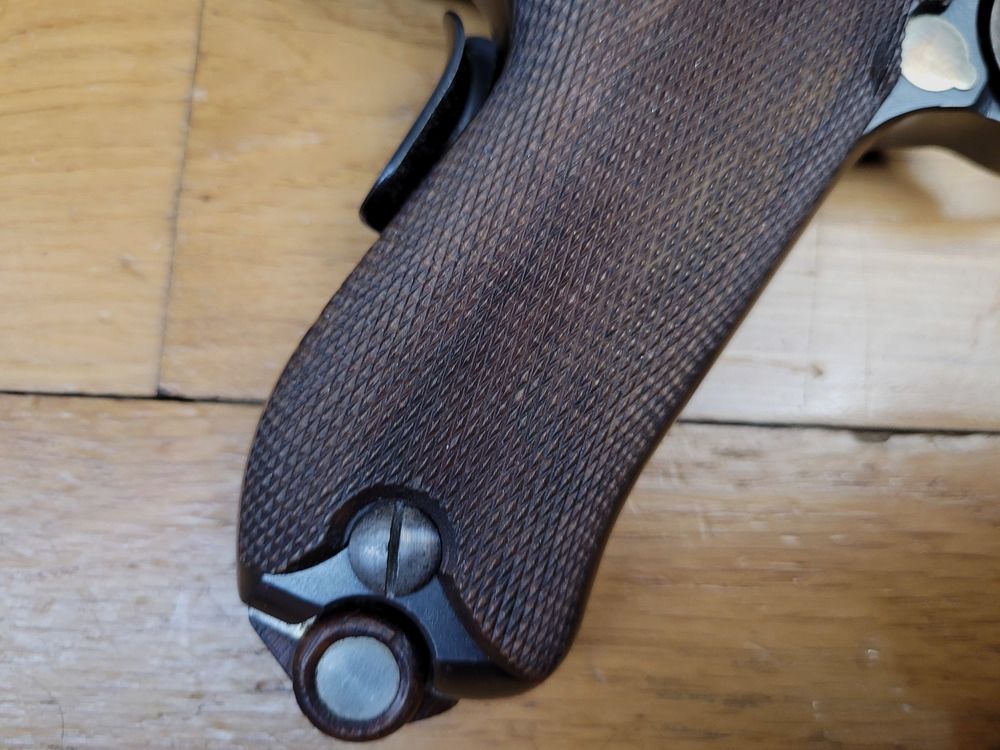
The grips are perfect, with no wear or cracks.
The bluing is magnificent—100% original—with no scratches. Just my fingerprints and isopropyl alcohol marks. It was dusty when I got it.
The firearm has retained all its original “German-style” gilding, as found on pre-war Lugers (before 1914): on the safety, trigger, ejector and takedown lever pin. There’s a very slight loss of gilding on the left side of the takedown lever pin; that’s its one and only minor flaw. I could restore it. I won’t.
Dreamlike mechanics, barely broken in even after 110 years—the safety lever is as light as a “zephyr,” just like the trigger. The internal condition matches the external condition: like new.
The barrel is one of the finest I’ve ever seen on a Luger in my life—absolutely mirror-bright, with rifling sharp enough to cut your retina. Impressive.
I’m even starting to think that the best Luger barrels are from these production runs and from pre-war German civilian models. It’s probably never been fired, or has only had a few cartridges through it, and has been miraculously preserved for 110 years.
In short, a true collector’s piece.
The magazine is the correct one—the second model—with a wooden base and no serial number (Swiss magazines aren’t numbered), and the correct metal insert in the round baseplate—a fine, distinctive detail of these German-made models.
What’s more, I’m including a second magazine of the same type in its regulation leather pouch for both magazines (the one in the firearm and the spare). These German-made magazines also normally cost an arm and a leg in Switzerland (around 200 euros)—when you can find them.
It’s in such like-new condition that I recommend taking great care when disassembling and firing it—don’t scratch it!
In the end, a firearm still coveted for its symbolism and its place in the history of firearms, one of only 15,200 Made in Germany for Switzerland and one of the very first military orders in history—in a level of craftsmanship that’s impossible to achieve today. Dream condition and an exceptional collector’s piece!
And this pure joy has a little name: Lulu!
CATEGORY B FIREARM UNDER THE CSI: SUBJECT TO AUTHORIZATION; PHOTOCOPY OF ID AND ORIGINALS OF SECTIONS 1 AND 2 OF THE AUTHORIZATION REQUIRED. Shipment with signature required in two separate packages, at least 48 hours apart.
****************************************************************************************************************************************************************
Let’s say it again! Flingus Maximus gun shop in Paris and throughout France is also here to help with private firearm transfer paperwork, buying firearm and militaria collections, firearm valuations, and questions about firearms in estates and inheritances. Contact your favorite gun dealer using our contact form or at [email protected] (Show description in original language)
Nul n’est prophète en son pays, vous le savez bien.
C’est exactement pour cela que Georg Luger (6 mars 1849 – 22 décembre 1923), né tyrolien et polyglotte, élevé à Padoue en Italie par un père professeur de Médecine préférant le soleil, n’a pas pu concevoir l’invention qui a rendu son nom quasi éternel en Autriche, son pays natal.
Ni même n’a pu avoir le succès de sa première commande là où son Luger naitra et sera construit, dans le pays où il a fait sa vie et où il est mort, en Allemagne.
C’est la Suisse qui adoptera la première son pistolet semi-automatique militaire le 4 mai 1900. L’Allemagne ne le fera que très prudemment pour sa Marine en 1904 et plus massivement pour son armée à partir de 1908.
Tout commence avec le pistolet C93 d’Hugo Bochardt ( 6 juin 1844 – 8 mai 1924), un des premiers pistolets semi-automatiques de l’histoire et en tous cas un des premiers dont on pouvait espérer tirer une arme utilisable par une armée.
L’arme est assez fiable, une originalité pour un PA de l’époque. Elle a un chargeur amovible, toujours une nouveauté pour l’époque (les C96, Mannlicher et consorts sont à lame-chargeur). Et elle est surtout dotée d’une munition novatrice, puissante (qui donnera naissance au 7,65 Para et au 7,63 Mauser) bien adaptée au sujet.
Mais c’est aussi une « canne à pêche » – 30 cm de long pour 1,1 kg – bien trop encombrante pour être acceptée dans un concours militaire…
L’arme est fabriquée par la DWM de Berlin (ex Loewe après l’histoire des G88) où officie, aux cotés de Borchardt, un commercial qui passe de plus en plus à la technique répondant au nom de Georg Luger.
Notez bien qu’il y avait du beau monde à la DWM à l’époque car nos deux lascars y croisaient un jeune plein d’avenir du nom de Karl Maybach.
La DWM, déjà consortium industriel puissant, majoritaire chez Mauser et actionnaire de référence de le FN Herstal notamment, demande donc poliment à Bochardt d’améliorer sa copie.
Je ne reviens pas sur les histoires de mauvais caractère de Hugo Bochardt, inventeur prolixe et multi-domaines (mais je reviendrai un jour sur ses histoires de jupons qui sont assez amusantes et situent bien le personnage et ses déménagements ).
Mais le beau Hugo refuse obstinément de modifier son assez bon pistolet C93 qu’il jugeait, lui, juste parfait.
Terrible erreur car le dossier est donc confié à Georg Luger, moins récalcitrant, et qui va bien sûr saisir l’occasion de se faire un nom. En 1894, c’est déjà Georg qui avait présenté le Bochardt C93 dans un concours aux USA. Il connaissait parfaitement l’arme, ses défauts et son potentiel.
Luger va ainsi pourvoir conserver ce qui lui plait dans le C93 notamment la fameuse genouillère (et pas la « grenouillère » comme disent certains de mes sympathiques clients) et sa munition bouteille, un peu, raccourcie qui deviendra la 7,65 Parabellum.
En revanche, il adopte un système novateur de ressort de compression principal en crosse (à lame au début) et supprime le ressort en spirale logé dans l’excroissance circulaire à l’arrière de la carcasse.
C’est ce ressort qui donnait au Bochardt C93 cet aspect de fusil-harpon qui crache du feu et semblait tiré d’un film de Science fiction des années 1950.
Le Luger sous sa forme quasi définitive est né.
Encore dénommée « pistolet Borchardt-Luger », cette arme est présentée au concours de sélection d’un nouveau pistolet semi-automatique pour l’Armée suisse en 1898.
Les concurrents sont le Mauser C 96, le Bergmann, un Mannlicher et un Mannlicher-Roth. Cinq concurrents en tout.
Luger est venu avec 3 prototypes de son « Borchardt-Luger » numérotés N°5, N°6 et N°7. Le beau Georg a laissé l’exemplaire N°5 en souvenir à la Commission de Selection. Il est à Bern dans un musée. Il est revenu avec les N°6 et 7 en Allemagne.
Le N°6 fait désormais la légitime fierté d’un grand collectionneur suisse. Le N°7 est perdu. Si vous le trouvez, appelez moi. Je lui construirai un nid douillet, lui chanterai des berceuses et en prendrai grand soin.
Compte tenu de ce que sont les autres armes en concours, sans aucune ironie de ma part, c’est le pistolet Borchardt-Luger, notre Luger, qui remporte haut la main les épreuves.
Aucune chance de rivaliser avec l’invention de nos deux comparses tant elle est supérieure dans tous les tests. Hugo le volage ayant au passage raté le coche d’attacher son nom plus clairement dans l’esprit du public à cette mythique invention…
Après quelques petites modifications, et une commande d’essai de 20 armes supplémentaires pour une nouvelle série d’essais en 1899, le pistolet Borchardt-Luger de la DWM est adopté officiellement sous le nom officiel de « Parabellum modèle 1900 » en calibre 7,65 parabellum ou plus simplement « P00 » pour 1900. Le 4 mai 1900 donc.
Appeler les Luger « Luger » (pour les allemand c’est P04, P06, P08, P14…) c’est une lubie de commerçant américain (Stoeger, l’importateur de ces armes aux USA après la première GM) ayant eu le bon goût …de déposer le nom Luger chez lui (Luger est mort en 1923). Mais le nom est resté.
Les suisses avaient choisi pour lui l’excellent (et très tendu) calibre 7,65 parabellum proposé par Luger – un calibre à mon sens meilleur au tir que le 9 para des allemands.
Les tout premiers Luger suisses seront commandés en Allemagne chez la DWM.
Cette « Deutsche Waffen- und Munitions Aktiengesellschaft », située à Berlin (ex Loewe) était et restera jusqu’à son rachat par la dynastie Quandt (Empire BMW, allant bien au-delà des voitures et moteurs) en 1929, un des plus grands marchands de canons d’Allemagne. On lui doit notamment la sinistre mitrailleuse MG08 de 14-18 qui nous a tué un peu de monde.
Ces fabrications de Luger par la DWM à destination de la Suisse sont, comme pour beaucoup d’armes germaniques pré 1914, parmi les mieux finies et les plus belles que l’on puisse trouver. Bronzage, ajustements, canon, tout est aux meilleurs niveaux.
Les suisses commanderont 5.000 de ces Luger P00 en Allemagne numérotés de 1A à 5000A et étaleront leurs achats sur six ans, réclamant à chaque lot de petites améliorations poussant l’arme vers une perfection croissante. S’y ajoute une toute petite commande de 200 exemplaires d’essais et de démonstration en série E.
On reconnait immédiatement ces 5.000 premiers exemplaires à une croix suisse dans un soleil en sommet de chambre.
En 1906, cette première commande de 5.000 pièces est entièrement livrée et la Suisse décide de commander un nouveau lot de 10.000 autres armes seulement – l’arme tient compte des modifications et améliorations des six années précédentes.
On parle alors de modèle P06 ou plutôt P00/06 pour ne pas le confondre avec une des variantes du Luger de Marine allemand.
Ces armes se distinguent par un ressort principal à compression, relié à l’arrière de la genouillère par l’intermédiaire d’une tige de traction et qui remplace un ressort à lame en poignée. Les boutons de la dite genouillères sont désormais plats, ronds et nervurés au lieu d’être asymétriques.
Sauf au début (croix suisse dans un soleil quand même), ces luger se caractérisent en outre par une croix suisse non plus dans un soleil mais dans un écu en dessus de chambre.
Et bien sûr, comme les 5000 premiers, ils portent le très beau logo de la DWM en genouillère témoignage de leur naissance berlinoise.
Ce modèle 1906, toujours en 7,65, toujours à canon de 12 cm, verra sa numérotation partir de celle du dernier P00 acheté, 5001 jusqu’au n° 15215 (en 1914).
Ces canons de 12cm dans ces finitions de rêve donnent à ces armes une esthétique très harmonieuse que je préfère au P08 avec son canon de 10cm.
Les dernières productions de P00/06 seront livrées en 1914 – toujours avec de petites modifications.
Au global, environ et seulement, 15.215 luger suisses, y compris les séries et les essais, auront été produits en Allemagne avant guerre à des standards de qualité des plus élevés
Patriotisme économique oblige, et guerre de 14 arrivant, les suisses font en sortent que les suivants soient fabriqués, à partir de 1917, en Suisse et plus en Allemagne. Ceux là sont marqués « W+F » en chambre pour la Waffen Fabrik à Berne et plus de la « DWM ».
De construction extrêmement soignée, ils connaitront, eux, une production, toujours de grande qualité mais de près de 47.000 armes venant compléter les 15.000 fabriqués en Allemagne avant 1914.
Maitre Flingus est heureux. Il vous à trouvé un de ces rares Luger suisses nés en Allemagne à la DMW avant 1914. Il s’agit d’un splendide P00/06.
Ils partent tous à l’étranger et ils ne va pas en rester beaucoup chez nous.
Avec son numéro 14723, c’est un des tout derniers livrés aux suisses par les allemands en 1914. Il était temps…
Cette arme a 110 ans. Je n’en reviens pas. Exactement ce que je cherche partout.
Elle est splendide, à l’état de neuf et monomatricule. Strictement muséale.
Ses plaquettes sont parfaites sans aucune usure ni fracture.
Son bronzage est somptueux – 100% d’origine – et sans rayure. Juste mes trace de doigts et d’alcool isopropylique. Il était poussiéreux quand je l’ai eu.
L’arme a conservé toutes ses dorures d’origine « à l’Allemande sur les Luger d’avant guerre (de 14) » : en sécurité, en queue de détente, en éjecteur et en axe de portière de démontage. Un très léger effacement de dorure en axe de portière de démontage coté gauche, c’est son seul et unique petit défaut. Je pourrai le refaire. Il n’en est pas question.
Mécanique de rêve à peine rodée 110 ans après – la pédale de sécurité est d’une légèreté « zéphyrénique » comme la détente. L’état interne est égal à l’état externe: neuf.
Le canon est un des plus beaux que j’ai jamais vus sur un luger de ma vie – absolument miroir avec des rayures à vous découper la rétine. Impressionnant.
J’en viens à me dire même que les meilleurs canons de luger sont ceux de ces fabrications là et des civils allemands d’avant-guerre. Il n’a sans doute jamais tiré, ou quelques cartouches, et a été miraculeusement préservé pendant 110 ans.
Bref une pièce de collection dans l’acception pure du terme.
Le chargeur est le bon – du second modèle – à fonds bois sans aucun numéro (ils ne sont pas numérotés pour les suisses) et avec son bon insert métallique dans le rond du talon – petit détail esthétique de pointe propre à ces fabrications allemandes.
En plus, je le livre avec son second chargeur du même type dans sa pochette de cuir réglementaire pour les deux chargeurs (celui de l’arme et celui de rechange) – ces chargeurs de fabrications allemandes aussi coûtent normalement un bras (dans les 200 euros) en Suisse – quand on les trouve.
Il est dans un tel état de neuf que je recommande une grande prudence au démontage et au tir – N’allez pas me le rayer !
Au final, une arme toujours désirée par sa symbolique et son poids dans l’histoire de l’armement, un des seulement 15.200 exemplaires Made in Germany pour la Suisse et une des toutes premières commandes militaires de l’Histoire – Dans une fabrication inatteignable aujourd’hui. – État de rêve et pièce de collection d’exception !
Et ce pur bonheur porte un petit nom: Lulu !
ARME DE CATÉGORIE B AU CSI : SOUMISE À AUTORISATION, PHOTOCOPIE DE LA PIÈCE D’IDENTITÉ ET ORIGINAUX DES VOLETS 1 ET 2 DE L’AUTORISATION. Expédition contre signature en deux colis séparés d’au moins 48 heures obligatoire.
****************************************************************************************************************************************************************
Répétons le ! L’armurerie Flingus Maximus à Paris et partout en France est là aussi pour vos formalités armes entre particuliers, le rachat de collections armes et militaria, vos estimations d’armes, vos questions armes dans les successions et héritage. Contactez votre armurier préféré via notre formulaire de contact ou à [email protected]