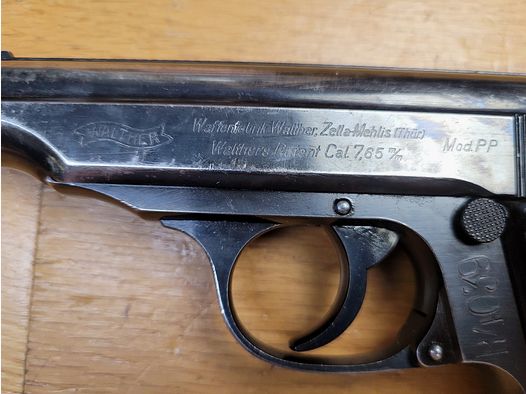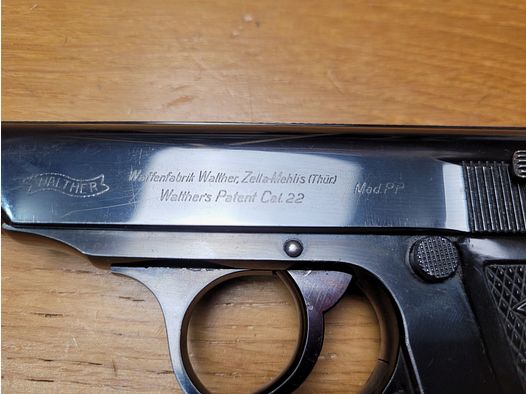


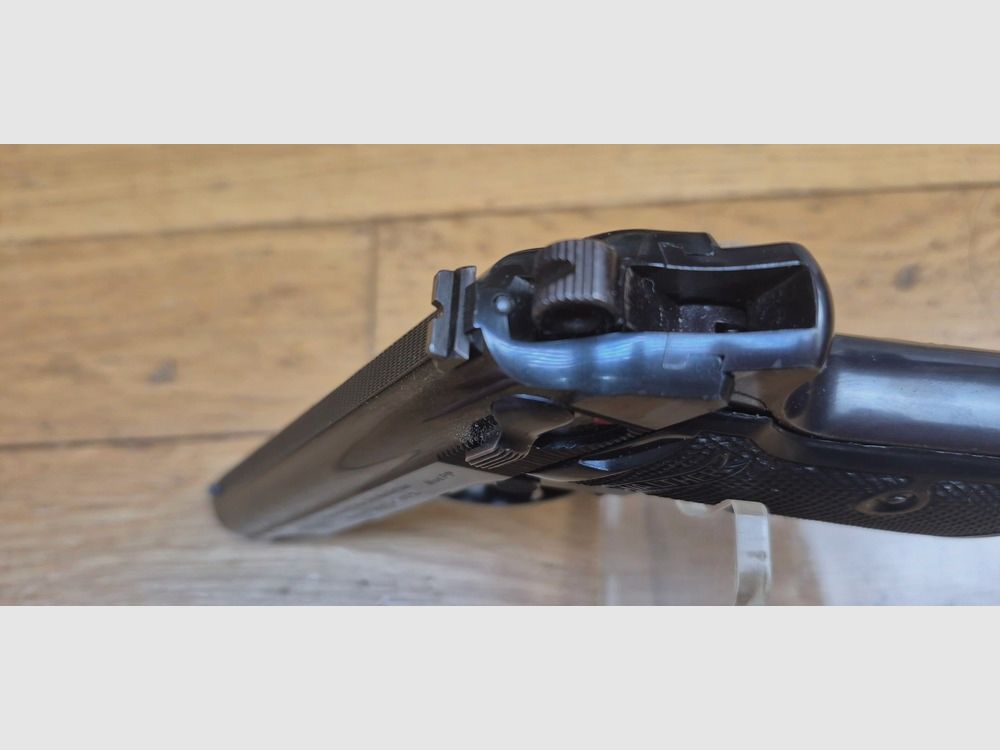
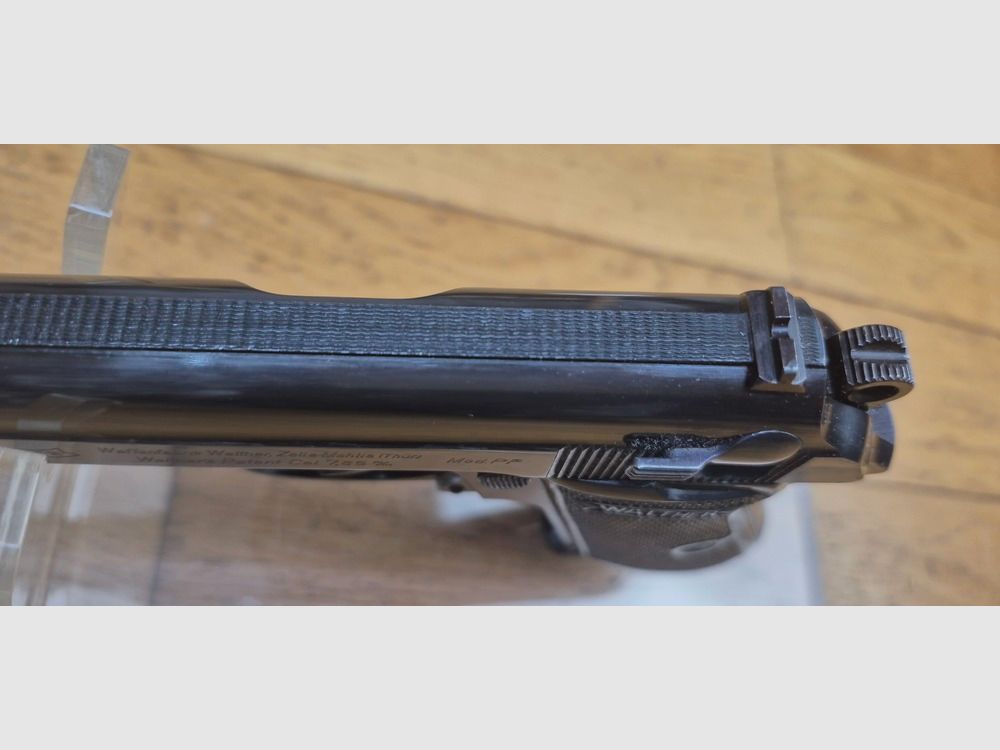
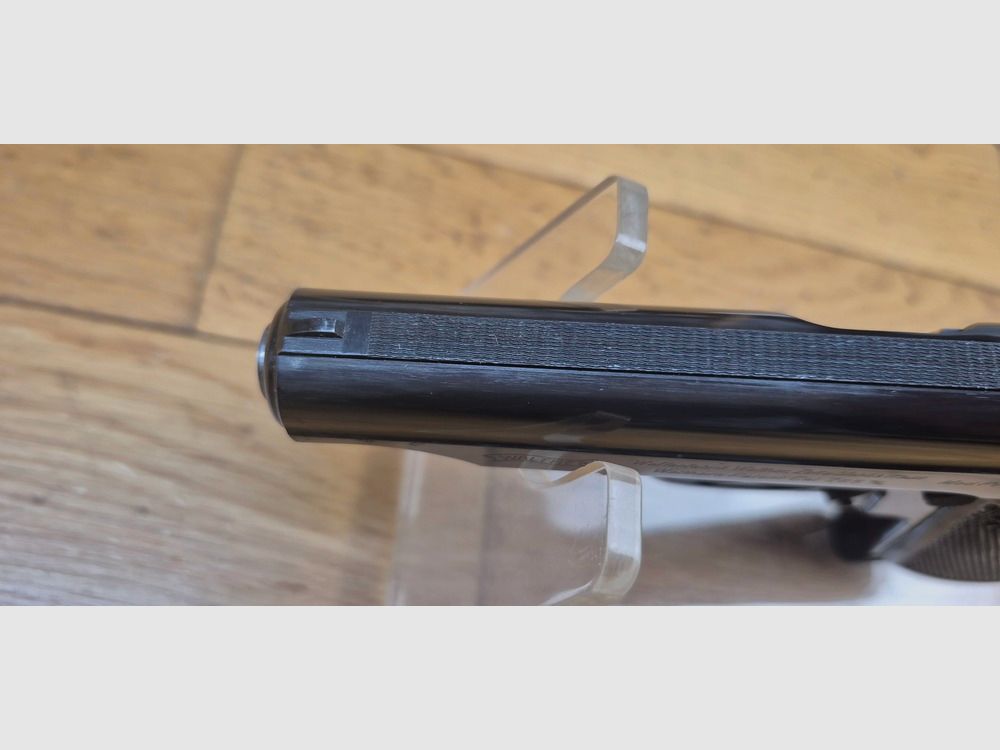
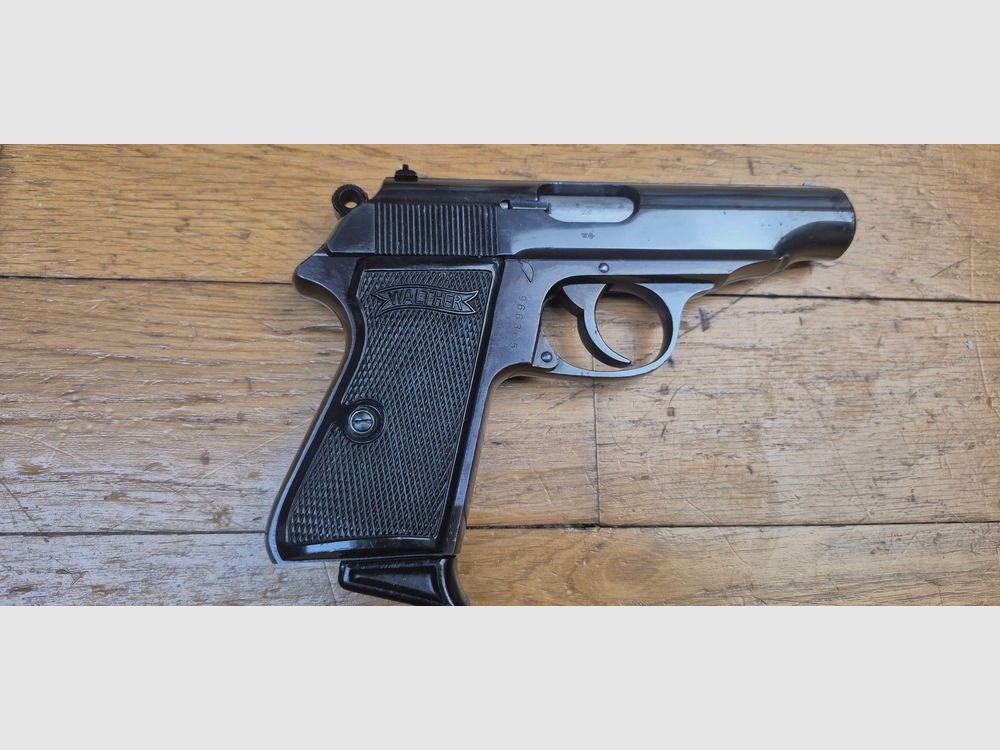

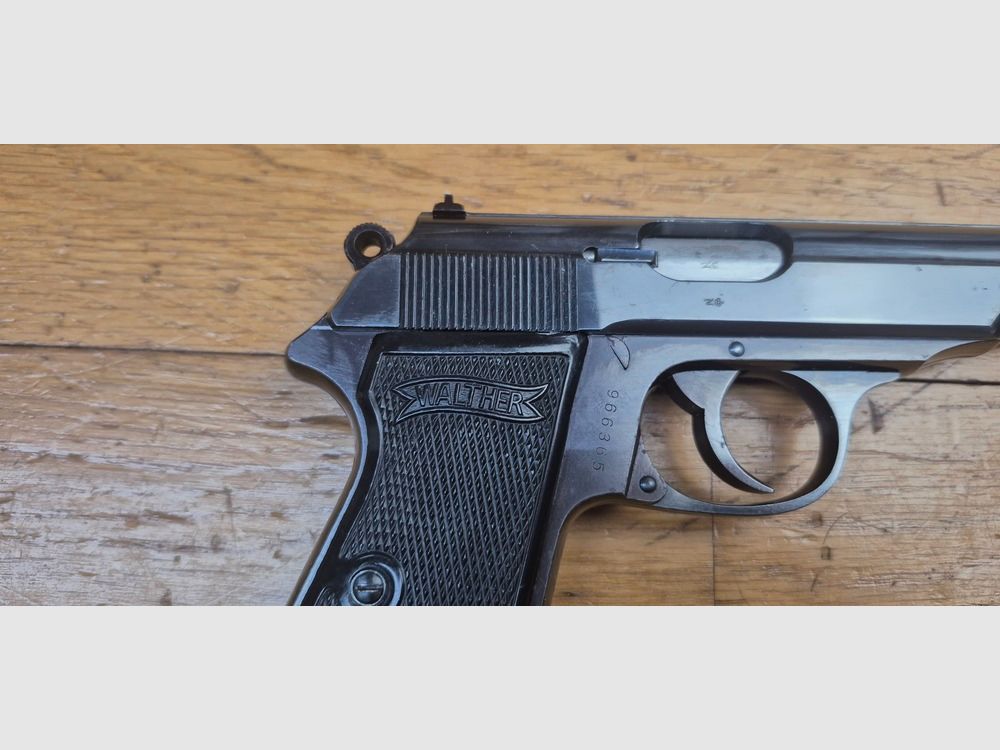

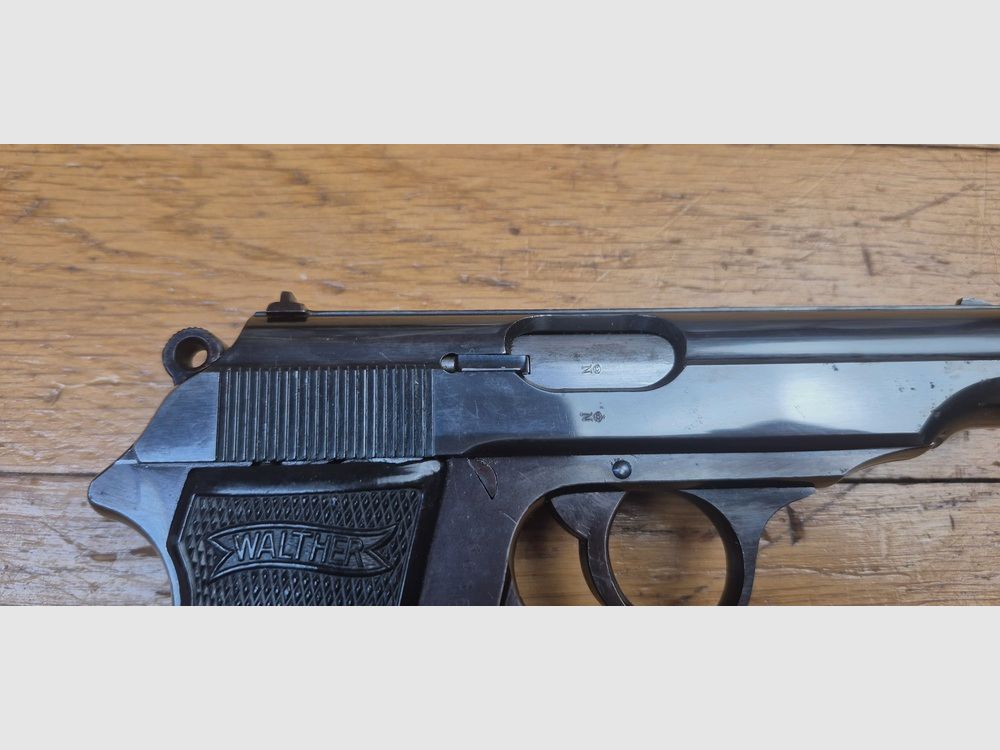

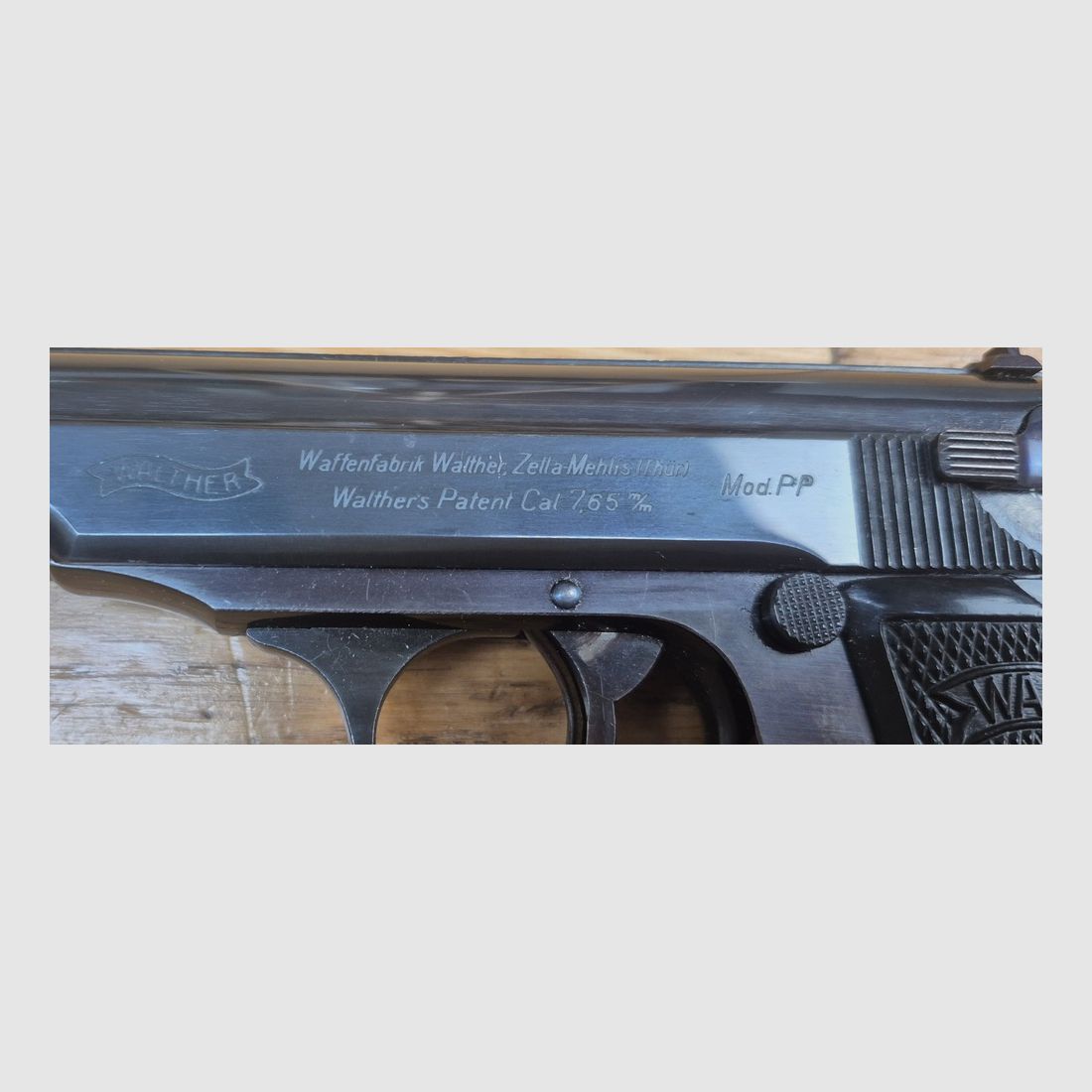


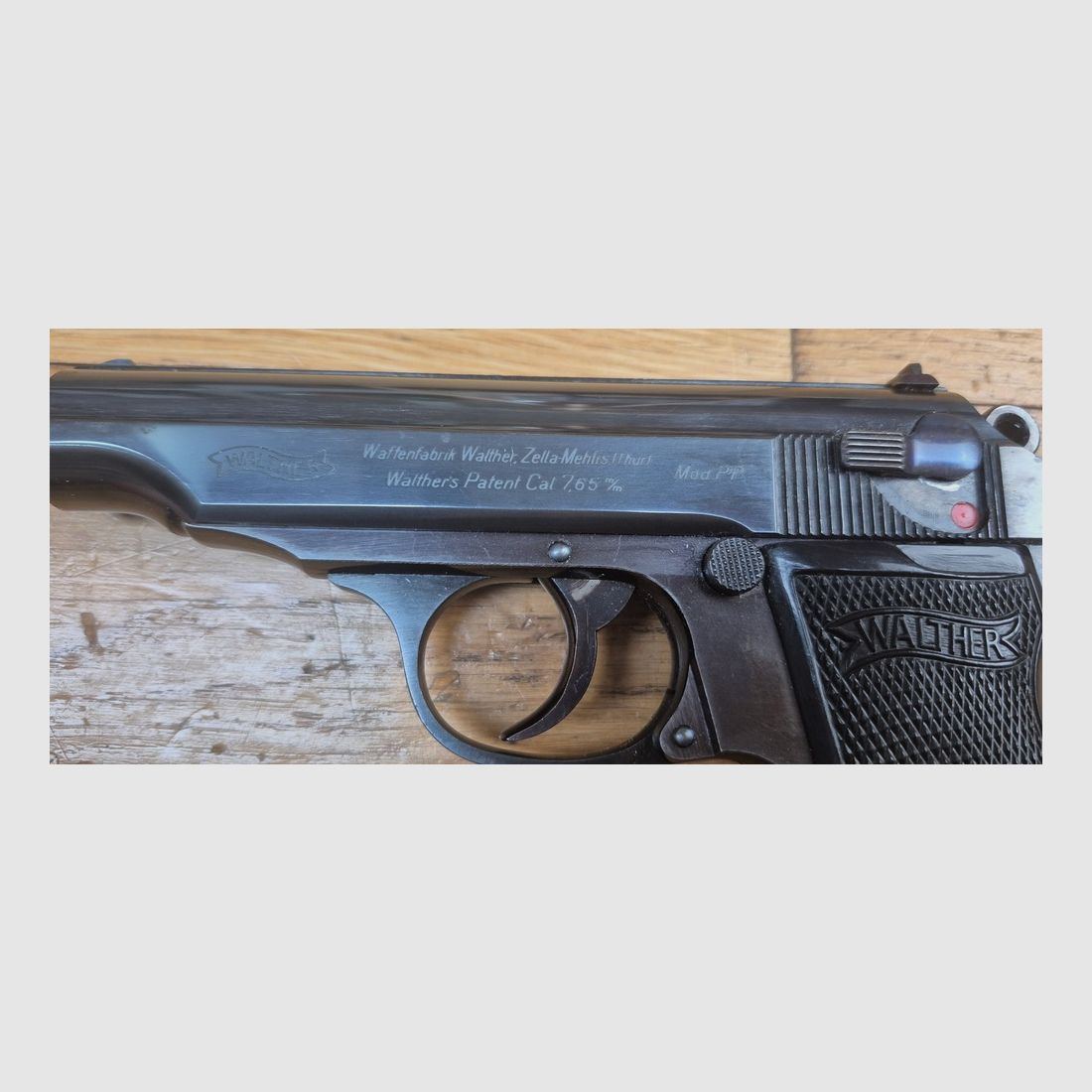


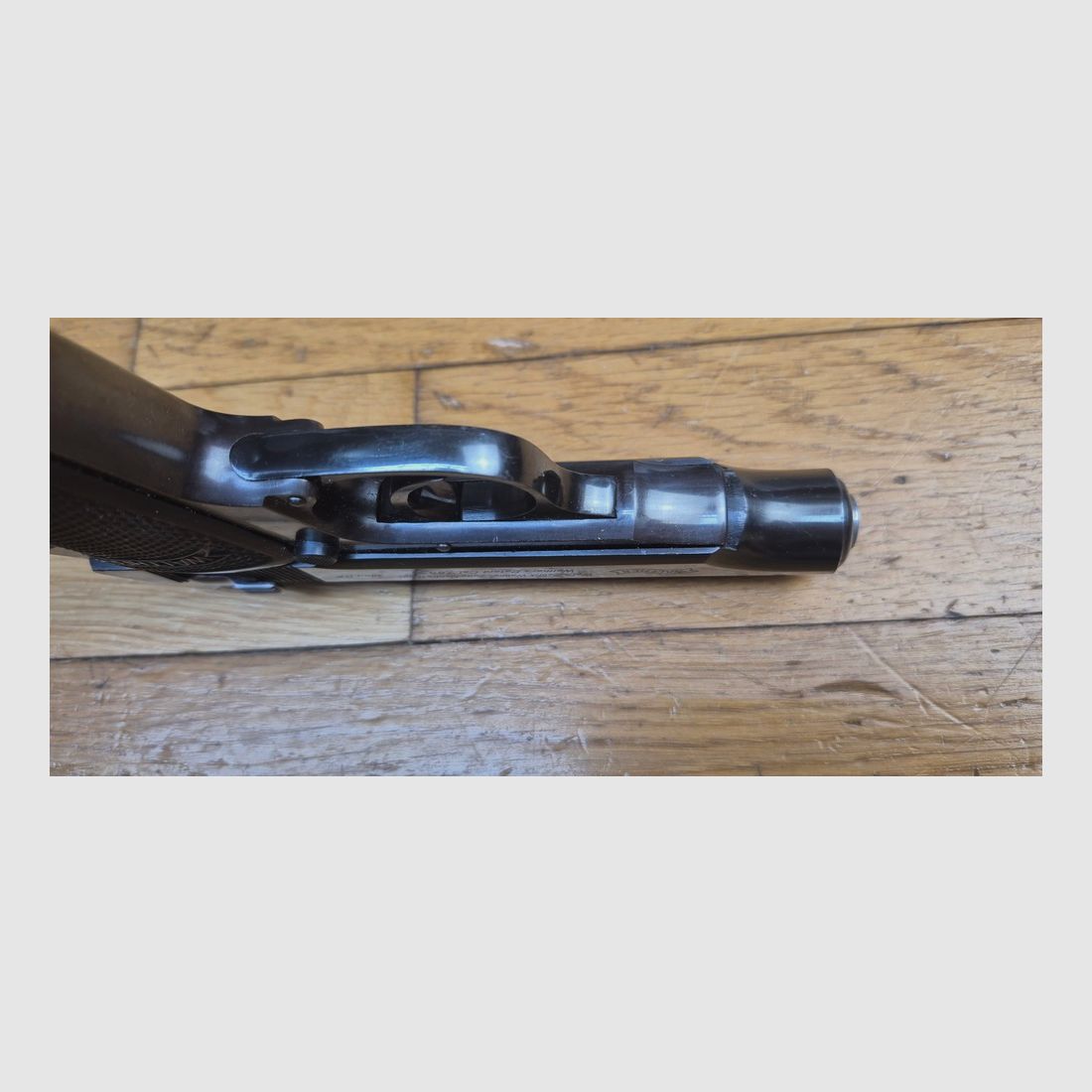
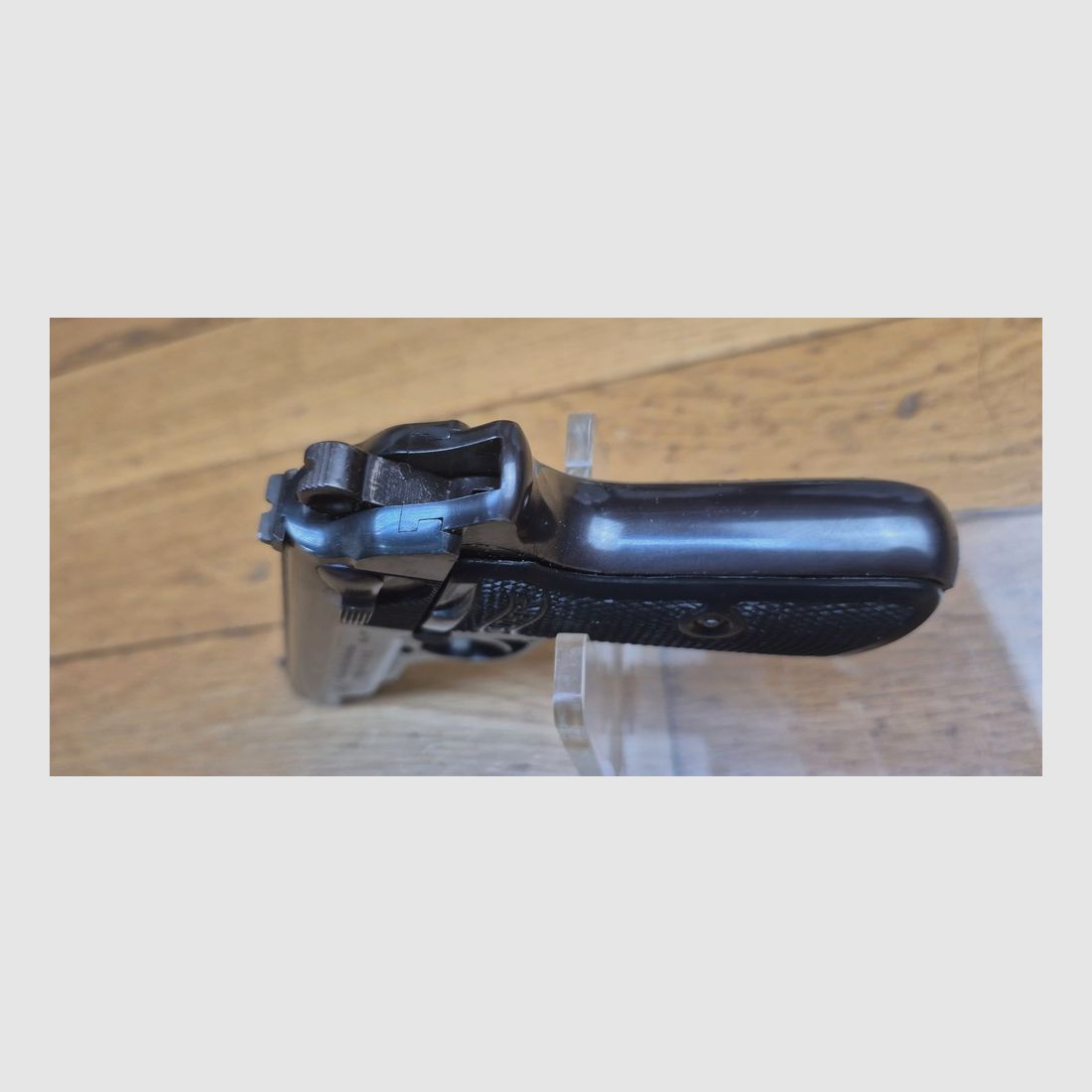

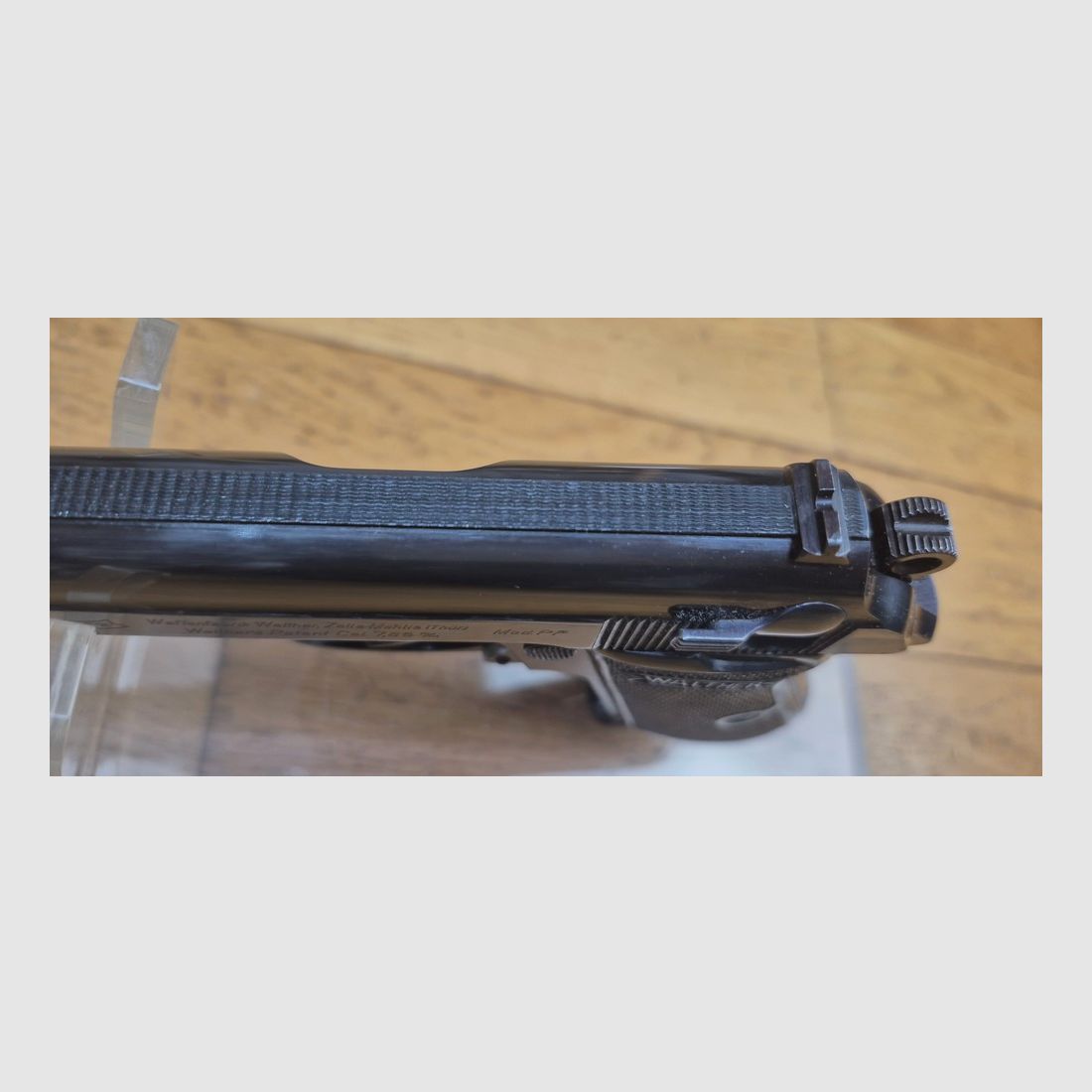
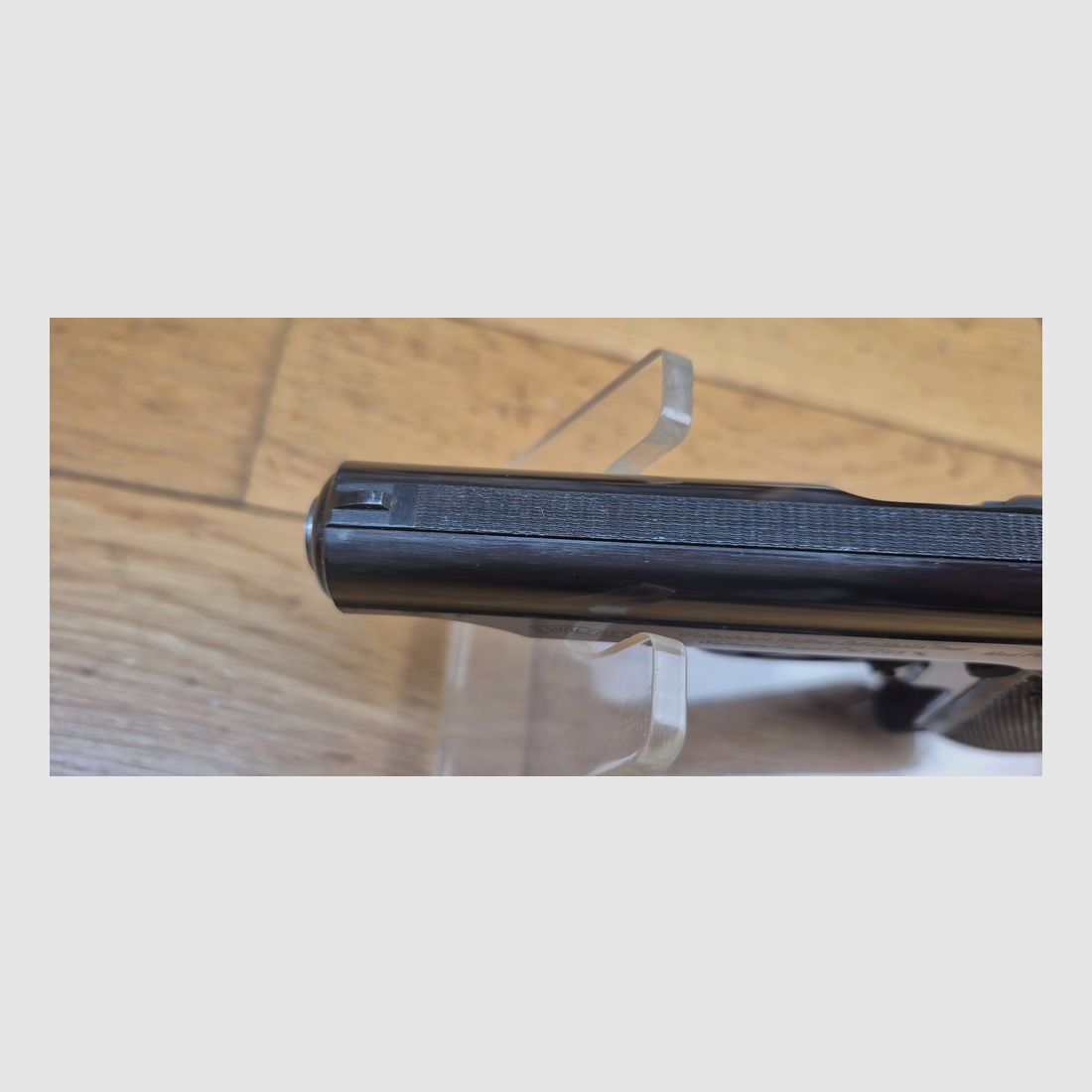
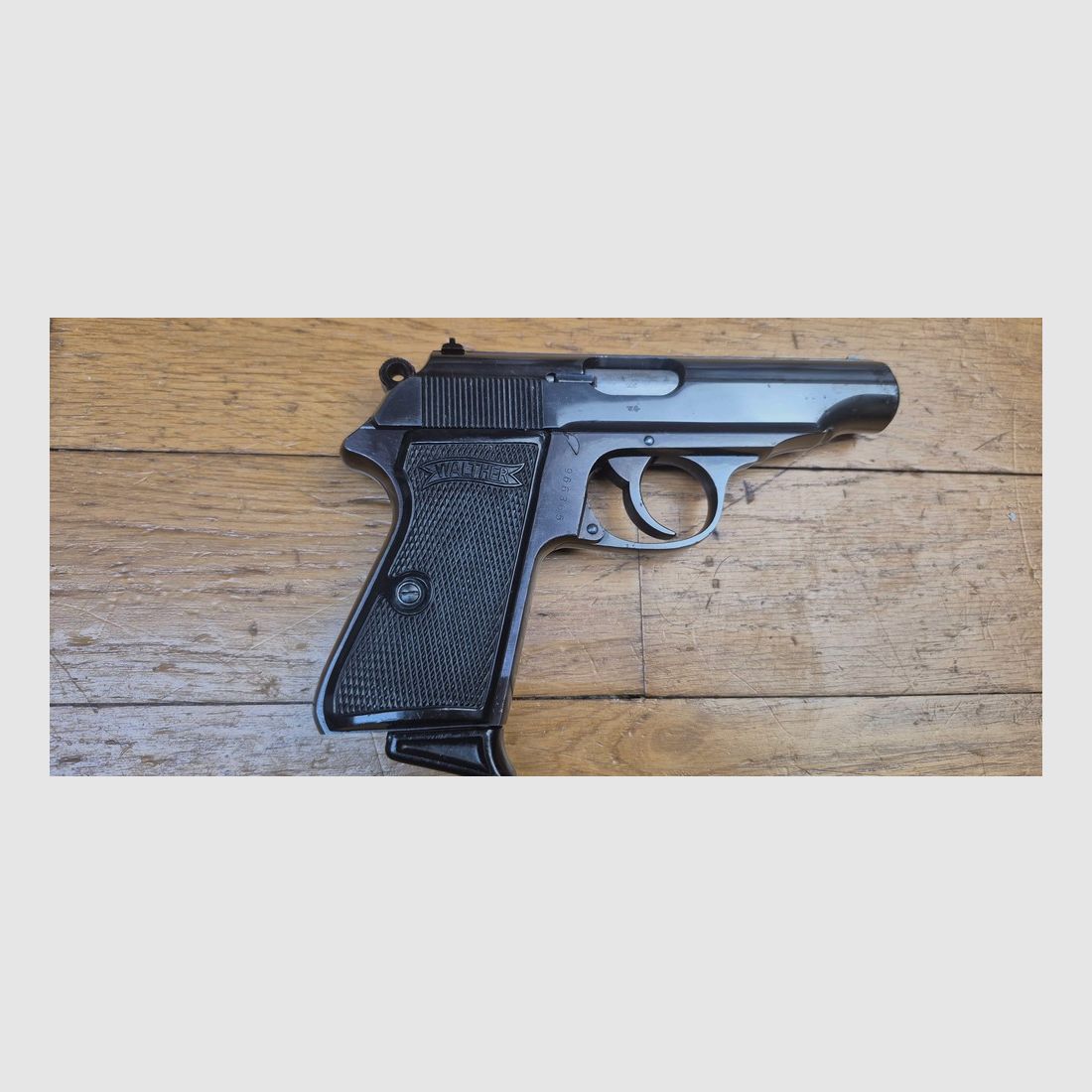



Magnificent Walther PP pistol period III Reich – Beautiful manufacture Walther Zella-Mehlis – Caliber 7.65 mm – Civilian weapon from late 1937 – Splendid original bluing at 99% – 100% Serial number – Perfect mechanics – New mirror barrel – Compliant magazine – A splendid PP – TBE++
≈ $989
Price at the dealer: 900 €. Converted at the ECB rate as of November 20, 2026.
Purchase permit required
75002 Paris, France
6
ID: 10338535
This item is currently unavailable.
Purchase from outside the EU: The firearm goes through an importer in your country, the dealer handles the export.
How buying from Europe works
Shop safely with Gunfinder
Our AI-powered seller identity verification makes Gunfinder the safest marketplace online.
Learn more
Details
- Original language
- French
- Brand
- Walther
- Product
- Walther PP
- Category
- Purchase eligibility
- Required
- Condition
- New
- Location
- 🇫🇷 75002 Paris, France
- Availability
- Out of stock
Freshness
This listing is based on a mirrored offer, where the listing data was synced to us from a shop, dealer, or external marketplace. Please note that temporary price discrepancies may occur due to possible delays in data transmission.
- Source
- Flingus Maximus
- Last checked with the dealer
- 1 day ago
Description
Note:
The item is located abroad. Please note that delivery conditions, shipping times, and/or the purchase process may differ.
We have Carl Walther to thank for introducing double- and single-action triggers on semi-automatic pistols in 1929. Such a mechanism may seem obvious in the age of polymer striker-fired pistols. But without the Walther PP and PPK, we wouldn’t have had the Beretta 92FS, CZ-75, SIG P226 or even the Makarov… The world of shooting would have been poorer for it, and movies of the ’70s and ’80s probably less fun.
The Walther’s ability to be “never cocked and always ready to fire” (that’s not my line—it’s a famous Manufrance slogan!) gave it a considerable advantage over other defensive firearms and military sidearms. No need to trust an inaccessible safety that you might forget about when you need to draw. And no risk of the already chambered round “going off by itself,” either.
Another welcome feature: the decocking lever also serves as a safety. A first in the world of firearms, copied many times since, notably by SIG (being copied by such a fine company is no small thing). The risk of the hammer slipping from your fingers as you try to lower it gently is reduced to absolutely zero. A significant advantage given the size of the PP and PPK and their intended use.
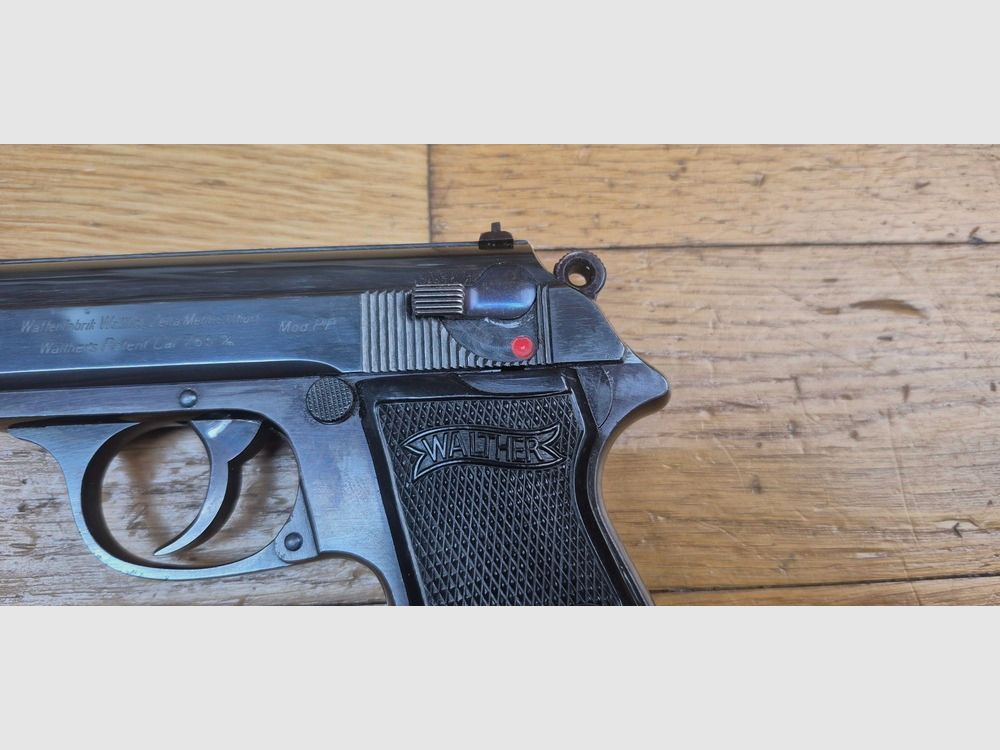
A loaded-chamber indicator completes the package, so you can check with a simple touch, deep in your pocket and without taking the firearm out, that everything is “ready.”
The Walther PP and PPK were innovative in their takedown and ergonomics, too. With the firearm unloaded, simply remove the magazine, pull the trigger guard down, then pull the slide back and lift it off. And there you go: everything is in your hand, disassembled. No parts flying off or getting lost. The designers of the CZ vz. 50 and Makarov got their inspiration right when they equipped… the armies of the Warsaw Pact.
It’s easy to understand, then, why this pistol was an immediate success, followed by countless copies, some of them excellent. From the moment it was introduced, it became a prestige item, often given as a gift or even as a reward by German authorities.
Even today, it remains a firearm that is both modern and classic. A timeless piece, as they say in fashion.
Originally designed for discreet police work, the PP was available in .22 LR, 6.35 and .380 ACP, but more often in 7.65 Browning. The Walther PP was frequently issued to army officers and to just about every branch of the Third Reich: the air force and navy, of course, but also customs, the postal service, and the ministries of finance and justice… A broad collecting theme, too.
In its excellent French-made version produced by Manurhin, it served with the French police and customs before the MR73 arrived. In the 1980s, it was still carried by the gendarmes of the Republican Guard responsible for security at the Élysée Palace (CSPR of the 1st RI).
The last Walther PP pistols made by Walther left the factory in 1999, marking the end of a production run spanning 1929–1999. Seventy years!
A total of 940,000 were produced: 540,000 up to 1945 at the Zella-Mehlis factory, and another 400,000 between 1952 and 1999 by Manurhin in Mulhouse and Walther in Ulm. It’s worth noting that even more PPKs were produced (964,000), not counting American production of its variants. A real success.
With talent like that, it’s no surprise that it inspired so many firearms: the SIG Sauer P230, Argentina’s Bersa Thunder 380, Hungary’s FEG PA-63, the Soviet Makarov PM, Romania’s Carpați Md. 1974, China’s Type 64, the CZ vz. 50… They all owe it a lot. To name just a few copies that went on to become standard issue in the
their respective countries.
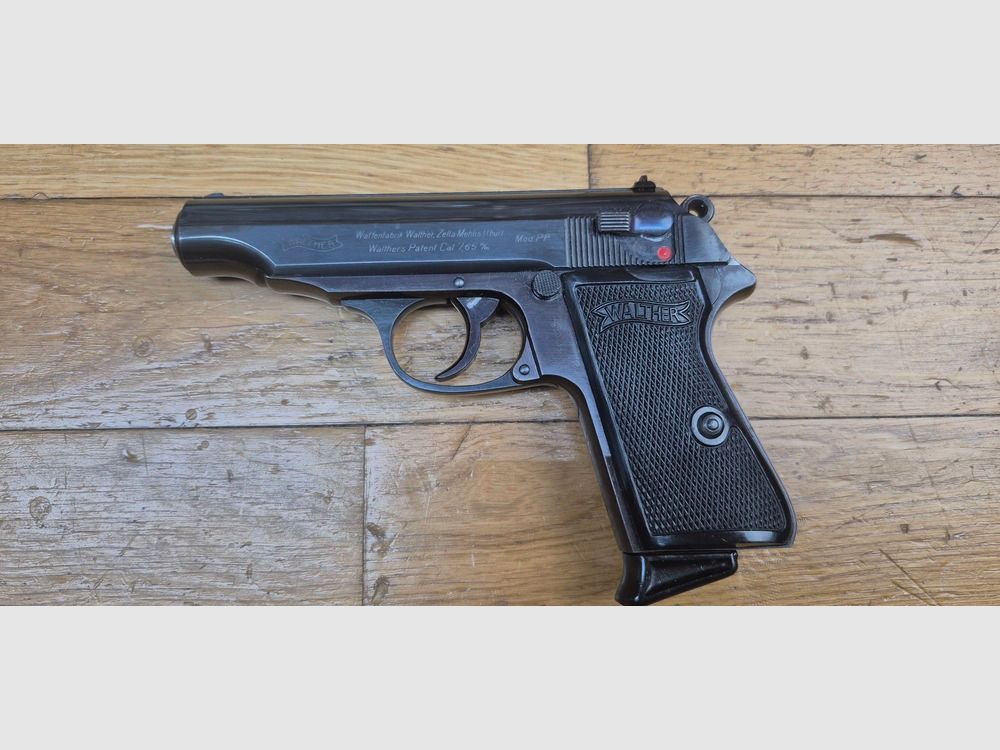
Our example today is a very fine example of a civilian firearm from the Third Reich.
It was made by Walther in Zella-Mehlis, Thuringia, the original Walther factory before the catastrophe (for them) of 1945 and its looting by the Americans, followed by its occupation by the Soviets. And before the move to Ulm after 1947.
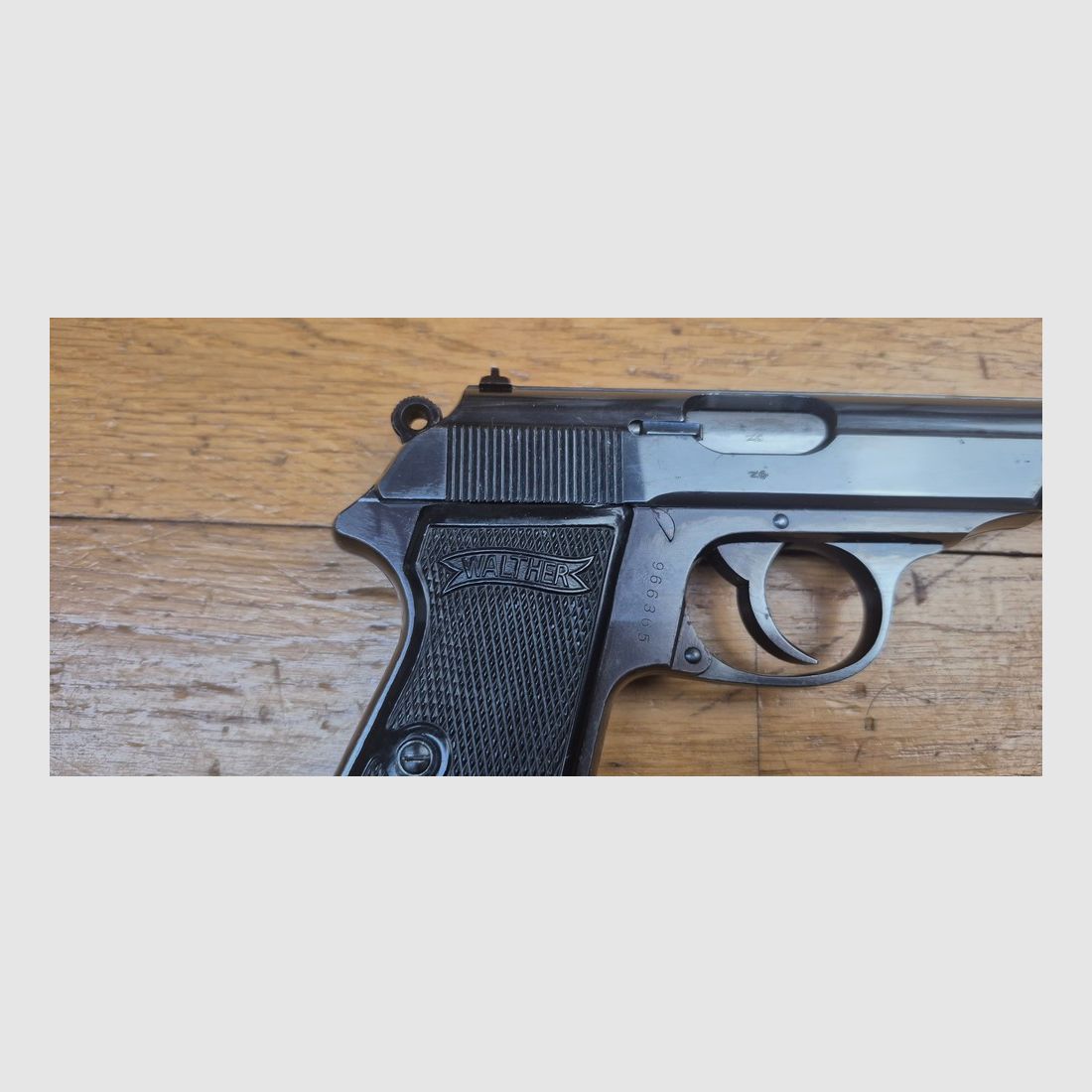
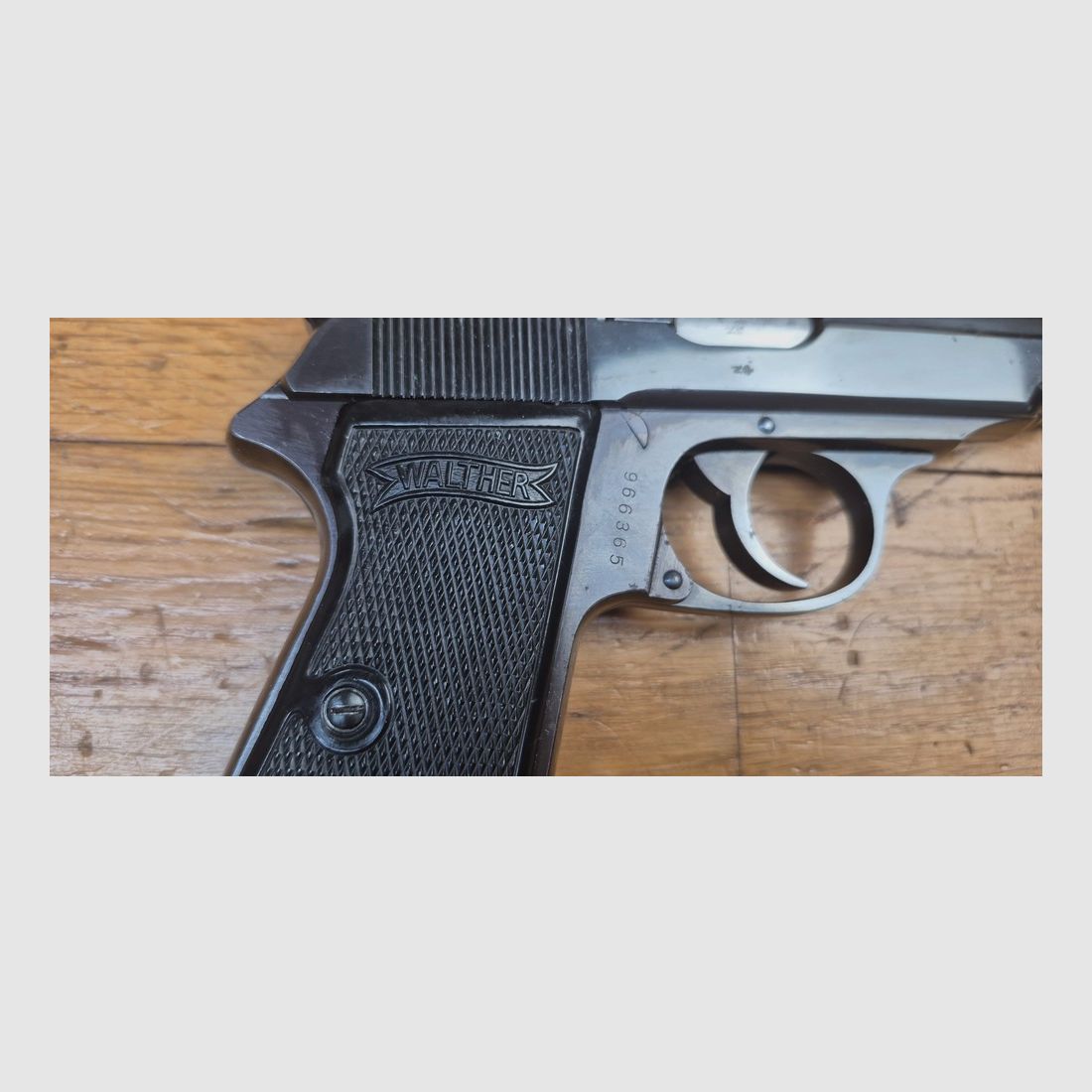
Its serial number – 966 xxx – places it in late 1937 production.
The firearm is in splendid condition, both cosmetically and mechanically. It’s rare to see one this “fresh.”
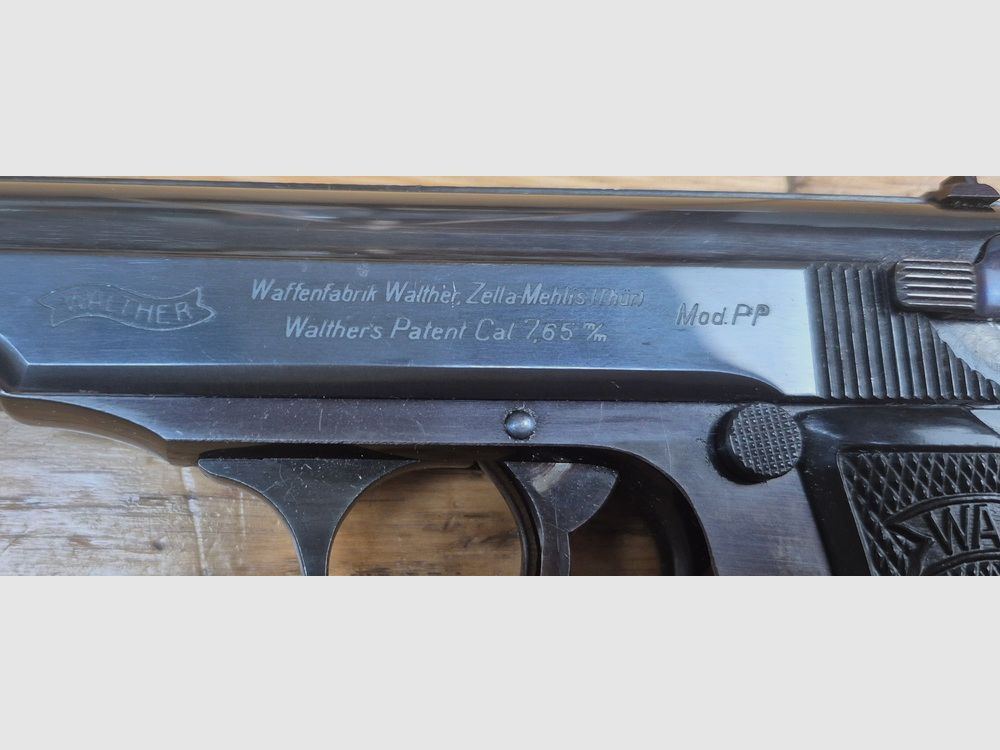
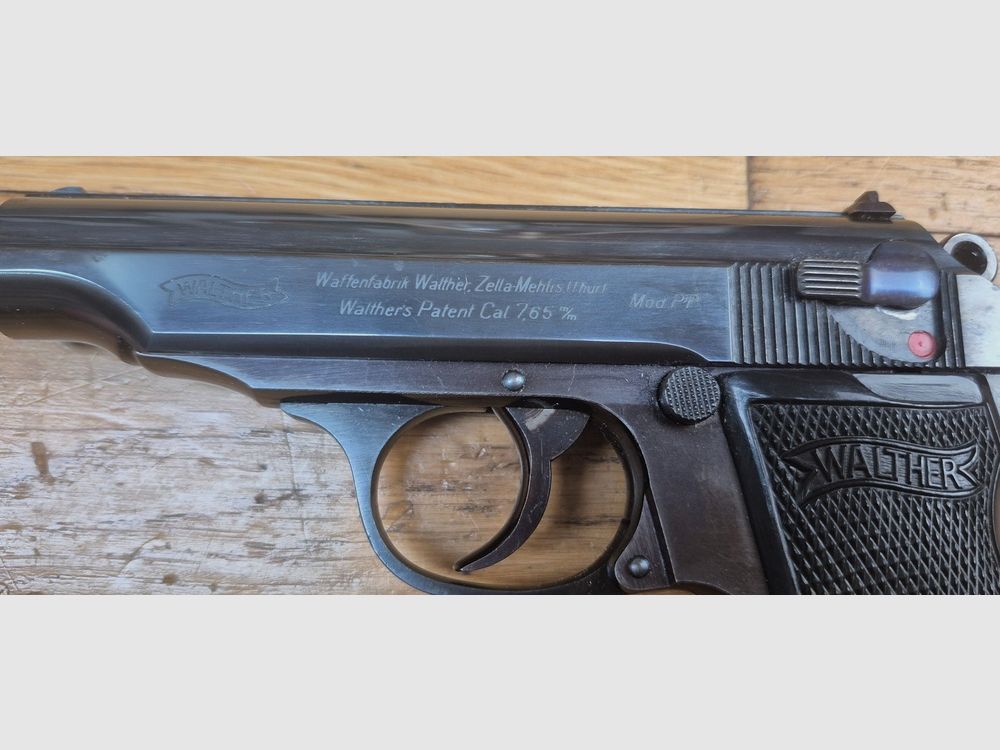
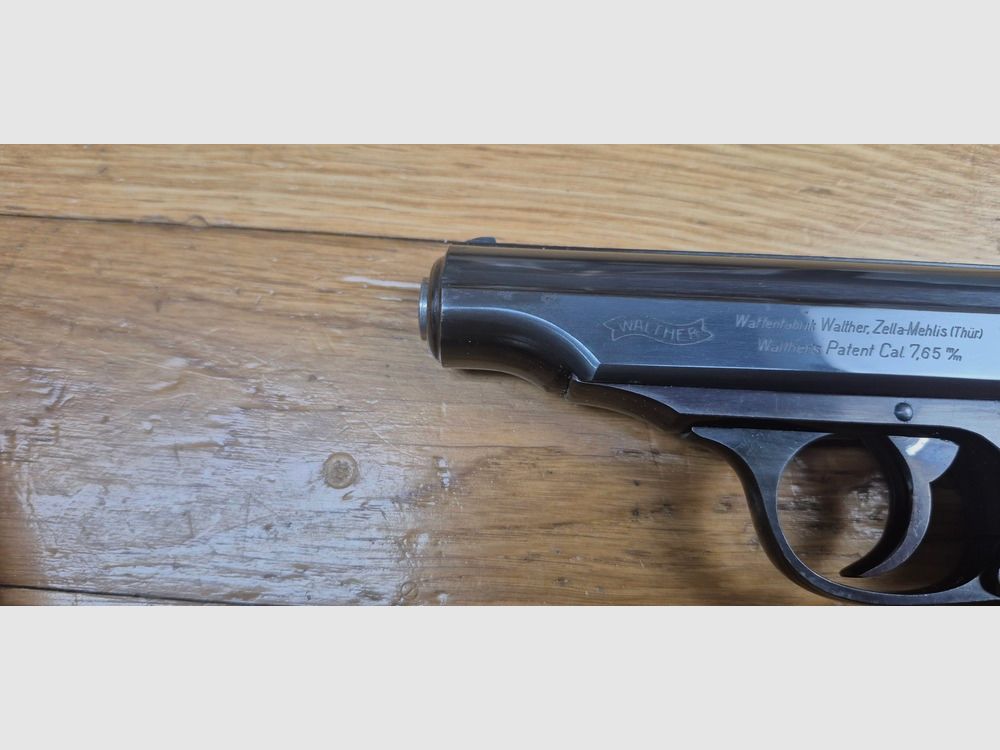
All manufacturer, model and caliber markings are clear and easy to read.
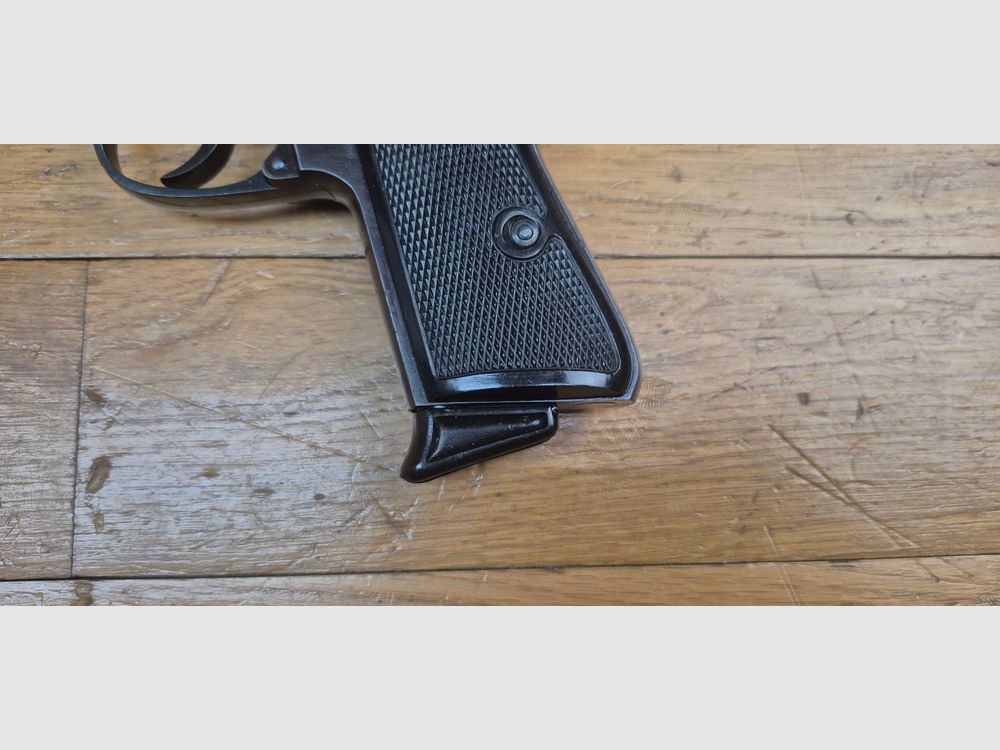
Beautiful original black Bakelite grips, correct for this period. They’re in perfect condition, with no repairs or weak spots.
The firearm has a magnificent original glossy black Walther blued finish, typical of the brand and discontinued during the war, with 99% remaining.
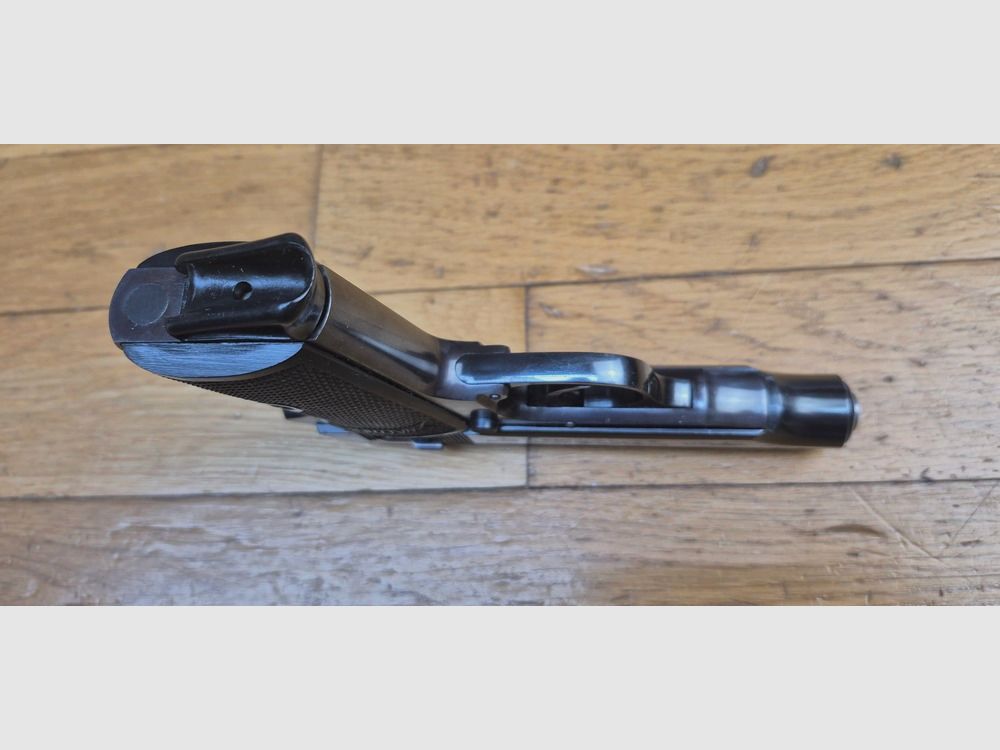
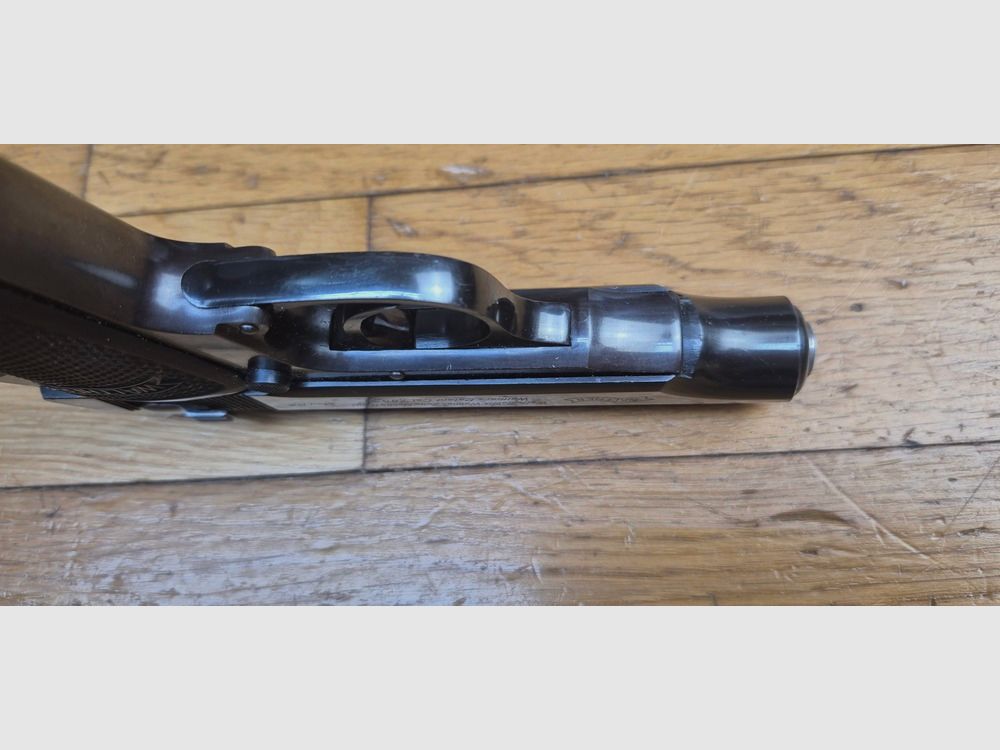
A tiny, barely visible spot of finish loss at the right end of the barrel, and another on the trigger, which I mention as a matter of professional conscience. My usual TOO close-up photos do me no favors, and you can barely see it when holding the firearm. If you spot anything else in my photos, it’s reflections or dirt, as the firearm is dirty.
No visible scratches when holding the firearm. Any tiny flaws are exaggerated by my usual close-ups, but at least you know everything. The firearm has seen very little handling in its life.
It’s dirty and covered in fingerprints (I’m ashamed!). But really beautiful. The best-looking one in the neighborhood. Like me. You’ll have a hard time finding a nicer one… Bluing in very good condition++
All its markings are still clearly legible. Besides the serial number on the right side, you can clearly see two crisp eagles above an N, one on the slide and one on the barrel. This is the civilian proof mark for smokeless powder used in the Third Reich. The eagle over N was introduced in 1940.
It’s rare for these markings to be this crisp, as they were stamped after bluing and very finely at Walther. Time, oxidation and overly vigorous cleaning often wore them down. That’s not the case here at all—they’re perfect too. Markings in very good condition+++
The magazine is a genuine Walther magazine, marked with the brand logo and the third pre-war civilian type, with a notched edge, correct for the production period. It’s the original one. It’s in perfect condition. Very good condition+++
The firearm is in impeccable mechanical condition, with very firm springs and a strong firing mechanism. The slide cycles and the firearm disassembles without any issues. The smoothness of the mechanisms (slide, safety, trigger, etc.) and their fit and firmness belong to another era. Yet everything feels pleasant and smooth. A level of workmanship that modern production can’t match.
The screws are perfect too.
The barrel is mirror-bright, splendid, with beautiful rifling. In fact, it’s like new despite being almost 90 years old. Original caliber: 7.65 Browning. The firearm is 100% matching numbers. It has seen very little use and has been very well preserved.
These purely civilian firearms from the Third Reich are rare. Paradoxically, firearms laws were very strict, and the Nazis, who had fought other political forces in the streets with weapons for years, took the issue of civilian firearm ownership very seriously. Like all dictatorships.
You had to be a Party member, a member of the police or armed forces, or very much in favor (often as a reward) to own one. I also think many of these uncommon civilian firearms from the Third Reich were private purchases by police officers or military personnel who had other firearms issued to them but wanted a Walther.
In short, a very fine Walther PP from the Third Reich period, from the still exceptional Zella-Mehlis factory. An uncommon Walther PPK in 7.65, interesting and in top cosmetic and mechanical condition.
If you’re going to own a PP, one of the best pocket pistols in history, you might as well buy an excellent-condition period Zella-Mehlis model…
That!
CATEGORY B FIREARM REGISTERED IN THE CSI: SUBJECT TO AUTHORIZATION; A COPY OF A VALID ID AND LICENSE IS REQUIRED – SIA ACCOUNT MUST BE OPEN, OF COURSE – Shipment with signature required in two separate packages at least 48 hours apart is mandatory.
***********************************************************************************************************************
Let’s say it again! Flingus Maximus gun shop in Paris and throughout France is also here to help with private firearm transfers, buying firearm and militaria collections, firearm valuations, and questions about firearms in estates and inheritances. Contact your favorite gun dealer using our contact form or at [email protected] (Show description in original language)
Au delà de sa carrière cinématographique, le Walther PP (né en 1929), avec son petit frère encore plus discret le Walther PPK (né en 1931), s’est imposé comme une des meilleures armes de sa génération. Une de celles qui influencent toutes les suivantes.
Nous devons à la firme de Carl Walther l’application de la platine double et simple action aux pistolets automatiques dès 1929. Un tel dispositif peut sembler évident à l’ère du « strike fire » en polymère. Mais sans les Walther PP et PPK, nous n’aurions pas eu de Beretta 92FS, de CZ-75, de SiG P226 ou même de Makarov… Le monde du tir en eût été moins beau et le cinéma des années 70 et 80 sans doute moins amusant.
La capacité du Walther a n’être « jamais armé et toujours prêt à faire feu » (c’est pas de moi, c’est une célèbre formule de Manufrance !) offrait un avantage considérable sur les autres armes de défense comme sur celles des militaires. Pas besoin de faire confiance à une sécurité inaccessible et à laquelle on ne pense plus quand il faut dégainer. Et pas de risque non plus que le coup, déjà chambré, « parte tout seul ».
Luxe appréciable également, le levier de désarmement fait office de sûreté. Une première dans le monde des armes, maintes fois copiée par la suite après, par SIG notamment (il n’est pas rien d’être copié par une si bonne maison). Le risque d’avoir le chien qui vous échappe des doigts quand on essaye de le rabattre gentiment est réduit à absolument zéro. Qualité non négligeable au vue de la taille des PP et PPK et de leur contexte théorique d’utilisation.
De plus un indicateur de chambrage complète le tout pour vérifier, au fond de la poche et d’un simple toucher, sans avoir à sortir l’arme, que tout est « prêt ».
Par leur démontage et leur ergonomie aussi, les Walther PP et PPK étaient innovants. Arme vide, il suffit de retirer le chargeur, de tirer vers le bas le pontet, puis de ramener la culasse en arrière et de la soulever. Et, hop, tout est là, dans la main, démonté. Sans pièces qui volent ou qui se perdent. Cz Vsor et Makarov ne se seront pas trompés dans leurs inspirations pour équiper… les armées du Pacte de Varsovie.
On comprend dès lors alors le succès immédiat que connu ce pistolet et les innombrables copies, parfois excellentes, qui ont suivi. Dès sa naissance, il devint un objet de prestige, et souvent un cadeau, voire une récompense, de la part des autorités allemandes
Il reste aujourd’hui encore une arme moderne autant que classique. Un intemporel dirait-on dans la mode.
Prévu initialement pour les emplois policiers les plus discrets, on peut trouver des PP en 22LR, en 6,35 et en 380 Acp mais plus souvent encore en 7,65 browning. Le Walther PP fut fréquemment en dotation chez les officiers de l’Armée et à peu près dans tous les corps du III° Reich: aviation, marine bien sûr mais aussi Douanes, Postes, Ministère des Finances et de la Justice inclus… Un vaste thème de collection aussi donc.
Dans son excellente version franco-française produite par Manurhin, il équipa Police et Douanes françaises avant l’arrivée des MR73. Dans les années 1980, il équipait d’ailleurs encore les gendarmes de la Garde Républicaine chargés de la sécurité de l’Elysée (CSPR du 1er RI).
Les derniers Walther PP de production Walther sont sortis d’usine en 1999, soit une production s’étalant sur la période 1929-1999. 70 ans !
Il en a été produit en tout à 940.000 exemplaires: 540.000 jusque 1945 sur le site de Zella-Mehlis,et encore 400.000 entre 1952 et 1999 par Manurhin à Mulhouse et Walther à Ulm. A noter qu’il été produit encore un peu plus de PPK (964.000) sans les productions américaines de ses variantes. Un vrai succès.
Avec un tel talent il n’est pas étonnant qu’il ait été abondamment source d’aspiration: SIG Sauer P230, Bersa Thunder 380 argentin, FEG PA-63 hongrois, Makarov PM soviétique, Carpati Md. 1974 roumain, Type 64 chinois, Vzor 50 de chez CZ… Tous lui doivent beaucoup. Pour ne citer que quelques copies devenues réglementaires dans leurs pays respectifs.
Notre exemplaire de ce jour est un très bel exemplaire d’arme civile du III° Reich.
Il est de fabrication Walther à Zella-Mehlis en Thuringe, l’usine d’origine de Walther avant la catastrophe (pour eux) de 1945 et son pillage par les américains puis son occupation par les soviétiques. Et avant son déménagement post 1947 à Ulm.
Son numéro de série – 966 xxx le situe en production fin 1937.
L’arme est dans un splendide état tant esthétique que mécanique. Il est rare d’en voir des « aussi frais ».
Tous ses marquages de fabricants, de modèle et de calibre sont bien visibles et nets.
Belles plaquettes « maison » de bakélite noire conformes à cette période. Elles sont en parfait état sans aucune réparation ou fragilité.
L’arme est ornée d’un magnifique bronzage noir glacé d’origine typique Walther, qui disparaitra avec la guerre, bien présent à 99%.
Un poil de manque à peine visible en bout de canon à droite et autre en détente que je signale par conscience professionnelle. Mes TROP gros plans comme d’habitude me dé servent et on le voit à peine arme en main. Si vous en voyez d’autres sur mes photos, c’est des reflets ou des tâches car l’arme est sale.
Aucune griffure visible arme en main. Tous les micro défauts éventuels sont exagérés par mes gros plans comme d’habitude mais au moins vous savez tout. Arme fort peu manipulée dans sa vie.
Il est sale plein de traces de doigts (j’ai honte!). Mais vraiment très beau. Le plus beau du quartier. Comme moi. Il vous sera assez difficile d’en trouver un plus beau… Bronzage TBE++
Tous ses marquages étant encore bien lisibles, outre le numéro de série coté droit – on découvre clairement deux aigles surmontant un N bien nets, un en culasse et un en canon. C’est le poinçon d’épreuve civil d’épreuve poudre vive pour le III°Reich. L’aigle à N n’est apparu qu’en 1940.
Il est rare que ces marquages soient aussi nets car ils étaient frappés post bronzage et très finement chez Walther. Le temps, l’oxydation et les nettoyage trop appuyés les ont souvent affaiblis. Ce n’est nullement le cas ici – Parfaits aussi – Marquages TBE+++
Le chargeur est un bon chargeur Walther marqué du logo de la marque et du troisième type civil d’avant guerre – à bord indenté conforme à la période de production. C(est le sien. Il est en parfait état. TBE+++
L’arme est dans un état mécanique impeccable – ressort très fermes comme la percussion – Fonctionnement de culasse et démontage sans souci aucun. La souplesse des mécanisme (culasse, sécurité, détente….) sont d’une autre ère en ajustement et fermeté. Tout en étant agréable et souple. Un très beau boulot inatteignable sur une production moderne.
Vis parfaites aussi.
Le canon est juste miroir, splendide, avec de très belle rayures. Neuf en fait en dépit de ses presque 90 ans. Calibre d’origine 7,65 browning. Arme 100% mono-matricule. L’arme n’a que très peu tiré et a été très bien conservée.
Ces armes purement civiles du III° Reich sont rares. Car la législation sur les armes était très dure paradoxalement et les nazis, qui avaient combattu d’autres forces politiques les armes à la main dans la rue pendant des années, ne rigolaient pas du tout sur le sujet de la détention des armes par les citoyens. Comme toutes les dictatures.
Il fallait être membre du Parti ou des forces de l’ordre ou très bien vu (c’était souvent une récompense) pour en posséder une. Je pense d’ailleurs que nombre de ces peu courantes armes civiles de la période 3° Reich sont en fait des achats privés de policiers ou militaires dotés d’autres armes et qui voulaient un Walther.
En somme, un très bel exemplaire de Walther PP de la période du III° Reich et des encore exceptionnelles fabrications de Zella-Mehlis. Un Walther PPK en 7,65, peu courant, intéressant et dans un état esthétique et mécanique au top.
Quitte à avoir un PP, un des meilleurs pistolets de poche de l’Histoire, autant vous acheter un modèle Zella-Mehlis d’époque en excellent état !
ARME DE CATÉGORIE B AU CSI : SOUMISE À AUTORISATION, PHOTOCOPIE DE LA PIÈCE D’IDENTITÉ EN COURS DE VALIDITÉ ET DE LA LICENCE OBLIGATOIRE – COMPTE SIA OUVERT BIEN ÉVIDEMENT – Expédition contre signature en deux colis séparés d’au moins 48 heures obligatoire.
***********************************************************************************************************************
Répétons le ! L’armurerie Flingus Maximus à Paris et partout en France est là aussi pour vos formalités armes entre particuliers, le rachat de collections armes et militaria, vos estimations d’armes, vos questions armes dans les successions et héritage. Contactez votre armurier préféré via notre formulaire de contact ou à [email protected]