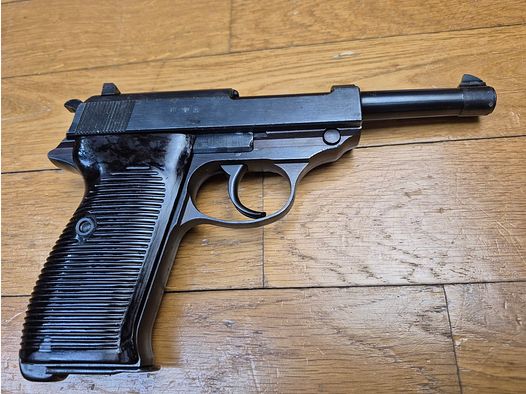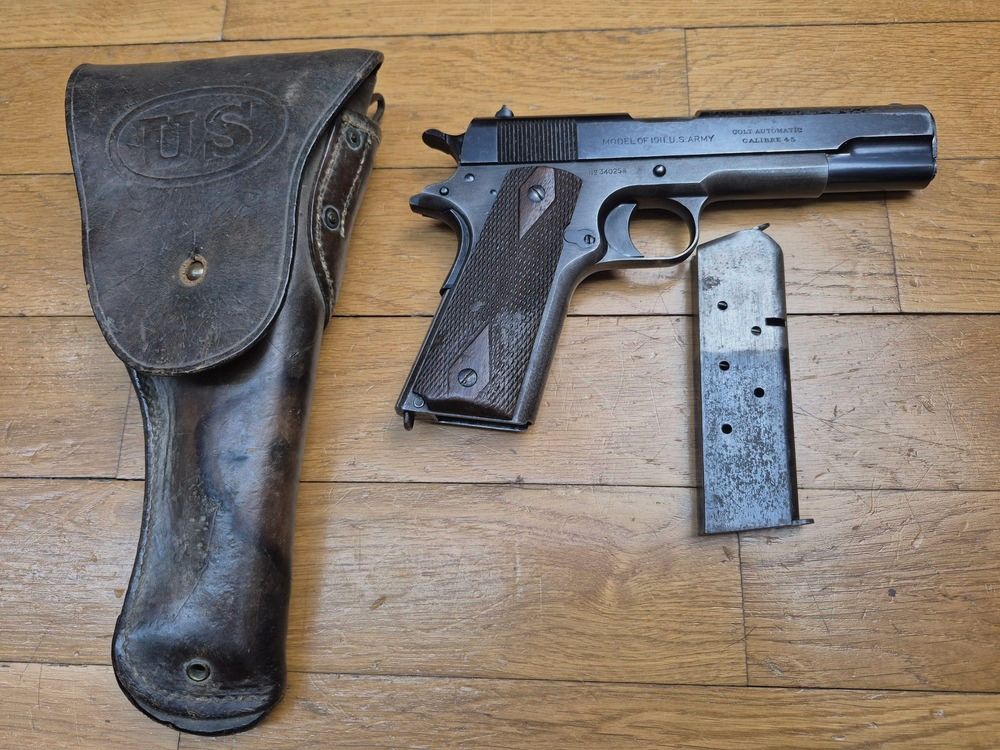



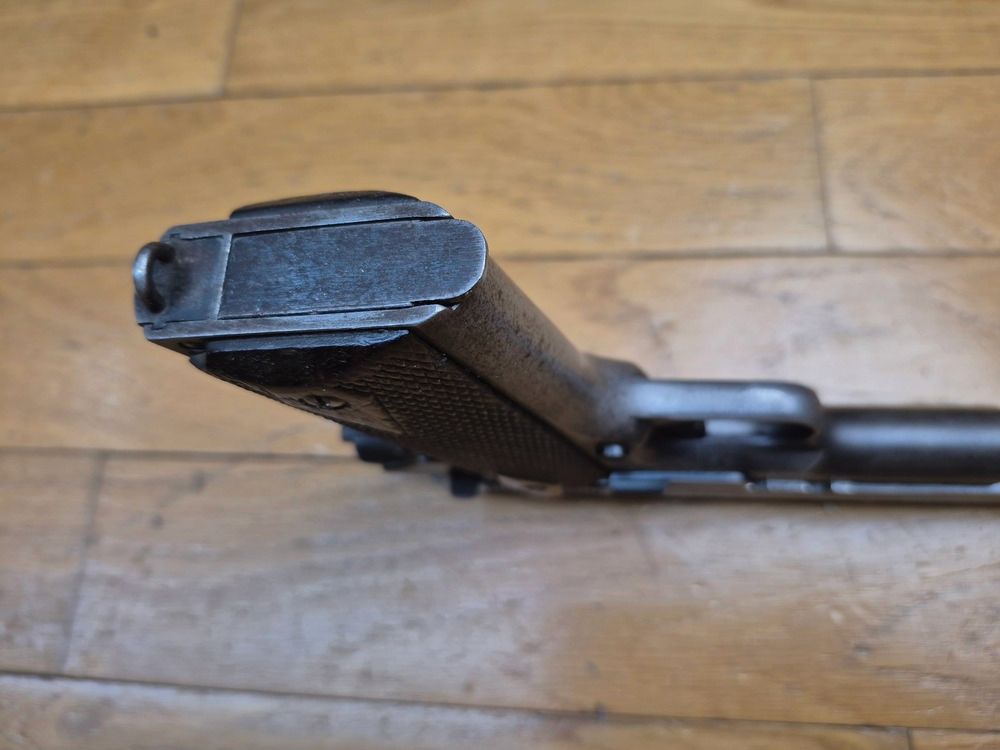

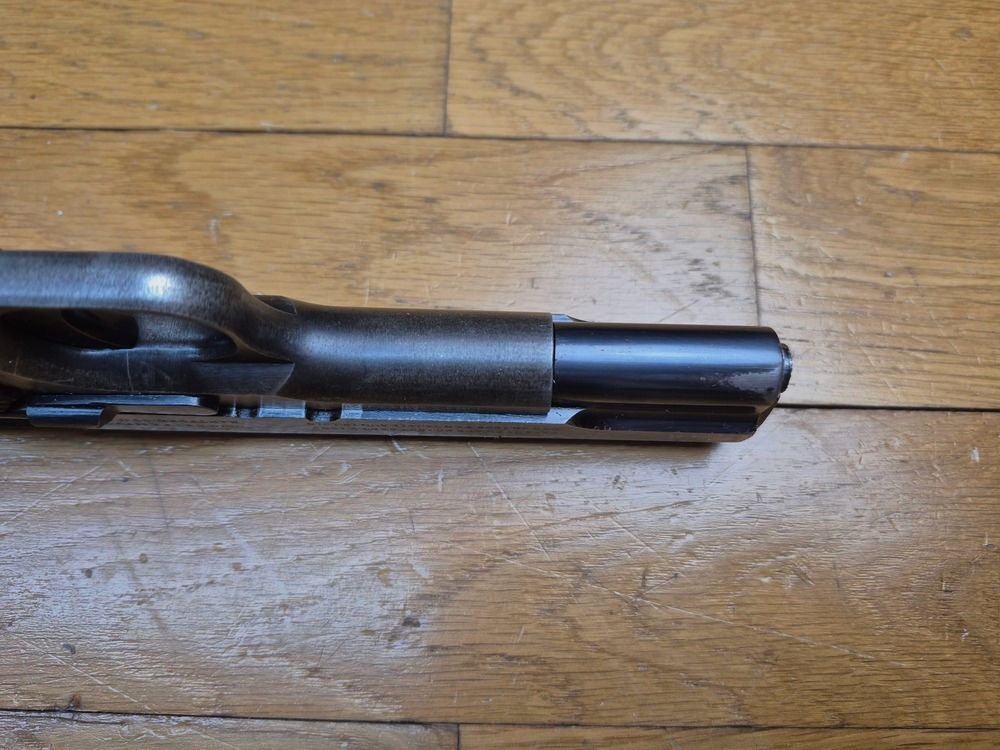
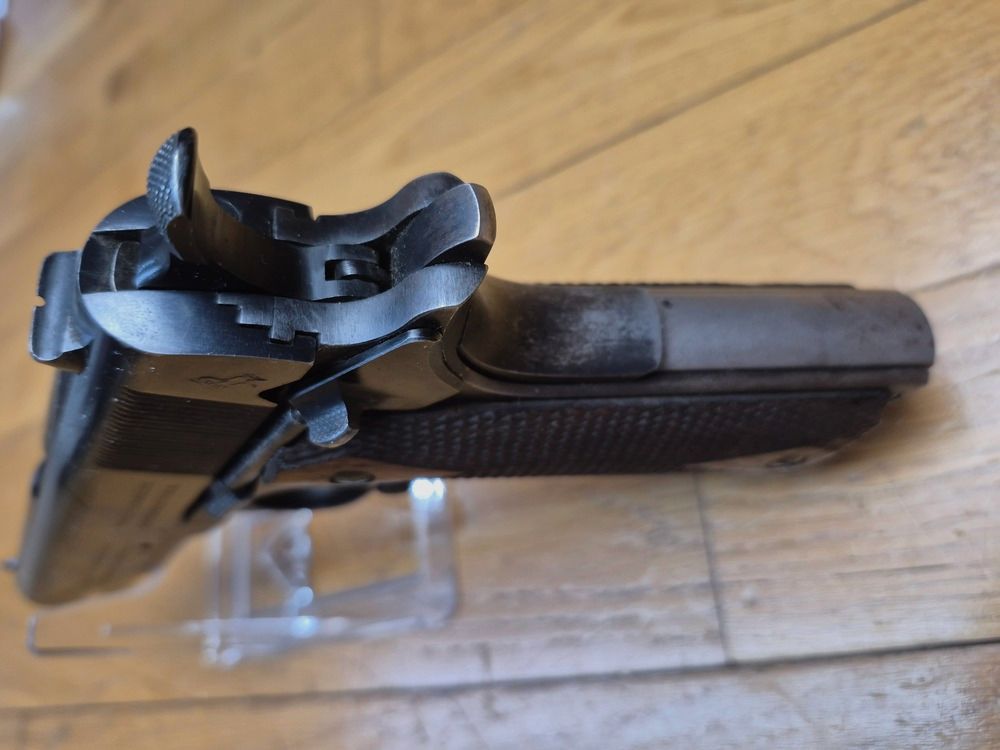


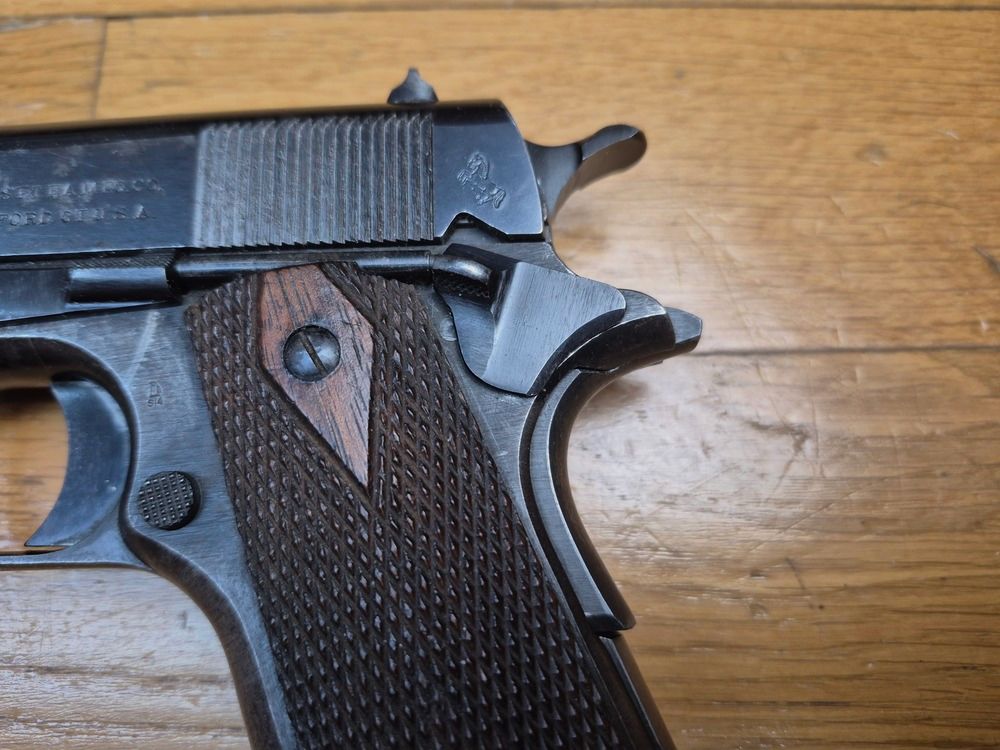




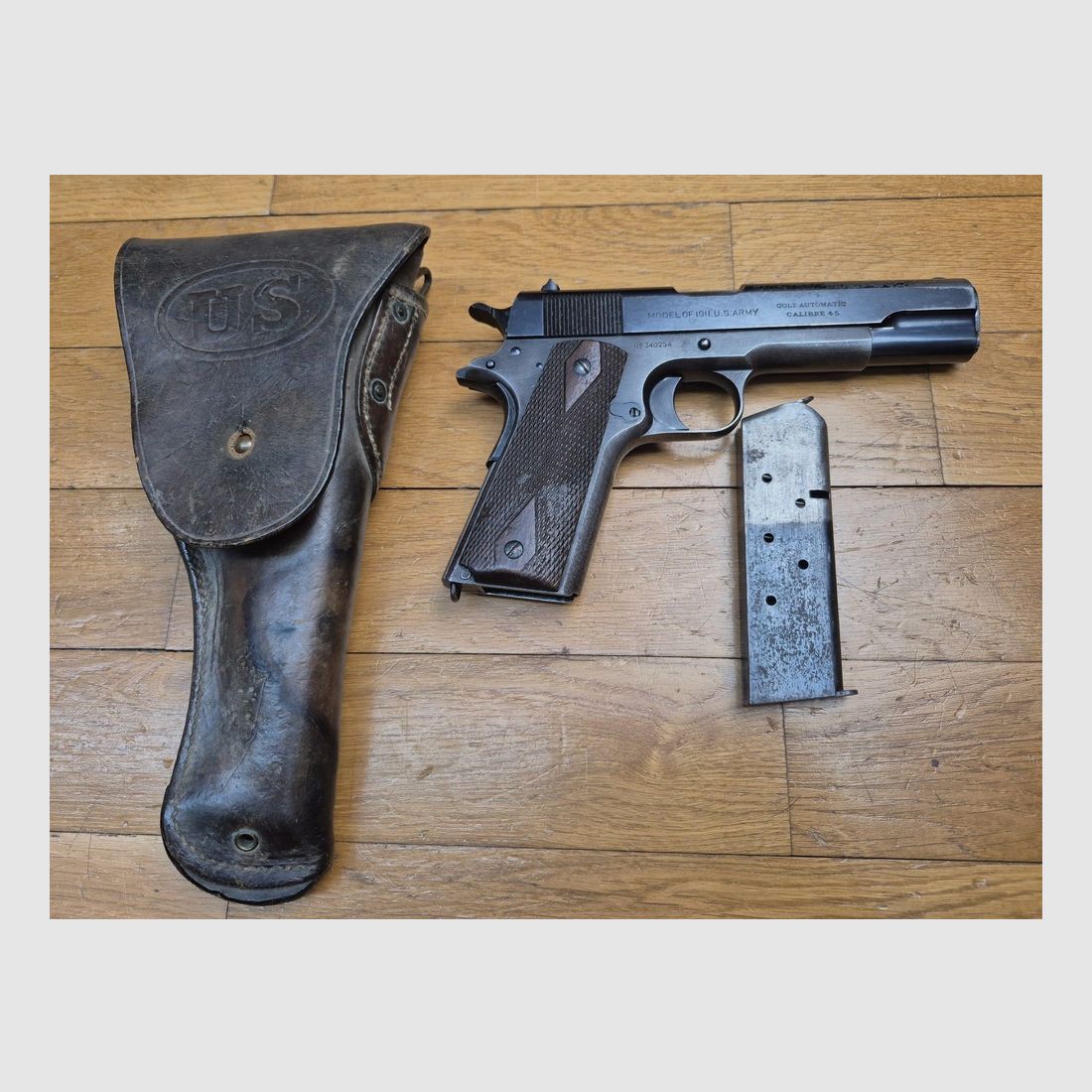
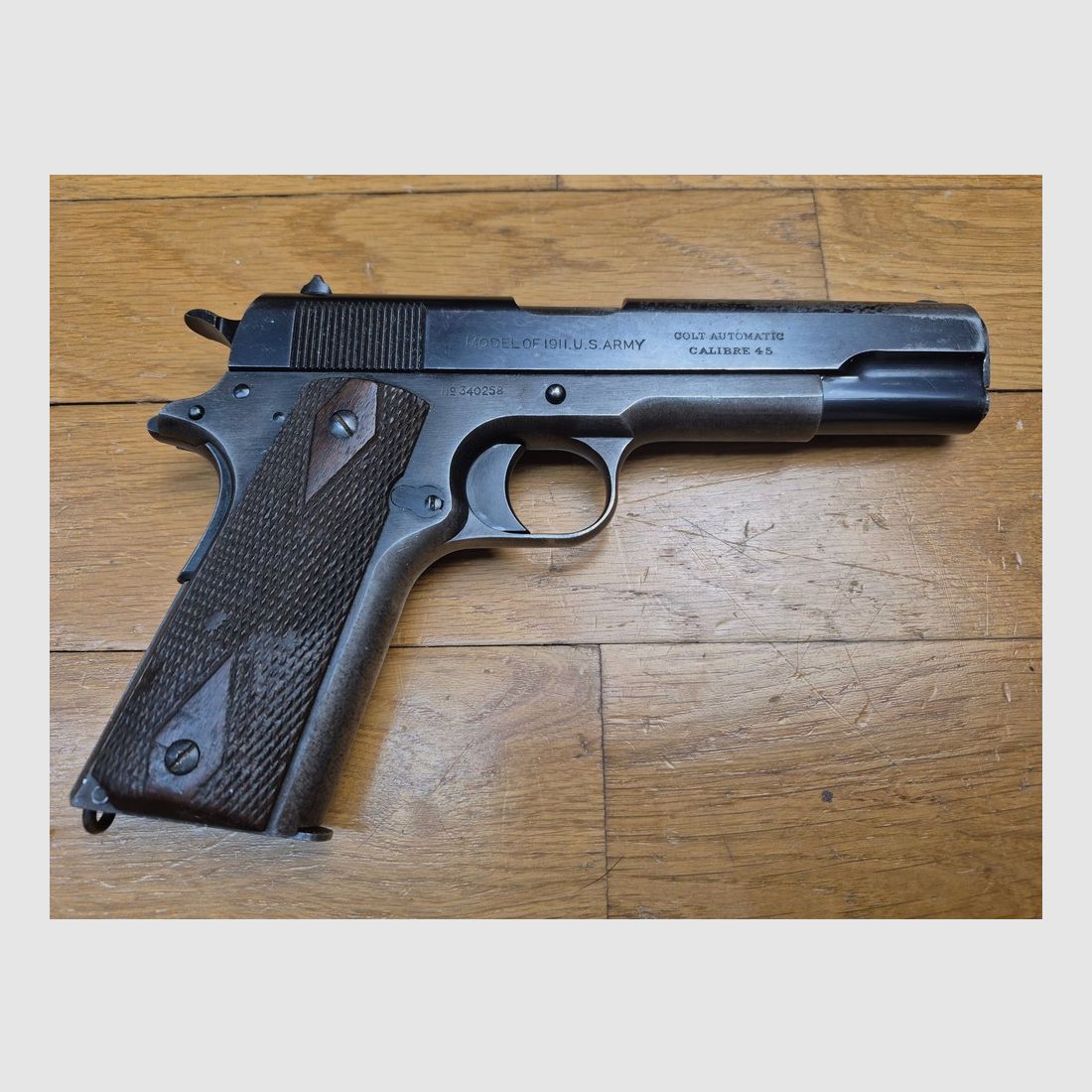


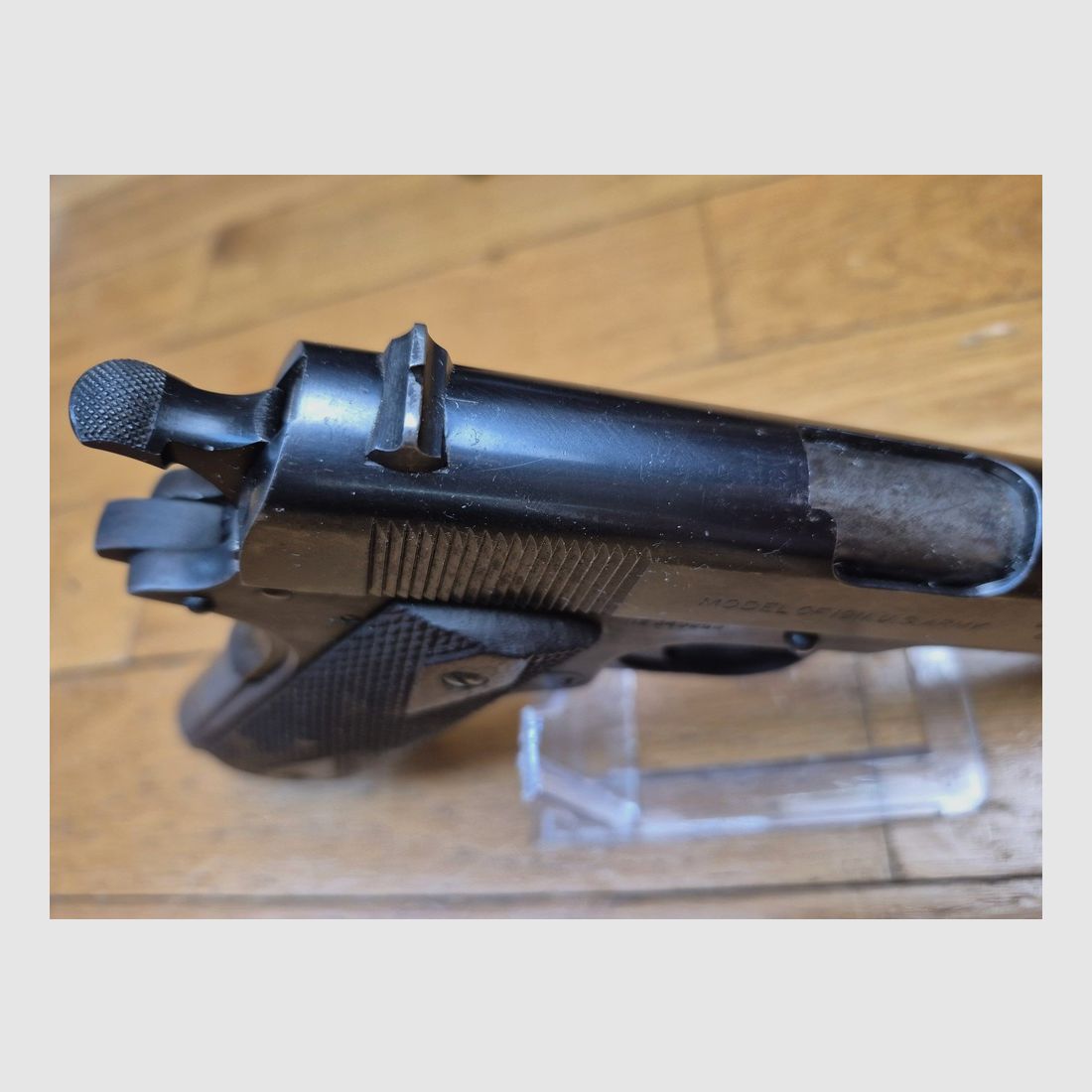

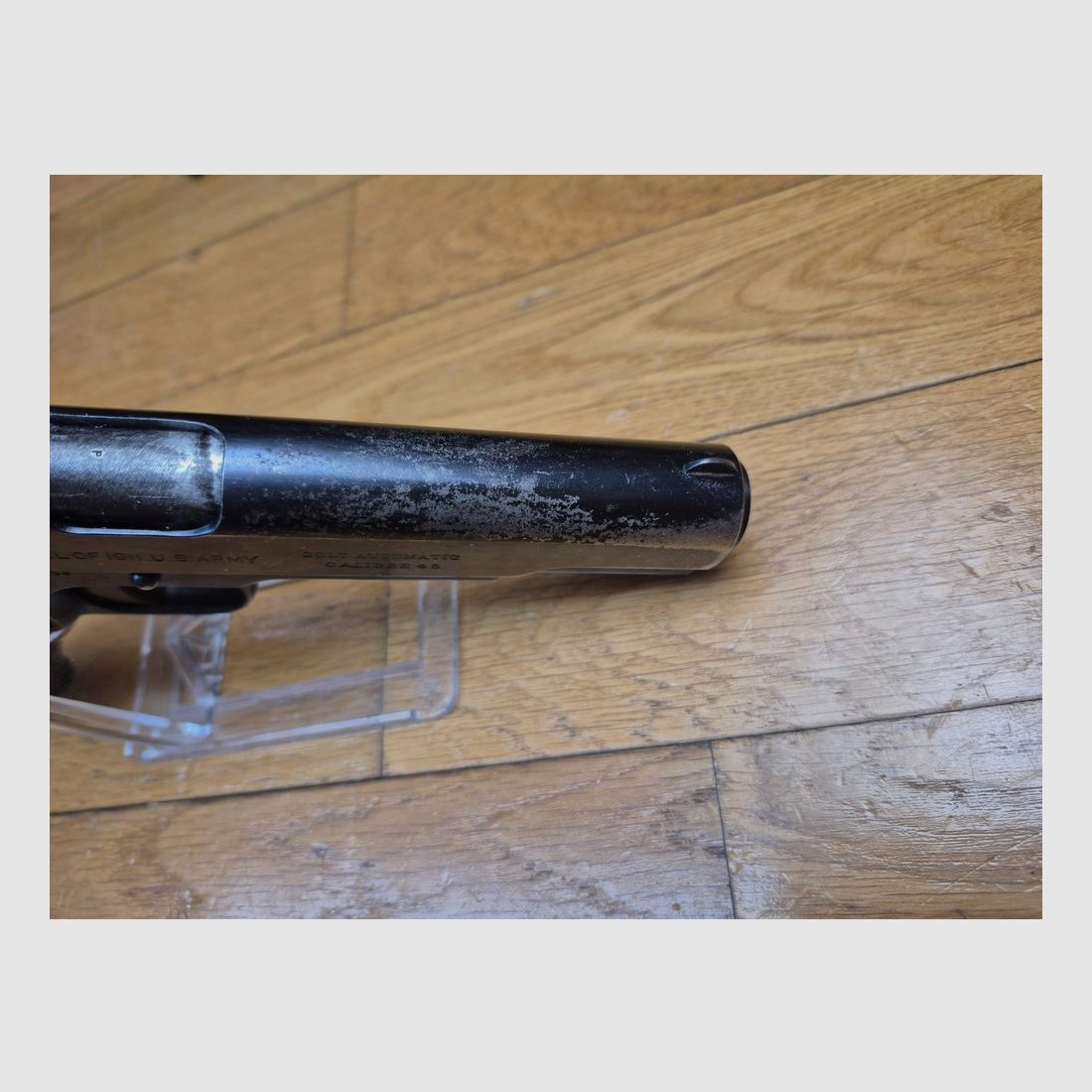
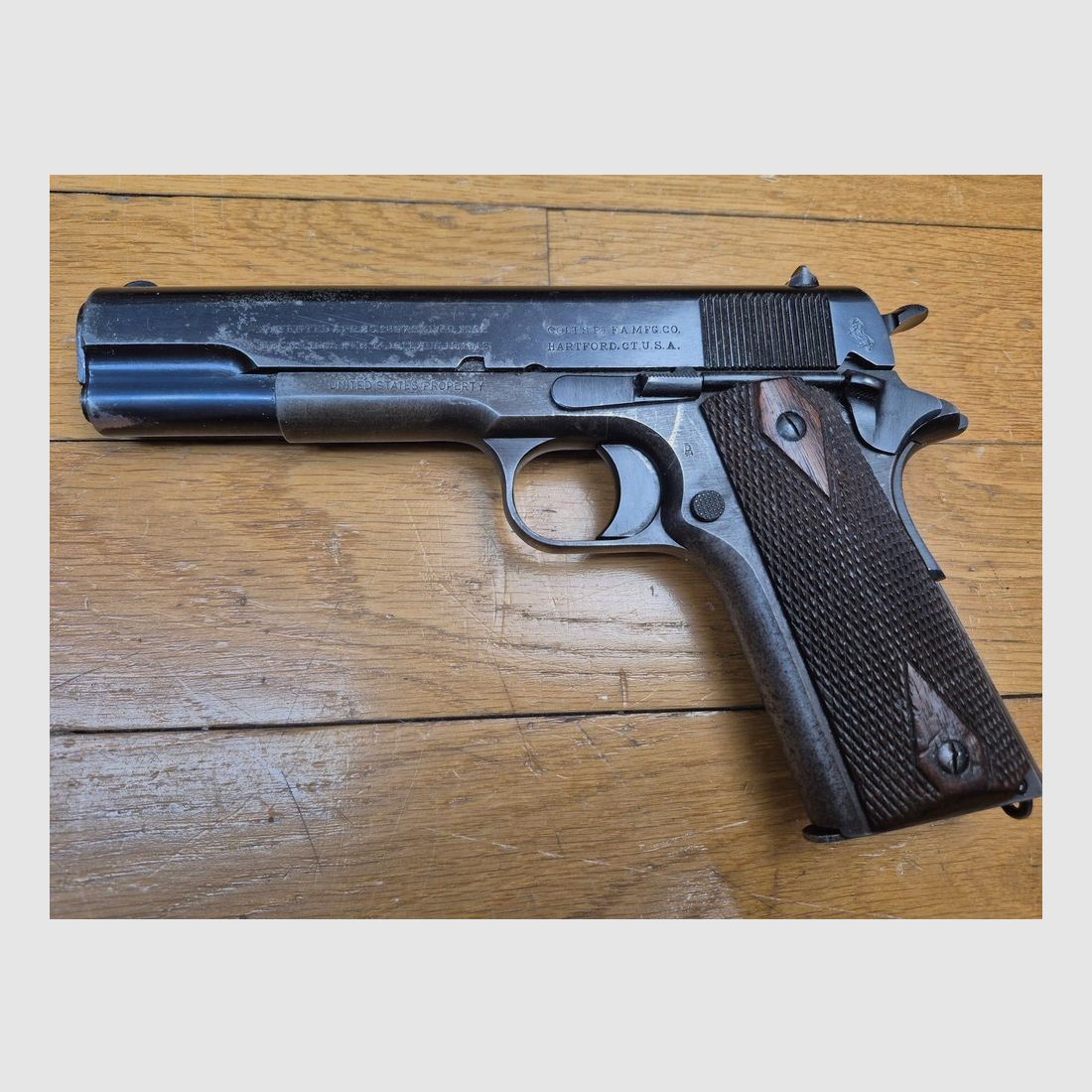


Rare Colt 1911 pistol (not 1911 A1!) – The original myth! – Military weapon from 1918 – Cal. .45 ACP – Beautiful original bluing at 80% without oxidation – Very nice markings – Barrel in good condition – Impeccable mechanics – Grips, screws, magazine conforming and TBE – Rare original holster from 1918 included – BE+!
≈ $2,748
Price at the dealer: 2,500 €. Converted at the ECB rate as of November 20, 2026.
Purchase permit required
75002 Paris, France
23
ID: 10338726
This item is currently unavailable.
Purchase from outside the EU: The firearm goes through an importer in your country, the dealer handles the export.
How buying from Europe works
Shop safely with Gunfinder
Our AI-powered seller identity verification makes Gunfinder the safest marketplace online.
Learn more
Details
- Original language
- French
- Brand
- Colt
- Product
- Colt 1911
- Category
- Purchase eligibility
- Required
- Caliber
- .45Auto
- Condition
- New
- Location
- 🇫🇷 75002 Paris, France
- Availability
- Out of stock
Freshness
This listing is based on a mirrored offer, where the listing data was synced to us from a shop, dealer, or external marketplace. Please note that temporary price discrepancies may occur due to possible delays in data transmission.
- Source
- Flingus Maximus
- Last checked with the dealer
- 1 day ago
Description
Note:
The item is located abroad. Please note that delivery conditions, shipping times, and/or the purchase process may differ.
Not easy to find, to begin with. I already have a hard time “placing” beautiful Colt 1911 A1s from World War II in very good condition and 100% original. So these…
He’s a little Parisian, and even a neighbor. He’d been in the same family forever—charming people—and survived moves and the ups and downs of life. He’s on the market for the first time. Maitre Flingus offered him the hospitality of his cave to spare him a more tragic fate. You all know how much he loves beautiful firearms that tell a story.
No need to introduce the Colt 1911 (though…).
But I’ll still provide a little background on the firearm “in general” to put this particular piece in context.
First of all, it’s one of the early ones. A 1911, not a “1911 A1.”
This is the variant that went off to fight in Europe with the Sammies in 1917. The version you see everywhere is the “1911 A1.” It wasn’t adopted until 1926, and it served the US Army until the operation on the island of Grenada in 1982. The 1911 A1 has also spawned a myriad of civilian variants since then. Many were reluctant to see it go, but it was finally replaced in 1985 by the M9, a militarized Beretta 92. A very Italian-style heist.
So how do you tell this “1911” from the “1911 A1”—the more “common” version?
Well, the front sight on the classic “1911 A1” is noticeably thicker than on the original 1911, like ours. Its hammer and beavertail are also noticeably longer than on our 1911. The trigger on the 1911 A1, on the other hand, is much shorter than on the 1911. And one detail you can spot at a glance: the 1911 A1 has a rounded cutout in the frame behind the trigger guard, while the original 1911 doesn’t.
The only internal difference is the differently shaped firing pin on the A1. That’s it.
Otherwise, same overall shape, same caliber and same capacity. Note that ammunition and magazines are fully interchangeable. You can put a brand-new civilian magazine from 2025 in this one. It’ll tell you that magazine finishes have changed a lot since its youth, but it’ll work.
So ours is a 1911, not an A1. That’s already much less common.
Trials that led to the adoption of the very first version of this legendary firearm began in 1906, following a rather unusual experience.
In 1899, the Philippines decided one fine morning to declare war on the USA “just to see what would happen,” even though they’d only been independent from Spain (1898), their original colonial power, for a few months. Obviously, that’s a (bad) joke.
The USA had simply tried to set up a provisional government under its control without consulting our victors over the Spanish, who had already been internationally recognized as the legitimate government. America was also threatening to land troops to make clear that it did not recognize the 1898 Treaty of Paris, which confirmed the Philippines’ independence—even though the USA had signed and ratified it.
It’s true that the USA had helped the Philippines gain independence from Spain, but only so it could control them more effectively afterward, considering its domination of the Philippines to be of strategic interest and the Filipino people, as a whole, unfit for independence.
Barely independent, the Filipinos in reality had no choice but to submit or fight a new colonial power. And not just any power.
Faced with the choice between war and dishonor, they chose to fight despite the overwhelming imbalance of forces. They fought with extreme bravery against a formidable and extremely violent adversary.
This war, which in American historiography spans from February 1
899 to July 1902, it actually lasted 14 years! It was terrible (perhaps 1 million dead according to the demonstrators; 200,000 according to the police, with widespread famine, massacres, rapes, summary executions…).
Its main geopolitical effect was to mark the beginning of a new international era: American interventionism in its military form.
In practice, the Americans encountered particularly fierce resistance in the south of the country from the Muslim Moro and Catholic Pulahan peoples, who made life difficult for them until the end of 1913.
In these jungle battles against warriors driven by the energy of despair, the standard US sidearm was the Colt M1892 New Army & Navy double-action revolver in .38 Long Colt. The natives, for their part, favored bladed assaults, appearing by surprise, seeking hand-to-hand combat, and often fighting under the influence of psychotropic drugs that removed all fear and pain inhibition.
In this very particular struggle, the Colt 1892 and its .38 LC caliber were judged to have insufficient stopping power. The US Army therefore called for heavy artillery in a sidearm.
That worked out well, because a certain John Moses Browning, then a Colt collaborator, had been working with all his genius since 1900 on developing a reliable semi-automatic firearm. This firearm had already been tested by the US Navy with its Colt Model 1900, a trial that ended with the purchase of 250 firearms.
Military semi-automatic firearms (and therefore reliable under combat conditions) were still in their infancy, and Browning's genius would take things further.
During these first military trials in 1900, Browning's Colt 1900 was tested against the Mauser C96 and the Mannlicher 1894. No firearm was selected, but the Army and Navy gained a clear understanding of the firearm's potential.
A few examples nevertheless made their way to the Philippines, and this first field experience led to the Colt 1902. It was nothing more than an improved Colt 1900, still in .38 ACP. A remarkable model, with a dream design, highly sought after today, as is its daddy, the 1900.
The Colt 1902 was also tested, but the military remained wary of the pistol's durability and reliability compared with the revolver. Complaints about the weakness of the .38 caliber continued to come in from the Philippines regarding the supposedly recent Colt 1892, reinforcing the idea that they should wait and see before adopting a new technology that still needed refinement.
Nevertheless, the adoption of the pistol by foreign armies such as Switzerland with the Luger strongly encouraged further efforts.
In 1904, Browning developed a more powerful .41 caliber cartridge to address military criticism of the .38's inadequacy. They were getting closer to the final product.
Especially since, during these trials, Browning thought it would be a good idea to have Colonel John Taliaferro Thompson, responsible for Small Arms for the US Army (yes, yes, the father of the famous Thompson used by Al Capone and the US Marines in 1927), test a brand-new cartridge from his prolific mind: the .45 ACP. Browning had modified his pistol for this caliber.
The Colt Model 1905 in .45 ACP, already looking very much like a Colt 1911, was born.
Enthusiastic, Thompson declared outright that this caliber was providential. Further trials would be held with several firearms using this caliber, and the US Army, embodied by its strong-willed representative, would hear nothing of anything less than the formidable .45 ACP.
Thus, in January 1906, the Chief of Ordnance, General B.G. Crozier, issued a call for bids for a military semi-automatic firearm chambered in .45 ACP to equip all American forces. Eighteen companies responded, but only six were selected for the trials to be held in 1907. And three of them
Only three survived the first phase of operational testing. The competition was fierce!
Who were these three survivors? Well, they were all legends in their own right.
First, Savage, with its remarkable but perhaps overly complex 1907 in .45 ACP; Browning, back with his Colt 1905, modified once again and transformed into the splendid Colt 1907 in .45 ACP, featuring for the first time the famous grip safety (another invention by Saint John Browning); and finally, the formidable German firm DMW, with its equally formidable representative, George Luger, who arrived with his P06, specially chambered in .45 ACP for the occasion.
Between firing tests at galloping horses followed by the slaughter of veal calves to make sure the .45 ACP could kill more than just flies, the most punishing test involved firing 5,000 rounds in a row through the same gun. Operationally, this was completely unrealistic and had no real-world equivalent (although, in Korea around 1950… ), but it was still a genuine technical test.
Dear George Luger had brought only 746 rounds specially adapted to his gun, designed for 9mm Parabellum and developed for the famous .45 caliber without much preliminary testing. With American .45 ACP ammunition, malfunctions multiplied.
It’s more than likely that Luger could have developed a perfectly reliable .45 ACP Luger for these trials. But the US Army was then tiny compared with the European armies, and the market was considered too small to justify further investment.
DMW and Luger therefore threw in the towel. A shame, because I would have loved to own a .45 ACP Lulu! They do exist, in various versions (including the extremely rare trial guns), as well as some exotic modern US-made examples, but they’re rare.
The Savage 1907, meanwhile, suffered only 37 malfunctions, which says a lot about its quality. Slightly modified and chambered in 7.65, it was ordered by the French Army in 1915 and performed very well.
It’s often been said that Colt was favored in these trials to ensure 100% US production by a renowned American manufacturer. That’s possible, even likely.
But it should also be said that the gun finally perfected by our Saint John Browning suffered… no malfunctions! Zero. Perfect.
Even when scorching hot and plunged into cold water, it was ready to go again immediately. And it fired 6,000 rounds! Its reputation for toughness was just beginning.
After unit trials and a few improvements, the Colt 1907 became the Colt 1909 and 1910, which underwent a few more tests. The gun was officially adopted on March 29, 1911, under the name Colt M1911.
The Army ordered 31,344 for its first order, accounting for a third of Colt’s revenue that year. A legend was born.
Our Colt 1911, not yet an A1, still saw the fury of some of the fiercest fighting.
Its first operational use dates to 1913, during the final battles against the Philippine Moros.
Its first serious engagement was with the men of the future General Patton against Pancho Villa’s forces in Mexico in 1916. Patton, always something of a cowboy, even managed to shoot himself in the foot with his 1911 in a Mexican saloon. This led him to hate semi-automatic pistols and to fight all his later campaigns with the two ivory-gripped 1873 Peacemaker revolvers on his belt that helped build his golden legend. But they were still Colts.
But the main feat of arms for our 1911, not yet an A1, in its early days and first version, was fighting in France from 1915 to 1918.
It was standard issue with the British Royal Flying Corps in .455 Eley (5,000 delivered out of 10,000 ordered), with the French, who also ordered 5,000 between May 1915 and January 1916 for their tank crews and airmen, and even in Russia via England. Above all, it was carried by many of the 53,402 Americans killed in action during the few mo
is from their involvement in the First World War.
Slightly modified in 1926 to become the iconic Colt 1911 A1, its military career would span the globe and every side, making it the very image of the 20th-century semi-automatic combat pistol.
An icon, perhaps the only one that can rival the Luger P08 in the memory of nations.
Our rare Colt 1911 today is typical of wartime production in 1918. Its serial number (340 258) places it in production in the summer of 1918.
Originally blued like the commercial models, with a black finish and blue highlights (I can’t stress enough that “blued” in English means “blued,” not “bluish,” even though the word comes from the original color of bluing—a classic false friend), military Colts had their slides finished in “black army” bluing, a simpler, darker finish that was still fairly glossy, starting at around serial number 312,000.
The lower frame was parkerized, although this “parkerizing” has nothing to do with modern parkerizing and looks more like a kind of greener, matte bluing.
That is indeed the case with our firearm, making it one of the first to receive this new finish. It has retained 85% of its original bluing. Overall, that’s pretty good—or better than good.
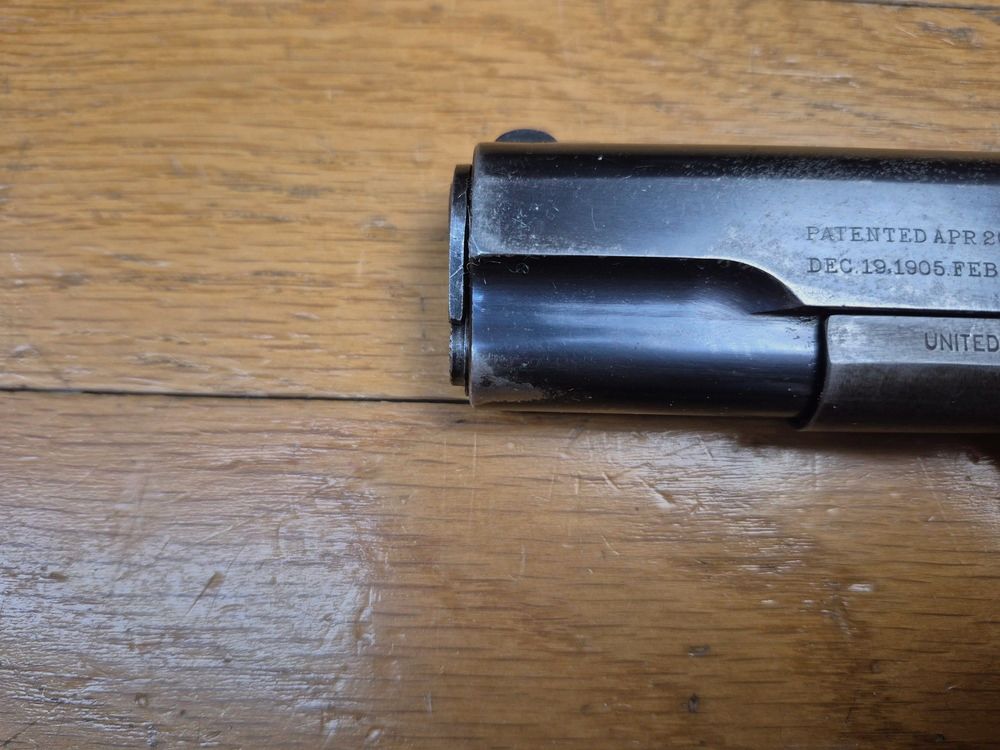
The bluing is a little worn, mainly on top of the slide and at the muzzle (holster wear), with small spots missing on the right side of the slide only. The bluing did its job of protecting the firearm, as there is no oxidation or orange peel (no “pitting” or loss of metal). That’s already more than good for this firearm, which will soon be 107 years old. It’s even quite rare.
Someone else might have “touched it up” a little to make it look newer and more “saleable,” but not me. I believe that, with 85% of its original bluing and no oxidation, this now-rare firearm should be left as it is. You don’t have to agree with me, and if you don’t, I suggest having it completely reblued, since the metal is still very well polished and free of damage. It could therefore be refinished without any problem to make it look “new.” But I don’t like to alter a firearm.
Overall, it’s very well preserved, despite the missing bluing. It was mainly carried in a holster for a long time.
Colt 1911s from 1914–1918 on the market are often in much worse condition than this one, but you know that Maître Flingus is pretty uncompromising about condition. I’d rather you be pleasantly surprised when it arrives than the other way around.
Further proof of its good exterior condition: all the manufacturer, caliber, and patent markings are crisp and clearly legible—not worn at all—and the Colt pony is in the right place for a 1911, not an A1! That is, behind the slide on the left side. The horse moved around quite a bit over the course of Colt’s history. Here, it’s in the right place for the period.
Of course, it is clearly marked “United State Property” and “Model of US Army 1911.” It’s a genuine military firearm that saw action. Excellent!
The frame, behind the trigger guard, bears a magnificent, crisp and clearly visible eagle-head acceptance mark, visible through the rear sight.
These numbered marks (normally they bear the inspector’s initials) have generated a lot of discussion among US collectors. No one knows who these “numbered” inspectors were; they were probably recruited solely to meet wartime needs. Ours is marked “S14.”
Others found in the same situation include S11, S15, S5, and S8. The other numbered inspectors’ marks have been found on wartime Smith & Wesson firearms (S2, S24, and S6). This is unique in the history of military Colts and specific to 1918 firearms (S14 has also been found on late-1917 Colt firearms).
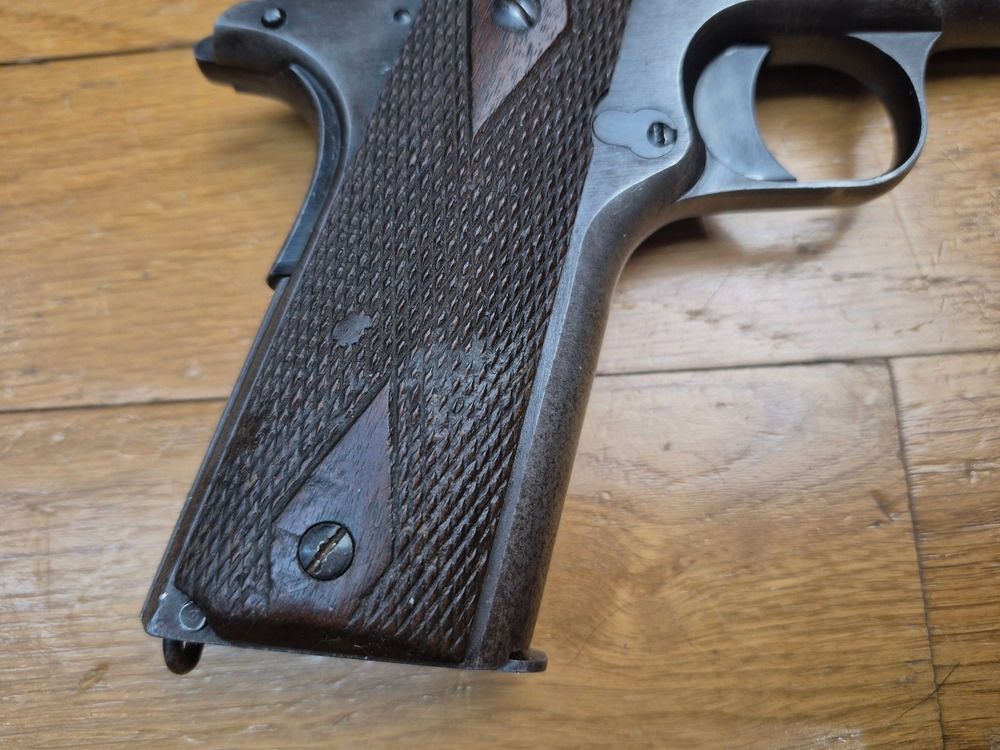
Its grips are the correct original military grips, made of slightly reddish brown walnut, typically American. They are in excellent condition.
t, very sound, barely used, with only a few handling marks. Very nice. In any case, nicer than many 1911s, even A1s, that I’ve come across.
The screws have been handled, but work perfectly and aren’t stuck at all. Very good plus. Better still, they’re the original ones. I took them out to make sure. The ISO 9001 thread standard didn’t exist back then, and these aren’t metric threads anyway. Superb!
The disassembled firearm is in the same condition inside as out—generally nice, with no oxidation or orange peel. It’s just very dirty, and I recommend a complete disassembly followed by a soak for at least three days in something like WD-40, barrel included.
It’s in superb mechanical condition—works and disassembles without any problems. Crisp firing pin strike, firm slide return. The recoil spring still has the strength of a young man (I’m getting a bit racy; it’s past 11 p.m. and the heroes are tired). Impeccable.
The barrel is dull, with some oxidation at the bottom of the grooves. It’s good, or even better than that, and certainly much better than average for these firearms. Master Flingus is always strict about condition, but that’s just how I am.
This one probably hasn’t been cleaned in a very long time. I recommend soaking it for 72 hours in Bore Tech Inc. (I can’t say enough about the virtues of this product, in which I have no shares). The rifling is still clearly visible and well defined. That’s what matters. I have no doubt it’ll shoot well, or even very well.
But most importantly, it’s the original barrel. This is something to check when buying a 1911, not an A1. Why?
You should know that Colt 1911s from this production run (there were also a few Remingtons in 1918—not many, but still) all have small “P” and “R” letters on the barrel. The R looks out of place, but it’s there under the P, slightly offset to the left.
So this barrel isn’t a replacement (its machining is also typical if you have a keen eye and some experience), because plenty of crooks have sold rare World War I Colts for a fortune with replacement barrels instead of the originals…
Caliber .45 ACP, with seven rounds, of course.
The magazine is the most “widely publicized” Colt model: blued on the upper half (with 90% of its original bluing), faded on top, and not marked “Colt 45. Auto”. That caliber marking came well after World War I.
Contrary to a myth regularly repeated over the airwaves of “Radio Stand,” Colt magazines from the 1911–1919 period aren’t ALL two-tone (from flame-hardening the upper part), and there are at least eight types, including the famous two-tone one. Its spring is nice and firm, and it’s 100% functional.
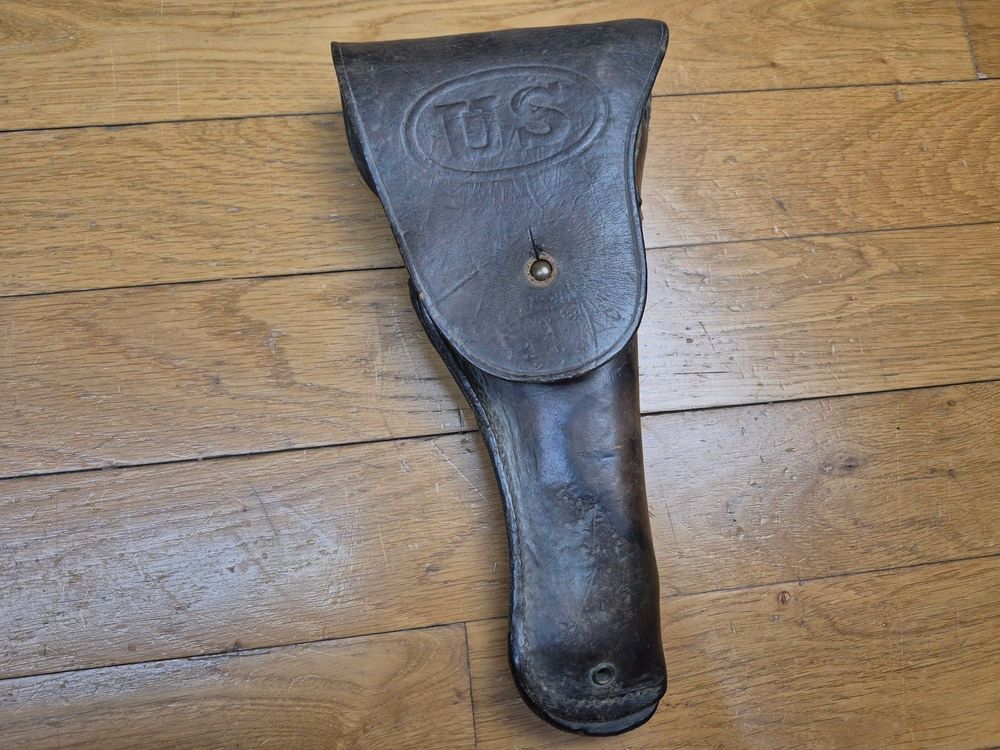
This very nice firearm, now extremely uncommon, also comes with its original holster.
Very nice leather holster made by G & K (Graton & Knight), a Worcester, Massachusetts company that supplied leather goods to the US Army until 1962.
This one is also correctly dated 1918! It belongs with the firearm. With its sturdy period brass hooks in very good condition, it won’t fall off your belt and will give you a certain look at the range…
All it needs is a small leather cord to hold the holster snug against your leg. The stitching and snaps are in perfect condition. Graton & Knight made things to last in 1918.
It’s worth around 150 euros on its own, no problem, but I don’t want to separate it from the firearm it went through the trenches with and lived alongside for so long. So I’m selling it with the firearm at no extra charge, on the condition that if you ever resell it, you sell it with this holster.
In short, an exceptional firearm for its pre-1926 Colt-made 1911 profile, its rarity, and its still good to very good condition (many are “rotten” by my standards—I really can’t stand orange peel).
ge même localisée) – a rare firearm on the market, infinitely rarer than a First World War A1 that happened to be in the same condition.
This first military variant of the 1911 is a top choice for collectors of First World War firearms or Colt. The true beginning of the legend of the military Colt 1911, which tells the story of one of the toughest conflicts in history. If you’re only going to own one military Colt 1911, this is the one to have.
CATEGORY B FIREARM AT THE CSI: PERMIT REQUIRED, PHOTOCOPIES OF ID AND FIREARMS LICENCE REQUIRED. SIA ACCOUNT MUST ALSO BE OPEN! Shipping with signature required in two separate packages at least 48 hours apart.
*****************************************************************************************************************************************
Let’s say it again! Flingus Maximus gun shop in Paris and across France is also here to buy firearms and militaria collections, provide firearm valuations, and answer your questions about firearms in estates and inheritances. Contact your favorite gunsmith using our contact form or at [email protected] (Show description in original language)
Comme aurait dit Johnny en couverture d’un album où on le voit, en sueur, tous muscles saillants, faire un bras de fer avec un gentil bébé style camionneur américain de film : pas facile …
Pas facile à trouver déjà. Déjà que j’ai bien du mal à “loger” de beaux Colt 1911 A1 de la seconde guerre mondiale en très bel état et 100% d’origine. Alors ceux-là…
C’est un petit parisien, et même un voisin. Il était dans la même famille depuis toujours – des gens charmants – et a survécu aux déménagements et aux aléas de la vie. Il est pour la première fois sur le marché. Maitre Flingus lui a offert l’hospitalité de sa grotte pour lui éviter un sort plus tragique. Vous connaissez tous son amour des belles armes qui racontent l’histoire.
On ne présente pas le Colt 1911 (quoique…).
Mais je fournirai néanmoins quelques éclaircissements sur l’arme “en général” qui serviront à situer la présente pièce.
Surtout, et déjà, c’est un des premiers. Un 1911 pas un “1911 A1”.
C’est bien cette variante là qui est partie combattre en Europe avec les Sammies en 1917. La version que l’on voit partout est la “1911 A1”. Elle n’a été adoptée qu’en 1926 et elle servira l’US Army jusqu’à l’opération sur l’île de la Grenade en 1982. La 1911 A1 a donné lieu en outre depuis à une myriade de variantes civiles. Il ne sera abandonné, à contre cœur par beaucoup, qu’en 1985 pour le M9, Un Beretta 92 militarisé. Un hold-up à l’Italienne.
Comment donc distinguer ce “1911” du “1911 A1” c’est à dire des plus “communs”?
Et bien, le guidon du classique “1911 A1” est sensiblement plus épais que sur le 1911 d’origine comme le notre. Son marteau et sa queue de castor sont aussi sensiblement plus longs que sur notre 1911. La détente du 1911 A1 est en revanche nettement plus petite que celle du 1911 et, détail visible au premier coup d’œil, le 1911 A1 possède une découpe arrondie sur la carcasse en arrière du pontet alors que cette découpe est absente du premier 1911.
La seule différence interne est le percuteur de forme différente sur le A1. Voilà.
Sinon même forme générale, même calibre et même capacité. Noter que munitions et chargeurs sont parfaitement interchangeables. Vous pouvez rentrer un chargeur civil neuf de 2025 dans celui-là. Il vous dira que les finitions des chargeurs ont bien changé depuis sa jeunesse mais ça fonctionnera.
Notre arme est donc un 1911 et pas un A1. C’est déjà nettement moins courant.
Les essais qui ont mené à l’adoption de cette toute première versions de cette arme mythique ont commencé en 1906. Suite à un retour d’expérience un peu particulier.
En 1899, Les Philippines ont décidé un beau matin de déclarer la guerre aux USA « pour voir un peu » alors qu’elles n’étaient indépendantes de l’Espagne (1898), leur puissance coloniale initiale, que depuis quelques mois seulement. Évidement, c’est une (mauvaise) plaisanterie.
Les USA avaient juste essayé de créer un gouvernement provisoire à leur botte sans prendre l’avis de nos vainqueurs des espagnols déjà reconnus internationalement comme le gouvernement légitime. L’Amérique menaçait en prime de débarquer pour signifier qu’elle ne reconnaissait pas le Traité de Paris de 1898 qui entérinait l’indépendance des Philippines qu’elle avait pourtant signé et ratifié.
Certes les USA avaient aidé Les Philippines à se rendre indépendantes de l’Espagne mais c’était pour mieux les contrôler ensuite, considérant leur domination sur Les Philippines comme d’intérêt stratégique et les philippins, en tant que peuple, comme inaptes à l’indépendance.
A peine indépendants, les Philippins n’avaient en réalité aucun autre choix possible que de se soumettre ou de combattre une nouvelle puissance coloniale. Et pas la moindre.
Entre la guerre et le déshonneur, ils choisirent le combat en dépit de la totale disproportion des forces. Ils combattirent avec une extrême bravoure cet adversaire redoutable et d’une extrême violence.
Cette guerre, qui, dans l’historiographie américaine s’étale de février 1899 à juillet 1902, dura en réalité 14 ans ! Elle fut terrible (1 million de morts peut-être selon les manifestants; 200.000 selon la Police, avec force famines, massacres, viols, exécutions sommaires…).
Son effet géopolitique essentiel fut de marquer le début d’une nouvelle ère internationale: l’interventionnisme américain dans sa version militaire.
Pratiquement, les américains se heurtèrent notamment dans le sud du pays à une résistance fanatique des peuples Moros musulmans et Pulahan catholiques qui leur menèrent la vie dure jusque la fin de 1913.
Dans ces combats de jungle face à des guerriers portés par l’énergie du désespoir, l’arme de poing standard US était le revolver Colt M1892 New Army & Navy à double action en calibre .38 long Colt. Les autochtones, eux, étaient friands d’assaut à l’arme blanche, surgissant par surprise, recherchant le corps à corps, et combattant fréquemment sous l’effet de psychotropes leur enlevant toute inhibition de peur et de douleur.
Dans cette lutte très particulière, le Colt 1892 et son calibre 38LC furent jugés d’un pourvoir d’arrêt insuffisant. L’US Army réclama donc de l’artillerie lourde en arme de poing.
Cela tombait bien car un certain John Moses Browning, alors collaborteur de Colt, travaillait de tout son génie depuis 1900 au développement d’une arme semi automatique fiable. Cette arme avait déjà donné lieu à un essai par l’US Navy avec son Colt modèle 1900, essai qui s’était conclu par l’achat de 250 armes.
L’arme semi automatique militaire (donc fiable en conditions de combat) en était à ses balbutiement et le génie de Browning allait faire la suite.
Lors de ces premiers essais militaires de 1900, le Colt 1900 de Browning avait été confronté au Mauser C96 et au Mannlicher 1894. Aucune arme ne fut retenue mais l’armée pris, avec la marine, une exacte conscience du potentiel de l’arme.
Quelques exemplaires échouèrent tout de même aux Philippines et ce premier retour d’expérience conduisit au Colt 1902. Qui n’est rien d’autre qu’un Colt 1900 déjà amélioré mais toujours en 38ACP. Modèle remarquable, d’un dessin de rêve, fort recherché aujourd’hui au demeurant comme son papa le 1900.
Le Colt 1902 fut lui aussi testé mais les militaires restaient méfiants sur la durabilité et la fiabilité du pistolet par rapport au révolver. Les plaintes relatives à la faiblesse du calibre 38 continuant à remonter des Philippines au sujet du pourtant récent Colt 1892 renforçaient l’idée qu’il fallait attendre et voir devant une technologie nouvelle à perfectionner.
Néanmoins, l’adoption du pistolet par des armées étrangères comme la Suisse avec le Luger incitait fortement à poursuivre les efforts.
En 1904, Browning développa une cartouche plus costaude en calibre .41 pour faire face aux critiques militaires sur insuffisance de la 38. On se rapprochait à pas de loup du produit final.
D’autant plus que lors de ces essais, Browning trouva fort à propos de faire essayer au colonel John Taliaferro Thompson, responsable Small Arms pour l’US Army (oui, oui, le père de la fameuse Thompson d’Al Capone et des Us marines en 1927.) une toute dernière munition sortie de son prolifique cerveau: la 45 ACP. Browning avait à cette occasion modifié son pistolet pour ce calibre.
Le Pistolet Colt 1905, en 45ACP, qui ressemble déjà furieusement à un Colt 1911, était né
Enthousiasmé, Thompson déclara tout net que ce calibre était providentiel. Que de nouveaux essais seraient menés entre plusieurs armes à partir de ce calibre et que l’US Army, prise en la personne de sa forte personnalité, ne voudrait rien entendre qui ne soit en dessous de la redoutable 45.ACP.
C’est ainsi qu’en janvier 1906 le Général en Chef de l’Intendance, le général B.G. Crozier lança un appel d’offre pour une arme semi automatique militaire chambrée en 45 ACP qui équiperait l’ensemble des force américaines. 18 entreprise répondirent “présent” et mais seules six furent sélectionnées pour les essais à tenir en 1907. Et trois seulement survécurent à la première phase de tests opérationnels. Ça écrémait dur !
Qui sont ces trois survivants ? Et bien, tous des légendes dans leur genre.
Savage, d’abord, avec son remarquable mais peut-être trop complexe 1907 en 45 ACP, Browning revenu avec son Colt 1905 à nouveau modifié et devenu le splendide Colt 1907 en 45 ACP doté pour la première fois de la fameuse sécurité de poignée (encore une invention de Saint John Browning) et, enfin, la redoutable firme allemande DMW avec son non moins redoutable représentant, George Luger, arrivé avec son P06 spécialement chambré en 45 ACP pour l’occasion.
Entre des séries de tirs sur chevaux au galop suivi d’un génocide de veaux de lait visant à s’assurer que la 45ACP arrivait bien à tuer autre chose que des mouches, l’essai le plus violent consista à tirer d’affiler 5.000 coups avec la même arme. Ce qui opérationnellement est parfaitement sur réaliste et ne correspond à rien (quoique, en Corée, vers 1950… ) mais un vrai test technique quand même.
Le beau George Luger n’avait apporté que 746 munitions spécialement adaptées à son arme, conçue pour le 9 para, mise au point sans beaucoup d’essais préalables au fameux calibre 45. Avec les 45 ACP américaines, les incidents se multiplièrent.
Il est plus que très probable que Luger aurait pu développer un Luger en 45 ACP parfaitement fiable pour ces essais. Mais l’armée US était alors parfaitement ridicule en taille comparée aux armées européennes et ce marché fut jugé insuffisant pour y investir plus.
DMW et Luger jetèrent donc l’éponge. Dommage, car j’aurai bien aimé avoir un Lulu en 45 Acp ! Il en existe, de diverses fabrications (ceux, rarissimes, de ces essais déjà) y compris d’exotiques fabrications US contemporaines, mais c’est rare.
Le Savage 1907, lui, ne souffrit que 37 incidents ce qui en dit long sur ses qualités. Légèrement modifié, et en 7,65, il fut commandé par l’Armée française en 1915 et donna toute satisfaction.
On a beaucoup dit que Colt avait été favorisé lors de ces essais afin d’assurer une production 100% US chez un producteur de renom US. C’est possible, et même probable.
Mais il faut dire aussi que l’engin enfin mis au point par notre Saint John Browning ne subit… aucun incident ! Zéro. Parfait.
Même brûlant et simplement plongé dans l’eau froide, il repartait illico. Et lui tira 6.000 coups! Sa réputation de robustesse commençait.
Après les essais en unités et quelques améliorations le Colt 1907 devint les Colt 1909 et 1910 qui subirent quelques essais supplémentaires. L’arme fut définitivement adoptée le 29 mars 1911 sous le nom de Colt M1911 .
Commandé par l’armée à 31.344 exemplaires pour la première commande, il assura le tiers du chiffre d’affaire de Colt cette année là. La Légende était née.
Notre Colt 1911 pas encore A1 connut tout de même la fureur des combats et les plus sévères.
Sa première utilisation opérationnelle date de 1913 durant les tout derniers combats contre les Moros philippins.
Son premier engagement sérieux fut de servir les hommes du futur Général Patton contre ceux de Pancho Villa en 1916 au Mexique. Patton, toujours au style très cowboy, trouva d’ailleurs le moyen de se tirer une balle dans le pied dans un saloon mexicain avec son 1911. Ce qui le conduisit à détester les automatiques et à faire toutes ses campagnes ultérieures avec les deux revolvers 1873 Peacemaker à crosse d’ivoire en ceinturon qui contribuèrent à sa légende doré. Mais toujours des Colts.
Mais son principal fait d’armes, à notre 1911 pas A1, en ce début de carrière et en cette première version, sera de combattre en France en 1915-1918.
Réglementaire dans le Royal Flying Corps anglais en calibre 455 Eley (5.000 livrés pour 10.000 commandés), chez les Français qui en commandèrent aussi 5.000 entre mai 1915 et janvier 1916 pour leur tankistes et aviateurs, et même en Russie via l’Angleterre, il a été surtout porté par nombre des 53.402 américains morts au combat pendant les quelques mois de leur intervention dans la première guerre mondiale.
Légèrement modifié en 1926 pour devenir l’iconique Colt 1911 A1, sa carrière militaire s’étendra sur tous les points du globe et dans tous les camps, pour devenir l’image même du pistolet semi-automatique de combat au XX° siècle.
Une icône, peut-être la seule à pouvoir faire le pendant, dans la mémoire des peuples, au Luger P08.
Notre rare Colt 1911 de ce jour est typique de la production de guerre de 1918. Son numéro de série (340 258) le situe dans une production de l’été 1918.
Initialement bronzés comme les commerciaux d’un bronzage noir à reflets bleutés (je n’insisterai jamais assez que “blued” en anglais veut dire “bronzé” et pas “bleuté” même si le mot vient de la couleur initiale des bronzages – faux amis classique de l’anglais), les Colt militaires furent bronzés en culasse d’un bronzage “black army”, un bronzage plus simple et plus noir mais encore assez brillant à partir du n° 312 mille environ.
Le bas de carcasse lui était parkérisée même si cette « parkerisation » n’a rien à voir avec les nôtres et ressemble plus à une sorte de bronzage plus vert et mat.
C’est bien le cas de notre arme, qui est donc une des premières à avoir reçu cette nouvelle finition. Elle a conservé 85% de son bronzage d’origine. C’est globalement pas mal ou mieux que mal.
Le bronzage est un peu usé plutôt en dessus de culasse et en bout de canon (port en étui) et manquant sous forme de petites tâches en coté droit en culasse seulement. Le bronzage a fait son boulot de protection ici car l’arme n’a en revanche aucune oxydation ni peau d’orange (aucun « cratère »/manque de métal). C’est déjà plus que bien pour cette arme de 107 ans bientôt. C’est même assez rare.
Un autre l’aurait peut-être « tamponné » un peu pour le rendre un peu plus neuf et « vendeur » mais pas moi. J’estime, moi, qu’à 85% de son bronzage d’origine et sans oxydation, cette arme devenue rare doit rester telle quelle. On est pas obligé de partager mon avis et, dans ce cas je suggère, de le re bronzer complètement car le métal est toujours très bien poli et sans accroc. On peut donc y faire sans problème y faire un travail le rendant « neuf ». Mais je n’aime pas dénaturer une arme.
Globalement donc plutôt très bien conservé en nonobstant les manques de bronzage. Il a surtout été porté longtemps en étui.
Les Colt 1911 de 1914-1918 sur le marché sont souvent bien moins beaux que celui-là mais vous savez que Maître Flingus est assez intraitable sur les états. Je préfère que vous ayez une bonne surprise à la livraison que le contraire.
Preuve supplémentaire de son bon état extérieur: tous les marquages de fabricant, calibre et de brevets sont bien nets et bien lisibles – aucunement usés et bien avec le Poulain à la bonne place pour un 1911 pas A1 ! C’est à dire en arrière de culasse coté gauche. Le canasson s’est en effet pas mal déplacé dans l’histoire des Colt. Et là, il est à sa bonne place pour l’époque.
Bien marqué “United State Property” et “Model of US Army 1911 “évidement. C’est un vrai militaire qui a fait la campagne. Top!
L’arme porte en carcasse en arrière de pontet un magnifique poinçon de réception à la tête d’aigle bien net et bien visible à l’œilleton.
Ces poinçons chiffrés (normalement ils sont aux initiales de l’Inspecteur) ont fait couler des flots d’encre chez les collectionneurs US. On ne sait toujours pas qui furent ces inspecteurs “chiffrés”, probablement recrutés uniquement pour les besoins de la guerre : le notre est ”S14″.
Mais on peut trouver aussi dans le même cas: S11, S15, S5 et S8. Les autres inspecteurs chiffrés sont trouvés sur des Smith & Wesson de la guerre (S2, S24 et S6). C’est un cas unique dans l’histoire des colts militaires et propre aux armes de 1918 (S14 a été trouvé aussi sur des armes Colt de fin 1917).
Ses plaquettes sont les bonnes plaquettes militaires d’origines en noyer brun légèrement rougeoyant typiquement américain. Elles sont en excellent état, très saines, à peine usées et avec de rares traces de manipulations. Très belles. Plus belles en tous cas que sur nombre de 1911 même A1 que j’ai pu croiser.
Les vis, manipulées, sont parfaitement opérationnelles et nullement bloquées. BE+. Mieux ce sont les siennes. Je les ai démontées pour m’en assurer. Le pas iso 9001 n’existait pas et en plus c’est pas du pas métrique. Superbe!
L’arme démontée est dans le même état à intérieur qu’extérieurement – globalement belle et sans oxydation ou peau d’orange. Elle est juste très sale et je recommande un démontage totale suivi d’un bain d’au moins trois jours dans un truc genre WD40, canon compris.
Elle est dans un état mécanique superbe – fonctionnement et démontage sans aucun problème – Percussion bien nette – rappel de culasse bien ferme. Le ressort récupérateur bande toujours comme un jeune homme (je deviens grivois, il est 23h passées et les héros sont fatigués). Impeccable.
Le canon est est terne avec des petites oxydations à fonds de rayures. Il est bon voire mieux que cela et bien mieux, en tous cas, que la moyenne de ce que j’ai déjà vu sur ces armes. Maître Flingus est toujours dur sur les états mais on ne se refait pas.
Celui-là n’a jamais nettoyé sans doute depuis fort longtemps. Je conseille de le tremper 72 heures dans du Bore Tech Inc. (je ne répéterais jamais assez les vertus de ce produit dans lequel je n’ai aucune actions) Les rayures restent bien visibles et bien nettes. C’est l’essentiel. Je n’ai aucun doute qu’il tirera bien ou même très bien.
Mais, surtout, c’est bien le sien, de canon. C’est un point à vérifier quand on achète un 1911 pasA1. Pourquoi?
Il faut en effet savoir que les Colts 1911 de cette production de chez Colt (il y a eu aussi quelques Remington aussi en 1918, pas beaucoup mais quand même) portent, tous de petites lettres “P” et “R” en canon – Le R est mal venu mais il est bien là sous le P et un peu décalé à sa gauche.
Ce canon n’est donc pas un remplacement (son usinage aussi est typique quand on a un peu l’œil et l’habitude) car nombre d’aigrefins ont vendu de rares Colt de la première guerre mondiale à prix d’or avec des canons de remplacement de ceux d’origine…
Calibre 45 ACP, en sept coups évidemment.
Le chargeur est bien du modèle Colt le plus « médiatisé »– bronzé bleuté première moitié (avec 90% de son bronzage d’origine), décoloré en dessus et bien pas marqué “Colt 45. Auto”. Ce marquage de calibre ce sera bien après la première guerre mondiale.
Contrairement à une légende, régulièrement colportée sur les ondes de « Radio Stand », les chargeurs de Colt de la période 1911-1919 ne sont pas TOUS bicolores (par durcissement à la flamme de leur partie supérieure) et il en existe au moins 8 types dont le fameux bicolore. Son ressort est bien ferme et il est 100% opérationnel.
Cette très belle arme, désormais très très peu courante, nous est en plus venu avec son étui d’origine.
Très bel étui en cuir de fabrication G & K, (Graton & Knight), une boite de Worcester Massachusetts qui a fourni des pièces de cuir à l’armée US jusque 1962.
Celui-là est bien daté de 1918 aussi ! C’est celui de l’arme. Avec ses bons gros crochets laiton d’époque en TBE, il ne risque pas de tomber de votre ceinturon et vous donnera un genre certain au stand…
Ne manque qu’une petite cordelette de cuir pour bien plaquer l’étui à la jambe. Coutures et pressions sont en parfait état. On faisait du solide chez Graton & Knight en 1918.
Ça vaut dans les 150 euros sans problème tout seul mais je ne veux pas le séparer de l’arme avec laquelle il a fait les tranchées et avec qui il a vécu si longtemps. Donc je le vends avec l’arme sans rien demander de plus que si, un jour, vous le revendiez, ce soit avec cet étui.
Bref une arme exceptionnelle par son profil 1911 d’avant 1926 de fabrication maison Colt, par sa rareté et par son état encore bon à très bon (beaucoup sont « pourris » selon mes critères à moi qui ne supporte très mal la peau d’orange même localisée) – une arme rare sur le marché, infiniment plus rare qu’un A1 seconde guerre mondiale qui serait, par chance, dans le même état.
Cette première variante militaire du 1911 est une pièce de collection de premier choix pour un collectionneur d’armes de la première guerre mondiale ou de Colt. Le vrai début du mythe Colt 1911 réglementaire qui raconte un des conflit les plus dur de l’Histoire. Si vous ne devez avoir qu’un Colt 1911 militaire, c’est un bien un comme celui-là.
ARME DE CATÉGORIE B AU CSI : SOUMISE À AUTORISATION, PHOTOCOPIE DE LA PIÈCE D’IDENTITÉ ET DE LA LICENCE OBLIGATOIRES. COMPTE SIA OBLIGATOIREMENT OUVERT AUSSI ! Expédition contre signature en deux colis séparés d’au moins 48 heures obligatoire.
*****************************************************************************************************************************************
Répétons le ! L’armurerie Flingus Maximus à Paris et partout en France est là aussi pour le rachat de collections armes et militaria, vos estimations d’armes, vos questions armes dans les successions et héritages. Contactez votre armurier préféré via notre formulaire de contact ou à [email protected]