









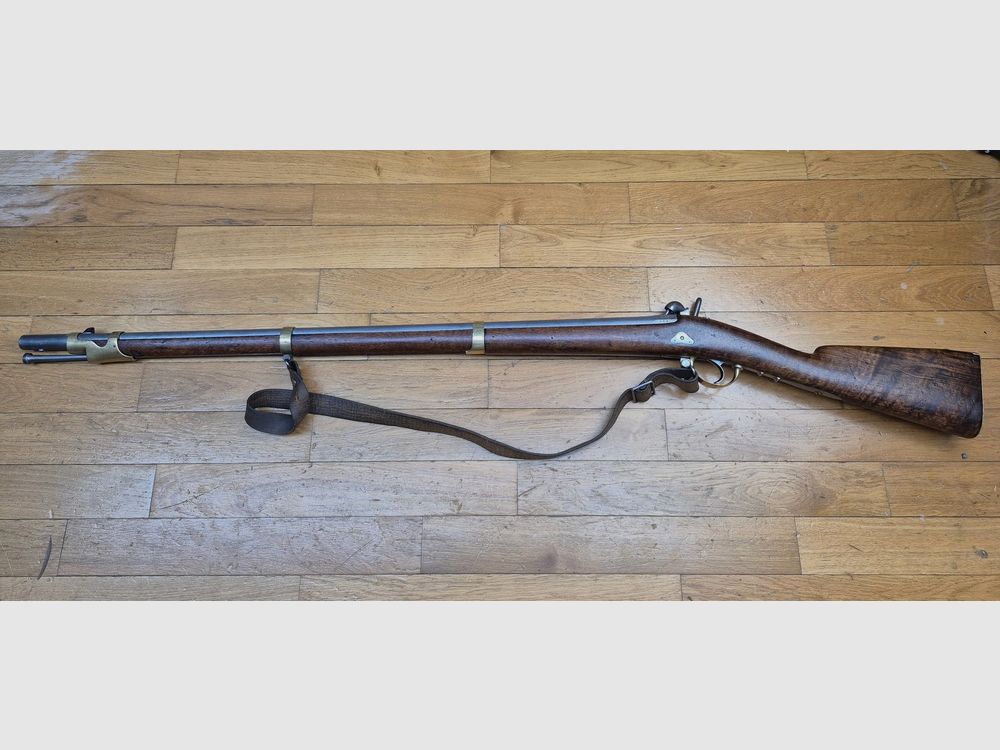










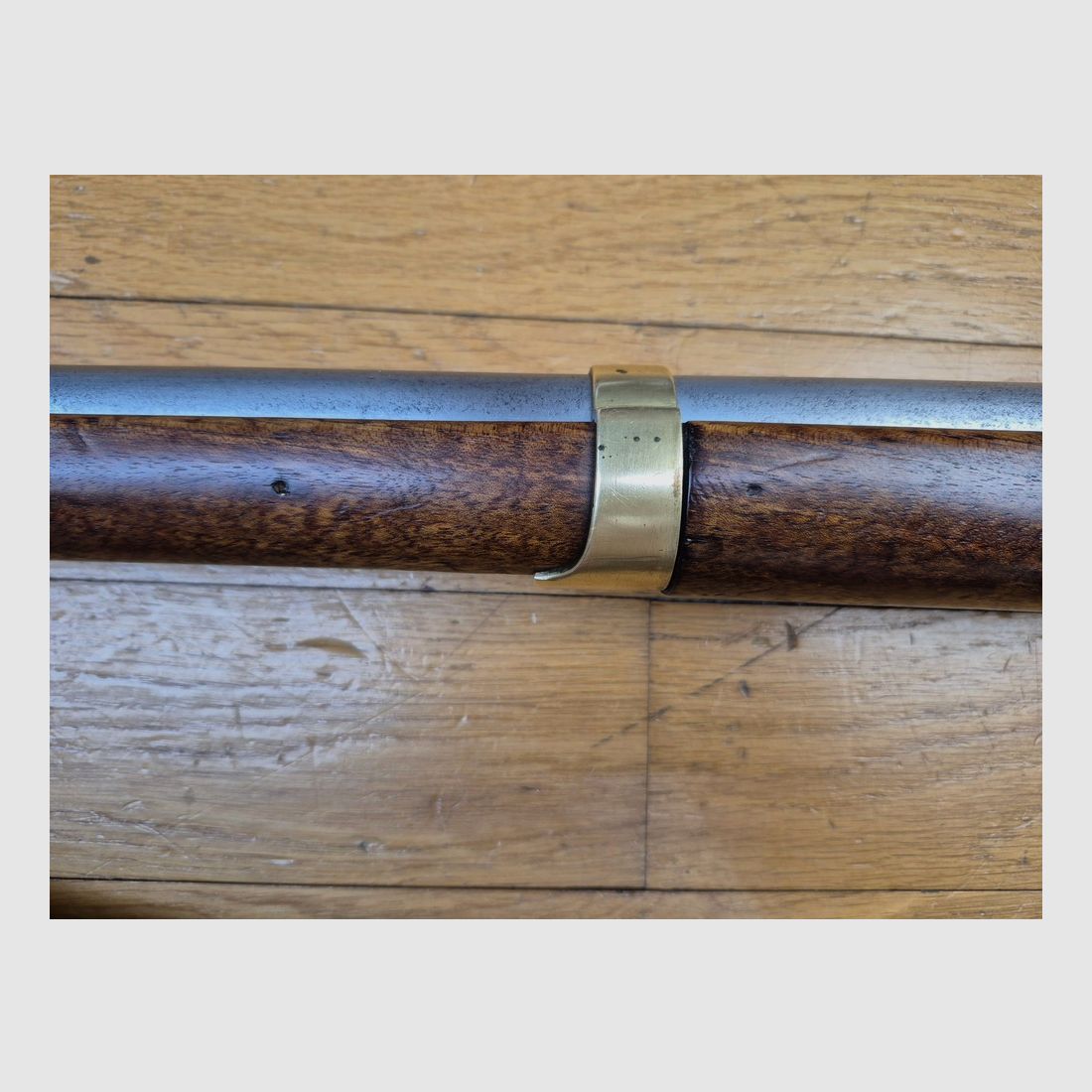


Rare infantry rifle Marine Model 1842 T (not T bis) – Royal Manufacture of Tulle 1847 – Modified rifling and repaired in Tulle in 1861 – Well-readable emblem and homogeneous weapon – Magnificent wood with beautiful stamps – Good barrel and mechanical condition – TBE+
≈ $1,429
Price at the dealer: 1,300 €. Converted at the ECB rate as of November 20, 2026.
Purchase permit required
75002 Paris, France
9
ID: 10338724
This item is currently unavailable.
Purchase from outside the EU: The firearm goes through an importer in your country, the dealer handles the export.
How buying from Europe works
Shop safely with Gunfinder
Our AI-powered seller identity verification makes Gunfinder the safest marketplace online.
Learn more
Details
- Original language
- French
- Category
- Purchase eligibility
- Required
- Condition
- New
- Location
- 🇫🇷 75002 Paris, France
- Availability
- Out of stock
Freshness
This listing is based on a mirrored offer, where the listing data was synced to us from a shop, dealer, or external marketplace. Please note that temporary price discrepancies may occur due to possible delays in data transmission.
- Source
- Flingus Maximus
- Last checked with the dealer
- 1 day ago
Description
Note:
The item is located abroad. Please note that delivery conditions, shipping times, and/or the purchase process may differ.
Yet, to borrow the words of a bald man in a turtleneck, it’s a revolution!
The number of misfires and rate of fire would go in opposite directions thanks to percussion caps for greater weapon efficiency. The idea that it’s safer to separate the primer from the cartridge would still need to be overcome. This would take a long time, due to a surreal 1838 experiment that I’ll tell you about another time. But even for the piston rifle with separate primer, the path was not simple.
Taking up all the principles of the Gribeauval system and its 1777 flintlock, combined with experiments started in the 1830s on primers, ramrod carbines, and the rampart rifles of Director Pontcharra, the very innovative 1840 piston system was nevertheless a fiasco. Largely due to forging issues with fixing the hammer weight that brings the primer’s fire into contact with the powder in the barrel. The problem was more metallurgical than gunsmithing. They decided to switch back from steel to iron… A metallurgical step backward against gunsmithing progress. Life can be frustrating. Even in state arsenals.
The 1842 system was therefore the first to offer a newly built percussion firearm that solved the problems of hammer fixing and barrel strength. It was with the 1842 that French armament took on the general external appearance it would keep until the Chassepot 1866 and the bolt action.
Of proverbial sturdiness, this weapon served France in Crimea, Italy, and Mexico as well as on many overseas grounds (Algeria, Africa, …), helping to reinforce everywhere the reputation of the Furia Francese. Converted (or not!) to tabatière, it would still serve the Fatherland in 1870/71.
Less well known is that 1842 rifles made their way to the Navy and underwent modifications. We have proof of this here.
How do you recognise 1842 Navy firearms? Well, not much, but enough to make them relatively rare. I see one Navy rifle for maybe 100 “infantry or similar.” They shouldn’t be that rare, but for some reason I don’t know, some event, like the extinction of the dinosaurs, must have occurred in their long history and made them quite uncommon (like an arsenal destruction).
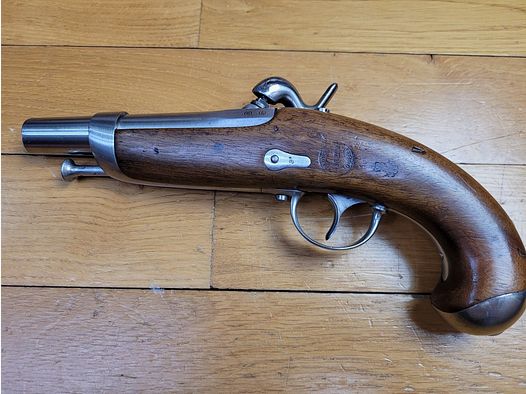
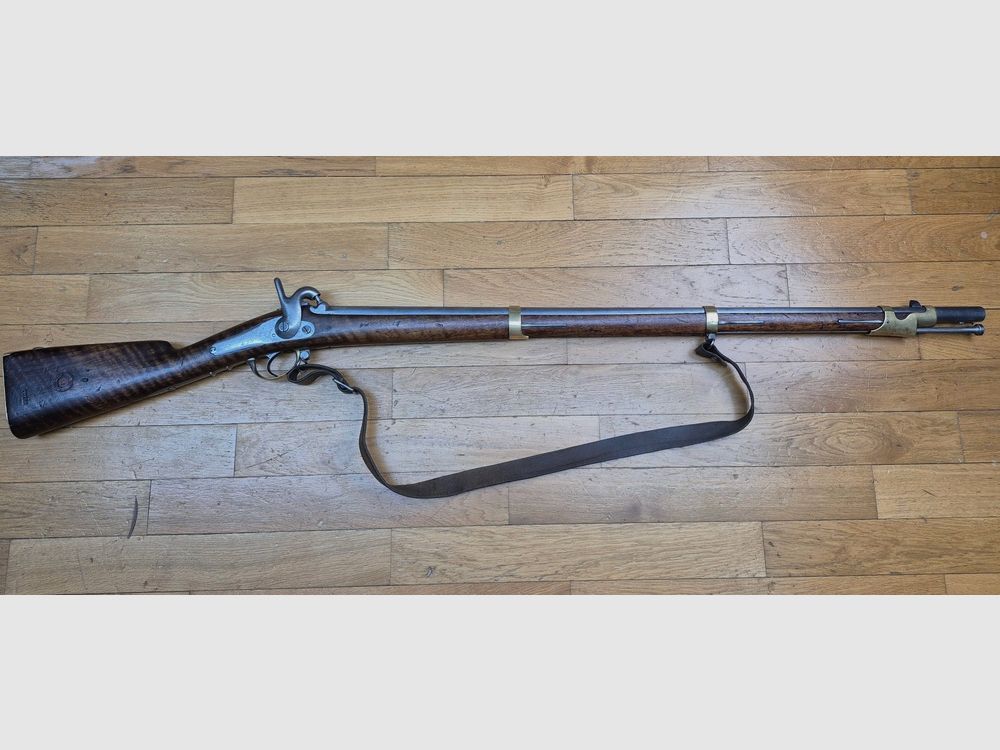
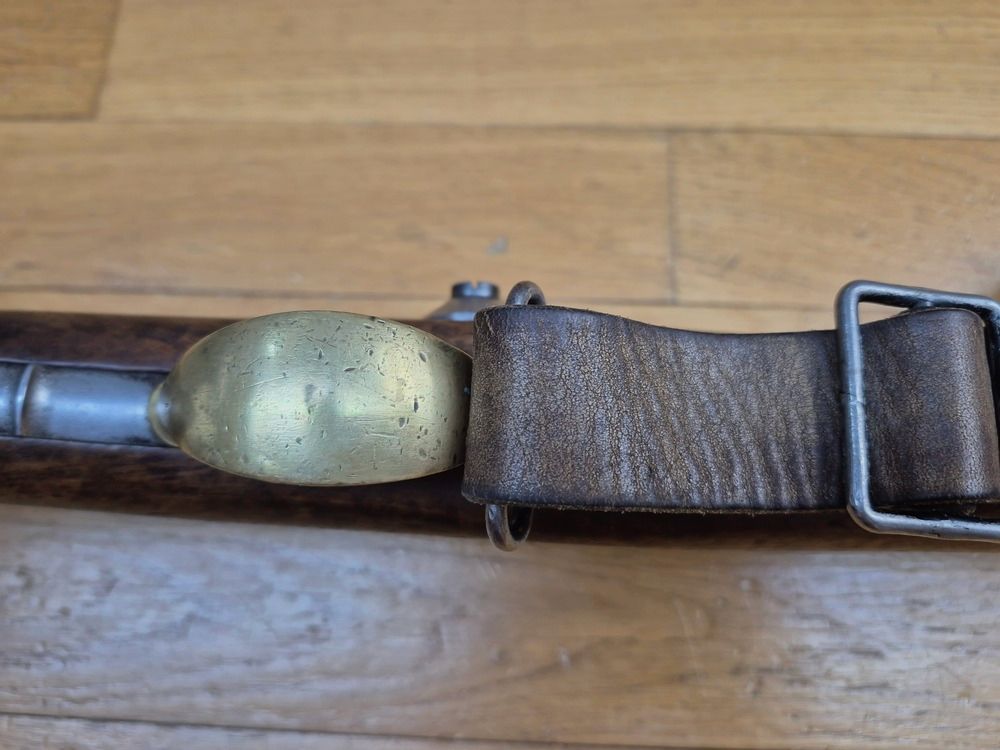
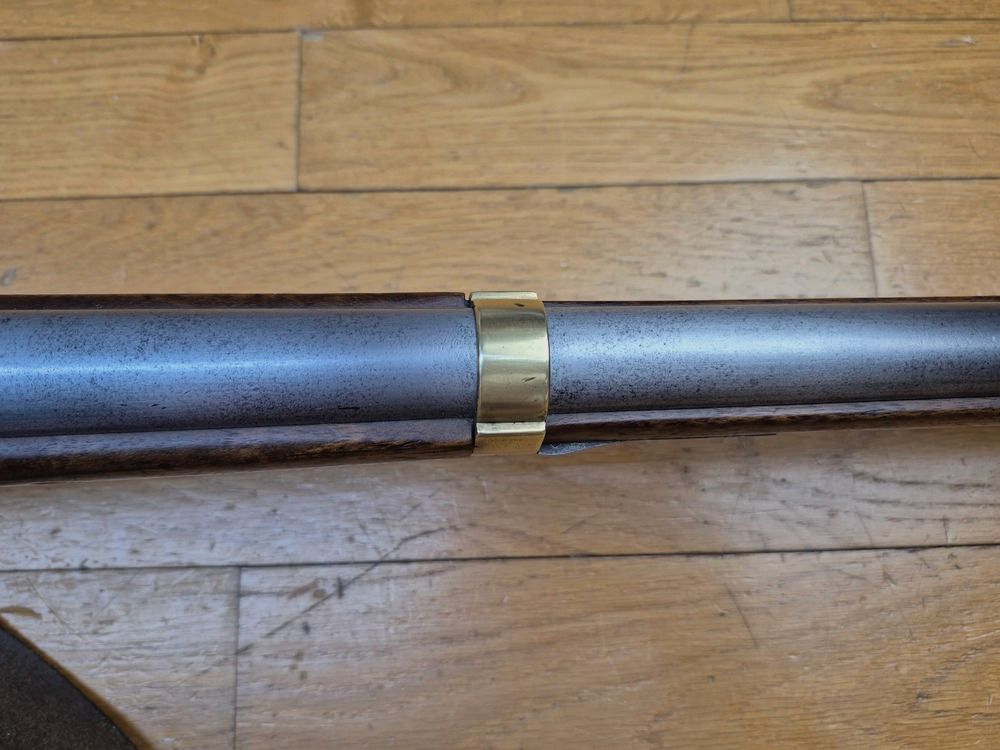
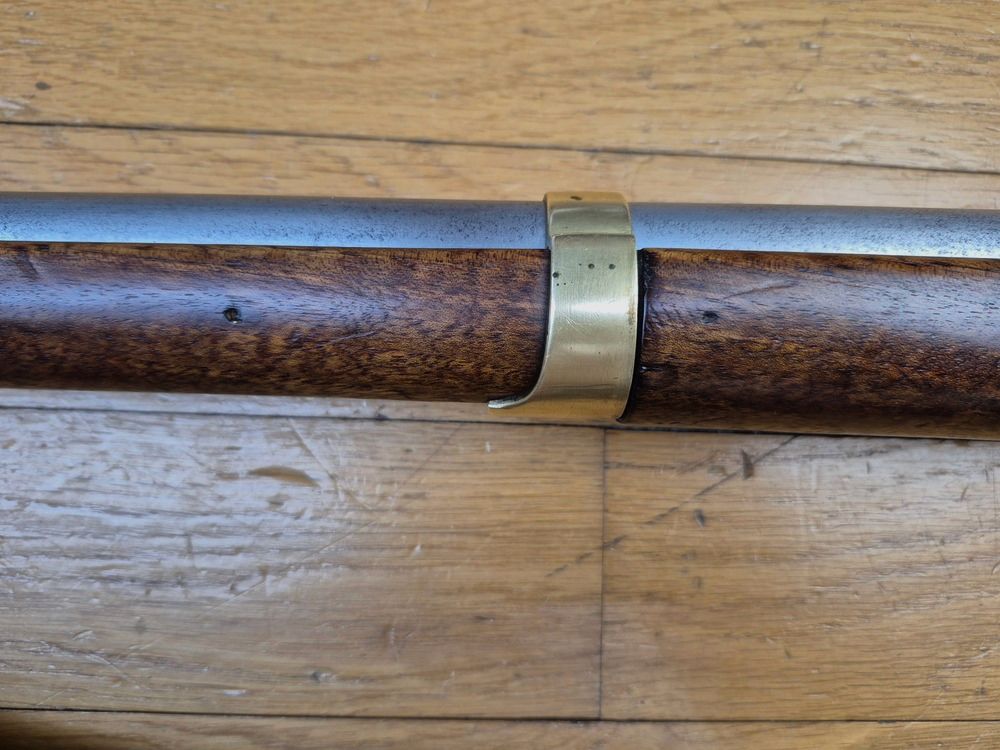
Based on Voltigeur (142) or Dragon (132) sizes like ours, they are mainly characterised by brass fittings (nose cap, barrel band, stock band – the attachment, not the band itself) complemented by a brass trigger guard. Brass is less sensitive to sea spray than the iron fittings of the 1842 land rifles.
Note that on these Navy models, the trigger piece (the long one behind the trigger guard on the stock side) remained iron. Always.
In short, a fine beast, very uncommon among French regulation armaments.
Our example stands out by being a royal production from 1847. The production date is clearly visible on the barrel. It is a primitive Navy model by origin, produced at Tulle, the favourite arsenal for producing our Navy weapons since the Ancien Régime. The later-produced 1842 Navy rifles, including under the Second Empire, are often from Châtellerault. At least those I have handled.
Let’s also note that our 1842 rifle, with its quality finish and its strong 18 mm caliber, was much more powerful and accurate than the English weapons alongside which it fought in Crimea, for example.
As progress never stops, especially in ballistics, our fine representative of its Navy kind saw its barrel rifled at the dawn of the 1860s and was fitted with the model 1 ramrod.
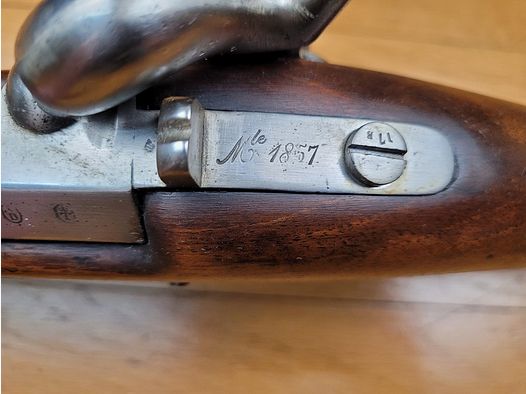
857 with a "nail head" at that moment. It was standard for converted T firearms.
Born directly as a piston, our example only underwent this single transformation, being considered still sturdy enough to undergo the operation of creating the 4 additional grooves. Because naval firearms went through it too. Only one transformation, so a T and no bis.
Given the large number of almost new 1822T models still available, not as many of these 1842 T rifled muskets were made as one might have thought. However, great care was taken in their manufacture and, with its lines and its 1.32 meter length, this firearm is among the most elegant of our standard issue.
As with every standard firearm selected for you by Maître Flingus, it is in excellent condition and we can actually read it like an open book and follow at least part of its journey.
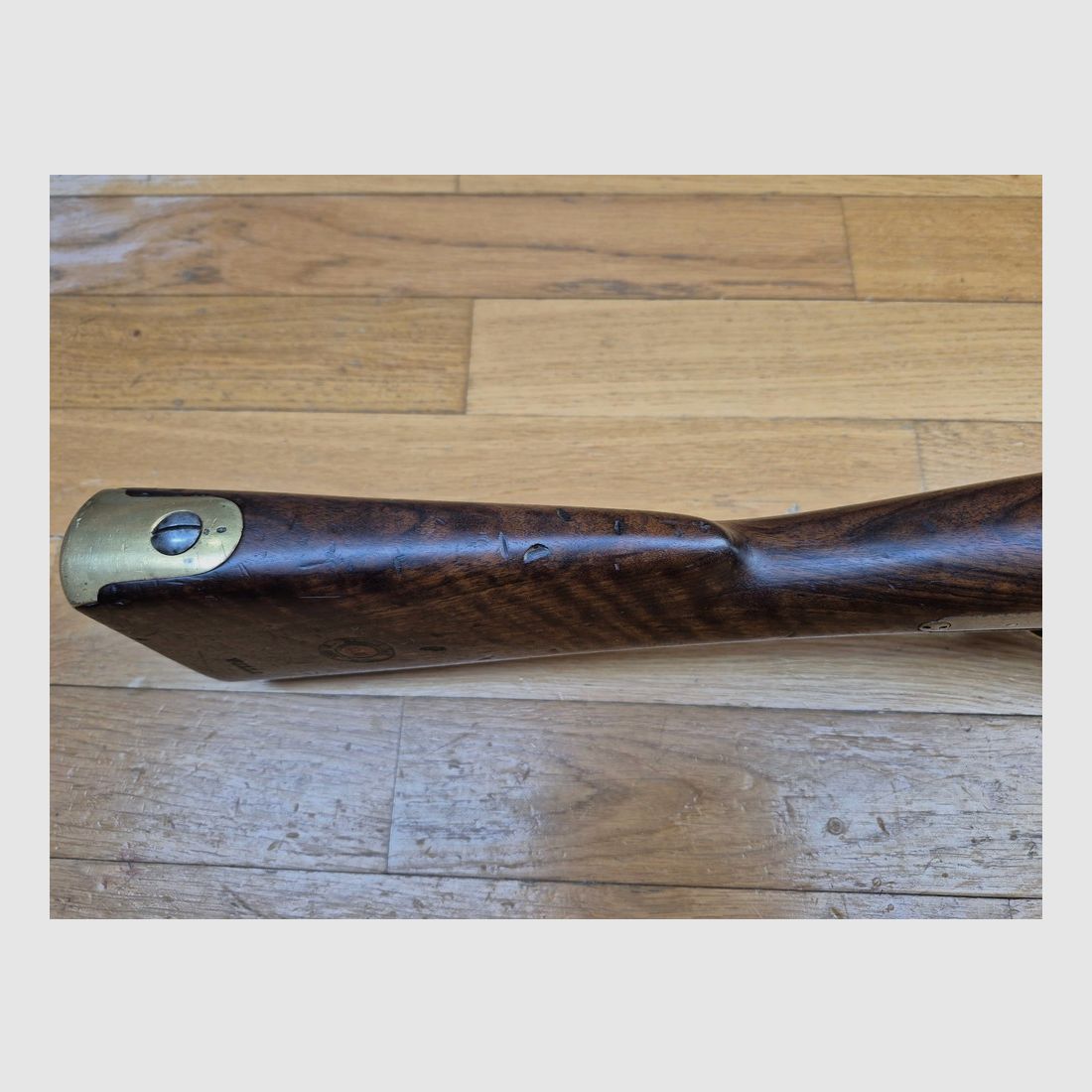
The stock is carved from a very, very beautiful walnut inconceivable nowadays outside of a high-end hunting firearm. With magnificent grain and colour. It is also one of the marks of naval firearms, often made with very particular care.
No cracks, no repairs, no wormholes, and scattered handling marks exaggerated by my close-ups as usual. Not too bad. Rather beautiful to very beautiful wood.
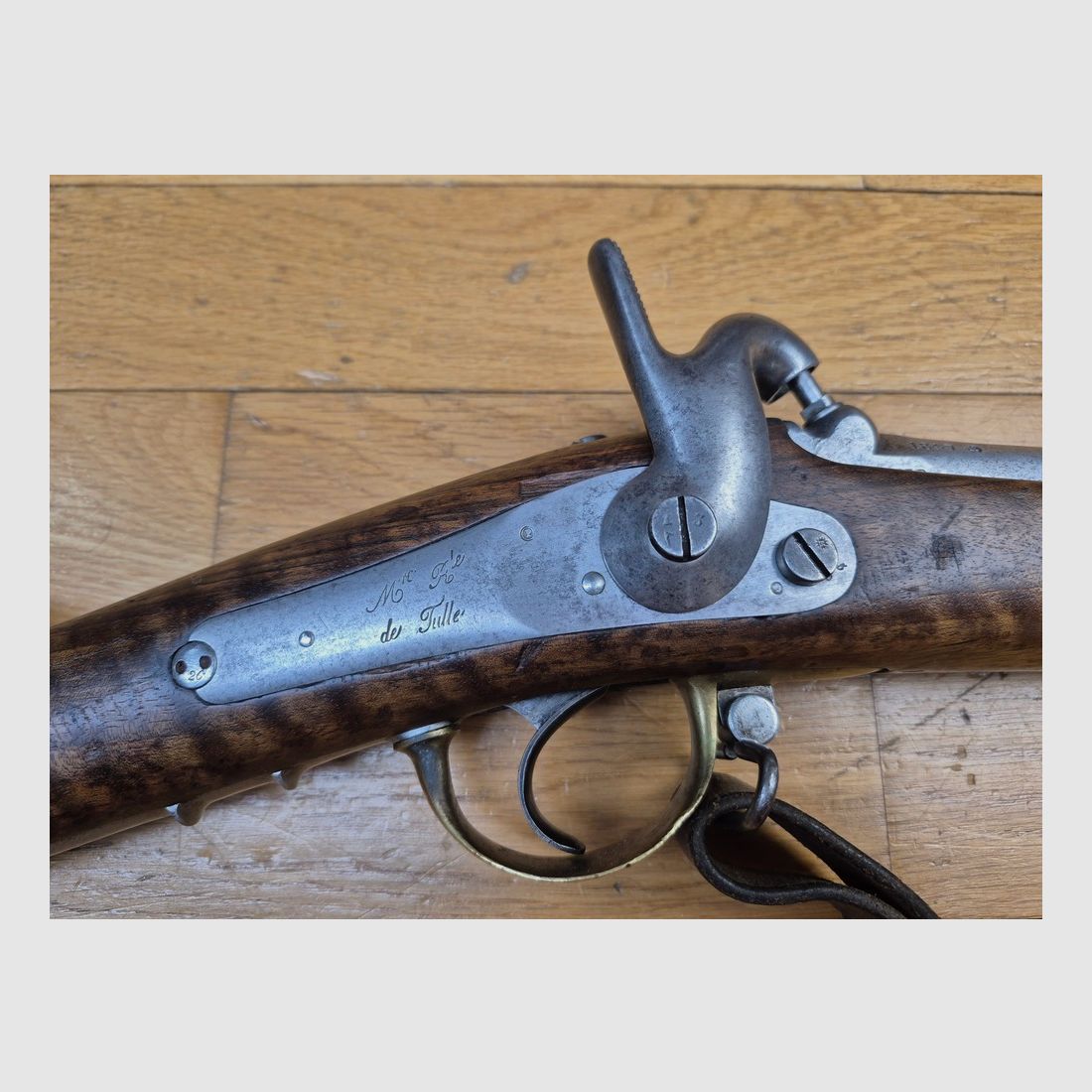
All the acceptance and wood control stamps are clearly visible, a sign of their good preservation on the wood, as well as a very beautiful repair stamp from 1861, largely legible except for the second word (normally the city of transformation which here starts with a T) and the word Tulle stamped at the bottom of the stock. Our fine naval firearm was therefore repaired in this arsenal in 1861.
It is probably on this occasion that it was also converted to T and rifled because the musket bears no other trace of arsenal passage.
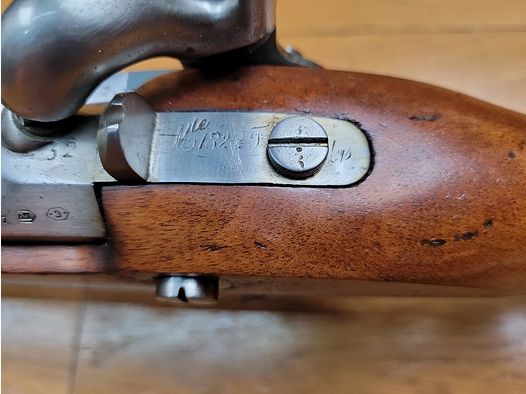
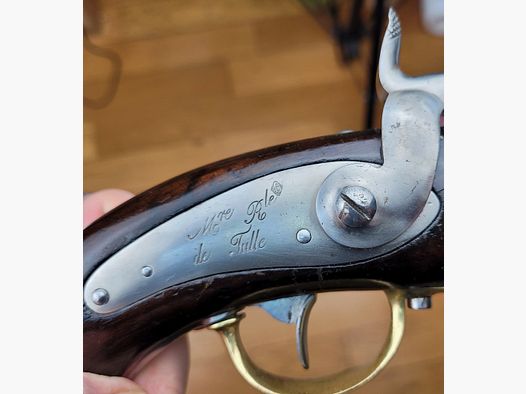
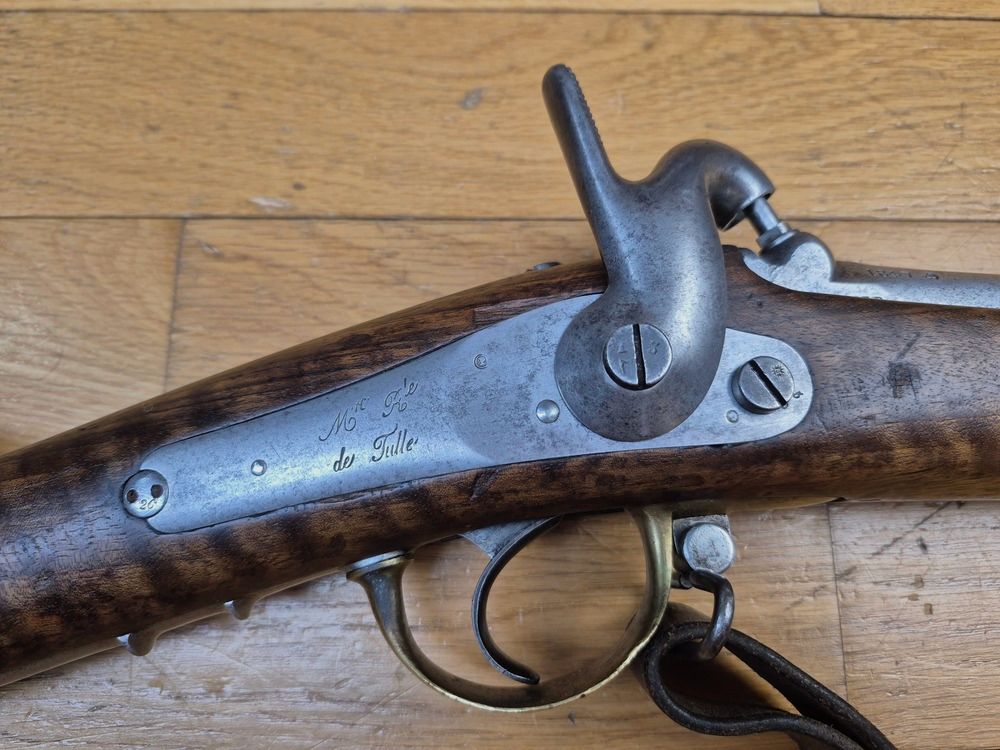
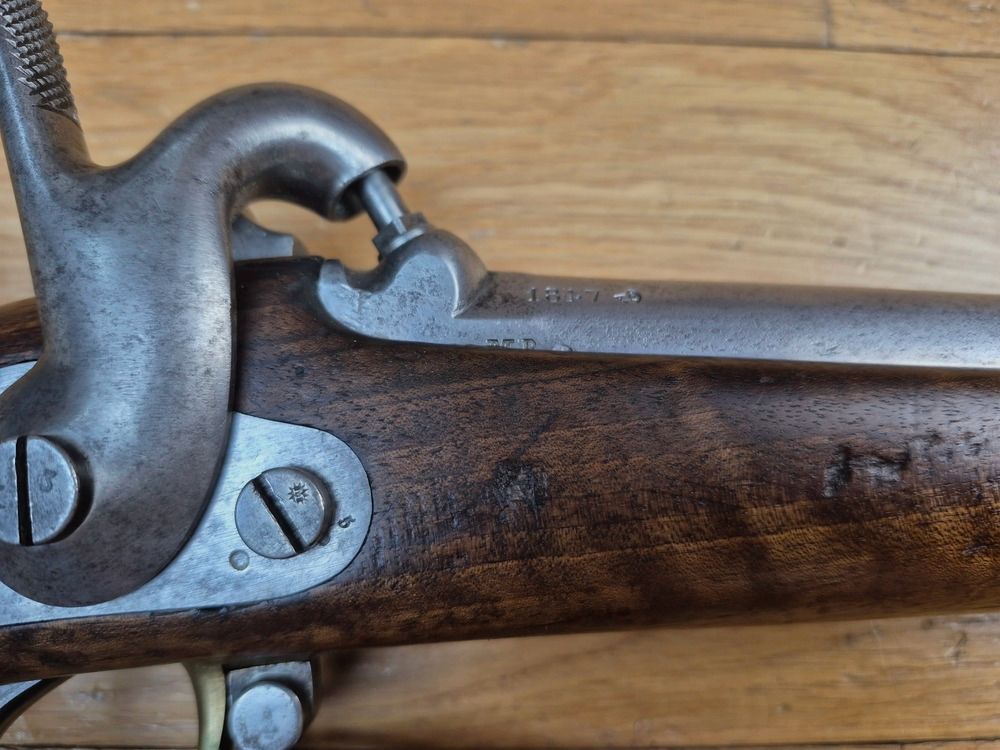
The lock is well marked by the Manufacture Royale de Tulle. It is the 1847 type with wide pillars. Its clicks are as clear as they are musical, with a dog without play, with strong regulatory checkering and its hexagonal drilling to mount on the bolt axis. The firearm holds its two sears well and the percussion is excellent. Despite old oxidation, all markings are clearly readable. Very nice overall condition of the firearm.
The bolt handle bears a beautiful "1842 T" marking, very clear, and also the new fixed sight model with a single notch identical to the 1822 T, which is forged directly into the bolt.
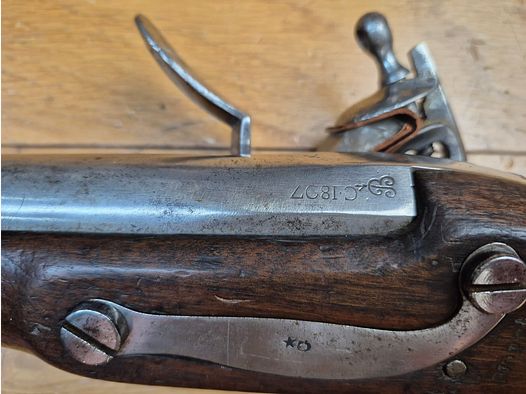
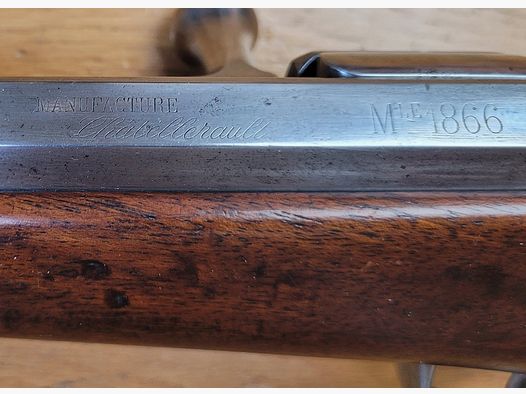
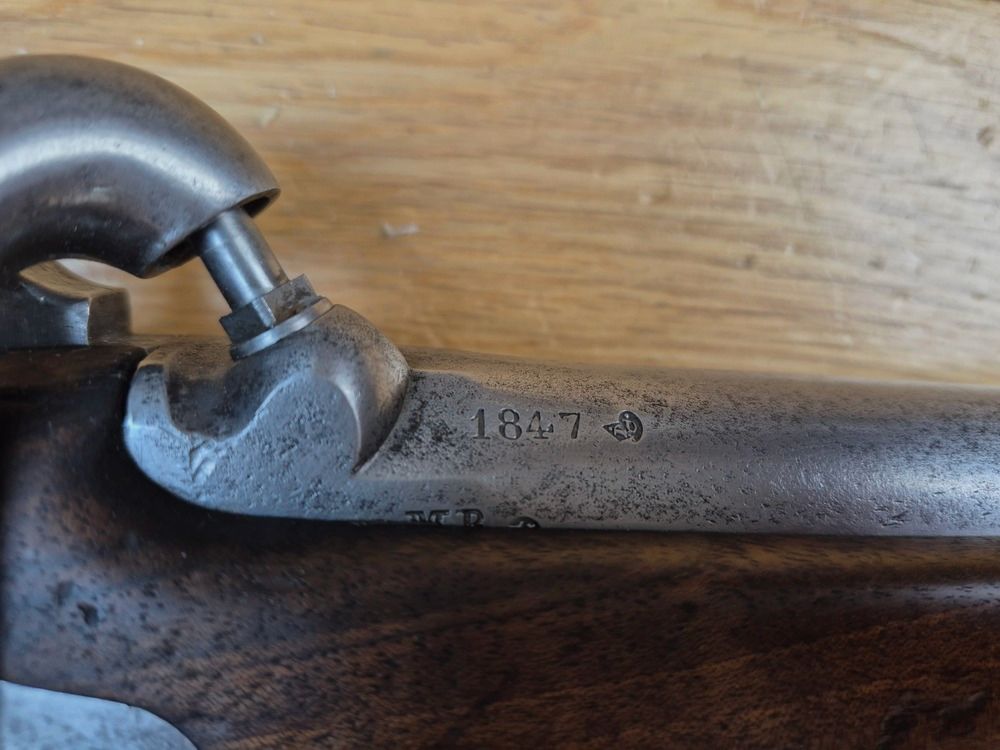
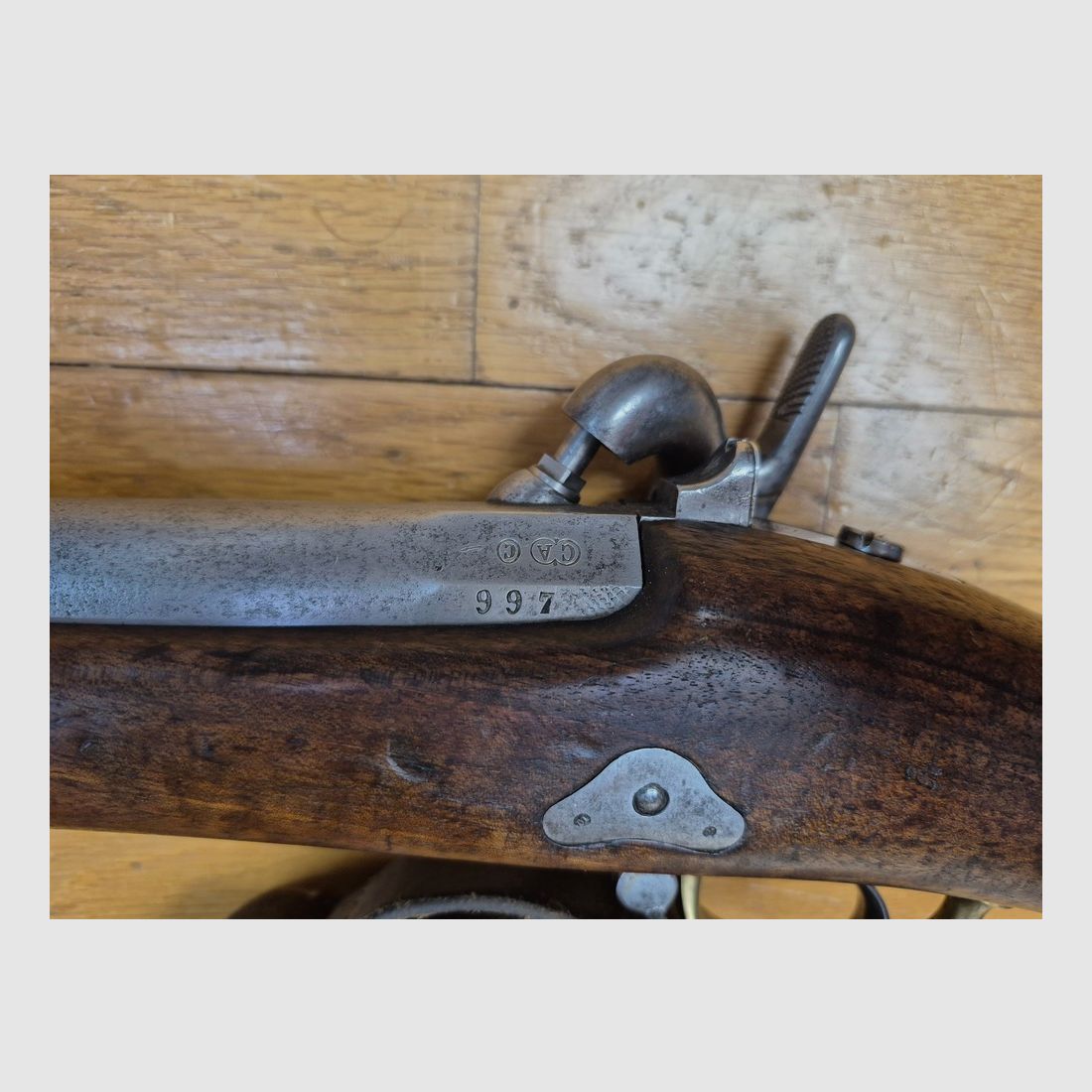
On the right side of the barrel is also the date "1847" (creation) as well as the "MR" Manufacture Royale mark. So it is not a replacement.
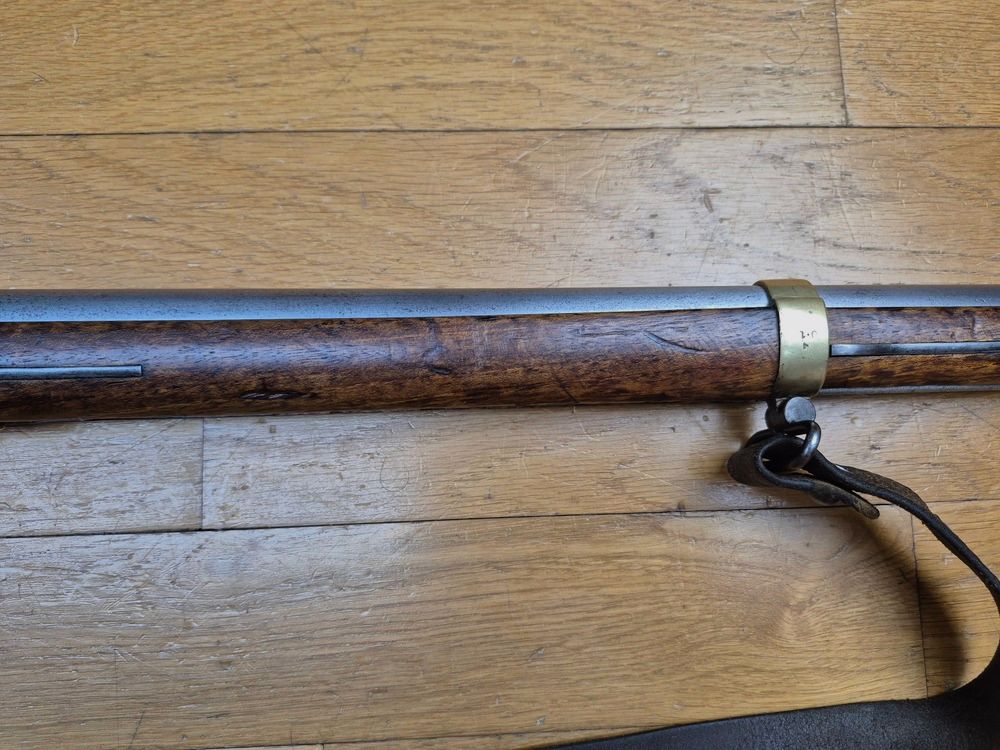
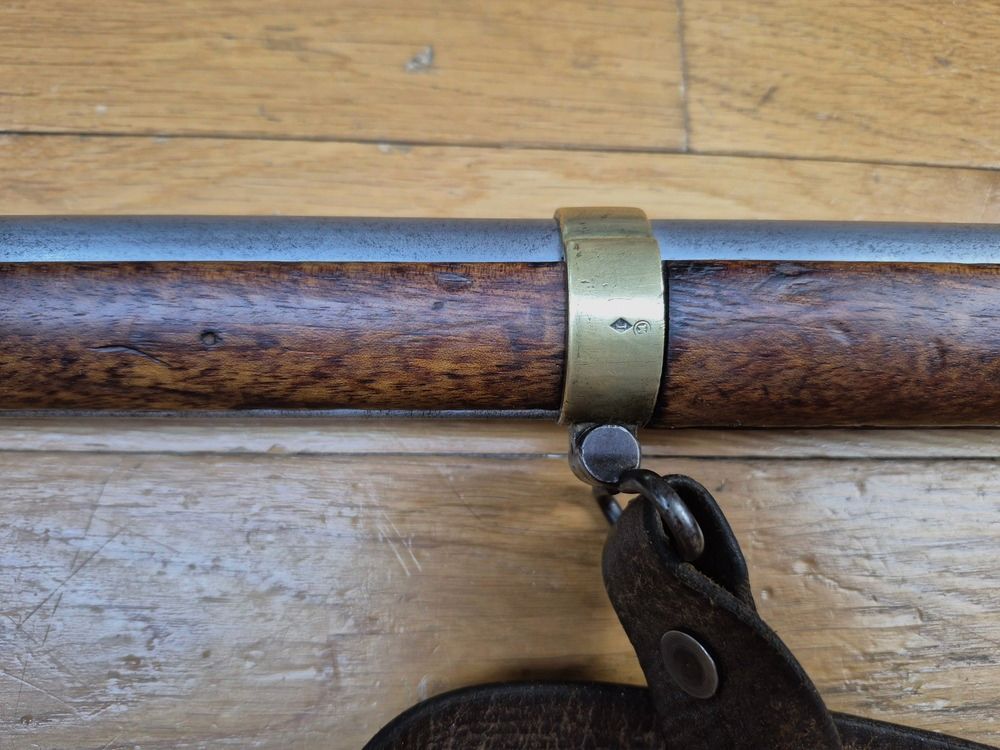
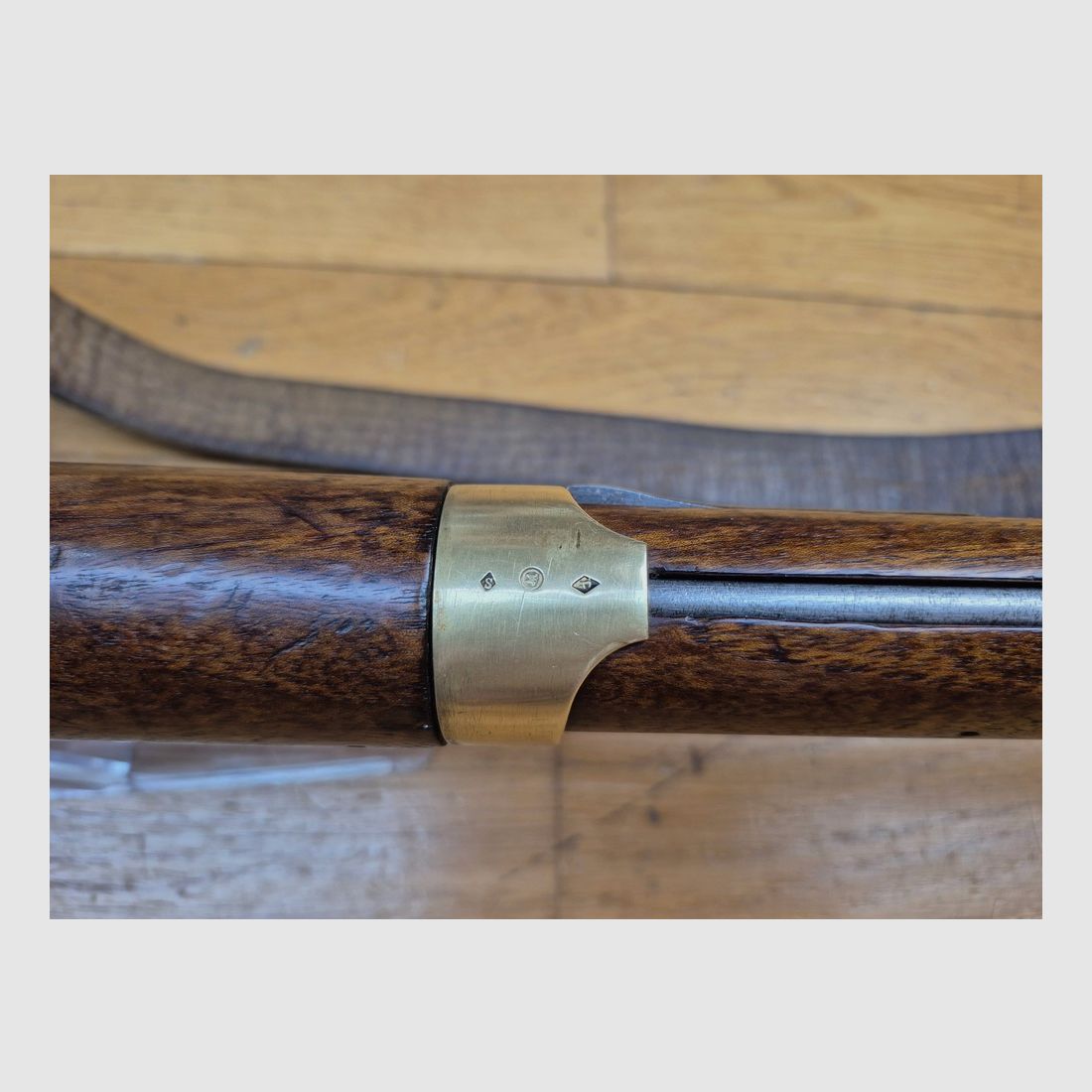
The fittings are indeed brass and all conform to the model. They are very homogeneous except the muzzle band which bears other stamps but is perfectly conforming to the model, the period, and the arsenal. It is enough that the muzzle band was changed in 1861 during the repair for the fittings stamps to change. This is almost certain here because on the muzzle band we find the D in a circle of Louis Stanislas Demoulin and the crowned one of Dumont, fittings inspectors at Tulle between 1846 and 1862.
All other fittings including the stock plate bear the M in a circle of Montrieux Dieudonné, fittings inspector at Tulle from 1844 to 1849, the period of manufacture of our musket. Incidentally, we find (including on the trigger piece behind the trigger guard) the P in a circle of Pierret or Piron (two inspectors of Tulle between 1835 and 1853) as well as an S in a diamond that I could not identify. Ultimately, all fittings conform to the model, in good condition, clearly readable and homogeneous from Tulle. That’s rare!
All stamps including on iron and lock plate are clearly readable including on the barrel where we find the CA stamp of Charles Arcelin, Director of the Manufacture de Tulle from 1842 to 1849 at the time of creation of our musket.
The barrel, with
a very beautiful "face" and quite thick, showing four very nice grooves with sharp edges, which would just need a good little rod cleaning. Very nice barrel.
The firearm is presented with its rod compliant with the 1857 regulation, of slightly larger section. All screws are compliant and in good condition.
In short, a regulatory naval firearm, very consistent, not tinkered with and in excellent condition. A rare condition especially when you see the number of 1842s in poor condition and/or abusively "sanded" with very faded, scratched or erased markings on the market.
This firearm will honour your collection. It especially pays tribute to the productions of our Manufactures and to all those humble working lives spent producing well-done work out of pride in their craft. Particularly difficult to find in this condition and much less common than the 1842 Tbis infantry models, its contemporaries.
Firearm category D under CSI: valid ID card, CNI or passport mandatory
*******************************************************************************************************************************************
Let's repeat it! The Flingus Maximus gun shop in Paris and throughout France is also here for your private firearm formalities, buying collections of firearms and militaria, your firearm appraisals, your firearm questions in successions and inheritance. Contact your favourite gunsmith via our contact form or at [email protected]
Reminder: All collection, hunting, and shooting firearms are used and sold as-is, without warranty.
All historic firearms of old manufacture sold as category C or D, “Collection” or “Cow-boy shooting”, are collection firearms not proof-tested for shooting and not tested at the range. They have been visually inspected regarding their general condition but none have been used for shooting and are therefore sold as untested. Buyers wishing to use a firearm for shooting must imperatively contact the National Proof House of Saint Étienne beforehand, the only entity authorised to issue proof certifications prior to shooting use. (Show description in original language)
Avec nos yeux du XXI ème siècle, les armes à piston ne nous semblent pas si différentes tant au niveau de leur ligne que de leur mode de fonctionnement des fusils An IX à silex du Premier Empire.
Pourtant, pour reprendre les mots d’un homme chauve en col roulé, c’est une révolution!
Nombre de ratés et cadence de tir vont aller en sens inverse grâce à la percussion à amorce pour une plus grande efficacité des armes. Restera encore à vaincre l’idée reçue qu’il est plus prudent de séparer l’amorce de la cartouche. Ce qui prendra encore fort longtemps. A cause d’un essai surréaliste de 1838 que je vous raconterai une autre fois. Mais même pour le fusil à piston à amorce séparée, le chemin ne fut pas simple.
Reprenant tous les principes du système Gribeauval et de son silex 1777, combiné avec les expérimentations commencées dans les années 1830 sur les amorces, les carabines à tige et les fusils de rempart du Directeur Pontcharra, le très novateur système 1840 à piston fut néanmoins un fiasco. En grande partie à cause de soucis de fixation à la forge de la masselotte de cheminée qui met le feu de l’amorce en contact avec la poudre logée dans le canon. Le problème était sidérurgique plus qu’armurier. On décida de repasser de l’acier au fer… Un retour en arrière sidérurgique contre un progrès armurier. La vie est parfois contrariante. Même dans les arsenaux d’État.
Le système 1842 fut donc le premier à proposer une arme à percussion construite neuve ayant résolu les problèmes de fixation de la cheminée et de solidité des canons. C’est avec le 1842 que l’armement français prendra l’aspect général extérieur qu’il conservera jusqu’au Chassepot 1866 et la culasse mobile.
D’une solidité proverbiale, cette arme servira la France en Crimée, en Italie et au Mexique ainsi que sur de nombreux terrains extérieurs (Algérie, Afrique,…), contribuant à conforter partout la réputation de la Furia Francese. Transformé (ou pas!) à tabatière, il servira encore la Patrie en 1870/71.
On le sait moins mais des 1842 filèrent leur chemin jusqu’à la Marine et subirent les transformations. Nous en avons la preuve ici.
A quoi reconnait-on les armes 1842 de Marine Et bien pas grand chose mais qui suffisent à en faire de relatives raretés. Je vois un marine pour peut-être 100 « infanterie ou assimilés ». Ils ne devraient pourtant pas être si rares que cela mais, pour une raison que je ne connais pas, un événement quelconque, genre extinction des dinosaures, a du survenir dans leur longue histoire et les a rendu fort peu courant (genre destruction d’un arsenal).
Basés sur les tailles Voltigeur (142) ou Dragon (132) comme le notre, ils se caractérisent essentiellement par des garnitures en laiton (embouchoir, capucine, battant de fut – l’attache pas le battant lui-même) complétées par un pontet en laiton. Le laiton est moins sensible aux embruns que le fer normal des garnitures des 1842 terrestres.
Notez que sur ces modèles de Marine, la pièce de détente (celle en long derrière le pontet coté crosse) est restée, elle, en fer. Toujours.
Bref une belle bête fort peu courante de l’armement réglementaire français.
Notre exemplaire se distingue par le fait d’être une production royale de 1847. La date de production et bien visible en canon. C’est un marine primitif d’origine car produit à Tulle, arsenal fétiche de production de nos armes de Marine depuis l’Ancien Régime. Les fusils système 1842 Marine produits plus tardivement, y compris sous le second empire, sont souvent de Châtellerault. Enfin ceux que j’ai eu en main.
Notons au passage aussi que notre fusil 1842, avec sa finition de qualité et son fort calibre de 18 mm, était bien plus puissant et précis que les armes anglaises aux cotés desquelles il a combattu en Crimée par exemple.
Comme on n’arrête pas le progrès, surtout en matière de balistique, notre beau représentant de son espèce de marine a vu son canon doté de rayures à l’aube des années 1860 et il a été doté de la baguette modèle 1857 à « tête de clou » ce moment là. C’était réglementaire pour les armes transformées T.
Né à directement à piston, notre exemplaire n’a donc subit que cette seule transformation étant jugé encore suffisamment costaud pour subir l’opération de création des 4 rayures supplémentaires. Car les armes de marine y sont passées aussi. Une seule transformation, donc un T et pas de bis.
Devant la masse de modèles 1822T quasi neufs encore disponibles, on ne fabriqua pas autant de ces fusils 1842 T rayés qu’on aurait pu le penser. Cependant un grand soin a été porté à leur réalisation et, avec sa ligne et son mètre 32, cette arme compte parmi les plus élégantes de nos réglementaires.
Comme sur tout réglementaire sélectionné pour vous par Maître Flingus, il est en excellent état et nous pouvons d’ailleurs lire en lui comme dans un livre ouvert et suivre au moins une partie de ses pérégrinations.
La crosse est taillée dans un très très beau noyer inconcevable de nos jours en dehors d’une arme de chasse haut de gamme. Avec un veinage et une couleur magnifiques. C’est aussi une des marques des armes de Marine, souvent réalisées avec un soin très particulier.
Pas de fissure, pas d’enture, pas de trous de vers et des traces de manipulation éparses et exagérées par mes gros plan comme d’habitude. Pas bien Méchant. Plutôt beaux à très beaux bois.
Tous les poinçons d’acceptation et de contrôle des bois y sont d’ailleurs bien visibles, signe de leur bonne conservation aux bois, ainsi qu’un très beau cachet de réparation de 1861 largement lisisble sauf le second mot (normalement la ville de transformation qui ici commence par un T) et le mot Tulle frappé en bas de crosse. Notre belle arme de Marine a donc fait l’objet d’une réparation dans cet arsenal en 1861.
C’est sans dote à cette occasion qu’elle a été également transformée T et rayée car le fusil ne porte aucune autre trace de passage en arsenal.
La platine est bien marquée de la Manufacture Royale de Tulle. Elle est du type 1847 à large piliers. Ses cliquetis sont aussi nets que musicaux, avec un chien sans jeu, au fort quadrillage réglementaire et son perçage hexagonal pour se monter sur l’axe de la noix. L’arme tient bien ses deux crans et a percussion est excellente. En dépit d’une ancienne oxydation toutes les mentions sont bien lisibles. Très bel état général de l’arme.
La queue de culasse porte un beau marquage « 1842 T » bien net et également le nouveau modèle de hausse fixe à cran unique identique au 1822 T qui est forgée directement dans la culasse.
Sur la face droite du canon figure également la date « 1847 » (création) ainsi que le sigle de » MR » de Manufacture Royale. Ce n’est donc pas un remplacement.
Les garnitures sont bien en laiton et toutes conformes au modèle. Elles sont très homogènes sauf l’embouchoir qui portent d’autres poinçons mais qui est parfaitement conforme au modèle, à l’époque et à l’arsenal. Il suffit que l’embouchoir ait été changé en 1861 lors de la réparation pour que les poinçons de garnitures changent. Or c’est ici quasi certain car on trouve bien sur l’embouchoir le D dans un rond de Louis Stanislas Demoulin et celui couronné de Dumont contrôleurs des garnitures à Tulle entre 1846 et 1862.
Toutes les autres garnitures y compris la plaque de crosse porte le M dans un rond de Montrieux Dieudonné Inspecteur garniture à Tulle de 1844 à 1849 époque de fabrication de notre fusil. Accessoirement on y trouve (y compris en pièce de détente en arrière de pontet) le P dans un rond de Pierret ou Piron (deux contrôleurs de Tulle entre 1835 et 1853) ainsi qu’un S dans un losange que je n’ai pu identifier. In fine Garnitures toutes conformes au modèle, en bon état, bien lisibles et homogènes de Tulle. C’est rare !
Tous les ponçons y compris en fer et en platine sont bien lisibles y compris en canon où on trouve le poinçon de CA de Charles Arcelin Directeur de la Manufacture de Tulle de 1842 à 1849 lors de la création de notre fusil.
Le canon, avec une très belle »gueule » et bien épais, présente quatre très belles rayures aux angles bien vifs, qui auraient juste besoin d’un bon petit coup de baguette. Très beau canon.
L’arme est présentée avec sa baguette conforme au règlement de 1857, de section légèrement plus importante. Toutes vis conformes et en bon état.
Bref une arme réglementaire de marine, très homogène, pas bricolée et en excellent état. Un état rare surtout quand on voit le nombre de 1842 en mauvais état et/ou abusivement « poncés » avec des marquages très atténués, griffés ou effacés présents sur le marché.
Cette arme fera honneur à votre collection. Elle rend surtout encore hommage aux fabrications de nos Manufactures et à toutes ces humbles existences ouvrières passées à produire un travail bien fait par fierté de son métier. Particulièrement difficile à trouver dans cet état et bien moins commun que les 1842 Tbis d’infanterie, ses contemporains.
Arme de catégorie D au CSI : pièce d’identité, CNI ou passeport, en cours de validité obligatoire
*******************************************************************************************************************************************
Répétons le ! L’armurerie Flingus Maximus à Paris et partout en France est là aussi pour vos formalités armes entre particuliers, le rachat de collections armes et militaria, vos estimations d’armes, vos questions armes dans les successions et héritage. Contactez votre armurier préféré via notre formulaire de contact ou à [email protected]
Rappel : Toutes les armes de collection, de chasse, et de tir sont d’occasion et sont vendues dans l’état, sans garantie.
Toutes les armes historiques de fabrication ancienne vendues en tant que C ou D, “Collection” ou “Cow-boy shooting” , sont des armes de collection non éprouvées pour le tir et non testées en stand. Elles ont été inspectées visuellement relativement à leur état général mais aucune n’a été utilisée au tir et elles sont donc vendues comme non testées. L’acquéreur désirant utiliser une arme pour le tir devra impérativement se rapprocher préalablement du banc National d’Épreuve de Saint Étienne, seule entité habilitée à délivrer des certifications d’épreuves préalable à un usage de tir.