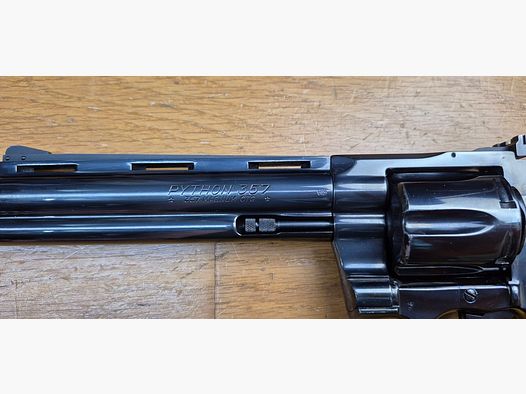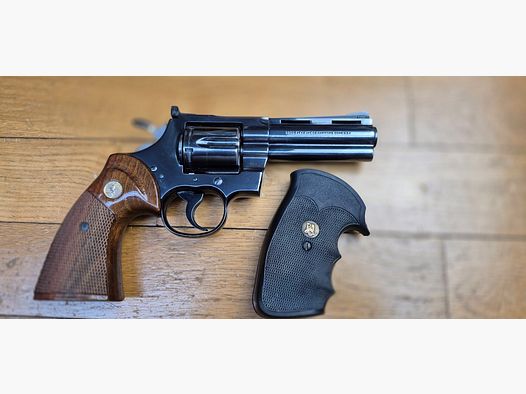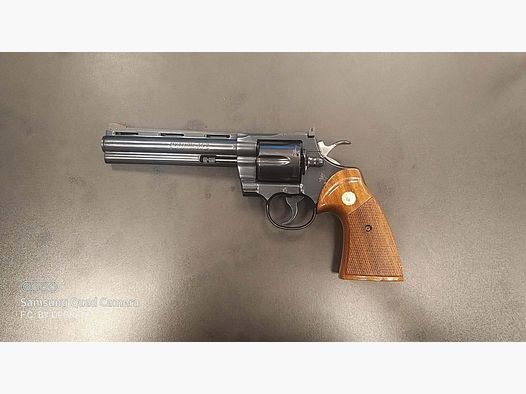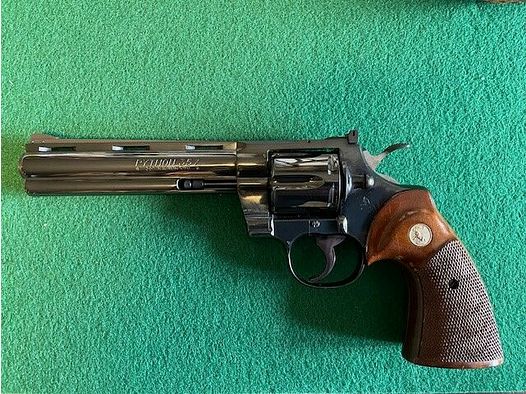
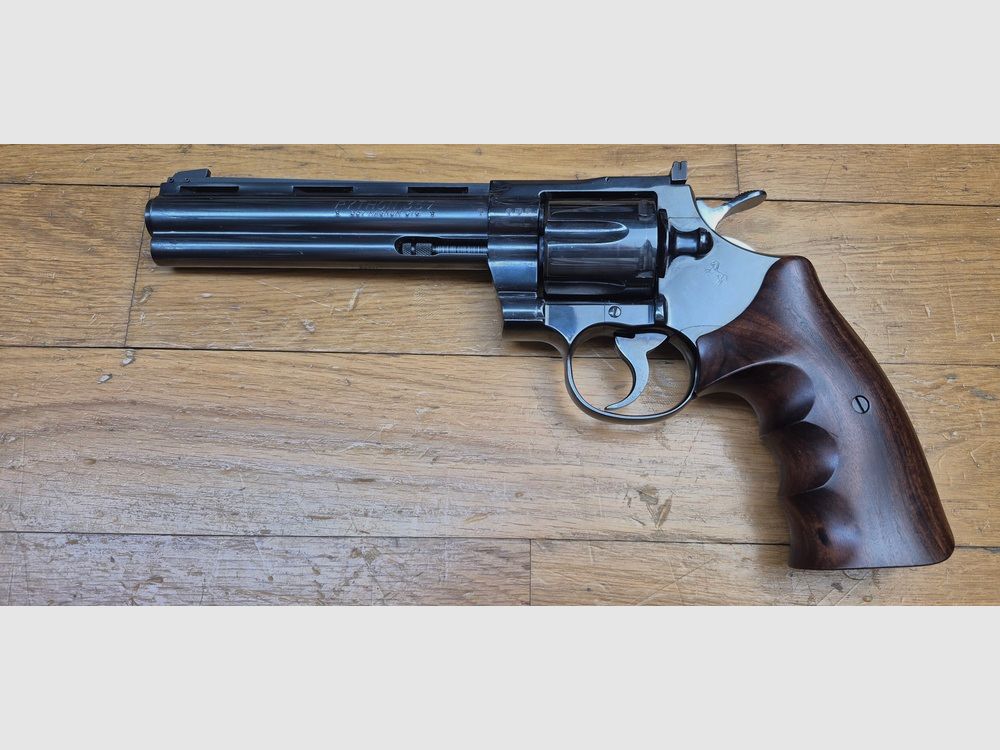
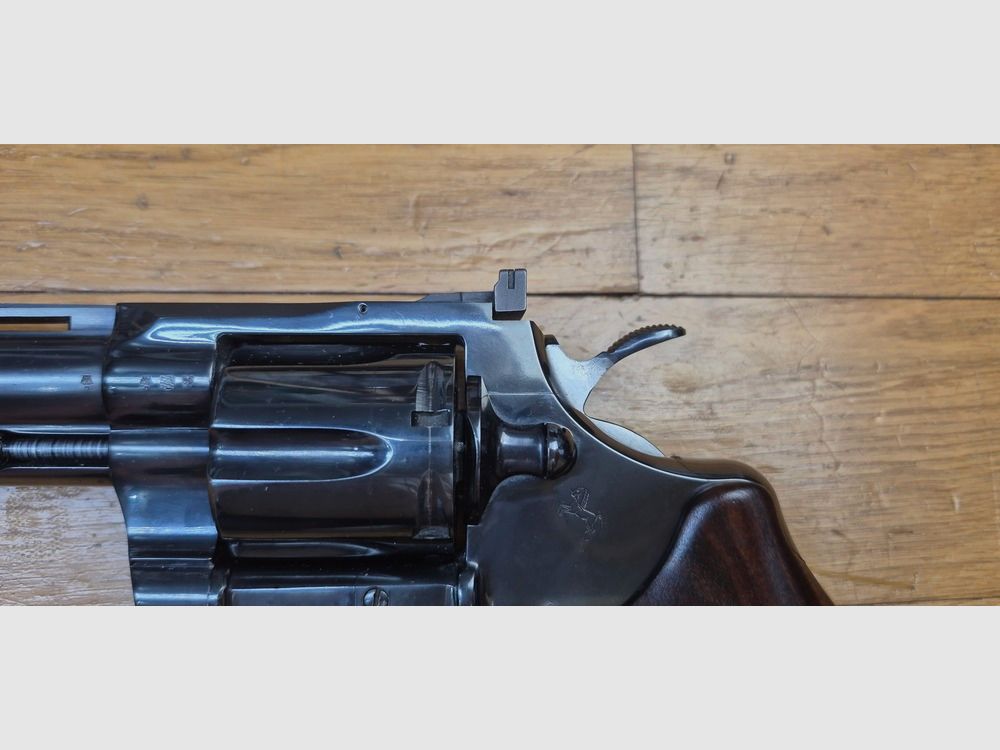
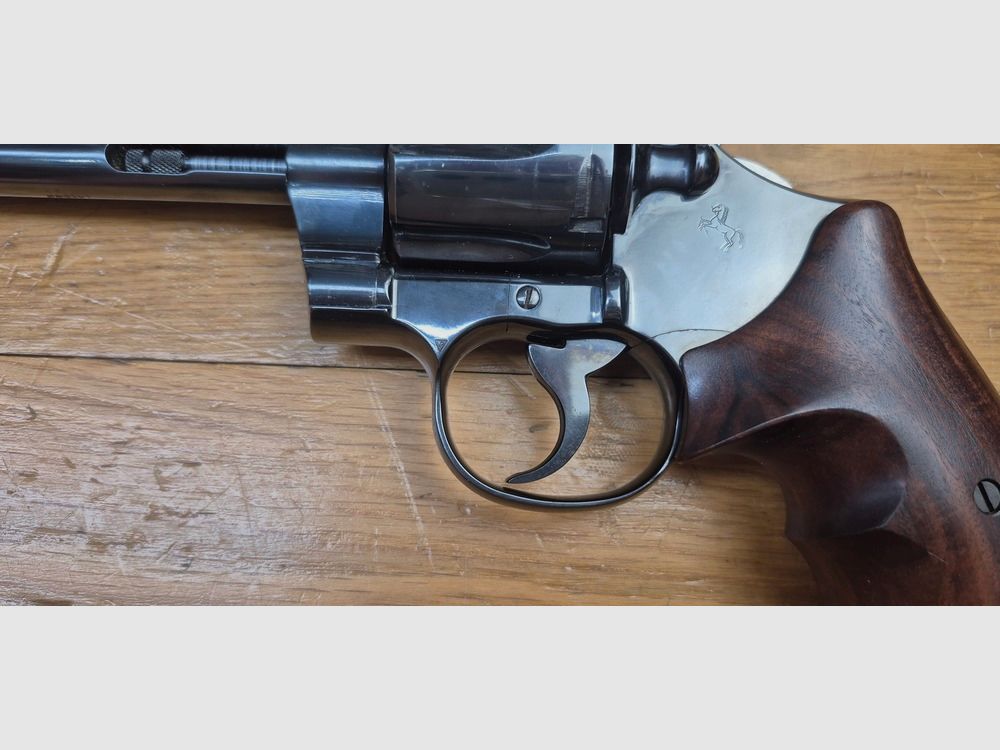
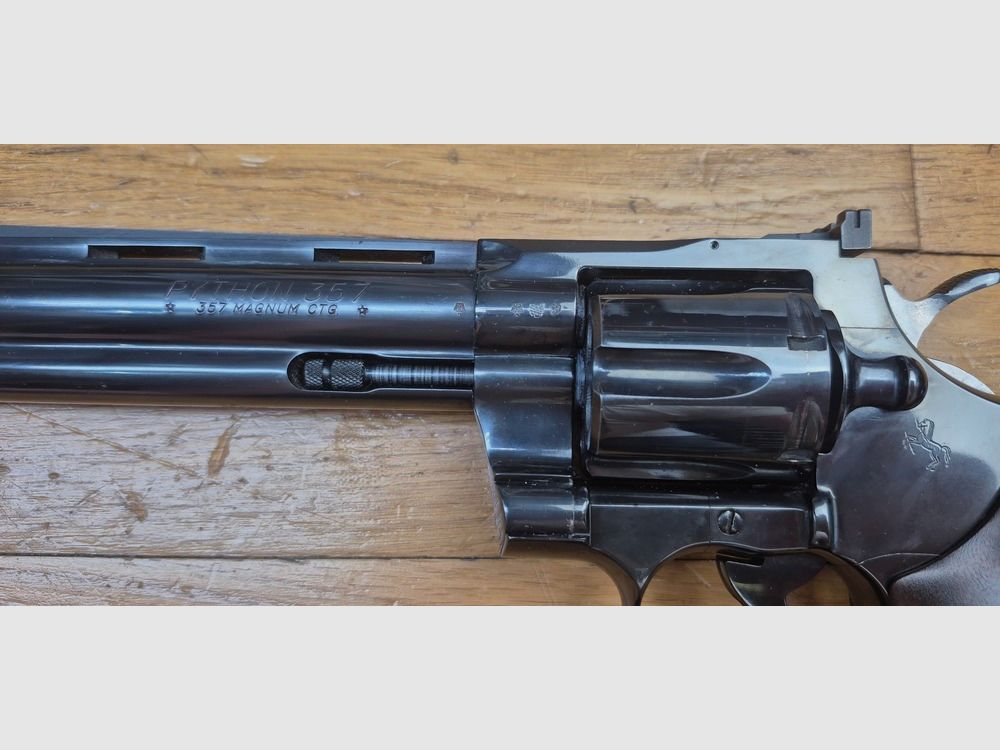
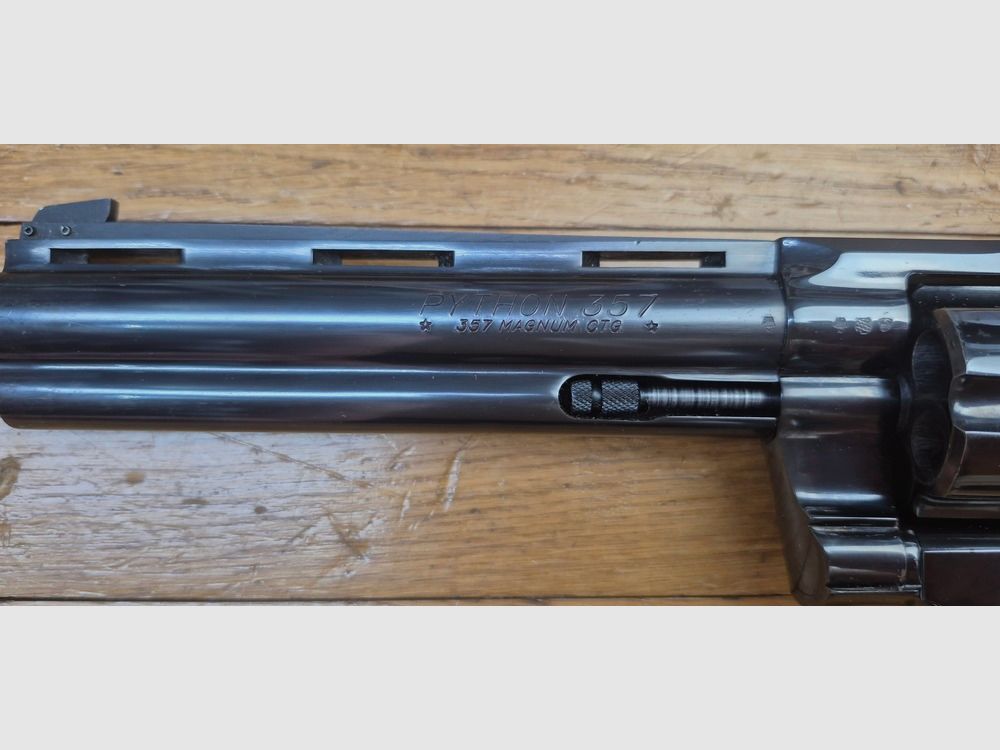
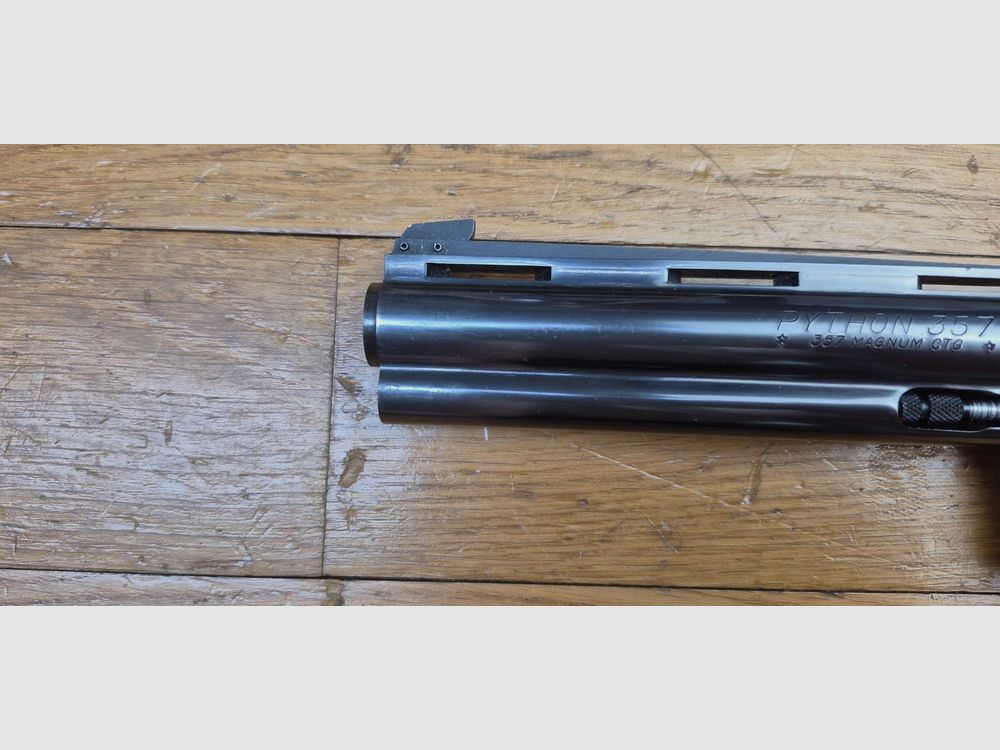
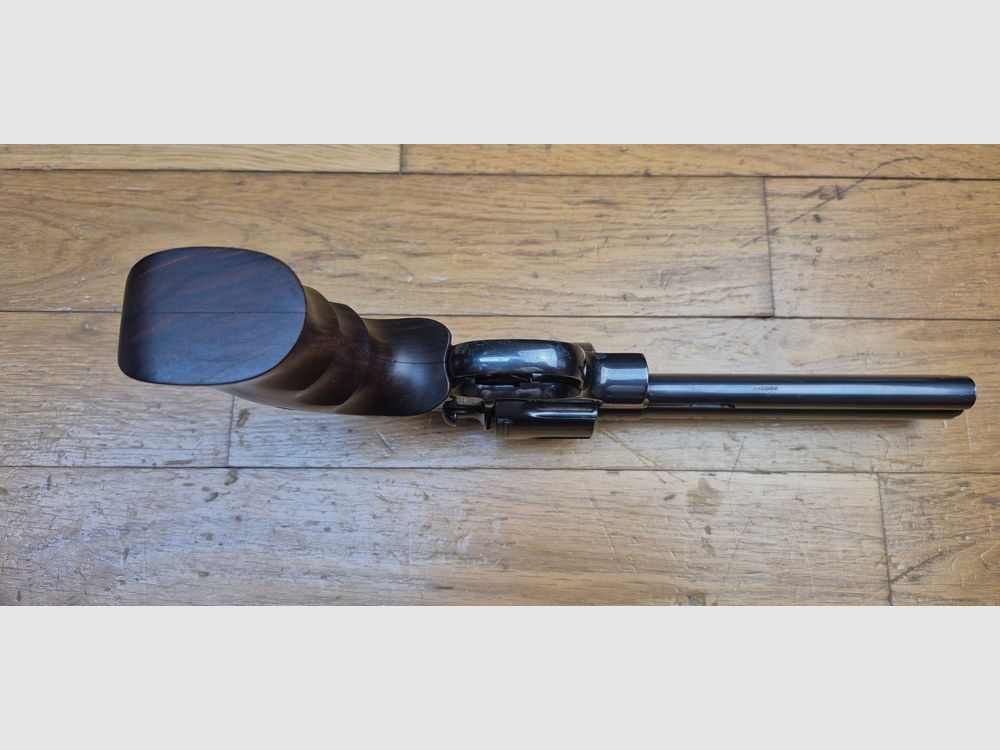
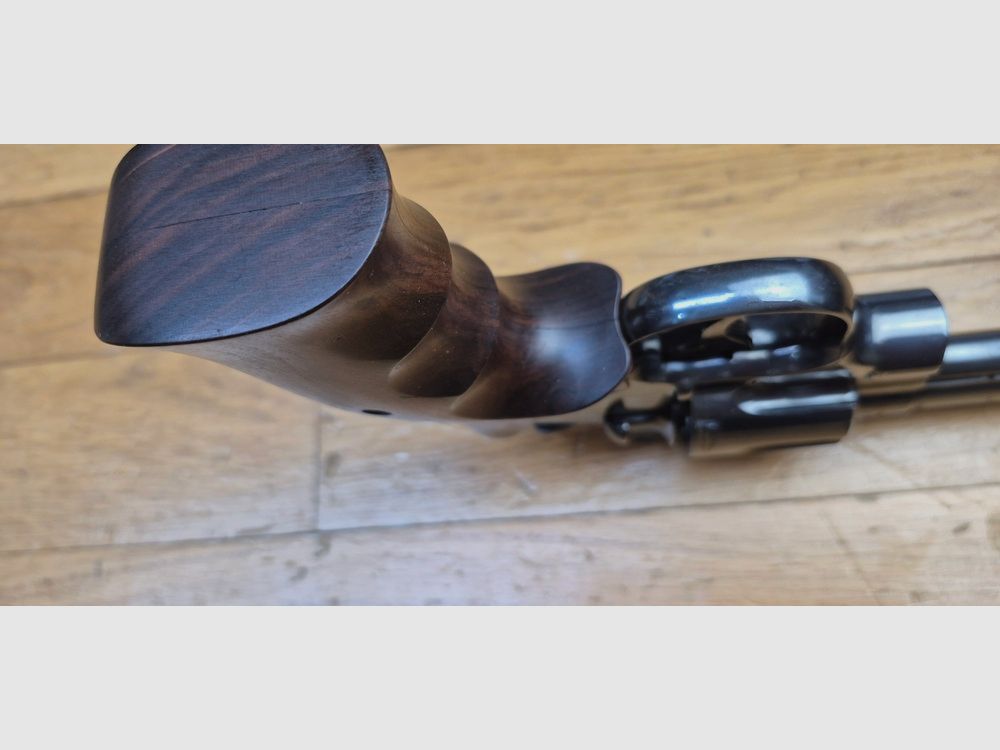

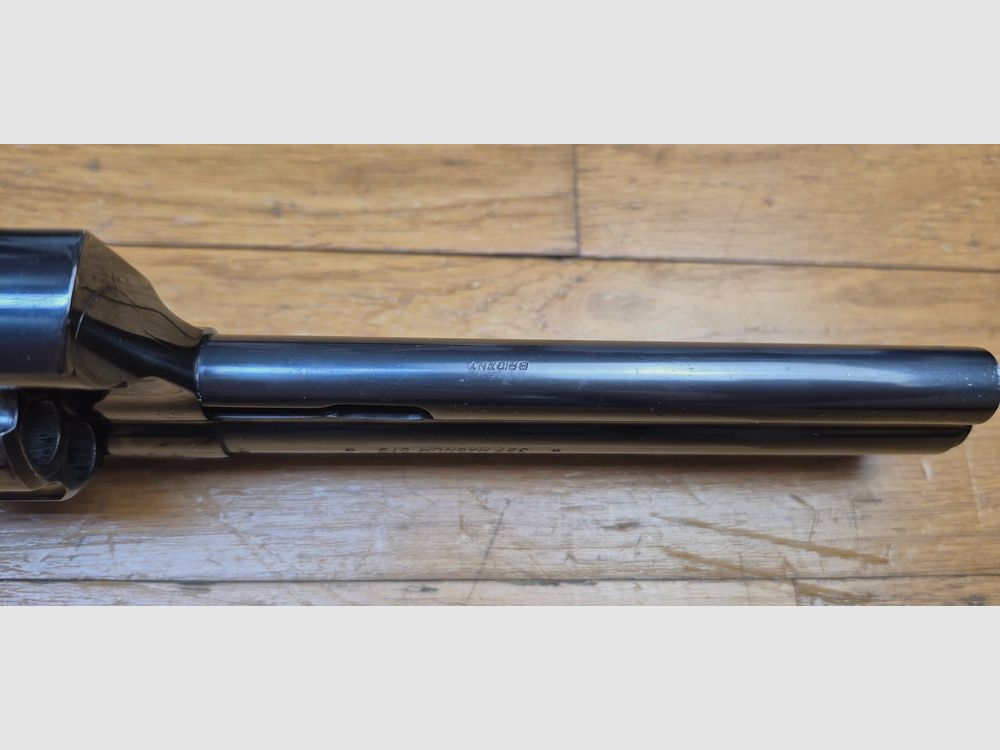

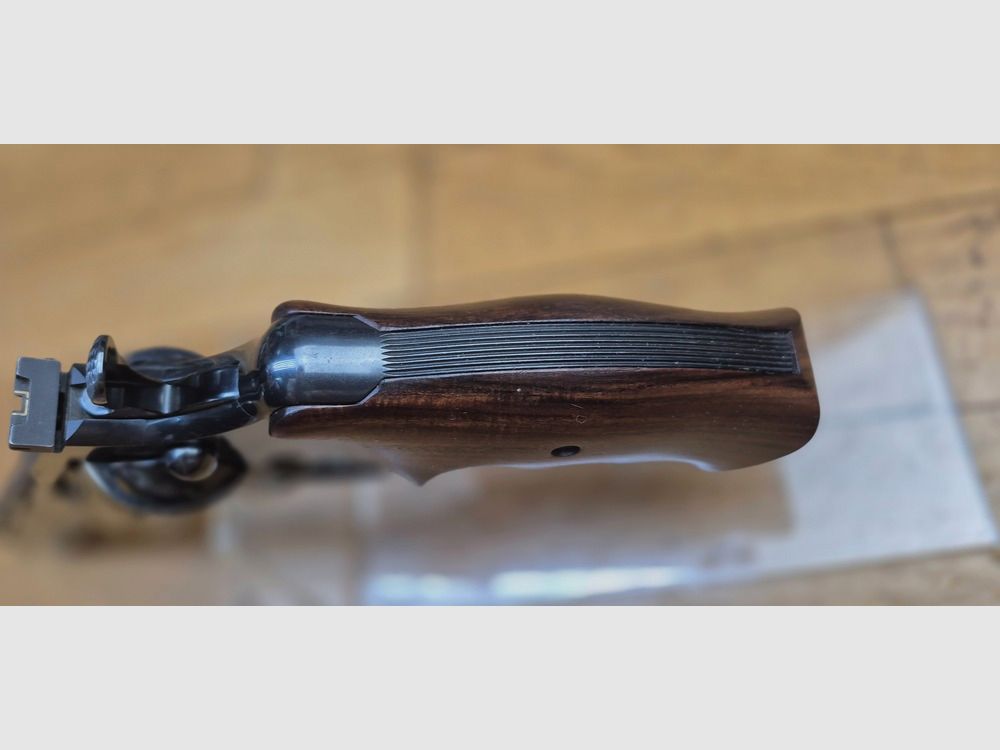
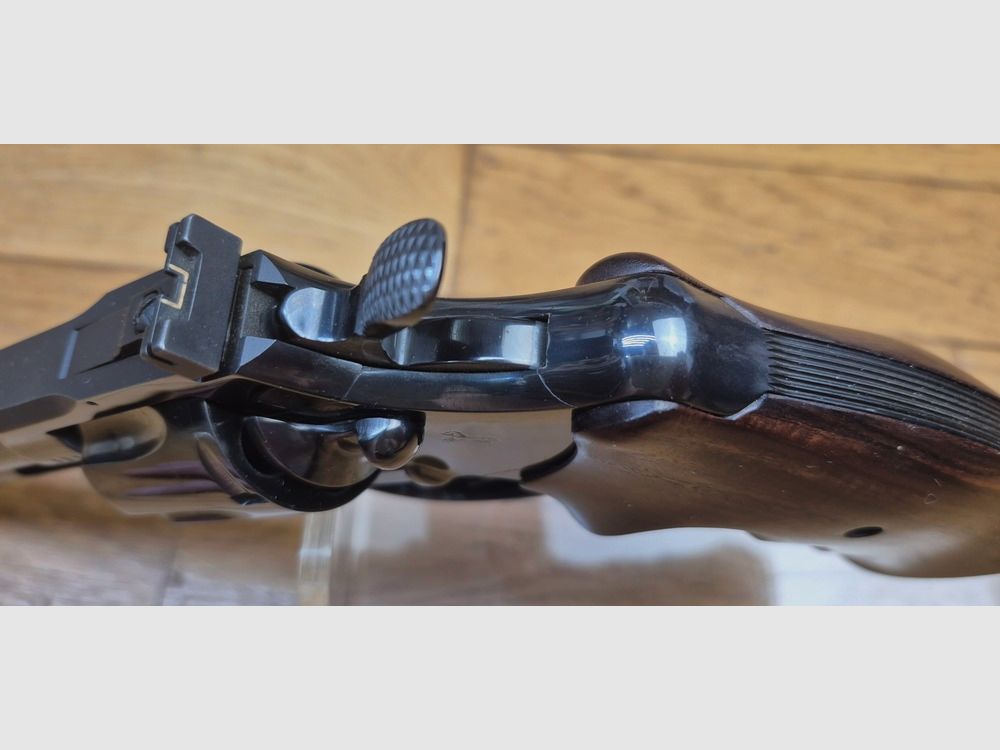
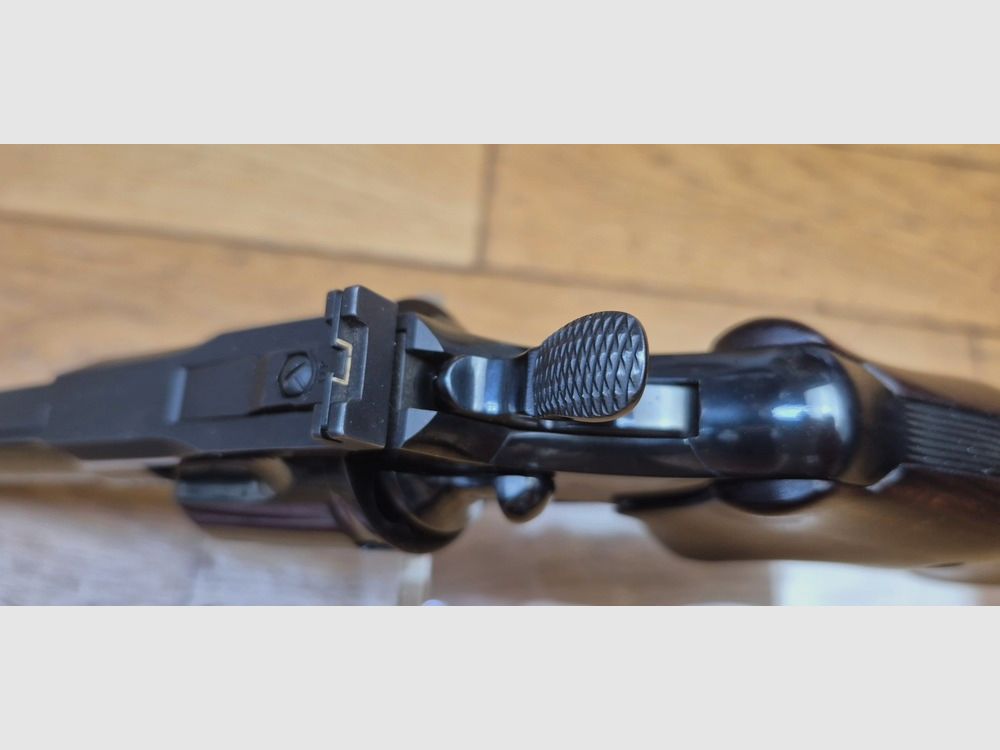
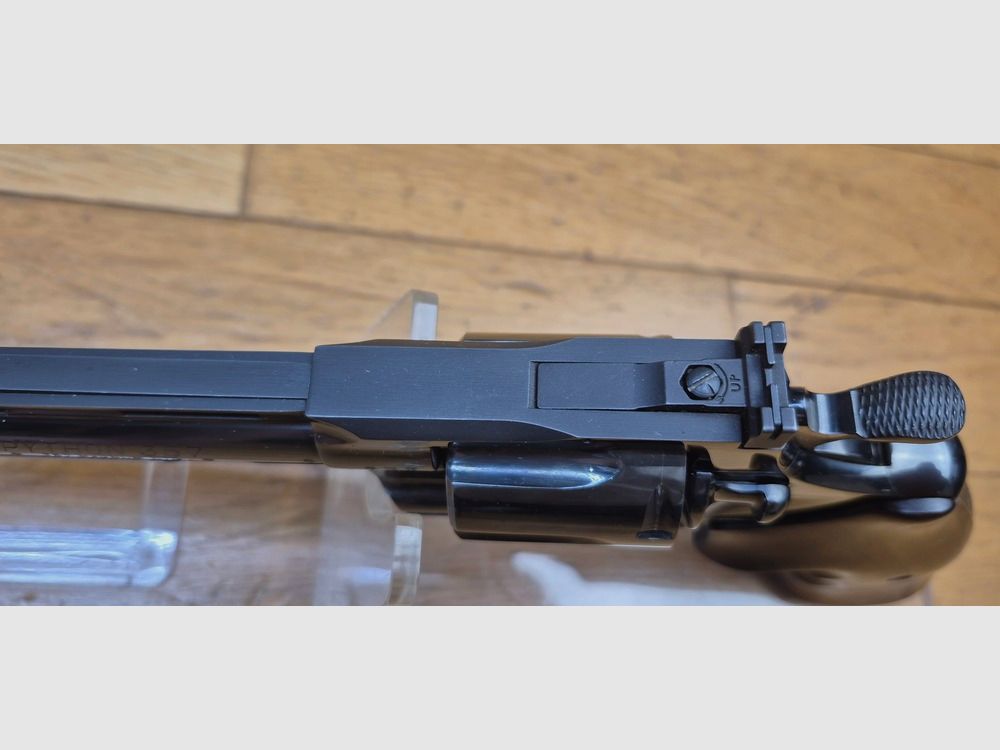

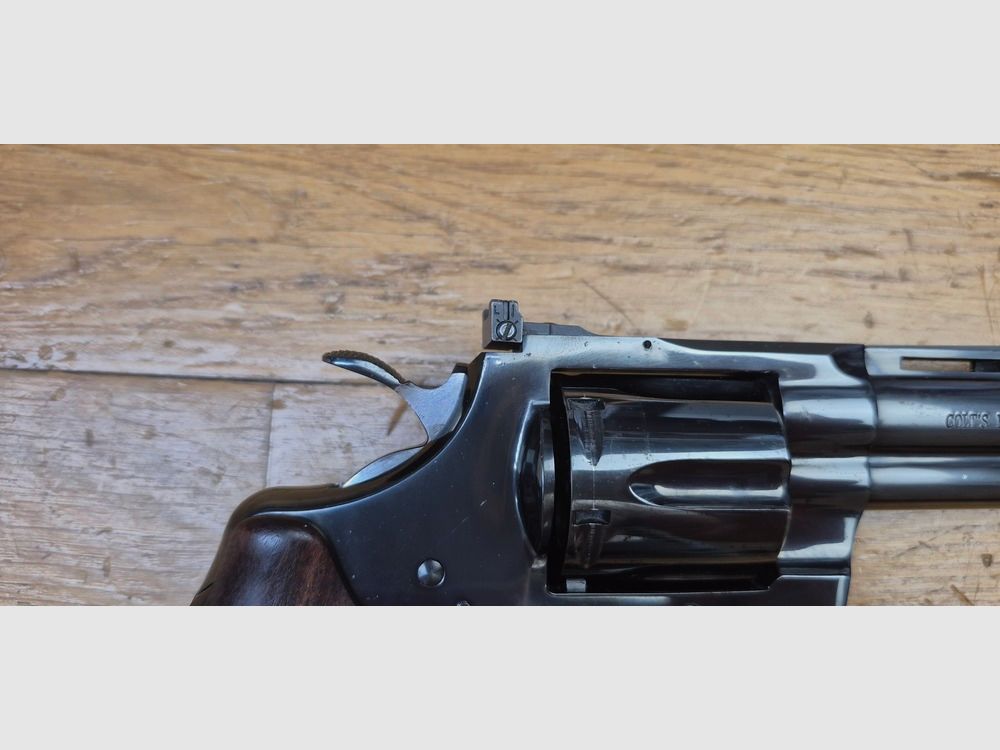


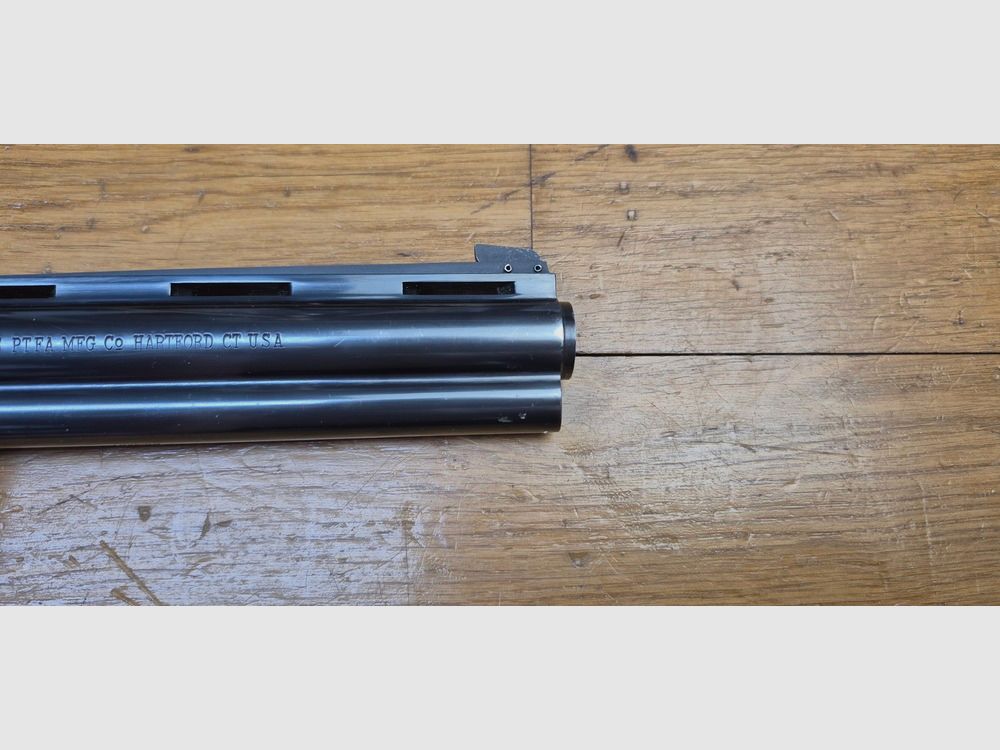
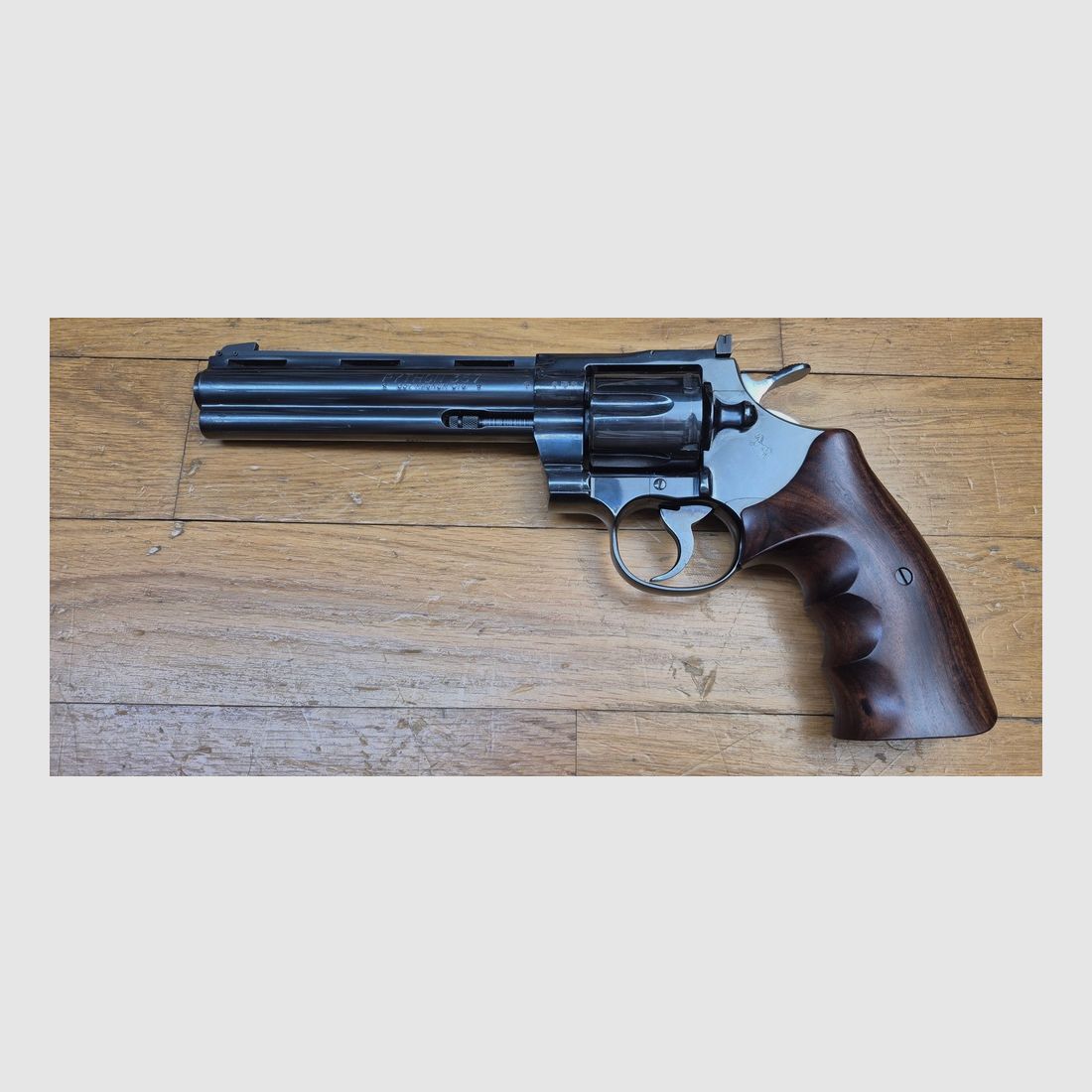
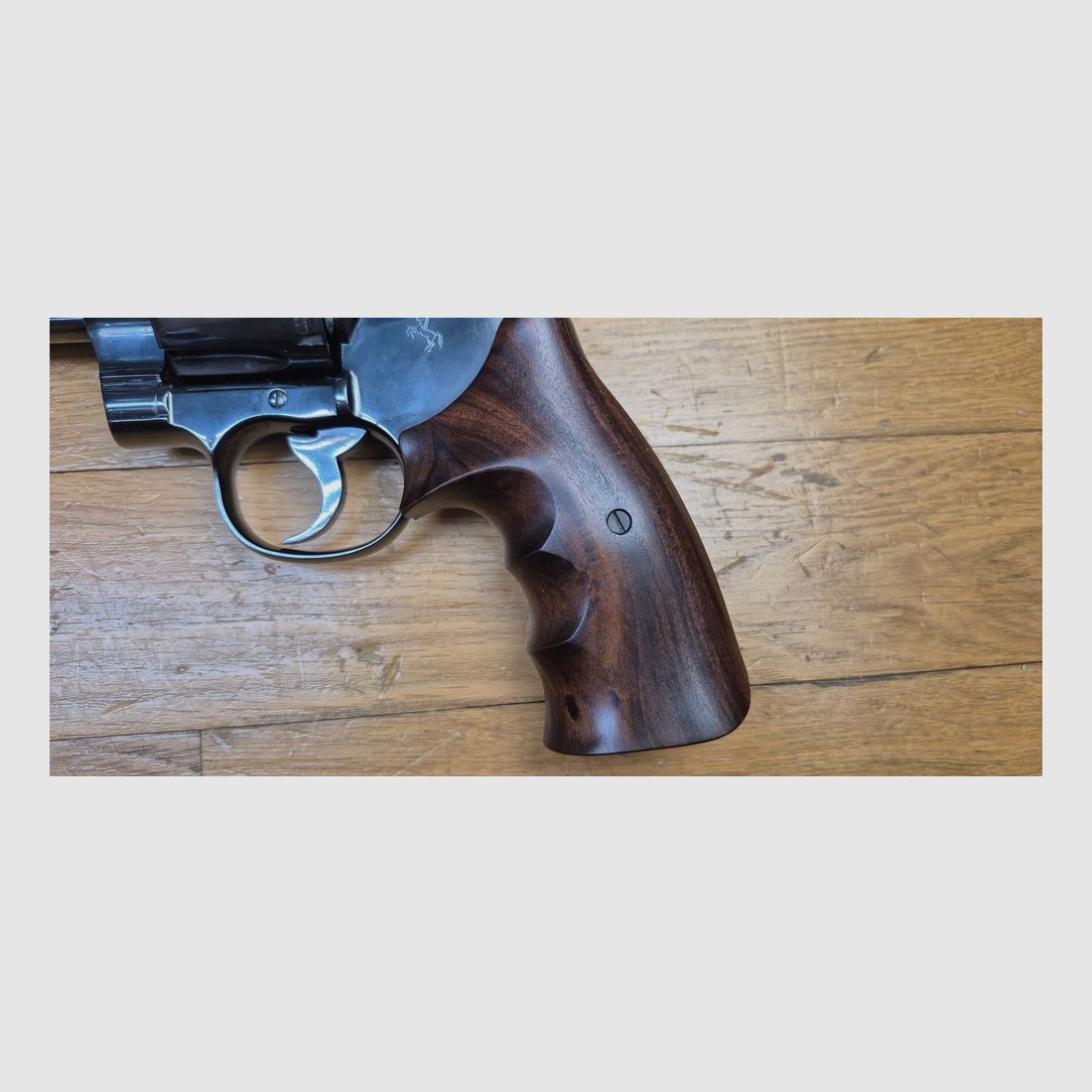
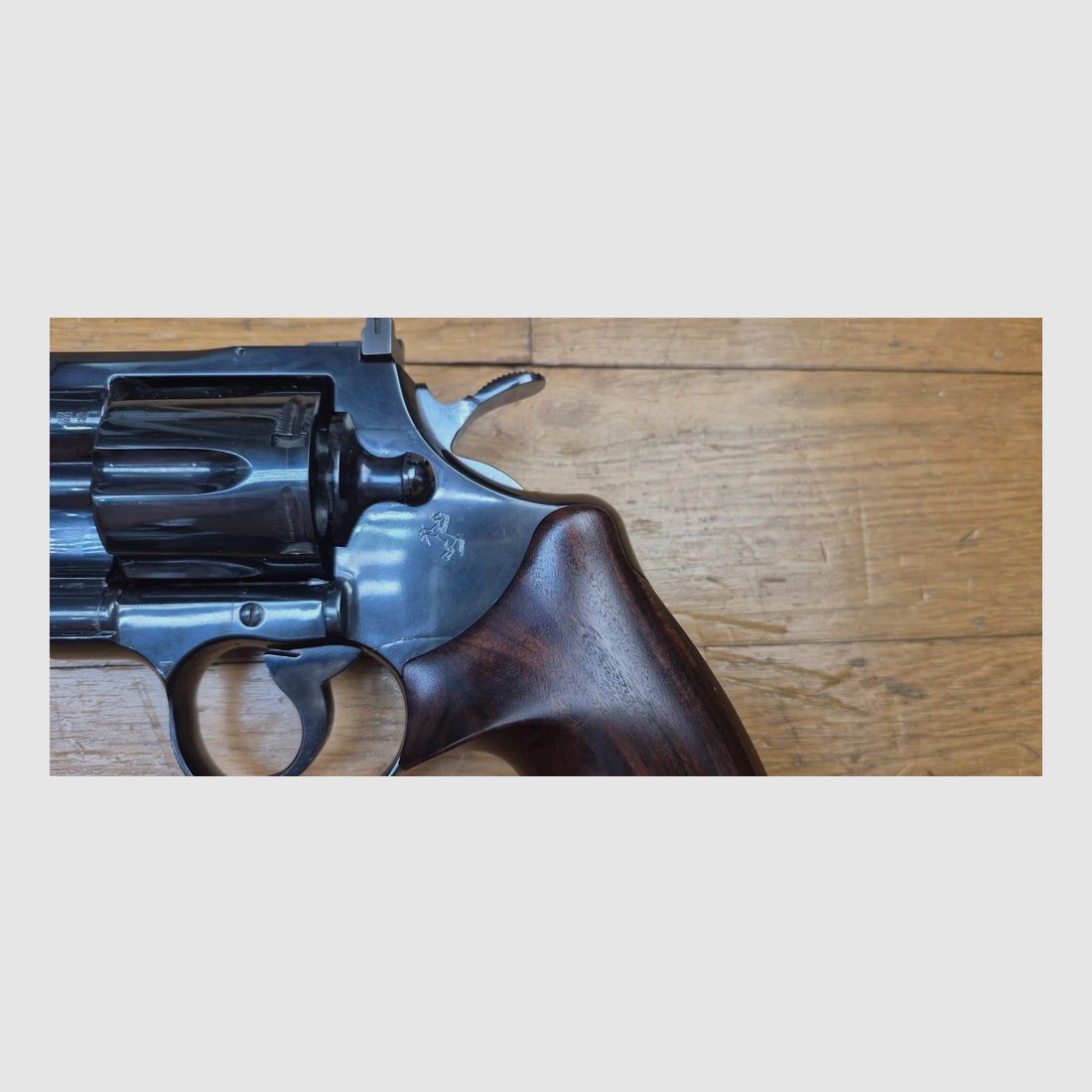


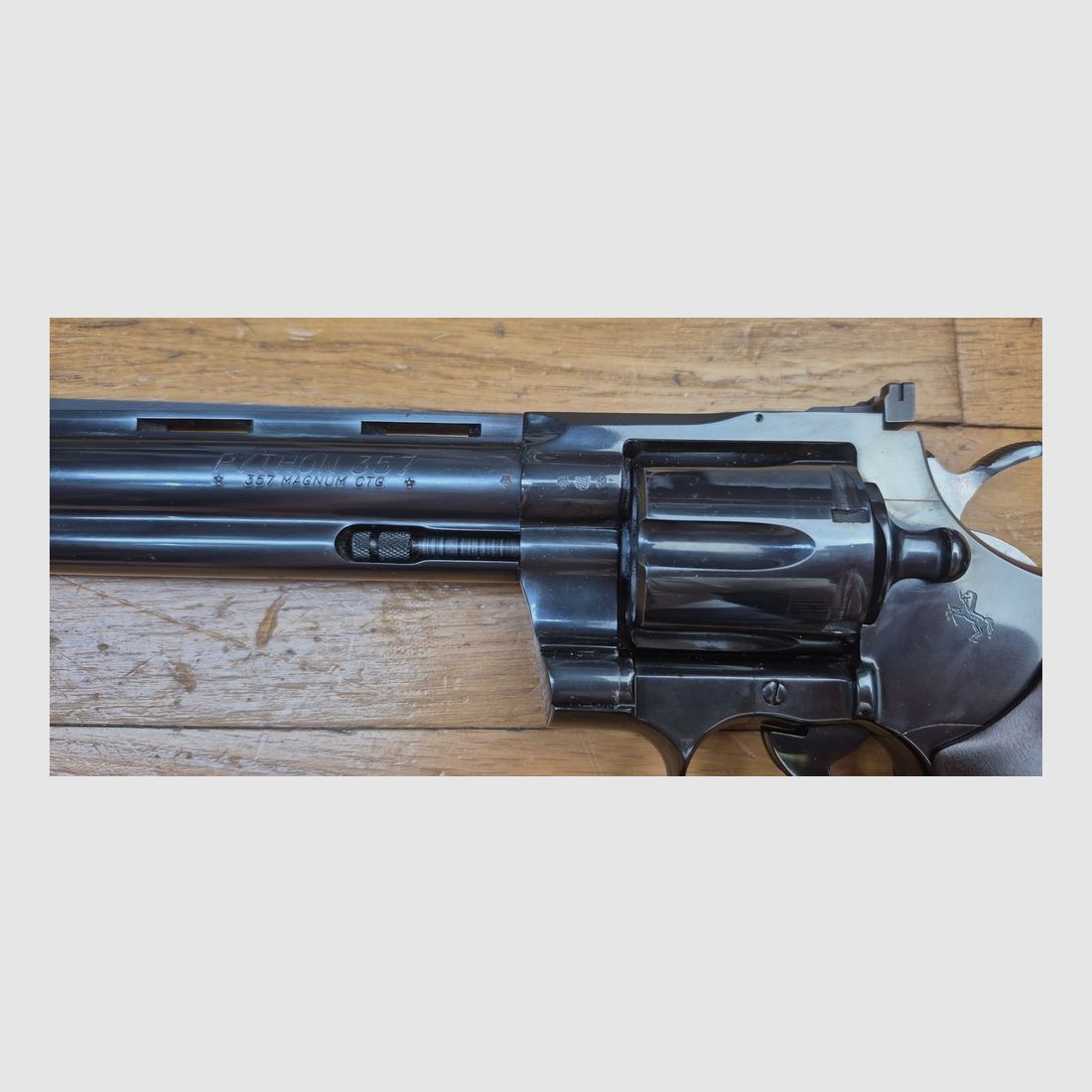

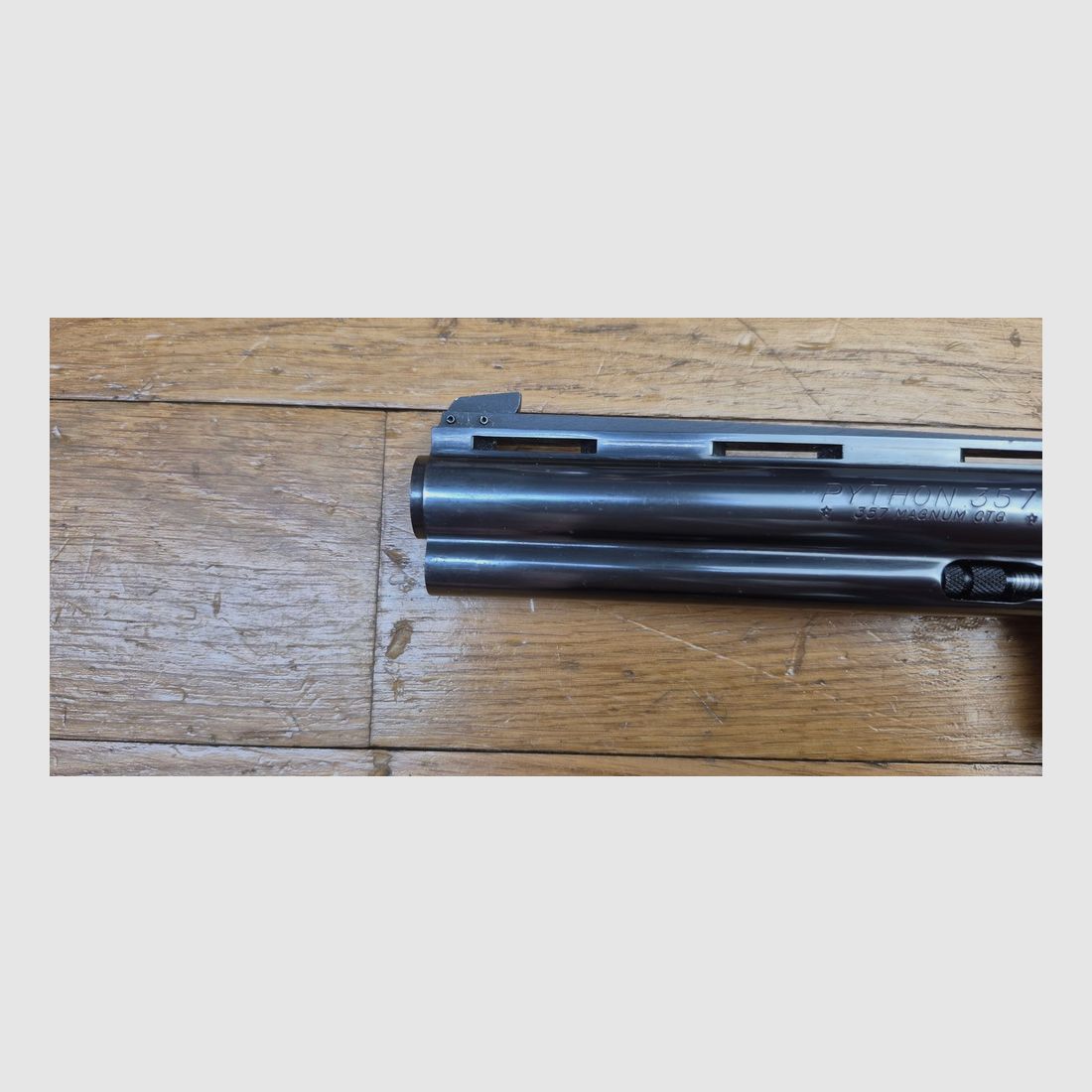
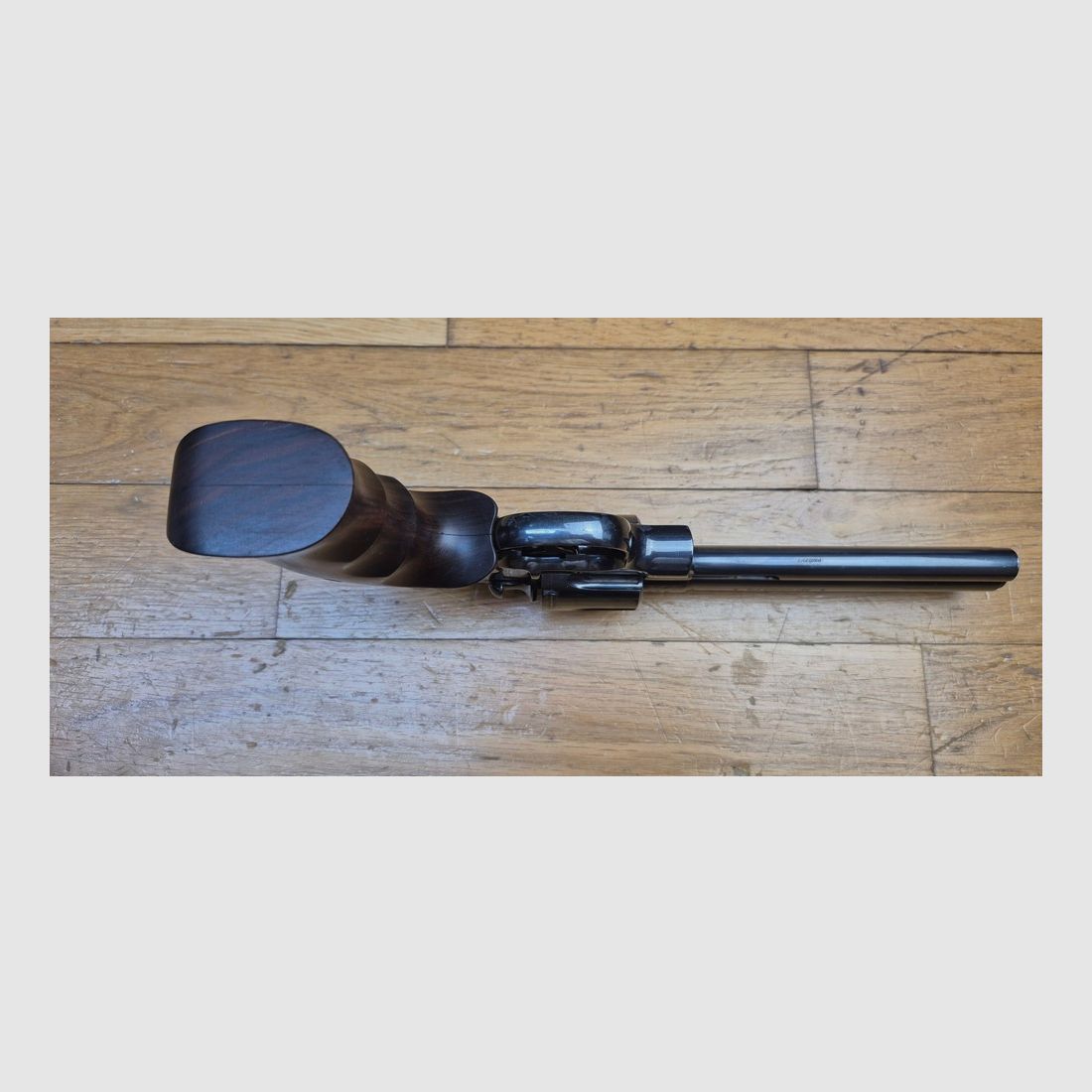
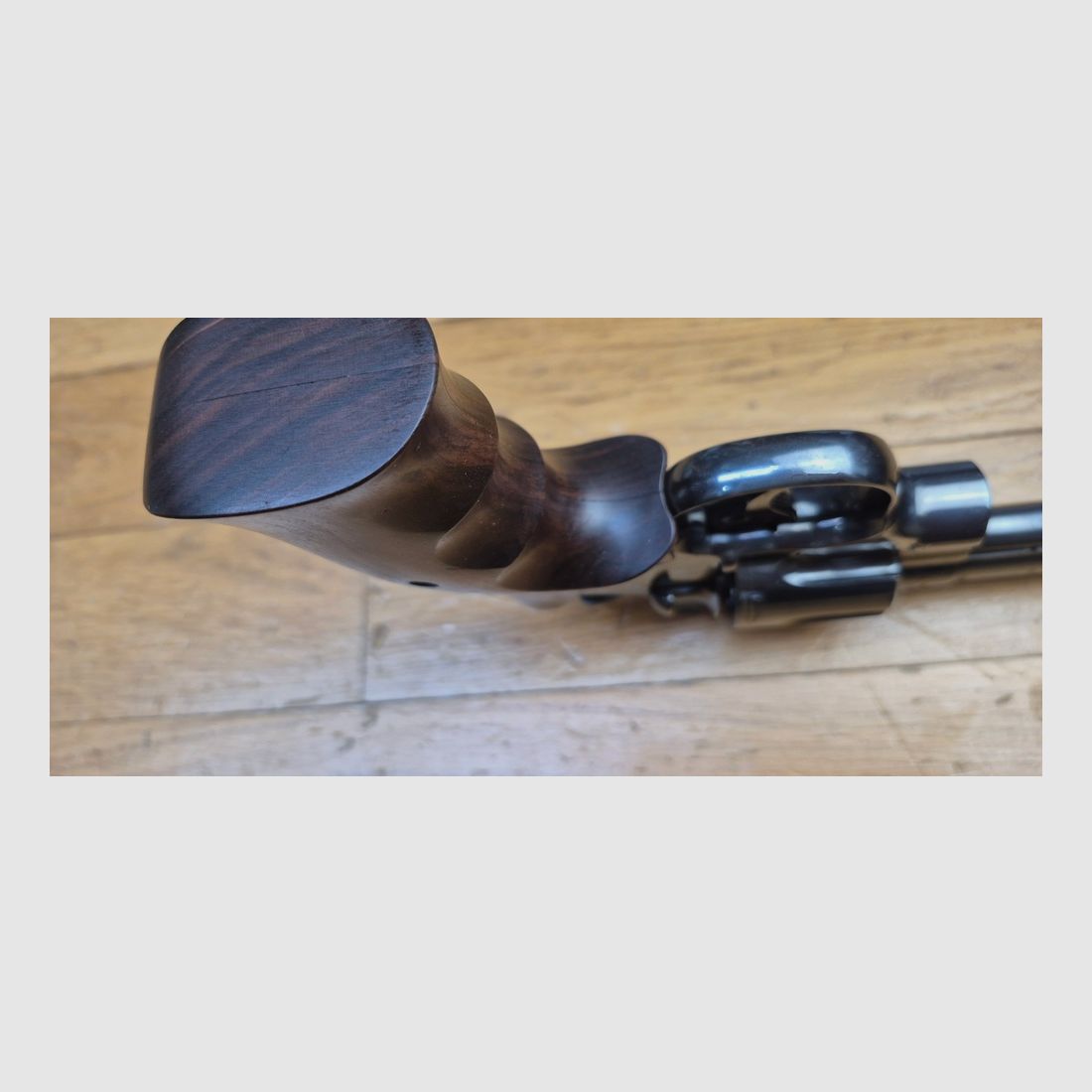


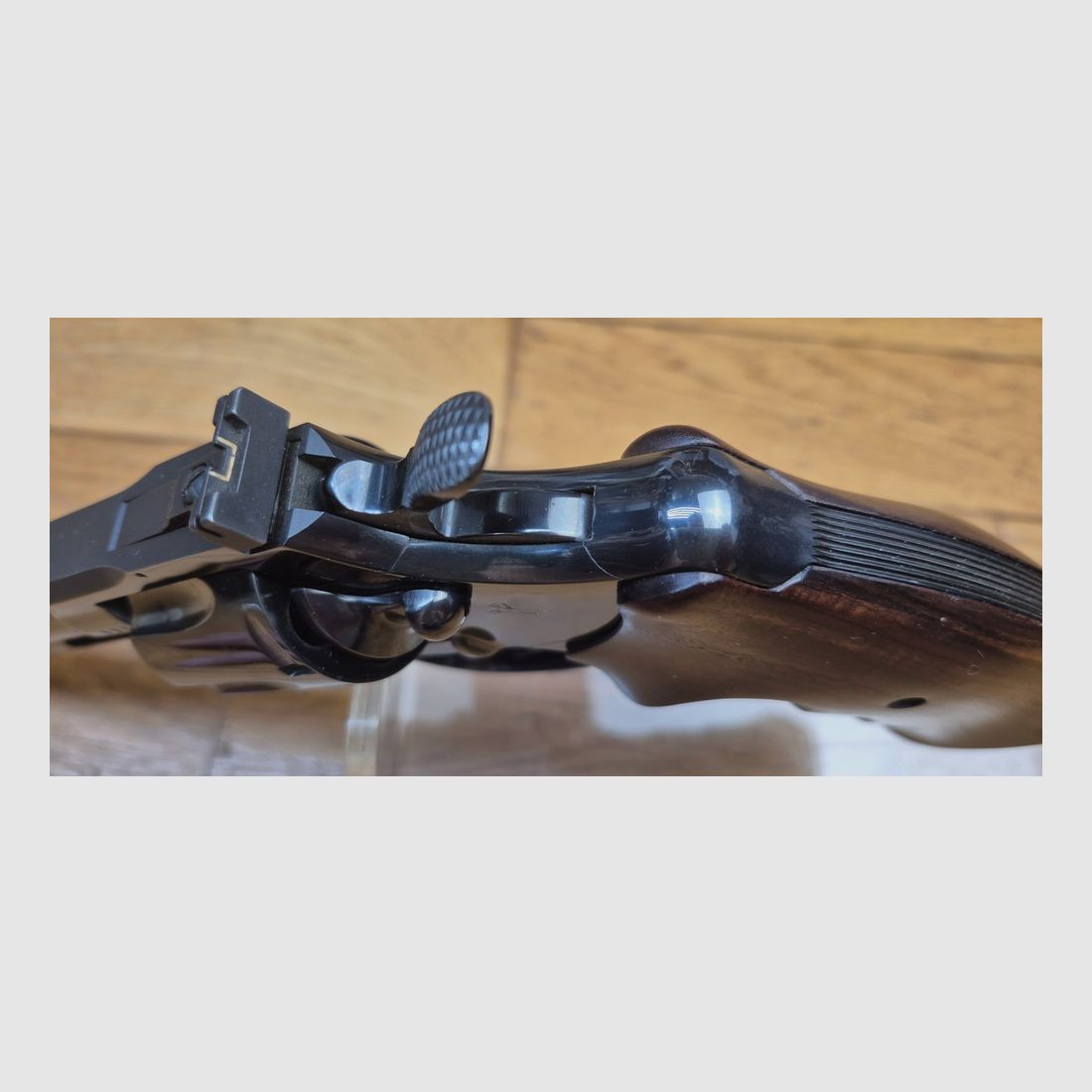
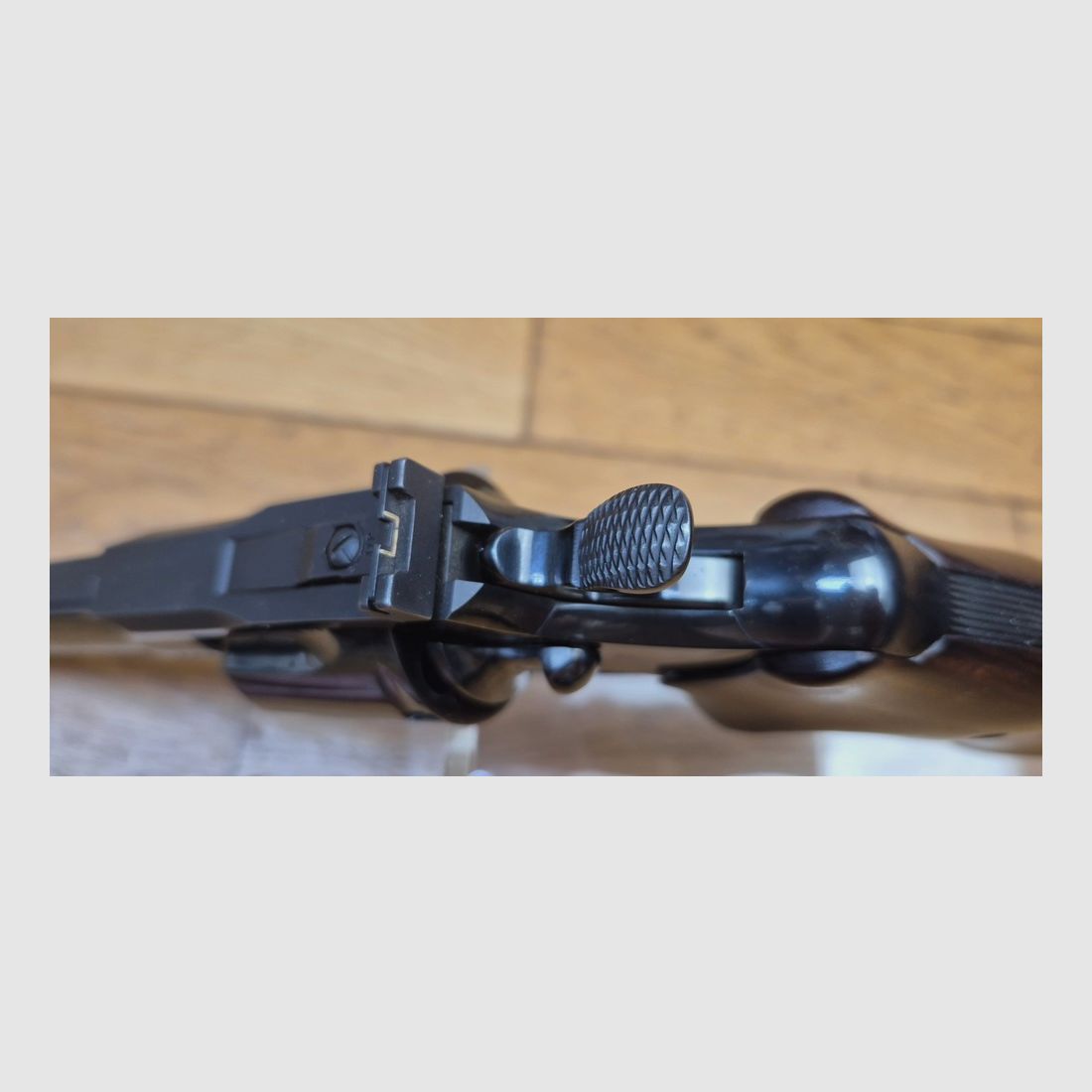
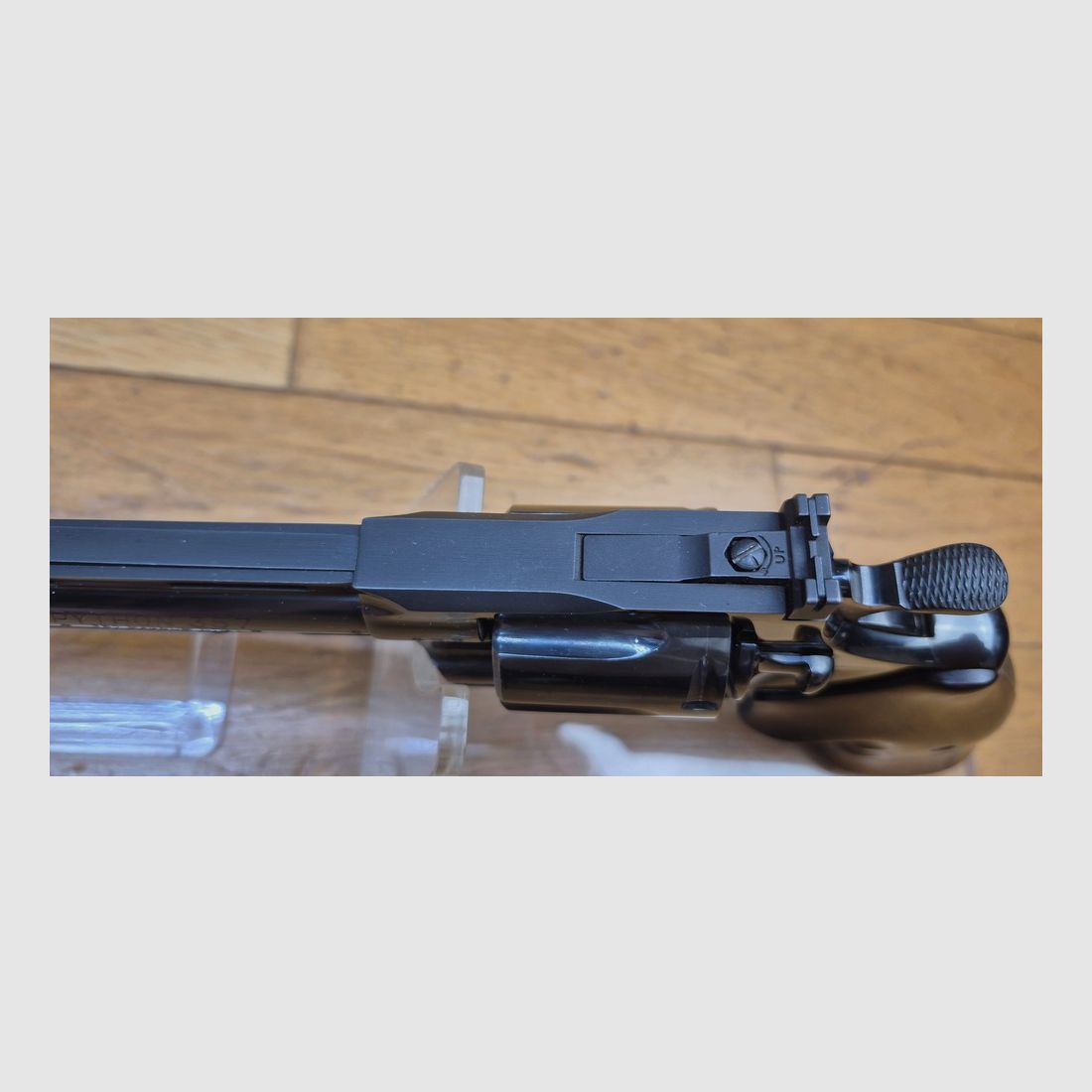
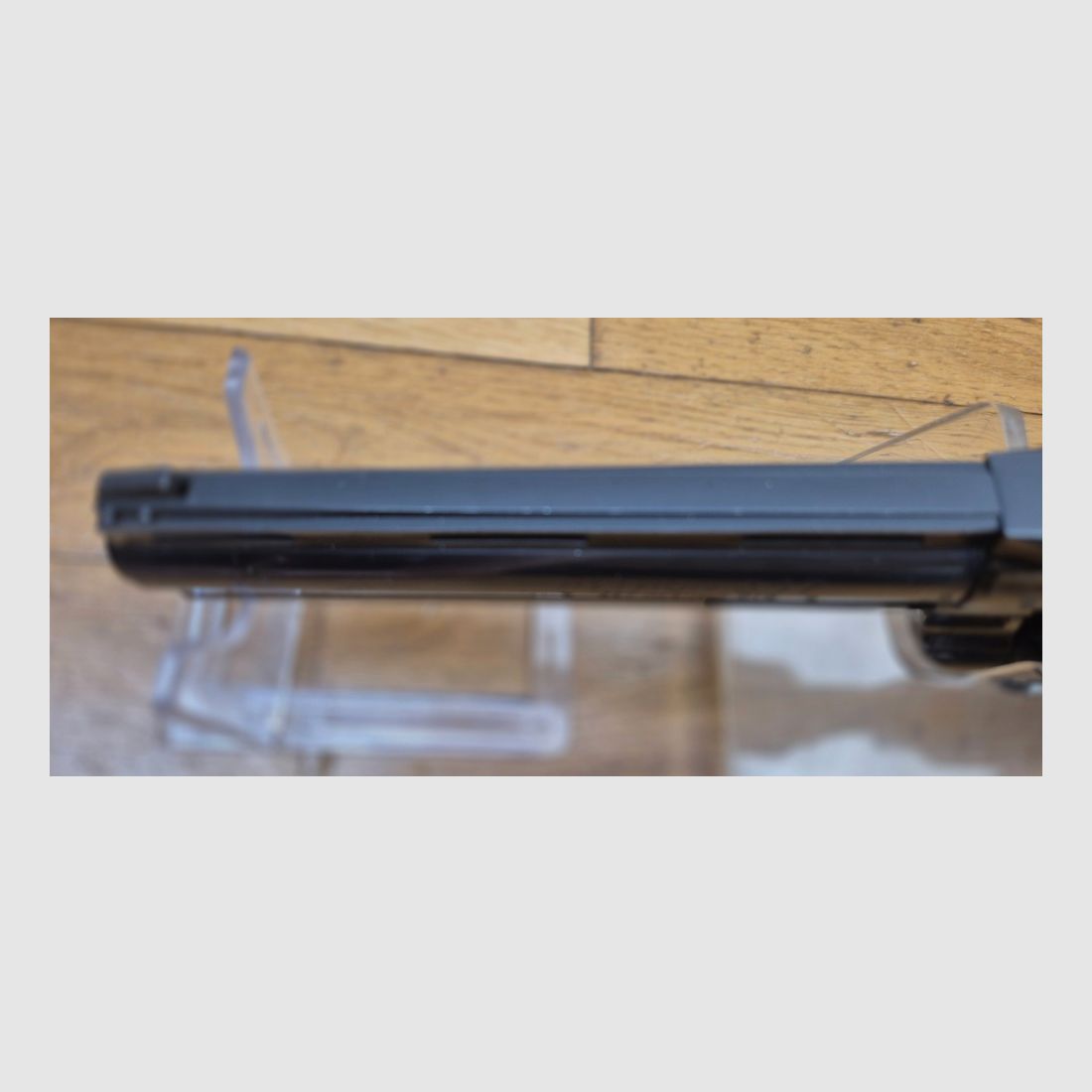

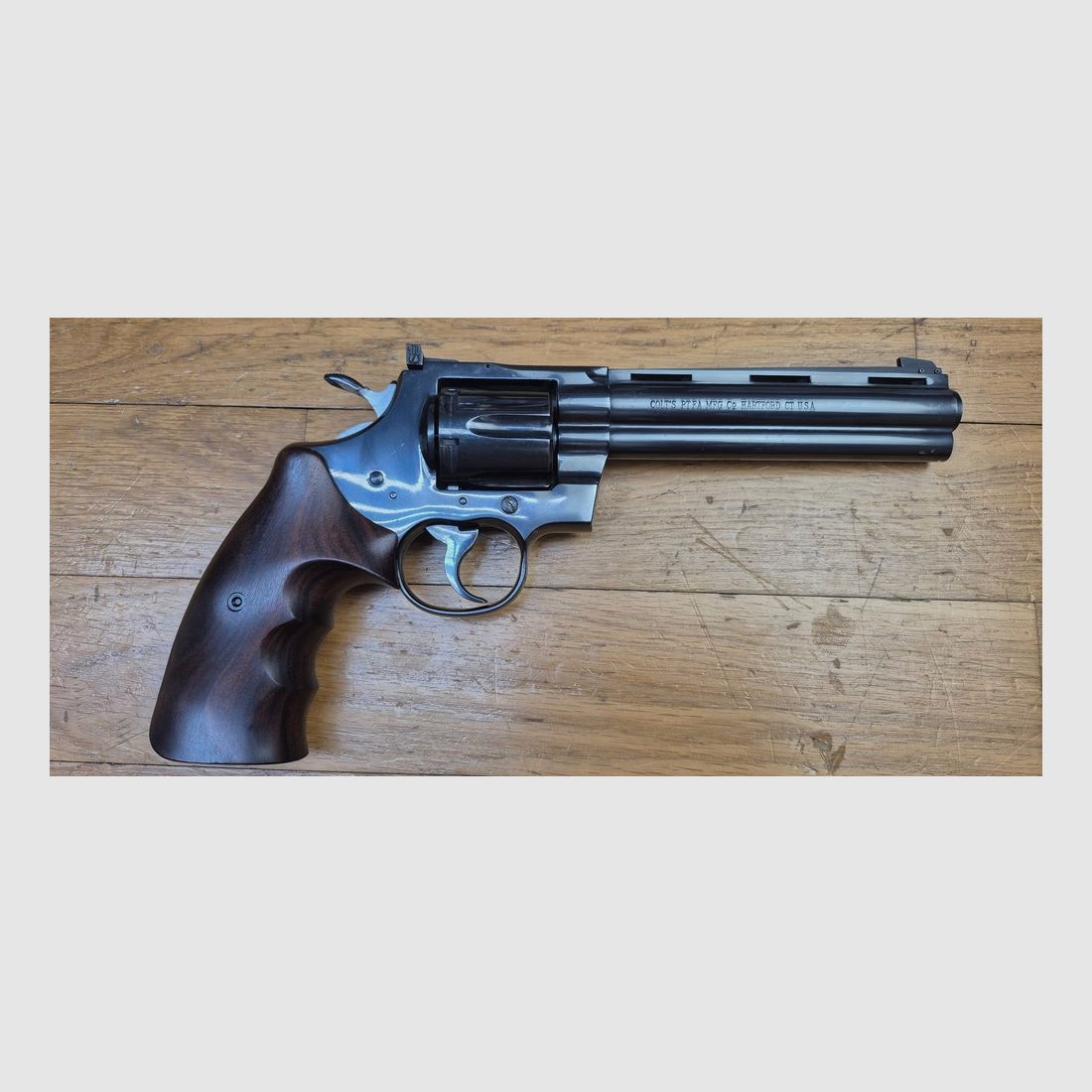


Splendid Colt Python 357 Magnum – Barrel 6 inches – Beginner's gun 1968 (!) in top finishes – Used gun in excellent condition for its age – Premium piece in every respect – TBE++
≈ $2,857
Price at the dealer: 2,600 €. Converted at the ECB rate as of November 20, 2026.
Purchase permit required
75002 Paris, France
16
ID: 10338530
This item is currently unavailable.
Purchase from outside the EU: The firearm goes through an importer in your country, the dealer handles the export.
How buying from Europe works
Shop safely with Gunfinder
Our AI-powered seller identity verification makes Gunfinder the safest marketplace online.
Learn more
Details
- Original language
- French
- Brand
- Colt
- Product
- Colt Python
- Category
- Purchase eligibility
- Required
- Caliber
- .357Mag
- Condition
- Used
- Location
- 🇫🇷 75002 Paris, France
- Availability
- Out of stock
Freshness
This listing is based on a mirrored offer, where the listing data was synced to us from a shop, dealer, or external marketplace. Please note that temporary price discrepancies may occur due to possible delays in data transmission.
- Source
- Flingus Maximus
- Last checked with the dealer
- 39 minutes ago
Description
Note:
The item is located abroad. Please note that delivery conditions, shipping times, and/or the purchase process may differ.
You don’t see these fine pre-1982 examples very often. And this one is a rare 1968 model.
The Python is something of a revolver that symbolizes all modern revolvers. The emblem of modern revolvers.
Yet from its launch in 1955, it was reserved for Colt’s high-end market and therefore intended to remain relatively limited in production. Which, in principle, doesn’t help popularity. And yet…
1955 was a great year for handguns, because our handsome colt was born the same year as another serious competitor: the Smith&Wesson 29 in .44 Mag (one of Maître Flingus’s favorites).
A lot has been said about the Python, including its weight of 1.2 kilos (if you have arms like a little girl, don’t buy a Python — get yourself a slowworm instead!).
Some have also talked about a very hypothetical loss of accuracy during intensive shooting, with the metal heating up and supposedly causing the chambers to become misaligned with the forcing cone. This could also lead to a slight gas leak and, in very rare cases (never seen at the range!), require the gun to be retimed.
So what’s the truth?
It amuses me a little because, to get to that point (in a 2005 test), they had to fire several hundred rounds in a row (!) at rapid fire, without any break at all (!), which I’ve never seen anyone do with a Python, or even a Smith, at the range or anywhere else. It’s just not something people do.
In reality, since 1955, it has probably been the most reliable gun on the market, alongside Smiths from the golden years (up to 1982–1986) and earlier Ruger GP 100s. An exceptional gun that fully deserves its reputation for power and strength. Never a malfunction with a Python. At least with the highest-quality examples made up to the mid-1980s.
The Python is rightly renowned for its accuracy (it stays in the 10-ring at 25 meters), the smoothness of its action, especially when cocking the hammer, and its cylinder lockup system. We’ll come back to that. These are the “details” that make all the difference.
And they’re the kind of “gunsmith’s details” that show a real understanding of the practical mechanical stresses involved in a powerful firearm. The work of highly skilled craftsmen.
Because one little-known fact about this gun explains a lot: the Colt Python wasn’t developed by an engineering department.
It was created on the shop floor by two gunsmiths from Colt’s golden age of quality, who worked directly on the production line. They set out to create a .357 match revolver, using mainly existing parts.
As they got more involved, and as testing and improvements progressed, they ended up creating one of the most beautiful and impressive handguns ever made.
So let’s pay tribute to Al De John, a Colt gunsmith since 1946, and another production-line gunsmith who went on to become Director of Production, Al Gunther.
As surprising as it may seem at first, our guys actually started with the Special Officer’s Model Match in 38.Sp. A very high-quality target gun, and they knew it.
Trying to make it even more accurate while adapting it to .357, they had to solve problems with reinforcing the cylinder and frame, as well as reliability issues with the firing mechanism, which kept breaking. That was the price of moving to the formidable .357 Mag in such a big way.
Because the Python, like our Manurhin or the Smith 27, is truly a gun designed to shoot .357 at very high volumes. Smith’s K-frames, for example, are more of an exceptional platform.
But they also went on to create a new cylinder-locking mechanism. When the hammer is
fully cocked, at the very moment you pull the trigger, the cylinder locks and stays locked throughout the hammer’s entire travel, right through to the hammer fall. This is a fundamental improvement in accuracy. The Python makes it “easier” for the shooter.
The machining of the moving parts is also designed so that, when the gun reaches the firing position, the gap between the cylinder and the forcing cone narrows just a little more, further improving accuracy and velocity. The Python’s cylinder lockup also has a reputation for being one of the strongest on the market.
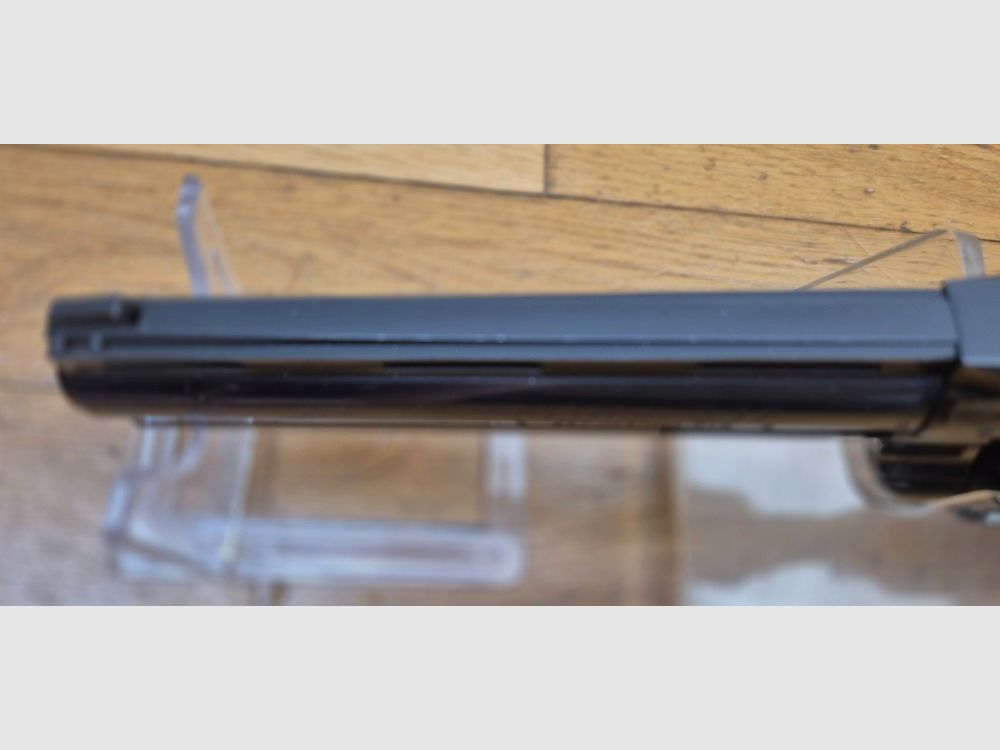
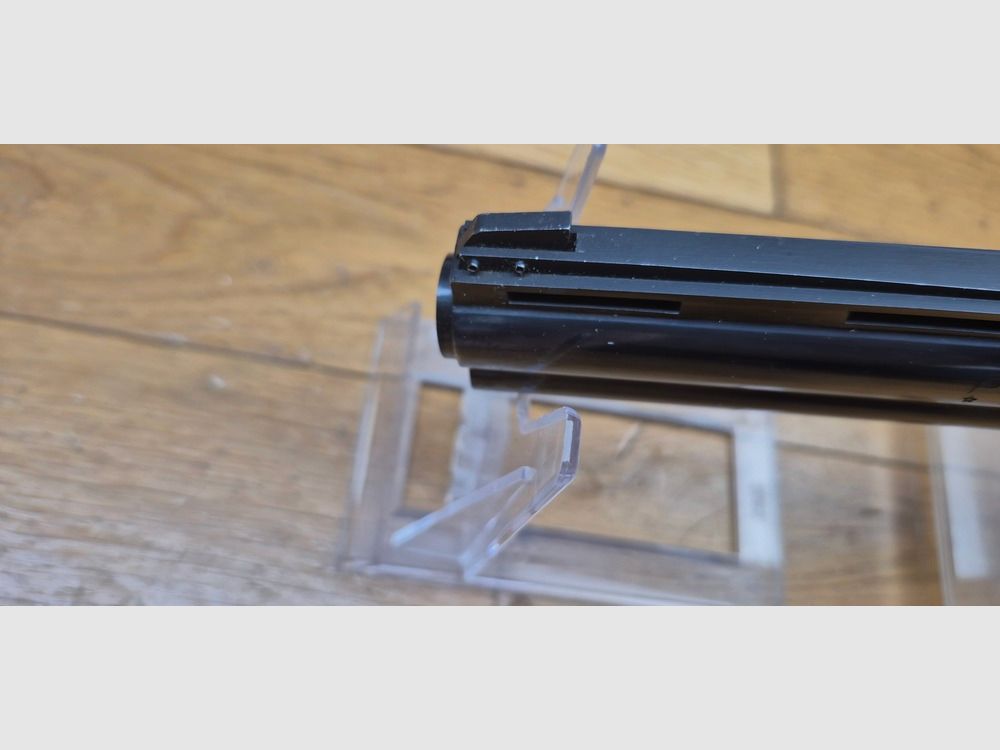
In short, they completely redesigned the gun, adding that famous ventilated rib along the way—a novelty on a revolver at the time. Besides helping dissipate heat during intensive shooting, it also gave the gun an iconic look that many have tried to imitate. A success.
Its complex double-action mechanism, its high-quality finish—especially its famous Colt Royal Blue finish (a reminder: in gunsmithing, “blue” means blued, not blue, in color), which requires very careful polishing beforehand—and its machining, which is every bit as good as that of Smith & Wesson revolvers from their heyday, made it a distinctive gun from the start.
Initially, only Al De John and another top craftsman on the production line, Don Bedford, were authorized to work on Pythons. This complex hand-fitting and polishing took these highly skilled, exceptionally fast gunsmiths more time: just under 25 minutes per gun, compared with 15 minutes for other Colt revolvers.
The Python initially sold for $125 (the average weekly income of an American household around 1955 was $68—two months’ wages for a gun), the same price as the Single Action Army, reintroduced in 1956.
Just one (!) Python was built in 1955, and only a little over 300 came off the line in 1956. It took 12 years, until 1968, for the relatively modest milestone of 100,000 Pythons produced to be reached. It was expensive.
It was initially made only with 6- and 4-inch barrels; the 2.5-inch version didn’t appear until the 1970s. An 8-inch barrel appeared in 1980.
By then, the Python had earned its reputation as an exceptional gun: certainly expensive to make and buy, but deservedly world-famous. The best of Colt.
It’s worth noting that, starting in the early 1970s, Colt Pythons were the first guns to have their barrels and chambers laser-aligned—a first in firearms production worldwide. That shows how much care Colt always took with its Python babies, striving to perfect them from the production stage onward.
Pythons were produced from 1956 to 1997, mostly after 1970. Everyone’s standard of living had risen considerably.
From that year (1997) until 2004, they were made only to order, with production ending for good in early 2005.
Lower manufacturing standards, the growing popularity of pistols among shooters, and Colt’s missteps with its menagerie of models—the Boa, King Cobra, Grizzly, Kodiak, and others—had commercially done in this magnificent gun. Largely through internal competition.
Still, the legend of this exceptional gun remained so strong that Colt resumed production in 2020.
Objectively, at €3,000 or more for a new 6- or 4-inch model with its rough laser-cut finish, you might as well go for a used one in excellent or perfect condition from the best years—if you can find one. The gun is also practically indestructible, even if nobody cares about passing it down anymore. And it looks better, too.
In terms of quality and finish, American collector-shooters agree that the best examples are those made from the 1960s (it’s very hard to find earlier ones, even in the US) through the early 1980s. Those from the 1960s are so
particularly sought after. Much like Smith, for that matter.
After 1985/90, we enter a different world: one of overwhelmed customer service departments, to the point that new ones had to be created… Marlin held out a little longer (2008).
Beyond its immense inherent qualities and peerless finish, the Colt Python from its golden years owes its reputation as an exceptional firearm to its aggressive yet imposing, timeless look, which has become iconic.
Its adoption by the Colorado and Georgia Harley-Davidson motor patrols, along with the many TV series recounting their exploits in the 60s and 80s, played a major part.
With its adoption by the Florida Highway Patrol, the Sunshine State’s highway patrol, it cemented its iconic status as the weapon of choice for police officers and outlaw bikers in the Southern states.
Surprisingly in the age of the pistol, but logical given its reliability in particular, our Python also saw military service.
It served in Vietnam with the formidable MACV-SOG special forces and the Marines.
As an aside, the Marines guarding the US Embassy in Saigon threw theirs into the sea when they landed with the fleeing Ambassador on the deck of the USS Blue Ridge amid the chaos of the frantic 1975 evacuation!).
On screen, it has appeared in the hands of actors as different as Charles Bronson in “Love and Bullets,” Brad Pitt in “Fight Club,” Christophe Lambert in “Subway,” Belmondo in “Flic ou voyou,” Bruce Willis in “12 Monkeys,” and, of course, at the very top, the iconic John Wayne in “McQ.”
The Colt Python is also one of the few firearms to have had a movie named after it (“Police Python 357” with Montand), using the model’s exact name. (Dozens of movies feature the words Colt or Winchester without specifying a model or caliber.) The other two are, to my knowledge, a film titled “Winchester ’73,” recently joined by the (good) film “MR73”—our own legend, which deserves its place in this distinguished cinematic company.
Your humble servant has counted no fewer than 360 appearances by our hero in movies. That’s without ads, TV series, or games. Our Python is a star across every screen format.
Among its famous owners were King Hassan II, King Fahd of Saudi Arabia, King Hussein of Jordan, King Juan Carlos of Spain, and, of course, the king of kings, Elvis Presley, who collected them. In short, a firearm fit for royalty.
To see what you can do with a Python, take a look at the King’s.
Men will always dream of firearms…
Between Wilson’s verdict—he was the unofficial historian of the Colt brand—calling it “the Rolls-Royce of Colts,” and Hogg’s, one of the most respected firearms historians, simply calling it the best revolver in the world, I’m torn. I lean more toward Wilson’s view, particularly when you consider the date of manufacture.
Because the best revolver in the world will always be the one that suits you.
This is a beautiful example from the finest years of production of the legendary Python, offered to you today by Maitre Flingus. It dates from early 1968, still the golden age of Colt. A rare find.
Our example has seen very little use and its action remains absolutely impeccable. There are very few rotation marks on its cylinder. Another sign.
It’s in better than excellent condition, especially considering it’s 58 years old. Almost like new in that respect. A truly exceptional piece.
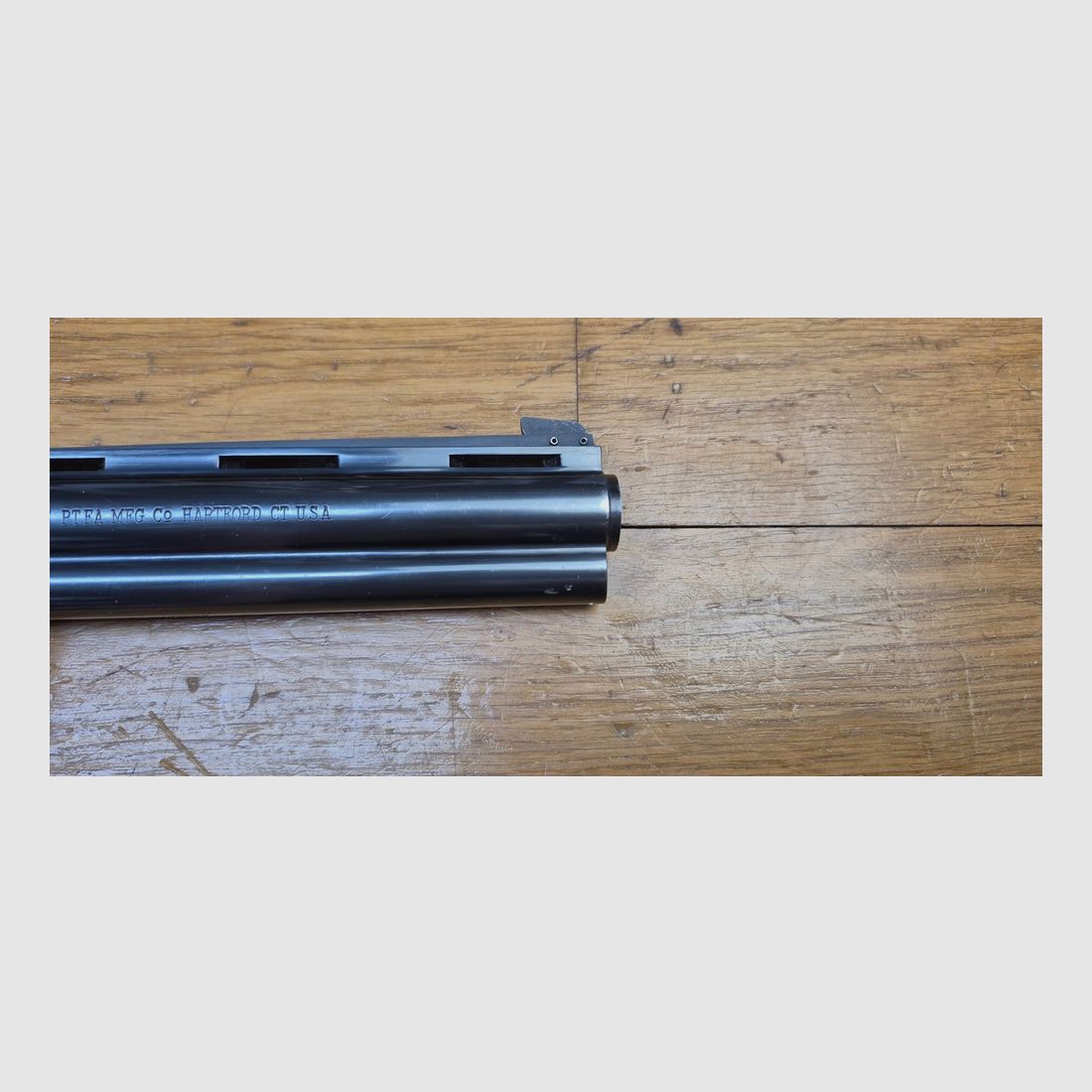
The exterior is in more than very good, beautiful condition. There’s just a tiny bit of bluing loss at the muzzle end of the barrel. As was the fashion at the time, it may have been carried in a leather holster for a short time. This is barely noticeable when holding the firearm, especially with the reflections in the bluing, but I mention it out of professional diligence.
Its deep black bluing, tending toward the m
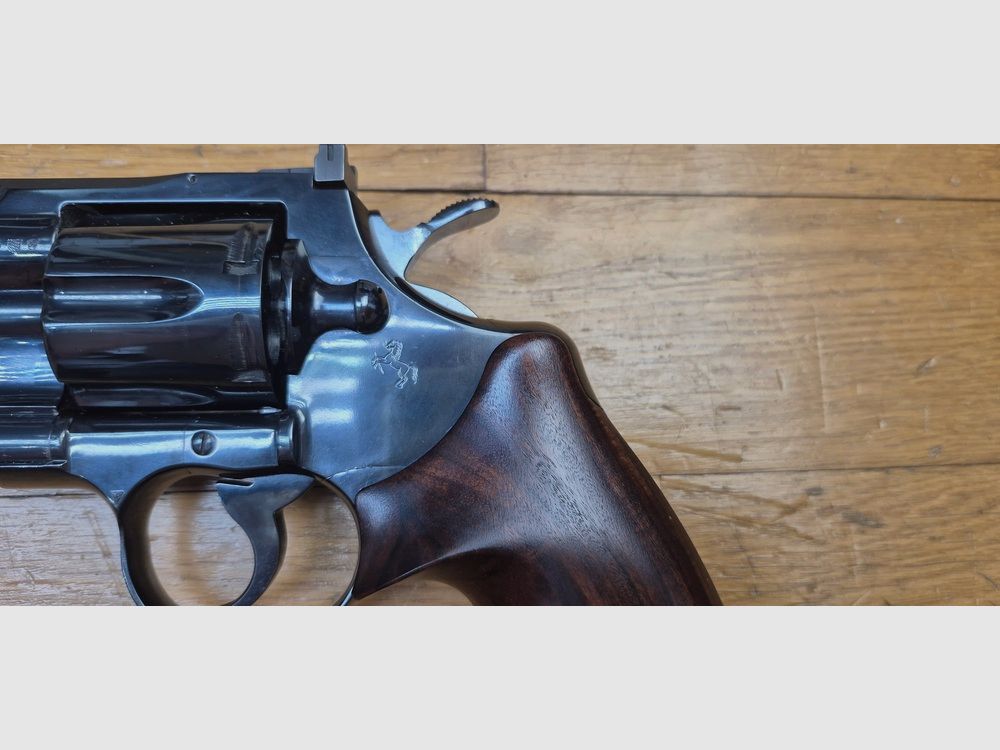
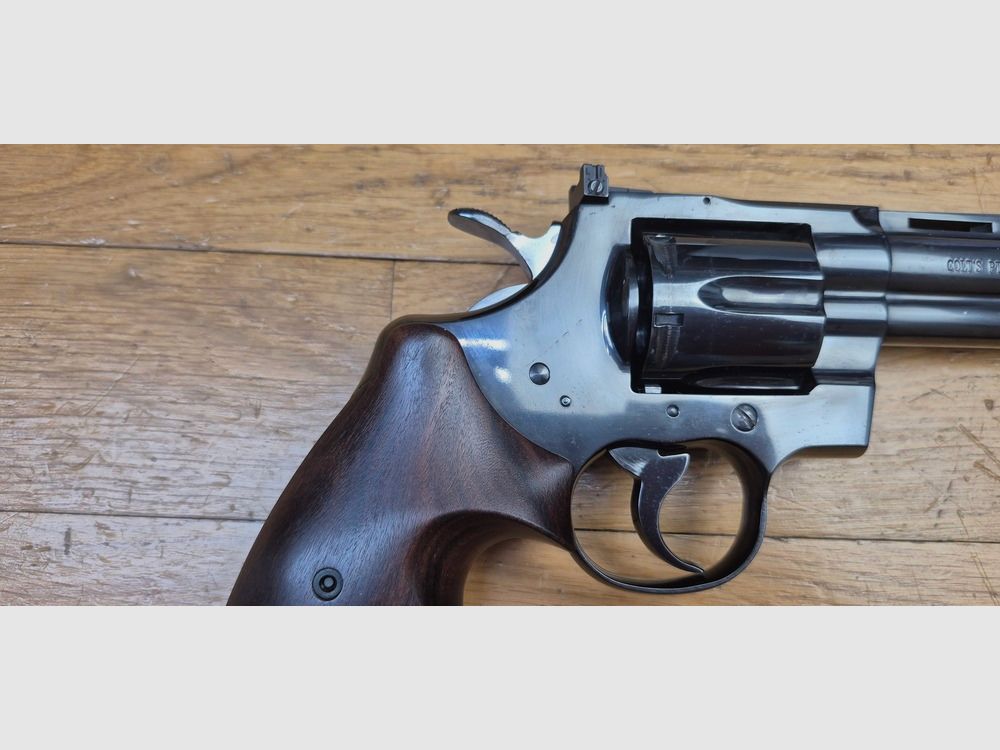
The deep blue finish, as thick as a fortress wall, is simply splendid. It’s the superb, original Colt Royal Blue finish, 99% intact. It was refinished in the 1980s. Sumptuous.
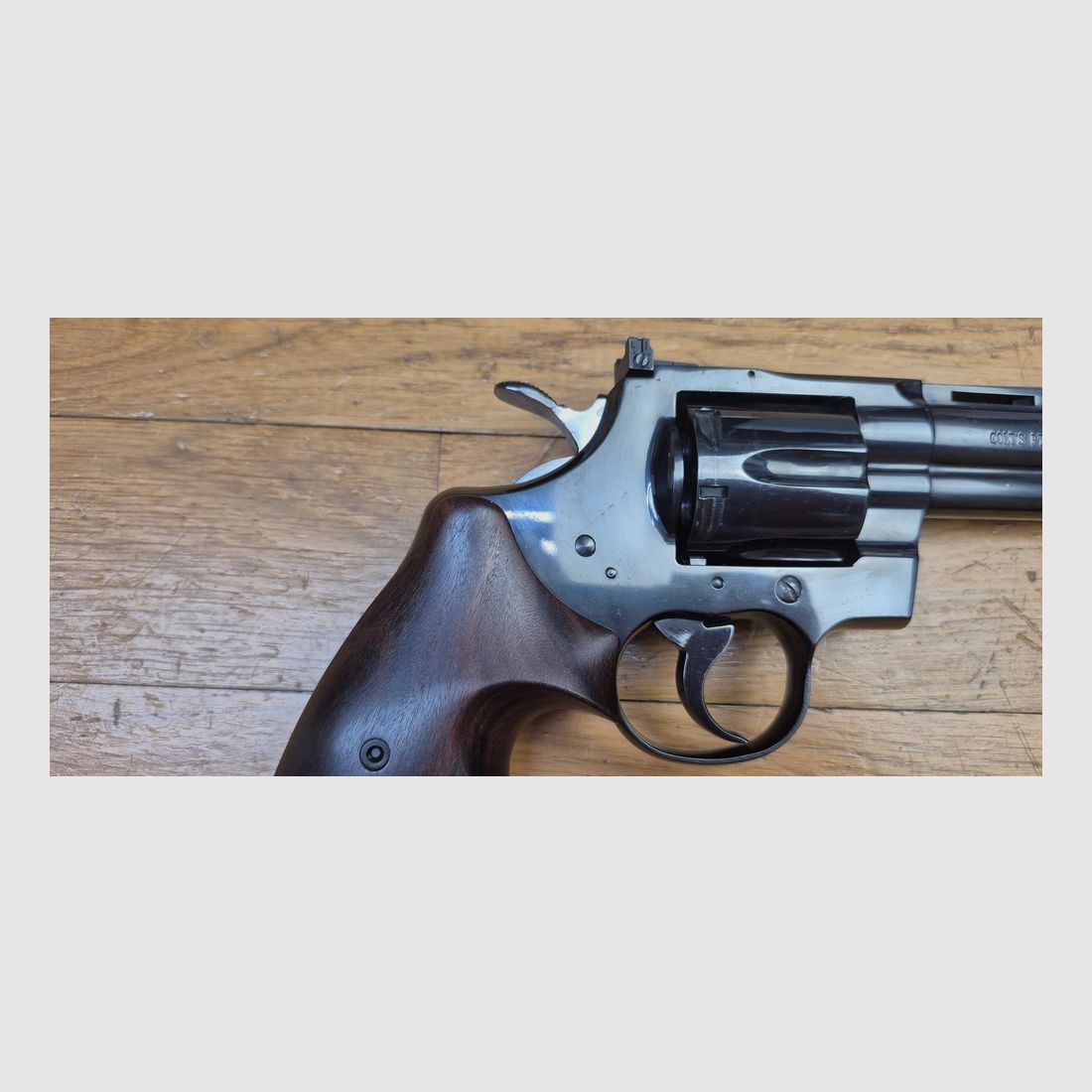
The gun has virtually no visible scratches in the finish when viewed in hand, just one or two very fine ones on the right side.
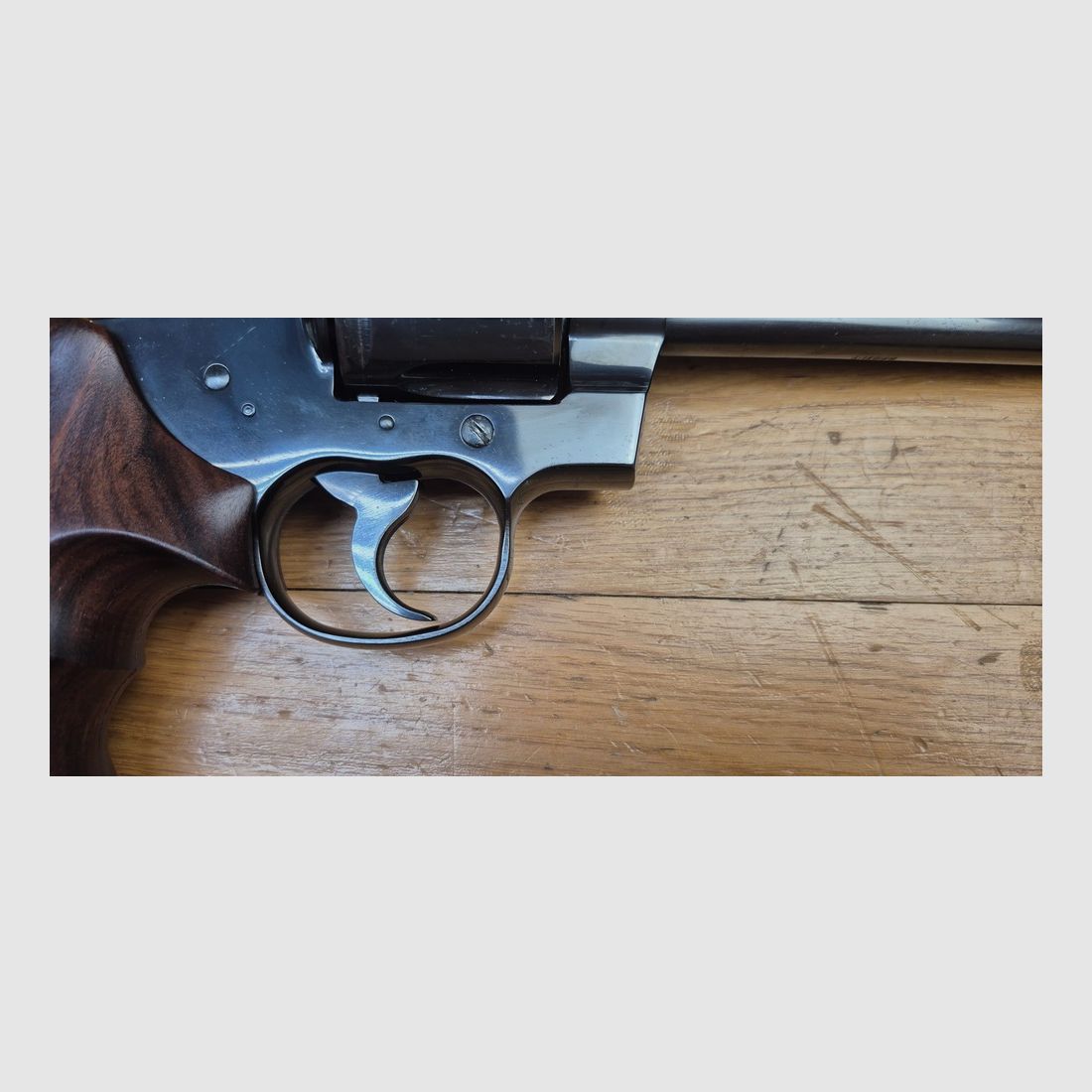
The marks you’ll see magnified in my GIGANTIC photos, or the “spots” caused by my dirty fingers, are exaggerated—more than exaggerated—by my damn close-ups, as usual. The gun is dirty, even though it’s superb. Dust, spots and reflections make it look worse. But in hand and to the eye, it’s more than beautiful.
Just look at the overall photos and see for yourself. It’s simply magnificent.
Condition: very good++/very good+++
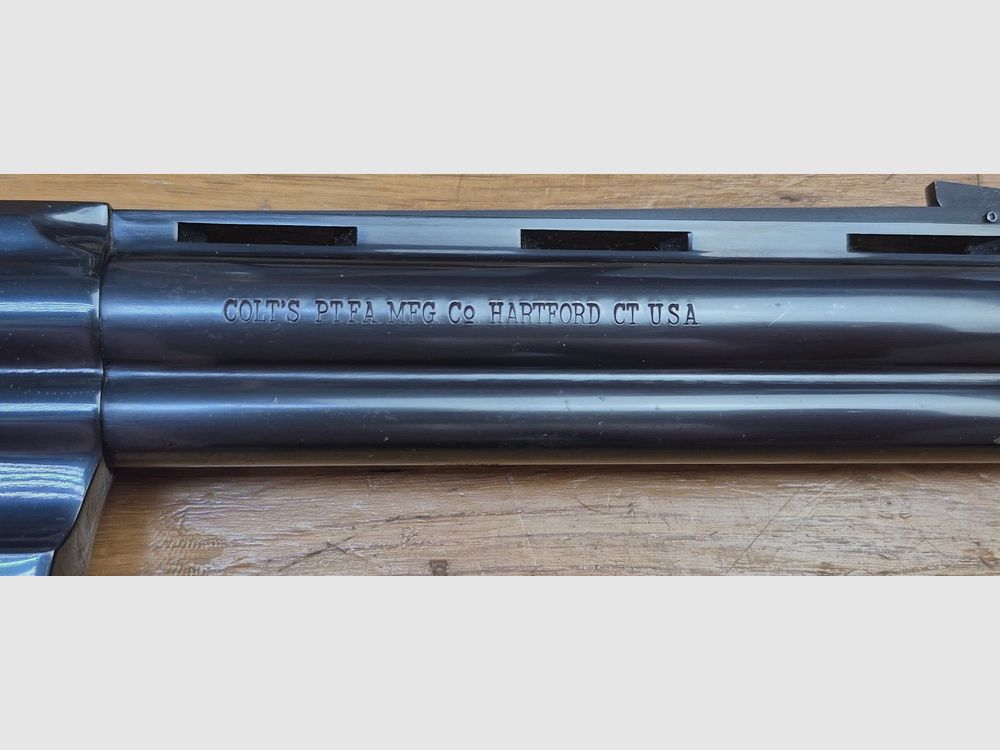
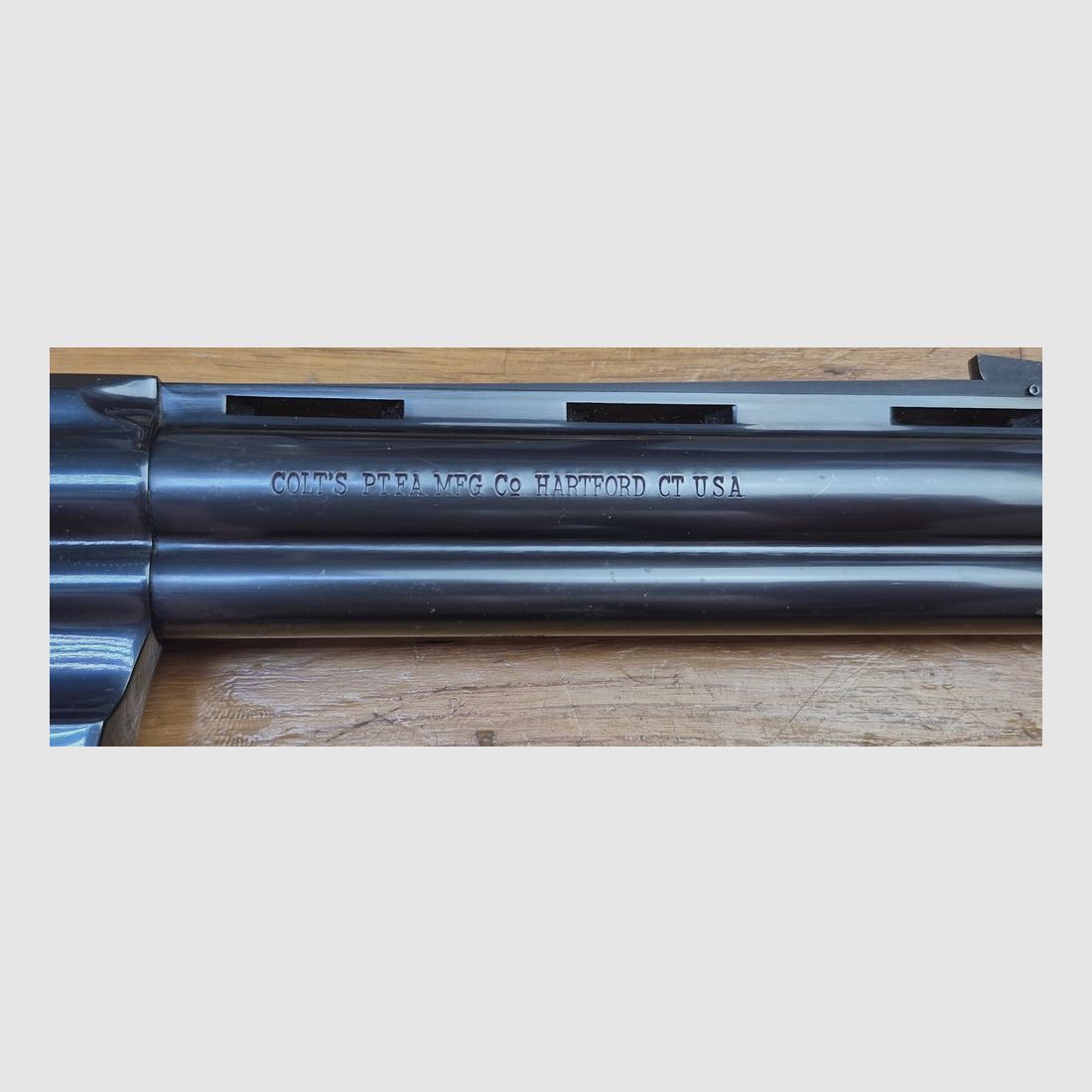
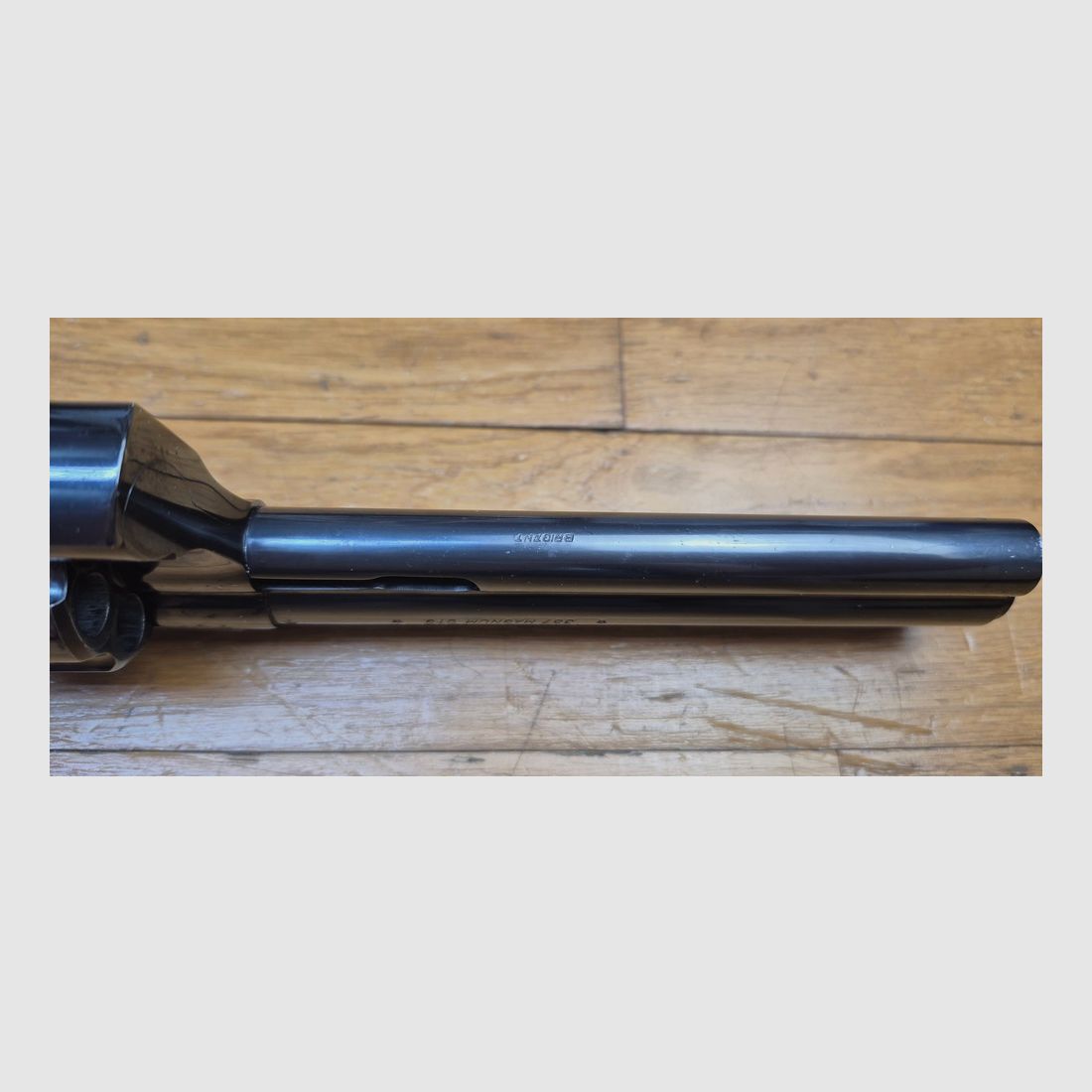
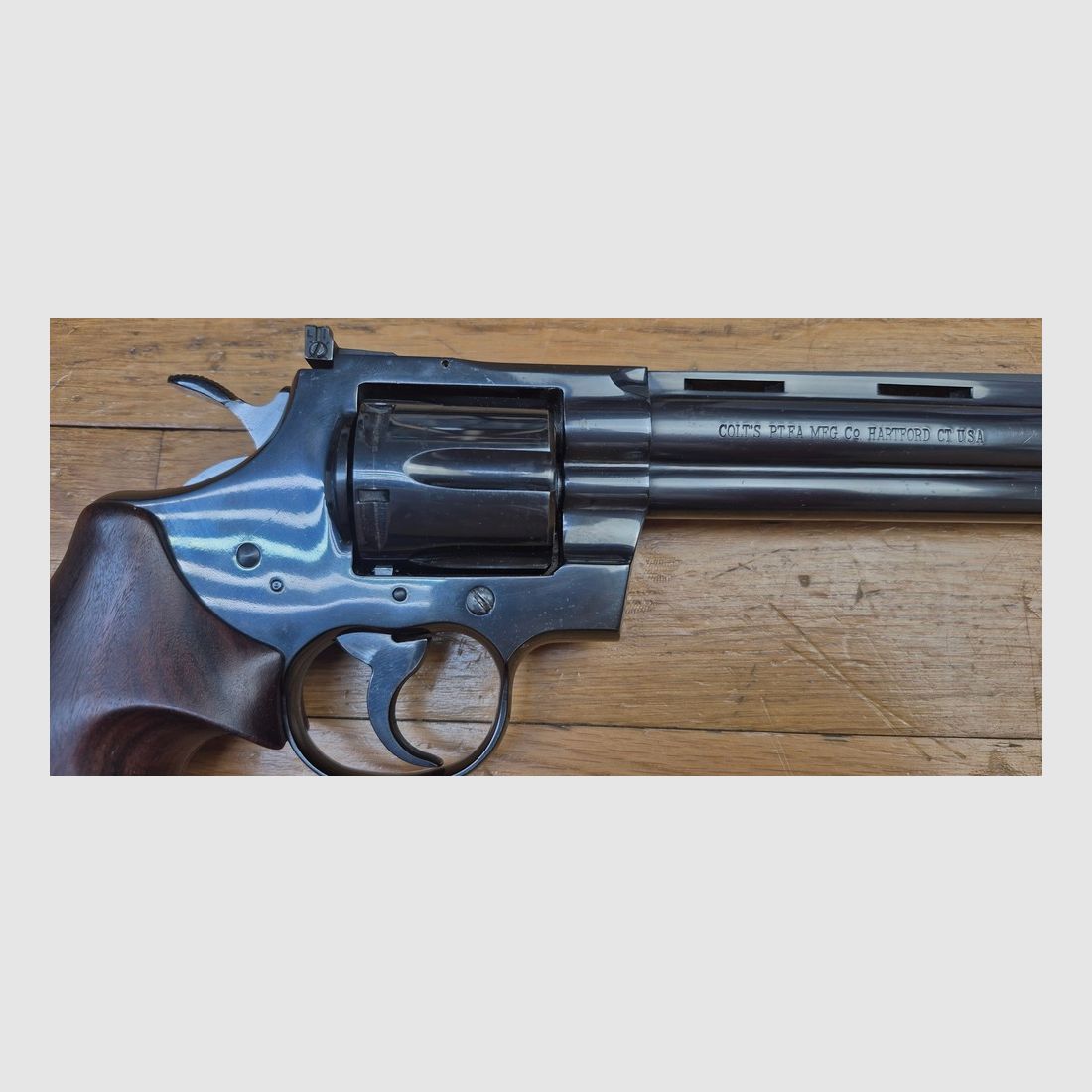
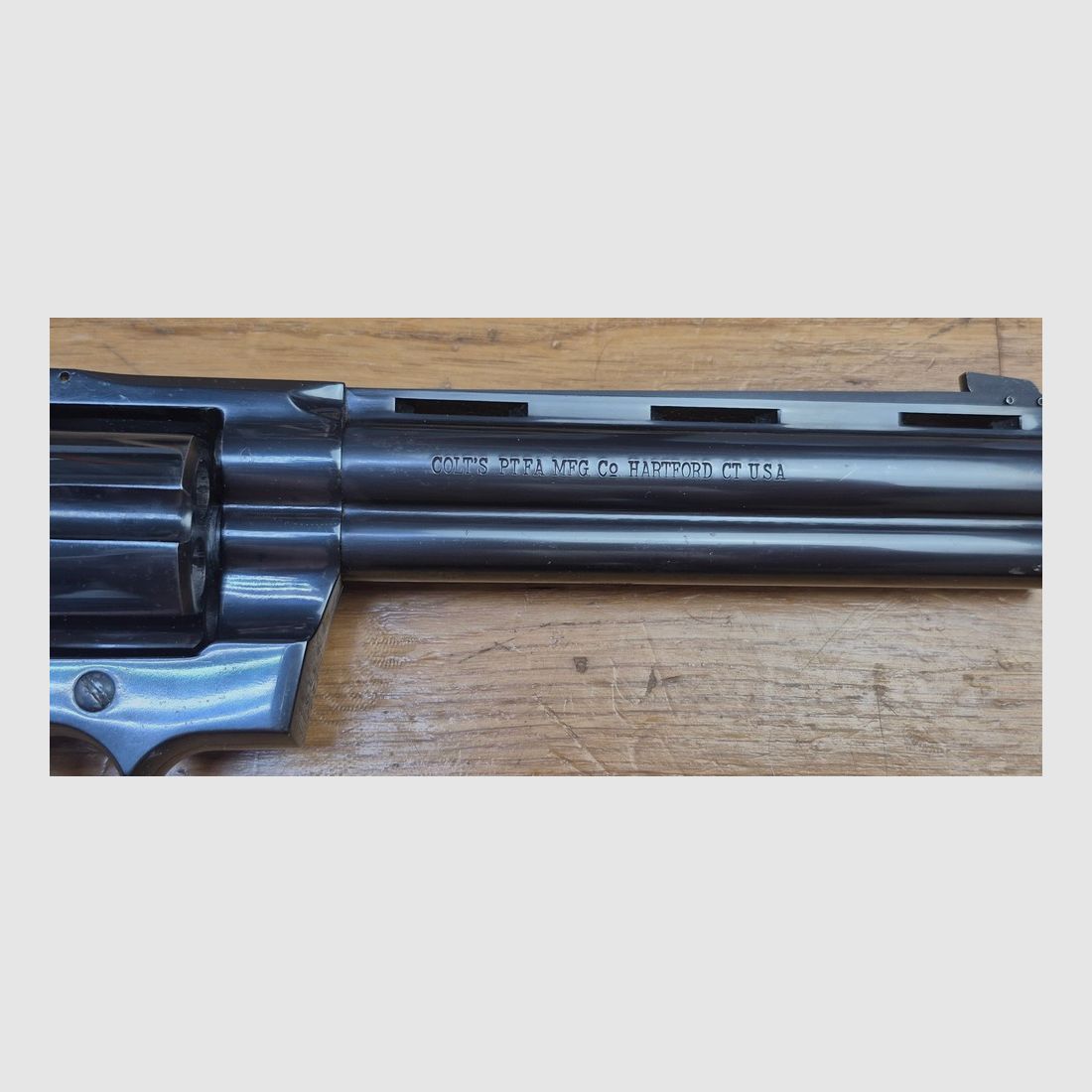
Note that the markings and the way they’re stamped into the finish (these characters were always stamped after bluing—you can imagine how important it was not to mess it up!) differ from those on later examples. The characters, especially the manufacturer’s name, are noticeably finer than even on a 1980 model.
They’re also different from those on my last 1980s model, which was sumptuous too. It was marked “Colt’s PT. EA.MFG. Co. Hartford, Conn.USA.” The earlier ones are marked “Colt’s PT FA MFG Co Harford Ct USA” in noticeably finer characters and without periods.
The fine lettering and variation in the text are a foolproof way to authenticate these early examples at a glance when you don’t have the serial numbers memorized. And those fine markings are beautiful and classy too.
Only five digits in the serial number. And no prefix. That’s what you get with the first series.
In short, exactly the kind of gun Maître Flingus searches high and low for on your behalf.
This gun will be very accurate.
It’ll obviously handle .38 Special. But even if you shoot .357 Mag like a maniac (it’s seen very little, since the front of the cylinder is barely “whitened.” The cylinder is mostly just dirty), it’s hard to imagine you’ll manage to wear it out. The Python can handle very high volumes of .357. It’s built for it.
A gun for life. And one to pass down. In the same league as the 27-2 or 29-2, my favorites from the other brand. And we’ll come back to the mechanics too.
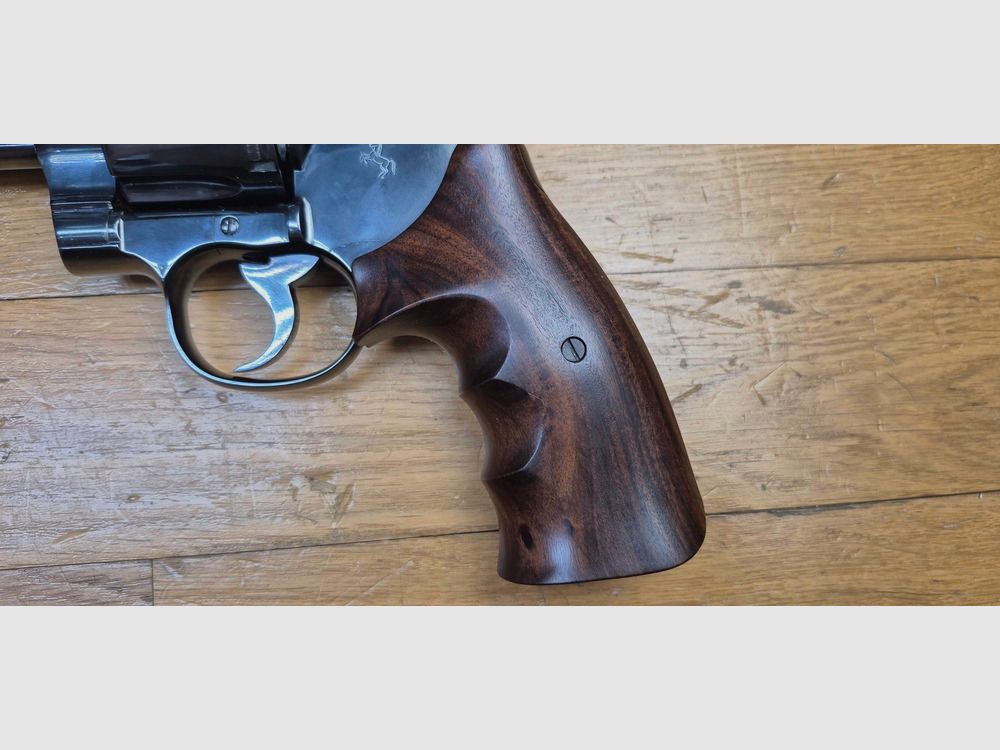
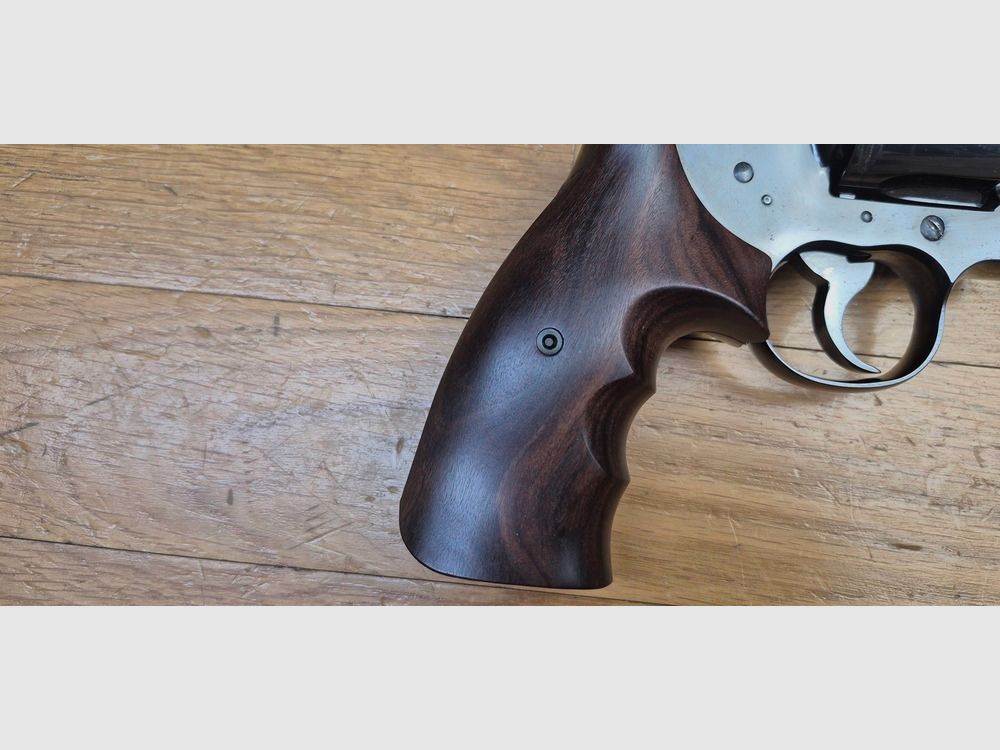
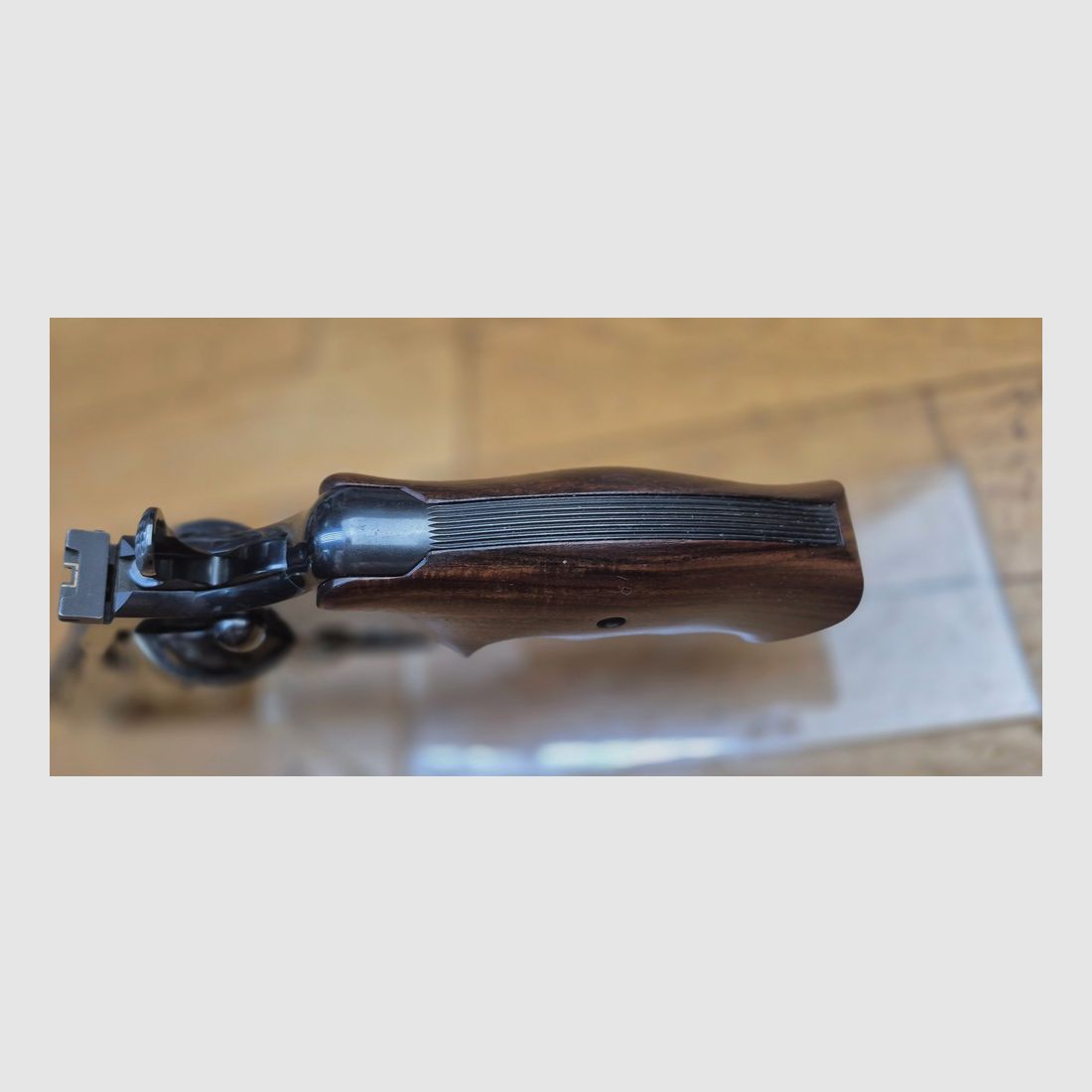
The ergonomic red walnut grips from over there are in perfect condition, with no dents or chips. Virtually no handling marks either—they’re magnified by my close-ups once again.
In hand, it’s practically like new. And very smooth. Best suited to medium to large hands. Excellent grip. Grips in very good+++ condition.
If you’d like to get a set of classic Colt Python grips to complete it, but original (not Made in Thailand), let me know. It’ll take a month or two to get them shipped from over there, but I have a source.
Mechanically, the gun is impeccable. Perfect. Locks up just like it did on day one. Cocking the hammer is an experience that anyone with a post-2020 Colt Python will never know…
Extraordinary smoothness in double action. These guns were still individually fitted, part by part, at all the contact points. The difference compared with a modern post-85 or post-2020 model is obvious. But this one is truly exceptional.
The trigger is a dream, especially in single action. I suggest fitting it with a trigger shoe if you have large fingers.
Very clearly the best-finished one I’ve had, mechanically too. Mechanics in very good+++ condition.
Finding pre-1970 Pythons is a challenge even in the USA. I was very excited to get this one in. It came directly from Germany and bears the proof marks of the Bavarian proof house. From 1969. Another confirmation of its date of birth.
The adjustable sights and screws are in perfect condition. And it’s all 100% steel, including the rear sight. Indestructible too. Everything is pristine. Very good+++ condition.
To give you an idea of its mechanical condition, there’s no visible gap at the cylinder gap. A combat-ready fit! It’s like new. Even though it’s seen very little use, these guns are...
Truly indestructible.
The barrel is simply stunning—mirror-bright, with perfect rifling all the way to the muzzle—as are the chambers, though I recommend giving them a good clean with my favorite product: “Bore Tech Inc,” the one with the big pink pig on the bottle. I like pigs. And sows too. (Yes, I’m leaving now… for aggravated bawdiness.)
The gun needs cleaning around the cylinder axis, but it’s already more than smooth. Perfection. Even as it is, the wrist test is an experience in itself for understanding what a proper fit is. All by itself. And not even a sound…
A Python of this Premium quality will never depreciate. Treat yourself to the absolute best version of the model for a used-gun price. A real Flingus bargain.
Owning a Python also means joining a very, very exclusive circle, in excellent company with Ian Fleming, the father of James Bond, and Lieutenant Ken Hutchinson from “Starsky & Hutch.”
A legend, I tell you.
Just as exceptional on the range. And this one is the best they ever made.
CATEGORY B FIREARM AT THE CSI: SUBJECT TO AUTHORIZATION. A COPY OF A VALID ID AND A FIREARMS LICENSE ARE REQUIRED—AN OPEN SIA ACCOUNT IS ALSO REQUIRED, OF COURSE. SHIPPING WITH SIGNATURE REQUIRED IN TWO SEPARATE PARCELS AT LEAST 48 HOURS APART.
***********************************************************************************************************************
Let’s say it again! Flingus Maximus Gun Shop in Paris and throughout France is also here to buy firearm collections and other militaria, provide firearm valuations, answer your questions about firearms regulations, and help with estates and inheritances. Contact your favorite gunsmith using our contact form or at [email protected] (Show description in original language)
Que voilà un très bel exemplaire du Python (on pourrait dire Royal !) de chez Colt – Un magnifique réticulé en 6 coups et 6 pouces en finition bronzée et en 357 Magnum bien sûr. Une bête de scène et de concours !
Je ne le vois pas si souvent dans ces bonnes fabrications d’avant 1982. Et celui-ci est une rareté de 1968.
Le Python, c’est un peu le revolver qui symbolise tous les révolvers modernes. L’emblème des revolvers modernes.
Pourtant, dès sa naissance en 1955, il fut réservé à un créneau haut de gamme chez Colt et donc destiné à rester plutôt restreint en diffusion. Ce qui en principe ne favorise pas la popularité. Et pourtant…
1955 fut une grande année pour les armes de poing, car notre beau poulain naissait la même année qu’un autre concurrent des plus sérieux : le Smith&Wesson 29 en 44 mag (un des chouchous de Maître Flingus).
On a beaucoup glosé sur le Python, son kilo deux en poids (si on a des bras de fillette, on n’achète pas un Python, on se rabat sur un orvet !).
D’aucun ont aussi parlé d’une très supposée perte de précision en tir intensif, l’échauffement du métal conduisant, parait-il, à un alignement imparfait des chambres face au cône de forçage pouvant conduire en outre à une légère projection de gaz, et, dans de très rare cas (jamais vu en stand!), à devoir resynchroniser l’arme.
Qu’en est-il ?
Ça m’amuse un peu car, pour en arriver là (test de 2005), il avait fallu tirer plusieurs centaines cartouches d’affilé (!) en tir rapide, sans pose aucune (!), ce que je n’ai jamais vu faire avec un Python, ni même avec un Smith, et ni en stand ni ailleurs. Ce qu’on ne fait jamais.
En réalité, et depuis 1955, c’est sans doute l’arme la plus fiable du marché avec les Smith des grandes années (jusque 1982-1986) et les Ruger type GP 100 d’avant. Une arme d’exception justifiant parfaitement sa réputation de puissance et de solidité. Jamais d’incident de tir avec un Python. Au moins sur les fabrications les plus qualitatives jusqu’au milieu des années 80.
Le Python est à juste titre réputé pour sa précision (il ne sort pas du 10 à 25 mètres), la souplesse de sa mécanique, notamment à l’armement du chien, et pour son système de verrouillage de barillet. On va y revenir. Des « détails » qui font la différence.
D’ailleurs des détails « d’armuriers », très au fait des contraintes mécaniques concrètes propres à une arme puissante. Une arme d’ouvriers très qualifiés.
Car c’est une des choses peu connues sur cette arme et qui explique elle-même bien des choses: le Colt Python n’a pas bénéficié d’un programme de développement en bureau d’études.
Il a été créé sur le terrain par deux armuriers de métier de la grande époque qualitative de Colt qui travaillaient directement sur la chaine de production. Ils essayaient de créer un revolver de match en 357 en utilisant principalement des pièces déjà existantes.
Se prenant au jeu, et au fur et à mesure des tests et améliorations, ils ont fini par créer une des plus belles et des plus impressionnantes armes de poing jamais fabriquées.
Alors rendons hommage à Al De John, qui était armurier chez Colt depuis 1946 et à un autre armurier de la chaine de production, devenu Directeur de la Production, Al Gunther.
Aussi surprenant que cela puisse paraître (au 1er abord), nos gaillards sont en fait partis du Special Officer’s Model Match en 38.Sp.Une arme de précision de très grande qualité et ils le savaient.
Essayant de le rendre encore plus précis tout en l’adaptant au 357, ils durent résoudre des problèmes de renforcement du barillet et du cadre ainsi que de fiabilité de la percussion qui cassait régulièrement. Passage au redoutable 357 mag à très haute dose oblige.
Car le Python, à l’image de notre Manurhin ou du Smith 27, est réellement une arme conçue pour tirer du 357 à très haute dose. Les carcasses K de Smith c’est plus sur une base d’exception par exemple.
Mais ils en vinrent aussi à créer un nouveau mécanisme de verrouillage du barillet. Quand le chien est totalement à l’armé, au moment même où l’on appuie sur la détente, le barillet se verrouille et continue de l’être pendant toute la durée du parcours du chien jusqu’au tomber du marteau inclus. C’est un point fondamental d’amélioration en précision. Le Python en est plus « facile » pour le tireur.
L’usinage des pièces mobiles est en outre conçu pour que, à l’arrivée en position feu, l’espace entre le barillet et le cône de forcement se réduise encore d’un poil, ce qui améliore encore précision et vélocité. Le verrouillage du barillet du Python a aussi la réputation d’être un des plus costauds du marché.
Bref, ils repensèrent totalement l’arme en lui ajoutant au passage cette fameuse bande ventilée, autre nouveauté à l’époque sur un révolver, qui, outre son intérêt de dispersion de chaleur pour les tirs intensifs, lui donna aussi un look iconique que beaucoup on essayé d’imiter. Une réussite.
Sa platine double action de construction complexe, ses qualités de finitions, notamment son fameux bronzage Colt Royal (« Royal Blue finish » – rappel: « Blue » en anglais d’armurerie ne signifie pas bleu mais bronzage) qui suppose un très soigneux polissage préalable, et son usinage qui n’a rien à envier à celui des Smith de la grande époque, en ont fait une arme particulière dès sa naissance.
Initialement, seuls Al De John et une autre pointure de la chaîne, Don Bedford, étaient autorisés à travailler sur les Python. Ce travail d’ajustement et de polissage manuels complexes demandait plus de temps à ces armuriers pourtant ultra qualifiés et ultra rapides: un peu moins de 25 minutes de travail par arme contre 15 minutes sur les autres revolvers Colt.
Le Python était initialement vendu à 125 $ (le revenu moyen hebdomadaire d’un ménage américain vers 1955 était de 68 $ – deux mois de salaire pour une arme), soit le même prix que le Single Action Army réintroduit en 1956.
Un seul (!) Python fut construit en 1955 et à peine plus de 300 exemplaires seulement sortirent en 1956. Il fallu attendre 12 ans et 1968 pour que le assez faible cap des 100.000 pythons produits soit enfin atteint. Il était cher.
Il ne fut produit initialement qu’en 6 et 4 pouces, le 2.5 pouces n’apparaitra que dans les années 70. Un canon 8 pouces apparut en 1980.
Entre temps, le Python avait gagné ses galons d’arme d’exception, certes chère à produire et à la vente, mais d’une réputation fort justement devenue mondiale. Le nec plus ultra de chez Colt.
A noter qu’à partir du début des années 70, les colts Python furent les premières armes à être alignées canon-chambres au laser, une première dans toutes les productions mondiales. C’est dire le soin que Colt a toujours pris de ses bébés Python dès la production cherchant toujours à les parfaire.
Les Python ont été produits de 1956 à 1997. Mais surtout après 1970. Le niveau de vie de tous avait considérablement augmenté
A partir de cette année-là (1997) et jusque 2004, ils ne furent plus produits que sur commande, début 2005 marquant l’arrêt définitif de la production.
La baisse des critères de fabrication, la concurrence du pistolet dans le cœur des tireurs, les errements de Colt avec leurs histoires de bestioles façon Boa, King Cobra, Grizzly et autres Kodiak avaient eu raison commercialement de cette arme magnifique. En bonne partie par auto-concurrence.
Toutefois la légende de cette arme d’exception est restée si forte que Colt en a… repris la production en 2020.
Objectivement, à 3.000 euros ou plus neuf en 6 ou 4 pouces, en fabrication laser qui accroche, autant passer sur une occasion en excellent ou parfait état des meilleures années. Quand on la trouve. L’arme est inusable en plus même si cela n’intéresse plus personne de transmettre. Et c’est plus beau surtout.
En termes de qualité et de finitions, les collectionneurs tireurs américains s’accordent à privilégier les fabrications allant des années 60 (très difficile d’en trouver d’avant même chez eux) au début des années 80. Ceux des années 60 sont tout particulièrement recherchés. Un peu comme pour Smith d’ailleurs.
Après 1985/90, on rentre dans un autre monde. Celui des SAV débordés au point qu’il a fallu en créer… Marlin a tenu un peu plus longtemps (2008).
Au delà de ses immenses qualités intrinsèques et de ses finitions hors pair, le Colt Python des grandes années doit aussi sa réputation d’arme d’exception à son look à la fois agressif et massif, hors du temps, devenu iconique.
Son adoption, avec force séries télévisées racontant leurs exploits dans les années 60/80, par les patrouilles motorisées Harley Davidson du Colorado et de Georgie y fut pour beaucoup.
Avec son adoption par la Florida Highway Patrol, la brigade motorisée d’autoroute du Sunshine State, il acquit définitivement son statut iconique d’arme de Police et de biker-voyou des États du Sud.
Surprenamment à l’ère du pistolet, mais logiquement compte tenu de ses qualités de fiabilité notamment, il se fit aussi militaire notre Python.
Il a servi au Vietnam au sein des forces spéciales du redoutable MACV-SOG et des Marines.
Pour l’anecdote, les marines qui gardaient l’ambassade US à Saïgon ont balancé les leurs à la mer en atterrissant avec l’Ambassadeur en fuite sur le pont de l’USS Blue Ridge dans le foutoir de l’évacuation en catastrophe de 1975!).
Au cinéma, on l’a vu dans des mains aussi différentes que celle de Charles Bronson dans « Love and bullets », de Brad Pitt dans « Fight Club », de Christophe Lambert dans « Subway », de Belmondo dans « Flic ou voyou », de Bruce Willis dans « L’Année des 12 Singes » et bien sûr, au sommet, dans les mains de l’iconique John Wayne dans « McQ ».
Le Colt Python est aussi une des seules armes à avoir eu un film à sa gloire (« Police Python 357″avec Montand) au nom exact du modèle (des dizaines de films portent les mots Colt ou Winchester sans précision de modèle ou de calibre). Les deux autres sont, à ma connaissance, un film intitulé « Winchester 1873 » rejoint il y a peu par le (bon) film « MR73 », notre mythe à nous, qui mérite bien cette noble compagnie cinématographique.
Votre humble serviteur n’a pas dénombré moins de 360 apparitions au cinéma de notre héros. Sans les pubs, les séries télévisées et les jeux. Une star des écrans tous formats, notre Python.
Parmi ses propriétaires célèbres, on trouve le Roi Hassan II, le Roi Fahd d’Arabie Saoudite, le Roi Hussein de Jordanie, Le Roi d’Espagne Juan Carlos et bien sûr, bien sûr, le roi des rois, le King Elvis Presley qui les collectionnait. Bref une arme de tête couronnée.
Pour voir ce qu’on peut faire avec un Python, regardez un peu celui du King.
Les hommes rêveront toujours d’armes…
Entre le jugement de Wilson, l’historien non officiel de la marque Colt, le qualifiant de « Rolls-Royce des Colt » et le jugement de Hogg, un des plus sérieux historiens des armes à feu, le qualifiant tout simplement de meilleur revolver du monde, mon cœur balance. Avec une position plus proche de celle de Wilson et relativement à la date de fabrication.
Parce que le meilleur revolver du monde, sera toujours celui qui vous correspond.
C’est une très belle version des plus belles années de construction du mythique Python que Maitre Flingus vous propose ce jour. Il est de début 1968. La très grande époque encore de Colt. C’est rare.
Notre exemplaire n’a que très peu tiré et il est resté absolument impeccable en mécanique. Il ne porte que très peu de traces de rotations sur son barillet. Autre signe.
Il est mieux qu’en excellent état surtout compte tenu de ses 58 ans. Quasi neuf de ce point de vue. Une pièce exceptionnelle en fait.
État externe plus que très bon et très beau. Juste un poil de manque de bronzage en extrêmité de canon. Car, selon la mode de l’époque, il a peut -être été porté très peu de temps en étui cuir. Ce n’est quasi pas notable arme en main surtout avec les reflets du bronzages et je le signale par abnégation professionnelle.
Son bronzage d’un noir profond tirant sur le marine et d’une épaisseur de château-fort est juste splendide. C’est le superbe et vrai bronzage Colt Royal Blue d’origine à 99%. Il a changé dans les années 80. Somptueux.
D’ailleurs l’arme ne porte, en bronzage, quasiment aucune rayure visible arme en main, juste un ou deux toutes fines coté droit.
Celles que vous verrez en énormes sur mes GIGANTISSIMES photos ou bien les « tâches » du à mes doigts sales sont exagérées, plus qu’exagérées, par mes damnées gros plans comme d’habitude. L’arme est sale même si superbe. Poussières, taches et reflets la déversent. Mais elle est plus que très belle en main et à l’œil.
Regardez donc les photo d’ensemble pour vous en convaincre. Il est juste magnifique.
Esthétique TBE++/TBE+++
A noter que les marquages et leur incrustations dans le bronzage (car ces caractères étaient toujours frappés post bronzage – inutile de vous dire qu’il ne faut pas se rater!) sont différentes des pièces postérieures. Les caractères, notamment, pour le fabricant, sont nettement plus fins que même sur un 1980.
Et ils ne sont pas les mêmes non plus que sur mon dernier années 80, somptueux aussi. Il était marqué « Colt’s PT. EA.MFG. Co. Hartford, Conn.USA. ». Les premiers sont marqués » Colt’s PT FA MFG Co Harford Ct USA » en caractères nettement plus fins et sans points.
La finesse de caractères autant que la variation de texte est un moyen infaillible d’authentifier ces fabrications précoce au 1er coup d’œil quand on a pas les numéros de séries en tête. Et ces marquages fins, c’est aussi très beau et très classe.
Numéro de série à 5 chiffres seulement. Et sans préfixe. 1ières séries obligent.
Bref, tout à fait le genre d’armes que Maître Flingus cherche partout pour vous.
L’arme sera très précise.
Il avalera le 38 SP bien évidemment. Mais, même en tirant du 357 Mag comme un forcené (il en a fort peu tiré, puisque l’avant du barillet est à peine « blanchi ». Le barillet est surtout sale), difficile d’imaginer que vous puissiez arriver à l’user. Le Python peut tirer de la 357 à très hautes doses. Il est fait pour ça.
Une arme pour la vie. Et à transmettre. De la même eau que les 27-2 ou 29-2, mes petits chouchous de l’autre marque. Et même en mécanique, on va y revenir.
Les plaquettes ergonomiques bois en noyer rouge de là-bas sont en parfait état sans coups ni manques. Quasiment aucune de traces de manipulation qui sont grossies par mes gros plans encore une fois.
En main, c’est quasi neuf. Et très doux. Plutôt des mains moyennes à grandes. Excellente prise en main. Plaquettes TBE+++
Si vous souhaitez acquérir un jeu de poignée Colt classique Python mais d’origine (pas Made in Thaïlande) pour le compléter, dîtes le moi. Cela prendra un mois ou deux à faire venir de là-bas mais j’ai la source.
Mécaniquement, l’arme est impeccable. Parfaite. Verrouillage comme au 1er jour. Tirer sur le chien est une expérience qu’un possesseur d’une fabrication Colt Python post 2020 ne connaitra jamais…
Extraordinaire souplesse en double action. Ces armes là étaient encore ajustées une par une sur toutes les pièces de contacts. La différence avec une fabrication moderne post 85 ou 2020 est flagrante. Mais celui-ci est vraiment particulièrement au top.
La détente est un ange particulièrement en simple action.Je suggère de lui greffer un élargisseur si gros doigts.
Très clairement c’est le mieux fini que j’ai eu y compris mécaniquement. Mécanique en TBE+++
Trouver des Python d’avant 1970 est une gageure même aux USA. J’étais très ému de le rentrer. Il vient directement d’Allemagne et porte les poinçons d’épreuve du banc de Bavière. En 1969. Autre confirmation de sa date de naissance.
Organe de visées réglables et impeccables comme les vis. Et tout ça est en 100% acier y compris en hausse. Indestructible aussi. Tout est nickel. TBE+++
Pour donner une idée de son état mécanique, l’entrefer est nulle à la lumière. Un ajustement de combat ! C’est une valeur à neuf. Même s’il a très peu tiré, ces armes sont réellement increvables.
Le canon est juste splendide – miroir avec de parfaites rayures jusqu’au bout du canon – comme les chambres même si je suggère un bon passage à mon produit fétiche pour le faire soit le « Bore Tech Inc » au gros cochon rose sur la bouteille. J’aime les cochons. Et les cochonnes aussi. (Oui, je sors… pour gauloiserie aggravée.)
L’arme est à nettoyer en axe de barillet mais déjà plus que souple. Une perfection. Le test du poignet, même en l’état, est déjà une expérience en soi pour comprendre ce qu’est un ajustement. Tout seul. Et même pas de bruit…
Un Python de cette qualité Premium ne décotera jamais. Offrez vous l’excellence absolue du modèle pour un prix d’occasion. Une vraie occasion Flingus.
S’offrir un Python, c’est aussi rentrer dans un cercle très très fermé et d’excellente compagnie avec Ian Fleming le papa de James Bond et le Lieutenant Ken Hutchinson de « Starsky et Hutch ».
Un mythe vous-dis-je.
Autant qu’une arme d’exception au stand. Et celui-là est ce qu’ils ont fait de mieux.
ARME DE CATÉGORIE B AU CSI : SOUMISE À AUTORISATION, PHOTOCOPIE DE LA PIÈCE D’IDENTITÉ EN COURS DE VALIDITÉ ET DE LA LICENCE OBLIGATOIRE – COMPTE SIA OUVERT BIEN ÉVIDEMENT – Expédition contre signature en deux colis séparés d’au moins 48 heures obligatoire.
***********************************************************************************************************************
Répétons le ! L’armurerie Flingus Maximus à Paris et partout en France est là aussi pour le rachat de collections d’armes et d’autre militaria, vos estimations d’armes, vos questions relatives à la règlementation des armes, les successions et héritage. Contactez votre armurier préféré via notre formulaire de contact ou à [email protected]