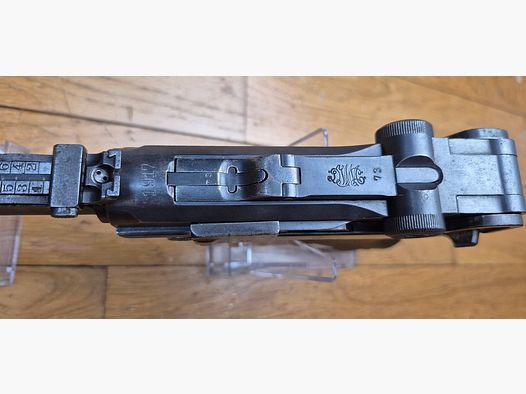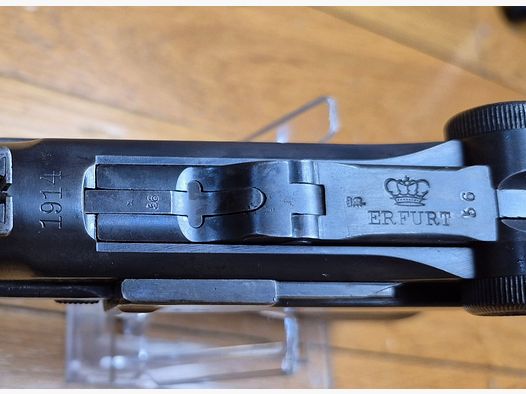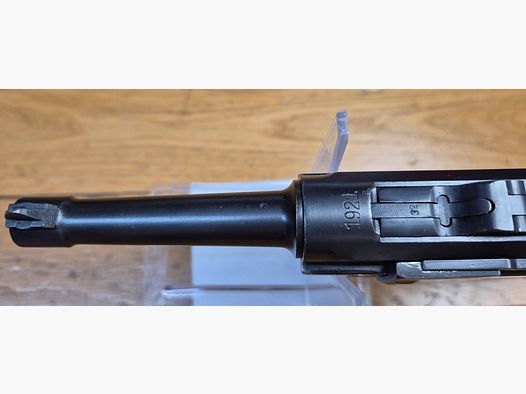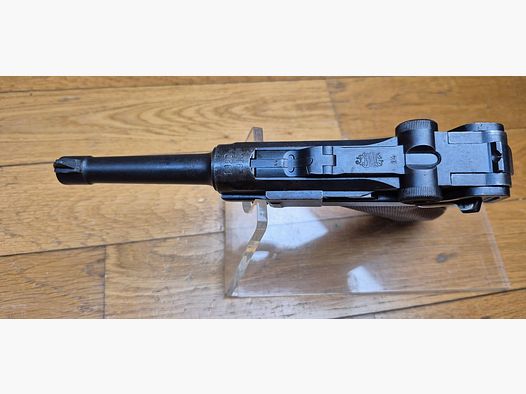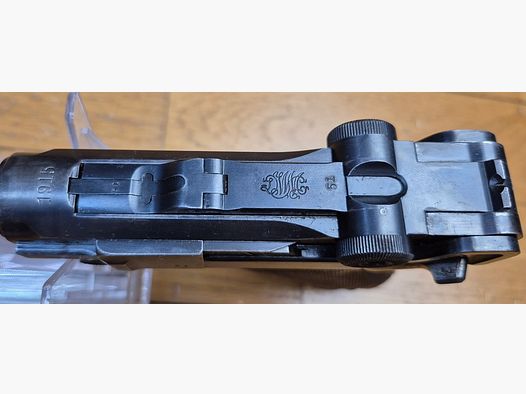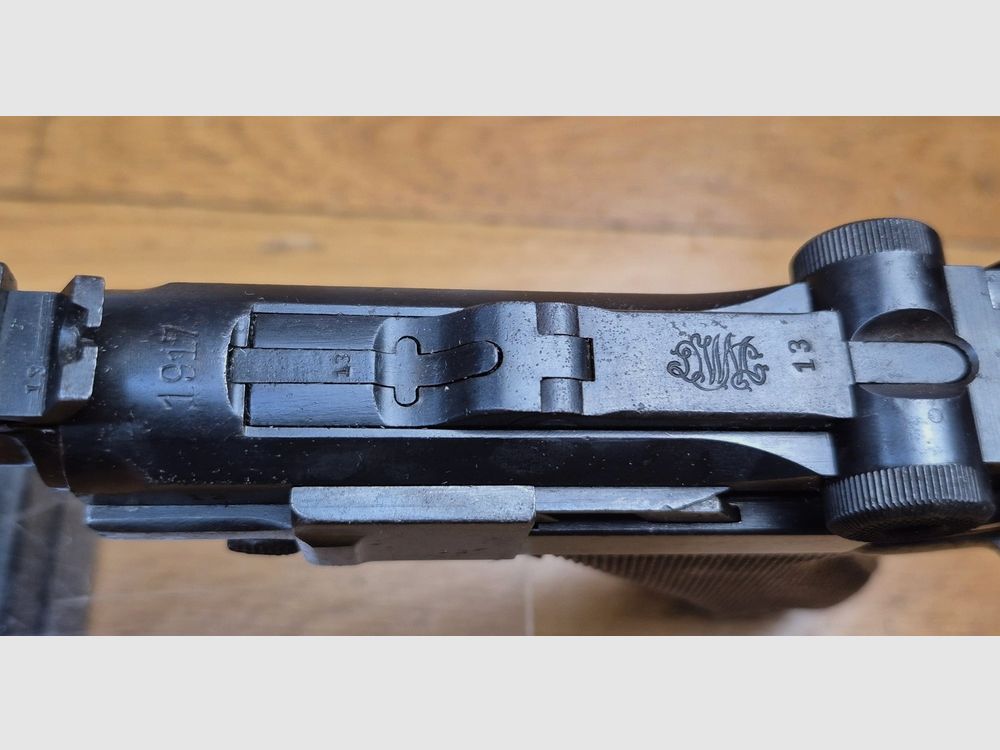

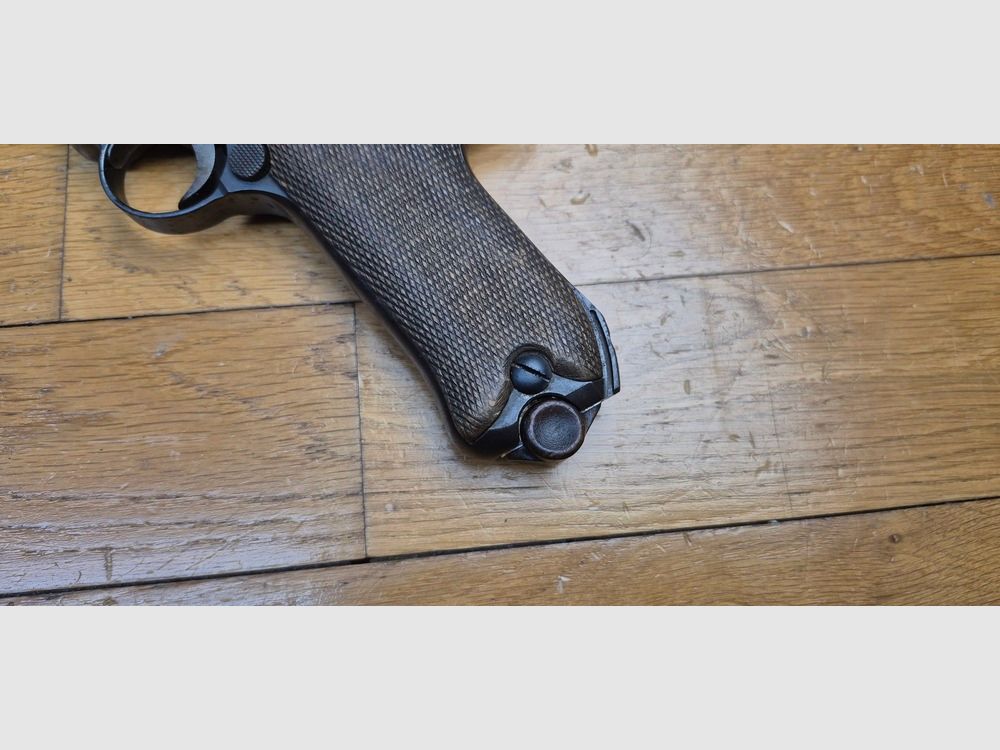


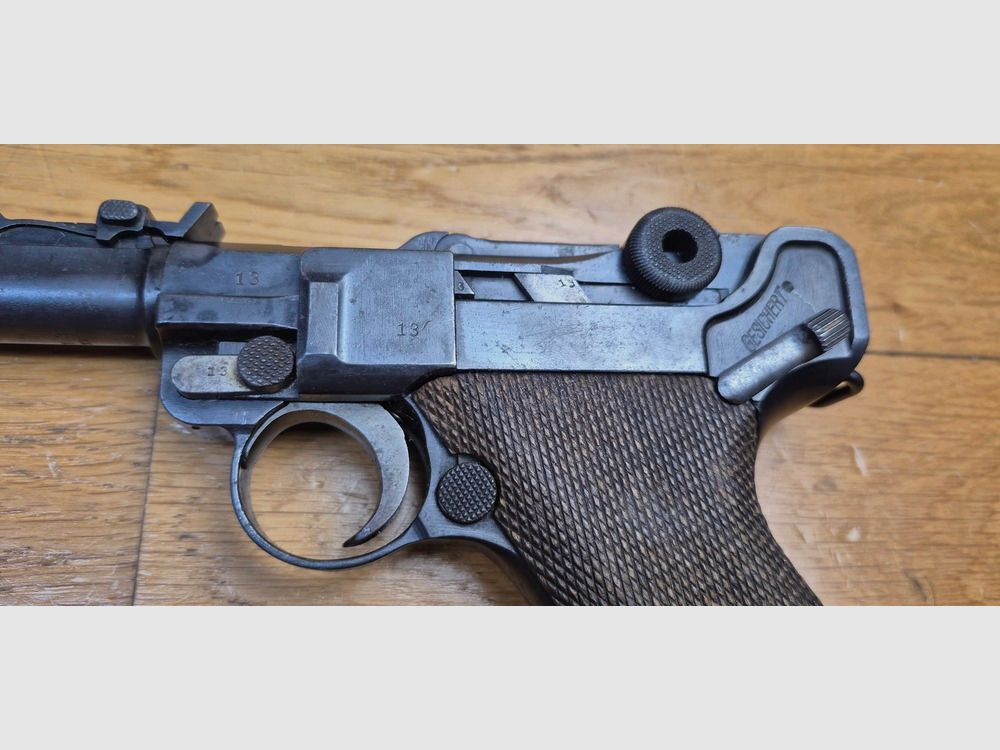

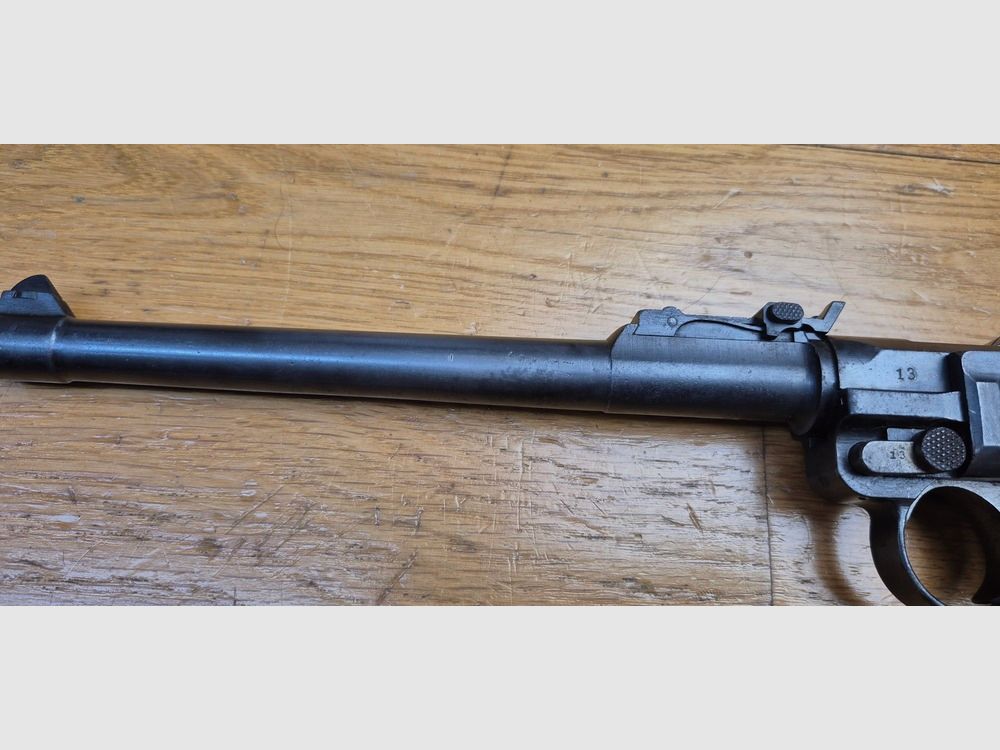
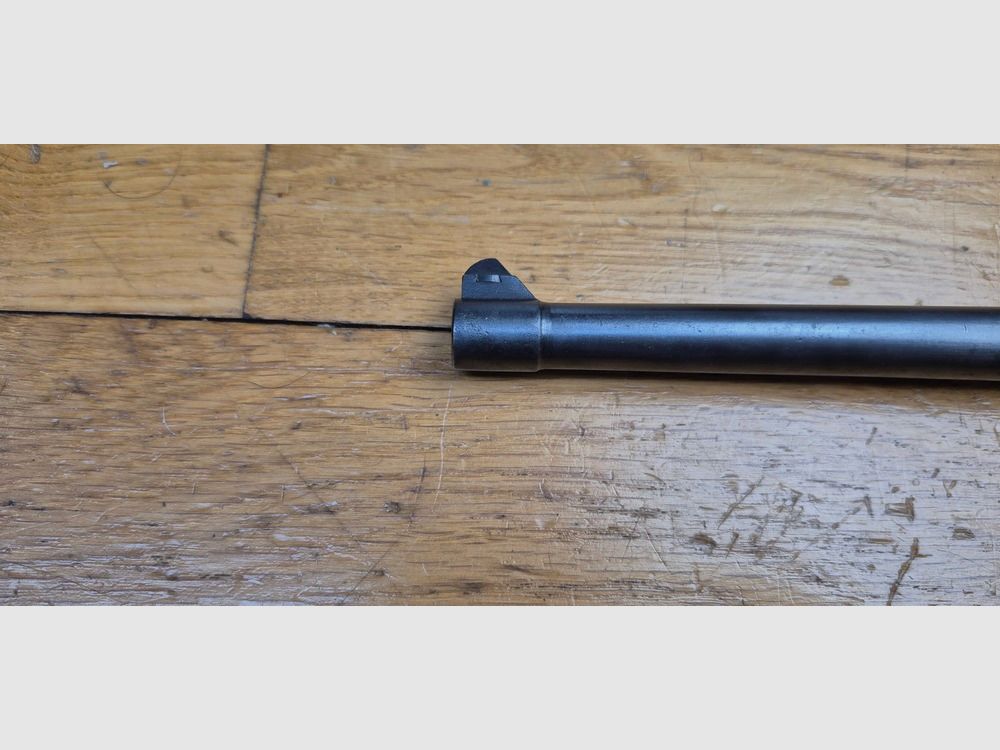
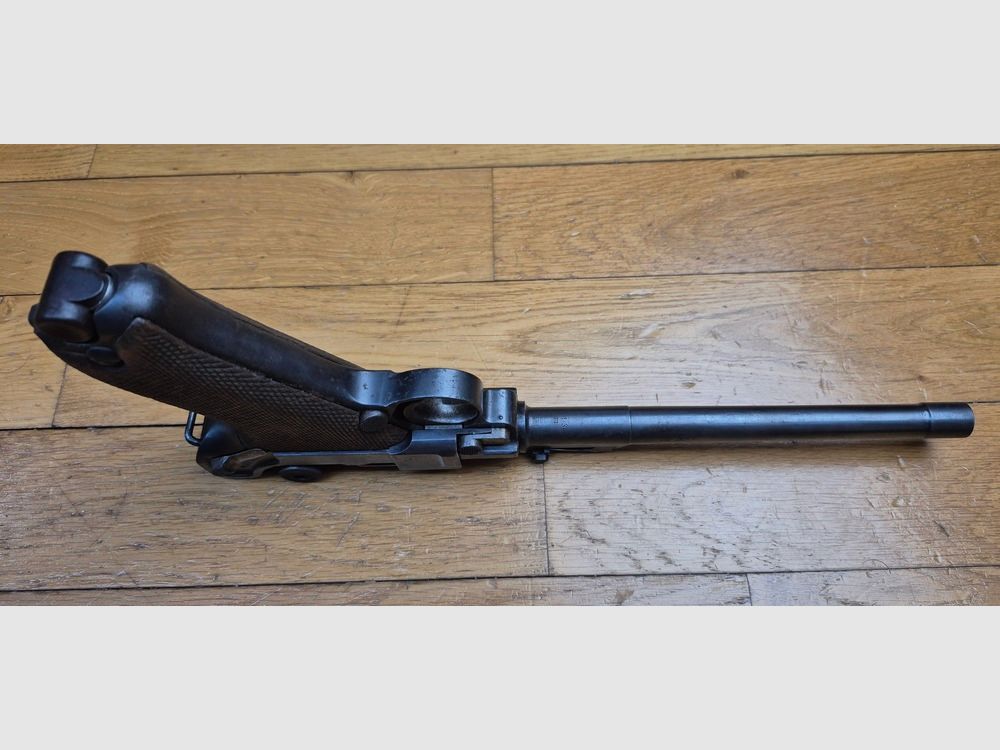


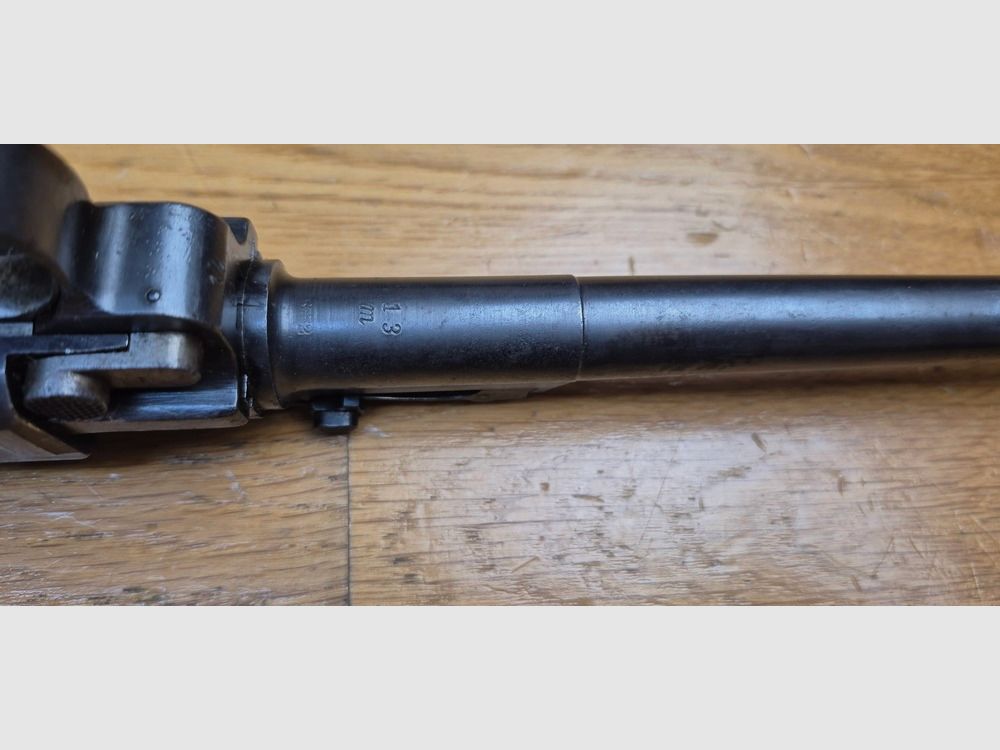


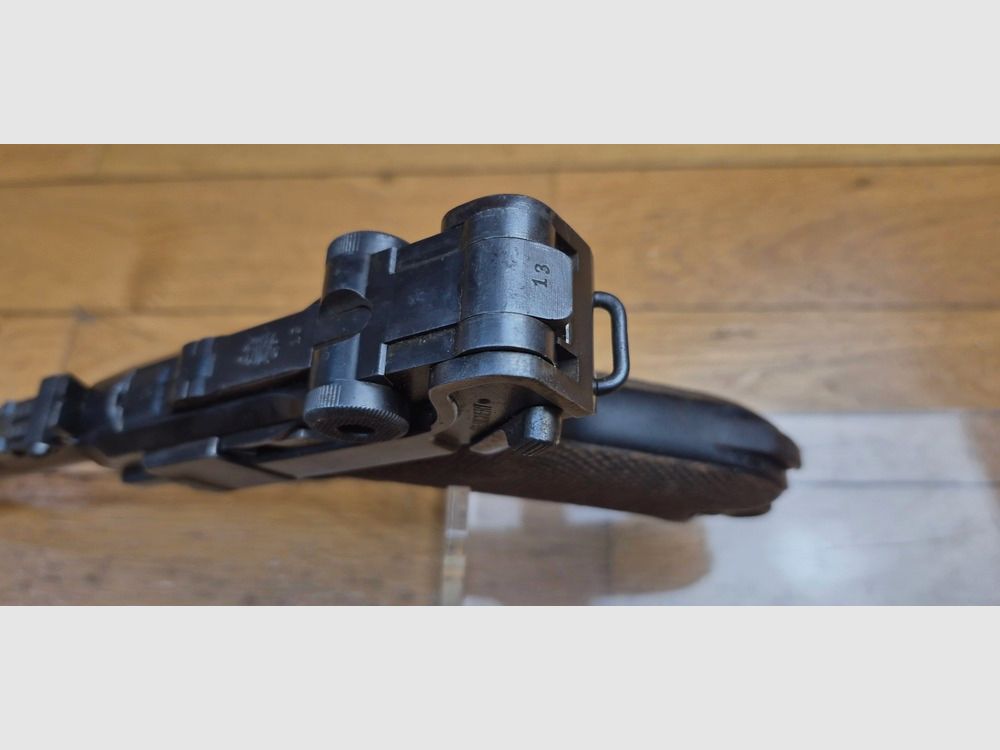

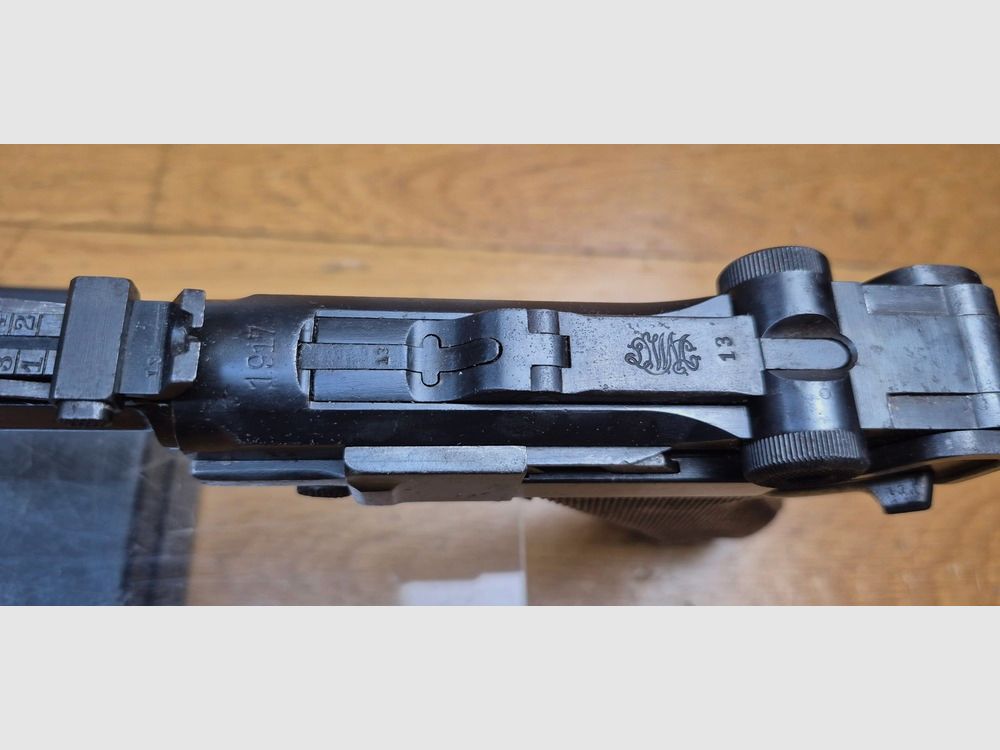
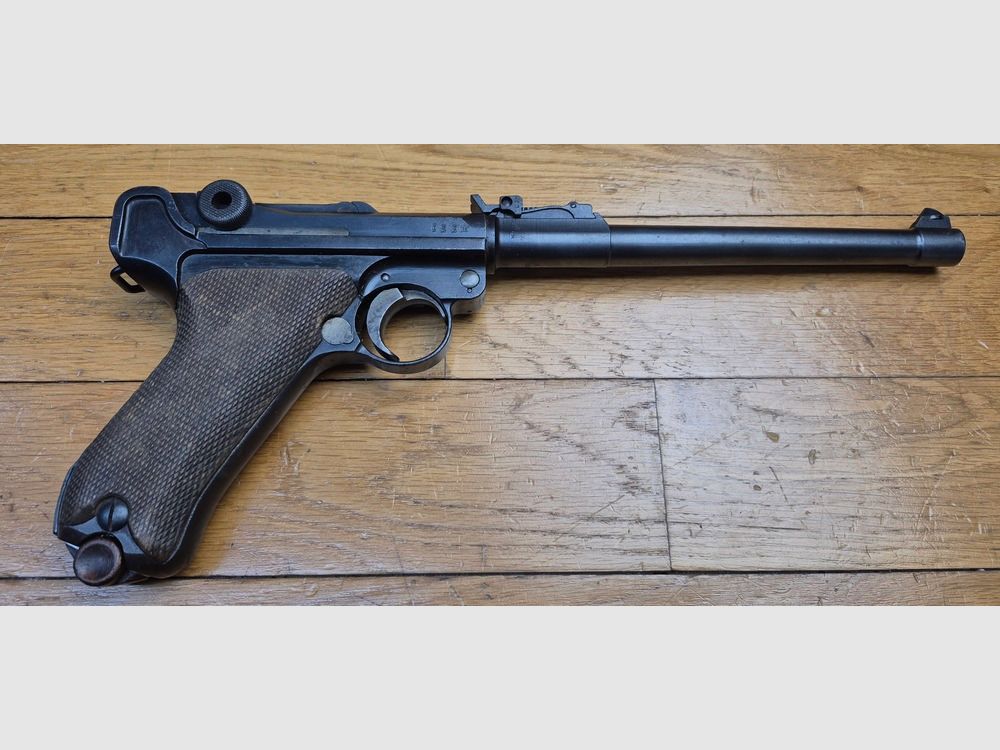

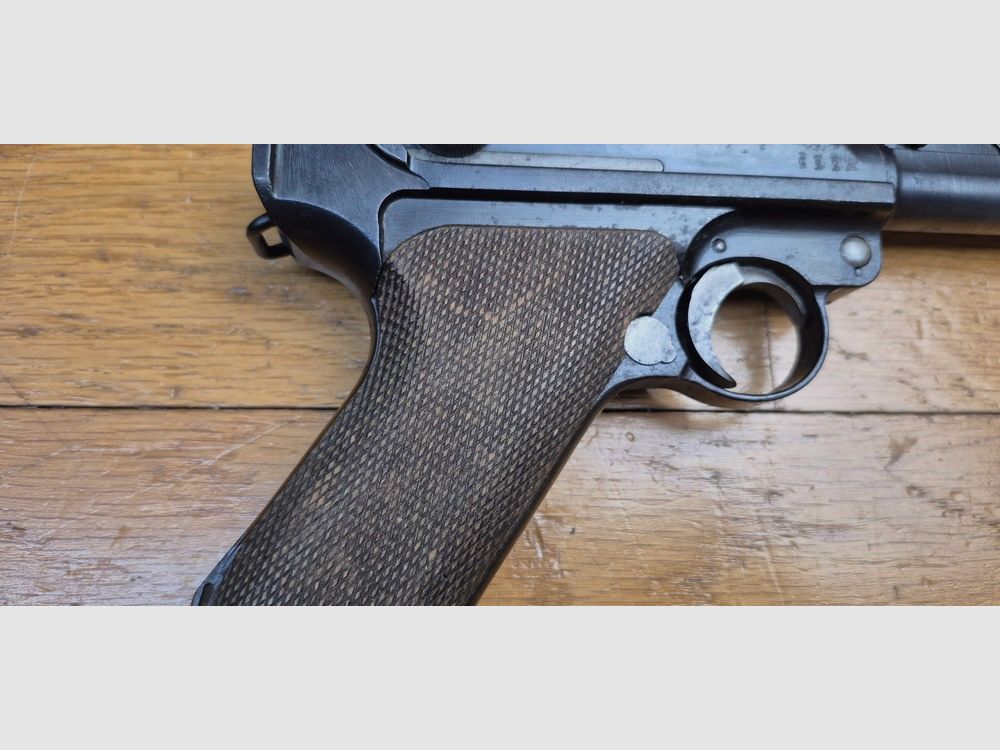
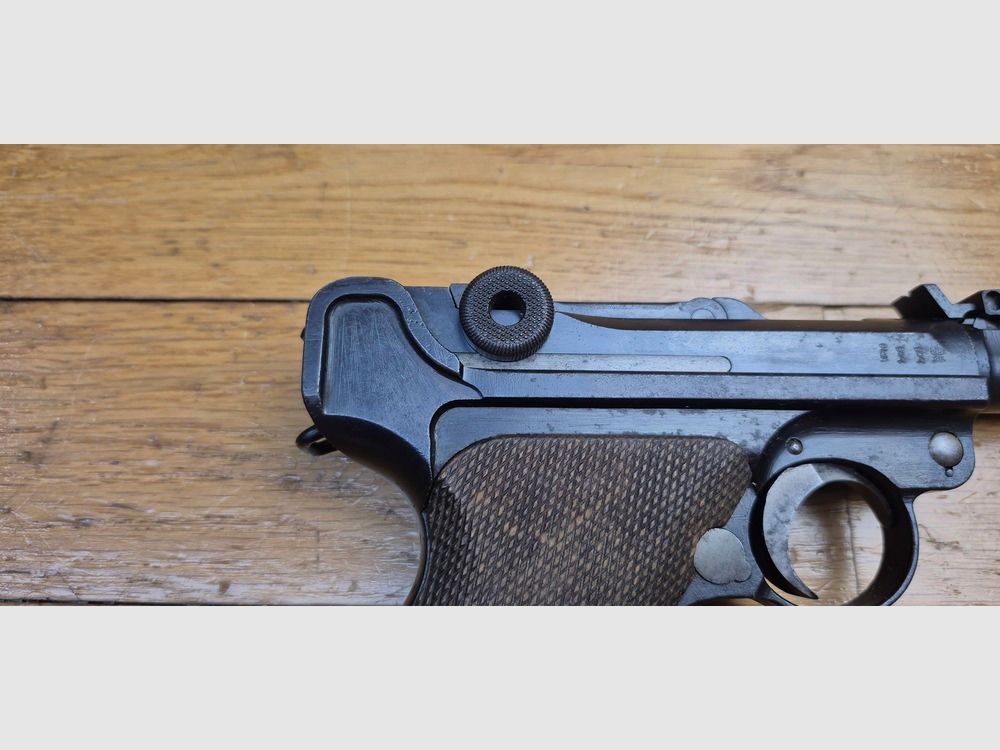
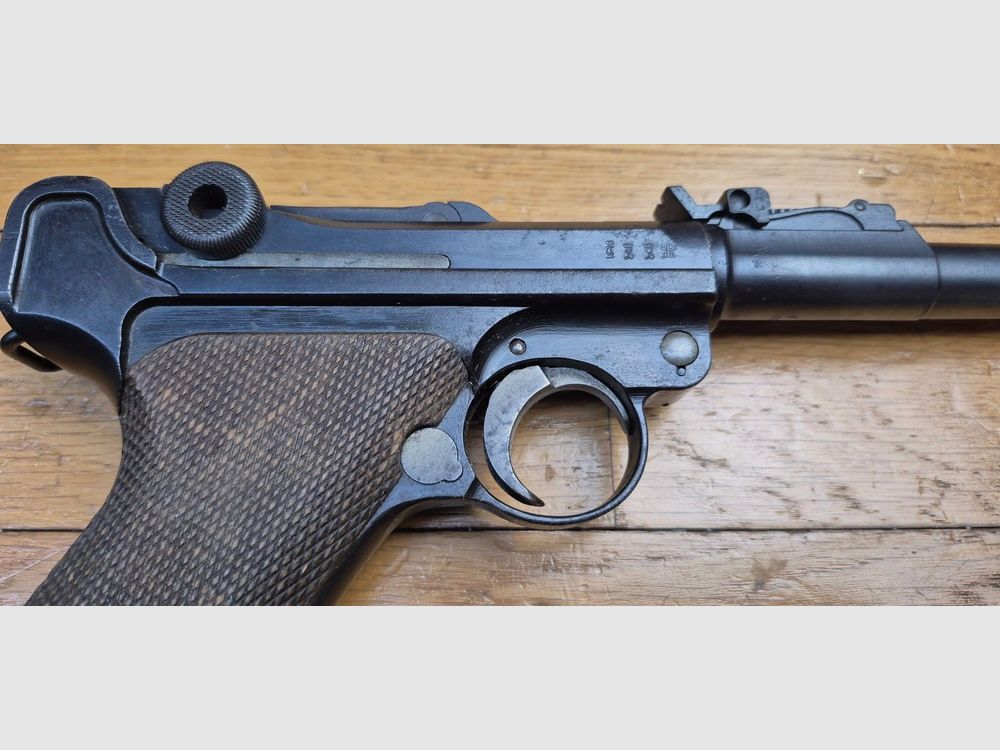
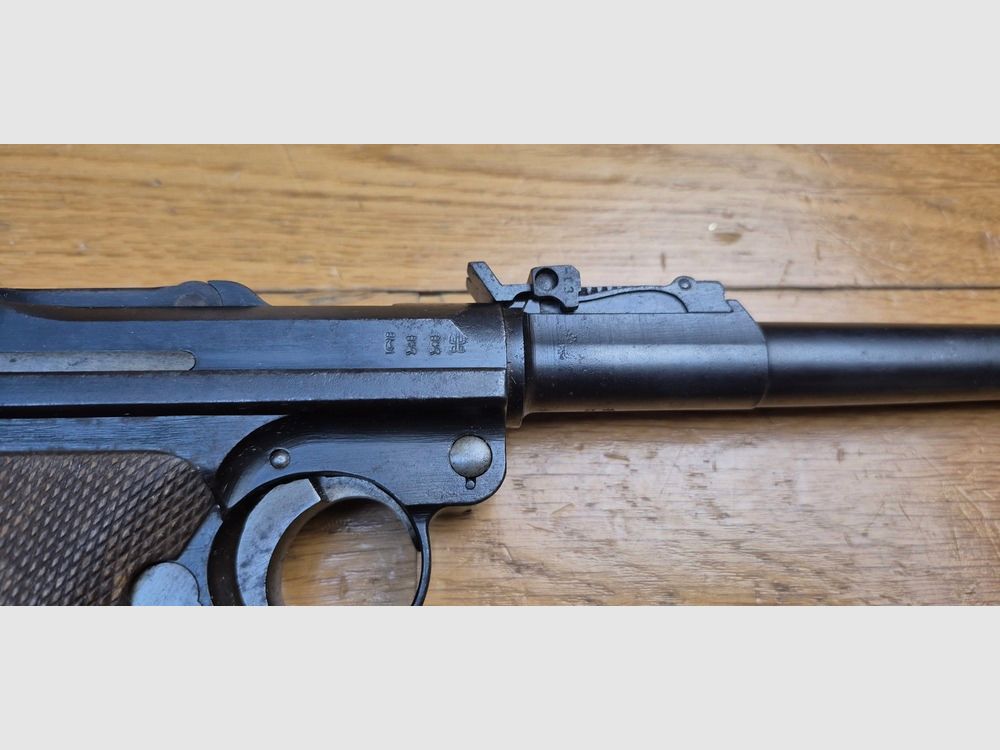
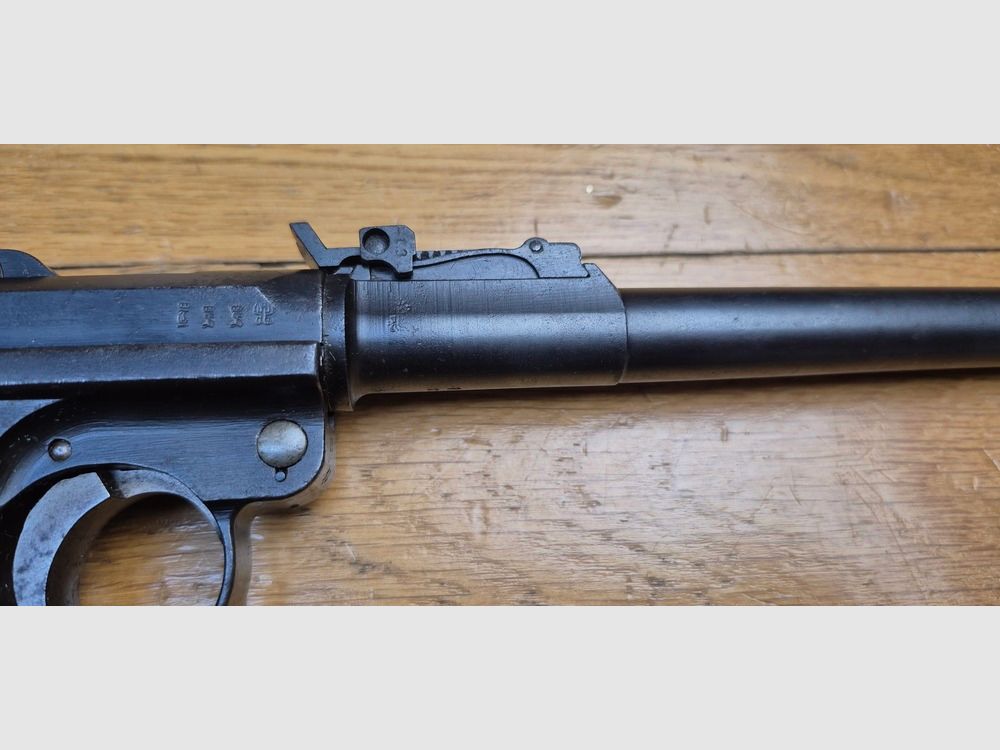
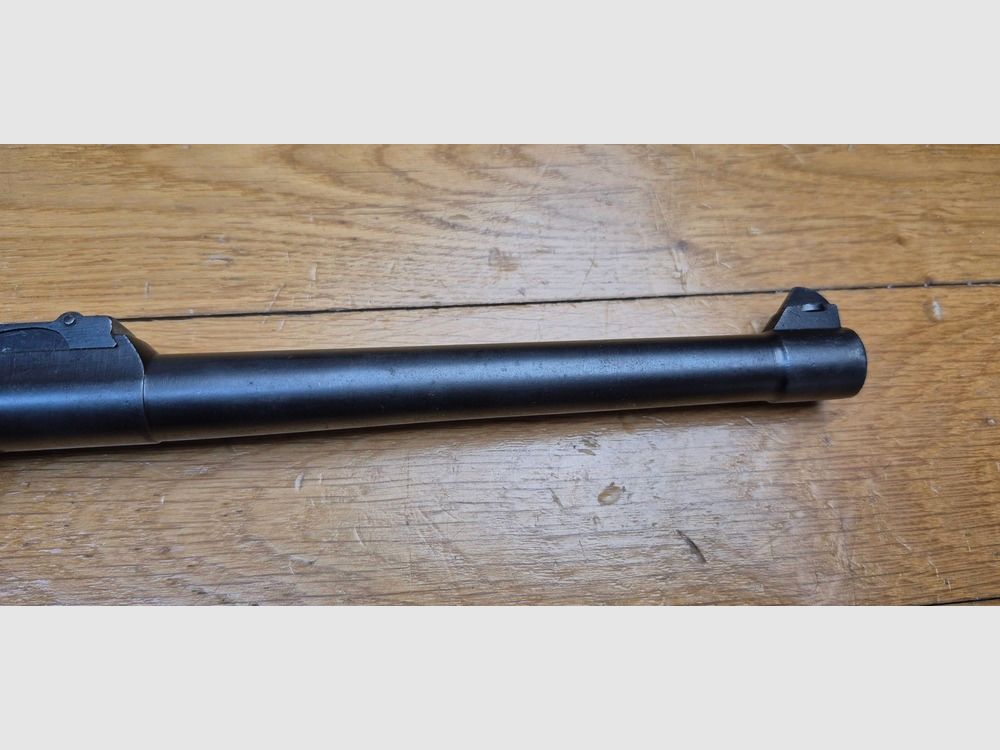
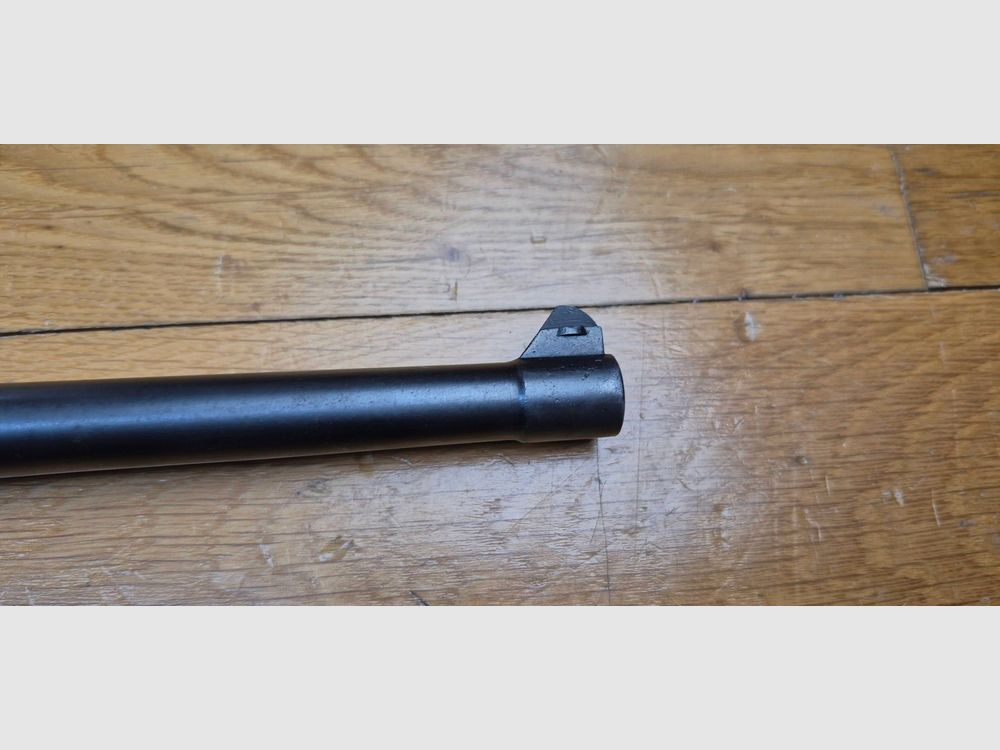
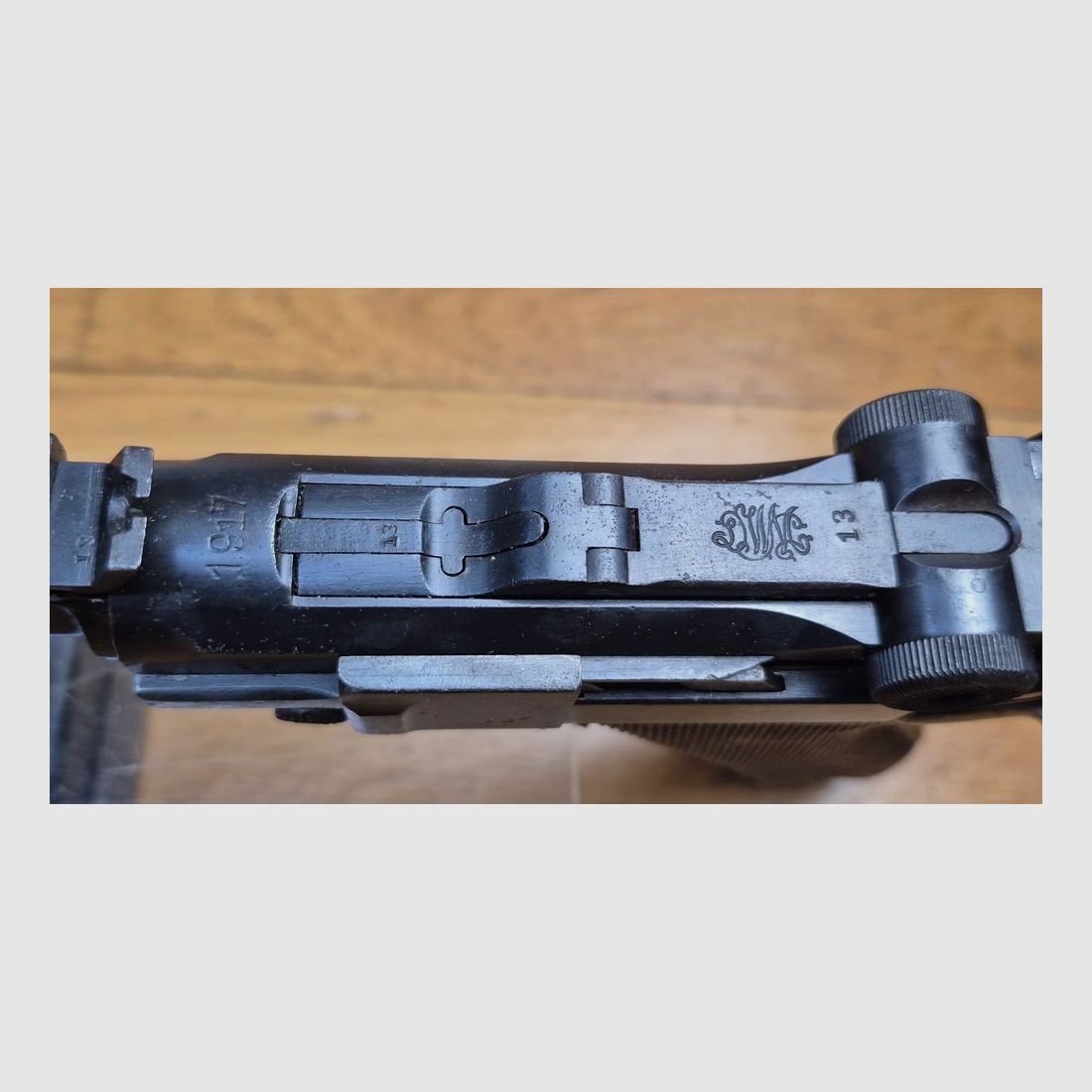
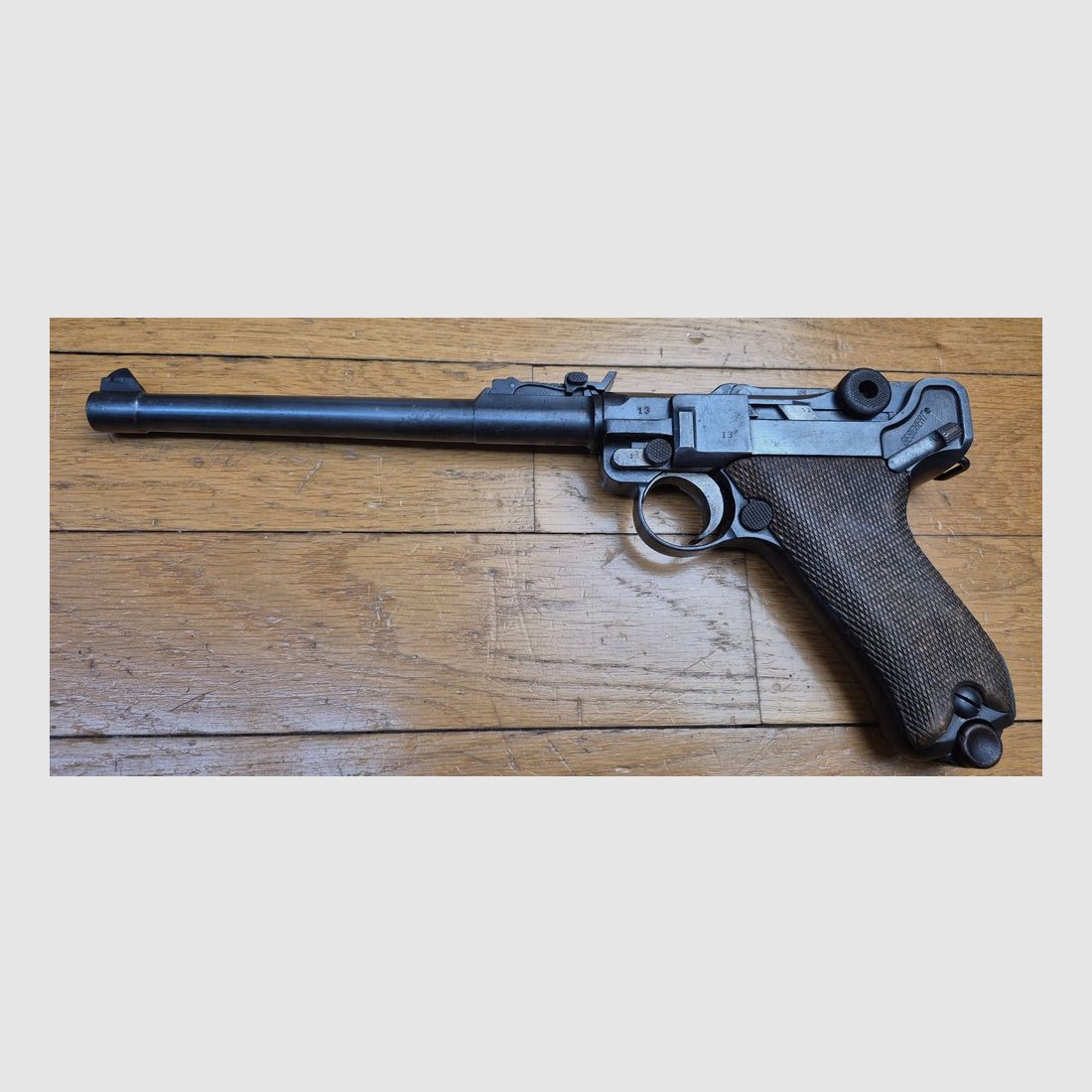

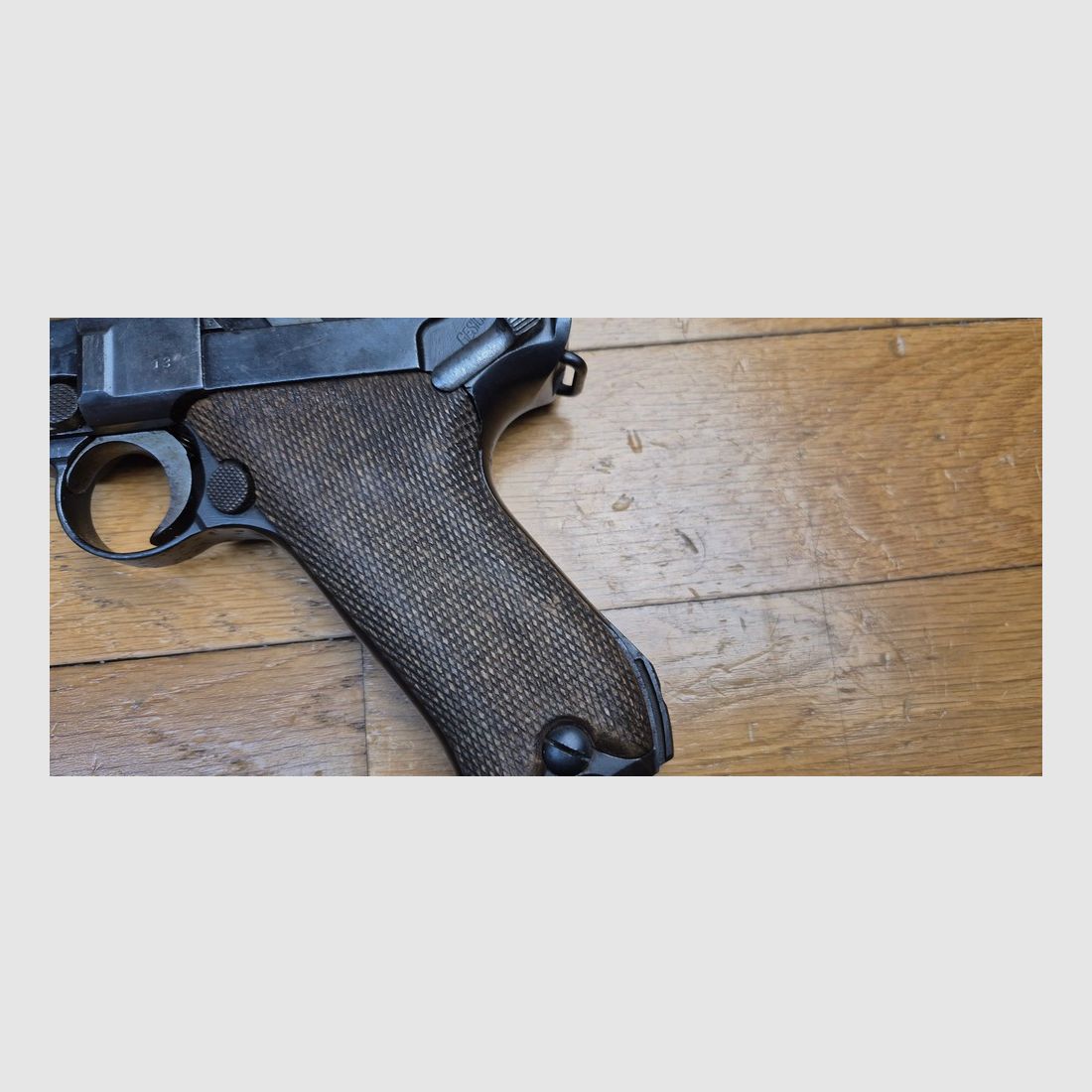


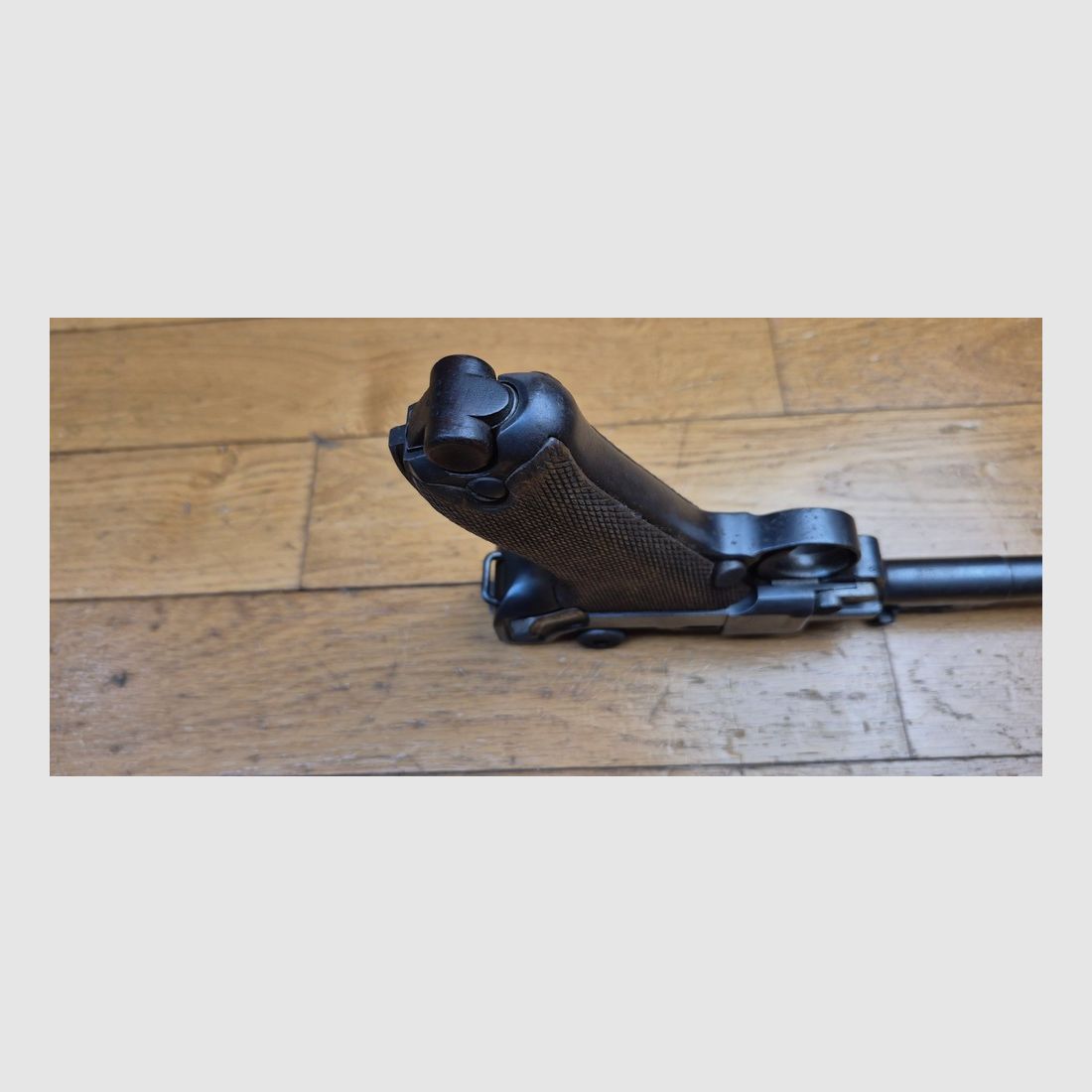


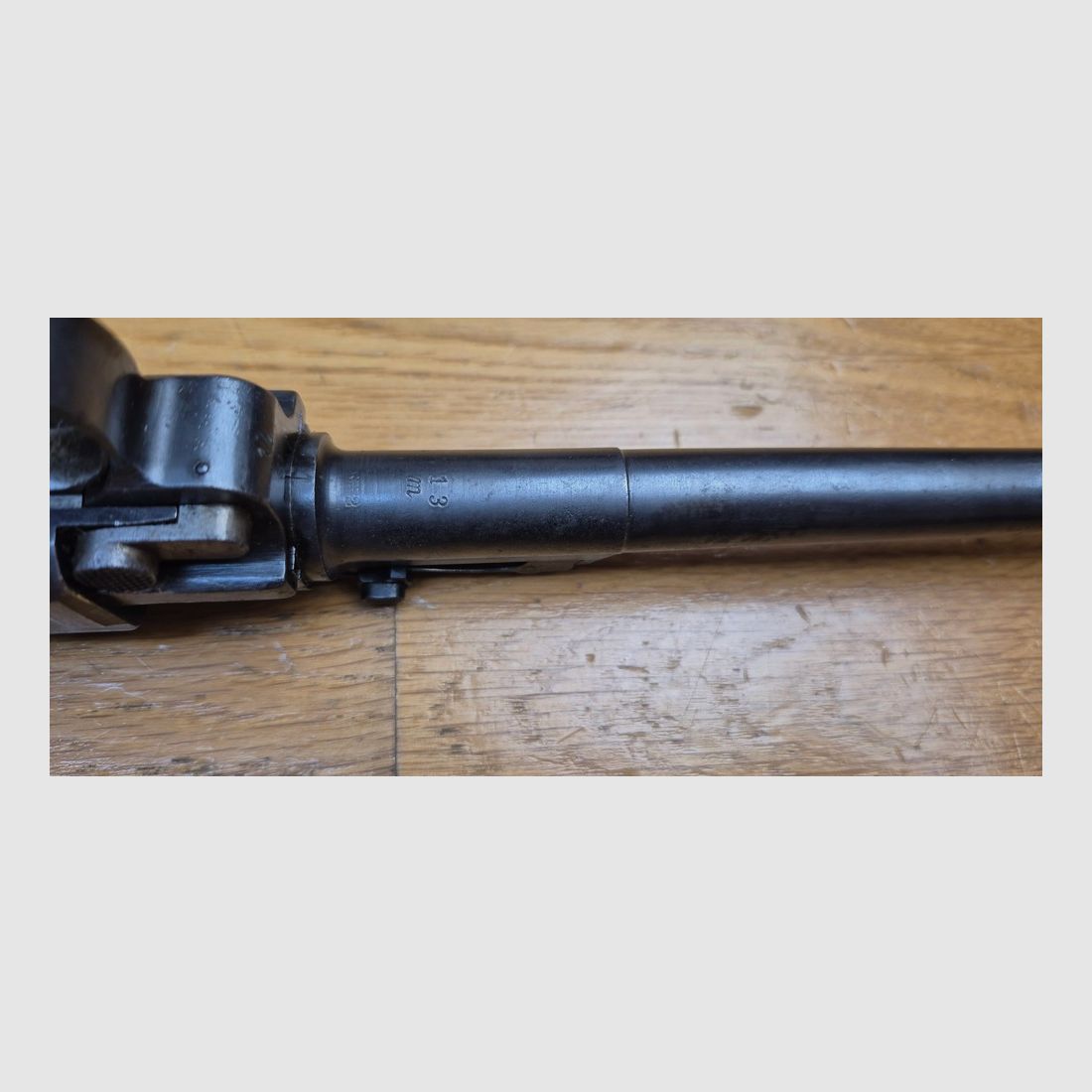

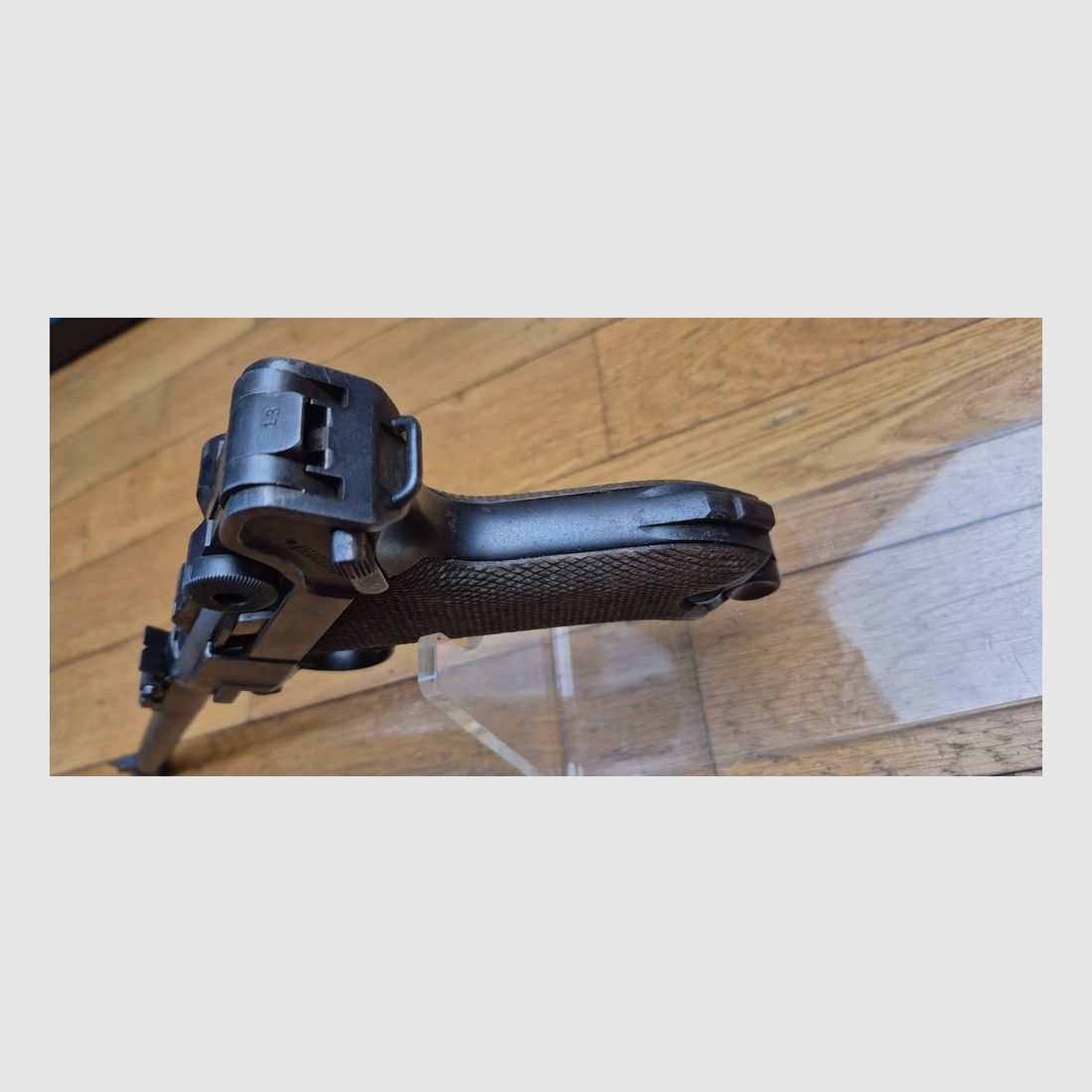
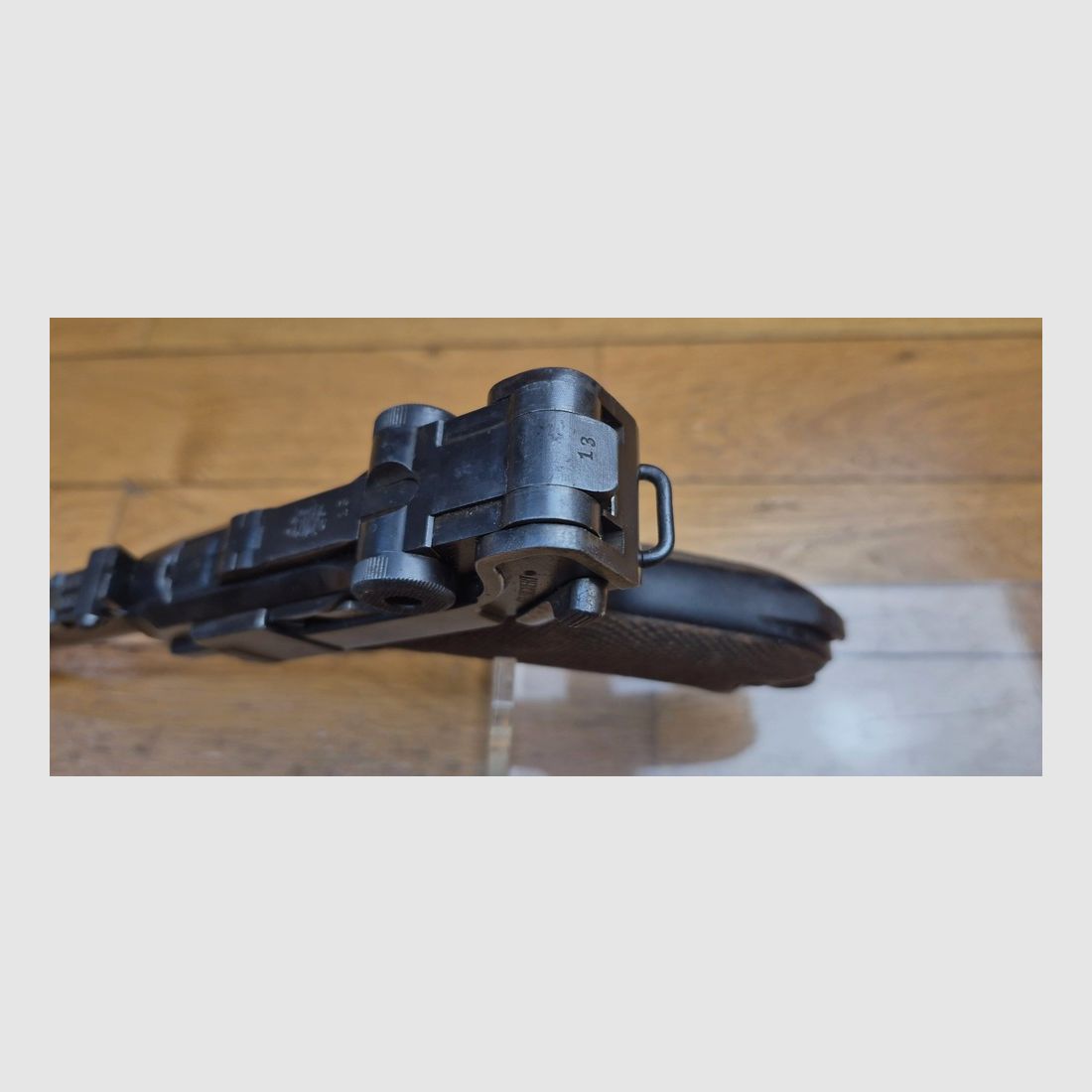
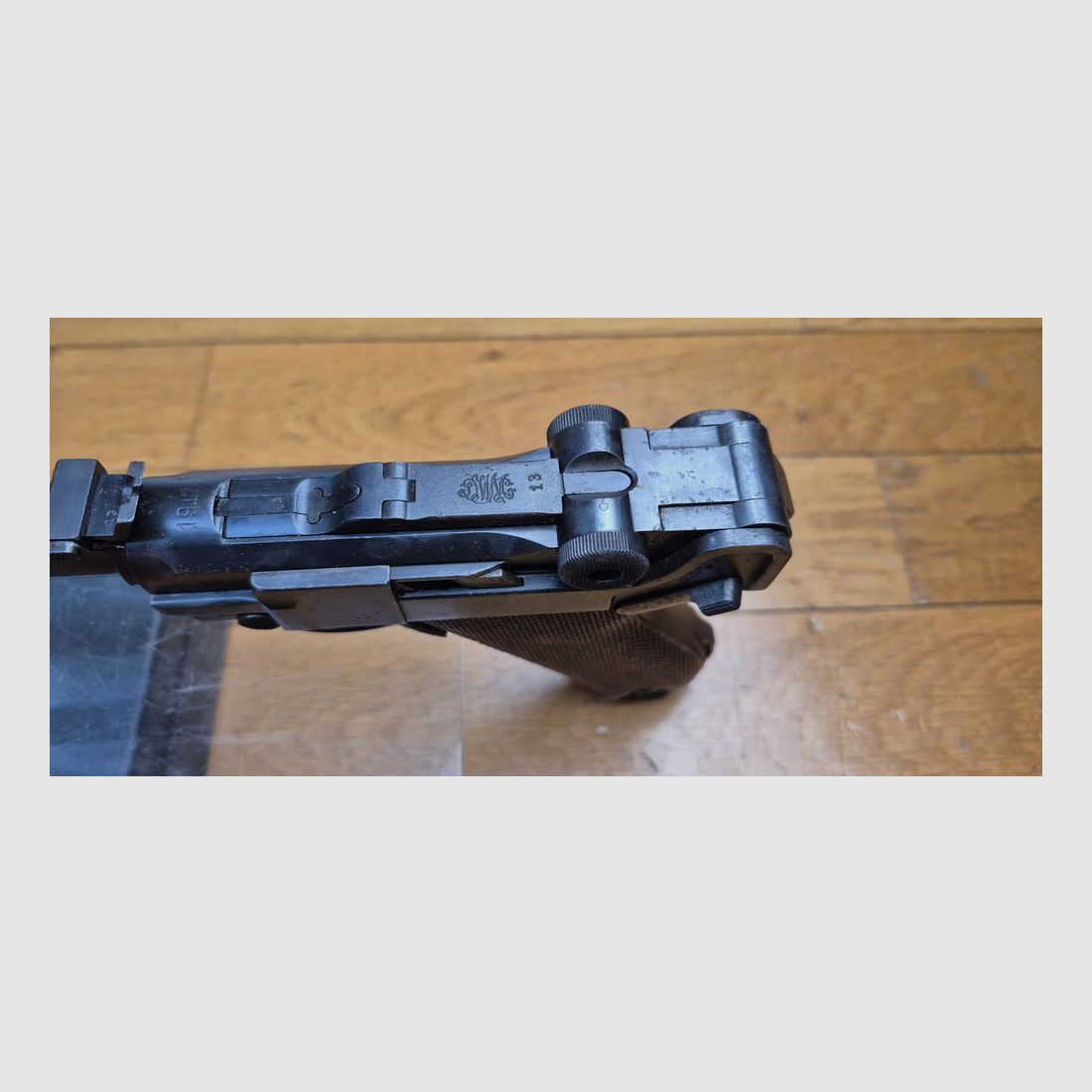
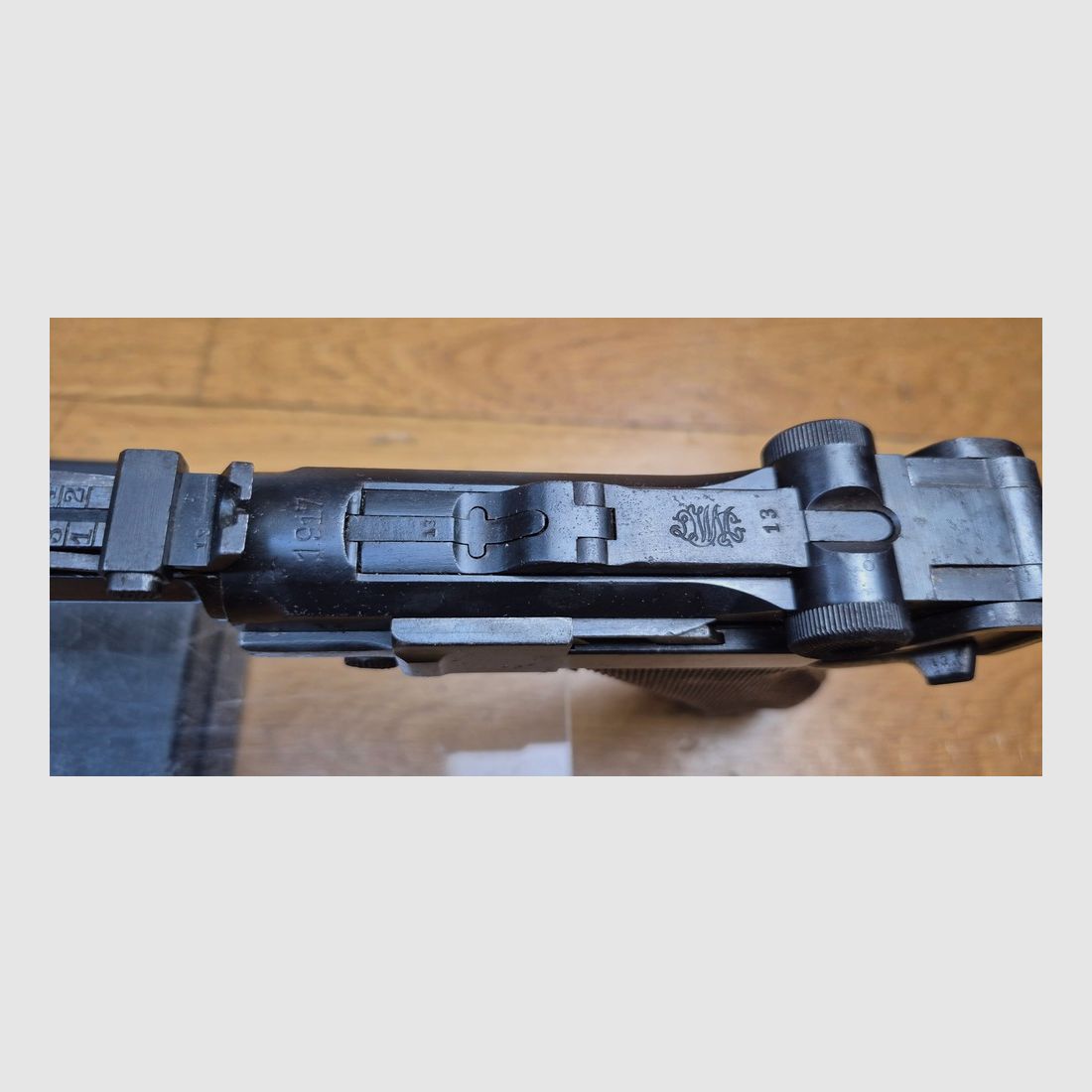

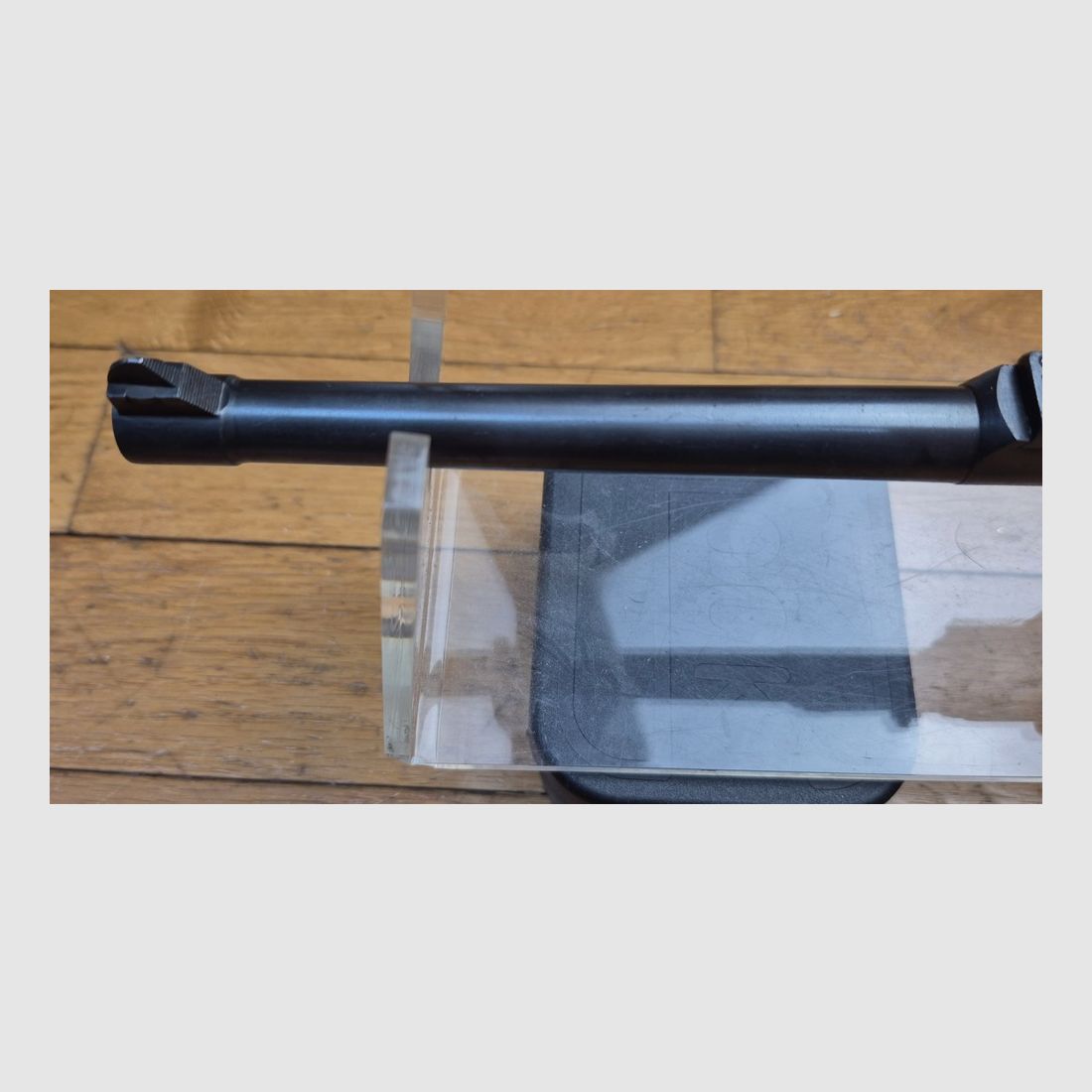
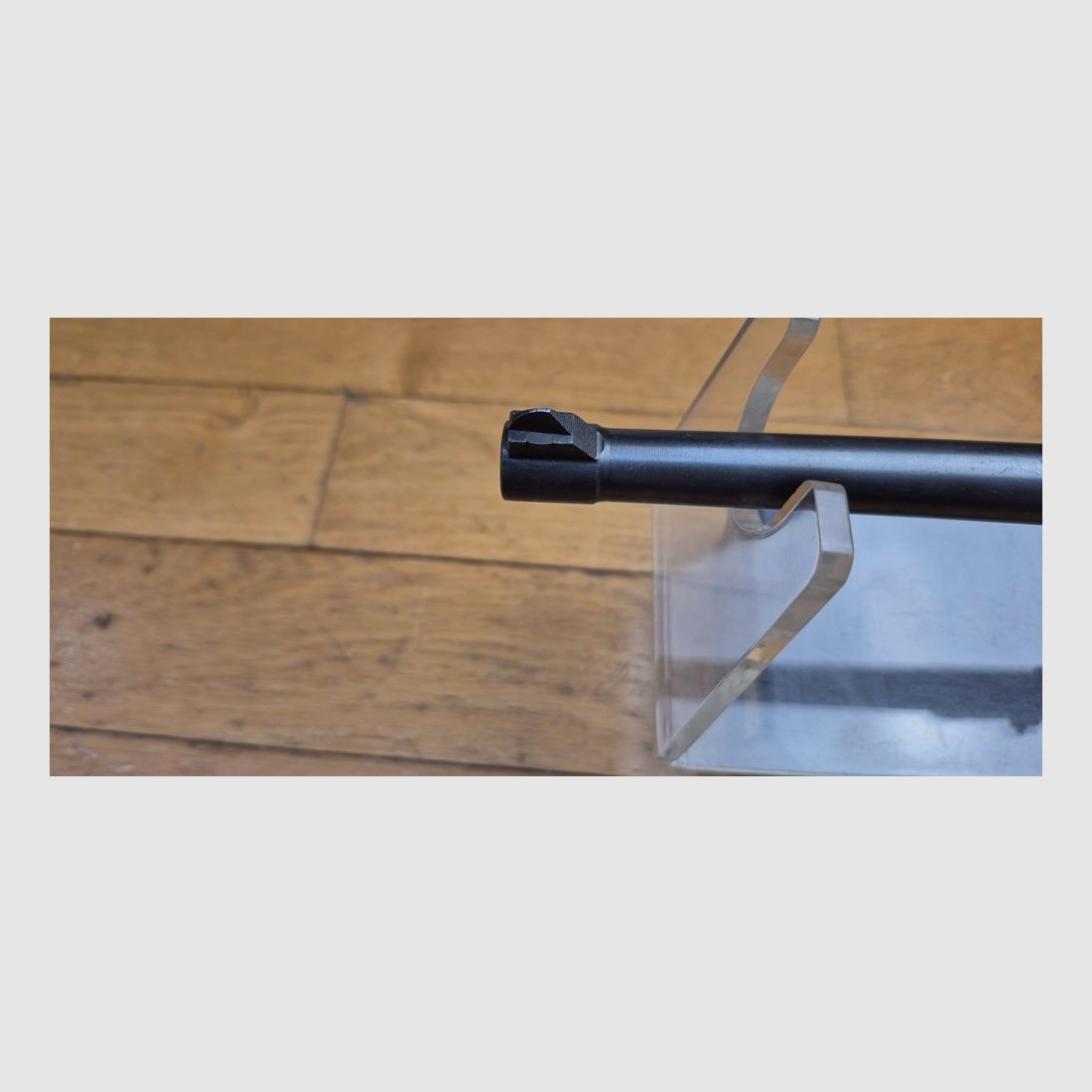
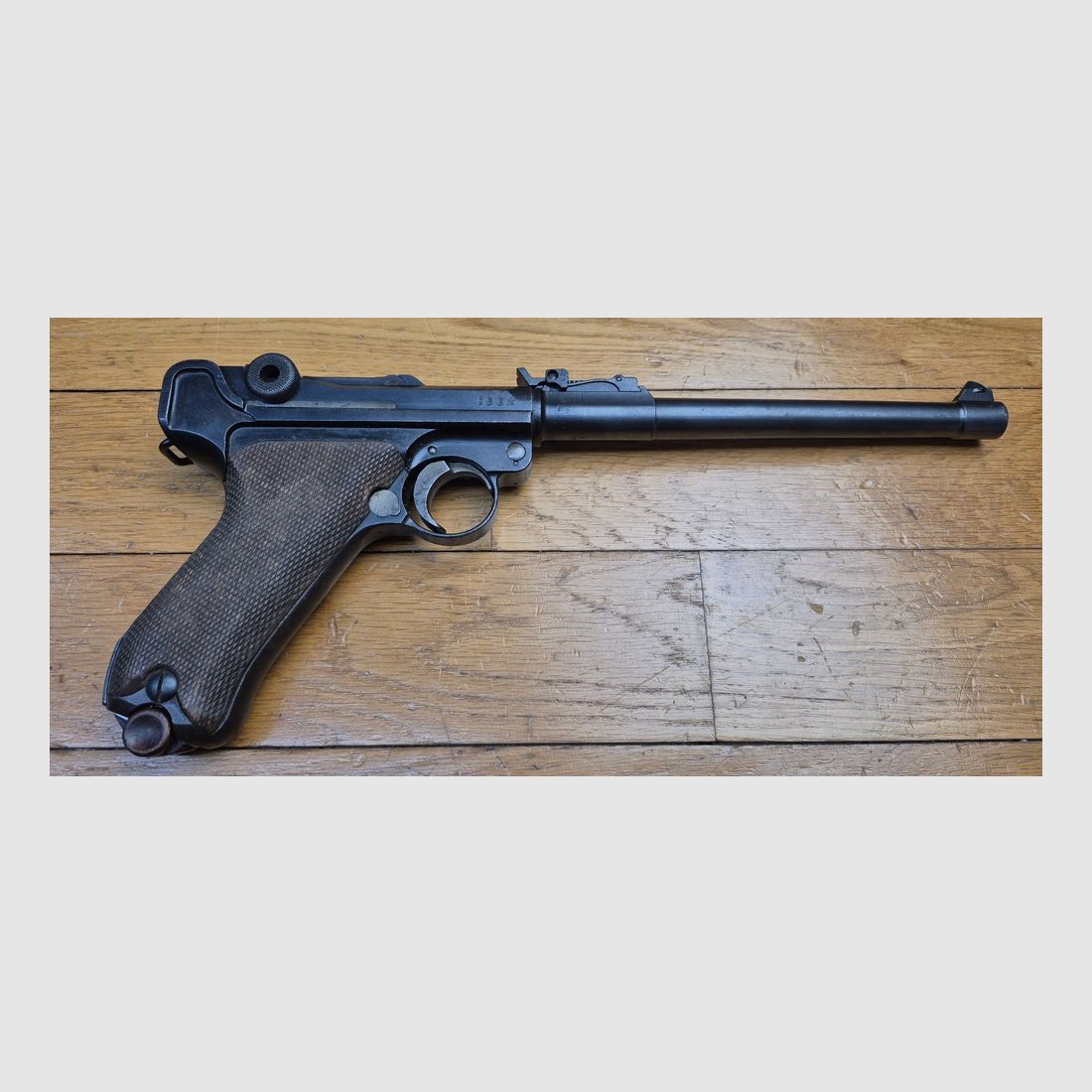


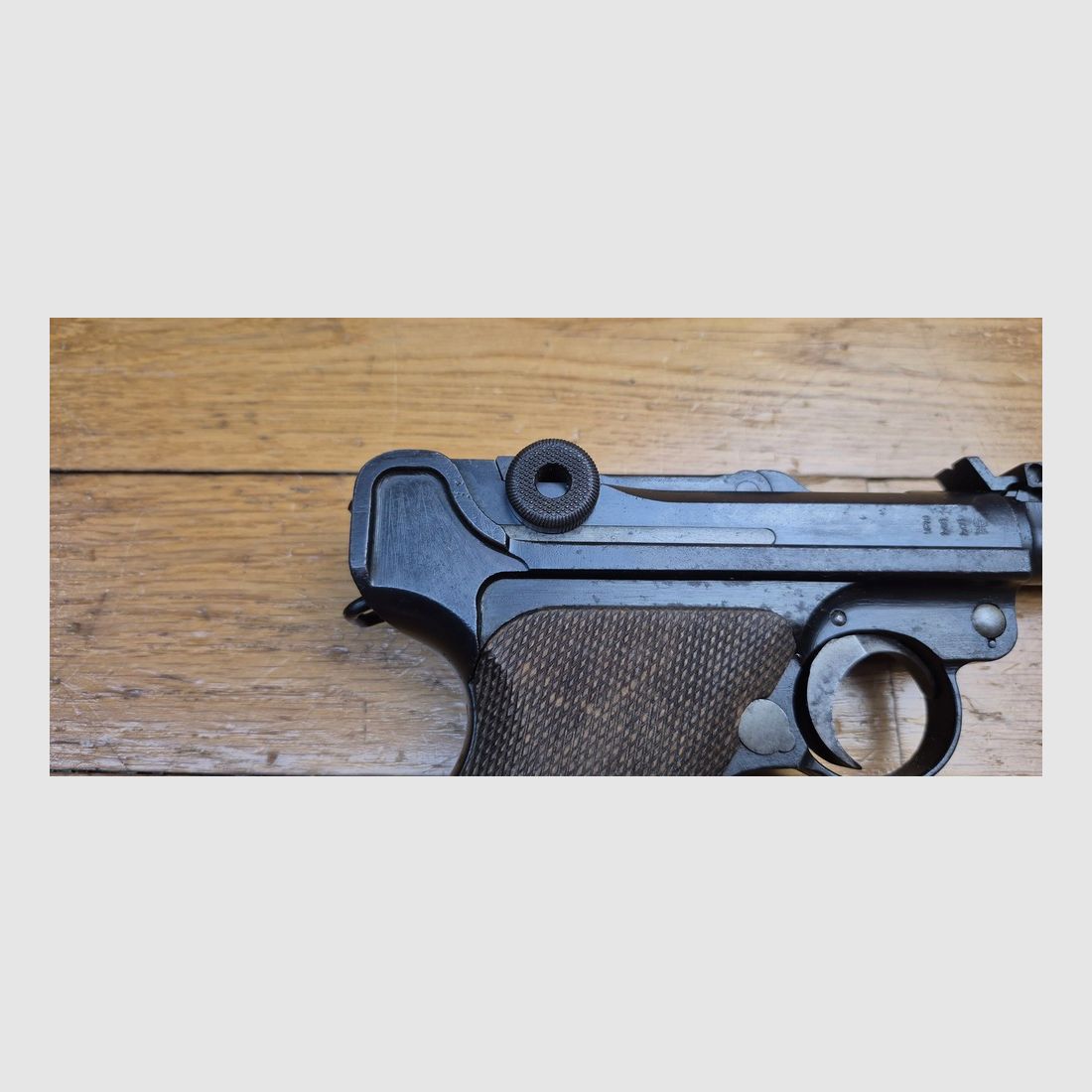
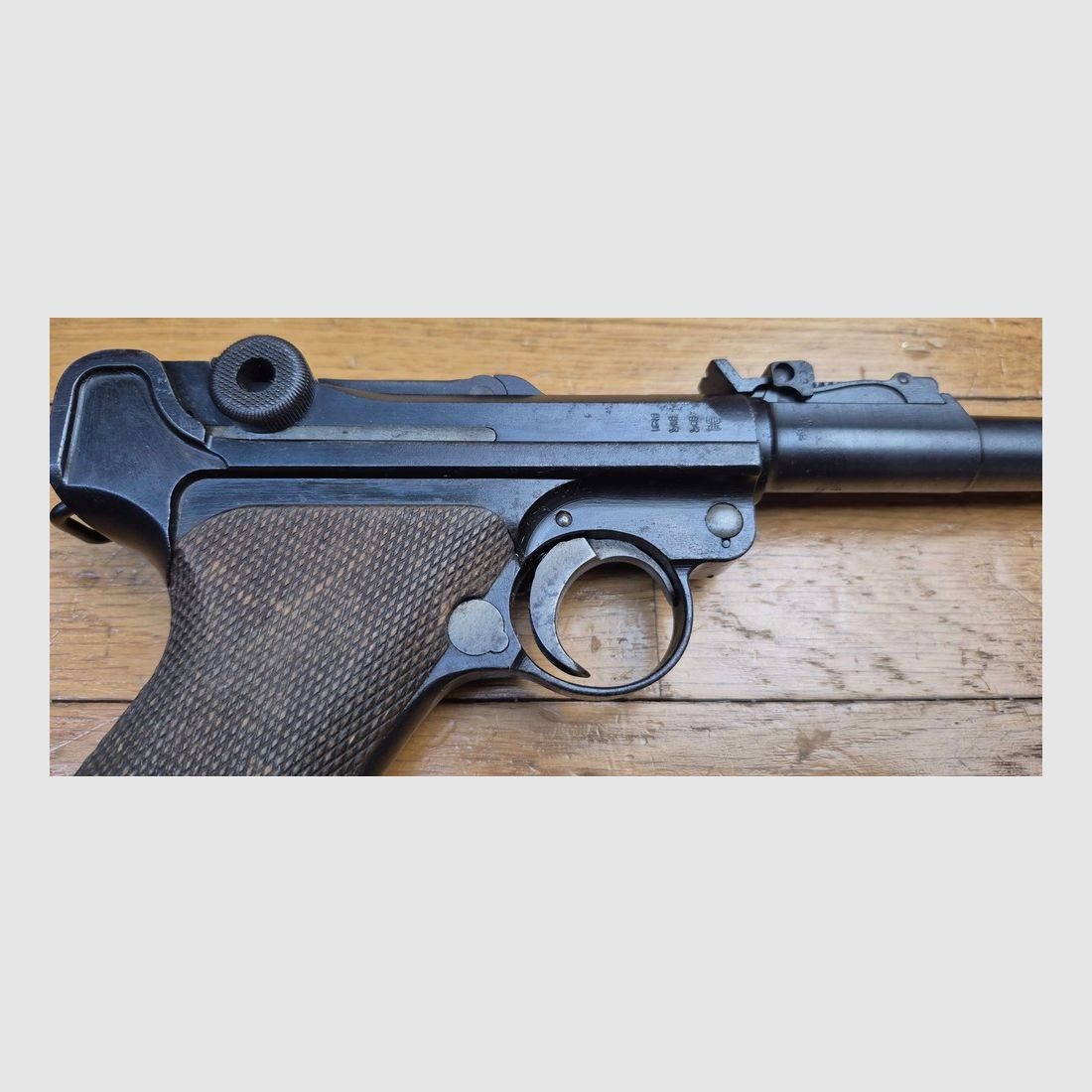
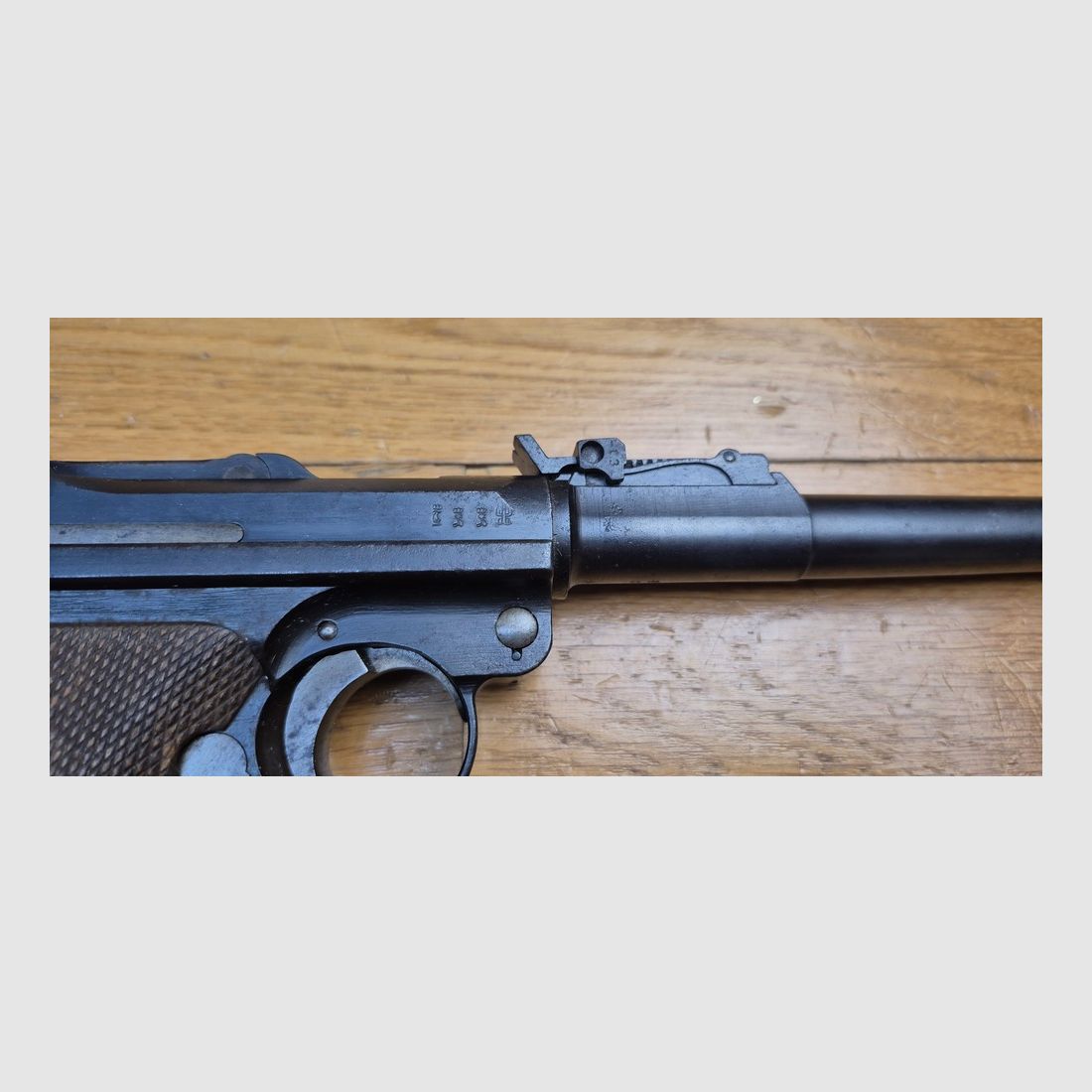
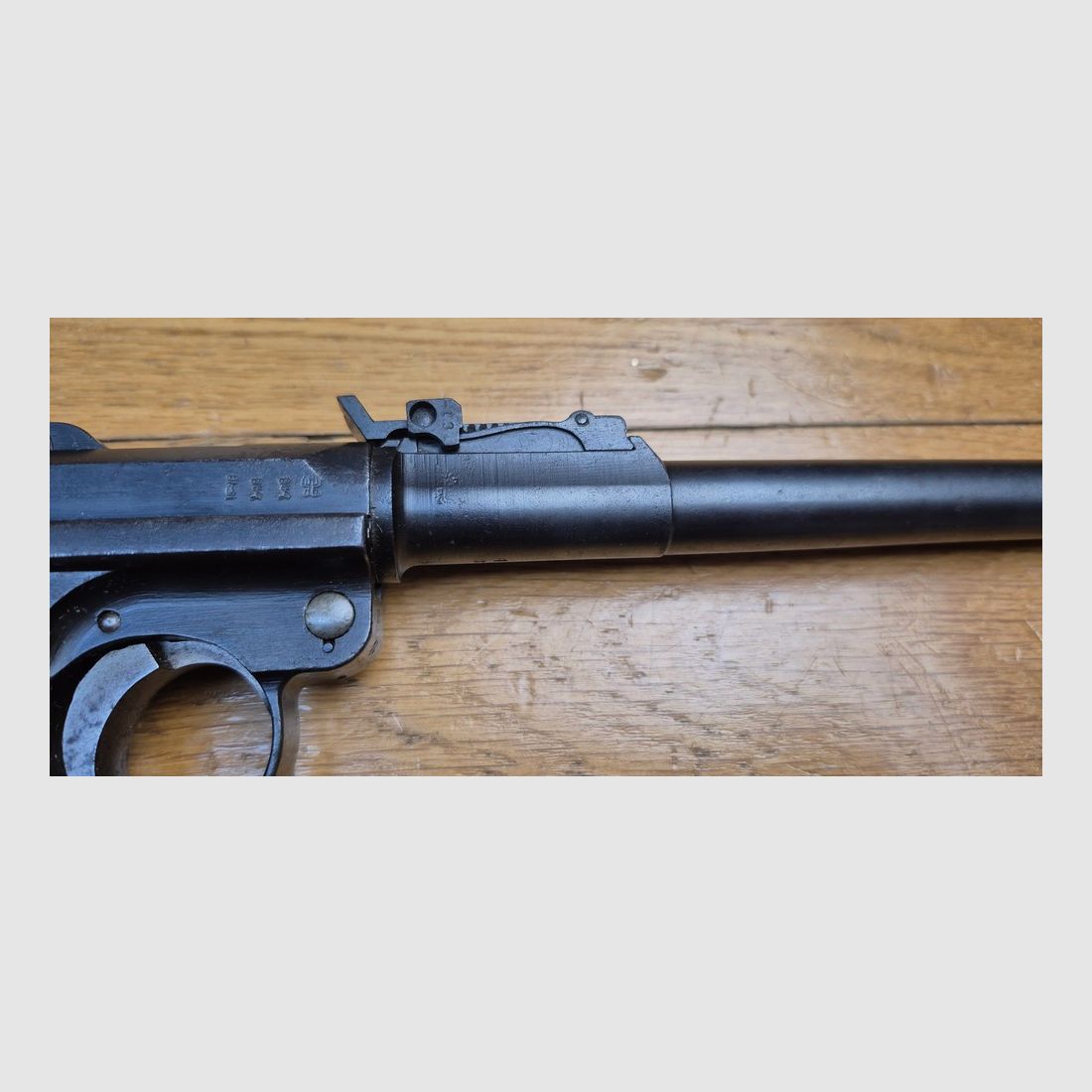
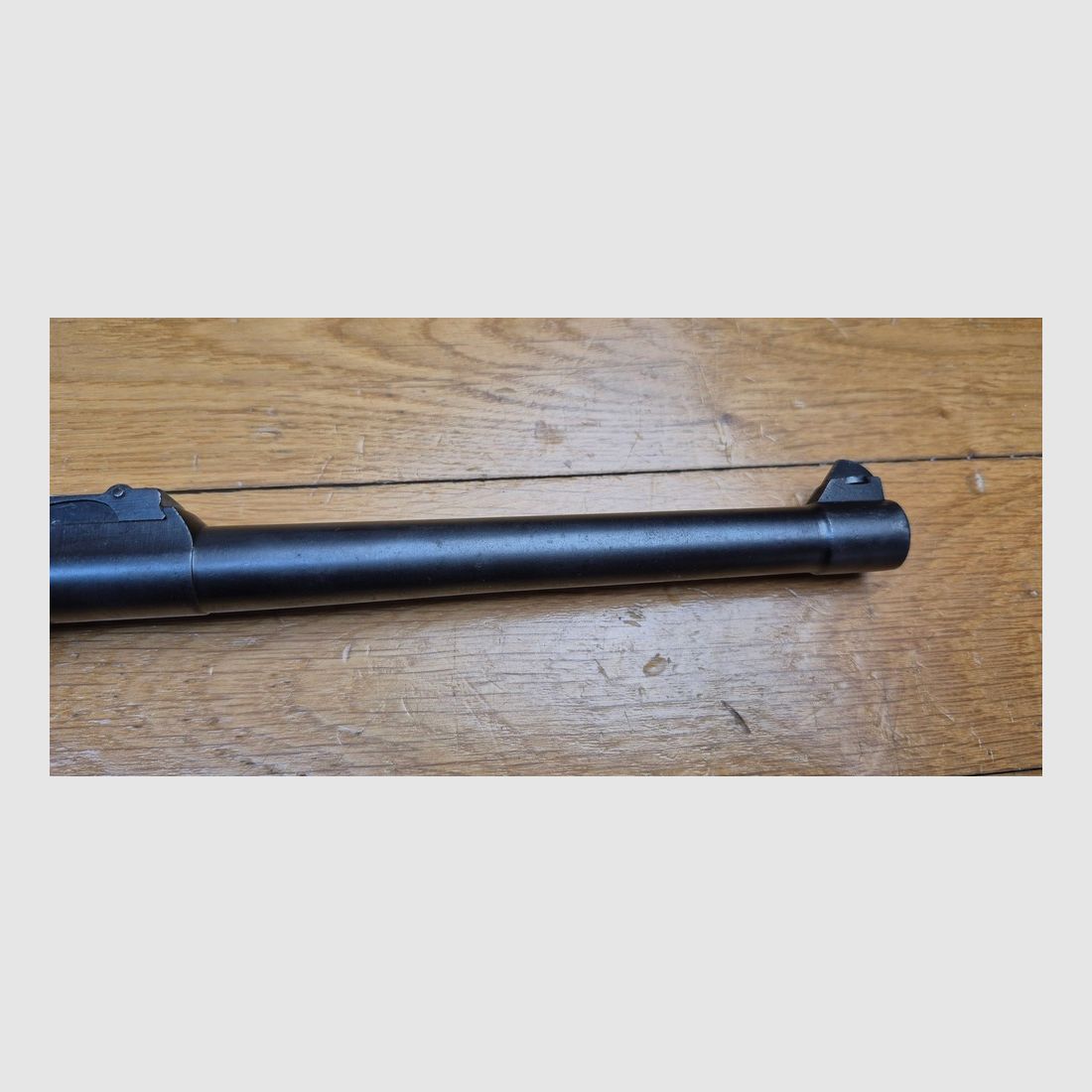
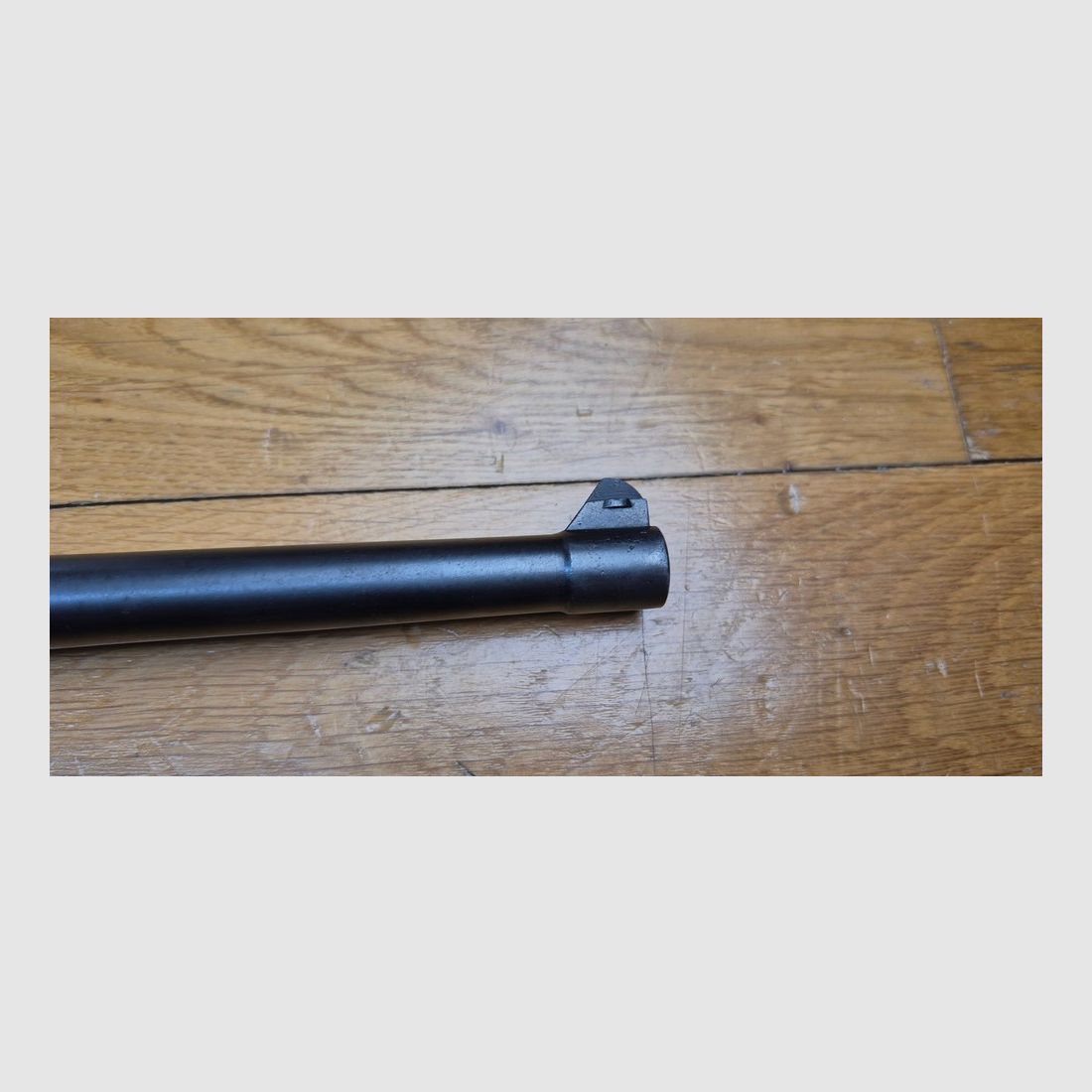
Very nice Luger artillery P08 – Weapon from 1917 – Barrel 8 inches (20cm!) – Made by DWM – Fully matching (except the magazine which is period) – Cal. 9×19 – Rare second type rear sight and front sight – Very nice grips – Period bluing still at 80% – Splendid barrel – TBE+
≈ $2,528
Price at the dealer: 2,300 €. Converted at the ECB rate as of November 20, 2026.
Purchase permit required
75002 Paris, France
10
ID: 10338501
This item is currently unavailable.
Purchase from outside the EU: The firearm goes through an importer in your country, the dealer handles the export.
How buying from Europe works
Shop safely with Gunfinder
Our AI-powered seller identity verification makes Gunfinder the safest marketplace online.
Learn more
Details
- Original language
- French
- Category
- Purchase eligibility
- Required
- Caliber
- 9mmLuger
- Condition
- New
- Location
- 🇫🇷 75002 Paris, France
- Availability
- Out of stock
Freshness
This listing is based on a mirrored offer, where the listing data was synced to us from a shop, dealer, or external marketplace. Please note that temporary price discrepancies may occur due to possible delays in data transmission.
- Source
- Flingus Maximus
- Last checked with the dealer
- 1 day ago
Description
Note:
The item is located abroad. Please note that delivery conditions, shipping times, and/or the purchase process may differ.
In these words, we could sum up one of the most extraordinary passions for firearms anywhere in the world: the passion for Parabellums and the work of George Luger (1849–1923), a benefactor of humanity—or at least of those who love firearms. And, incidentally, a distinguished member of Maître Flingus’s Hall of Fame.
The way of the future in this new century (it’s around 1900): the so-called “automatic repeating pistol” (meaning semi-automatic), as it was called back then, was a must for any army that wanted to be at the cutting edge of progress.
In May 1900, Switzerland became the second power to adopt one of these “semi-autos”—the height of modernity. And the very first to adopt the Luger. Before Germany.
As for semi-automatics in general, it was beaten to the punch by the brazen Belgians by just two months. They had struck first with their Browning 1900.
But Switzerland would have its revenge, because the weapon chosen by the Swiss went on to have a prolific and magnificent lineage.
From that point on, alongside a healthy number of civilian orders, Lugers featured in every government program to adopt a handgun. Even in France.
There was something for everyone: dozens of Luger variants in barrel length, operating details, country of issue and, of course, caliber—from 7.65 Parabellum to .45 ACP (!), with the ubiquitous 9mm Parabellum, designed by the same father, George Luger, in 1902, in between.
They were all more beautiful and better finished than the last. Their chambers were adorned with fantastic emblems reflecting their destinations, from the peaceful Swiss cross to the fierce Lion of Persia against a rising sun, and the American bald eagle.
Now, if there’s a king among service Lugers, it’s German.
Germania was not ungrateful to her sons, assigning a specific model to each branch of her armed forces.
Her proud navy, which meant to challenge the unshakable Royal Navy, was the first to be equipped, starting in 1904. It, too, received a model with a long barrel (15 cm) and an attachable shoulder stock, plus a rear sight for shooting at 100/200 m. This was the legendary P04, a sea serpent of modern weaponry, eagerly watched for by hoplophile paparazzi around the world.
Then came the army, in 1908, with the P08, by far the most widely produced model. And the one that remained in service the longest.
We’d still see the P08, adopted in 1908, in the holsters of Luftwaffe airmen and German submariners during the Battle of the Atlantic. With them, it would be lost everywhere from Stalingrad and Venezuela’s oil-rich coasts to the ruins of Berlin, badly ravaged and not at all liberated. Just conquered in 1945.
Finally, the artillery would be issued this marvel, the “long P08,” known as the “artillery” model.
But it would only appear in 1914, and in very small numbers, making artillery Lugers dated “1914” highly desirable.
Hence the terms “P14” or “P08/14,” sometimes used by collectors to refer to it, because the earliest examples you occasionally see really are from that year. We’ll come back to that.
The designation “artillery P08” is not, in fact, an official one. The Heer knew it only as the “Lange Pistole 08,” or “long pistol, model 1908.”
1914?
Not quite, actually. The first to receive it was the Prussian air service, which, after trials between 1911 and 1913, received a few pistols with 20 cm “artillery” barrels in 1914, on the eve of war.
The weapon was officially adopted by Prussia on June 3, 1913, and Bavaria on July 27, 1913. So perhaps we should call it the “1913 pistol” rather than the “artillery pistol”…
The weapon, its holster and its famous stock cost 69 Marks 50 Pfenning. An expensive weapon. A luxury.
The clouds of war were gathering over Europe. But no one could
anticipate that everything would change so quickly from June 28, 1914. Production therefore remained very sluggish.
An artillery anecdote: In 1913, although the “standard” P08 had already been adopted five years earlier for infantry machine gunners (initially), the corporal-medic was the only man in the artillery battery equipped with a P08. The rest of the unit was still equipped with 147 obsolete black-powder revolvers, models 1879 and 1883…
It must be said that fewer than 135,000 “handguns” had been produced for the rest of the army (excluding the navy) since 1908.
Despite substantial orders for the long P08 (144,000 weapons to be delivered by 1919 for the Prussian army alone), intended for the artillery, it is certain that very few long P08s were in service in August 1914. A few thousand at most.
Between August 1, 1914, and the end of February 1915, only 27,617 long P08s had been manufactured, including 3,068 for Bavaria. Only around 55,000 would be produced by 1916.
In reality, the P08 would not arrive in significant numbers until 1917, helped by the expansion of the artillery and, above all, the Sturmtruppen (assault troops). That explains why you mostly see “1917” models.
The Americans would be very impressed by this weapon.
They would understand the value of the pistol-carbine concept, even in a light caliber. A “light” carbine, or even a semi-automatic pistol-carbine like the long P08, easy to carry at your side, is often more useful than a pistol—even one as powerful as a Colt 1911—for defending your artillery pieces against an enemy who has caught you by surprise.
Shooting at a moving target with a pistol from 20–30 meters and hitting it now and then is already quite an achievement…
Their evaluation reports would lead them to consider equipping their technical troops, such as artillerymen and engineers, with a longer semi-automatic weapon than their Colt 1911 as early as November 1918. Routine and the 1929 crisis would mean they had to wait until 1941 and the USM1 to put this excellent idea into practice.
But knowing that our iconic artillery Lugers are also the distant, if only spiritual, ancestors of the equally iconic USM1 is amusing in itself.
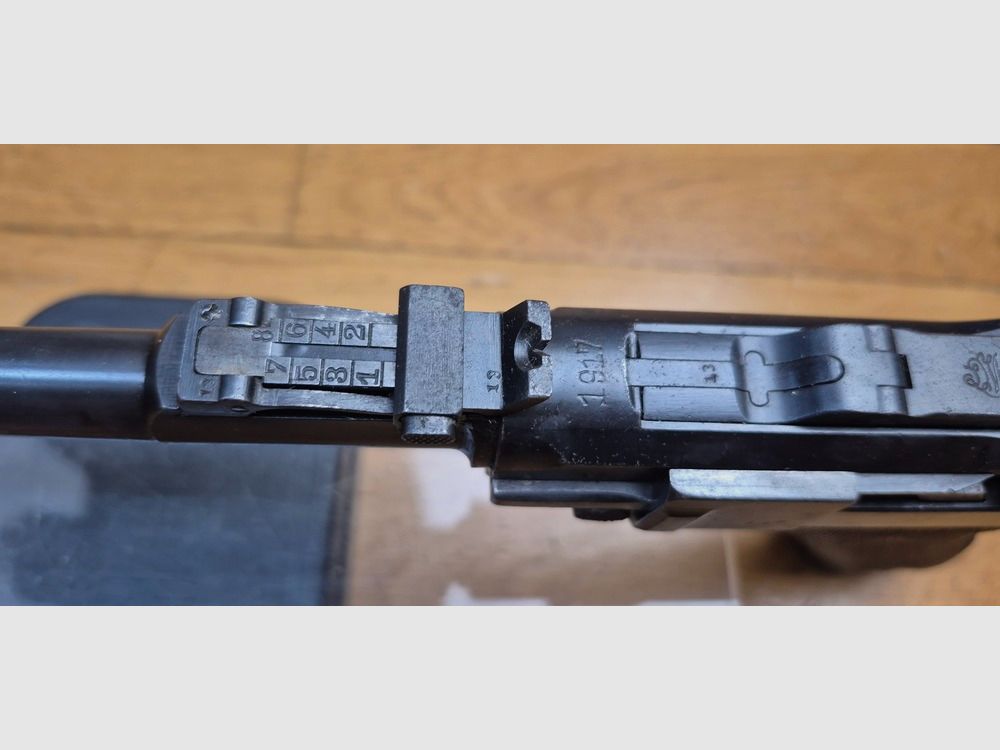
This so-called artillery Luger, the weapon we’re featuring today, is magnificent, with its rear sight graduated up to 800 m (almost half the range of the manually operated 8×57 bolt-action carbine used by these same artillerymen!).
And its wonderful 20-centimeter barrel is as graceful as Adriana Karembeu’s legs…
Some of the Kaiser’s artillerymen therefore traded an elegant Mauser 98a carbine in 8×57 IS for what was designed as a take-down semi-automatic carbine, in a less powerful caliber, certainly, but with a more compact size and higher rate of fire.
At a time when conversion kits like the Roni are popular, the concept of a handgun that can instantly be transformed into a small carbine was already highly developed!
And this one has an incomparable look.
This “specialized” service weapon would become one of the most iconic weapons of the First World War when the fearsome Sturmtruppen assault troops took it up.
And they weren’t the only ones.
The famous Red Baron, Rittmeister (a cavalry rank equivalent to captain; Manfred was an Uhlan officer) Manfred Von Richtofen, carried one in his scarlet triplane.
The Fliegertruppen, the Luftwaffe’s predecessor, had adopted it in small numbers as early as 1913. A combat weapon, it was initially reserved for observers and machine gunners.
As for the Sturmtruppen, their long P08s, fitted with shoulder stocks and high-capacity magazines introduced later, around 1917, made them formidable trench clearers.
The excellent grip provided by the Luger’s famous grip angle is enhanced on our example by wooden grip panels in excellent condition, with no stains or dents.
The checkering of
The finish is perfect and very eye-catching. We haven’t made anything up. An uncompromising grip since 1914.
The stock lug is present and fully functional (we couldn’t resist testing it with this stock). It’ll be delighted to take an authentic, high-quality stock and turn it into a carbine. This stock is here. No play at all!
Our firearm’s magazine has a wooden base, just as was standard for production during 1914–18 (aluminum and Bakelite came in World War II).
Although the firearm is compatible with these later aluminum- or plastic-base magazines, this small difference gives it a significant advantage and an old-world charm.
The magazine’s serial number differs from the rest of the firearm, which is celebrating its 109th birthday. Luger pistols were issued to their owners with a holster and two magazines bearing the firearm’s serial number, but finding them today—especially both magazines—with their original firearm is exceptional.
Our magazine is in excellent condition, with a spring that’s still firm after all these years.
The locking button feels firm, very Germanic.
The safety lever, duly engraved “Gesichert” (“safe”), is very easy to operate. The trigger is military, but not unpleasant. If you’re used to a Glock, you might even find it excellent! On our example today, it’s very smooth after a short take-up.
Very slight machining marks are visible, typical of these late-war productions, when there was no longer time to be as “delicate” as before the war. And yet, it’s beautifully finished!
Better than many modern handguns, despite the fact that the Kaiser’s factories were running three shifts to feed the insatiable Moloch at the front. In my opinion, modern gunmakers have no excuse—other than immediate profitability.
The extractor has the same serial number as all the other parts. An important detail and a sign that it hasn’t been replaced after firing overly powerful loads. All the firearm’s parts are matching.
Because of its eight-inch barrel, you’ll need slightly hotter handloads than for a standard P08, while still staying below a “normal” 9mm Parabellum load if possible.
Its springs are perfect, so it’ll handle commercial ammunition without a fuss. Just don’t turn it into a machine gun, and give this noble old-timer time to rest… Ideally, reload for it, but subsonic ammunition—which generally has 15% less muzzle energy—should work very well.
The firearm functions very well mechanically. It just needs a thorough cleaning and, above all, careful lubrication.
With a barrel like this, you’ll soon be annoying your range neighbors with their Glocks! And with a stock, you’ll be unbeatable!
The chamber is adorned with the proud date “1917,” the year of the Chemin des Dames and the endless, savage destruction wrought by the “Pickelhaube wearers” during their well-planned retreat to the Hindenburg Line. There, they would quietly await their chance to launch the last-ditch Spring Offensive of 1918.
From 1917 onward, the artillery P08 was produced on a larger scale and was no longer reserved for artillerymen. It was issued in large numbers to assault troops.
To give you an idea, just 25,000 were produced in 1916, four times as many in 1917 (100,000), and then 25,000 again in 1918.
That explains why, given the losses and destruction, you—and I with you—are far more likely to come across a 1917 than any other year! And a DWM far more often than an Erfurt, of which only 25,000 were produced in total.
So what’s the overall picture?
The total number of artillery Lugers produced was still just under 200,000, probably fewer than 1
95,000 out of a total of 1.35 million military Lugers produced between 1908 and 1918 were long P08s, known as artillery models—a little under 15%.
This total of 1.35 million also includes the 34,000 P04s produced between 1904 and 1914 and during the war.
So the vast majority of Lugers from 1914–18 were P08s with 10 cm barrels. The “standard” models, already highly desirable…
Ultimately, relatively few P08 artillery models were produced. And how many have been destroyed since then?
They have become rare, especially in the condition of ours.
Our example is fitted with the non-adjustable rear sight of the second type, introduced from September/late 1917 onward. It is in perfect working order, matching numbers throughout, and has no play.
To me, this second-type rear sight is a rare and interesting feature. 80% of the 1917 models I see have the adjustable first-type rear sight. Just fantastic! This is clearly a late-1917 weapon, ready for action. It would have seen the astonishing assaults of 1918.
Our weapon was produced by DWM (Deutsche Waffen und Munitionsfabriken) in Berlin, whose beautiful logo it bears on the toggle. DWM also made the infamous Maxim machine guns, remembered with dread by our troops.
Our weapon is also rare because of its very fine condition, with 95% or more of its original bluing. It has barely been lightened by wear, overzealous cleaning, or carrying in a holster, as is unfortunately often the case. It is beautiful, and that is very rare.
A little thinning on the edges; the rest of the bluing is truly impeccable. This is “wartime” bluing, darker and less shiny than early-war bluing, which confirms its date. An excellent piece aesthetically.
Very few oxidation spots, shallow and scattered. In fact, almost none. They look VERY exaggerated, as do the machining marks, because of MY ENORMOUS, GIGANTIC close-ups. Look at the overall photos and see for yourself.
A gentle but patient rub with 0000 steel wool and WD-40 will remove most of the surface marks without affecting the proof marks or bluing at all, and make it even more beautiful. I simply don’t have the time. Objectively, it’s an example that needs cleaning, but a superb late-1917 example.
In your hands, all of this disappears, leaving a very beautiful weapon you’ll be proud of. Only the original straw-yellow finish on the parts that had it when they left the factory has faded. Here too, there is no oxidation at all.
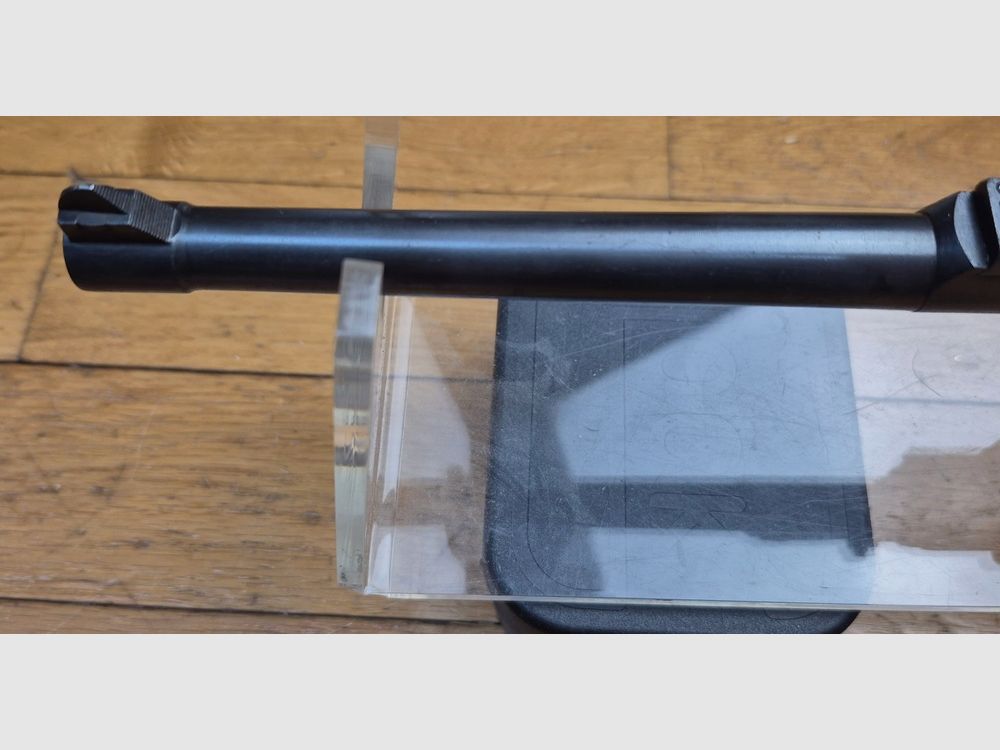
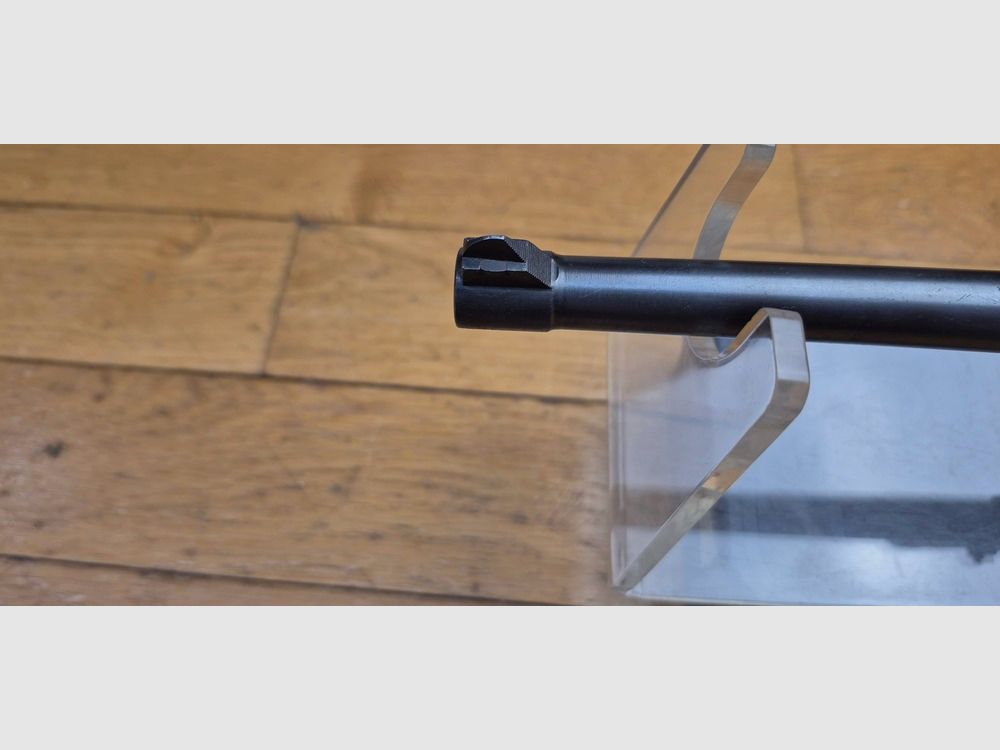
The 20 cm barrel is as exceptionally long as it is beautiful. It’s a little dull because it hasn’t been cleaned either, but it’s not oxidized at all and, above all, has very fine rifling. This 20 cm length gives this legendary weapon a unique silhouette. A very fine barrel that has seen very little use!
You don’t see Lugers like this every day, especially artillery models, with matching numbers and in such excellent overall condition. Maître Flingus goes to great lengths to find them for you in such well-preserved condition and probably turns down 3 out of every 4 offered…
How many are left? Especially in this condition.
Many were destroyed, and very quickly. And not just because of the fighting. Why?
The Treaty of Versailles imposed a maximum barrel length of just 10 cm to prevent the proliferation of these semi-automatic pistols, which could become perfect guerrilla carbines, easily concealed under the raincoat of some Albert Léo Schlageter…
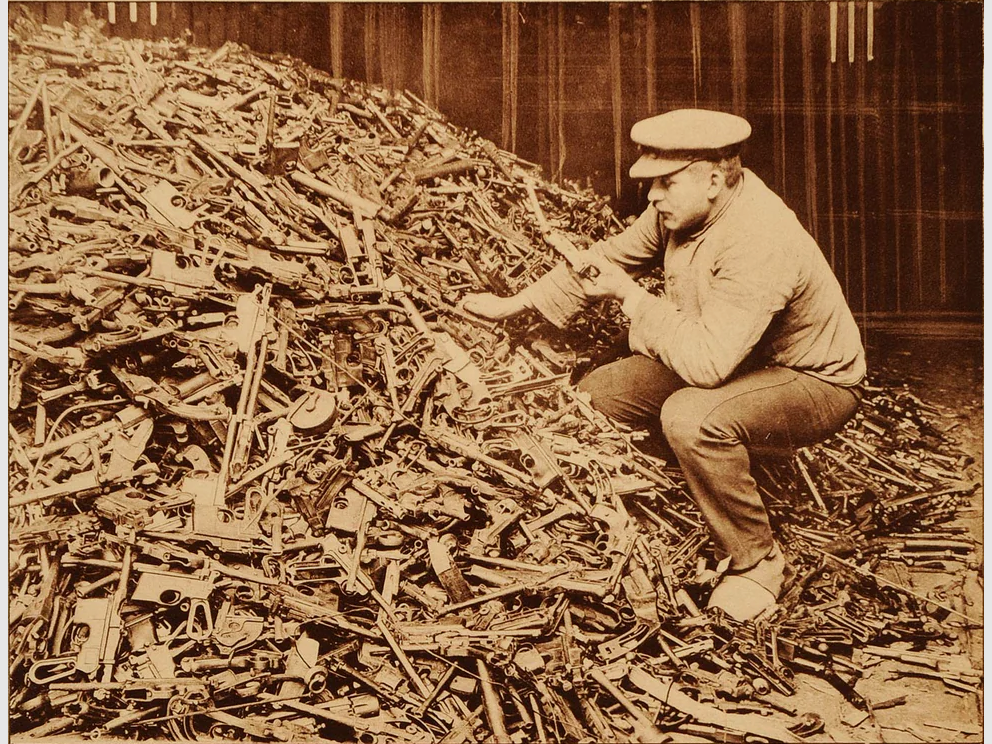
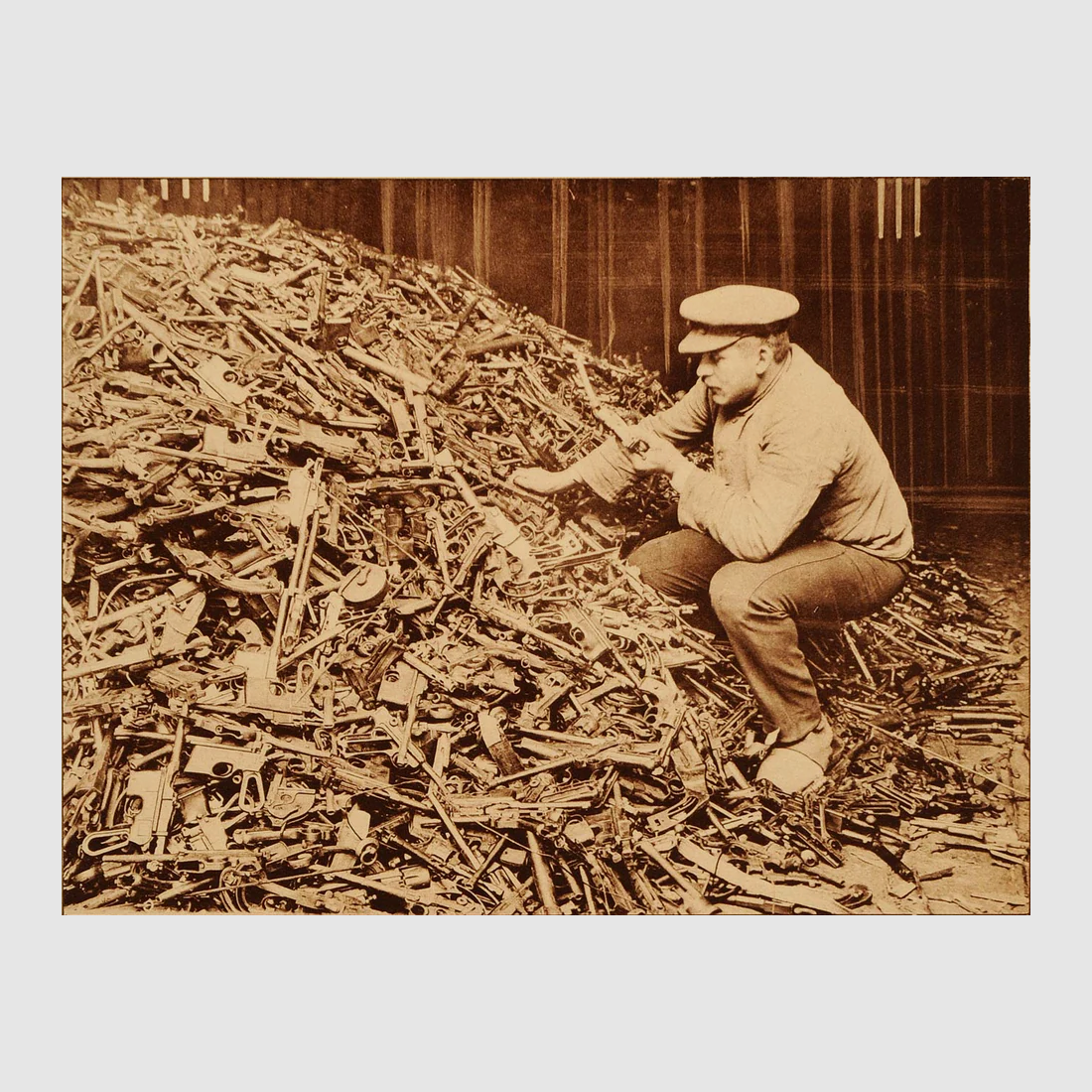
The destruction of these exceptional weapons began very early.
For fun, I’ve included a period photo puzzle. Besides an impressive number of C96s, try to spot our favorite long P08s (there are quite a few!) and imagine what this pile, sent off for scrap, would be worth today…
This holy grail of German firearms is exceptionally available from your favorite antique dealer and gunsmith. It’s beautiful and will become increasingly difficult to find in this condition with its original bluing. A Flingus pick!
For a holster that
fits this firearm: see here
CATEGORY B FIREARM UNDER THE CSI: FIREARM REQUIRING AUTHORIZATION, PHOTOCOPIES OF A VALID ID AND FIREARMS LICENSE REQUIRED – SIA ACCOUNT MUST BE OPENED. Shipment requiring a signature in two separate packages at least 48 hours apart is mandatory.
*********************************************************************************************************************
Let’s say it again! Flingus Maximus gun shop in Paris and throughout France is also here to buy your firearm and militaria collections, appraise your firearms, and answer your questions about legislation or firearms in estates and inheritances. Contact your favorite gun dealer via our contact form or at [email protected] (Show description in original language)
Parlez moi de Luger, parlez moi d’amour.
En ces mots, on pourrait résumer l’une des plus extraordinaires passions armurières partout dans le monde: celles des Parabellums et de l’œuvre de George Luger (1849-1923), bienfaiteur de l’humanité, au moins celle amatrice d’armes. Et accessoirement membre éminent du Panthéon de Maître Flingus.
Voie d’avenir en ce siècle nouveau (on est vers 1900), le pistolet dit « à répétition automatique » (comprendre semi-automatique) comme on l’appelait alors était un must pour toute armée qui voulait être à la pointe du progrès.
La Suisse, en mai 1900, fût la seconde puissance à adopter un de ces « semi-auto », comble de modernité. Et la toute première à adopter le Luger. Avant l’Allemagne.
Pour ce qui est des semi-automatiques en général, elle ne se fit doubler que de deux mois par l’insolente Belgique. Qui avait frappé la première avec ses Browning 1900.
A charge de revanche, car l’arme choisie par les helvètes eu une prolifique et magnifique descendance.
A partir de cette date, et au delà de commandes civiles bien remplies, les Luger furent de tous les programmes gouvernementaux d’adoption d’armes de poing. Même en France.
Il y en eut pour tous les goûts: des dizaines de variantes de Lulus en taille de canon, en détails de fonctionnement, en pays d’attribution, et, bien sûr, en calibre; du 7,65 parabellum jusqu’au .45 acp (!), en passant par l’omniprésent 9mm parabellum conçu par le même père, George Luger, en 1902 .
Tous étaient plus beaux et mieux finis les uns que les autres. Tous étaient couverts d’emblèmes fantastiques en chambre selon leurs destinations, de la tranquille croix helvétique au féroce Lion de Perse sur soleil levant, en passant par la pygargue à tête blanches des USA.
Or, s’il y a bien un roi parmi les Luger réglementaires, il est allemand.
Germania ne fut point ingrate envers ses fils, attribuant à chacune de ses armes un modèle spécifique.
Son orgueilleuse marine, qui entendait défier l’indéboulonnable Royal Navy, fut servie la première, dès 1904, et reçut, elle aussi, un modèle à canon long (15cm) et à crosse d’épaule adaptable, avec une hausse pour le tir à 100/200m. C’est le mythique P04, serpent de mer de l’armement moderne, guettés avec avidité par tous les paparazzi hoplophiles de la planète.
Puis ce sera l’armée de terre, en 1908, avec le P08, le modèle qui sera de loin le plus produit. Et surtout le plus longtemps.
On le verra encore ce P08, adopté en 1908, jusque dans les étuis des aviateurs de la Lufwaffe et dans ceux des sous-mariniers allemands de la Bataille de l’Atlantique. Avec eux, il s’en perdra encore de Stalingrad et des côtes pétrolifères du Venezuela jusque dans les ruines de Berlin sérieusement outragée et nullement libérée. Juste conquise en 1945.
Enfin, c’est l’artillerie qui se verra attribuer cette merveille, le « P08 long » dit « d’artillerie ».
Mais lui naîtra seulement en 1914, et en très petit nombre, ce qui rend les Luger d’artillerie datés « 1914 » très désirables.
D’où aussi le vocable « P14 » ou « P08/14 » utilisé parfois pour le désigner chez les collectionneurs parce que les plus anciens que l’on voit de temps à autres sont bien de cette année là. On va y revenir.
Cette désignation « P08 d’artillerie » n’est d’ailleurs en rien réglementaire. La Heer n’a connu comme modèle officiel que le « Lange Pistole 08 » ou « pistolet long du modèle 1908 ».
1914 ?
En réalité pas tout à fait. La première dotée fut l’aviation prussienne qui, après des essais entre 1911 et 1913, reçut quelques pistolets à canons 20cm type « artillerie » en 1914 à la veille de la guerre.
L’arme fut effectivement adoptée par la Prusse le 3 juin 1913 et la Bavière le 27 juillet 1913. On devrait donc plutôt parler de « Pistolet 1913 » que de « Pistolet d’artillerie »…
L’arme, son étui et sa fameuse crosse étaient facturés 69 Marks 50 Pfenning. Une arme très chère. Un luxe.
Les nuages de la guerre s’accumulaient en Europe. Mais nul ne pouvait anticiper que tout dériverait si vite à partir du 28 juin 1914. La production restait donc fort indolente.
Anecdote sur l’artillerie: En 1913, alors que le P08 « normal » avait été adopté déjà depuis 5 ans pour les mitrailleurs d’infanterie (au début), le caporal-infirmier était le seul homme de la batterie d’artillerie équipé d’un P08. Le reste de l’unité était encore équipé de 147 obsolètes revolvers modèle 1879 et 1883 à poudre noire…
Il faut dire que pour le reste de l’armée (hors marine) moins de 135.000 armes « courtes » avaient été produites depuis 1908.
Pour le P08 long, en dépit de commande importantes (144.000 armes à livrer jusque 1919 pour l’armée prussienne seule), à destination de l’Artillerie, il est certain que très peu de P08 long étaient à pied d’œuvre en août 1914. Quelques milliers tout au plus.
Entre le 1er août 1914 et fin février 1915, seuls 27.617 P08 long avaient été fabriqués dont 3068 pour la Bavière.Environ 55.000 seulement auront produits jusque 1916.
En réalité, le P08 ne fera une arrivée un peu significative qu’en 1917, développement de masse de l’artillerie et surtout des Sturmtruppen (Troupe d’assaut) aidant. Cela vous explique pourquoi on voit surtout des « 1917 ».
Les américains seront très admiratifs de cette arme.
Ils comprendront tout l’intérêt du concept de pistolet-carabine, même en calibre léger. Une carabine « light » voire un pistolet carabine semi-automatique comme le P08 long, facile à porter au coté, est souvent plus utile qu’un pistolet, fut-il aussi puissant qu’un Colt 1911, pour défendre ses pièces d’artillerie d’un ennemi qui vous a surpris.
Tirer au pistolet sur une cible mobile à 20-30 mètres et la toucher de temps à autre est déjà un exploit…
Leurs rapports d’évaluation fera qu’ils penseront à doter leurs troupes techniques genres artilleurs / Génie d’une arme légère semi automatique plus longue que leur Colt 1911 dès novembre 1918. Routine et crise de 1929 aidant, ils leur faudra attendre 1941 et la USM1 pour concrétiser cette excellente idée.
Mais savoir que nos iconiques Luger d’artillerie sont aussi les pères lointains, au moins spirituels, de la tout aussi iconique USM1 est déjà en soi amusant.
Ce Luger dit d’artillerie, notre arme de ce jour, est magnifique avec sa hausse graduée jusqu’à 800m (soit quasiment la moitié de celle du mousqueton en 8×57 à répétition manuelle qui équipaient ces mêmes artilleurs!).
Et son merveilleux canon de 20 centimètres est aussi gracile que les jambes d’Adriana Karembeu…
Les artilleurs du Kaiser troquèrent donc, pour certains, un élégant mousqueton Mauser 98a en 8×57 IS pour ce qui était pensé comme une carabine semi-automatique démontable, dans un calibre certes moins puissant, mais dont l’encombrement et la cadence de feu l’emporteraient.
A l’heure de la popularité des kits de conversion genre Roni, le concept d’arme de poing transformable en un instant en une petite carabine était déjà très abouti!
Et il possède ici une allure incomparable.
Cette arme de troupe « spécialisée » deviendra une des armes les plus iconiques du premier conflit mondial lorsque les terribles Sturmtruppen des troupes d’assaut s’en emparèrent.
Et pas qu’eux.
Le fameux Baron Rouge, le Rittmeister (grade de cavalerie équivalent à Capitaine, notre Manfred étant officier de Uhlans de son état) Manfred Von Richtofen en avait un avec lui dans son triplan écarlate.
Car les Fliegertruppen, l’ancêtre de la Luftwaffe, l’avaient bien adopté, au compte goutte, dès 1913. Outil de combat, il fut d’abord réservé aux observateurs et mitrailleurs.
Pour ce qui est des Sturmtruppen, leur P08 longs, munis de leur crosse d’épaule et de chargeurs de très hautes capacités qui viendront dans un second temps vers 1917, en feront de redoutables nettoyeurs de tranchées.
L’excellente prise en main de la célèbre pente de crosse du Luger est sublimée sur notre exemplaire par des plaquettes en bois en excellent état, sans taches ni coups.
Le quadrillage d’usine est parfait, bien accrocheur. On a rien inventé. Une prise en main intraitable dès 1914.
Le tenon de crosse est bien présent, parfaitement fonctionnel (nous n’avons pu nous empêcher de le tester avec cette crosse là). Il sera donc ravi d’accueillir une authentique crosse de qualité pour le transformer en carabine. Cette crosse est ici. Aucun jeu !
Le chargeur de notre arme est à fond bois bien conformément aux fabrications réglementaires de l’époque 14-18 (les aluminium et bakélite sont 2° GM).
Bien que l’arme soit compatible compatible avec ces chargeurs fond alu ou plastiques plus tardifs, cette petite différence lui confère un plus non négligeable et un charme désuet.
Le numéro de série du chargeur est différent du reste de l’arme, qui souffle ses 109 bougies. Il faut savoir que les Luger étaient livrés à leur titulaire avec un étui et deux chargeurs au numéro de l’arme mais qu’il est aujourd’hui exceptionnel de les retrouver (surtout les deux!) avec leur arme d’origine.
Notre chargeur est en excellent état avec un ressort bien ferme pour ces 100 ans passés.
La sensation du poussoir de verrouillage est ferme, très germanique.
Le levier de sûreté dûment gravé « Gesichert » (« en sécurité ») se manipule avec une grande facilité. La détente est militaire, sans pour autant être désagréable. Si vous êtes habitués au Glock, elle ne vous paraitra même excellente! Elle est très douce après une courte course sur notre exemplaire de ce jour
Très légères traces d’usinage visibles, typiques de ces productions de fin de guerre, où on n’avait plus le temps de faire autant « dans la dentelle » qu’avant guerre. Et pourtant, il est merveilleusement fini !
Mieux que beaucoup d’armes de poing modernes et en dépit du fait que les usines du Kaiser fonctionnaient en 3/8 pour alimenter le Moloch insatiable du front. Les fabricants d’armes modernes n’ont, à mon sens, aucune excuse. A part celle de la rentabilité immédiate.
L’extracteur est au même numéro que l’ensemble des autres pièces. Détail important et signe qu’il n’a pas été changé suite au tir de trop fortes charges. Toutes les pièces de l’arme sont au numéro.
Du fait de son canon de huit pouces, un rechargement légèrement plus pêchu que pour un P08 classique s’imposera tout en restant en dessous d’un 9 para « normal » si possible.
Ses ressorts sont parfaits – il encaissera donc même de la munition du commerce sans broncher. A condition de ne pas le transformer en mitraillette et de respecter des temps de repos pour ce noble vieillard… L’idéal est de recharger mais de la subsonique qui a, en général 15 % de puissance à la bouche en moins, pourra lui convenir très bien.
L’arme a un très bon fonctionnement mécanique. Elle nécessite juste un nettoyage de fond et surtout un graissage minutieux.
Avec un canon pareil, vous allez vite énerver vos voisins de stand avec leur Glock ! Et avec une crosse vous serez imbattable !
La tonnerre est orné du fier millésime « 1917 », l’année du Chemin des Dames et des destructions infinies et sauvages des « casques à boulons » dans leur repli, fort bien calculé, sur la Ligne Hindenburg. Où ils attendront tranquillement l’occasion de l’assaut de la dernière chance du Printemps 1918.
A partir de 1917, la production du P08 d’artillerie est à plus grande échelle et l’arme n’est plus réservée aux artilleurs. Elle rejoint massivement les troupes d’assaut.
Pour donner une idée, de vingt cinq mille exemplaires seulement en 1916, il en est produit quatre fois plus en 1917 (100.000) pour à nouveau 25.000 en 1918.
Cela vous explique pourquoi, compte tenu des pertes et des destructions, vous avez (et moi avec vous) bien plus de chance de tomber sur un 1917 que sur un autre millésime ! Et sur un DWM bien plus que sur un Erfurt qui eux ne sont sortis qu’à 25.000 exemplaires en tout.
Au global cela donne quoi ?
Le nombre total de Luger d’artillerie produits est néanmoins d’un petit peu moins de 200 000 exemplaires, sans doute moins de 195.000, sur une population de 1,35 millions de Luger militaires produits entre 1908 et 1918 soit un petit 15% du total en P08 long dit d’ artillerie.
Ce total de 1,35 millions comprend d’ailleurs aussi les 34 000 P04 produit entre 1904 et 1914 et pendant la guerre.
La grande masse des Luger 14-18 sont donc des P08 à canon de 10cm. Les « normaux », déjà très désirables…
Le P08 d’artillerie a donc in fine été relativement peu produit. Et combien ont été détruits depuis lors?
Elle devient une arme rare surtout dans l’état du notre.
Notre exemplaire est bien équipée de la hausse non dérivables du second type apparue à compter de septembre/fin 1917.Elle est en parfait état de fonctionnement, numérotée au même numéro de partout et sans aucun jeu.
Pour moi cette hausse du second type est une rareté d’intérêt. 80% des 1917 que je vois sont avec la hausse dérivable du 1er type. Juste top ! C’est clairement une arme de fin 1917 prête. Elle a donc vu les stupéfiants assauts de 1918.
Notre arme a été produite par la DWM (Deustsche Waffen Und Munitionsfabriken) de Berlin dont elle porte le beau logo sur la genouillère. La DWM fabriquait aussi les fameuses mitrailleuses Maxim de sinistre mémoire dans nos rangs.
Notre arme est rare aussi par son très bel état avec son bronzage d’origine à 95% ou plus. Il est peu éclairci par l’usure du temps , les nettoyages intempestifs et le port en étui comme c’est hélas souvent le cas. Il est très beau et c’est très rare.
Un peu d’éclaircissements en arrêtes, le reste du bronzage est vraiment impeccable. C’est un bronzage « de guerre », plus sombre et moins brillant qu’en début de guerre, ce qui confirma sa datation. Excellente pièce esthétiquement.
Très peu de points d’oxydation, peu profonds et éparses. A vrai dire quasiment pas. Ils sont TRÈS exagérés, comme pour les traces d’usinages, par MES ÉNORMES ET GIGANTISSIMES gros plans. Regardez les photos d’ensemble pour vous en convaincre.
Un léger mais patient passage à la paille 0000 et au WD40 lui enlèvera la plupart des taches de surfaces de l’arme sans obérer en rien poinçons et bronzage et le rendra encore plus beau. Je n’en ai pas du tout le temps. Objectivement, un exemplaire à nettoyer mais un superbe exemplaire fin de 1917.
En main tout cela disparait pour laisser juste une très belle arme dont vous serez fier. Seul son jaune paille d’origine sur les pièces qui le devaient à la sortie d’usine a blanchi. Là aussi sans aucune oxydation.
Le canon de 20cm, aussi interminable que très beau. Il est un poil terne car non nettoyé non plus mais nullement oxydé et surtout doté de très belles rayures. Cette longueur de 20 cm confère une silhouette unique à cette arme mythique. Très beau canon qui a très peu tiré !
Ce n’est pas tous les jours que l’on voit de pareils Luger, surtout en « artillerie », mono-matricules et dans cet excellent état global. Maître Flingus se casse à vous les trouver dans ces états très préservés et en refuse probablement 3 sur 4 proposés…
Combien en reste t-il ? Surtout dans cet état.
Beaucoup ont été détruits et très vite. Et pas seulement du fait des combats. Pourquoi ?
Le traité de Versailles imposait des canons de longueur maximale de 10cm seulement en vue d’empêcher la prolifération de ces pistolets semi automatiques pouvant devenir de parfaites carabines de guérilla facilement dissimulables sous l’imperméable d’un quelconque Albert Léo Schlageter…
L’holocauste de ces armes d’exception a donc commencé très tôt.
Pour le fun, je vous ai mis une photo-jeu d’époque. Outre un nombre impressionnant de C96, essayez d’y repérer nos P08 long préférés (il y a en a un paquet !) et d’imaginer la valeur marchande de cette pile, partie à la ferraille, de nos jours…
Ce saint Graal de l’armement allemand est exceptionnellement disponible chez votre antiquaire et armurier préféré. Il est très beau et sera de plus en plus difficile à trouver dans cet état en bronzage d’origine. Une sélection Flingus !
Pour un étui qui convient à cette arme: voir ici
ARME DE CATÉGORIE B AU CSI: ARME SOUMISE À AUTORISATION, PHOTOCOPIES DE LA PIÈCE D’IDENTITÉ EN COURS DE VALIDITÉ ET DE LA LICENCE OBLIGATOIRES – COMPTE SIA OBLIGATOIREMENT OUVERT. Expédition contre signature en deux colis séparés d’au moins 48 heures obligatoire.
*********************************************************************************************************************
Répétons le ! L’armurerie Flingus Maximus à Paris et partout en France, est là aussi pour pour vos rachats de collections armes et militaria, vos estimations d’armes, vos questions de législation ou sur les armes dans les successions et héritage. Contactez votre armurier préféré via notre formulaire de contact ou à [email protected]