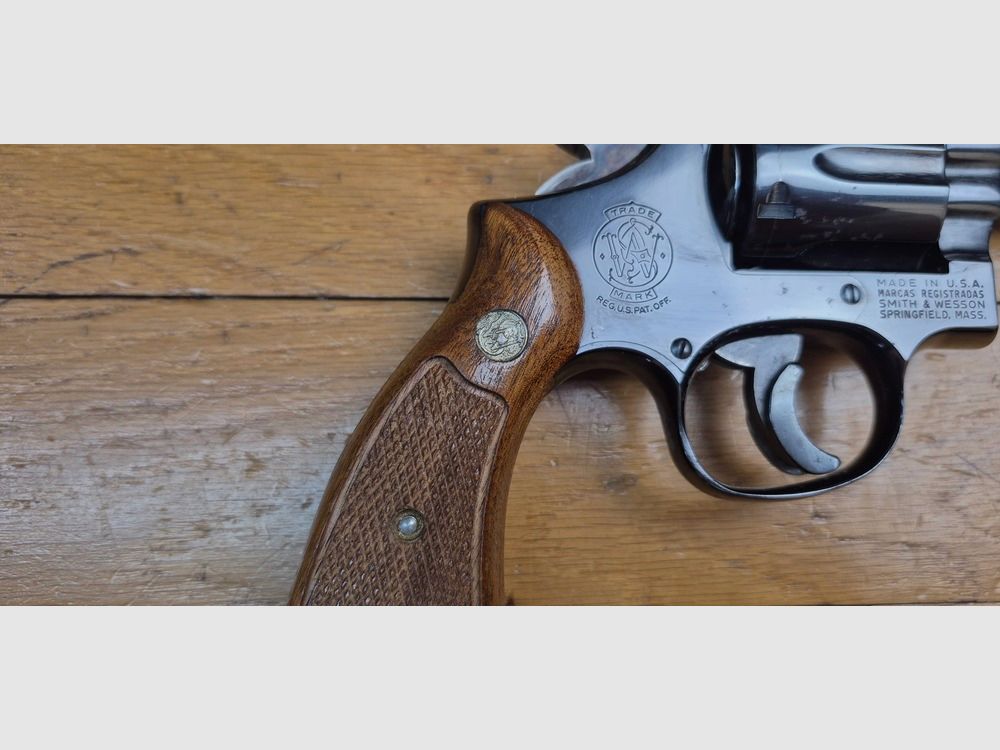
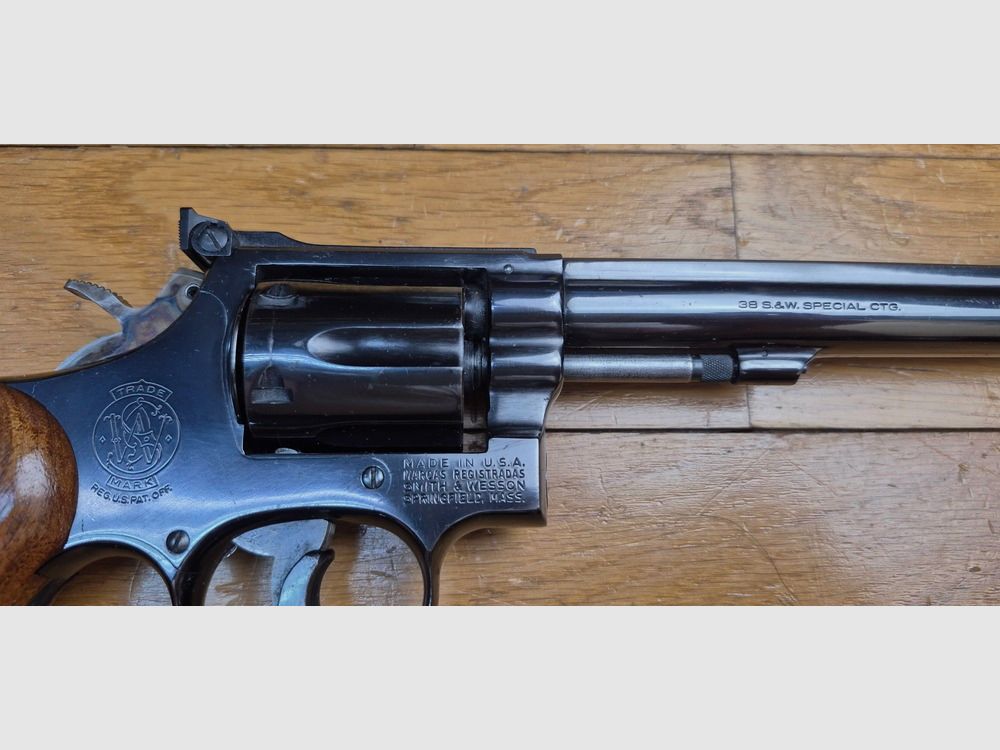
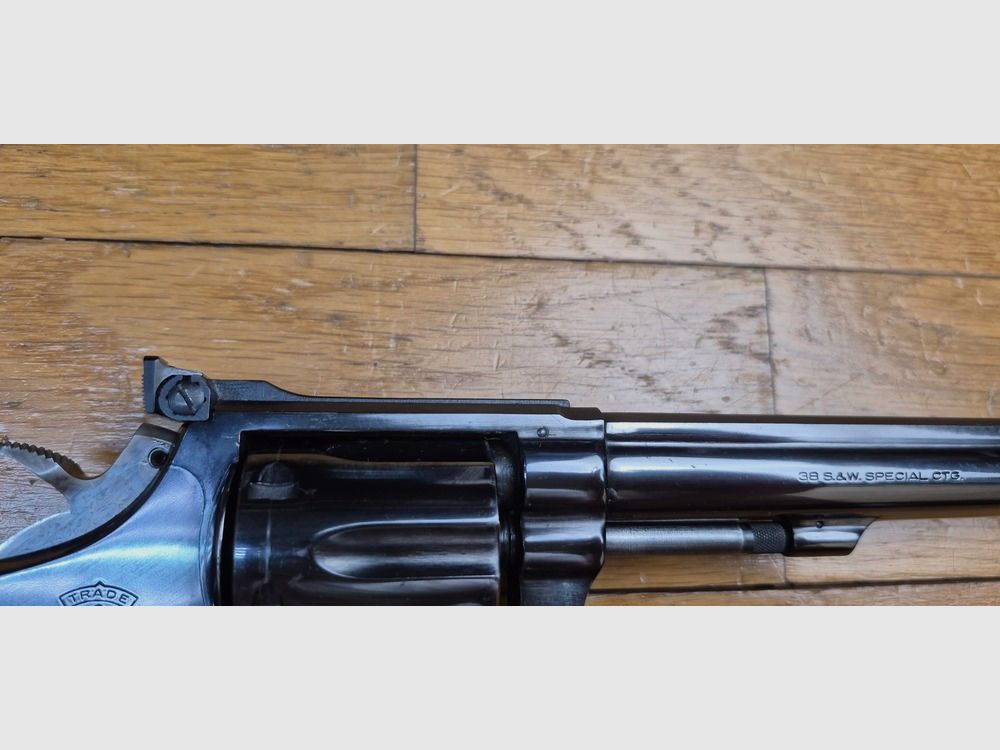

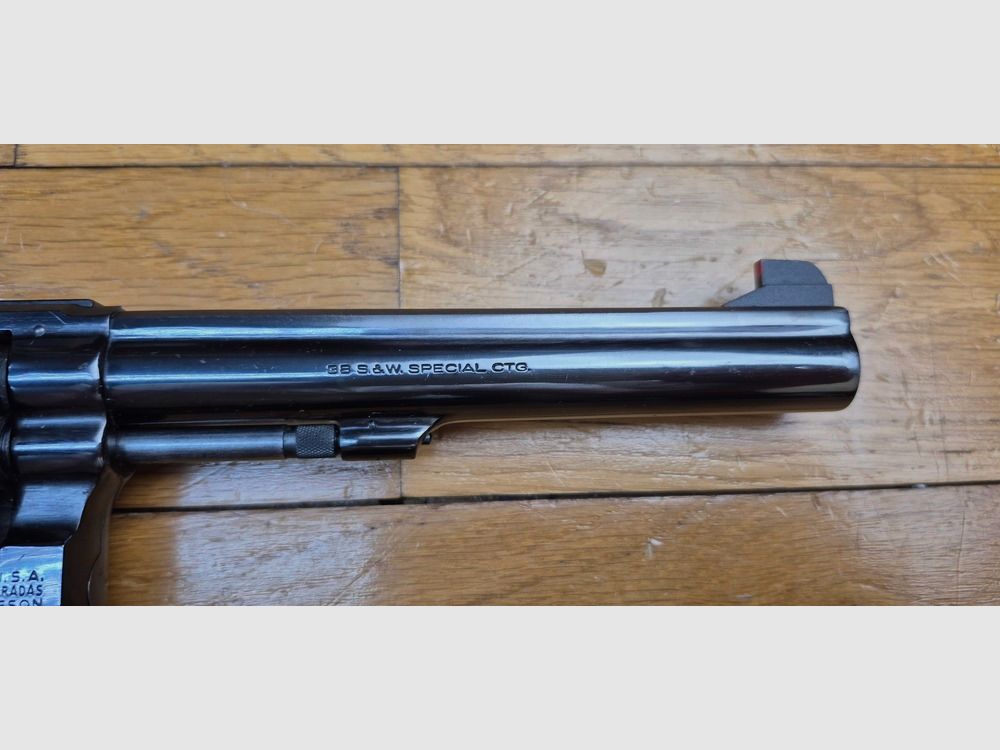
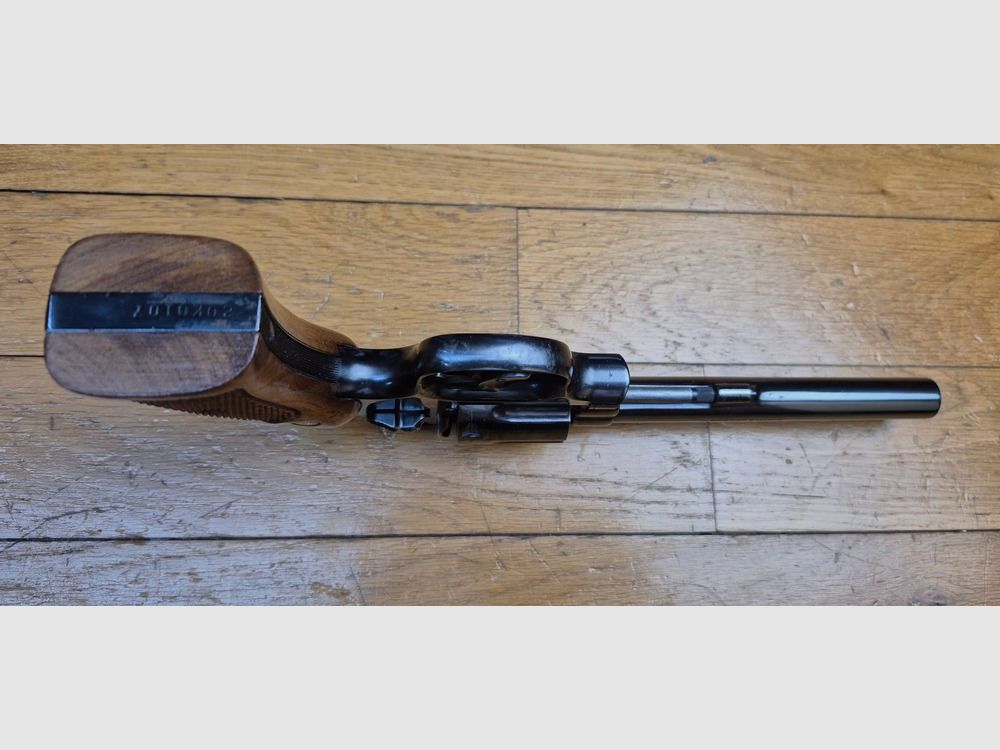
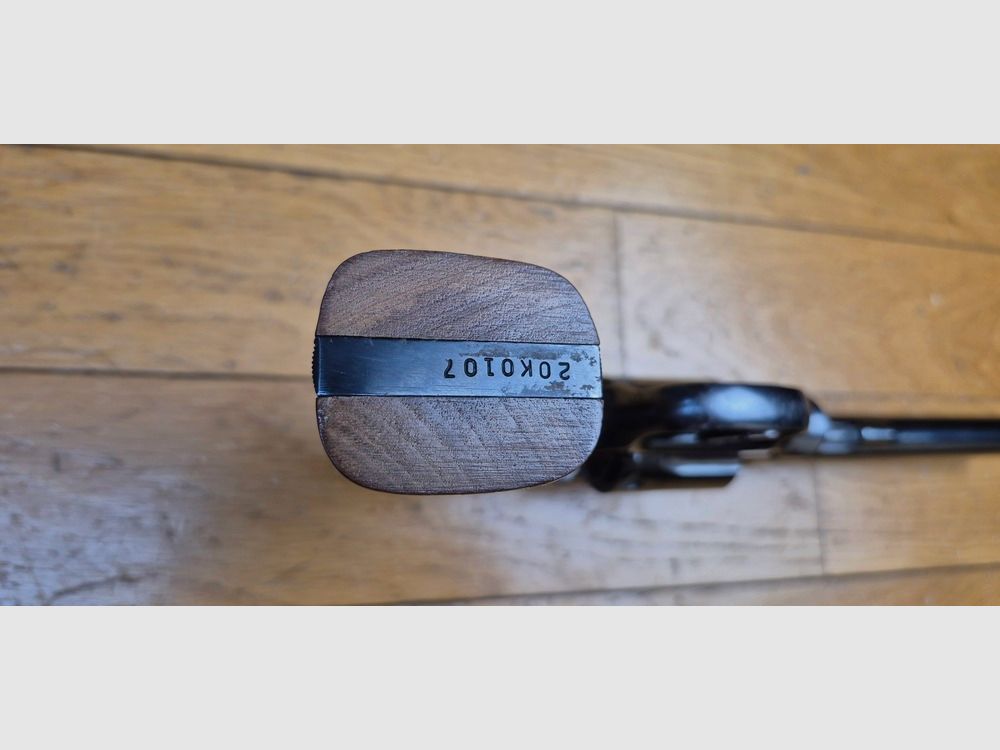
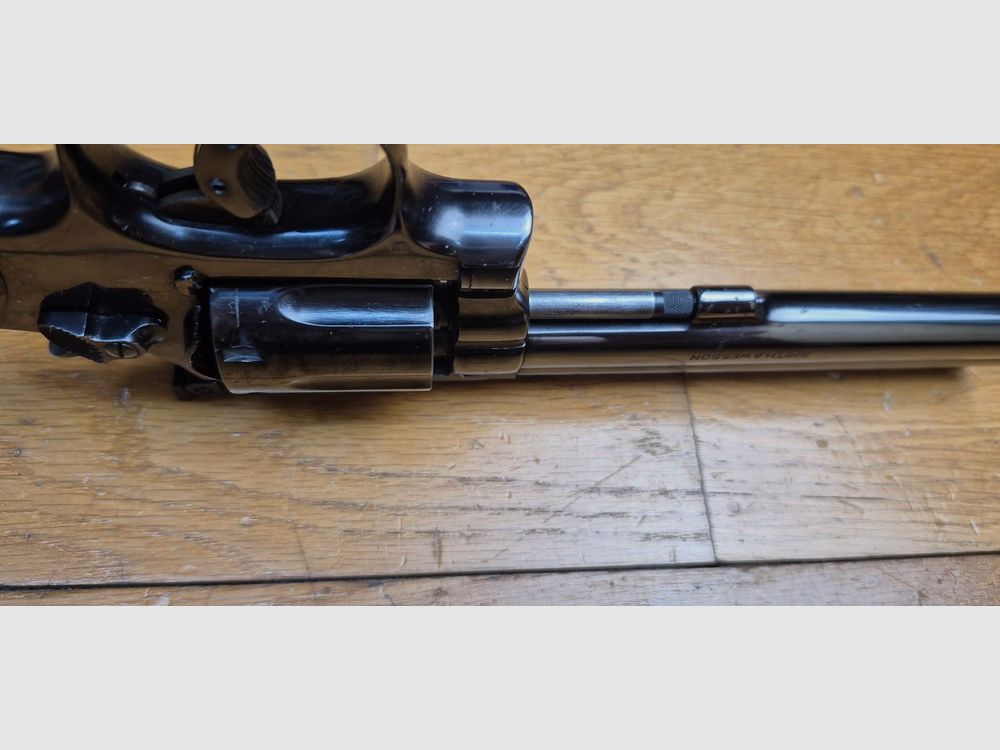
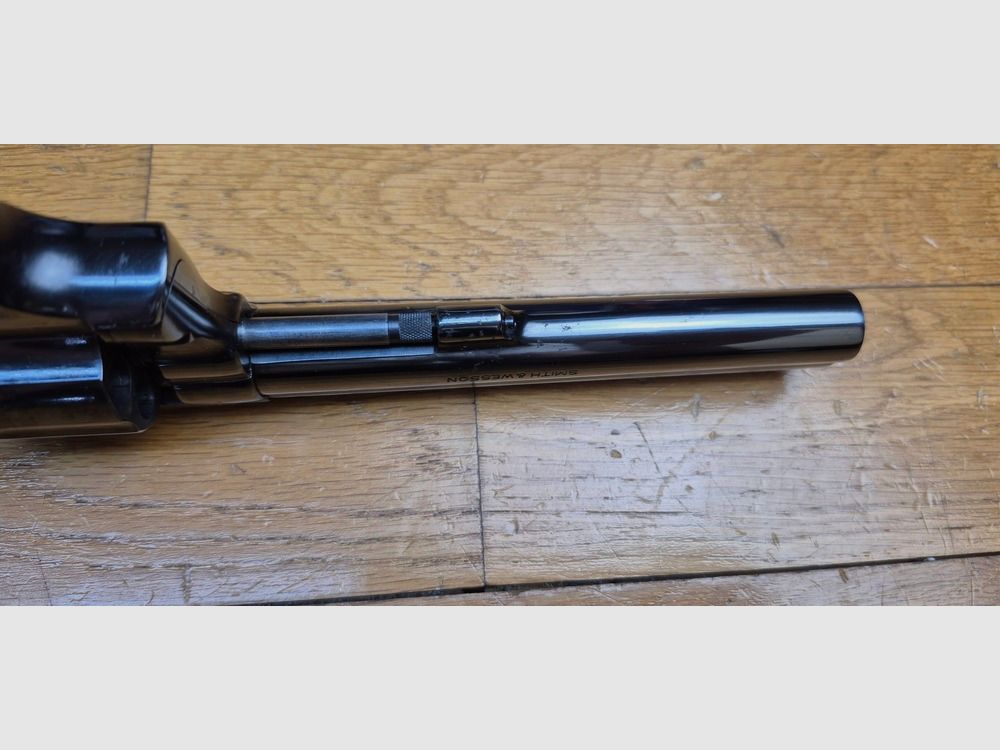

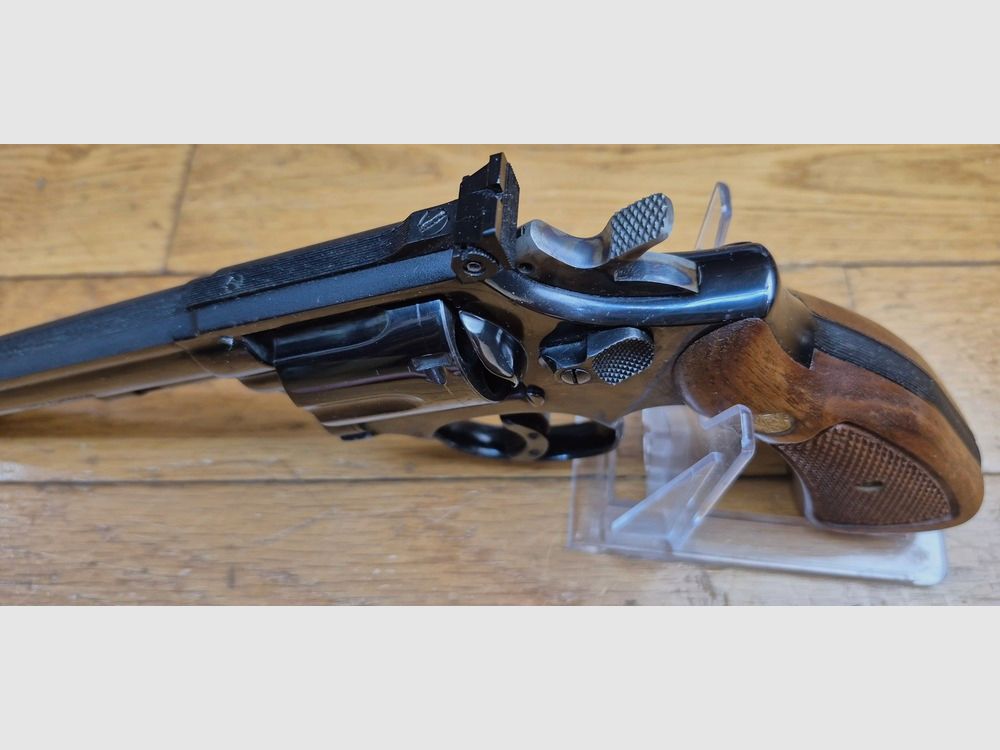
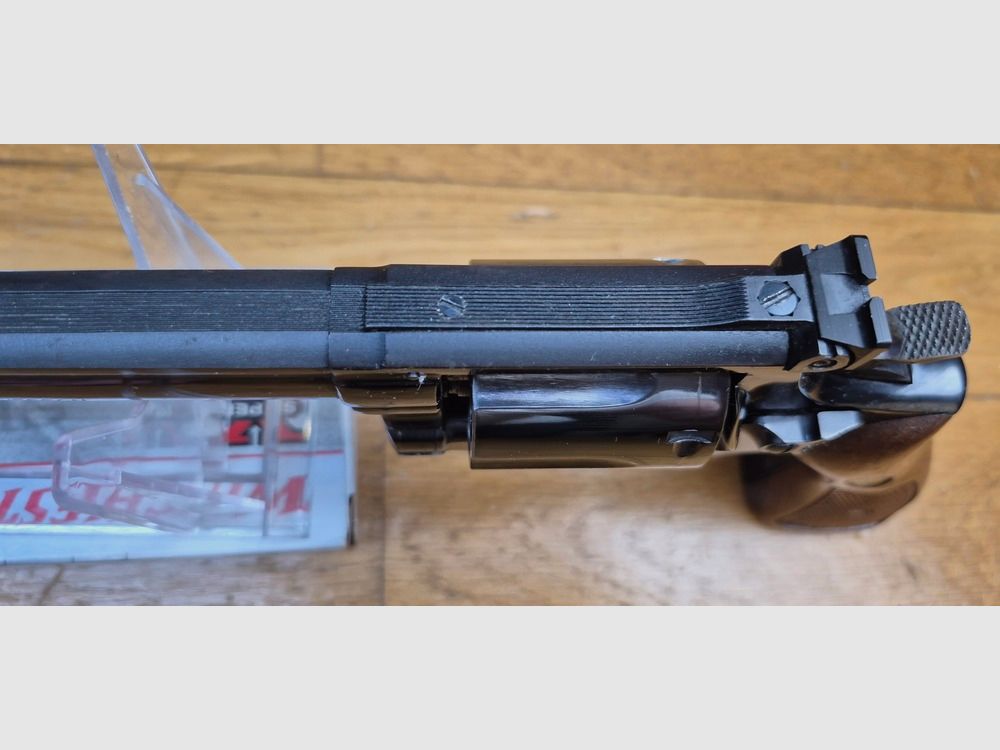

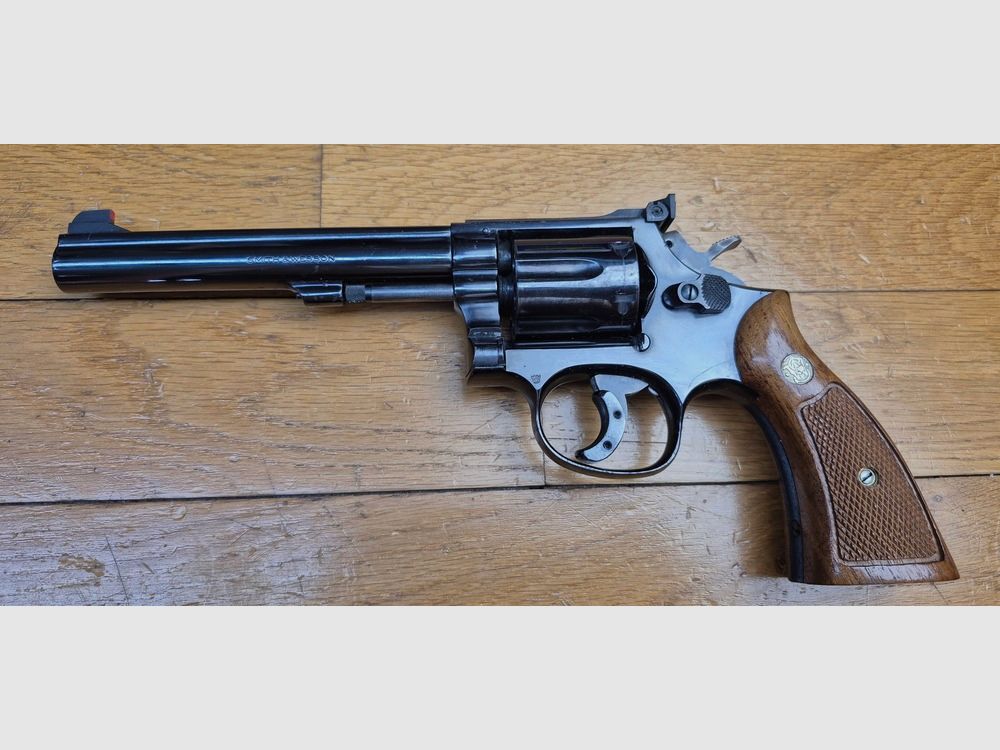
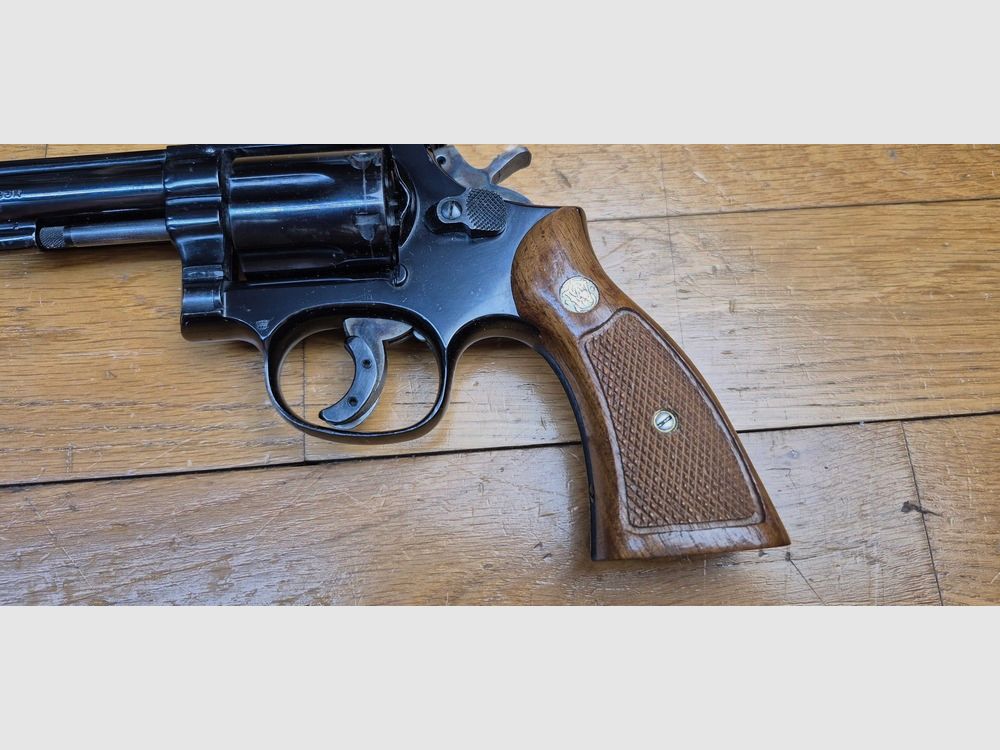

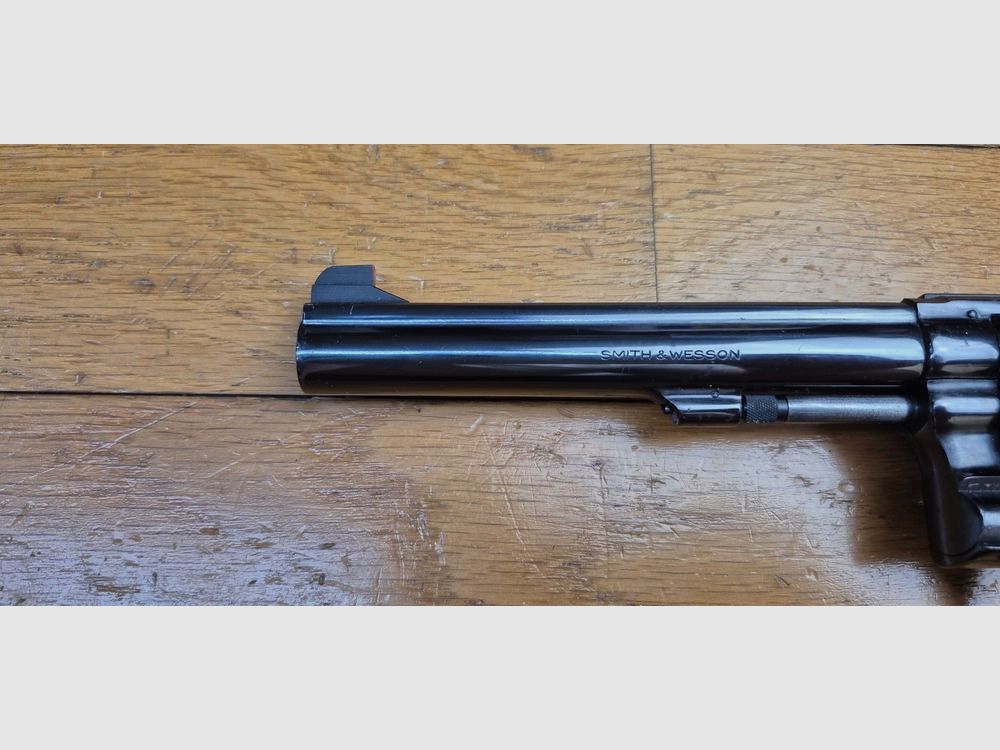
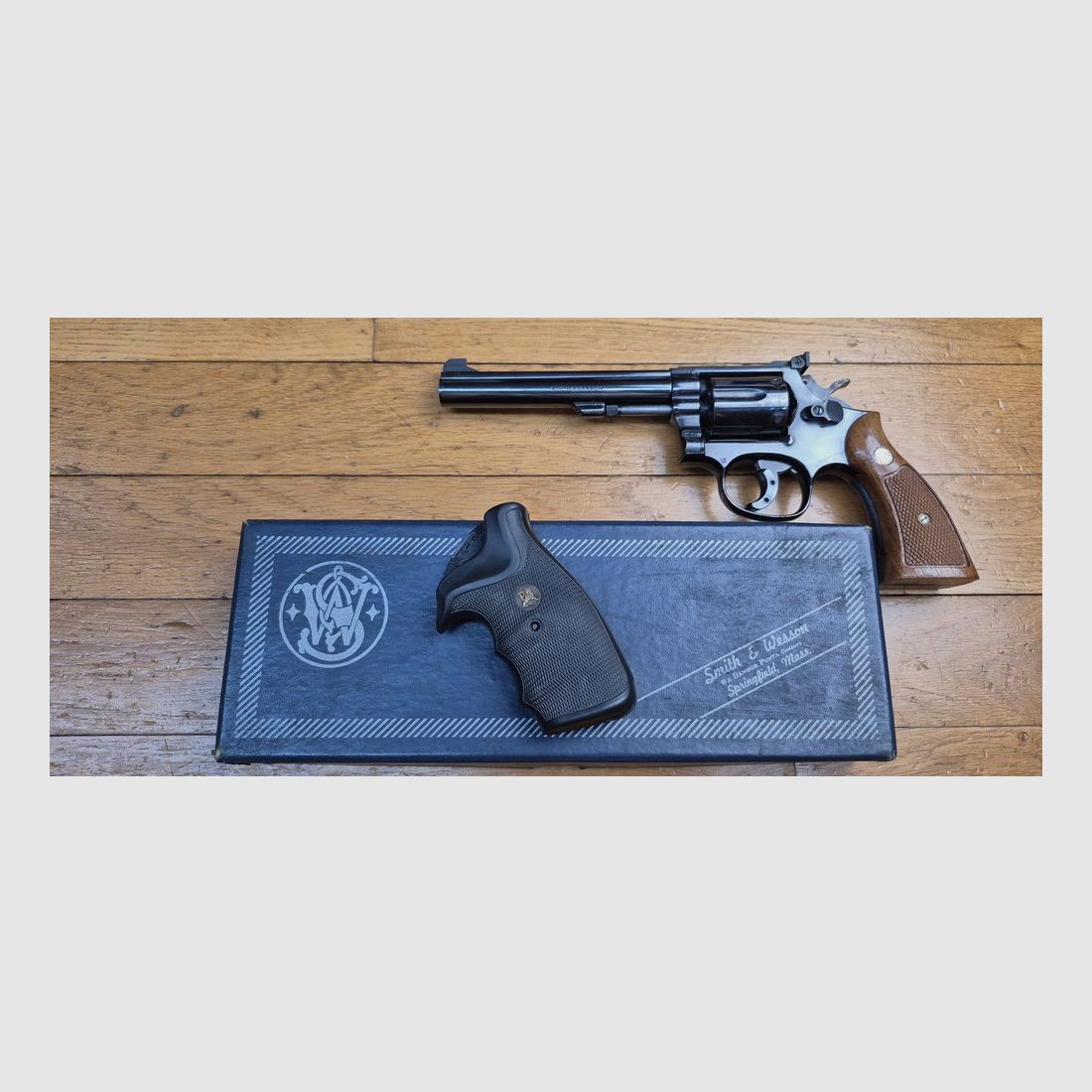
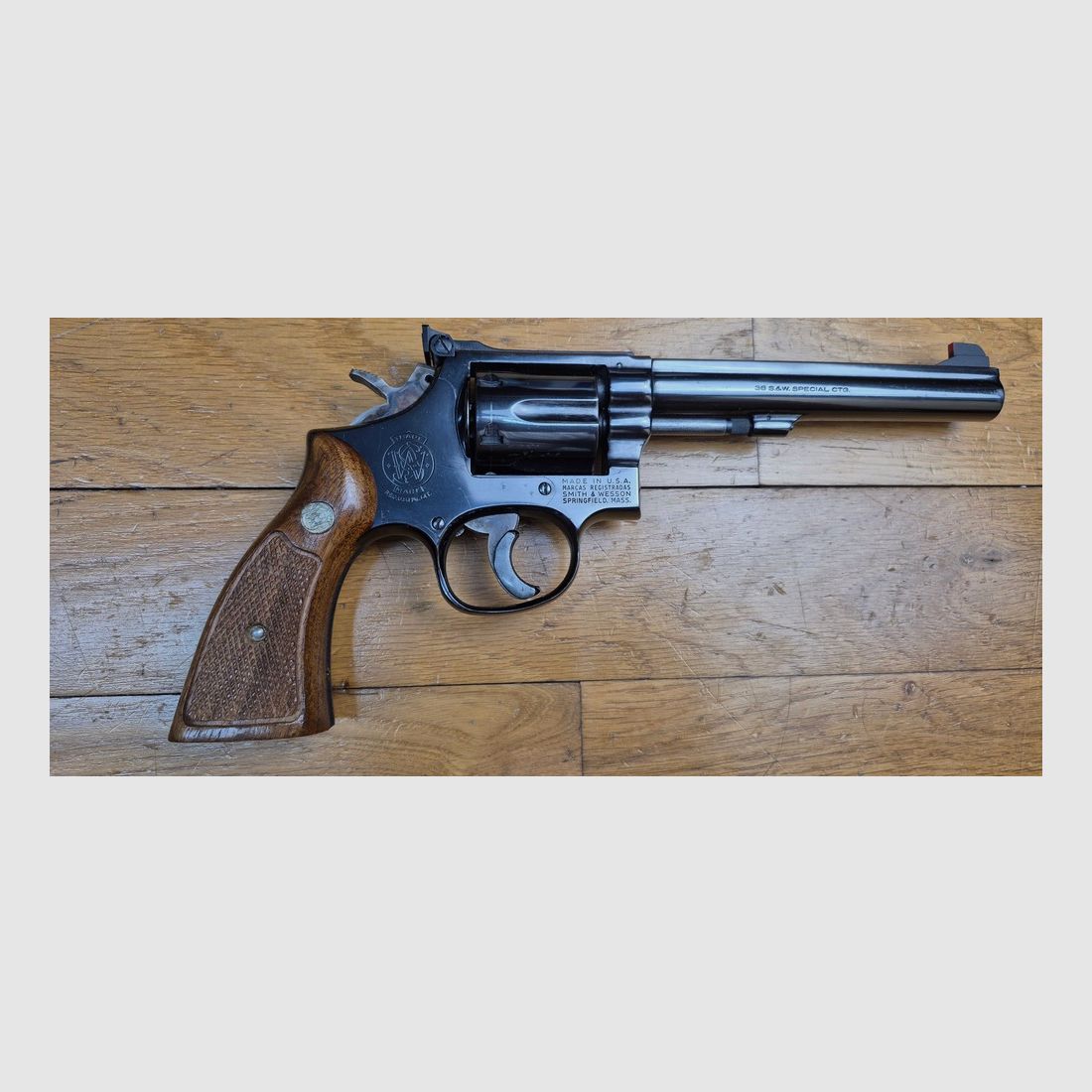

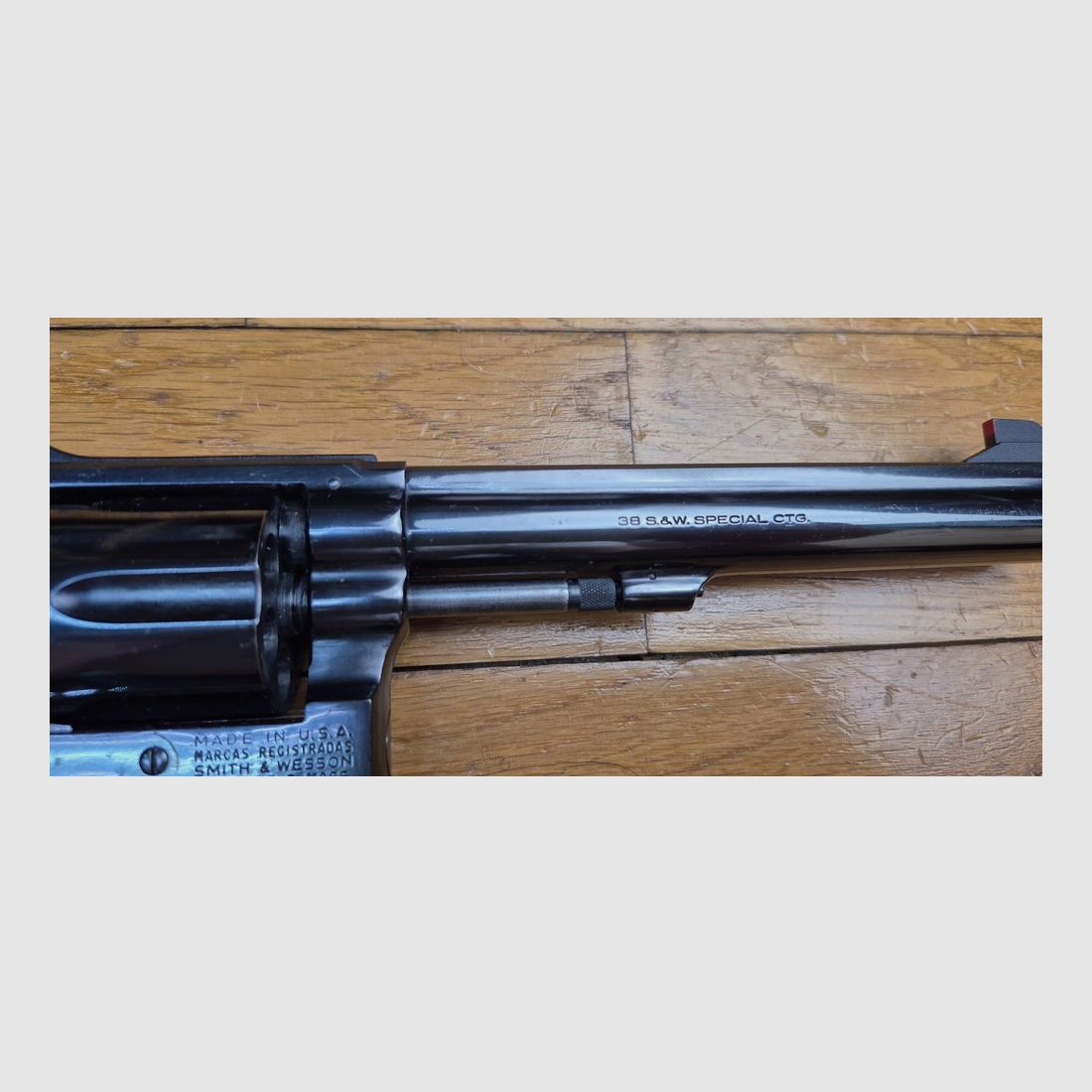
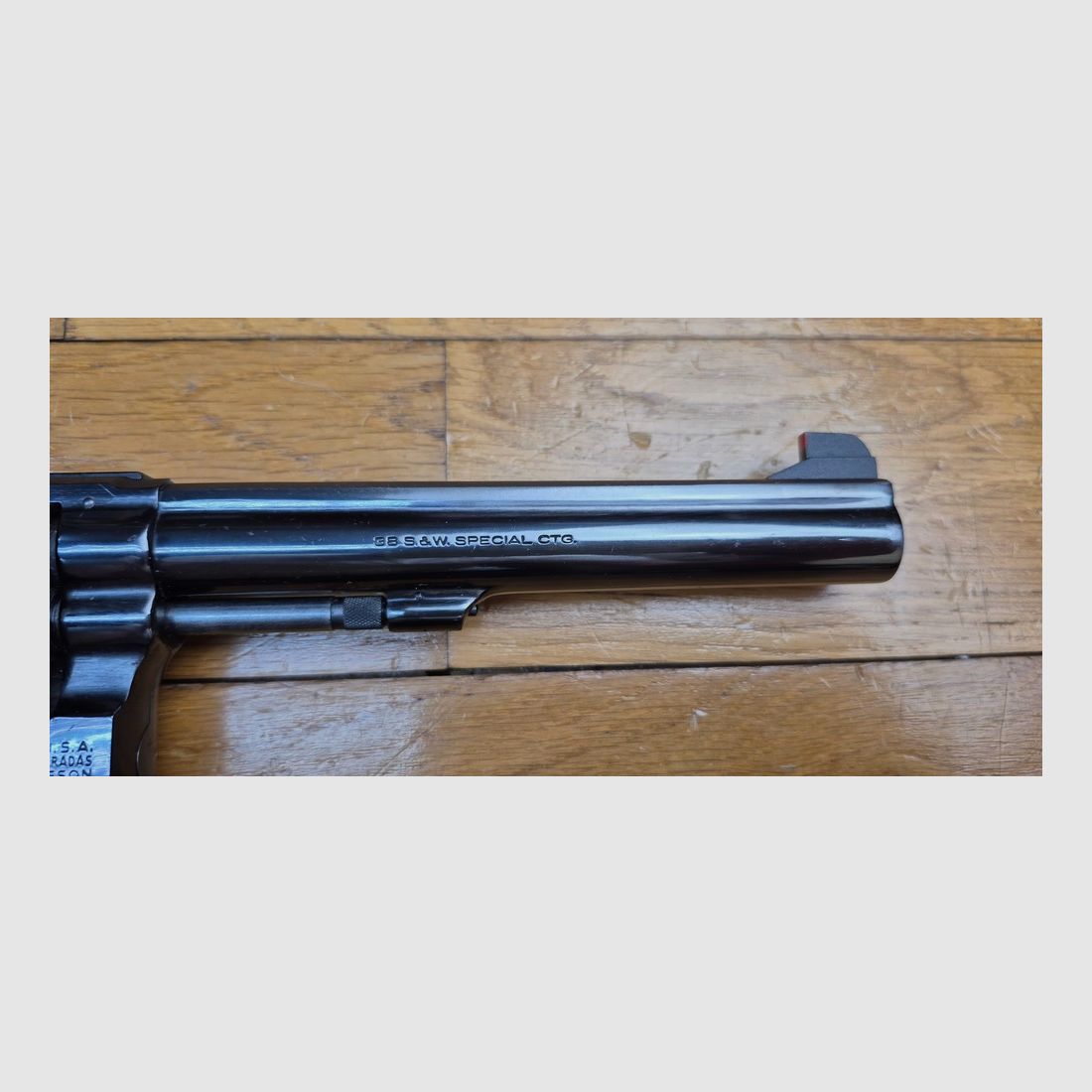


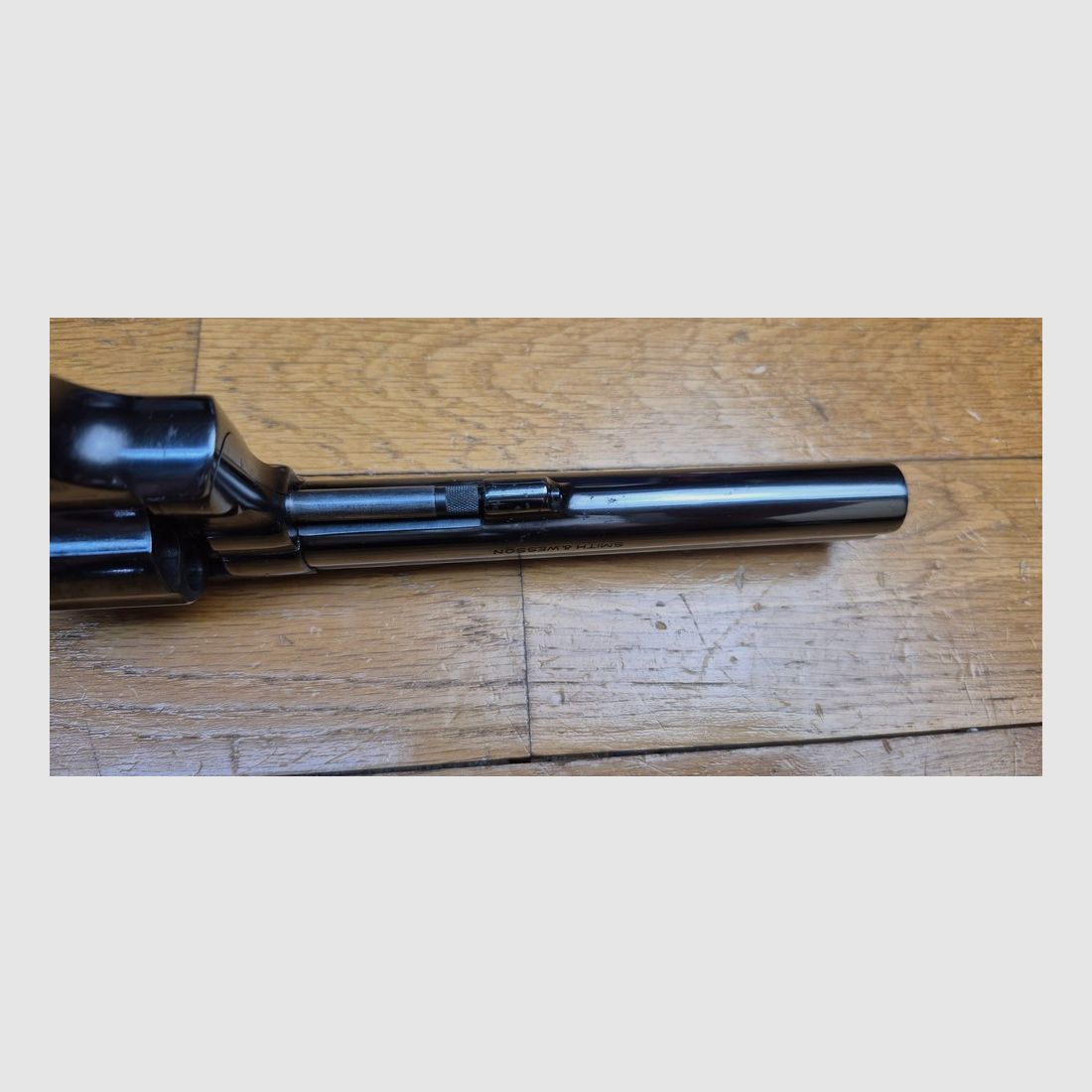
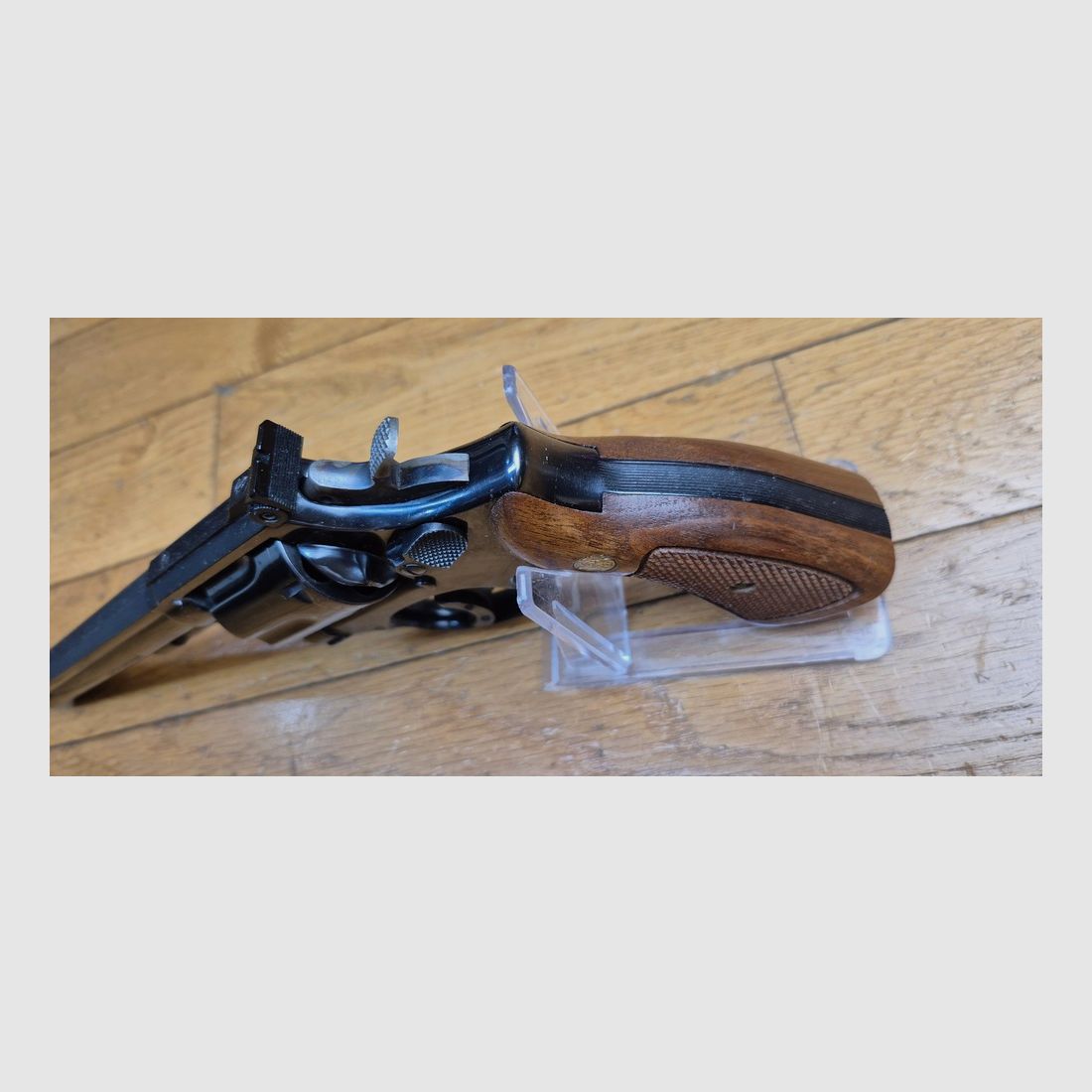
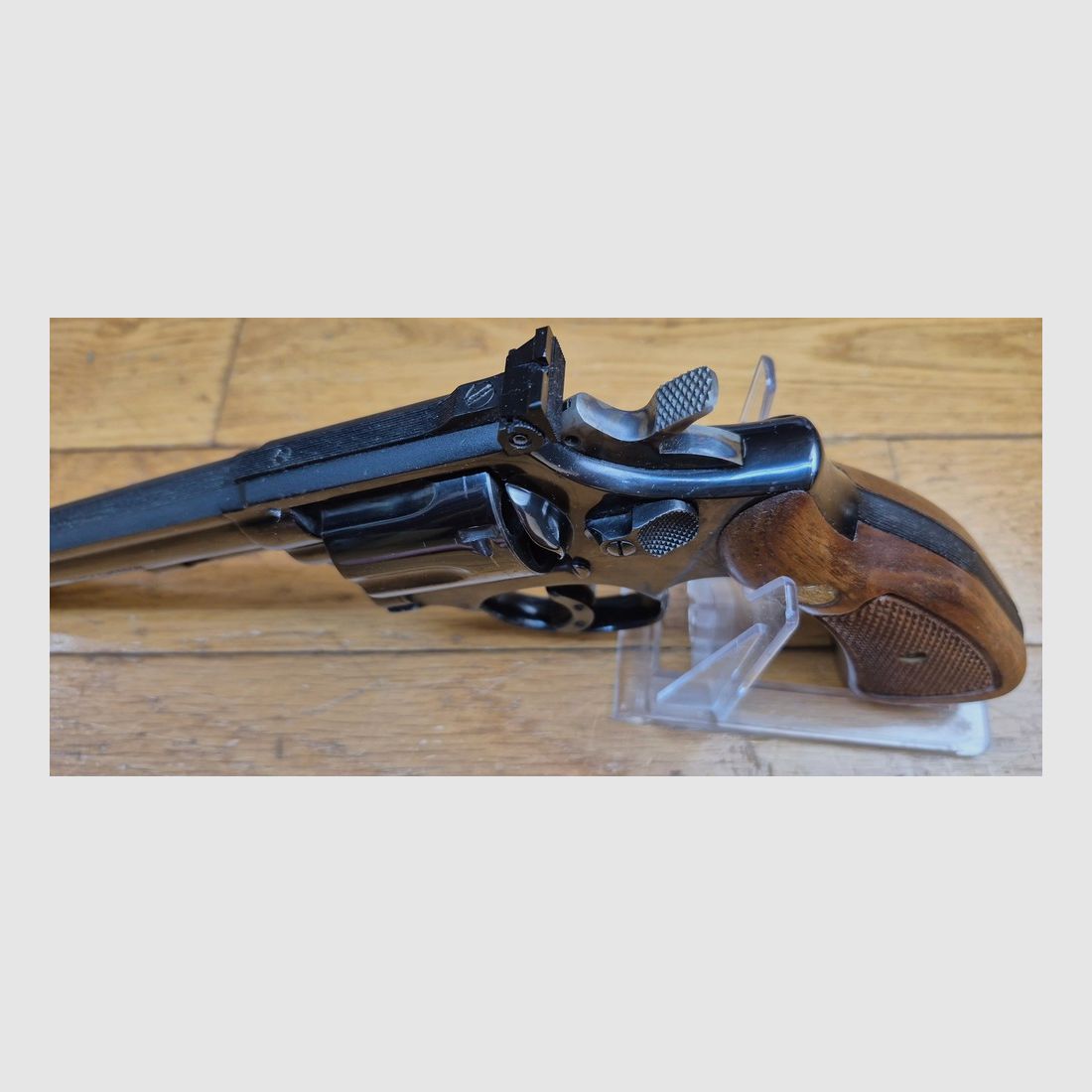


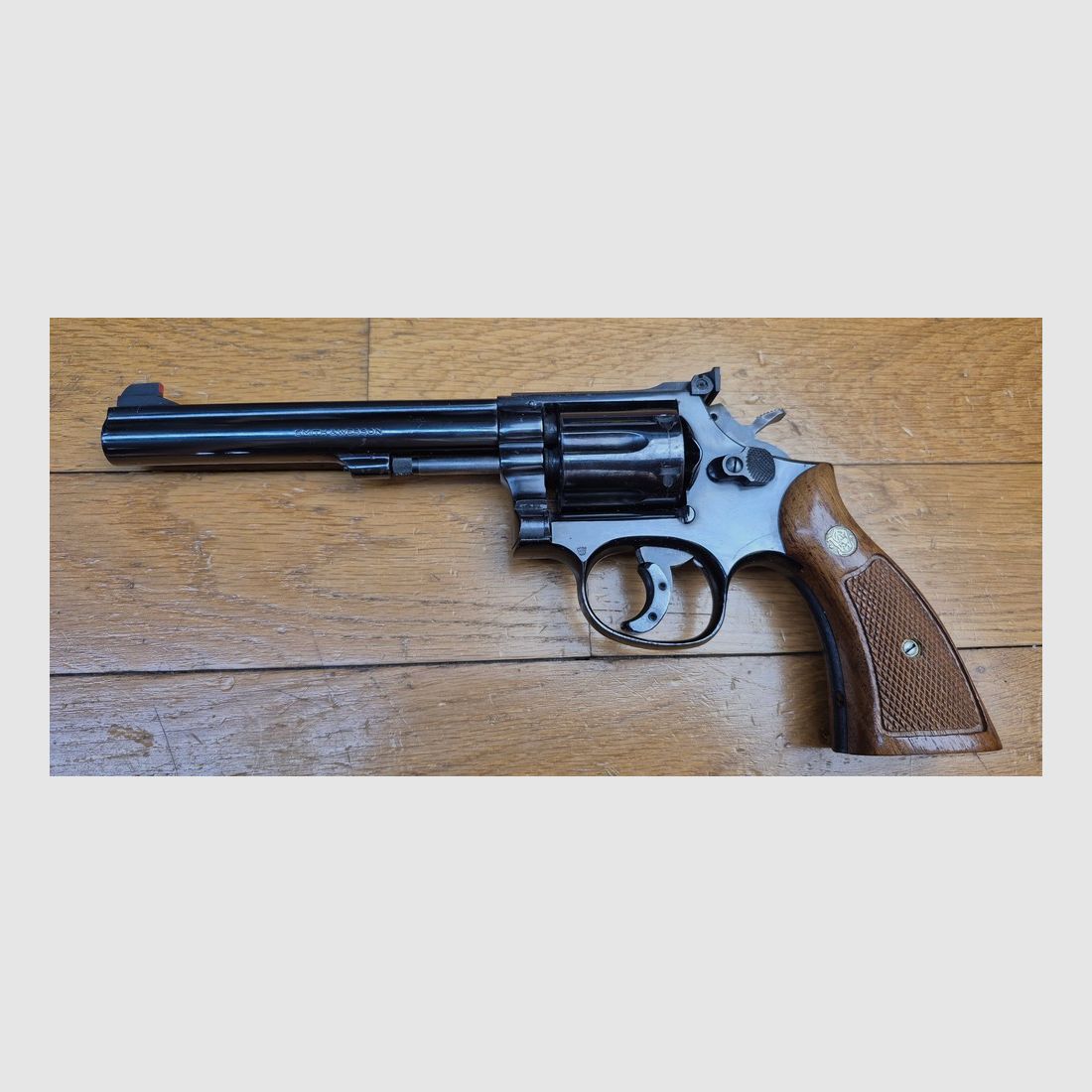


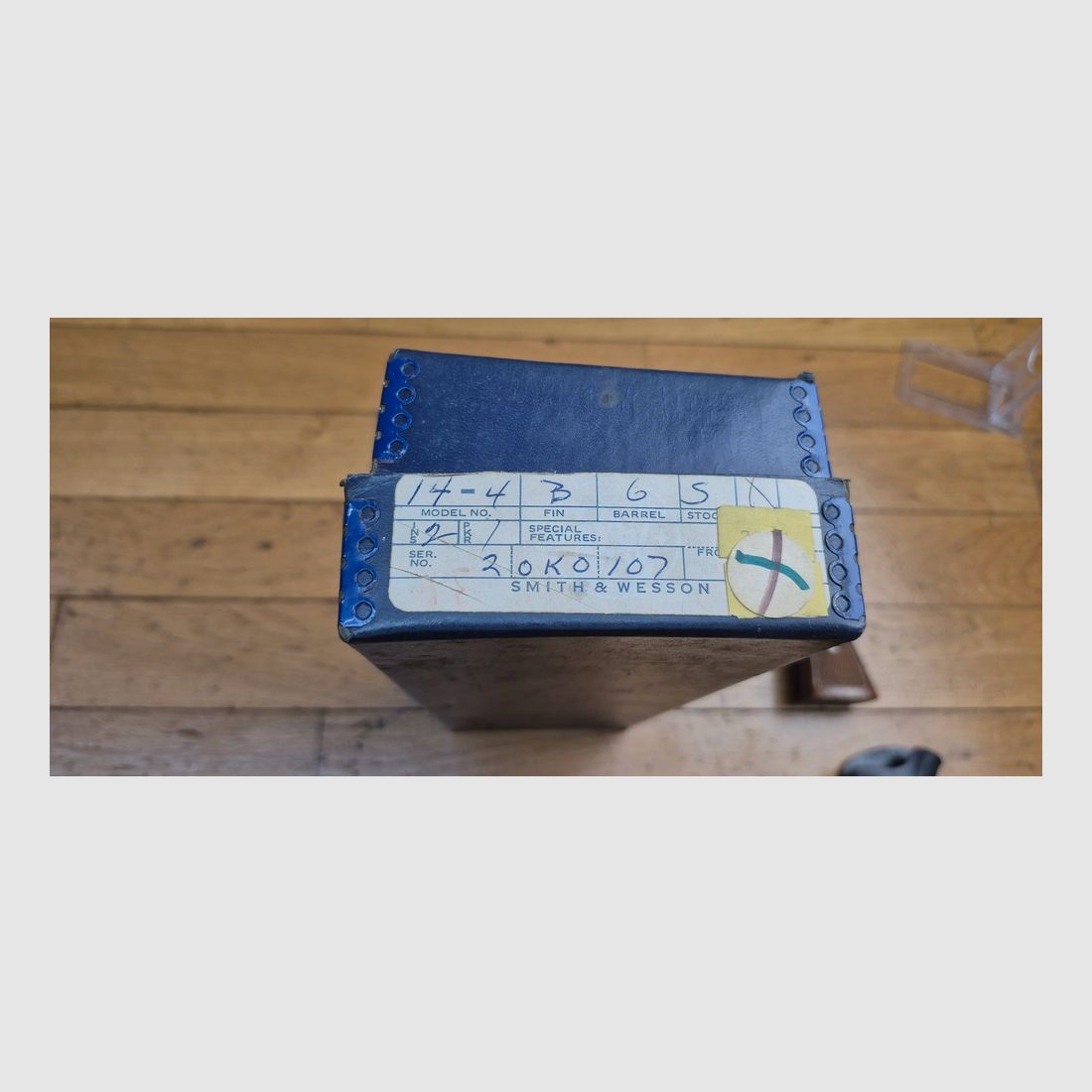
Magnificent Smith&Wesson K38 "Masterpiece" or Smith 14-4 after 1957 – Cal. .38 SP – Gun from 1977 – The "Target" model in .38 of the Military and Police from 1905! – 80 years of well-deserved success – Second set of Pachmayr grips – Original box with number – Condition almost new! – TBE/TBE+
≈ $1,209
Price at the dealer: 1,100 €. Converted at the ECB rate as of November 20, 2026.
Purchase permit required
75002 Paris, France
7
ID: 10338458
This item is currently unavailable.
Purchase from outside the EU: The firearm goes through an importer in your country, the dealer handles the export.
How buying from Europe works
Shop safely with Gunfinder
Our AI-powered seller identity verification makes Gunfinder the safest marketplace online.
Learn more
Details
- Original language
- French
- Brand
- Smith & Wesson
- Category
- Purchase eligibility
- Required
- Condition
- New
- Location
- 🇫🇷 75002 Paris, France
- Availability
- Out of stock
Freshness
This listing is based on a mirrored offer, where the listing data was synced to us from a shop, dealer, or external marketplace. Please note that temporary price discrepancies may occur due to possible delays in data transmission.
- Source
- Flingus Maximus
- Last checked with the dealer
- 29 minutes ago
Description
Note:
The item is located abroad. Please note that delivery conditions, shipping times, and/or the purchase process may differ.
Why in three or more places on my site?
Because the story of the K frame, which began in 1899 with the first K-frame Hand Ejector models (the Hand Ejector story itself began with a very rare First Model 1896 in an I frame and .32 S&W, which I was lucky enough to show you here), is full of twists and turns. Above all, it’s the result of 50 years of successive improvements.
K-frame guns, despite the remarkable N-frame Smith 27 and 29, are in my view Smith’s greatest achievement, because they could do everything—and do it all exceptionally well.
A symbol of legendary police guns, the K frame began its career chambered for a .358 bullet. In other words, it was a .38 caliber right from the start. The .38 caliber is the great love story of the K frame.
But before any military or police service, the K frame was first and foremost a sporting frame, thanks to its excellent, universally recognized grip.
After the 1899 K38s came the K22s in .22 LR, including the equally legendary Outdoorsman and Bekaert Model. K-frame .32 S&W models joined the lineup in 1902, this time by special order, even though they had chambered the very first Smith Hand Ejector (meaning a swing-out cylinder) back in 1896.
In short, the sporting models came before the military ones, such as the K-frame Military and Police 1903 and 1905, which would become the Model 10. They already led in numbers.
The small military orders for K38s up until just before World War II couldn’t change that. A few thousand guns at most for the Army and Navy couldn’t seriously challenge Colt’s position. So after .38 caliber, the K frame’s second great love is sport shooting.
We’ll also see purely “sporting” models later adopted by the police, chief among them today’s Model 14. More on that shortly.
In short, today’s K38 is a sporting gun whose career began in 1947, so it was really a return to Smith’s roots. Smith took the opportunity to make it an outstanding target-shooting gun. That’s why it was given the “Masterpiece” name right after K38. The 38, of course, refers to .38 Special.
Launched in 1946, it became the Model 14 in 1957, when all Smith models were renamed that year. Production began with serial number K 1661. They’re mostly found with 6-inch and 8 3/8-inch barrels.
It’s worth noting that a police exception was made right away, with a rare 4-inch version—375 made—for the Kansas City Police, and a 5-inch version for the Illinois Police. Just a few hundred were made for the police. Rare nickel-plated examples are also reported. All are in .38 Special.
The exception here is a handful of K38 Masterpieces sent to the Commonwealth on a small British order, in .38 S&W.
It was mainly after the war that it found lasting success, remaining in production without interruption from 1947 to 1982 (when things started going downhill at Smith, by the way…).
Two rare variants are worth mentioning. A single-action-only model was made in 1961 and 1962. The extra parts needed to convert it to double action were included in the box. There was also a model known as the Dayton, named after a distributor of the same name, with 2,038 made between 1965 and 1968.
A curious hybrid, with a heavy 4-inch barrel and a Baughman front sight. It’s a sort of pre-Model 15, and 1,040 examples are said to have gone to the police in the same town, Dayton, Ohio.
The gun was also used for about ten years by the Los Angeles Police. It’s highly likely that the Model 14s that ended up with the police were used only for training.
The Model 14 would nevertheless achieve such a reputation
ation that the Police Forces would request a non-training version. It’s the same model as our 14, but with a standard 4-inch barrel (not heavy) and a Baughman front sight that’s easier to draw. They also came in “stainless” and 2-inch versions. This one would go on to have a real career in street policing. It’s the rather uncommon Model 15. That shows just how much impact and reputation the Model 14 had among police forces.
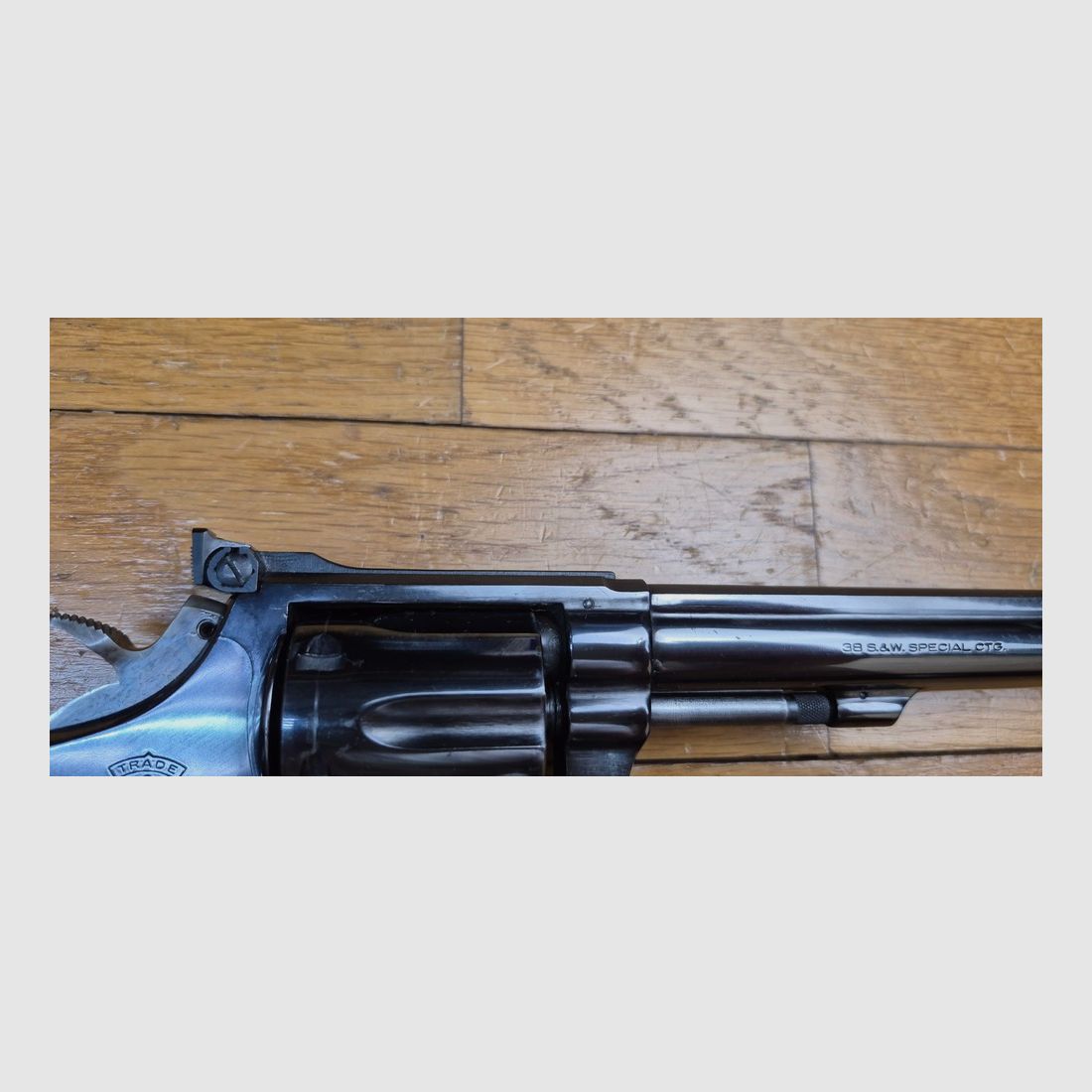
Adjustable rear sight, wide Patridge front sight, fine adjustments to the trigger and hammer, and a 6-inch barrel for most of the production run (with a few 8-inch 3/8 models): the Smith 14 was designed first and foremost for competition. Its younger Masterpiece siblings, also designed for competition, are the Model 16 (in 32SW long) and Model 17 (in 22LR), both equally excellent. 0 years of success that continues to this day.
Although primarily a competition and training gun, it still had a brief career in cinema. You can see it in “Le Bar du Telephone” in the hands of Richard Anconina, or in Belmondo’s hands in “l’Alpagueur”. More amusingly, it unexpectedly appears in Jack Nicholson’s hands in “Batman”, due to a casting mistake when the guns were switched between takes…
Under legitimate public pressure, production resumed in 1991 and continued until 1999 (Model 14-5 from 1991 to 14-7 from 1997, with plastic grips). You can recognize them because they’re no longer “square butt” in frame shape, and they have a barrel fully shrouded all the way to the muzzle, in line with the cylinder axis. In English, that’s called a “full underlug barrel”.
For shooting, some enthusiasts have found that with the “full underlug barrel”, the gun tends to become a little muzzle-heavy during longer sessions. We therefore definitely recommend a Model 14-4 or earlier, if only for its smoother action. The challenge is finding one of these Masterpieces from the best production period and in perfect condition. But that’s Master Flingus’s job.
A “modern” model was reintroduced by Smith in 2009 as part of the “Classic Series”, but the finish isn’t really the same…
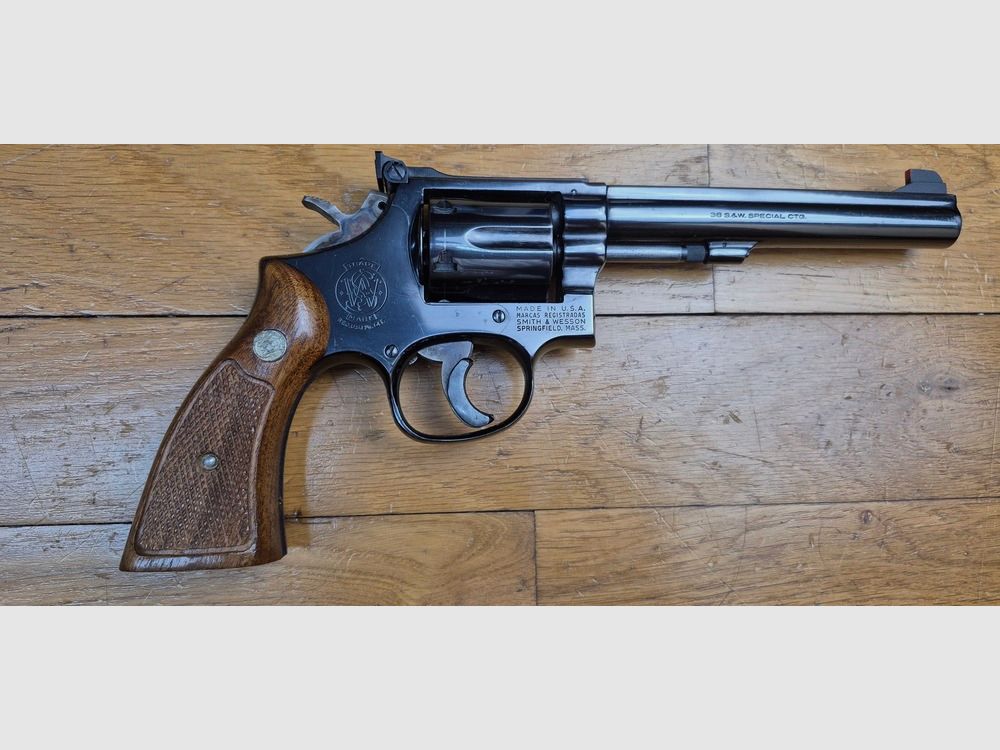
Here is a very fine example of a Smith & Wesson Model 14, specifically a 14-4 from 1977.
The gun is in .38 SP caliber and in more than excellent condition for a firearm from the 1970s … 50 years old and still better than ever!
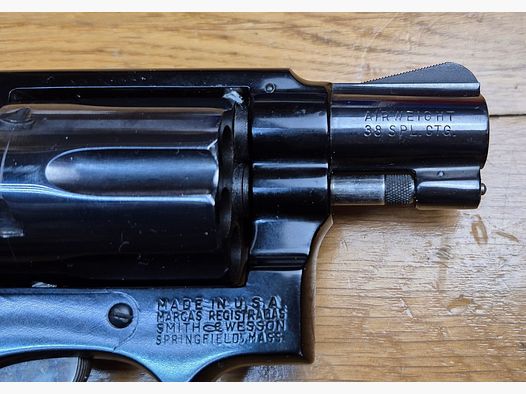
97% of the bluing remains, with a very slight loss at the muzzle (holster wear?) – This is the original bluing, still deep, dark, and thick, as was typical of the period – Very few handling marks – The few visible spots will come off with a little WD-40 and some 0000 steel wool. It’s mostly just very dirty. Virtually no scratches.
The few scratches you can see in the photos are scattered and greatly exaggerated by my GIGANTIC CLOSE-UPS – In hand, the gun is simply superb. Look at the overall photos and see for yourself. Very good condition.
Few marks around the cylinder too – between this detail and the condition of the metal and wood, you can say that the gun hasn’t spent much time at the range.
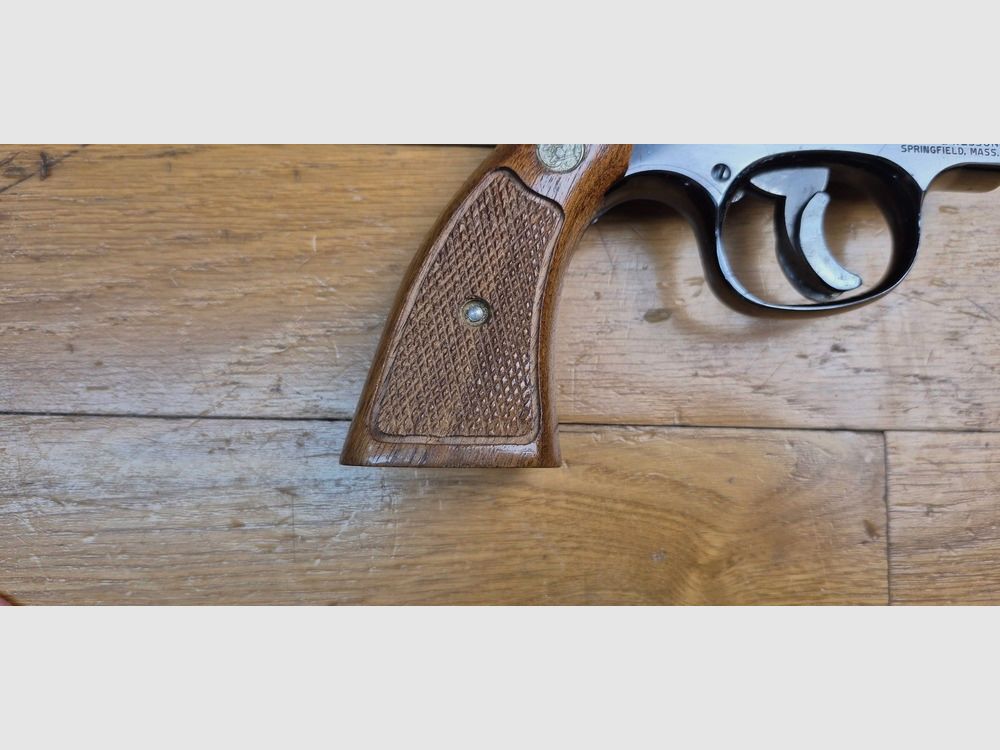
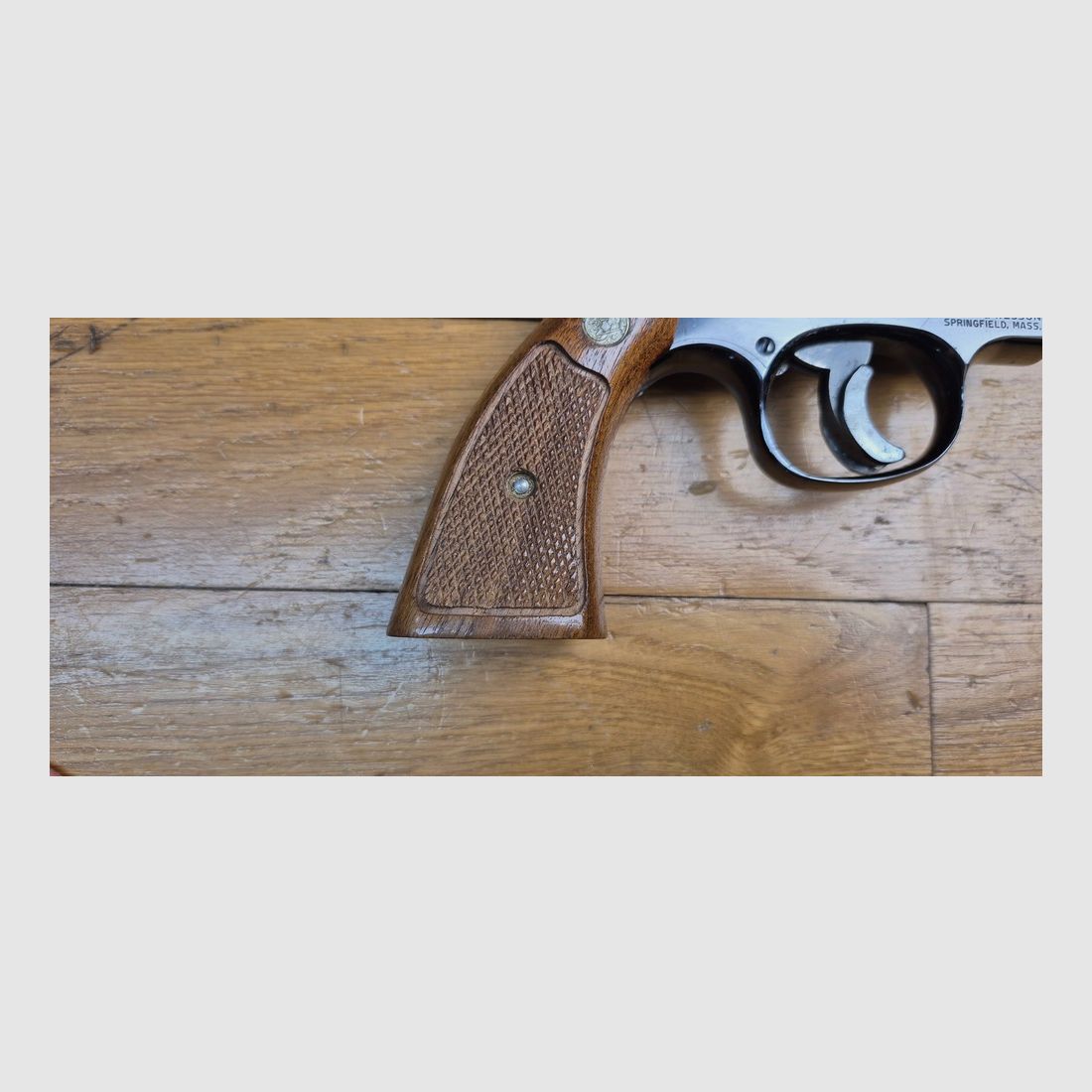
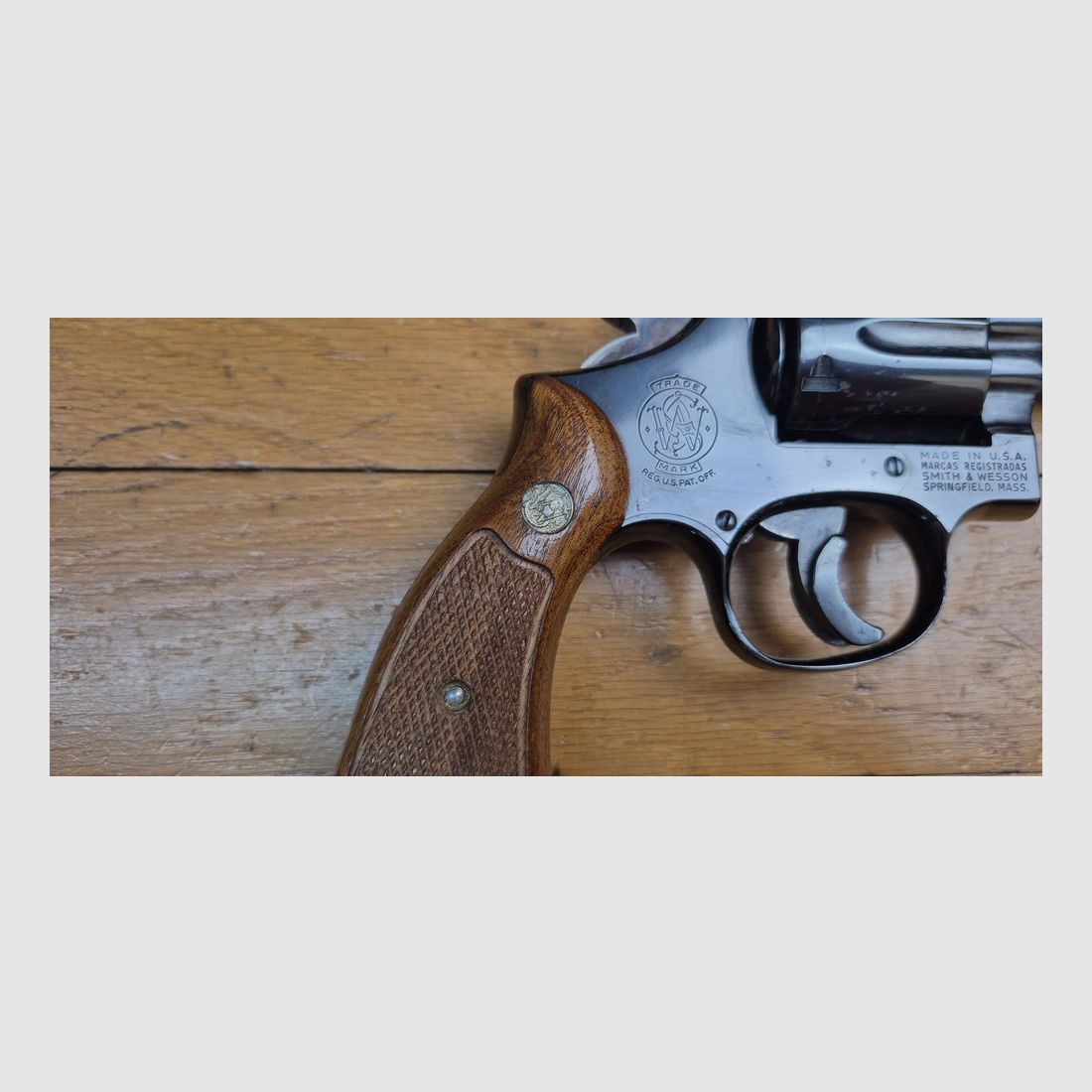
The wooden grips are Magna-style, as was still the case at the time. They’re made of quality American red walnut, with flawless checkering that provides a secure grip. Designed specifically by the company for K Frame models with a square butt, these grips ensure a firm, ergonomic hold while retaining the iconic Smith profile. They’re original, with the beautiful gold Smith logo, and above all in perfect condition.
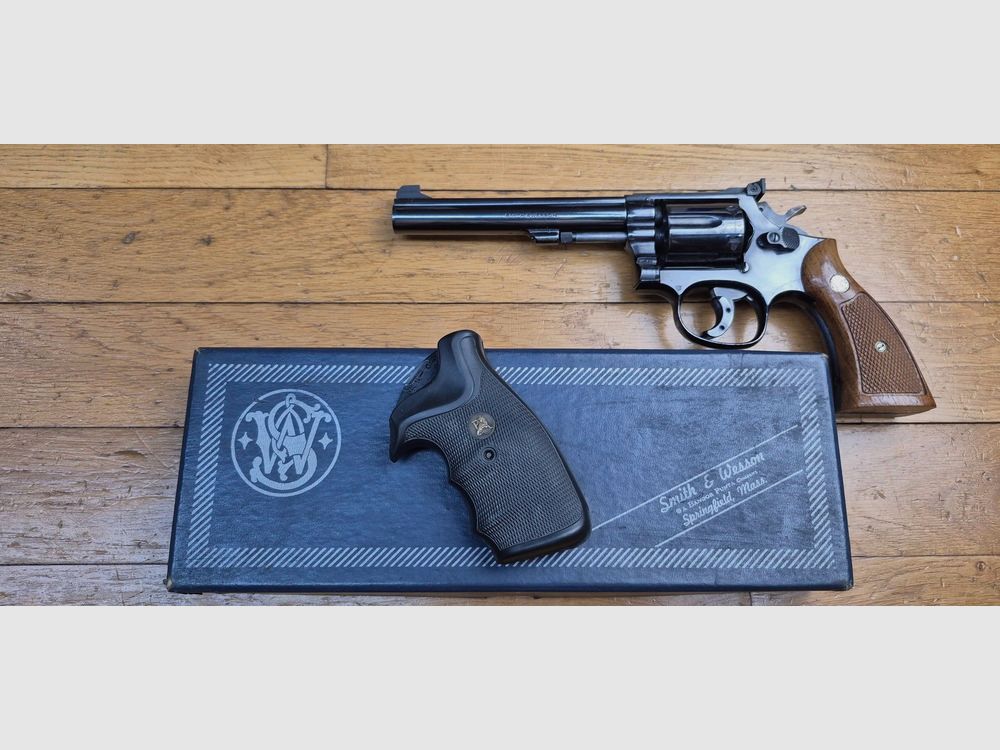
But for those who prefer something else, since everyone has their own tastes and dislikes, I’m also including a good one-piece Pachmayr grip with its screw. In short, you can choose what you want, whenever you want, and try the difference at the range.
Case-hardened and checkered hammer (impossible to miss unless you do it on purpose), case-hardened trigger too, with a trigger shoe system. Case hardening also at
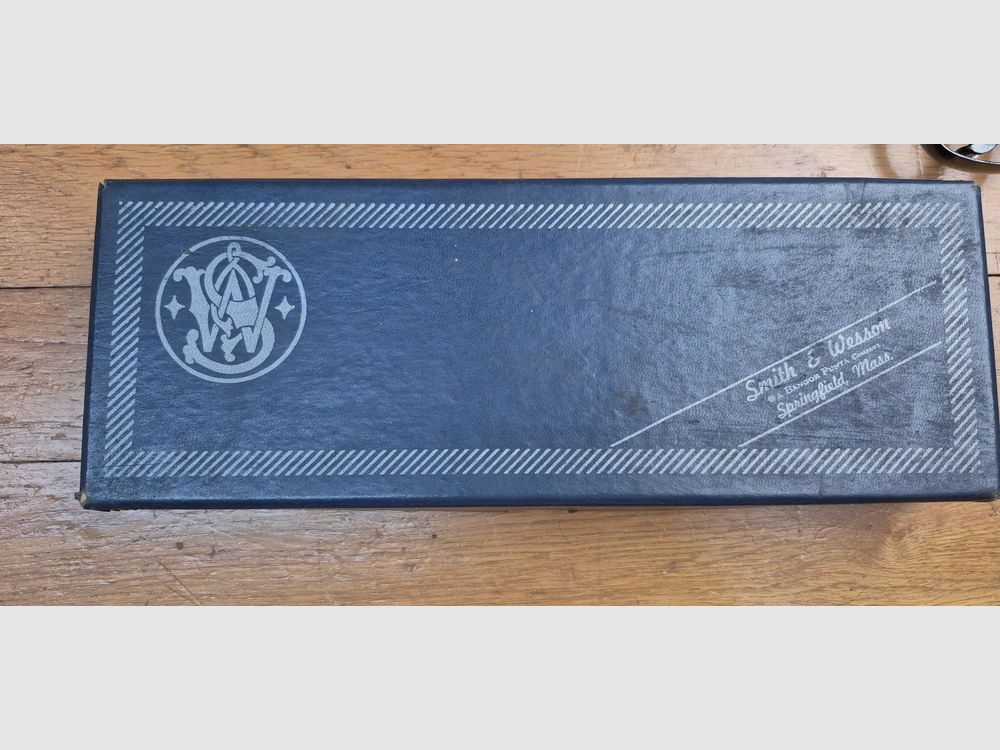
The original box is present and 100% intact. Superb finish, then.
Mechanical operation is more than impeccable—pulling the trigger is a pleasure. Smith did everything right on their end to prevent any “jerking the trigger.” The trigger and firing mechanism are crisp.
All the fit and finish are perfect. Even though the gun hasn’t been cleaned or oiled, a simple quarter-turn of the grip brings the cylinder back into place as if you were laying a baby in its cradle!
Barrel in like-new condition—mirror bright, with all its grooves nice and deep. No oxidation. The chambers are perfect too.
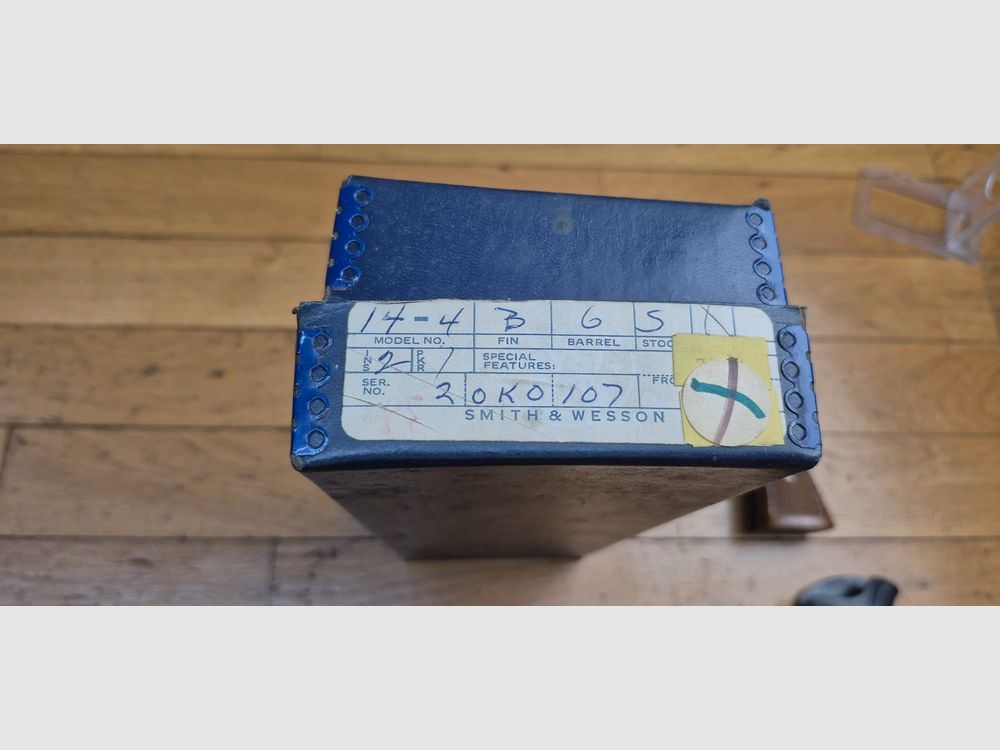
It also comes in its original, matching-number box.
In short, a splendid example.
The “real” K-38 has not been produced by Smith since 1991. It has become a collector’s item and remains a target gun of impeccable quality. Only Colt’s Officer Match in .38, made before 1975/80, can rival it for smoothness and mechanical quality. An essential collector’s item for .38 Special enthusiasts. A real competition beast.
CATEGORY B FIREARM AT THE CSI: FIREARM SUBJECT TO AUTHORIZATION. PHOTOCOPIES OF A VALID ID AND FIREARMS LICENSE REQUIRED—SIA ACCOUNT MUST BE OPENED. Shipping with signature required in two separate packages, at least 48 hours apart.
************************************************************************************************************************
Let’s say it again! Flingus Maximus gun shop in Paris and throughout France is also here to help with private firearm transfers, buying firearm and militaria collections, firearm appraisals, and questions about firearms in estates and inheritances. Contact your favorite gun dealer using our contact form or at [email protected] (Show description in original language)
Maître Flingus vous a déjà fait l’histoire de la carcasse medium ou K de Smith, ici ou encore ici.
Pourquoi à trois endroits ou plus sur mon site ?
Parce que l’histoire de la carcasse K qui commence en 1899 avec les premiers modèles de Hand Ejector en K (une histoire débutée, elle, celle des Hand ejector, avec un rarissime First Model 1896 en carcasse I et en 32SW que j’ai eu la chance de vous présenter ici) est pleine de rebondissements. Et surtout le fruit de 50 ans d’améliorations successives.
Les armes en carcasse K, nonobstant les remarquables Smith 27 et 29 en carcasse N, sont pour moi la plus grande réussite de Smith car ils ont pu tout faire et tout faire dans l’excellence.
Symbole d’armes de police mythiques, la carcasse K a d’abord commencé sa carrière pour une balle en .358. C’est à dire de suite pour un calibre 38. Le calibre 38, c’est la grande Histoire d’amour de la carcasse K.
Mais, avant tout passage par une carrière militaire ou policière, la carcasse K fut avant tout une carcasse sportive du fait de sa prise en main excellente reconnue par tous.
Après les K38 1899 viendront d’abord les K22 en 22 LR avec les tout aussi mythiques Outdoorsman et Bekaert Model. Les 32 SW en K rejoindront la danse dès 1902, sur commande cette fois, alors qu’ils avaient bel et bien chambré le tout premier Smith Hand Ejector (comprendre à barillet basculant) de 1896.
Bref, les sportifs avaient précédés les militaires du type Military and Police 1903 ou 1905 en K aussi et qui deviendront le modèle 10. Par le nombre déjà.
Les petites commandes militaires de K38 jusque avant la seconde guerre mondiale ne pouvaient changer la donne. Quelques milliers d’armes à peine pour l’armée et la marine ne pouvaient challenger sérieusement la place de Colt. Le second amour de la carcasse K, après le calibre .38, c’est donc le sport.
On verra d’ailleurs des modèles purement « sport » rejoindre ultérieurement la police et au 1er chef notre modèle 14 de ce jour. On va en reparler
Bref notre K38 de ce jour, une arme de sport dont la carrière débute en 1947 n’est donc qu’un retour aux sources pour Smith. Il va en profiter pour en tirer une excellence du tir sportif. C’est pourquoi lui est affublé directement le nom commercial de « Masterpiece » derrière K38. Ce 38, c’est bien évidemment le 38sp.
Lancé en 1946 donc il deviendra Modèle 14 en 1957 au changement de dénomination de tous les Smith cette année là. Leur numérotation commence avec le matricule K 1661. On les trouve en canon 6 pouces et 8 pouces 3/8 surtout.
A noter que, de suite, une exception policière est faite avec de rares 4 pouces, à hauteur de 375 exemplaires, pour la police de Kansas City et en 5 Pouces pour la Police de L’illinois. Quelques centaines d’exemplaires seulement pour la Police donc. On signale aussi de rares exemplaires nickelé. Tous sont en 38 Sp.
L’exception est ici une poignée de K38 Masterpiece, parti dans le Commenwealth sur une petite commande britannique, en 38SW.
C’est surtout dans l’après guerre qu’il connait un succès qui ne se dément pas puisqu’il est produit sans discontinuer de 1947 à 1982 (quand ça commence à ne plus aller chez Smith au passage…).
A signaler, deux variantes rares. Un modèle simple action seulement est produit uniquement en 1961 et 1962. Les pièces supplémentaires permettant de le repasser en double action aussi étaient vendues dans la boite. Et aussi un modèle dit Dayton, pour un distributeur du même nom d’ailleurs, produits à 2038 exemplaires entre 1965 et 1968.
Curieuse bête, hybride, à canon lourd et en 4 pouces, dotée d’un guidon Baughman cette fois. C’est une sorte de pré modèle 15 dont 1.040 exemplaires auraient rejoint la Police du même bled, Dayton dans l’Ohio.
L’arme a aussi été utilisée une dizaine d’années par la police de Los Angeles. Il est plus que hautement probable que ces modèle 14 ayant fini dans la Police étaient des armes d’entrainement seulement.
Le modèle 14 atteindra toutefois une telle réputation que les Forces de Police en demanderont un exemplaire qui ne soit pas que d’entrainement. C’est le même modèle que notre 14 mais en canon 4 pouces normal (pas lourd) et à guidon Baughman plus facile à dégainer. Il en existe des « stainless » blanc et des deux pouces. Celui-là connaitra une vraie carrière policière de rue. C’est le fort peu courant modèle 15. Mais c’est dire l’impact et la réputation du modèle 14 sur les forces de police.
Hausse réglable, guidon Patridge large, ajustements de pointe en détente et en chien, canon 6 pouces pour l’essentiel de la production (avec un peu de 8 pouces 3/8), le Smith 14 est fait avant tout pour la compétition. Ses petits frères Masterpiece eux aussi pensés pour la compétition sont le Modèle 16 (en 32SW long) et le Modèle 17 (en 22LR) tous aussi excellents. 0 ans de succès qui dure encore.
L’arme, pourtant de compétition et d’entrainement avant tout, a quand même fait une petite carrière au cinéma. On la voit dans « Le Bar du Telephone » dans les mains de Richard Anconina ou dans les mains de Belmondo dans « l’Alpagueur ». Plus drolatiquement, elle apparait inopinément, par erreur de casting d’un changement d’armes entre deux prises, dans les mains de Jack Nicholson dans « Batman »…
Sous la légitime pression populaire, la production sera relancée en 1991 et jusque 1999 (modèle 14-5 de 1991 à 14-7 de 1997 à poignées plastiques. On les reconnait car ils ne sont plus « square butt » en forme de carcasse et ils ont un canon entièrement doublé jusqu’à la bouche en axe de barillet. On dit « full underlug barrel » en roastbeef.
Pour le tir, certains fanas ont constaté qu’avec le « full underlug barrel », l’arme tendait un peu à piquer du nez dès que la séance durait un peu. Nous vous conseillons donc définitivement un modèle 14-4 ou antérieur ne serait ce que pour leur souplesse mécanique. Le problème est de trouver un de ces Masterpiece en production de la meilleure époque et en parfait état. Mais, ça, c’est le boulot de Maître Flingus.
Un modèle « moderne » est ressorti en 2009 chez Smith dans la série « Classic Series » mais là on n’est plus vraiment dans les mêmes finitions…
Voici ici un très bel exemplaire de Smith & Wesson Modèle 14, un 14-4 de 1977 exactement.
L’arme est donc en calibre 38 SP et dans un état de conservation plus qu’excellent pour une arme des années 70 … 50 ans et mieux que toutes ses dents !
Bronzage à 97% avec un très léger manque en bout de canon (port en étui?) – Ce bronzage est celui d’origine encore bien noir profond et épais de cette époque – Très peu de marques de manipulations – Les quelques tachettes visibles s’effaceront avec un poil de WD 40 et un peu de paille 0000. Elle est surtout très sale. Quasiment aucune rayures.
Les quelques rayures que vous pouvez voir sur les photos sont éparses et très exagérées par mes GIGANTESQUES GROS plans – L’arme en main est juste superbe. Regardez les photos d’ensemble pour vous en convaincre. TBE
Peu de marques en contour de barillet aussi – entre ce détail et l’état des fers et bois, on peut affirmer que l’arme n’est pas beaucoup allé au stand.
Les plaquettes de crosse bois sont de type Magna encore à cette époque. C’est du noyer rouge d’Amérique de qualité avec un quadrillage irréprochable en prise en main. Conçues spécifiquement par la maison pour les modèles K Frame à poignée carrée (« square butt »), ces plaquettes garantissent une prise ferme et ergonomique, tout en conservant le profil emblématique des Smith. Elles sont d’origine avec le beaux logo Smith doré et surtout en parfait état.
Mais pour ceux qui préfèrent, car tous les goûts et les dégoûts sont dans la nature, je fourni aussi avec cette arme une bonne poignée monobloc Pachmayr avec sa vis. Bref chacun pourra faire comme il voudra quand il voudra et tester la différence au tir.
Chien jaspé et quadrillé (impossible à rater sauf à le faire exprès), détente jaspée aussi à système d’élargissement de queue de détente. Jaspage encore à la boite à l’époque et présent à 100%. Superbes finitions donc.
Fonctionnement mécanique plus qu’impeccable – Presser sur la détente est une jouissance. Smith faisait tout ce qu’il faut de son coté pour éviter tout » coup de doigt ». Détente et percussion cristalline.
Tout les ajustements son parfaits. Alors que l’arme n’est pas nettoyée ou graisser un simple quart de tour de poignée renvoie le barillet à la bonne place comme si on posait un bébé dans un berceau !
Canon à l’état de neuf – Miroir avec toutes ses rayures bien profondes – Aucune oxydation – Chambres parfaites également.
En plus il nous vient dans sa boite d’origine au numéro
Bref un splendide exemplaire.
Le « vrai » K-38 n’est plus produit chez Smith depuis 1991. Il est devenu une arme de collection et reste une arme de tir d’une qualité irréprochable. Seul l’Officer Match en 38 de chez Colt dans les fabrications d’avant 75/80 peut rivaliser en souplesse et en mécanique. Un collector indispensable pour les amateurs de 38sp. Une bête de compet’.
ARME DE CATÉGORIE B AU CSI : ARME SOUMISE À AUTORISATION, PHOTOCOPIES DE LA PIÈCE D’IDENTITÉ EN COURS DE VALIDITÉ ET DE LA LICENCE OBLIGATOIRES – COMPTE SIA OBLIGATOIREMENT OUVERT. Expédition contre signature en deux colis séparés d’au moins 48 heures obligatoire.
************************************************************************************************************************
Répétons le ! L’armurerie Flingus Maximus à Paris et partout en France, est là aussi pour vos formalités armes entre particuliers, le rachat de collections armes et militaria, vos estimations d’armes, vos questions armes dans les successions et héritage. Contactez votre armurier préféré via notre formulaire de contact ou à [email protected]