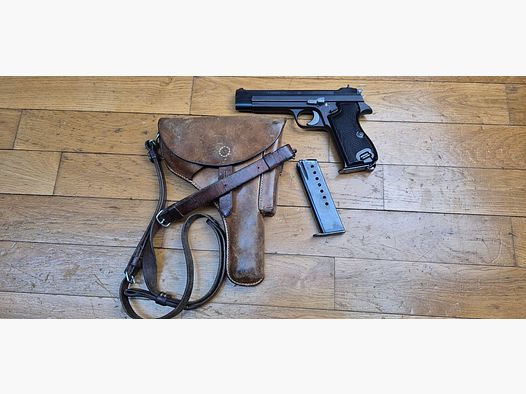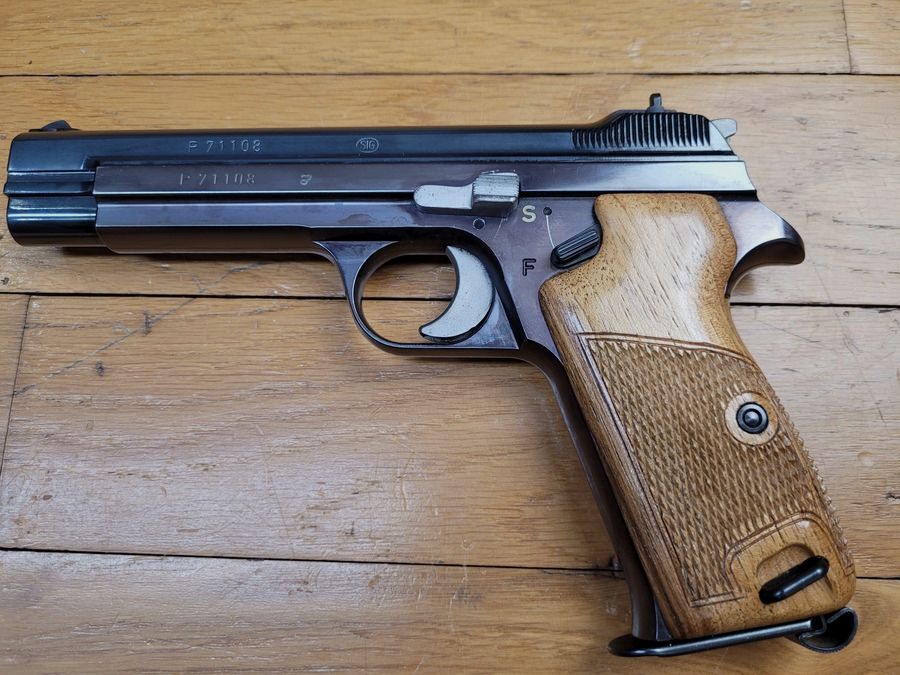
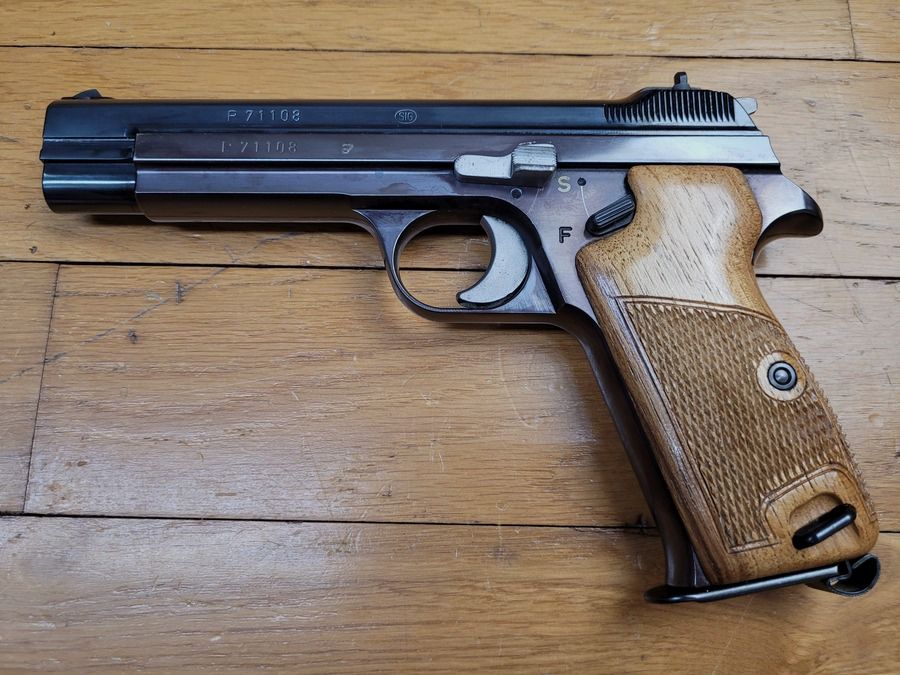


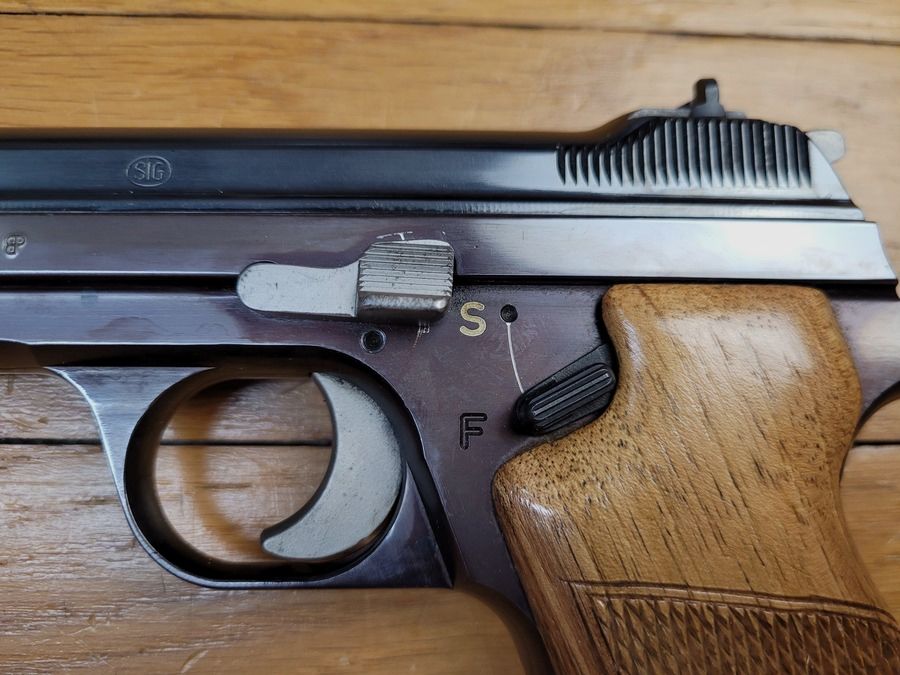

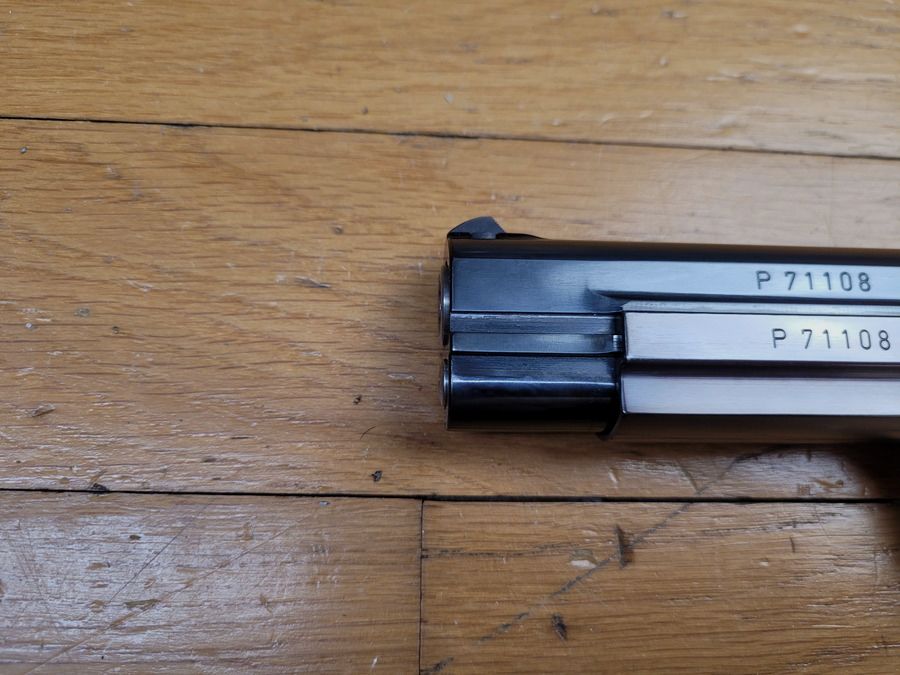
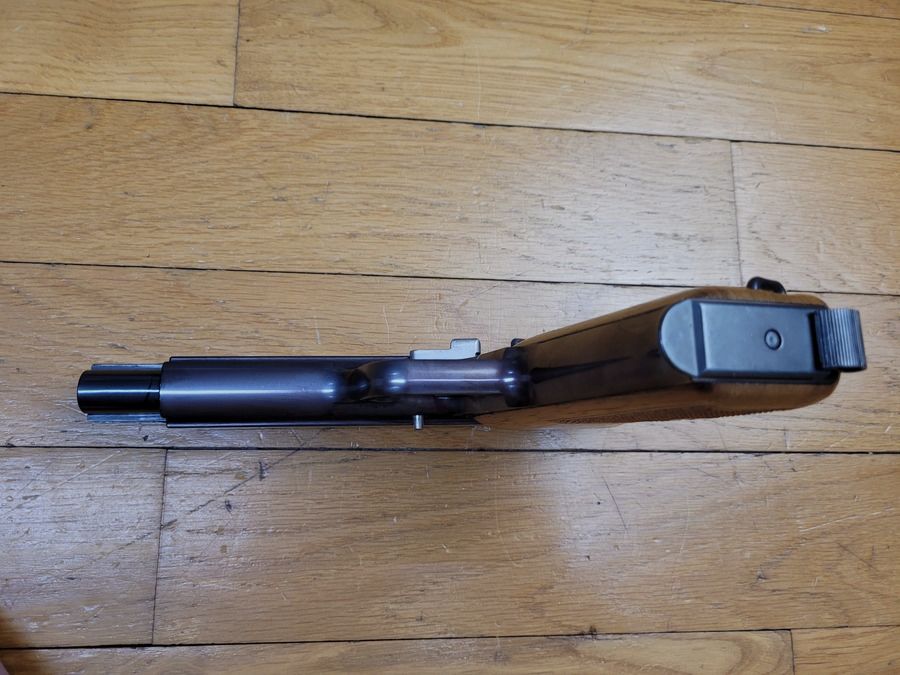

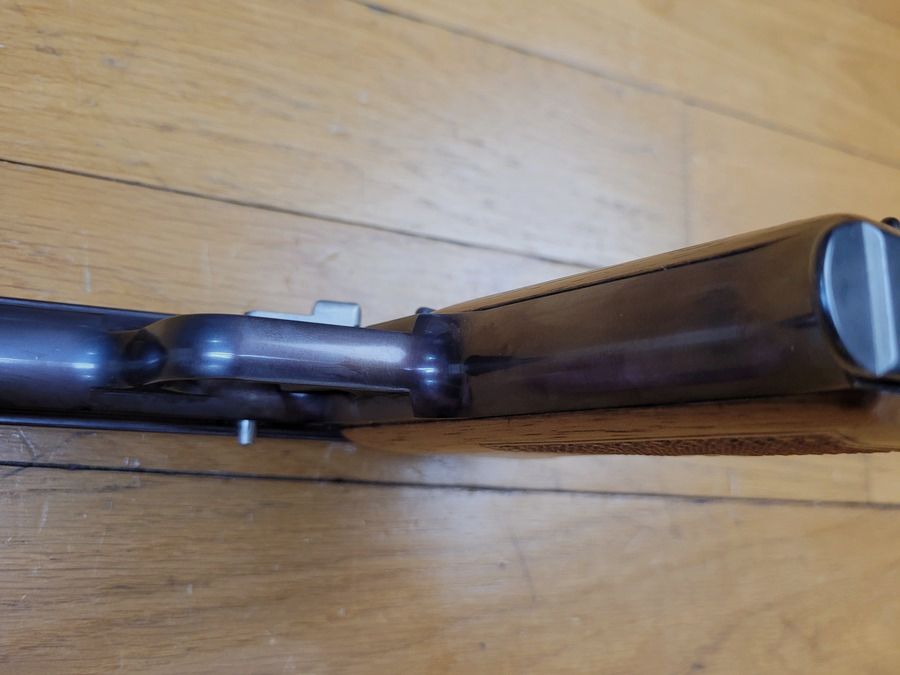

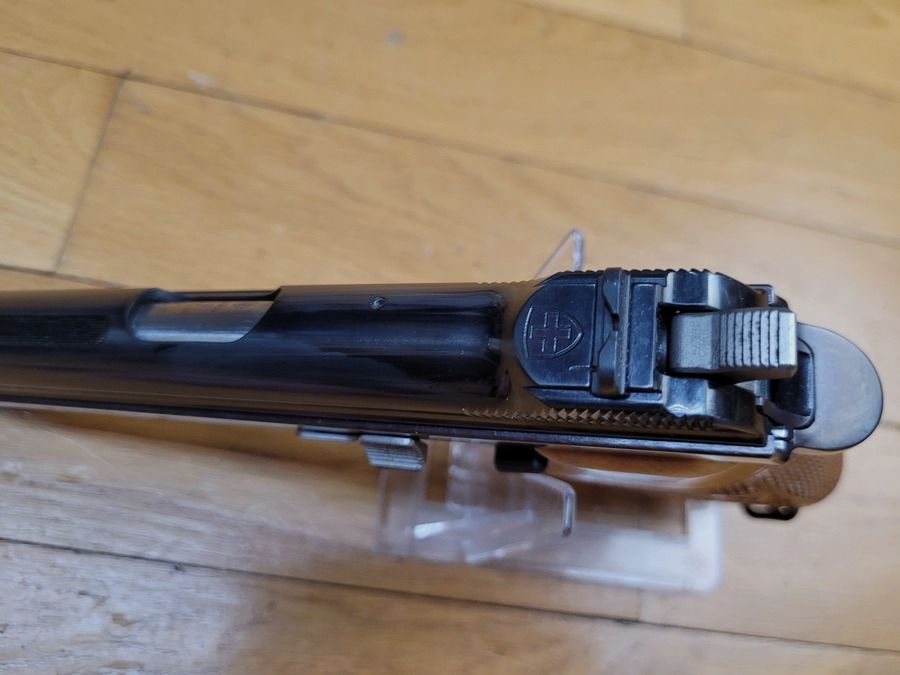






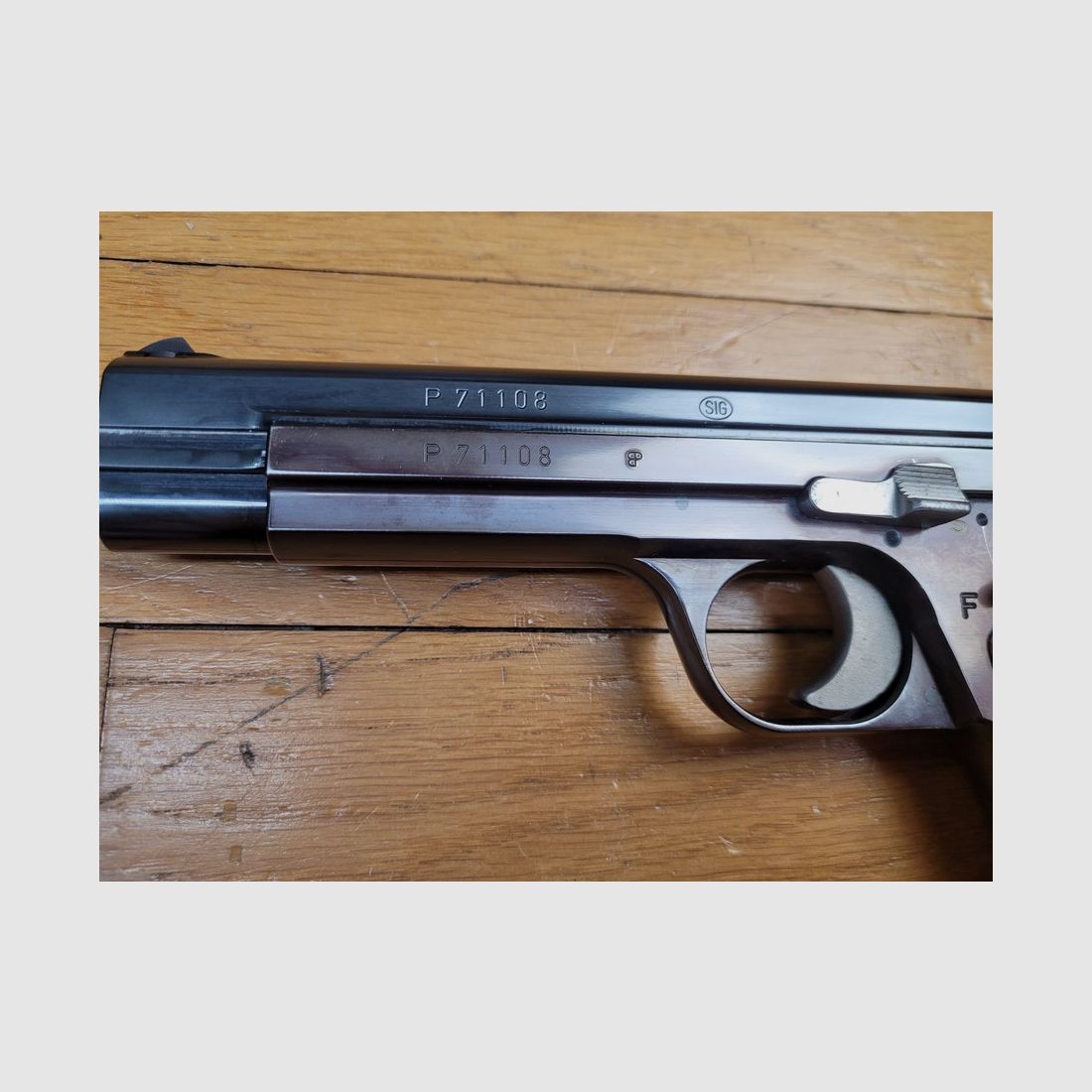


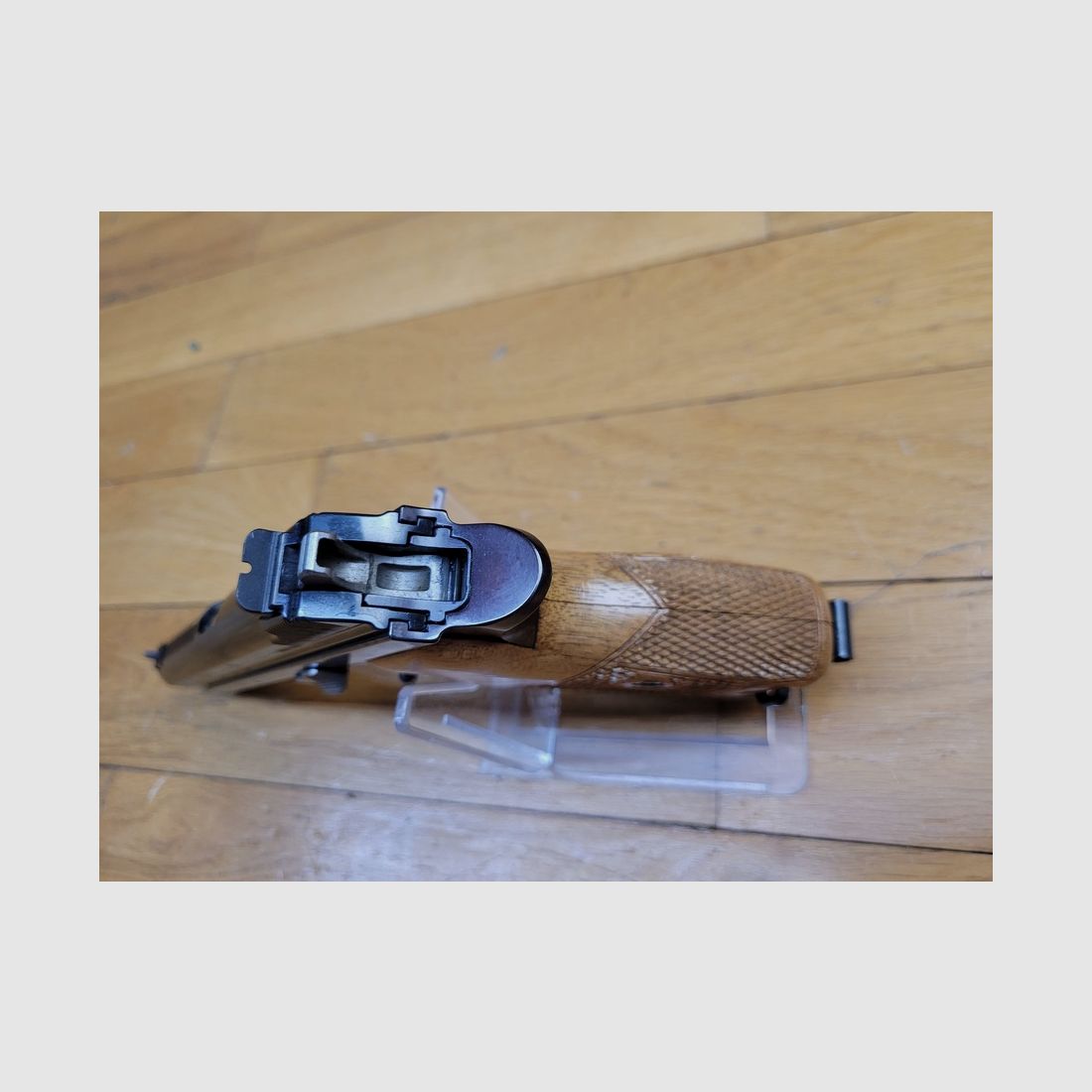
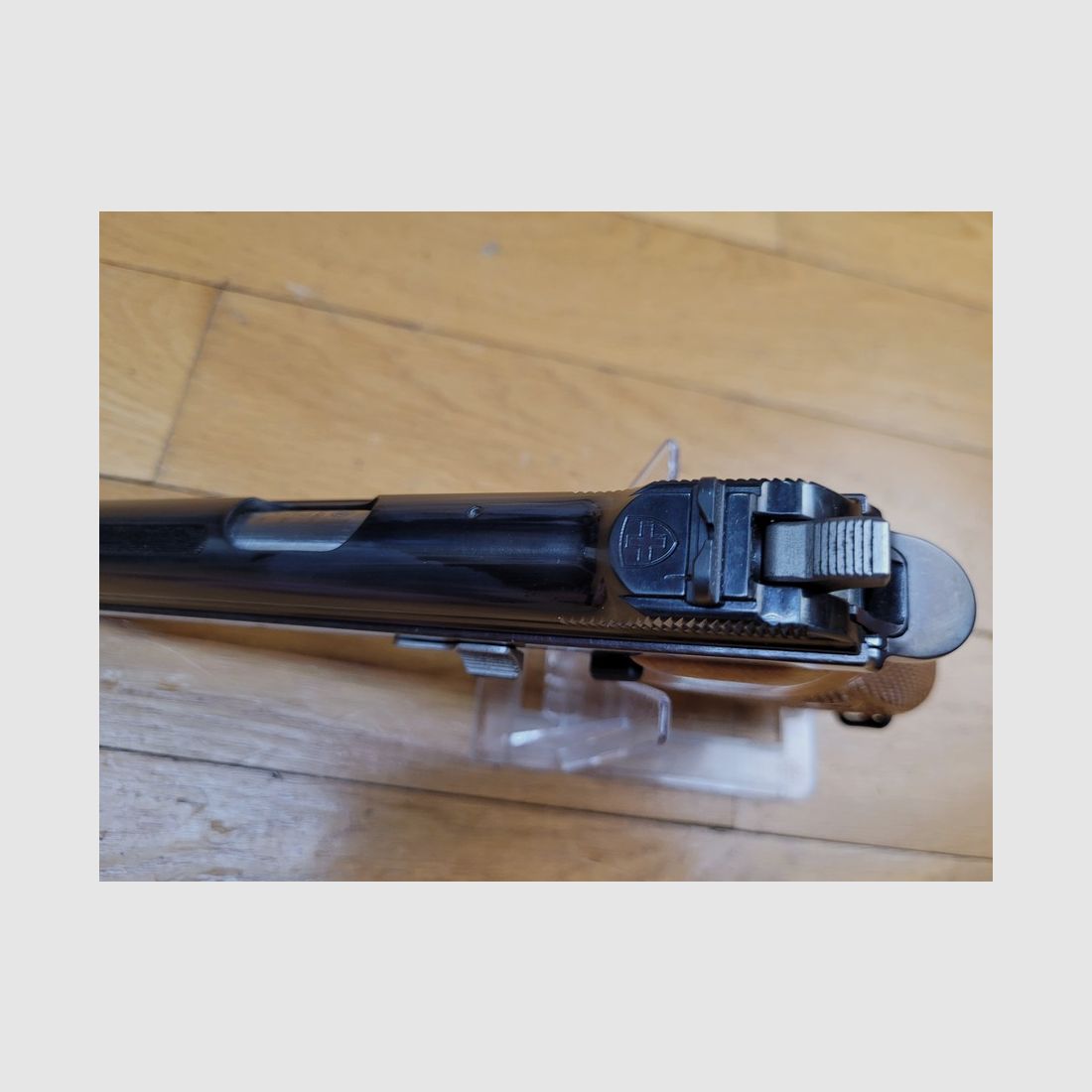
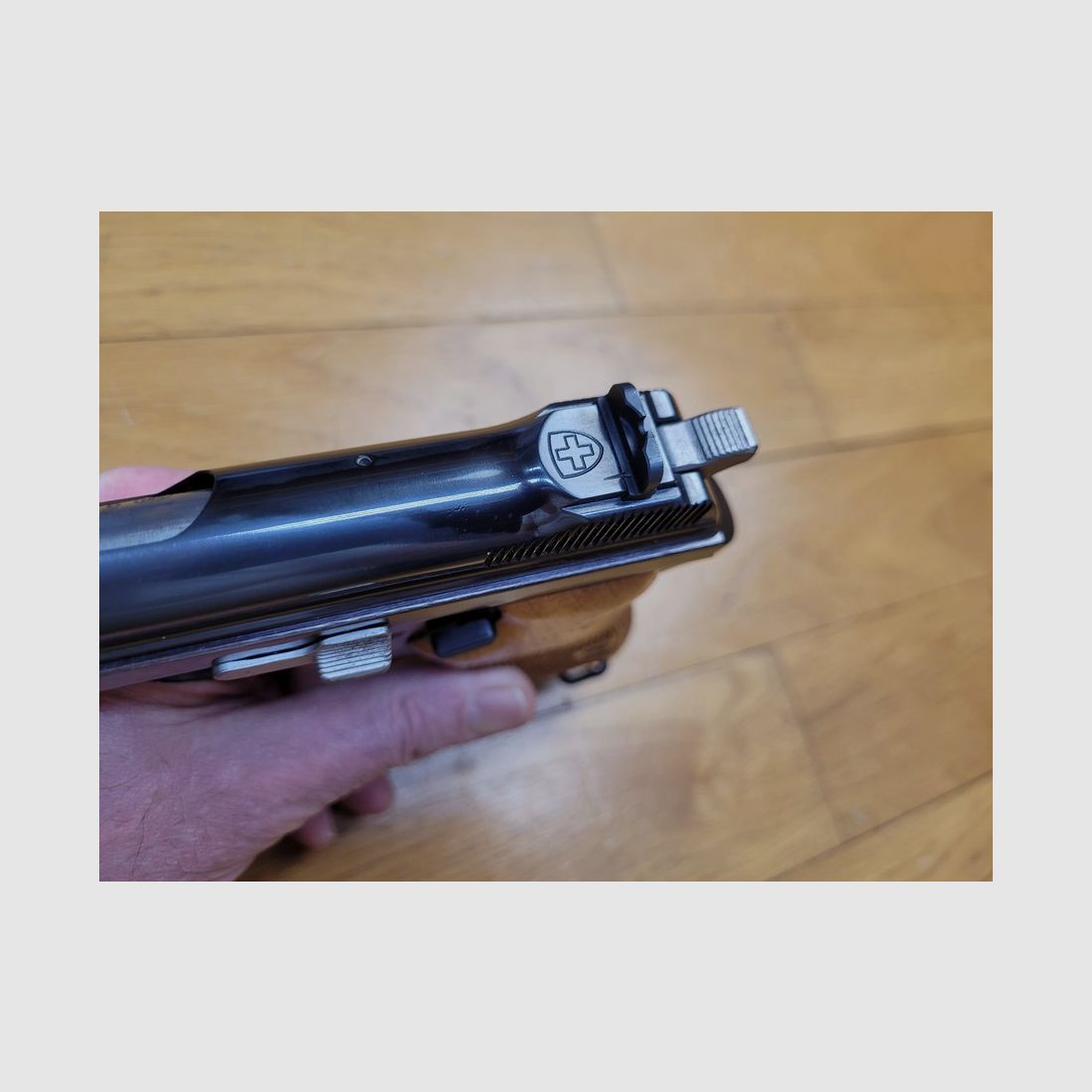




Splendid SIG P210-2 pistol – Myth of the 9 para caliber – Civilian weapon SP47/8 compliant with military type – First SIG production (not SIG Sauer) before 1975 – Weapon from 1972/73 – Bluing, operation, and dream barrel – Like new condition!
Price on Request
Purchase permit required
75002 Paris, France
16
ID: 10338889
This item is currently unavailable.
Purchase from outside the EU: The firearm goes through an importer in your country, the dealer handles the export.
How buying from Europe works
Shop safely with Gunfinder
Our AI-powered seller identity verification makes Gunfinder the safest marketplace online.
Learn more
Details
- Original language
- French
- Brand
- SIG Sauer
- Category
- Purchase eligibility
- Required
- Caliber
- 9mmLuger
- Condition
- New
- Location
- 🇫🇷 75002 Paris, France
- Availability
- Out of stock
Freshness
This listing is based on a mirrored offer, where the listing data was synced to us from a shop, dealer, or external marketplace. Please note that temporary price discrepancies may occur due to possible delays in data transmission.
- Source
- Flingus Maximus
- Last checked with the dealer
- 1 day ago
Description
Note:
The item is located abroad. Please note that delivery conditions, shipping times, and/or the purchase process may differ.
Just think about it. First, it had to succeed a legend. Then it had to see off formidable rivals.
First, the P-210 succeeded the legendary Luger pistol, adopted by the Swiss Army as early as 1900—before Germany—and chambered in the excellent 7.65 Parabellum caliber. The Swiss produced it until 1947 because they loved their Lulu so much—the last standard-issue Lugers in the world, in fact. At the range, it’s my favorite of all the Lugers, along with its artillery-model cousin, for quite different reasons.
Then they tried to replace it with a firearm that already existed.
A miracle. Neither the excellent French PA 35 (despite its ammunition) nor the formidable Belgian GP35 won favor with the Swiss Army Selection Commission. If the commission had seen things differently, we might not have the P210 today. That’s been a stroke of luck for our shooting friends for the past … 74 years.
For the record, the P35 A and GP35 were deemed not reliable enough and too inaccurate. If you know both firearms, that’ll make you smile—but nothing is reliable enough, and above all, nothing is accurate enough in the land of William Tell. Perhaps they also simply wanted to produce something Made in Switzerland? A perfectly legitimate concern, and one we would have done well to take inspiration from.
Still, the challenge of doing better than those three was a bold one. But they exceeded all expectations.
What other firearm made after 1945 has been called the “Rolls-Royce of military pistols”? Or the “crown jewel of SIG”?
And yet the French aren’t entirely strangers to this strictly Swiss story. Far from it.
In 1937, SIG bought the patent for the French PA 35, an excellent semi-automatic pistol invented by Charles Gabriel Petter, born Carl Gabriel Petter (1880–1953), a Swiss man from Bern who became French through blood shed in battle. He was one of those Swiss men who joined the Foreign Legion as early as 1914 to fight for France, like Blaise Cendrars. (As for Cendrars, I can’t recommend his “La main coupée” enough: his memoirs of 1914–18, probably his best work alongside “L’or.”) Petter became a French citizen in June 1916 after becoming a Legion captain and being mentioned in dispatches twice.
Together with his colleagues at the SACM factory in Cholet, he developed the mechanism of the excellent PA 35, which suffered only from its more eccentric than truly bad ammunition (the 7.65 Long)—and that wasn’t Petter’s choice, either. The Swiss would base their P-210 on the French firearm.
The SIG Swiss had “a good nose” for business when they bought the French patent from SACM (Société Alsacienne de Construction Mécanique). The company had failed to protect its rights amid the French general staff’s dithering over the choice of an automatic pistol before 1940: barely 10,000 had been made by the June 1940 armistice, despite the firearm having been selected as early as 1935 and production starting in 1937. A disgrace…
By chambering it in the more suitable 9mm Parabellum and taking its manufacturing quality to almost unreasonable lengths, the Swiss made the Patek Philippe of military semi-automatic pistols.
Between 1942 and 1944, SIG tested no fewer than 11 prototypes. In 1944, two of them were entered in the Swiss Army competition: the first was the SP44/16, a P210 with a larger grip to accommodate a 16-round double-stack magazine. The second was an 8-round firearm designated the SP44/8.
This is Switzerland, so they took their time with field trials. World War II was coming to an end, making things less urgent. The 44/16 was rejected in the meantime, and that brings us to 1947.
Surprisingly, it was first launched on the civilian market that year under the designation SP47/8. It became standard issue in the Swiss Army only in October 1948 under the designation…
tion P49. In 1949, it also became standard issue, marking its first immediate export success in Denmark under the designation Pistol M/1949.
Still no “P210” in sight, then. Why?
Let’s take a little detour into SIG designations and serial numbers.
In fact, it wasn’t until 1957 that the civilian designation SP47/8 was changed to “P210.” It first appeared among the other designations for this same pistol in SIG’s catalog. In retrospect, the designation “Model P210-1” would cover all firearms produced up to 1965. The designation “P210-2” would cover all standard models produced from 1966 onward (starting with serial number P 59071). The designation “P210-3” was assigned to a batch made for the police forces of three Swiss cantons, including Lausanne. They were produced between 1951 and 1964 (serial numbers P 6791 to P 6840 and P 8001 to P 8893). The designation “P210-4” applies to the famous pistols made for the German border guards (serial numbers D 1 to D 6500). Starting with the “P-210-5” designation (and including the very rare “P210-7” in 22lr), we’re talking about target-shooting models made from the 1980s onward.
For the record: all Swiss military firearms have an A on the frame, from A 100001 to A 213110 (with or without a “P” on the trigger guard, depending on whether they were kept by their owners after returning to civilian life). Firearms with a P on the frame before the serial number were made for the police if they have the numbers listed above, between 1951 and 1964, and for the civilian market with numbers P 50004 (1949) to P 79150 (1975).
After that, they’re no longer SIGs from SIG in the strict sense.
Serial numbers P 79600 to P 97950 are private commercial models made by SIG Sauer Switzerland between 1976–1984, which doesn’t detract from their quality, of course.
The jump to the 300,000 serial numbers indicates production by Swiss Arms /SIG Sauer and the shift from traditional forged frames to laser and CNC production.
Now you know everything.
So, come on! Get your guns out! Quickly check all your serial numbers and see where your firearm fits into all this.
P.S.: Anyone lucky enough to have one of the following serial numbers should urgently head to the nearest church to light a candle and call Maître Flingus for a thorough examination: 6001 to 6028 and 6033 to 6406, P 76521 to P76620 and P 79101 to P79150.
End of the detour into designations and serial numbers
The P210 was a worldwide success and remained in armed service in Switzerland until…1975, before being replaced by the P220. Its only fundamental advantage over its father, the 210, is that it’s also double-action and, above all, much cheaper to produce.
The P210 is a single-action pistol with an overall design similar to the Colt 1911, but reworked by the French at SACM to simplify it (always a difficult task).
What makes the SIG P210 exceptional is its build quality.
First, SIG’s quality control was probably the strictest in the world, especially for civilian firearms (military firearms are, by definition, subject to very strict controls).
Second, it was designed for accuracy from the outset. The Swiss understood that consistency is the ultimate source of accuracy, both for the results it delivers after the sights have been “finally” adjusted and for what it brings to training. If the results vary, it’s you. Not the firearm.
Beyond the shooter, consistency comes as much from the mechanics as from the finish (and ammunition, too, for that matter). A technical trick helped them achieve this.
In most semi-automatic pistols, the slide moves on the outside of the frame. On the P210, it’s the other way around: the slide moves inside the frame rails. The lateral play between the fixed parts
and moving parts is thus eliminated. Longitudinal play is also significantly reduced. Combined with a very tight assembly, finely adjusted to remain smooth, this design gives the P210 great rigidity, which explains its consistent accuracy. But it is more expensive to machine.
Another strong point: maintenance. The SIG P210 is always immaculate throughout. Swiss obsession with cleanliness! It can be disassembled and reassembled in about twenty seconds, and the trigger group can be removed as a complete unit (like on a Tokarev or Garand) for quick and easy cleaning of the gun’s inner workings… In short, this 210 is a Rolls-Royce! And the Rolls-Royce has become a legend.
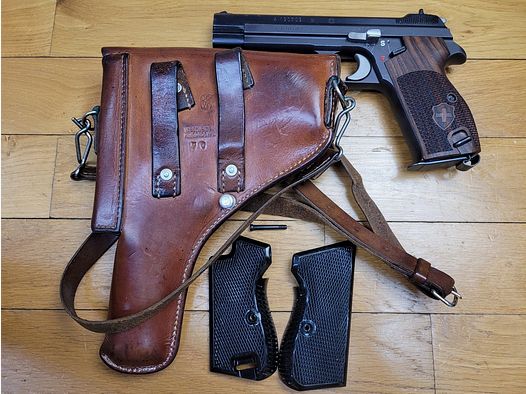
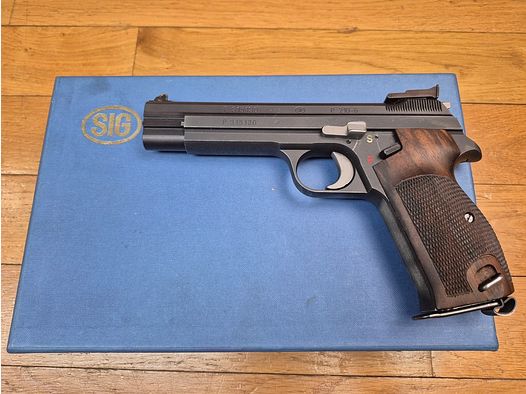
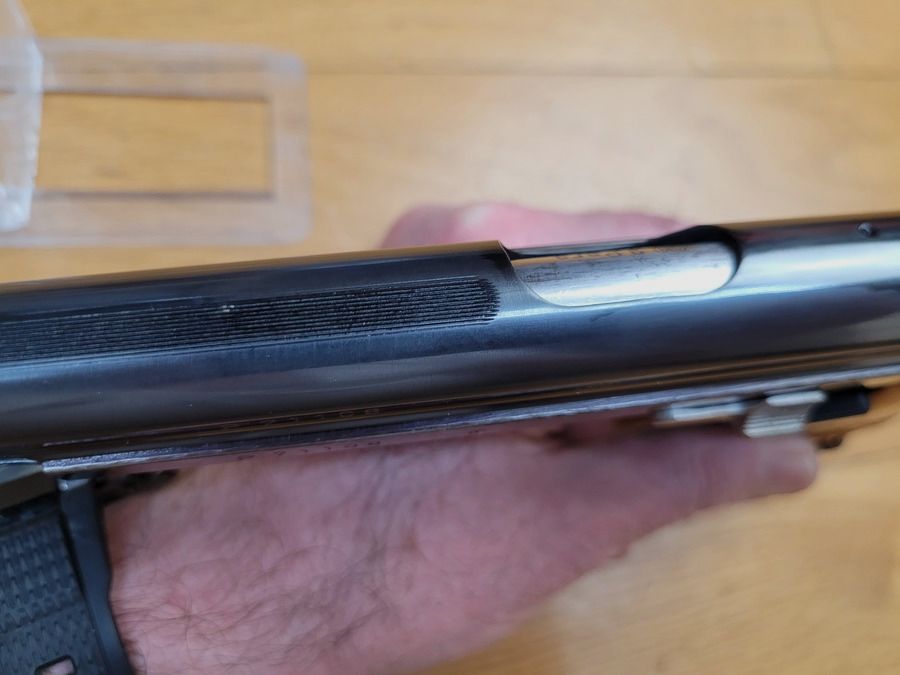
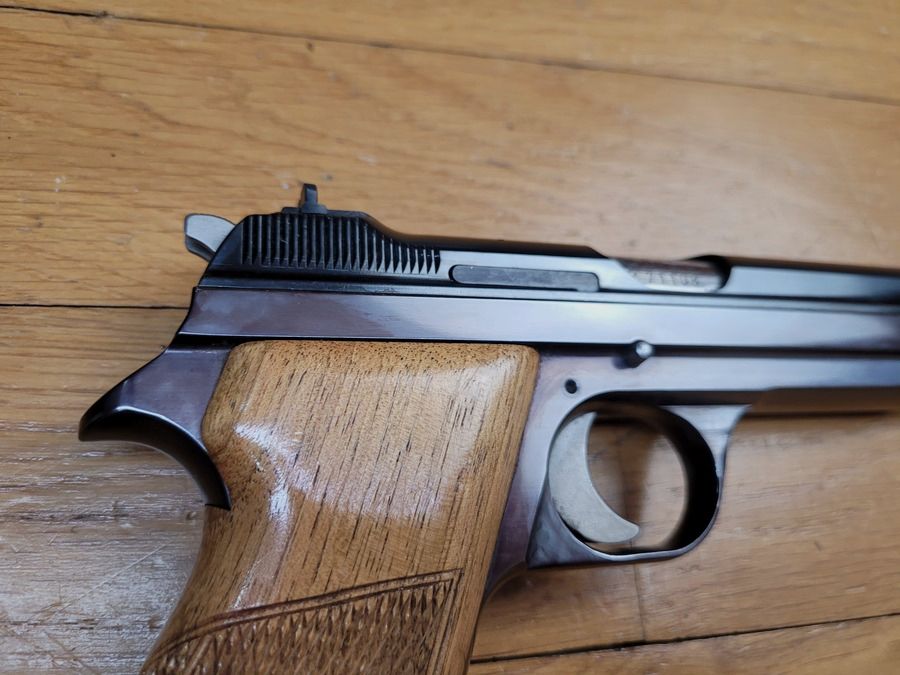
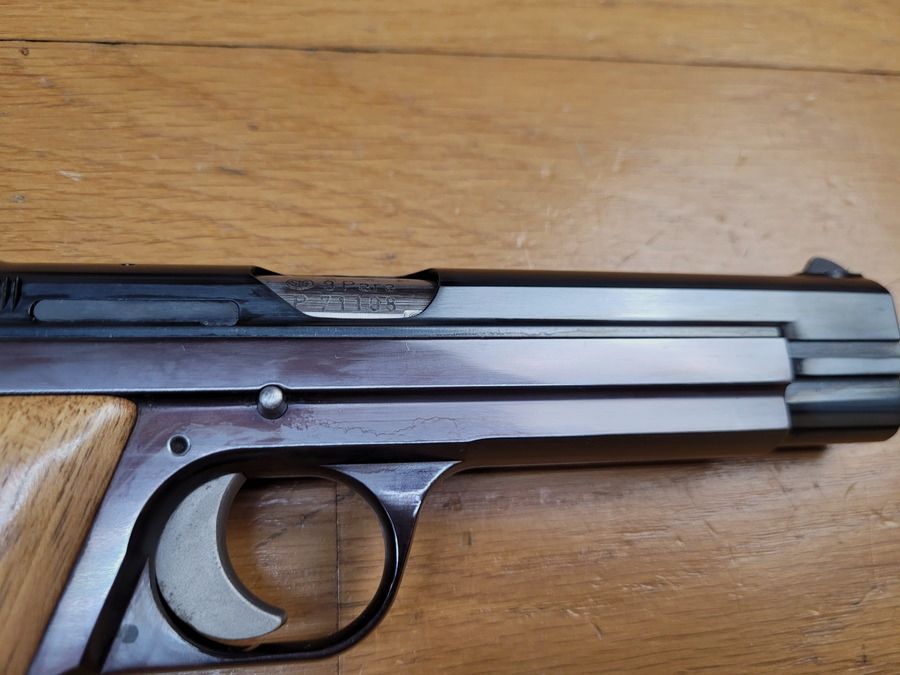
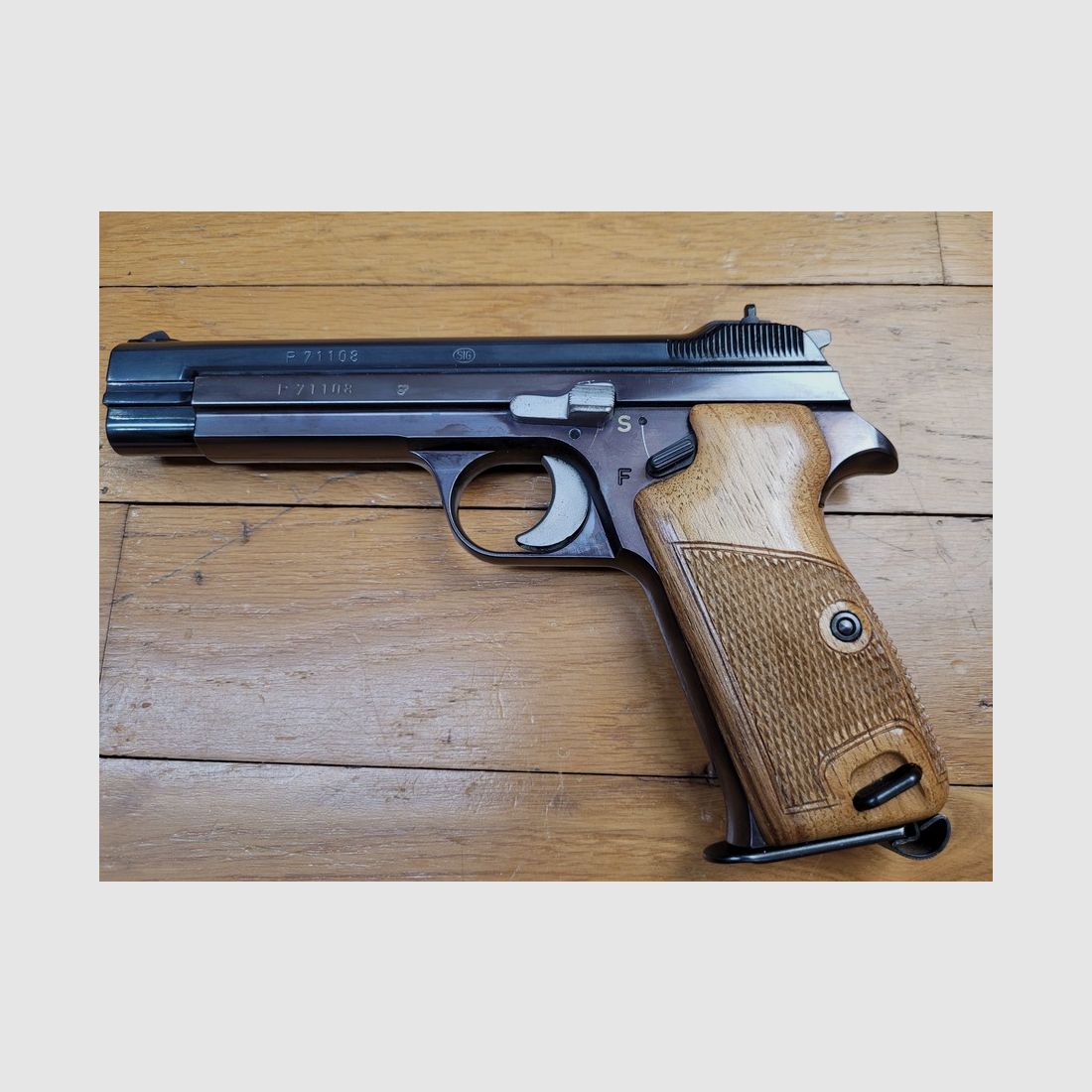
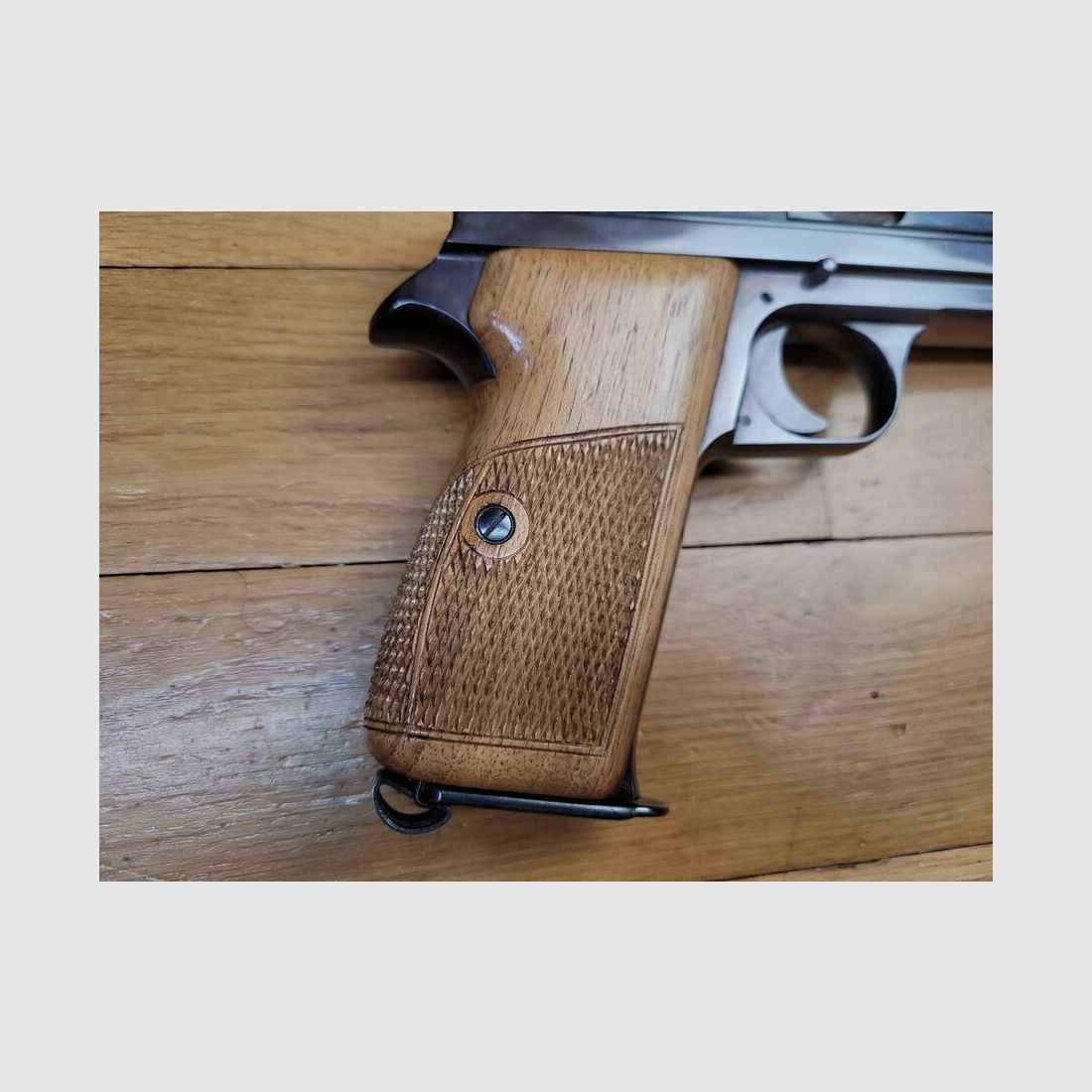
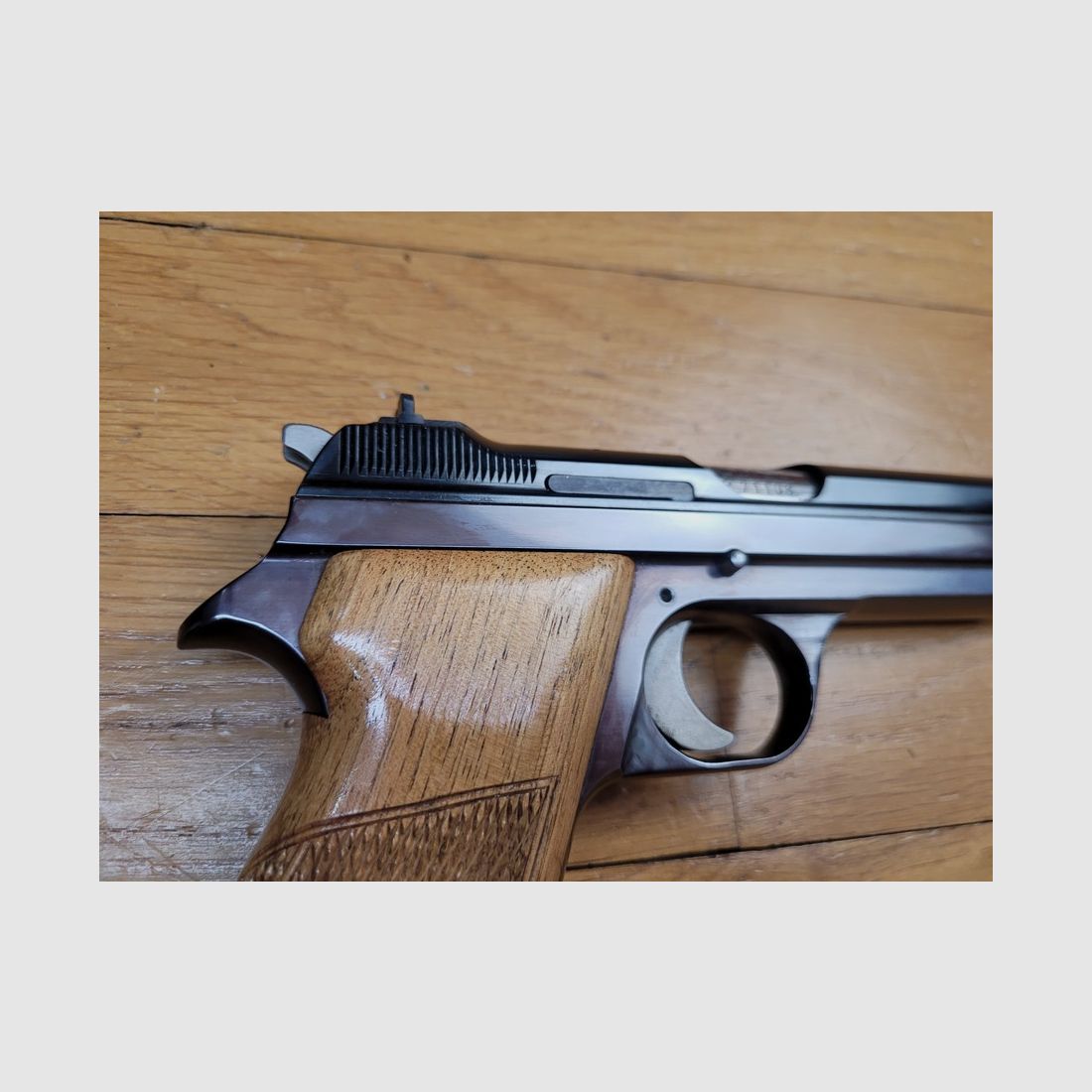
Today’s example is a splendid SIG P 210-2, made by SIG before 1975 and from the original production run (the most carefully finished). As for its condition, I’ve rarely seen one of this type and age in such beautiful shape. Like new!
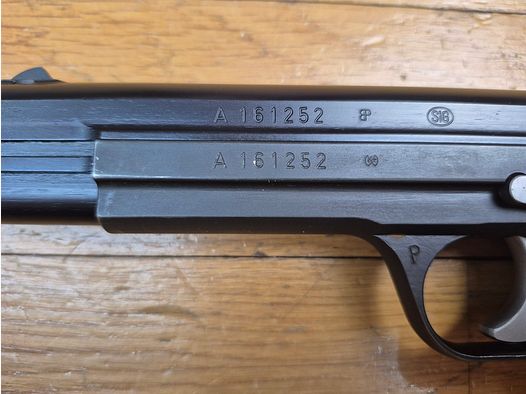
It is identical to the first type of the third military contract model. Only the serial number tells us it’s a civilian model. After that, these military firearms, produced identically for the civilian market, were fitted with plastic grip panels like their military counterparts, starting with the fourth military contract (No. 109710). From this serial number and contract onward, the finish also changed to a rougher sandblasted finish.
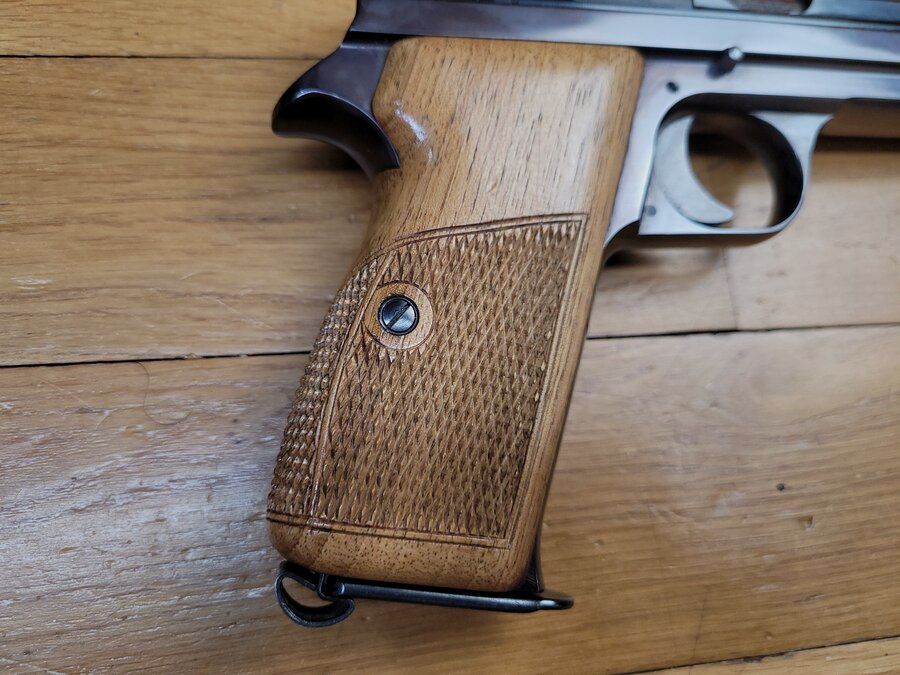
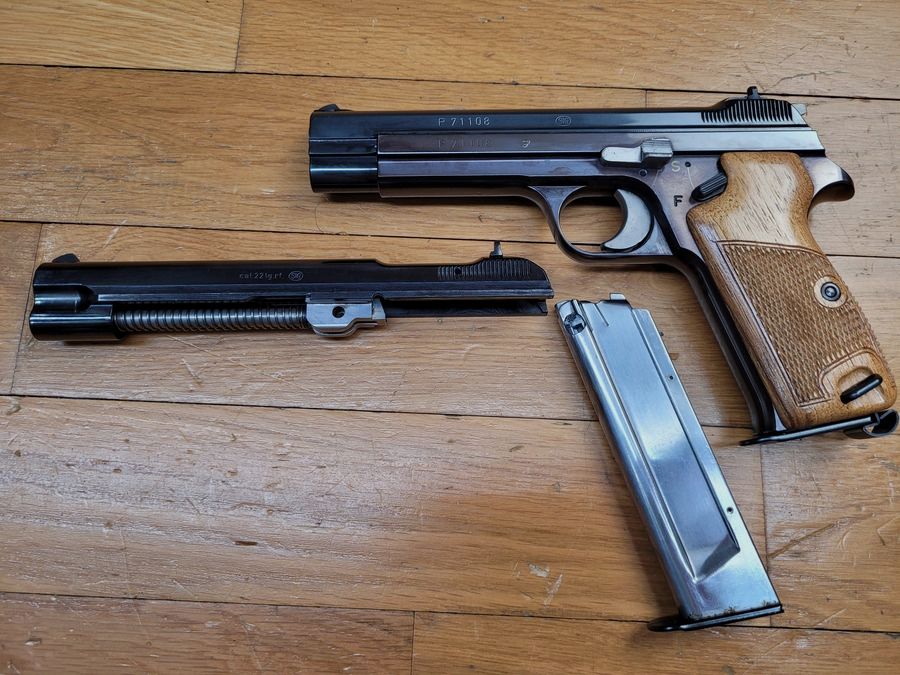
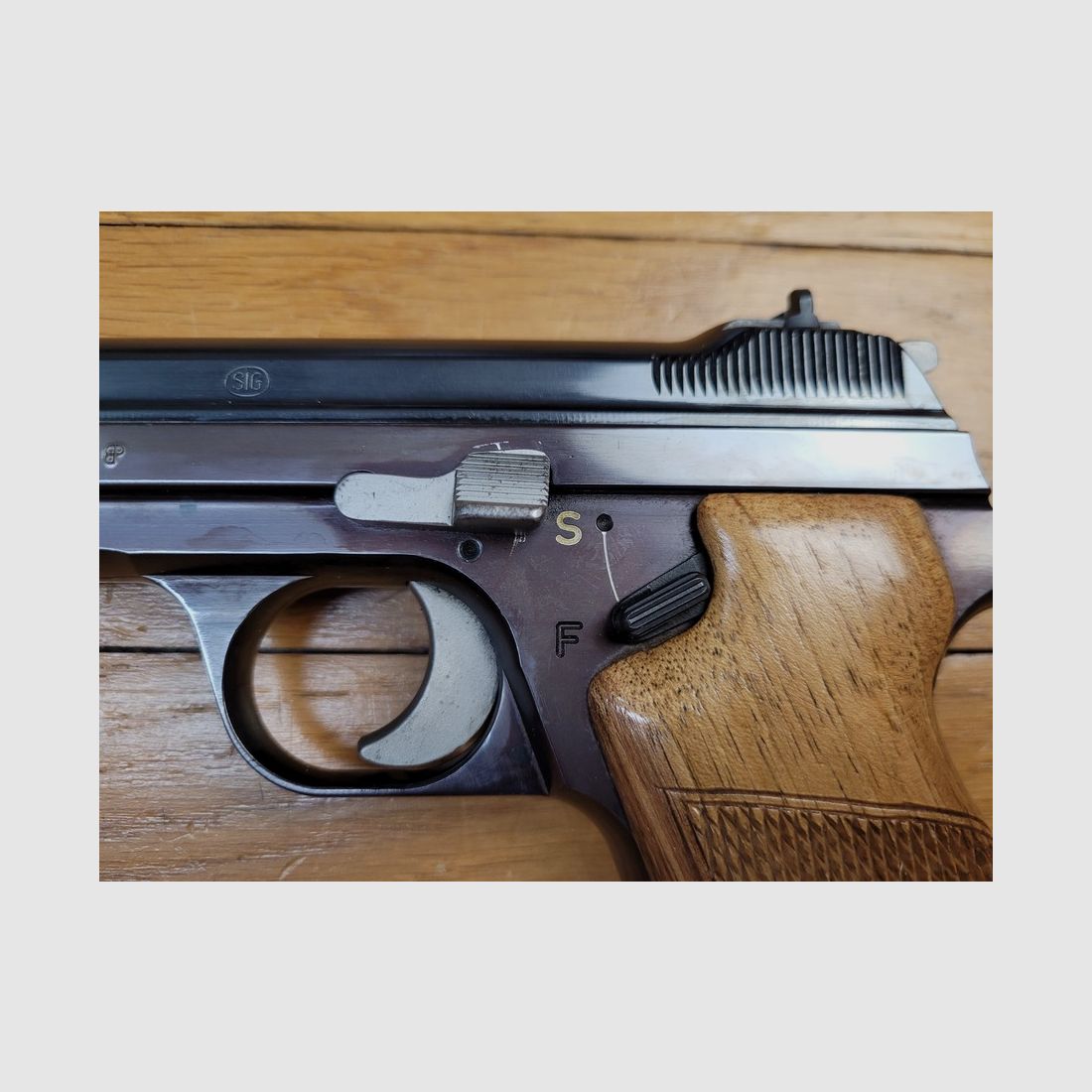
Ours is from before that. It has one of the finest cosmetic finishes. It has therefore retained the good wooden grip panels from this military-type production for the civilian market. Light walnut checkered grip panels (just grooved on the military models). Perfect condition. It also has its original lanyard ring, an unmistakable sign of its military lineage.
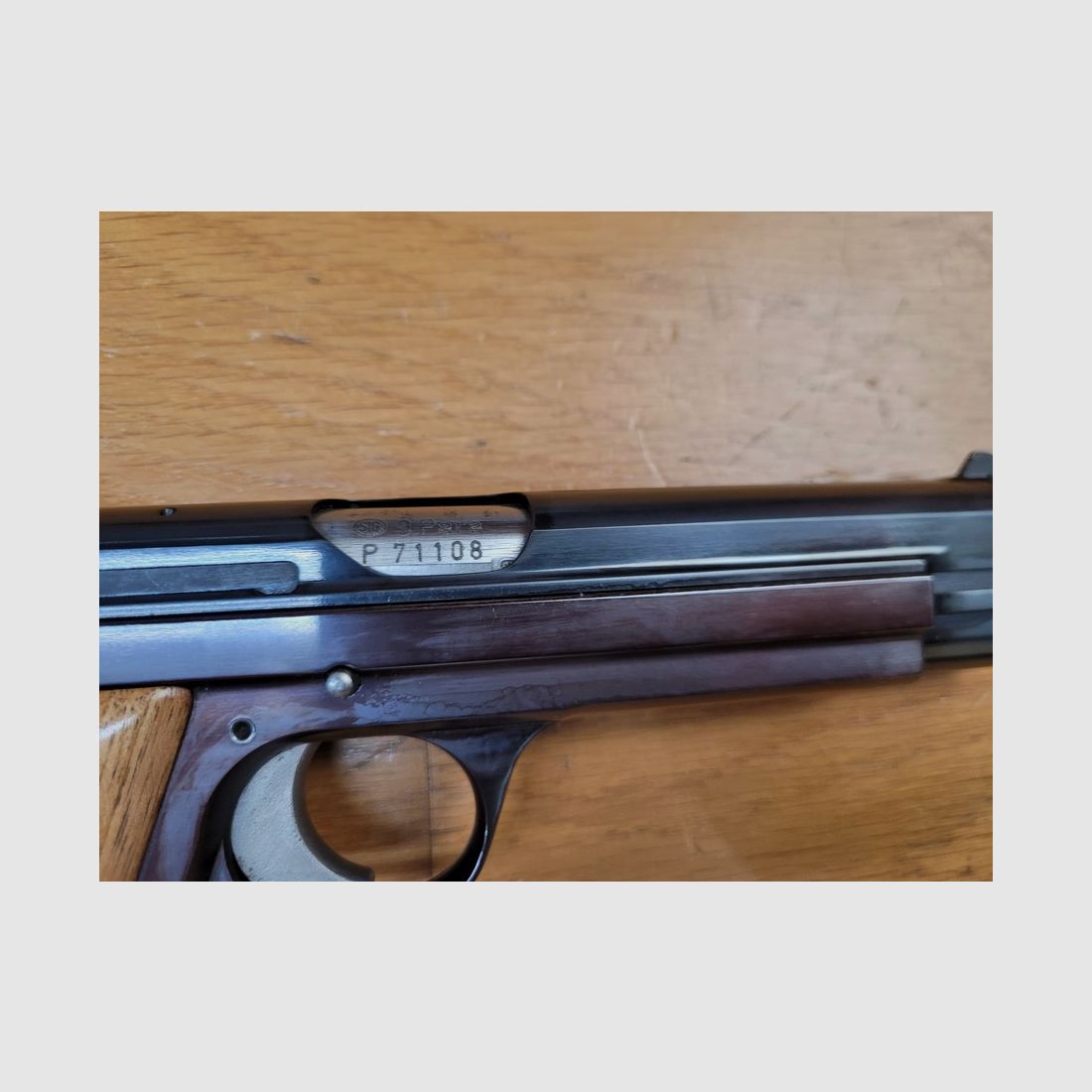
Its serial number tells us our baby is from 1972, among the last made with this finest finish. And it is in truly excellent condition.
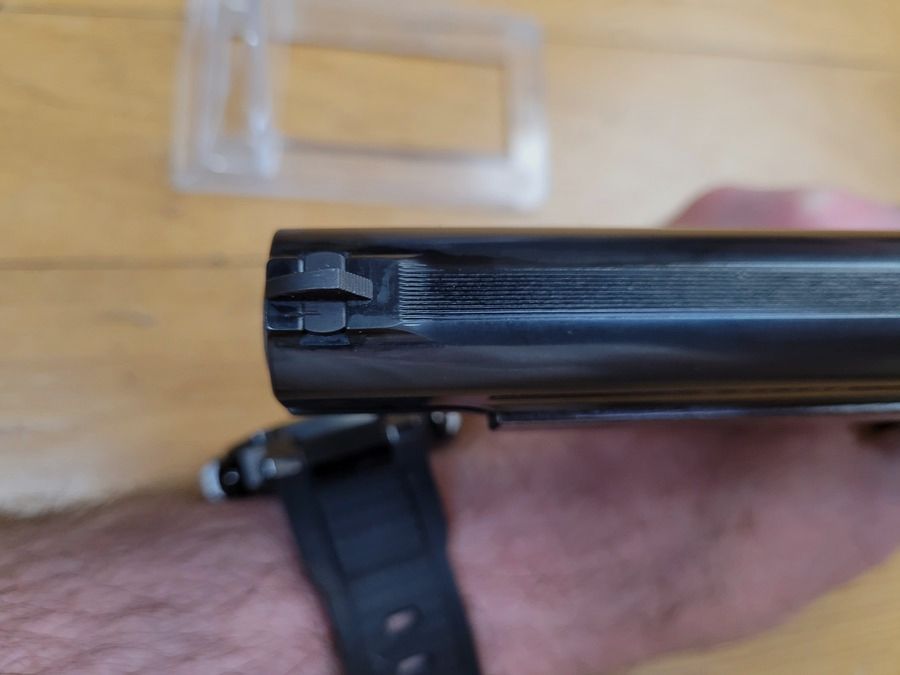
It has seen little or no use, even though its barrel is dusty. It is 100% mirror-bright and, frankly, impressive. The rifling is like new and extremely “sharp.” I strongly encourage its buyer to examine the rifling closely and compare it with that of other old firearms in like-new condition (German Lugers or P38s, for example). They’ll immediately understand what Swiss barrel quality means with this P210-2. This close inspection will be a real lesson in firearms craftsmanship.
Mechanically, the firearm is impeccable. Rigidity, bolt and magazine operation are simply perfect—crisp, robust firing and springs. And yet everything remains remarkably smooth. Truly superior quality. Its operation gave me the same feeling I get from Smith revolvers made during their finest years of production.
Perfect exterior. Glossy black bluing, very thick, which, together with its lanyard ring, gives it a handsome military look with a touch of luxury. 100% bluing with not a single scratch! Classy vintage style.
A very fine piece, then, with all its shooting potential still intact. The steel is in perfect condition. Impeccable screws. All handguns should be built like this.
The P210-2 is an icon. Treat yourself to an exceptional firearm from its finest production run, one that never loses value. One of the rare ones that does. Once you hold it, you’ll quickly understand why.
For your information, the Danish army, the very first to select it, kept them until… 2019. A full 70 years! They replaced them, incidentally, with… another SIG (the 320).
As my great-grandmother used to say, “With SIGs, it’s more than love—it’s an obsession!”
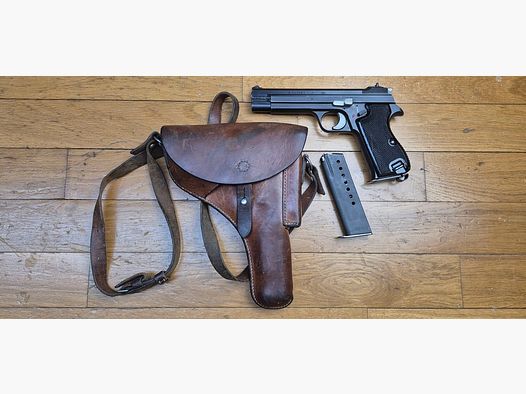
PS: And you know what? I also have its extremely rare .22 LR conversion from the SAME PRODUCTION RUN. It’s here. Exactly the same finish as the firearm. A perfect match. Sold separately from the firearm.
The final photo with the conversion is there just to show the set.
CATEGORY B FIREARM AT THE CSI: FIREARM SUBJECT
SUBJECT TO AUTHORIZATION. PHOTOCOPIES OF A VALID ID AND LICENSE REQUIRED – SIA ACCOUNT MUST BE OPENED. Shipping in two separate packages at least 48 hours apart, with signature required.
***************************************************************************************************************************************
Let’s say it again! Flingus Maximus gun shop in Paris and throughout France is also here to help with private firearm sales, buying firearm and militaria collections, firearm appraisals, and questions about firearms in estates and inheritances. Contact your favorite gun dealer using our contact form or at [email protected]
. (Show description in original language)
Le SIG P-210 est une arme née pour relever les défis.
Rendez vous compte. Elle a d’abord du succéder à un mythe. Et ensuite se débarrasser d’adversaires redoutables.
D’abord, le P-210 a pris la suite du mythique pistolet Luger adopté par l’armée suisse dès 1900, et avant l’Allemagne, dans l’excellent calibre en 7,65 parabellum (et que les suisses ont produit jusque 1947 tellement ils l’ont aimé leur lulu – les derniers Luger réglementaires au monde d’ailleurs). Au tir, mon préféré de tous les Luger avec son cousin l’artilleur 14 pour des raisons d’ailleurs assez différentes.
Ensuite, on a essayé de lui substituer une arme déjà existante.
Miracle. Ni l’excellent (nonobstant sa munition) PA 35 français, ni le redoutable GP35 belge n’ont trouvé grâce aux yeux de la Commission de Sélection de l’Armée Suisse. Si la Commission de sélection avait vu les choses différemment, on aurait peut-être pas de P210 aujourd’hui. Un sacré coup de pot pour nos amis tireurs depuis maintenant … 74 ans.
Pour la petite histoire, le P35 A et le GP35 ne furent pas jugés assez fiables et trop imprécis. Quand on connait les deux armes ça fait sourire mais rien n’est assez fiable et surtout précis au pays de Guillaume Tell. Peut-être aussi voulait-on surtout produire Made in Suitzerland ? Préoccupation d’ailleurs légitime dont eussions mieux fait de nous inspirer.
Néanmoins le pari de faire mieux que ces trois là était osé. Il fut toutefois tenu au delà des espérances.
Quelle autre arme d’après 1945 a pu être appelée la « Rolls des pistolets militaires » ? ou le « Fleuron de SIG »?
Et pourtant les français ne sont pas complètement étrangers à cette affaire strictement suisse. Loin de là.
En 1937, la SIG avait racheté le brevet du PA 35 français, un excellent pistolet semi auto inventé par Charles Gabriel Petter, né Carl Gabriel Petter (1880-1953), suisse bernois devenu français par le sang versé. Un de ces suisses qui ont rejoint la Légion Étrangère dès 1914 pour se battre pour la France à l’image de Blaise Cendrars (Pour Cendrars, je ne saurai d’ailleurs assez vous recommander son « La main coupée », ses souvenirs de 14-18, sans doute son meilleur opus avec « L’or »). Petter fut naturalisé français en juin 1916 après qu’il soit devenu capitaine de Légion et cité deux fois à l’ordre de l’Armée.
Il développera, avec ses collègues de l’usine SACM de Cholet, la mécanique de l’excellent PA35 qui ne souffrait que d’une munition baroque plus que réellement mauvaise (la 7,65 long) et qui n’était pas du choix de Petter d’ailleurs. C’est bien de l’arme française que repartiront les suisses pour leur P-210.
Les suisses de SIG ont eu le « nez creux » en achetant le brevet français de la SACM (Société Alsacienne de Construction Mécanique). Elle n’avait pas conservé ses droits face aux atermoiements de l’état-major français d’avant 1940 en matière de choix de pistolet automatique (à peine 10.000 exemplaires fabriqués en juin 1940 à l’armistice pour une arme sélectionnée dès 1935 et dont le début de production datait de 1937). Une honte…
En lui choisissant un calibre 9 para plus adapté à sa configuration et en soignant au-delà de tout raisonnable sa qualité de fabrication, les suisses ont en fait la Patek Philippe du pistolet semi-automatique mlitaire.
Entre 1942 et 1944, SIG ne teste pas moins de 11 prototypes. En 1944, deux de ceux-là sont présentés au concours de l’Armée Suisse – le premier est le SP44/16, un P210 à plus grosse poignée car on y loge un chargeur 16 coups double-colonne. Le second est une arme en 8 coups sous la dénomination SP44/8.
On est en Suisse, on prend son temps pour les essais en campagne, la seconde guerre mondiale se termine ce qui rend les choses moins sensibles. Le 44/16 est recalé sur ces entrefaites et nous voilà en 1947.
De façon surprenante, il est d’abord lancé sur le marché civil sous la dénomination SP47/8 cette année là. Il devient réglementaire dans l’Armée Suisse seulement en Octobre 1948 sous la désignation P49. En 1949 toujours, il devient également règlementaire, 1er succès export immédiat, au Danemark sous la mention Pistol M/1949.
Toujours pas d’arme dénommée « P210 » à l’horizon donc. Pourquoi ?
Allez, on se fait un petit tunnel sur les dénominations et les N° de série des SIG.
En fait, ce n’est qu’en 1957 que la désignation civile SP47/8 est changée pour celle de « P210 ». Elle apparait ainsi pour la première fois au milieu des autres désignations de ce même pistolet dans la nomenclature de SIG. Rétrospectivement, la dénomination « Modèle P210-1 » recouvrira toutes les armes produites jusque 1965. La dénomination « P210-2 » recouvrira tous les modèles standards produits à partir de 1966 (qui commence avec le numéro de série P 59071). La mention « P210-3 » sera attribuée à une fabrication pour la police de 3 cantons suisses dont Lausanne. Ils seront produits entre 1951 et 1964 (N° de série P 6791 à P 6840 et P 8001 à P 8893). La mention « P210-4 » s’applique aux fameux pistolets produits pour les gardes-frontières allemands (N° de série en D de D 1 à D 6500). A partir de la dénomination « P-210-5 » (et y compris le très rare « P210-7 » en 22lr) ont est dans des productions de tir sportif des années 1980 et plus.
A savoir: toutes les armes militaires suisses sont en A sur la carcasse de A 100001 à A 213110 (avec ou sans un « P » sur le pontet selon qu’ils aient été ou non conservées par leur titulaire revenu à la vie civile) – Les armes en P sur la carcasse devant le n° de série ont été produits pour la Police si elles sont avec les numéros déjà indiqués ci-dessus en 1951 et 1964 et pour le marché civil avec les numéros P 50004 (1949) à P 79150 (1975).
Après c’est plus des SIG de chez SIG au sens strict.
Les numéros P 79600 à P 97950 sont des modèles privés commerciaux fabriqués par SIG Sauer Switzerland entre 1976–1984, ce qui ne retire rien à leur qualité d’ailleurs.
Le saut de série dans les n° 300 000 indique lui des productions Swiss Arms /SIG Sauer et le passage de carcasses forgées traditionnelles à une production par laser et commandes numériques.
Désormais vous savez tout.
Alors hop ! Tous à vos flingues ! Vérifiez moi vite fait tous vos numéros de série et essayez de situer votre arme dans tout ça.
Ps: les éventuels et heureux titulaires des numéros de série suivants doivent d’urgence rejoindre l’Église la plus proche pour y déposer un cierge et appeler Maître Flingus pour une auscultation approfondie : 6001 à 6028 et 6033 à 6406, P 76521 à P76620 et P 79101 à P79150.
Fin du tunnel sur les dénominations et les numéros de série
Le succès du 210 sera mondial et il restera en service armé en Suisse jusque…1975 avant son remplacement par le P220. Qui n’a d’autre intérêt fondamental par rapport à son papa 210 que d’être aussi double action et surtout d’être bien moins cher à produire.
Le P210 est pistolet simple action avec une architecture générale proche du Colt 1911 mais remodelée dans un sens de simplification (exercice toujours difficile) par les français de la SACM.
Ce qui rend le SIG P210 exceptionnel, c’est sa qualité de fabrication.
D’abord, le contrôle qualité de SIG fut sans doute le plus sévère du monde notamment pour des armes civiles (les armes militaires sont par définition très contrôlées).
Ensuite, il a été dessiné dès l’origine pour la précision. Les suisses ont compris que la régularité était la source ultime de la précision tant pour ce quelle apporte après réglages « définitifs » des organes de visée que pour ce qu’elle apporte à l’entrainement. Si les résultats varient, c’est vous. Pas l’arme.
Or, au-delà du tireur, la régularité vient autant de la mécanique que des finitions (et des munitions aussi au passage). Un tour de passe-passe technique les y a bien aidé.
Dans la plupart des PA, la glissière coulisse à l’extérieur de la carcasse. Sur le P210 c’est le contraire, la glissière coulisse à l’intérieur du rail de la carcasse. Le jeu latéral entre les parties fixes et mobiles est ainsi supprimé. Le jeu longitudinal est sensiblement amoindri aussi. Cette construction associée un assemblage très serré mais très finement ajusté pour rester fluide quand même apporte au P210 une grande rigidité qui explique sa régularité du tir. Mais c’est plus cher à usiner.
Autre point fort: son entretien. Le SIG P210 est toujours impeccable de partout. Obsession suisse de la propreté ! Son démontage et remontage en se fait en quelques vingt secondes et le bloc-platine est amovible en entier (façon Tokarev ou Garand) pour un nettoyage facile et rapide des parties intimes du pétard… Bref une rolls ce 210 ! Et la Rolls est devenue mythe.
Notre exemplaire de ce jour est un splendide P 210-2 SIG de chez SIG d’avant 1975 et de la fabrication initiale (la plus soignée). Quant à son état, j’en ai rarement vu d’aussi beau de ce type et pour cet âge. Neuf !
Il est totalement similaire au modèle militaire troisième contrat 1er type. Seul le numéro de série nous dit que c’est un civil. Après cela, ces armes militaires produites à l’identique pour le marché civil seront équipées, comme leurs petits frères militaires, de plaquettes de crosse plastiques à partir du 4° contrat militaire (N°109710). Toujours à partir de ce N° et de ce contrat, la finition passera à une finition plus brute sablée.
Le notre est d’avant. Celles des meilleures finitions esthétiques. Il a donc conservé les bonnes plaquettes bois de cette fabrication du type militaire pour le marché civil. Des plaquettes de noyer clair quadrillées (juste rayées sur les militaires). Parfait état. Il a aussi bien son anneau de dragonne d’origine, signe immanquable de sa lignée militaire.
Son numéro de série nous indique que notre bébé est de 1972, dans les derniers de la fabrication de cette finition la plus soignée. Et il est dans un état vraiment plus qu’excellent.
Il a peu ou pas tiré même si son canon est poussiéreux. Il est 100% miroir et pour tout dire impressionnant. Les rayures sont comme neuves et extrêmement « coupantes ». J’invite vivement son acquéreur à bien observer ces rayures et à les comparer à celles d’autres armes anciennes à l’état de neuf (des luger ou P38 allemands par exemple). Il comprendra immédiatement ce que veut dire qualité suisse en matière de canon avec ce P210-2. Cette observation attentive sera pour lui une véritable leçon de choses et d’arquebuserie.
Mécaniquement, l’arme est impeccable. Rigidité, fonctionnement de culasse et de chargeur justes parfaits – Percussion et ressorts francs et robustes. Et le tout reste néanmoins d’une souplesse confondante. Véritablement une qualité supérieure. J’ai éprouvé à son fonctionnement les mêmes sensations que celles que me donnent en revolvers les Smith des plus grandes années de fabrication.
Aspect extérieur parfait. Bronzage noir brillant et très épais qui associé à son anneau de dragonne lui donne un bel aspect miliaire mâtiné de luxe. Bronzage à 100% sans la moindre rayure! La grande classe dans un look vintage.
Très belle pièce donc avec encore tout son potentiel de tir. La qualité de l’acier est parfaite. Vis impeccables. Toutes les armes de poing devraient être construite comme ça.
Le P210-2 c’est une icône. Offrez vous une arme d’exception dans sa meilleure fabrication et qui ne décote jamais. Une des rares dans ce cas. Quand vous l’aurez en main, vous comprendrez vite pourquoi.
Pour info, l’armée danoise qui l’avait sélectionné la toute première les a gardé jusque… 2019. Juste 70 ans! Pour les remplacer d’ailleurs par … un autre SIG (le 320).
Comme disait mon arrière grand-mère, « Les SIG, c’est plus de l’amour, c’est de la rage! ».
PS: Et vous savez quoi ? J’ai aussi sa rarissime conversion en 22 LR de la MÊME FABRICATION. Elle est là. Exactement dans la même finition que l’arme. Parfaitement assortie. Vendue séparément de l’arme.
La photo finale avec la conversion est là juste pour montrer l’ensemble seulement.
ARME DE CATÉGORIE B AU CSI : ARME SOUMISE À AUTORISATION, PHOTOCOPIES DE LA PIÈCE D’IDENTITÉ EN COURS DE VALIDITÉ ET DE LA LICENCE OBLIGATOIRES – COMPTE SIA OBLIGATOIREMENT OUVERT. Expédition contre signature en deux colis séparés d’au moins 48 heures obligatoire.
***************************************************************************************************************************************
Répétons le ! L’armurerie Flingus Maximus à Paris et partout en France, est là aussi pour vos formalités armes entre particuliers, le rachat de collections armes et militaria, vos estimations d’armes, vos questions armes dans les successions et héritage. Contactez votre armurier préféré via notre formulaire de contact ou à [email protected]
.