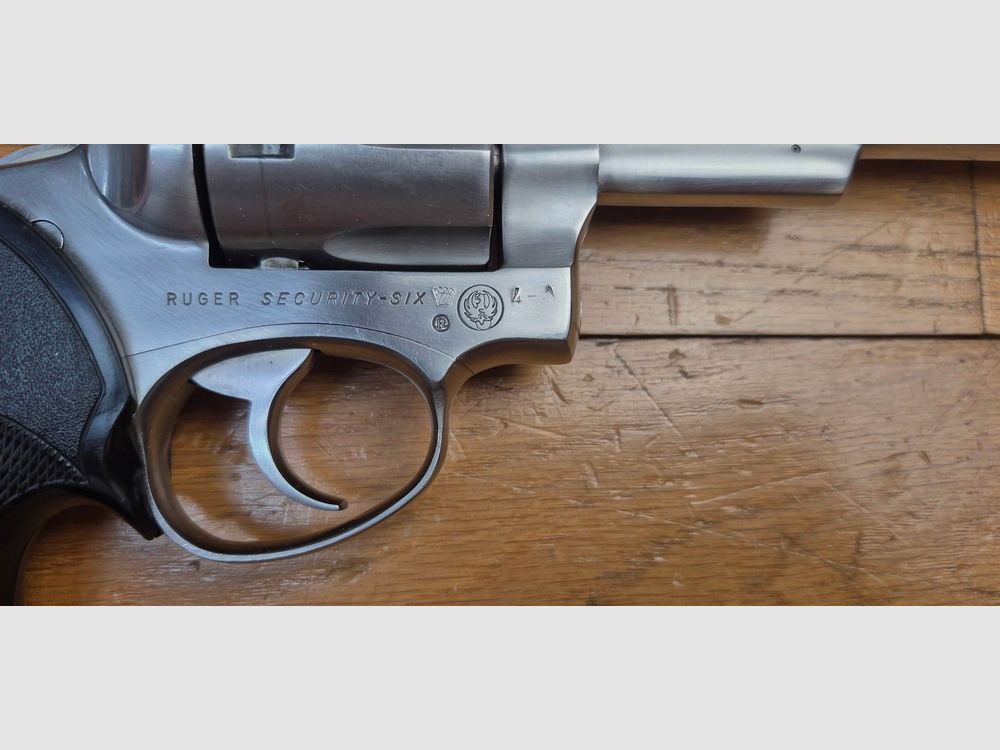
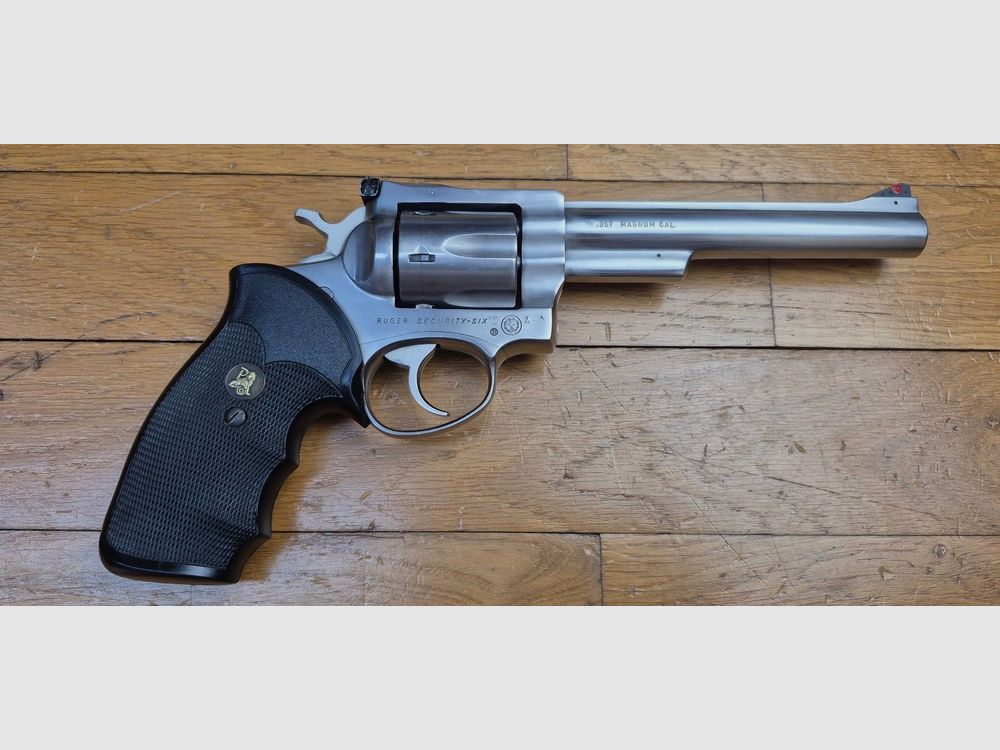


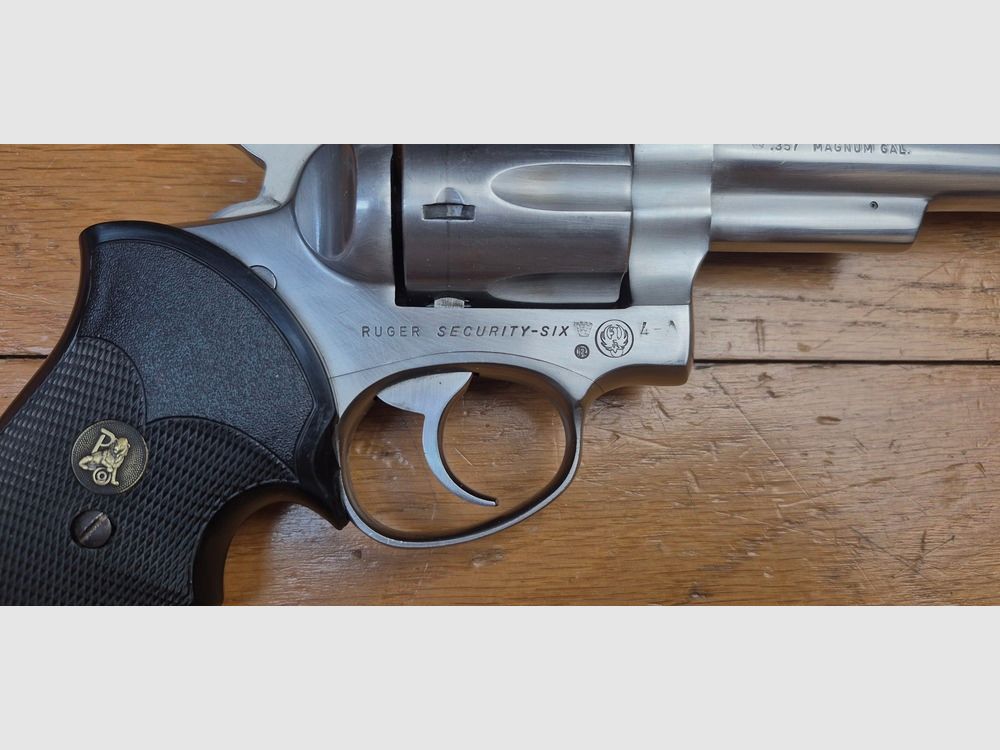
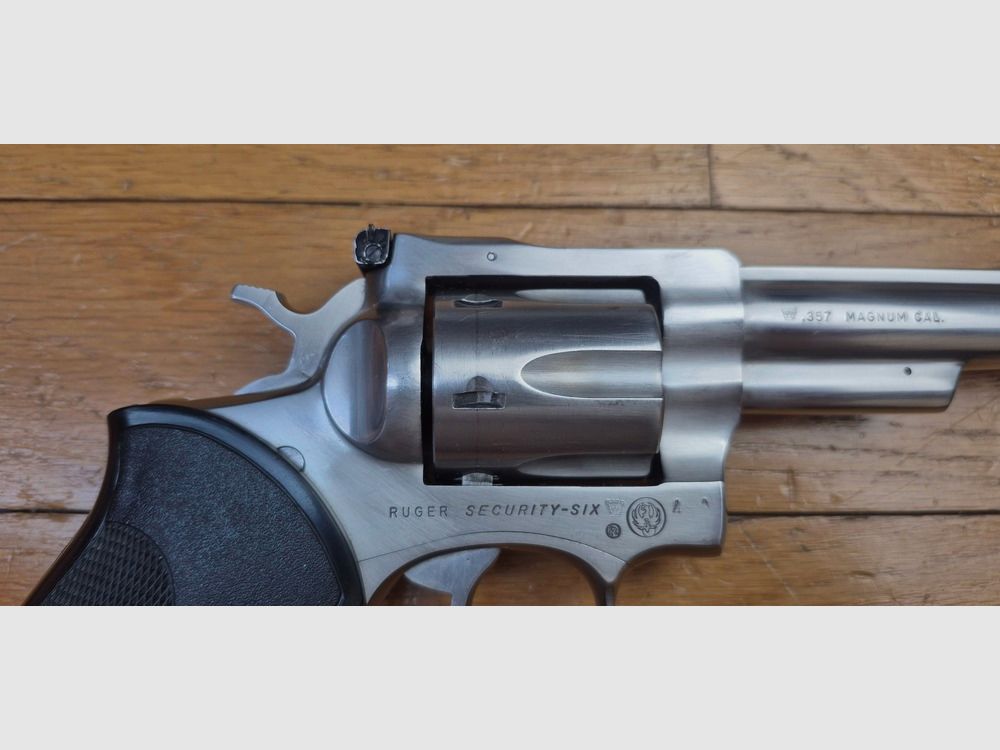
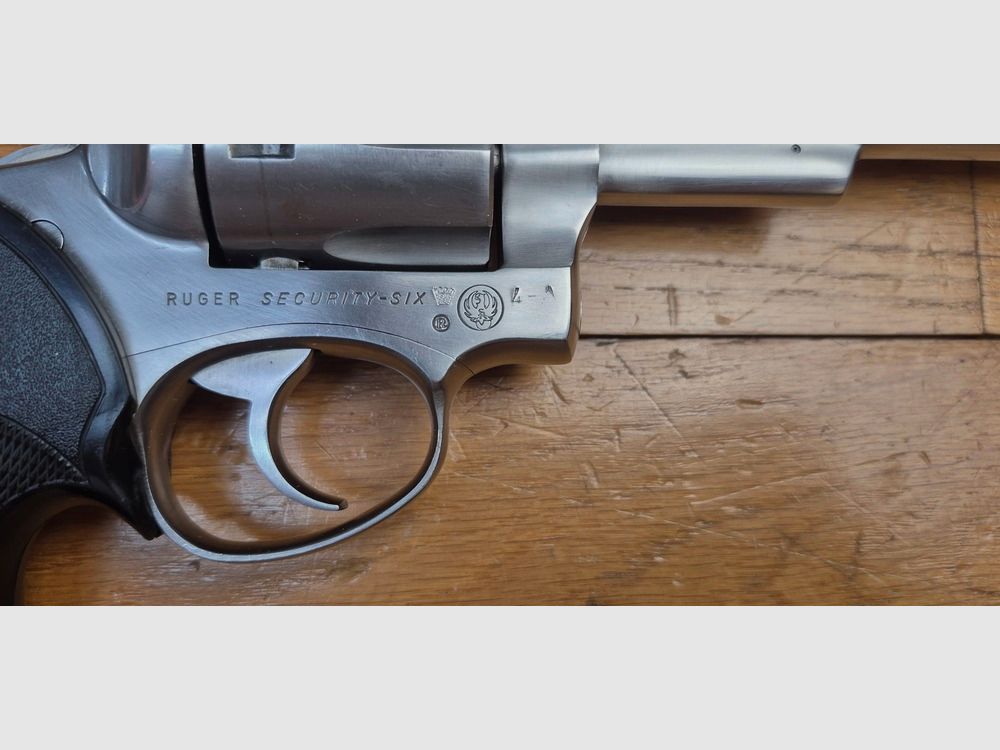

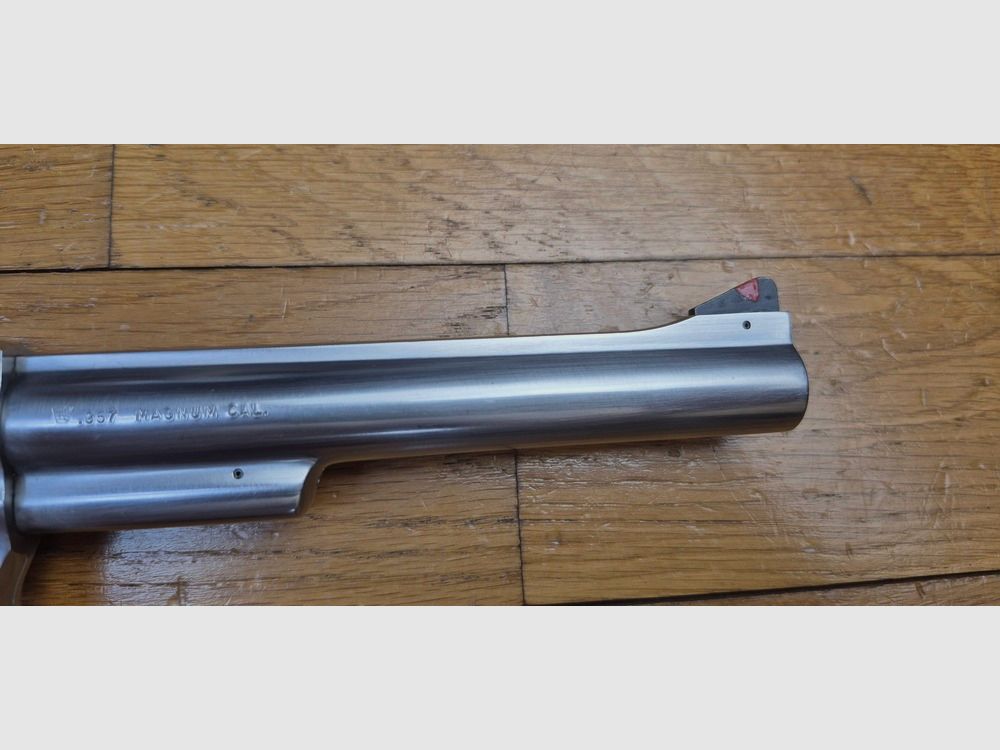


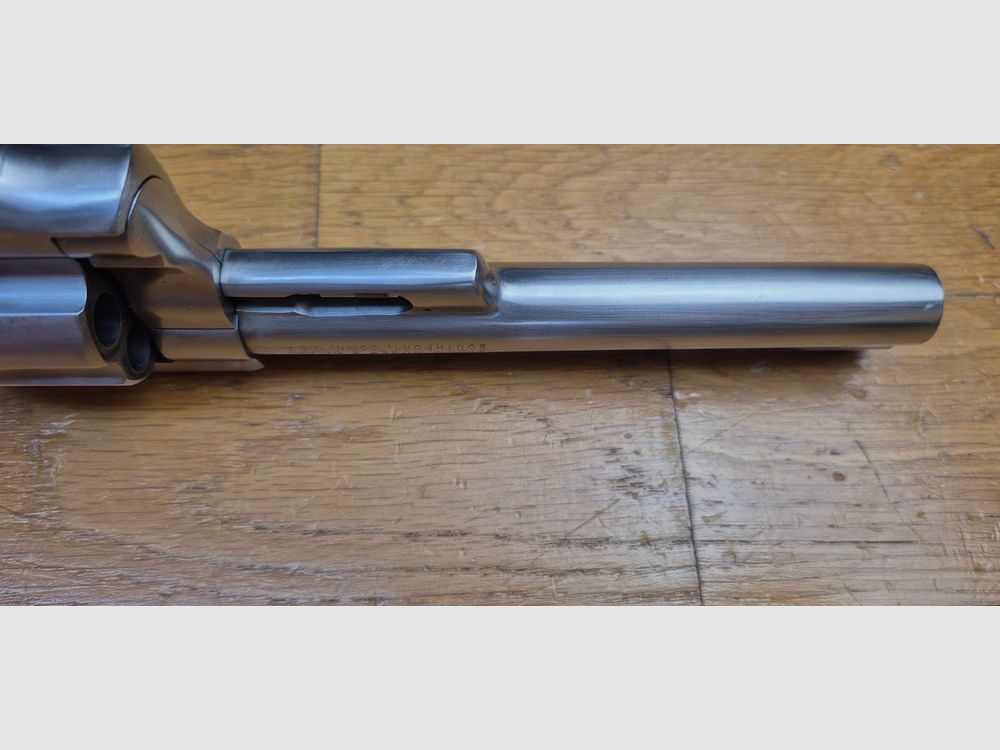

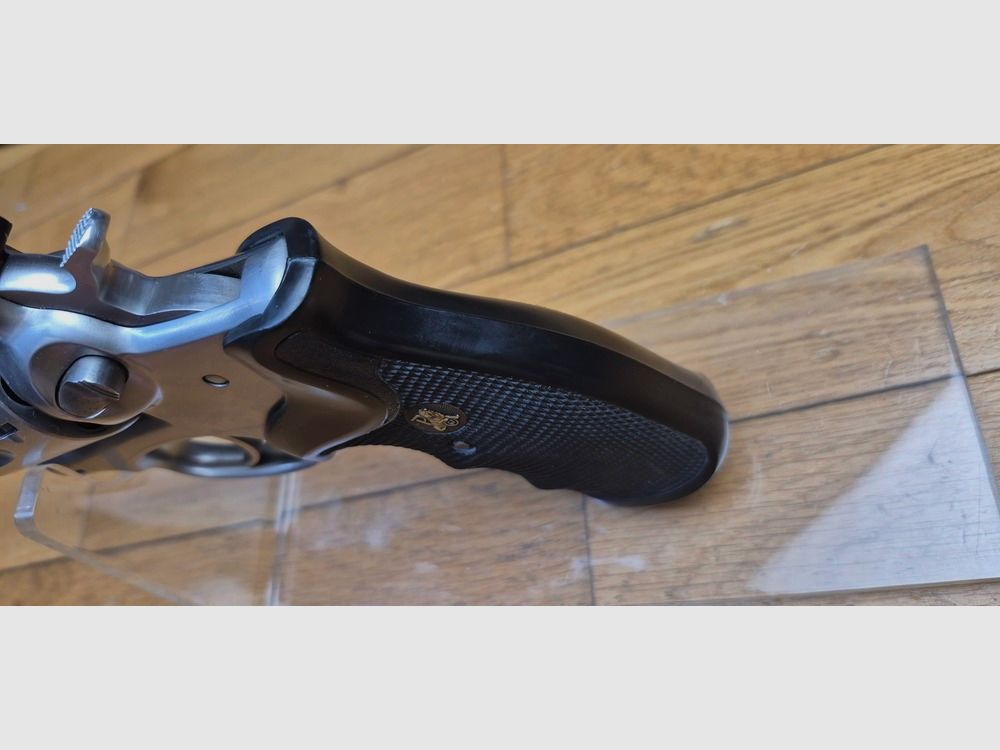
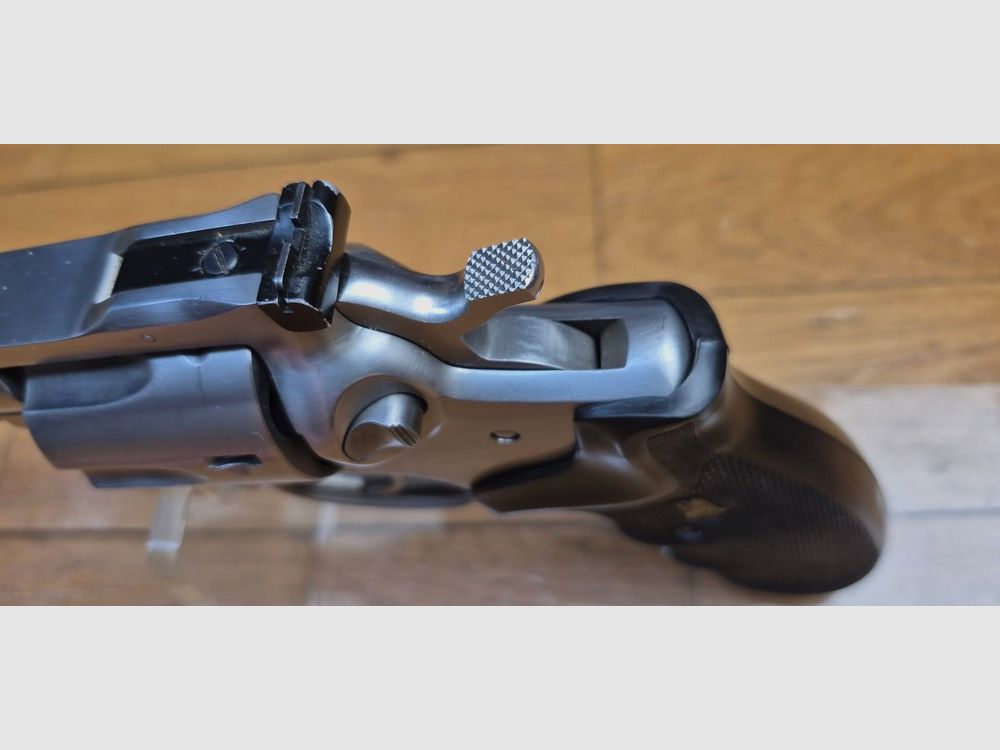
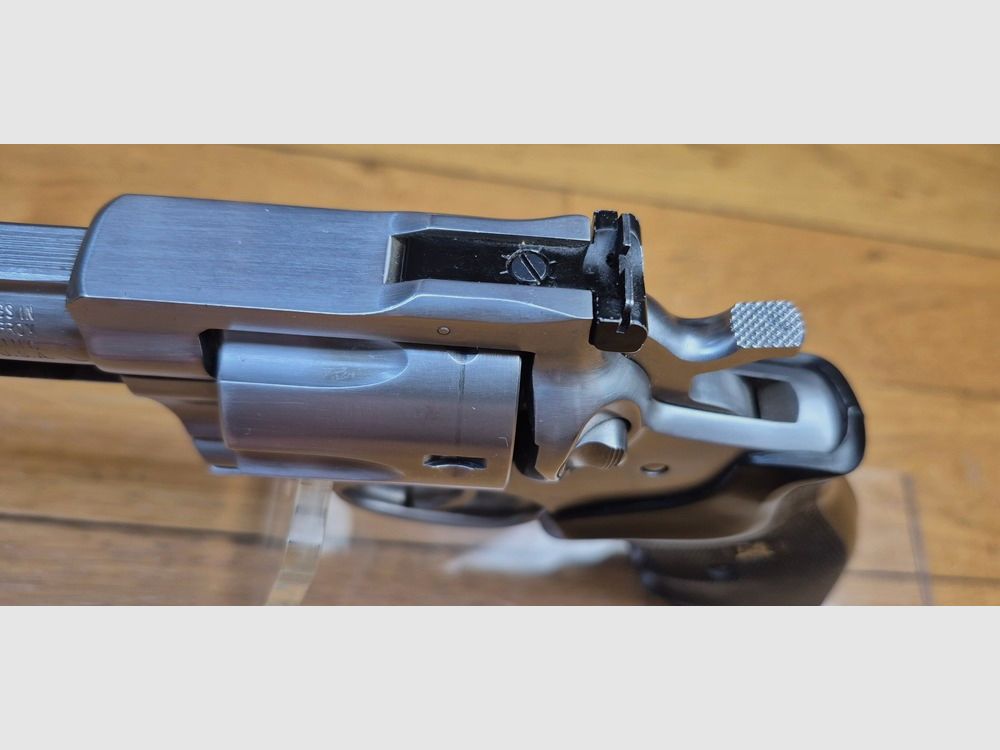

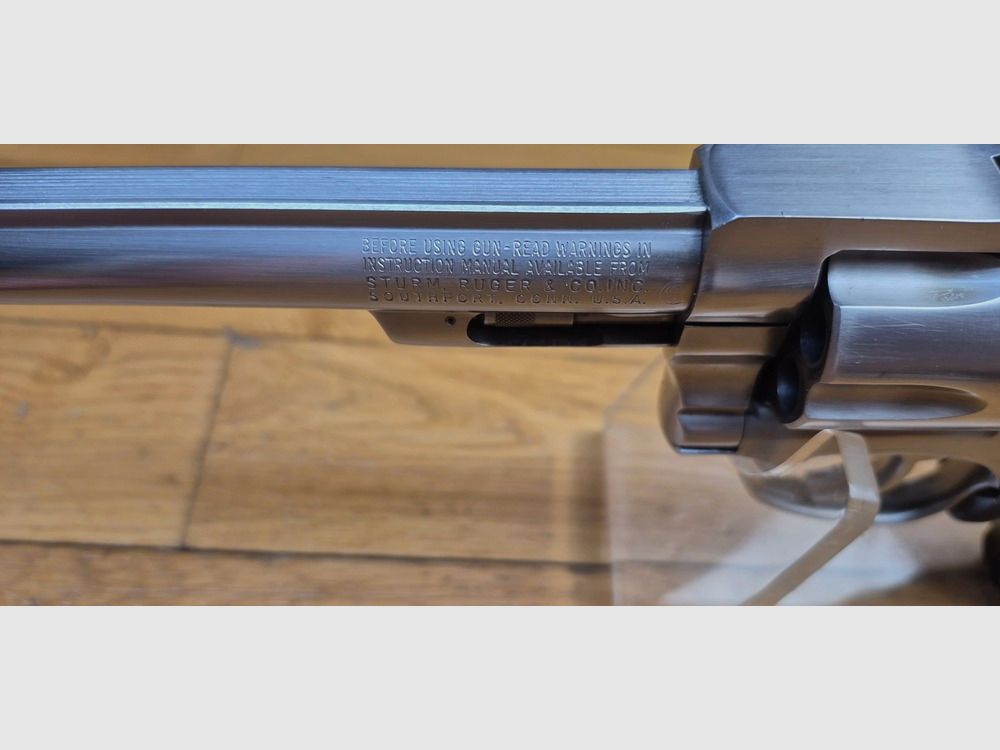

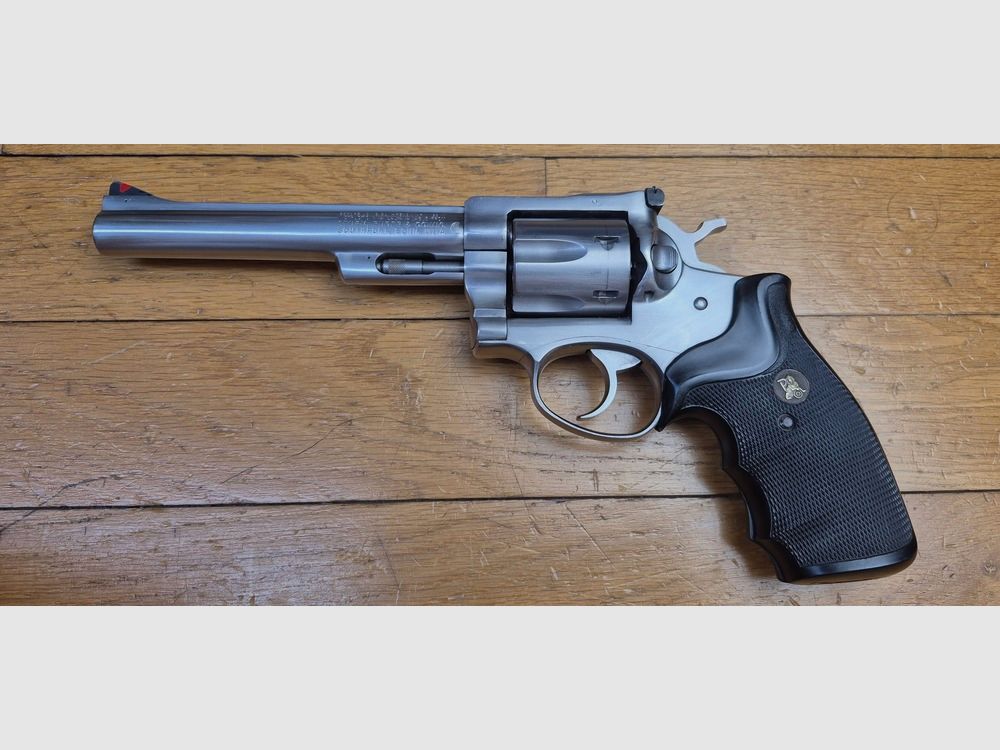


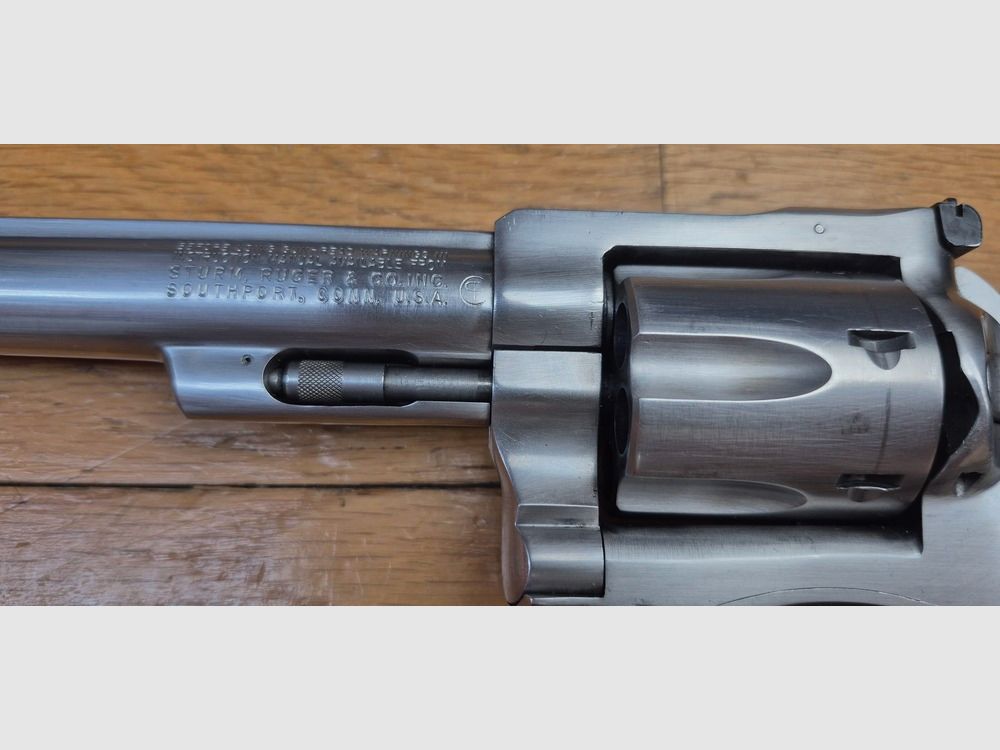

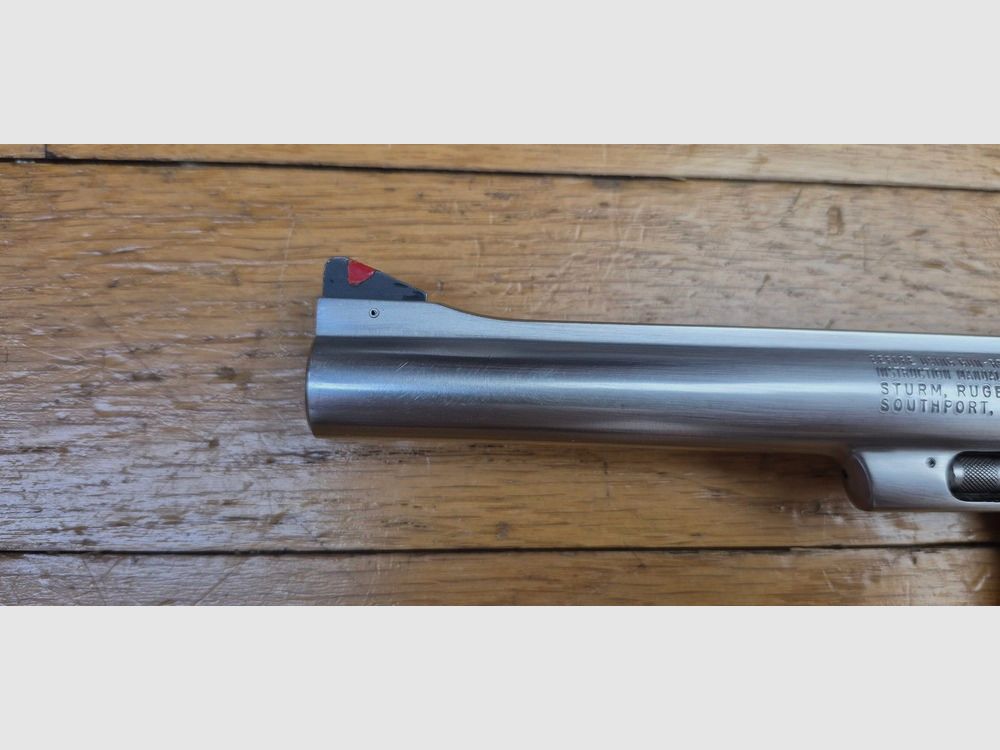
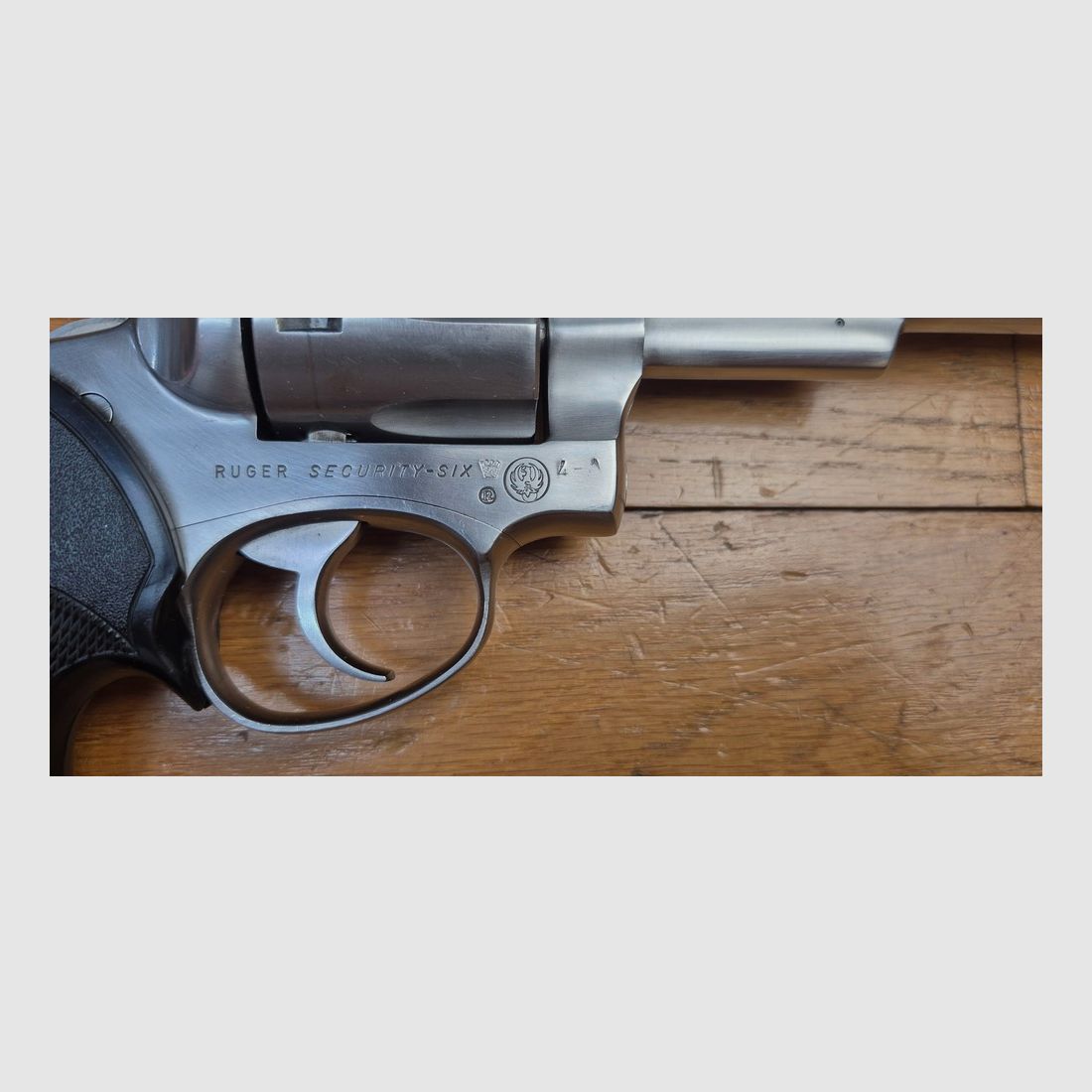


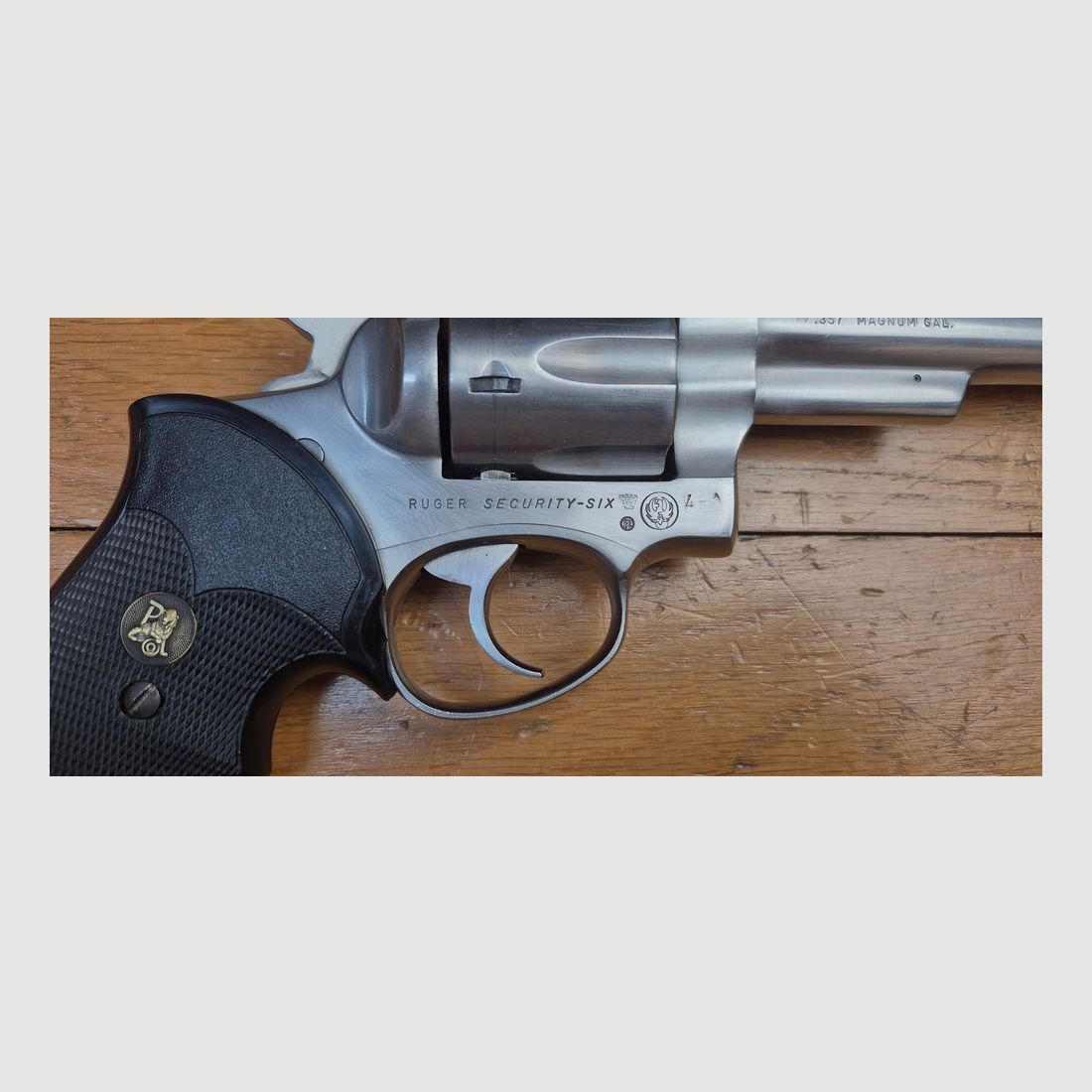
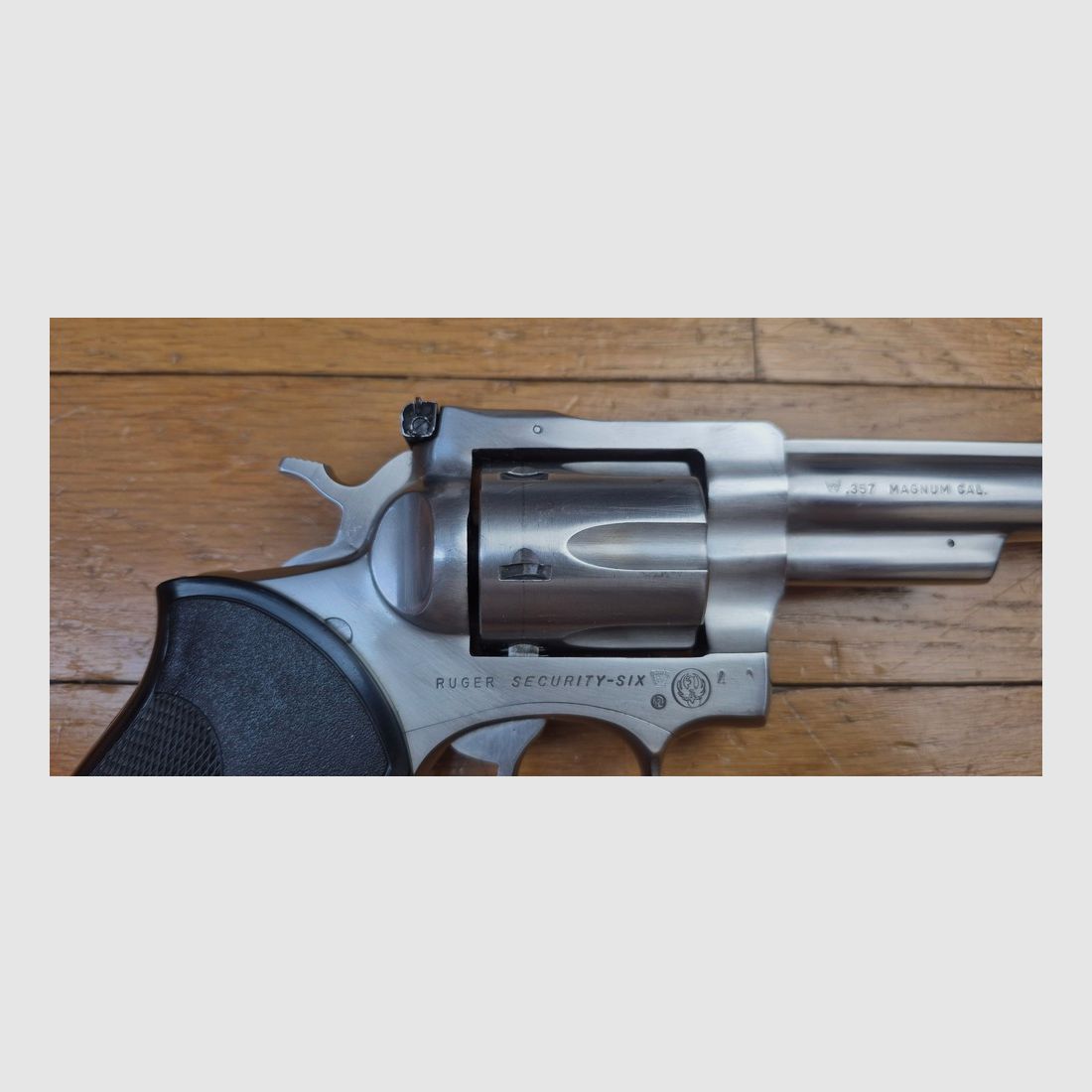
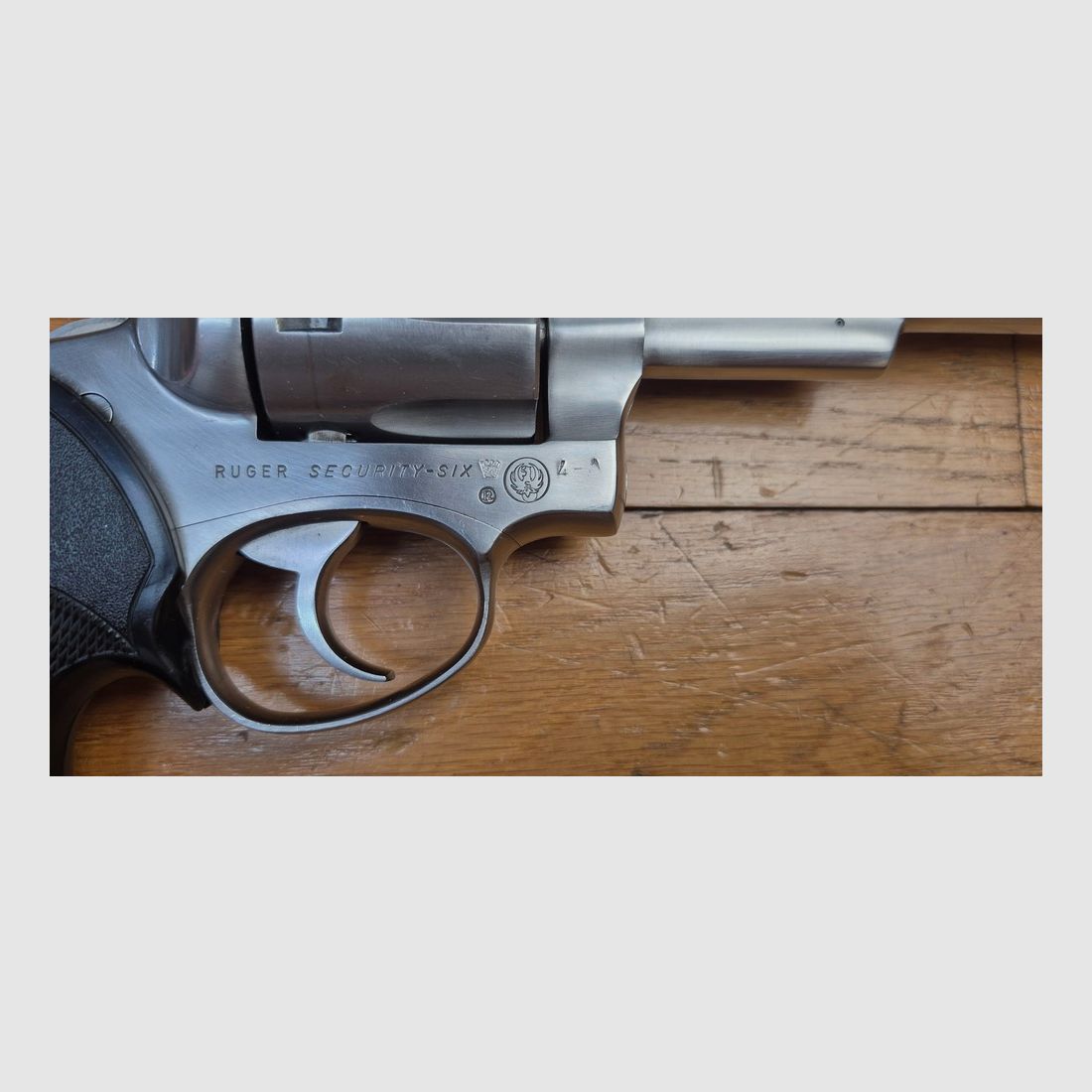


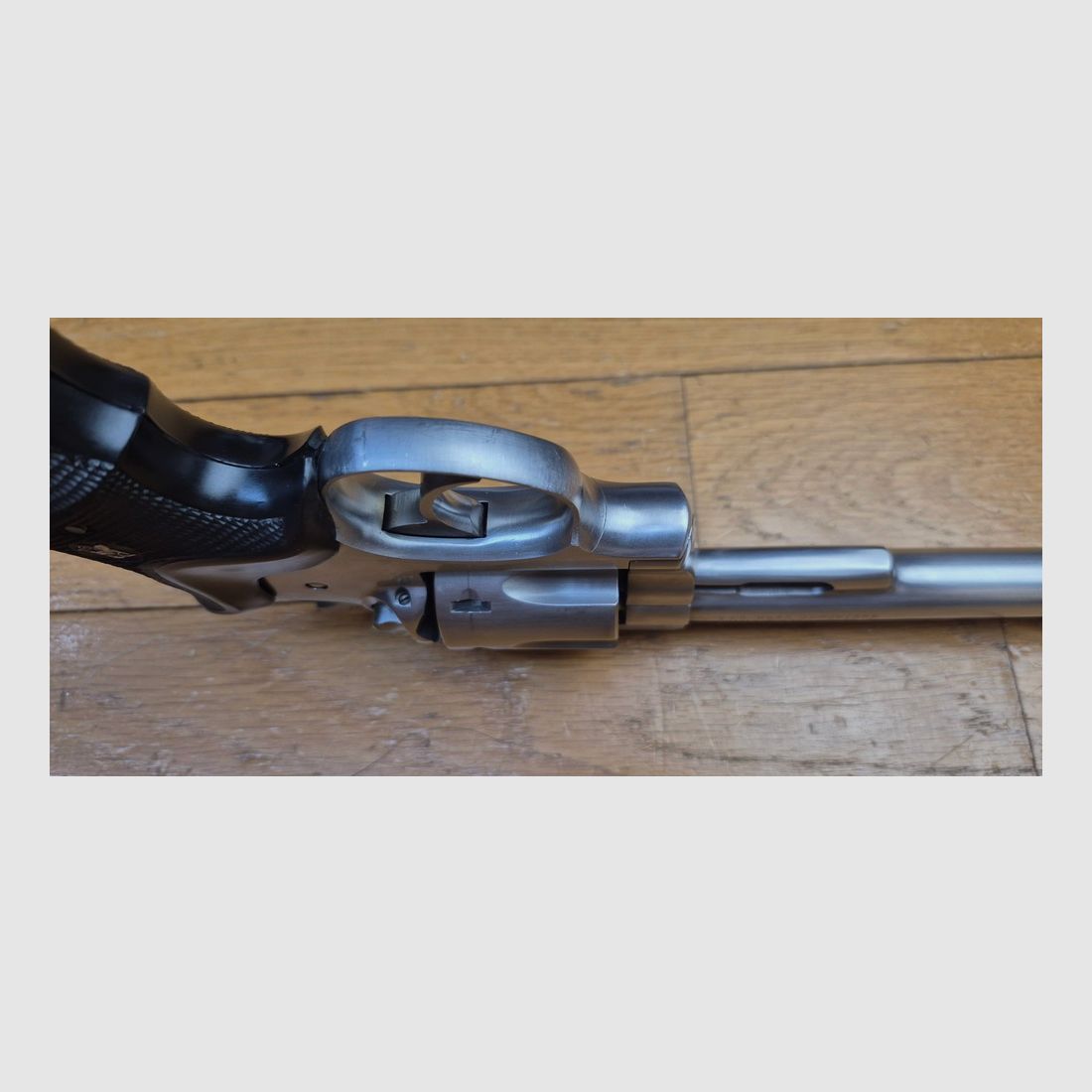


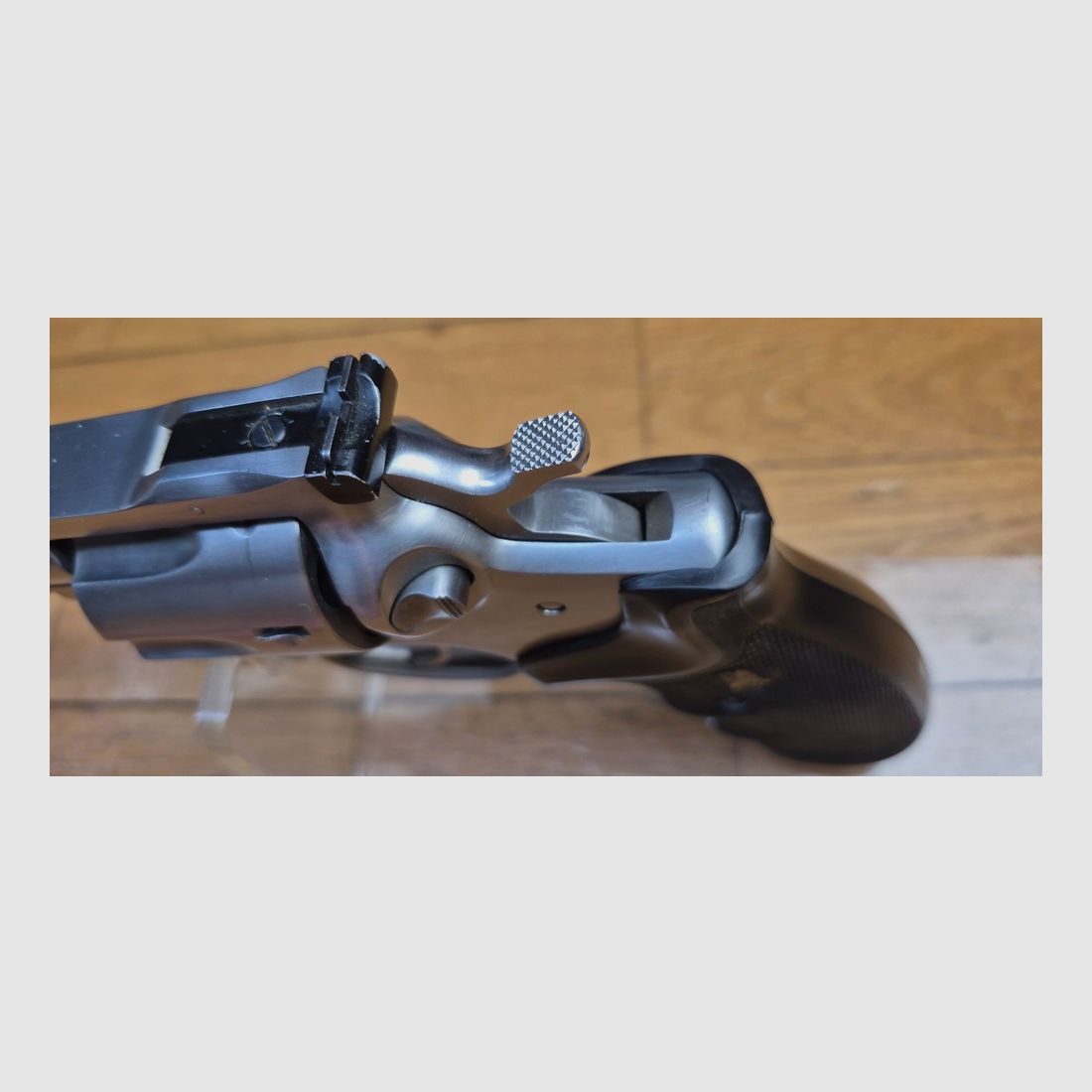


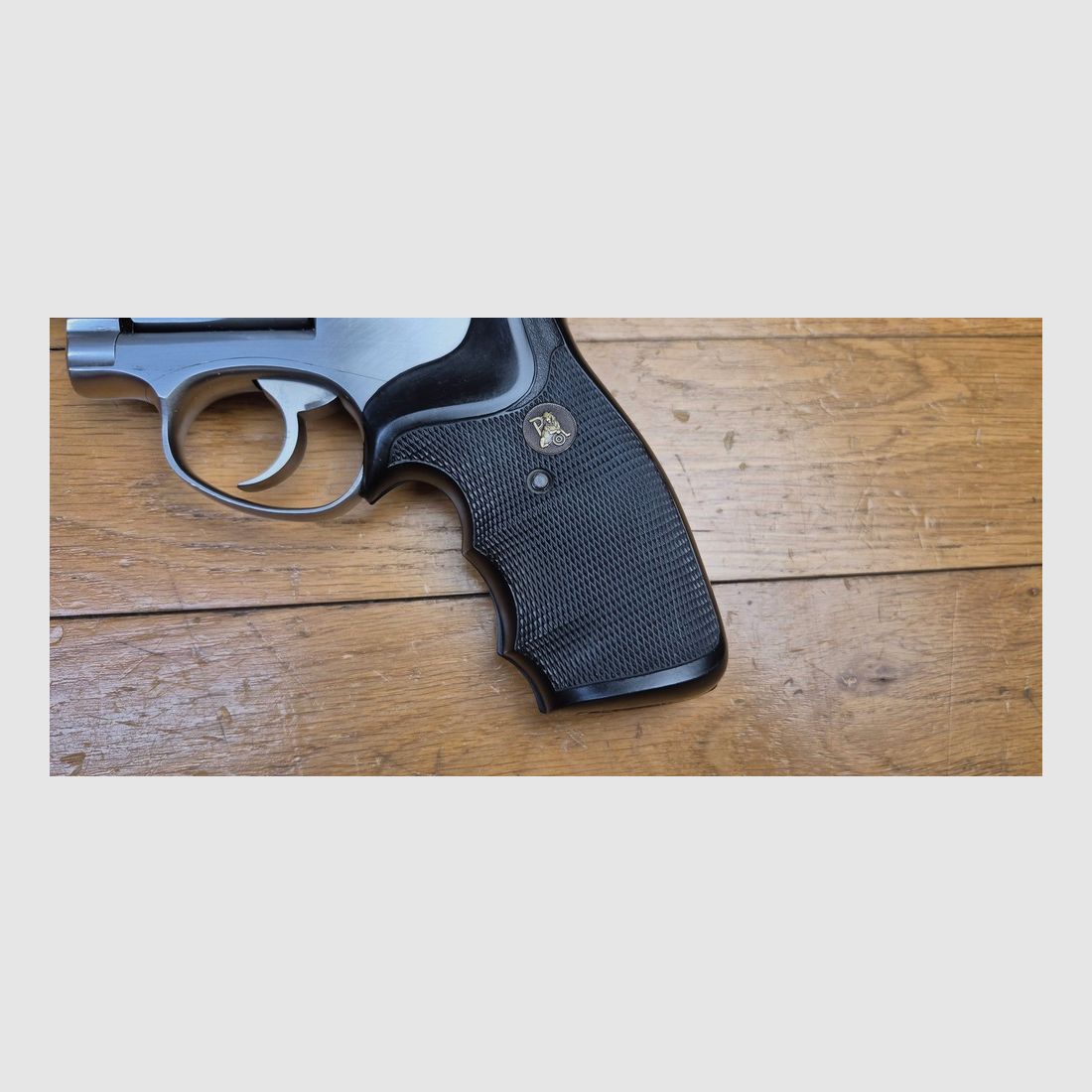


Very nice Revolver Sturm Ruger Security-Six — Cal .357 Magnum — Less common stainless finish in six inches — Firearm from late 1981 / early 1982 — Still the best era of Bill Ruger — Very very nice physical condition of the aesthetic and mechanical athlete! — Pachmayr grips — Mirror barrel — A classic that has become rare in stainless and six inches — TBE+ / TBE++
≈ $769
Price at the dealer: 700 €. Converted at the ECB rate as of November 20, 2026.
Purchase permit required
75002 Paris, France
10
ID: 10338378
Purchase from outside the EU: The firearm goes through an importer in your country, the dealer handles the export.
How buying from Europe works
Shop safely with Gunfinder
Our AI-powered seller identity verification makes Gunfinder the safest marketplace online.
Learn more
Details
- Original language
- French
- Brand
- Ruger
- Category
- Purchase eligibility
- Required
- Caliber
- .357Mag
- Condition
- New
- Location
- 🇫🇷 75002 Paris, France
- Availability
- In stock
Freshness
This listing is based on a mirrored offer, where the listing data was synced to us from a shop, dealer, or external marketplace. Please note that temporary price discrepancies may occur due to possible delays in data transmission.
- Source
- Flingus Maximus
- Last checked with the dealer
- 1 day ago
Description
Note:
The item is located abroad. Please note that delivery conditions, shipping times, and/or the purchase process may differ.
For this revolver, it all starts, paradoxically, with a Japanese Nambu pistol. A variant I’d quite like to “get my hands on”, too.
At the end of World War II, a young self-taught engineer, William Batterman Ruger, gets hold of a “Baby Nambu” pistol brought back from the Pacific by a Marine.
In his garage, he takes the thing apart, studies it, and manages to duplicate its mechanism from A to Z all by himself. A small feat of craftsmanship that would set the course of his career in handguns.
Ruger wasn’t exactly a beginner when it came to firearms, though. He loved them.
And we love people who love them.
His passion for firearms actually showed itself very early on.
At 21 (he was born in 1916), while studying at the University of North Carolina at Chapel Hill, Ruger turned an abandoned room on campus into his own workshop… It was there, entirely self-taught and unrelated to his studies, that he designed his very first firearm: a light machine gun that caught the attention of the US Army Ordnance Department in 1938.
His prototype, the T10/T23E1, was tested but didn’t make it through the 10,000-round trial without a single malfunction. The Browning M1919 in its A6 version was selected instead.
Even so, his career as a gunsmith was already set in his mind. He left university without earning a degree to follow his passion.
He first worked as a designer at Springfield Armory, then, after the war, at Auto-Ordnance—the maker of the legendary Thompson. There, he would refine automatic firearms. But his attempts to start his own business failed one after another.
In 1948, at 32, he had to close up shop for the second time.
That’s where Alexander McCormick Sturm comes in.
Born into a well-to-do family, a graduate of the Yale School of Art, writer, painter, passionate about heraldry—and above all, a keen firearms collector. The two men met in 1948, hit it off, and went into business together the following year.
Sturm brought $50,000 in family funds; Ruger brought his mechanical and gunsmithing expertise. Sturm Ruger & Co. was founded in 1949 in a small rented workshop in Southport, Connecticut. The Ruger adventure began.
Sturm himself designed the brand’s red eagle, inspired by German and Japanese heraldry.
Their first product, the Ruger Standard .22 pistol, was an immediate success and set the young company on its way to the future.
But fate would catch up with this happy story. In November 1951, Alexander Sturm died suddenly of viral hepatitis, aged just 28.
In tribute to his friend and partner, Ruger changed the eagle’s background from red to black on all subsequent production—a loss forever etched into the steel of every Ruger firearm. He would carry on alone.
For twenty years, Ruger built its reputation on single-shot and single-action firearms—the Standard, the Single-Six, the Blackhawk. The lucrative double-action revolver market for police and the military still belonged to Smith & Wesson and Colt.
In 1968, a team of Ruger engineers led by Harry Sefried set out to design a revolver that could compete with those two giants while remaining significantly cheaper to produce.
The goal was clear from the outset: a robust, easy-to-assemble firearm, made using precision casting rather than costly forging—unlike Smith & Wesson and Colt, who stuck to their traditional methods.
Before its commercial launch, the Security-Six underwent three full years of testing… Ruger knew all too well what its competitors Smith and Colt were capable of. They had to be ready.
A single example withstood no fewer than 100,000 consecutive .357 Magnum rounds to prove its durability. That figure is still staggering when you consider the pressure level that g
Generate this ammunition.
The Security-Six revolver finally came out in 1972, manufactured at Ruger’s factory in Southport, Connecticut.
The reception was immediate and triumphant: the New York and Los Angeles police departments adopted it, along with the Border Patrol, the former Immigration and Naturalization Service, and the U.S. Postal Police.
The U.S. military itself bought small quantities for its security units. In the 1980s, it could even be found in some prisons as a guard’s weapon.
The reason for this success lies in its many strengths, but above all in its price.
Other manufacturers’ guns still belonged to the world of small-batch mechanical production, with complex machining. Ruger had the genius to simplify production of the main parts without neglecting the final mechanical finishing. And without shying away from innovation. Quite the opposite.
When it came out in 1972, the Security-Six cost around $100 — 16% less than a Smith & Wesson Model 19, and 25% less than a Colt Trooper — while still being exceptionally robust. Properly maintained, it is reputed to handle up to 80,000 rounds of .357 Magnum over its lifetime — a combination of longevity and price that made it legendary among sport shooters and hunters alike.
Mechanically, the Security-Six was innovative, too.
Its modular trigger assembly is put together separately and then inserted into the frame — a new design that greatly simplifies maintenance and repairs, long before this approach became commonplace.
Its safety incorporates a transfer bar that prevents the gun from firing if dropped with the hammer cocked — a major advance for the time. Ruger developed it in response to criticism of its older single-action revolvers, inherited from the Colt Peacemaker. That’s where the “Security” in the model name comes from.
The Security-Six also made it onto the big screen.
It appeared in several films and TV shows of the 1970s and 1980s, in the wake of the Dirty Harry era. Though it never reached the status of Charles Bronson’s Colt Python or Inspector Callahan’s 8⅜-inch Smith 29, it earned a very solid supporting role.
You can spot it in “Murphy’s Law,” in “Terminator” in a six-inch stainless-steel version like ours, in the hands of the unflinching Sarah Connor, and even in “Licence to Kill,” facing off against a famous 007.
The Security-Six was offered with three barrel lengths — 2¾, 4, and 6 inches.
The 6-inch version, like this one, is the least common of the three. It’s also the one most sought after by precision shooters and fans of old wheelguns: longer sight radius, higher muzzle velocity, and better recoil control.
On today’s French market, this long barrel has become fairly rare — 4-inch models are much more common. And in stainless-steel finish, it looks great, too.
Produced from 1972 to 1988, the Security-Six sold more than 1.5 million units across all variants (Security-Six with adjustable rear sight, budget Service-Six with fixed rear sight, and compact Speed-Six with round butt). A real success, and a well-deserved one in a tough American market. That says a lot about its inherent qualities.
The stainless-steel finish — like ours — only appeared in 1975, a few years after the blued-steel version launched. It’s also much less common on the French market than the blued finish.
The model remained in Ruger’s catalog until 1988, when it was replaced by another legend: the GP100. That’s probably the best proof that the Security-Six had fulfilled its mission to the end, paving the way for another brand success.
A word, too, about Ruger’s quality, a topic that often comes up among enthusiasts.
It’s now widely accepted, even among the brand’s most devoted fans in the USA, that Ruger’s level of finish has gradually...
It started to decline in the 1990s and 2000s. The reasons were increased production rates, the widespread use of polymer in certain parts, and less consistent machining than in Bill Ruger’s day.
The serial number on this example—Block 158—makes it possible to date it precisely. It falls right at the transition between late 1981 and early 1982, and among the very first examples in Block 158.
This is therefore a piece that firmly belongs to the brand’s golden age, well before the industrial shift that collectors place a good ten years later. A fine Ruger from the good old days.
Here is a splendid Security-Six in stainless steel with a 6-inch barrel.
It’s filthy all over, but in very, very good cosmetic condition and perfect mechanical condition. It seems to have seen very little use in its 45 years of service. It will need a full cosmetic clean-up. That’s all. Nothing else.
The cylinder is impeccable, with very nice chambers and the typical Ruger smoothness. I performed the wrist-flick test on this firearm. The result reminded me of the best Smith & Wesson revolvers from before 1982—which says a lot about the finish and machining precision of this Security-Six from that era, even though it isn’t forged. As it happens, the firearm itself dates from exactly that pivotal period when Smith gave up.
It just goes to show that competition is a good thing and forces you to make an effort. Ruger did.
No play when cocked. No excessive endshake. The firearm is truly in excellent condition.
The springs are excellent. The trigger is excellent too, with a very crisp break. Very pleasant.
The barrel is mirror-bright, with superb rifling. It has retained all its potential for use and accuracy.
The firing action is very crisp.
100% steel sights—model with adjustable rear sight.
The firearm is very smooth to use, including in double action. It also feels really good in the hand.
The steel is high quality throughout. This is a very sturdy firearm, and it has very few scratches. Very few signs of handling. Truly in very good cosmetic condition.
As always, any flaws you might spot in the photos are mostly due to my MACRO SHOTS, which greatly exaggerate even the slightest imperfection. The firearm is truly very attractive, and the overall shots give a much better impression of its excellent overall condition. But this way, you can see everything.
The grips are Pachmayr, also in very good condition. And perfect for use with this caliber.
In short, a great American revolver classic, in a particularly attractive stainless finish and with a 6-inch barrel, which is much less common than the standard 4-inch barrel on the used market. An example dating from one of the brand’s best production periods.
This firearm still has plenty of life left in it. Whoever buys it will enjoy many years of happy days at the range with a high-quality revolver at a price-to-quality ratio you just can’t find anymore.
CATEGORY B FIREARM UNDER THE CSI: SUBJECT TO AUTHORIZATION. A COPY OF A VALID ID AND LICENSE IS REQUIRED—AN OPEN SIA ACCOUNT IS ALSO REQUIRED, OF COURSE. SHIPPING WITH SIGNATURE REQUIRED IN TWO SEPARATE PARCELS AT LEAST 48 HOURS APART.
***********************************************************************************************************************
Let’s say it again! Flingus Maximus gun shop in Paris and throughout France is also here to help with buying your firearm and militaria collections, firearm valuations, and questions about firearms legislation or firearms in estates and inheritances. Contact your favorite gun dealer using our contact form or at [email protected] (Show description in original language)
Deux hommes, un pistolet dans un garage et un aigle qui devient noir…. Ça pourrait assez bien résumer l’histoire de Ruger.
Pour ce révolver, tout commence paradoxalement par un pistolet Nambu japonais. Une variante que j’aimerai bien « serrer » d’ailleurs.
À la fin de la Seconde Guerre mondiale, jeune ingénieur autodidacte, William Batterman Ruger récupère un exemplaire du pistolet « baby Nambu » rapporté par un Marine de ses périples dans le Pacifique.
Dans son garage, il démonte la bête, l’étudie, et parvient à en dupliquer seul le mécanisme de A à Z. Un petit exploit artisanal qui va décider de sa carrière dans les armes courtes.
Ruger n’est toutefois pas tout à fait un débutant en matière d’armes. Il les aime.
Et nous, on aime ceux qui les aiment.
Sa passion pour les armes se manifeste très tôt en fait.
A 21 ans (il est de 1916), étudiant à l’université de Caroline du Nord à Chapel Hill, Ruger transforme une salle abandonnée du campus en atelier personnel… C’est là, en complet autodidacte et sans lien avec ses études, qu’il conçoit sa toute première arme : une mitrailleuse légère qui sera remarquée par l’Army Ordnance américaine en 1938.
Son prototype, la T10/T23E1, est testé mais ne passe pas le cap de l’épreuve des 10.000 coups sans un seul incident. C’est la Browning M1919 dans sa version A6 qui sera retenue.
Il n’en reste pas moins que sa carrière armurière est déjà décidée dans sa tête. Il quitte l’université sans y décrocher de diplôme pour suivre sa passion.
Il travaille d’abord comme concepteur à la Springfield Armory, puis passé la guerre, chez Auto-Ordnance — le fabricant du légendaire Thompson. Il y perfectionnera des armes automatiques. Mais ses tentatives pour monter sa propre affaire échouent l’une après l’autre.
En 1948, à 32 ans, il doit fermer boutique une deuxième fois.
C’est là qu’intervient Alexander McCormick Sturm.
Fils de bonne famille, diplômé de la Yale School of Art, écrivain, peintre, féru d’héraldique — et surtout collectionneur d’armes passionné. Les deux hommes se rencontrent en 1948, sympathisent et s’associent l’année suivante.
Sturm apporte 50 000 dollars de fonds familiaux ; Ruger apporte son savoir mécanique et armurier. Sturm Ruger & Co. naît en 1949 dans un petit atelier loué à Southport, Connecticut. L’aventure Ruger commence.
C’est Sturm lui-même qui dessine l’aigle rouge de la marque, en s’inspirant de l’héraldique allemande et japonaise.
Leur premier produit, le pistolet Ruger Standard .22, est un succès immédiat et porte la jeune entreprise vers l’avenir.
Le destin va néanmoins rattraper cette belle histoire. En novembre 1951, Alexander Sturm meurt brutalement d’une hépatite virale, à seulement 28 ans.
En hommage à son ami et associé, Ruger fait alors passer le fond de l’aigle du rouge au noir sur toute la production suivante — un deuil gravé à jamais dans l’acier de chaque arme Ruger. Il poursuivra seul l’aventure.
Pendant vingt ans, Ruger construit sa réputation sur le monocoup et le simple action — le Standard, le Single-Six, le Blackhawk. Le juteux marché du révolver double action pour la police et l’armée appartient encore à Smith & Wesson et à Colt.
En 1968, une équipe d’ingénieurs Ruger dirigée par Harry Sefried se lance dans la conception d’un révolver capable de rivaliser avec ces deux géants, tout en restant nettement moins cher à produire.
L’objectif est clair dès le départ : une arme robuste et facile à assembler, construite en moulage de précision plutôt qu’en forgeage coûteux — là où Smith & Wesson et Colt s’accrochent à leurs méthodes traditionnelles.
Avant sa sortie commerciale, le Security-Six passe trois années entières de tests… Car on connait bien les qualités de la concurrence Smith et Colt chez nos amis de Ruger. Il faut s’y préparer.
Un seul exemplaire encaisse pas moins de 100 000 cartouches consécutives de .357 Magnum pour valider sa durabilité. Le chiffre donne quand même le vertige quand on sait le niveau de pression que génère cette munition.
Le révolver Security-Six sort enfin en 1972, produit à l’usine Ruger de Southport, Connecticut.
L’accueil est immédiat et triomphal : les polices de New York et de Los Angeles l’adoptent, aux côtés de la Border Patrol, de l’ancien Immigration and Naturalization Service et de la police postale américaine.
L’armée américaine elle-même en achète de petites quantités pour ses unités de sécurité. Dans les années 1980, on le retrouvera jusque dans certaines prisons comme arme de garde.
La raison de ce succès tient à ses qualités qui sont grandes mais surtout à son prix.
Les armes des autres sont encore du domaine de l’industrie mécanique de petites séries avec des usinages complexes. Ruger aura le génie d’une production plus simple des pièces principales sans toutefois négliger les finitions mécaniques finales. Et sans refuser l’innovation. Bien au contraire.
À sa sortie en 1972, le Security-Six coûte environ 100 dollars — soit 16% de moins qu’un Smith & Wesson Model 19, et 25% de moins qu’un Colt Trooper — avec une robustesse néanmoins sans faille. Entretenu correctement, il est réputé capable d’encaisser jusqu’à 80.000 cartouches de .357 Magnum sur toute sa vie — une longévité/prix qui a fait sa légende auprès des tireurs sportifs comme des chasseurs.
Sur le plan mécanique, le Security-Six innove en plus.
Son groupe de détente modulaire est assemblé séparément puis inséré dans le cadre — une conception nouvelle qui simplifie considérablement l’entretien et la réparation, bien avant que cette approche ne devienne courante.
La sécurité, elle, intègre une barre de transfert qui interdit tout départ du coup en cas de chute avec le chien armé — une avancée majeure pour l’époque. Elle a été développée par Ruger en réponse aux critiques adressées à ses anciens révolvers simple action hérités du Colt Peacemaker. De là, le mot « Security » dans la dénomination du modèle.
Le grand écran s’emparera aussi du Security-Six.
Il apparaît dans plusieurs films et séries des années 1970-1980 dans le sillage de l’ère Dirty Harry. Sans atteindre le statut de Star absolue du Colt Python de Charles Bronson ou du Smith 29 en 8 pouces 3/8 de l’inspecteur Callahan, il gagnera une très solide place de second rôle.
On le verra notamment dans la « Loi de Murphy », dans « Terminator » en six pouces inox comme le notre dans les mains de l’inflexible Sarah Connor ou bien même dans « Licence to Kill » en duel contre un célèbre 007.
Le Security-Six a été proposé en trois longueurs de canon — 2¾, 4 et 6 pouces.
Le 6 pouces, celui de cet exemplaire, est le format le moins répandu des trois. C’est aussi celui que recherchent en priorité les tireurs de précision et les amateurs de vieux wheelguns : ligne de mire plus longue, vitesse initiale supérieure, recul mieux maîtrisé.
Sur le marché français actuel, ce canon long est devenu assez rare — les 4 pouces circulent bien davantage. Et en finition inox, il est sexy en plus.
Produit de 1972 à 1988, le Security-Six s’écoulera à plus d’1,5 million d’exemplaires, toutes variantes confondues (Security-Six à hausse réglable, Service-Six économique à hausse fixe, Speed-Six compact à crosse ronde). Un vrai succès. Mérité sur un marché américain difficile. Ce qui en dit long sur ses qualités intrinsèques.
La finition inox — la notre — n’apparaît qu’à partir de 1975, quelques années après le lancement en acier bronzé. Elle reste aussi nettement moins fréquente sur le marché français que le bleui.
Le modèle ne sera remplacé au catalogue Ruger qu’en 1988. Et par un autre seigneur: le GP100. C’est sans doute la meilleure preuve que le Security Six avait rempli sa mission jusqu’au bout, ouvrant la voie à un autre succès de la marque.
Un mot aussi sur le sujet de la qualité Ruger, sujet qui revient souvent chez les connaisseurs.
Il est aujourd’hui largement admis, y compris chez les passionnés les plus fidèles de la marque aux USA, que le niveau de finition Ruger s’est progressivement tassé à partir des années 1990-2000. La faute à la montée en cadence de production, à la généralisation du criminel polymère sur certaines pièces, et à une régularité d’usinage moins constante qu’à l’époque de Bill Ruger.
Le numéro de série de cet exemplaire — Bloc 158 — permet justement de le dater avec précision. Il se situe à la toute charnière entre fin 1981 et tout début 1982, et dans même dans les tout premiers exemplaires du bloc 158.
C’est donc une pièce qui appartient pleinement à l’âge d’or de la marque, bien avant le tournant industriel que les collectionneurs situent une bonne dizaine d’années plus tard. Un beau Ruger de la bonne époque donc.
Voici donc un splendide un Security-Six en finition inox et canon 6 pouces.
Il est cra-cra de partout mais en très très bel état esthétique et en parfait état mécanique. Il en fait assez peu servi dans ses 45 ans de service. Il faudra lui faire une séance cosmétique complète. C’est tout. Rien d’autre.
Le barillet est irréprochable avec de très belles chambres et un glissement Ruger typique. J’ai fait le test du quart de poignet sur cette arme. Le résultat m’a rappelé les meilleurs Smith & Wesson d’avant 1982 — c’est dire le niveau de finition et de précision d’usinage de ce Security-Six de cette époque même pour des armes non forgées. Ça tombe bien puisque l’arme elle-même date très exactement de cette période charnière où Smith a baissé les bras.
Comme quoi aussi la concurrence, cela a du bon et ça oblige à faire des efforts. Ruger les faisait.
Aucun jeu à l’abattu. Aucun entrefer d’usage excessif. Arme vraiment en excellent état.
Les ressorts sont excellents. La détente est excellente également, très nette au départ. Très agréable.
Le canon est miroir, avec de superbes rayures. Il a conservé tout son potentiel d’utilisation et de précision.
La percussion est très nette.
Organes de visée 100% acier – Modèle à hausse réglable.
L’arme est très souple à l’utilisation, y compris en double action. Et c’est vraiment agréable en main.
L’acier est de grande qualité sur toute l’arme. C’est une arme très solide et d’ailleurs fort peu rayée. Très très peu de traces de manipulation. Très bel état esthétique vraiment.
Comme toujours, tous les défauts que vous pourriez apercevoir sur les photos sont surtout l’effet de mes MACRO PLANS qui exagèrent considérablement le moindre défaut. L’arme est vraiment très belle et les plans généraux rendent bien mieux son état global excellent. Mais comme ça vous voyez tout.
Les plaquettes sont des Pachmayr, en très bel état aussi. Et parfaites en utilisation dans ce calibre.
Bref un grand classique du révolver américain, dans une finition inox particulièrement séduisante et un canon 6 pouces bien moins courant que le 4 pouces standard sur le marché de l’occasion. Exemplaire daté d’une des meilleures périodes de fabrication de la marque.
Cette arme a encore tout son potentiel devant elle. En l’acquérant, un heureux tireur se donnera de longues années de petits bonheurs du stand avec un revolver de grande qualité à un rapport qualité prix qu’on ne trouve plus.
ARME DE CATÉGORIE B AU CSI : SOUMISE À AUTORISATION, PHOTOCOPIE DE LA PIÈCE D’IDENTITÉ EN COURS DE VALIDITÉ ET DE LA LICENCE OBLIGATOIRE – COMPTE SIA OUVERT BIEN ÉVIDEMENT – Expédition contre signature en deux colis séparés d’au moins 48 heures obligatoire.
***********************************************************************************************************************
Répétons le ! L’armurerie Flingus Maximus à Paris et partout en France, est là aussi pour pour vos rachats de collections armes et militaria, vos estimations d’armes, vos questions de législation ou sur les armes dans les successions et héritage. Contactez votre armurier préféré via notre formulaire de contact ou à [email protected]