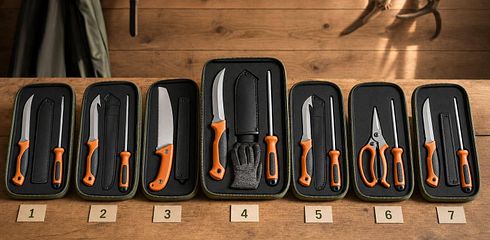
Compact hunting knife sets: Check weight and packed size

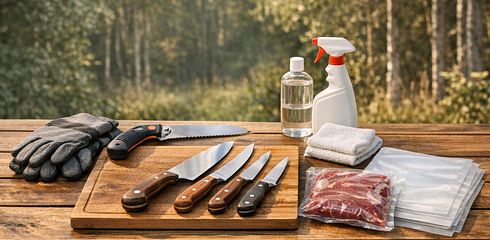
A compact hunting knife set must fit in your backpack compartment when fully packed, with the blades protected and securely held in place. The key factors are the transport weight in grams and the closed external dimensions in centimeters, including sheaths, pouch, and sharpening accessories.
Before buying, consider these points:
- Weight and space: Account for every item you’ll carry and compare length × width × height with the compartment opening and usable storage space.
- Protection and retention: Every edge and tip must be covered. Tools must not shift, and closures must stay shut.
- Cover and care: Check sheaths, roll-up pouches, and cases for space requirements, damage, and ease of cleaning and drying.
- Suitable tools: Choose a 2-knife set or butchering set based on the tasks you have planned. Leave out unnecessary items only if the rest can still be stored safely.
Missing information is not the same as zero. Confirm the weight, packed size, and tool retention in writing before ordering.
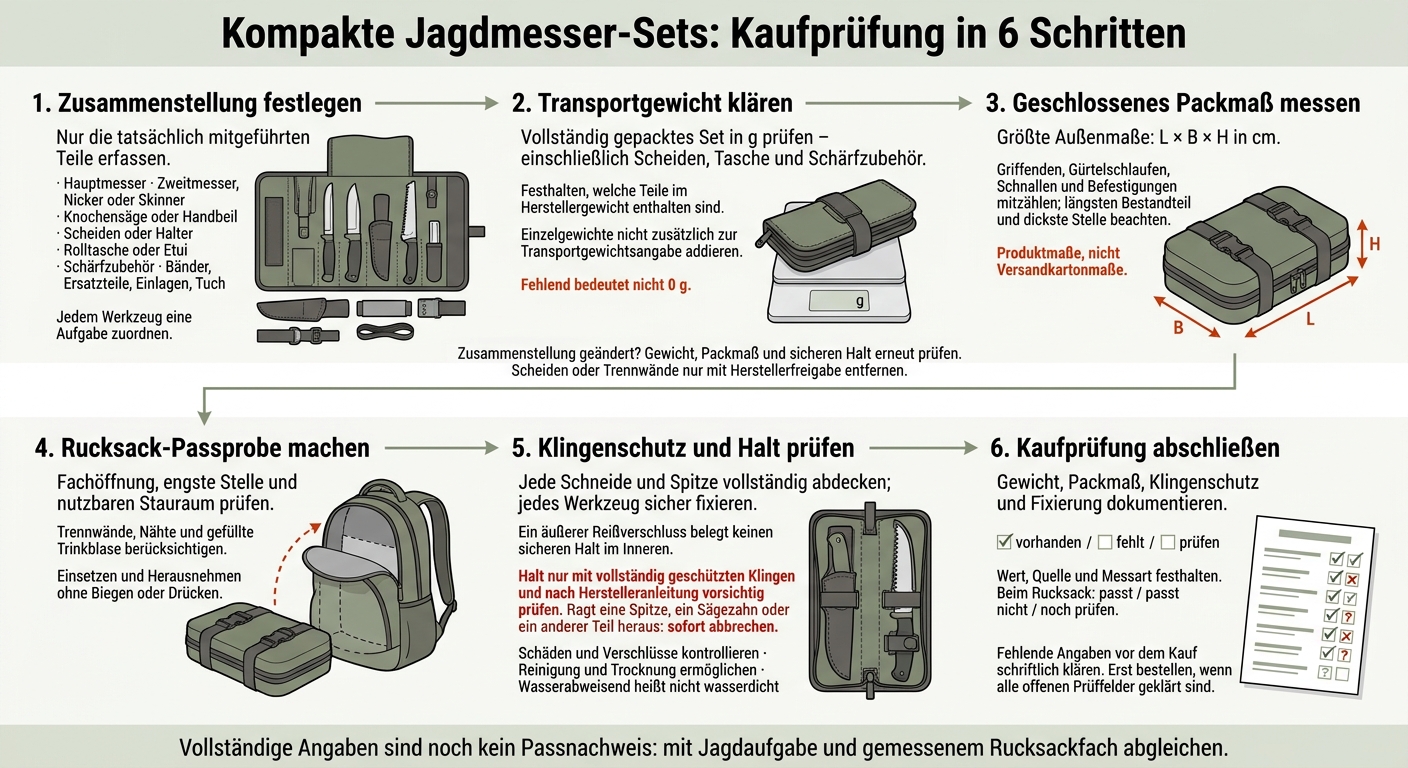
Compact Hunting Knife Sets: 6-Step Buying Checklist
Checklist 1: Check Weight and Packed Size
First, list all the components, then check the packed dimensions, and finally compare the carrying cases.
List All the Items You’ll Carry
Check off only the items you actually plan to take. Note the weight of each item in grams and whether it is included in the supplier’s stated weight. If the supplier only gives a “set weight,” explicitly mark any missing information. “Missing” does not mean 0 g.
Then check the total weight of the packed set. Don’t add individual weights to a stated transport weight afterward.
| Component | Weight | Included in manufacturer’s stated weight? | Relevance to backpack |
|---|---|---|---|
| ☐ Main knife | Missing | To be confirmed | Length including handle and sheath |
| ☐ Second knife, Nicker, or skinner | Missing | To be confirmed | Extra space for handle and blade guard |
| ☐ Bone saw or hand axe | Missing | To be confirmed | Storage space for rigid parts |
| ☐ Individual sheaths or shared holder | Missing | To be confirmed | Protruding loops and bulges |
| ☐ Roll-up pouch or case | Missing | To be confirmed | Overall packed shape |
| ☐ Honing steel, whetstone, or sharpener | Missing | To be confirmed | Its own secure space |
| ☐ Straps, spare parts, inserts, cloth | Missing | To be confirmed | Additional carrying weight |
After checking the weight, check the closed packed size and the storage space actually available.
Measure the Packed Set and Backpack Compartment
Measure the largest external dimensions of the closed set. Include handle ends, belt loops, buckles, and attachments. Use the product dimensions, not the shipping box dimensions. Also note the longest component and the thickest point.
Next, measure the backpack compartment, its opening and its narrowest point. Dividers, seams and a filled hydration bladder can reduce the usable space.
- ☐ Measure the set when closed.
- ☐ Check the compartment opening.
- ☐ Check the narrowest point.
- ☐ Make sure you can put it in and take it out without bending or pressing.
Compare sheaths, roll-up bags and cases
The design determines how compactly the set can be packed—not the material. So compare each format when closed. Also check how much room you need to open it, remove items and pack them away.
| Transport format | Packed size | Blade protection | Advantage/disadvantage in a backpack |
|---|---|---|---|
| Individual sheaths | Combined outer dimensions, including belt loops | Each blade needs a close-fitting cover | Can be distributed flexibly; gaps may remain |
| Shared leather sheath | Overall dimensions, including flaps and closure | Check the internal dividers and secure fit | Keeps everything together, but is less flexible |
| Roll-up bag | Rolled outer dimensions, including straps and pockets | Check pocket depth and closure; blades must not touch fabric edges | Adaptable; bulky and uneven when overfilled |
| Hard case | Outer dimensions, including hinges and closures | Rigid walls provide external protection | Holds its shape; takes up the same space even when partly filled |
- ☐ The pockets fit the tools.
- ☐ Rigid walls make sense for how I transport the set.
- ☐ Fixed empty spaces are acceptable.
- ☐ Closures stay shut when pressed by the rest of my gear.
sbb-itb-1cfd233
Checklist 2: Check blade protection and secure fit
Check protection and secure fit for every blade
Now that you’ve checked the weight and packed size, it’s time to check protection and secure fit for every blade. The blade guard must cover the edge and tip. A secure fit keeps everything from shifting. Check each knife, each serrated tool and the closed set individually. An outer zipper doesn’t tell you how securely the tools are held inside.
Check the retention system, such as a snap button, strap or close-fitting holder.
Check the blade and sheath opening for damage before inserting the tool. Test the fit only with fully protected blades and according to the manufacturer’s instructions: Lift the closed set by its designated carry point and move it gently. Keep your hands away from the edges. If a tip, saw tooth or other part sticks out, stop the test immediately. Then check whether the design will provide lasting protection in everyday use.
Check the construction and removable parts
Inspect the material, lining, joints, closures and carry attachments. Is anything damaged or loose? The packed case must hold its shape so the blades don’t touch other tools or the contents of your backpack. Simply stating that it’s made of leather, nylon or Kydex isn’t enough.
Also check whether the interior surfaces can be cleaned and dried and whether you can remove the inserts. Check the documented moisture protection details: Water-resistant does not mean waterproof. After use, remove any residue and dry the blade and sheath according to the care instructions.
For a multi-piece set, check whether you can leave individual tools at home. Remove sheaths or dividers only if the manufacturer allows it. Then check the packed dimensions again and make sure each tool remaining in the set is secure.
Checklist 3: Choose tools to suit your transport needs
Compare a 2-knife set and a butchering set
You know the weight and packed dimensions. Now consider which tools you actually need to take with you.
Assign a task to each tool. A 2-knife set is often enough for opening and skinning. A butchering set is worth it if you also need to debone, fillet or sharpen.
Use the table to guide your checks. Enter the documented details for each listing.
| Criterion | Compact 2-knife set | Butchering set |
|---|---|---|
| Tasks | Tasks for both blades | Additional uses: deboning, filleting, fine work, sawing |
| Complete transport weight | Weight of the fully packed set in g | Weight of the fully packed set in g |
| Closed packed dimensions | External dimensions of the closed case in cm | External dimensions of the closed case in cm |
| Protective compartments | Secure holders for both knives | Separate holders for knives, saw and accessories |
| Sharpening accessories | Included / missing / unknown | What's included and how it's stored securely |
| Taking only what you need | Can you safely take only the tools you need? | Can you leave unnecessary tools at home without blades being loose or the case becoming unstable? |
A larger set can be useful at the butchering site, but you don't need to take it on every trip into the hunting area. So assess the setup you actually carry, not just what's included. Factor in unusually long handles and extra sharpening accessories if they need more storage space or their own protective compartments.
Check listing details before comparing
If details are missing, you can't compare a listing reliably. So classify each listing by how much information it provides. Complete only means the details are available. Check whether the set suits your needs based on your planned setup and the measured dimensions of your backpack compartment.
| Information available | Details provided | Next step |
|---|---|---|
| Complete | Transport weight, closed packed dimensions and tool retention | Compare with your hunting needs and the measured dimensions of your backpack compartment |
| Partial | Functions or individual weights; missing transport weight, packed dimensions or retention details | Ask for the missing measurements and protection details |
| Insufficient | Transport or blade protection can't be assessed | Ask for complete details; a reliable comparison isn't possible yet |
Check each listing individually. Ask specifically for any missing details: the weight of the packed set, the closed dimensions (L × W × H), and how each tool is secured. Explicitly confirm whether the sheaths, case, and sharpening accessories were included in the weight for the exact configuration you’ll be carrying.
Conclusion: complete your purchase check
Record the details before ordering
Bring together the values from the three checklists here: weight, packed dimensions, blade protection, and secure fastening. Fill out the template for each set. Mark included / missing / check and add measurements, measurement method, and source: manufacturer data, technical drawing, product photo, or written information from the dealer.
Photos help you count items, not determine dimensions. Get any missing details in writing before buying.
| Check | included | missing | check | Value / source / measurement method |
|---|---|---|---|---|
| Number of knives and accessories | ☐ | ☐ | ☐ | |
| Set weight in g; included items | ☐ | ☐ | ☐ | |
| Total carry weight in g | ☐ | ☐ | ☐ | |
| Closed external dimensions (L × W × H) in cm | ☐ | ☐ | ☐ | |
| Full blade protection for each blade | ☐ | ☐ | ☐ | |
| Each tool securely fastened | ☐ | ☐ | ☐ | |
| Backpack opening: width and height in cm | ☐ | ☐ | ☐ | |
| Backpack compartment: usable length, width, and depth in cm | ☐ | ☐ | ☐ | |
| Unneeded items can be safely removed | ☐ | ☐ | ☐ | |
| Product dimensions, not shipping dimensions | ☐ | ☐ | ☐ |
For the backpack, also note “fits,” “doesn’t fit,” or “check”. The closed set must fit through the opening and into the compartment without forcing it. Even if you remove unused items, blade protection and secure fastening must remain in place.
Clarify missing details before buying
Only order once all outstanding checks have been resolved.
FAQs
How much extra space does my hunting knife set need in my backpack?
How much space you need for your set depends on where you use it. Compact 3-piece sets are a good choice for carrying in the field and can often be stored in space-saving sheaths. By contrast, 8- or 12-piece sets for processing game or use in the game room need considerably more storage space: their carry bags or hard cases are larger.
Pack your set so it stays secure, protects your other gear, and is easy to reach.
How do I safely pack damp knives for the trip back?
Before packing, remove blood, grease, and tissue residue from the blades—ideally with a cloth. Dry the knives as much as possible, as moisture can cause corrosion.
Protect yourself and your gear with a suitable sheath, case, or roll bag. Each item in a set should be held securely in place. Let the knives dry completely at home before storing them.
When should I replace a damaged knife sheath?
You should replace a damaged knife sheath if it no longer protects the blade from external elements, doesn't adequately protect you from injury, or no longer holds the knife securely. Only an intact sheath lets you safely stow the knife in your hunting backpack.
Find the right accessories on Gunfinder, the search engine and marketplace for hunters.