
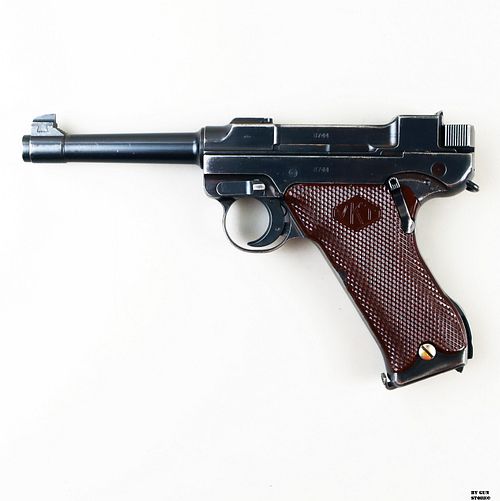
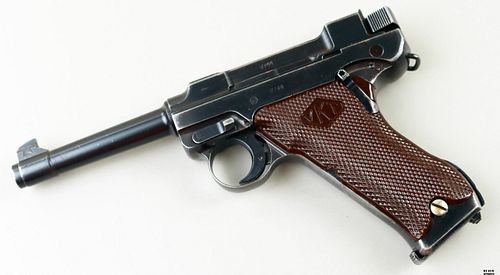


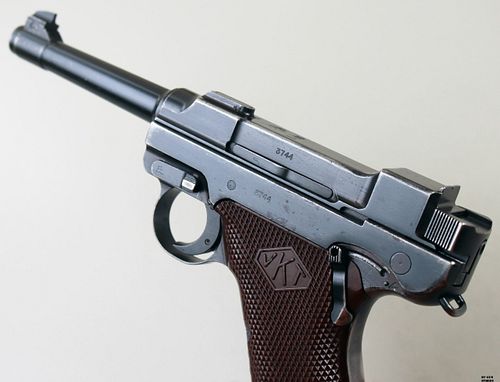
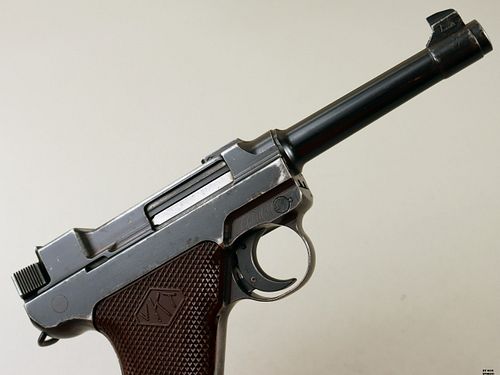
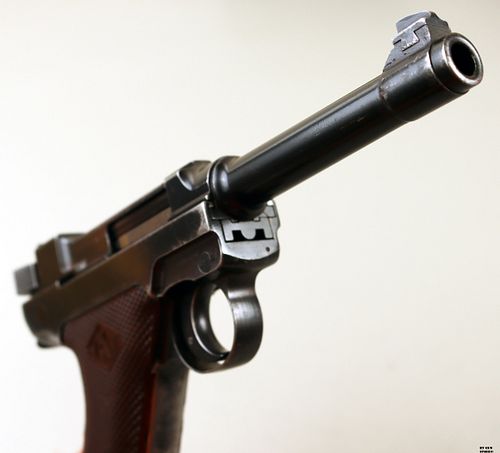
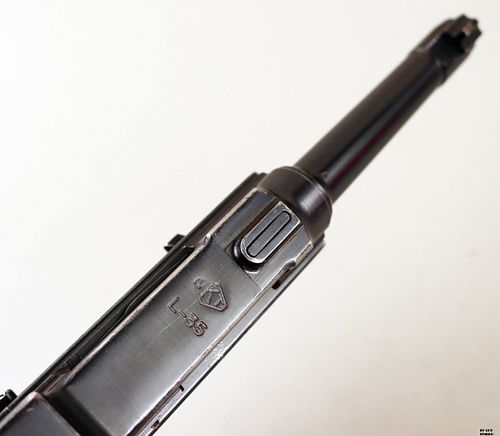

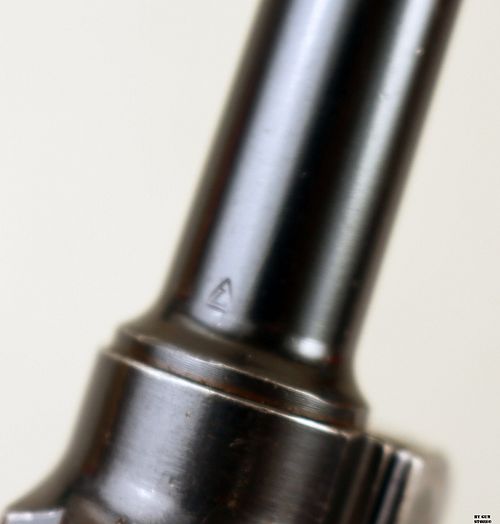

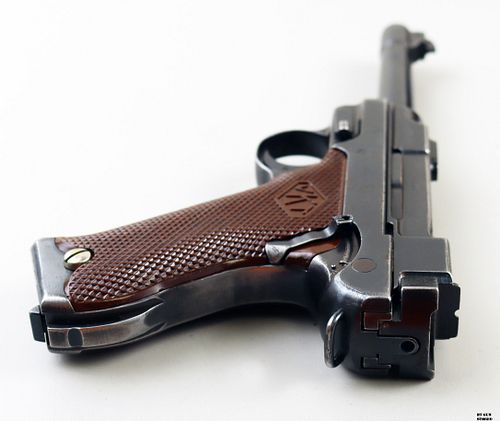
This pistol was designed and produced in Finland and distributed to frontline units during the Winter War (1939-1940), in very limited numbers and then increasing during the Continuation War (1941-1944). After World War II, it remained in use in the Finnish Armed Forces until the 1980s.
Aimo Lahti had the idea to develop this pistol from his superiors in the autumn of 1929. He did not receive a specific order to develop a new military pistol, but rather a suggestion to see if it was possible to develop a new pistol for tests, which would be organised in the near future. The weapon had to have good reliability, structural simplicity, ease of disassembly, and sufficient power to penetrate a German steel helmet at a distance of 50 meters.
The weapon with which the new pistol would naturally be compared was the German Parabellum used by the Finnish army at the time. Lahti managed to design the first version already in the autumn of 1929, and the Helsinki technical weapons depot produced the first prototype. The pistol has a clear visual resemblance to the Parabellum, but its mechanism is very different. The first L-29 prototype was in 9 mm x 19 caliber (Parabellum).
In 1931, Lahti made some improvements to the L-29 pistol designs. A prototype of the improved L-31 pistol was produced, but it broke during testing. Lahti made several further improvements, which led to the L-29/35 trial version in 1935. In June 1935, the infantry and light anti-aircraft weapons committee decided that the pistol could be put into production as soon as some problems were solved. The trigger mechanism was improved. On 28 January 1936, an order for 2,500 L-35 pistols was sent to VKT. The price per pistol was to be 650 Finnish marks. In February 1937, the L-35 pistol was accepted for serial production, but the decision required that the grip panels be replaced with non-wooden ones first. Tests had revealed that wooden grip panels could swell after getting wet and block the trigger mechanism.
The changes made to the design further delayed the start of serial production, and the initial cost per pistol also proved too low. When the unit price of the pistols was recalculated in 1938, it was almost double the original, now standing at 1,290 Finnish marks per pistol. A test series of five pistols was not completed and delivered to the army until March 1938; in July of the same year, a larger test series of 94 pistols was completed. Tests carried out with this test series in army units revealed several problems; fortunately, Aimo Lahti had already anticipated most of the problems and had managed to develop the necessary improvements to eliminate them. These prototypes had wooden grip panels, while all production pistols had brown bakelite grip panels with the VKT mark (Valtion Kivääritehdas = State Rifle Factory in the city of Jyväskylä).
In July 1938, the old order of 2,500 pistols was cancelled and a new order of 7,642 L-35s was introduced. The price of this new order was now 1,290 marks/pistol. VKT, which produced these pistols, was to deliver them in batches of 1,000 pistols every 3 months. However, production did not start as quickly as expected, and in the summer of 1939 the Finnish Armed Forces were still waiting for the first delivery.
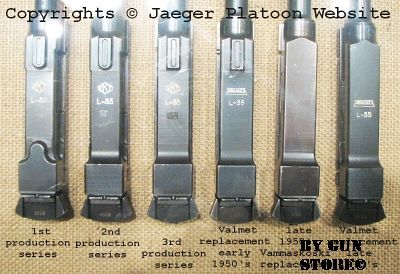
Collectors usually divide the production of the L-35 pistol as follows:
Series 0: Series produced mainly for field tests in 1938, serial numbers 1006-1104. After tests in various military units, further improvements were made. Such improvements were introduced in the next production series.
Series
1: First true production series. Production was delayed and this production series was finally delivered during the Winter War. This production series included about 2,600 pistols, with the first 1,000 delivered before mid-March 1940 and another 1,500 by June 1941. This production series included serial numbers between 1100 and 3700. They are identifiable by the slide structure, which still features unnecessarily machined details for parts (slide buffer) that were omitted after improvements introduced after series 0 and “the curve” on the top of the slide.
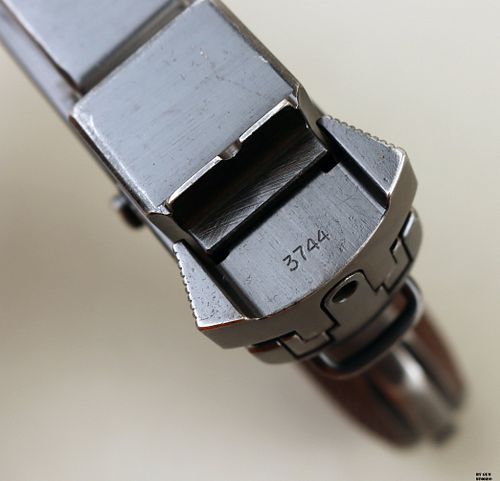
Series 2: This production series of about 1,000 pistols was made around 1941-1942. The pistols no longer had unnecessary machined details inside the pistol for parts (slide buffer) omitted after series 0. The serial numbers were about 3700-4700. Ours has serial number 3744.
Series 3: This production series counted just over 2,000 pistols. The part of this series produced during wartime had serial numbers around 3700-5800 and was almost entirely delivered in spring 1944. The 1944 peace interrupted new component production, but building L-35 pistols from existing components continued until the end of 1945. This post-war continuation production counted about 1,000 pistols (serial numbers around 5800-6800). The last L-35 pistol delivered to the Finnish Armed Forces had serial number 6731.
Series 4: After World War II, the Finnish Armed Forces had more than enough pistols for peacetime use. However, Valmet Oy Tourula factories (VKT factory under the new name) still had many semi-finished components for the L-35 pistol. The company decided to use these existing components to produce pistols for the commercial market. This production, counting just over 2,000 pistols, had serial numbers between 6800 and 9300. Most of these pistols were sold abroad. All series 4 L-35s featured Valmet and L-35 markings on the top of the slide, instead of the VKT and L-35 markings used in previous production series. The series 4 pistols also did not have the stock attachment, which had been used in all previous production series.
As mentioned, VKT (Valtion Kivääritehdas = State Rifle Factory) in the city of Jyväskylä was the only producer of this pistol in Finland. The factory name was changed to Valmet (Valtion Metallitehtaat Tourulan Tehdas = State Metal Factories – Tourula Factory) after World War II.
| ID | 9932073 |
| URL | https://www.gunfinder.com/items/9932073 |
| Category | Firearms / Pistols |
| Purchase eligibility | Required |
| Caliber | 9mmLuger |
| Condition | Gebraucht |
| Location | 20127 Milano, Italy |
| Availability | In stock |
| Shipping costs paid by | Buyer |