
.br-v3-product{--br-green:#18392f;--br-green-2:#245346;--br-cream:#f5f1e8;--br-gold:#c8a96a;--br-ink:#17211d;--br-line:#d9d3c6;color:var(--br-ink);font:400 16px/1.65 system-ui,-apple-system,BlinkMacSystemFont,"Segoe UI",sans-serif;background:#fff}
.br-v3-product *{box-sizing:border-box}.br-v3-product a{color:#0f5948;text-decoration-thickness:1px;text-underline-offset:3px}.br-v3-product p{margin:.55rem 0}.br-v3-product ul{margin:.65rem 0;padding-left:1.2rem}.br-v3-product li{margin:.25rem 0}.br-shell{max-width:1120px;margin:0 auto;padding:0 18px 32px}.br-hero{padding:30px;border-radius:22px;background:linear-gradient(135deg,var(--br-green),var(--br-green-2));color:#fff}.br-kicker{margin:0 0 8px;color:#f2d49a;font-size:.78rem;font-weight:800;letter-spacing:.12em;text-transform:uppercase}.br-title{margin:0;font-size:clamp(1.75rem,4vw,2.7rem);line-height:1.12}.br-lead{max-width:790px;margin:14px 0 0;font-size:1.08rem;color:#f4f7f5}.br-grid{display:grid;grid-template-columns:repeat(12,1fr);gap:18px;margin-top:18px}.br-card{grid-column:span 6;padding:22px;border:1px solid var(--br-line);border-radius:18px;background:#fff}.br-card-wide{grid-column:1/-1}.br-card-accent{background:var(--br-cream)}.br-card-title{margin:0 0 9px;color:var(--br-green);font-size:1.23rem;line-height:1.3}.br-check{list-style:none;padding-left:0}.br-check li{position:relative;padding-left:1.55rem}.br-check li:before{position:absolute;left:0;color:#17624d;font-weight:900;content:"✓"}.br-facts{display:grid;grid-template-columns:repeat(2,minmax(0,1fr));gap:10px}.br-fact{padding:12px;border-radius:12px;background:#f7f7f4}.br-fact b{display:block;color:var(--br-green);font-size:.83rem}.br-callout{padding:14px 16px;border-left:4px solid var(--br-gold);background:#fff9ec}.br-compare{display:grid;grid-template-columns:repeat(3,minmax(0,1fr));gap:12px}.br-compare-item{padding:14px;border:1px solid var(--br-line);border-radius:14px}.br-compare-item b{display:block;color:var(--br-green);margin-bottom:4px}.br-links{display:flex;flex-wrap:wrap;gap:10px}.br-link{display:inline-block;padding:9px 13px;border:1px solid #7eaa9b;border-radius:999px;background:#fff;font-weight:700;text-decoration:none}.br-faq details{border-top:1px solid var(--br-line);padding:12px 0}.br-faq details:last-child{border-bottom:1px solid var(--br-line)}.br-faq summary{cursor:pointer;color:var(--br-green);font-weight:800}
@media(max-width:760px){.br-shell{padding-inline:12px}.br-hero{padding:22px}.br-card{grid-column:1/-1;padding:18px}.br-facts,.br-compare{grid-template-columns:1fr}.br-link{width:100%;text-align:center}}
Reloading · Measuring and Testing Technology
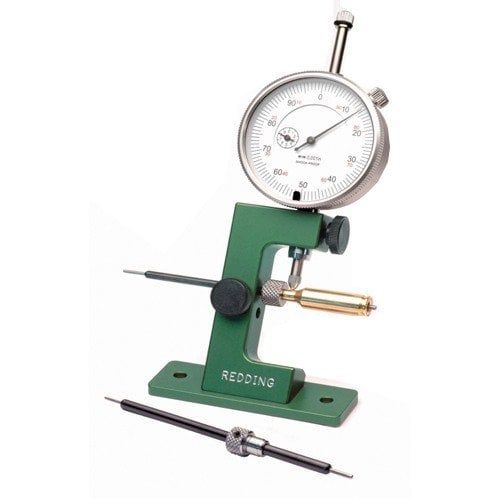
REDDING 26400 Case Neck Wall Thickness Gauge with Dial Indicator
For reloaders who want to sort cases not only by manufacturer or lot but measurably by uniformity. The gauge makes wall thickness differences on the case neck visible when turning – fast, reproducible, and clearly distinct from runout measurement.
The quick purchase check
Measurement range for cases from .17 to .338 caliber
Dial indicator with 0.001″ graduation
Two mandrels for standard and .060″ flash holes
Pilot gauges for .22 and .30 caliber included
Other calibers require the appropriate REDDING pilot gauge
Who is the gauge worth it for?
It is especially strong for quick lot sorting for precision loadings, benchrest, and long range: multiple cases can be compared with the same routine without repositioning a ball micrometer for each measurement point. Those who miss material for exact neck turning should complement the faster indication of this gauge with a suitable ball micrometer.
Compatibility and avoiding wrong purchases
Caliber range .17 to .338 with matching pilot gauge
Included pilots .22 and .30 caliber
Dial indicator 0.001″ graduation
Mandrels 3/16″ and 9/64″; smaller mandrel for .060
″-Primer Pockets
Mounting Stable table base; REDDING clamp 30520 optional
Identity MPN 26400 · UPC 611760264009
Important: The device shows neck wall thickness differences. It is not a gauge for the concentricity of a fully loaded cartridge. For calibers outside .22 and .30, the appropriate stainless steel pilot stop must be purchased separately.
Practical interpretation: What the pointer deflection means
REDDING 26400 Quick comparative measurement on the entire case neck; ideal for sorting many cases by relative uniformity.
Ball micrometer Slower, but often the more precise reference for individual absolute wall thickness values and controlled neck turning.
Concentricity gauge Checks the radial deviation of the case or cartridge. This is a different measurement and not a substitute for neck wall thickness testing.
REDDING points out that a neck wall deviation over 0.0015″ often indicates further material differences in the shoulder and case body. This is a diagnostic hint, not a general rejection limit: lot, application, chamber, and your own precision requirements remain decisive.
User and instructor tips
Only measure clean, empty, and decapped cases.
Mount the appropriate pilot stop and position the case without side load.
Slowly rotate the case completely once; note the smallest and largest reading.
Always measure at the same neck position and evaluate cases only within comparable lots.
Check the dial indicator for smooth operation and reproducible zero setting before a series.
Scope of delivery and limits
Included: REDDING Case Neck Gauge 26400 with dial indicator, stable table base, two mandrels, and pilot stops for .22 and .30 calibers.
Not included: other caliber-specific pilot stops, table clamp 30520, cases, or other reloading accessories.
The exact net weight is not published. Therefore, the Brownells shipping weight was deliberately not adopted as product weight.
Suitable assortments
REDDING
Reloading accessories
Workshop
Range & Precision
Frequently asked questions
Does the REDDING 26400 measure cartridge concentricity? No. It compares the wall thickness around the case neck. A separate concentricity gauge is intended for the concentricity of a case or loaded cartridge.
Which calibers can I measure directly out of the box? The scope of delivery includes pilot stops for .22 and .30 calibers. For other calibers in the supported range from .17 to .338, the respective REDDING pilot stop is required.
What are the two mandrels for? The two mandrels support different case and primer pocket geometries. The smaller 9/64″ mandrel is intended for cases with .060″ primer pockets.
How is a case compared? The empty, decapped case is slowly rotated on the appropriate pilot stop. The difference between the smallest and largest measurement shows the wall thickness deviation in the tested neck area.
Does the gauge replace a ball micrometer? It is more convenient for quick sorting. For absolute individual values or setting during precise neck turning, a suitable ball micrometer can be the better reference.
Does the gauge need to be fixed to the workbench? The stable base allows a steady table setup. For a fixed clamp mounting, REDDING names the separately available table clamp 30520.
Is a deviation over 0.0015″ automatically reject? No. REDDING describes this value as an indication of possible further material differences. Whether a case is rejected depends on lot, chamber, load, and precision goal.
| ID | 9905202 |
| URL | https://www.gunfinder.com/items/9905202 |
| Category | Ammunition / Wiederladezubehör |
| Condition | Neu |
| Location | 72479 Straßberg, Germany |
| Availability | In stock |
| Shipping costs paid by | Buyer |