




.br-product{
font-family:Arial,Helvetica,sans-serif;
line-height:1.6;
color:#222;
}
.br-product h2{
font-size:1.2rem;
margin-top:28px;
}
.br-product h3{
font-size:1rem;
margin:0 0 8px;
}
.br-product ul{
padding-left:18px;
}
.br-product .info-box{
background:#ffdddd;
border-left:6px solid #c40000;
padding:12px;
margin:20px 0;
}
.br-product .tip-box{
background:#eef6ff;
border-left:6px solid #2a6fdb;
padding:12px;
margin:20px 0;
}
.br-product .trust-box{
background:#eaf7ea;
border-left:6px solid #2f8f2f;
padding:12px;
margin:20px 0;
}
.br-product .compare-box{
background:#f5f5f5;
border-left:6px solid #444;
padding:12px;
margin:20px 0;
}
.br-product details{
background:#f2f2f2;
padding:10px;
margin-bottom:8px;
border-radius:4px;
}
.br-product summary{
font-weight:600;
cursor:pointer;
}
.br-product .reticle-section{
margin:24px 0;
}
.br-product .reticle-intro{
background:#eef6ff;
border-left:6px solid #2a6fdb;
padding:14px;
margin:18px 0;
}
.br-product .reticle-grid{
display:grid;
grid-template-columns:repeat(2,minmax(0,1fr));
gap:18px;
margin-top:18px;
}
.br-product .reticle-card{
background:#fff;
border:1px solid #ddd;
border-radius:10px;
overflow:hidden;
box-shadow:0 6px 18px rgba(0,0,0,.06);
display:flex;
flex-direction:column;
}
.br-product .reticle-image-wrap{
background:#f7f7f7;
padding:14px;
border-bottom:1px solid #e3e3e3;
display:flex;
align-items:center;
justify-content:center;
min-height:260px;
}
.br-product .reticle-image-wrap img{
width:100%;
height:auto;
max-height:340px;
object-fit:contain;
display:block;
}
.br-product .reticle-gallery{
display:grid;
grid-template-columns:1fr;
gap:10px;
width:100%;
}
.br-product .reticle-gallery figure{
margin:0;
background:#fff;
border:1px solid #e5e5e5;
border-radius:8px;
padding:8px;
}
.br-product .reticle-gallery figcaption{
font-size:.82rem;
color:#555;
margin-top:6px;
text-align:center;
}
.br-product .reticle-content{
padding:14px;
}
.br-product .reticle-tag{
display:inline-block;
font-size:.82rem;
font-weight:700;
background:#eef6ff;
color:#1f4f9a;
padding:4px 8px;
border-radius:999px;
margin-bottom:8px;
}
.br-product .reticle-decision{
background:#f4f7f2;
border-left:6px solid #6b7d3a;
padding:12px;
margin-top:12px;
}
.br-product .br-small-note{
font-size:.9rem;
color:#555;
margin-top:8px;
}
@media(max-width:780px){
.br-product .reticle-grid{
grid-template-columns:1fr;
gap:14px;
}
.br-product .reticle-image-wrap{
min-height:190px;
padding:10px;
}
.br-product .reticle-image-wrap img{
max-height:260px;
}
.br-product .reticle-content{
padding:12px;
}
}
A 3-15x44 scope is one of the most sensible compromises for shooters who want to seamlessly combine hunting, range, and controlled distance work. You have enough overview at the low end, and enough magnification at the high end for target acquisition, zeroing, and precise adjustments. That’s exactly why it’s worth taking a close look at the Vortex Viper 3-15x44 variants: The scopes look similar but perform differently.
The Viper PST Gen II is the more robust, heavier, and more precision-oriented line. The Viper HD is lighter, more agile, and often more pleasant for hunting. Then come the crucial questions: MOA or MRAD? FFP or SFP? EBR-7C, EBR-4, or VMR-3? Anyone who chooses here just by price or model name quickly buys the wrong scope for their setup.
This variants article is therefore deliberately designed as a real buying guide. You shouldn’t just buy any Viper 3-15x44, but the scope that fits your firearm, your mount, your data card, your reticle understanding, and your training routine.
Key Features
3-15x magnification: practical range for hunting, bolt-action rifles, range, zeroing, and controlled distance work.
44 mm objective: good compromise of light transmission, height, weight, and handling.
PST Gen II or Viper HD: choose between a robust precision line and a lighter hunting/range line.
MOA and MRAD variants: matching ballistics app, data card, turret, reticle, and training
ingssprache.
FFP variant: PST Gen II MRAD FFP EBR-7C with correct holdover values at every magnification.
SFP variants: PST Gen II MOA SFP and Viper HD VMR-3 with consistent reticle image.
Illuminated reticles: helpful with dark target backgrounds, dusk, or difficult contrast.
Zero-stop systems: PST Gen II with Tactical RZR Zero Stop, Viper HD with RevStop® Zero.
30 mm main tube: wide mounting options and sensible adjustment range.
Parallax from approx. 18 m: flexible for training, zeroing, and distance work.
Viper HD at approx. 638 g: noticeably more manageable and more interesting for hunting.
PST Gen II at approx. 874 g: heavier but clearly designed for robust precision use.
Our assessment
The Vortex Viper 3-15x44 variants are strong for users who don’t want to mount a large 5-25x or 6-36x scope right away but still want significantly more than a simple standard hunting scope. 3-15x is not a marketing figure but a very usable working range outdoors and on the range.
The PST Gen II fits better when range, precision shooting, robust turrets, and deliberate work with turret and reticle are the focus. It is heavier, but on a stable bolt-action or chassis setup, that can be just right.
The Viper HD is, in our view, the better choice when weight, handling, and hunting balance are more important. 638 g instead of 874 g is noticeable on a bolt-action. If you carry the scope in the field, use it on a stand, or don’t want to make a setup unnecessarily front-heavy, the HD line is often the smarter decision.
Black-Raptor short summary
Buy if: you want a versatile 3-15x44 scope for hunting, range, bolt-action, or controlled distance work and want to consciously choose between PST Gen II, Viper HD, MOA, MRAD, FFP, and SFP.
Don’t buy if: you want an LPVO, a pure stalking scope, an ultralight minimal scope, a 5-25x long-range setup, or a premium Razor.
Important classification before purchase
Before buying, you should clarify three things: How heavy can your setup be? Which unit do you work in? And do you really need FFP or is SFP even more comfortable for your application?
PST Gen II: robust, heavier, more sporty. Good choice for range, chassis, bolt-action, and setups where weight is less critical than turret feel, repeatability, and precision logic.
Viper HD: lighter, more manageable, modern hunting/range compromise. Good choice for bolt-actions that shouldn’t become front-heavy and for users looking for a strong 3-15x44 with open elevation adjustment and RevStop® Zero.
FFP: useful if you want to use holdover values correctly at different magnifications. SFP: useful if you prefer a consistently sized, steadier reticle and use your holdover values at a defined magnification.
Choose reticle & variants correctly
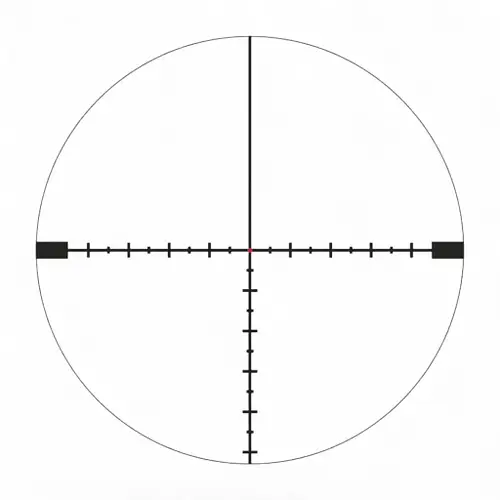
Reticle images as real buying aid:
The reticles differ not only visually. What matters is whether the reticle logic fits your unit, your magnification use, and your training. This is exactly where most bad purchases happen: wrong unit, wrong focal plane, or a reticle that doesn’t fit your working style.
EBR-7C MRAD – reticle view
EBR-7C MRAD – scale
MRAD · FFP · PST Gen II
Viper PST Gen II 3-15x44 MRAD FFP EBR-7C
The technically most consistent variant if you work metrically and want to use holdover values correctly at every magnification.
0.1 MRAD: 1 cm at 100 m, 3 cm at 300 m, 5 cm at 500 m.
FFP: reticle values remain correct at every magnification.
Ideal for: range, bolt-action, PRS-like use, and metric data cards.
Buy if: app, turret, reticle, and spotter calls run in MRAD for you and you work flexibly with magnification.
EBR-4 MOA – reticle view
EBR-4 MOA – close-up
MOA · SFP · PST
Gen II
Viper PST Gen II 3-15x44 MOA SFP EBR-4
For shooters who use MOA and prefer a consistently sized, steadier reticle.
¼ MOA: approx. 0.7 cm at 100 m per click.
SFP: reticle remains visually the same size.
Ideal for: target, stand hunting, more static applications, and defined working magnification.
Buy if: You use MOA, want a steady reticle image, and don’t need to work with subtensions at every magnification.
MRAD · SFP · Viper HD
Viper HD 3-15x44 VMR-3 MRAD
The lighter MRAD solution for hunters and shooters who work metrically but don’t want a heavy PST Gen II setup.
MRAD system: direct metric correction logic.
Viper HD: lighter, shorter, and more maneuverable than the PST Gen II.
SFP note: hold values of the VMR-3 apply at defined magnification.
Buy if: You want MRAD but weight and hunting maneuverability are more important than FFP.
MOA · SFP · Viper HD
Viper HD 3-15x44 VMR-3 MOA
For shooters who use MOA as their working language and want a lighter 3-15x44 with a practical reticle.
¼ MOA: fine, familiar MOA click logic.
Viper HD: good balance of weight, optics, and handling.
Ideal for: hunting, range, and users with existing MOA data cards.
Buy if: Your app, data card, and training routine run in MOA and you prefer a lighter scope.
Note: The reticle images serve as visual orientation. The decisive factors for selection remain the image plane, unit system, turret logic, and real use on your setup.
MOA or MRAD – one language, no mixed system
MRAD is very direct for metric-thinking shooters. 0.1 MRAD equals 1 cm at 100 m, 3 cm at 300 m, and 5 cm at 500 m. If the hit is 0.4 MRAD low, you correct 0.4 MRAD – without converting centimeters back in your head.
MOA is not worse, just a different language. 1 MOA roughly equals 3 cm at 100 m. ¼ MOA is about 0.7 cm at 100 m, 2.2 cm at 300 m, and 3.6 cm at 500 m. This works very well if the app, data card, turret, and calls also run in MOA.
MRAD: ideal if you work metrically and note corrections directly in MRAD.
MOA: sensible if your data card, app, or training group already works in MOA.
Most important rule: turret, reticle, ballistics app, data card, and spotter calls must use the same unit.
Avoid mistakes: Don’t buy MRAD if your entire process runs in MOA – and vice versa.
Instructor principle: Clarify unit first, then buy scope
The question is not whether MOA or MRAD is better. The question is which language your setup speaks. If you work with friends, spotter, app, and data card in MRAD, stick with MRAD. If your system is MOA, stay consistent with MOA. Mixed logic costs time and produces unnecessary errors.
3-15x44 in practice
Many shooters underestimate how powerful a good 3-15x44 can be. 3x still gives you overview, 8x to 12x is enough for many hunting and sporting situations, and 15x offers enough reserve for target identification, zeroing, and more precise work.
The advantage over large long-range scopes lies in maneuverability. Less weight, lower height, and a more compact overall package make a noticeable difference on bolt actions. Especially for hunting use, this can be more important than maximum magnification.
Practice tip: Train consciously below 15x
Don’t automatically turn to maximum magnification. Train consciously at 6x, 8x, 10x, and 12x. Often you recognize your position better there and have a steadier image. 15x is reserve – not always the best setting.
Setup tip: Mounting height determines speed
With 3-15x44 you can often build lower than with 50- or 56-mm objectives. This is a real advantage when stock, cheek rest, and eye line match. Check dry before zeroing: Can you repeatedly get behind
nander in the same view, without searching for the head? If not, the mounting height is more important than the next click adjustment.
Application Scenarios
Hunting Bolt Action: Viper HD 3-15x44 is especially interesting when weight and handling matter.
Range and Precision Shooting: PST Gen II fits well when turret operation, reticle logic, and robust construction are more important.
Controlled Distance Work: 15x is more than enough for many shots at medium to longer distances.
Stand Hunting and Territory: 44 mm objective and 3x at the low end remain practical if you’re not looking for a pure driven hunt scope.
Training and Zeroing: Parallax adjustment, illuminated reticle, and clear click logic help with a clean setup build.
Features & Construction
The PST Gen II variants rely on a robust one-piece aluminum housing, 30 mm main tube, XD™ lens elements, XR™ multi-coating, ArmorTek®, and argon filling. They are clearly designed for precision work, range, and rugged use.
The Viper HD variants are more modern and lighter. They offer 3-15x44, HD optics, VMR-3 reticle, 10 brightness levels, open lockable elevation turret, covered windage turret, and RevStop® Zero. The focus is more on versatile hunting/range use.
All variants require a clean mounting. Ring height, eye relief, cant, torque, and cheek weld strongly determine whether the scope later works quickly and reproducibly. A good scope does not compensate for poor mounting.
Technical Data
Product type: 3-15x44 scope – for hunting, range, bolt action, and controlled distance work.
Variants: PST Gen II MRAD FFP EBR-7C, PST Gen II MOA SFP EBR-4, Viper HD VMR-3 MRAD, Viper HD VMR-3 MOA.
Magnification: 3-15x – good range from overview to precise target analysis.
Objective diameter: 44 mm – practical compromise of light performance, weight, and mounting height.
PST Gen II main tube: 30 mm – wide mounting options and robust precision base.
PST Gen II eye relief: approx. 7.62 cm – choose mounting position carefully.
PST Gen II field of view at 100 m: approx. 13.74 m to 2.9 m – wide overview at 3x, tighter target image at 15x.
PST Gen II parallax: from approx. 18 m to infinity – useful for training and distance work.
PST Gen II MRAD FFP: 0.1 MRAD click value, 22 MRAD elevation adjustment, 11 MRAD windage adjustment.
PST Gen II MOA SFP: ¼ MOA click value, 75 MOA elevation adjustment, 40 MOA windage adjustment.
PST Gen II length: approx. 36.3 cm – classic precision scope with corresponding space requirement.
PST Gen II weight: approx. 874 g – robust but significantly heavier than the Viper HD.
Viper HD image plane: second image plane, SFP – reticle remains optically the same size.
Viper HD illumination: 10 brightness levels – helpful with dark target backgrounds or twilight.
Viper HD elevation turret: open, lockable, RevStop® Zero – for controlled elevation corrections.
Viper HD windage turret: covered – protects the windage adjustment from unintentional changes.
Viper HD MRAD: 0.1 MRAD per click, 10 MRAD per revolution, 30.5 MRAD elevation and windage adjustment.
Viper HD MOA: ¼ MOA per click, 25 MOA per revolution, 92 MOA elevation and windage adjustment.
Viper HD field of view at 100 m: approx. 13.3 m to 2.7 m – very similar to PST Gen II.
Viper HD eye relief: approx. 86 mm – practical for hunting and sporting setups.
Viper HD parallax: from approx. 18.3 m to infinity – flexible for training and distance work.
Viper HD main tube: 30 mm – wide selection of mounts and rings.
Viper HD length: approx. 335 mm – more compact than PST Gen II.
Viper HD weight: approx. 638 g – significantly more manageable and more interesting for hunting than PST Gen II.
Battery: CR2032 – powers the illuminated reticle.
Scope of Delivery
Vortex Viper 3-15x44 scope in chosen variant
CR2032 battery
Sunshade
Cleaning cloth or lens cloth
Depending on variant N
eoprene cover
Product documents
Note on variant selection:
This product includes different Viper series and different operating logics. Before buying, consciously check: PST Gen II or Viper HD, FFP or SFP, MOA or MRAD. It’s not just about the price, but whether weight, reticle, turret logic, and unit system fit your firearm and your training.
FAQ
Why are PST Gen II and Viper HD listed in one variant article?
All variants cover the same basic range 3-15x44. At the same time, they differ in series, weight, focal plane, reticle, and adjustment logic. A variant article makes comparison easier when the differences are clearly explained.
Which variant is most interesting for hunting?
The Viper HD is especially interesting for hunting due to about 638 g weight, more compact length, and RevStop® Zero. It remains more maneuverable than the heavier PST Gen II.
When is the PST Gen II more sensible?
When range, precision shooting, robust turret work, and a sportier design are more important than low weight. Especially the MRAD-FFP variant is strong for reticle work at varying magnifications.
What is better: MOA or MRAD?
Neither is generally better. MRAD is very direct for metric work, MOA makes sense if your app, data card, or training group works in MOA. The important thing is not to mix both systems.
What is the difference between FFP and SFP?
FFP reticles scale with magnification, so holdover values remain correct at every level. SFP reticles stay visually the same size, but their values only apply at a defined magnification.
Which mount do I need?
You need a high-quality 30 mm mount or matching 30 mm rings. Important are height, eye relief, objective clearance, torque, and possibly a canted mount for distance work.
| ID | 9896169 |
| URL | https://www.gunfinder.com/items/9896169 |
| Category | Optics / Target scopes |
| Condition | Neu |
| Location | 72479 Straßberg, Germany |
| Availability | In stock |
| Shipping costs paid by | Buyer |