




.br-product{
font-family: Arial, Helvetica, sans-serif;
line-height:1.6;
color:#222;
}
.br-product h1{
font-size:1.4rem;
margin-bottom:10px;
}
.br-product h2{
font-size:1.2rem;
margin-top:28px;
}
.br-product ul{
padding-left:18px;
}
.br-product .info-box{
background:#ffdddd;
border-left:6px solid #c40000;
padding:12px;
margin:20px 0;
}
.br-product .tip-box{
background:#eef6ff;
border-left:6px solid #2a6fdb;
padding:12px;
margin:20px 0;
}
.br-product .trust-box{
background:#eaf7ea;
border-left:6px solid #2f8f2f;
padding:12px;
margin:20px 0;
}
.br-product .compare-box{
background:#f5f5f5;
border-left:6px solid #444;
padding:12px;
margin:20px 0;
}
.br-product details{
background:#f2f2f2;
padding:10px;
margin-bottom:8px;
border-radius:4px;
}
.br-product summary{
font-weight:600;
cursor:pointer;
}
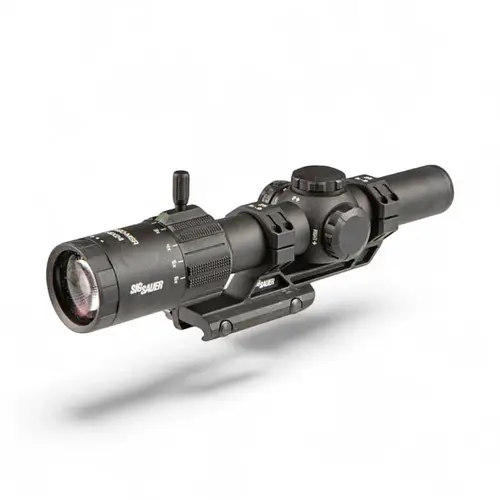
SIG SAUER TANGO-MSR 1-6x24 – fast LPVO for short to medium distances
When speed is more important than maximum magnification, a 1–6× LPVO is often the most honest solution.
SIG SAUER TANGO-MSR 1-6x24 MSR BDC6 SFP is not a showcase scope, but an LPVO optic for real training and practical use: short distances, quick target transitions, changing positions, and controlled work at medium ranges.
The crucial point is not just the zoom factor. What matters is whether reticle, focal plane, click logic, and mounting fit your use. That’s exactly why you shouldn’t choose this optic just for “more magnification,” but for how it works.
Why exactly this SIG SAUER LPVO?
✔ 1–6× for fast close and medium distances
✔ MSR BDC6 reticle in the second focal plane (SFP)
✔ 0.5 MOA click logic for precise adjustments
✔ robust LPVO platform for range, training, and modern sporting rifles
✔ ideal if you want to combine speed and precision in one setup
Why this product?
The 1-6x24 is the MSR variant for shooters looking for an easy-to-understand, fast, and rugged LPVO. 1× stays clear and responsive, 6× is enough for many realistic training and hunting distances.
You keep overview and speed at low magnification
You get more target info than with a red dot
You can apply point-of-impact corrections clearly in MOA/MRAD
You build a setup covering short and medium distances
Decision aid:
The 1–6× is not the variant for maximum detail recognition at distance. It’s the variant for speed, overview, and simple operation.
Trainer tip: Separate zero and hold points cleanly
Many mistakes happen because shooters mix BDC, zero, and click adjustments.
First mount mechanically clean, then zero at 100 m, then check hold marks at real distances. Only this way do you know if your ammo really fits the reticle logic.
Key features
1–6× magnification with LPVO character
MSR BDC6 reticle in the second focal plane (SFP)
24 mm objective diameter
30 mm main tube / mounting platform according to model logic
0.5 MOA click adjustment for traceable point-of-impact correction
illuminated reticle for better target acquisition in changing light
designed for modern sporting rifles, carbine platforms, and dynamic applications
Our assessment
This optic makes particular sense if you don’t want to switch between red dot and classic scope. An LPVO gives you fast acquisition at low magnification and enough reserve to identify targets more clearly at medium distances.
The difference between SIG variants lies mainly in zoom factor, focal plane, and reticle. SFP often feels steadier and faster at low magnification. FFP is stronger if hold points should stay correct at different magnifications.
Who it’s for
Training at 25–300 m with clear target structure
Driven hunt/moving scenarios when speed counts
Shooters looking for a straightforward LPVO instead of maximum magnification
Why exactly for you?
If you’re looking for an optic that not only delivers technical specs but supports your real work between close range, mid-range, and controlled point-of-impact adjustment, this model fits perfectly in that role.
You’ll also find suitable gear in our Outdoor & Emergency Preparedness category.
Important note:
Point of impact, BDC hold points, and repeatability always depend on mounting, firearm, ammunition, barrel length, and proper zeroing.
Mounting and torque must follow manufacturer specifications. After every mounting or change to the setup, the point of impact should be checked.
SFP in practice – what does it mean?
With SFP, the reticle stays visually the same size. This often feels steadier and faster at low magnification. Important: BDC hold marks are usually only accurate at a defined magnification.
Understanding click values correctly
0.5 MOA equals about 1.45 cm at 100 m, 2.9 cm at 200 m, and 4.4 cm at 300 m. The click logic is simple enough for quick corrections at the range.
Always document after zeroing: distance, ammunition, clicks, and point of impact
Confirm BDC hold points at real distances, don’t just rely on the datasheet
Always check point of impact with changing ammunition
Pro tip: Don’t treat an LPVO like a pure scope
At 1× it’s about speed, posture, and target acquisition. At high magnification it’s about control and clean follow-through.
Train both separately: first fast target acquisition, then precise work with hold points. That’s how you really get the most out of the LPVO.
Technical data
Magnification: 1–6×
Objective diameter: 24 mm
Main tube: 30 mm
Reticle: MSR BDC6
Focal plane: SFP / second focal plane
Illumination: 11 levels
Click value: 0.5 MOA
Elevation/windage: 100 MOA
Weight: approx. 18.5 oz / 525 g
Mount: includes ALPHA-MSR Cantilever mount
Scope of delivery
1x SIG SAUER TANGO-MSR 1-6x24 MSR BDC6 SFP
Mount / accessories depending on manufacturer and importer scope
Operating instructions
FAQ
Is this LPVO meant more for close or distance?
It’s built exactly for the transition: fast at low magnification, controlled at mid-range. It doesn’t replace a specialized long-range scope but is clearly more versatile than a pure red dot.
What’s more important: 1–6×, 1–8×, or 1–10×?
1–6× is faster and simpler, 1–8× is the strong middle ground, 1–10× offers more detail reserve. The key is whether you really regularly need more than 6×.
What is the BDC reticle useful for?
BDC hold points help at known distances when ammunition, barrel length, and zero match the reticle logic. They don’t replace confirmation at real distances.
What do I need to check after mounting?
Eye relief, horizontal alignment, torque, 100-m zero, and then the point of impact at the distances where you actually want to use the optic.
Especially in the LPVO scope segment, SIG SAUER TANGO-MSR and TANGO6T, it’s not a single data value that matters but the combination of magnification, reticle, focal plane, click logic, and properly confirmed point of impact.
| ID | 9894173 |
| URL | https://www.gunfinder.com/items/9894173 |
| Category | Optics / Target scopes |
| Condition | Neu |
| Location | 72479 Straßberg, Germany |
| Availability | In stock |
| Shipping costs paid by | Buyer |