
The evolution of the knife: The tumultuous history of humanity is inseparably linked to the development of cutting tools. Due to the different developments of peoples, the transitions between the epochs of "Stone, Bronze, and Iron Age" are fluid and temporally staggered. Blade weapons, however, found their way into every culture and often served, adorned with elaborate decorations, as status symbols of their respective owners. From the very beginning, it was vital to possess tools with which to produce food and clothing. For this, hunted game had to be divided and its components processed. Our ancestors initially used sharp-edged stones for this purpose.
By chipping flint, the first "knife," the hand axe, was created. This could be used for cutting, scraping, dividing, sharpening, and as a weapon. Thus, humanity reached an evolutionary stage where it could purposefully use a self-made tool. In further development, humans succeeded in extracting and processing metals. Copper was initially used for knife production. This could be cast into shapes by heating and then processed. This new melting process made it possible to create complex shapes, allowing blades and handles to form an integral unit. However, the cutting tools were not hard and robust enough to perform all necessary tasks, so stone tools continued to be used. In the following period, it was possible to add a little tin to copper, thus producing bronze. This now had excellent properties and completely replaced stone as blade material. The smelting and refining of iron ore eventually led to the production of iron and later – by adding carbon – steel. The density and achievable hardness of the material could be controlled through forging and subsequent heat treatment, optimizing wear resistance and load capacity. Now, longer blades, for example for swords, could also be produced, which exhibited both hardness and flexibility.
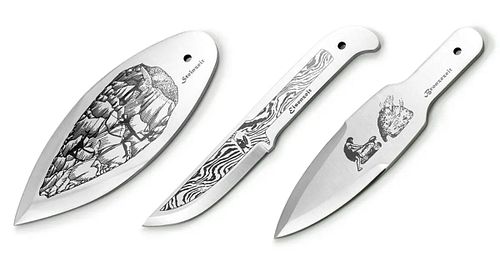
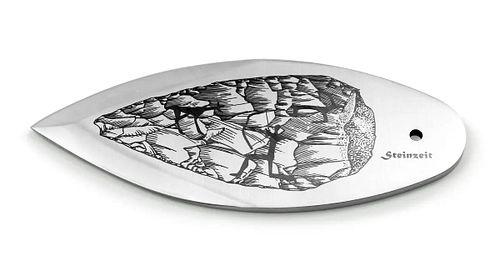
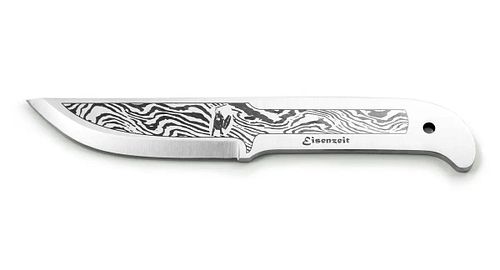
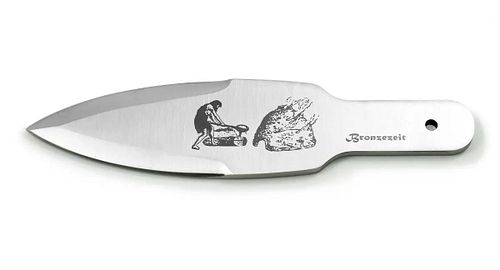
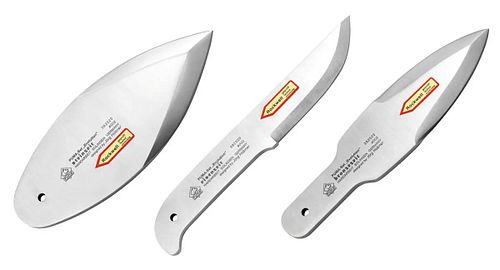
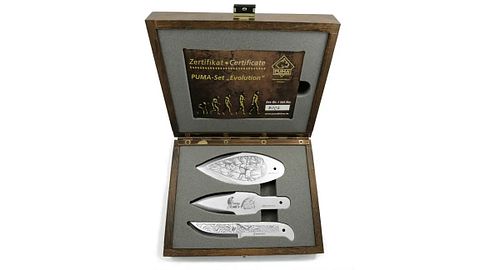
The PUMA set "Evolution" consists of three blades: Stone, Bronze, and Iron Age. Each blade has an engraving representative of its respective epoch. The blades are packaged in a high-quality wooden box and are delivered with a certificate. The first edition is limited to 100 pieces. Each set is numbered.
PUMA "Stone" = hand axe The hand axe originated about one and a half million years ago, during the Stone Age. It was a bi-facially worked and almond-shaped stone, with a rounded base opposite a point. The model "Stone" is a reminiscence of the first knife of humanity.
PUMA "Bronze" = dagger with short handle From the 3rd millennium BC, some peoples were able to produce cutting tools from copper. By adding about ten percent tin, bronze could be cast from copper and used for knife making. The model "Bronze" is inspired by a dagger from this epoch. PUMA "Iron" = knife with long handle Already from the late Bronze Age, knives made of iron appeared, gradually replacing bronze knives. Knives made from smelted iron are documented from the 17th century BC. This technological advancement reached Europe about 2,800 years ago, marking the beginning of the local Iron Age. The model "Iron" corresponds to the shape of a Celtic knife.
Details:
Stone Age Blade edge: 55 mm (double-edged) Total length: 137 mm Thickness: 4 mm Weight: 145 g Steel / Hardness: 1.4125 / 56-57 HRC
Bronze Age Blade edge: 60 mm (double-edged) Total length: 147 mm Thickness: 4 mm Weight: 97 g Steel / Hardness: 1.4125 / 56-57 HRC
Iron Age Blade edge: 73 mm Total length: 153 mm Thickness: 4 mm Weight: 79 g Steel / Hardness: 1.4125 / 56-57 HRC
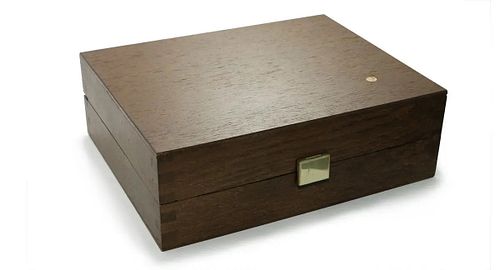
Packaging: Wooden gift box Dimensions: L x W x H, 220 x 176 x 72 mm Total weight: 964 g Design: Jörg Hübner
| ID | 9719025 |
| URL | https://www.gunfinder.com/items/9719025 |
| Condition | Neu |
| Location | 42699 Solingen, Germany |
| Availability | In stock |
| Shipping costs paid by | Buyer |