
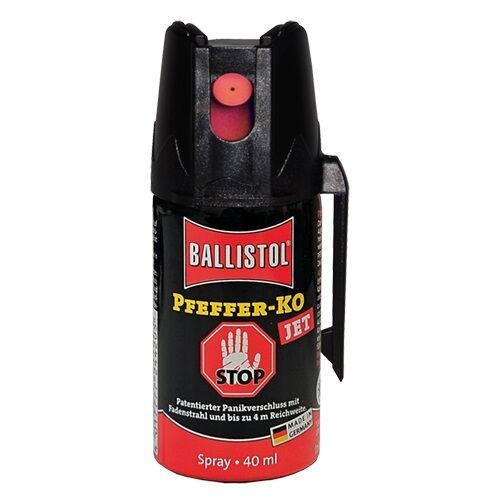
Pfeffer-KO - 40 ml Jet
Verfügbarkeit und aktuelle Preise unter: Klick
Artikelbeschreibung:
Effektive Verteidigungssprays gegen Mensch und Tier
Das Mittel der Wahl unter dem Aspekt der Verhältnismäßigkeit
Unterschiedliche Auffassungen über die Verhältnismäßigkeit bei Notwehr und Selbstverteidigung führten von Seiten der potentiell Gefährdeten, häufig Frauen und Teenager, zu verstärkter Nachfrage nach geeigneten Verteidigungsmitteln. Eine dieser Alternativen sind die so genannten Tränengassprays, auch Verteidigungssprays, Abwehrsprays oder Reizstoffsprays genannt. Der Ausdruck "Tränengas" ist irreführend, da es sich bei den erlaubten Wirkstoffen nicht um Gase handelt, sondern ausschließlich um kristalline Feststoffe oder Flüssigkeiten, die in Sprayform zur Anwendung kommen.
1. Geforderte Eigenschaft
solcher Sprays ist der effektive Schutz der/des Angegriffenen, bei möglichst geringer physischer Beeinträchtigung des Angreifenden. Diese Einschränkung erscheint zunächst absurd, ist jedoch nach einigen uns vorliegenden Prozessberichten, nach denen das Opfer plötzlich zum Täter gestempelt wurde, durchaus angebracht. Was heißt denn "verhältnismäßig" in der Selbstverteidigung? Dazu drei Testfälle. Fünf Rowdys pöbeln in einer Fußgängerzone Herrn Müller an, fordern Geld und Zigaretten. Hilfe von anderen Passanten ist nicht zu erwarten. Frau Meier fährt im einsamen Park ein Baby spazieren, zwei Männer nähern sich, werden zudringlich und betatschen sie ... Ein Drogenabhängiger setzt dem alten Rentner Schultz ein Messer an den Bauch und verlangt Geld. Gesetzt den Fall, alle drei Bedrängten wären im legalen Besitz einer Schusswaffe, wann wäre der Gebrauch davon "angemessen"?
Darf Herr Müller die Waffe ziehen, um sich die Rowdys vom Leib zu halten? Darf er abdrücken, wenn diese trotzdem auf ihn eindringen? Muss sich Frau Meier betatschen lassen, wenn ihr die beiden erklären, sie wollten ja nur ein bisschen... Darf Herr Schultz ohne vorherige Warnung schießen, wenn er die Messerspitze auf der Haut fühlt? In allen Fällen: Ausgang ungewiss, Staatsanwalt und Richter entscheiden am grünen Tisch, wer wie in welcher Situation hätte handeln dürfen.
In den geschilderten Fällen, und nicht nur in diesen, wäre die Verteidigung mit einer Schusswaffe unter Umständen für den/die Angreifer tödlich. Mit einem geeigneten Verteidigungsspray hätte unter Umständen ebenfalls effektiver Schutz weitaus mildere Folgen gehabt. Was ist nun eigentlich ein geeignetes Verteidigungsspray?
2. Physikalische Anforderungen an ein Verteidigungsspray
In der Anlage 2 der 1. Verordnung zum Waffengesetz werden die Anforderungen an Reizstoffsprays beschrieben. Danach können die Reizstoffsprays gasförmig, als Aerosol oder in gelöster Form versprüht werden, müssen aber eine Mindestreichweite von 1,5 m besitzen. Sprühnebel bzw. Sprühstrahl sollten auf eine Entfernung von 1,5 Metern nicht mehr als das Doppelte eines Gesichtsdurchmessers betragen. Als Regel gilt: je "nasser" der Sprühstrahl und je höher die Ausbringrate beim Sprühen, desto wirksamer und weniger anfällig ist das Spray auch bei leichtem Gegenwind. BALLISTOL VErteidigungssprays erfüllen diese Anforderungen.
3. Wahl des Reizstoffes
Derzeit werden vom Bundeskriminalamt für den freien Verkauf nur Sprays mit maximal 80 mg CS (2 Chlorbenzylidenmalodinitril) bzw. CN (omega-Chloracetophen) oder sog. Pfeffer-Sprays zugelassen; die Wirksamkeit dieser Menge ist erwiesen.
Heute sind wieder Pfeffer-Sprays „in“, nachdem diese in den USA als sogenanntes unschädliches Abwehrspray propagiert wurden. Das enthaltene Paprikakonzentrat wird in der Regel als ´Oleoresin Capsicum´, abgekürzt, ´OC´, bezeichnet und ist ein Extrakt aus den scharfen Parprikaschoten. Gefördert wurde diese Entwicklung durch die Produkthaftung, derzufolge bei Einsatz von CN oder CS hohe Schadensklagen aufgrund vorgetäuschter Schäden und Spätfolgen befürchtet werden. Bei Pfefferkonzentraten wird dies in den USA nicht befürchtet,
as the concentrate is used in significantly lower concentrations even in spicy foods. Nevertheless, an asthmatic person affected by it can experience an asthma attack just like with the irritants CS or CN.
4. Toxicological data on CS, CN, and OC
The two irritants have been extensively studied for their toxicological effects over the past thirty years. The "classic" irritant CN has proven to be significantly more toxic than CS.
When administered orally, the LD 50 (lethal dose for 50% of test animals) for CS in rats was about 200 mg/kg, whereas for CN it was under 100 mg/kg. Solutions of 4% CN caused permanent corneal damage to the eye, while this was only the case for CS starting at 10%.
According to a study from the University Eye Clinic in Münster, CN can lead to permanent corneal opacity in the human eye, whereas CS does not. Studies on rats and rabbits have shown that CS, even at higher concentrations (up to 60 mg/cbm of inhaled air), is not embryo or genetic material damaging. Besides its effectiveness, these findings favor the use of CS.
The irritant OC (pepper or paprika concentrate, Oleoresin Capsicum) that we use is food-grade quality. It can therefore also be used to season a hearty goulash. Accordingly, it does not cause permanent damage to the eyes and respiratory tract. Nevertheless, it acts convincingly and safely due to bronchial and cough irritation as well as tearing.
5. Mode of action and first aid in case of misuse
In general, when using DEFENOL, the face of the attacker is hit with the first spray. Unprotected eyes reflexively close due to the immediate burning pain; depending on the amount of CS, eyelid closure can occur, lasting several minutes. CS also produces a burning pain on the facial skin, and the same applies to the mucous membranes of the mouth and nose. The affected person gasps for air, even though the body's oxygen supply is ensured. This subjective shortness of breath is caused by the burning of the irritant; the affected person instinctively tries to alleviate the pain by deep inhalation, but this causes the irritant to penetrate deeper into the airways and intensifies the symptoms. In rare cases, an attack can be triggered in asthmatics.
Depending on the duration of the spray, distance, and amount of irritant, the described complaints can last up to thirty minutes; in most cases, noticeable improvement occurs after 5 to 10 minutes. The irritant effect diminishes, the burning sensation fades, but the eyes continue to tear and nasal secretion remains increased for some time. Generally, the affected person is fully operational again after an hour; no permanent damage has been proven, even though in some cases attackers have sought compensation for pain and even disability pensions in court.
After misuse, immediate washing with plenty of cold water is the best relief; rinsing the eyes with a gentle stream of cold water significantly shortens the suffering time. It is essential to change clothes quickly, as adhering CS particles can still be effective for days.
The best method is to have the laundry dry-cleaned, as this removes all traces of CS. If CS has been sprayed in enclosed spaces, only intensive ventilation helps, possibly damp wiping of furniture, as CS hydrolyzes with water, and the breakdown products are no longer irritating.
Neither CN nor CS affect heavily intoxicated individuals, but pepper sprays are also only partially effective. Depending on the level of intoxication, these individuals can tolerate a "full dose" without showing any effect. In an intoxicated state, pain perception is significantly to completely reduced. Only pepper sprays trigger a reflexive reaction of the respiratory tract, causing the affected person to "lose their breath."
n, but not must.
It can happen that a heavily intoxicated person does not feel a broken leg or another serious injury at all. On the other hand, such intoxicated individuals are no longer capable of violent acts, as their mobility is severely restricted. Therefore, the use of an irritant spray is not necessary.
Dogs are said to react more sensitively to CN than to CS. This view could not be confirmed by us. In any case, when defending against attacking dogs, it is important that the attacked person initially remains calm and, in an emergency, sprays specifically at the eyes, nose, and lips. Irritant that clings to the fur shows no effect. Usually, the attacking dog will whine and flee when the eyes, snout, and lips are hit.
With the highest dosed natural cayenne pepper concentrate Oleresin Capsicum (OC) in food quality
With 11% OC and over 2.5 million SHU’s, the strongest "biological club" that works under all circumstances!
Spray range up to 4 meters
In Germany, pepper spray is classified as an animal defense spray, which must not be intentionally used against humans. In other countries, there may be differing regulations under national law that allow pepper sprays to be used against humans or prohibit them entirely.
In Germany, pepper spray can be purchased without restriction and age verification.
Other: more information at https://hs-arms.de/Pfeffer-KO-40-ml-Jet
further offers at: www.hs-arms.de
Financing possible!
You are welcome to view or pick up this offer in our store in Heidenau.
SHIPPING = https://hs-arms.de/Versand
PICKUP = FREE
Product safety information: This product was made available on the marketplace before 13.12.2024. For manufacturer and safety information, please contact the offering dealer.
| ID | 9081233 |
| URL | https://www.gunfinder.com/items/9081233 |
| Category | Firearms / Free Weapons for Self-Defense |
| Condition | Neu |
| Location | 01809 Heidenau, Germany |
| Availability | In stock |
| Shipping costs paid by | Buyer |