
The Mauser C96 is more a legend than a weapon.
C96 could be the coordinates of a point in the space-time of global armament, the subliminal yet striking common link between Churchill, Lawrence of Arabia, Alexander I of Yugoslavia, Stalin, the Irish revolutionary De Valera, and Nicholas II, to name just a few famous names who dealt with the C96, whether they were in front of the barrel or (more likely!) behind it…
The weapon had a fantastic career. In the real world and in imaginations. Mostly in imaginations. It is associated with a good part of the adventures, adventurers, revolutions, and conflicts of the early 20th century.
In cinema, you see it everywhere. Alongside Clint Eastwood in Joe Kidd or Ian Solo in a final and hypothetical laser version of Star Wars. An almost poetic version.
Our C96 is never dead.
And yet it all started with a huge argument. One of Paul Mauser’s most famous rages, and he was not stingy with those.
Paul Mauser, designer of legendary weapons, did not have only successes. Especially with handguns.
He had just failed twice, after much investment, energy, and disappointed hopes, in the German army’s handgun replacement competitions with his C77 and C78 models, his very famous and highly sought-after Zig-Zag model among collectors.
He had therefore sworn never to be caught again and had forbidden any handgun development in his design offices.
And then he unexpectedly discovered, in the summer of 1894, that the Federle brothers, especially Fidel Federle, his closest collaborator, had been working for over a year on a semi-automatic handgun prototype in caliber 7.63, a caliber that seemed promising to them. All this secretly, using the factory’s material and human resources and on their working time.
Basically, Paul Mauser was openly contradicted and was the last to know what was happening at his own place.
He was furious, hysterical, and the Federle brothers and their many accomplices went through difficult times. The matter took a long time to settle, which explains why it took more than a year to finally produce a presentable weapon for a competition.
But it was too late, the model was already well advanced and promising. Even innovative in 1894. Paul Mauser had no choice but to calm down and try not to lose everything by going all the way against his will.
Alas, alas, the bad luck that weighs on Mauser handguns was still there. And that damned Austrian Georg Luger began developing his famous Luger barely a year after the Mauser team put the finishing touch on their famous C96 pistol.
Handguns had a hard time convincing the general staffs at the beginning of the century, so they took their time testing everything that came out. And the two weapons were therefore finally in direct competition from 1900/1902 during the major military tenders of the early century.
And there, alas, there was no contest. The Swiss chose the Luger as early as 1900, followed by the Germans in 1904 for the Navy and in 1908 for the Army. Luger sold his beautiful pistol widely and in large numbers, from Bulgaria to the USA. Paul Mauser was again defeated in handguns. Fatalitas!
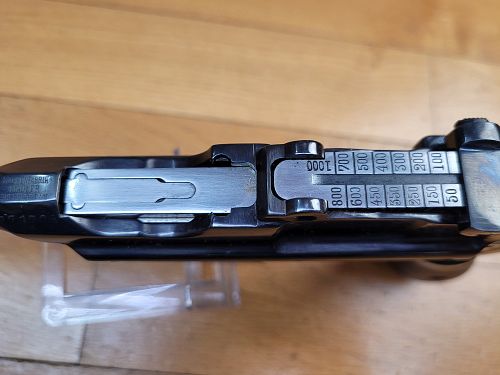
The Luger is simpler to produce, lighter, less bulky, and its detachable magazine system gave it a great reloading advantage over the Mauser with its antique stripper clip system. End of major military contracts for the Mauser C96.
And yet the Mauser C96 is a superb weapon.
It is of a solidity approaching perfection because the barrel and frame are machined from a single block of very high-quality steel. No handgun can rival it in this regard. Indestructible.
But that is also its weakness because machining it is a feat and the slightest machining error...
age, in an era without CNC, forces the weapon to be scrapped. It is therefore expensive to produce and costly in sale price.
Mauser designed, for his C96, a very ingenious wooden stock holster that allows it to be carried and also transformed in a fraction of a second into a mini-carbine, making shooting much easier and more accurate. It’s very clever and a lot of fun at the range, trust Maître Flingus. In fact, Luger copied the system on his 1902 and especially for his artillery Lugers.
But nothing helped, and despite the very prestigious sponsorship of Kaiser Wilhelm II himself, after its failure against the P08, Paul Mauser’s C96 won only a few military contracts: 5,000 units for the Italian Navy in 1899, an order for the Ottoman Empire, and one for the Persian Empire of 1,000 weapons each. Nothing. And weapons that have become true rare collectibles highly sought after today.
Nevertheless, it still became almost standard issue in 14-18 in the German army since the Heer ordered 150,000 civilian models in 1916, but in 9mm caliber, to cope with its acute shortage of handguns. But still, 150,000 is not much, especially in 1914-1918.
Being expensive, civilian sales didn’t really take off either. Perhaps its very harsh design and almost “bandit” style worked against it as well.
And yet, it’s this design and its fundamental robustness that attracted adventurers, restless officers, or hot-headed revolutionaries of all nations deprived of official “automatics.”
It was very popular in Tsarist Russia where many officers bought it privately before 1914. It also became popular among Bolshevik revolutionaries. Iosif Dzhugashvili, then known under the pseudonym Koba, and the party’s chief financier well before the 1917 Revolution and before becoming Stalin, was a C96 user.
From blackmail to bank robberies, from various raids to piracy in the Black Sea, Stalin gathered the funds necessary so that exiles like Lenin or Trotsky and escapees from penal colonies could live without ever working and only prepare the Revolution. He regularly evaluated the money thus collected in “Mauser equivalents” which the Russian revolutionaries would directly buy in Germany…
Many famous adventurers or terrorists would equip themselves with this rugged weapon.
The young Lieutenant Churchill bought one in London in 1898 with his own money and used it, with his wounded arm thanks to the famous stock holster, in Sudan against the Dervishes at the Battle of Omdurman in 1898. His C96 would see service again during his thrilling adventures as a journalist during the Boer War around 1901.
It was also the weapon of Yankel Haïmovitch Yourovski, better known as Yakov Mikhailovich Yurovsky, who personally killed Tsar Nicholas II with his C96 as head of the execution squad of the imperial family in Yekaterinburg on the grim night of July 16-17, 1918.
Nicholas II was not the only notable figure to fall under the bullets of a Mauser C96 pistol in any of its variants: the weapon also eliminated Spanish Prime Minister Eduardo Dato in 1921 and King Alexander I of Yugoslavia, accompanied in death by French Foreign Minister Louis Barthou in 1934 in Marseille.
Lawrence of Arabia in his peninsular adventures, Kaiser Wilhelm II at the shooting range before 1914, Indian revolutionary Ram Prasad Bismil in 1925 during the Kakori train attack, a dress rehearsal for the Indian revolution against the British, Chinese General Zhu De, communist leader of the Nanchang uprising in 1927 marking the start of the Chinese revolution, Irish revolutionary De Valera at Easter 1916, and the famous Red Baron, Manfred von Richthofen, in his last combat, all the po
rteront on the side.
In short, a myth, this C96…
So legendary that it was widely copied in China (at least three models), Spain (at least six models), and even in the USA in the late 1980s!
Paul Mauser didn’t see any of this. He died in May 1914 just before the great catastrophe.
If he hears what we say about his C96 today, he must be smiling thinking about his outburst from 1894.
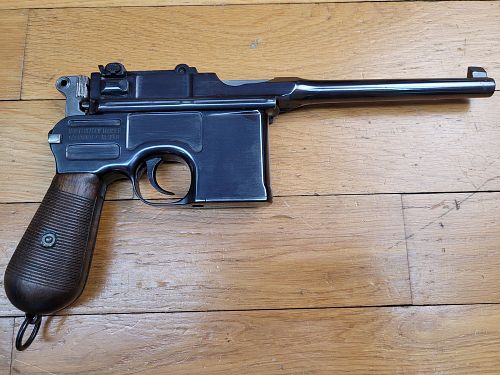
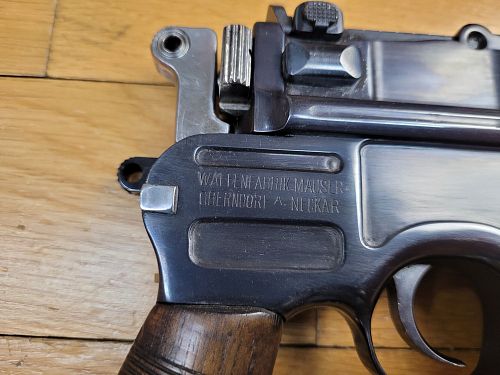
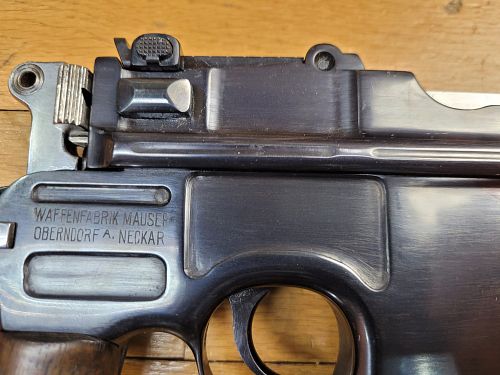
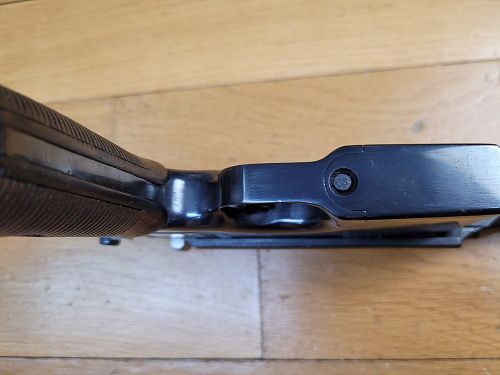
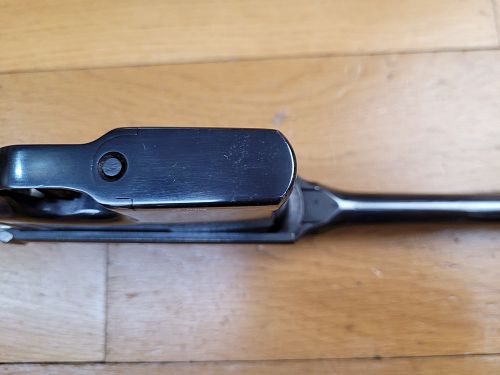
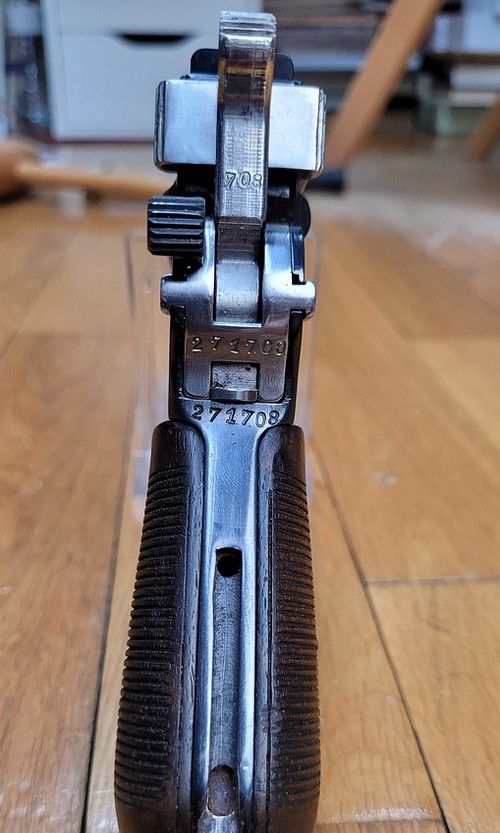
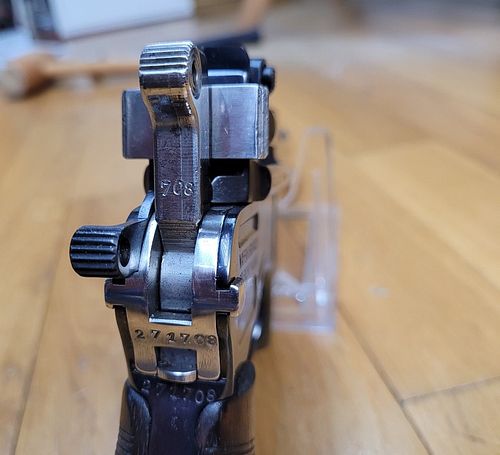
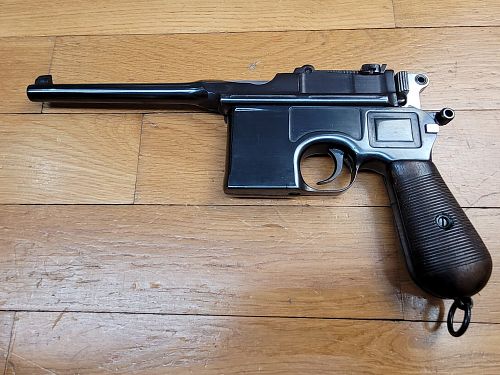
Our example is a very beautiful specimen, truly German, from Paul Mauser in Oberndorf. It is 100% matching numbers including its internal parts.
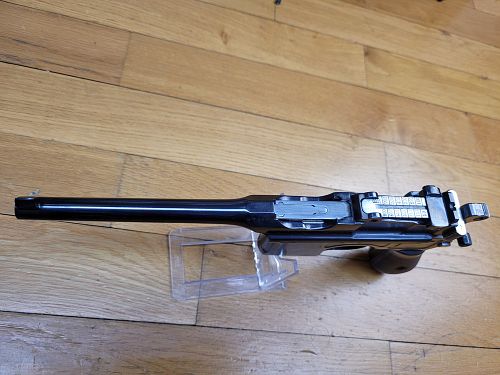
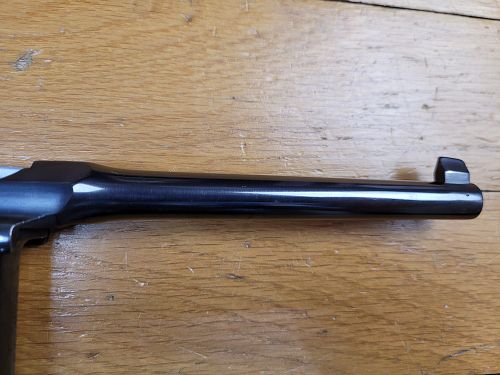
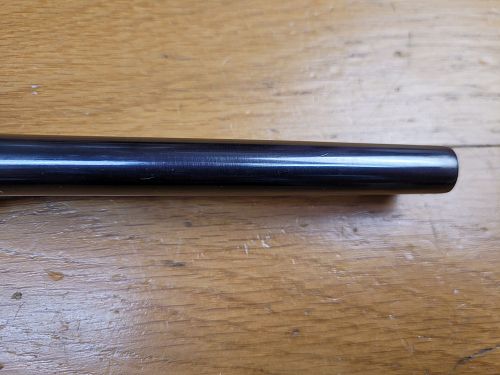
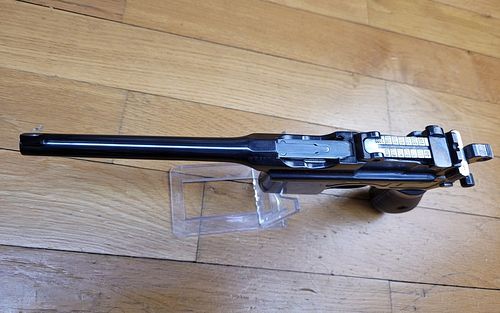
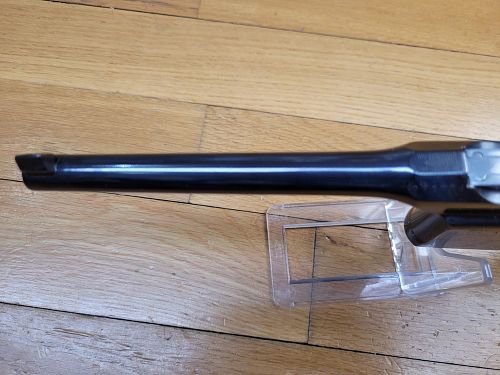
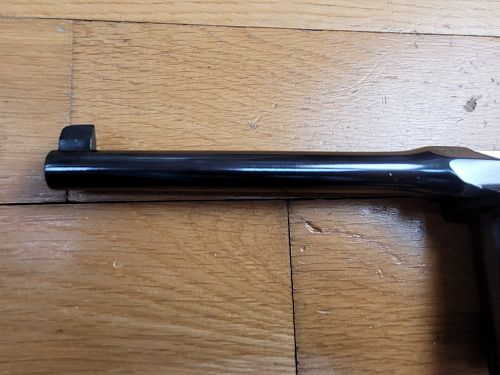
It is in excellent condition. Mechanically excellent, its barrel is truly mirror-like with beautiful rifling and it is accurate when shooting.
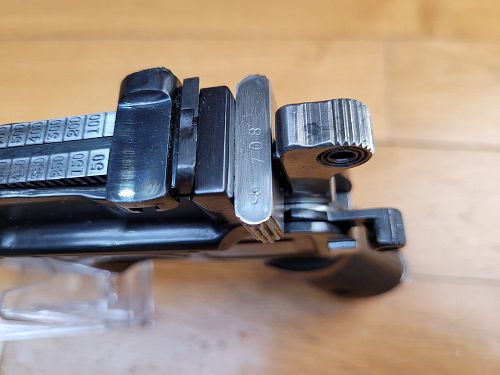
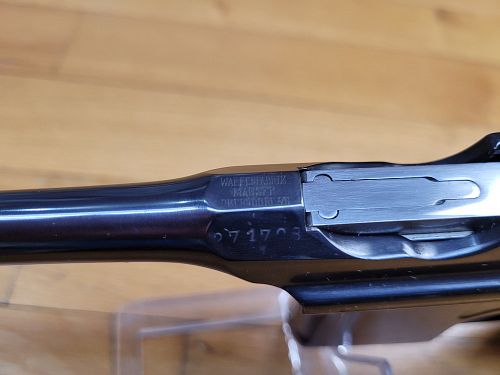
Its serial number (278 xxx) places it at the end of 1915. The date and serial numbers are therefore consistent with its “new safety” (Neues Sicherung) requiring the hammer to be pulled back to engage the safety, introduced around October 1915.
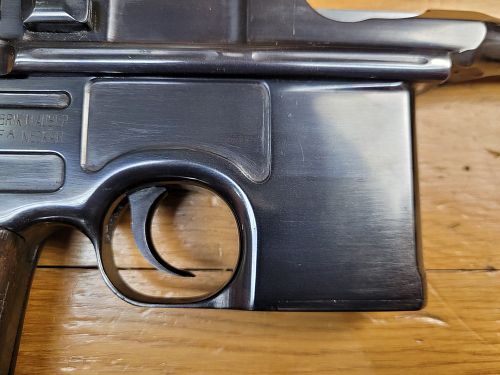
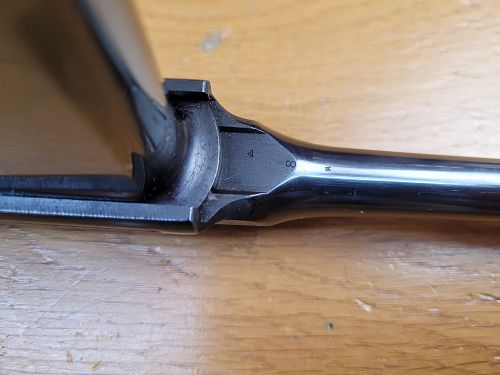
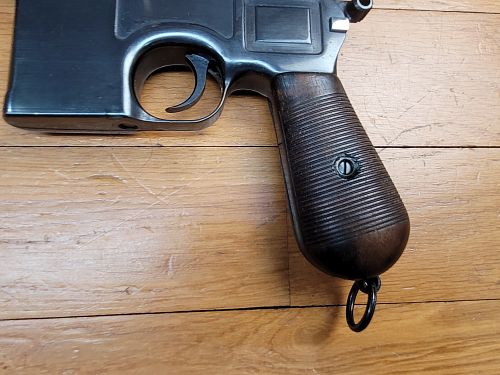
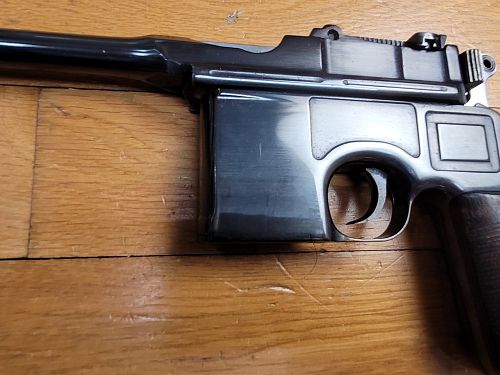
The firearm was professionally re-blued a long time ago in Germany (where it comes from) and in the same commercial bluing as at the time. And it’s an impressive job, with the same deep/bright grey colour and especially the very nice thickness characteristic of commercial productions (thus always more luxurious than military productions) of the era. Yet all its markings remain clearly visible. It looks like a new one from the period. Splendid!
Disassembly confirmed a civilian version despite its production date and the urgency of the time, with impeccable pre-war style finishing and good crowned German proof marks “U” as befits a civilian version produced under the Empire.
It could very well have been alongside a German officer in 1914-1918 who bought many Mauser C96 privately, like their Russian counterparts, attracted by its very sturdy nature. The “9mm red” Mauser in 9 para from the military order after 1916 are generally much less finished, especially regarding the complex lateral machining on these parts.
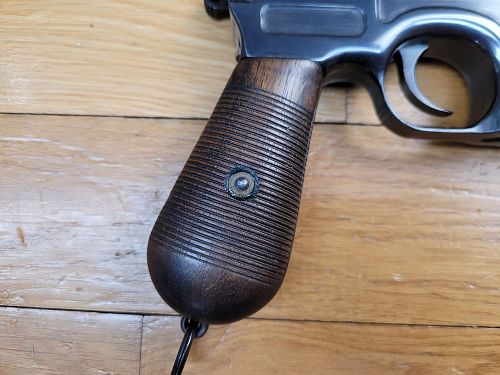
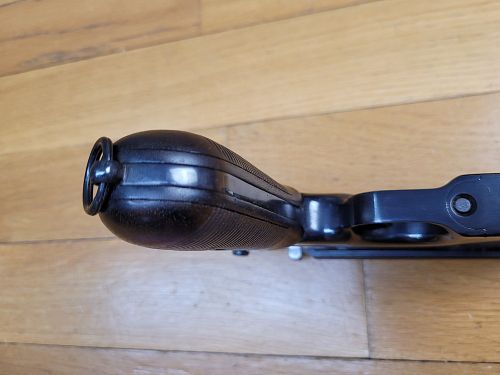
Its grips are original and in perfect condition – cherry on top, they are also matching numbers! It is in its correct caliber 7.63 or 0.30 Mauser, a high-velocity, penetrating caliber with relatively low recoil that I personally much prefer over the 9 para.
In short, a very beautiful piece, truly period and not cobbled together like many others often eaten by rust… (Master Flingus hates rust except in bouillabaisse). A marvel that will trigger admiring comments at the range.
Mechanically the firearm is impeccable and works like clockwork including the famous Neues Sicherung – Good firm springs – No play anywhere – No signs of heavy use anywhere – The barrel in particular is very nice, mirror-like with beautiful rifling. Not bad for a 107-year-old firearm!
Incidentally, as it is by no means mandatory to enjoy it, Master Flingus advises you to buy a replica holster-stock for transport and shooting. Advice all the more disinterested as I don’t sell any.
There are very good quality ones at very reasonable prices, including Made in China. You’ll see it’s wildly fun to use. Besides a “classy” transport for arrival at the range under the crowd’s ovations, it’s really very useful for shooting and provides a real lesson on the concept of sight line in handguns…
In the end, a legendary firearm, matching numbers, in the original caliber as legendary as the firearm itself, and above all in splendid condition that will make you proud. Solid, beautiful, historic.
If you must own only one iconic handgun from History and you appreciate “Deutsche Qualität”, this is the one you need.
CATEGORY B FIREARM UNDER CSI: SUBJECT TO AUTHORIZATION, COPY OF ID AND ORIGINALS OF PARTS 1 AND 2 OF THE AUTHORIZATION (or Part 1 of a released authorization). Shipment against
signature in two separate packages at least 48 hours apart mandatory.
***********************************************************************************************************************
Let's repeat it! The Flingus Maximus gun shop in Paris and throughout France is also here for your private party firearm formalities, the purchase of firearm and militaria collections, your firearm appraisals, your firearm questions in successions and inheritance. Contact your favourite gunsmith via our contact form or at [email protected]
| ID | 10338850 |
| URL | https://www.gunfinder.com/items/10338850 |
| Category | Firearms / Pistols |
| Purchase eligibility | Required |
| Condition | Neu |
| Location | 75002 Paris, France |
| Availability | In stock |
| Shipping costs paid by | Buyer |