

Maître Flingus already told you the saga of the P210 here on the occasion of the presentation of this beautiful military P210 with A numbering.
Just to place our P210-5 of today in context, it was only in 1957 that the civilian designation SP47/8 was changed to "P210". It thus appears for the first time among the other designations of this same pistol in the SIG nomenclature.
In retrospect, the designation "Model P210-1" will cover all firearms produced up to and including 1965.
The designation "P210-2" will cover all standard models, military or not, produced from 1966 onwards (starting with serial number P 59071). Before 1966, the military P210s are M49 (Model 49 adopted at the end of 1948).
The mention "P210-3" will be assigned to a production for the police of 3 Swiss cantons Basel, Lausanne, and Glarus. They were produced between 1951 and 1964 (Serial No. P 6791 to P 6840 and P 8001 to P 8893).
The mention "P210-4" applies to the famous and rare 5,500 pistols with a loading indicator produced for the German border guards (Serial No. in D from D 1 to D 5500).
From the designation "P-210-5" and onwards (the rare specimen of today with its 150mm barrel and removable front sight) and including the already uncommon "P210-6" and the very rare "P210-7" in 22lr, these are Swiss SIG sport shooting productions from 1965 and later.
The quality of these sporting firearms is exceptional and the sights here are adjustable for competition. Jewels with uncompromising quality.
To know:
All Swiss military firearms have serial numbers in A on the frame from A 100001 to A 213110 (with or without a "P" stamped alone on the trigger guard depending on whether they were kept by their military holder once returned to civilian life).
Firearms with a P on the frame before the serial number were produced for the Police if they have the numbers already indicated above between 1951 and 1964. And, for quite a few in the end, these P productions are also purely civilian productions taken among the military weapons in series A but with numbers between P 5004 (1949) and P 79150 (1975). Because nothing else fundamental than this letter "P" in the serial number distinguishes a civilian from a military. Civilians even have a lanyard ring (even the P210-6 for sport shooting). They are strictly the same with a P added for civilians. That's all.
The very rare P210-5, in "Heavy Frame" version or not, the versions of the P210-6, "Heavy Frame" or not, or P210-7 in 22 LR are also included in this "package" with the letter P.
The numbers P 79600 to P 97950 are all private commercial models manufactured in Switzerland by SIG Sauer Switzerland (and assembled by Hammerli if I recall correctly) between 1976 and 1984, which does not detract from their quality by the way.
The jump in series to numbers 300,000 indicates Swiss Arms/SIG Sauer productions and the transition from traditional forged frames to production by laser and numerical controls. We are in a different league in terms of quality, fit, and durability. Everything ends one day...
Now you know how to place the P210-5 designation in its large family. Long live Switzerland and its many cantons, cheeses, and P210!
The success of the 210 was worldwide. It is still an essential reference for military or civilian shooting.
Fundamentally, the P210 is a single-action pistol with a general architecture close to the Colt 1911 but remodelled towards simplification (always a difficult exercise) and modularity.
What makes the Swiss SIG P210 exceptional is its manufacturing quality.
First, SIG's quality control was probably the strictest in the world, especially for civilian firearms (military firearms are by definition very controlled). Moreover, the quality of the barrel steel is probably among the best ever made.
Some recorded examples have
120,000 rounds or more and they are still just as accurate. That’s exceptional for a pistol.
Next, the P210 was designed from the start for precision. The Swiss understood that consistency was the ultimate source of accuracy, both for what it brings after “final” adjustments of the sights and for what it brings to training. If the results vary, it’s you. Not the gun.
Now, beyond the shooter, consistency comes as much from the mechanics as from the finish (and the ammunition too, by the way). And a technical trick really helped with that.
In most pistols, the slide moves outside the frame. On the P210 it’s the opposite: the slide moves inside the frame’s rail. The lateral play between the fixed and moving parts is thus eliminated. The longitudinal play is also significantly reduced. This construction, combined with a very tight but finely adjusted fit to remain smooth, gives the P210 great rigidity which explains its shooting consistency. But it’s much more expensive to machine and adjust.
Another strong point: its maintenance. The SIG P210 is always spotless everywhere. Swiss obsession with cleanliness!
Its disassembly and reassembly takes about twenty seconds, and the trigger group is fully removable (like a Tokarev or Garand) for easy and quick cleaning of the gun’s inner parts…
By the way, this was also a feature of the P35 A tricolor. It really is an invention of SACM and Petter because I doubt they had a Soviet TT 33 available before 1935 to copy.
In short, the SIG P210 is a Rolls-Royce of military pistols! You can even say without exaggeration that this Rolls has become a legend. Justified for once too.
And here is one of the most refined – and rarest – versions of this Rolls, this time in a civilian version, offered by Maître Flingus.
A P210-5, the High Competition version of the P210!
But to have this P210-5 in hand, it took 20 years…
Twenty years after the development of the SP47/8 (from 1947) for SIG to finally introduce its first pistol dedicated to the highest level of competition shooting, the P210-5. That was in 1967.
Let’s clear up a possible confusion right away: The P210-6, the “public” (which doesn’t mean common) sport shooting version of the P210-2, is not the P210-5, which was designed primarily for competition by Swiss national civilian teams.
The P210-6 is a standard P210 with a standard 12 cm barrel but equipped with a precision rear sight (instead of a fixed rear sight on the P210-2) and an adjustable trigger stop (non-adjustable on a P210-2). The sport version of a military gun, to put it simply.
That’s also why it’s banned in TAR. It was designed in the 1950s.
But the story gets a bit more complicated because there is also a very rare (late) competition version of the P210-6 called Heavy Frame (meaning “heavy frame”).
For now, let’s return to the P210-5(s). Possibly plural. And we’ll see why.
Designed as a special limited series offer for an even more competitive clientele (Swiss national teams first), the P210-5s were delivered between 1967 and 1975.
What makes it “special competition”?
Let’s first look at the outside of the beast.
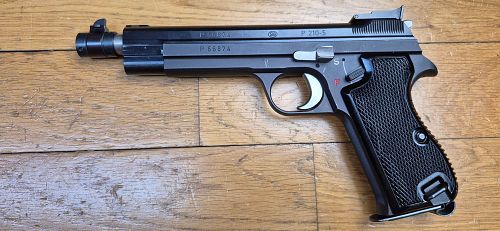
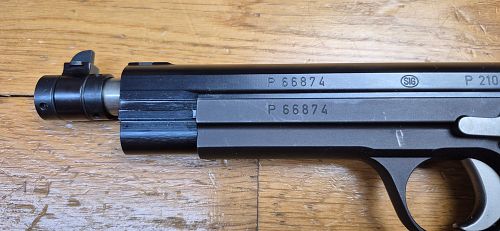
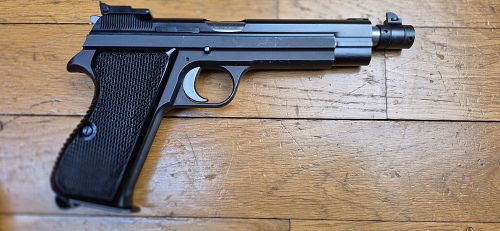
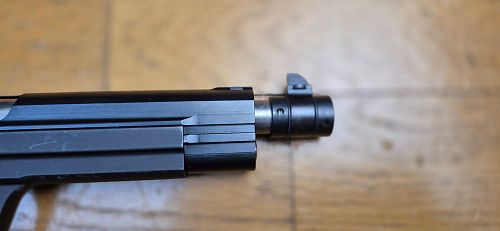
Externally, it stands out first and foremost by a 150 mm barrel, 30 mm longer than the standard 120 mm barrel. The standard 120 mm length is a SIG legacy from their excellent Swiss Lugers, also 120 mm, and already noticeably more accurate than the German Lugers…
This long 150 mm barrel is paired with a standard-profile P210 slide, allowing an extended sight radius of 202 mm, compared to 164 mm for the basic service models of the P210 or P210-6.
This standard slide also helps avoid making the gun too heavy toward the...
front. That’s a real plus for anyone already used to the standard 210 since the weights are close. 0.98 kg with magazine inserted but empty for the 210-5 competition gun versus 0.94 kg for the standard 210-2. I checked.
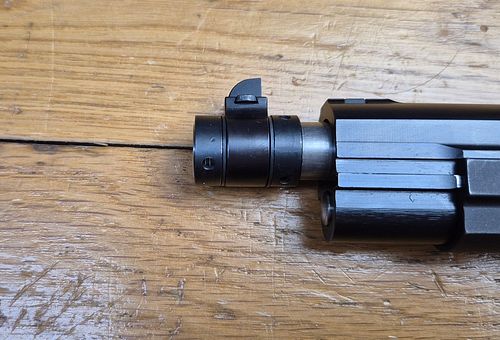
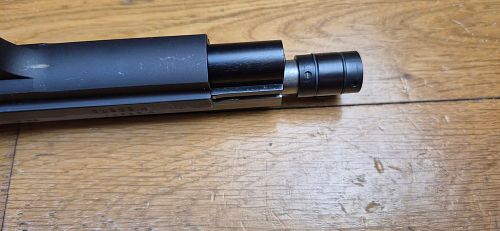
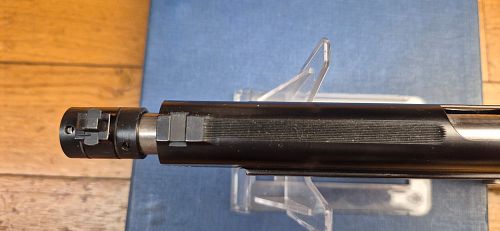
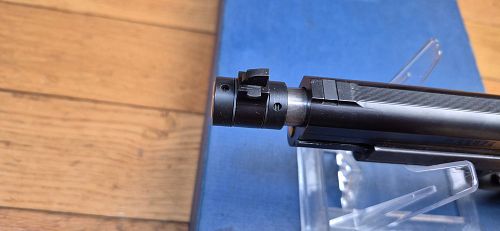
But if the slide doesn’t cover the barrel, it still needs a front sight if you want to hope to hit anything at 50 meters. So you have to find a way to mount a very good front sight on this bare barrel.
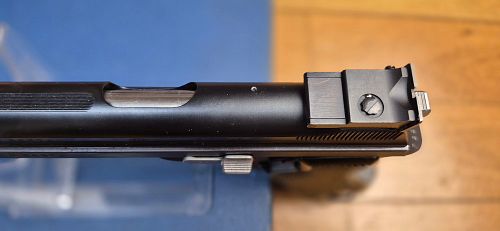
This special Patridge-type front sight from the P210-5 is mounted on a dovetail cut into a tubular steel front sight base. This base wraps around the end of the barrel. It’s held by two steel nuts resting on two polymer washers. Six parts for one front sight. Rock solid.
Everything is aligned with total precision by means of a steel Woodruff key that fits into a longitudinal groove factory-cut on top of the barrel. It fixes the front sight in the best possible position, perfectly longitudinal to the gun, and strictly prevents any radial play of the front sight.
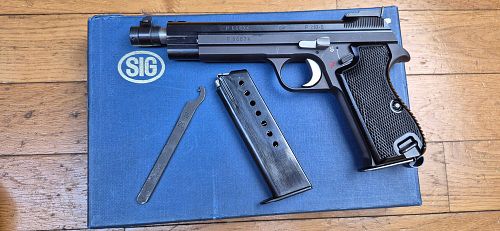
So there’s nothing to adjust when reassembling the front sight. Just put it back correctly. In order. Simple and precise, Swiss style. A special wrench (included with the gun) for the nuts lets you do this in a minute.
No need to tighten like crazy. It won’t move.
Like the sporty P210-6 introduced right after the military model, the P210-5 target pistol is equipped with an adjustable trigger stop, consisting of an Allen screw screwed into the frame behind the trigger guard. It’s accessible from the rear after removing the grips and the hammer mechanism.
Like all SIG pistols, the P210-5 can be fitted with an original interchangeable barrel chambered in 7.65 mm or 9 mm Parabellum. If you find the 7.65 Para in 150mm…
There’s even one on the ultra-late post-1984 versions in 180mm.
That’s the outside, and it’s already quite a lot.
But inside, what’s different from a “normal” 210?
You have to admit that SIG, by setting a specification entirely focused on competition, had to compromise on one of the main principles of the military P-210: ease of disassembly and compatibility of trigger parts between the different P-210 model variations.
Historically, SIG had always strived to maintain maximum compatibility between the internal parts of the P210, so they could be swapped between different variants, regardless of production dates and without fitting. Essential for military guns.
However, this compatibility never extended to the internal parts of the hammer mechanism, which in any case had to be manually fitted to each other to optimize the tactile quality of the trigger on each P210. Because even military, the trigger play of the P210-2 is already exceptional compared to its contemporaries.
Hence the need for a homogeneous block of hammer mechanism parts that is interchangeable as a set but with internal parts already finely fitted to each other. You don’t change one part but a set of parts pre-fitted together.
A complete spare hammer mechanism (from the trigger to the hammer itself, springs and plate included) can therefore be mounted without difficulty from one military P210 to another without loss of functionality or mechanical precision. This strictly meets the needs of military unit armourers.
This modularity, however, requires clearance between the hammer mechanism body and its housing in the frame. These clearances are necessary to allow hand disassembly/reassembly of the hammer mechanism in the middle of combat.
But that’s impossible for a gun intended for a top-level precision competition shooter.
Unlike mechanical precision (measured by the maximum dispersion of service ammo impacts fired from a p
(pistol immobilized by its frame in a mechanical support at 50 m), the "practical" accuracy obtained in freehand shooting on the same target critically depends on the quality and consistency of the mechanical chain linking the trigger to the hammer.
In a pistol dedicated to competition shooting, the modularity of the hammer/trigger mechanism must be sacrificed in favour of a precision adjustment ensuring a hammer mechanism ergonomics that is always the same.
And this assembly, once adjusted, must never move in the frame under the pretext of necessary play to allow for a possible manual change. Or due to repeated mechanical shocks generated in a semi-automatic. At least if you want absolute consistency quality in the play of parts between trigger and hammer.
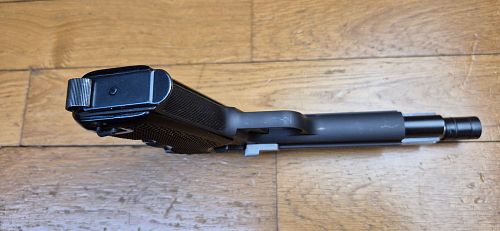
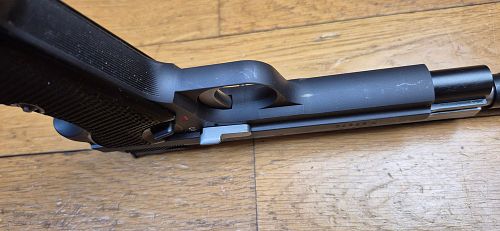
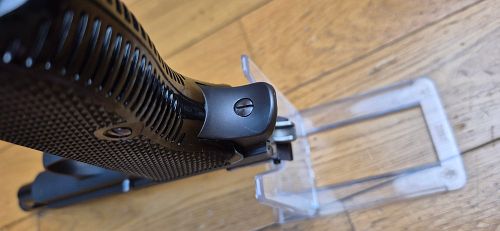
The P210-5 is therefore equipped with a special fixation of the hammer mechanism to the frame by a screw. This screw is located under the beavertail. Its threading is fixed in a threaded hole made in the rear slope of the hammer mechanism. I have included a photo of the underside of the slide to show it to you because you have to turn the gun over to see this famous screw.
This device does not allow any movement fancy regardless of the mechanical stresses suffered by the gun. No modularity of change either, of course, in such a system.
But it is this special fixation of the hammer mechanism, combined with adjustments in parts worthy of a Swiss watch, that ensures the clockwork regularity of the trigger/hammer assembly. This does not exist on a P210-6.
The P210-5 is also equipped with a "sport" trigger with a special hooked profile that reduces the travel length (and even very noticeably compared to the "normal" P210). By its shape, it also promotes a more consistent finger positioning on the trigger.
But adapting the P49 or P210 to the demands of precision shooting also imposed another compromise.
On a semi-automatic firearm, the trigger engagement must be long enough to offer safety against the jolts of the firing cycle. Otherwise, risk of malfunction... or burst fire!
There are two ways to integrate a safety margin in the trigger of a semi-automatic firearm: either you lengthen the piece in a single-trigger system (like on the M1911), or you adopt a more complex two-stage trigger with a relatively long travel completing the cocking, followed by a release (like on the P08 and the P210, or even the M1 Garand).
Two-stage systems require a longer mechanism reset ("reset"). They are popular in precision shooting competitions, where the transition between the two stages allows the shooter to reacquire the target just before the shot breaks.
Similarly, they are well suited for military and police use, where the first "long" stage of the trigger offers a safety margin against involuntary contractions induced by combat. This is the reason for the choice of this mechanism on the P210, a firearm of military origin.
Concretely, the trigger, after a more or less long travel, hits a hard point that determines the release thanks to a part called the hard point lever.
On the P210, the hard point lever is manually and individually adjusted to the trigger and hammer to set the hard point weight ("Druckpunkt") of the two-stage trigger system.
The P210-5 models are equipped with a redesigned hard point lever to adapt the transition between the two stages of the trigger to the demands of slow shooting on fixed targets. Everything goes faster at this moment of the press. A hard point that magically disappears. But it is "less safe".
If you put your finger on the trigger, especially up to the hard point, it is to shoot, not to think... Thinking is before. This is true for all firearms. But especially for this one.
Combined with the modified profile of the trigger q
The trigger travel before the hard stop is reduced, with the engagement play of the sear minimized to the necessary level for safe operation, and a lightened release point, making the P210-5’s trigger mechanism a dream of consistency.
It’s very noticeable for anyone lucky enough to compare the two pistols in hand, the 210 and the 210-5. The repeatability of precision is, of course, clearly in favour of the P210-5.
Designed for high-level competition, our current P210-5 was therefore produced in very limited numbers.
From this purely Swiss SIG era, a total of about… 3,294 P210-5 pistols were made, with a few rarities and prototypes aside. Production of the P210-5 officially ended in 1975. That shows how rare this SIG competition beast is.
The last one bore the number P79000.
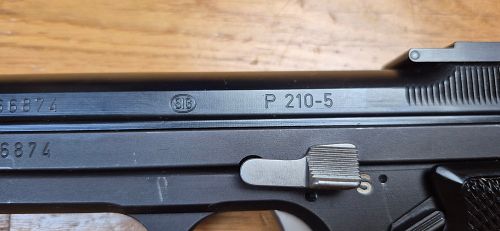
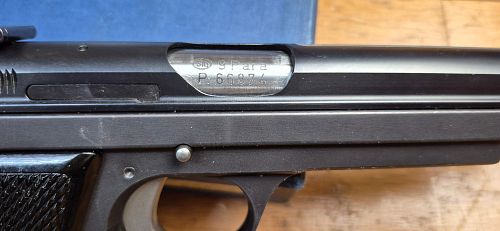
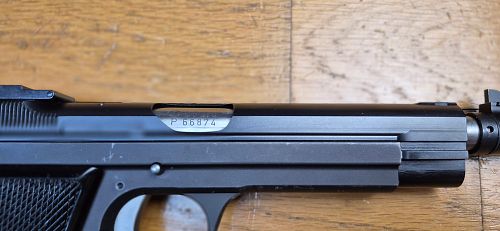
Ours is P668XX. The “P” because they are all, of course, “civilian” pistols, even for private civilians.
However, after 1975, SIG Switzerland sporadically continued, until the late 1970s and early 1980s, to pair some standard P210-6 frames with upper assemblies of the P210-5 type equipped with 150 mm barrels. But these are not pure P210-5s (notably lacking the retaining screw for the trigger assembly under the beavertail).
All this delights collectors of SIG variants. At least in countries where you can own more than fifteen…
“Batch” production of “P210-5” resumed after the transition to Sauer in 1983/84, when they switched from frames machined from forged parts to CNC-machined frames from solid bars. All of those have serial numbers above 300,000.
From the late 1980s, SIG Sauer even offered a P210-5 with an extra-long 180 mm barrel, complemented by an optional conversion kit in .22 LR of similar dimensions.
Let’s stick to strictly SIG production.
This low Swiss production of fewer than 3,300 pistols nevertheless gave rise to a variant (!) – the P210-5 Heavy Frame (or “heavy frame”).
“Heavy Frame” is a collector’s Americanised nickname that sounds fancy. Its official designation is “Nationalmannschafts-SIG” or “SIG of the national team”.
The main features of this rare P210-5 variant compared to our “standard” P210-5 are a reinforced frame, a grooved trigger, and enlarged screws for micrometric rear sight adjustment.
They are mainly recognised by their specially checkered and oil-finished walnut grips, extended towards the rear of the grip and fitted with lateral grooves for the index finger and thumb.
Why suddenly a heavy frame?
We mentioned reducing the risk of cracking as the initial motivation for a heavier frame. It’s true that it was assumed the Swiss national team competitors would shoot much more than the military.
However, military studies showed that firing 100,000 to 120,000 high-pressure Swiss PP41 9 Para cartridges in a standard frame would statistically cause cracks in only about one pistol out of a thousand… So durability is not the argument.
Adding mass to the frame may also have been justified by the desire to dampen vibrations of the semi-automatic mechanism and stabilise freehand aiming.
Regardless of these speculations, it is certain that these heavy-frame pistols (about sixty), intended for the national team, received even more careful assembly, finishing, and tuning to ensure they delivered the “best of the best” to the A team guys.
From 1967, SIG delivered 58 pistols to the A team of the Schweizerischen Match-Schützenverbandes (SMSV) or Swiss Match Shooting Federation.
These deliveries included 12 “normal” P210-5 pistols (like ours), built on frames of standard dimensions e
intended for the SMSV “B” team, as well as 38 P210-5 “Heavy Frame” pistols intended for the A team. Eight other heavy frame pistols were sold outside this framework.
To whom? We don’t know. Probably to the federation bigwigs, the Minister, his mistress, etc., etc…
In total, the delivery of these 58 firearms stretched from 1967 to 1972.
After that and until 1984, SIG still produced some P210-5 (28) and P210-6 (250 – simpler) heavy frame variants, in many versions (7.65 para, 9mm, with or without extra barrel sets of different calibers, in cases, etc.) for the civilian market.
In the end, 336 “heavy” firearms were produced, 210-5 with 150mm barrel or 210-6 with 120mm barrel, all told.
The P210-5s strictly divide between 86 heavy frame firearms (58 for SMSV + 28 sold on the market) and 3,208 “normal frame” firearms like ours.
Most of these 210-5s were sold to serious club competitors wanting an even better firearm than the P210-6 in all its versions, which were already superior to the P210-2.
And probably also to some wealthy enthusiasts wanting to set aside an exceptional firearm they quickly suspected would inevitably become a collector’s item…
The 3,200 or so P210-5s of the type like ours are therefore true rarities in any case, surpassed in rarity only by their very rare 86 heavy frame siblings. And above all, top competition firearms.
The P210-5 thus gained considerable renown among top-level paper target competition shooters in Switzerland and Germany. Elsewhere they are almost never seen except maybe in the USA.
Less known is their distinction in dynamic shooting competitions.
For example, Norwegian Jan Foss won the IPSC World Shoot II championship in 1976 in Salzburg, Austria, with his SIG P210-5 in 9 mm, beating the previous year’s champion, American Ray Chapman, armed with his Colt Government Model in .45 ACP customised by Pachmayr Gunworks.
The P-210-5, in Switzerland and elsewhere, remains a rare and prestigious range firearm. A firearm reserved for a small elite.
Our example is a very fine P210-5 from SIG’s best production years, a purely Swiss and Rolls of the P210. It is in 9×19 caliber. There are also versions in 7.65 Parabellum.
Rare 150mm barrel, well marked SIG original and with the number of course. Not a cobbled-together piece as sometimes sold.
The firearm is in more than excellent condition and has been very little “handled.”
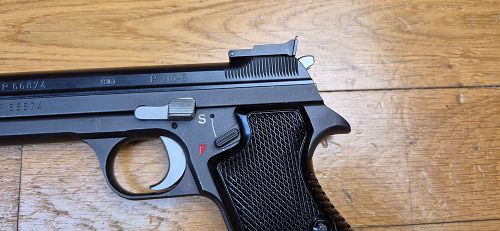
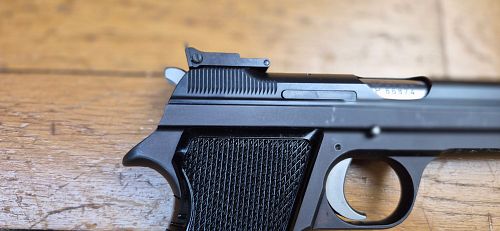
Its external appearance is almost perfect despite tiny handling marks OUTRAGEOUSLY exaggerated by my gigantic close-up photos which especially magnify all flaws. As usual. You don’t see them in hand. Just look at the two photos of the whole firearm to be convinced.
No brightening on the frame edges like on the “normal” 210s because it was obviously never carried in a holster.
The SIG quality phosphating of the frame, typical of firearms from the 4th military contract (they took and adapted normal frames) is silky and lightly marked.
Barely a mark on the disassembly axis, also exaggerated by my TOO close photos.
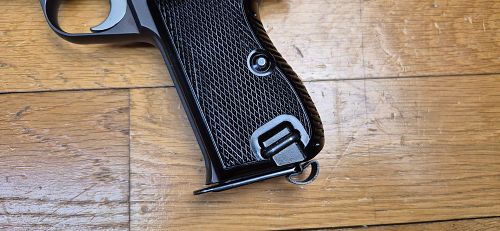
Note that this high competition P210-5 model, whether in heavy frame version or not, is always and curiously equipped with a lanyard ring, probably a testimony to the military origin in production of the frames which were later adjusted.
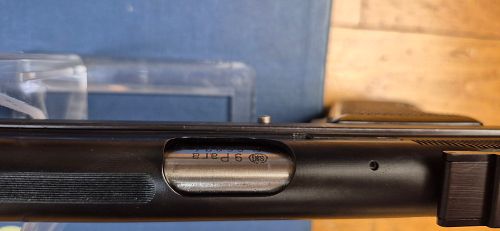
The bluing of the upper part, slide which was specially selected for a particular fit, is splendid and 100% present – It is well marked with the SIG logo and the proud “P210-5” inscription. Other P-210-2, 3 or 4 models are not marked like this, obviously a mark of pride…
Rear sight 100% steel adjustable for elevation and windage. Patridge front sight also steel in impeccable condition with its c
original disassembly key. They are like new.
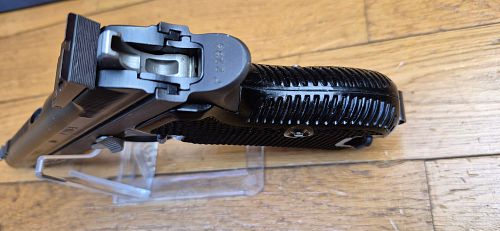
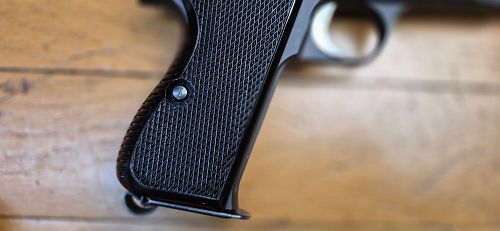
The grips are 100% original and in very, very beautiful condition. Actually new as well. Same production mold on the right and left. They are his. Their fit surprised me during disassembly. The firearm was clearly finished with the utmost care.
Note that since the frame is standard in its dimensions, you can attach any sport grip for P210 of your choice to this P210-5 if you wish.
In short, overall more than excellent aesthetic condition for a firearm nearly 55 years old. Pure Maître Flingus.
Our P210-5 has seen little shooting. The frame shows very few signs of use.
And the barrel is a dream. They were specially selected and machined for this competition model. The rifling is like new, extremely “sharp.” And with a “mirror” finish that could burn your retina. A very beautiful piece then, still with 100% of its immense shooting potential (at least 150,000 rounds).
The firearm is fully matching serial numbers. Its number P668XX would date it, according to sources, to around 1972. Vetter places number P66385 in 1972, and number P68649 is also dated 1972 by cross-referencing on a website. Close, but not quite right…
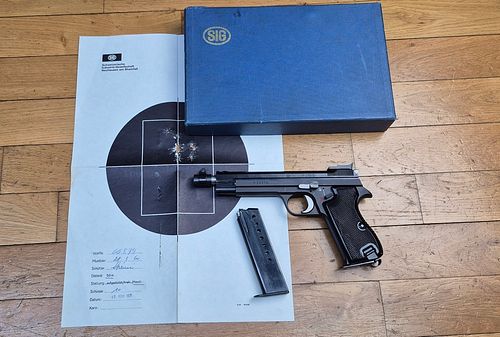
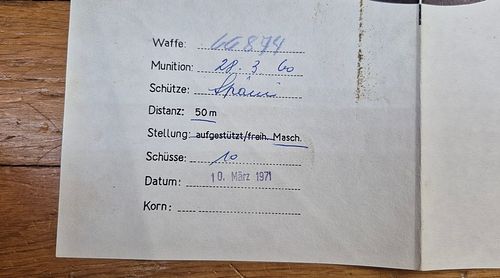
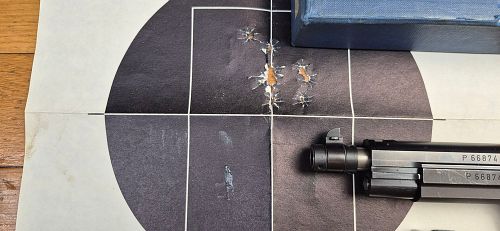
Because today’s firearm comes with its original box matching the firearm’s number AND with its rare 10-shot test target (almost all shots passing through six holes at 50 meters! That says a lot about the precision of the piece). The target is also numbered to the firearm and dated March 1971. So it is quite unlikely that our firearm (and the two previously mentioned) is from 1972… I humbly think the genealogy of our rare P210-5s should be pushed back by a good six months to a year.
Mechanically, the firearm is impeccable. Rigidity, bolt and magazine function are just perfect – crisp firing and springs more than very firm. Even the magazine fit in its well is impressive.
And the whole thing is both rigid and surprisingly smooth. Even better than a P210-2 or 210-6. A true P210… A cutting-edge firearm!
The trigger is excellent. Adjustable, with a short travel and a crystal-clear break.
Despite its extended barrel and all its modifications, the firearm weighs about the same as any other P210, allowing for very precise aiming, which will be even better thanks to its XXL sight line. A great pistol.
The steel quality is perfect. Screws impeccable.
As mentioned above, the firearm will be delivered with its original box matching the number, its impressive 50-meter test target, the front sight disassembly key. I will add a perfectly compliant extra military magazine.
For your information, these original military magazines, made of bronze-like durability and proverbially reliable in function, are quite hard to find, even in Switzerland, where they commonly sell for 130 Swiss francs and more (often 150/180 euros here).
Besides being a top competition firearm (not allowed in TAR, for good reason, it would easily outclass all its rivals), this P210-5, in its original box, is a highly desirable and rare collector’s piece in our climate.
The P210 is an icon that succeeded a legend. Treat yourself to an exceptional firearm that never depreciates. One of the few cases, especially in this rare version. Once you have it in your hands, you’ll quickly understand why.
As my great-grandmother used to say, “SIGs aren’t love, they’re rage!”
CATEGORY B FIREARM UNDER CSI: FIREARM SUBJECT TO AUTHORIZATION, PHOTOCOPIES OF VALID ID AND LICENSE REQUIRED – SIA ACCOUNT MANDATORILY OPENED. Shipment against signature in two separate packages at least 48 hours apart mandatory.
************************************************************************************************************************
Let’s repeat it! Armurerie Flingus Maximus in Paris and
all over France, is also here for your firearm formalities between private individuals, the purchase of firearm and militaria collections, your firearm appraisals, your firearm questions in successions and inheritance. Contact your favourite gunsmith via our contact form or at [email protected]
| ID | 10338494 |
| URL | https://www.gunfinder.com/items/10338494 |
| Category | Firearms / Pistols |
| Purchase eligibility | Required |
| Caliber | 9mmLuger |
| Condition | Neu |
| Location | 75002 Paris, France |
| Availability | In stock |
| Shipping costs paid by | Buyer |